Connect with us
DAPA Banner
DAPA Coin
DAPA
COIN PAYMENT ASSET
PRIVACY · BLOCKDAG · HOMOMORPHIC ENCRYPTION · RUST
ElGamal Encrypted MINE DAPA
🚫 GENESIS SOLD OUT
DAPAPAY COMING

Business

Case Explodes as Sheriff Scolded Official for FBI Tip, Sparking Fresh Coordination Rift

Published

on

Nancy Guthrie

TUCSON, Ariz. — The investigation into the disappearance of 84-year-old Nancy Guthrie took a sharp new turn Tuesday as Pima County Sheriff Chris Nanos faced accusations that he scolded a county assessor for sharing information with the FBI, reigniting long-simmering questions about inter-agency cooperation more than 100 days after the high-profile abduction.

Pima County Assessor Suzanne Droubie told The Arizona Republic that Nanos contacted her in February after technicians in her office, which handles property records, forwarded data to the FBI at the bureau’s request. Droubie said the sheriff expressed frustration, suggesting her office had created extra work for his department by generating additional leads that investigators then had to pursue.

“It was inferred that we were creating a lot of additional work for the sheriff’s department,” Droubie said in the interview published Tuesday. She added that Nanos ultimately acknowledged she had done the right thing by cooperating with the FBI but left her feeling reprimanded for the outreach.

The claim comes as the case — involving the mother of NBC’s “Today” show co-anchor Savannah Guthrie — enters its fourth month with no arrest, no recovery of Nancy Guthrie and mounting public scrutiny over how local and federal authorities have worked together.

Advertisement

Nancy Guthrie was reported missing from her Catalina Foothills home north of Tucson on Feb. 1. Security footage showed a masked figure on her porch the night before, tampering with a doorbell camera. Blood was found on the porch, and investigators believe she was abducted. A Bitcoin ransom demand followed but yielded no results. The family offered a $1 million reward, and the FBI later increased its own to $100,000.

Tensions between the sheriff’s office and the FBI surfaced early. In February, reports emerged that Nanos initially resisted sending key evidence — including a glove and DNA samples from the home — to the FBI’s lab in Quantico, preferring a private Florida facility instead. FBI Director Kash Patel later publicly criticized the delay, claiming federal agents were kept out for four days. Nanos has repeatedly denied blocking the FBI and insisted collaboration began almost immediately.

On Tuesday, as Droubie’s account circulated, Nanos provided a routine 100-day update but did not directly address the assessor’s allegations. He described the investigation as active, with DNA analysis ongoing across multiple labs and tips still pouring in. “We are getting closer,” he said in earlier remarks, though reporters have questioned the optimism given the lack of public breakthroughs.

The assessor’s office became involved because property records can reveal ownership patterns, liens or connections potentially relevant to suspects. Droubie said her staff acted promptly when the FBI requested assistance, viewing it as standard inter-agency support in a major case.

Advertisement

Critics see the latest flap as symptomatic of deeper coordination problems. Former FBI agents and forensic experts have questioned the decision to route evidence through a private lab rather than leveraging federal resources from the start. Genealogy company Othram, known for high-profile cold cases, publicly called the move “devastating” for potentially slowing identification efforts.

Savannah Guthrie has maintained a low public profile on the investigation while continuing her work. On Mother’s Day, she posted a poignant plea: “We will never stop looking for you.” The family continues to offer the substantial reward for information leading to Nancy’s recovery.

As of mid-May, more than 100 days have passed since the abduction. No suspects have been named publicly, though authorities have detained and released individuals for questioning. Volunteer search groups, including the United Cajun Navy, have offered assistance but reported being largely sidelined by the sheriff’s office.

The case has drawn intense national attention, in part because of Savannah Guthrie’s prominence. It has also highlighted challenges in missing persons investigations involving elderly victims in suburban areas. Digital evidence, enhanced video analysis and DNA remain central, with the FBI assisting on technical fronts despite reported friction.

Advertisement

Sheriff’s officials maintain they are pursuing every lead methodically. In March, they highlighted possible activity around Jan. 11 — weeks before the reported disappearance — based on digital forensics. New neighborhood surveillance videos showing masked individuals have surfaced, though connections remain unclear.

Droubie’s account adds a new layer of alleged internal discord. County officials typically defer to law enforcement in active cases, making her decision to speak publicly notable. She framed the interaction as professional but tense, emphasizing that her office sought only to help solve the mystery.

Legal observers say such inter-agency spats, while not uncommon, can erode public confidence when a case stalls. High rewards and celebrity ties amplify pressure on investigators to produce results or at least demonstrate seamless teamwork.

The Pima County Sheriff’s Department has not issued a direct rebuttal to Droubie’s specific claims as of Wednesday. A spokesperson reiterated commitment to the investigation and partnerships with the FBI. “This remains an active case,” the department said in a statement. “We continue reviewing tips and analyzing evidence.”

Advertisement

For the Guthrie family, each passing week without resolution deepens the anguish. Nancy, described as vibrant and independent, was last seen in her home of many years. Blood evidence suggested possible violence, yet authorities still operate under the hope she may be found alive.

Public tips continue to flood in, with the FBI’s Phoenix office urging anyone with information to come forward anonymously. Neighborhood patrols have increased amid concerns over amateur sleuths disturbing potential evidence.

As the investigation stretches into summer, questions linger about resource allocation, lab choices and communication protocols. The latest controversy over the assessor’s FBI tip underscores how even well-intentioned actions can complicate an already complex probe.

Nancy Guthrie’s disappearance has become one of Arizona’s most watched cold cases in recent memory. Whether the sheriff’s response to the new claims calms or further fuels speculation may determine if public trust — and crucial tips — continue flowing. For now, the search persists, with federal and local agencies publicly aligned even as private tensions surface.

Advertisement
Continue Reading
Click to comment

You must be logged in to post a comment Login

Leave a Reply

Business

YouTube Studio Down for Creators? Latest Outage Reports, Fixes and What to Do on May 13, 2026

Published

on

Claude AI Down Today? App Faces Intermittent Glitches but No

SAN FRANCISCO — YouTube Studio appears operational for most users Wednesday as of mid-morning May 13, 2026, with no widespread outage reported on major monitoring sites, though creators continue to encounter occasional “Something Went Wrong” errors amid lingering platform glitches from earlier this year.

Downdetector and other status trackers show minimal reports of problems with YouTube overall or its creator dashboard specifically in the past 24 hours. Video playback, uploads and analytics load normally for the vast majority, but isolated complaints persist on forums and social media about slow dashboard loading or delayed statistics.

YouTube Studio serves as the central hub for millions of content creators managing channels, uploading videos, checking analytics and engaging with audiences. Any disruption can halt workflows, delay monetization insights and frustrate scheduling. While no global outage matches the scale of February or March incidents, periodic hiccups remain common.

Earlier in 2026, creators faced notable disruptions. On March 10, YouTube Studio experienced a partial outage affecting dashboard loading, analytics visibility and mobile app functionality. Google confirmed the issue and resolved it within hours, restoring full access. Similar glitches appeared around March 30, with users reporting frozen subscriber counts and incomplete data.

Advertisement

The February 17 outage proved more severe, impacting the broader YouTube platform including homepage recommendations, the main app and YouTube Studio tools. Over 300,000 users reported problems at peak, primarily in the United States. TeamYouTube acknowledged the recommendations system failure on X, noting it prevented videos from appearing across surfaces. Full restoration took several hours.

These events highlight YouTube’s massive scale — more than 2.5 billion monthly users — and the complexity of its backend infrastructure. Even brief interruptions affect creators’ livelihoods, especially those relying on timely analytics for algorithm optimization or ad revenue tracking.

Common error messages include “Something Went Wrong,” “Oops,” or loading spinners that never resolve. These often stem from server-side issues, browser cache conflicts, network problems or high traffic. Mobile app users sometimes fare differently from desktop, with one interface working while the other fails.

If experiencing problems today, several troubleshooting steps typically resolve them quickly. First, refresh the page multiple times or try incognito mode. Clearing browser cache and cookies for youtube.com often helps. Switching networks or using a VPN can bypass regional routing glitches.

Advertisement

Updating the YouTube Studio mobile app to the latest version frequently fixes compatibility bugs. Logging out and back in, or accessing via a different device, can also restore functionality. For persistent issues, checking Downdetector or YouTube’s official @TeamYouTube account provides real-time confirmation.

Google rarely discloses root causes publicly, citing security and competitive reasons. However, industry experts point to routine maintenance, database synchronization delays or spikes in creator activity as frequent culprits. The platform’s heavy reliance on machine learning for recommendations and analytics adds layers of potential failure points.

Creators have voiced frustration over recurring disruptions. On Reddit forums like r/PartneredYoutube and r/YouTubeCreators, threads from March detailed hours-long analytics blackouts that hindered content planning. Some reported lost upload progress or inability to respond to comments during outages.

Despite challenges, YouTube remains the dominant platform for video creators, offering unmatched reach and monetization tools. Features like real-time analytics, copyright management and community posts make Studio indispensable. Google continues investing in reliability, rolling out gradual backend improvements.

Advertisement

For those affected right now, patience often proves effective as issues self-resolve within minutes to hours. In rare prolonged cases, reaching out via YouTube Help Center or waiting for an official acknowledgment yields results. Backup workflows — such as preparing thumbnails and descriptions offline — help mitigate impact.

The platform’s evolution includes better error handling in recent updates. Enhanced mobile Studio experiences and faster loading aim to reduce future headaches. Yet as creator numbers grow, so does pressure on infrastructure during peak hours like evenings in major time zones.

Broader context shows YouTube’s resilience. Major outages remain infrequent compared to daily uptime. The company maintains dedicated status communications and rapid response teams. For enterprise or high-volume creators, YouTube Partner Manager support provides priority assistance during incidents.

Looking ahead, expectations rise for even greater stability as artificial intelligence tools integrate deeper into Studio for content optimization and trend prediction. Any downtime in those features could amplify creator anxiety. Google has hinted at expanded redundancy measures in upcoming infrastructure announcements.

Advertisement

In the meantime, creators adapt by diversifying platforms — posting to TikTok, Instagram Reels or X alongside YouTube. Multi-platform strategies reduce dependency risks during technical hiccups. Many maintain personal dashboards or third-party analytics tools as backups.

As of 10 a.m. BST on May 13, monitoring sites confirm normal operations across YouTube services. Occasional user reports likely reflect localized issues rather than systemic failure. The platform continues serving billions of video views without interruption for most.

For creators checking Studio today, the dashboard should display current analytics, pending uploads and comment management tools without major barriers. If anomalies appear, standard fixes usually restore access quickly. YouTube’s scale means even small percentage issues affect thousands, amplifying visibility on social media.

The episode underscores the digital economy’s fragility. Millions depend on seamless access for income, education and entertainment. Google’s ownership provides resources for quick recovery, but expectations for near-perfect uptime grow with each incident.

Advertisement

Creators navigating today’s environment benefit from community knowledge-sharing. Forums, Discord groups and creator newsletters often circulate workarounds faster than official channels. Staying updated on platform changes helps anticipate potential disruptions.

While YouTube Studio functions normally now, its history of intermittent issues reminds users to prepare contingencies. Reliable internet, updated software and alternative tools form the best defense. For most, the dashboard delivers essential insights without delay on this Wednesday.

As the day progresses, any new developments will likely surface first on social platforms and outage trackers. For now, creators can focus on content rather than technical troubleshooting, with YouTube Studio standing ready to support their work.

Advertisement
Continue Reading

Business

Oil Price Today (May 14): Crude oil above $105 per barrel. Here’s why Trump-Xi meeting is important for Strait of Hormuz

Published

on

Oil Price Today (May 14): Crude oil above $105 per barrel. Here’s why Trump-Xi meeting is important for Strait of Hormuz
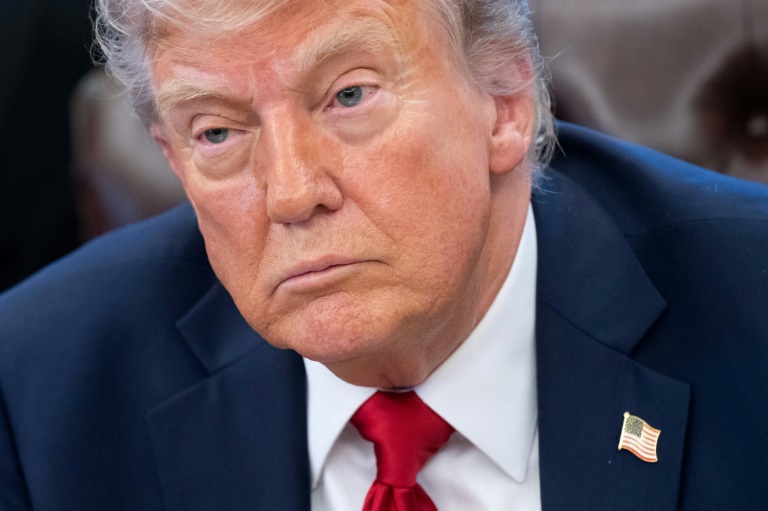
Oil prices inched higher on Thursday as investors entered a wait-and-watch mode ahead of talks between U.S. President Donald Trump and Chinese President Xi Jinping later today.

Trump arrived in Beijing on Wednesday evening and is set to hold a series of meetings with Xi as he looks to secure economic gains and address key geopolitical issues including the Iran war and the Strait of Hormuz.

Crude oil price on May 14

Brent crude futures rose 13 cents, or 0.12%, to $105.76 a barrel, while U.S. West Texas Intermediate futures gained 12 cents, or 0.12%, to $101.14 a barrel. Both benchmarks had settled lower on Wednesday amid concerns that further U.S. interest rate hikes could weigh on demand. Brent dropped more than $2 a barrel, while WTI lost over $1.Although Trump has said he does not believe China’s support is necessary to end the conflict with Iran, he is still expected to seek Xi’s assistance in resolving the costly and politically unpopular war.

Advertisement

China remains the largest buyer of Iranian crude despite sanctions and pressure from the Trump administration. More than 80% of Iran’s oil shipments in 2025 were headed to China, with independent Chinese refiners continuing to purchase discounted sanctioned crude.
Analysts at Morgan Stanley said the global oil market is now in “a race against time,” warning that the factors limiting a sharper rise in crude prices may weaken if the Strait of Hormuz stays shut into June.
Despite disruptions impacting nearly 1 billion barrels of oil supply, crude prices are still below the highs reached in 2022 after Russia’s invasion of Ukraine. Analysts led by Martijn Rats said the market entered the current crisis with stronger supply buffers, while investors largely continue to believe the strait will eventually reopen.
Morgan Stanley added that higher U.S. crude exports and softer Chinese imports have so far helped shield the market from a deeper supply shock. However, the brokerage warned that a prolonged closure of Hormuz could once again tighten global supplies if disruptions continue beyond what either China or the United States can manage comfortably.

Haitong Futures said markets remain cautious and warned the ceasefire may only be temporary. The brokerage added that stalled negotiations between Washington and Tehran could trigger another escalation, pushing oil prices even higher.

Saudi Aramco CEO Amin Nasser said on Monday that disruptions to shipments through Hormuz could delay stability returning to oil markets until 2027, potentially affecting around 100 million barrels of oil supply every week.

Nuvama Institutional Equities said an extended shutdown of the Strait of Hormuz could disrupt nearly 20 million barrels per day of global crude flows. In such a scenario, the brokerage estimates oil prices could climb to between $110 and $150 per barrel.

(Disclaimer: Recommendations, suggestions, views and opinions given by the experts are their own. These do not represent the views of The Economic Times)

Advertisement
Continue Reading

Business

Southeast Asian Leaders’ Meeting Weighs Optimism Against Tension and Uncertainty

Published

on

Southeast Asian Leaders' Meeting Weighs Optimism Against Tension and Uncertainty

Philippine President Marcos Jr. chaired the 48th ASEAN Summit in Cebu, addressing energy security, South China Sea tensions, Myanmar crisis, and Thai-Cambodian conflict. Despite geopolitical challenges reshaping the agenda, the summit yielded substantive outcomes, including exploring regional petroleum reserves and welcoming Timor-Leste as a full member.

Key Points

  • •President Marcos acknowledged the Cebu summit shifted from its intended cultural focus to pressing security issues, including energy security, with leaders exploring strategic oil reserves inspired by Asean’s 2008 emergency rice reserve model amid Middle East-driven economic shocks.
  • Marcos facilitated a 75-minute meeting between Thai and Cambodian leaders over border tensions and presided over Timor-Leste’s full Asean membership, while leaders addressed Myanmar’s minimal progress on the Five-Point Consensus.
  • Key remaining priorities for the Philippines’ chairship include finalizing a South China Sea code of conduct, improving Thai-Cambodian relations, and pushing Myanmar toward meaningful compliance with Asean’s core principles.

The Cebu Summit: Navigating Geopolitical Challenges

Unexpected Shifts and Landmark Moments
Philippine President Ferdinand Marcos Jr. acknowledged that the 48th ASEAN Summit in Cebu evolved far beyond his original vision of cultural celebration and regional camaraderie. Geopolitical developments redirected the summit toward pressing security concerns, yet the Philippines demonstrated remarkable resilience in steering the bloc forward. A historic highlight was Timor-Leste’s participation as a full ASEAN member, with Prime Minister Xanana Gusmão’s emotional reunion with Indonesian President Prabowo Subianto creating an atmosphere so candid that leaders spoke without prepared speeches, marking Cebu as one of ASEAN’s most consequential gatherings.

Economic Resilience and Diplomatic Breakthroughs

Energy Security and Regional Tensions
Amid a declared national energy emergency, ASEAN leaders explored strategic oil and petroleum reserves across member states, inspired by the bloc’s successful 2008 emergency rice reserve initiative. Beyond economic concerns, President Marcos played a pivotal diplomatic role by facilitating a 75-minute face-to-face meeting between Thai Prime Minister Anutin Charnvirakul and Cambodian Prime Minister Hun Manet, easing bilateral tensions. Both leaders agreed to task their foreign ministers with identifying immediate areas of cooperation while extending the ASEAN Observer Team’s ceasefire monitoring mandate for an additional three months through July.

Myanmar Crisis and the South China Sea Outlook

Firm Principles and Future Priorities
ASEAN leaders expressed open frustration over Myanmar’s minimal progress on the Five-Point Consensus, emphasizing that the bloc views Myanmar as a family member rather than merely a trade partner. While acknowledging positive steps — including the release of approximately 5,500 prisoners and a reduction of Aung San Suu Kyi’s sentence — leaders maintained firm conditions around human rights and the rule of law. Looking ahead, three priorities will define the Philippines’ chairship success: advancing a South China Sea Code of Conduct, strengthening Thai-Cambodian relations, and securing meaningful Myanmar compliance with ASEAN’s core principles.

Advertisement
Continue Reading

Business

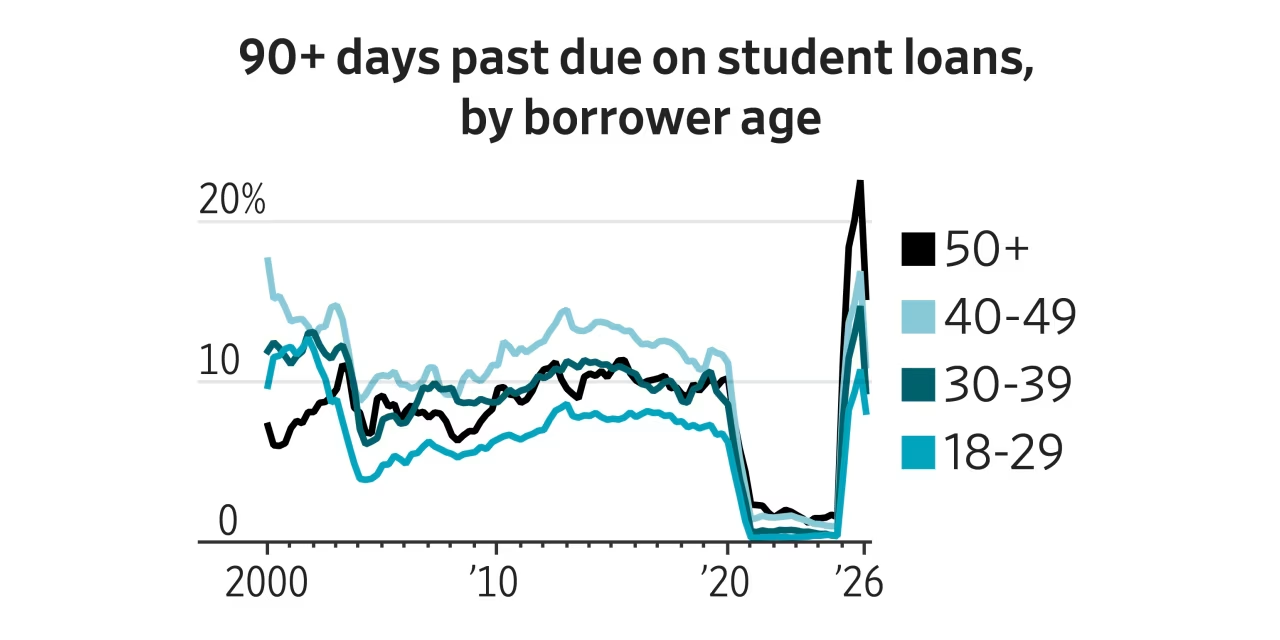
The Average Student-Loan Defaulter Is Nearly 40 Years Old

Published

on

The Average Student-Loan Defaulter Is Nearly 40 Years Old

The Average Student-Loan Defaulter Is Nearly 40 Years Old

Continue Reading

Business

How It Differs Dramatically From His Lavish 2017 Visit

Published

on

Is Abu Dhabi Airport Open? Zayed International Airport Resumes Limited

BEIJING — President Donald Trump arrived in Beijing Wednesday evening for a high-stakes two-day summit with Chinese President Xi Jinping, the first visit by a U.S. leader to China in nearly nine years, but one unfolding in a far more tense and constrained atmosphere than his 2017 trip.

Where Trump’s November 2017 state visit was billed as a “state visit-plus” overflowing with pageantry — a private dinner and opera performance inside the Forbidden City, children waving flags along motorcade routes and the announcement of $250 billion in business deals — the 2026 gathering carries markedly lower ambitions and a sharper edge of rivalry.

Trump touched down at Beijing Capital International Airport as security locked down the capital and global attention fixed on the world’s two largest economies navigating war in the Middle East, persistent trade frictions and technological competition. Meetings with Xi are scheduled for Thursday and Friday at the Great Hall of the People.

In 2017, the tone was celebratory. Xi rolled out the red carpet, escorting Trump and first lady Melania Trump through the Forbidden City’s main halls for an afternoon tea and evening performance. A military band played, schoolchildren chanted welcomes and Trump praised Xi as a “very special man.” The two leaders touted what appeared to be a budding personal rapport and a new era in bilateral ties. Chinese officials unveiled a raft of memorandums of understanding worth hundreds of billions of dollars in sectors from energy to agriculture, though many later failed to materialize fully.

Advertisement

Nine years later, the choreography remains formal but noticeably scaled back. No “state visit-plus” designation this time. Analysts say the grandeur serves a different purpose: signaling mutual respect while acknowledging deep distrust built over a decade of tariffs, technology restrictions, military posturing and the 2023 spy balloon incident.

The agenda has shifted dramatically. In 2017, North Korea dominated alongside trade. This week, the shadow of the U.S.-Israel conflict with Iran looms large. Trump has pressed China to use its influence to help reopen the Strait of Hormuz and ease oil price spikes that have fueled U.S. inflation. Beijing, for its part, seeks stability to protect its economy and wants progress on Taiwan and reduced U.S. tech export curbs.

Trade remains central but looks different. Trump’s second-term tariffs — initially hiked sharply before partial rollbacks following the October 2025 Busan meeting with Xi — still hover around 26-34 percent on many Chinese goods after court rulings and negotiations. Chinese officials expect announcements of Boeing aircraft purchases, U.S. agricultural products and energy deals, but analysts doubt anything approaching 2017’s headline-grabbing scale.

Critical minerals and rare earths also feature prominently. The two sides are discussing extensions of existing deals while wrestling over semiconductor restrictions. Artificial intelligence cooperation — or at least guardrails — is expected to surface, reflecting how technology has become a core battleground absent in 2017.

Advertisement

Power dynamics have flipped in subtle but important ways. In 2017, China’s economy was far more dependent on the U.S. market; today the U.S. share of Chinese exports has fallen from about 19 percent to roughly 11 percent. Beijing has diversified trading partners, advanced its technological self-reliance and weathered previous tariff rounds. Xi enters talks from a position of greater confidence, even as China’s growth faces domestic headwinds.

Trump, distracted by the Iran conflict and domestic economic pressures, is seeking tangible wins to bolster his image at home. White House officials speak of “stabilizing” the relationship rather than resetting it. Expectations are modest: possible new dialogue forums on trade and investment, symbolic purchases and commitments to future visits — Xi to Washington in the fall and Trump to the APEC summit in Shenzhen in November.

The personal chemistry between the two leaders has evolved too. They have met multiple times, most recently in Busan in late 2025. Xi has a clearer read on Trump’s transactional style, while Trump has tempered some of the first-term bombast with pragmatic deal-making. Yet underlying suspicions remain. U.S. officials continue to view China as a strategic competitor; Beijing sees Washington as intent on containing its rise.

Security around the summit reflects the stakes. Beijing has imposed heavy restrictions, closing sites like the Temple of Heaven and tightening airspace. The visit occurs against a backdrop of military tensions in the Taiwan Strait and South China Sea that were far less acute in 2017.

Advertisement

Experts describe the gathering as a “risk-management summit.” Both sides want to prevent escalation but harbor little hope for breakthroughs on structural issues such as industrial subsidies or market access. “The relationship is defined more by the absence of friction than by any affirmative agenda,” one former U.S. official noted.

For Trump, a successful outcome might include photo opportunities, modest trade announcements and language committing both nations to dialogue on Iran and nuclear issues. For Xi, hosting the first U.S. presidential visit in nearly a decade allows China to project strength and global centrality even amid its own challenges.

Broader implications extend beyond the two days. The summit could set the tone for U.S.-China relations through the remainder of Trump’s term. A smoother-than-expected meeting might open doors to cooperation on global issues; missteps or overly tough rhetoric could harden positions on Taiwan or technology.

As Trump and Xi sit down Thursday, the contrast with 2017 is stark. Then, the world’s two largest economies appeared on the cusp of a golden partnership. Now, they meet as wary superpowers managing competition while the world watches — distracted by war, worried about supply chains and uncertain about artificial intelligence’s next chapter.

Advertisement

The Forbidden City may not host a private dinner this time. The opera is off the schedule. Instead, closed-door talks in the Great Hall will focus on preventing confrontation rather than celebrating friendship. In that shift lies the story of how the U.S.-China relationship has matured — or hardened — over the past decade.

Continue Reading

Business

Surge Energy Inc. (SGY:CA) Shareholder/Analyst Call Transcript

Published

on

OneWater Marine Inc. (ONEW) Q1 2026 Earnings Call Transcript

James Pasieka

Hello. Good afternoon, ladies and gentlemen. Welcome to the Annual General Meeting of the holders of common shares of Surge Energy, Inc.

My name is James Pasieka, and I’m Chair of the Board of Directors of Surge. Joining us online are our directors of the corporation, Myles Bosman, Marion Burnyeat, Daryl Gilbert, Michelle Gramatke, Ryan Gritzfeldt, Robert Leach, Allison Maher, and of course, our Chief Executive Officer, Paul Colborne. Also with us are the members of our executive management team, Murray Bye, Chief Operating Officer; Jared Ducs, Chief Financial Officer; Margaret Elekes, Senior Vice President, Land and Business Development; and Derek Christie, Senior Vice President, Exploration.

We will now proceed with the formal business of the meeting. In order to have the meeting proceed efficiently, certain individuals have been asked to move and second the motions, which are to be called for the notice of meeting. This is not intended to limit in any way your right to participate in the meeting. Any proposed amendments or objections to a motion will need to be submitted as questions. All proposed amendments or objections to the matters to be approved at this meeting will be addressed during the meeting provided that they are submitted during the period when the polls are open.

Advertisement

There will be opportunities for shareholders to ask questions specific to each resolution on the webcast. If you have a question, click on the Messaging icon at the top right of the webcast page. Please read the instructions in the text box before submitting your question. Once you have finished typing out your question, click the Submit button. We will address questions that directly relate

Continue Reading

Business

Opposition pledges to restrict welfare for foreigners

Published

on

Opposition pledges to restrict welfare for foreigners

The coalition has announced its plan to rein in migration by tying it to housing supply as well as restricting the welfare foreigners receive.

Continue Reading

Business

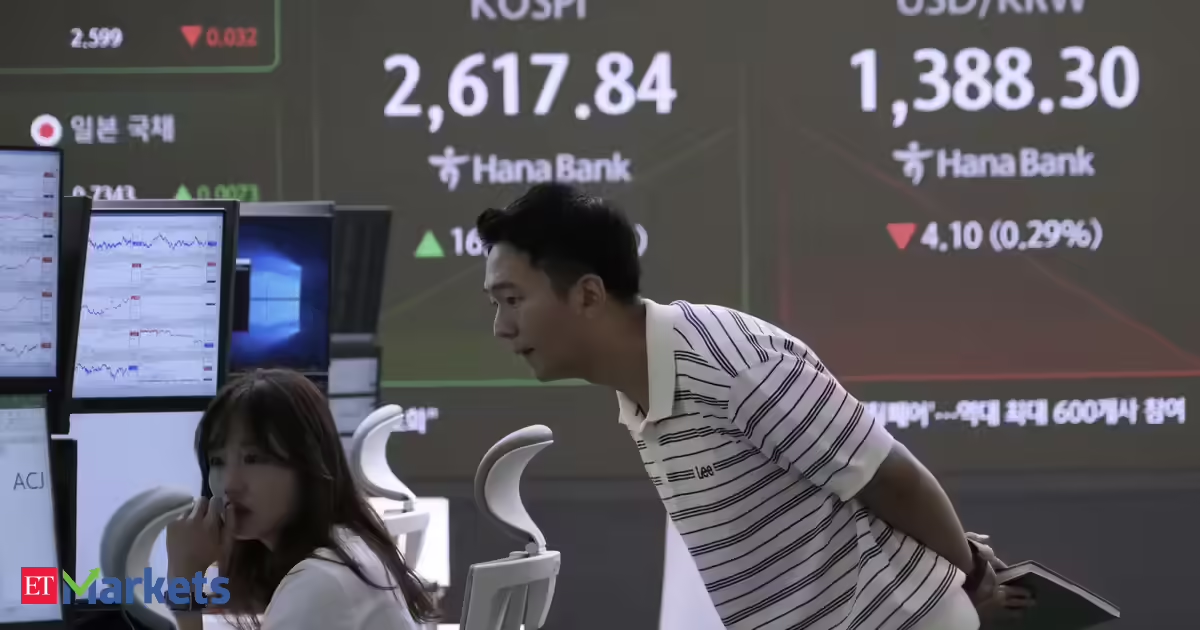
Global Market Today: Asian stocks, US futures climb on tech optimism

Published

on

Global Market Today: Asian stocks, US futures climb on tech optimism
Asian stocks advanced after a surge in US tech shares pushed Wall Street to a record, masking worries about inflation that have driven bets the Federal Reserve will raise interest rates next year.

A gauge of regional stocks edged 0.1% higher after US benchmarks closed at record highs. A strong outlook by Cisco Systems Inc. lifted Nasdaq 100 futures contracts 0.5%, reinforcing the bullish narrative for the technology sector. The company’s shares surged 18% in extended trading.

Chinese equities, at their highest level since 2021, were set for a 1% advance, with attention on the summit between President Donald Trump and Xi Jinping in Beijing. Technology shares will be closely watched after Alibaba Group Holding Ltd. and Tencent Holdings Ltd. posted revenue that missed estimates. The offshore yuan is on its best winning streak since 2017.

A drop in oil also helped sentiment on Wednesday, while a $25 billion sale of 30-year bonds saw investors snagging 5% yields on those maturities for the first time since 2007. An index of the dollar was fractionally higher Wednesday, while gold fell for a second session. Investors fled Treasuries after back-to-back US inflation reports this week showed mounting price pressures.

Advertisement

US stocks have pushed to record highs, supported by strong corporate earnings and expectations that AI-driven spending will sustain growth. Traders are also turning to geopolitical developments in Iran and the summit between Xi and Trump for next moves, as concerns mount that the war in the Middle East could keep inflation elevated and weigh on the global economy.


“Attention now turns to ongoing geopolitical headlines with President Trump continuing his visit to China and markets remaining highly sensitive to any developments surrounding the Strait of Hormuz,” Nick Twidale, chief market analyst at AT Global Markets, wrote in a note to clients.
Trump arrived in Beijing for the first state visit to China by a US leader in nine years, as the world’s two largest economies look to stabilize ties with a summit playing out against the backdrop of the Iran war.Trump is scheduled to meet with Chinese President Xi Jinping at the Great Hall of the People on Thursday morning.

Elsewhere, US inflation reports this week have shown mounting price pressures, pushing traders to boost wagers on a Fed rate hike in the coming year. The yield on benchmark 10-year Treasuries rose to the highest since July.

US wholesale inflation accelerated in April to the fastest pace since 2022 on a war-driven increase in energy prices that’s feeding into higher freight transportation costs. The producer price index rose 6% from a year ago, according to Bureau of Labor Statistics data out Wednesday, eclipsing economist estimates and coming in after a hot consumer price readout.

“One takeaway is that companies are not passing through costs to consumers across the board just yet,” noted Chris Low at FHN Financial. “But company input costs are sharply higher, which obviously increases pressure to pass through costs in future.”

Advertisement

Separately, the Senate narrowly confirmed Kevin Warsh as chair of the Fed, setting up the most controversial leadership transition at the US central bank in decades and a test of its political independence.

First-quarter profits at S&P 500 companies have surged 27% so far, more than double the roughly 12% analysts had expected — the fastest year-on-year earnings growth outside of recoveries from major shocks since 2004.

The bullish run for US stocks may extend should a recovery in earnings and still-low positioning outweigh the threat from higher bond yields, said Max Kettner at HSBC Holdings Plc.

Morgan Stanley strategists are turning more positive on US equities in a bet that profits and a strong economy will keep the bull market running. The team led by Mike Wilson expects the S&P 500 to reach 8,300 in the next 12 months. The gauge is currently trading near 7,444.

Advertisement

“Resiliency in earnings data despite geopolitical risk, private credit concerns and AI disruption is supportive of our view,” Wilson said.

Continue Reading

Business

Higher Europe air fares 'inevitable', says industry head

Published

on

Higher Europe air fares 'inevitable', says industry head

Flying by air will get more expensive as oil prices remain high after the US and Israel’s conflict with Iran.

Continue Reading

Business

StubHub Holdings, Inc. (STUB) Q1 2026 Earnings Call Transcript

Published

on

OneWater Marine Inc. (ONEW) Q1 2026 Earnings Call Transcript

StubHub Holdings, Inc. (STUB) Q1 2026 Earnings Call May 13, 2026 5:00 PM EDT

Company Participants

Jonathan Schaffer
Eric Baker – Founder, CEO, & Chairman
Constance James – Chief Financial Officer

Advertisement

Conference Call Participants

Eric Sheridan – Goldman Sachs Group, Inc., Research Division
Douglas Anmuth – JPMorgan Chase & Co, Research Division
Mark Stephen Mahaney – Evercore Inc.
Justin Post – BofA Securities, Research Division
Logan Whalley – TD Cowen, Research Division
Brian Pitz – BMO Capital Markets Equity Research
Shweta Khajuria – Wolfe Research, LLC
Andrew Boone – Citizens JMP Securities, LLC, Research Division
Jed Kelly – Oppenheimer & Co. Inc., Research Division
Cameron Mansson-Perrone – Morgan Stanley, Research Division
Jason Bazinet – Citigroup Inc., Research Division
Ryan Sigdahl – Craig-Hallum Capital Group LLC, Research Division
Brandon Ross – LightShed Partners, LLC

Presentation

Advertisement

Operator

Good day, ladies and gentlemen, and thank you for standing by. Welcome to StubHub’s First Quarter 2026 Earnings Conference Call. [Operator Instructions] Please note that this conference call is being recorded today, May 13, 2026. I will now turn the call over to Jonathan Schaffer, SVP, Investor Relations with StubHub.

Jonathan Schaffer

Advertisement

Thank you. Good afternoon, and thank you for joining us to discuss StubHub’s first quarter 2026 results. For reference, our first quarter earnings release and presentation are available under the Quarterly Results section of our Investor Relations website at investors.stubhub.com.

Before we begin, please note that today’s call will include forward-looking statements. These forward-looking statements are based on the company’s current expectations and are not guarantees of future performance. These statements are subject to numerous risks and uncertainties that could cause actual results to differ materially from what we expect. Although the company believes the expectations reflected in such forward-looking statements are based on reasonable assumptions, it can make no assurance related to its expectations. We refer you to our recent SEC filings for a more detailed discussion of the

Advertisement
Continue Reading

Trending

Copyright © 2025