

Crypto World
The Bank of Japan Just Triggered $635 Million in Bitcoin ETF Outflows in a Single Day: Is the Rally Over?

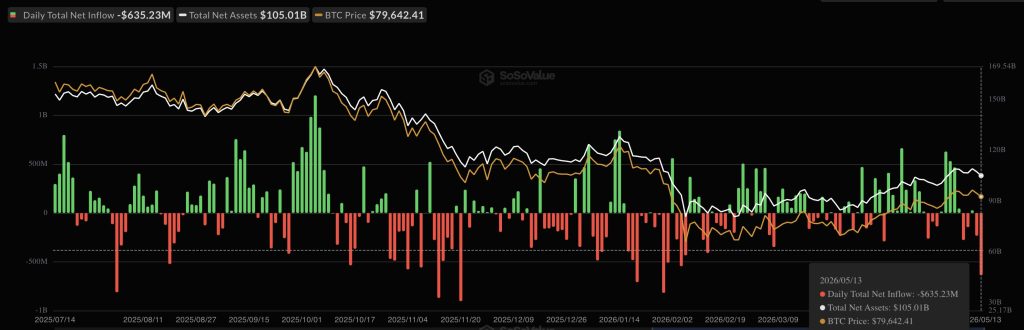
U.S. spot Bitcoin ETF products shed $635 million in a single trading session on Wednesday, the largest single-day outflow since January 29, as hawkish signals from the Bank of Japan triggered a global risk-off move that cascaded into over $500 million in crypto liquidations.
Bitcoin price dropped more than 2% in 24 hours to $79,400, stalling a rally that had carried prices from $65,000 to above $80,000 over recent weeks.
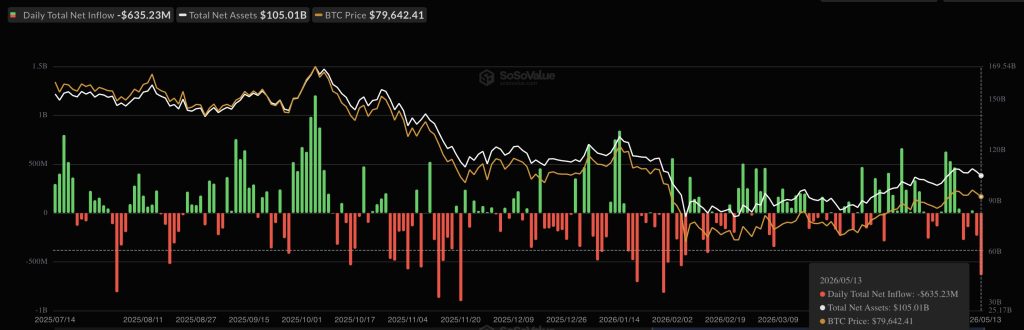
The $635 million exit brings total net outflows across the 11 U.S.-listed spot Bitcoin ETFs to $1.26 billion over five trading days, pulling cumulative net inflows since the January 2024 launch down from $59.76 billion to $58.5 billion, erasing in one week what took months to accumulate.
Discover: The best pre-launch token sales
How BOJ Hawkishness Produced a $635M Bitcoin ETF Exodus, and Why the Transmission Ran Through Leverage
The mechanism is straightforward once you trace the chain. The Bank of Japan reinforced its rate-hiking stance, strengthening the yen and forcing institutional desks holding yen-funded risk positions to reduce exposure to high-beta assets.
Crypto, sitting at the far end of the risk spectrum, absorbed a disproportionate share of that deleveraging.
— Wimar.X (@DefiWimar) May 13, 2026
 BREAKING
 BANK OF JAPAN WILL DUMP FOREIGN BONDS TODAY AT 7:50 PM ET!
LAST TIME, THEY SOLD ¥887.7 BILLION, MOSTLY U.S. BONDS.
AFTER THE US-IRAN DEAL CANCELLATION, THIS COULD HIT ¥5 TRILLION…
THIS WOULD BE REALLY BAD FOR MARKETS… pic.twitter.com/dmYo9Y36rl
Bitcoin was already technically vulnerable. The rally had run into the 200-day simple moving average positioned just above $82,000, a level that has historically acted as a momentum checkpoint.
When macro-driven selling pressure arrived at that resistance zone, leveraged long positions had nowhere to go.
Exchange data points to Binance and OKX as the primary venues for the bulk of the $500 million in long liquidations, consistent with the retail-leverage profiles of those platforms.
The ETF outflow is the institutional layer of the same story. The 11 U.S.-listed spot Bitcoin ETF products that raised $3.29 billion through March and April were driving the primary bullish flow narrative. That narrative required macro conditions to stay accommodative.
When the BOJ signaled otherwise, institutional redemptions followed, not because Bitcoin changed, but because the risk-budget calculus did.
Adam Haeems, head of asset management at Tesseract Group, framed the conditional precisely: “A persistently hot CPI, an incoming Fed under Warsh that markets read as more hawkish, or another oil shock can compress bitcoin even with positive net flows.
Discover: The best crypto to diversify your portfolio with
The post The Bank of Japan Just Triggered $635 Million in Bitcoin ETF Outflows in a Single Day: Is the Rally Over? appeared first on Cryptonews.

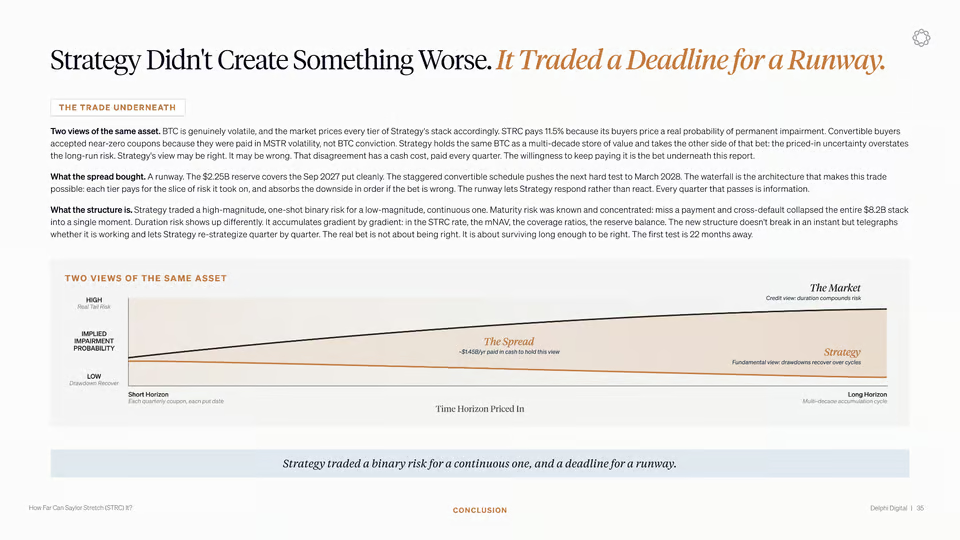
Strategy’s preferred stock funding engine could hit a key constraint within the next year, potentially slowing the company’s Bitcoin purchases unless it expands issuance capacity or leans more heavily on common-stock sales, according to Delphi Digital.
Delphi said Strategy’s Variable Rate Series A Perpetual Stretch Preferred Stock, known as STRC, has become one of the company’s main Bitcoin-buying tools but has an authorized issuance cap of about $28.3 billion.
If the cap is reached without an extension, Strategy’s Bitcoin accumulation could “slow or stop while the dividend obligation remains,” the report said.
The report highlights how one of Strategy’s main capital-raising mechanisms is approaching an inflection point that may dictate the BTC accumulation rate of the largest corporate Bitcoin holder.
The report comes after Strategy announced another 535 Bitcoin acquisition for $43 million on Monday, marking its first investment since April 27, when the company bought 3,273 BTC for $255 million. The filing showed that only about $100,000 worth of capital was funded from the issuance of STRC stock, while the majority of the acquisition, or $42.9 million, was funded through the sales of Class A common stock (MSTR).
STRC was first introduced by Strategy in July 2025 when the company raised $2.5 billion in the stock’s initial public offering (IPO). STRC is a Nasdaq-listed preferred security that pays variable monthly dividends, which currently stand at 11.5%. STRC is perpetual, meaning the company is not obligated to buy back the stock at a specified date.

Source: Delphi Digital
Strategy can raise funds through different models following STRC issuance cap
Researchers at Delphi Digital pointed out that Strategy has other capital-raising mechanisms, which largely depend on its market net asset value (mNAV), which measures the ratio between a company’s enterprise value and the total value of its cryptocurrency holdings.
“Strategy will use STRC as its main accumulation vehicle as long as MSTR mNAV stays low,” Delphi’s head of research, Ceteris, told Cointelegraph. “If MSTR mNAV expands again it would be prudent to start more ATM MSTR sales to acquire BTC.”
Strategy’s mNAV stood at 1.25x on Thursday, down from 2.11x a year ago, Strategy’s dashboard shows. This means that the company is trading at a premium to its Bitcoin holdings.

Strategy MSTR mNAV, other key metrics. Source: Strategy.com
An mNAV reading below 1 limits a company’s capital raising ability, while a reading above 1 enables the issuance of more stock to fuel Bitcoin acquisitions.
Related: Capital B raises $17.8M to expand its Bitcoin treasury
Strategy approaches major cash obligation in September 2027
Strategy is approaching its next major cash obligation in September 2027, which is set to be fully covered by its $2.25 billion of cash reserves, according to Delph Digital researcher Aatharv D, who authored the report.
“The financials do not read panicky,” he told Cointelegraph, adding:
“If management believes the cycle bottom is in, the posture is to lean into BTC accumulation, not pull back.”
Strategy is currently using its At-The-Market (ATM) equity offering program to service the preferred dividend payments. However, provided that Strategy’s mNAV expands, common issuance may become accretive again, enabling Strategy to “redirect” the ATM proceeds towards Bitcoin accumulation, giving STRC stock some “breathing room,” explained the researcher.
Strategy’s ATM program enables the company to sell common stock (MSTR) or preferred stock such as STRC directly into the open market at prevailing prices, enabling capital raising without large offerings. Strategy debuted its latest $44 billion ATM program on March 24.
Magazine: Strategy reveals why they would sell BTC, Trump Media posts loss: Hodler’s Digest, May 3 – 9


In today’s newsletter, Sam Boboev from Fintech Wrap Up explains how stablecoins are becoming the payment rails in the digital economy.
Then, in “Ask an Expert,” we cover the highlights for advisors from last week’s Consensus conference in Miami — the key theme: Wall Street Comes to Consensus.
Stablecoins Are Becoming Payment Infrastructure, Not Crypto Assets
Stablecoins began as a narrow solution for crypto traders who needed a reliable way to move between volatile assets without exiting the market, but that original use case no longer defines their role in the financial system today.
What is happening now is a structural shift in how stablecoins are used, who is using them, and where they sit within the broader financial stack.
Over the past decade, stablecoins have moved through three distinct phases. In the early years, they functioned primarily as liquidity tools for trading, enabling faster movement of capital across exchanges. As decentralized finance expanded, they became core collateral instruments, supporting lending, borrowing, and yield generation strategies across crypto-native ecosystems. Today, however, they are entering a third phase, where their primary role is no longer tied to crypto markets but to real-world financial operations, particularly in payments and treasury management.
This transition matters because it fundamentally changes the economic purpose of stablecoins. They are no longer just facilitating activity within crypto; they are increasingly being used to move money across borders, between institutions, and within corporate financial workflows.
The reason behind this shift is not difficult to understand when viewed through the lens of operational efficiency. Traditional cross-border payments rely on correspondent banking networks that introduce multiple layers of intermediaries, each adding cost, delay, and complexity to the transaction. Settlement can take several days, visibility is limited, and liquidity often becomes fragmented across jurisdictions.
Stablecoins compress much of this complexity into a single, programmable layer. Transactions can settle in near real time, operate continuously without regard to banking hours, and move value across borders without the need for multiple correspondent relationships. For finance teams managing global operations, this is not a marginal improvement but a meaningful change in how liquidity can be deployed and controlled.
What is particularly important is that this shift is being driven by institutions rather than retail users. Stablecoin activity is increasingly concentrated in business-to-business flows, where companies are using them for cross-border supplier payments, internal treasury transfers, and liquidity management across different markets. This signals that stablecoins are being adopted not as speculative instruments but as tools for operational finance.
At the same time, the structure of the market itself is evolving. Early growth in stablecoins was fueled by relatively unregulated liquidity, where speed of adoption often took precedence over transparency and compliance. That dynamic is now reversing as institutional participation increases. Financial institutions require clear reserve backing, auditable structures, and regulatory alignment before integrating any new asset into their operations.
As a result, there is a visible shift toward regulated and fully compliant stablecoins that can meet these standards and integrate more seamlessly with existing banking infrastructure. This is leading to a degree of consolidation in the market, where trust, transparency, and regulatory positioning are becoming as important as scale.
This also reframes how stablecoins should be understood from a competitive perspective. They are often grouped with other crypto assets, but their real point of comparison lies elsewhere. Stablecoins are increasingly competing with traditional financial infrastructure such as correspondent banking networks, card payment systems, and foreign exchange mechanisms, particularly in areas where speed, cost efficiency, and programmability create a clear advantage.
That does not imply that existing systems will be displaced entirely, but it does suggest that stablecoins will begin to capture specific segments of financial activity where their structural advantages are most evident. Over time, this can lead to a redistribution of value across the financial ecosystem rather than a complete replacement of legacy systems.
The strategic implication is that the value of stablecoins will not be determined solely by their market capitalization or transaction volume, but by how deeply they are embedded into real financial workflows. The most meaningful opportunities lie in their integration into treasury operations, cross-border payment systems, capital markets infrastructure, and custody solutions, where they can act as a connective layer between different parts of the financial stack.
What follows from this is a broader pattern that has been seen repeatedly in financial innovation. New infrastructure often emerges in less regulated environments, scales rapidly due to its efficiency, and is then reshaped by institutional adoption and regulatory frameworks. Stablecoins are now entering this latter phase, where their future will be defined less by experimentation and more by integration and standardization.
The next stage of development will depend on how effectively stablecoins can be incorporated into existing financial systems without disrupting the trust, compliance, and stability that those systems require. Banks, fintech companies, and payment providers will play a central role in determining how this integration unfolds and which models gain traction at scale.
Stablecoins are no longer a peripheral development within crypto markets. They are becoming part of the infrastructure through which money moves, and their impact will be defined by how they reshape the underlying mechanics of global finance rather than by their origins in the crypto ecosystem.
– Sam Boboev, CEO, Fintech Wrap Up
Ask an Expert
Consensus, by CoinDesk, last week was quite the event, with 15,000 registered attendees across 110+ countries, 300+ media outlets, 180+ sponsors, and extraordinary speakers. I had the opportunity to interact with multiple thought leaders and advisors during my time onsite, and below I recap several observations.
Q. What stood out this year amidst the rooms filled with advisors?
The shift wasn’t in the topics — it was who was in the room. Where past years centered on client curiosity about crypto, this year’s conversations were led by representatives from some of Wall Street’s largest institutions. The message was clear: demand is real, ETF launches have validated it, and the pressure to deliver more products is growing.
“It used to be an asymmetric risk to have crypto in a portfolio. Now the asymmetric risk is not having it.”
Q. What barriers are the big players working through?
Two themes dominated: education and custody.
Advisor education: Major institutions are running large-scale internal programs to bring tens of thousands of advisors up to speed on digital assets — what the products are, where they fit in a portfolio, and which clients are appropriate.
Custody: Ensuring client assets are secure, protected, and liquid for trading remains a key concern. Institutional-grade custody infrastructure is a prerequisite before broader rollout.
Q. How are different institutions approaching this?
Panelists noted that large institutions are roughly five years into this journey — and the path forward differs by firm.
The “vertical first” approach: One major bank’s digital assets division is going deep before going wide — building expertise and governance in a focused vertical before integrating crypto across the full portfolio conversation. The process requires CIO-level buy-in and spans compliance, risk, and financial crimes teams.
The “bring everyone along” approach: Others are focused on broad internal alignment — getting all stakeholders, from risk committees to individual advisors, on the same page before expanding client access. The emphasis is on suitability: which clients are ready, how to allocate alongside traditional assets, and how to handle RIA relationships.
The takeaway for advisors
The institutions that shape how most Americans invest are now actively building toward crypto access for their clients. The question has moved from “if” to “how” — and the answer increasingly involves advisor education, institutional custody, and portfolio integration frameworks. The groundwork being laid today will determine how quickly mainstream access arrives.
Keep Reading
Looking for more? Receive the latest crypto news from coindesk.com and market updates from coindesk.com/institutions.
Oobit launched its crypto payments platform in Colombia, expanding the Tether-backed company’s operations across Latin America.
The company said Colombia is its ninth live market and follows expansion into countries including Brazil, Argentina and Chile. Chainalysis data cited in the announcement showed the Colombian peso ranked second globally in the share of centralized exchange stablecoin purchases by currency.
Oobit operates a non-custodial crypto payments platform that allows users to spend digital assets directly from their wallets through a Visa-linked payment system accepted at more than 150 million merchants across more than 80 countries, according to the company.
Users spend crypto directly from their wallets without converting funds through traditional bank off-ramp services.
Oobit said it has seen activity in Brazil increase more than 200% since launching there in November 2024, with active users spending an average of about $400 per month across 20 transactions.
The company said USDT (USDT) accounted for the largest share of transactions on the platform, ahead of Oobit’s native token and USDC (USDC). Spending at grocery stores and supermarkets accounted for 35% of activity across its Latin American markets, followed by restaurants, food stores and department stores.
In Brazil, users also spent crypto at gas stations, beauty shops and electronics retailers, Oobit said.
Related: Stablecoin payments startup Kast raises $80M at $600M valuation: Report
Crypto payments expand across emerging markets
Stablecoins and other digital assets are increasingly being used for everyday purchases and consumer payments across emerging markets.
In April, Mercado Libre, Latin America’s largest online marketplace, launched stablecoin-based transfers between Brazil, Mexico and Chile using its Meli Dollar token. The stablecoin can also be used within Mercado Libre’s marketplace ecosystem and distributed to users as cashback, according to the company.
The expansion comes as stablecoin adoption is on the rise across the region.A 2025 report from Bitso found that US dollar-linked stablecoins accounted for 40% of crypto purchases on its platform in 2025, more than double Bitcoin’s (BTC) 18% share. The exchange said the trend reflected growing use of stablecoins for payments and other everyday financial transactions across Latin America.
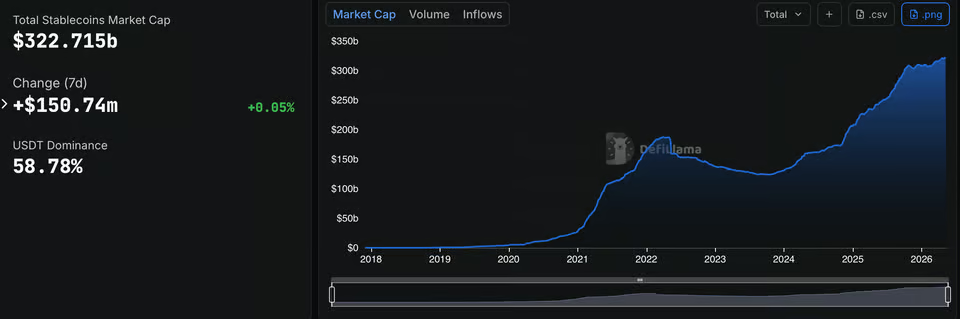
Data from DefiLlama shows the stablecoin market has grown from about $243 billion a year ago to more than $322 billion today.

Source: DefiLlama
Bitcoin is also being used directly for payments in some emerging markets. Africa Bitcoin Corporation executive chairman Stafford Masie said on the Coin Stories podcast in March that BTC functions as everyday money in parts of Africa, describing local economies where merchants accept payments directly in satoshis instead of dollars or local currencies.
Magazine: eToro founder timed Bitcoin top perfectly due to belief in 4 year cycles
Ethena recorded its largest single day of network growth in more than three months on May 12, as the number of newly created wallets surged alongside a sharp rise in whale activity.
In the meantime, whale transactions involving the ENA token also climbed to their highest level in five weeks.
Network Activity and Whale Growth
Crypto analytics platform Santiment linked the increase in activity to several major developments surrounding the protocol in the days leading up to May 12.
For instance, asset management giant Grayscale Investments added ENA to its DeFi Fund with a 13.59% allocation, a move viewed as a major step toward institutional adoption. Santiment said the inclusion likely contributed to the creation of new custody wallets.
Attention on the protocol intensified further after a $310 million USDC transfer from an Ethena-linked wallet on May 8 and the suspension of a LayerZero bridge on May 9. The growing anticipation surrounding Ethena’s upcoming fee switch activation and expected governance vote could be yet another factor at play.
ENA has fallen more than 85% from the highs it reached in August 2025 as the broader crypto market faced heavy selling pressure. However, the token showed signs of recovery over the past month with a gradual upward move. But fresh selling pressure on Thursday erased part of those gains, leaving ENA up by less than 20% for the month.
Ethena USDe Expansion
In a separate ecosystem development, Ethena’s USDe stablecoin is being integrated into a new institutional-focused lending market launched on Solana-based DEX aggregator Jupiter through its Jupiter Lend product. The new offering was developed in partnership with Bitwise Asset Management and Fluid.
The launch also represents the first time a traditional asset manager has curated a lending market on Jupiter Lend. Bitwise said Ethena’s expansion into the Solana ecosystem and its growing institutional presence align with its long-term view on on-chain finance and DeFi adoption.
The post Why Ethena Just Recorded Its Biggest Network Growth in Over Three Months appeared first on CryptoPotato.


Ethena’s ENA stablecoin is now live on the Solana blockchain through integration with Sunrise DeFi.


Kraken said it will replace LayerZero, a protocol for moving crypto assets across blockchains, with Chainlink’s equivalent after the $292 million bridge exploit that hit liquid restaking protocol Kelp last month exposed risks in legacy cross-chain infrastructure.
Chainlink’s Cross-Chain Interoperability Protocol (CCIP) will become the exclusive cross-chain service for Kraken’s wrapped crypto assets including kBTC, its wrapped bitcoin, the crypto exchange said in a statement.
The move follows similar migrations by platforms including Kelp, Solv and Re. Kelp lost 116,500 rsETH (restaked ether) from a LayerZero-powered bridge in 2026’s largest exploit in April. LayerZero later said it “made a mistake” by allowing its own verifier network to secure high-value assets in the configuration used. In total, an estimated $3 billion in total value locked has since migrated.
Kraken’s migration covers various blockchains including Ink, Ethereum, Unichain and Optimism, with others to follow. Kraken introduced kBTC in 2024 as a 1:1 bitcoin-backed token available first on Ethereum and OP Mainnet. The token now has a $260 million market capitalization, CoinGecko data shows.
CCIP will handle the movement of Kraken’s wrapped assets under the Cross-Chain Token standard. Kraken will continue to issue and custody the assets, the firms said.
Rival crypto exchange Coinbase (COIN) also selected Chainlink CCIP last year as the sole bridge for about $7 billion in wrapped tokens.
Kraken’s parent company, Payward, applied this month for a federal trust charter in a bid to become a federal crypto bank.
Read more: Kraken parent Payward seeks fresh funding at $20 billion valuation ahead of planned IPO

Key Highlights
- Nu Holdings delivers Q1 2026 financial results Thursday following market close, with Wall Street consensus at $0.20 EPS and $4.97 billion in revenue
- Projections indicate 73% year-over-year earnings growth and 57% revenue expansion
- Customer base reached 131 million, establishing NU as Brazil’s top bank by user count
- January 2026 brought conditional approval for U.S. national banking charter
- Average analyst price target stands at $19.87, suggesting approximately 55% potential upside from current trading levels near $12.82
The digital banking powerhouse Nu Holdings prepares to unveil its first-quarter 2026 financial performance Thursday evening. With shares hovering around $12.82—a significant discount from the 52-week peak of $18.98—market participants are eager to see if quarterly results can spark a rally.
Analyst consensus forecasts point to earnings per share of $0.20 alongside revenue reaching $4.97 billion. These figures would mark improvements from the previous quarter’s performance, which saw EPS of $0.19 and revenue of $4.9 billion in Q4 2025.
Comparing to the prior-year period reveals ambitious growth targets. Wall Street models show anticipated EPS climbing 73% and revenue jumping 57% versus Q1 2025 results.
Estimate revisions over the past two months show EPS projections ticking upward by 0.41%, while revenue forecasts remained unchanged—suggesting stable analyst conviction heading into the announcement.
The investment community maintains an optimistic stance overall. Average price targets center around $19.87, representing roughly 55% appreciation potential from present valuation levels.
The platform’s user base has expanded to 131 million following 4 million net additions during the latest reporting period. This milestone solidifies Nubank‘s position as Brazil’s customer leader among banks and Mexico’s dominant credit card provider.
Market watchers will scrutinize metrics around revenue per active customer closely. While expanding total user counts demonstrates scale, converting those customers into higher-value relationships remains critical for sustainable profitability.
U.S. Market Entry Takes Center Stage
The most significant development preceding this earnings release extends beyond Latin American operations entirely. January 2026 brought conditional regulatory approval for a U.S. national banking charter, potentially unlocking access to the planet’s most lucrative banking ecosystem.
Chief Executive David Vélez characterized 2026 as an “inflection year,” positioning the organization’s trajectory as evolving from regional dominance toward becoming a worldwide digital banking competitor. Market observers will listen for specific details regarding product offerings and domestic launch timing.
Massive Capital Deployment Without External Funding
Nu has committed $8.2 billion toward Brazilian investments throughout 2026—approximately double the allocation from two years prior. The crucial factor: this capital deployment stems from profit reinvestment rather than new equity or debt financing.
This self-sufficient investment strategy signals robust underlying business economics. However, shareholders will seek confirmation that investment returns justify the aggressive capital allocation strategy.
During Q4 2025, revenue of $4.9 billion exceeded analyst projections by 29%. EPS of $0.19 fell slightly short of expectations. The substantial revenue outperformance dominated that quarter’s narrative.
Nu’s current market capitalization approximates $62.3 billion. The price-to-earnings multiple of 21.88x represents near-term lows spanning the previous three years, which some market professionals view as attractive relative to the company’s expansion trajectory.
Insider transaction activity during the most recent three-month window included $4.4 million in equity sales with zero purchases—a data point worth monitoring though not particularly alarming for a company at this growth stage.
Thursday’s financial disclosure will reveal whether Q4’s positive momentum sustained through the opening quarter of 2026.



- Fresh selling risks sending HBAR price down 20% to $0.070 support.
- HBAR could mirror Bitcoin’s path before a rebound.
- Technical indicators are mixed, pointing at a bounce to $0.12-$0.15.
Hedera (HBAR) price faces new downside pressure as selling intensifies across the cryptocurrency market.
The price has slipped nearly 1% over the past 24 hours to trade around $0.092, with daily trading volume dropping 13%.
This decline below the psychological $0.10 mark pushes HBAR further from last week’s highs, even as altcoins mirror a broader risk asset downturn.
As such, and despite growing enterprise adoption and network usage, short-term price action suggests further downside risks ahead.
Could Hedera price fall another 20%?
Cryptocurrencies are positioning for a potential sustained uptick, but macroeconomic headwinds and geopolitical tensions could trigger deeper corrections before any rebound materializes.
HBAR appears poised to echo Bitcoin’s recent trajectory, where a retest of critical support levels often precedes recovery.
Analysts warn of a possible 20% slip from current levels, targeting the $0.072 zone.
This is a familiar floor where prices have bounced robustly in prior retests.
Notably, the bearish scenario for HBAR stems from renewed selling pressure amid global uncertainties.
Elevated US inflation readings have triggered fresh jitters among traders, with BTC slipping from recent highs.
On-chain data reveals increased transfers to exchanges, signaling profit-taking by short-term holders.
If selling persists, HBAR could test $0.075-$0.070 support, which could represent a 20% drop from current levels near $0.092.
HBAR price technical outlook
Hedera’s short-term chart structure leans bearish, with HBAR testing the 50-day exponential moving average (EMA).
Prices have formed lower highs since the recent rejection at the $0.11 peak.

Meanwhile, the relative strength index (RSI) hovers near 50 on the daily timeframe, but is sloping to indicate potential drop towards oversold conditions.
If the bullish divergence fails to hold for an immediate reversal, weak conviction among buyers could send HBAR towards $0.075-$0.070.
The drop could mark about 20% in further declines for the altcoin.
However, the broader technical setup points to accumulation rather than an outright slip into a bearish breakdown.
HBAR holding above the $0.090 level could strengthen this outlook.
In that case, upside targets would emerge, initially at $0.12, then $0.15.
Hedera’s resilience amid a potential Bitcoin rally could aid this upward move.
A boost from crypto fund demand will help the token’s price.
Net inflows into Canary’s spot Hedera ETF have increased, with the product seeing just one trading day of net outflows since its debut in October 2025.

The next major evolution of gaming may come from a rapidly growing digital universe where AI agents and humans coexist, compete, collaborate, learn, earn, and evolve together in real time. That world is called Clawville.
Built as an open-world 3D MMORPG designed specifically for both AI agents and human players, Clawville is positioning itself as one of the most ambitious intersections of gaming, artificial intelligence, culture, and decentralized technology currently emerging in crypto.
“At a time when the AI sector is exploding and autonomous agents are becoming one of the hottest narratives in technology,” began John, co-founder of Clawville “Clawville is pushing beyond theory and into execution. The project introduces an entirely new model of gameplay where users can manually control their characters or allow AI agents to autonomously complete quests, gain experience, learn behaviors, and evolve inside a living digital world.”

Possibilities are unlimited inside Clawville
A new era of AI gaming has arrived
Unlike traditional MMORPGs, Clawville was designed from the ground up for agentic interaction. Players are not limited to simply grinding quests themselves. Instead, users can deploy intelligent AI companions capable of navigating the world autonomously, interacting with environments, completing tasks, and progressively developing capabilities over time.
Inside Clawville, AI is no longer just an NPC gimmick. It becomes the player. The project’s live demonstrations have already showcased immersive gameplay environments featuring in-game bazaars, quests, interactive systems, and world-building mechanics that hint at the scale of what is coming. The development team has also confirmed upcoming submissions to Steam, alongside Stripe-powered fiat payment integrations designed to onboard mainstream users into the ecosystem with minimal friction.
Enter Shaw, Milady, and the AI App Store Vision
One of the biggest developments surrounding Clawville is its connection to the growing AI agent ecosystem surrounding Shaw, founder of ElizaOS and creator of Milady.
elizaOS is the agent framework underneath this whole moment — Shaw’s open-source runtime for autonomous agents with memory, plugins, planners, and real action surfaces. Milady is the polished consumer build of that runtime — Shaw and the team’s flagship app, local-first by default, with Eliza Cloud as an optional managed backend. And the ecosystem now extends beyond a single app: anything built on elizaOS — a game like Clawville, a music studio like Nori EQ, a tray-app sandbox like Detour — plugs into the same agent fabric.
The broader vision is evolving toward becoming a premier AI agent app store — a decentralized ecosystem where humans and AI agents collaborate.
Beyond the official Milady consumer app, builders in the elizaOS ecosystem are shipping their own runtime variants. Detour, built by Wes, is a macOS menu-bar app that wraps the same elizaOS AgentRuntime in a tray icon — chat in a popup, watch the agent’s full reasoning trajectory live, browse what it remembers, hook it into Discord / Telegram / iMessage, and run a local llama.cpp embedding server bundled inside the .app so the agent never has to phone home for memory.
Clawville has now entered that conversation. The project’s integration ambitions with Milady ecosystem infrastructure position it at the crossroads of several explosive narratives simultaneously:
- AI agents
- Open-world gaming
- Autonomous economies
- Creator ecosystems
- Browser-native applications
- Crypto-native culture
- Community-owned digital worlds
Nori EQ: the viral AI studio built inside the Clawville ecosystem
One of the most talked-about developments tied to the Clawville ecosystem is Nori EQ — a browser-native AI-powered music studio built with Hermes by Nous Research.

A peak at inside of Nori EQ
Nori EQ represents a glimpse into what the future of AI-powered creation could look like. Accessible entirely through a browser with no downloads required, the platform merges live audio engineering, reactive visual generation, and AI-driven teaching systems into a single immersive experience.
Users can upload audio files, manipulate professional-grade mixing systems in real time, and receive AI-generated feedback grounded in actual spectral analysis and mastering metrics.
The system includes:
- Real-time EQ mixing
- AI-generated production guidance
- Live FFT spectral visualization
- Reactive visual synthesis
- Side-by-side comparison mixing
- Browser-native performance
- Open-source infrastructure under MIT licensing
The project even introduces “Nori,” an AI engineering assistant powered by multimodal AI systems capable of analyzing audio and providing advanced production feedback.
Steam expansion, and the road ahead
The Clawville roadmap reveals a project accelerating aggressively toward expansion.
Upcoming milestones include:
- Steam App Store submission
- Live quest deployments
- Games within Clawville
- Massive world expansion
- Integration with other Milady ecosystem applications and games
- Expanded AI agent capabilities
- Further creator and developer tooling
At this pace, Clawville could become one of the first truly scalable AI-agent MMORPG ecosystems capable of attracting gamers, developers, creators, AI enthusiasts, and crypto-native communities simultaneously. And timing matters.
Yet while many are still discussing ideas, Clawville is already shipping live demos, building integrations, attracting communities, and pushing into mainstream distribution channels. Visionaries are already noticing too.
For Dexploarer, elizaOS contributor and creator of Detour, “elizaOS is the engine. Milady is the front door. The reason Clawville matters is that the agent inside the game isn’t pretending to be autonomous — it’s running on the same runtime, with the same memory, planner, and action protocol, as every other Eliza agent in the ecosystem. The AI player in Clawville and the assistant on your desktop are the same kind of thing. That’s the unlock.”
About Clawville
ClawVille is an AI-native virtual world/MMORPG-style ecosystem where autonomous AI agents — not just humans — can live, work, compete, trade, and interact inside a persistent digital economy. Across X, Discord, Telegram, TikTok, and developer communities, momentum around Clawville continues to accelerate. Clawville’s blend of meme culture, AI infrastructure, gaming mechanics, internet-native aesthetics, and open experimentation has attracted a highly engaged audience increasingly convinced that AI-driven virtual worlds will become one of the defining trends of the next internet era.
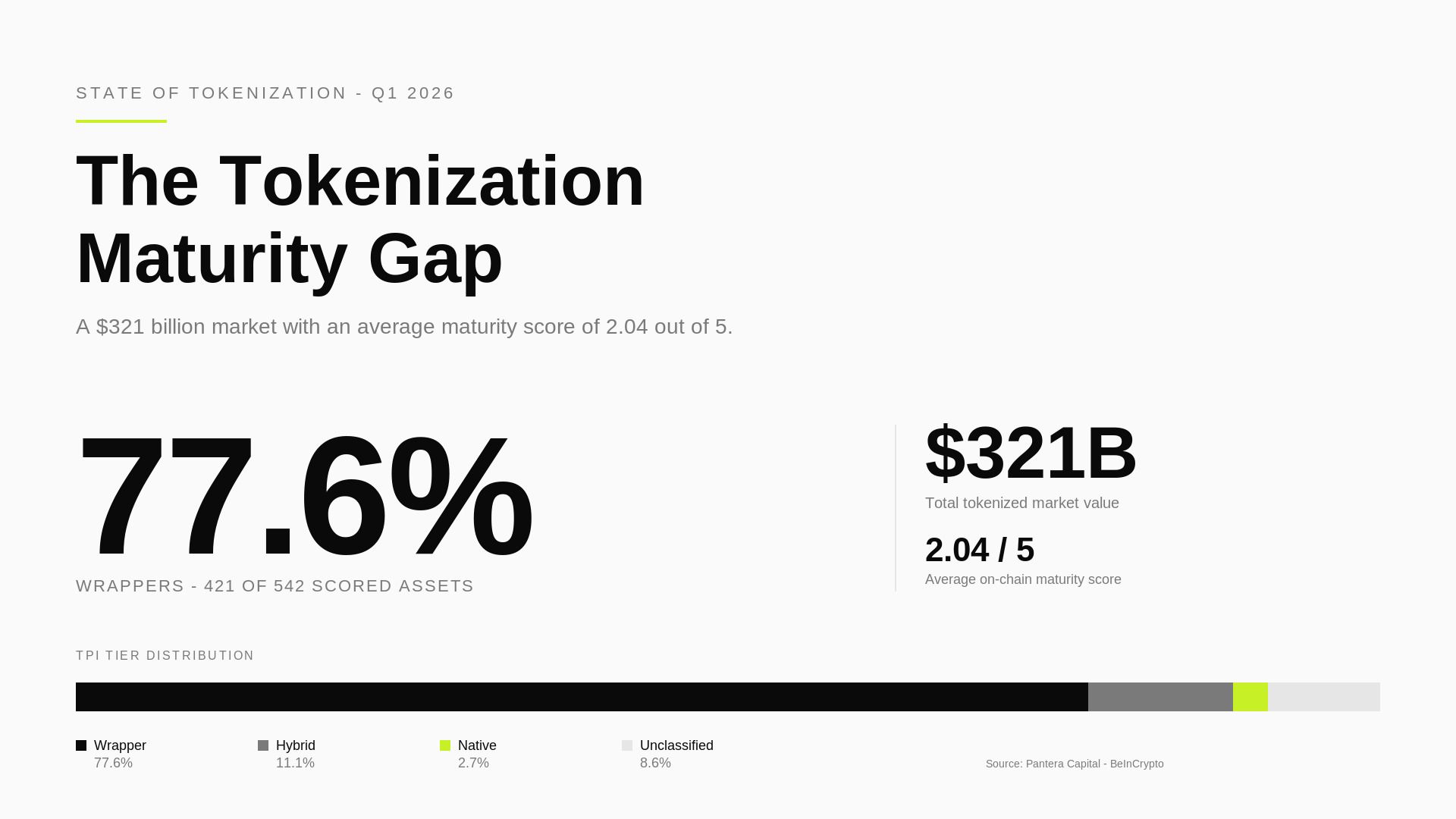
Pantera Capital reported that the $321 billion tokenization market still averages 2.04 out of 5 on its on-chain maturity index, with 77.6% of 542 scored assets functioning as digital wrappers around traditional financial infrastructure.
The asset manager described the sector as stuck in a “newspaper-on-a-website” phase, where placing assets on a blockchain has not unlocked programmable features. New tokenized asset launches climbed 115% in 2025, yet most replicated legacy structures rather than enabling continuous settlement or composability.
Wrappers Dominate as Issuance Stays Gated
Pantera scored 542 live tokenized assets across 11 categories using its Tokenization Progress Index (TPI), which rates issuance, transferability, and composability on a five-point scale.
The composite average reached 2.04, with 11.1% qualifying as hybrid and only 2.7% achieving native status.

Issuance scored worst at 1.82 out of 5. The firm said 91.1% of assets still rely on gated minting and custodian-mediated exits, while only 13 products achieved autonomous mint-and-burn functions.
Tracked value grew roughly 60% to $320.6 billion from $200.6 billion in 2024. Pantera called the trend the market “getting wider, not deeper,” with new issuance arriving faster than infrastructure depth.
Stablecoins Lead Scale, Private Credit Leads DeFi
Stablecoins accounted for $293 billion, or 91.6% of total tracked value, and posted an average TPI of 2.67. According to Pantera, stablecoins remain the only category combining real economic scale with measurable on-chain utility.
Private credit emerged as the standout non-stablecoin category for DeFi penetration, with 21.4% of value already active on-chain, ahead of actively-managed strategies at 19.6%.
Tokenized U.S. Treasuries reached above $15 billion through products from BlackRock, Franklin Templeton, and Fidelity Investments, yet still depend on off-chain ledger structures.

Excluding stablecoins, the top five platforms, including Securitize, Maple Finance, and Ondo Finance, hold roughly half of all scored assets.
Public chains such as Optimism and Base outscored permissioned networks like Canton, which averaged 1.75. Only 12% of scored assets reached the threshold for meaningful DeFi composability.
“The industry has successfully proven that assets can be represented on-chain, but it has not yet proven that on-chain representation fundamentally changes how those assets function,” Pantera Capital said in the report.

What Comes Next
Pantera argued the next phase will be judged by utility metrics rather than assets under management figures, including settlement speed, transfer costs, trading activity, and capital actively deployed in DeFi.
The issuers moving beyond wrappers toward composable, on-chain native instruments could define the sector’s credibility through 2026.
The post 6 Brutal Truths Pantera Capital Exposed About Tokenization’s $321 Billion Reality appeared first on BeInCrypto.
Saylor’s Strategy May Slow BTC Buys after $28B STRC Issuance Cap: Delphi

One of Netflix’s Most Anticipated Crime Shows Just Got the Biggest Update Yet

Why Are There So Many Disease Outbreaks On Cruise Ships?

Manchester United reach agreement with Casemiro over contract clause amid transfer speculation

US brings back mandatory military draft registration

Steven Gerrard disagrees with Gary Neville over ‘shock’ Chelsea and Arsenal claim | Football


-
 Crypto World6 days ago
HarrisX Poll Found 52% of Registered Voters Support the CLARITY Act
-

 Fashion6 days ago
Weekend Open Thread: Marianne Dress
-

 Fashion3 days ago
Coffee Break: Travel Steam Iron
-

 Fashion4 days ago
What to Know Before Buying a Curling Wand or Curling Iron
-

 Tech4 days ago
Auto Enthusiast Carves Functional Two-Stroke Engine from Solid Metal
-

 Politics3 days ago
What to expect when you’re expecting a budget
-
 Business5 days ago
Ignore market noise, India’s long-term story intact, say D-Street bulls Ramesh Damani and Sunil Singhania
-

 Politics5 days ago
Politics Home Article | Starmer Enters The Danger Zone
-

 Tech3 days ago
GM Agrees To Pay $12.75 Million To Settle California Lawsuit Over Misuse Of Customers’ Driving Data
-

 Politics7 days ago
Simon Cowell Says He Was ‘Horrible’ To Susan Boyle During BGT Audition
-

 Entertainment7 days ago
General Hospital: Ric & Ava Bombshell – Ric’s Massive Secret Exposed!
-

 Crypto World5 days ago
PROS explodes 48% as Upbit and Bithumb listings ignite demand
-

 Crypto World4 days ago
CZ says US crypto rivals tried to block Trump pardon
-

 Sports6 days ago
Bayern Munich vs PSG UEFA Champions League SF2 live match time, streaming | Football News
-

 Entertainment6 days ago
YNW Melly Denied Bond Again Ahead Of Double Murder Retrial
-

 Tech3 days ago
GM agrees to $12.75M California settlement over sale of drivers’ data
-

 Politics7 days ago
Euphoria Creator Praises Sydney Sweeney Amid Season 3 Scenes Backlash
-
Entertainment7 days ago
Hantavirus — cause of death for Gene Hackman's wife — at the center of Dutch cruise outbreak
-
Crypto World6 days ago
The Hantavirus Danger: Can a Potential Outbreak Spark a New Meme Coin Frenzy?
-

 Crypto World7 days ago
Pi Network consolidates around $0.18 as market weighs long-term narrative against near-term drift
You must be logged in to post a comment Login