

Crypto World
Stablecoins Are Becoming Payment Infrastructure, Not Crypto Assets



In today’s newsletter, Sam Boboev from Fintech Wrap Up explains how stablecoins are becoming the payment rails in the digital economy.
Then, in “Ask an Expert,” we cover the highlights for advisors from last week’s Consensus conference in Miami — the key theme: Wall Street Comes to Consensus.
Stablecoins Are Becoming Payment Infrastructure, Not Crypto Assets
Stablecoins began as a narrow solution for crypto traders who needed a reliable way to move between volatile assets without exiting the market, but that original use case no longer defines their role in the financial system today.
What is happening now is a structural shift in how stablecoins are used, who is using them, and where they sit within the broader financial stack.
Over the past decade, stablecoins have moved through three distinct phases. In the early years, they functioned primarily as liquidity tools for trading, enabling faster movement of capital across exchanges. As decentralized finance expanded, they became core collateral instruments, supporting lending, borrowing, and yield generation strategies across crypto-native ecosystems. Today, however, they are entering a third phase, where their primary role is no longer tied to crypto markets but to real-world financial operations, particularly in payments and treasury management.
This transition matters because it fundamentally changes the economic purpose of stablecoins. They are no longer just facilitating activity within crypto; they are increasingly being used to move money across borders, between institutions, and within corporate financial workflows.
The reason behind this shift is not difficult to understand when viewed through the lens of operational efficiency. Traditional cross-border payments rely on correspondent banking networks that introduce multiple layers of intermediaries, each adding cost, delay, and complexity to the transaction. Settlement can take several days, visibility is limited, and liquidity often becomes fragmented across jurisdictions.
Stablecoins compress much of this complexity into a single, programmable layer. Transactions can settle in near real time, operate continuously without regard to banking hours, and move value across borders without the need for multiple correspondent relationships. For finance teams managing global operations, this is not a marginal improvement but a meaningful change in how liquidity can be deployed and controlled.
What is particularly important is that this shift is being driven by institutions rather than retail users. Stablecoin activity is increasingly concentrated in business-to-business flows, where companies are using them for cross-border supplier payments, internal treasury transfers, and liquidity management across different markets. This signals that stablecoins are being adopted not as speculative instruments but as tools for operational finance.
At the same time, the structure of the market itself is evolving. Early growth in stablecoins was fueled by relatively unregulated liquidity, where speed of adoption often took precedence over transparency and compliance. That dynamic is now reversing as institutional participation increases. Financial institutions require clear reserve backing, auditable structures, and regulatory alignment before integrating any new asset into their operations.
As a result, there is a visible shift toward regulated and fully compliant stablecoins that can meet these standards and integrate more seamlessly with existing banking infrastructure. This is leading to a degree of consolidation in the market, where trust, transparency, and regulatory positioning are becoming as important as scale.
This also reframes how stablecoins should be understood from a competitive perspective. They are often grouped with other crypto assets, but their real point of comparison lies elsewhere. Stablecoins are increasingly competing with traditional financial infrastructure such as correspondent banking networks, card payment systems, and foreign exchange mechanisms, particularly in areas where speed, cost efficiency, and programmability create a clear advantage.
That does not imply that existing systems will be displaced entirely, but it does suggest that stablecoins will begin to capture specific segments of financial activity where their structural advantages are most evident. Over time, this can lead to a redistribution of value across the financial ecosystem rather than a complete replacement of legacy systems.
The strategic implication is that the value of stablecoins will not be determined solely by their market capitalization or transaction volume, but by how deeply they are embedded into real financial workflows. The most meaningful opportunities lie in their integration into treasury operations, cross-border payment systems, capital markets infrastructure, and custody solutions, where they can act as a connective layer between different parts of the financial stack.
What follows from this is a broader pattern that has been seen repeatedly in financial innovation. New infrastructure often emerges in less regulated environments, scales rapidly due to its efficiency, and is then reshaped by institutional adoption and regulatory frameworks. Stablecoins are now entering this latter phase, where their future will be defined less by experimentation and more by integration and standardization.
The next stage of development will depend on how effectively stablecoins can be incorporated into existing financial systems without disrupting the trust, compliance, and stability that those systems require. Banks, fintech companies, and payment providers will play a central role in determining how this integration unfolds and which models gain traction at scale.
Stablecoins are no longer a peripheral development within crypto markets. They are becoming part of the infrastructure through which money moves, and their impact will be defined by how they reshape the underlying mechanics of global finance rather than by their origins in the crypto ecosystem.
– Sam Boboev, CEO, Fintech Wrap Up
Ask an Expert
Consensus, by CoinDesk, last week was quite the event, with 15,000 registered attendees across 110+ countries, 300+ media outlets, 180+ sponsors, and extraordinary speakers. I had the opportunity to interact with multiple thought leaders and advisors during my time onsite, and below I recap several observations.
Q. What stood out this year amidst the rooms filled with advisors?
The shift wasn’t in the topics — it was who was in the room. Where past years centered on client curiosity about crypto, this year’s conversations were led by representatives from some of Wall Street’s largest institutions. The message was clear: demand is real, ETF launches have validated it, and the pressure to deliver more products is growing.
“It used to be an asymmetric risk to have crypto in a portfolio. Now the asymmetric risk is not having it.”
Q. What barriers are the big players working through?
Two themes dominated: education and custody.
Advisor education: Major institutions are running large-scale internal programs to bring tens of thousands of advisors up to speed on digital assets — what the products are, where they fit in a portfolio, and which clients are appropriate.
Custody: Ensuring client assets are secure, protected, and liquid for trading remains a key concern. Institutional-grade custody infrastructure is a prerequisite before broader rollout.
Q. How are different institutions approaching this?
Panelists noted that large institutions are roughly five years into this journey — and the path forward differs by firm.
The “vertical first” approach: One major bank’s digital assets division is going deep before going wide — building expertise and governance in a focused vertical before integrating crypto across the full portfolio conversation. The process requires CIO-level buy-in and spans compliance, risk, and financial crimes teams.
The “bring everyone along” approach: Others are focused on broad internal alignment — getting all stakeholders, from risk committees to individual advisors, on the same page before expanding client access. The emphasis is on suitability: which clients are ready, how to allocate alongside traditional assets, and how to handle RIA relationships.
The takeaway for advisors
The institutions that shape how most Americans invest are now actively building toward crypto access for their clients. The question has moved from “if” to “how” — and the answer increasingly involves advisor education, institutional custody, and portfolio integration frameworks. The groundwork being laid today will determine how quickly mainstream access arrives.
Keep Reading
Looking for more? Receive the latest crypto news from coindesk.com and market updates from coindesk.com/institutions.



Circle (CRCL) stock suddenly turned positive on Thursday, recording higher highs after the digital asset market Clarity Act passed the Senate Banking Committee with bipartisan support.
The post Circle Stock Explodes As Long-Stalled Clarity Act Passes Senate Vote appeared first on BeInCrypto.

Oobit has extended its non-custodial crypto payments platform into Colombia, marking the ninth live market for the Tether-backed payments company as it deepens its footprint across Latin America. The rollout aligns with a broader regional shift toward stablecoins and crypto-based purchases, with Chainalysis data cited in the announcement showing the Colombian peso ranking second globally in centralized-exchange stablecoin purchases by currency.
Oobit enables users to spend digital assets directly from their wallets through a Visa-linked payment network that it says is accepted by more than 150 million merchants across over 80 countries. The platform emphasizes on-wallet spending without converting funds through traditional bank off-ramps, offering what it describes as a smoother, crypto-first checkout for everyday purchases.
Key takeaways
- Colombia becomes Oobit’s ninth live market, with Brazil showing the strongest early momentum since its November 2024 launch—activity there has risen more than 200%, and active users are spending about $400 per month across roughly 20 transactions.
- USDT accounts for the largest share of on-platform transactions, outpacing Oobit’s native token and USDC, underscoring the peso market’s preference for dollar-linked stablecoins in daily spending.
- Across LATAM, grocery purchases drive a substantial portion of activity (about 35%), with Brazil expanding usage into gas stations, beauty shops, and electronics retailers.
- The broader Latin American payments trend toward stablecoins is accelerating, with Mercado Libre launching stablecoin-based transfers in Brazil, Mexico, and Chile using its Meli Dollar token, and Bitso reporting stablecoins comprising a sizable share of 2025 crypto purchases.
- DefiLlama’s latest figures show the global stablecoin market expanding from roughly $243 billion to over $322 billion, highlighting the growing scale of stablecoins in crypto markets; observers also point to Bitcoin’s role as everyday money in parts of Africa as evidence of broader adoption patterns.
LATAM expansion and usage patterns
Colombia’s entry for Oobit places the country alongside its existing Latin American footprint, which includes Brazil, Argentina, and Chile. The company highlighted Chainalysis data indicating that the peso ranks second globally in the share of centralized-exchange stablecoin purchases by currency, signaling a pronounced inclination toward dollar-stable instruments for on-chain spending in the region.
On the ground, Oobit said activity in Brazil has surged since its market launch there in November 2024. Reported figures show more than a 200% increase in platform activity, with active Brazilian users spending an average of about $400 per month across 20 transactions. These metrics reflect a growing comfort level with crypto payments among everyday consumers who previously relied on traditional means for purchases.
USDT leads platform activity and what shoppers are buying
Within Oobit’s ecosystem, USDT (Tether) accounted for the largest slice of transactions, outpacing the platform’s native token and USDC. The preference for USDT aligns with broader regional trends toward stablecoins as a means of reducing volatility and expediting cross-border payments in LATAM markets where local fiat currencies can be volatile or constrained by banking friction.
In terms of spending categories, groceries and supermarkets made up about 35% of activity across Oobit’s Latin American footprint. The mix also includes dining out and retail purchases, with consumer behavior in Brazil extending beyond groceries to include gas stations, beauty shops, and electronics retailers as acceptance of crypto-based payments grows.
Oobit’s approach—allowing direct wallet-to-merchant payments without traditional off-ramps—appeals to users seeking speed and convenience, while merchants gain access to a broader, crypto-enabled customer base. The company’s announcement also noted the reach of its Visa-linked system, designed to facilitate broad merchant acceptance for crypto-backed payments.
Regional momentum: stablecoins become everyday money
The LATAM story sits within a wider pattern of stablecoin adoption for routine payments. In April, Mercado Libre, Latin America’s largest online marketplace, launched stablecoin-based transfers between Brazil, Mexico, and Chile using its Meli Dollar token. The token is operable within Mercado Libre’s ecosystem and can be issued as cashback to users, illustrating how e-commerce platforms are integrating stablecoins into their commerce and loyalty structures.
These developments sit alongside a 2025 Bitso report showing stablecoins accounting for about 40% of crypto purchases on its platform, more than double Bitcoin’s 18% share. Bitso’s data point to an increasingly prominent role for dollar-linked stablecoins in everyday crypto activity across the region, reinforcing Oobit’s Colombia expansion as part of a broader regional shift.
DefiLlama’s consolidated data adds another layer to the narrative: the global stablecoin market has grown from roughly $243 billion a year ago to more than $322 billion today. This growth underscores how stablecoins have evolved from a niche instrument into a foundational element of regional crypto commerce, particularly in markets where traditional financial rails can be uneven or expensive.
Beyond Latin America, the story of crypto-enabled payments is evolving in other regions as well. In parts of Africa, for example, Bitcoin is being described as an everyday money option by some merchants and users, illustrating a broader diversification in how digital assets are used for daily transactions rather than as purely investment vehicles. This trend is highlighted in industry discussions and related coverage on stablecoin and crypto payments dynamics across emerging markets.
For readers seeking broader context on related developments, coverage on Kast’s recent funding round signals continued investor interest in stablecoin-based payments startups, underscoring the growing convergence of payments and crypto infrastructure in the global market.
Analysts and observers note that the LATAM push by Oobit and peers occurs at a pivotal moment for crypto payments, where non-custodial usage, stablecoins, and merchant acceptance are increasingly intertwined with consumer habits and merchant incentives. The momentum suggests a shift away from purely on-exchange trading toward practical on-chain spending that leverages crypto for everyday purchases, while regulators monitor consumer protection and transparency in stablecoin markets.
Looking ahead, observers will be watching how Oobit scales in Colombia and whether similar non-custodial protocols gain traction in other markets with evolving financial infrastructure. Questions remain about how regulatory developments, local fiat liquidity, and merchant onboarding will shape the pace and breadth of adoption in the near term.
Readers should keep an eye on how Mercado Libre’s Meli Dollar strategy evolves and how Bitso’s regional data may foreshadow further diversification of stablecoins into daily commerce. As stablecoins integrate deeper into consumer ecosystems, the balance between convenience, risk management, and regulatory clarity will likely become the defining dynamic for investors and users alike.
Crypto World
Bitcoin Mining: MARA’s Reported $1.5B Bitcoin Sale Puts Corporate Treasury Conviction in Focus
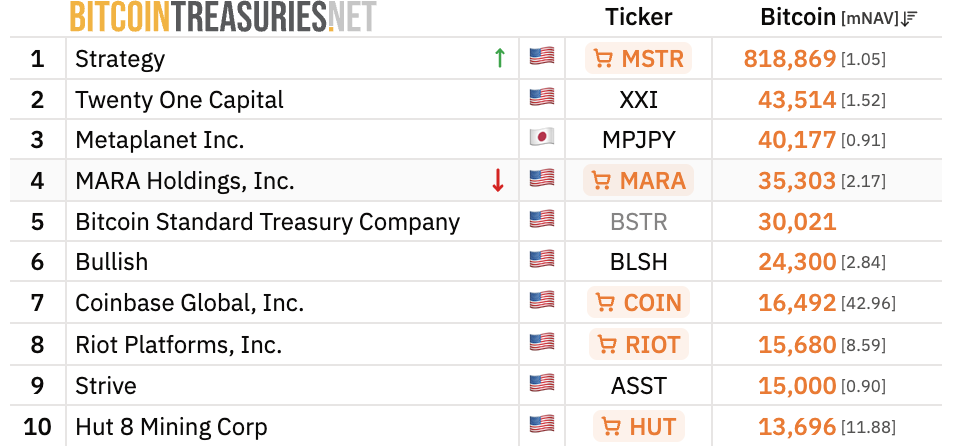
Marathon Digital Holdings, the largest Bitcoin Mining miner in America, has reportedly sold approximately $1.5 billion in Bitcoin, offloading roughly 20,880 BTC at an average price near $70,137 per coin, and announced it will not purchase additional mining hardware, pivoting instead toward AI infrastructure.
MARA stock was up 0.24% at the time of reporting, while BTC-USD was down 1.39%. Bearish signal for corporate Bitcoin treasury models.
The sale reduces MARA’s holdings from 38,689 BTC to approximately 35,303 BTC, ranking the company fourth among public Bitcoin holders.
Proceeds were used to repurchase convertible notes at a discount, cutting total debt from $3.3 billion to $2.3 billion, a 30% reduction, and generating a $71 million accounting gain. Q1 revenue fell 18% year-over-year to $174.6 million amid a $1.26 billion net loss.
How a $1.5B Bitcoin Mining Sale Works Mechanically, and Why the Timing Matters
MARA’s reported sale represents roughly 54% of its former Bitcoin stack by coin count, executed in tranches with 15,133 BTC ($1.1 billion) sold between March 4 and March 25, 2026.
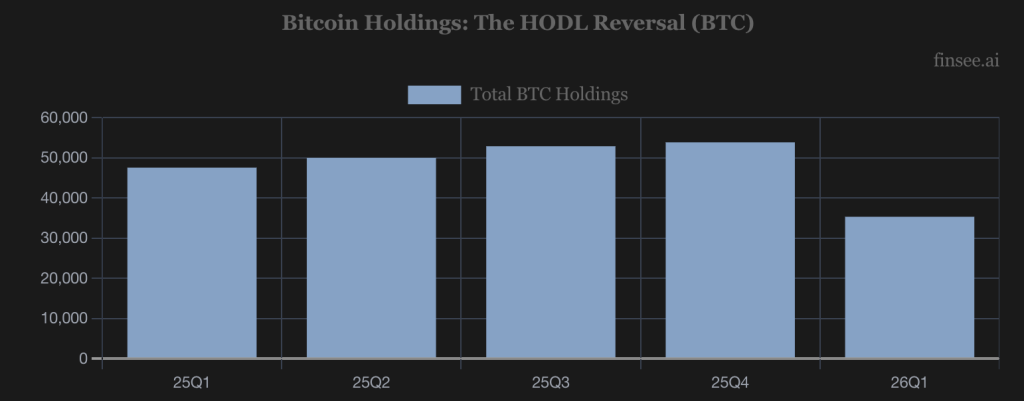
At current market prices, the remaining 35,303 BTC is valued at approximately $2.84 billion. That is a meaningful reserve. It is not the treasury-first posture the company was signaling 12 months ago.
The mechanics of the debt repurchase matter here. By retiring convertible notes at a discount, MARA locked in a $71 million accounting gain while simultaneously removing the interest burden that made the Saylor-style treasury model increasingly fragile at post-halving mining margins.
CEO Fred Thiel did not abandon Bitcoin. He used it as liquidity to stabilize a balance sheet that $3.3 billion in convertible notes had stretched thin.
That distinction is worth naming. Selling Bitcoin to service debt is operationally rational under margin pressure. It is not the same as abandoning a thesis. Those are not the same thing, and conflating them leads to the wrong analytical conclusion.
Does a $1.5B Sale Signal a Break in MARA’s Bitcoin Conviction – or Operational Cash Management?
Two readings compete here. The bearish read: MARA raised a convertible note explicitly to emulate Michael Saylor’s Bitcoin treasury accumulation strategy, then reversed course and liquidated a substantial portion of its stack within two earnings cycles.
If the conviction were genuine, the company would have found alternative debt service mechanisms rather than selling BTC near cycle lows.
The pivot to AI is a rebranding exercise covering a treasury model that failed stress testing.
The operational read: MARA produced 2,247 BTC in Q1 while simultaneously boosting its energized hashrate 33% year-over-year to 72.2 EH/s. It is still mining aggressively.
The $1.5 billion in AI infrastructure spending – anchored by a ~$1.5 billion acquisition of Long Ridge Energy’s 505-MW natural gas plant in Hannibal, Ohio, expected to yield $144 million in annual EBITDA – is not a retreat from hard assets. It is a rotation from one capital-intensive physical infrastructure play to another, with better margin economics in the current rate environment.
Scott Melker, host of The Daily Wolf on Yahoo Finance, framed the industry trajectory bluntly: “Bitcoin miners are no longer Bitcoin miners, they are AI companies that will also mine Bitcoin.”
That is not an indictment of Bitcoin conviction. It describes where the capital returns are. Bitcoin Society recent pause on Bitcoin treasury acquisition reflects a similar dynamic, corporate conviction around BTC holdings is being stress-tested across multiple balance sheets simultaneously, not just MARA’s.
The provisional conclusion: MARA’s sale is primarily a debt management event with a strategic pivot embedded inside it. The treasury model stress is real. The conviction collapse narrative is overstated.
The post Bitcoin Mining: MARA’s Reported $1.5B Bitcoin Sale Puts Corporate Treasury Conviction in Focus appeared first on Cryptonews.

Disclosure: This article does not represent investment advice. The content and materials featured on this page are for educational purposes only.
Shiba Inu faces renewed competition as AI-focused crypto projects attract trader attention in 2026.
Summary
- Shiba Inu remains under pressure in 2026 as AI-focused crypto projects like Poly Truth gain investor attention.
- Poly Truth is building AI-driven prediction market analysis while SHIB traders debate the memecoin’s next move.
- As SHIB struggles for momentum, Poly Truth targets growing demand for AI-powered event market intelligence.
Shiba Inu is still one of the most recognized memecoins, but its 2026 price action shows a slower story. As of today, the price of SHIB is $0.0000063, down 1.62% over 24 hours, with a market cap of about $3.71 billion and 24-hour volume near $120.3 million.
That keeps the Shiba Inu price prediction debate active, especially for traders comparing meme coins with newer AI crypto projects.
Meanwhile, Poly Truth is gaining attention through PTRUE, an Ethereum-based presale tied to prediction market intelligence rather than meme demand alone.
How SHIB is trading in May 2026
SHIB remains far below its 2021 peak. Current data shows its all-time high at $0.0000862, while the current price sits near $0.0000063, leaving the token more than 90% below that record level.
However, the token still has real market activity. Its circulating supply is above 589 trillion SHIB, and its monthly price move was positive at 8.62%, even as the 7-day move stayed negative.
This creates a mixed setup. SHIB still has brand power, but it needs stronger volume and broader meme coin demand to start another major run.
Can Shiba Inu reach its old high again?
A return to the old high would require a much stronger market than SHIB has now. The token would need a large flow of new money, since its supply is already massive and its market cap is still in the billions.
Kraken’s prediction tool shows a slower path under a 5% annual growth input. Its table places SHIB at $0.0000063 in 2026, $0.0000080 in 2031, and $0.000013 in 2041, with Kraken noting that these results are based on the selected input rather than a future performance signal.
CoinCodex is also cautious in the near term. Its 2026 range places SHIB between $0.000005491 and $0.000006587, with the upper target showing only 4.78% growth from the listed price.
That does not mean SHIB is finished. It means the next move depends on stronger meme coin demand, not only past fame.
Why memecoin traders are looking at new themes
Shiba Inu became popular because it was easy to understand. It had meme energy, a low unit price, and a large online community that helped it spread fast.
However, the market in 2026 is more selective. Traders still follow memecoins, but many also want tokens linked to tools, data, games, payments, or AI systems.
That shift helps explain why AI crypto coins are getting more attention. A token with a clear job can be easier to follow when the market becomes crowded.
What Poly Truth adds to the 2026 crypto world
Poly Truth is not trying to copy Shiba Inu’s memecoin path. Its angle is based on a different question, since prediction markets often move on fast news, shifting odds, and public sentiment.

That creates room for tools that help sort information faster. Poly Truth aims to turn scattered data into easier probability-led reports, which fit a market where traders already follow event odds, crypto price targets, and macro news.
PTRUE has a total supply of 11.5 billion tokens. The allocation is split across the main parts of the project.
- Presale receives 40%.
- Liquidity pool receives 17%.
- Development receives 13%.
- Team receives 10%.
- Staking rewards receive 10%.
- Marketing receives 8%.
- Community and airdrops receive 2%.
At the time of writing, Poly Truth displayed 4,452% staking rewards, a listed Ethereum token address, and audit logos from Coinsult and SolidProof.
Its roadmap moves from presale and staking into data source integrations, exchange listings, alpha access, a dashboard, a Telegram bot, governance, new markets, and added listings.

AI crypto coins are pulling attention from pure meme demand
AI crypto projects are gaining interest because they connect token use to data, automation, and market research. That makes the story different from older meme coins that rely mostly on social buzz.
Poly Truth fits that shift through prediction market intelligence. The project is built to read active prediction events across sports, politics, crypto, and other markets, then show which outcome has stronger data support.
The process has three moving parts.
- The Runners collect event data.
- The Starlet compares sources and calculates probability scores.
- The Presenter turns the work into a clear event brief.
This gives PTRUE a clear place in the AI crypto trend. It connects the token to access, staking, and future use inside a system built around data-backed prediction analysis.
What comes next for SHIB and AI tokens
The next Shiba Inu price prediction depends on whether memecoin demand can return with enough force. SHIB still has the name, the community, and the exchange access to stay relevant.
Still, the path to another huge move looks harder than it did in the early memecoin boom. SHIB now needs larger capital inflows to move sharply because its market cap is already far above that of smaller tokens.
Meanwhile, Poly Truth shows how newer crypto projects are taking a different route. PTRUE is tied to prediction intelligence, where the focus is on data, event analysis, and clearer market signals.That contrast is why both stories can exist at once. Shiba Inu remains a memecoin benchmark, while Poly Truth gives AI-focused crypto traders a newer angle to watch in 2026.
Disclosure: This content is provided by a third party. Neither crypto.news nor the author of this article endorses any product mentioned on this page. Users should conduct their own research before taking any action related to the company.

Key Takeaways
- Redwire shares climbed approximately 20% following the release of Q1 2026 results showing revenue of $97 million, representing a 57.9% year-over-year increase.
- The space infrastructure company closed the quarter with a backlog of $498.1 million, marking a 71.1% annual gain and a robust book-to-bill ratio of 1.92.
- Gross profit margin expanded significantly to 26.6%, compared to 14.7% in the prior-year period.
- Management maintained its full-year 2026 revenue forecast of $450 million to $500 million, implying roughly 41.6% growth at the midpoint.
- Wall Street firms including Alliance Global and Jefferies lifted their price targets after the earnings release, with executives highlighting wins in Andromeda, lunar energy infrastructure, and Stalker unmanned aerial systems.
Redwire (RDW) shares jumped nearly 20% during Wednesday’s trading session after the aerospace and defense contractor delivered impressive first-quarter earnings marked by a record order backlog and substantial margin expansion.
First-quarter revenue totaled $97 million, marking a 57.9% climb compared to the year-ago quarter. The performance was powered by gains across both operating divisions — space-related revenue reached $52.7 million, while the defense technology segment generated $44.3 million, largely boosted by the Edge Autonomy transaction, which has now been completely integrated under the Redwire brand.
Shares traded approximately 19.76% higher during Wednesday’s session, signaling strong investor confidence in the quarterly performance and maintained forward outlook.
Gross margin represented a standout metric for the period. The figure reached 26.6%, a substantial improvement from 14.7% one year earlier and 9.6% during the fourth quarter of 2025. Company leadership credited the expansion to an improved contract mix, the transition of products from development phases into full production, and enhanced operational efficiency.
The quarterly net loss totaled $76.5 million, although executives emphasized that over $44 million represented one-time charges, including $42.5 million in non-cash equity compensation related to the Edge Autonomy integration. Adjusted EBITDA came in at negative $9.2 million, but CEO Peter Cannito indicated the company would have achieved positive EBITDA when excluding voluntary research and development investments.
Pipeline Growth Accelerates With Defense Contract Momentum
New bookings reached $186.5 million during the three-month period, producing a book-to-bill ratio of 1.92. This propelled total backlog to $498.1 million — representing a 21.1% sequential increase and 71.1% year-over-year expansion.
On the defense side, Redwire secured over $20 million in additional orders for its Stalker drone systems from the U.S. Navy and Marine Corps. The Marine Corps also placed its inaugural order for the enhanced navigation variant of Stalker Block 30, a platform with approximately 250 units already deployed by the service branch.
The Stalker technology also saw action during the U.S. Army’s Ivy Sting training operations, where Cannito noted it served as the sole fixed-wing vertical takeoff and landing platform in attendance.
Additionally, Redwire won a prime contractor position with Belgium’s Ministry of Defence to develop the country’s inaugural national security satellite, alongside a quantum-encrypted satellite contract through the European Space Agency’s QKDSat initiative.
Andromeda Program Opens Door to $6 Billion Market
Redwire earned a spot among 14 companies selected for Space Systems Command’s Andromeda IDIQ vehicle, initially valued at $1.8 billion across a decade. Cannito revealed the program’s aggregate ceiling is now projected to exceed $6 billion.
The firm also landed a $12.8 million agreement to deliver ELSA solar arrays to Moog, plus an additional $4 million award from NASA supporting pharmaceutical experiments on the International Space Station utilizing Redwire’s PIL-BOX technology.
Cannito indicated the company is pursuing opportunities within a multi-orbit Golden Dome architecture and continues to compete for lunar power network contracts. Redwire’s Roll-Out Solar Arrays are being positioned as a foundational technology for lunar electrical grid systems.
Full-year 2026 revenue guidance was held steady at $450 million to $500 million. The company closed the first quarter with $175.2 million in total liquidity, including $145.2 million in cash reserves.
Both Alliance Global and Jefferies analysts increased their price targets in response to the quarterly results.


Ripple’s native cross-border token is among the most popular assets within the cryptocurrency community, and the CEO of the company behind it recently published a video explaining what makes it unique.
Some of those features include rapid transaction speeds and low costs.
Why Is XRP Unique?
Garlinghouse’s video began with a short history lesson going back to the early XRP Ledger days from a decade ago. Contributors at the time included key developers who worked on the core of Bitcoin, where they saw an opportunity to “build something specialized and specific and unique to really solve a payments problem.”
This is where the cross-border token shines, according to Garlinghouse. At first, he began by outlining the settling speeds where transactions are completed in 3 to 5 seconds. Second: “it’s cost. Extremely low costs, fractions of a penny per transaction.” Third: XRP’s scalability, with over 4 billion transactions completed since its inception. Last but not least, the CEO highlighted the “incredible community” around the token, which the company calls “the XRP family.”
“But you put those things together, and you can include the longevity of this blockchain, you have something special and unique that is poised for great success in the years ahead.”
XRP Price Update
While on the topic of XRP, let’s quickly explore its most recent price moves. The token tried to break out on Sunday when it outperformed the rest of the larger-cap alts, but it was almost instantly halted at $1.52 and driven back down toward $1.45. It has since slipped below that level as most of the crypto market has retreated.
What’s particularly worrying is that it lost the fourth spot in terms of market cap to BNB, and the gap between the two stands at $1.5 billion as of press time.
Popular analyst MikybullCrypto noted that XRP has been forming a “possible breakout of the 9-month trendline resistance,” which could be supported by an ongoing significant accumulation at this triangle formation. CRYPTOWZRD said XRP had closed indecisively once again as it needs to hold above the $1.445 resistance to initiate a more profound run. As of now, though, the asset remains below that important level.
The post Why Is XRP Special and Unique? Garlinghouse Reveals Ripple’s Biggest Advantages appeared first on CryptoPotato.

Key takeaways
- Quant (QNT) extends its rally toward $80, supported by rising whale and retail demand.
- A breakout above the $80 resistance could set the stage for a potential rise toward $100.
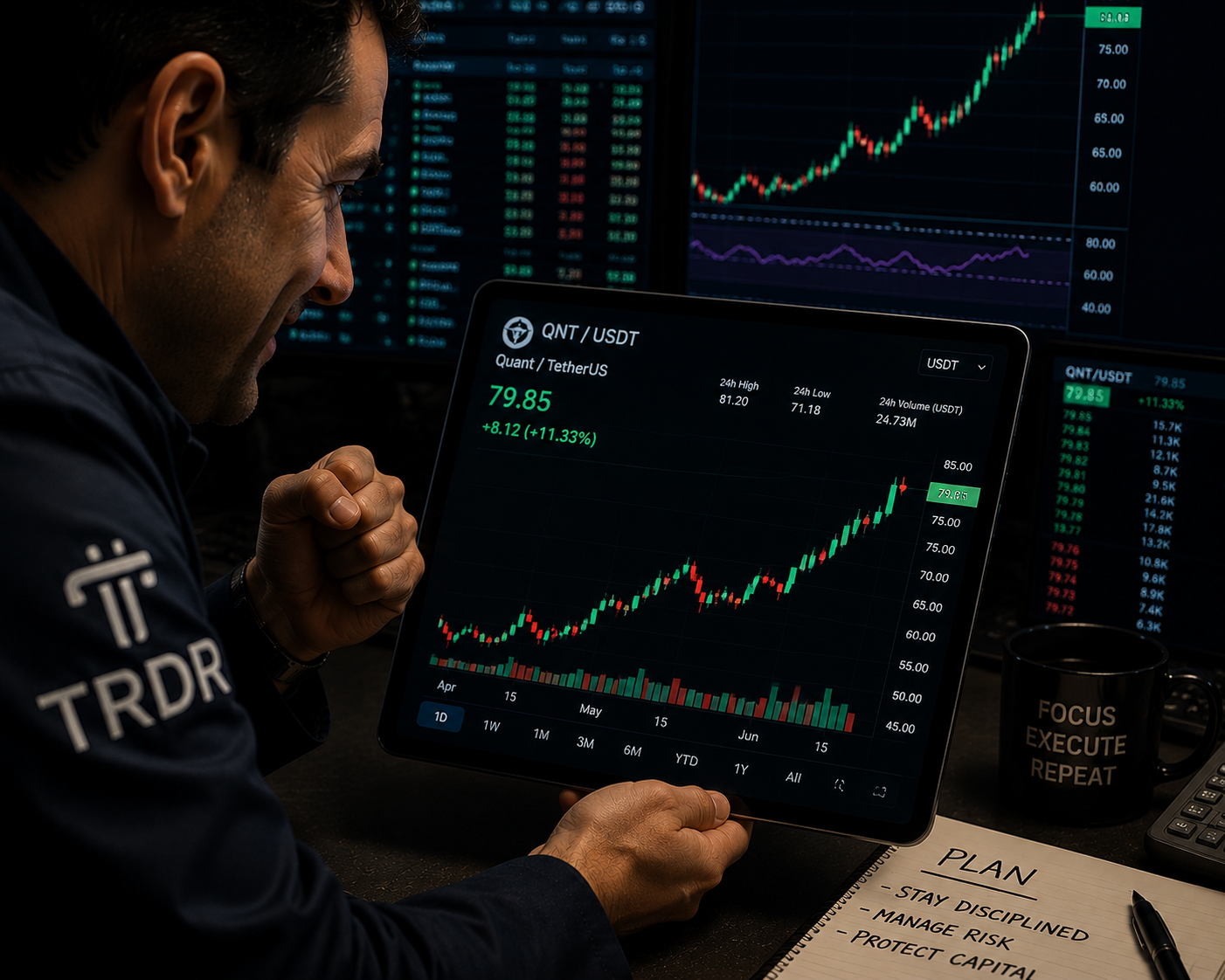
Quant (QNT) has extended its recent gains towards the $80 mark on Thursday, testing the potential breakout from a long-standing resistance trendline.
The cryptocurrency’s bullish technical outlook is supported by rising leverage-based activity from large wallet investors, or whales, with a daily close above $80 paving the way for a possible rally toward the $100 target.
Whale and retail demand fuel Quant’s steady recovery
Quant’s steady short-term recovery is being driven by growing demand from both retail and large-wallet investors.
CryptoQuant data reveals an increase in the average order size of executed orders in the leverage market, indicating heightened whale activity. Additionally, the 90-day cumulative volume difference between buy and sell orders reflects a clear buy dominance, further supporting bullish sentiment.
CoinGlass data shows that QNT futures Open Interest (OI) has surged to $17.61 million, up significantly from $16.96 million on May 1.
This steady recovery in QNT futures is now approaching the peak of $38.27 million reached on September 21, indicating continued investor interest and positive market sentiment.
Technical outlook: Will Quant reach $100?
The QNT/USD 4-hour chart is bullish as Quant is up by 7% in the last 24 hours. It is currently trading at $78, above the 200-day Exponential Moving Average (EMA) near $77.52.
The Moving Average Convergence Divergence (MACD) histogram is positive, with the MACD line crossing above its signal and both moving above zero, signaling strong bullish momentum.
The Relative Strength Index (RSI) hovers around 64, indicating firm bullish momentum, though edging closer to overbought territory as price approaches higher resistance levels.
If the rally continues, a decisive close above the descending trendline break level near $77.89 would confirm a breakout from the triangle pattern on the daily chart.
Such a breakout could pave the way for a rally toward the $88.30 swing high, followed by the 127.2% Fibonacci extension level at $101.14.

However, if the bears regain control of the market, they would encounter initial support at the 50-day EMA near $72.03.
A deeper pullback would target the 50% retracement level around $68.79, with further support found at the former rising trendline region near $67.86 and the 38.2% retracement near $66.86.
Crypto World
Interactive Brokers Rolls Out Centralized Prediction Market Trading Hub with Kalshi Partnership

Key Highlights
- Interactive Brokers debuts a consolidated platform enabling access to prediction market instruments from Kalshi, CME Group, and ForecastEx through a single interface.
- Traders can take positions on political races, weather phenomena, and financial metrics — entertainment and sporting event contracts remain unavailable.
- Smart order routing technology directs trades to the exchange offering optimal pricing after accounting for transaction costs.
- Kalshi reports institutional participation has surged eight times over a half-year period and recently introduced block trading capabilities for high-volume participants.
- The brokerage firm posted all-time high first-quarter 2026 revenues of $1.68 billion with client accounts reaching 4.859 million, representing 31% annual growth.
Interactive Brokers has introduced a consolidated trading dashboard that provides clients with unified access to prediction market instruments across three domestic platforms: Kalshi, CME Group, and the company’s proprietary ForecastEx offering.
The trading interface became accessible to qualified users this week. Prediction contracts from Kalshi and CME Group are being incorporated progressively, with access determined by each client’s geographic location.
Traders can take binary positions on various scenarios including political election outcomes, environmental developments, and macroeconomic trends. The brokerage firm has indicated it will not incorporate contracts related to athletic competitions or entertainment industry events in the near term.
The integrated system displays pricing information from all three marketplaces and employs intelligent routing to execute orders at the most favorable net cost including commissions. Account holders can engage with prediction markets while maintaining positions in equities, derivatives, currency pairs, digital assets, and fixed income securities — eliminating the need for multiple account registrations.
Company founder and chairman Thomas Peterffy noted growing appetite from institutional capital allocators seeking to utilize prediction markets as hedging instruments against environmental catastrophes, climate change impacts, and raw material price volatility. He anticipates broader institutional participation as market depth increases.
Wall Street Participation Accelerates
Kalshi disclosed earlier this month that institutional transaction volume on its marketplace has multiplied eightfold during the preceding six-month window. The platform operator also unveiled block trading functionality, facilitating large-scale private negotiations characteristic of professional investor activity.
Kalshi co-founder and CEO Tarek Mansour rejected assertions that institutional market participants create asymmetric advantages. He referenced internal performance metrics demonstrating that individual traders without financial industry experience consistently rank among the platform’s most successful participants, outperforming institutional counterparts.
Detractors have characterized prediction markets as gambling mechanisms due to their binary payout structure. Market participants pay prices ranging from one cent to ninety-nine cents per contract, collecting one dollar upon correct predictions while forfeiting their entire investment when incorrect.
Peterffy dismissed the gambling comparison as “a silly concern,” emphasizing that these instruments address substantive questions regarding economic conditions and geopolitical developments.
Brokerage Firm’s Financial Results
Interactive Brokers announced record-breaking revenues of $1.68 billion for the first quarter of 2026, delivering earnings per share of $0.60 that aligned precisely with Wall Street consensus estimates. Customer accounts totaled 4.859 million as of April’s conclusion, marking a 31% year-over-year expansion.
Average daily trading volume for April reached 4.241 million transactions, an 11% improvement compared to the corresponding period last year. BMO Capital upgraded its price objective for Interactive Brokers shares to $93 following the quarterly report, maintaining its Outperform rating.
The equity has generated approximately 68% returns over the trailing twelve months and recently approached its 52-week peak of $87.37. The corporation commands a market valuation near $144 billion.
Top-line revenues for the firm expanded 19% over the past year to $6.4 billion.
Interactive Brokers indicated plans to broaden marketplace connectivity beyond the three currently integrated exchanges.
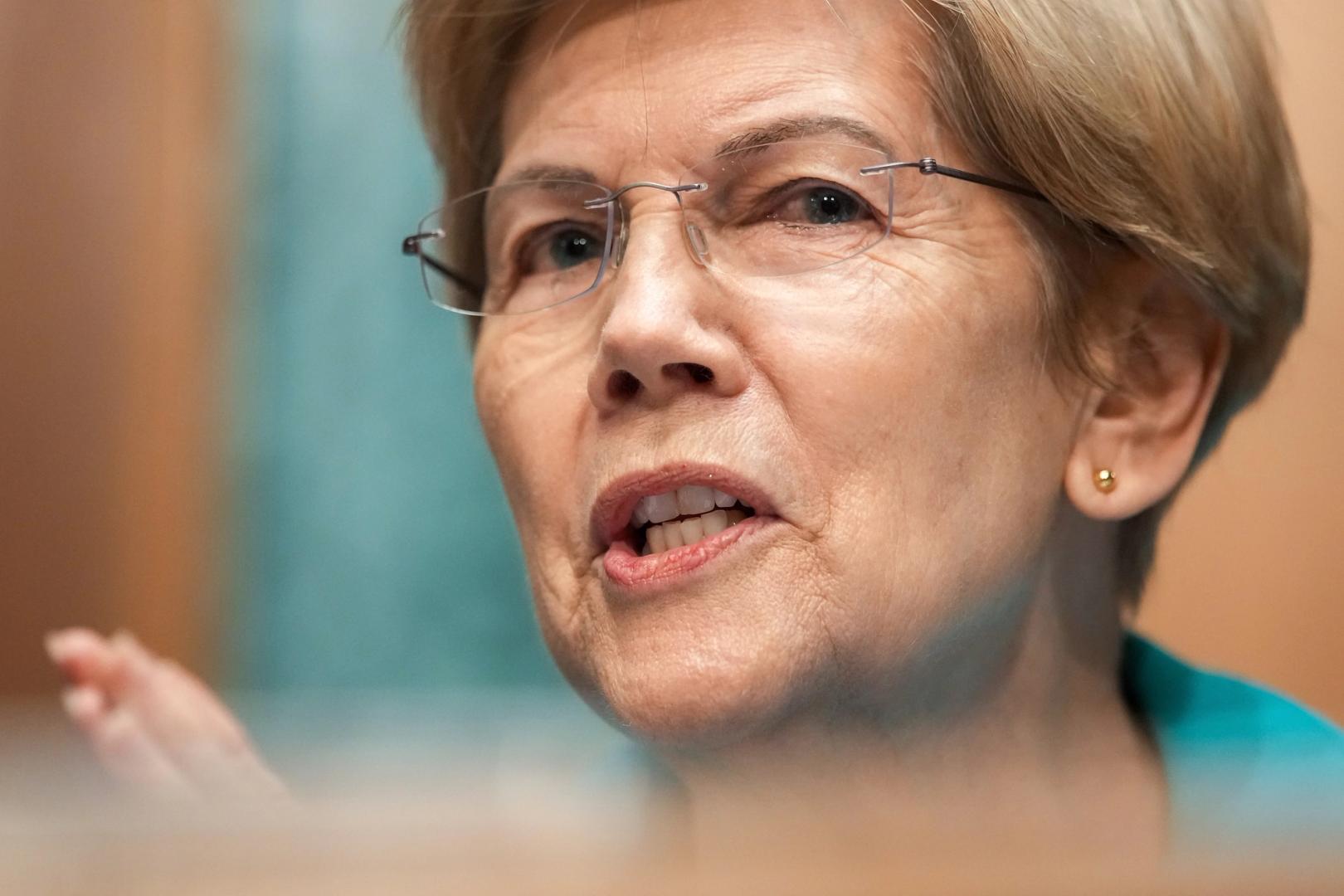
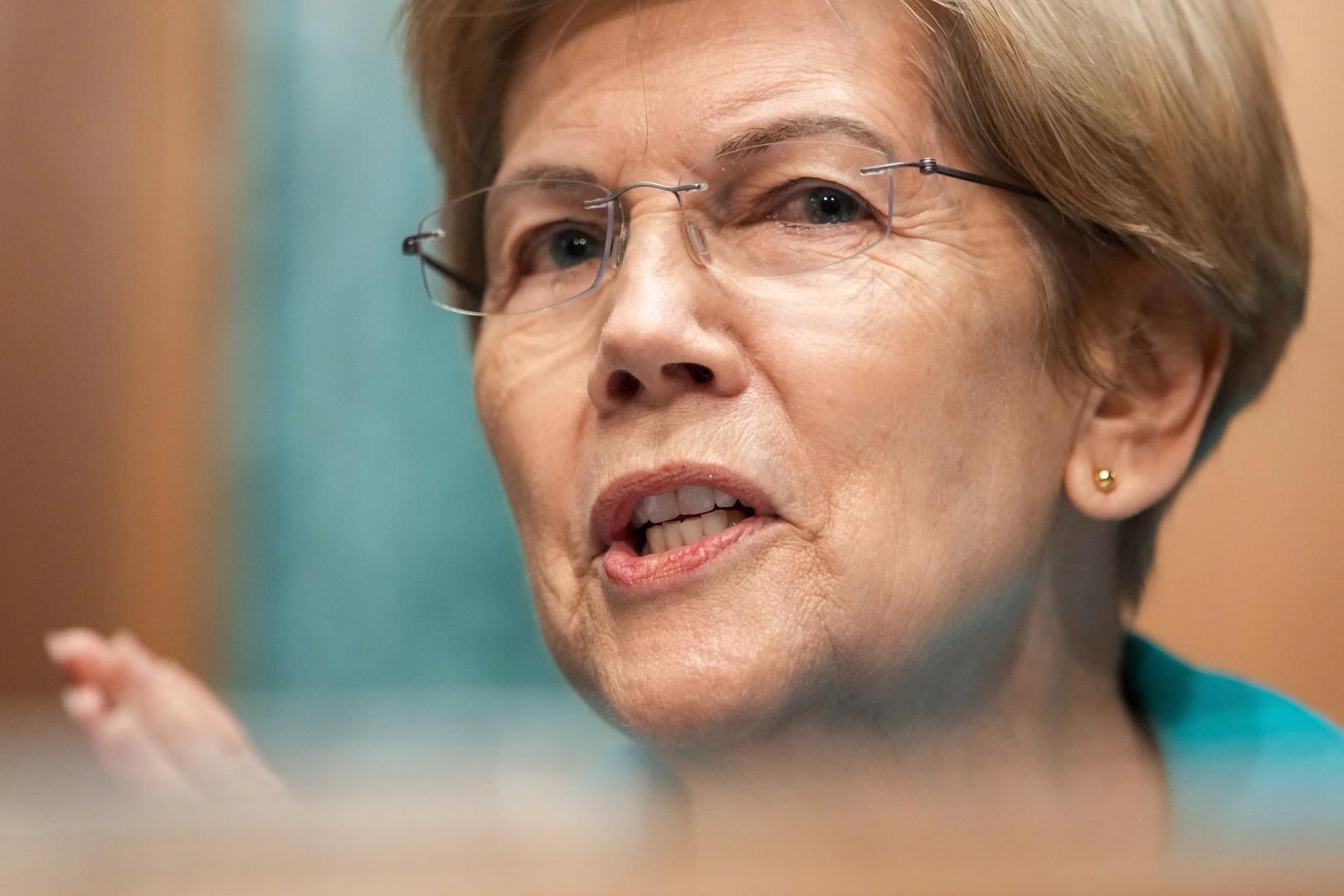
As U.S. senators launched the long-awaited hearing called to advance the crypto market structure legislation, they granted that there was still a rift between Republicans and Democrats on the latest version of the Digital Asset Market Clarity Act.
The Thursday hearing of the Senate Banking Committee, known as a “markup” hearing to weigh dozens of amendments to revise and overhaul the bill’s language, represents a key moment in the process to move this policy effort past a longtime roadblock. Republican senators may be the only supporters at this moment, but the eventual aim is to finish with a bipartisan version that can pass the overall Senate with sufficient Democratic support.
Members of the committee began their session with a nod to difficult, bipartisan talks that have seemingly still led to an impasse Thursday on the latest version of the legislation.
“We will disagree on this today, but I hope that what we end up with is a legislative product that is good now and gets another bite at the apple as it heads to the floor,” said Chairman Tim Scott. “This is not over, and I hope that no one thinks that this is over. This process has been transparent. It has been hard and it has been clear, and that’s good news for the American people who are watching this process.”
Down to the wire, lawmakers and their staffs sought to hash out remaining issues, including the bill’s treatment of decentralized finance (DeFi) and a major government-ethics provision to keep senior officials out of the crypto industry. If the bill passes along party lines at the end of the hearing, 13-11, it still moves forward to the next steps, including merger with a similar bill that already passed the Senate Agriculture Committee.
“This is by far the hardest piece of legislation I have ever worked on,” said Senator Cynthia Lummis, a Wyoming Republican who leads the panel’s digital assets subcommittee. She noted that it’s a “case of first impression” and seeks to address new innovations. Lummis said the lawmakers negotiating the bill will keep working on the “1% of remaining issues that didn’t come to fruition before today, despite our around-the-clock negotiations.”
A fundamental disconnect was apparent at the hearing, because the most senior Democrats — including ranking member Elizabeth Warren — were the legislation’s most vocal critics, while the many Democrats who actively participated in negotiations with Republicans weren’t engaged in the opening remarks.
“This bill is just not ready for prime time,” Warren said. “First, the draft in front of us would blow a hole in our securities laws that have protected investors since 1929. Most Americans don’t want their pensions at risk so that a few crypto billionaires can juice their own profits. Second, this bill declares open season on defrauding American consumers who use crypto.”
Democrats objected to many amendments that were scrapped on procedural grounds before the hearing began, though Scott contended that the procedural dispute began with Democrats targeting a Republican amendment.
The hearing began knocking down most of the Democratic amendments one-by-one along partisan lines, with lawmakers briefly making their cases for each. The partisanship was reminiscent of the similar markup earlier this year in the agriculture panel, though some provisions received successful votes on Thursday, such as an amendment regarding the extension of government protections involving the practice of calculating margin across portfolios.
While Democrats continued to express resistance to Clarity Act language and argue it hadn’t answered significant questions on illicit finance and consumer protection, Republicans argued that much of the bill addresses those concerns — which currently have no federal protections — for the first time.
Senator Thom Tillis, the Republican who helped lead talks over a longtime sticking point involving yield on stablecoins, countered that, “The status quo, quite honestly, is unacceptable.”
Read More: Clarity Act, in the flesh, unveiled by U.S. Senate Banking Committee before hearing

Disclosure: This article does not represent investment advice. The content and materials featured on this page are for educational purposes only.
AI crypto sector grows to $25.7B as projects like Poly Truth target prediction market intelligence.
Summary
- AI crypto tokens now hold a $25.7B market cap as projects like Poly Truth target prediction market analysis.
- Poly Truth uses AI-style event analysis to help users assess prediction markets across crypto, politics, and sports.
- As AI crypto grows, Poly Truth is positioning PTRUE around data-driven prediction market intelligence.
AI tokens have become one of the main crypto stories heading into 2026. CoinGecko’s artificial intelligence category shows a market cap of $25.7 billion, with around $3.3 billion in 24-hour trading volume.
The category now includes large listed names such as Chainlink, Bittensor, NEAR Protocol, Internet Computer, Render, Virtuals Protocol, and Artificial Superintelligence Alliance.
That size changes the search for the next crypto to explode. Many larger AI coins already have deep liquidity and public market history, but they also need bigger capital inflows to move sharply. Early-stage projects can attract more attention when they link AI to a use case that feels timely.
Poly Truth is entering that space through PTRUE, an Ethereum-based presale token built around prediction market intelligence. Its focus is not on automated trading. The project uses AI-style data analysis to help users judge prediction events across sports, politics, crypto, and other markets with more context.
AI crypto is moving beyond simple market hype
The AI crypto sector is no longer made up only of small tokens using a popular label. CoinGecko lists AI tokens across data networks, compute markets, agent platforms, indexing tools, and blockchain infrastructure. That makes the sector broader, but also harder to judge.
The best AI crypto coins usually have one clear trait. Their token has to connect to a real task. That can mean paying for compute, routing data, rewarding network work, supporting agents, or giving access to a product.
This is where Poly Truth’s pitch becomes easier to understand. Prediction markets already depend on data. Traders need to compare news, odds, sentiment, history, price action, and event timing. Poly Truth is building around that need by turning scattered event data into probability-led reports.
Prediction markets give AI a clear crypto use case
Prediction markets have grown into a serious event-trading category. Kalshi recently raised $1 billion at a $22 billion valuation, with backers including Coatue, Sequoia Capital, Andreessen Horowitz, IVP, Paradigm, Morgan Stanley, and ARK Invest.
The Financial Times also reported that Kalshi’s trading volume reached $178 billion in April, up from $5.5 billion one year earlier.
That growth explains why data tools are becoming more important. Prediction markets cover events that can change quickly, including elections, sports, inflation, crypto prices, central bank decisions, and geopolitical risks. The crowd can price those events, but the crowd does not always explain which side has stronger support.
Poly Truth uses three roles to organize that process.
The Runners collect data from active prediction events across the internet.
The Starlet compares sources, finds patterns, and calculates probability scores.
The Presenter turns the analysis into a final event brief showing the stronger side, the probability score, and the reasoning behind it.

Why PTRUE is drawing early attention
PTRUE is the token connected to Poly Truth’s future access and staking model. The project has a total supply of 11.5 billion tokens, with the largest share set aside for the presale.
The contract address listed on the Poly Truth website is 0xbAD9Ef869539999cB9786c00c6B4BB435A905F49.

The token split is simple to scan.
- Presale receives 40%.
- Liquidity pool receives 17%.
- Development receives 13%.
- Team receives 10%.
- Staking rewards receive 10%.
- Marketing receives 8%.
- Community and airdrops receive 2%.
Poly Truth currently displays 4,452% staking rewards and audit logos from Coinsult and SolidProof.
The roadmap starts with presale and staking, then moves to data source integrations, whitepaper publication, exchange listings, alpha access, a dashboard and Telegram bot, token claim, public product release, governance, new markets, and additional listings.
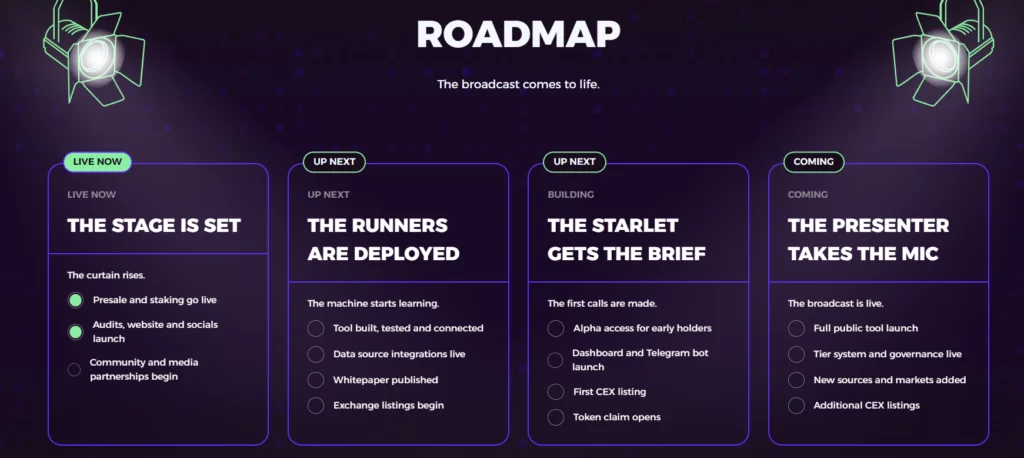
Those details help separate PTRUE from a plain AI token narrative. The presale is tied to a defined product idea, a fixed token supply, public token allocation, and a category that is gaining wider market attention.
The 2026 setup favors AI projects with clear jobs
The search for the next crypto to explode often starts with price, but price alone does not say much. A low presale price can attract attention, yet long-term demand depends on product use, liquidity, trust, and the strength of the market category.
For Poly Truth, the stronger point is not only that it uses AI. The stronger point is that prediction markets need cleaner information.
When an event market moves, traders need to know what changed and why the odds shifted. A system that gathers data, compares signals, and explains probability scores has a clearer job than a token built only around a broad AI theme.
This matters because the best AI crypto coins in 2026 are likely to face more scrutiny. The market has already seen many AI-labeled tokens rise and fade.
Projects with a direct link between token use and product demand may have a better chance of holding attention.
Why crypto hunters are watching AI prediction tools
AI crypto is already a large sector, but much of the next cycle may depend on practical use. Prediction markets offer one of the clearer places for AI analysis because events move quickly, and users need better signal quality.Poly Truth brings that idea into a presale format through PTRUE. The project connects AI-style analysis with prediction market data, while its roadmap points toward tools that could turn raw event information into easier decisions.
Disclosure: This content is provided by a third party. Neither crypto.news nor the author of this article endorses any product mentioned on this page. Users should conduct their own research before taking any action related to the company.

Why is Kai Rooney not playing in FA Youth Cup final for Man United? Full reason explained

How much a Financial Planner makes in Toronto

Strait of Hormuz Remains Largely Closed Amid Iran Conflict as Trump-Xi Summit Eyes Resolution

Manchester United reach agreement with Casemiro over contract clause amid transfer speculation

US brings back mandatory military draft registration

Steven Gerrard disagrees with Gary Neville over ‘shock’ Chelsea and Arsenal claim | Football


-
 Crypto World6 days ago
HarrisX Poll Found 52% of Registered Voters Support the CLARITY Act
-

 Fashion6 days ago
Weekend Open Thread: Marianne Dress
-

 Fashion3 days ago
Coffee Break: Travel Steam Iron
-

 Fashion4 days ago
What to Know Before Buying a Curling Wand or Curling Iron
-

 Tech4 days ago
Auto Enthusiast Carves Functional Two-Stroke Engine from Solid Metal
-

 Politics3 days ago
What to expect when you’re expecting a budget
-
 Business5 days ago
Ignore market noise, India’s long-term story intact, say D-Street bulls Ramesh Damani and Sunil Singhania
-

 Politics5 days ago
Politics Home Article | Starmer Enters The Danger Zone
-

 Tech3 days ago
GM Agrees To Pay $12.75 Million To Settle California Lawsuit Over Misuse Of Customers’ Driving Data
-

 Politics7 days ago
Simon Cowell Says He Was ‘Horrible’ To Susan Boyle During BGT Audition
-

 Entertainment7 days ago
General Hospital: Ric & Ava Bombshell – Ric’s Massive Secret Exposed!
-

 Crypto World5 days ago
PROS explodes 48% as Upbit and Bithumb listings ignite demand
-

 Crypto World4 days ago
CZ says US crypto rivals tried to block Trump pardon
-

 Sports6 days ago
Bayern Munich vs PSG UEFA Champions League SF2 live match time, streaming | Football News
-

 Entertainment6 days ago
YNW Melly Denied Bond Again Ahead Of Double Murder Retrial
-

 Tech3 days ago
GM agrees to $12.75M California settlement over sale of drivers’ data
-

 Politics7 days ago
Euphoria Creator Praises Sydney Sweeney Amid Season 3 Scenes Backlash
-
Entertainment7 days ago
Hantavirus — cause of death for Gene Hackman's wife — at the center of Dutch cruise outbreak
-
Crypto World6 days ago
The Hantavirus Danger: Can a Potential Outbreak Spark a New Meme Coin Frenzy?
-

 Politics6 days ago
David Attenborough ‘Overwhelmed’ By Love Shown Ahead Of 100th Birthday
You must be logged in to post a comment Login