

Crypto World
Hana Bank makes $670M Upbit parent bet as Korea crypto shifts



Hana Bank will buy 2.28 million shares in Dunamu, the parent company of Upbit, from Kakao Investments for about 1.003 trillion won, or nearly $670 million.
Summary
- Hana Bank’s Dunamu stake gives it direct exposure to South Korea’s largest crypto exchange operator.
- Kakao Investments will reduce its Dunamu holding as Hana becomes the fourth-largest shareholder.
- The deal comes as Dunamu works through its planned merger with Naver Financial.
The deal gives Hana Bank a 6.55% stake in Dunamu and makes it the company’s fourth-largest shareholder. Reuters reported the deal as a 1 trillion won transaction based on regulatory filings.
The transaction is expected to close on June 15. Kakao Investments will keep 1.4 million Dunamu shares after the sale, equal to a 4.03% stake. The sale changes Dunamu’s investor structure as major Korean finance and technology groups move closer to crypto businesses.
Banking groups move closer to crypto
Hana said the investment aims to “secure competitiveness in the new financial landscape.” The wording shows the bank is treating digital assets as part of its wider financial services plan, rather than a short-term market trade.
The purchase also follows earlier moves by Hana-linked units. Hana Card signed a USDC-related marketing deal with Circle and Crypto.com in March, while Hana Bank and SK Telecom partnered with BitGo in 2024 to set up BitGo Korea, where Hana owns 25%.
Dunamu is already part of a wider corporate process involving Naver Financial. Crypto.news reported in April that South Korea’s Financial Supervisory Service ordered Dunamu to correct major omissions in filings linked to its stock swap with Naver Financial.
The same report said the deal would make Dunamu a wholly owned Naver Financial subsidiary, but regulatory, competition and legislative reviews remain part of the process. Earlier coverage placed Dunamu’s implied value near $10 billion and the broader merger around $14.5 billion.
Upbit dominates Korea’s exchange market
Upbit remains South Korea’s largest crypto trading platform. Reuters reported that the exchange handles more than 80% of the country’s virtual asset trading volume, making Dunamu one of the most watched crypto firms in Asia.
Recent market updates show Upbit still drives activity in Korean crypto trading. Crypto.news reported fresh Upbit actions this week, including a Cosmos ATOM transfer pause for a network upgrade and the planned delisting of NKN’s BTC market in June.
Korea’s rules add to the timing
The Hana-Dunamu deal comes as South Korea works on the Digital Asset Basic Act. Crypto.news reported that the law was delayed into 2026 as regulators debated stablecoin oversight and the role of banks in issuance.
Separate coverage said the ruling party’s draft law includes tighter stablecoin rules, including a 5 billion won capital bar. That makes Hana’s Dunamu stake part of a larger shift, as banks, exchanges and technology groups prepare for clearer digital asset rules.

Crypto World
Netomi CEO says $5 trillion AI customer experience market could boost stablecoin demand


The customer experience industry will become a $5 trillion market by 2030, according to Netomi founder and CEO Puneet Mehta, who says that growth will create demand for stablecoins and blockchain-based payment infrastructure rather than pull capital away from crypto.
Mehta said companies currently spend roughly $500 billion annually on customer experience-related knowledge work. As AI expands beyond customer support into sales, conversion, upselling and cross-selling, he expects the market opportunity to grow tenfold by 2030.
“Customer experience today is structured as a silo,” Mehta said. “That layer of technology and people does not fully talk to every system and every process autonomously in the company. Once that starts to happen, it unlocks a much bigger category.”
Mehta, whose company recently raised $110 million in a Series C round backed by Accenture Ventures and Adobe Ventures, argues that the rise of artificial intelligence and crypto should be viewed as complementary trends rather than competing sectors.
“The idea that AI is simply sucking capital away from crypto is a fundamental misunderstanding of where technology is heading,” said Mehta, who previously worked as an engineer and data scientist at IBM and later held similar roles at JPMorgan, Citi and Merrill Lynch. “We are not in a zero-sum battle for venture dollars.”
Mehta’s view that AI agents will require faster financial infrastructure aligns with a growing argument among crypto executives that autonomous software could become a major driver of stablecoin adoption.
Fiat-pegged cryptocurrencies are entering a new phase of adoption, with large corporations using them for cross-border treasury flows while AI agents begin using blockchain rails for autonomous payments, Bridge and Deus X Capital executives recently said at Consensus 2026. In April, Chainalysis said stablecoins are on track to become a foundational layer of global finance, with adjusted transaction volumes projected to reach $719 trillion by 2035
AI enabling crypto
The next phase of enterprise software will rely on autonomous AI agents capable of handling increasingly complex business functions, including financial transactions, according to Mehta.
“AI agents are moving money and assets faster than legacy enterprises can follow,” he said. “An autonomous agent cannot rely on traditional banking systems that take days to settle transactions via manual paperwork. ”
Mehta argues that fully automated software systems require two key components: AI systems capable of decision-making and blockchain payment infrastructure capable of moving money instantly.
“To achieve true end-to-end automation, these software systems require always-on capital rails that operate 24/7,” he said.
That requirement could drive greater demand for stablecoins and blockchain-based settlement networks that operate around the clock (24/7). Stablecoin issuers and crypto payment firms have increasingly positioned their products as tools for real-time settlement and cross-border transactions.
Still, many enterprise software companies continue to rely on traditional payment providers and banking networks, and it remains unclear how quickly blockchain-based settlement systems will become a standard component of AI-driven commerce.
Unicorn status
Netomi’s latest raise brings its total funding to $168 million. Mehta declined to disclose the company’s valuation but said the company is nearing unicorn status.
Netomi, whose clients include global giants such as Delta, United Airlines, MetLife, ESPN, and ATB Financial, is building a unified AI platform rather than a collection of disconnected tools, he said.
While many enterprise AI providers focus on individual functions such as customer service, legal operations or sales support, he explained, Netomi is building systems that work across those functions and share information between them.
“Most companies are building point solutions,” Mehta said. “They’re solving one problem at a time. We believe the future is a connected enterprise where AI systems aren’t operating in silos but working together across the entire organization.”
UPDATE (June 10, 17:10 UTC): Adds section on Netomi nearing unicorn status.

[PRESS RELEASE – Delaware, USA, June 10th, 2026]
Alltoscan, a multi-blockchain explorer ecosystem infrastructure provider, has announced the official launch schedule for its new token burn mechanism, designed to systematically restructure its native tokenomics model.
The integration of this deflationary protocol follows the company’s verified strategic roadmap, establishing a fixed schedule to gradually reduce the total available supply of its native utility token, ATS.
Scheduled Phases and Supply Reduction Targets
The native token of the Alltoscan ecosystem, ATS, currently maintains a maximum total supply of 100 million tokens. According to the technical documentation released by the development team, the newly implemented protocol will automate consecutive burn events until the maximum supply reaches a fixed ceiling of exactly 30 million tokens.
The initial phase of this protocol is scheduled to be executed between June 25th and June 30th, initiating the first major reduction phase toward the long-term 70% supply contraction target.
Verification of the Buyback Mechanism and Circulating Supply Data
In contrast to conventional ecosystem burn models that utilize locked or unreleased treasury reserves, the Alltoscan development team confirmed that this protocol directly targets active market supply. The assets designated for the permanent burn address consist entirely of ATS tokens accumulated via the company’s corporate revenue-funded buyback program implemented since the token’s initial public listing.
By removing active tokens directly from the open market rather than non-circulating smart contracts, the mechanism is engineered to directly alter the current supply-demand equilibrium across integrated global digital asset exchanges.
Current Protocol Metrics and Infrastructure Valuations
According to current market dashboard tracking data, Alltoscan’s structural financial metrics reflect the following baselines prior to the execution of the June protocol update:
- Current Market Capitalization: $9 Million
- Fully Diluted Valuation (FDV): $12 Million
- Historical Maximum Valuation (ATH): $2.5
The reduction of the total token framework from 100 million to 30 million structurally modifies the underlying distribution metrics. Industry tracking models indicate that reducing total supply while holding baseline market capitalization constant alters the mathematical allocation per token unit. This adjustment comes as the protocol operates below its historical valuation peak of $2.5, recorded during previous infrastructure deployment phases.
Historical Precedents in Decentralized Tokenomics
The implementation of systematic supply adjustment protocols represents an established method within decentralized networks seeking to align long-term ecosystem balance:
- Binance Coin (BNB): Digital asset platforms utilize corporate revenue percentages to execute open-market buybacks, establishing structured supply-reduction schedules over multi-year periods.
- Shiba Inu (SHIB): Network contract deployments have historically utilized large-scale single-event token transfers to unrecoverable dead addresses to alter initial deployment architectures.
Alltoscan’s deployment relies on a programmatic corporate buyback framework tied directly to functional platform performance and operational utility revenues.
About Alltoscan
Alltoscan is a Web3 infrastructure provider specializing in multi-blockchain explorer solutions, designed to improve data transparency and cross-chain tracking efficiency across decentralized networks.
Website: https://ats.alltoscan.com/
The post Alltoscan Announces Token Burn Protocol to Adjust ATS Supply Dynamics appeared first on CryptoPotato.

Key Highlights
- Security Matters shares advanced 4.51% following platform introduction.
- New system emphasizes verified recycled plastic with enhanced monitoring capabilities.
- Digital Material Passports enable transparent recycled plastic commerce.
- Company registry designed to authenticate recycled plastic standards and availability.
- Plastic Cycle Token system provides digital oversight for recycling verification.
Security Matters (SMX) experienced upward momentum on Wednesday following the introduction of its Circularity-as-a-Service solution designed for the worldwide plastics sector. Shares reached $13.68, climbing 4.51%, as initial trading fluctuations transitioned into more stable afternoon activity. This debut establishes the company’s focus on authenticated recycled materials, transparent supply networks, and digital infrastructure for market operations.
SMX (Security Matters) Public Limited Company, SMX
Security Matters Debuts Circular Economy Platform for Plastics
SMX announced the solution is designed to transform recycled plastic into an authenticated and commercially viable industrial commodity. The infrastructure integrates molecular identification technology, reader networks, Digital Material Passports, and a comprehensive recycled materials registry. Additionally, it incorporates marketplace functionality and Plastic Cycle Tokens to validate recycling achievements.
The platform was developed in response to a plastics industry confronting increased financial pressures and supply uncertainties. Geopolitical conflicts, petroleum price instability, petrochemical production interruptions, trade restrictions, and environmental levies have fundamentally altered manufacturing economics. Consequently, producers now require documented evidence of recycled composition, provenance, and custody documentation.
Security Matters characterizes this transformation as the Age of Parity, wherein recycled plastics compete beyond environmental marketing narratives. The organization contends that authenticated recycled materials can achieve enhanced economic standing as virgin plastic pricing remains volatile. Accordingly, the solution emphasizes documentation, certification, and quantifiable circular economy metrics.
System Monitors Provenance, Standards and Regulatory Adherence
Every recycled material batch can receive a Digital Material Passport within the Security Matters framework. These passports document polymer classification, recycled percentage, origin point, quality grade, quantity, and authentication records. They additionally monitor reprocessing cycles, commercial exchanges, and regulatory compliance information for industry stakeholders.
The infrastructure addresses multiple segments throughout the plastics ecosystem. Participants include collection operations, sorting facilities, material recovery centers, reprocessing plants, compounding operations, pellet manufacturers and resin suppliers. The platform also accommodates converting operations, packaging producers, brand managers, retail organizations, and commodity trading firms.
The SMX Recycled Plastic Registry and Marketplace constitute core platform components. The registry catalogs authenticated recycled plastics and facilitates access for approved purchasers. It further enables enhanced transparency regarding quality specifications, geographic location, inventory levels, transaction records, and recycled material composition.
Security Matters Stock Advances as Industry Attention Intensifies
Security Matters equity appreciated as the platform introduction provided an updated commercial strategy centered on verified circular materials. Shares migrated toward the upper portion of the session’s trading band following an inconsistent opening. This movement reflected strengthening afternoon interest as market participants absorbed the announcement details.
The context surrounding this launch carries significance given mounting worldwide pressures facing plastic markets. Petrochemical supply chain disruptions, raw material scarcity, and packaging expense escalation have amplified uncertainty throughout the industry. Regulatory authorities and purchasers increasingly demand substantiated evidence supporting recycled content assertions.
SMX seeks to bridge this verification deficit through infrastructure built upon traceability protocols, registry documentation, and digital authentication mechanisms. The Plastic Cycle Token structure introduces an additional verification dimension for monitoring certified recycling performance. Through this approach, the company endeavors to make recycled plastics quantifiable, investment-grade, and more accessible for commercial transactions.

Welcome to our institutional newsletter, Crypto Long & Short. This week:
- To win over big investors, DeFi builders must act like accountable money managers, not just software developers, writes Ben Nadareski.
- Bitcoin holders can survive crashes and protect their assets by earning income through reinsurance, says Stephen Stonberg.
- Top headlines institutions should pay attention to by Helene Braun.
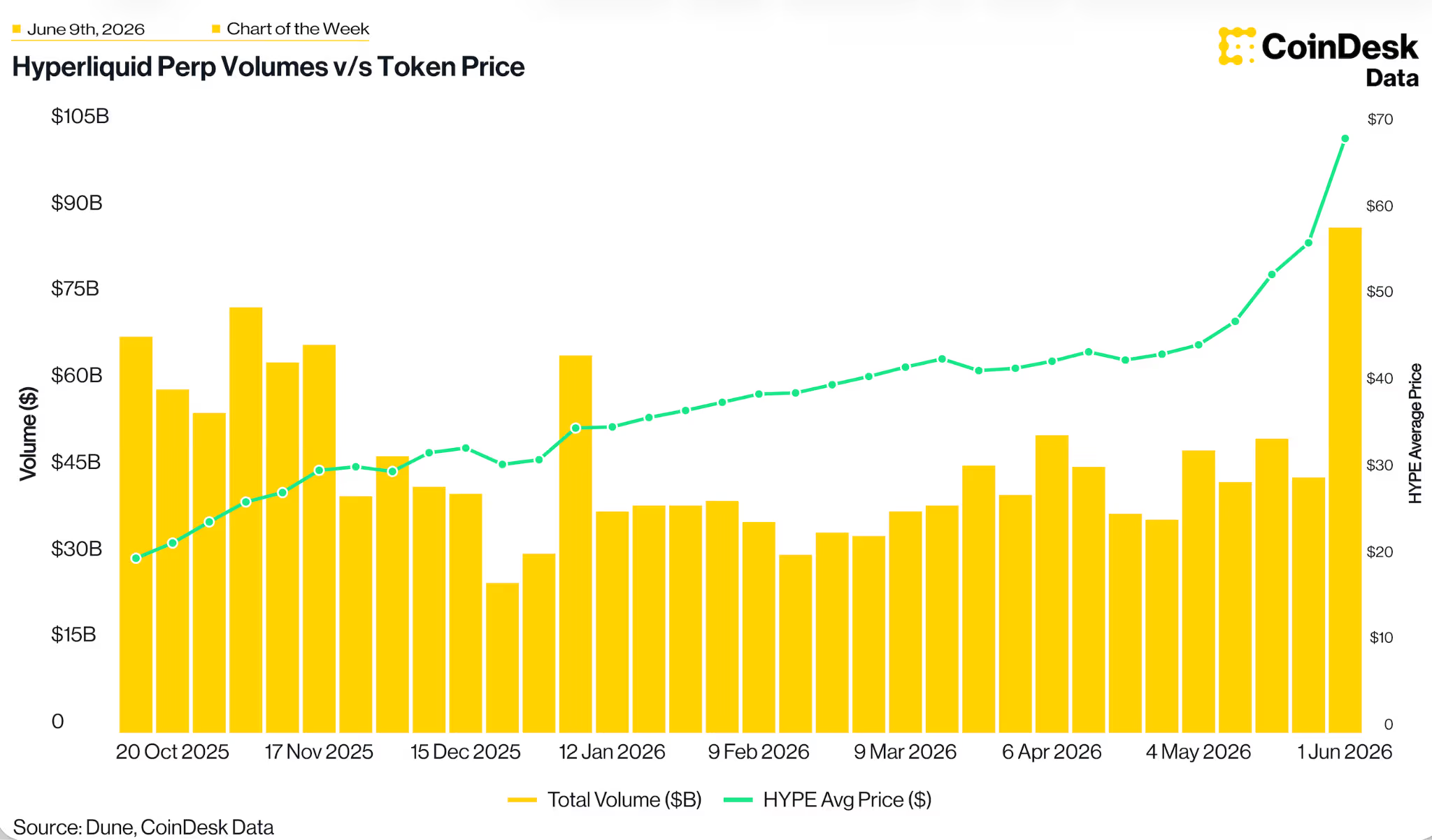
- “Hyperliquid’s 70% Rally: What Drove HYPE from $40 to $75 in Six Weeks” in Chart of the Week.
Expert Insights
Who answers the 3am call when DeFi breaks?
By Ben Nadareski, co-founder and CEO of Solstice
Last week, I shared something with CoinDesk that I want to sit with a little longer. A few minutes in an interview didn’t do it justice. My suggestion is that anyone building in DeFi should think of themselves as a financial asset manager who happens to write code, rather than as a software team that handles money.
A few people pushed back, so let me take one step further: the thing institutions really want from us has almost nothing to do with the code. They want to answer an age-old question: “When something goes wrong, who picks up the phone?”
So far, the answer has been nobody. The code is law: no company, no jurisdiction and no name on the door. For a while, we pushed that as the unique selling proposition (USP), and I understand the appeal. “Trust the contract, not the human” can feel like the safer bet, but if you spend time with a risk committee, you’ll see how strange it sounds to them.
They don’t underwrite code; they assess people and processes. They want to know who signed off, who can move funds, what happens at 3am when a key is compromised and whose responsibility it is to have considered those risks. If you hand them a brilliant protocol written by an anonymous team, with a multi-signature wallet (multisig) controlled by a group of people who have never met each other, the committee will not view it as an innovation. Instead, they will see it as an operational risk they can’t yet price.
And here’s where I’ve landed: the accountability they’re asking for is what lets decentralisation grow up. You get to keep the openness, the composability and the permissionless rails — all of it — while still answering the basic questions any serious financial steward should be able to address.
What does that look like in practice? It means having reserves you can verify in real time, allowing anyone to check solvency rather than relying on assertions in a blog post or press release. It includes controls to ensure that no single person can move significant amounts of money alone, because that’s standard practice in well-run institutions (and it should embarrass us that most protocols don’t adhere to this). None of this is a big ask; it’s the bare minimum.
I get the skepticism. People might say this is how you compromise on the speed that makes crypto alluring. I see it differently, though. Moving fast on what you build is a gift, whereas moving fast with other people’s money (with no one willing to be accountable for it) isn’t speed, it’s just risk waiting for a deadline. April showed us some of those deadlines, and there will be more.
The audience for getting this right has already changed. The institutions everyone keeps waiting for aren’t on their way. They’re already here, managing real money on these rails right now while half the industry debates whether they belong. The platforms that win in the next few years will be the ones that can include a Galaxy or Susquehanna alongside someone opening their first wallet in Lagos. Both should have the same access and the same protections, and both should know who is accountable when it counts.
That’s the bar I want us to be measured against, and I want it set higher than the banks — not on the same level. Not because regulators are coming, although they are. The harder question is whether we’ll build it ourselves or wait for someone else to force our hand.
Principled Perspectives
The centuries-old structure solving bitcoin’s yield problem
By Stephen Stonberg, CEO and co-founder, Tabit Insurance
Bitcoin holders face a dilemma: how do you preserve ownership through market stress without being forced into actions that destroy long-term value? The answer is not another “crypto yield wrapper”. As bitcoin adoption matures, a centuries-old financial structure is emerging as a compelling alternative: reinsurance.
BTC is currently trading well below its 2025 highs, and the drawdown is testing conviction across the investor spectrum. The investors who build lasting wealth are not those who predict bottoms or avoid drawdowns; they are the ones who can hold through corrections without being forced to sell. That requires a way to generate income from a long-term bitcoin position without relying on bitcoin’s price direction.
Why the traditional bitcoin yield playbook fails when you need it most
Most yield offerings fall into two buckets: options strategies that monetize volatility, and lending platforms that rehypothecate assets. Both tend to break precisely when stress arrives. Options strategies expose holders to path dependency, volatility regime shifts and counterparty risk, with yield that vanishes when margin calls hit. Lending platforms can be worse: bitcoin disappears into opaque collateral chains, and when liquidity dries up, so does the capital behind it.
Reinsurance is a different source of yield entirely
Reinsurance is insurance for insurance companies, allowing primary insurers to transfer portions of their risk portfolio to limit exposure to large-scale events. These contracts operate independently of financial markets, creating a structurally different return profile that combines underwriting profits with conservative leverage, a time-tested approach that predates cryptocurrency by centuries.
The key insight is that reinsurance returns are driven by real-world risk selection and pricing rather than bitcoin’s price direction. Hurricane risk in Florida does not care if bitcoin is trading at $40,000 or $100,000. This creates historically low correlation to both crypto markets and public equity beta with genuine diversification, rather than repackaging the same underlying exposures.
The mechanics
The structure is simple: post bitcoin as capital in a regulated (re)insurance vehicle, write USD-denominated policies and collect premiums in dollars. Reserves are held in cash and cash equivalents, using standard trust and custody mechanics, keeping the bitcoin ring-fenced as capital, not rehypothecated. Reinsurance is structurally advantaged here. BTC remains in institutional-grade custody within a corporate structure with legal segregation intended to isolate different investors’ assets, with investors able to have 24/7 on-chain proof of their bitcoin capital. This preserves the core objective: maintaining BTC exposure for long-term appreciation, while generating dollar cash flows from uncorrelated reinsurance premiums.
Why institutions should consider reinsurance
Recent 13F filings suggest that long-duration institutional investors are not all running for the exit. Select endowments, public pension plans and sovereign wealth-backed investors have added or maintained bitcoin ETF exposure through the drawdown, underscoring that sophisticated allocators are increasingly treating regulated bitcoin exposure as a long-term portfolio position rather than a purely tactical trade.
But staying the course is easier to justify when a bitcoin position can produce cash flow without depending on price appreciation alone. Reinsurance operates within established regulatory perimeters, supported by actuarial discipline, underwriting controls and capital adequacy standards. For institutions thinking in decades, that distinction matters. The objective is not to chase incremental yield by taking on more crypto-native risk. It is to keep bitcoin exposure intact, earn dollar-denominated income from an independent risk pool and reduce the likelihood that market stress forces a sale at precisely the wrong time.
Headlines of the week
By Helene Braun
A dormant Satoshi-era bitcoin wallet moved after 14 years as the owner became the target of a $285 billion lawsuit, with notice served through Bitcoin’s blockchain; institutional investors continued pulling money from bitcoin ETFs even as BTC revisited the $60,000 level that attracted buyers earlier this year; and DFG CEO James Wo, who built a billion-dollar crypto investment firm from a $20 million family-backed start, said he remains bullish on bitcoin while questioning some of the market’s most aggressive ether price forecasts.
Chart of the Week
Hyperliquid’s 70% rally: what drove HYPE from $40 to $75 in six weeks
HYPE ran from ~$44 to an ATH of $75.52 in six weeks (early May to June 3), as spot ETF launches from Bitwise and 21Shares drove over $130 million; the ATH broke on June 2–3 as TD Securities published the first major bank report documenting Hyperliquid beating CME to oil price discovery, with Grayscale’s HYPG ETF launching the same day.

Listen. Read. Watch. Engage.
- Listen: $3 billion leaves Bitcoin ETFs. Why Wall Street isn’t panicking. Jennifer Sanasie is joined by David LaValle to unpack a $2.97 billion outflow streak from Bitcoin ETFs, Bloomberg’s Eric Balchunas explains why the recent outflows may be more noise than signal and Stellar Development Foundation CEO Denelle Dixon discusses DTCC’s decision to select Stellar.
- Read: In “Crypto for Advisors”, Beth Haddock reviews the three due diligence questions advisors should be asking in 2026. Then, Aaron Brogan reviews the GENIUS Act implementation timeline and how things will change once it’s here.
- Watch: “I will not vote for CLARITY until we address ethics.” Senator Angela Alsobrooks joins CoinDesk Policy Protocol hosts Rebecca Rettig and Renato Mariotti to discuss the three outstanding issues she needs resolved before voting the CLARITY Act off the Senate floor.
- Engage: The CoinDesk: Policy & Regulation event is heading back to Washington, D.C. on September 24. This one-day event connects law makers with chief legal officers, compliance officers and policy experts to discuss the future of digital asset industry standards.
Looking for more? Receive the latest crypto news from coindesk.com and market updates from coindesk.com/institutions.
Note: The views expressed in this column are those of the author and do not necessarily reflect those of CoinDesk, Inc., CoinDesk Indices or its owners and affiliates.
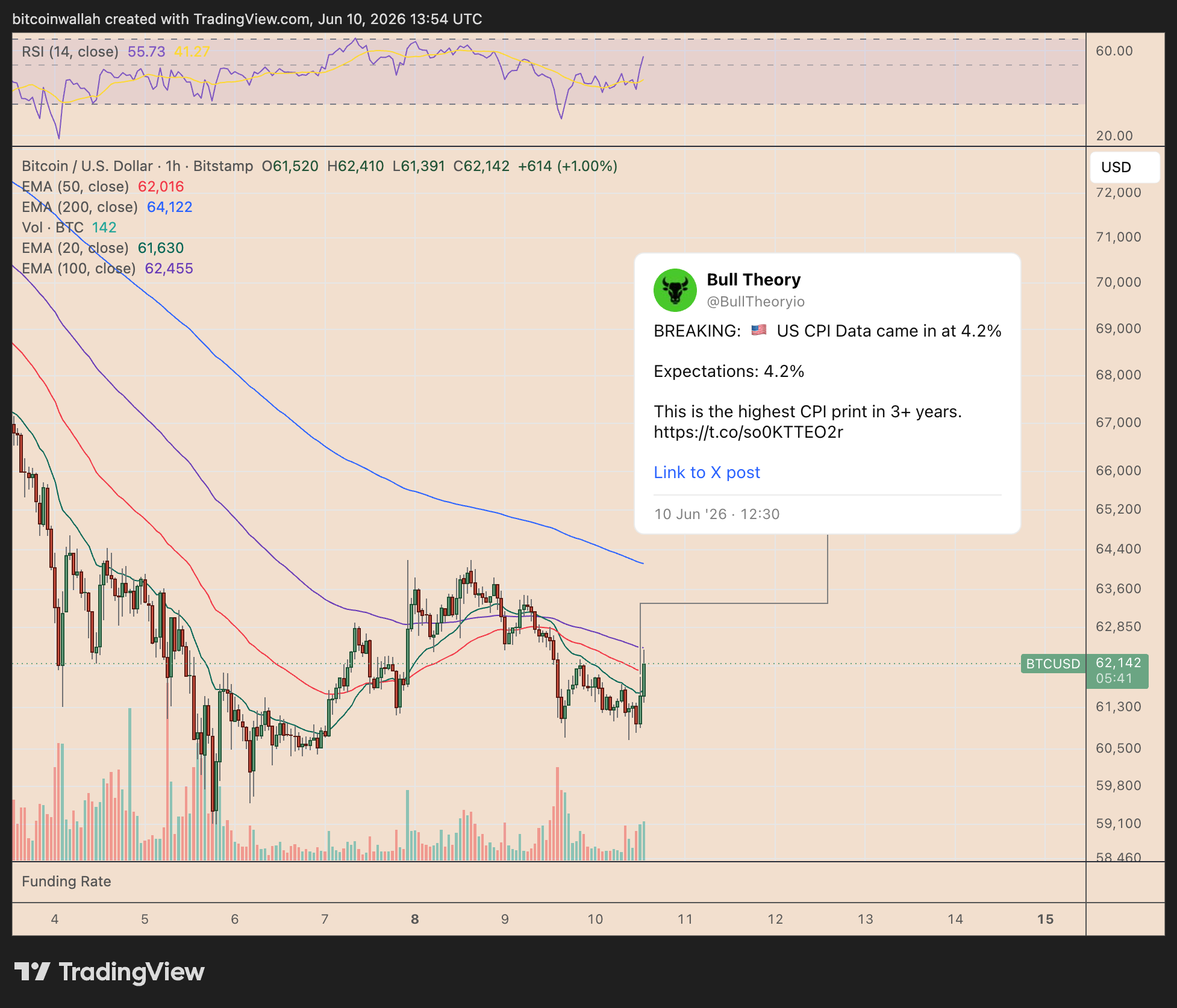
Bitcoin (BTC) erased its intraday losses and rose by around 2.5% to $62,410 immediately after the US inflation report, even as the headline Consumer Price Index (CPI) hit its highest level in more than three years.
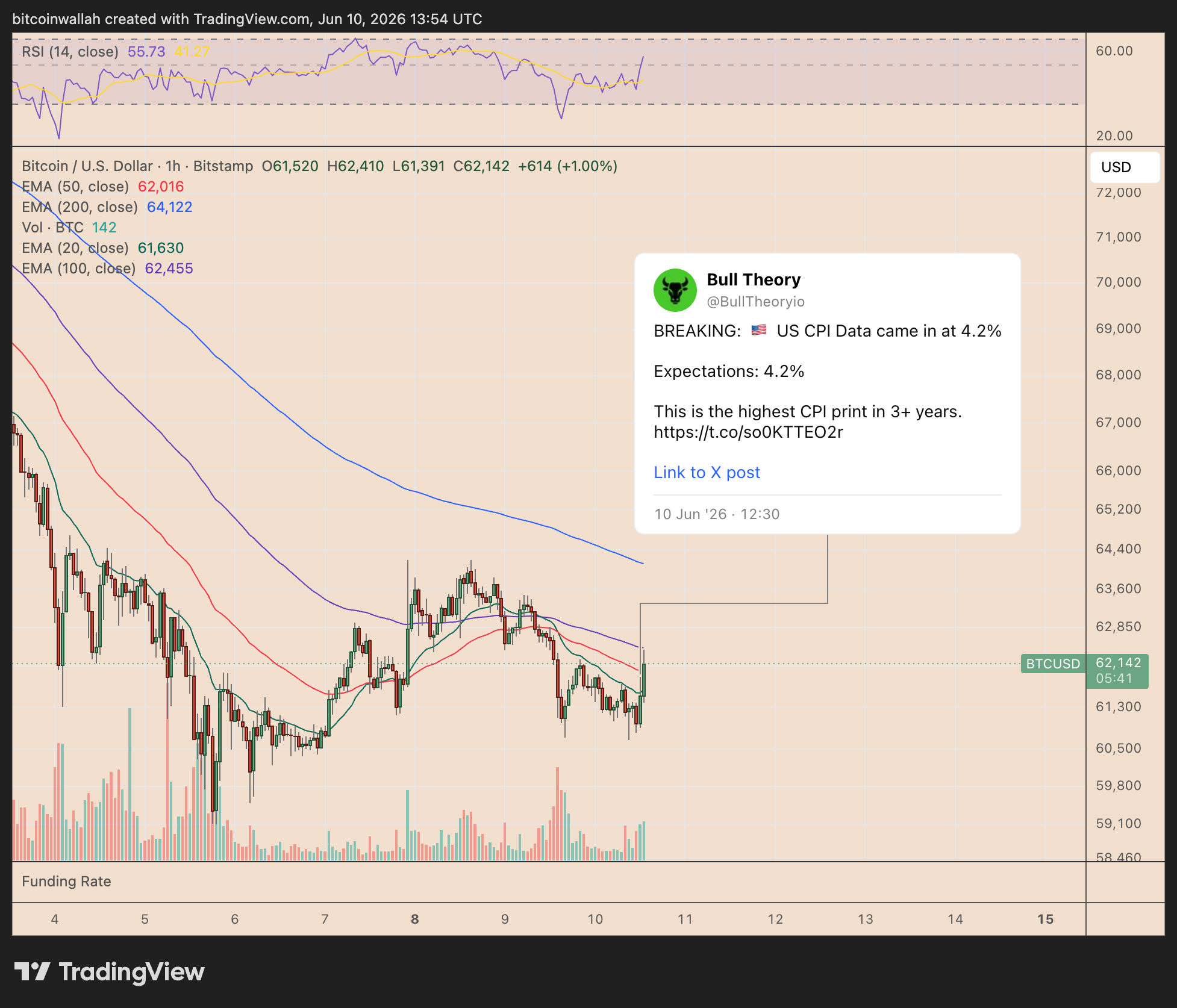
BTC/USD hourly chart. Source: TradingView
Key takeaways:
- Bitcoin rose as the latest US CPI reading matched economists’ expectations.
- BTC still faces short-term downside risks as it trades below strong resistance levels.
May US inflation matched expectations
The US CPI rose 4.2% year over year in May. On a monthly basis, headline inflation increased 0.5%, while core inflation, which excludes food and energy, rose 2.9% annually and 0.2% month over month.
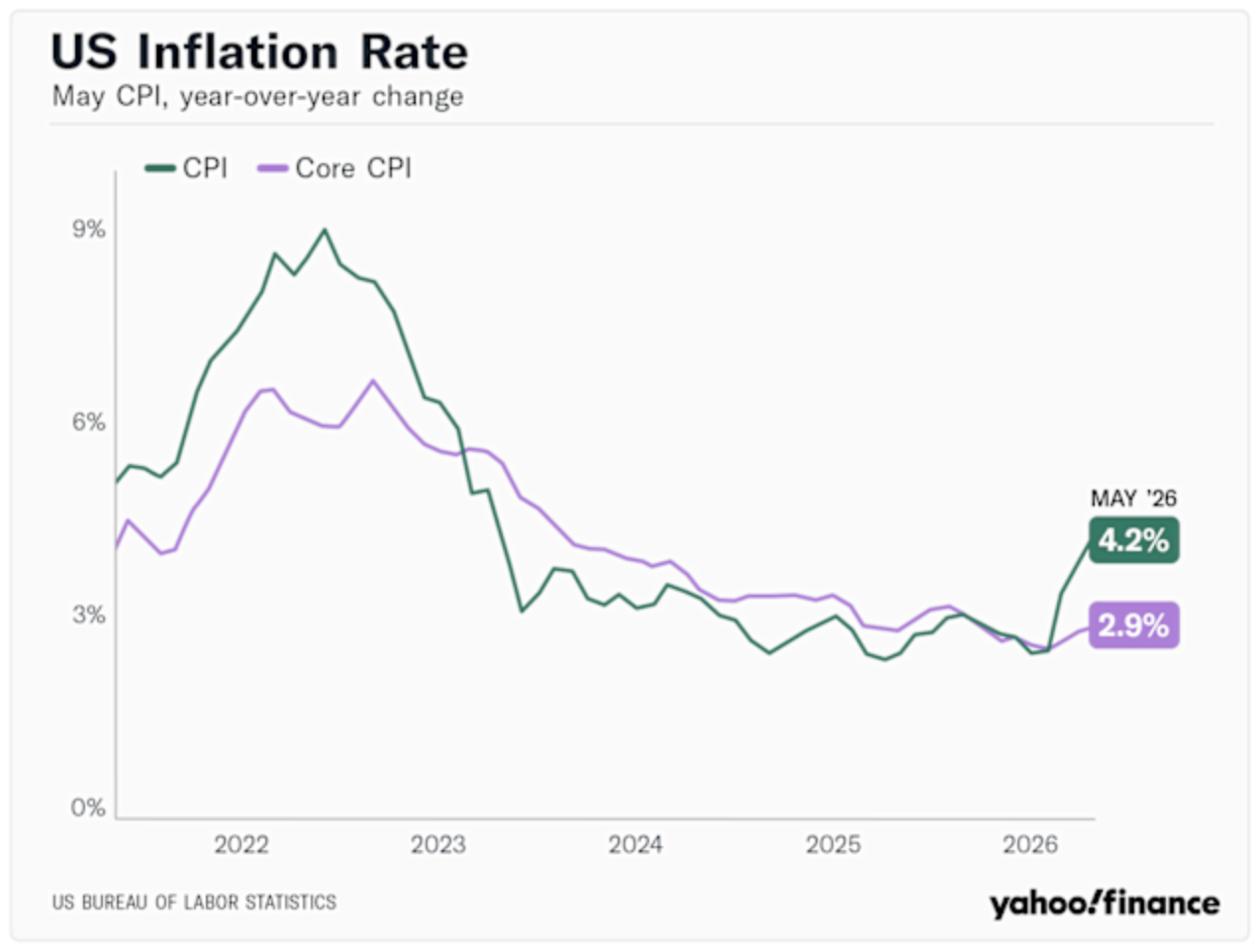
US headline and core CPI. Source: Bureau of Labor Statistics/Yahoo Finance
The headline jump came largely from higher energy and gasoline prices, as renewed Middle East tensions lifted oil prices and reignited inflation concerns.
At first glance, the report looked bearish for Bitcoin. Higher inflation usually reduces the odds of Federal Reserve rate cuts, keeps Treasury yields elevated, and tightens financial conditions. That typically pressures risk assets, including crypto.
But BTC rallied because the inflation print did not come in worse than feared.
Economists had already expected headline CPI to hit 4.2%. The actual number matched that forecast, removing the risk of a hotter surprise.
Traders did not see the report as strong enough to force the Fed into a tougher stance, giving them room to buy risk assets again.
That gave Bitcoin the chance to bounce from long-term support zones, including the 200-week exponential moving average (200-week EMA, the blue line) and the psychological $60,000–$62,000 price floor area, as shown below.
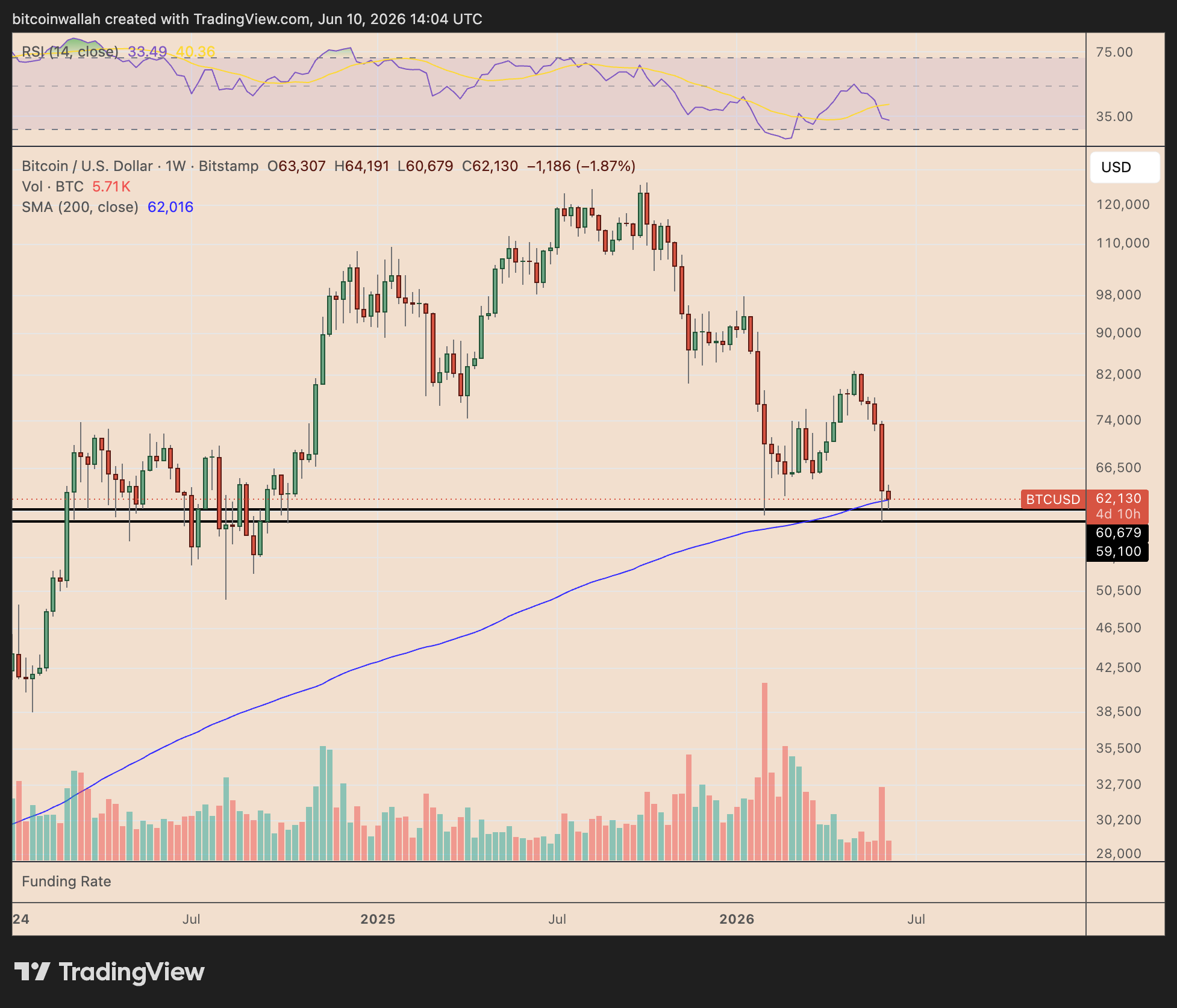
BTC/USD weekly chart. Source: TradingView
Is Bitcoin undergoing a bullish reversal?
Bitcoin’s post-CPI rebound does not yet confirm a full bullish reversal.
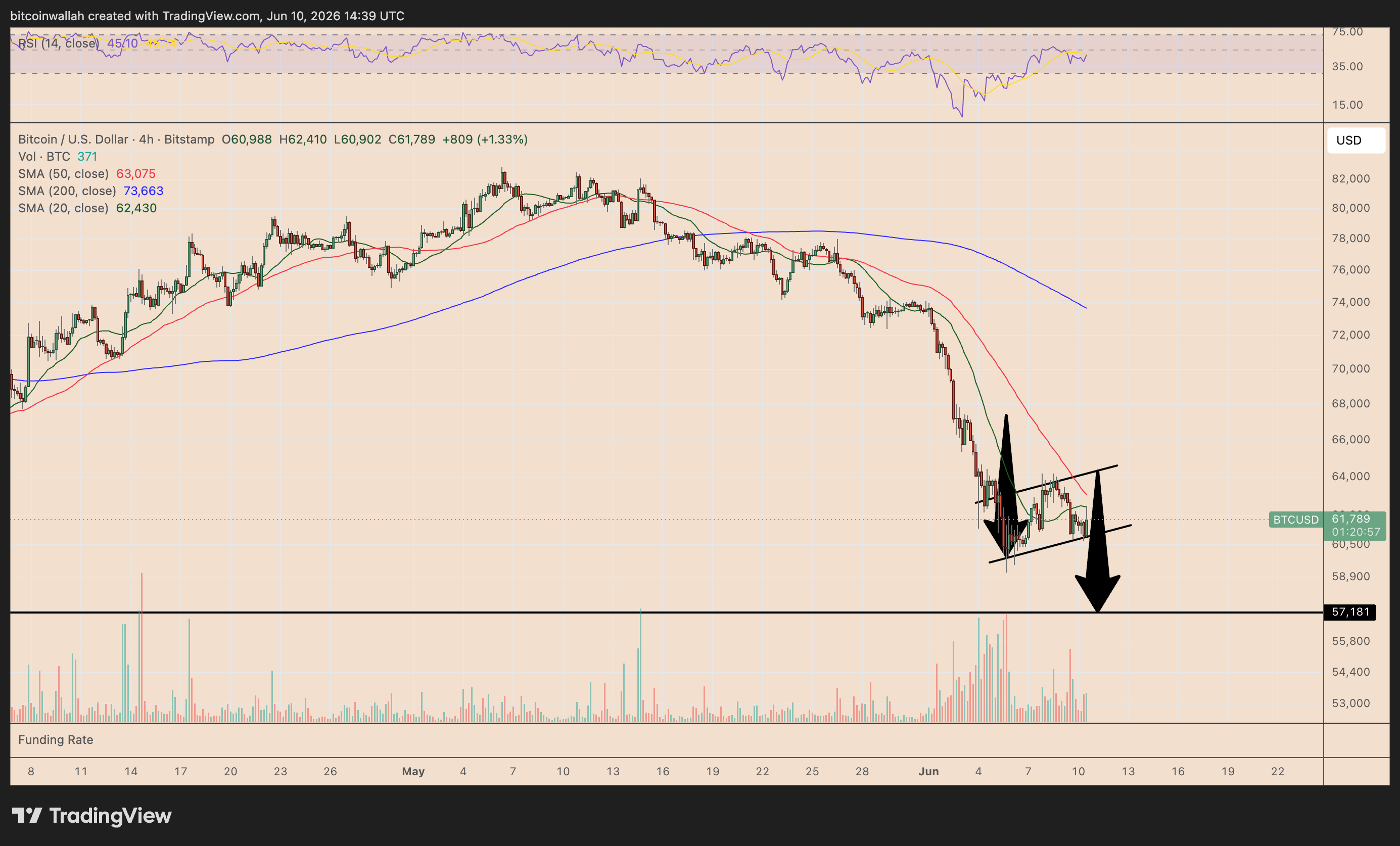
From a technical perspective, BTC still trades below key short-term resistance levels, including the 20-period SMA, shown in green, and the 50-period SMA, shown in red, on the four-hour chart.
BTC/USD four-hour chart. Source: TradingView
BTC also appears to be consolidating inside a bear flag pattern.
This setup forms when the price rebounds inside an upward-sloping parallel channel after a sharp decline. In simple terms, the bounce may only be a pause before the next leg lower, not the start of a new uptrend.
As a rule of technical analysis, a bear flag confirms when price breaks below the flag’s lower trend line. The measured downside target equals the height of the previous sell-off, projected from the breakdown point.
That puts Bitcoin’s bearish target near $57,800 in June, down about 7.6% from current levels.
Bitcoin relief bounce scenario also in play
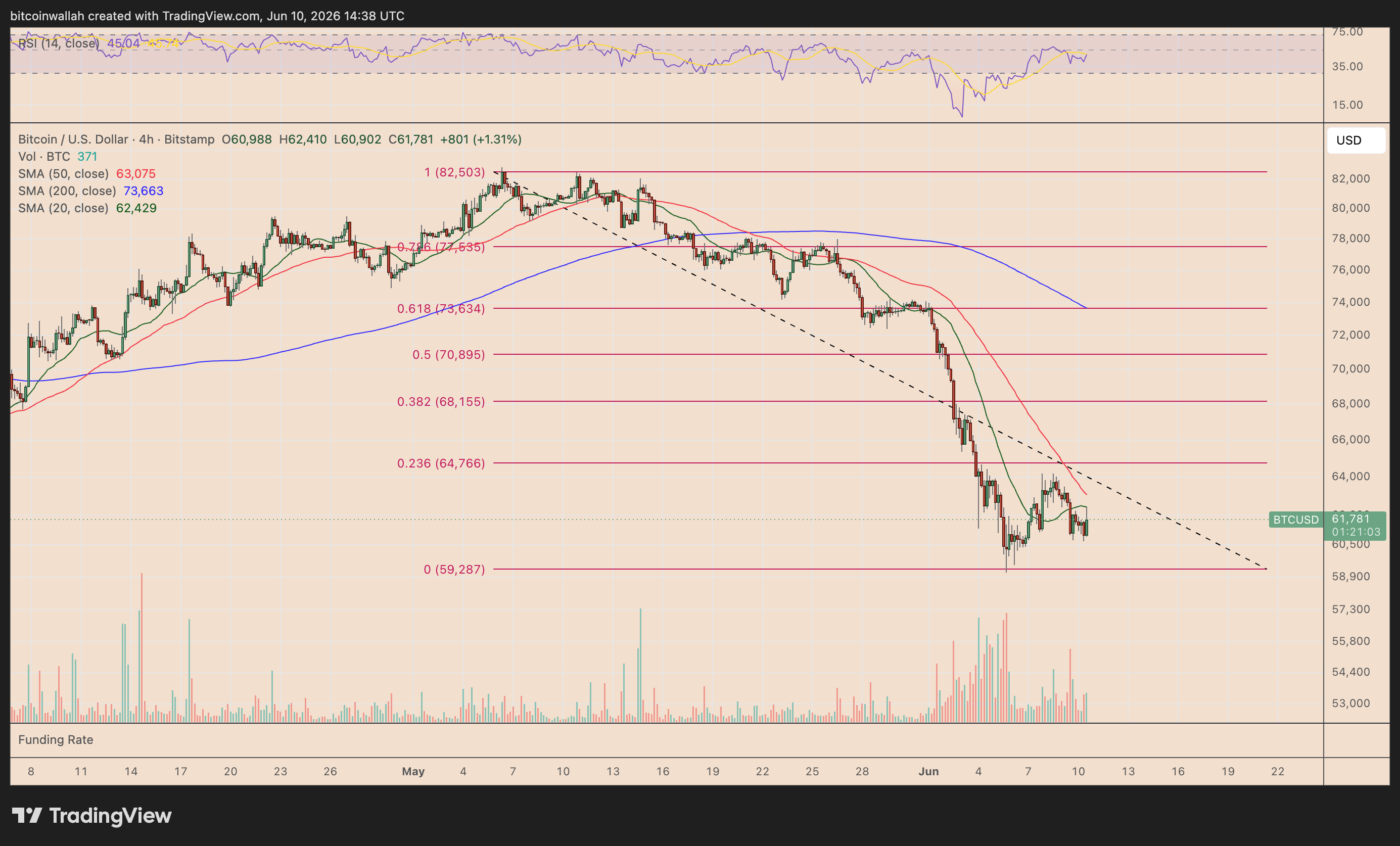
Conversely, a clear breakout above the resistance confluence, comprising the 20-period SMA, the 50-period SMA, and the flag’s upper trend line, would weaken the bear flag structure and invalidate the immediate downside setup.
BTC/USD four-hour chart. Source: TradingView
In that scenario, Bitcoin could extend its recovery toward the $64,000–$68,000 range in June, aligning with the 0.236 and 0.318 Fibonacci retracement lines.
HYPE stood out as a rare outperformer amid a sharply declining crypto market, with its price hitting a new all-time high at the beginning of the month.
However, it has since pulled back by about 25% from the peak, and some analysts warn that the drop is far from finished.
The Bears Take Over
It was just days ago when Hyperliquid’s native token soared to a record high of over $75. Meanwhile, its market capitalization neared $17 billion, making HYPE one of the 10 largest cryptocurrencies.
However, the harsh bearish environment, combined with Arthur Hayes dumping all his positions in the asset, made the rally short-lived. As of this writing, HYPE is worth around $56 and has a market cap of roughly $12.5 billion.
According to many analysts, the worst is just beginning for the asset. The popular X user Altcoin Sherpa said, “some cool off is pretty normal,” predicting a slump to as low as $44 if the price drops below $54. At the same time, they still believe this is among the best altcoins investors can own for the long term.
For their part, BATMAN argued that “things are not looking good right now,” spotting the formation of “a very clean head and shoulders pattern” which indicates that a drop to $50 might come next. This is a common chart in which the price forms one large peak with two smaller ones on each side, and it is usually seen as a precursor to a pullback. Sjuul | AltCryptoGems identified the same development, saying:
“I have to be honest, HYPE looks a bit in trouble here. Basically trading in a massive Head & Shoulder pattern. If this starts to break down, it’s not gonna be pretty.”
Crypto with Haris ₿ also anticipates an additional move south. The X user revealed opening a $30,000 short of HYPE, predicting a plunge to the low $40s if the price breaks below $55.
Not so Quick
Some key factors, though, indicate that HYPE bulls may soon regain control. One clear sign is the substantial shift of funds from centralized exchanges to self-custody solutions in recent weeks, which has reduced immediate selling pressure.

Meanwhile, the X account Whale Factor opined that Hyperliquid is quietly becoming “a major powerhouse” in the market. According to their data, the project handled nearly half of all crypto token buybacks last year, and this buy pressure makes the asset look like “a very compelling hold” for this cycle.
“When a project generates this much real revenue, it becomes hard to ignore,” it concluded.
The post Why Hyperliquid (HYPE) Could Be Headed for a Much Bigger Correction appeared first on CryptoPotato.

Key Takeaways
- Massachusetts Senator Elizabeth Warren has formally requested the SEC postpone SpaceX’s planned June 12 public offering.
- The company aims to achieve a valuation as high as $2 trillion while securing $75 billion in capital.
- Key issues raised include Elon Musk’s concentrated voting power, dual-class stock structure, and limited shareholder protections.
- Despite political opposition, investor interest has exceeded $250 billion — surpassing the target by more than three times.
- Financial regulators are expected to proceed unless significant legal or disclosure problems emerge.
SpaceX stands on the verge of executing one of Wall Street’s most anticipated public offerings. However, a prominent lawmaker is calling for federal oversight before the launch proceeds.
Senator Elizabeth Warren of Massachusetts delivered a formal request to SEC Chairman Paul Atkins on June 10, pushing for a postponement of the SpaceX initial public offering. The aerospace company plans to price its shares Thursday evening, with public trading commencing Friday, June 12.
If successful, the offering would establish SpaceX’s market capitalization near $2 trillion while generating approximately $75 billion from new shareholders.
The Democratic senator expressed alarm that the transaction creates disproportionate risk for retail investors and pension funds, while predominantly benefiting company executives and early backers.
Corporate Structure Under the Microscope
Warren’s correspondence focuses heavily on SpaceX’s internal governance framework.
Her letter highlights Musk’s outsized voting authority, the implementation of multi-tiered share classes, forced arbitration requirements, and restrictions on stockholder proposals. These mechanisms, Warren contends, would severely constrain the influence of public market participants once shares begin trading.
The senator also challenged the company’s price tag. Her statement referenced market analysts who characterized the $2 trillion figure as “completely disconnected from reality” and “financial engineering,” particularly when measured against SpaceX’s approximately $19 billion in yearly sales.
Warren emphasized that the SEC “has an obligation to examine whether index fund managers and financial institutions participating in this offering are fulfilling their fiduciary duties to investors.”
Given SpaceX’s role as a significant Defense Department supplier, Warren additionally voiced apprehension about possible foreign capital entering the company following its market debut.
Market Enthusiasm Remains Robust
Regardless of congressional opposition, institutional interest in the offering has proven exceptional.
According to a June 9 Reuters report, SpaceX has secured commitments exceeding $250 billion from prospective investors — representing between 3.5 and 4 times the intended capital raise.
The Securities and Exchange Commission has completed its examination of SpaceX’s registration materials. Market participants are fully informed about Musk’s operational control, and the filing documents enumerate extensive risk disclosures.
Securities law specialists indicate that regulatory intervention would require evidence of material omissions, fraudulent accounting practices, or statutory breaches. An aggressive price target by itself doesn’t provide sufficient grounds for federal action.
Warren has set a June 23 deadline for the SEC’s response, requesting information about valuation methodology, corporate governance standards, protections for passive investment vehicles, arbitration policies, and allegations regarding premature information disclosure.
This represents another chapter in the ongoing tension between Warren and Musk. The pair have previously clashed over executive compensation, social media platform acquisitions, and government efficiency initiatives.
Investment commitments are scheduled to finalize Wednesday. The public offering currently remains on its original timeline.

TLDR
- Jim Cramer advised a Mad Money viewer to “buy some here” on Costco shares near $968, though he’d prefer seeing a modest pullback for better value
- Motley Fool Asset Management expanded its Costco holdings by 20.8% during Q4, purchasing 10,429 additional shares to total 60,650
- Several institutional funds expanded their Costco positions throughout Q4 and Q2, with institutions controlling 68.48% of outstanding shares
- The warehouse retailer’s most recent quarter delivered $70.53B in revenue, surpassing forecasts, though earnings per share fell short by $0.01 at $4.93
- Wall Street analysts assign an average “Moderate Buy” recommendation with a consensus price objective of $1,060.41, significantly higher than present trading levels
Costco (COST) shares began Wednesday’s session at $968.59, declining 0.6% intraday and remaining notably beneath the 52-week peak of $1,096.50.
Costco Wholesale Corporation, COST
During a recent Mad Money segment on CNBC, Jim Cramer responded to a viewer inquiry regarding the optimal timing for establishing a long-term stake. His advice was direct: purchase some shares now, while remaining hopeful for additional downside.
“I want value just like I want value at a store,” Cramer explained. He suggested the downside scenario involves the stock rallying directly to $1,025 with shareholders participating in the gains.
Cramer observed the shares currently command a 47x earnings multiple and recommended strategic patience, allowing the price to “come in a little” instead of deploying capital at a single level.
Institutional Accumulation Continues
As individual investors contemplate timing, institutional capital has been flowing into the stock. Motley Fool Asset Management expanded its stake by 20.8% throughout Q4, acquiring 10,429 shares to reach a total holding of 60,650, valued at approximately $52.3 million.
The asset manager wasn’t the only buyer. Brighton Jones increased its allocation by 12.3% during Q4. Revolve Wealth Partners grew its position by 13.1%. Additional funds elevated their holdings during Q2 as well. Collectively, institutional ownership now represents 68.48% of the company.
The stock’s 50-day moving average currently rests at $1,006.30, while the 200-day moving average stands at $965.46 — indicating shares are trading near their long-term technical support.
Quarterly Results and Dividend Increase
Costco disclosed quarterly results on May 28th. Revenue reached $70.53 billion, exceeding analyst projections of $70.12 billion. However, earnings per share of $4.93 fell one penny short of the $4.94 Wall Street consensus.
The retailer simultaneously announced a dividend increase from $1.30 to $1.47 per share quarterly, distributed on May 15th. The annualized dividend now totals $5.88, representing approximately a 0.6% yield.
E-commerce revenue surged more than 21% during the period, while gasoline volume reached all-time highs. Despite these operational highlights, shares declined roughly 5% following the announcement — suggesting the market prioritized valuation concerns over fundamental performance.
Costco also discreetly reduced prices across four Kirkland Signature items spanning food, household products, and sporting goods categories.
Wall Street sentiment remains predominantly bullish. Deutsche Bank elevated its price objective to $1,106 with a Buy recommendation. BTIG Research maintains a $1,125 target. Both Evercore and HC Wainwright continue advocating Buy ratings.
The consensus analyst price target reaches $1,060.41, supported by 22 Buy ratings, 11 Hold ratings, and a single Sell rating.
The stock trades at a PE ratio of 48.72, commanding a market capitalization of $429.55 billion. Analysts forecast full-year earnings per share of $20.38.

Bitcoin is showing signs of a capitulation phase as capital continues leaving the network and investors lock in losses across the market, according to the latest analysis by crypto analyst Axel Adler Jr.
Data suggests that Bitcoin’s Realized Cap 30D Change dropped to -1.1%. This is the first time since mid-March that outflows have reached this level.
Capitulation Signals
Realized Cap measures the aggregate value of all Bitcoin based on the price at which coins last moved, and its 30-day change is used to track whether capital is entering or leaving the network. Adler explained that Realized Cap declined by around $12 billion from its mid-May peak of approximately $1.087 trillion to $1.075 trillion.
The pace of contraction also accelerated sharply in recent days. On June 1, the indicator was still at -0.15%, but by June 8 it had fallen to -1.1%. During the same period, BTC’s price dropped from $82,000 to $63,000, representing a 23% decline. According to the analysis, the current pace of outflows is already comparable to the early stage of the March capitulation event, when the indicator eventually fell to -2.4%. This suggests there is still room for further deterioration before conditions reach the March extremes.
The first positive sign would be stabilization in the 30-day change near zero before turning upward. Until then, the market regime remains negative.
The analysis also revealed that Bitcoin’s Adjusted SOPR SMA-30, or aSOPR, which measures whether coins are being sold at a profit or loss, fell below the crucial 1.0 level on May 28 and has now remained below that threshold for 13 consecutive days.
Its current reading of 0.987 indicates that coins moved on-chain are being sold at an average loss of about 1.3%. The indicator has continued trending downward without any meaningful recovery since breaking below 1.0.
As such, a continued period with aSOPR below 1 is a classic sign of weak hands being flushed out of the market. Adler added that sellers remain in control until the indicator reverses upward and retests the 1.0 level. The analyst said the major trigger for a regime change would be a recovery in aSOPR above 1.0 alongside stabilization in Realized Cap outflows. Until those signals appear, the market remains in a capitulation regime, with the risk of deeper outflows toward the March extreme of -2.4%.
Historical Profitability Reset
Separate data from CryptoQuant revealed that Bitcoin’s Percent Supply in Profit metric is moving closer to the 45% level. This area has historically coincided with deeper corrections and capitulation phases. The decline indicates that recent price weakness is no longer affecting only a small group of holders, as a growing portion of the Bitcoin supply has now lost its unrealized profit cushion.
CryptoQuant added that similar profitability compression in previous cycles often took place as weaker hands exited the market while long-term investors gradually accumulated coins.
The post Bitcoin’s (BTC) On-Chain Data Just Flashed a Major Warning Sign appeared first on CryptoPotato.
Crypto World
North Carolina treasurer passes on SpaceX citing valuation concerns; favors OpenAI, Anthropic
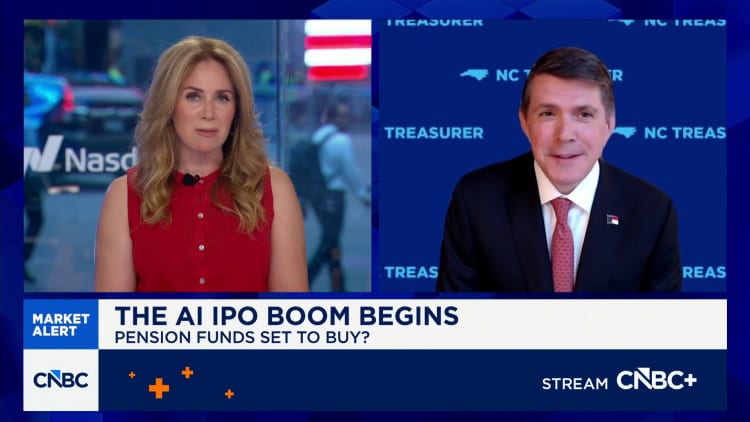

North Carolina state Treasurer Brad Briner said the year’s hottest IPO is too expensive for his pension fund to own.
Briner, who oversees roughly $200 billion for North Carolina’s teachers, firefighters and police officers, said the state has invested heavily in artificial intelligence startups OpenAI and Anthropic while avoiding a direct stake in SpaceX — expected to go public Friday — because of concerns that the Elon Musk-led company’s $1.77 trillion valuation leaves little room for future gains.
“There’s been a pricing issue that we’ve been concerned about for the last year or so with SpaceX,” Briner said on CNBC’s “Squawk Box” on Wednesday. “Elon Musk, an amazing entrepreneur, incredible technology to launch business, startling, etc. But at some point, things are fully priced. We’re trying to make a high-single-digit, predictable rate of return for our retirees. And we’ve got to consider valuation when we do that. And so, certainly, SpaceX at $1.75 trillion is a big valuation.”
SpaceX is scheduled to price its IPO on Thursday and begin trading on Friday. The rocket maker plans to sell 555.6 million shares at $135 apiece, raising about $75 billion and valuing the aerospace company at roughly $1.8 trillion.
Briner’s comments underscore a growing debate among institutional investors as SpaceX prepares for what is expected to be one of the largest initial public offerings in history. While many money managers view the company as a unique asset with dominant positions in rocket launches and satellite internet, other long-term investors are questioning whether today’s valuation already reflects much of that optimism.
The state treasurer has instead directed capital toward AI companies that he believes offer stronger risk-reward opportunities. North Carolina invested about $40 million in OpenAI and committed roughly $250 million to Anthropic earlier this year, a position he said is now worth more than $600 million.
“We saw an opportunity in Anthropic which we thought was completely mispriced earlier this year,” Briner said. “If you use that technology, you see how powerful it is.”
Rather than buying SpaceX shares in the private market, Briner said North Carolina’s pension system expects to gain exposure through index funds once the company goes public.
“We will ultimately participate in SpaceX through our index positions in our public equity,” he said, “but we don’t have any on the private side.”

Netomi CEO says $5 trillion AI customer experience market could boost stablecoin demand

Nearly five million more people experiencing poor mental health since 2009

Ben Stokes, Atkinson dropped from 2nd NZ Test squad over nightclub row | Other Sports News

HarrisX Poll Found 52% of Registered Voters Support the CLARITY Act

BloFin War of Whales 2026 Grand Prix opens registration for $5M trading championship

Blockchain.com files with SEC for U.S. IPO

Personal Financial Planning|Mcom sem4nep|Most Imp Question|Paper Pattern|University Solution|Ark sir

What Is Cryptocurrency In Telugu By Venu Kalyan | Business Coach | Life Coach

financial freedom here we come #financialfreedom #financialplanning #rent
-

 Fashion5 days ago
Weekend Open Thread: Evereve – Corporette.com
-
 Crypto World5 days ago
Jensen Huang Approves Samsung, SK Hynix, and Micron for NVIDIA (NVDA) HBM4 Memory Supply
-

 Crypto World2 days ago
Anatomy of the June crypto crash: Fed, Iran, Saylor
-
 Entertainment4 days ago
The Best Mystery Series of All Time Is Surging on Streaming 30 Years After It Ended
-

 NewsBeat3 days ago
Alexander Zverev wins the French Open to finally earn a 1st Grand Slam title
-

 Tech5 days ago
Suspicious Polyfill login prompts pop up on Toshiba, Muji websites
-
Crypto World4 days ago
Senator Cynthia Lummis Calls CLARITY Act the Most Consequential Financial Legislation of This Generation
-

 Tech3 days ago
Microsoft unveils seven homegrown AI models in new bid for ‘long term self-sufficiency’
-

 Tech5 days ago
Microsoft launches MXC, an OS-level sandbox for AI agents, with OpenAI and Nvidia already on board
-

 Business5 days ago
(VIDEO) Justin Bieber Delivers Surprise Happy Birthday Serenade to Diners at Los Angeles Mexican Restaurant
-
 Business4 days ago
The Pain Points Taking a Fragile Tech Rally Down a Notch
-
Crypto World5 days ago
LBank Surpasses 25 Million Users Worldwide as AFA Partnership Continues to Drive Global Growth
-

 Crypto World3 days ago
Trump’s AI Ownership Plan Could Benefit Anthropic at OpenAI’s Expense
-
 Crypto World2 days ago
Eli Lilly (LLY) Stock Surges 4% Following Breakthrough Sleep Apnea Trial Results
-

 Tech5 days ago
Meta steals a tactic from Tesla and builds data centers in tents
-

 Tech5 days ago
Von der Leyen’s AI envoy pick draws conflict-of-interest fire
-
 Sports1 day ago
Bangladesh beat Australia after 20 years in ODIs, register only their second win over six-time world champions | Cricket News
-

 Business2 days ago
High Stakes for Wembanyama as New York Pushes for 3-0 Lead
-

 Tech4 days ago
Hackers now exploit SolarWinds Serv-U flaw to crash servers
-

 Tech3 days ago
Notion restores access to Anthropic after service disruption
You must be logged in to post a comment Login