
Connect with us
DAPA Banner
DAPA Coin
DAPA
COIN PAYMENT ASSET
PRIVACY · BLOCKDAG · HOMOMORPHIC ENCRYPTION · RUST
ElGamal Encrypted MINE DAPA
🚫 GENESIS SOLD OUT
DAPAPAY COMING

NewsBeat

Is Keir Starmer’s Government About To Collapse?

Published

on

Is Keir Starmer's Government About To Collapse?

Keir Starmer’s political future has never looked so uncertain.

The prime minister publicly lost the support of almost 100 MPs this week, including four ministers and four ministerial aides all of whom resigned and urged Starmer to set out a timetable for his departure.

Labour’s affiliated unions also called on him to quit.

And then on Thursday, health secretary Wes Streeting – who has never made any secret of his leadership ambitions – dramatically resigned with a ferocious attack on the PM.

Advertisement

He said: “Where we need vision, we have a vacuum. Where we need direction, we have drift.”

Other cabinet ministers have also told the prime minister privately that he must set out a timetable for his departure from Downing Street.

The chaos engulfing the government comes amid Labour fury at the party’s catastrophic performance in last week’s elections in England, Wales and Scotland.

A make-or-break speech by Starmer on Monday, which was supposed to set out his plan to turn around the government’s fortunes, was branded “utterly inadequate” by his critics.

Advertisement

After weeks of painful door-knocking with dissatisfied voters, the majority of Labour MPs now want Starmer gone – although they cannot agree on who should take over.

Starmer’s critics fear that sticking with him guarantees handing the next general election to Reform and Nigel Farage.

But the prime minister has made it clear he will not make it easy for his opponents to oust him, telling his cabinet on Tuesday to either put up or shut up.

Labour Party rules state that anyone seeking to oust the leader must have the backing of 20% of MPs, which currently works out at 81.

Advertisement

That’s a high bar, and as things stand no leadership contenders – including Streeting – have that level of support.

Meanwhile, Andy Burnham, the mayor of Greater Manchester, was given a path back to Westminster on Thursday when Labour MP for Makerfield Josh Simons stepped down.

But there’s no guarantee Burnham will win the subsequent contest, especially after Reform UK won 50.4% of the vote across the constituency’s eight wards in last week’s local elections.

Former deputy prime minister Angela Rayner threw a further spanner into the works on Thursday when she announced that had been given the all-clear by the tax man after she failed to pay enough stamp duty on a flat purchase.

Advertisement

While she has insisted she would not challenge Starmer directly, she made it clear she would be prepared to stand in any contest.

Speculation that other Labour figures such as energy secretary Ed Miliband, foreign secretary Yvette Cooper and even junior defence minister Al Carns might throw their hat into the ring also continues.

At this point, the whole of Westminster is on the edge of its seat to see who, if anyone, will wield the knife and directly challenge Starmer – with the right number of MPs to back them up.

Listen to Commons People as we dissect the chaos of the last week, what Labour figures are saying behind the scenes and try to predict what could happen next.

Advertisement

Subscribe to Commons People, the podcast that makes politics easy. Every week, Kevin Schofield and Kate Nicholson unpack the week’s biggest stories to keep you informed. Join us for straightforward analysis of what’s going on at Westminster.

Source link

Advertisement
Continue Reading
Click to comment

You must be logged in to post a comment Login

Leave a Reply

NewsBeat

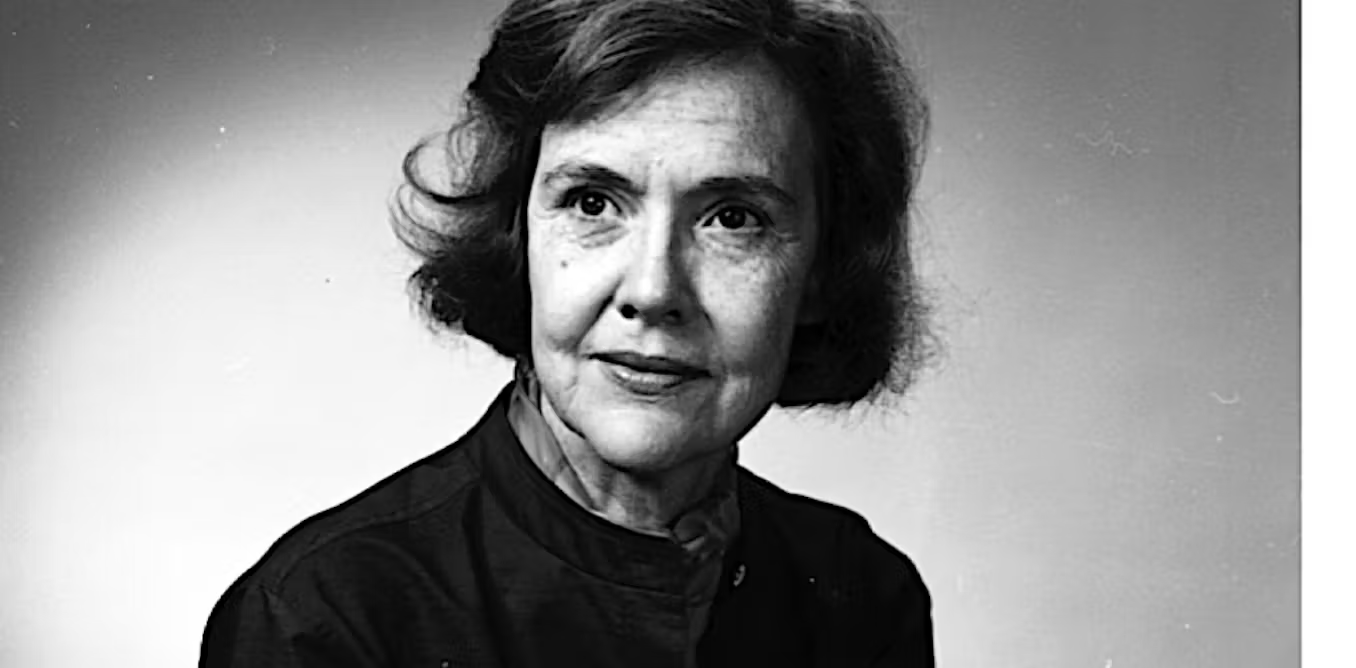
Carolyn Wood Sherif, pioneer of feminist psychology who foresaw the risks of scientific bias

Published

on

Carolyn Wood Sherif, pioneer of feminist psychology who foresaw the risks of scientific bias

In the US state park of Robbers Cave, Oklahoma, Carolyn Wood Sherif is standing squinting up at the sun. The two wooden cabins before her rattle with shrieks and cries from excited 11-year-old boys. They have been split into two groups of 11 and encouraged to bond.

Over three long, laborious weeks in the summer of 1954, Wood Sherif watches as these boys become enthusiastically dedicated to their allocated groups. When instructed to compete for resources, they grow hostile towards their opponents. The experiment descends into inter-group violence and aggression.

This research was among the first naturalistic psychological studies to show how group formation can lead to prejudice and intense conflict. It is considered a classic study upon which the subdiscipline of social psychology – how mind and behaviour are influenced by the presence of other people – was born. Wood Sherif should have made her academic career from it.

But in many ways, scientific research is a culture, a club. There are people with the power to warmly invite others to participate, and others who are intentionally kept out. Many female scientists have suffered because of this power imbalance.

Advertisement

Video: Cummings Center for the History of Psychology.

‘A wife helping her husband’

Wood Sherif ran the Robbers Cave study with her longstanding collaborator, colleague and husband, Muzafer Sherif. Yet while he enjoyed an illustrious career, her intellectual contributions to social psychology were literally written out of the historical record.

Wood started working as Sherif’s research assistant in 1944. At the time, his department at Princeton University did not allow women to be faculty members or graduate students, but he had the power to make an exception. They married a year later.

The pair collaborated extensively for over a decade. Wood Sherif was often the driving force behind their research, yet her scientific writing was often attributed solely to her husband. Wood Sherif’s name was removed from academic papers when they were circulated. “I was seen as a wife helping her husband,” she later recalled.

Advertisement

After her husband was awarded the American Psychological Association’s Distinguished Scientific Contribution Award in 1968, Wood Sherif began to realise that social psychology might never welcome her in the same way. She joined the American women’s movement, a national campaign for legal, social and political gender equality. This connected her with more women in her discipline who were having similar frustrated experiences. Finally, Wood Sherif found a welcoming academic home.

She turned her focus sharply to identifying and exposing the presence of bias in psychology. Her core thesis was that it was flawed because most research was based on men’s experiences and treated male behaviour as the “normal” standard, leading to distorted and damaging views of women.


This series is dedicated to lesser-known, highly influential scientists who have had a powerful influence on the careers and research paths of many others, including the authors of these articles.

Advertisement

In 1979, Wood Sherif wrote my favourite psychological paper of all time. The paper, titled Bias in Psychology, offered a demolition job of psychological science over 16 glorious pages.

She warned that psychologists had gone awry by attempting to mimic the methodologies of the “hard sciences”, such as physics and chemistry, without first considering how these standards did not naturally apply to the scientific study of human beings in context.

Wood Sherif argued that people should be studied within their social context. She criticised psychologists for reducing complex human experiences into compartmentalised units that might have been easier to study, but were disconnected from real life.

She explicitly rejected the discipline’s reliance on experimental methods. Rather, she implored her peers to embrace the messy human aspects of their work in order for it to be useful, writing:

Advertisement

What goes on in our laboratories, clinics and classrooms must be seen for what it is: cultural phenomena and events where we can learn about individuals, provided we understand the times and the larger societies of which they are parts.

Wood Sherif set the agenda for a new, critical subdiscipline: feminist psychology. This includes analyses of how gender shapes both our experiences as people and the work we do as psychologists. Longstanding male bias in psychology has served as its manifesto.

As she pivoted away from social psychology, Wood Sherif’s work became funny, personal and prophetic. In their 1998 reappraisal of her seminal 1979 paper, psychologists Rhoda Unger and Arnold Kahn noted how her writing “provokes and excites as well as amuses”.

Sadly, this writing was also largely ignored. Cited predominately by feminist scholars, it never gained the discipline-wide impact it deserved.

The story of Wood Sherif, and psychology’s longstanding rejection of her work, has had a powerful impact on me. She helped me understand that we cannot evaluate the state of our science without first evaluating who is welcome within it. This is the crux of my own research, which I categorise as “feminist metascience”.

Advertisement

The garden of forking paths

Wood Sherif died in 1982 aged 60, but her ideas are arguably more relevant now than ever. Following widespread concerns about the replicability of psychological research in the 2010s, many psychologists are realising their research may be less objective than was previously believed.

Issues such as confirmation bias and the “garden of forking paths” (the many flexible decisions researchers make during analysis that can produce misleading results) are receiving widespread attention.

But while psychology is now in an era of science reform, there are two parallel conversations going on – by those who continue to insist upon reproducibility to strengthen psychological research, and those trying to reform the science as communal, compassionate and open to issues of bias.

The latter approach has been championed by a new generation of women in the discipline. They are forced to repeat the same critiques Wood Sherif made decades ago, because her warnings about bias and objectivity were not heeded.

Advertisement

There are, of course, many other examples of women’s contributions being written out of the scientific record. As I document in my new book Absent Minds: The Untold Story of the Women who Changed Psychology Forever, women have time and again been relegated to supporting roles as wives, secretaries or assistants of scientists, rather than scholars in their own right.

There is one, simple, enduring lesson that stories like Wood Sherif’s tell us: listen to women.


This article features a reference to a book included for editorial reasons, and a link to bookshop.org. If you click on this link and go on to buy something from bookshop.org, The Conversation UK may earn a commission.


Advertisement

Source link

Continue Reading

NewsBeat

Emergency services called to Mill Street, Norton car incident

Published

on

Emergency services called to Mill Street, Norton car incident

As a subscriber, you are shown 80% less display advertising when reading our
articles.

Those ads you do see are predominantly from local businesses promoting local
services
.

These adverts enable local businesses to get in front of their target audience – the local
community
.

It is important that we continue to promote these adverts as our local businesses need
as much support as possible during these challenging times.

Advertisement

Source link

Advertisement
Continue Reading

NewsBeat

Hartlepool memorial tournament to honour Syed Taalay Ahmed

Published

on

Hartlepool memorial tournament to honour Syed Taalay Ahmed

The Syed Taalay Ahmed Memorial Shield Tournament, taking place in Hartlepool, will honour the late Syed Taalay Ahmed.

It will also raise funds for charities, taking place at High Tunstall College of Science, the former school of Syed Taalay Ahmed, on May 16 from 11am to 4pm.

Syed Taalay Ahmed (Image: MTA)

Now in its fourth year, the event has raised more than £13,000 since 2023.

Syed Taalay Ahmed, a respected journalist, humanitarian and member of the Ahmadiyya Muslim Community, was killed at the age of 31 in an armed ambush while filming a humanitarian documentary in Ghana.

Advertisement

Organisers said: “This year is especially poignant as the tournament returns to Hartlepool and to High Tunstall College of Science, where Taalay himself studied.

“It is an opportunity not only to remember his remarkable life but to continue the charitable work and values he dedicated himself to.”

PortraitSyed Taalay Ahmed (Image: Supplied)

A proud Hartlepudlian, Mr Ahmed played cricket for Hartlepool Cricket Club, Wolviston Cricket Club and Hartlepool Power Station Cricket Club.

He also played football for The Gents FC, earning respect across the sports community.

Advertisement

Funds raised this year will support three causes.

PortraitThe Syed Taalay Ahmed Memorial Shield Tournament will take place in Hartlepool (Image: Supplied)

The first is The Syed Taalay Ahmed Scholarship, which helps underprivileged young people in Ghana access education.

The second is Alice House Hospice, which supports people with life-limiting illnesses across Hartlepool.

The third is Hartlepool Baby Bank, which provides essential supplies for families in need.

Advertisement

Members of the public are encouraged to attend and support the event.

For more information, sponsorship opportunities or to donate, visit the fundraising page at www.justgiving.com/team/syedtaalay2026.

Source link

Advertisement
Continue Reading

NewsBeat

Pensions expert shares ‘start early’ message for people in twenties

Published

on

Daily Mirror

A Which? pensions expert shared three methods anyone can use to boost their pension, plus advice for people in their twenties

A pensions expert has explained how much people could gain by increasing their contributions from a young age. According to Which? pensions expert Holly Lanyon, even small amounts can make a big difference if you ‘start early’.

Advertisement

Appearing in a video shared on @Whichuk’s TikTok page, the expert explained just how much people could gain if they start boosting their contributions in their twenties. The post was titled: “Three simple ways you can boost your pension.” In the post, Holly explained: “Here are three ways you can boost your pension.

“Increasing your contributions, even by a small amount, can make a big difference over time, especially if you start early. Just to give you an idea, if you were earning £25,000 and you increased your contributions from the minimum of 5% of your salary to 7% from the age of 22, you could end up with a pot worth an extra £52,000.”

She continued: “Adjusted for inflation, by the age of 68, this rises to an extra £79,000 if you contribute 8%. Some employers will even match your contributions, which will further boost your pot.”

Sharing further advice, Holly urged viewers to make sure they get every pound they are entitled to. “Basic rate taxpayers usually get tax relief added to their pension contributions automatically.

Advertisement
Content cannot be displayed without consent

“So if you wanted to top up your pension by £100, you’d only need to pay in £80 as the government would add £20. If you’re a higher or additional rate taxpayer, you may need to proactively claim the extra tax relief you’re entitled to by heading to the HMRC website,” she explained.

The expert concluded: “Sacrificing a part of your salary isn’t about rituals, offerings or spells. It’s a brilliant way to boost your pension pot and reduce the National Insurance you have to pay.

“There’s currently no limit on the amount that you can pay into your pension using salary sacrifice, but from April 2029, an annual cap of £2,000 will apply. You’ll still be able to pay more than this into your pension, but contributions above the cap will no longer be exempt from National Insurance.”

In the caption, Which? wrote: “Three simple pension changes could make a major difference to your retirement savings. It might be tempting to cut or stop payments if money gets tight, but this could end up costing you in the long run.

“Better still, if you can afford to make extra contributions from time to time – for example, after receiving a bonus – it could significantly boost your pension over the long term.”

Source link

Advertisement
Continue Reading

NewsBeat

Mackenzie Shirilla case explained as Netflix documentary The Crash releases

Published

on

Manchester Evening News

Netflix’s latest true crime film examines the theories behind Mackenzie Shirilla’s case and ‘why did she do it’

Netflix’s latest true crime documentary explores several theories surrounding an extraordinary car crash case, though some questions still remain unanswered.

The shocking feature-length documentary, titled The Crash, has been streaming since this week (May 15) and is certain to keep armchair detectives thoroughly engrossed.

Advertisement

According to its synopsis, it examines the investigation that unfolded after a car carrying three young adults slammed into a brick building at 100 miles per hour in Strongsville, Ohio, leaving two dead and one seriously injured.

Dominic Russo and Davion Flanagan both died at the scene. Dom was the boyfriend of the driver, 17 year old Mackenzie Shirilla.

While it initially appeared to be a tragic accident, detectives soon uncovered something far more sinister. Shirilla was subsequently arrested, charged and convicted of murder. Although she could spend the remainder of her life behind bars, her parents continue to maintain her innocence, reports the Mirror.

They dispute the prosecution’s claim that Mackenzie deliberately drove the car into the wall. So what drove Mackenzie Shirilla to crash the vehicle? Here’s everything you need to know, according to the new Netflix documentary.

Advertisement

Why did Mackenzie Shirilla crash the car?

The Netflix documentary explores a number of theories as to why the car crash occurred. This encompasses arguments and suggestions put forward by both the prosecution and the defence team representing Mackenzie throughout the trial. According to an interview given to a local news station in 2025, Shirilla’s parents Steve and Natalie claim that their daughter suffered a medical event right before the crash and did not intentionally kill her boyfriend and friend. They say they had a neurologist review evidence.

However, neither this evidence nor testimony from an expert witness suggesting a medical episode was presented as a defence during the trial. Dominic’s mother Christine revealed that her son and Shirilla had been in a relationship for four years and moved in together in 2021.

His brother alleged that the couple had ‘broken up many times’ throughout their relationship. Christine also disclosed that her son’s relationship with Shirilla had become ‘strained’ in the months leading up to the crash. There were reported incidents of ‘fighting’ and a video circulated in which Shirilla threatened to break into her boyfriend’s house.

Advertisement

Get Netflix free with Sky

This article contains affiliate links, we will receive a commission on any sales we generate from it. Learn more
Netflix logo

£5.99

£0

Sky

Get the deal here

Sky is giving away a free Netflix subscription with its new Sky Stream TV bundles, including the £15 Essential TV plan.

Advertisement

This lets members watch live and on-demand TV content without a satellite dish or aerial and includes hit shows like Stranger Things and The Last of Us.

Prosecutors ultimately argued that she deliberately crashed the car to kill Russo and bring their troubled relationship to an end. The evening before the crash, the three attended several gatherings with friends. Data retrieved from their phone activity indicates that they began making their way home at around 5:30 a.m.

While the journey started without incident, the vehicle accelerated sharply just minutes before the crash. A forensic mechanical expert assisted with the investigation and analysed the car’s event data recorder, which is essentially the vehicle’s equivalent of a black box. The data revealed that the accelerator pedal was fully depressed with no application of the brake just seconds before the collision. This indicates that there was no attempt to lift a foot off the accelerator or apply the brakes.

The data also established that there was a sharp steering movement to the right, and the car shifted between neutral and drive in the moments preceding the crash. The reason for either of these occurrences remains unknown.

Advertisement

In the Netflix documentary, the lead prosecutor suggests the two victims may have been attempting to regain control of the vehicle. This has not been proven, and it could not be established whether it was the driver or a consequence of the car’s movement at speed.

Shirilla maintains she has no recollection of what occurred in the moments leading up to the crash. It was determined that she had traces of marijuana in her system, but nothing else.

The forensic expert further noted there was “no indication of any precrash mechanical or electrical failure that may have caused a loss of accelerator control, a loss of braking or a loss in the ability to steer the vehicle”.

Advertisement

While some questions may linger over the case, the Judge remained convinced. In her sentencing remarks, Judge Russ said: “This was not reckless driving. This was murder. The video clearly shows the purpose and intent of the defendant. She chose a course of death and destruction that day.” Shirilla received a sentence of 15 years to life for both murder charges. She is presently serving 15 years to life with the possibility of parole.

The Crash is streaming on Netflix

Source link

Advertisement
Continue Reading

NewsBeat

‘Magical’ walk 2 hours from Cambridge follows beautiful trail surrounded by flowers

Published

on

Cambridgeshire Live

Connecting with nature is a desire many people share throughout the summer months and one scenic walk has been praised for its “magical” beauty – and it’s less than two hours from Cambridge

A “magical” walk has been praised for its ethereal beauty and connection to nature – and it’s less than a two hour drive from Cambridge city centre.

There’s a wealth of scenic and historic walks to enjoy throughout Cambridge but for those looking for something a little further afield, Norfolk may have the answer. A Norfolk mum keen to showcase the best the area has to offer recently praised a historic ruin with expansive grounds bathed in swathes of snowdrops.

Advertisement

This “beautiful” plant is recognised by its drooping, bell-like, bright white flowers, which create a delicate yet distinctive look.

The destination in question is Walsingham Abbey, a historic house in Walsingham, north Norfolk, which is also home to the ruins of a medieval priory, Our Lady of Walsingham. The Abbey’s grounds are a popular destination thanks to the abundance of snowdrops carpeting the surrounding woodlands.

The so-called “snowdrop season” at Walsingham Abbey typically lasts from late January until the end of October. In the springtime, the grounds are also home to daffodils, bluebells and wild garlic.

Content cannot be displayed without consent

Mum Jes shared a video of a walk through Walsingham Abbey, showcasing the “amazing” snowdrops. Over the top of the footage, which was posted on TikTok, Jes added text which reads: “I think I just found the most magical place in Norfolk”.

Advertisement

In the caption, the mum elaborated: “If you’re looking for the prettiest spring walk in Norfolk, this is it. The medieval ruins [are] surrounded by thousands of snowdrops.”

The video has racked up hundreds of thousands of views, with fellow TikTok users flocking to the comments section to share their thoughts. One person said: “Ooohhhh I went a couple of years ago but it looks more amazing with snowdrops!”

Another said: “Wow nature is beautiful, what an amazing place” while a third commented: “I lived in Walsingham for 19 years, beautiful place to visit”.

Someone else took issue with the admission charge and said: “It’s lovely but £7.50 per person to go for a walk?”

Advertisement

To which, another replied: “Usually I agree but places like this are disappearing. The money helps upkeep the place. If it helps the environment, the wildlife, the insects, I’m all for it. It was only £6 last time we went though”.

And another shared: “It’s a shame there’s not proper funding for it, I appreciate the money goes towards the up keep and I’m glad it is still around”.

Getting there

Travelling by car is the simplest method and can take as little as 1 hour and 30 minutes, depending on traffic.

A common route is to head from Cambridge onto the A14 East/North, then the A11 towards Norwich. Pick up the A47 (towards King’s Lynn). Then, follow local roads via Fakenham to Little Walsingham (often A148/B1105 depending on sat-nav).

Advertisement

By public transport – Get the train from Cambridge King’s Lynn, then a bus to Fakenham. You’ll need to get another bus to Little Walsingham, or you can take a taxi.

Alternatively, visit by getting a train to Norwich (often via Ely). Get a bus to Fakenham from the city centre, then you can take more public transport or a taxi.

Source link

Advertisement
Continue Reading

NewsBeat

Palestinians in Gaza mark anniversary of 1948 mass expulsion

Published

on

Palestinians in Gaza mark anniversary of 1948 mass expulsion

DEIR AL-BALAH, Gaza Strip (AP) — Blink and you might miss the few stone walls that are all that’s left of the village that Yusuf Abu Hamam’s family was forced to flee when he was an infant in 1948.

The village, al-Joura, was demolished by the Israeli military at the time. It has since vanished under neighborhoods of the southern Israeli city of Ashkelon and the grounds of a national park.

The neighborhood where Abu Hamam’s family ended up — and where he spent most of his life — now lies also largely in ruins. Buildings in the Shati Camp in the northern Gaza Strip have been razed and wrecked by Israeli bombardment and demolitions during the past 2½ years of war.

On Friday, Abu Hamam and millions of Palestinians mark the 78th anniversary of the Nakba, Arabic for “catastrophe,” referring to the mass expulsion and flight of some 750,000 Palestinians from what is now Israel during the 1948 war surrounding Israel’s creation. It’s the third commemoration of the Nakba since the war in Gaza began.

Advertisement

The 78-year-old Abu Hamam, one of a dwindling number of Nakba survivors, says the current war is an even greater catastrophe.

More than six months after an October ceasefire, he and the rest of Gaza’s more than 2 million people are now crammed into less than half of the 25-mile-long strip along the Mediterranean coast, surrounded by an Israeli-controlled zone encompassing the rest of the territory.

“There is no country left,” Abu Hamam said, speaking next to his home, which was heavily damaged by Israeli shelling earlier in the war. “A square kilometer and a half extending from the sea, this is what we are living in … It’s indescribable, unbearable.”

Advertisement

What was the Nakba?

For Palestinians, the Nakba meant the loss of most of their homeland. Some 80% of the Palestinians who lived in the area that became Israel were driven from their homes by forces of the nascent state before and during the war. The fighting began when Arab armies attacked following Israel’s establishment as a home for Jews in the wake of the Holocaust. Palestinians who remained behind hold Israeli citizenship.

After the war, Israel refused to allow Palestinian refugees to return to ensure a Jewish majority within its borders. Palestinians became a seemingly permanent refugee community that now numbers some 6 million, with most living in refugee camps in the Israeli-occupied West Bank, Lebanon, Syria, Jordan and Gaza.

Around 530 Palestinian villages in what became Israel were destroyed, according to the Palestinian Bureau of Statistics.

Abu Hamam’s birth village was one of them. Al-Joura was seized by the Israeli military as it advanced against Egyptian forces in November 1948. Soldiers were ordered to destroy every home in al-Joura and neighboring villages to ensure their Palestinian populations couldn’t come back, according to military archives cited by Israeli historian Benny Morris.

Advertisement

Refugees swelled the population of the tiny patch of territory along the southern coast that became the Gaza Strip. They stayed in tent camps, run by a newly created U.N. agency for Palestinians, UNRWA, which provided aid and schooling. Those camps, like Abu Hamam’s Shati Camp, grew into dense urban neighborhoods over the decades, before many were flattened during the latest Gaza war by Israeli bombardment.

In Gaza, Palestinians live a new Nakba

The ancestors of Ne’man Abu Jarad and his wife, Majida, were already living in what would become the Gaza Strip in 1948. They both recall stories from their families about refugees streaming in by foot from areas further north, like the village Abu Hamam came from.

Though they avoided the original Nakba, there was no escaping from what Majida now calls “our Nakba.”

Their hometown has been wiped off the map. Over the past year, Israeli bulldozers and controlled detonations have razed nearly every building in the northern Gaza towns of Beit Lahiya and Beit Hanoun. A new Israeli military base stands about 700 meters (765 yards) from where the Abu Jarads’ house once stood, according to satellite photos.

Advertisement

Also gone is the southern Gaza city of Rafah, once home to a quarter million people, and other villages and neighborhoods located in the Israeli-held half of the Gaza Strip. The military says it is destroying positions used by Hamas and preparing the area for reconstruction. Satellite photos show nearly every structure reduced to rubble.

Over the last 31 months of war, the Abu Jarads and their six daughters have been displaced more than a dozen times as they fled Israeli bombardment and offensives. They currently live in a camp in the southern city of Khan Younis. Their tent offers little shelter from biting winter winds or summer heat, Majida said.

Their daughters have been out of school for over two years now.

“The Nakba of ’48, I don’t think it can be compared to our Nakba,” Majida said. “In ’48, they say people were displaced once and settled in one place, and they are still there until now. But our Nakba, honestly, is more severe because our displacement has happened multiple times. There is no stability.”

Advertisement

Around 90% of Gaza’s more than 2 million people have lost their homes, according to U.N. estimates, with most of them now sheltering in huge tent camps with rat infestations and pools of sewage. They are dependent on aid to survive.

Israel’s offensive has killed over 72,700 Palestinians, according to local health officials. It was triggered by Hamas’ Oct. 7, 2023, attack on southern Israel that killed some 1,200 people. Militants also abducted 251 hostages.

In the northern West Bank, tens of thousands of Palestinians are entering their 15th month of displacement, after the Israeli military ordered them out of their refugee camps as it launched an operation it said was targeting militant groups.

Since then, troops have demolished or heavily damaged at least 850 structures across the refugee camps of Nur Shams, Jenin and Tulkarem, according to an analysis of satellite imagery by Human Rights Watch released in December.

Advertisement

Saving what was lost, again and again

The 1948 Nakba also brought the loss of Palestinians’ history, as those fleeing struggled to keep hold of the documents and possessions tying them to their homes.

One of the largest archives of Palestinian documents dating back to the Nakba belongs to UNRWA.

UNRWA staff members, who fled their offices in Gaza after Israel ordered the north evacuated, had to leave behind the agency’s extensive archive.

The staff then launched a mission to rescue the most crucial documents — birth, death and marriage certificates and refugee registration cards, according to Juliette Touma, a former senior UNRWA official.

Advertisement

Without those documents, Palestinians could lose their rights and refugee status. Staffers crammed their personal suitcases full of papers and carried them through checkpoints and out of the territory, Touma said.

The current war has cost Palestinians in Gaza what little remained of their personal histories. Majida’s parents’ home in Beit Hanoun was destroyed, and with it family photos.

“There is nothing left,” she said.

Abu Hamam, too, says everything has been lost.

Advertisement

“When this war came, it devoured trees, stones and people,” he said. “Entire families were erased from the civil registry. Hundreds of families are still buried under the rubble.”

Source link

Advertisement
Continue Reading

NewsBeat

Young man fighting for his life after being hit by car in Abergavenny

Published

on

Wales Online

The man in his twenties is seeking treatment in hospital

A man in his twenties has been taken to hospital after a collision early on Friday, May 15 morning. Gwent Police received reports of a collision on Old Hereford Road, Abergavenny at around 6.15am on Friday.

Advertisement

A pedestrian, a man in his twenties, has been taken to hospital with life-threatening injuries following the incident. Officers have closed the road between Rother Avenue and Underhill Crescent including the footpaths.

Residents in the area have reported seeing an air ambulance land near the scene as the pedestrian was taken to hospital.

Officers currently remain at the scene while enquiries are ongoing. For the biggest stories in Wales first sign up to our daily newsletter here

Anyone with any information, including dashcam or CCTV footage, is asked to contact Gwent Police quoting log reference 2600151351.

Advertisement

Get daily breaking news updates on your phone by joining our WhatsApp community here. We occasionally treat members to special offers, promotions and ads from us and our partners. See our Privacy Notice

Source link

Continue Reading

NewsBeat

Why pairing the Maldives with Sri Lanka just makes sense

Published

on

Why pairing the Maldives with Sri Lanka just makes sense
From sacred temples to villas on white sandy beaches, discover two island worlds on one journey with unforgettable stays with Sun Siyam (Picture: Sun Siyam)

Imagine a holiday that takes you from exploring ancient temples and spotting wild elephants to gorgeous overwater villas and some of the world’s dreamiest stretches of sand.

The shores of the Indian Ocean offer it all, and by twinning lush Sri Lanka with the tropical idyll of a private island in the Maldives, you get a holiday that offers double the unforgettable experiences.

Sun Siyam has unforgettable escapes in both destinations. This collection of 24-hour premium all-inclusive resorts is 100 per cent Maldivian-owned, offering an authentic way to immerse yourself in the rich cultures and pristine scenery that define Sri Lanka and the Maldives.

Choose your escape

In Sri Lanka, Sun Siyam Pasikudah is a boutique hideaway that forms part of Sun Siyam’s Privé Collection, a group of small romantic resorts for an intimate, authentic experience, where barefoot simplicity merges with gorgeous design and a richly intuitive service.

Advertisement
Boasting golden shores, gentle waves, and timeless calm, Sun Siyam Pasikudah is Sri Lanka at its most serene (Picture: Sun Siyam)

In the Maldives, the Privé Collection continues with Sun Siyam Vilu Reef, where you can snorkel the colourful house reef and take your pick from tropical villas tucked among the coconut palms or set on stilts over the dazzling waters.

And then there is Sun Siyam Iru Veli, another boutique hideaway where hand-thatched villas all come with private pools and dolphins frolic offshore.

For the ultimate indulgent experience, Sun Siyam Iru Fushi is a Luxury Collection property, ideal for couples and families. It combines private island exclusivity with a jungle spa and signature experiences. Walk from one world-class restaurant to another, where the only choice is between which sunset view is the most heavenly and what to ask your butler for next.

Wake to ocean whispers, drift through sunlit lagoons, and savour every moment at Sun Siyam Iru Fushi’s vibrant island escape (Picture: Sun Siyam)

Families and active couples will want to choose a resort from the Lifestyle Collection. Siyam World is a tropical realm of constant wonder where no two days look the same, offering 24-hour premium all-inclusive adventures in a stunning setting. Splash with the kids in the region’s largest floating water park or go horse-riding on the beach, trotting through the surf.

Spread across three islands, and only 40 mins by speedboat from the airport, Sun Siyam Olhuveli should be at the top of your travel list. Arrive by zipping over the waves, before taking a trip to dive under the waves to discover marine life.

Where are you going to choose for your twin-centre Indian Ocean escape?

Advertisement

Sri Lankan soul

Start your journey on the north-east coast of Sri Lanka, where Sun Siyam Pasikudah invites you to immerse yourself in the island’s vibrant culture and relax on jungle-fringed beaches.

At this secluded hideaway, there is an expansive infinity pool along the white-sand shoreline and an Ayurvedic spa. And once you’ve drunk your fill of those amazing views, bespoke experiences will help you discover the local area.

Set along Sri Lanka’s tranquil east coast, Sun Siyam Pasikudah blends contemporary design and beachfront luxury with warm island hospitality (Picture: Sun Siyam)
From fresh seafood feasts to cultural excursions and ocean adventures, the resort serves unforgettable flavours and moments at every turn (Picture: Sun Siyam)

Join the Sun Siyam chef in the local market, selecting the catch of the day for lunch in a cooking class teaching you about the rich spices and exotic fruits that mark Sri Lankan cuisine.

Explore the ancient temple complex of Dambulla or the ruins of Polonnaruwa, both Unesco World Heritage Sites, meet locals at a nearby village or spot wild elephants and a kaleidoscope of bird species at Minneriya National Park.

Pick your perfect Sun Siyam break

Sun Siyam Olhuveli: 7 nights from £2,149 pp (based on 2 adults sharing). Includes flights from London Heathrow, a Beach Pavilion room on an all-inclusive basis, and speedboat transfers.

Advertisement

SPECIAL OFFER: Save up to 25% and enjoy a FREE one-time dolphin cruise. To book, call Kenwood Travel on 0203 918 9202 or visit KenwoodTravel.co.uk.

Priced for 1 September departure, based on 2 adults travelling together. 

Sun Siyam Olhuveli: 7 nights from £3,099 per adult and £645 per child. Includes flights from London Heathrow, a Grand Beach Villa with Pool on an all-inclusive basis, and speedboat transfers.

SPECIAL OFFER: Save up to 25% and enjoy a FREE one-time dolphin cruise. To book, call Kenwood Travel on 0203 918 9202 or visit KenwoodTravel.co.uk.

Price based on 2 adults and 2 children travelling together, departing on 27 Oct 2026 (in October half term).

Sun Siyam Vilu Reef: 7 nights from £2,489 pp, based on two adults sharing. Includes flights from London Heathrow, a Deluxe Beach Villa on an all-inclusive basis, and seaplane transfers

Advertisement

SPECIAL OFFER: Save up to 25% and get free seaplane transfers. To book, call Kenwood Travel on 0203 918 9202 or visit KenwoodTravel.co.uk.

Price based on two adults departing on 23 September 2026.

Sun Siyam Pasikudah, Sri Lanka: 7 nights from £2,199pp, based on two adults sharing. Includes: Direct return flights from London Heathrow with Sri Lankan Airlines and all-inclusive basis.

SPECIAL OFFER: Save up to £520 per couple. To book, call Travelbag on 0203 393 9620 or visit Travelbag.co.uk

Price based on two adults sharing on selected Departures in September 2026.

All packages subject to availability. You can also book directly at SunSiyam.com

Advertisement

A secluded escape

Once you’ve had your fill of Sri Lankan history and culture, it’s time to find tranquillity in the Maldives.

At Sun Siyam Vilu Reef, you can snorkel right out to the reef from your beach villa, a hideaway beneath a green roof of palm fronds. Or opt for a water villa, set right over the lagoon, so you can simply dip into the water from your private deck.

Advertisement
Steps from powder-soft sand, your private Beach Villa with Pool at Sun Siyam Vilu Reef offers shade and effortless island vibes (Picture: Sun Siyam)
Wake above shimmering waters and swim straight from your deck before unwinding to endless horizon views from a Water Villa (Picture: Sun Siyam)

Wellness treatments at the spa are rooted in traditional wisdom, and dining options combine Indian and Italian flavours, fresh fish and plant-based cuisine featuring fresh ingredients sourced from island veggie gardens.

Explore more of your surroundings through immersive island experiences, from Cinema by Moonlight and breakfast in a traditional Maldivian village to early-morning fishing on a local dhoni, dolphin spotting at sunrise, visits to neighbouring islands or even a hands-on Maldivian cooking class.

Head out at dawn on a traditional Dhoni fishing boat and catch a glimpse of dolphins frolicking in the surf, visit neighbouring islands or take a Maldivian cooking class.

Multi-island adventures

Perhaps you’d like to combine Sri Lanka’s cultural immersion with the endless possibilities offered by Sun Siyam Olhuveli, an idyllic haven, spread over three islands, that combines the tranquil beauty of villas and bungalows on white-sand beaches or poised over the waves, with an invigorating adventure destination.

Here, you can swim with manta rays or whale sharks – the gentle giants of the deep – windsurf across the glassy-clear waves, go jetskiing, or go scuba diving at any of the 50 dive sites.

Advertisement

Families and couples will find plenty to entertain them here, from whizzing over the crystal waves on a kiteboard to swimming laps in the Maldives’ longest pool. You can even zip across the lagoon on a sporty jet car.

Sunlit swims in the longest pool in the Maldives at Sun Siyam Olhuveli, where island days flow effortlessly into vibrant nights (Picture: Sun Siyam)
Sip handcrafted cocktails with sand between your toes, as sunset paints the sky behind the resort’s dreamy shoreline (Picture: Sun Siyam)

And when you return, laughing and windswept, enjoy an island-inspired wellness ritual in one of the three spas: one set in lush jungle, another overwater and the other on its own island.

And you’ll love the foodie options, too, with 24-hour premium all-inclusive, you have access to 20 restaurants and bars that take you from relaxed beach eats to fine dining and bars that combine crafted cocktails with sensational views.

Sun Siyam makes it effortlessly easy to enjoy the best of both worlds in a single holiday. It’s the perfect Indian Ocean escape where you can enjoy cultural immersion, gorgeous scenery and everything wrapped up in your all-inclusive stay.

Find out more and book your holiday at SunSiyam.com

Advertisement

Source link

Continue Reading

NewsBeat

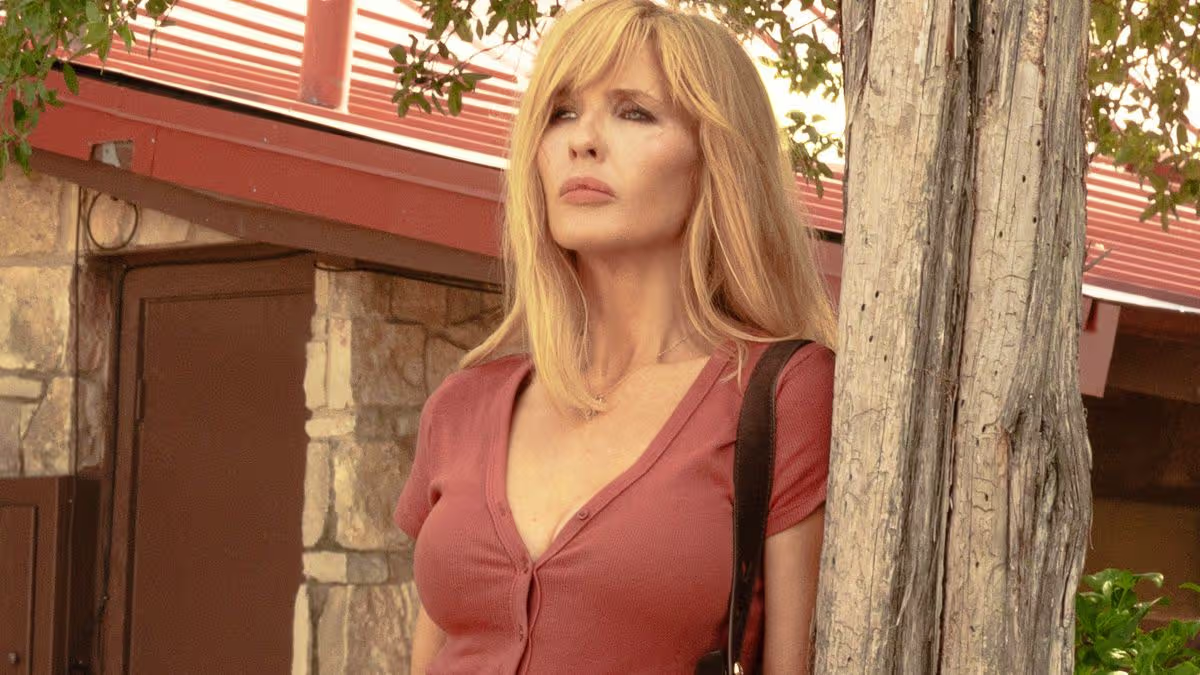
Inside Dutton Ranch star Kelly Reilly’s life from real first name to surprising dating history

Published

on

Wales Online

Actress Kelly Reilly keeps her life away from the cameras mostly under wraps, but we do know some details about the Dutton Ranch star

Dutton Ranch is the latest Yellowstone spin-off hitting Paramount+ this week and will finally continue the story of Beth Dutton (played by Kelly Reilly) and Rip Wheeler (Cole Hauser).

Advertisement

Almost two years after the thrilling conclusion to the flagship Western drama starring Kevin Costner as notorious rancher John Dutton, the hit Western franchise created by Taylor Sheridan will finally return.

Beth and Rip are once again carving out their destiny in the new series premiering today (Friday, 15th May), which sees them moving to Texas and purchasing a new ranch.

As the highly anticipated new series, helmed by director and executive producer Christina Alexandra Voros, gets started, fans will want to know more about the beloved stars behind their favourite characters.

Lead actress Reilly keeps her personal life relatively private, but we do know some surprising titbits about what she has gotten up to away from the cameras.

Advertisement

Early Life

Kelly Reilly was actually born Jessica Kelly Siobhán Reilly, shortening her name when she began her acting career.

The British star was born in 1977 in Chessington, in the borough of Kingston upon Thames in Greater London, making her 48 years old.

Her mother was a hospital receptionist while her father Jack was a police officer. Her grandparents on her father’s side were Irish, hailing from County Galway.

Advertisement

Reilly has even credited her grandmother as being one of the first people in her life to nurture her love of acting.

Speaking to the Irish Independent, she recalled: “She’d come around and pick me up, probably when my brother was at football or something, and we’d go off to church. And I remember thinking that was my first taste of theatre.

“The stage and the costumes and the ritual and the incense. I had no idea really what was going on other than I loved the experience of it. It was like I was observing it, rather than being part of it.”

Advertisement

Romantic History

Reilly has been married to financier Kyle Baugher since 2012, having met two years previously at a wedding in Texas.

While Baugher is not involved in the entertainment industry, Reilly’s previous relationships have been a little more high-profile.

She was previously engaged to Israeli actor Jonah Lotan in 2007. Lotan is best known for appearances in hit TV shows such as Hostages, Foyle’s War and 24.

Advertisement

A year later, Reilly was involved with director Guy Ritchie, going on to star in his 2009 film Sherlock Holmes, starring Robert Downey Jr as the famous detective.

Marriage to Kyle Baugher

A touching Instagram post from Reilly in 2023 confirmed she and Baugher were married in Somerset. She has called the event, which took place on 5th June, 2012, “a magical afternoon”.

Speaking about her husband on The Drew Barrymore Show, Reilly explained that they met each other at his brother’s wedding, to which she was her friend’s plus-one.

Advertisement

Get Paramount+ free for a week

This article contains affiliate links, we will receive a commission on any sales we generate from it. Learn more
Content Image

£4.99

£0

Paramount+

Get Paramount+ here

Telly fans can get seven days of free access to Paramount+ shows like Tulsa King and Dexter: Original Sin by signing up for a free trial via Amazon Prime’s Paramount+ channel.

Advertisement

“I thought he was Texan… he’s from Long Island,” she revealed. “He’s the love of my life. The most beautiful thing that’s ever happened to me is my marriage.”

It’s believed that the couple do not have children together, though they do have a schnauzer dog.

They split their time between Long Island, New York and a 300-year-old cottage in rural Sussex, England.

Dutton Ranch continues Fridays on Paramount+.

Advertisement

Source link

Continue Reading

Trending

Copyright © 2025