Connect with us
DAPA Banner
DAPA Coin
DAPA
COIN PAYMENT ASSET
PRIVACY · BLOCKDAG · HOMOMORPHIC ENCRYPTION · RUST
ElGamal Encrypted MINE DAPA
🚫 GENESIS SOLD OUT
DAPAPAY COMING

Tech

Hacking Hard Drive Firmware | Hackaday

Published

on

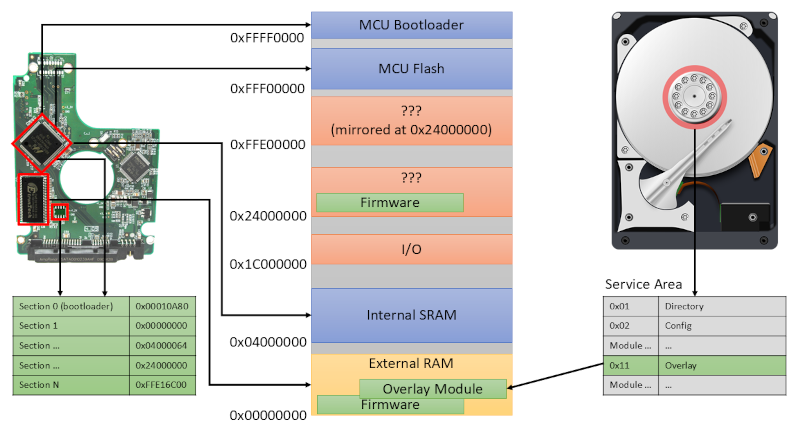
You probably flash new firmware on a variety of devices regularly, even though that’s rare for non-technical types. But what about your hard drive firmware? Most of us don’t want to touch our operating drives, so unless you are dealing with surplus drives or have a special project in mind, you may not think much about the firmware running your spinning rust storage. [I Code 4 Coffee] uses hard drives in an unusual way to exploit Xbox 360s, and wound up reverse engineering some drive firmware with an eye to making changes.

The analysis started with three hard drives and an SSD. Looking for people who’ve done similar work wasn’t as productive as you might think. There isn’t much call for modifying hard drive firmware, and what data there is can be outdated.

One thing that was available was firmware dumps taken with a PC-3000 data recovery tool. What follows is a deep dive down the hard drive rabbit hole. There are backdoor vendor commands and connections to the diagnostic RS-232 port on some drives. You can find the technical artifacts on GitHub.

Advertisement

We learned a few things, and we bet you will too. Another way to get into the hard drive’s firmware is via JTAG.

Source link

Advertisement
Continue Reading
Click to comment

You must be logged in to post a comment Login

Leave a Reply

Tech

Tesla reveals two Robotaxi crashes involving teleoperators

Published

on

Tesla Robotaxis have crashed at least twice since July 2025 while a teleoperator was remotely driving the vehicles, according to newly unredacted information submitted to the National Highway Traffic Safety Administration (NHTSA).

Both crashes happened in Austin, Texas and occurred at low speeds. In each case, there was a safety monitor behind the wheel and no passengers were onboard.

The new information comes just a few months after Tesla told lawmakers that it allows remote operators to pilot one of the company’s vehicles as long as they stay under 10 miles per hour. “This capability enables Tesla to promptly move a vehicle that may be in a compromising position, thereby mitigating the need to wait for a first responder or Tesla field representative to manually recover the vehicle,” the company said at the time.

Tesla, like other companies working on autonomous vehicle technology, is required to submit detailed information about any crashes to NHTSA. Unlike most of those other companies, though, Tesla had always redacted the descriptions of its crashes, claiming they were confidential business information.

Advertisement

It’s not clear why, but Tesla changed course this week, and the latest version of the data released by NHTSA now provides a narrative description for all 17 crashes Tesla has recorded since last year with its nascent Robotaxi network.

In July 2025, shortly after Tesla first started operating the network in Austin, the company’s automated driving system (ADS) apparently had trouble moving forward while stopped on a street. The safety monitor requested help from Tesla’s remote assistance team, and a teleoperator “took over vehicle control and gradually increased vehicle speed and turned the Tesla ADS left toward the left side of the street.”

The teleoperator then drove “up the curb and made contact with a metal fence.”

A similar sequence played out in January 2026. The Tesla ADS was driving the vehicle straight on a street, when the safety monitor “requested support to assist with vehicle navigation.”

Advertisement

“The teleoperator took over vehicle control when the ADS was stopped and proceeded straight on the street. The Tesla vehicle made contact with a temporary barricade fora. construction site at approximately 9MPH, scraping the front-left fender and tire,” according to the data submitted to NHTSA.

Similar to other autonomous vehicle companies like Waymo, most of the other newly unredacted crashes involve Tesla Robotaxi vehicles being crashed into instead of causing crashes.

But at least two of them involve a Tesla Robotaxi clipping its mirrors on other vehicles. In one crash, from September 2025, the Tesla ADS was unable to avoid hitting a dog that ran into the street. (Tesla reported the dog was able to run away.)

In another September 2025 crash, a Tesla Robotaxi made an unprotected left turn into a parking lot and ran into a metal chain. (NHTSA recently closed an investigation into the occasional tendency of Tesla’s Full Self-Driving software to crash into parking lot bollards, chains, and gates. Waymo also issued a recall last year related to a similar problem.)

Advertisement

While other robotaxi companies like Waymo and Zoox have reported more crashes than Tesla, Elon Musk’s company is operating at a fraction of the scale. The details that were revealed this week in the newly un-redacted data may help explain why Tesla is scaling up its nascent autonomous ride-hailing network so slowly. Musk himself admitted last month that “making sure things are completely safe” is the biggest limiting factor to Tesla expanding the network, saying the company is being “very cautious.”

When you purchase through links in our articles, we may earn a small commission. This doesn’t affect our editorial independence.

Source link

Advertisement
Continue Reading

Tech

Microsoft Exchange, Windows 11 hacked on second day of Pwn2Own

Published

on

Pwn2Own Berlin

​During the second day of Pwn2Own Berlin 2026, competitors collected $385,750 in cash awards after exploiting 15 unique zero-day vulnerabilities in multiple products, including Windows 11, Microsoft Exchange, and Red Hat Enterprise Linux for Workstations.

The Pwn2Own Berlin 2026 hacking competition takes place at the OffensiveCon conference from May 14 to May 16 and focuses on enterprise technologies and artificial intelligence.

Security researchers can earn over $1,000,000 in cash and prizes by hacking fully patched products in the web browser, enterprise applications, cloud-native/container environments, virtualization, local privilege escalation, servers, local inference, and LLM categories.

According to Pwn2Own’s rules, all targeted devices run the latest operating system versions, and all entries must compromise the target and demonstrate arbitrary code execution. Vendors have 90 days to patch their software and hardware after the zero-days are disclosed at Pwn2Own.

Advertisement

The highlight of the second day was Cheng-Da Tsai (also known as Orange Tsai) of DEVCORE Research Team earning $200,000 after chaining three bugs to gain remote code execution with SYSTEM privileges on Microsoft Exchange.

Siyeon Wi also collected $7,500 after exploiting an integer overflow bug to hack Windows 11, and Ben Koo of Team DDOS escalated privileges to root on Red Hat Enterprise Linux for Workstations to earn a $10,000 cash prize, while 0xDACA and Noam Trobishi used a use-after-free bug to exploit the NVIDIA Container Toolkit.

In the AI category, Le Duc Anh Vu of Viettel Cyber Security hacked the Cursor AI coding agent for $30,000, Sina Kheirkhah of Summoning Team demoed an OpenAI Codex zero-day ($20,000), and Compass Security exploited Cursor ($15,000).

Pwn2Own leaderboard Day 2
Pwn2Own leaderboard (ZDI)

On the first day, Orange Tsai earned another $175,000 after chaining 4 logic bugs for a Microsoft Edge sandbox escape, while Valentina Palmiotti (chompie) of IBM X-Force Offensive Research collected $20,000 for rooting Red Hat Linux for Workstations and $50,000 for an NVIDIA Container Toolkit zero-day.

Windows 11 was also hacked three times on day one by Angelboy and TwinkleStar03 (working with the DEVCORE Internship Program), Kentaro Kawane of GMO Cybersecurity, and Marcin Wiązowski, each earning $30,000 in cash rewards for demonstrating new privilege-escalation zero-days.

Advertisement

On the third day of Pwn2Own, the hackers will target Microsoft Windows 11, VMware ESXi, Red Hat Enterprise Linux, Microsoft SharePoint, and several AI coding agents.

The full schedule for the second day and the results for each challenge are available here, while the complete schedule for Pwn2Own Berlin 2026 is available here.

During last year’s Pwn2Own Berlin contest, TrendMicro’s Zero Day Initiative awarded 1,078,750 for 29 zero-day flaws and some bug collisions.


article image

Automated pentesting tools deliver real value, but they were built to answer one question: can an attacker move through the network? They were not built to test whether your controls block threats, your detection rules fire, or your cloud configs hold.

This guide covers the 6 surfaces you actually need to validate.

Advertisement

Download Now

Source link

Continue Reading

Tech

If This Stunning Coupe Is The Future Of BMW ALPINA, The Purists Will Be Delighted

Published

on


You can tell a lot from a concept car. No, these flights of automaker fancy — divorced as they are from factors so tedious as road safety, regulations, and “can we actually afford to build this?” — are unlikely to make it to dealership forecourts, or at least not in their original form. But as signposts to what a car company believes is important (and will eventually sell), they’re rich seams for the digging.

On that front, the new Vision BMW ALPINA is attention-grabbing for more than just its graceful silhouette. As the “Vision” prefix suggests, it’s the handiwork of BMW Group Design rather than a production model per se. The “ALPINA” part, meanwhile, confirms this is a preview of something a whole lot more niche than the usual BMW concept.

Once a standalone tuner, then brought in-house, Alpina is now the core of what BMW says will fill the (broad) gap between its regular range and the sky-high luxury echelons of Rolls-Royce. What’s unclear — and probably won’t be known until the first BMW ALPINA car debuts in 2027, a riff off the BMW 7 Series — is just how far the brand will stray from BMW’s own focus right now.

Advertisement

You’re rich and enjoy vast coupes and V8 engines, right?

If the Vision BMW ALPINA is anything to go by, the answer there could be a considerable distinction under the hood. The concept car is a two-door coupe, a design study for what a four-passenger grand tourer could deliver if given plenty of space and money to play with. At nearly 205 inches long, it’s only about 7 inches shorter than a 7 Series sedan.

The designers aren’t giving specifics for powertrain, but it’s a V8 “tuned to produce the characteristic notes of the Alpina exhaust” that BMW ALPINA says is envisaged for propulsion. Considering how often show cars these days are all-electric or plug-in hybrid, that’s a conspicuous departure. It could also reflect the reality that high-end car buyers may not quite be ready for full electrification — or, more accurately, ready to give up their evocative combustion soundtrack.

Since BMW is putting its best foot forward with EVs for the mass market — and, given the whims of the rich, it’s their taste for private jets that comprises the bulk of their carbon footprint, not rarely-driven four-wheel fancies in the garage — we can probably forgive the old-school engine. BMW ALPINA certainly wraps it up in modern style, anyway.

Advertisement

Not just slotting in, but standing out

The lengthy hood is fronted by a sizable kidney grille, illuminated as per many of BMW’s recent production cars. The headlights are narrow and angrily squinting, reminiscent of what’s on the new 2027 i7 electric sedan; they’re paired with 20-spoke alloy wheels — a staggered set, measuring 22 inches at the front, 23 inches at the rear — that are an Alpina hallmark.

Inside, and unsurprising given the scale of the coupe, BMW ALPINA promises plenty of space. BMW’s recent dashboard displays deliver the tech to the front; a pair of crystal glasses that power up out of the central armrest add some drama to the rear cabin. No word on overall performance, but a Comfort+ drive mode goes beyond what a mainstream BMW delivers for cosseting.

There’s a Sport mode, too, naturally. Alpina’s goal, after all, was always a subtly different riff on performance compared to BMW’s own M division. If BMW ALPINA is to continue that strategy — and justify price tags in excess of what a mass-market BMW currently commands — it’ll need to draw on that unique focus when its first production cars arrive. A modern V8 for those not quite ready to go entirely electric might be just what’s required.

Advertisement


Source link

Continue Reading

Tech

Bolt partners with China’s Dongfeng to launch EV ride-hailing fleet in South Africa

Published

on

TL;DR

Bolt has partnered with China’s Dongfeng Motor Group to roll out electric vehicles on its ride-hailing platform in South Africa, starting in Cape Town. The Estonian company claims more than 50% market share in the country after investing roughly $180 million. The deal pairs Dongfeng’s Box hatchback and 007 sedan with Bolt’s driver network as rising fuel prices make EVs increasingly attractive for ride-hailing economics.


Advertisement

Bolt Technology, the Estonian ride-hailing company that has spent roughly $180 million building a dominant position in South Africa, has struck a deal with China’s Dongfeng Motor Group to roll out an electric-vehicle fleet in the country. The partnership will start in Cape Town, with Dongfeng’s Box hatchback and its more premium 007 sedan available to riders through Bolt’s platform. A fleet management company called Yugo Rides will operate the vehicles.

The deal is a bet on two converging forces: rising global demand for Chinese electric vehicles and the economic pressure that elevated fuel prices, driven in part by the Iran conflict, are placing on ride-hailing drivers across emerging markets. Simo Kalajdzic, who manages Bolt’s South African operations, said the company is taking a phased approach to the rollout because of infrastructure constraints, particularly the need for sufficient charging stations.

Why South Africa matters to Bolt

Bolt claims more than 50% of the ride-hailing market in Africa’s largest economy, a figure that, if accurate, would make South Africa one of the few markets globally where Uber is not the leading platform. The company has invested about $180 million in building out the local business and says South Africa consistently ranks among its top 10 markets worldwide. Kalajdzic described the country as a “strong strategic priority.

That investment is part of a broader expansion that now spans more than 50 countries and 850 cities. Bolt, which offers ride-hailing, food delivery, and scooter rentals, earned a €7.4 billion valuation in a 2022 funding round after raising €628 million from Sequoia Capital, Fidelity Management, and other investors. It has since moved into East Asia by launching in Taiwan and entered Canada under a sub-brand called Hopp. It also launched scooters in Washington, DC.

The EV calculus for ride-hailing

The logic behind electrifying a ride-hailing fleet in South Africa is straightforward but not simple. Fuel costs are among the largest expenses for drivers on any ride-hailing platform, and the oil price increases linked to the Iran conflict have made that burden heavier. Electric vehicles offer substantially lower per-kilometre running costs, which in theory should improve driver earnings and make the platform more attractive to new drivers.

Advertisement

The constraint is infrastructure. South Africa’s charging network remains sparse compared with those in Europe or China, and the country’s electricity grid has historically been unreliable, though load-shedding has eased in recent months. Bolt’s phased approach, starting in Cape Town, which has better charging infrastructure than most South African cities, suggests the company is aware that scaling an EV fleet will take time.

Dongfeng, for its part, gains a distribution channel in a market where Chinese manufacturers are increasingly competitive but have not yet established the consumer brand recognition that BYD and others have built in Europe and Southeast Asia. Partnering with a ride-hailing platform lets Dongfeng put its vehicles in front of millions of riders without needing to build a retail network from scratch.

The IPO question

The South Africa deal arrives as Bolt weighs an initial public offering. Kalajdzic said the company will “consider options, when market conditions are right,” a formulation that venture-backed companies typically use when an IPO is being planned but not yet committed to. Bolt’s €7.4 billion private valuation dates from 2022, and market conditions for ride-hailing IPOs have shifted considerably since then, not least because Uber’s own stock has demonstrated the difficulty of sustaining high multiples in the sector.

The Dongfeng partnership could serve a dual purpose in that context. Demonstrating the ability to electrify its fleet in a key market would strengthen Bolt’s narrative for public investors, particularly those focused on environmental, social, and governance criteria. It would also help differentiate Bolt from the company whose shadow it has always operated in: Uber has invested heavily in autonomous vehicles but has been slower to electrify its conventional fleet in emerging markets.

Advertisement

Whether the economics work at scale remains to be seen. The deal is small, a phased rollout of two Dongfeng models in a single city, and Bolt has not disclosed the financial terms of the partnership or the number of vehicles involved. But it signals a strategic direction that, if it succeeds, could be replicated across Bolt’s African and emerging-market footprint. For a company that built its position by being cheaper and faster than Uber in markets the American company treated as secondary, electrification is a logical next step.

Source link

Advertisement
Continue Reading

Tech

Popular node-ipc npm package compromised to steal credentials

Published

on

Popular node-ipc npm package compromised to steal credentials

Hackers have injected credential-stealing malware into newly published versions of node-ipc, a popular inter-process communication package, in a new supply chain attack targeting npm.

The node-ipc package is a Node.js module that enables various processes to communicate through all forms of sockets, including Unix, Windows, UDP, TLS, and TCP.

Despite the maintainer publishing in March 2022 weaponized versions that targeted Russia and Belarus-based systems with a data-overwriting module, in protest to the Russian invasion of Ukraine, the package still has more than 690,000 weekly downloads on npm.

The recent supply-chain attack was detected by multiple application security companies, including Socket, Ox Security, and Upwind, who confirmed the following three versions as malicious:

Advertisement
  • node-ipc@9.1.6
  • node-ipc@9.2.3
  • node-ipc@12.0.1

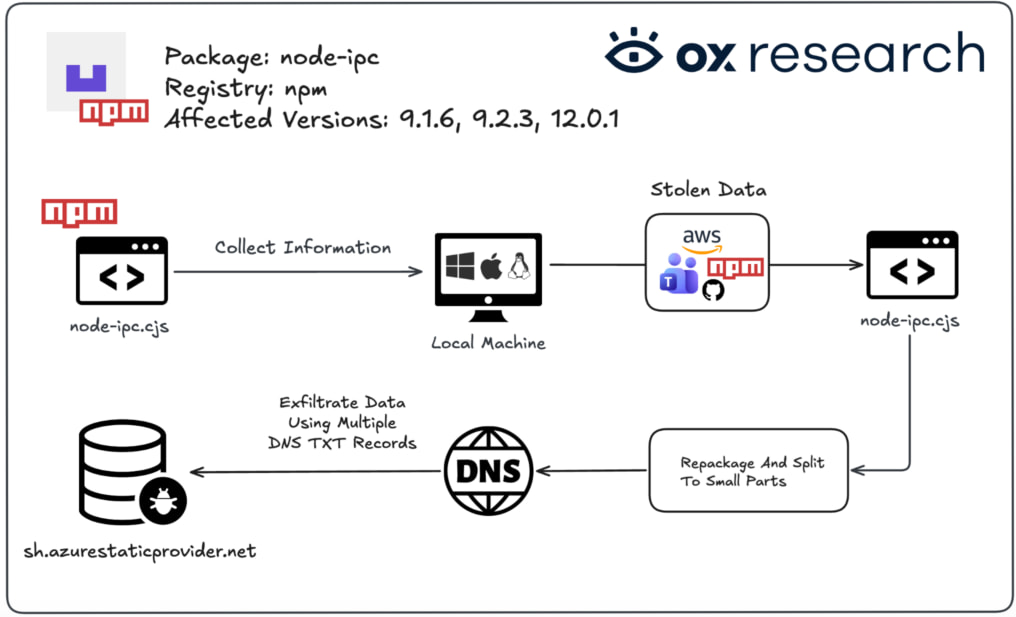
The malicious code hides inside the CommonJS entrypoint (node-ipc.cjs) and executes automatically whenever applications are loaded.

The malware is heavily obfuscated and fingerprints infected systems, collects environment variables and sensitive local files, compresses the stolen data into archives, and exfiltrates it through DNS TXT queries.

The latest compromise appears to be the work of an external actor who compromised the account of an inactive maintainer named ‘atiertant.’

According to the researchers, the infostealer injected in the new node-ipc versions collects the following types of information from compromised systems:

  • Cloud credentials from AWS, Azure, GCP, OCI, DigitalOcean, and others
  • SSH keys and SSH configs
  • Kubernetes, Docker, Helm, and Terraform credentials
  • npm, GitHub, GitLab, and Git CLI tokens
  • .env files and database credentials
  • Shell histories and CI/CD secrets
  • macOS Keychain files and Linux keyrings
  • Firefox profile and key database files (on macOS)
  • Microsoft Teams local storage and IndexedDB paths

The malware skips files larger than 4 MiB and avoids scanning .git and node_modules directories to increase efficiency and reduce operational noise on the host.

Attack overview
Attack overview
Source: Ox Research

A notable operational characteristic is the use of DNS TXT queries instead of conventional HTTP-based command-and-control (C2) traffic for data exfiltration. The attackers use a fake Azure-themed domain (sh[.]azurestaticprovider[.]net:443) as a bootstrap resolver, transmitting the data to ‘bt[.]node[.]js’ with query prefixes like xh, xd, and xf.

According to Socket, exfiltrating a 500 KB compressed archive could generate roughly 29,400 DNS TXT requests, helping the traffic blend into normal DNS activity.

Advertisement

Prior to submission, the malware stores collected data in temporary compressed tar.gz archives, which are deleted after exfiltration to reduce forensic traces.

The malware does not establish persistence or download any secondary payloads, so the operation appears focused on rapid credential theft and exfiltration.

Potentially impacted developers should immediately remove the affected versions, rotate exposed secrets and credentials, and inspect lockfiles and npm caches.


article image

Automated pentesting tools deliver real value, but they were built to answer one question: can an attacker move through the network? They were not built to test whether your controls block threats, your detection rules fire, or your cloud configs hold.

This guide covers the 6 surfaces you actually need to validate.

Advertisement

Download Now

Source link

Continue Reading

Tech

Dell Alienware's new $1,300 gaming laptop cuts corners by using cheap plastic and older-gen gaming hardware

Published

on


The Alienware 15 is available in several hardware configurations, with both AMD and Intel CPU options, along with multiple generations of Nvidia GeForce RTX GPUs. A configuration featuring an AMD Ryzen 5 220 processor and a GeForce RTX 4050 graphics card starts at $1,300, while the most expensive Intel-based model…
Read Entire Article
Source link

Continue Reading

Tech

Lenovo launches a budget 200Hz gaming monitor

Published

on

Lenovo has introduced a new budget gaming monitor in China under its Lecoo branding, and on paper, it looks like serious value for money.

The new Lecoo N2757Q combines a high refresh rate and 1440p resolution with a relatively low price tag, targeting gamers who want smooth performance without spending much.

At the centre of the package is a 27-inch Fast IPS panel with a 2560 × 1440 resolution and a native 200Hz refresh rate. The refresh rate can even be pushed slightly higher to 210Hz via overclocking, putting it firmly in competitive gaming territory. This is especially true for fast-paced FPS and RTS titles where frame smoothness matters more than anything else.


Lenovo also claims a 1ms (GTG) response time, aiming to reduce motion blur during high-speed gameplay. Colour performance sits in the mid-to-upper range for a budget display with 121% sRGB coverage and 96% DCI-P3; decent for everyday gaming and content consumption, but it’s not aimed at professional colour work.

Advertisement

Brightness peaks at 400 nits, which allows the monitor to meet the HDR400 standard. That won’t deliver true HDR impact compared to higher-end panels, but it should still offer a noticeable boost in contrast and highlights over standard SDR displays. Lenovo is also highlighting built-in game modes, designed to optimise visuals for different genres like shooters and strategy games.

Advertisement

On the connectivity side, there’s nothing flashy, but the monitor is practical. It includes two DisplayPort 1.4 ports and two HDMI 2.1 ports. This allows multiple devices to stay connected at the same time without constant swapping.

Elsewhere, the Lecoo N2757Q comes with an adjustable stand, VESA mount support, and a fairly minimal design. It keeps things simple rather than aggressive or overly “gamer-focused”.

Advertisement

The most striking part of the package, though, is the price. Lenovo has launched the Lecoo N2757Q in China at CNY 799 (around $118). This undercuts many 1440p high-refresh monitors currently on the market.

There’s no word yet on international availability, and given the Lecoo branding’s limited global presence, it’s unclear if this ultra-budget 200Hz monitor will ever leave China. Still, on specs alone, it’s one of the more aggressive value plays in the gaming display space right now.

Source link

Advertisement
Continue Reading

Tech

PreFlight Slicer Brings Added Part Strength Feature, And Many More

Published

on

Interested in taking some wild new 3D printing features for a test drive? preFlight is free and open source slicer that brings a host of processing improvements as well as fascinating new features and interesting twists on old ones. There are almost too many to list, so here are a few that caught our eye.

Cross-sectional view of Interlocking Perimeters, which increases Z-strength. Unlike brick layers, layer height stays constant.

Want to mix and match different support types on the same object? No problem. How about use Nip & Tuck seams to better hide where layers start and stop? You can emboss images directly onto print surfaces with a real-time preview and use smart bridging for counter-bored holes. We particularly like the ability to preview a sliced object from the side instead of just by layer. That’s not all, either.

Those features alone are pretty intriguing, but there’s one in particular that is particularly relevant to creating stronger parts. Interlocking Perimeters increases layer bonding to increase object strength. Unlike brick layers, which staggers layers vertically, interlocking perimeters plays with spacing and compression to increase bonding in the Z axis while keeping layer heights constant. This is possible thanks in part to the greater control offered by Athena, the new perimeter generator.

There are plenty more features — like a full Python runtime embedded directly into the slicing pipeline, and a host of export pathways — so check out the GitHub repository for added detail and let us know in the comments if you give it a try.

Advertisement

Source link

Advertisement
Continue Reading

Tech

ChatGPT Will Offer Personalized Financial Advice (If You Connect Your Bank Account)

Published

on

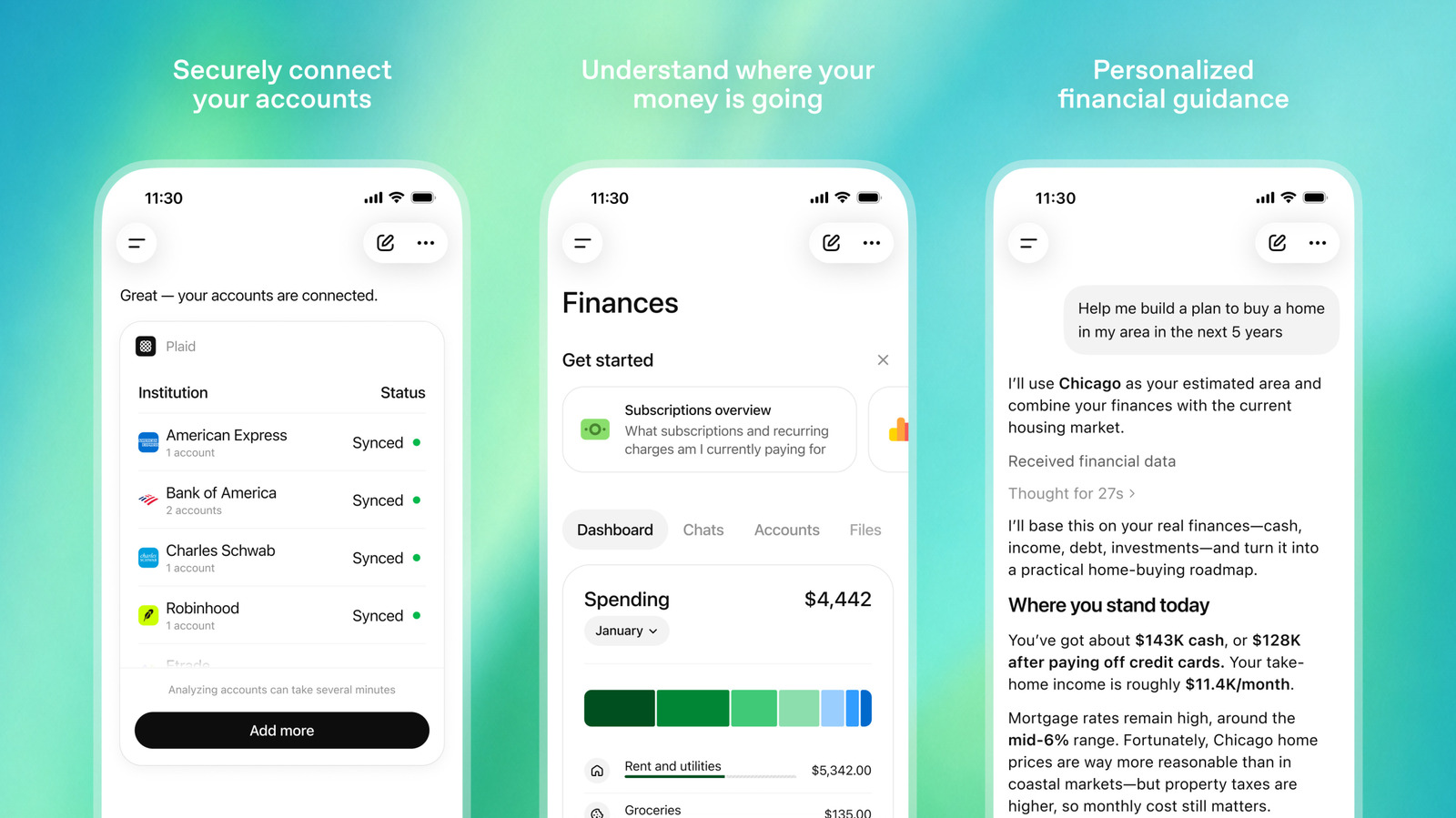
OpenAI is rolling out a preview of a new personal finance feature inside of ChatGPT. Starting today, Pro users in the US can connect their financial accounts to ChatGPT in order to get more personalized advice from the chatbot.

To hear OpenAI tell it, every month more than 200 million users already turn to ChatGPT for guidance on managing their money. By building a framework that allows those people to connect their accounts to its servers, ChatGPT can go from offering generic advice to helping those same users take actions that more directly improve their lives. The integration is made possible through a partnership OpenAI has signed with Plaid, which offers connections to more than 12,000 financial institutions, including banks like Citi and Chase, in addition to services like Affirm and Robinhood.

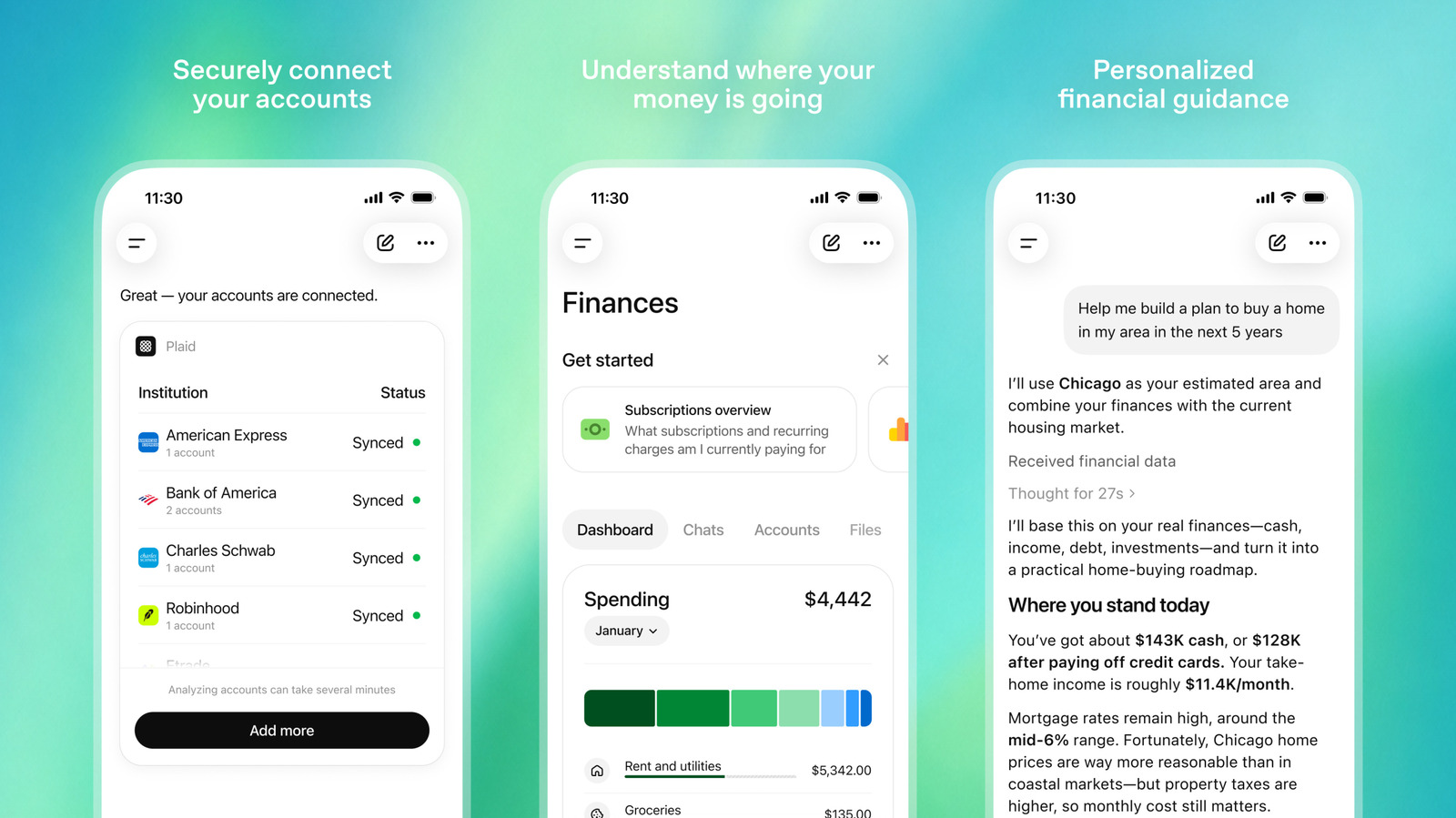
To begin using the new integration, find the “Finances” section inside of ChatGPT’s sidebar or write a prompt along the lines of “@Finances, connect my accounts.” ChatGPT will guide you through the process of importing your financial information through Plaid. The chatbot will then start building a visual dashboard, like the one you see in the screenshot OpenAI provided. The process of generating a visual representation of your finances may take a few minutes. From there, you can select one of the starter prompts or ask your own questions.

Understandably, some people may be hesitant to share their financial information with ChatGPT. OpenAI is looking to address those concerns by limiting the scope of what its chatbot can see. According to the company, ChatGPT can only read your balances, transactions, investments and liabilities through Plaid. It cannot see full account numbers or make changes to your accounts through the system.

Advertisement

Additionally, the company says users can disconnect their financial accounts from ChatGPT at any time, and any memories the chatbot saves about your financial situation can be seen or deleted directly from the Finances section of the app. ChatGPT cannot access these memories when using the temporary chats feature. Lastly, OpenAI’s data controls settings apply to the new experience, so if you’ve already dug into those, your prompts and other information won’t be used by the company to train future models.

According to an OpenAI spokesperson, work on the feature began before the company’s recent acquisition of fintech startup Hiro, which offered an AI-powered financial planning tool for consumers. The company hopes to bring this new experience to more users, including Plus subscribers, in the future. “We’re starting with a preview to a smaller group so we can learn from real-world use, improve the experience, and expand thoughtfully,” OpenAI said.

Source link

Advertisement
Continue Reading

Tech

4 Cool Perks You Didn’t Realize Came With Owning A Ford

Published

on


Given the upfront cost of a car, some of the biggest car brands have been known to hand out perks as added incentives to buy. And before you figure you’ve heard it all before, these special offers go beyond the standard checklist of benefits (like a warranty or free roadside assistance options). Like Ford, for example. When you drive off the lot in one of their vehicles, Ford tacks on several nice little bonuses you might not even realize you have.

Some of these perks are meant to save you time. Others are meant to save you money. No matter what, though, they all make owning a Ford just that much sweeter. We’ve put together the four coolest below, plus instructions on how to make the most of them (if you haven’t already). Pick one or two to take advantage of, or get your money’s worth and start enjoying all four.

Advertisement

1. Complimentary Pickup & Delivery service

It’s one of the biggest hassles associated with vehicle maintenance: actually getting the car to the dealership. Ford seems to understand this, as many of their dealerships offer a complimentary Pickup & Delivery service. Instead of rearranging your entire day around an oil change or warranty repair, you can just schedule a service appointment at the dealership and have your vehicle picked up directly from your home or office.

A technician will pick up your car from your place, take it to the dealership for servicing, and bring it back once the work is done. If your local dealership is participating, it’s all done completely free of charge. (Although you still have to pay for the repair and parts costs, of course.) The program covers both warranty work and customer-pay repairs. As long as your car’s drivable and hasn’t been involved in an accident, you can take advantage of Pickup & Delivery.

Advertisement

2. Complimentary Mobile Service program

Alongside the Pickup & Delivery perk, Ford’s complimentary Mobile Service program makes dealership maintenance even easier. Rather than having to drive to the service center (or have the Ford dealership come pick up the car and bring it back), Ford Mobile Service will send a dealership technician straight to your home or work. The tech will then handle the on-site maintenance tasks.

The service itself is totally complimentary for Ford owners through participating dealerships. (As mentioned above, you still have to pay for the actual maintenance task itself.) The list of services available through Ford Mobile Service is a lot more extensive than you might expect, as well. They can do oil and filter changes, brake services, battery replacements, tire rotations, wiper replacements, fluid checks, filter replacements, lamp and bulb service, software updates, accessory installations, and diagnostic scanning, all right there in your driveway or parking spot.

Advertisement

3. Phone As A Key feature

Another nice perk of owning a Ford: The “Phone As A Key” feature in the FordPass app. This perk lets owners of select Ford vehicles use their smartphone in place of a traditional key fob. Once you’re paired with your vehicle, you can lock and unlock the doors, start the engine, and control several other functions directly through the app. You can also roll windows up or down, honk the horn, and open the trunk, no separate physical key required.

It’s all done via Bluetooth Low Energy, which means it’ll work within a range of roughly 30 to 50 meters. Passive entry functions specifically will only work within about two meters. (That’s nothing out of the ordinary for other keyless entry systems you might’ve used before.) All in all, Ford lets you pair up to four Phone As A Key setups per vehicle. As long as you have iOS 16 or later or Android 8.0 or later, you can store your car keys on an iPhone or Android.

Advertisement

4. Free service visits with points

If you own a Ford, you might not realize you’re sitting on a heap of rewards points. Ford owners receive tens of thousands of points for getting the car in the first place, then add to that grand total with maintenance visits, accessory purchases, and other Ford transactions. More specifically, it’s 31,000 points for gas, diesel, or hybrid vehicle purchases or leases, or 22,000 for an EV purchase.

For many drivers, those many points can cover your first few oil changes. Depending on your driving habits and service intervals, that could be the first year and a half to two years of ownership. (This writer was personally able to stretch it to two years.) Of course, you don’t have to spend them on that. Points can also be redeemed for accessories and connected services like Ford BlueCruise. It’s not unlike airline rewards systems, in a way: It pays you to stay within Ford’s broader service ecosystem.

Advertisement


Source link

Advertisement
Continue Reading

Trending

Copyright © 2025