

Crypto World
Bitwise Set to Launch Hyperliquid (HYPE) ETF


Asset manager Bitwise is set to launch an exchange-traded fund tracking Hyperliquid’s native HYPE token.
The ETF will start trading on May 15 under the ticker BHYP on the New York Stock Exchange (NYSE).
Capitalizing on Hyperliquid’s Growth and Dominance
Bitwise said that BHYP is the first HYPE ETF to use an in-house staking infrastructure, with the firm adding that the fund was designed to give investors a convenient and low-cost way to participate in Hyperliquid’s growth. Reacting to the development, Galaxy’s head of DeFi, Marc Antonio, wrote, “Damn Matt Hougan and Bitwise are cooking.”
DeFi Llama data shows that Hyperliquid makes up about 60% of global on-chain perpetual DEX open interest, with the network being capable of processing up to 200,000 orders per second while maintaining a strong reliability track record. Bitwise believes that because of this, the platform is on the road to becoming one of the biggest beneficiaries as capital markets continue moving on-chain.
Matt Hougan, Chief Investment Officer at Bitwise, said the chain proved its relevance during a period of geopolitical tensions earlier this year, when traditional markets were closed, and traders turned to it for price discovery.
“Hyperliquid has emerged as one of the most compelling investment opportunities in crypto today,” said Hougan.
Additionally, Hype has risen to become the tenth largest crypto asset in the world since launching two years ago, with a market cap of over $11 billion.
“Hyperliquid’s token is explicitly designed so that rising trading activity on the Hyperliquid platform directly benefits token holders. This has translated into historically strong returns,” he added.
Bitwise Shares Fees
The fund’s prospectus shows that BHYP carries a 0.34% sponsor fee, which Bitwise plans to waive for the first month on the first $500 million in assets. The company also clarified that the product hasn’t been registered as an investment firm, meaning it doesn’t have the same protections as ETFs and mutual funds.
Earlier in the week, 21Shares launched a similar product tracking HYPE dubbed THYP, which pulled about $1.8 million in trading volume on its first day, a feat described by analyst James Seyffart as “nothing too crazy.”
It has since racked up $7.42 million in cumulative net inflow, with data from SoSoValue showing that yesterday’s flow alone came in at nearly $5 million.
The post Bitwise Set to Launch Hyperliquid (HYPE) ETF appeared first on CryptoPotato.



SpaceX has priced its shares at $135, according to a filing with the U.S. Securities and Exchange Commission on Thursday, setting the stage for one of the most closely watched public market debuts in recent years.
The company sold 555.6 million shares at that price, raising $75 billion, making it the largest IPO ever, easily topping Saudi Aramco’s $30 billion in 2019.
The Elon Musk-led aerospace and satellite company is expected to begin trading on Nasdaq on Friday under the ticker SPCX, giving public investors their first opportunity to buy shares. Based on the offering price, SpaceX will enter the public markets with a fully-diluted valuation of roughly $1.8 trillion.
The valuation is a pricey one, given SpaceX produced roughly $19 billion in revenue last year, driven by launches, government contracts and its rapidly growing Starlink satellite internet business.
Also notable is the company’s sizable bitcoin holdings. SpaceX held 18,712 bitcoin as of March 31. That would be valued at just under $1.2 billion at BTC’s current price around $63,500.
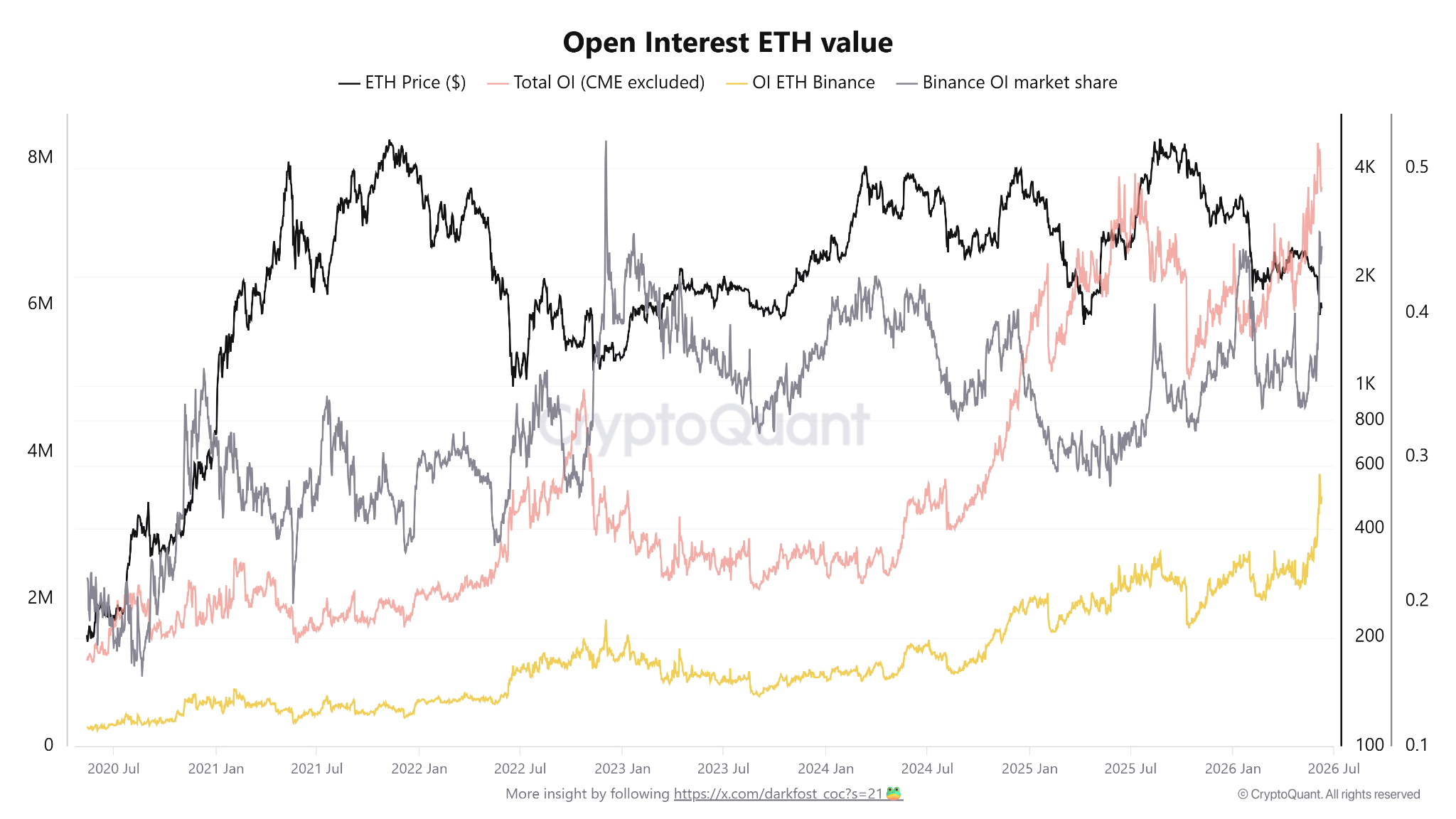
Ether (ETH) traders are increasing their leveraged long positions despite ETH price being down 44% in 2026. Ether’s futures open interest at Binance has climbed to a record 3.7 million ETH, with the exchange accounting for more than 44% of total Ether futures.
Crypto analyst Darkfost noted that Ether futures activity has improved despite rising uncertainty driven by geopolitical tensions and weakening economic conditions.
The analyst noted that Binance now holds nearly 3.7 million ETH in open futures contracts, marking a new all-time high for Ether open interest on the exchange.
ETH open interest value on Binance. Source: CryptoQuant
Improving risk appetite for long positions also emerged as Binance’s weekly average taker buy-sell ratio increased to 1.0 from 0.95 after months of seller-led activity. A reading near 1.0 points to a more balanced market after a prolonged period of selling pressure.
The trend extends beyond Binance. Across all exchanges, the taker buy-sell ratio has risen to 1 from 0.94 over the past two weeks, indicating that buyers are becoming more active in market orders than sellers.
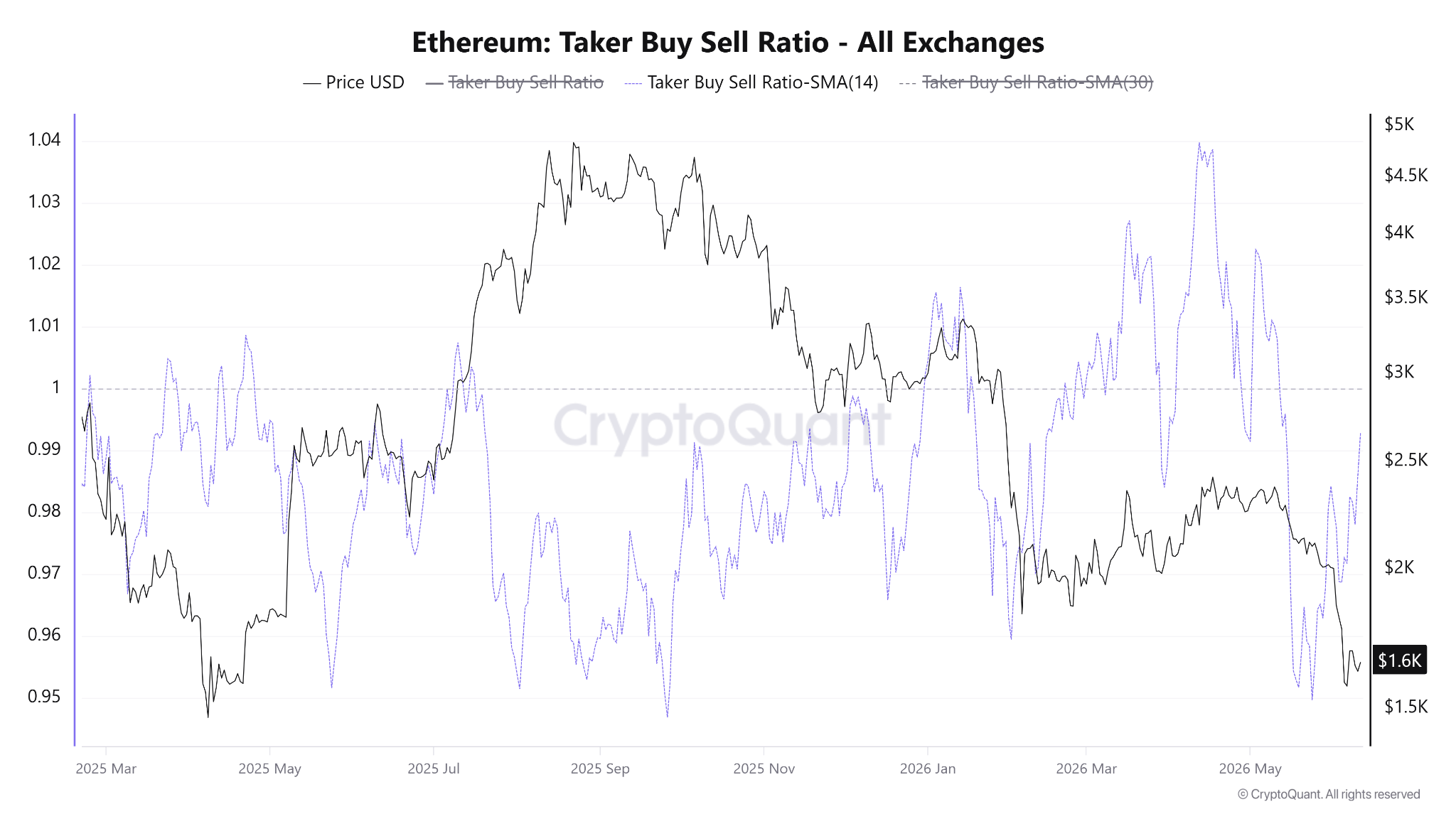
Ether: taker buy sell ratio across all exchanges. Source: CryptoQuant
At the same time, the speculative activity is accelerating faster than spot demand. Binance’s perp-spot volume imbalance indicator climbed to roughly 0.90, close to a record high, while its 30-day Z-score reached 2.53.
Perpetual futures volume stood near 5.57 million ETH compared with about 290,000 ETH in spot trading. This indicates leveraged participation is expanding far more quickly than activity in the underlying market.
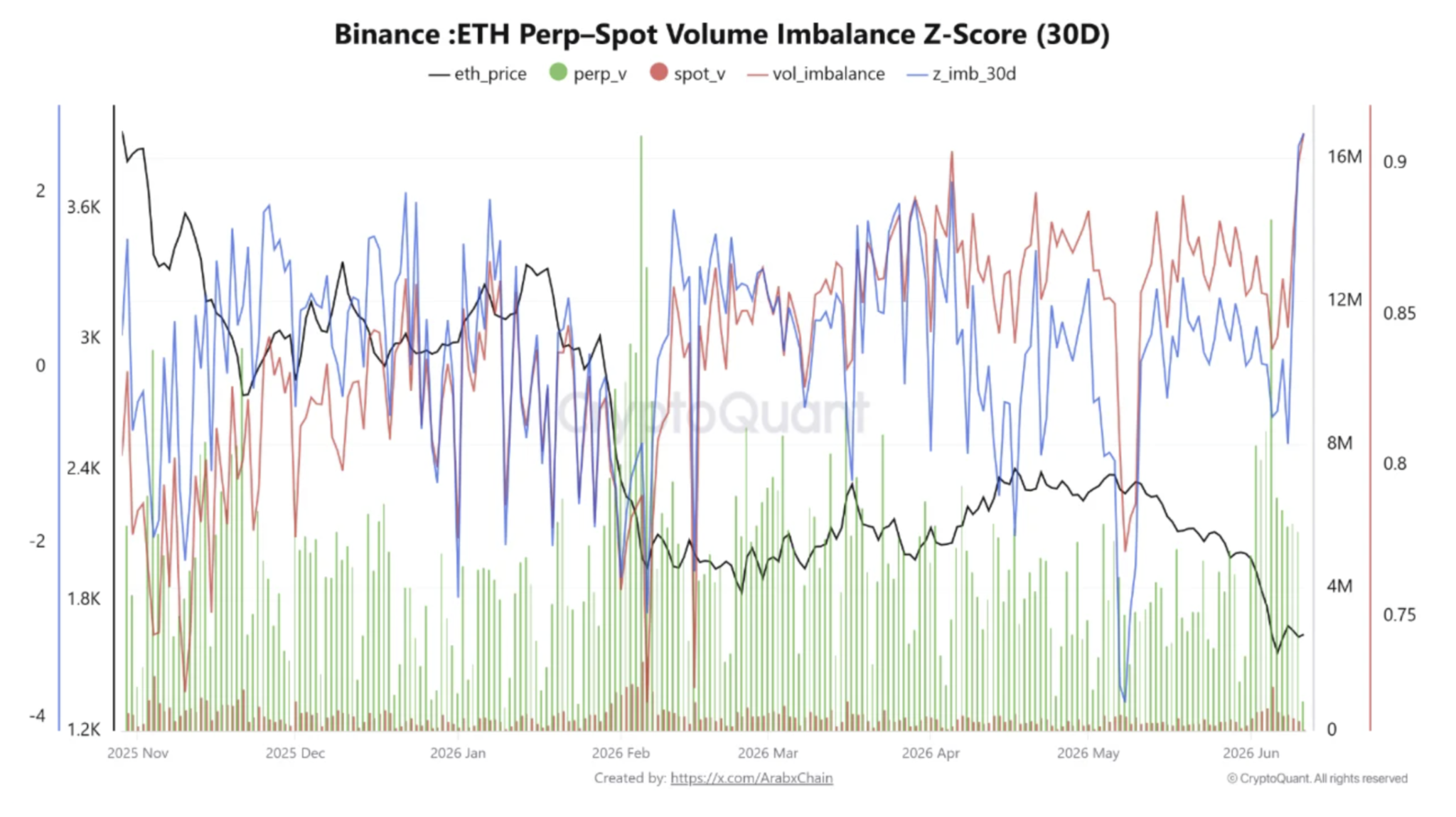
ETH Perp-Spot volume imbalance indicator. Source: CryptoQuant
Related: Audiera’s AI token BEAT beats Bitcoin, Ethereum as price surges 1,500% in a month
ETH liquidation risk remains on both sides
Market analyst Amr Taha highlighted a growing split in exchange positioning. Binance recorded a 30-day open interest increase of 616,400 ETH, its strongest reading since 2019. During the same period, Gate.io posted a decline of 631,700 ETH.
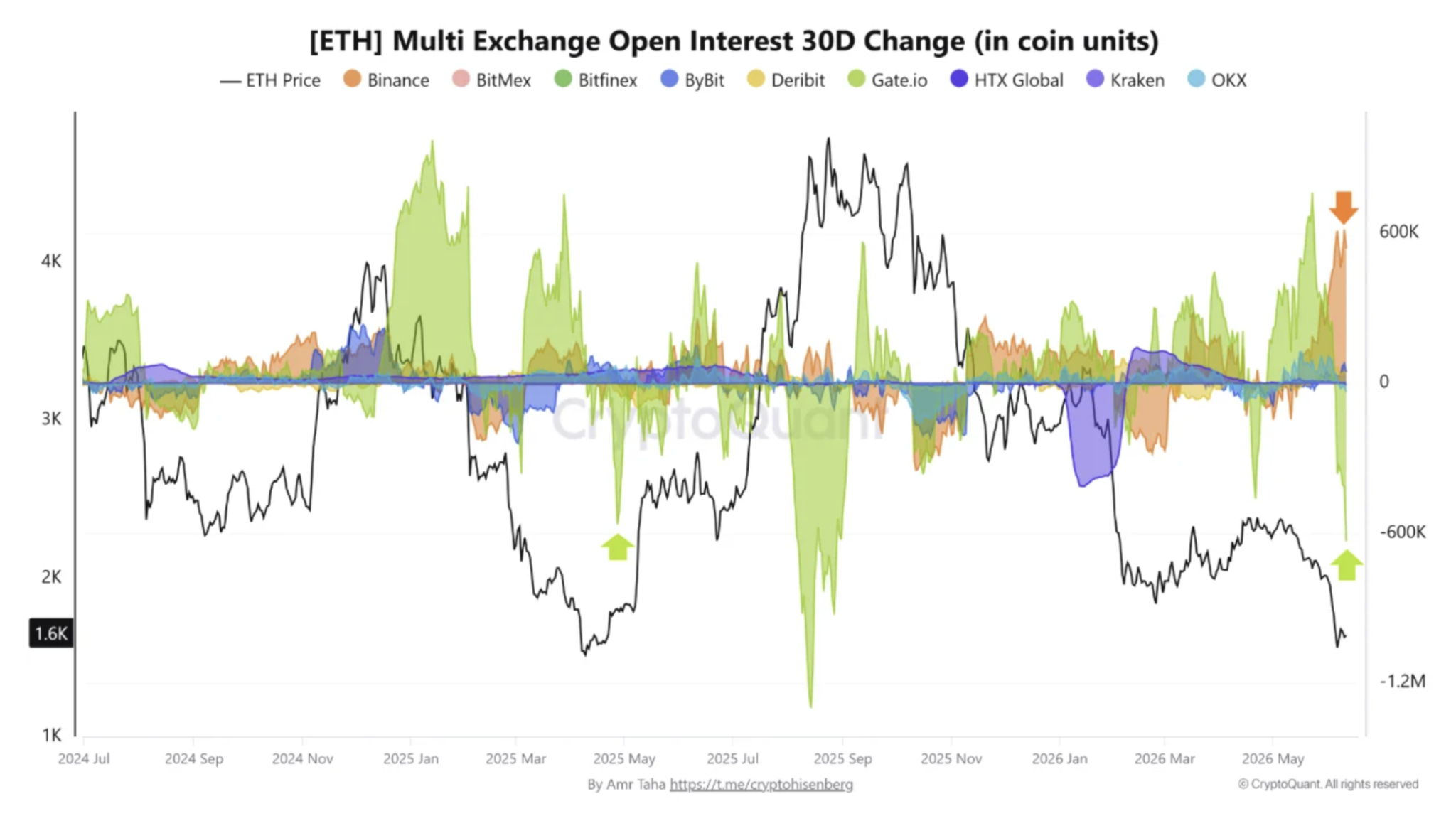
Multi-exchange open interest 30-day change. Source: CryptoQuant
Liquidation heatmaps show nearly $8 billion in short positions clustered between $2,200 and $2,400. Those levels stand out as key liquidity zones if ETH price begins to push higher.
However, near-term positioning remains heavily leveraged on both sides. Roughly $1.72 billion in cumulative long liquidations sits below the current price of $1,500, while nearly $1.90 billion in short liquidation exposure is concentrated near $1,800.
The narrow gap between those pools highlights a market where both bullish and bearish positions carry significant liquidation risk.
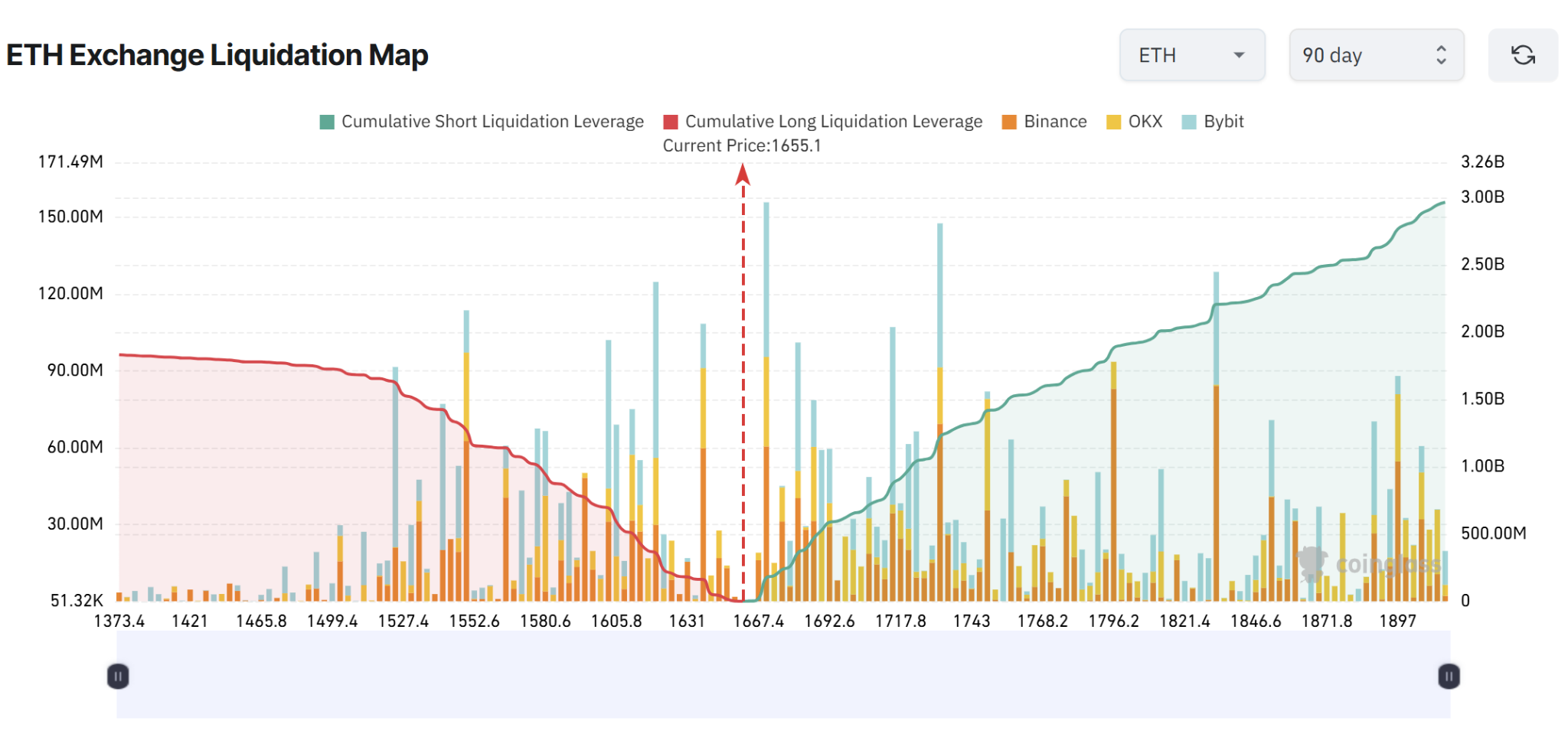
ETH liquidation map. Source: CoinGlass
Related: ETH crash to $1K looms if key support breaks: Will futures traders step in?

Ripple CEO Brad Garlinghouse posted a single word, “True,” in response to Flare co-founder Hugo Philion’s observation that the entire crypto industry is now scrambling to become what XRP was always criticized for being.
Philion’s original comment cut straight to the point: “When XRP and Ripple kind of started out, they were accused of being the banker coin. Now, everyone in the entire industry is desperate to be the banker coin.”
Garlinghouse’s public endorsement, backed by reports of Ripple deploying $4 billion in XRP holdings toward mainstream institutional finance, frames this less as a narrative shift and more as a belated market correction.
An X post summarizes it bluntly: “They mocked the vision. Now they’re copying it.”
Real-world assets, bank-integrated infrastructure, and institutional liquidity rails, which once XRP’s niche, are now the most crowded pitch in crypto.
Discover: The Best Crypto to Diversify Your Portfolio
Garlinghouse, Ripple, and XRP Price
XRP is barely holding above the psychologically critical $1.00 handle, with price consolidating in a tight range that technicals describe as bullish compression. Key support sits in the $1 zone, a prior consolidation band that has absorbed selling pressure through cycles.
Volume remains elevated relative to XRP’s ETF baseline, suggesting sustained interest rather than a dead-cat bounce. Transaction demand data indicates the $1.00 support level carries real on-chain significance, not just chart psychology.

At current levels, the risk/reward favors watching the $1.2 breakout level closely before adding exposure.
The banker coin narrative is now the consensus, which means the rerating from fringe institutional asset to mainstream financial infrastructure is largely priced in. The asymmetric upside that early XRP holders captured, buying into a vision the market hadn’t yet accepted, no longer exists at its current price.
Now, can XRP run back above its all-time high? Only time will tell
Discover: The Best Token Presales
The post Garlinghouse of Ripple Agrees Wall Street Is Copying XRP’s Banker Coin Model appeared first on Cryptonews.

Binance has announced a $250,000 humanitarian contribution to support frontline response efforts against an ongoing Ebola outbreak affecting the Democratic Republic of Congo and Uganda. The exchange said the funds will be divided equally between the Uganda Red Cross Society and Doctors Without Borders, known internationally as Médecins Sans Frontières (MSF).
What the donation will support
The company said the funding is earmarked for activities such as emergency medical care, prevention and public-awareness campaigns, contact tracing and containment work, and provision of sanitation supplies and personal protective equipment for health workers. Binance framed the contribution as a rapid-response intervention to shore up services in high-risk and underserved areas where healthcare access remains limited.
Outbreak context and operational constraints
Health authorities have linked the recent cases to the Bundibugyo Ebola virus, for which there is currently no approved vaccine or targeted antiviral treatment. That profile heightens pressure on local health systems, particularly in eastern DRC where insecurity and limited infrastructure complicate response operations. MSF has reported concern about the speed and geographic spread of the outbreak, including cross-border transmission into Uganda, and has emphasised the need for swift action to prevent escalation.
Operationally, donations that finance protective equipment, sanitation, community outreach and contact tracing can improve immediate containment measures. However, humanitarian responders frequently highlight that resources alone are not a silver bullet: access, security, logistics and sustained funding streams all influence whether short-term grants translate into lower transmission.
Why a crypto firm is stepping in
Binance has been expanding its footprint across African markets through initiatives tied to education, digital skills and financial inclusion. This contribution follows a pattern of technology and crypto companies engaging in corporate social responsibility and emergency aid, often to complement work by established humanitarian organisations.
For Binance, supporting recognised responders such as MSF and national Red Cross societies helps direct funds to organisations with operational experience and logistics networks already in place. The company has also publicly urged other firms active in the region to consider similar support during humanitarian crises.
Industry and reputational implications
Donations by major crypto platforms carry both practical and reputational effects. On the practical side, funds can supply critical items that immediate responders need. From a reputational perspective, contributions to humanitarian causes can bolster a company’s public image and relationships with governments and civil-society actors—important in jurisdictions where crypto regulation and licensing are evolving.
At the same time, observers note potential limits. A $250,000 pledge, while useful for targeted activities, is modest relative to the scale of nationwide outbreak responses and the sustained funding those efforts typically demand. How companies balance short-term aid with longer-term development or health-system strengthening will shape whether their interventions are perceived as substantive or largely symbolic.
What this means for responders and the region
For frontline organisations, rapid injections of cash can enable faster procurement of supplies and quicker expansion of outreach in specific communities. MSF and national Red Cross societies often operate in volatile environments where formal procurement channels and local markets may be disrupted; unrestricted funds or targeted grants for equipment and awareness campaigns can therefore have a direct impact on response speed.
Nonetheless, containment of Ebola outbreaks relies on coordinated multi-agency efforts, steady surveillance and community trust. Financial contributions from private companies are most effective when they align with national and international response plans and when they are delivered through partners with local operational capacity.
Looking ahead
Binance’s contribution highlights a growing trend of crypto-sector actors participating in humanitarian financing, particularly in regions where they have commercial or strategic interest. For policy makers and aid organisations, the emergence of new private donors offers additional resources but also underscores the need for transparent coordination, accountability and sustained engagement to ensure that funds strengthen resilience rather than only addressing immediate gaps.
As the outbreak evolves, the priority for health agencies and their partners will remain rapid detection, treatment where possible, and measures to break chains of transmission. Private donations can support those goals, but they are one element within a broader, resource-intensive public-health response.
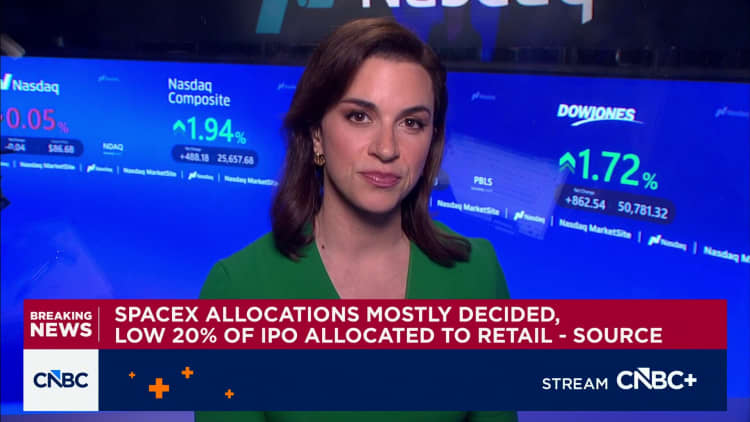

SpaceX is allocating a smaller-than-expected portion of its blockbuster initial public offering to retail investors, according to a person familiar with the matter.
The Elon Musk-led company plans to direct a percentage in the low 20s of the offering to retail buyers, including international individual investors, online brokerages and private-bank clients, the person said.
The allocation is below earlier expectations that roughly 30% of the deal would be reserved for retail investors.
The allocation decisions are almost finalized and could still change, the person said.
SpaceX is set to begin trading Friday, in what is poised to become one of the largest public offerings in history. The company is expected to be valued at about $1.8 trillion.
The reduced allocation suggests institutional demand for the shares has been strong as investors compete for access to the hottest IPO in recent years. Even with a smaller allocation, the retail tranche would still rank among the largest ever for a U.S. IPO of this size.
Cardano’s native token has collapsed by almost 80% over the past year, while its founder, Charles Hoskinson, said he’s “taking a break” and warned about an upcoming “wave of failures” in the ecosystem.
Despite the grim reality, certain analysts remain optimistic that a price revival could be on the way, while some key indicators support the bullish scenario.
Recovery in the Coming Weeks?
Earlier this month, ADA briefly crashed below $0.15, its lowest level since the end of 2020. As of this writing, it is worth around $0.16 (per CoinGecko’s data), which remains quite close to the local bottom.
And while many industry participants have lost faith in the token and expect additional losses, X user Sssebi presented an optimistic scenario. They believe Cardano’s ADA will not remain in its current range for long and predict a surge above $0.20 within a month.
The analyst based their theory on the asset having reached its most oversold level (on the weekly chart) in its entire history. Data show that the Relative Strength Index (RSI) recently dropped to 12 and now stands at around 25, which is still considered a bullish territory. On the other hand, ratios above 70 signal that ADA has become overbought and could be gearing up for a correction.

Another popular X user who hasn’t panicked amid the bloodbath is Crypto with Haris ₿. They claimed ADA’s meltdown doesn’t look like the end but like an opportunity, reminding that similar collapses have occurred in the past.
“Back in 2023, ADA went from around $0.22 to $1.30 in just a few months. Maybe history repeats itself. Maybe it doesn’t. But if the next bull run comes, I wouldn’t be surprised to see Cardano make another crazy move,” they said.
The Crazy Rumor
Cardano’s founder, Charles Hoskinson, has drawn significant attention lately following several controversial statements. At the start of June, he raised concerns within the community by announcing a temporary break and warning that the broader ecosystem could experience a “wave of failures” due to project closures and financial difficulties.
Shortly after, Hoskinson opined that Cardano is “the only ecosystem that can run the world,” while more recently, some X users have suggested he might have sold approximately 1.5 billion ADA during the 2021 bull run. He hasn’t responded to the accusations, but the speculation could further shake investors’ confidence and lead to an additional price drop for the asset.
The post Can Cardano (ADA) Rally by Double Digits After Falling to a 5.5-Year Low? appeared first on CryptoPotato.

Japan just rewrote the rules. XRP price is battling below resistance at $1.10, but it’s prediction is getting bullish as Japan’s parliament passes landmark legislation reclassifying crypto as a financial instrument. It’s a structural shift that could unlock institutional demand for XRP specifically.
Japan’s House of Representatives passed a bill moving crypto regulation from the Payment Services Act to the Financial Instruments and Exchange Act (FIEA), the same framework governing stocks and bonds. The Financial Services Agency confirmed Japan now holds more than 14 million open crypto accounts, with 70% held by earners under ¥7 million ($43,600) annually.
Probably Nothing.. —
Japan is moving to reclassify major crypto assets, including $XRP, under the FIEA 
Today, the June 11th lower house approval marks a pivotal shift — positioning XRP as a regulated financial asset and opening the door to deeper institutional integration  https://t.co/bt7eShlk7R pic.twitter.com/WDe5wOG0s2
 ChartNerd
  (@ChartNerdTA) June 11, 2026
The new framework introduces insider-trading bans mirroring stock markets, mandatory disclosure rules for projects, and, critically, opens the door to crypto ETFs. The rules will take effect in 2027, but XRP, already embedded in Japanese banking infrastructure through SBI-linked pilots, is structurally positioned to benefit before most other tokens.
Discover: The Best Crypto to Diversify Your Portfolio
XRP Price Prediction: Will the Coin Run Before Japan’s FIEA Rules Take Effect?
XRP is consolidating near $1.1, having pulled back from the $1.50 resistance zone that capped Q1 price action. There is a potential rebound toward $2.00 from current levels, with heavier resistance stacked near $2.40. Volume has been compressing in a coil that could spring fast.
Our technical support analysis places the critical floor between the current level and $1. A close below that zone would invalidate the near-term bullish case. Above it, the structure remains intact.
With the Japan crypto developements, we could see $1.5 to $2.50 as realistic upside under a constructive macro backdrop. A flat 20% capital-gains rate for qualified Japanese investors would make XRP structurally more attractive to institutions sitting on the sidelines.
Separate research on XRP price suppression dynamics suggests regulatory clarity alone rarely produces immediate price explosions, and the move tends to come when capital pipelines actually open.
Discover: The Best Token Presales
LiquidChain Targets Early-Mover Upside as XRP Tests Key Levels
XRP’s Japan catalyst is real, but at the current entry with major resistance stacking, the risk-reward isn’t asymmetric in the way early positioning offers. Traders hunting higher-multiple exposure are scanning earlier on the curve. That search lands on infrastructure plays priced before institutional discovery.
LiquidChain ($LIQUID) is a Layer 3 infrastructure project with a specific thesis: the cross-chain liquidity problem like fragmented BTC, ETH, and SOL ecosystems unable to communicate efficiently. It remains crypto’s most persistent structural failure.
The secrets of The Order are within. — LiquidChain (@getliquidchain) June 11, 2026
Are you ready to find out what they are?  ⟁https://t.co/vqvBcdSQYC pic.twitter.com/cKT8nEK5R2
LiquidChain’s Unified Liquidity Layer fuses Bitcoin, Ethereum, and Solana liquidity into a single execution environment, with Single-Step Execution and Verifiable Settlement as the core technical differentiators. Developers deploy once and access all three ecosystems.
The presale is live at $0.01468 per $LIQUID, with $835K raised to date. Features include a Deploy-Once Architecture that eliminates the redundant multi-chain deployment overhead that currently fragments developer attention and capital.
Research LiquidChain before the next price stage.
The post XRP Price Prediction: Japan Regulates Crypto like Stocks, XRP to Benefit First appeared first on Cryptonews.
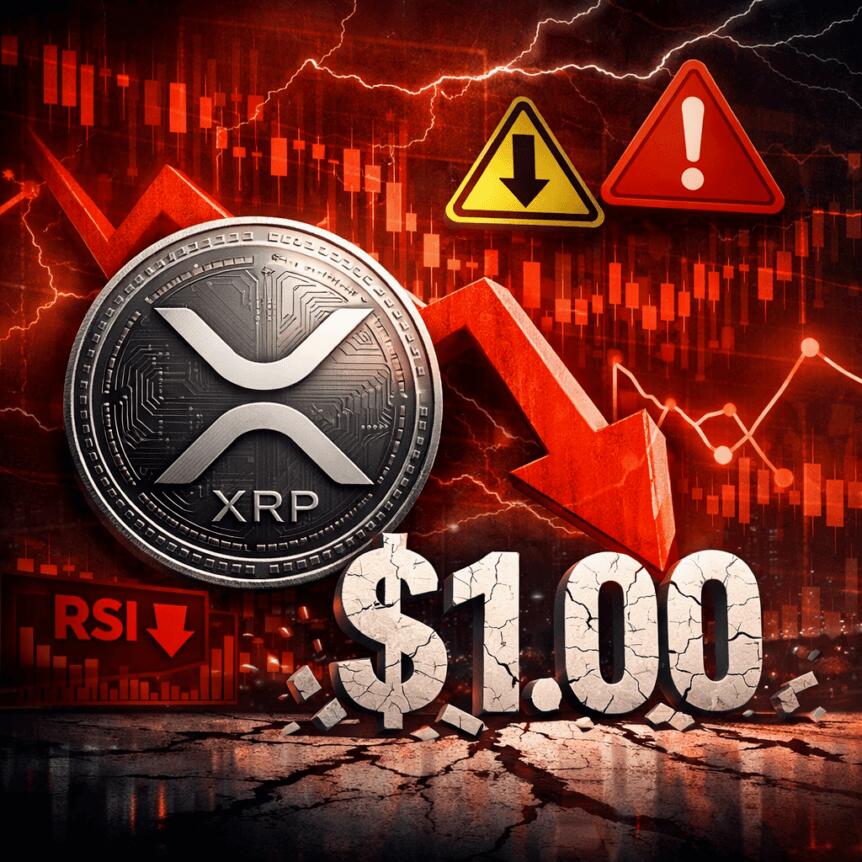
XRP’s price action has cooled into a setup that several traders are watching for a potential return below the $1 level. On the four-hour chart, a classic head-and-shoulders pattern and a parallel-bear flag are emerging, pointing to a sub-$1 downside scenario if selling pressure intensifies.
Analysts note that bullish arguments are not as compelling at the moment, with momentum gauges suggesting limited upside unless XRP can clear key resistance. At the same time, on-chain metrics are flashing caution, implying that holders could be sitting on limited profits and that weak demand might precede a renewed price dip.
Key takeaways
- XRP appears to be forming a head-and-shoulders pattern on the four-hour chart, with a neckline near $1.09. A confirmed breakdown could target roughly $0.99, about a 10% slide from current levels.
- Another bearish signal comes from a bear-flag formation on the same timeframe, with a measured target near $0.94 if the price breaks below the lower trendline around $1.10.
- The relative strength index hovers around 43, indicating tepid momentum that could leave XRP vulnerable to further downside unless buyers step in above key thresholds.
- On-chain activity supports a cautious stance: MVRV pricing bands point to the lower green zone near $0.96 as a potential magnet in past downturns, suggesting room for downside before a material reversal materializes.
Head-and-shoulders: a looming neckline test and risk of a sub-$1 scan
Since the first days of June, XRP has displayed the characteristics of a head-and-shoulders pattern on shorter timeframes. The setup features a central peak (the head) flanked by two lower peaks (the shoulders) and a common neckline that has been near the $1.09 area on the latest observations. In classic technical analysis, a decisive break below the neckline serves as a bearish confirmation and typically sets a target equivalent to the pattern’s height projected downward from the breakdown point. In this case, the implied downside targets hover around the $0.99 mark, translating to roughly a 10% drop if the pattern resolves as predicted.
On the upside, a sustained move above the right shoulder—roughly at $1.12—could invalidate the pattern, especially since that level aligns with the 20-period exponential moving average on the four-hour chart. A clear break above that resistance would open the door to a potential rebound toward the next moving-average hurdle near $1.15, which is close to the 50-period EMA and could offer a short-term rally catalyst.
Overall, traders watching the H&S formation see a clear bifurcation: a breakdown below $1.09 could usher in a sub-$1 test, while a bullish reclaim above near-term resistance could revive the case for a measured move toward the next EMA cluster around $1.15 to $1.20.
Bear flag adds to the sub-$1 downside case and key levels to monitor
Complicating the near-term outlook is a bear flag pattern on the same four-hour window. After a sharp initial sell-off, XRP appears to be consolidating within a rising channel, with the lower boundary currently flirting with $1.10. A sustained weekly close below this line would reinforce the bearish narrative and suggest that the prior downtrend could resume.
Applying the standard target rule for bear flags, the consolidation breakout could point toward around $0.94, representing a roughly 15% decline from current readings. The move comes with confirmation risk: a close above the upper boundary of the flag—around $1.18 to $1.20—would reframe the outlook toward a renewed attempt at higher levels, particularly if momentum accelerates through the region near the 50-period EMA.
The current momentum picture mirrors a cautious stance: the RSI sitting in the low 40s underscoring a lack of bullish conviction. Yet the chart structure leaves room for a shift if buyers reclaim the area just over $1.12, potentially stalling the bear-flag downside and pushing XRP back toward the higher end of the immediate range.
On-chain signals align with a cautious stance, pointing toward $0.96 in store if selling intensifies
Beyond price pattern analysis, on-chain data adds texture to the risk assessment. The MVRV (Market-Value-to-Realized-Value) framework indicates where holders may be sitting relative to the price at which coins last moved on-chain. The bands show that while XRP has rooms to fall, the next meaningful downside target sits near the lower green zone around $0.96. Historically, this band has acted as a magnet during major downturns, with XRP dipping toward or below this level in prior cycles before finding a more definitive base.
In practical terms, if market participants do encounter weakness that leads to a test of the $0.96 area, it could be accompanied by weaker transaction demand and selling pressure as holders re-assess risk versus potential longer-term relief rallies. By contrast, a sustained push below this band could invite further downside, while a decisive move back above the upper green boundary would be a signal that buyers are re-entering the market with more conviction.
For traders looking for corroboration, the latest pattern readings line up with other market signals. Earlier coverage highlighted that XRP’s transaction demand had cooled, underscoring a broader narrative of cautious participation as traders focus on key support zones. See related coverage discussing how demand dynamics around sub-$1 and $0.65 zones have influenced sentiment and liquidity dynamics in recent sessions.
All told, the confluence of price-pattern warnings, momentum readings, and on-chain stress signals reinforces a cautious stance toward XRP in the near term. The major near-term milestones remain the $1.09 neckline, the $1.12–$1.15 cluster of resistance, and the lower-bound targets near $0.96 to $0.99 depending on how the price reacts to the immediate supports and moving averages.
Where the market goes next will hinge on the balance between sellers pressing toward the neckline and buyers defending the critical thresholds above. If buyers manage to sustain a break above the $1.15 zone and clear the $1.20 area, the path could tilt toward a more constructive setup; otherwise, the bears will likely test the suspected sub-$1 levels in the near term.
What to watch next: monitor the neckline around $1.09 for a potential breakdown or a sticky hold, the 20- and 50-period EMA levels near $1.12–$1.15 for early validation or invalidation of the patterns, and the lower MVRV band near $0.96 as a potential magnet for price weakness. Investors should also keep an eye on on-chain demand signals to gauge whether capitulation or renewed buying interest could accompany any technical break.
For context on related dynamics, previous reporting highlighted XRP’s evolving on-chain demand and its impact on sentiment around critical support levels, offering a reminder that price action on the charts often aligns with shifts in on-chain activity and market participation.
As the week unfolds, traders will be weighing the immediate risk of a breakdown through the neckline against the possibility of a bounce that could reframe XRP’s short-term trajectory. The coming sessions will be telling for whether the sub-$1 narrative holds, or if the market finds footing above resistance and reopens room for a corrective move higher.
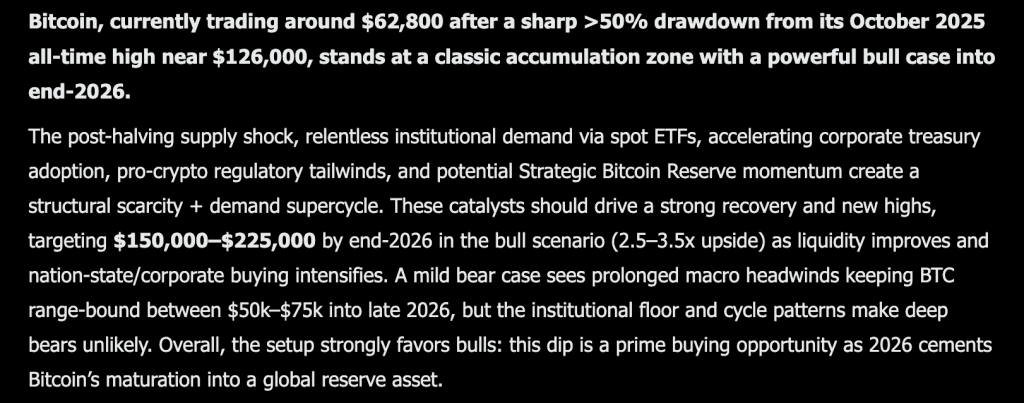
Elon Musk Grok AI just looked at a Bitcoin chart down more than 50% and predicts it’s a classic accumulation zone, targeting $150,000 to $225,000 by the end of 2026.
With BTC price trading around $62,800 right now, that is a 2.5x to 3.5x call built on the idea that the worst of the pain is also the best of the opportunity.
The core thesis is structural scarcity meeting relentless demand. The read is that Bitcoin is not just dipping, it is setting up a supply and demand supercycle.
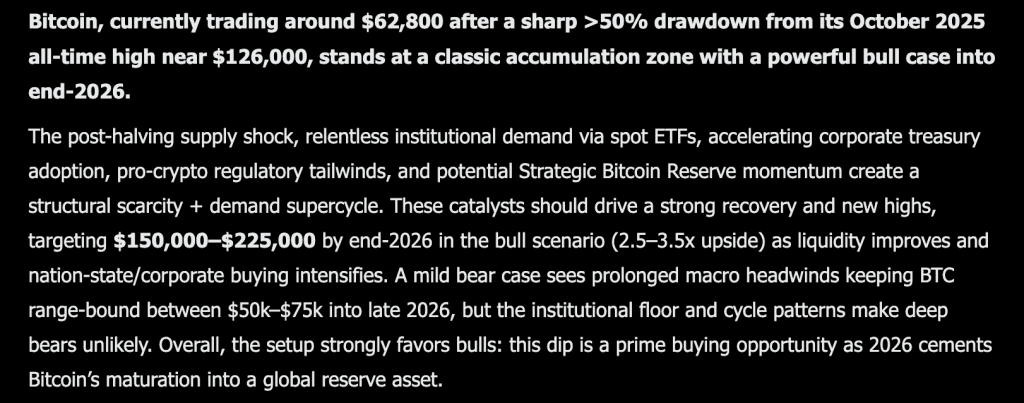
The post-halving supply shock chokes new issuance while spot ETFs, corporate treasuries, and potential Strategic Bitcoin Reserve momentum all pull on a shrinking float.
When supply tightens, and demand intensifies at the same time, price tends to rise violently to the upside. That is the engine behind the whole call.
The bull case stacks those catalysts into a recovery. Post-halving scarcity, relentless institutional demand through spot ETFs, accelerating corporate treasury adoption, and pro-crypto regulatory tailwinds drive a strong recovery and new highs.
The target lands at $150,000 to $225,000 by the end of 2026, a 2.5x to 3.5x move as liquidity improves and nation-state and corporate buying intensifies. This is the scenario where the dip gets remembered as the last cheap entry before maturation.

The bear case is mild by comparison. Prolonged macro headwinds could keep BTC range-bound between $50,000 and $75,000 into late 2026. But the institutional floor and repeating cycle patterns make a deep bear market unlikely from here.
That is the key distinction. This reads like a correction inside a bigger uptrend, not the start of a multi-year winter. Overall, the setup strongly favors bulls, and the dip looks like a prime buying opportunity.
Discover: The best pre-launch token sales
Bitcoin Price Prediction: A Supply Shock Meeting A Demand Supercycle
Now the chart. BTC is on the weekly and price sits at $62,857 after a sharp drop from the $126,000 all-time high set in October 2025.
The structure is a deep correction, more than 50% off the top, with price now sliding into a major prior accumulation shelf. Pattern-wise, this is a return to the wide $55,000 to $70,000 band that served as the launchpad before the last big leg up.
Key support sits at $60,000, with the next floor near $55,000 and deeper demand around $50,000. Resistance stacks at $70,000, then $80,000, and the heavier ceiling at $90,000.
RSI is reading 33.97 with its signal line at 40.40. So momentum is sitting well below its average and pressing toward oversold on the high timeframe.
That wide gap of about 6.4 points shows real selling pressure short term, but on the weekly, this kind of stretch has marked major cycle lows before.
When RSI curls back above that 40.40 signal, it flips the long-term read bullish again. Tie it together, and the chart is sitting right on the accumulation zone that has historically launched the next leg.
Hold this $55,000 to $70,000 band and the path back toward six figures, and that $150,000 to $225,000 target opens up exactly like the prediction lays out.
Discover: The best pre-launch token sales
You Might Like What Grok AI Predicts About LiquidChain
Large caps are not in trouble. They are just out of the room. Bitcoin, Ethereum, and XRP have been testing the same ceilings for weeks with nothing breaking through.
Every macro catalyst has a new arrival date. Every institutional wave has a new quarter attached to it. Holding assets where the next leg depends entirely on someone else’s decision is not a trade. It is a waiting room.
The money that wins cycles never announces where it is going.
The capital that actually moves in cycles relocates before the destination has a name.
Small market cap infrastructure plays operate on physics that large caps simply cannot replicate. A rotation that would not register as a rounding error at Bitcoin’s scale can reprice an undiscovered project by multiples.
The opportunity lies in the distance between what something is genuinely worth and what the market has assigned it so far. That distance shrinks to zero the moment discovery happens. Before that moment, it is fully capturable.
Multi-chain fragmentation is one of the most consistently expensive problems in DeFi, and it has never been solved. Bitcoin, Ethereum, and Solana exist as completely isolated systems. No shared architecture. No native interoperability. Every time value moves between them, the disconnection extracts its cost in fees, slippage, and failed transactions. That cost hits every single crossing every single time.
LiquidChain makes the crossing free as Grok AI predicts. All 3 networks inside one execution environment. Single deployment. Complete ecosystem access. No tax on any interaction.
The presale is at $0.01454 with just over $830,000 raised. Early and undiscovered.
Execution is unproven. Adoption is unknown. Established assets offer predictability toward a ceiling that the market already sees. LiquidChain is an entry point that does not exist once the market finds it.
Explore the LiquidChain Presale
The post Most Traders Will Scroll Past This Grok AI Bitcoin Predicts, Big Mistake appeared first on Cryptonews.
Crypto World
Exclusive: Cardano Foundation Recasts Itself as Active Adoption Driver as Hoskinson Pulls Back


The Cardano Foundation is stepping out from behind the blockchain's technical curtain to actively push adoption and seed its decentralized finance markets, a reversal of the supporting role it held for most of the network's history, Chief Executive Officer Frederik Gregaard said. "We believe that… Read the full story at The Defiant

Mexico vs South Africa LIVE Score, FIFA World Cup 2026 LIVE Updates: 2 Red Cards For South Africa; Mexico’s Raul Jimenez In Tears After Goal | MEX 2-0 RSA

Google AI Plus Just Got A Welcomed Upgrade (And A Major Price Drop)

This Simple Formula Can Change Your Financial Life Forever..!



-

 Fashion6 days ago
Weekend Open Thread: Evereve – Corporette.com
-
 Crypto World6 days ago
Jensen Huang Approves Samsung, SK Hynix, and Micron for NVIDIA (NVDA) HBM4 Memory Supply
-

 Crypto World4 days ago
Anatomy of the June crypto crash: Fed, Iran, Saylor
-
 Entertainment5 days ago
The Best Mystery Series of All Time Is Surging on Streaming 30 Years After It Ended
-

 NewsBeat4 days ago
Alexander Zverev wins the French Open to finally earn a 1st Grand Slam title
-

 Tech6 days ago
Suspicious Polyfill login prompts pop up on Toshiba, Muji websites
-
 Crypto World5 days ago
Senator Cynthia Lummis Calls CLARITY Act the Most Consequential Financial Legislation of This Generation
-

 Tech4 days ago
Microsoft unveils seven homegrown AI models in new bid for ‘long term self-sufficiency’
-

 Tech6 days ago
Microsoft launches MXC, an OS-level sandbox for AI agents, with OpenAI and Nvidia already on board
-

 Business6 days ago
(VIDEO) Justin Bieber Delivers Surprise Happy Birthday Serenade to Diners at Los Angeles Mexican Restaurant
-
 Business5 days ago
The Pain Points Taking a Fragile Tech Rally Down a Notch
-

 Business4 days ago
High Stakes for Wembanyama as New York Pushes for 3-0 Lead
-
 Crypto World3 days ago
Eli Lilly (LLY) Stock Surges 4% Following Breakthrough Sleep Apnea Trial Results
-

 Tech6 days ago
Von der Leyen’s AI envoy pick draws conflict-of-interest fire
-

 Tech6 days ago
Meta steals a tactic from Tesla and builds data centers in tents
-
 NewsBeat4 days ago
Alexander Zverev conquers demons and outlasts Flavio Cobolli to win French Open for first major title
-
Crypto World6 days ago
LBank Surpasses 25 Million Users Worldwide as AFA Partnership Continues to Drive Global Growth
-

 Tech6 days ago
Hackers now exploit SolarWinds Serv-U flaw to crash servers
-

 Crypto World4 days ago
Trump’s AI Ownership Plan Could Benefit Anthropic at OpenAI’s Expense
-
 Sports2 days ago
Bangladesh beat Australia after 20 years in ODIs, register only their second win over six-time world champions | Cricket News
You must be logged in to post a comment Login