Gemini Intelligence has been announced just a month before Apple Intelligence’s big moment at WWDC, but I have doubts about whether either company can deliver on its AI promises.
Google announced its new suite of AI features under the Gemini Intelligence banner during a streamed event on May 12, 2026. That’s less than a month before Apple’s WWDC 2026 event kicks off on June 8.
Surely, that isn’t a coincidence.
Gemini Intelligence promises a whole lot, some of it similar to what Apple promised iPhone owners almost two years ago. Apple has yet to produce the personalized Apple Intelligence features that were revealed during WWDC 2024.
Advertisement
That brings us back to Gemini Intelligence and Google’s claims that it will start to roll out this summer. The similarities to Apple Intelligence are clear, but with Google’s AI head start, it’s high time it started to execute on its promises.
For iPhone users peering over the fence, Gemini Intelligence appears compelling. There’s a lot to like, but it’s impossible not to look at it and wonder where Apple Intelligence is right now and why Google chose to announce it now.
Gemini Intelligence gets personal
Announced during The Android Show, it’s no surprise that Google used its Pixel phones to show off Gemini Intelligence. The Pixels are Google’s answer to the iPhone, giving it more direct control over everything.
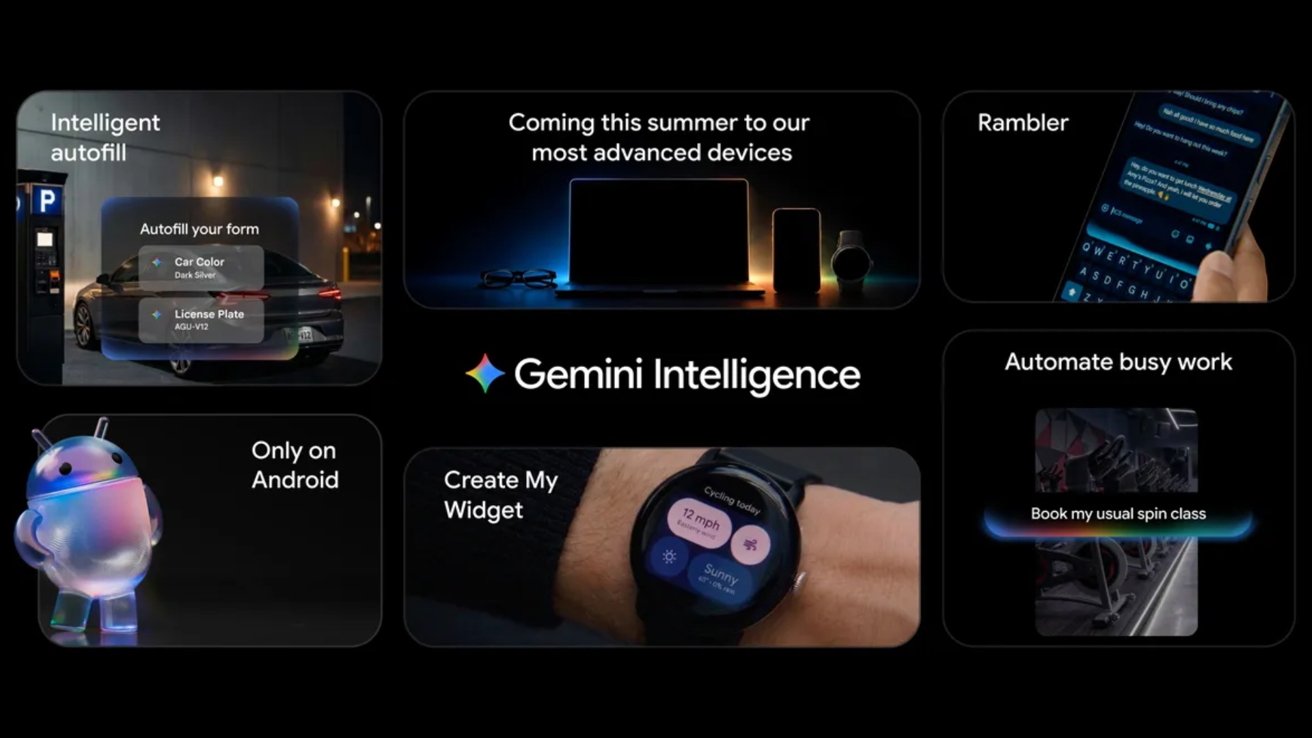
At its core, Gemini Intelligence is actually five distinct features. All of them use AI to try to change the way people use their phones, ranging from the mundane to the futuristic.
Advertisement
Starting at the mundane end of things, Gemini Intelligence promises to make it easier to search for things on the web. Chrome will use Gemini to summarize and compare content from different sources, while an auto-browse feature will book appointments and carry out other, similar tasks.
Android will also take the hassle out of filling out forms. Using Gemini’s Personal Intelligence, Android will be able to fill in details across text boxes so users don’t have to type them in themselves. Think of it as AI-powered autofill.
The next feature, Rambler, will allow users to talk to their Android phone and have it turn what they said into clear, concise text. Google is already pretty good at voice recognition and transcription, so it’s no surprise that Gemini Intelligence builds on that.
In demos, Google used a text message scenario to show what the new feature can do. Built into the Gboard keyboard, users press a button and simply talk as if they were having a conversation.
Advertisement
Next, Gboard removes all of the “ums,” “ahs,” and “likes” as well as any repetition or tangents. The result is something that is more akin to a message you’d type, but without the typing.
One Gemini Intelligence feature that Apple should absolutely borrow is the ability to create custom widgets. Dubbed “Create My Widget,” the feature can build an entire widget based on what the user wants it to display.
Examples include building a widget that only shows the wind speed and whether it will rain, rather than a full forecast. Another imagines someone creating a new widget that displays a new list of meal options each week.
Gemini Intelligence promises a lot, but now it must deliver
Advertisement
Finally, we get to the futuristic feature, and one that Google led with when unveiling Gemini Intelligence. And it’s the kind of feature that has the potential to be useful, albeit in limited situations.
That feature is multi-app automation, with Gemini handling tedious tasks so the user doesn’t have to. Gemini will be able to book a spin class or arrange a trip via Expedia, for example.
Another example Google gave was a grocery list in a notes app. With the list open, an Android user will be able to long-press the power button and ask Gemini to get to work. It’ll go off and build a shopping cart with all of the listed items, Google says.
Gemini Intelligence promises a whole lot. But like Apple Intelligence, questions remain whether anyone will actually use these features in the real world.
Advertisement
Limited availability
Google doesn’t have the luxury of designing features for a single device. Whereas Apple can focus on the iPhone, Google has to consider dozens of different models in all kinds of form factors.
That’s why, at launch, Gemini Intelligence will be limited to the latest Pixel and Samsung Galaxy devices. If you’re using a phone from Motorola, for example, all bets are off.
As for timescales, Google says that Gemini Intelligence’s various features will start to roll out to devices this summer. After that, it’ll start to pop up on watches, cars, laptops, and even glasses. But details are still sparse on which ones.
Chasing Headlines or Changing the Game?
As I mentioned earlier, Google chose the month before WWDC to announce Gemini Intelligence. I suspect it was keen to get its AI features in front of people before Apple shows off its own AI upgrades.
Advertisement
Of course, those that pay attention to tech outside of Apple know that Google’s tech conferences always take place before WWDC. Whether or not it was an intentional play to get some easy headlines ahead of Apple’s annual developer conference remains to be seen.
All of the newly announced features make for great demonstrations, but Google’s own history raises real questions about whether they’ll still be around in a few years.
It’s easy to wonder whether Google’s new features were built to capitalize on AI buzz or actually be used. And we only have to look at its own history to see why.
Over the years, Google has announced various attempts at personal and proactive AI features. But not all of them are still around today.
Advertisement
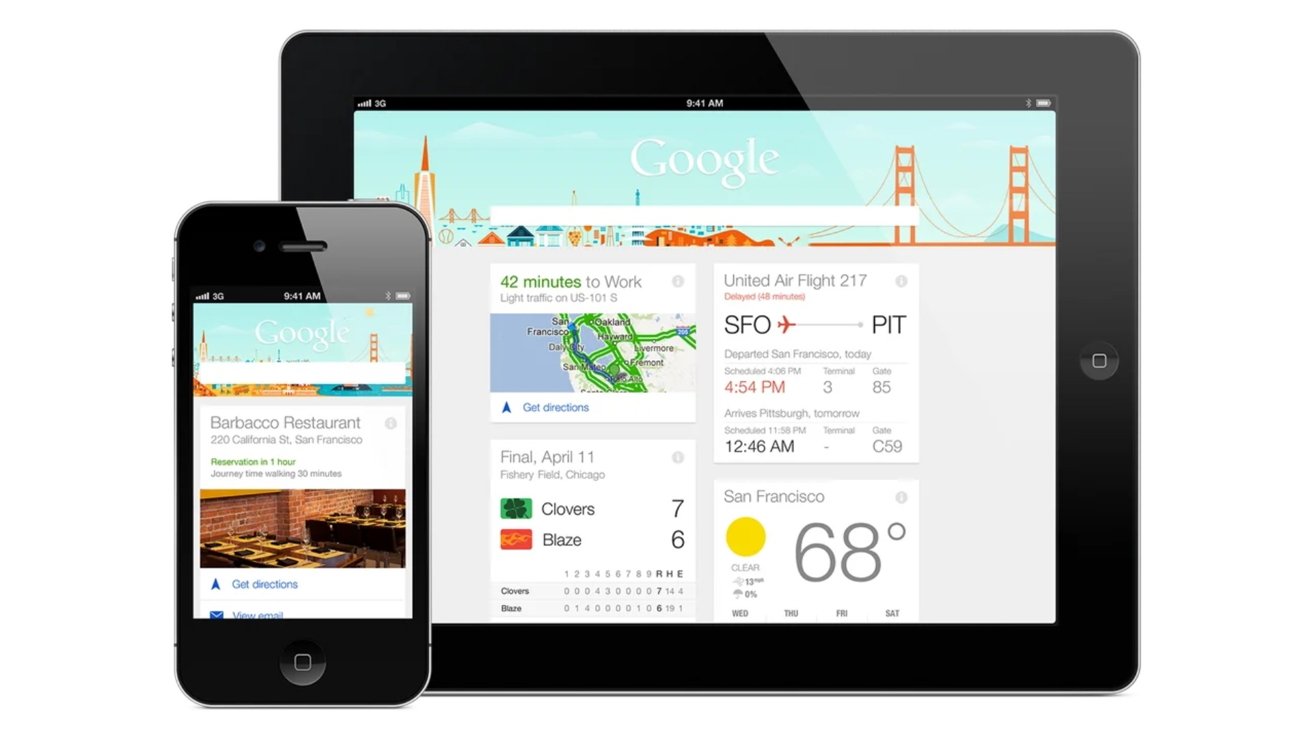
If we go all the way back to 2012, we find Google Now. It was a feature of the Google app and was supposed to proactively deliver information before it was needed. There was even iPhone support.
Google Now was even available on iPhone and iPad
Google Now would use contextual cards that displayed information when it would be most useful. Think flight information and commute times, for example.
Four years later, Google Now was dead, replaced by Google Assistant. Users found it to be too intrusive, offering up irrelevant information.
Advertisement
2018 saw the flashy unveiling of Google Duplex, an AI that would make phone calls for people. Users would tell Duplex what they needed, and it would make the call, using an AI voice to complete the task.
But the feature was littered with problems. It couldn’t reliably deal with the way conversations could change course. Then came the legal and privacy concerns.
People taking AI calls would need to be warned, and there were questions over whether they would simply hang up. Ultimately, Google Duplex on the web was killed off in 2022, and Duplex tech has been rolled into other Gemini features.
There are other examples, too. But it’s worth calling out two features that stuck around. And Apple even copied them for Apple Intelligence.
Advertisement
Hold for Me and Call Screen are both features that are available on Pixel phones today. The former waits in a hold queue for you, while the latter screens calls so you can avoid the ones you don’t need to answer.
Some of Google’s advanced features stand the test of time, while others don’t. We’ll have to wait and see how Gemini Intelligence fares.
Apple Intelligence is up next
Apple will unveil its new iPhone software during the WWDC 2026 opening stream on June 8. And with it, we expect Apple to share what’s next for Apple Intelligence.
Much of what that will entail is likely to be features we’ve already seen, but Apple has yet to deliver. A new, more personal Siri is expected.
Advertisement
It was first promised for iOS 18 back in 2024 and has yet to launch. That delay even spurred some lawsuits and a class action settlement.
WWDC 2026 could finally see Siri get a much-needed upgrade
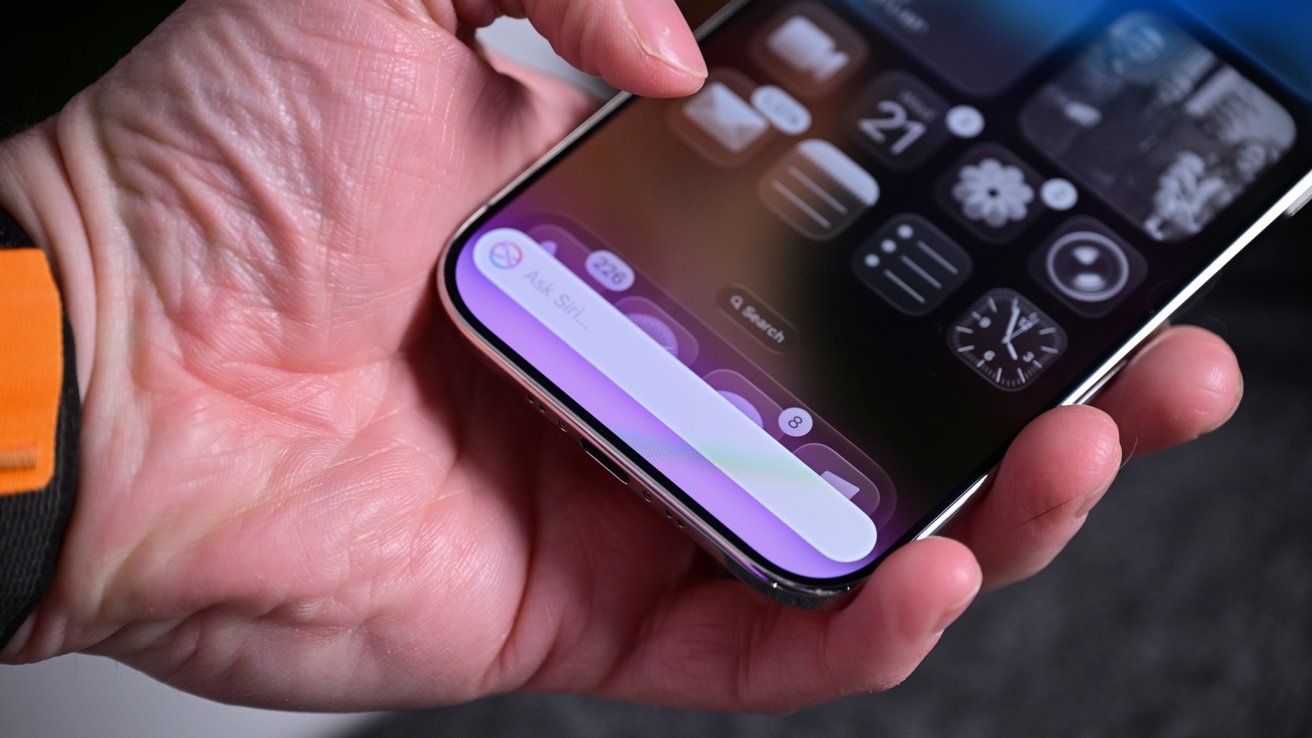
If the new Siri can do everything previously announced, it will have automation abilities similar to those of Gemini Intelligence. Siri will be able to work with and between apps while understanding context and what’s on-screen.
Siri is also tipped to have a new, chatbot-like interface. Apple Intelligence will also likely extend to new photo-editing features, while Safari will use it to automatically group tabs.
Advertisement
One thing that Apple and Google have in common
But Apple and Google’s roadmaps both face the same credibility test. And these Apple Intelligence changes have a familiar feeling, one that can be felt with Google’s Gemini Intelligence announcements.
It’s a feeling that’s hard to shake: Apple Intelligence is set to gain new features that few will ever use.
Even if Apple Intelligence and Gemini Intelligence can do everything they claim and more, they will still have the same fundamental problem. Both will offer features that demo well and will wow users the first time they use them.
Then, six months later, many users won’t even remember they existed.
In all of our conversations about video game preservation, one common thread is the general apathy of developers and publishers when it comes to this sort of thing. It’s actually a bit mind boggling to me that apathy is even a thing here. After all, this is the work done by these developers and, to a lesser extent, the publishers. When we have seen instances in the past of game servers being shut down, and even more so in cases where publishers have gone after fan-run servers of online games that have already been shut down, this represents the loss and potential erasure of what is often years and years of work by very talented artists and programmers.
It’s with that in mind that I found it so refreshing that the developer behind one online game that didn’t perform so well, Blindfire, has committed to keeping the servers up and running for “years” because they actually take pride in their work.
Blindfire was released back in October 2024 with a unique hook: It was an online first-person shooter set in the dark and was built around finding your enemies or remaining out of their sight. Sadly for developer Double Eleven, it never found much of an audience. Now, a year after its last patch, Blindfire will get one last big update and will go free, with devs promising to keep the servers on because they are “proud of it” and want to preserve it for others.
“We are doing this because we believe games are art and they deserve to be preserved,” said Double Eleven. “We refuse to bury what we built just because things didn’t go perfectly. We are keeping it alive because we are proud of it. You won’t see adverts or marketing campaigns trying to drag you back in. This is just a gift to those who want to see what we created.”
When you read the comments from Double Eleven, you immediately wonder why the hell this isn’t the posture of every developer of online games out there. This is their work, after all. Why in the world would they want it scattered to the ether?
Advertisement
Now, this also cannot be the end state, if we’re truly looking at this from a preservation standpoint. A commitment directly from the developer to keep the game around for several years is a good thing. But it’s perpetuity we’re after here, after all. And there’s no guarantee that Double Eleven will live on long enough to keep the game available for whatever passes as “forever” these days. Coupling this with the eventual release of source code, so that fans and preservationists can scatter the game to the wide ranging corners of the internet, is what will end any danger of this art and culture ever disappearing. That hasn’t been done yet, but hopefully Double Eleven is thinking along these same lines.
But if you can find a more human, kind, and engaging message for a situation like this than the following, I’ll be surprised.
“We loved making [Blindfire],” said the studio on Steam. “Watching playtesters get to grips with our twist on the FPS was a massive highlight for us and seeing some big streamers jump into our world was a proper thrill. Blindfire was a flash in the dark. It was weird, loud, and ours. It is staying online for anyone who wants to play it today, tomorrow or years from now. Thanks for being part of the journey.”
Bravo on step 1 in the preservation process, folks. Now let’s take this further.
In recent months, a new infostealer malware known as REMUS has emerged across the cybercrime landscape, drawing attention from security researchers and malware analysts. Several technical analyses published in recent months focused on the malware’s capabilities, infrastructure, and similarities to Lumma Stealer, including browser targeting mechanisms, and credential theft functionality and more.
However, far less attention has been given to the underground operation behind the malware itself.
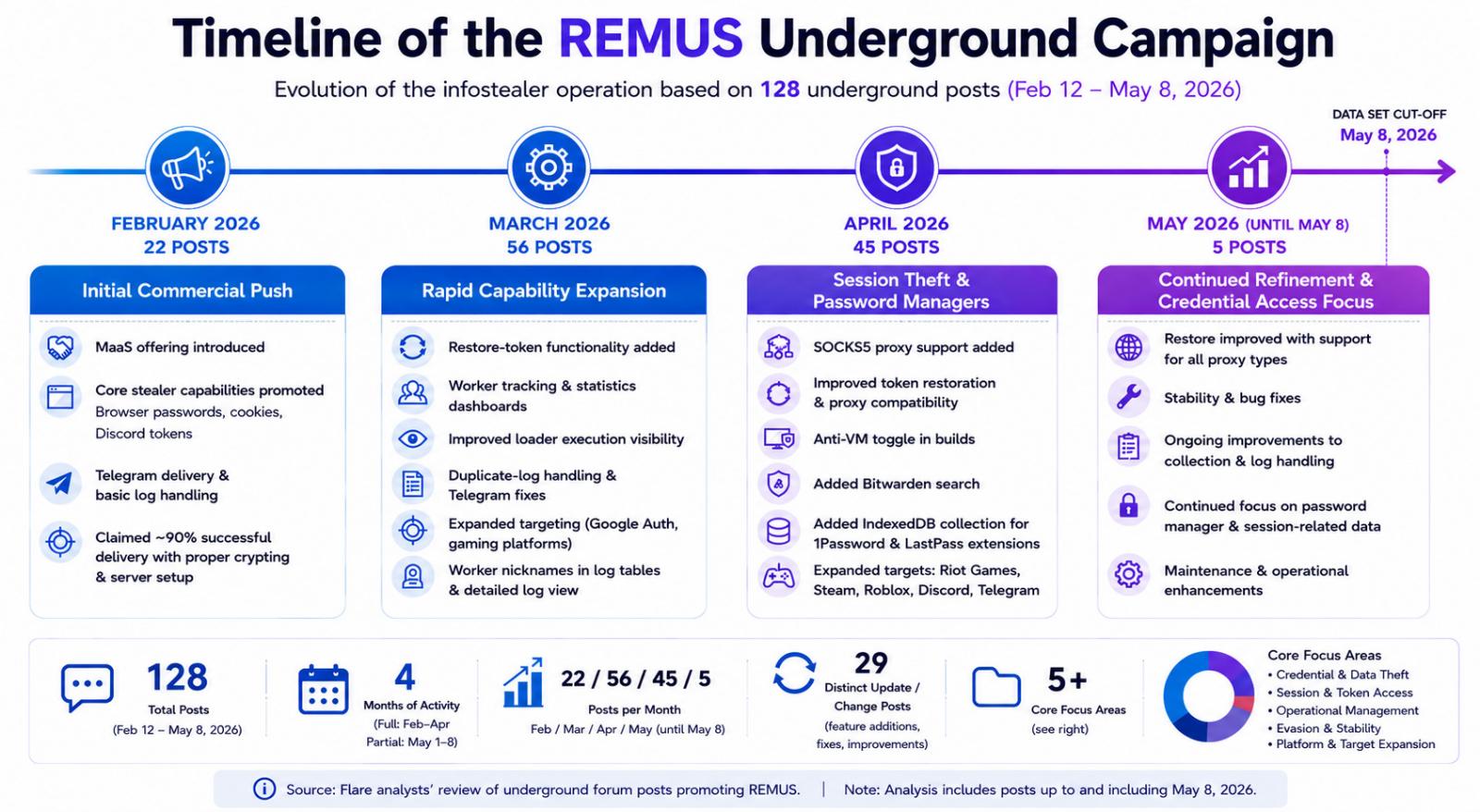
An analysis conducted by Flare researchers of 128 posts linked to the REMUS underground operation between February 12 and May 8, 2026, provides a rare look into how the group presents, develops, and operationalizes the malware within underground communities. By analyzing the actor’s advertisements, update logs, feature announcements, operational discussions, and customer-facing communications, the research helps map how the operation evolved over time and what priorities drove its development.
The findings reveal not only the rapid evolution of the stealer’s capabilities, but also a growing focus on commercialization, operational scalability, session theft, and password-manager targeting. More broadly, the activity offers insight into how modern malware-as-a-service (MaaS) operations increasingly resemble structured software businesses, with continuous development cycles, operational refinements, and features designed to improve usability, persistence, and long-term monetization.
Advertisement
The underground activity reveals a highly compressed but aggressive development cycle, with the operator repeatedly publishing feature updates, operational refinements, and new collection capabilities over just a few months.
Rather than advertising a static malware build, the posts portray an actively maintained MaaS platform evolving in near real time.
February 2026 marked the initial commercial push. Early posts focused on establishing REMUS as a reliable and easy-to-use stealer, promoting browser credential theft, cookie collection, Discord token theft, Telegram delivery, and basic log management. The tone was highly promotional and customer-oriented. In one of the earliest posts, the operator claimed: “With good crypting and a dedicated intermediary server, the callback rate is ~90%.”
Another post marketed the malware as featuring “24/7 support” and functionality “simple enough that even a child can figure it out” highlighting a strong emphasis on usability and commercialization from the beginning.
Advertisement
March 2026 represented the campaign’s most active development period. During this phase, the operator introduced restore-token functionality, expanded log handling, worker tracking, statistics pages, duplicate-log filtering, and improved Telegram delivery workflows. Multiple posts focused not on theft itself, but on operational visibility and campaign management. One update added worker nicknames to log tables and statistics views, while another improved loader execution visibility so operators could better understand failed infections. The shift suggests REMUS was evolving into a broader operational platform rather than just a malware executable.
April 2026 showed a clear move toward session continuity and browser-side authentication artifacts. The operator added SOCKS5 proxy support, improved token restoration, anti-VM toggles, gaming-platform targeting, and password-manager-related collection. One update explicitly stated: “Added IndexedDB collection for 1Password and LastPass extensions.”
Another referenced Bitwarden-related searches. The posts increasingly emphasized authenticated sessions, restore workflows, and browser-side storage rather than standalone credentials alone.
By early May 2026, the operation appeared focused on refinement and operational stability. The remaining posts in the dataset referenced restore improvements, bug fixes, collection optimizations, and continued adjustments to delivery and management functionality, suggesting the operator was shifting from rapid feature expansion toward platform stabilization.
REMUS and Its Connection to Lumma
Screenshot from Flare’s platform showing one of REMUS’s earliest posts. Sign up for the free trial to access if you aren’t already a customer.
Public reporting has largely focused on REMUS as a technically significant successor or variant of the Lumma Stealer. Researchers described the malware as a 64-bit infostealer sharing multiple similarities with Lumma, including anti-VM checks, browser-focused credential theft, and browser encryption bypass techniques.
That technical overlap is important, but the underground data suggests the story extends far beyond malware lineage.
Advertisement
The analyzed posts show a threat actor aggressively building a commercial cybercrime product around the malware. The operation repeatedly promoted updates, customer support, performance improvements, and additional collection capabilities in a way that strongly resembles legitimate software development cycles.
In one early post, the operator claimed the malware could achieve approximately “90%” successful delivery rates when paired with proper crypting and an intermediary server, language clearly aimed at reassuring potential buyers about operational reliability.
Infostealers like REMUS don’t just harvest credentials anymore, they capture cookies, browser tokens, and authenticated sessions that bypass MFA entirely.
Flare monitors millions of stealer logs across dark web markets and Telegram channels continuously, so you can detect exposed sessions and credentials before attackers use them against you.
A Shift Toward Session Theft and the Rising Value of Cookies
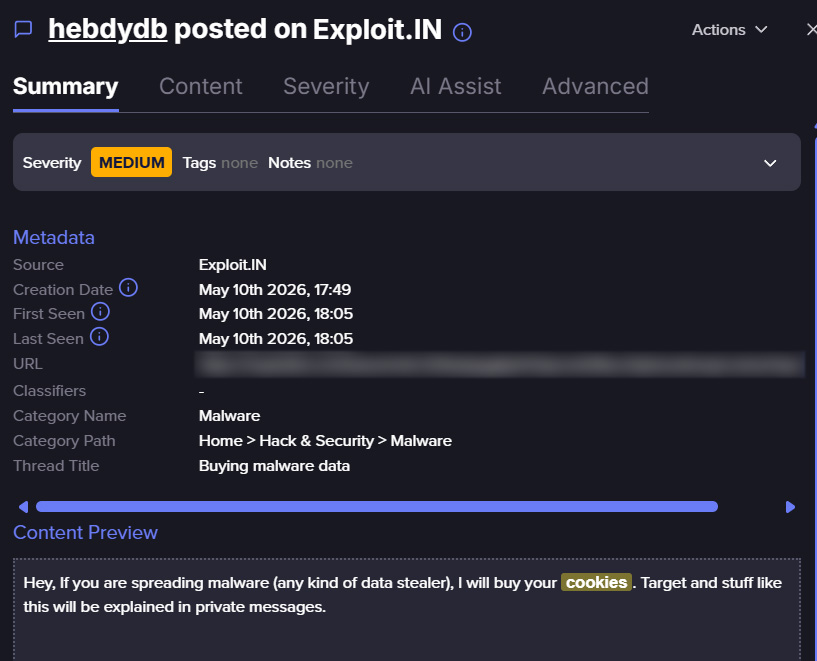
Screenshot from Flare’s platform showing an example of the high demand for “cookies.” Sign up for the free trial to access if you aren’t already a customer.
One of the clearest themes across the REMUS campaign is the growing emphasis on session theft rather than traditional credential harvesting alone.
Historically, many infostealers focused primarily on usernames and passwords.
REMUS, however, repeatedly emphasized cookie collection, token handling, browser sessions, proxy-assisted restoration, and authenticated access continuity. From the earliest stages of the campaign, the malware promoted browser sessions and authentication artifacts as a core part of its value.
This reflects a broader shift across the underground economy, where stolen cookies and authenticated sessions have increasingly become a highly valuable commodity. Instead of stealing credentials and attempting to log in later, attackers increasingly seek already authenticated sessions that may bypass MFA prompts, login alerts, device verification, and risk-based authentication systems.
Multiple REMUS updates referenced “Restore” improvements, proxy compatibility, and support for multiple proxy types during token restoration workflows, strongly suggesting the operator viewed session persistence as a major selling point.
Several updates also focused on platforms where active sessions carry substantial value, including Discord, Steam, Riot Games, and Telegram-linked environments. Combined with cookie collection and restore functionality, the campaign increasingly appeared designed not just to steal credentials, but to preserve and operationalize authenticated access itself.
Advertisement
Password Managers Become High-Value Targets
The most significant late-stage evolution observed in the campaign involved password-manager-related collection. By April 2026, the operator was advertising support tied to Bitwarden, 1Password, LastPass, and IndexedDB browser storage. Password managers increasingly represent concentrated stores of valuable credentials and authentication material.
The references to IndexedDB are especially relevant because modern browser applications and extensions frequently use local browser storage mechanisms to retain application data and session information.
The posts do not prove successful vault decryption or direct password-manager compromise by themselves.
However, they clearly demonstrate that REMUS development was moving toward browser-side storage collection associated with password-management ecosystems.
The Operational Maturity Behind REMUS
The underground activity also demonstrates how modern MaaS ecosystems increasingly resemble legitimate software businesses.
Advertisement
Across the analyzed posts, the operator repeatedly published versioned updates, bug fixes, feature expansions, troubleshooting improvements, statistics enhancements, and operational visibility refinements.
Several posts also implied a multi-operator environment through references to workers, statistics dashboards, management visibility, loader monitoring, and log categorization. This operational structure aligns closely with broader MaaS trends where malware developers increasingly separate development, infrastructure, delivery, and monetization into specialized roles.
Final Thoughts
The REMUS campaign offers a revealing look into how modern infostealer operations are evolving far beyond simple credential theft.
Over just a few months, the underground activity analyzed by Flare analysts showed a clear transition from basic malware promotion into the development of a structured MaaS ecosystem focused on operational reliability, session persistence, and scalable data collection.
Advertisement
Perhaps most notably, the campaign highlighted the growing importance of authenticated sessions and browser-side authentication artifacts within the underground economy. The repeated emphasis on token restoration, proxy-assisted session recovery, and password-manager-related collection reflects a broader shift in cybercrime operations away from simply stealing passwords and toward maintaining direct access to already-authenticated environments.
The findings reinforce an increasingly important reality: infostealers are rapidly evolving into mature operational platforms that support persistence, automation, and long-term monetization workflows. As these ecosystems continue to professionalize, understanding how threat actors operationalize and commercialize malware may become just as important as analyzing the malware itself.
Alpina built its name on the simple idea that a comfortable driver covers ground faster. Founded in 1965 in Buchloe, Germany, the company tuned BMW cars to deliver both performance and ease on long trips. BMW took full control of the brand a few years ago and now offers this one-of-a-kind concept as a clear signal of what comes next.
The four-seat coupe’s low stance, wide hood, and softly curving roofline set the tone right away. Four adults can fit inside without feeling crowded, and the vibe is reminiscent of Alpina’s classic grand tourers while being contemporary. A single line, six degrees from the front, runs the length of the body, curling around the back and tying everything together like a nice little bow.
BMW MODEL CAR KIT – Racing enthusiasts can fuel their imaginations with the LEGO Technic BMW M4 GT3 EVO Race Car (42226) building set for boys and…
AUTHENTIC DETAILS – This race car playset features iconic BMW detailing and is equipped with a working steering function, a detailed 6-cylinder…
BUILD, PLAY & DISPLAY – Kids can enjoy assembling their model car and racing it down an imaginary track, then display it on a shelf or table to…
The front elements are simple but eye-catching, with a shark-nose profile that leans in, framing a kidney grille sculpted into a three-dimensional work of art around the central symbol. The warm white lights around the grille’s edges were inspired by the first light of dawn over the Bavarian Alps. You can only see the subtle designs inside the grille at certain times of day, and the recessed surfaces have a dark metallic sheen that adds depth.
The wheels and exhaust pipes are ultra-traditional, with twenty-spoke designs that have barely changed since 1971, measuring 22 inches up front and 23 inches in the back. At the back, there are four elliptical exhaust pipes positioned low and ready to unleash the V8’s tuned roar. The engine is a true gem, producing a rich, full-bodied sound at low revs and a deeper, fuller note at higher revs, all while providing the smooth oomph required for driving down the interstate.
Advertisement
The Comfort+ mode takes it to a whole new level, softening the ride even more than the standard BMW settings, so it’s all about relaxed driving and comfortable miles rather than snappy turns, and every option here is about keeping comfort and speed working together rather than against each other, as that’s the original Alpina principle, you see.
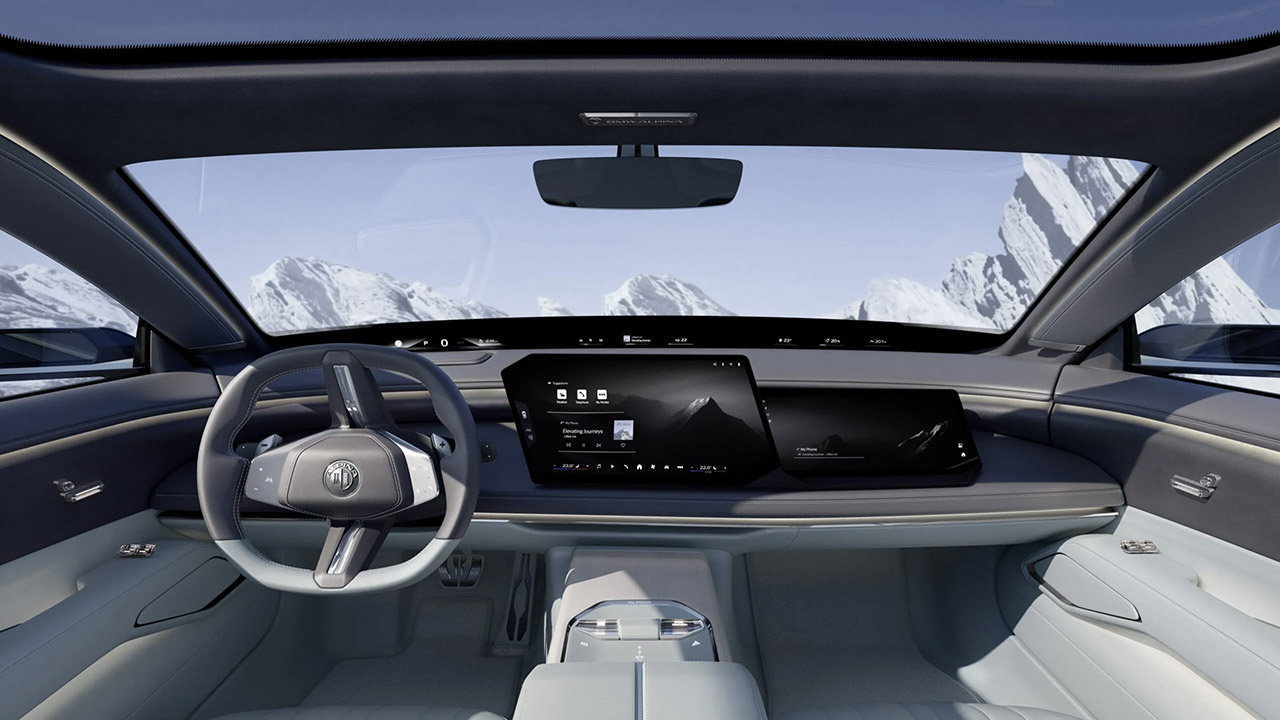
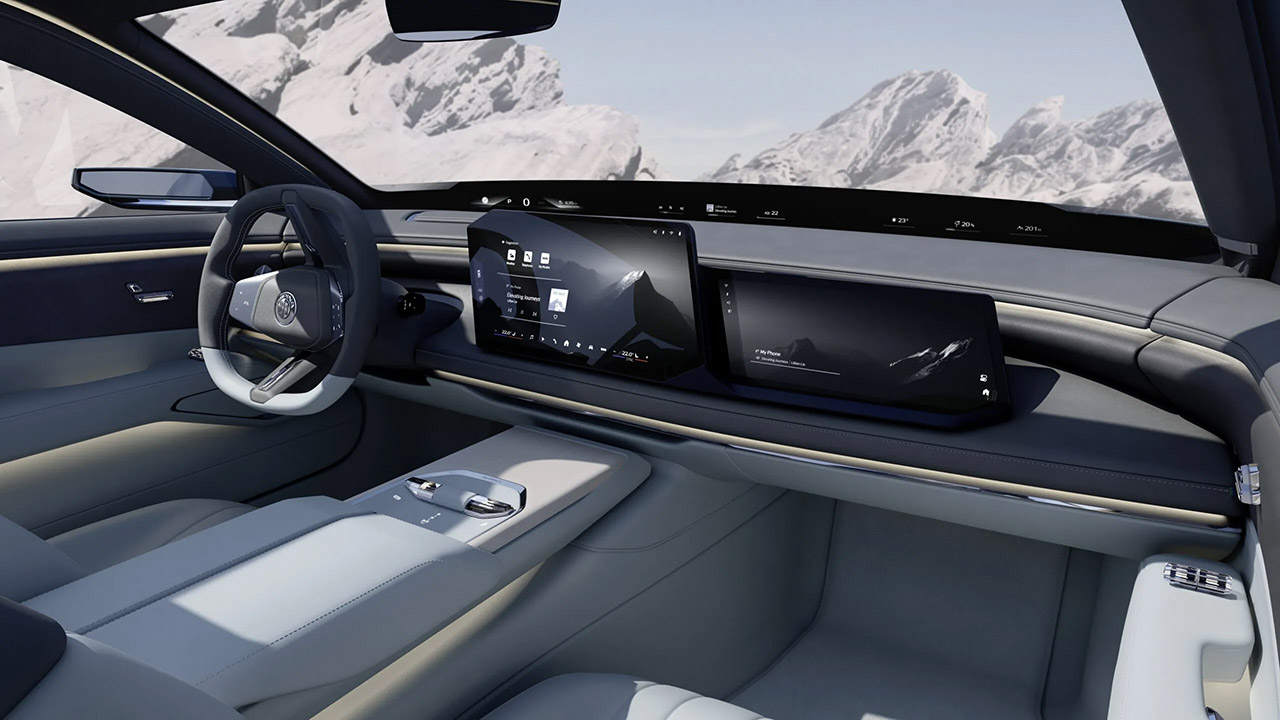
Inside, the cabin’s clean and straightforward lines complement the exterior’s immaculate discipline. The same six-degree line goes across the dashboard and doors, dividing the darker higher area from the lighter lower one. The seats and panels are all upholstered in beautiful full-grain leather from producers in the Alpina region, and the stitching echoes the classic deco lines initially utilized in 1974. The rear passengers will appreciate the quiet luxury touches, which include a glass water bottle and two crystal glasses that pop up automatically when needed. Each glass has 20 carved deco lines and a six-degree rim angle, is kept in place by hidden magnets, illuminated from below, and is set against a stunning open-grain wood surface. It’s the small nuances like this that make a long journey worthwhile.
The screens are quite modest while still delivering all of the necessary information. The panoramic display runs directly across your line of sight, with a second screen for the passenger. As you switch between Comfort+ and Speed mode, the blue and green accents become more prominent, and the background becomes this magnificent representation of the Alpine landscape just south of Buchloe. The metal trim has been beveled by a watchmaker, resulting in a pleasing combination of satin and polished surfaces.
Sharp detail from NASA’s Hubble Space Telescope brings every feature of NGC 1266 into clear view. Dust lanes in shades of reddish brown stretch across the galaxy’s flattened disk and weave around a bright central bulge. Hints of spiral structure linger in the disk even though no obvious arms stand out. Tiny clumps and filaments of dust partly hide the core while distant background galaxies shine through the outer haze in red, blue, and orange tones against the black of space.
This intriguing galaxy, situated in the constellation Eridanus, is classed as a Lenticular type, a subset of graceful spirals and rounded ellipticals. This is a one-percent unusual post-starburst galaxy because, some 500 million years ago, something extraordinary occurred that activated the galaxy’s star formation switch for a brief period of time before turning it off.
NASA rocket model kit – Launch into a creative project with the LEGO Icons NASA Artemis Space Launch System model building project for adult space…
What’s in the box? – This creative building set includes everything you need to craft a multistage rocket with 2 solid-fuel boosters, an Orion…
Features and Functions – This NASA-themed rocket model features retractable launch tower umbilicals, rocket support and crew bridge, detachable…
A minor collision with another galaxy set the entire event into action. Fresh gas began to rush into the center, causing rapid star formation and bulge growth, while the supermassive black hole at the galaxy’s heart re-emerged as an active galactic nucleus. As a result, a strong energy jet shot out of the black hole, sending winds and jets flying out. These eruptions then swept up gas and churned up all of the space between the stars, stopping fresh star formation in the process.
Hubble and other instruments have allowed us to confirm this. These days, you can still see streams of gas rushing out from the core, and star-forming nurseries are only found in the very center, while the remainder of the galaxy sleeps soundly. The star formation rate is a mere 0.87 solar masses per year, which is a fraction of what one would anticipate from a galaxy of this size, and as a result, the molecular clouds never have a chance to settle long enough to collapse.
The visible black hole activity is responsible for the outflow of gas. The same jets that caused the initial starburst a few hundred million years ago are now keeping new stars from forming. Gas departs the galaxy at a pace of approximately 110 solar masses every year, albeit the majority of it remains trapped rather than departing. This cause-and-effect cycle exemplifies how enormous core black holes can influence the evolution of their host galaxy.
— Microsoft has named Jon Friedman as its first chief design officer. Friedman, who has been with the tech giant for more than 22 years, said the new role recognizes the challenge of innovating in an AI-dominated world where customers need products they can trust, find intuitive to use and that retain a sense of humanity.
The chief design officer role “spans boundaries, connecting design, engineering, and product to ensure that what we build comes together as a unified, human-centered experience. It exists to reduce fragmentation, increase alignment, and make innovation at scale real across the company,” Friedman wrote on LinkedIn.
The position sits within Microsoft 365, the suite of apps and services that includes Word, Excel, PowerPoint, OneDrive and Microsoft Teams. Friedman will report to Ryan Roslansky, executive vice president of LinkedIn and Microsoft 365.
Friedman pointed to Microsoft’s early Copilot rollout as a cautionary tale of what happens without strong design leadership. The AI technology was added across the company’s products but “attaching it to existing experiences isn’t enough to create value,” he said, resulting in a fragmented user experience.
Susan Loosmore. (LinkedIn Photo)
— Susan Loosmore has resigned from T-Mobile after more than 17 years with the Bellevue, Wash.-based telecom giant. Loosmore began her career in the wireless sector 30 years ago as a staff accountant at McCaw Cellular, the pioneering telecom acquired by AT&T. She departed T-Mobile as an executive vice president.
“A defining milestone in my career was joining the senior leadership team as a woman. It stands as a reminder that with focus, resilience, and a commitment to both hard and smart work, it can be done,” Loosmore said on LinkedIn.
Advertisement
Loosmore has shifted her attention to serving as a board member with Seattle Humane and National Fiduciary Trust, and is planning additional roles.
Ian Fliflet. (LinkedIn Photo)
— Ian Fliflet, chief growth officer at OfferUp, is leaving the Seattle-based online marketplace after more than 12 years.
“When I started, we were a scrappy team trying to reimagine local commerce,” he said on LinkedIn, noting that the platform now has more than 20 million monthly users.
Before OfferUp, Fliflet spent more than a decade at RealNetworks, departing as director of corporate development prior to joining GameHouse. As for what’s next, he said he plans to take time with his family and “dig into an idea I’ve been excited about for a while. More to share when the time is right.”
— Seattle-based law firm Foster Garvey has made two C-suite promotions, naming Scott Flichtbeil as CEO and Andrew Randles as chief financial officer. The firm, which has additional offices on both U.S. coasts, specializes in technology, intellectual property and patents, healthcare, logistics and hospitality.
Advertisement
Flichtbeil previously served as chief operating officer for more than five years and as CFO before that. Randles, who is based in Portland, Ore., was previously director of finance and accounting.
— And in case you missed it, GeekWire on Friday reported on a slate of Allen Institute for AI (Ai2) researchers who recently took roles at Microsoft, joining the Superintelligence team led by Microsoft AI CEO Mustafa Suleyman.
Microsoft is updating the Edge web browser to ensure it no longer loads saved passwords into process memory in clear text at startup after previously stating it was “by design.”
This behavior was disclosed on May 4 by security researcher Tom Jøran Sønstebyseter Rønning, who demonstrated that all credentials stored in the Edge built-in password manager were decrypted on launch and kept in memory even when not in use.
Rønning also released a proof-of-concept (PoC) tool that would allow attackers with Administrator privileges to dump passwords from other users’ Edge processes (without admin privileges, the PoC only allows accessing Edge processes launched by the same user).
He also said he reported the issue to Microsoft and was told the behavior was “by design” before he publicly disclosed it.
Advertisement
“Edge is the only Chromium‑based browser I’ve tested that behaves this way. By contrast, Chrome uses a design that makes it far harder for attackers to extract saved passwords by simply reading process memory,” the researcher said.
While it initially refused to address the issue, telling BleepingComputer at the time that “this is an expected feature of the application,” Microsoft announced on Wednesday that future versions of Edge will no longer load saved passwords into memory on startup, even though the reported scenario falls within the expected existing threat model (which excludes attacks where an adversary already has administrative control of a device).
“This defense-in-depth change will come to every supported version of Edge (Stable, Beta, Dev, Canary, and the Extended Stable channel our enterprise customers run), and we’re prioritizing the rollout,” said Microsoft Edge Security Lead Gareth Evans.
“With our commitment to the Secure Future Initiative and customer feedback, we are taking a broader view. That means looking not only at whether something meets the bar for a security issue, but also at where we can reduce exposure through defense-in-depth improvements. In this case, reducing the exposure of passwords in memory is a practical step in that direction.”
Advertisement
The fix is already live in the Edge Canary channel and will be included in the next update for all supported Edge releases (build 148 and newer).
Automated pentesting tools deliver real value, but they were built to answer one question: can an attacker move through the network? They were not built to test whether your controls block threats, your detection rules fire, or your cloud configs hold.
This guide covers the 6 surfaces you actually need to validate.
Bose knows the soundbar market better than most because it helped make the category matter. The new Bose Lifestyle Ultra Soundbar and Lifestyle Ultra Subwoofer have arrived with Dolby Atmos, Apple AirPlay, Google Cast, and a very specific mission of delivering better TV and movie sound without turning the living room into a wiring nightmare.
At $1,099 for the Lifestyle Ultra Soundbar and $899 for the wireless Lifestyle Ultra Subwoofer, Bose is not trying to win the spec sheet Olympics. There is no attempt here to bury consumers under every possible format, socket, mode, or app feature. The focus is narrower, and frankly smarter: sound quality, easy setup, daily usability, a clean aesthetic, and enough Dolby Atmos performance to make people rethink whether they really need an AVR and five boxes to enjoy movie night.
That matters because the soundbar fight has become nasty. LG, Samsung, Sony, Klipsch, and Sonos all want the same space under your TV, and most of them are pitching some version of “cinema sound” from a long plastic enclosure. Bose is taking a different swing with the Lifestyle Ultra system. It is betting that people still care about sound quality, but not enough to spend a weekend fishing speaker wire through walls like they’re tunneling out of Shawshank.
A traditional 5.1 or Dolby Atmos AVR based system can still outperform a soundbar and subwoofer combo when properly installed. Physics remains undefeated. But most consumers are not building dedicated theaters — That is where the Bose Lifestyle Ultra Soundbar and Subwoofer are aimed.
Advertisement
Dolby Atmos, Dialogue, and Bass That Doesn’t Fall Apart
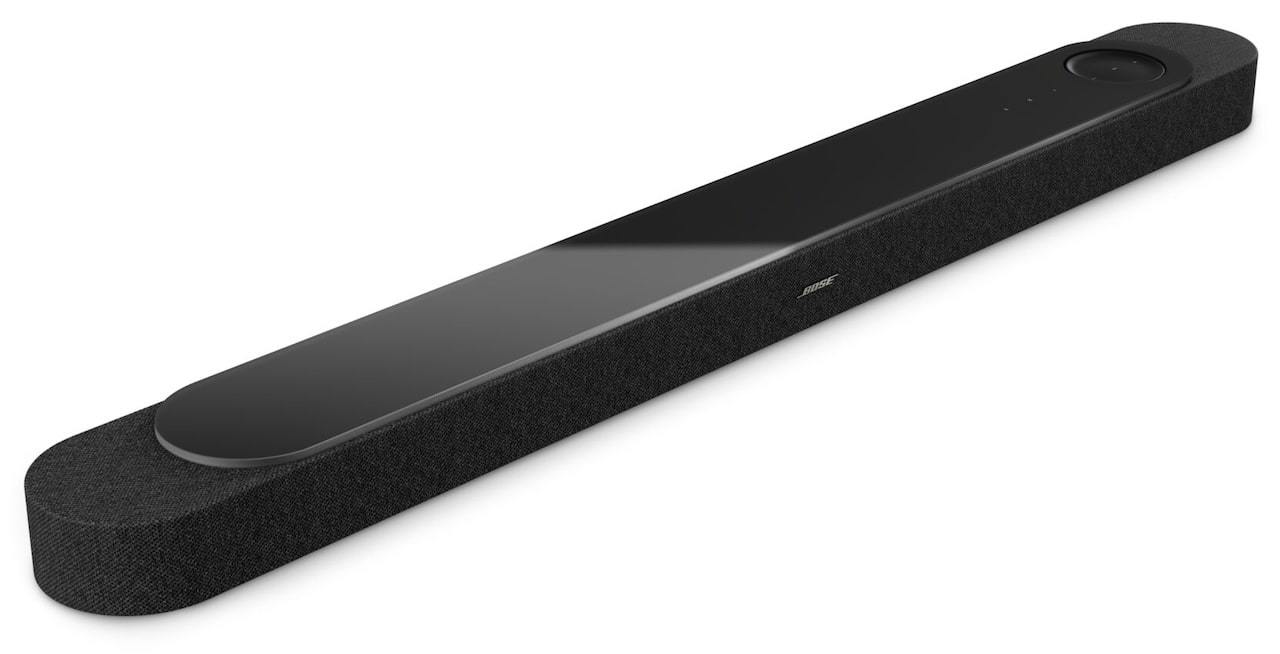
The Bose Lifestyle Ultra Soundbar is the anchor of the company’s new home theater system, and Bose says it represents its first major soundbar redesign in more than a decade. That matters because this is not just a new shell around old hardware.
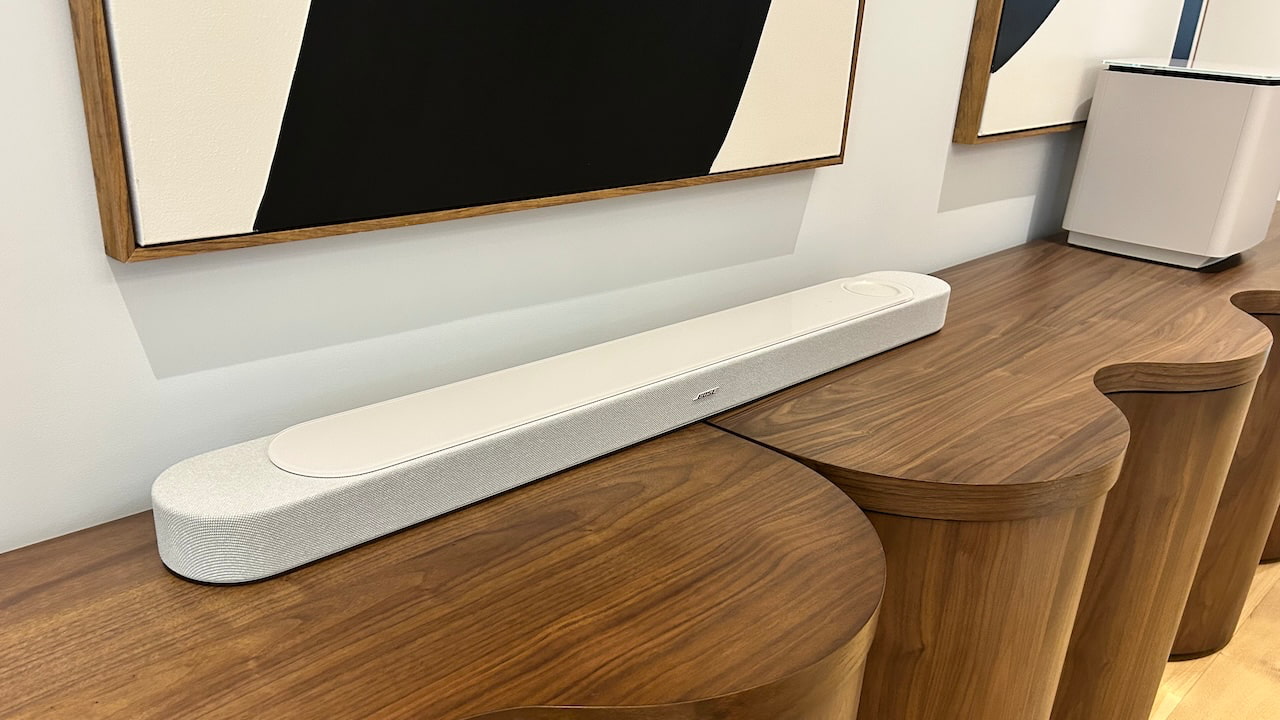
Inside the 43.54 inch wide enclosure is a nine driver array that includes six full range drivers, with two up firing drivers, four front facing drivers, a dedicated center tweeter, and two proprietary PhaseGuide drivers. At 2.64 inches tall, 4.96 inches deep, and 14.8 pounds, it is clearly designed for larger TVs; Bose is thinking 55 inches and up here.
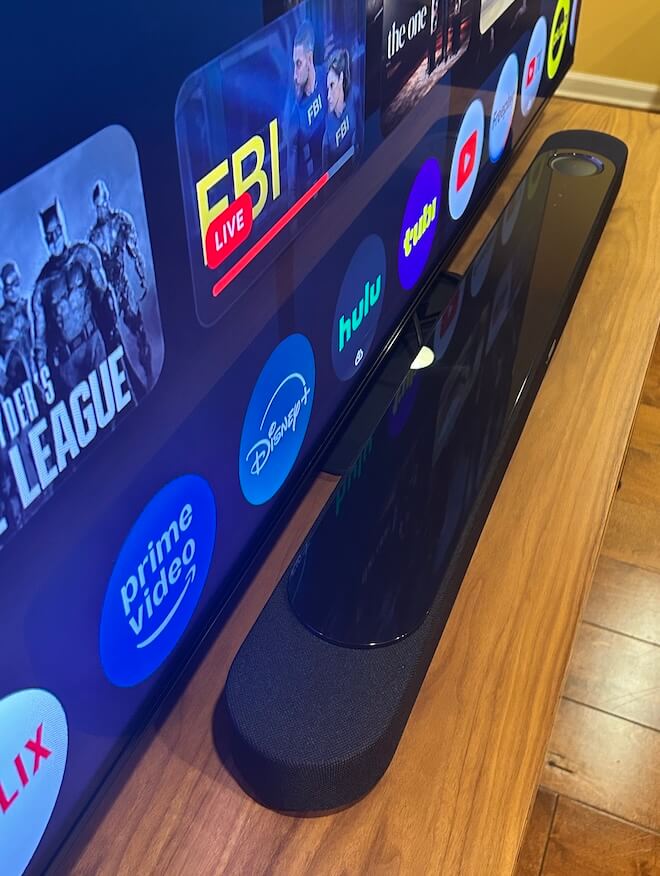
For testing, I used it with a 55-inch Samsung TV in my den and a 75-inch MiniLED display in my living room, and the Lifestyle Ultra worked just fine in both spaces without looking undersized or ridiculous. Always a plus when the gear doesn’t look like it wandered in from another room.
The goal is straightforward: deliver Dolby Atmos playback, better spatial width, clearer dialogue, and a more convincing sense of height from a single enclosure before asking buyers to add a subwoofer, rear speakers, or anything else to the room. Although Bose wants you to add both from their new lineup as well.
Advertisement
The supporting technology is aimed at the usual soundbar weaknesses. PhaseGuide is designed to steer sound horizontally so effects can appear to come from areas where there are no physical speakers. TrueSpatial processing is used to make non Atmos content sound more immersive, which matters because not everything on Netflix, Disney+, Prime Video, or cable is mixed in Dolby Atmos.
DTS and its variants are not supported, so anyone with a disc-heavy library that leans on DTS:X or DTS-HD Master Audio needs to know that before getting emotionally attached.
Dialogue also gets specific attention. SpeechClarity uses adjustable AI driven speech enhancement to make voices easier to follow without boosting the entire mix like a volume button with trust issues. CustomTune room calibration uses an iOS or Android device as the microphone reference point to analyze the room, seating position, surfaces, and layout.
Advertisement. Scroll to continue reading.
Advertisement
Bass is handled by CleanBass, which works with Bose’s QuietPort acoustic opening and DSP to reduce low frequency distortion. That is important because compact soundbars are often asked to deliver more bass than their cabinets can honestly support. Bose is clearly trying to keep the Lifestyle Ultra Soundbar controlled before the optional Lifestyle Ultra Subwoofer enters the picture.
Adding the Subwoofer
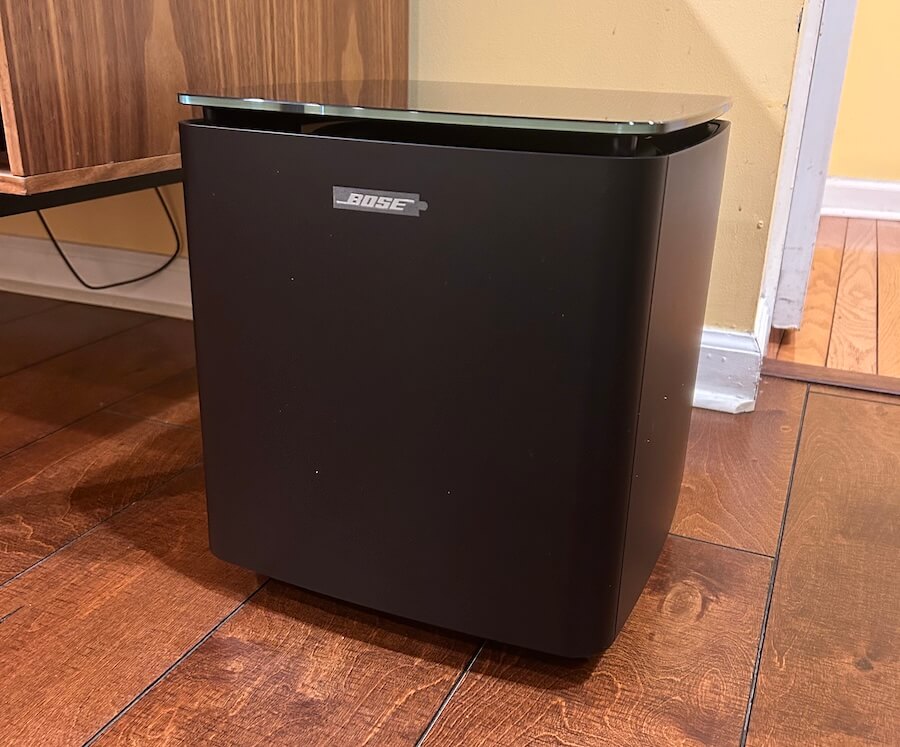
Bose Ultra Lifestyle Wireless Subwoofer
The Lifestyle Ultra Subwoofer is the obvious next step if the system is going under the main TV. It measures 11.63 inches wide, 12.88 inches tall, and 11.63 inches deep, weighs 33.7 pounds, and connects wirelessly through the Bose app with a stated range of 30 feet. Bose also lists a 3.5 mm wired connection as an option, which is useful for anyone who prefers a hardwired backup.
Its role is simple: handle the more demanding low frequency effects, add weight to movies and music, and let the soundbar focus on dialogue, spatial cues, mids, and highs. In 5.1.2 or 7.1.4 configurations, the subwoofer also works with CustomTune room calibration, which matters because bass and rooms have been arguing since the first person shoved a speaker into a corner and called it “placement.”
The configuration path is where Bose keeps things flexible. The Lifestyle Ultra Soundbar can be used on its own as a 5.0.2 system. Add the Lifestyle Ultra Subwoofer and it becomes 5.1.2, which is where most buyers are likely to start if this is replacing a basic soundbar or TV speakers in the main room.
Adding two Lifestyle Ultra Speakers as wireless surrounds expands the system to 7.0.4 without the subwoofer, or 7.1.4 with the subwoofer included. That is the more complete setup, but it also adds another $600 to the bill, so it will likely be a second step for many buyers rather than the automatic first move.
Advertisement
That is the practical appeal here. Buyers can start with the soundbar, add the subwoofer for more impact, and decide later whether rear channels are worth the extra cost. Bose also offers custom designed stands for the Lifestyle Ultra Wireless Speakers with cable management, but did not supply the custom stands for this review, so I used a pair of 28-inch Wharfedale metal stands to position the Lifestyle Ultra Speakers for rear surround and height channel duties.
The setup worked, although the dedicated Bose stands would likely offer a cleaner look and better cable management.
HDMI eARC, Wireless Streaming, and the Missing Second Subwoofer
A few practical details matter here. The Bose Lifestyle Ultra Soundbar supports HDMI ARC and eARC, Wi-Fi, Bluetooth 5.3, Google Cast, Apple AirPlay, Spotify Connect, Alexa, and Alexa Plus in the U.S. Bose includes an eARC compatible HDMI cable in the box, along with tactile controls and a hidden LED for status feedback. Optional accessories include a wall bracket and remote control.
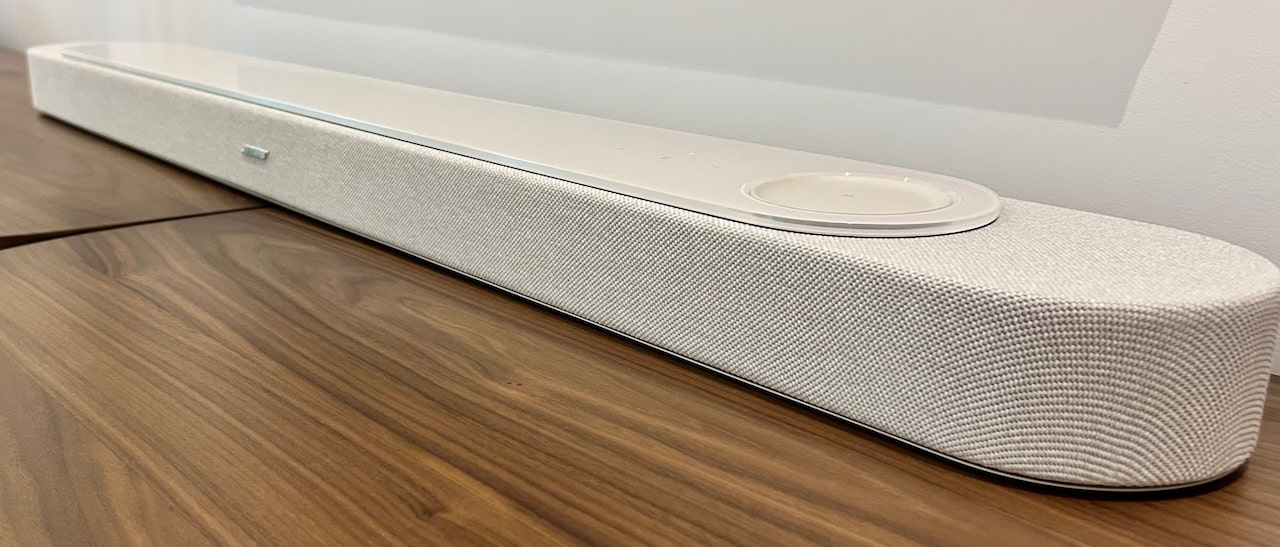
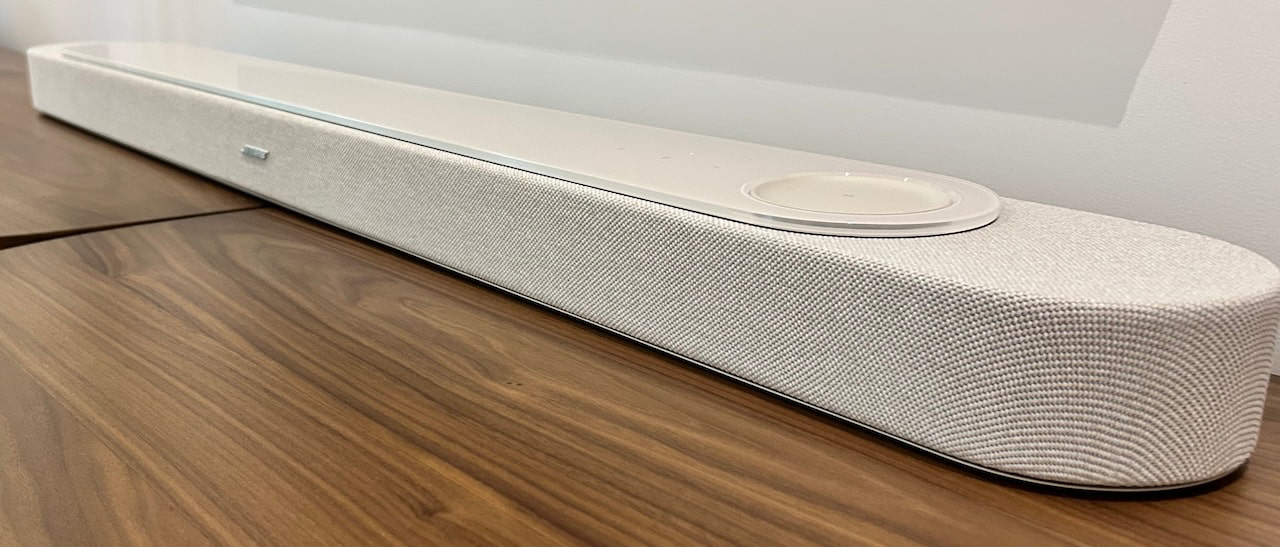
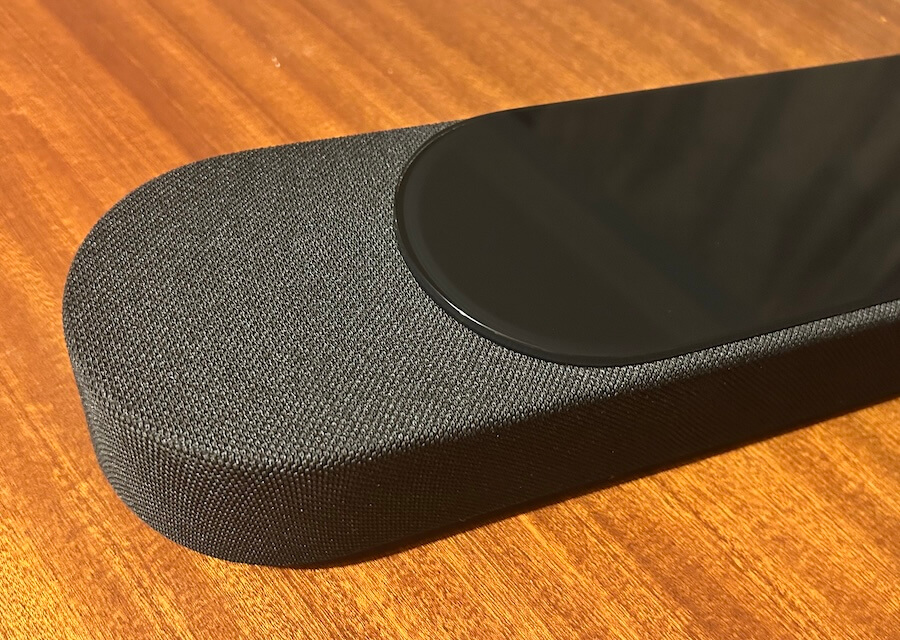
The soundbar and subwoofer are both available in Black and White Smoke, with the soundbar using a textured knit fabric grille and the same premium glass top design language found across the new Lifestyle Ultra lineup. It looks clean, modern, and intentionally understated.
Bose has clearly paid attention to build quality here, and it shows. The cabinet feels solid, the glass top adds a more premium finish, and the finger flick test came back with a sore index finger. Not exactly lab grade testing, but it told me enough.
Advertisement
The Lifestyle Ultra Soundbar feels like a premium product, not a hollow plastic tube trying to bluff its way through movie night. No glitter, no hallway meltdown, no Rue voiceover explaining the trauma behind the HDMI cable. Just a solid piece of hardware that looks and feels the part.
The bigger practical question is subwoofer support. At launch, Bose is not claiming dual subwoofer compatibility for the Lifestyle Ultra system. Previous Bose systems have supported dual bass modules, so the question is fair. In larger rooms, or rooms where bass response gets uneven, support for two subs would be useful. Not because everyone needs to rattle the windows, but because two properly placed subwoofers can deliver smoother, more consistent bass across the seating area.
Advertisement. Scroll to continue reading.
At the Bose House event in New York, Bose did not say that dual subwoofer support is never coming. But it is also not available right now. So the accurate answer is simple: one Lifestyle Ultra Subwoofer today, no confirmed path to two tomorrow.
Advertisement
Setup Is Mostly Painless, It Brings on Many Changes
Sorry. Couldn’t resist. I’ve been watching M*A*S*H again, which remains a top five show ever. Toledo Mud Hens forever.
Out of the box, the Lifestyle Ultra Soundbar and Lifestyle Ultra Subwoofer were relatively easy to set up. Bose has wisely kept the process simple, with fewer steps, fewer cables, and less of the usual “why is this asking me to do that again?” routine.
Fine. Into the system one went.
The rest of the setup was mostly painless: connect the soundbar to the TV through HDMI eARC, plug in the subwoofer, open the Bose app, and let the system walk through pairing and calibration. There were a few app hiccups along the way, but nothing that derailed the process or required a visit from Radar O’Reilly with a clipboard.
Advertisement
One issue I ran into with the Lifestyle Ultra Wireless Speakers was the Bose app occasionally acting like it had picked up some Southie attitude about recognizing both speakers. It took four or five tries before everything finally behaved. I get paid to do this, so I kept going. Most consumers, however, are not especially thrilled when setup starts requiring online troubleshooting, emotional restraint, or a phone call to someone in New England who may or may not be prepared for yelling.
Bose did make one smart choice during setup: the app separates the process for a 2-channel configuration from a home theater system. That helps avoid some confusion, especially if you are adding the Lifestyle Ultra Speakers as surround and height channels rather than using them as a stereo pair.
For whatever reason, integrating the Lifestyle Ultra Soundbar, Lifestyle Ultra Subwoofer, and the rear surround and height channels took only two tries in my system.
Mazel tov. Progress is progress.
Advertisement
That matters because setup problems at 11 p.m. tend to expose the worst version of me. Tyrion just sits there, stares, and rolls over expecting a belly rub. I usually consider going outside with my goalie stick, pretending to be Toshiro Mifune in Yojimbo, and swinging at imaginary enemies in the dark. Another Ian may have used a cricket bat. I went Canadian.
My Indian neighbors generally lower the shades at that point, which feels fair.
The actual takeaway is simple: setup was easier than most competing systems I have tried, but the Bose app still had a few moments where it needed to get out of its own way.Once the speakers were recognized and assigned correctly, the system locked in and calibration moved along fairly quickly.
Advertisement. Scroll to continue reading.
Advertisement
Anyone expecting Dirac level room correction should keep walking. This is Bose keeping setup simple and practical, not handing you a lab coat, a calibrated microphone, and three hours of self-loathing.
Listening
Bose handled the NYC demo the right way: full 7.1.4 first, then fewer pieces. We heard the complete system, then the rear channels were removed, and the Lifestyle Ultra Subwoofer was switched in and out. That made it easier to judge what the Lifestyle Ultra Soundbar could do by itself, what the subwoofer actually contributed, and how much the Lifestyle Ultra Speakers changed the surround and height presentation.
That kind of demo matters because soundbars can be hard to evaluate when everything is playing at once. The bar, subwoofer, and surrounds all contribute, but not equally. Bose gave us a cleaner read on the system instead of hiding behind the full package and hoping nobody asked questions. Always suspicious when nobody asks questions.
The room was also part of the story. Bose used an upper floor den inside its Upper West Side press location, not a massive showroom or some hotel demo room where bass goes to die. I don’t know the exact dimensions, but it felt close to my 16 x 13 foot den at home, probably a little deeper, with ceilings that looked to be at least 10 feet high. Brick walls covered in plaster helped, and the room was quiet enough that Broadway traffic in the mid-70s never intruded. For Manhattan, that’s basically a miracle with alternate side parking.
But press demos in $5 million Upper West Side brownstones have to be taken for what they are: useful, controlled, and not exactly the same as your apartment, condo, ranch, or suburban house where the walls went on Ozempic and now transmit every sneeze from the next room.
Advertisement
That is why I tested the system in two very different real world spaces. One was my den with a 55-inch Samsung TV. The other was my living room with a 75-inch Mini LED display. Both rooms have openings into a larger central foyer, and each also opens into either the dining room or kitchen. In other words, these are not sealed listening rooms. They are normal spaces where sound has places to escape, bass has places to misbehave, and reflections do what reflections do.
That context matters for readers. The Bose demo showed what the Lifestyle Ultra system can do in a carefully selected room. My spaces were closer to what many buyers will actually use: imperfect, open, lived in, and not designed by an Gerrman acoustician who owns too many black turtlenecks.
The Sandworm Arrives, But Only If the Subwoofer Shows Up
I started with Dune and Dune: Part Two because both films are loaded with low frequency effects, wide spatial cues, sandworm chaos, ornithopters moving across the soundstage, and enough desert violence to expose a soundbar that is bluffing.
I was especially interested in three things: how the Bose Lifestyle Ultra Soundbar performed on its own, how much the Lifestyle Ultra Subwoofer added, and whether the system became more convincing with the Lifestyle Ultra Wireless Speakers handling the rear surround and height channels. That is the point of a modular system. The pieces need to matter, not just make the receipt longer.
Advertisement
I am not going to compare the Bose system directly with the Theory Audio Design soundbar system which is my personal benchmark, because that would be dumb. The Theory system costs roughly 15 times more, uses larger full range drivers and serious active subwoofers, and can pressurize my 30 x 13 x 9 foot basement space with very little effort.
That is not the same contest. It is like asking an Acura TLX Type S to chase a Porsche 911 GT3 RS around a track. Both are real cars. Only one of them arrived wearing a helmet and a bad attitude and a pocket filled with biltong.
Without the Lifestyle Ultra Subwoofer, the sandworm scenes in both Dune films still worked, but only up to a point. You get the rumble. You get the scale. You get enough low end information to understand what the film is trying to do. What you do not get is the visceral punch, the dynamic shove, or that pressure wave in your gut and chair when Arrakis decides to remind everyone who actually owns the lease.
Advertisement. Scroll to continue reading.
Advertisement
Adding the subwoofer is a clear step in the right direction. It gives the system more weight, better impact, and a much stronger foundation during the worm attacks and spice harvester sequences. It is not SVS level bass, and anyone expecting that from a lifestyle wireless subwoofer needs a glass of water and a chair. But the Bose subwoofer makes the system feel more complete and much more credible with films that lean hard on LFE.
Dialogue was very clear, and that was before I engaged SpeechClarity, which I will get into more below. That matters with Dune, because whispered prophecy, political scheming, and sand blasted exposition can become mush on lesser systems. The Bose kept voices clean and centered without making everything sound artificially sharpened.
The stereo spread was also good, and the overall sense of spaciousness was better in my room than it was during the NYC setup. That surprised me a little, but rooms matter. My listening spaces are more open and reflective in different ways, and the Bose system did a good job creating width without making effects sound detached from the screen.
The surround performance was solid with the bar alone, but it became a lot more effective once I added the Lifestyle Ultra Wireless Speakers behind the listening position. That is where the system started to feel less like a very good soundbar and more like an actual home theater package.
Advertisement
The overhead movement of the ornithopters was also one of the better parts of the demo material. The aircraft movement was precise, easy to follow, and more convincing with the rear speakers engaged. The films use ornithopters heavily, including the spice harvester and attack sequences, so they are a useful Atmos test when you want to hear whether height effects are actually moving through the room or just being sprayed upward like acoustic Febreze.
Dragons, Dialogue, and Why TV Still Needs Real Audio
Switching to TV viewing matters because this is where a lot of families will actually use the Bose Lifestyle Ultra Soundbar and Lifestyle Ultra Subwoofer the most. Movie night is great, but prestige TV, sports, streaming series, and the nightly “what are we watching?” debate are the real workload.
I spent time with the 4K Dolby Atmos encoded seasons of Game of Thrones, which remain a very useful test for a system like this. The show needs scale. It needs clean dialogue. It needs weight when dragons arrive, armies move, castles fall, and Ramin Djawadi’s score starts doing emotional damage with a full orchestral weapon pointed at your living room.
I remain one of those people who hated the final three episodes, but I was pretty much obsessed with the rest of the series. I could watch Arya, Tyrion, and Cersei on repeat for days. Especially Cersei, whose venomous smile could make a man mad before breakfast. And Peter Dinklage? I could listen to that man deliver dialogue forever. The writing gave him a blade, and he knew exactly where to put it. Jersey boy for the win.
That is where the Bose system did well. Dialogue stayed clear and centered, even before leaning on SpeechClarity, and the soundbar did a good job keeping voices intelligible without making the presentation feel thin or artificially boosted. That matters with Game of Thrones, because half the show is people whispering threats in rooms full of stone, wine, bad lighting, and worse family decisions about incest and who has to live beyond the wall.
Advertisement
The subwoofer also helped give the series the foundation it needs. Game of Thrones is not just dialogue and political rot; it has dragons, siege engines, battles, ships, and low frequency moments that lose impact through TV speakers or weaker soundbars. With the Lifestyle Ultra Subwoofer engaged, the presentation had more body and scale. Not dedicated theater levels of impact, but enough weight to make the world feel larger and more convincing.
SpeechClarity is one of the more useful features here because it pushes dialogue forward without dragging the rest of the mix along for the ride. Explosions do not suddenly get louder with the voices, but they also do not vanish like someone hit the “make this boring” button.
And yes, some of us are getting older. Some of us watch the Stanley Cup Playoffs past 11 p.m. Some of us have spouses and children upstairs who are armed. Being able to keep the focus on the play-by-play crew in the booth without turning crowd noise into a fight is a genuinely valuable feature.
Advertisement. Scroll to continue reading.
Advertisement
It worked well. No text messages from upstairs. That counts as a win.
Bigger, Wider, Better With Electronic Music
Switching over to music, a few things stood out. The Bose Lifestyle Ultra Soundbar does a very solid job with music, especially when paired with the Lifestyle Ultra Subwoofer, but I still found myself more drawn to the two Lifestyle Ultra Wireless Speakers on their own for dedicated music listening.
Does that make me weird? Possibly. But we passed that exit in Palm Beach County 12 months ago.
The soundbar and subwoofer combination works best with music that benefits from a larger sense of space and more low end energy. The Orb, Aphex Twin, and some Sia tracks were the strongest fits because the Bose system could lean into scale, width, and bass foundation without pretending to be a pair of properly positioned stereo loudspeakers.
Advertisement
The presentation was bigger than the wireless speakers on their own, and the subwoofer gave electronic music more drive and physical presence. Soundstage width was good, the sense of scale was better, and the system delivered more sonic weight than the Lifestyle Ultra Speakers can manage alone.
Jazz and singer songwriter material were a different story. Lee Morgan and Jason Isbell sounded clean, clear, and easy to follow, but I was less emotionally pulled in. That is not a failure of the Bose system as much as it is the reality of music through a soundbar. I have never truly loved listening to music through one, and apparently this is the hill I have chosen to stand on with a coffee in one hand and a mildly judgmental expression on my face.
The Bottom Line
The Bose Lifestyle Ultra Soundbar and Lifestyle Ultra Subwoofer work because Bose kept the mission focused: better TV and movie sound, clean industrial design, easier setup than most, useful wireless streaming, and credible Dolby Atmos performance without dragging an AVR, speaker wire, and a therapy co-pay into the living room. Dialogue clarity is excellent, even before SpeechClarity gets involved, and the subwoofer adds the weight the soundbar needs for films, and anything with real LFE content.
What is missing? DTS support, dual subwoofer support, and deeper room correction for users expecting Dirac level calibration. The app still has a few moments where it needs to stop arguing with itself, and music playback through the soundbar is good but not as satisfying as using the Lifestyle Ultra Wireless Speakers on their own.
Advertisement
This system is for buyers who want a clean, premium Dolby Atmos package with strong dialogue, useful streaming, solid spatial effects, and enough bass to make movies feel bigger without building a full component system. It is not for hardcore theater purists or anyone expecting SVS level impact, but for families, apartment dwellers, condo owners, and anyone allergic to cable chaos, the Bose Lifestyle Ultra system makes a strong case.
Pros:
Clean, premium design that works well under larger TVs
Strong dialogue clarity, with SpeechClarity adding real value
Dolby Atmos performance delivers good width, height, and spatial effects
Lifestyle Ultra Subwoofer adds needed weight and scale for movies and TV
Easier setup than most competing systems, with useful AirPlay, Google Cast, Spotify Connect, and Bluetooth support
Cons:
No DTS or DTS variant support
No dual subwoofer support at launch
App setup can still have a few hiccups
Room calibration is simple, not Dirac level correction
Music playback is good, but bettered by the stand-alone Lifestyle Ultra wireless speakers
Google has confirmed it is testing a 5GB storage limit for some new Gmail accounts, with users able to unlock the standard 15GB by adding a phone number. Android Authority reports: While the company didn’t mention which regions are impacted, user reports from yesterday were mostly from African countries. That said, if Google’s tests prove successful, this could possibly become the norm for new sign-ups in more regions. The company could be testing ways to discourage users from creating multiple Gmail accounts to access free cloud storage. However, if you already have a Gmail account with 15GB free storage, it shouldn’t be impacted by this change.
The language on Google’s support page mentions “up to 15GB of storage.” However, it’s a recent change. An archived version of the support page from February did not use the words “up to.” Whether the test has been running since early March or Google updated its language before it ever started the test, it’s evident that the company could roll out the change globally as well.
Bitwarden appears to be undergoing a quiet shift in leadership and messaging. Its longtime CEO and CFO have stepped down, while the company has removed “Always free” from a prominent password-manager page and replaced “Inclusion” and “Transparency” in its GRIT values with “Innovation” and “Trust.” Fast Company reports: In February, longtime CEO Michael Crandell moved to an advisory role, according to LinkedIn, with no announcement from the company. His replacement, Michael Sullivan, former CEO of both Acquia and Insightsoftware, touts his experience with “all facets of mergers and acquisitions” on his own LinkedIn page, including experience working with leading private equity firms. CFO Stephen Morrison also left Bitwarden in April, replaced by former InVision CEO Michael Shenkman. Both Crandell and Morrison joined the company in 2019. Kyle Spearrin, who started Bitwarden as a fun hobby project in 2015, remains the company’s CTO.
Meanwhile, Bitwarden has made some subtle tweaks to its website. The page for its personal password manager no longer includes the phrase “Always free.” Previously this appeared under the “Pick a plan” section partway down the page, but that section no longer mentions the free plan, though it remains available elsewhere on the page. Bitwarden made this change in mid-April, according to the Internet Archive. Bitwarden has also stopped listing “Inclusion” and “Transparency” as tentpole values on its careers page. The company has long defined its values with the acronym “GRIT,” which used to stand for “Gratitude, Responsibility, Inclusion, and Transparency.” After May 4, it changed the acronym to stand for “Gratitude, Responsibility, Innovation, and Trust.” The phrase “inclusive environment” still appears under a description of Gratitude, while “transparency” is mentioned under the Trust heading. They’re just no longer the focus.







































































You must be logged in to post a comment Login