

Crypto World
Elon Musk Amplifies Citadel CEO’s Stanford Warning: AI Is After PhD Jobs Now



Elon Musk shared a video clip warning that AI now replaces high-skilled finance jobs. The speaker, Citadel CEO Ken Griffin, said agentic systems do PhD-level work in hours.
Griffin made the remarks at Stanford University. He said the AI toolkit has become profoundly more powerful in just nine months, prompting concern about its impact on highly skilled professions.
Citadel’s AI Awakening
Griffin, a longtime AI skeptic, admitted the technology has changed how his hedge fund operates internally. He said work usually done by master’s and PhD holders over weeks or months now takes hours or days.
Follow us on X to get the latest news as it happens
The Citadel chief told Stanford students he went home one Friday “fairly depressed” by the change. He said witnessing it inside his own firm marked his first sense of real AI impact at scale.
“These are not mid-tier white-collar jobs. These are extraordinarily high-skilled jobs being automated by agentic AI,” said Ken Griffin, CEO of Citadel.
Historically, Citadel has hired hundreds of quantitative researchers from top mathematics and physics programs. Griffin’s comments suggest AI is now competing for that elite talent pool directly.
The Wider Workforce Story
Citadel’s experience tracks a broader 2026 trend. Tech employers cited AI as the trigger behind thousands of layoffs this year, with agentic systems accounting for a growing share of cuts.
Musk himself has long argued AI will eliminate most paid work over time. However, not every analyst agrees on the timing.
A recent a16z review of four major studies found AI is not killing jobs at scale yet. Displacement remains concentrated in narrow tasks rather than full occupations across the broader economy.
Crypto-native firms have nonetheless built product roadmaps around agents that trade and settle directly. Coinbase, Microsoft, and other large employers frame recent cuts as a pivot toward smaller, AI-augmented teams.
Whether Griffin’s Friday depression spreads across the finance industry will hinge on how durable the recent productivity leap proves through year-end. Earnings calls in the coming quarter could reveal which firms quantify their AI-driven cost cuts.
Investors will also be watching whether Citadel itself publicly details how much capacity it has freed up by handing PhD-level work to agents.
The post Elon Musk Amplifies Citadel CEO’s Stanford Warning: AI Is After PhD Jobs Now appeared first on BeInCrypto.



BNB Chain has published a guide for moving assets from a centralized exchange to BNB Chain, as European crypto users adjust to new rules under the Markets in Crypto-Assets framework.
Summary
- MiCA has changed EU exchange access, pushing some users to compare licensed platforms and self-custody.
- BNB Chain’s guide frames wallets, test transfers, and recovery phrases as core safety steps.
- Stablecoin delistings and Binance limits have made European crypto users review custody options more carefully.
The guide explains how users can hold crypto in their own wallets and connect directly to decentralized apps.
Meanwhile, the timing follows the end of MiCA’s transition period on July 1. As previously reported, MiCA now requires crypto firms to hold CASP licenses to keep serving users under the EU rulebook. The change has pushed users to check whether their exchanges can still offer services in the bloc.
BNB Chain guide focuses on self-custody
BNB Chain’s guide presents self-custody as an alternative to keeping assets on a centralized exchange. It says users who move on-chain control their own private keys, while centralized platforms hold keys on behalf of customers.
The guide also warns that self-custody comes with responsibility. Users must protect their recovery phrases, send test transfers before moving larger sums, and keep a small amount of BNB for network fees. It also tells users to avoid fake wallet apps, fake bridge sites, and links sent through messages or ads.
BNB Chain says users can access swaps, stablecoins, staking, lending, borrowing, tokenized real-world assets, and perpetual trading from their wallets. It names apps such as PancakeSwap, Venus, Lista DAO, Aster, DappBay, and BscTrace as tools available across the ecosystem.
Exchange shifts put wallets in focus
The guide lands as several exchange services in Europe change under MiCA. As previously reported, Binance said it would suspend several EU services after failing to secure a MiCA license before the deadline. The pause covered new spot orders, new deposits, sign-ups, and some yield products, while withdrawals remained available.
Licensed rivals have also used the deadline to compete for users. As previously reported, Coinbase and OKX targeted Binance users with transfer offers before the rule change took full effect. The shift has made regulation, custody, and access central issues for EU users choosing where to hold crypto.
Stablecoins are also part of the change. As previously reported, USDT lost access to regulated EU exchange order books after Tether chose not to seek MiCA authorization. That has pushed compliant stablecoins such as USDC and EURC into a stronger position on licensed platforms.
Licensed firms gain ground
The EU market is not closing to crypto, but access now depends more on authorization. ESMA’s MiCA register rose to 300 authorized crypto firms after 57 new providers were added around the deadline.
The updated list includes banks, trading firms, and crypto companies that can serve users across the bloc through MiCA passporting. Ripple also joined the licensed market after securing approval in Luxembourg, as previously reported.
BNB Chain’s message is aimed at users who want direct control rather than a licensed exchange account. The guide does not remove the risks of DeFi or self-custody. It instead gives users a route to move assets, test transactions, check apps, and decide how much responsibility they want to hold themselves.


Ripple legal chief and National Cryptocurrency Association President Stuart Alderoty said Washington should stop treating crypto users as a small political group.
Summary
- Alderoty says 67 million U.S. crypto holders make digital assets a major voting bloc.
- Polling shows mixed views, with many Americans still worried about crypto risk and influence.
- The CLARITY Act remains under Senate pressure as lawmakers weigh rules, ethics, and oversight.
In a July 7 post on X, he said U.S. crypto holders now represent one of the country’s largest public groups.
Alderoty pointed to National Cryptocurrency Association data showing that 67 million American adults own crypto. He said, “For starters, it means more people have crypto than have dogs.” He added that crypto users are “by any reasonable standard” a large national group.
His comments came after a Politico poll showed limited public support for the CLARITY Act. Alderoty argued that weak support for one bill does not mean crypto users are irrelevant. He said the 27% support figure is close to the share of adults who already hold crypto.
Crypto ownership broadens across the U.S.
The 2026 State of Crypto Holders Report said one in four U.S. adults now owns crypto, or more than 67 million people. The report also said the country added 12 million holders over the past year.
Alderoty said the data challenges old images of crypto holders as wealthy male tech workers or short-term speculators. The report said women made up 42% of new holders in 2025 and 2026, compared with 34% among earlier holders.
The same report said nearly a quarter of holders earn $75,000 or less per year. It also said construction and manufacturing workers now make up more than 21% of the holder base. Alderoty used those figures to argue that crypto ownership now reaches working and middle-class households.
CLARITY Act debate enters tighter window
The remarks come as Congress continues to debate the CLARITY Act, a bill meant to set federal rules for crypto markets. As previously reported, the bill missed its July 4 target and now faces an Aug. 7 deadline before the Senate summer break.
The bill has already cleared key steps, but it still needs a full Senate vote. Senate staff also need to merge versions from the Banking and Agriculture committees before lawmakers can move cleanly toward final passage.
As previously reported, the Senate Banking Committee advanced the bill in a 15 to 9 vote in May. The bill still needs 60 Senate votes, while ethics language, anti-money laundering rules, and agency oversight remain points of debate.
Polling and lobbying shape the fight
Public polling gives lawmakers a mixed picture. A Politico and Public First survey found that crypto ranked low among voter priorities, with only 4% saying a candidate’s crypto stance would shape their vote.
Other polling shows voters want stronger rules. Americans for Financial Reform said voters across parties worry about crypto industry influence in Washington and want crypto firms to follow bank-like rules.
The industry has also increased political spending. Reuters reported that crypto firms have spent $189 million so far on the 2026 U.S. election cycle, more than their 2024 total. The report named Ripple Labs, Coinbase, Andreessen Horowitz, and Foris DAX among the top contributors to corporate policy-focused political action committees.
Alderoty’s message places crypto ownership at the center of the Washington debate. His argument is that lawmakers do not need to endorse a specific token to pass basic rules. They must decide whether 67 million holders are a niche group or a public market that needs clear guardrails.


Paradigm has led an oversubscribed seed funding round for sovereign financial infrastructure firm M1X Global, bringing the company’s total funding to $8.5 million just 14 weeks after its public launch.
Summary
- Paradigm has led M1X Global’s oversubscribed seed round, bringing the sovereign financial infrastructure firm’s total funding to $8.5 million.
- M1X Global said its blockchain based sovereign bond USDM1 is being deployed for institutional use and supports regulated 24/7 financial markets.
- The investment adds to Paradigm’s recent backing of blockchain payment and sovereign infrastructure projects beyond traditional crypto venture funding.
According to a press release shared with crypto.news, the round also attracted participation from Breed VC following M1X Global’s earlier angel raise. The company said the funding comes as regulatory clarity and institutional interest continue driving adoption of blockchain-based financial infrastructure.
M1X builds blockchain infrastructure for sovereign markets
Working with governments on digital financial systems, M1X Global has concentrated on sovereign financial instruments issued on blockchain networks. Its flagship partnership with the Republic of the Marshall Islands led to the launch of USDM1, which the company described as the first U.S. dollar-denominated secured sovereign bond issued natively on a public blockchain.
M1X Global said it coordinated the issuance with Cleary Gottlieb, Stellar Development Foundation, Anchorage Digital Bank, Guidepost, Inca Digital and Crossmint. According to the company, USDM1 was created to expand access to government aid and financial services across the Pacific while introducing a blockchain-native sovereign instrument for institutional markets.
The company said USDM1 combines the legal and economic structure of fully collateralized U.S. dollar sovereign debt with programmable digital asset features, enabling T+0 settlement, enforceable legal protections and programmable transfers. It added that the instrument qualifies as eligible sovereign collateral for regulated 24/7 markets and has already featured in institutional working groups involving Bank of America, Citadel Securities, Virtu Financial, Tradeweb, and DTCC.
According to M1X Global, the bond has also been structured to remain bankruptcy remote while supporting look-through to high-quality liquid assets and inclusion in legal netting sets used for collateral.
“Paradigm’s investment is an important milestone for M1X Global, strengthening our ability to scale the infrastructure behind sovereign financial instruments and to accelerate the build-out of systems that can support their use across regulated markets. This support advances our capacity as we continue to see strong onboarding demand and institutional adoption of USDM1, “ M1X Global Chief Executive Officer Mark Lurie said in an accompanying statement.
Jordan Goldman, president and chief operating officer of M1X Global, added that institutional deployment of USDM1 has demonstrated how sovereign digital assets can support both public services and financial markets.
According to Goldman, the assets can “deliver meaningful impacts in both domestic and institutional contexts” by improving access to government services while providing new sources of high-quality collateral for institutions operating in around-the-clock markets.
The investment continues Paradigm’s recent expansion beyond traditional crypto venture funding.
In June, the firm led a $9 million Series A round for Latin American payments platform El Dorado, supporting its stablecoin-powered cross-border payment network operating across 12 countries. It has also partnered with Stripe on the Tempo Layer 1 blockchain and participated in U.S. stablecoin policy discussions, including urging regulators not to restrict third-party stablecoin reward programs.


Yield Guild Games will shut down YGG Play, its crypto game publishing arm, after deciding the business is no longer commercially sustainable.
Summary
- Yield Guild Games is cutting 35 jobs and closing YGG Play after weak gaming demand.
- YGG will focus on gaming datasets for AI after extending total runway to four years.
- The shutdown adds to crypto layoffs as firms shift resources toward automation and AI products.
The company blamed weak crypto market conditions and a difficult video game publishing market.
YGG said the Oct. 10 market crash changed retail trading behavior and reduced the liquidity that many consumer crypto apps need. It said Bitcoin later fell below $60,000, while several altcoins lost 80% or more from prior levels.
The company said YGG Play had shown early traction before conditions worsened. It signed nine games, worked with intellectual property brands such as Pudgy Penguins, launched a publishing platform, and passed $9 million in lifetime revenue by the end of the first quarter of 2026.
35 staff affected by restructuring
The shutdown will affect 35 workers across different teams. YGG said it would help those employees find new roles and invited companies to contact it for hiring referrals.
The company will retire the YGG Play website, launchpad, and community rewards platform. It will also stop marketing support for third-party games. LOL Land and Waifu Sweeper will be taken down, while GIGACHADBAT and Ragnarok Breaker will continue through their own studios.
“Sunsetting YGG Play is a heavy decision, but it is a market decision, not a product decision,” said YGG co-founder Gabby Dizon.
He added that the company remains focused on using technology to create economic opportunities.
Company turns toward AI data
YGG said it will now move resources into the AI data economy. Its first focus will be a business-to-business pipeline for gaming datasets that can help train AI models.
The company said games can produce useful data because players make fast and complex decisions during play. YGG said its global community can help create behavioral datasets by playing games and completing related tasks.
YGG also pointed to its AI Alerts channel, formerly YGG Alerts, as part of the new direction. The company said the channel has already brought in 27,000 applications in its first five days by connecting Filipino workers with remote AI training jobs.
Crypto and gaming layoffs continue
The move adds to broader job cuts across crypto and gaming. As previously reported, Kraken cut about 150 jobs as AI tools took on a larger role across the exchange. Coinbase, Gemini, and Dune also reduced staff this year while reshaping operations.
In addition, BitGo cut nearly 15% of its workforce while shifting focus toward security, trading, stablecoins, settlement, and AI infrastructure. The cuts showed how crypto firms have continued to review costs after weaker market conditions.
The web3 gaming sector has also faced pressure. As previously reported, blockchain gaming activity fell in 2025 as user numbers dropped, funding slowed, and hundreds of gaming apps went inactive.
YGG said its treasury stood at $20.6 million at the end of the first quarter. It held $6.2 million in stablecoins, T-bills, and large-cap tokens. The company said the restructuring extends its operating runway to four years.

Crypto gaming company Yield Guild Games says it has shut down its crypto game publishing arm, YGG Play, and will instead focus on feeding data to artificial intelligence.
Yield Guild Games said Monday that it would also lay off 35 employees, adding that a prolonged crypto market downturn and a “similarly brutal” video game publishing market meant YGG Play “cannot be commercially sustainable.”
It said a major market crash on Oct. 10 “fundamentally altered retail market psychology, and we do not expect the crypto consumer market or the Web3 games publishing market to recover sufficiently in the near term.”
The layoffs add to the more than 5,000 jobs that crypto companies have cut this year, with many citing a crypto market slump and a refocus toward opportunities presented by artificial intelligence.
“Sunsetting YGG Play is a heavy decision, but it is a market decision, not a product decision,” Yield Guild Games co-founder Gabby Dizon said. “I am proud of what this team achieved under such tough conditions.”

Source: Yield Guild Games
Yield Guild Games said it would be closing YGG Play’s website, its web app that launched games and its community-focused rewards site. It would also end all marketing support for third-party games.
The company’s board game-style browser game LOL Land and its puzzle game Waifu Sweeper would also be taken down. The Web3 versions of the baseball game GIGACHADBAT and the battle game Ragnarok Breaker would continue as normal.
The company said sunsetting YGG Play and its restructure would extend its operating runway to four years, adding it had $20.6 million in its treasury as of the end of the first quarter.
Yield Guild pivots to AI data
Yield Guild Games said it would refocus its resources “into the AI data economy” to provide information that can be used to train AI models.
It will initially create a pipeline for gaming datasets, and said its global community “can generate these behavioral datasets just by playing.”
The company said it was “an organic next step” and the data would help AI networks understand “human irrationality and emergent behavior,” as video game players “constantly make complex, split-second decisions.”
More than 5,000 crypto layoffs in 2026
The crypto industry has cut over 5,000 jobs so far this year, with Block Inc. undertaking the largest round of layoffs in February by cutting 4,000 staff, or about half its workforce at the time.
Last month, crypto infrastructure company BitGo laid off 15% of its staff, an estimated 90 people, while Robinhood cut 10% of its workforce.
Earlier in the year, Kraken laid off 150 workers, and Coinbase cut 700 employees. Gemini also laid off 200 employees in February and Crypto.com cut about 180 staff a month later, both citing the use of AI.
Magazine: Solana exec trolls crypto gamers, Pixel tackles play-to-earn issues: Web3 Gamer
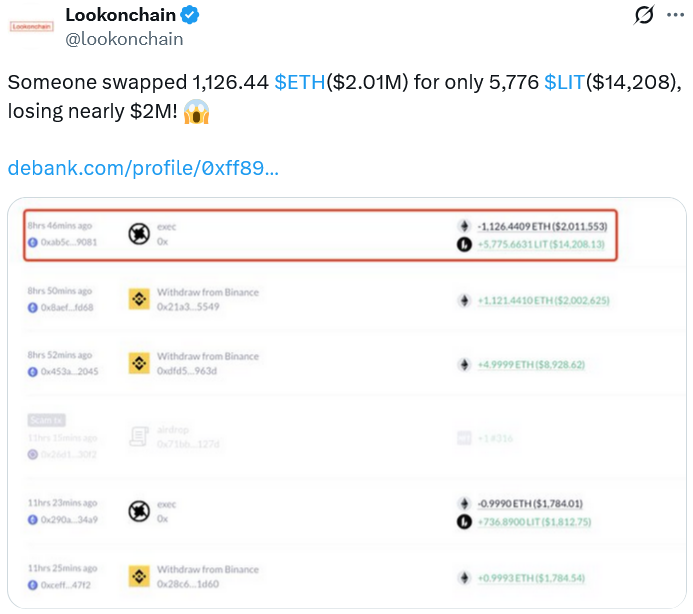
A trader who swapped $2.01 million worth of Ether on a decentralized exchange has been left with just $14,500 worth of tokens after a router directed the order through a low-liquidity pool, allowing an Ethereum block builder to profit massively from a same-block arbitrage trade.
The trader swapped 1,126.44 of Ether (ETH) but only received 5,776 Lighter (LIT) tokens, in a “textbook case of same-block backrun extraction,” according to GoPlus Security.
“This was a real, highly imbalanced backrunner arbitrage, not a classic sandwich attack,” GoPlus Security said. Titan Builder was the biggest beneficiary, walking away with $1.8 million from the transaction, which took place on Monday at 1:59 am UTC.
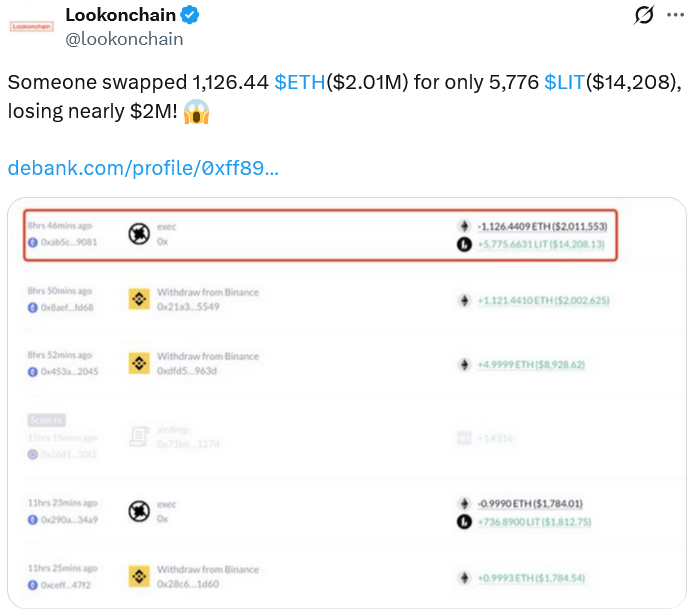
Source: Lookonchain
The incident is a reminder of the risks posed by maximal extractable value (MEV) bots and liquidity routers on top of hackers and scammers, which continue to run rampant in the crypto industry.
Don’t sign DEX transactions blindly, trader says
To reduce the risk of such incidents, crypto trader Ruslan Khairullin said traders should read the transaction route before signing the transaction.
“This is what happens when you clicked confirm faster than you read the route. Painful lesson to see in a real time.”
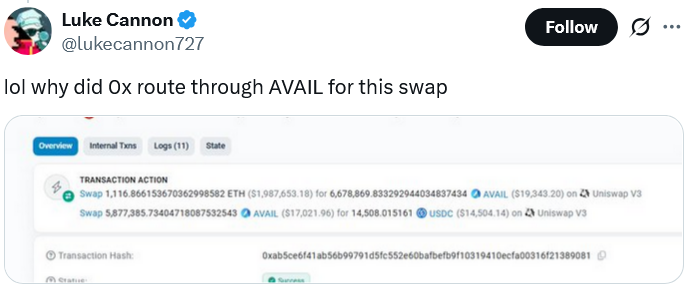
Source: Luke Cannon
How the victim lost $2M to a bot
The victim’s swap routed approximately 1,117 Ether into a low-liquidity AVAIL/WETH pool on Uniswap v3, causing the trade to execute at roughly 120 times higher than what AVAIL could later be sold for, GoPlus Security said.
After the trader received nearly 6.67 million AVAIL tokens at an inflated price, the router involved, 0x router, sold a small amount of externally sourced AVAIL into the same pool to extract about 1,072 WETH before paying out 1,018 ETH, worth $1.8 million, to Titan as a builder reward.
The AVAIL was then swapped for $14,200 worth of LIT tokens, marking a 99.3% loss.
Related: ‘All DeFi unsafe’ claim sparks AI security debate after April hack surge
Cointelegraph reached out to Titan but didn’t receive an immediate response.
Titan has now made $112.6 million in revenue from its block building services this year, data from DefiLlama shows.
Titan’s biggest day this year came in March when it extracted around $34 million in arbitrage profit from a MEV bot incident on the CoW Protocol.
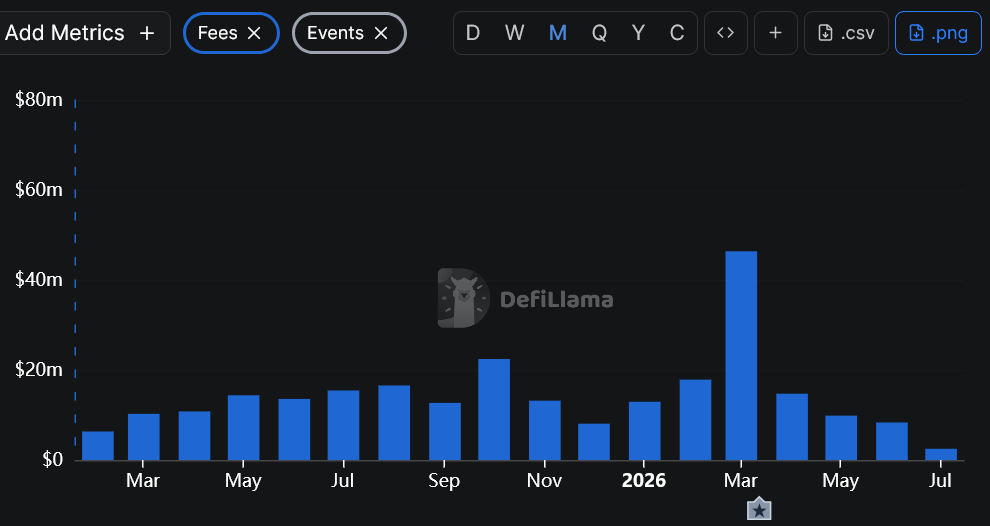
Monthly change in Titan’s revenue since February 2025. Source: DefiLlama
Magazine: China’s 107 Bitcoin memory thief, Bithumb CEO booked: Asia Express
AVAX One Technology has started a search for a permanent chief executive after Jolie Kahn resigned as CEO.
Summary
- AVAX One is searching for a permanent CEO after Jolie Kahn left the company.
- Pete Wylie will lead as interim CEO while also staying chief operating officer.
- Weak AVAX prices keep pressure on public companies tied to Avalanche treasury strategies.
The company said Kahn left the role effective immediately, while Chief Operating Officer Pete Wylie will serve as interim CEO.
Wylie will continue to serve as COO while leading the company during the search. AVAX One said its board has retained ZRG Partners to help find a permanent successor.
“We have full confidence in Pete’s ability to lead the Company through this transition,” said Chairman Matt Zhang.
Filing details Kahn’s exit
In its latest 8-K filing, AVAX One said Kahn’s departure came by mutual agreement and was not linked to any disagreement over the company’s operations, policies, or practices. The filing said she was not removed for cause.
The filing also outlined the separation terms. Kahn will receive a $160,000 lump-sum cash payment, reimbursement for certain medical insurance costs, and $250,000 worth of unregistered common shares. Wylie will receive $40,000 per month while serving as interim CEO.
Avalanche treasury pivot remains central
Kahn led the company during its shift from AgriFORCE into an Avalanche-focused digital asset treasury company. In September 2025, AgriFORCE announced plans to rebrand as AVAX One and raise about $550 million.
The company said the strategy aimed to build more than $700 million in AVAX holdings. SkyBridge Capital founder Anthony Scaramucci was named to lead the strategic advisory board. The plan placed AVAX One among the first Nasdaq-listed companies built around an Avalanche treasury strategy.
AVAX One said its business now includes digital infrastructure, Bitcoin mining, and an Avalanche treasury. The company operates Bitcoin mining facilities in Alberta and Ohio with about 300 PH/s of hashrate, while also holding AVAX and seeking yield through staking and ecosystem participation.
AVX and AVAX remain under pressure
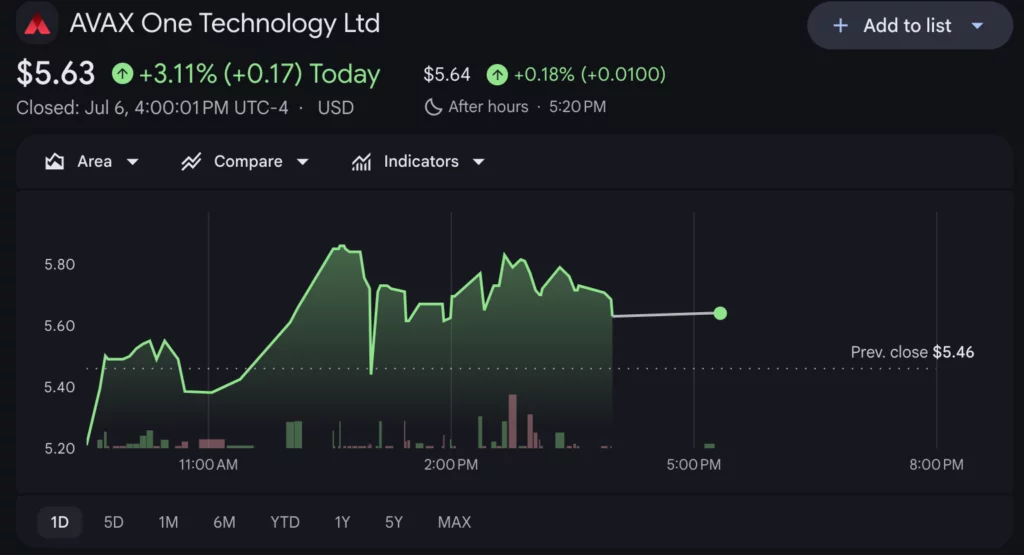
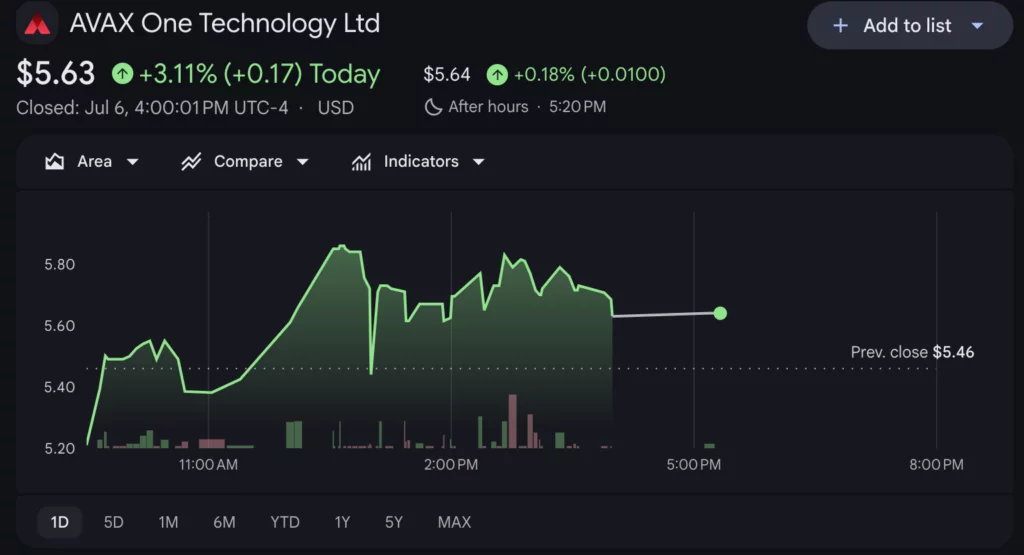
AVX stock traded at $5.63 at the latest check, up 5.13% on the day, according to Google Finance. The stock opened at $5.21, reached an intraday high of $5.86, and fell as low as $5.24, with a market cap near $549.1 million.
Avalanche traded near $6.73, down 1.89% on the day. The token traded between $6.71 and $7.01 over the same period, keeping pressure on companies whose treasury value is linked to AVAX.
The broader Avalanche treasury market has also weakened. As previously reported, Avalanche Treasury Co. shares fell about 73% from their Nasdaq debut level as lower AVAX prices weighed on its digital asset holdings.
As previously reported, Avalanche Treasury Co. closed 38.13% lower on its first Nasdaq trading day in June. The company held about 15 million AVAX at the time, linking its public-market value closely to the token’s price.
AVAX One’s leadership change now comes during a difficult period for public Avalanche treasury firms. The next CEO will inherit a company tied to digital infrastructure, Bitcoin mining, and AVAX accumulation at a time when token prices remain weak and investors are still testing demand for altcoin treasury stocks.


A federal judge has revived a fraud claim against Barry Silbert, Digital Currency Group, and other defendants in a lawsuit tied to the failed Genesis Yield program.
Summary
- A revived fraud claim keeps Barry Silbert and DCG under legal pressure over Genesis Yield.
- The court let federal securities claims continue while limiting several state consumer protection claims.
- Genesis Yield investors allege DCG misled customers before withdrawals stopped and bankruptcy followed in 2023.
The ruling revises an earlier February order after the court agreed to review state-law claims again.
The case is before Judge Stefan Underhill in the U.S. District Court for the District of Connecticut. Investors say Silbert, DCG, and other defendants misled customers about Genesis’ financial condition and risk controls before the lender froze withdrawals and filed for bankruptcy in early 2023.
Court narrows state-law claims
The court revived the New York common law fraud claim after plaintiffs argued that the Class Action Fairness Act gave the court power to hear their state-law claims. The revised order brought those claims back before the judge narrowed which ones could continue.
Consumer protection claims under Illinois, Kansas, Nevada, and Texas law were dismissed. Claims under California, Florida, and New York law were stayed. The February decision allowing federal securities claims to proceed remains unchanged, according to the case update.
Genesis Yield collapse remains central
Genesis Yield allowed customers to deposit crypto and earn interest payments. Plaintiffs claim the defendants knew Genesis faced deep financial stress but still presented the lending product as safer than it was.
DCG has previously rejected similar claims. The company has called allegations against it “baseless” and said it would defend itself. The latest ruling does not decide whether the claims are true. It allows part of the lawsuit to move forward.
The case sits alongside other legal disputes tied to Genesis’ collapse. As previously reported, Genesis filed lawsuits against DCG, Silbert, and other insiders in 2025, seeking to recover more than $1 billion in alleged improper transfers.
Prior settlements frame the dispute
Genesis entered bankruptcy after the failures of Three Arrows Capital and FTX placed pressure on crypto lenders. As previously reported, a bankruptcy judge approved a plan in 2024 allowing Genesis to distribute billions in cash and crypto to creditors while rejecting a DCG challenge.
Genesis also reached a $2 billion settlement with the New York Attorney General’s office. The settlement created a victims’ fund for creditors and resolved claims against Genesis linked to investor losses.
DCG later reached a separate settlement with the U.S. Securities and Exchange Commission. The SEC said DCG and former Genesis CEO Soichiro “Michael” Moro agreed to pay $38.5 million to settle charges that they misled investors about Genesis’ financial condition. They did not admit or deny the findings.
The revived claim adds another active legal track for DCG and Silbert. The court will now allow the New York fraud claim and federal securities claims to continue, while several state consumer claims remain paused or dismissed.
Crypto World
BONK faces $20 million treasury drain after attacker spends $4 million to pass malicious proposal
The sequence began on June 30, when an anonymous wallet submitted a proposal to transfer the treasury’s holdings to a wallet it controlled, per Chainalysis. To pass, the proposal needed yes votes equal to 1% of BONK’s supply, the quorum, or minimum participation, required for it to take effect.
Over July 4 and 5, a separate wallet acquired exactly that much, spending about $4.4 million to buy BONK on the exchanges Bybit and Binance and, by one account, borrowing more through DeFi lending platforms, according to Lookonchain.
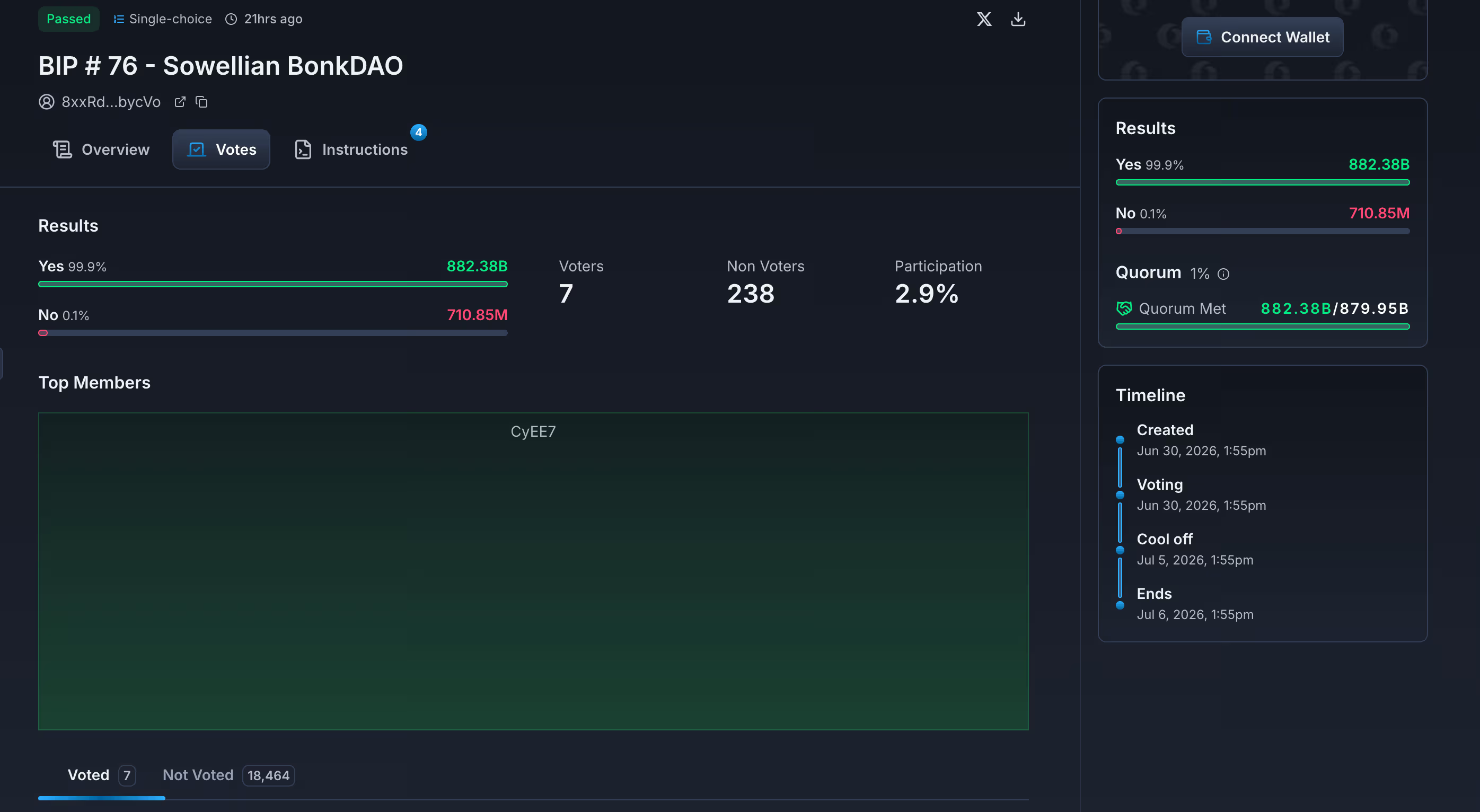
Titled “BIP #76 – Sowellian BonkDAO,” the proposal passed with just seven wallets voting, against more than 18,000 members who did not, a turnout of 2.9%.
It cleared quorum by the narrowest margin, 882.38 billion BONK in favor against a 879.95 billion threshold, almost exactly the stake the attacker had spent days assembling.
The 99.9% “yes” result was effectively a single voter agreeing with itself. Its written pitch read less like a governance motion than a boast, promising to “rebuild from the ashes, monetize holdings, stop the bleeding,” with a line noting that “all YES voters are eligible to receive tokens.”
Beneath it sat the only instruction that should have turned heads – a transfer of 4.43 trillion BONK to the attacker’s wallet.

By July 6 the voter held just enough. It cast its entire stake in favor, the proposal passed, and about $20 million in BONK automatically moved out of the treasury into the attacker’s wallet.

U.S. President Donald Trump said his pivot toward crypto was driven less by ideology than by geopolitics, arguing that if the United States did not embrace digital assets, China would. Speaking at a Monday press event at the White House to announce “Trump Accounts”—investment accounts for children under 18—Trump framed Bitcoin and crypto as a strategic industry the U.S. can’t afford to cede.
When asked whether the child-focused investment accounts would include Bitcoin, Trump responded that he became a “big crypto guy” because of competitive pressure from China. He also reiterated that he initially was not pro-crypto, but said he watched the sector grow into a “huge industry,” and later concluded that the U.S. needed to move first.
Key takeaways
- Trump said he turned pro-crypto because he believed China would advance first “if we don’t have it.”
- At the White House announcement of “Trump Accounts,” he addressed whether the new accounts would touch Bitcoin, without offering a detailed structure for crypto exposure.
- Trump described staying hands-off in discussions with his family about crypto investments.
- His remarks highlight ongoing scrutiny of crypto influence given reported family crypto-related earnings and political fundraising activity by the industry.
- He suggested investigations into crypto declined when he became more supportive, echoing criticism of enforcement shifts during his administration.
Why Trump says he shifted toward crypto
Trump’s comments added context to his changing rhetoric over the past few years. During his first term, he had said he was “not a fan” of crypto and referred to Bitcoin as “a scam.” In Monday’s exchange, he offered a different rationale: not personal conviction, but the belief that the U.S. needed to participate in a rapidly expanding market before a rival country did.
“I’ve become a big crypto guy only for one reason: If we don’t have it, China’s going to have it,” Trump said. He described watching crypto “grow” after taking less interest earlier on, and said he now sees it as a large and profitable industry.
Trump also said he got involved “a little bit for politics,” adding that he recognized “a lot of people that love crypto.” The framing matters for investors and users because it signals that, at least publicly, his administration’s stance may be justified through national competitiveness rather than consumer protection or technological neutrality.
“Trump Accounts” and the Bitcoin question
Trump delivered the remarks while unveiling “Trump Accounts,” an investment account program for children under 18 announced during a press event in the Oval Office. The question from reporters focused on whether the accounts would permit exposure to Bitcoin.
While Trump’s reply emphasized the broader importance of crypto—particularly Bitcoin’s geopolitical relevance—he did not provide specifics in the available remarks about how crypto, if any, would be implemented within the accounts. The gap between political endorsement and operational detail is important: parents, advisors, and compliance teams would need clarity on whether digital assets are directly included, held through other instruments, or excluded entirely.
For market participants, the key watch point is whether the administration follows through with concrete policy guidance that determines how, and to what extent, crypto could become part of mainstream, retail-oriented investment products for minors.
Trump’s family crypto interests: “I don’t talk to them”
Trump said he does not discuss his family’s crypto involvement. The question is especially sensitive given the financial disclosures and the public record around his household’s crypto exposure.
According to financial disclosures released June 30 by Cointelegraph, Trump made more than $1.4 billion last year from crypto-related activity. The disclosures cited Trump and his sons as co-founders of World Liberty Financial, a crypto platform that generated a large portion of his crypto-related income.
Despite those ties, Trump said his interest in crypto is “not a question of a personal thing.” He added, “I let my kids do whatever the hell they do. I don’t talk to them, ever, talk to them about it.”
The statement doesn’t remove the underlying concern for observers—namely whether political messaging and regulatory direction could benefit from family-linked interests. But it does show how the president is trying to separate public policy arguments from personal decision-making.
Enforcement investigations and regulatory scrutiny
Trump also addressed federal crypto enforcement, claiming that the Biden administration “dropped all investigations” after he “went very pro-crypto.” His remarks come amid a broader debate about how aggressively U.S. regulators have pursued crypto-related cases under different administrations.
In the material discussed, it is noted that under the Trump administration, the Securities and Exchange Commission stopped multiple investigations and withdrew or settled enforcement actions filed against crypto companies—some of which had donated to Trump. The president then used that alleged contrast to underscore his leverage as president.
“Every time I see a crypto guy where they dropped an investigation, I said: ‘You’re lucky I’m president,” Trump said.
For readers tracking regulatory risk, the implication is not a single policy promise but a pattern: Trump’s public support for crypto is intertwined with assertions about enforcement outcomes. That makes future developments—such as any formal guidance, legislation, or regulatory posture changes—central to understanding how U.S. compliance and litigation risks may evolve for exchanges, token issuers, and custody providers.
What to watch next
Beyond the political message, the practical question is whether “Trump Accounts” will offer transparent details on investment options and any crypto exposure. Investors and families should watch for follow-on policy documents that clarify implementation, because the difference between endorsement and enforceable product design will determine how quickly (or slowly) crypto could move into mainstream youth-facing financial tools.

England’s Jordan Henderson officially ruled out after freak fall causes fracture, opts for surgery

How One Taiwanese Company Made the Famicom Live Up to Its Name with the Bit79 Home Computer

Trump on crypto earnings: ‘I could know about it. I didn’t’


-

 Fashion4 days ago
Weekend Open Thread: High Hopes
-

 Politics4 days ago
The House | “Reframing the debate from a binary discussion of winners and losers”: Yuan Yang reviews ‘We Are Not Machines’
-

 Fashion14 hours ago
Open Thread: What Great Books Have You Read Recently?
-
 NewsBeat2 days ago
Taylor Swift and Travis Kelce wedding staffer hilariously struggles to keep her cool while checking in megastars
-

 News Videos7 days ago
How to Build INSANE Live Financial Dashboards With Claude
-
 Crypto World6 days ago
Airdrop Registration Becomes Key Focus For Remittix As RTX Launch Updates Approach
-

 Sports6 days ago
Broncos roster: OL Ben Powers (No. 74) entering final year of contract
-

 Crypto World5 days ago
Binance stock trading tops $1B in first month after launch
-

 NewsBeat6 days ago
Presenter Caroline Flack’s brother Paul Flack dies aged 55
-

 Crypto World5 days ago
Alibaba-affiliate Ant Group enters the humanoid robot market with 12 deals
-

 Crypto World4 days ago
Standard Chartered Secures MiCA License as ESMA Adds 37 New Crypto Firms
-

 Crypto World2 days ago
South Africa proposes crypto tax guidance under existing rules
-

 News Videos15 hours ago
Best Time to Enter Small Caps Right Now? Another Bull Run? | Financially Free
-

 Business5 days ago
Meta Platforms Stock Jumps 7% Today as Bloomberg Reports Company Plans to Enter the Cloud Business
-
 NewsBeat5 days ago
New exhibition reflects five decades of movement between island of Ireland and GB
-

 Tech2 days ago
Lenovo laptops are now shipping with YMTC SSDs, a sign of Chinese NAND entering the mainstream
-

 Business4 days ago
What a 10 Percent Drop Means for Buyers, Sellers and Renters
-

 Crypto World4 days ago
Binance Re-Enters Philippines As EU MiCA Rules Restrict Access
-

 News Videos18 hours ago
Avoid entering in FOMO #bitcoin #cryptocurrency #trading #scalping
-

 News Videos3 hours ago
Whats Hidden Inside This Cash Register? #treasure #reselling #money
You must be logged in to post a comment Login