
Crypto World
Trader Loses $2 Million From Malicious DEX incident

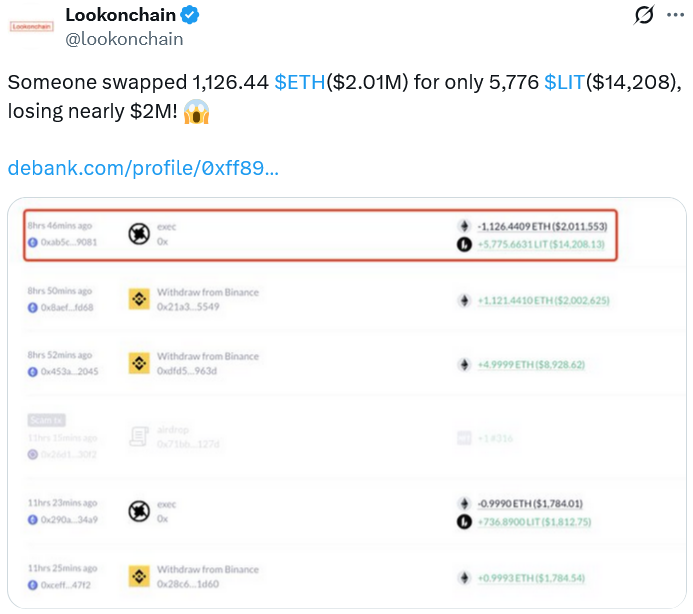
A trader who swapped $2.01 million worth of Ether on a decentralized exchange has been left with just $14,500 worth of tokens after a router directed the order through a low-liquidity pool, allowing an Ethereum block builder to profit massively from a same-block arbitrage trade.
The trader swapped 1,126.44 of Ether (ETH) but only received 5,776 Lighter (LIT) tokens, in a “textbook case of same-block backrun extraction,” according to GoPlus Security.
“This was a real, highly imbalanced backrunner arbitrage, not a classic sandwich attack,” GoPlus Security said. Titan Builder was the biggest beneficiary, walking away with $1.8 million from the transaction, which took place on Monday at 1:59 am UTC.
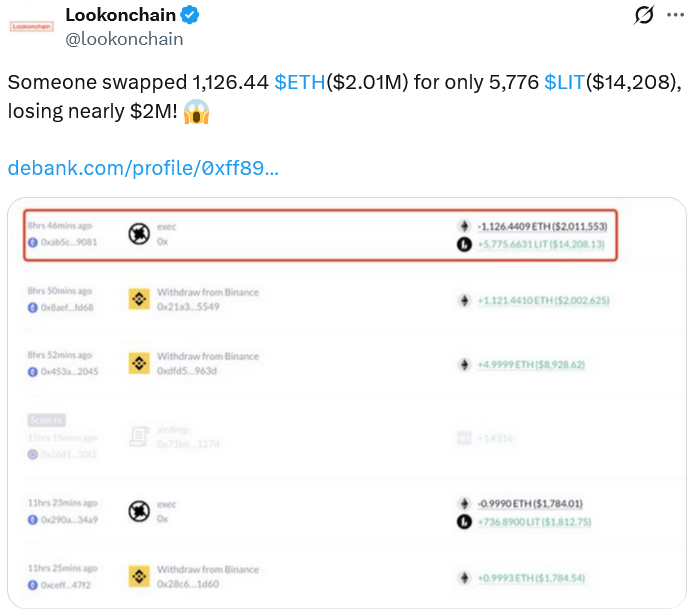
Source: Lookonchain
The incident is a reminder of the risks posed by maximal extractable value (MEV) bots and liquidity routers on top of hackers and scammers, which continue to run rampant in the crypto industry.
Don’t sign DEX transactions blindly, trader says
To reduce the risk of such incidents, crypto trader Ruslan Khairullin said traders should read the transaction route before signing the transaction.
“This is what happens when you clicked confirm faster than you read the route. Painful lesson to see in a real time.”
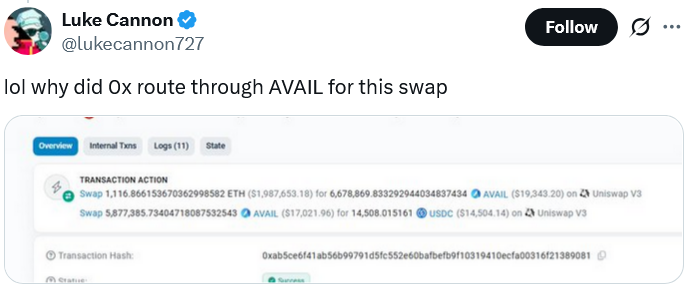
Source: Luke Cannon
How the victim lost $2M to a bot
The victim’s swap routed approximately 1,117 Ether into a low-liquidity AVAIL/WETH pool on Uniswap v3, causing the trade to execute at roughly 120 times higher than what AVAIL could later be sold for, GoPlus Security said.
After the trader received nearly 6.67 million AVAIL tokens at an inflated price, the router involved, 0x router, sold a small amount of externally sourced AVAIL into the same pool to extract about 1,072 WETH before paying out 1,018 ETH, worth $1.8 million, to Titan as a builder reward.
The AVAIL was then swapped for $14,200 worth of LIT tokens, marking a 99.3% loss.
Related: ‘All DeFi unsafe’ claim sparks AI security debate after April hack surge
Cointelegraph reached out to Titan but didn’t receive an immediate response.
Titan has now made $112.6 million in revenue from its block building services this year, data from DefiLlama shows.
Titan’s biggest day this year came in March when it extracted around $34 million in arbitrage profit from a MEV bot incident on the CoW Protocol.
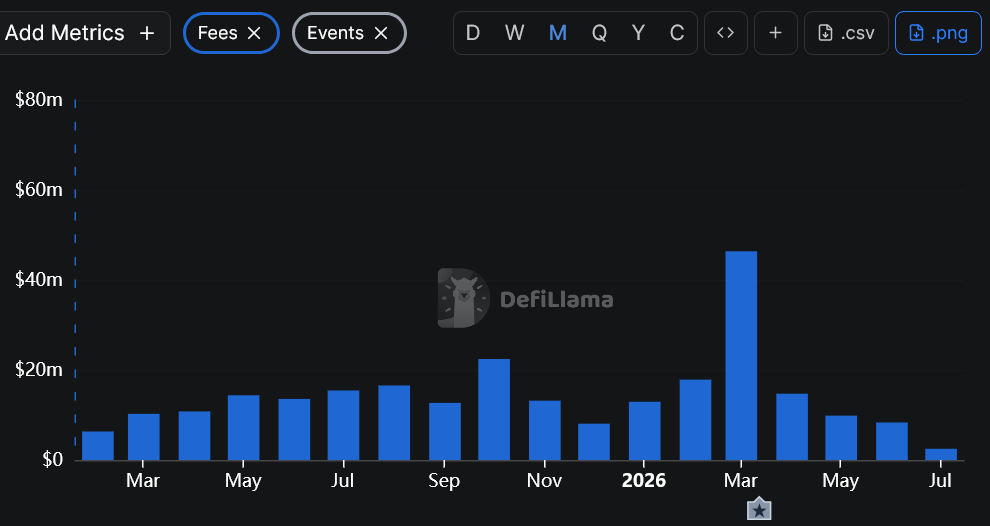
Monthly change in Titan’s revenue since February 2025. Source: DefiLlama
Magazine: China’s 107 Bitcoin memory thief, Bithumb CEO booked: Asia Express



A zero-knowledge proof lets one party prove to another that a statement is true without revealing any information beyond the truth of the statement itself. It is the cryptographic technique behind blockchain privacy, scalable rollups, and a growing number of identity verification systems.
Summary
- Zero-knowledge proofs allow a prover to convince a verifier that a computation was performed correctly without revealing the underlying data, enabling both privacy and scalability on blockchains.
- The two main families of zero-knowledge proofs used in blockchain are zk-SNARKs, which require an initial trusted setup ceremony, and zk-STARKs, which do not require trusted setup but produce larger proofs.
- Ethereum layer 2 rollups like zkSync, Scroll, and Polygon zkEVM use zero-knowledge proofs to compress thousands of transactions into a single proof verified on the main chain, reducing gas costs by 90 percent or more.
- Vitalik Buterin introduced the GKR protocol in late 2025 as a way to accelerate Ethereum zero-knowledge proof verification, aiming to make the technology practical for everyday use at scale.
- Zero-knowledge proofs are mathematically sound but not magic. They depend on specific cryptographic assumptions, require significant computational resources to generate, and have been deployed in production for less than three years at scale.
The standard explanation of zero-knowledge proofs uses the cave analogy. Ali Baba knows the secret word to open a door inside a circular cave. He can prove he knows the word by entering from one side and exiting from the other, on demand, without ever saying the word out loud. After enough successful demonstrations, the verifier becomes statistically certain Ali Baba knows the secret.
This analogy is correct but incomplete. It captures the intuition but misses the machinery. In practice, zero-knowledge proofs are not about caves or doors. They are about polynomial commitments, elliptic curve pairings, and the mathematical properties that allow one party to encode a computation as a set of constraints and another party to verify that those constraints are satisfied without learning what values satisfied them.
This article explains what zero-knowledge proofs do, how the two dominant proof systems work, where they are deployed in production, and what they cannot do. If you have heard that zero-knowledge proofs solve all of blockchain’s privacy and scalability problems, the reality is more specific and more interesting.
The three properties
A zero-knowledge proof must satisfy three mathematical properties. Completeness means that if the statement is true and both the prover and verifier follow the protocol, the verifier will always accept the proof. Soundness means that if the statement is false, no cheating prover can convince the verifier to accept it, except with negligible probability. Zero-knowledge means the verifier learns nothing beyond whether the statement is true.
The third property is the counterintuitive one. How can you verify a computation without learning anything about it? The answer lies in the structure of the proof system. The prover encodes the computation as a polynomial equation, commits to that polynomial using a cryptographic commitment scheme, and then responds to random challenges from the verifier. The verifier checks the responses against the commitment without ever seeing the polynomial itself.
In non-interactive zero-knowledge proofs, which are the type used in blockchains, the random challenges are replaced by a hash function applied to the commitment. This is called the Fiat-Shamir heuristic, and it allows the prover to generate the entire proof without any back and forth communication. The resulting proof is a compact string of data that anyone can verify independently.
The mathematical foundation rests on the hardness of certain computational problems. For zk-SNARKs, security relies on the difficulty of computing discrete logarithms on elliptic curves. For zk-STARKs, security relies on the collision resistance of hash functions, which is considered a weaker and more conservative assumption. If either assumption turns out to be wrong, the corresponding proof system breaks. This is why the choice between zk-SNARKs and zk-STARKs involves tradeoffs beyond just proof size and verification speed.
zk-SNARKs: trusted setup, small proofs
zk-SNARK stands for Zero-Knowledge Succinct Non-interactive Argument of Knowledge. The word succinct is the key differentiator: a zk-SNARK proof is extremely small, typically a few hundred bytes, and can be verified in milliseconds regardless of how complex the underlying computation is.
The cost of this succinctness is the trusted setup. Most zk-SNARK constructions require an initial ceremony where a set of structured reference strings are generated. These strings are used by both provers and verifiers. If the random values used to generate them are not properly destroyed, anyone who retains them could create fake proofs that appear valid. This is sometimes called toxic waste.
Modern trusted setup ceremonies use multi-party computation protocols where hundreds or thousands of participants each contribute randomness. The security guarantee is that as long as at least one participant honestly destroys their random contribution, the setup is secure. Zcash pioneered this approach with its Powers of Tau ceremony, and subsequent projects have refined it.
Newer zk-SNARK constructions like PLONK and its variants use a universal and updatable trusted setup, meaning the same setup can be reused for different circuits and additional participants can strengthen the setup over time without starting from scratch. This mitigates the trusted setup concern but does not eliminate it entirely. The fundamental tradeoff remains: smaller, faster proofs in exchange for a one-time trust assumption.
zk-STARKs: no trusted setup, larger proofs
zk-STARK stands for Zero-Knowledge Scalable Transparent Argument of Knowledge. Transparent means no trusted setup is required. The reference strings are generated from publicly verifiable randomness, which eliminates the toxic waste problem entirely. Scalable refers to the fact that proving time grows quasi-linearly with the size of the computation, making STARKs suitable for very large computations.
The tradeoff is proof size. A zk-STARK proof is typically tens to hundreds of kilobytes, compared to a few hundred bytes for a zk-SNARK. On a blockchain where data storage is expensive, this difference matters. Verification time is also somewhat longer for STARKs, though still fast enough for practical use.
StarkWare, the company behind Starknet, has been the primary commercial advocate for zk-STARKs. Their argument is that the transparency property, combined with quantum resistance from relying only on hash functions rather than elliptic curves, makes STARKs the better long term choice even at the cost of larger proofs. Whether quantum computers will actually threaten elliptic curve cryptography within a relevant timeframe is debated, but the conservative security posture appeals to applications where long term robustness matters more than immediate efficiency.
ZK rollups: the scaling application
The most important practical application of zero-knowledge proofs in blockchain today is ZK rollups. A rollup executes transactions off chain, batches them together, generates a zero-knowledge proof that all transactions were valid, and posts just the proof and compressed transaction data to the main chain. The main chain verifies the proof, which is orders of magnitude cheaper than executing every transaction individually.
This architecture allows Ethereum layer 2 networks to process thousands of transactions for the cost of a single proof verification on layer 1. In practice, ZK rollups like those built on Ethereum infrastructure reduce gas costs by 90 percent or more compared to executing the same transactions directly on mainnet.
The major ZK rollup projects in production or late stage development as of mid 2026 include zkSync Era, Scroll, Polygon zkEVM, Linea, and Taiko. Each uses a different proving system and makes different tradeoffs between EVM compatibility, proving speed, and decentralization. zkSync uses a custom virtual machine and PLONK-based proofs. Scroll aims for byte-level EVM equivalence using a zk-SNARK prover. Polygon zkEVM uses a combination of STARK and SNARK proofs in a recursive architecture.
The competition between these projects is driving rapid innovation in proof generation. Proving times have dropped from hours to minutes to seconds over the past two years. Vitalik Buterin’s introduction of the GKR protocol for Ethereum represents another step toward making ZK proof verification a routine operation rather than a computational bottleneck.
Privacy applications beyond rollups
Zero-knowledge proofs were originally developed for privacy, not scalability. Zcash, launched in 2016, was the first major blockchain to use zk-SNARKs for private transactions. In a shielded Zcash transaction, the sender, receiver, and amount are all hidden from public view while the proof guarantees that no coins were created out of thin air and no double spending occurred.
The privacy application extends beyond financial transactions. Zero-knowledge proofs can verify identity attributes without revealing the underlying data. A user could prove they are over 18 without revealing their birth date, prove they are a citizen of a specific country without revealing their passport number, or prove they hold a certain credential without revealing which institution issued it.
Projects like Worldcoin and Polygon ID have implemented ZK-based identity verification systems. Worldcoin uses zero-knowledge proofs to verify that a person has been scanned by their iris scanning device without linking the scan to any specific identity. Ethereum ecosystem projects are increasingly integrating ZK-based identity as a primitive alongside financial transactions.
The privacy use case faces regulatory headwinds. Financial regulators in multiple jurisdictions have expressed concern that fully private transactions could facilitate money laundering, sanctions evasion, and terrorist financing. The tension between privacy as a fundamental right and transparency as a regulatory requirement is one of the defining policy debates in cryptocurrency, and zero-knowledge proofs sit directly at the center of it.
What zero-knowledge proofs do not cover
Zero-knowledge proofs guarantee computational integrity: that a specific computation was performed correctly. They do not guarantee that the inputs to the computation were correct, that the computation was worth performing, or that the system built around the proof is free of bugs.
A ZK rollup can prove that all transactions in a batch were valid according to the rollup’s rules. It cannot prove that the rules themselves are correct. A bug in the rollup’s smart contracts or proving circuit could produce valid proofs for invalid state transitions. Several ZK rollup projects have disclosed and patched critical bugs in their circuits during audits and testnet deployments.
Zero-knowledge proofs also do not eliminate the need for data availability. In a ZK rollup, the proof tells the main chain that the state transition was valid, but users still need access to the underlying transaction data to reconstruct the state and verify that their funds are intact. Without data availability, users must trust the rollup operator, which partially defeats the purpose of the proof.
The computational cost of generating proofs is substantial. While verification is cheap, proof generation requires significant hardware. Running a ZK prover at production scale typically requires servers with hundreds of gigabytes of RAM and specialized hardware accelerators. This cost creates a natural centralizing force in who can afford to run provers, even if the proofs themselves can be verified by anyone.
Practical checks for evaluating ZK projects
When evaluating a project that claims to use zero-knowledge proofs, several questions distinguish serious implementations from marketing.
First, ask whether the proof system has been independently audited. Circuit bugs can create soundness vulnerabilities where invalid proofs are accepted as valid. A project that has not been audited by multiple independent cryptography firms should be treated with caution.
Second, ask whether the proving system uses a trusted setup and, if so, how the ceremony was conducted. A trusted setup with only a small number of participants, or one conducted by a single company without external verification, represents a meaningful trust assumption.
Third, check whether the project publishes its proof verification contracts and whether those contracts have been verified on chain. If verification is happening off chain or through upgradeable proxy contracts controlled by a multisig, the zero-knowledge proofs may not be providing the security guarantees users expect.
Fourth, look at the data availability solution. If the project does not post transaction data on chain or to a credible data availability layer, users cannot independently verify the state and must trust the operator. This is a meaningful departure from the trustlessness that zero-knowledge proofs are supposed to enable.
Frequently asked questions
What is a zero-knowledge proof in simple terms?
A zero-knowledge proof is a way to prove you know something without revealing what you know. In blockchain, it allows one computer to prove to another that a set of transactions is valid without showing the details of those transactions. This enables both privacy and scalability.
What is the difference between zk-SNARKs and zk-STARKs?
zk-SNARKs produce very small proofs, typically a few hundred bytes, and verify quickly, but require a one-time trusted setup ceremony. zk-STARKs produce larger proofs, typically tens of kilobytes, but do not require any trusted setup and are considered resistant to quantum computing attacks. Both achieve the same goal of verifiable computation with zero knowledge.
How do ZK rollups reduce Ethereum gas costs?
ZK rollups execute transactions off the Ethereum main chain, batch them together, and generate a zero-knowledge proof that all transactions are valid. Only the proof and compressed data are posted to Ethereum. Verifying a single proof is much cheaper than executing thousands of individual transactions, resulting in gas cost reductions of 90 percent or more.
Are zero-knowledge proofs quantum resistant?
It depends on the proof system. zk-STARKs rely on hash functions, which are believed to be resistant to quantum computers. zk-SNARKs rely on elliptic curve cryptography, which could theoretically be broken by a sufficiently powerful quantum computer. However, practical quantum computers capable of breaking elliptic curves do not yet exist and may not for decades.
Can zero-knowledge proofs make all blockchain transactions private?
Technically yes, but practically there are tradeoffs. Generating proofs for every transaction adds computational cost and complexity. Fully private transactions also face regulatory challenges in jurisdictions that require financial transparency. Projects like Zcash offer optional privacy, while most ZK rollups use the technology primarily for scalability rather than privacy.
What is a trusted setup and why does it matter?
A trusted setup is a one-time ceremony that generates cryptographic parameters needed by certain proof systems. If the random values used during the ceremony are not properly destroyed, someone could create fake proofs. Modern ceremonies use multi-party computation where hundreds of participants contribute randomness, and the setup is secure as long as at least one participant is honest.
Which blockchains use zero-knowledge proofs?
Zcash was the first major blockchain to use zero-knowledge proofs for private transactions. Ethereum uses ZK proofs through layer 2 rollups including zkSync, Scroll, Polygon zkEVM, Linea, and Starknet. Mina Protocol uses recursive ZK proofs to maintain a fixed-size blockchain. Several other chains incorporate ZK technology for specific features like identity verification or cross-chain messaging.
How long does it take to generate a zero-knowledge proof?
Proof generation time depends on the complexity of the computation and the hardware used. For ZK rollup batches containing thousands of transactions, proof generation currently takes seconds to minutes on specialized hardware. Two years ago, the same proofs took hours. The trend is toward faster proving through hardware acceleration and algorithmic improvements, with the goal of real-time proof generation.
Disclaimer: This article is for informational purposes only and does not constitute financial, investment, or legal advice. Cryptocurrency investments carry significant risk. Always conduct your own research before making any investment decisions. Information is accurate as of August 1, 2026.
A testnet is a separate blockchain network that mirrors a production chain’s rules and functionality but uses tokens with no monetary value. It is where developers break things, test upgrades, and discover bugs before those bugs can cost anyone real money.
Summary
- A testnet is a blockchain network that runs the same software as a mainnet but uses valueless tokens, allowing developers to test smart contracts, protocol upgrades, and applications without financial risk.
- Ethereum has run multiple testnets over its history, with Sepolia and Holesky serving as the primary public testing environments as of 2026 after the deprecation of Goerli.
- Testnet tokens are free and can be obtained from faucets, which are web services that distribute small amounts of test tokens to developer wallet addresses.
- Major protocol upgrades like Ethereum’s Pectra and Cardano’s van Rossem hard fork were deployed to testnets months before reaching mainnet, where they were tested under conditions designed to surface edge cases and failure modes.
- Testnets are not perfect replicas of mainnet conditions. They typically have fewer validators, lower transaction volume, and different economic incentives, which means some categories of bugs only appear after mainnet deployment.
Every piece of software ships with bugs. The question is whether those bugs are discovered in a controlled environment or in production, where they can destroy value. In traditional software development, staging environments and QA processes serve this function. In blockchain, testnets serve the same function but with a critical difference: blockchain bugs are often irreversible.
A smart contract that contains a vulnerability on a testnet loses nothing because the tokens are worthless. The same vulnerability on a mainnet can drain millions of dollars in minutes. The history of decentralized finance is littered with exploits that could have been caught on a testnet if the testing had been more thorough.
This article explains what testnets are, how they work, why they matter for the security of every blockchain protocol, and what their limitations are. If you interact with any blockchain application, the quality of its testnet phase directly affects the safety of your funds.
How testnets work
A testnet runs the same node software as its corresponding mainnet but operates on a separate network with its own genesis block, its own chain of blocks, and its own set of validators or miners. Transactions on a testnet are processed using the same consensus rules, the same virtual machine, and the same transaction format as mainnet transactions. The only fundamental difference is that the tokens have no market value.
This separation is enforced at the network level. Testnet nodes connect to other testnet nodes, not to mainnet nodes. The chain IDs are different, which prevents testnet transactions from being replayed on mainnet and vice versa. When a developer deploys a smart contract to a testnet, that contract exists only on the testnet and has no effect on the mainnet state.
Testnet tokens are distributed through faucets, which are simple web applications that send a small amount of test tokens to any wallet address that requests them. Most faucets impose rate limits to prevent abuse. Some require completing a captcha or connecting a social media account. The tokens have no monetary value by design, though there have been instances where testnet tokens have traded on secondary markets, which defeats their purpose and is generally discouraged by protocol teams.
Developers use testnets to deploy and interact with smart contracts exactly as they would on mainnet. They can test function calls, simulate user interactions, measure gas consumption, and verify that error handling works correctly. Wallet applications, decentralized exchanges, lending protocols, and NFT marketplaces all go through testnet deployment before launching on mainnet.
Types of testnets
Not all testnets serve the same purpose. Public testnets are open to anyone and mirror mainnet conditions as closely as possible. They are used for final stage testing before mainnet deployment and for community members who want to try new features. Ethereum’s Sepolia and Holesky are public testnets. Base’s Beryl testnet is another example of a public testnet used to test protocol upgrades before mainnet deployment.
Private or permissioned testnets are operated by specific development teams and are not open to public participation. These are used for early stage development where the protocol may be unstable or where the team wants to control the testing conditions. Many projects run private testnets for months before opening a public testnet.
Local development networks, sometimes called devnets, run on a developer’s own machine. Tools like Hardhat and Foundry for Ethereum allow developers to spin up a local blockchain instance, deploy contracts, and run tests in seconds without connecting to any external network. These are not true testnets but serve a similar function for unit testing and rapid iteration.
Shadow forks are a newer concept where a testnet replays real mainnet transaction data against a modified version of the protocol. This allows developers to test upgrades against realistic transaction patterns and state sizes rather than the synthetic and often unrealistic conditions of a standard testnet. Ethereum used shadow forking extensively during the preparation for The Merge in 2022.
Why testnet phases matter for protocol upgrades
Major blockchain upgrades follow a predictable lifecycle: specification, implementation, testnet deployment, monitoring, and finally mainnet activation. The testnet phase is where the implementation meets reality. Bugs that were invisible in unit tests become apparent when the code runs on a distributed network with independent operators, network latency, and concurrent transactions.
Ethereum’s Pectra upgrade, which introduced account abstraction and increased blob capacity, was deployed to the Hoodi testnet months before reaching mainnet. During the testnet phase, developers discovered edge cases in the account abstraction implementation that would have caused transaction failures for a subset of users. These were fixed before mainnet deployment.
Cardano’s van Rossem hard fork followed a similar pattern, with the upgrade reaching its public testnet weeks before the mainnet governance vote that activated it. The testnet phase allowed stake pool operators to update their nodes and verify compatibility before the hard fork went live.
The length of the testnet phase varies by the complexity and risk of the upgrade. Simple parameter changes might spend days on a testnet. Fundamental consensus changes like The Merge spent months across multiple testnets. The pressure to move quickly is always present, but the cost of shipping a mainnet bug that could have been caught on a testnet is high enough that most serious protocol teams err on the side of longer testing periods.
The gap between testnet and mainnet
Testnets are valuable but imperfect. Several categories of problems are difficult or impossible to reproduce on a testnet. Economic attacks, where an attacker exploits the relationship between token prices and protocol mechanics, require real economic incentives that do not exist on a testnet. Miner or validator extractable value strategies, front running, and sandwich attacks depend on real financial motivation.
Scale related bugs also often escape testnet detection. A testnet with 100 validators processes transactions differently than a mainnet with 1,000 validators. Network congestion patterns, state bloat, and the behavior of the peer to peer gossip layer under load all change with scale. Some bugs only manifest when the state database exceeds a certain size or when transaction volume spikes above levels that testnets rarely experience.
The social and governance dimensions of blockchain also differ between testnet and mainnet. On a testnet, there are no real stakeholders with financial exposure who might resist an upgrade. The politics of hard fork coordination, which can involve exchanges, wallet providers, major token holders, and application developers, do not exist on a testnet. A protocol change that works perfectly on a testnet can still fail on mainnet if the coordination required to activate it breaks down.
This gap is why many blockchain projects now use incentivized testnets, where participants earn rewards for finding bugs, stress testing the network, or running validators. Robinhood’s chain testnet recorded 4 million transactions in its first week, partly because of incentive programs that attracted real users performing realistic interactions rather than synthetic test scripts.
What testnets do not cover
Testnets do not test economic security. The value of tokens on a testnet is zero, which means rational economic actors behave differently than they would on mainnet. A protocol that appears secure on a testnet may be vulnerable to economic exploits that only become apparent when real money is at stake.
Testnets do not test long term stability. Most testnets are reset periodically, which means issues related to state growth, database performance over time, and the accumulation of edge cases in long running chains are not tested. Some protocols run long lived testnets specifically to catch these issues, but the practice is not universal.
Testnets do not test user behavior. On a testnet, users have no reason to optimize gas usage, rush to complete transactions before a deadline, or engage in arbitrage. The transaction patterns on a testnet are fundamentally different from mainnet patterns, which means performance metrics measured on a testnet may not translate to mainnet conditions.
Practical checks for using testnets
If you are a developer, always deploy to a testnet before mainnet. This sounds obvious but a surprising number of smart contract exploits involve code that was deployed directly to mainnet without adequate testnet coverage. Use automated testing frameworks to run your test suite against a testnet deployment, not just a local node.
If you are a user, check whether the applications you use went through a public testnet phase. Serious projects publish testnet addresses, invite community testing, and often run bug bounty programs during the testnet phase. A project that skips the public testnet phase and launches directly to mainnet is taking a risk with its users’ funds.
When interacting with testnets, use a separate wallet from your mainnet wallet. While testnet transactions cannot affect mainnet, using the same private key on both networks is a bad security practice. If a testnet application is compromised or contains malicious code, having your mainnet private key in the same wallet creates unnecessary risk.
Monitor the testnet phase of upgrades to networks where you hold assets. If a major upgrade encounters problems on a testnet, it may be delayed or modified before mainnet deployment. Understanding the testnet timeline gives you advance notice of potential disruptions or opportunities.
Frequently asked questions
What is a testnet in simple terms?
A testnet is a practice version of a blockchain. It works the same way as the real blockchain but uses fake tokens that have no value. Developers use it to test their applications and find bugs before launching on the real network where real money is involved.
Are testnet tokens worth anything?
No. Testnet tokens have no monetary value by design. They exist solely for testing purposes and can be obtained for free from faucets. While there have been cases of people trading testnet tokens on secondary markets, this is discouraged and defeats the purpose of having a free testing environment.
How do I get testnet tokens?
Testnet tokens are available from faucets, which are web services that distribute free test tokens. For Ethereum’s Sepolia testnet, you can search for a Sepolia faucet, enter your wallet address, and receive test ETH within seconds. Most faucets have rate limits to prevent abuse.
What is the difference between a testnet and a mainnet?
A mainnet is the production blockchain where transactions involve real tokens with real value. A testnet is a separate network that runs the same software but uses valueless tokens. Testnets are for development and testing. Mainnets are for actual use. They share the same rules but operate independently.
Why do blockchains need testnets?
Blockchain transactions are generally irreversible, so bugs in production can result in permanent loss of funds. Testnets allow developers to find and fix these bugs in a safe environment where mistakes cost nothing. Major protocol upgrades are always tested on testnets before being activated on mainnet.
Can I test my own smart contract on a testnet?
Yes. Anyone can deploy smart contracts to public testnets like Ethereum’s Sepolia. You need a wallet, free testnet tokens from a faucet, and a development framework like Hardhat or Foundry. The deployment process is identical to mainnet deployment, just using a different network endpoint.
What happens when a testnet is deprecated?
When a testnet is deprecated, its validators stop processing transactions and the network eventually shuts down. Any contracts deployed on it become inaccessible. This happens periodically as protocols evolve. Ethereum deprecated the Ropsten, Rinkeby, and Goerli testnets in favor of Sepolia and Holesky.
Is it safe to use testnets?
Testnets themselves are safe because the tokens have no value, so you cannot lose money. However, you should use a separate wallet from your mainnet wallet and never share private keys between networks. Be cautious of testnet applications that ask for mainnet wallet connections or permissions.
Disclaimer: This article is for informational purposes only and does not constitute financial, investment, or legal advice. Cryptocurrency investments carry significant risk. Always conduct your own research before making any investment decisions. Information is accurate as of August 1, 2026.
Bitcoin’s price failed at $65,000 earlier this week, and the subsequent correction pushed it south to a 17-day low of $62,400 before it found some support and rebounded to $63,000.
Most larger-cap alts are also in the red in the past 24 hours, led by more painful losses from HYPE, UNI, and AAVE.
BTC Back to $63K
It was just over a week ago when the primary cryptocurrency was riding high and tapped a monthly peak at $67,000 after the favorable US inflation data for June. However, the predominantly bearish sentiment quickly returned, and the asset slumped below $64,000 that Friday.
Its recovery began last weekend and intensified on Monday when bitcoin pumped to $65,600 on a couple of occasions. However, it couldn’t keep climbing and dumped to $62,700 a day later as investors de-risked ahead of the key FOMC meeting. More volatility ensued before and after the event as the Fed ultimately left the rates unchanged.
Bitcoin began a more profound recovery on Thursday and Friday morning, jumping to $65,500 once again. A familiar scenario repeated, though, as the bears resumed control and drove it south to its lowest position since July 14 at $62,400.
The bulls managed to step up and helped BTC recover some ground to the current $63,000, but there are some warning signs about another leg down in the making. Its market cap is down to $1.265 trillion on CG, while its dominance over the alts has settled at 56%.

These 2 Alts Fly
Audiera’s BEAT is by far the top gainer over the past 24 hours, surging by 22% to $4.60. MemeCore (M) follows suit and completes the modest double-digit gainer club with an 11% increase to $1.10. PUMP (9%) and PI (5%) follow suit.
In contrast, most of the larger-cap alts are in the red. ETH is down by over 1%, and so are BNB and XRP. HYPE has dumped by another 5% to $52. RAIN has lost almost 3% of value, while UNI and AAVE have slumped by more than 6%. XMR, HBAR, and SHIB are among the few exceptions in the green.
The total crypto market cap has dropped by around $30 billion in a day and is down to $2.260 trillion on CG.

The post Double-Digit Gains From These 2 Altcoins, Bitcoin Struggles at $63K: Weekend Watch appeared first on CryptoPotato.


Crypto investors were fleeced of almost a billion dollars in the first half of 2026, and the industry’s favorite comfort blanket did little to stop it.
Security research house ack3 has verified 135 exploits between January and June, with $939.86m in attributed losses, averaging $6.96m each time the alarm sounded. The firm has published its full incident dataset openly, so every number can be checked line by line.
Here’s the stat that should chill every retail holder: of the money stolen from audited projects, 94.4% walked out through code or infrastructure the auditors never examined. The green tick covered the front door. The thieves came through the loading bay.
The Mega Heists Major Crypto Audits Missed
Two mega-heists account for the bulk of the carnage, and neither was a bug that an auditor missed.
Kelp DAO’s rsETH hemorrhaged $292m in April after attackers forged a LayerZero cross-chain message by compromising the protocol’s single message verifier – one checkpoint, no backup.
Two weeks earlier, Solana perps giant Drift lost $285m when operatives – linked by researchers to North Korea – spent months socially engineering their way to admin keys. Between them: $577m, roughly 61% of everything stolen all half. Not broken maths. Broken keys and broken trust.
The pattern repeats down the ledger. Step Finance ($40m), Humanity Protocol ($32m), and Resolv’s USR stablecoin ($24.5m) were all drained through compromised private keys and signing infrastructure, the humans, not the smart contracts. Cross-chain bridges were the other killing field, from Verus ($11.5m) to Syscoin ($8m) to Taiko ($1.7m).
Nowhere was safe, not even the blue chips. Polymarket was hit twice: a $700k internal wallet drain in May, then a $3.1m front-end supply-chain attack in June that turned its own website into a wallet drainer.
CoW Swap had its domain hijacked from under it. And in the half’s most poetic entry, feared MEV bot jaredfromsubway.eth, which spent years farming retail traders, was itself fleeced for $7.5m by a honeypot token.
The unaudited crowd fared no better. Truebit coughed up $26.4m to a schoolboy integer-overflow error in its mint pricing.
DISCOVER: The Biggest Crypto Hacks of 2025
One Crypto Audit Isn’t Enough: Good Projects Are Checked Regularly
And on the rare occasions, had auditors reviewed the exploited code? The reports were mostly stale; 17 of the 20 nearest relevant audits were at least six months old by the time the hackers struck.
In a worrying prediction about the rise of AI tooling, Ack3 CEO and Founder Josef Gattermayer said:
The takeaway is brutal in its simplicity. “Audited” is a marketing word until you ask three questions: what exactly was reviewed, how long ago, and who controls the keys today. In H1 2026, the honest answers were too often: not this bit, over a year ago, and one compromised key from a catastrophe.
The auditors can read every line of the code. They can’t read the developer’s mind when clicking a link from “HR”.
Discover: The Best Crypto to Diversify Your Portfolio
The post Hackers Torch $940M In 6 Months, and Security Audits Missed 94% of It appeared first on Cryptonews.


Crypto holders used to focus on diversifying their coins. Now, following a $70 million Coldcard exploit, they’re being told to diversify their wallets as well.
On Saturday, Binance founder Changpeng Zhao, known as CZ, asked crypto holders to split their funds across multiple wallets following a major security failure in popular Coldcard hardware devices.
“Even hardware wallets can have bugs. Even old wallets (with long history) can have bugs. How to mitigate? Split your funds in a few wallets maybe? This has a different set of risks. Nothing is 100%. Stay informed. Stay SAFU!,” he said.
On July 30, some bitcoin users discovered that funds from their Coldcard wallets had been stolen in a series of unexpected transactions. The attacker exploited a firmware flaw dating to March 2021 that weakened the randomness used to generate recovery seeds on certain Coldcard models. By reconstructing private keys offline, the attacker was able to drain funds without ever physically accessing the devices.
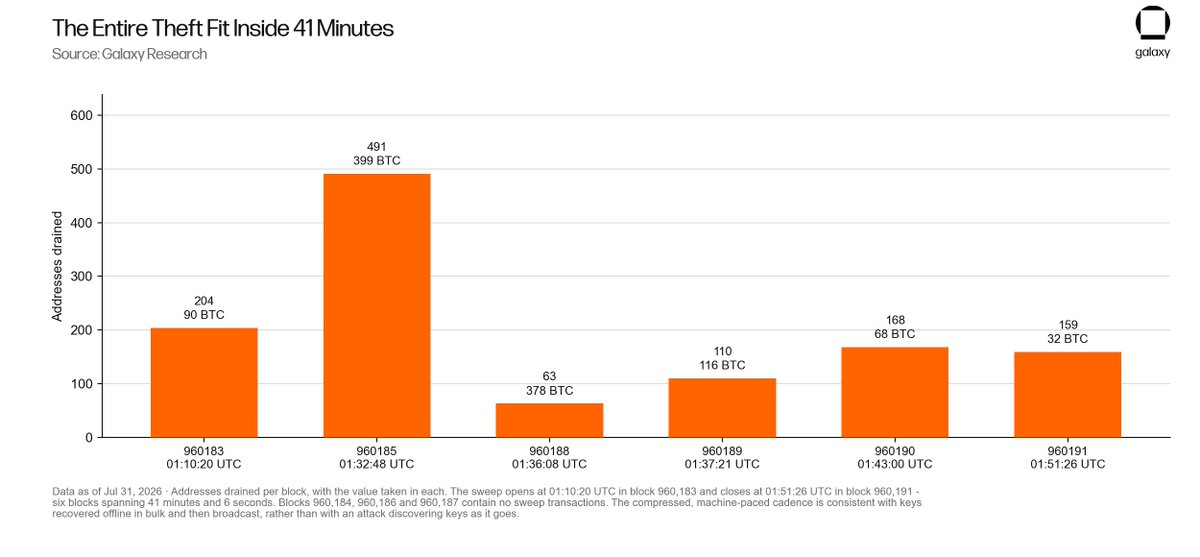
Initial reports said about 594 BTC, worth $38 million at the time, were drained from around 500 wallet in a 25-minute window. Subsequent analysis by Galaxy Research expanded the scope to 1,082.65 bitcoin, valued at approximately $70 million, drained from 1,196 addresses over about 41 minutes. Many of the affected wallets had sat dormant for years.
Coldcard maker Coinkite has acknowledged the bug, apologized, and released emergency firmware updates. The company has advised users who generated seeds on affected versions to create entirely new seeds on patched devices and carefully migrate funds, noting that simply updating firmware does not secure an already-created vulnerable seed.
The episode has renewed debate over the limits of self-custody. Hardware wallets are widely viewed as one of the strongest options for securing bitcoin offline, yet the Coldcard case shows that even long-established devices can harbor critical flaws that remain undetected for years.
CZ’s suggestion of diversification acknowledges that spreading risk comes with its own practical challenges, including more complex key management.


A mainnet is the production version of a blockchain network where transactions carry real economic value and are permanently recorded. When a cryptocurrency project launches its mainnet, it moves from concept to reality, and every line of code becomes a financial commitment.
Summary
- A mainnet is a fully operational blockchain network where tokens have real market value, transactions are irreversible, and the consensus mechanism secures actual economic activity.
- Mainnet launches are milestone events that typically follow months or years of testnet development, security audits, and community governance processes.
- Hard forks and protocol upgrades on a mainnet are high stakes operations because bugs cannot be rolled back without consensus from the entire network of validators and users.
- Major mainnet launches in 2026 include Robinhood’s layer 2 for tokenized stock trading, Firedancer on Solana, and multiple stablecoin mainnets including Tether’s USAT on Celo.
- The security assumptions of a mainnet differ fundamentally from a testnet because real economic incentives create both stronger security guarantees and more sophisticated attack vectors.
In software development, production is where the stakes are real. A bug in a development environment is a learning opportunity. A bug in production is an incident report. In blockchain, the gap between these two states is even wider because blockchain transactions are, by design, difficult or impossible to reverse.
A mainnet is a blockchain’s production environment. It is the live, operational network where tokens have market prices, smart contracts control real funds, and the consensus mechanism protects real economic value. Everything that happens before mainnet, including testnets, audits, and governance votes, exists to reduce the probability that something goes wrong after mainnet launch.
This article explains what a mainnet is, how mainnet launches work, what happens when mainnets are upgraded through hard forks, and what risks remain even after a successful launch. If you hold cryptocurrency on any blockchain, you are interacting with a mainnet, and understanding how it works is fundamental to understanding the security of your assets.
What makes a mainnet different from a testnet
The technical infrastructure of a mainnet and its corresponding testnet is largely identical. Both run the same node software, use the same consensus algorithm, and process transactions using the same virtual machine. The differences are economic and social rather than technical.
On a mainnet, tokens have market value. This means validators and miners have financial incentives to act honestly because their staked tokens or mining hardware represents real capital at risk. It also means attackers have financial incentives to exploit vulnerabilities because successful attacks can be monetized. This duality, where real value creates both stronger defense and stronger offense, is the fundamental characteristic of a mainnet.
The validator set on a mainnet is typically much larger and more geographically distributed than on a testnet. Ethereum mainnet has over 1 million active validators as of mid 2026. Its testnets have a few thousand. This scale difference affects network behavior, propagation times, and the difficulty of coordinating upgrades.
State size is another critical difference. Ethereum’s mainnet state, the accumulated data from every transaction since genesis in July 2015, is hundreds of gigabytes. Testnets are reset periodically and never accumulate state at this scale. Performance issues related to state bloat, database fragmentation, and node synchronization time are mainnet problems that testnets rarely surface.
The anatomy of a mainnet launch
A mainnet launch is the moment a blockchain network goes live with real economic value. For new layer 1 chains, this means activating the genesis block and enabling token transfers. For layer 2 networks, this means deploying the bridge contracts to the parent chain and opening the network to public transactions.
Robinhood’s layer 2 mainnet launch in mid 2026 illustrates the typical process. The team first ran a public testnet that processed 4 million transactions in its first week. After testnet validation, security audits, and regulatory approvals, the mainnet launched with tokenized stock trading functionality. The launch was phased, with a limited set of assets available initially and additional assets added over subsequent weeks.
Mainnet launches carry risks that testnet deployments do not. Bridge contracts that control the flow of value between layers are high value targets for attackers. Smart contract bugs that were not caught during testing become exploitable the moment real value is deposited. The coordination required to launch a mainnet, involving exchanges, wallet providers, infrastructure operators, and application developers, introduces organizational risks that are absent from testnets.
Some projects use a staged mainnet launch where the network goes live with training wheels: centralized sequencers, admin keys that can pause the protocol, or spending limits on smart contracts. These safety measures reduce the blast radius of potential bugs but require users to trust the project team, which partially contradicts the decentralization promise. Most projects commit to removing these training wheels on a published timeline, though some have taken years to do so.
Hard forks and mainnet upgrades
A mainnet is not static. Blockchain protocols evolve through upgrades that add new features, fix bugs, or change economic parameters. When an upgrade requires all nodes to update their software simultaneously, it is called a hard fork. When an upgrade is backward compatible and does not require all nodes to update at once, it is called a soft fork.
Hard forks on a mainnet are high stakes coordination events. If a significant portion of validators do not upgrade their software before the fork height, the chain can split into two incompatible networks. This happened with Ethereum and Ethereum Classic in 2016, with Bitcoin and Bitcoin Cash in 2017, and with several smaller chains since. Chain splits create confusion, duplicate transactions, and can permanently fragment a network’s community and economic value.
Cardano’s van Rossem hard fork in 2026 demonstrated modern hard fork governance. The upgrade went through an on chain voting process where stake pool operators signaled their readiness before the protocol activated the new rules. This governance mechanism reduces the risk of chain splits by making upgrade coordination explicit and measurable.
Ethereum’s approach to hard forks has evolved toward coordinated network upgrades with names like Shanghai, Cancun, and Pectra. Each upgrade bundles multiple protocol changes, goes through extensive testnet validation, and is activated at a predetermined block number or slot that all node operators know in advance. The Firedancer client for Solana represents a different approach, where a new validator client implementation is deployed alongside existing clients to increase client diversity without requiring a hard fork.
Mainnet security in practice
The security of a mainnet rests on three pillars: the correctness of the protocol software, the economic incentives of the consensus mechanism, and the diversity and distribution of the validator set.
Protocol correctness is addressed through code audits, formal verification, and testnet deployment. But audits are not guarantees. The history of blockchain exploits includes multiple incidents where audited contracts were exploited through vulnerabilities that the auditors missed. Formal verification, which mathematically proves that code behaves according to a specification, offers stronger guarantees but is expensive and only as good as the specification it verifies.
Economic security comes from the cost of attacking the network. On a proof of work mainnet, this cost is the energy and hardware required to sustain a 51 percent attack. On a proof of stake mainnet, this cost is the capital required to acquire a controlling stake, plus the risk of that stake being slashed if the attack is detected. Both models tie security to real economic value, which only exists on a mainnet.
Validator diversity means running multiple independent client implementations. If all validators run the same software and that software has a bug, the entire network is vulnerable. Ethereum currently has multiple execution clients, including Geth, Nethermind, and Besu, and multiple consensus clients, including Prysm, Lighthouse, Teku, and Lodestar. No single client implementation has a majority share, which means a bug in any one client cannot bring down the entire network.
What mainnet status does not cover
A project being on mainnet does not mean it is safe, decentralized, or battle tested. Many projects launch their mainnet with centralized components, limited validator sets, or admin keys that give the founding team control over critical protocol parameters. Mainnet status is a necessary but not sufficient condition for trustworthiness.
Mainnet status does not guarantee permanence. Several blockchain projects have launched mainnets that were later abandoned, shut down, or migrated to new chains. The tokens associated with those mainnets lost their value. Launching a mainnet is not the finish line. Sustaining it requires ongoing development, community participation, and economic viability.
Mainnet status does not indicate regulatory compliance. A blockchain can be technically operational while operating in legal gray areas. Tether’s USAT stablecoin launching on Celo as its second mainnet deployment illustrates how stablecoin projects must navigate both technical mainnet requirements and regulatory frameworks across multiple jurisdictions simultaneously.
Mainnet performance metrics should be read with context. A blockchain reporting high transaction throughput may be running with a small validator set, minimal decentralization, or artificial test traffic. The throughput that matters is sustained throughput under adversarial conditions with a geographically distributed validator set, not peak throughput on a permissioned or lightly loaded network.
Practical checks for evaluating mainnets
When evaluating whether a blockchain’s mainnet is robust, several indicators are more informative than marketing claims.
Check the age of the mainnet. A blockchain that has been running continuously for years with significant value at stake has survived conditions that a newly launched network has not. Bitcoin’s mainnet has run since January 2009 without a single hour of downtime. Ethereum’s has run since July 2015 with brief interruptions during consensus incidents. Newer chains have shorter track records and correspondingly less demonstrated reliability.
Check the validator count and distribution. A mainnet with thousands of validators distributed across dozens of countries is more resilient than one with a few dozen validators in a single data center. Block explorers and network dashboards for most chains publish this data.
Check whether admin keys or upgrade mechanisms exist that could allow a small group to modify the protocol without community consensus. Many new mainnets launch with multisig admin controls that could theoretically be used to drain funds, pause the network, or censor transactions. Understanding who holds these keys and under what conditions they can be used is essential due diligence.
Check the total value locked and the duration for which that value has been locked. A mainnet securing billions of dollars for years has a stronger security track record than one that recently attracted a spike of deposits following a token incentive program. The depth of the security test is proportional to both the amount of value at risk and the time period over which that value has been at risk.
Frequently asked questions
What is a mainnet in simple terms?
A mainnet is the live, production version of a blockchain where real transactions happen with real money. It is the opposite of a testnet, which uses fake tokens for testing. When you buy, sell, or transfer cryptocurrency, you are using a mainnet.
What happens during a mainnet launch?
During a mainnet launch, a blockchain network goes live for the first time with real economic value. The genesis block is created, validators or miners begin processing transactions, and tokens become tradable on exchanges. Mainnet launches typically follow months of testnet development and security auditing.
Can a mainnet be shut down?
A truly decentralized mainnet cannot be shut down by any single entity because it runs across thousands of independent computers worldwide. However, less decentralized mainnets with few validators or centralized control points could theoretically be stopped. Some smaller blockchain projects have had their mainnets shut down or abandoned.
What is a hard fork on a mainnet?
A hard fork is a protocol upgrade that is not backward compatible, meaning all nodes must update their software to remain on the same network. If some nodes do not update, the chain splits into two separate networks. Hard forks are used to add major new features or fix critical bugs.
How do I know if a project has launched its mainnet?
Check the project’s official website and social media channels for mainnet launch announcements. You can also check block explorers to see if the network is producing blocks with real transactions. Token listings on major exchanges typically coincide with mainnet launches. Be cautious of projects that claim mainnet status but actually run on another chain’s infrastructure.
Is mainnet the same as layer 1?
Not exactly. A mainnet is any production blockchain network. Layer 1 refers specifically to the base chain that provides its own consensus and security. Layer 2 networks like Arbitrum, Optimism, and zkSync also have mainnets, but they rely on a layer 1 mainnet for final settlement and security. Both layer 1 and layer 2 networks have mainnets.
What risks exist on a mainnet that do not exist on a testnet?
On a mainnet, smart contract bugs can result in permanent loss of real funds. Economic attacks like front running, sandwich attacks, and oracle manipulation only work when tokens have real value. Regulatory risks, validator collusion, and bridge exploits are all mainnet-specific risks because they depend on real economic incentives.
How long does it typically take from testnet to mainnet?
The timeline varies widely. Simple projects may go from testnet to mainnet in weeks. Complex layer 1 launches can take months to years. Ethereum’s transition from proof of work to proof of stake spent over two years in testnet and development phases before the mainnet Merge in September 2022. The more value a mainnet will secure, the longer the testing period should be.
Disclaimer: This article is for informational purposes only and does not constitute financial, investment, or legal advice. Cryptocurrency investments carry significant risk. Always conduct your own research before making any investment decisions. Information is accurate as of August 1, 2026.
Changpeng Zhao (CZ) has a warning for Bitcoin holders. Hardware wallets can fail too. He spoke days after a Coldcard firmware bug let thieves work out private keys and take $70 million.
Researchers at Galaxy and Block tracked the theft. Attackers emptied 1,196 wallets in 41 minutes on July 30. Nobody touched a single device.
CZ Points to the Limits of Cold Storage
CZ, the founder and former CEO of Binance exchange, says a wallet can be old, trusted, and still broken.
When he posted, early reports put the loss at $38 million. The real figure turned out to be almost double that.
“Even hardware wallets can have bugs. Even old wallets (with long history) can have bugs. How to mitigate? Split your funds in a few wallets maybe? This has a different set of risks. Nothing is 100%. Stay informed. Stay SAFU!” wrote CZ.
Follow us on X to get the latest news as it happens
His advice was to spread coins across several wallets. He also admitted that this brings new risks of its own.
CZ has been candid lately about calls he got wrong. One was the stablecoin market he dismissed, now worth over $300 billion.
How the Coldcard Firmware Bug Made Seeds Guessable
Every wallet starts with one huge secret number. It is called a seed. Every key and address grows out of it. That number has to be random. Coldcard used a dedicated chip to make it random.
Then came a coding mistake in March 2021. The job quietly passed to a weak backup instead. That backup leaned on the device serial number and its clock. Both can be worked out.
So the number stopped being huge. Block’s engineers put the range at roughly four billion options on newer models. A computer can chew through that.
Thieves simply built the seeds themselves. They turned each one into addresses. Then they scanned the public blockchain for funded matches.
Galaxy mapped the sweeps. Every one paid the exact same fee, far above normal. None left change behind. That is software, not a person.

“The full event spans six blocks and 41 minutes. Three intervening blocks contain no sweep activity at all, suggesting the transactions were broadcast in batches rather than streamed,” Galaxy Researchers indicated.
Owners Still Cannot Test Their Own Seeds
Coinkite has shipped fixed firmware for every model. An update cannot repair a seed that already exists.
If yours is exposed, you need a fresh seed and a new wallet. BeInCrypto’s earlier Coldcard theft coverage walks through the steps.
Two things help. The advisory says 50 or more private dice rolls at setup keep a seed strong. A good passphrase adds another wall, the same gap flagged over missing BIP39 passphrase support on phones.
There is still no test you can run at home. Block also lists the older Mk2 as at risk. Coinkite’s advisory does not name it.
The stolen coins have not moved. They sit in four wallets.
Galaxy says more sweeps are possible while weak seeds hold money. Block traced the thief through a paid data account and passed its findings to authorities.
While it has been a record year for crypto breaches, this one still stands apart. Storing a key safely was meant to be the easy part.
The post $70 Million Gone in 40 Minutes: CZ Weighs in on Coldcard Fallout appeared first on BeInCrypto.


Proof of work is a consensus mechanism that forces computers to spend measurable energy solving a mathematical puzzle before they can add a new block of transactions to a blockchain. It is the reason bitcoin has value as a settlement network and the reason that network consumes more electricity than some countries.
Summary
- Proof of work requires miners to find a hash output below a target threshold by repeatedly guessing a nonce value, consuming real computational energy in the process.
- Bitcoin adjusts its mining difficulty every 2,016 blocks, roughly every two weeks, to maintain an average block time of 10 minutes regardless of how much computing power joins or leaves the network.
- The global bitcoin network hash rate exceeded 1 exahash per second in mid 2026, meaning miners collectively perform more than one quintillion hash computations every second.
- Proof of work is not the only consensus mechanism. Proof of stake, used by Ethereum since September 2022, replaces energy expenditure with economic collateral but introduces different security tradeoffs.
- The environmental debate around proof of work is real but more nuanced than headlines suggest. Roughly 55 to 60 percent of bitcoin mining uses renewable energy sources according to 2025 industry surveys.
Most explanations of proof of work start with an analogy. They compare it to a lottery, a puzzle, or a race. These analogies are useful but they obscure the critical detail: proof of work is not about solving a problem. It is about proving that you spent resources attempting to solve it.
That distinction matters because it explains why bitcoin works as a decentralized ledger. No central authority decides who gets to write the next page of the transaction record. Instead, the network awards that right to whoever demonstrates the most computational effort. The cost of that effort is what makes the record trustworthy.
This article explains what proof of work actually does at a technical level, why it was chosen for bitcoin, how it compares to alternatives, and what it does not protect against. If you have heard that proof of work wastes energy or that it is obsolete, the arithmetic tells a more complicated story.
How hashing works
A hash function takes an input of any length and produces an output of fixed length. Bitcoin uses SHA-256, which produces a 256 bit output regardless of whether the input is a single character or an entire novel. The output looks random but is deterministic: the same input always produces the same output, and changing a single bit of the input produces a completely different output.
This property, called the avalanche effect, is what makes hashing useful for proof of work. There is no shortcut to finding an input that produces a specific output. The only way to find one is to try inputs until you get lucky. Every attempt costs a small amount of energy, and the probability of success on any single attempt is vanishingly small.
When a miner constructs a candidate block, they assemble a set of unconfirmed transactions, add a block header containing metadata like the previous block hash and a timestamp, and include a field called the nonce. The miner then hashes the block header repeatedly, incrementing the nonce each time, until the resulting hash is numerically below a target value set by the network. That target is what determines the difficulty.
The difficulty adjustment
Bitcoin was designed to produce one block approximately every 10 minutes. But the amount of computing power on the network changes constantly as miners join, leave, upgrade hardware, or lose access to cheap electricity. Without a mechanism to account for these changes, blocks would arrive faster when more miners join and slower when they leave.
The difficulty adjustment solves this problem. Every 2,016 blocks, the bitcoin protocol compares the actual time it took to mine those blocks against the expected time of 20,160 minutes. If blocks arrived faster than expected, difficulty increases. If slower, it decreases. The adjustment is capped at a factor of four in either direction to prevent sudden swings.
This mechanism is one of the most elegant engineering decisions in bitcoin. It means the network self-regulates regardless of external conditions. When China banned bitcoin mining in 2021 and roughly half of the global hash rate went offline overnight, the difficulty adjusted downward and blocks kept arriving. When that hash rate migrated to the United States, Kazakhstan, and other jurisdictions and came back online, difficulty adjusted upward again.
The difficulty adjustment also explains why mining difficulty can fall sharply when miners leave the network, as happened in mid 2026 when several large operators pivoted their infrastructure to AI data center operations. The network does not care why miners leave. It simply makes the puzzle easier until block times normalize.
Why energy expenditure creates security
The central insight of proof of work is that energy expenditure creates an unforgeable cost. To rewrite bitcoin’s transaction history, an attacker would need to redo the proof of work for every block they want to change, plus outpace the honest miners who continue extending the chain. This is called a 51 percent attack because it requires controlling more than half of the network’s total hash rate.
The economics make this prohibitive for bitcoin. At current hash rates, sustaining a 51 percent attack would require acquiring and operating more mining hardware than exists in any single country. The electricity cost alone would run into tens of millions of dollars per day. And even if an attacker succeeded, the market would likely crash the price of bitcoin in response, destroying the value of whatever the attacker hoped to steal.
This economic security model is sometimes called thermodynamic security. The idea is that the laws of physics guarantee a minimum cost to attack the network because hash computations require energy and energy has a market price. No amount of clever software can reduce the energy required to perform a SHA-256 computation below a physical floor.
Critics point out that this security comes at a steep cost. The bitcoin network consumes an estimated 150 to 170 terawatt hours of electricity per year, comparable to the annual consumption of Poland or Argentina. Supporters counter that this consumption secures a network carrying trillions of dollars in value and that the relevant comparison is not to zero energy but to the energy consumed by the traditional financial system’s data centers, office buildings, armored vehicles, and vault infrastructure.
Proof of work versus proof of stake
Proof of stake replaces computational work with economic collateral. Instead of spending energy to find a valid hash, validators lock up cryptocurrency as a stake and are selected to propose blocks based on the size of their stake and other factors. If they propose invalid blocks, their stake is partially destroyed through a process called slashing.
Ethereum made this transition in September 2022, moving from proof of work to proof of stake in an event called The Merge. The switch reduced Ethereum’s energy consumption by approximately 99.95 percent. It also changed the network’s security model from one based on energy expenditure to one based on capital at risk.
The debate between the two mechanisms is not settled. Proof of work advocates argue that energy expenditure provides a more robust and censorship resistant form of security because it ties block production to physical resources that cannot be seized or frozen by governments. Proof of stake advocates argue that the security per dollar spent is higher, that the environmental cost is negligible, and that the economic incentives align validators with network health just as effectively.
Both sides have valid points. The choice between them depends on what properties you prioritize. For a network designed to be a global, permissionless, censorship resistant monetary base layer, proof of work’s physical grounding is a feature. For a network designed to support high throughput smart contract execution, proof of stake’s efficiency makes more practical sense.
The mining hardware evolution
Bitcoin mining began on CPUs. Satoshi Nakamoto mined the genesis block on a standard desktop processor. Within two years, miners discovered that GPUs could perform SHA-256 computations far more efficiently. Within four years, field programmable gate arrays entered the picture. By 2013, the first application specific integrated circuits, known as ASICs, arrived and rendered every previous generation of mining hardware obsolete overnight.
Today, bitcoin mining is dominated by purpose built ASIC machines manufactured primarily by Bitmain, MicroBT, and Canaan. The latest generation models from 2025 and 2026 achieve energy efficiencies around 15 to 20 joules per terahash, compared to thousands of joules per terahash for the GPU miners of 2011. Each generation of hardware makes mining more efficient per unit of computation but does not reduce the total energy consumed by the network because difficulty adjusts upward to absorb the additional capacity.
This dynamic creates an arms race. Miners who deploy the newest hardware first gain a temporary advantage in efficiency and profitability. But as more efficient hardware comes online and difficulty rises, older machines become unprofitable and are retired. The regulatory landscape around mining operations has also evolved, with the SEC issuing guidance on how proof of work mining interacts with securities regulations.
The concentration of ASIC manufacturing in a small number of companies raises supply chain concerns. If a single manufacturer controls the majority of new mining hardware production, they have significant influence over who can mine and at what cost. This is an ongoing tension in the bitcoin ecosystem between the ideal of decentralized participation and the economic reality of specialized hardware manufacturing.
The energy debate in numbers
The environmental criticism of proof of work is the most common objection to bitcoin. The numbers are large and the criticism is not baseless. But the debate requires context that most coverage omits.
According to the Cambridge Centre for Alternative Finance and multiple 2025 industry reports, bitcoin mining consumes roughly 150 to 170 TWh per year. For comparison, global air conditioning consumes approximately 2,000 TWh per year. Global data centers consume approximately 1,000 TWh. Gold mining and processing consumes an estimated 240 TWh. The traditional banking system’s total energy footprint, including branches, ATMs, data centers, and transport, is estimated at 260 to 300 TWh.
The renewable energy share of bitcoin mining has increased steadily. The Bitcoin Mining Council, an industry group representing companies that account for roughly half of global hash rate, reported that 59.5 percent of mining energy came from renewable or zero emission sources in its Q4 2025 survey. Independent estimates from the International Energy Agency place the figure somewhat lower, around 50 to 55 percent, noting that self reporting by mining companies may overstate renewable usage.
A growing number of mining operations specifically target stranded or curtailed energy. These are situations where energy is being produced but has no buyer, either because of grid congestion, geographic isolation, or intermittent generation from wind and solar that exceeds local demand. In these cases, bitcoin mining acts as a buyer of last resort for energy that would otherwise be wasted. Whether this dynamic makes mining a net positive for renewable energy deployment is debated, but the economic incentive is clear: miners are drawn to the cheapest electricity available, and the cheapest electricity is increasingly renewable.
What proof of work does not cover
Proof of work secures the ordering and immutability of transactions on the blockchain. It does not secure the transactions themselves before they are confirmed. Unconfirmed transactions in the mempool can be reordered, censored, or front run by miners who have visibility into pending transactions before they are included in a block.
Proof of work does not protect users from sending bitcoin to the wrong address, losing their private keys, or falling for social engineering attacks. It does not validate the economic merits of any transaction. It simply ensures that once a transaction is included in a block and buried under subsequent blocks, it becomes exponentially more expensive to reverse.
Proof of work also does not prevent all forms of centralization. Mining pools, which allow individual miners to combine their hash rate and share rewards proportionally, have concentrated block production among a small number of pool operators. As of mid 2026, the top five mining pools control more than 75 percent of bitcoin’s hash rate. While individual miners can switch pools freely, the operational reality is that pool concentration creates potential points of coercion or regulatory pressure.
Finally, proof of work does not guarantee a particular level of transaction throughput. Bitcoin’s block size and block time are fixed parameters. Other proof of work chains have explored different throughput approaches, but the consensus mechanism itself is concerned with security and ordering, not speed.
Practical checks for verifying proof of work claims
If you want to independently verify claims about proof of work and bitcoin mining, several tools and data sources are available.
The bitcoin block explorer at mempool.space shows real time data on block production, including the hash of each block, the difficulty target it was mined against, and the number of transactions it contains. You can verify that each block hash is numerically below the difficulty target by converting the hash to a decimal number and comparing it to the target.
Hash rate estimates are available from multiple sources including Blockchain.com, Glassnode, and CoinMetrics. These are estimates because the actual hash rate is not directly observable. It is inferred from the rate at which blocks are found relative to the current difficulty. Short term fluctuations in estimated hash rate reflect the randomness inherent in mining, not actual changes in deployed hardware.
Energy consumption estimates from the Cambridge Centre for Alternative Finance use a model based on hardware efficiency assumptions and electricity price data. The model is transparent and its methodology is published. It is the most widely cited independent estimate but relies on assumptions about the mix of hardware deployed globally, which introduces uncertainty.
For verifying the renewable energy claims, the Bitcoin Mining Council publishes quarterly reports with survey data. The Bitcoin ESG Forecast by Daniel Batten provides an alternative estimate using a different methodology. Comparing multiple sources gives a more reliable picture than relying on any single estimate.
Frequently asked questions
What is proof of work in simple terms?
Proof of work is a system where computers compete to solve a mathematical puzzle. The first computer to find a valid solution gets to add the next block of transactions to the blockchain and earns a reward. The puzzle requires real energy to solve, which is what makes the system secure against tampering.
Why does bitcoin use proof of work instead of proof of stake?
Bitcoin uses proof of work because it ties the security of the network to physical energy expenditure, which cannot be faked, seized, or censored by any single entity. Proof of stake ties security to capital deposited within the system itself, which some argue creates different centralization risks. Bitcoin’s creator chose proof of work as the more conservative and censorship resistant option for a monetary base layer.
How much energy does bitcoin mining actually consume?
Bitcoin mining consumes an estimated 150 to 170 terawatt hours of electricity per year as of 2026. For context, global data centers consume roughly 1,000 TWh, air conditioning consumes about 2,000 TWh, and the traditional banking system consumes an estimated 260 to 300 TWh. Roughly 50 to 60 percent of bitcoin mining energy comes from renewable sources.
What is a 51 percent attack?
A 51 percent attack occurs when a single entity controls more than half of a proof of work network’s total hash rate. This would allow them to rewrite recent transaction history, double spend coins, or censor specific transactions. On bitcoin, the cost of sustaining such an attack is prohibitively expensive due to the massive amount of mining hardware and electricity required.
What happens when all 21 million bitcoin are mined?
The last bitcoin is expected to be mined around the year 2140. After that, miners will no longer receive block subsidies but will continue to earn transaction fees for processing transactions. Whether transaction fees alone will provide sufficient economic incentive to maintain current levels of hash rate and security is an open question that the bitcoin community actively debates.
Can you mine bitcoin on a regular computer?
Technically yes, but practically no. The difficulty of bitcoin mining is so high that a regular computer would take millions of years to find a single valid block on average. Bitcoin mining now requires specialized ASIC hardware that performs SHA-256 computations orders of magnitude more efficiently than general purpose processors.
What is the bitcoin halving?
The halving is a programmed event that occurs every 210,000 blocks, roughly every four years, which cuts the block subsidy reward in half. The most recent halving in April 2024 reduced the reward from 6.25 BTC to 3.125 BTC per block. Halvings reduce the rate of new bitcoin creation and contribute to bitcoin’s fixed supply cap of 21 million coins.
Is proof of work the same as bitcoin mining?
Not exactly. Proof of work is the consensus mechanism, which is the set of rules that determines how the network agrees on the state of the ledger. Mining is the activity of performing proof of work computations in exchange for block rewards. Other cryptocurrencies like Litecoin and Dogecoin also use proof of work but with different hash algorithms. Mining is the practical implementation of proof of work, not a synonym for it.
Disclaimer: This article is for informational purposes only and does not constitute financial, investment, or legal advice. Cryptocurrency investments carry significant risk. Always conduct your own research before making any investment decisions. Information is accurate as of August 1, 2026.


Coinkite says an attacker used AI to find a flaw its own AI review missed, exposing 500 wallets to a seed generation bug that reduced 128 bits of entropy to 40.
Summary
- An attacker drained 594 BTC, approximately $38 million, from roughly 500 Coldcard hardware wallets in 25 minutes on July 31, exploiting a seed generation flaw present since March 2021.
- The bug reduced the effective entropy of Mk3 seeds from 128 bits to approximately 40 bits, making private keys guessable through brute force computation instead of cryptographic attack.
- Coinkite, the maker of Coldcard, believes the attacker used AI to discover the flaw in its open source firmware, and says its own AI audit of the same code weeks earlier found nothing.
- Every current Coldcard model is affected to some degree, with Mk4, Q, and Mk5 seeds estimated at roughly 72 bits of entropy instead of 128, and updating the firmware does not repair seeds already created.
- Block, Trezor, and Ledger have confirmed their products are unaffected, while the incident raises fundamental questions about whether hardware wallets can be trusted as the sole custodial layer for significant bitcoin holdings.
The attack took 25 minutes. At 2:14 a.m. UTC on July 31, a single entity began sweeping bitcoin from Coldcard hardware wallets. By 2:39 a.m., 594 BTC had moved from approximately 500 wallets into a consolidation address. The funds, worth roughly $38 million at the time of the sweep, were not stolen through phishing, malware, or physical access to the devices. They were stolen because the devices generated predictable private keys.
Coinkite, the Toronto based company that manufactures Coldcard, published an advisory and a technical breakdown on July 30 after discovering the flaw. The company said a build error in its firmware caused seed generation to draw randomness from a software fallback rather than the hardware random number generator the device was designed to use. The bug had been present since firmware version 4.0.1, released in March 2021. Every seed generated on an affected Coldcard during the past five years was weaker than its owner believed.
The implications extend beyond the immediate financial loss. Coldcard has been the hardware wallet of choice for bitcoin maximalists, security researchers, and institutional custodians who prioritize air gapped, open source, bitcoin only security. If the most trusted hardware wallet in bitcoin could ship a five year old entropy bug without detection, the question is not whether Coldcard failed. The question is whether any hardware wallet can be trusted as a single point of custodial security.
The mechanism: how 128 bits became 40
The technical explanation is both simple and alarming. Coldcard’s firmware calls a function to fetch randomness during seed generation. Two implementations of that function existed in the codebase with identical signatures: the hardware random number generator that Coinkite wrote, and a software fallback inherited from MicroPython, the embedded Python runtime the firmware is built on.
A preprocessor guard was supposed to select the hardware implementation. But the guard checked only whether a configuration setting was defined, not whether its value was correct. When the firmware was compiled, the build system resolved the ambiguity by selecting the software fallback. The build completed without warnings. The resulting firmware generated seeds that appeared normal, produced valid bitcoin addresses, and accepted deposits without any indication that the underlying entropy was catastrophically weak.
On the Mk3, Coinkite estimates the effective search space for a seed generated under this condition at approximately 40 bits. A 128 bit seed has more possible combinations than there are atoms in the observable universe. A 40 bit seed has roughly one trillion combinations. That is within reach of a moderately resourced attacker using commodity hardware. The difference is not a rounding error. It is the difference between a lock that cannot be picked and a lock that can be kicked open.
The Mk4, Q, and Mk5 models include additional secure elements that mix their own entropy into the seed generation process. Coinkite estimates these models produce seeds with approximately 72 bits of effective entropy under the bug. That is materially better than 40 bits but still far below the 128 bit target. A 72 bit key space is not practically brute forceable with current consumer hardware, but it is within theoretical reach of a well funded adversary with access to specialized computing resources.
The most critical detail in Coinkite’s advisory is a single sentence: “Updating the firmware does not change or repair an existing seed.” Every Coldcard owner who generated a seed on affected firmware must create a new seed on patched hardware and migrate their funds. There is no software fix for a weak private key. The key itself must be replaced.
The AI dimension
Coinkite’s advisory introduced a claim that drew immediate scrutiny from the security community. The company said it believes “someone used AI to review previous versions of our firmware” to discover the bug. It added that it had run “one of the best available models” over the same code weeks before the attack, and the model “did not find this bug or anything serious.”
The claim is plausible but unverified. The Coldcard firmware is open source and publicly available on GitHub. Any person or automated system can review it. The specific class of bug, a preprocessor guard that checks definition rather than value, is the kind of subtle code path error that large language models have shown varying ability to detect depending on context, prompt engineering, and the model used.
The asymmetry Coinkite described is real even if its specific attribution is speculative. Attackers and defenders do have access to the same AI tools. But attackers have a structural advantage: they need to find one exploitable flaw, while defenders need to find all of them. An AI that reviews code and reports nothing serious provides false confidence. An AI that reviews code and finds a single exploitable path provides the attacker with everything needed.
The incident also raises questions about the security audit process for hardware wallets more broadly. Coldcard has been praised for its open source approach, which allows anyone to inspect the firmware. But open source visibility is only as valuable as the quality of the inspections performed. If the manufacturer’s own AI review, presumably conducted with full context about the codebase’s architecture and intent, missed the bug, the open source advantage becomes theoretical, not practical.
The security research community has debated the AI attribution claim with skepticism. Several researchers noted on social media that the specific bug class, a preprocessor guard checking definition versus value, is well documented in embedded systems literature and could have been found through conventional code review. The AI framing, they argued, risks obscuring a more fundamental failure: that Coinkite did not have sufficient human review processes in place for a critical code path that had not changed in five years. Whether AI found the bug or a human researcher did, the underlying problem is the same. The code was public, the bug was subtle but not novel, and nobody on the defending side caught it.
Block published an independent technical analysis on July 31 confirming that none of its products, including Bitkey, are affected. Block’s hardware lead Max Guise urged anyone with an affected Coldcard to “move funds as soon as they safely can.” Trezor confirmed its devices use a different entropy generation approach and are not vulnerable. Ledger has not published a formal response but its Secure Element architecture uses a dedicated hardware random number generator that operates independently of the firmware.
The five year window
The timeline of the vulnerability is as damaging as the vulnerability itself. Firmware version 4.0.1, which introduced the bug, was released in March 2021. Every seed generated on an affected Coldcard between March 2021 and the patched firmware releases on July 31, 2026, is potentially compromised. That is five years and four months of affected seed generation.
During that window, Coldcard shipped the Mk3 (affected at 40 bits), the Mk4 (affected at 72 bits), and the Q (affected at 72 bits). The Mk5, released in 2026, is also affected at 72 bits. Coinkite released multiple firmware updates during this period, none of which addressed or detected the entropy issue. The company’s own security reviews, including the recent AI audit, did not catch it.
The five year window also coincided with a period of significant bitcoin price appreciation. Seeds generated on affected Mk3 devices in 2021, when bitcoin traded between $29,000 and $69,000, now protect holdings at prices above $60,000. The economic incentive for an attacker to invest computational resources in brute forcing 40 bit keys increased with every price rally. A wallet holding 1 BTC that was worth $30,000 when the seed was generated is now worth twice that. The attacker’s return on investment improved simply by waiting.
The number of affected wallets is difficult to estimate precisely. Coinkite does not publish sales figures. The 500 wallets drained in the initial attack represent the most exposed subset, likely Mk3 users with the weakest 40 bit entropy who held balances large enough to justify the attacker’s computational investment. The total number of wallets with compromised seeds across all affected models could be significantly larger.
The attacker’s consolidation pattern suggests systematic preparation. The 594 BTC were swept from approximately 500 wallets into a consolidation address and then moved to a single address holding 562 BTC. The 25 minute execution window and the number of wallets targeted simultaneously indicate the attacker had precomputed the vulnerable keys before initiating the sweep. This was not an opportunistic attack. It was an operation that required weeks or months of preparation.
On chain analysis of the sweep shows a methodical execution sequence. The attacker did not broadcast all 500 transactions simultaneously, which would have risked mempool congestion and potential front running by MEV style bots monitoring for unusual transaction patterns. Instead, the transactions were batched in groups, each batch confirming within one or two blocks. The consolidation address received funds across multiple blocks before a final transaction moved 562 BTC to what appears to be a long term holding address. As of this writing, the funds have not moved further.
The migration problem
Coinkite’s remediation guidance asks affected users to perform a wallet migration: generate a new seed on patched firmware, verify the backup, send a test transaction, and then move remaining funds. The process is straightforward for users with a single wallet and moderate balances. It is significantly more complex for users with multisig setups, timelocked transactions, or wallets that serve as one key in a larger custodial arrangement.
The migration also creates its own security risks. Moving funds from a compromised wallet to a new wallet requires the compromised wallet to sign a transaction. If the attacker has already computed the private key, the attacker can front run the migration by monitoring the blockchain for any transaction from the compromised address and immediately sweeping remaining funds. Users with significant balances face a race condition between their own migration and the attacker’s sweep.
For users holding bitcoin in multisig arrangements where a Coldcard served as one of multiple signing devices, the migration is more complex but the risk is partially mitigated. A 2 of 3 multisig wallet where only one key was generated on an affected Coldcard remains secure as long as the attacker cannot compromise a second key. However, the compromised key still weakens the overall security model and should be replaced. The process requires coordinating with all key holders to construct a new multisig wallet with a replacement key, sign a migration transaction with the existing quorum, and verify the new arrangement before moving remaining funds.
Coinkite addressed one edge case that provides partial relief. Users who added at least 50 independent dice rolls during seed generation contributed enough external entropy to bring the total above 128 bits regardless of the firmware bug. The dice input was hashed together with the device generated randomness, so strong dice entropy compensated for weak device entropy. Users who added 99 or more rolls contributed approximately 256 bits from dice alone.
The dice exception highlights an irony. The users most likely to have added extensive dice rolls during seed generation are the most security conscious users, precisely the demographic that chose Coldcard specifically because of its reputation for superior security practices. For these users, their own paranoia about entropy quality may have inadvertently protected them from the manufacturer’s failure to deliver it.
What this means for hardware wallet security
The Coldcard incident is not the first hardware wallet compromise. Ledger faced a database breach in 2020 that exposed customer information. Trezor disclosed a physical extraction vulnerability in 2023. But those incidents involved either metadata exposure or physical access requirements. The Coldcard bug is different because it undermines the fundamental security promise of the device: that it generates truly random private keys.
The timing compounds the damage. The incident arrives as bitcoin trades near all time highs, and institutional adoption of self custody solutions has accelerated. Companies and family offices that selected Coldcard specifically for its security reputation now face an urgent operational decision: migrate funds on potentially compromised keys while racing against an attacker who may have already computed those keys.
The incident challenges several assumptions that the bitcoin community has treated as foundational. The assumption that open source firmware is inherently more secure than proprietary firmware because it can be audited. The assumption that hardware random number generators in dedicated bitcoin devices are more trustworthy than software alternatives. The assumption that a device focused exclusively on bitcoin, rather than supporting multiple cryptocurrencies, will have a simpler and therefore more auditable codebase.
None of these assumptions are wrong in principle. They are wrong only as absolutes. Open source firmware can be audited, but it was not audited effectively. Hardware random number generators are more trustworthy, but only when the build system actually links to them. A bitcoin only codebase is simpler, but simplicity did not prevent a five year old bug from going undetected.
The practical lesson is that hardware wallets should not be treated as the sole custodial layer for significant bitcoin holdings. Multisignature arrangements that distribute keys across multiple devices from different manufacturers, combined with independently generated entropy sources, provide defense in depth that no single device can match. The Coldcard incident demonstrates that even the most trusted device can fail in ways that are invisible to the user until the funds are gone.
The broader question is whether the hardware wallet industry’s security review processes are adequate for the assets they protect. A $38 million loss from a single firmware bug suggests they are not. The self custody model that bitcoin advocates promote requires custodial tools that meet a standard of reliability comparable to the banking infrastructure they seek to replace. After Coldcard, that standard has not been met.
What to watch
- The attacker’s movement of the 562 BTC consolidation. Whether the funds are mixed, sent to exchanges, or held in place will provide information about the attacker’s sophistication and jurisdiction. Chain analysis firms are already monitoring the address.
- Additional affected wallets beyond the initial 500. The attacker may have computed keys for additional wallets but chose not to sweep them simultaneously. The total exposure across all affected Coldcard models could be significantly larger than the initial $38 million.
- The pace of user migration. Coinkite cannot force users to generate new seeds. The number of wallets that remain on compromised seeds after 30, 60, and 90 days will indicate how effectively the advisory reached the affected user base.
- Regulatory response. A $38 million loss caused by a manufacturer’s firmware bug in a consumer financial product would trigger regulatory action in traditional finance. Whether consumer protection agencies or financial regulators respond to this incident will signal how governments classify hardware wallets.
- Competing manufacturers’ security disclosures. Block, Trezor, and Ledger have confirmed they are unaffected. Whether they publish detailed technical analyses of their own entropy generation processes will indicate whether the industry treats this as a Coldcard specific failure or a systemic review opportunity.
Frequently asked questions
How much bitcoin was stolen in the Coldcard exploit?
Approximately 594 BTC, worth roughly $38 million, was drained from about 500 Coldcard hardware wallets in 25 minutes on July 31, 2026. The funds were consolidated into a single address holding 562 BTC.
What caused the Coldcard vulnerability?
A build error in Coldcard’s firmware caused seed generation to use a software random number fallback from MicroPython instead of the hardware random number generator. A preprocessor guard checked only whether a configuration setting was defined, not its value, so the build linked to the wrong implementation without warning.
How weak were the affected seeds?
Mk3 seeds had approximately 40 bits of effective entropy instead of the intended 128 bits. Mk4, Q, and Mk5 seeds had approximately 72 bits due to additional entropy from their secure elements. A 40 bit key space is brute forceable with commodity hardware.
Does updating the firmware fix the problem?
No. Updating the firmware corrects future seed generation but does not repair a seed already created on affected firmware. Users must generate a new seed on patched hardware and migrate all funds to the new wallet.
Which Coldcard models are affected?
Every current model is affected to some degree. The Mk3 is most severely affected at 40 bits of entropy. The Mk4, Mk5, and Q are affected at approximately 72 bits. Tapsigner, Opendime, and Satscard use different code and are not affected.
Are other hardware wallets affected?
Block, Trezor, and Ledger have confirmed their products are not affected. Block published an independent technical analysis. Trezor said its devices use a different entropy generation approach. The vulnerability is specific to Coldcard’s firmware build process.
Did Coinkite know about the bug before the attack?
Coinkite says it discovered the flaw and published an advisory on July 30, after the bug was reported. The company says it ran an AI review of its firmware weeks before the attack and the review did not find the issue. The bug had been present since March 2021.
What should Coldcard owners do now?
Update to the latest firmware for your model. Generate a new seed on the patched device. Verify the backup and a receive address. Send a test transaction. Move remaining funds. Users who added at least 50 independent dice rolls during original seed generation may not need to migrate, but Coinkite recommends migrating regardless.
Disclaimer: This article is for informational purposes only and does not constitute financial or investment advice. The information presented reflects publicly available data as of July 31, 2026. Readers should conduct their own research and consult qualified professionals before making security or custody decisions.
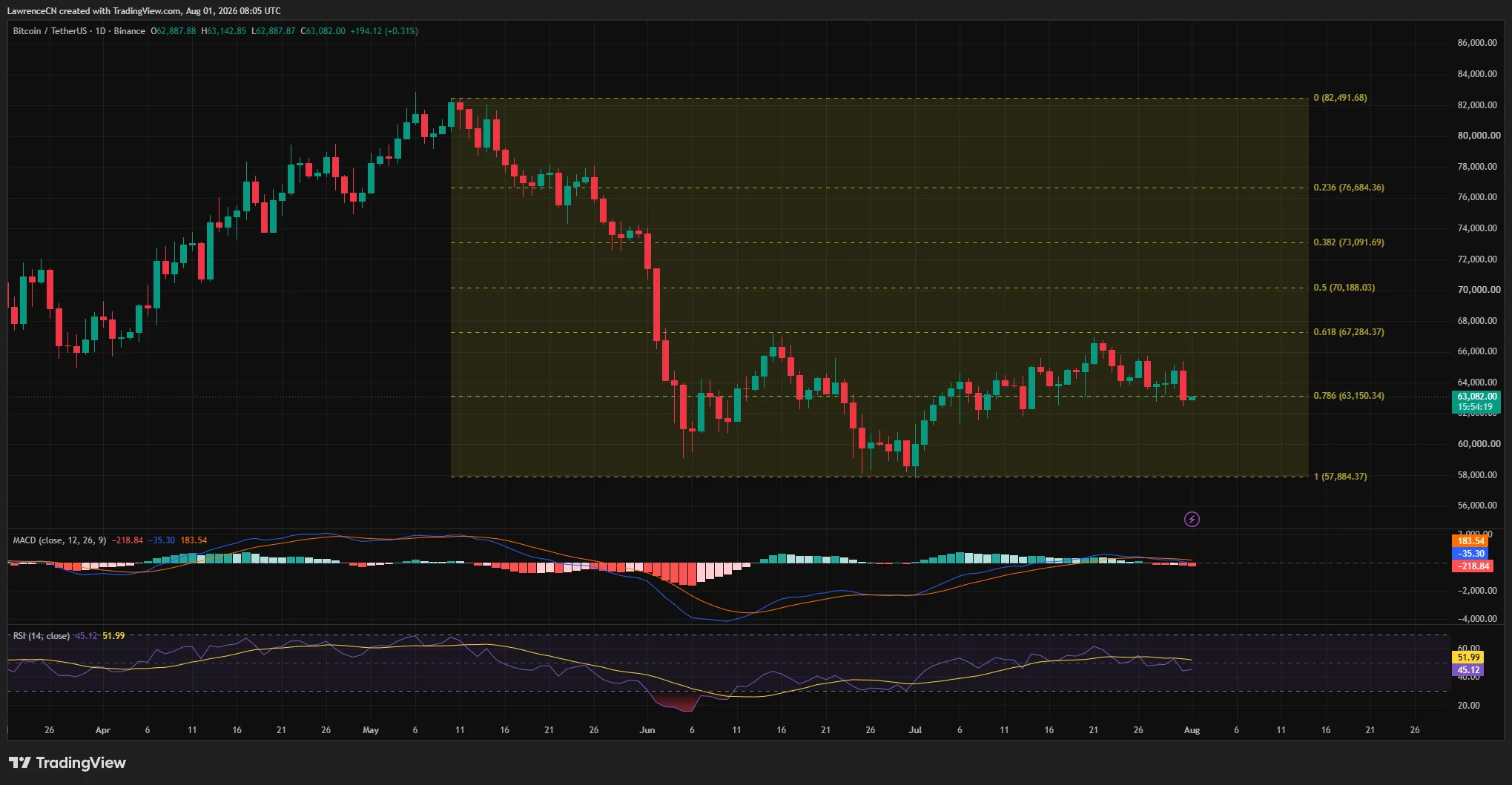
Bitcoin price hovered near $63,000 on Aug. 1 as US ETF outflows, weakening momentum and regulatory uncertainty kept buyers on the sidelines.
Summary
- Bitcoin price is testing the $63,150 Fibonacci support after retreating from July’s $66,900 high.
- US spot Bitcoin ETFs recorded $265 million in net outflows on July 31.
- 4-hour money flow fell to −0.22, indicating sustained selling pressure.
- Liquidation clusters near $62,000 and $65,000 could shape Bitcoin’s next move.
Bitcoin price struggles to hold $63,000
According to data from crypto.news, Bitcoin (BTC) price traded at approximately $63,082 at the time of writing after briefly falling below $63,000 during the latest selloff. The asset has now erased most of its recovery from the July 21 high near $66,900.
The daily chart places Bitcoin directly below the 78.6% Fibonacci retracement level at $63,150. This level is measured from the decline between the May peak of $82,492 and the June low of $57,884.
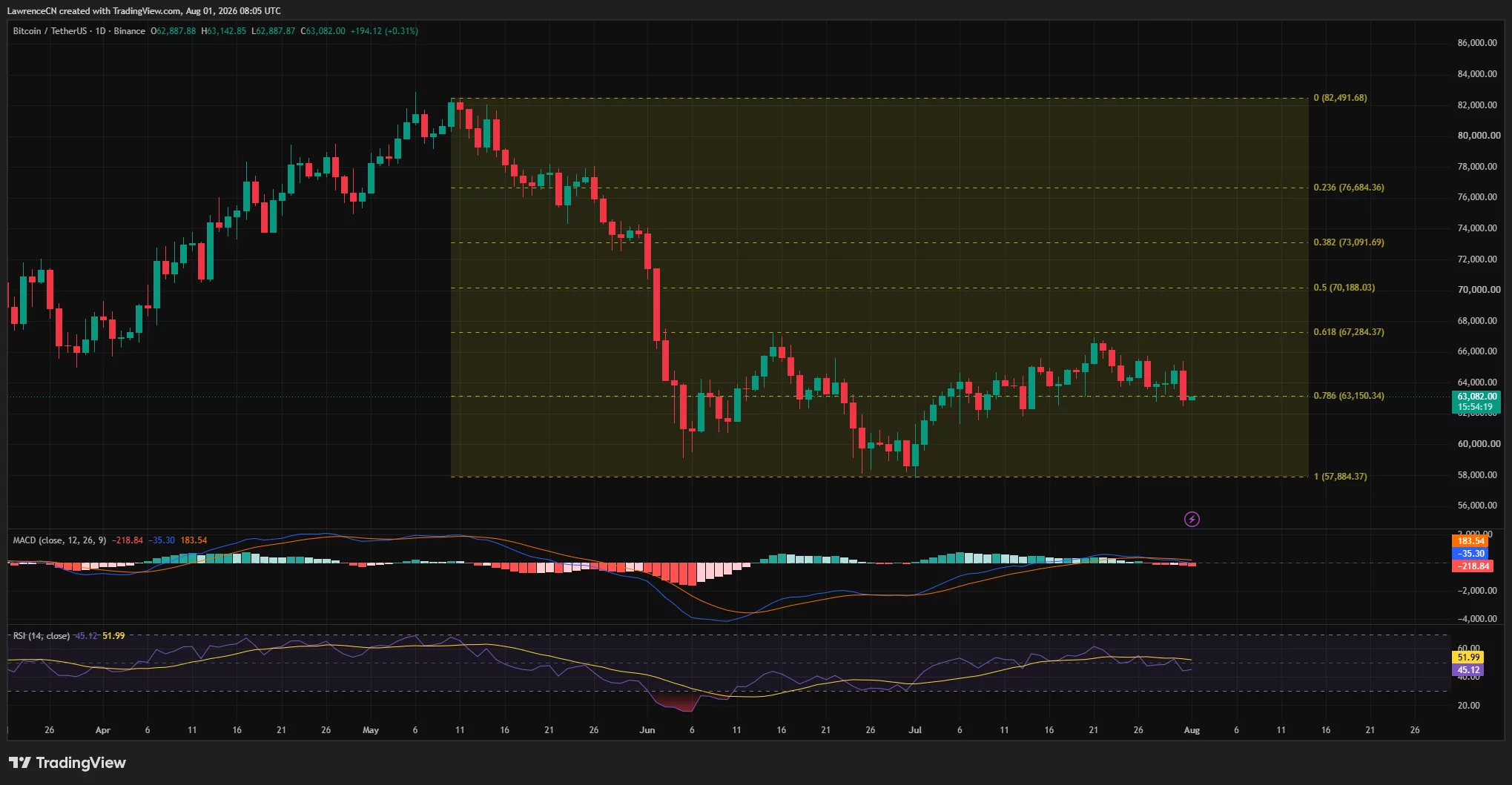
A daily close below $63,150 would confirm that buyers failed to defend the retracement level. Bitcoin could then retest the $62,000 area, followed by the psychological $60,000 support if selling accelerates.
Holding the current zone would leave room for another consolidation phase. However, Bitcoin must recover above $64,000 before the immediate pressure begins to ease.
Bitcoin momentum indicators turn bearish
Momentum readings on the daily and 4-hour charts favor sellers.
Bitcoin’s daily relative strength index has fallen to 45.12, below its moving average of 51.99. The reading is not yet oversold, meaning the market could decline further before reaching conditions that typically attract dip buyers.
The daily moving average convergence divergence indicator has also produced a bearish setup. The MACD line has crossed below its signal line, while the histogram has moved into negative territory at −218.84.
On the 4-hour chart, Bitcoin is trading below the Bollinger Band midpoint at $63,886 and close to the lower band at $62,489. The upper band near $65,284 marks the first major volatility-based resistance.
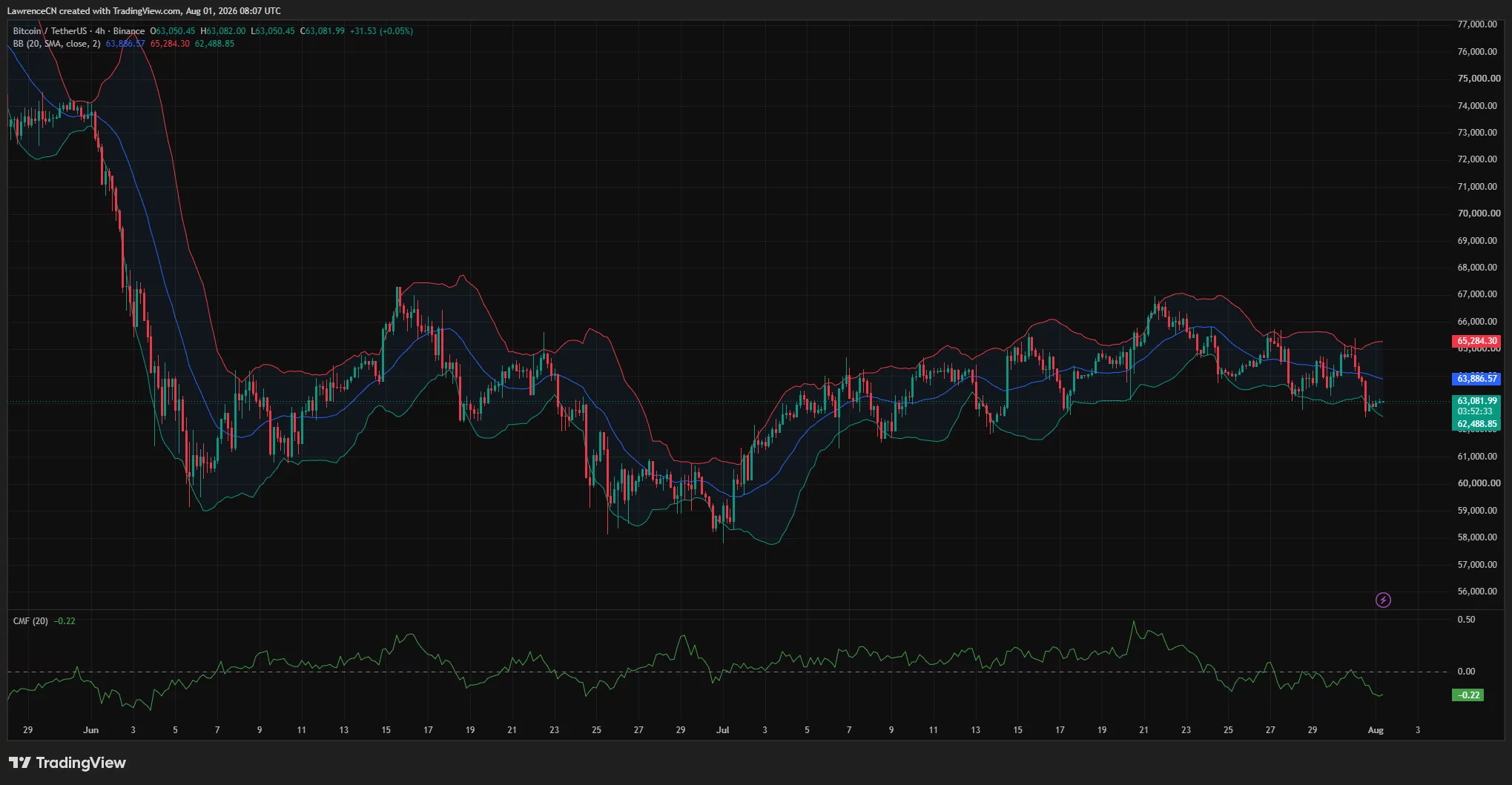
Chaikin Money Flow has dropped to −0.22 on the same timeframe. The negative reading indicates that capital is leaving Bitcoin as it trades near support, reducing the strength of any short-term recovery attempt.
ETF outflows add pressure on Bitcoin
US spot Bitcoin ETFs posted a combined net outflow of approximately $265 million on July 31, according to SoSoValue data.
BlackRock’s iShares Bitcoin Trust led the withdrawals with $123 million in net outflows. Fidelity’s FBTC followed with approximately $54.8 million.
The daily outflow ended a two-session inflow streak and showed that institutional demand remained fragile at the start of August. Total assets held by the US spot Bitcoin ETFs stood at approximately $76.29 billion, equivalent to 6.04% of Bitcoin’s market value.
Traders are also monitoring the CLARITY Act negotiations in Washington. The White House is expected to review a bipartisan ethics proposal as lawmakers seek enough support to move the market structure bill forward before the Senate’s August recess.
Polymarket traders placed the probability of the CLARITY Act becoming law in 2026 at just 27% on Aug. 1. Prediction-market odds reflect trader positioning rather than a reliable legislative forecast, but the decline points to limited confidence that lawmakers will resolve their differences quickly.
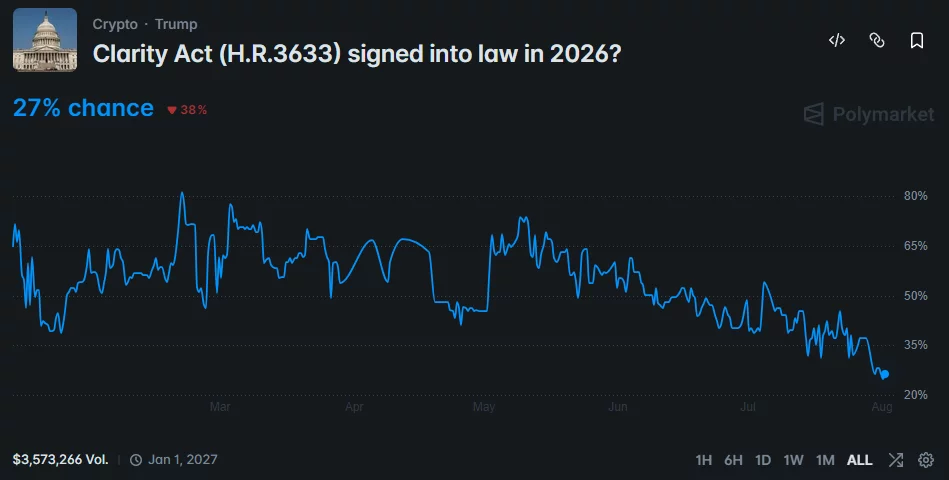
Liquidation map identifies $62K and $65K targets
Bitcoin’s one-week liquidation heatmap shows large concentrations of leveraged positions on both sides of the current price.
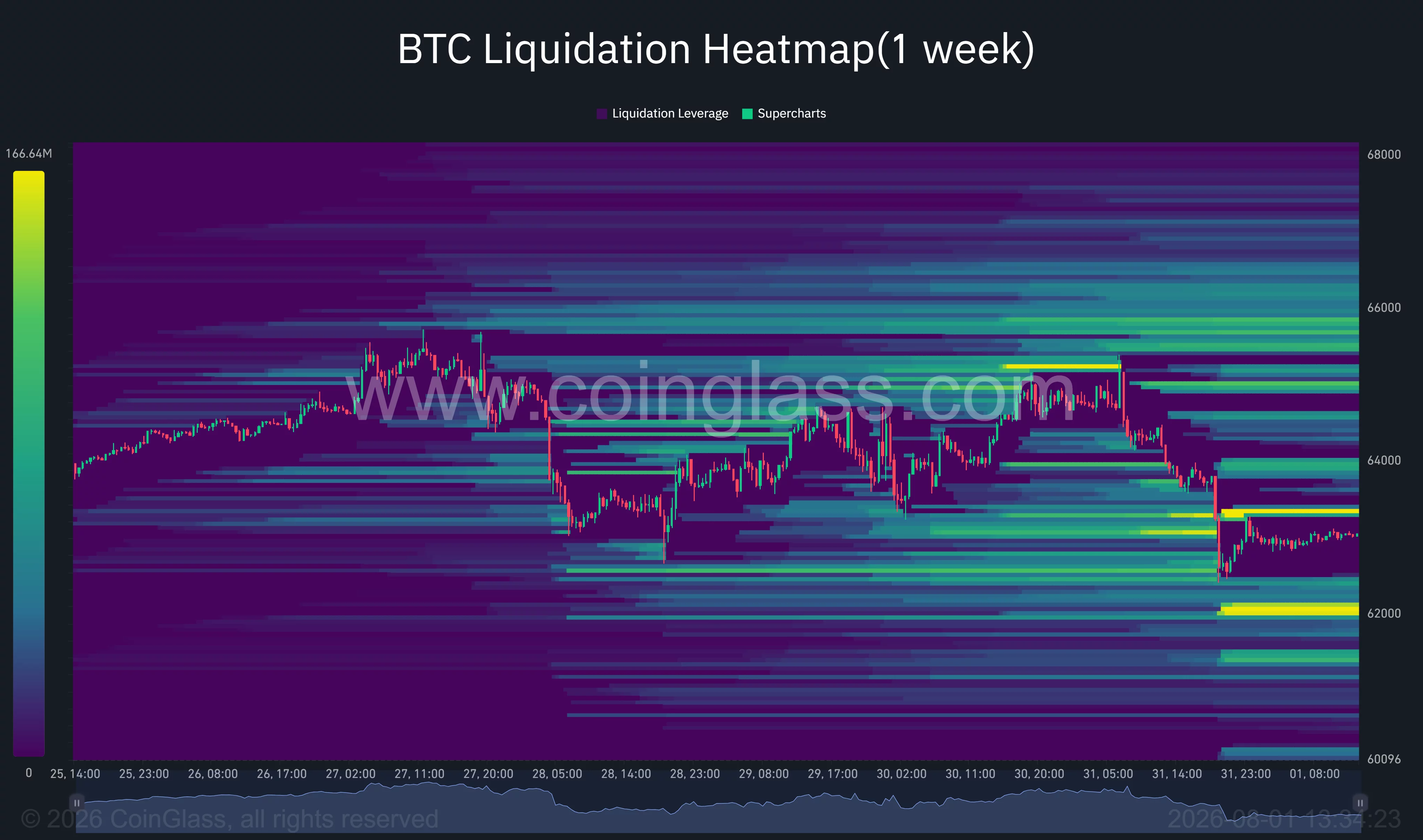
The nearest downside liquidity cluster sits around $62,000. A break below the 4-hour lower Bollinger Band at $62,489 could push Bitcoin toward this area as long positions are forced to close.
A smaller concentration appears near $63,300, which could act as an immediate target during a rebound. Above that level, the strongest nearby short-liquidation zones extend from approximately $65,000 to $66,000.
These concentrations can attract price as exchanges close leveraged positions, but they do not guarantee direction. Bitcoin could first sweep liquidity below $63,000 before attempting to recover, particularly while money flow remains negative.
Can Bitcoin price rebound toward $65,000?
Bitcoin needs to reclaim the 4-hour Bollinger midpoint near $63,886 to establish an initial recovery signal. A move above $64,000 would open a path toward $65,000 and the upper Bollinger Band at $65,284.
Clearing that area could trigger short liquidations and allow Bitcoin to retest $65,800 to $66,000. The broader recovery would remain incomplete until price breaks above the July high near $66,900 and the 0.618 Fibonacci level at $67,284.
Crypto analyst Ali Martinez also identified a TD Sequential sell signal on Bitcoin’s three-day chart.
“Bitcoin is flashing a warning sign,” Martinez said, adding that the signal appeared shortly before the start of August.
The TD Sequential attempts to identify trend exhaustion, but it does not independently confirm a decline. Bitcoin’s reaction at $63,150, ETF demand, and developments around the CLARITY Act will provide more immediate signals.
A sustained break below $62,000 would weaken the outlook and expose $60,000, followed by the June low near $57,884. Conversely, a recovery above $65,284 would reduce the immediate bearish pressure and shift attention back toward $67,284.
Disclosure: This article does not represent investment advice. The content and materials featured on this page are for educational purposes only.

How to Invest in Bonds Now

What is a zero-knowledge proof? ZK technology explained

Red Sox’s Willson Contreras injured after taking pitch to head


-
 Sports6 days ago
Commonwealth Games boxing: Jadumani Singh seals dominant 5-0 win over Pakistan’s Sumama Rehman to enter quarter-finals | Commonwealth Games News
-

 Business3 days ago
Why Trees Belong on the Risk Register
-

 Fashion16 hours ago
Weekend Open Thread: Wit & Wisdom
-

 Politics12 hours ago
Meta enters AI-training agreement with far-right ‘propaganda rag’ Newsmax
-

 Tech5 days ago
Intel is reversing course and bringing hyper-threading back to its server chips
-

 Crypto World7 days ago
Ripple bought a bank in pieces. The $4 billion audit
-

 Politics5 days ago
Luke Littler dismantles Gerwyn Price to retain title in Blackpool
-

 Politics4 days ago
The Part of the Electric Transition Nobody Wants to Discuss
-

 News Videos6 days ago
BITCOIN JUST ENTERED THIS CRITICAL ZONE…
-
 Entertainment4 days ago
‘Stargate’ Creator’s New Sci-Fi Series Returns for Season 3 Tomorrow
-

 Business3 days ago
Major shareholder moves on Canyon
-

 Crypto World6 days ago
XRP Ledger adds $2.6B as RWA inflows rank second
-

 Politics6 days ago
Spain sweeps the board at 2026 World Cup with individual awards
-

 News Videos2 days ago
Bitcoin Enters the 3rd Stage of the Bear Market
-
Crypto World3 hours ago
XRP Ledger v3.3.0 brings five institutional features
-

 Entertainment6 days ago
Sara Gilson Killed By Husband After Viral “Pedophile” TikTok Video
-

 Crypto World3 days ago
Kraken Enables Retail Access to Jersey Mike’s IPO via Tokenized Shares
-

 News Videos4 days ago
Claude: Build Financial Dashboards in Minutes (2026)
-

 Tech4 days ago
New macOS Sequoia & Sonoma security updates for older Macs
-

 Politics2 days ago
Luke Littler’s dominance sparks GOAT debate
You must be logged in to post a comment Login