Canberra, Australia — Australian scientists have unveiled a theoretical breakthrough that could dramatically accelerate the development of practical quantum computers, proposing the use of tiny “quantum batteries” to power the systems and potentially quadruple the number of qubits packed into the same physical space.
In a study published Wednesday in the journal Physical Review X, researchers from Australia’s national science agency CSIRO, the University of Queensland, and Japan’s Okinawa Institute of Science and Technology (OIST) demonstrated how integrating internal quantum batteries could overcome key barriers in quantum computing, including excessive heat generation, complex wiring requirements, and limited scalability due to cryogenic cooling constraints.
The architecture relies on quantum batteries—devices that harness quantum mechanical effects to store and deliver energy more efficiently than classical methods—as an intrinsic power source for quantum operations. By recycling energy within the system, the approach achieves near-zero energy dissipation for certain computations while eliminating the need for individual drive lines to each qubit.
Dr. James Quach, CSIRO’s quantum batteries research lead and a co-author of the study, described the innovation as a game-changer for scaling quantum technology.
Advertisement
“We’ve calculated that quantum-battery-operated systems will generate significantly less heat, require fewer wiring components, and fit more qubits into the same physical space—all important steps toward building practical, scalable quantum computers,” Quach said in a statement released by CSIRO.
Current quantum computers, particularly those using superconducting qubits, face severe limitations from the need for extreme cooling to near absolute zero and the dense cabling required to control and read out individual qubits. As qubit numbers increase, wiring overhead and heat load grow exponentially, constraining how many qubits can fit within a single cryogenic system.
The new modelling shows that a shared-resonator quantum battery design could eliminate per-qubit drive lines, reducing infrastructure demands and potentially increasing qubit capacity by up to four times. The researchers also identified potential gains in computational speed through “quantum superextensivity,” a phenomenon where performance improves nonlinearly as more qubits are added.
The proposal represents the first framework for using quantum batteries to intrinsically power quantum computation, enabling unitary gates with thermodynamic efficiency approaching zero dissipation. In a superconducting circuit implementation, the shared battery supplies energy collectively, preserving quantum coherence while simplifying control architecture.
Advertisement
While the work is theoretical and based on detailed simulations, the team emphasized its feasibility within existing quantum hardware platforms. Experimental validation remains a next step, but the findings align with ongoing global efforts to push qubit counts beyond current limits of several hundred toward the thousands or millions needed for fault-tolerant quantum computing.
Professor Arkady Fedorov from the University of Queensland, another co-author, highlighted the interdisciplinary nature of the advance.
“This collaboration brings together expertise in quantum thermodynamics, circuit design, and materials science to address one of the most pressing challenges in quantum technology—efficient energy management at the quantum scale,” Fedorov said.
CSIRO, which leads Australia’s quantum research through initiatives like the Quantum Batteries team, views the breakthrough as part of a broader push to position the nation as a leader in quantum technologies. The agency has invested heavily in quantum sensing, computing, and energy storage applications, with quantum batteries emerging as a dual-use technology that could also benefit classical energy systems.
Advertisement
The study arrives amid intense international competition in quantum computing, with companies and governments racing to achieve practical quantum advantage. Advances in qubit density and energy efficiency are seen as critical to making quantum machines viable for real-world applications in drug discovery, materials science, cryptography, and optimization problems beyond the reach of classical supercomputers.
Industry experts welcomed the findings but cautioned that translating theory into hardware will require further engineering breakthroughs.
“Quadrupling qubit density through smarter power delivery is an elegant solution to a hard problem,” said one quantum physicist familiar with the work, speaking on condition of anonymity. “If validated experimentally, it could reshape cryogenic system design and accelerate roadmaps toward error-corrected quantum computers.”
The research was supported by CSIRO’s internal funding and collaborative grants, with no immediate commercial partnerships announced. The full paper, titled “Powering Quantum Computation with Quantum Batteries,” is available open access via the American Physical Society’s Physical Review X.
Advertisement
As quantum technologies mature, Australian researchers say innovations like this could deliver significant economic benefits, with estimates projecting the global quantum market to reach hundreds of billions of dollars in the coming decades.
First came the cars of the United Nations, then two coaches with blue paintwork. And then came a wave of emotion – proof that the heart has a power that the head can’t always match.
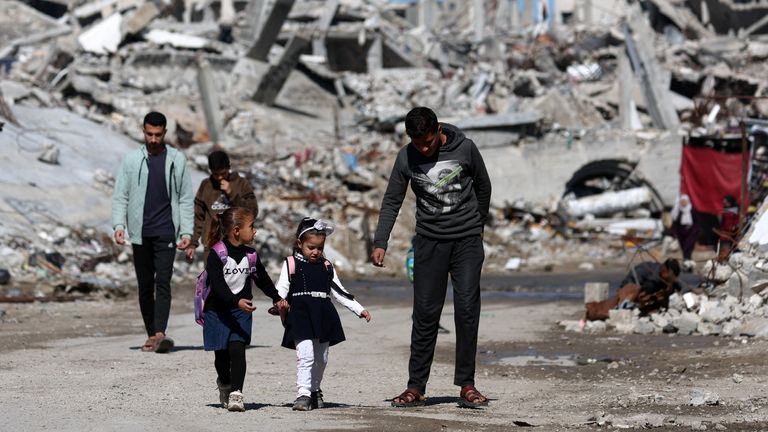
How to explain the logic of people desperate to return to the shattered ruins of Gaza?
To leave behind the safety and sanctuary of life in Egypt, and to rush back to a place where you search for running water, dream of functioning hospitals and fear the effects of airstrikes, collapsing buildings and unexploded bombs.
The only explanation is the profound sense of longing that can affect us all when we are separated from family, friends and the place we consider our home. And so it is in Gaza.
Advertisement
The people who came out of those coaches were among the first to have crossed the Rafah Crossing to pursue their dream of returning to Gaza.
Image: These people were among the first to return since the crossing reopened
It’s estimated that more than 40,000 people fled the Strip during the war. These were the first to come back.
Foreign journalists are banned from entering Gaza, but our Gazan colleagues have been reporting on our behalf ever since the war began. As they filmed, they saw a stream of emotional reunions and outpourings of joy.
Kariza Bahloul, 48, was one of those to have come home.
Advertisement
She told our colleagues in Khan Younis that it was “an indescribable feeling” to return: “I am very happy that I came back to my husband, my sons, my family, my loved ones, and also to my homeland. And the homeland feeling is the most important.”
A few feet away, Amati Othman Omran was also soaking up the feeling of homecoming.
2 February: First medical evacuees appear to leave Gaza
She had left Gaza to accompany her husband, Adel, to Egypt so he could have heart surgery. But her love for Gaza never diminished.
Advertisement
“When the road back was blocked, and I could not come back, I spent two years without a single day of peace, thinking of my sons, my brother, sisters. My family,” she said.
“I thank God that I have come back to Gaza. I smelled its scent and its air from far away.”
Huda Abu Abed had left during the first ceasefire, traumatised by the death of her son. Then, she said, there were still houses and olive trees.
Advertisement
“Everything was not destroyed, as it is now,” she said.
Image: At least 20 were killed in fresh Israeli strikes, say Gaza authorities
So how, she was asked, did she feel about coming back to a land where she will be destined to live in a tent, surrounded by rubble?
“It is better than living in a villa,” came the reply. “If I sit under a tree, it is better than being away from home. I am happy to get back to a tent, because that tent will contain my family.”
It is an intoxicating strain of both optimism and loyalty. But it also feels so discordant to the reality of life.
Image: At Shifa Hospital on Wednesday, a man carried his baby daughter, Mira, killed in an Israeli strike. Pic: AP
Not only is everyday existence still unpredictable and fragile, but the danger of sudden violence lingers over everything.
Just hours after these people were joyously reunited with their families, more than 20 Gazans were killed by a combination of Israeli tank and airstrikes. Among them, a paramedic who had come to help.
Advertisement
The Israeli military later issued a statement saying it had targeted one of the leaders of the 7 October massacre, and offered its regret for any harm done to “uninvolved civilians”. It was near as the Israel Defence Forces (IDF) normally comes to an apology.
Image: Most of Gaza lies in ruins after two years of Israeli attacks. Pic: Reuters
A little while later came a separate IDF statement, accusing “Hamas terrorists” of “systematically using ambulances in Gaza by transporting terrorists and weapons”.
The effect, whether deliberate or not, was to dilute their own words of regret. In Gaza, the place where some are desperate to flee, and others are desperate to return, nothing is ever sure.
Ryan Gravenberch looks set to start at centre-back with Joe Gomez (injury) and Ibrahima Konate (compassionate leave) unavailable. Andy Robertson is given the nod to start at left-back ahead of Milos Kerkez. There is no Curtis Jones in the squad.
More than £66 million has been paid to over 33,000 bereaved people since Funeral Support Payment launched in 2019.
People in South Lanarkshire who lose someone over the winter months are encouraged to apply for support to help with funeral costs.
Advertisement
Funeral Support Payment is delivered by Social Security Scotland and is available to people living in Scotland who receive certain benefits.
The payment can help cover some of the cost of a funeral and can be used towards funerals for a baby, child or adult. The payment also covers funerals for babies who are stillborn.
More than £66 million has been paid to over 33,000 bereaved people since Funeral Support Payment launched in 2019.
Cabinet Secretary for Social Justice, Shirley-Anne Somerville, said: “A bereavement is one of the hardest things a person can experience. On top of their grief, people often face the staggering costs of paying for the funeral. The average price for a funeral in the UK is now well over £4,000 – this is a cost many do not have the resources to pay for.
Advertisement
“Funeral Support Payment is there to ease some of the financial pressure for grieving individuals and reduce funeral poverty for people in Scotland. I urge people in South Lanarkshire to check their eligibility to receive Funeral Support Payment.”
A decade on from Ireland’s most notorious gangland hit, Irish police say they have had “unprecedented” success in tackling Dublin’s drug gangs – and ending a bitter feud that claimed at least 18 lives.
In 2025, the Gardai recorded a total of zero gangland gun murders “for the first time in modern times” – believed to be at least 30 years.
Ninety-eight members of the two most infamous organised crime groups – the Hutch and Kinahan gangs – have been jailed, and 51 attempted hits have been foiled.
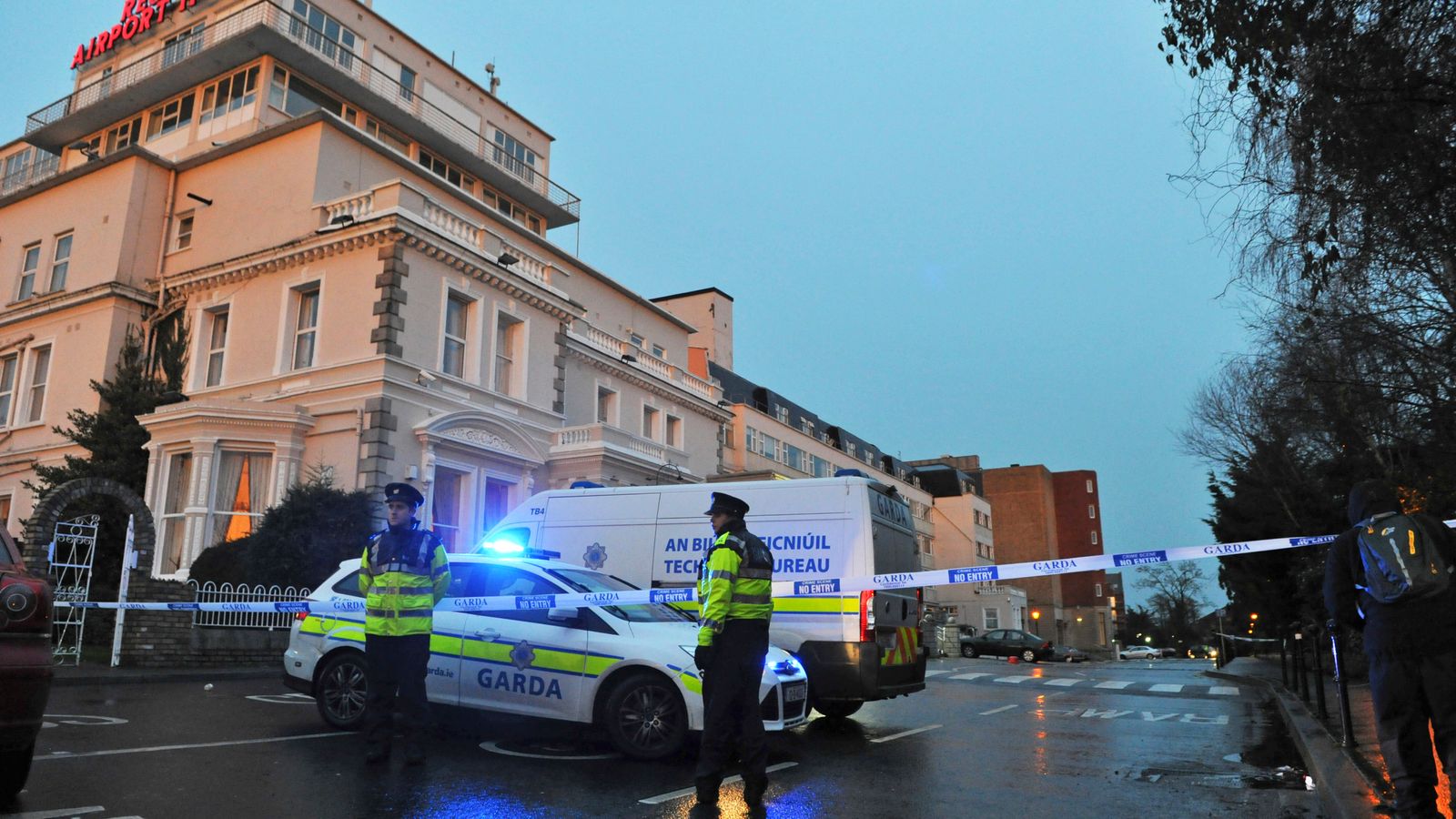
It was the Hollywood-style attack on the Regency Hotel that changed Ireland’s crime landscape forever.
Advertisement
On 5 February 2016, a hit squad of assassins disguised as a police SWAT team besieged a boxing weigh-in at the hotel, near Dublin Airport.
Image: Det Chief Supt Seamus Boland speaks to the press. Pic: Gardai
AK47-style assault rifles were fired as hundreds of panicked attendees fled. Several were injured in the chaos, and one man – Kinahan associate David Byrne – was killed in the lobby.
The attack, Gardai say, was carried out by the Hutch gang – their target was Daniel Kinahan, head of their bitter rivals.
It accelerated a feud that shocked Ireland with its ferocity, and ultimately backfired on both gangs as the police backlash strengthened.
Advertisement
The Garda National Drugs and Organised Crime Bureau, only a year old, led the way.
Dubliners became accustomed to heavily-armed police checkpoints in the inner city, as politicians promised all the resources necessary.
Spanish police arrest Irish fugitive
The Regency Hotel shooting “was not just an attack on a sporting event, and the murder of Mr Byrne, but an attack on our state and and an affront to all right-minded and peaceful citizens”, according to Garda Assistant Commissioner Angela Willis.
Advertisement
The gardai responded “with a sustained and relentless campaign to disrupt, degrade and dismantle the Hutch and Kinahan criminal organisations and their criminal activity”, she said.
At a press conference in Dublin today, Detective Chief Superintendent Seamus Boland vowed that the force would not become “complacent” in combatting organised crime.
“We don’t live in Nirvana”, he said, warning the continued demand for illegal drugs could fuel potential upsurge in gang violence.
Now, he says, the Kinahan cartel “no longer exists as it did in 2016”, although the Hutch group remains active and a target of investigation.
Its alleged leader, Gerry “The Monk” Hutch, was acquitted of Mr Byrne’s murder in a well-publicised trial in April 2023.
Advertisement
Against a backdrop of policing success, Boland says he does not regard that the absence of a murder conviction a decade on as a policing failure, or a regret.
“We’re not emotional about these things”, he says.
A famous expression, often wrongly attributed to Mark Twain, states that comedy is merely tragedy plus time. This theory highlights how our response to films can depend on the context in which we see them.
We tend to think of the genre of a film as something very fixed, decided by a combination of studio producers and marketers. But, in the right context, films can move across many different genres in the span of their lifetime, depending on the audiences that watch them.
To demonstrate this idea, here are five scary films for 2026. The twist, however, is that none of these films were ever intended to be horror films. Most on the list were satire or comedy when they were made. Instead, they have become horrific due to the way they touch on contemporary issues surrounding the global politics of President Donald Trump, impending environmental disaster, ever-accelerating technology and contemporary attitudes towards gender.
1. Duck Soup (1933)
The finest film produced by the famous Marx Brothers comedy troupe, Duck Soup is an anarchic political satire that tells the story of an unserious playboy president named Rufus T. Firefly. Beloved by film enthusiasts, the film showcases a series of mishaps and misdeeds caused by his selfish, erratic behaviour which inadvertently led his country of Freedonia into a war with its neighbours.
Advertisement
Duck Soup is considered a classic of Hollywood slapstick and quick-witted verbal comedy. But, in an era of a genuine unserious president, its central joke might not feel funny any more. Nor indeed is the idea that, nearly 100 years after its release, this biting satire on the politics of rising authoritarianism would be as timely now as it was then.
2. The Apartment (1960)
People often say “they don’t make them like they used to any more” when trying to articulate a nostalgia for the films of the past. That description can be aptly applied to Billy Wilder’s romantic comedy-drama The Apartment. They do not make films like this any more. But in this case, that’s a good thing.
Jack Lemmon’s “Buddy Boy” Baxter is the bachelor who routinely loans his apartment out to his bosses for them to conduct extra-marital affairs. Shirley MacLaine’s Fran is the loveable but down-on-her-luck elevator operator involved in a tawdry situation with Baxter’s boss. Their own romance emerges out of a suicide attempt, workplace harassment and abuses of power. It feels like the film is set not just in the past, but in some creepy alternative world.
Advertisement
To be fair to The Apartment, it hardly treats some of the more problematic behaviour of its characters as virtues we are supposed to admire. But it never quite attacks the deeply unpleasant nature of its central conceit either. Baxter is not just a loveable goof unaware of what he’s got himself mixed up in. He’s a complicit enabler. And Fran is not a ditsy but loveable woman mixed up with the wrong crowd. She’s a victim.
3. Idiocracy (2006)
Idiocracy was something of a box office bomb, given neither the marketing campaign nor the reviews it needed to ensure success. The fact it has since become a cult hit speaks to how startlingly prescient the film is for contemporary audiences now discovering the film in droves 20 years later.
Idiocracy tells the story of a young man put into suspended animation who wakes up 500 years in the future. The average intelligence of the population has severely decreased, to the extent that the world has become increasingly consumerist, vulgar, crass and prejudiced in its thinking. America has even elected a former pro wrestler and porn star, Dwayne “Mountain Dew” Camacho, as its leader.
Advertisement
Made in 2006 during the final year of George W. Bush’s presidency and set against the rise of Barack Obama, the film failed initially as a comedy. It now works perfectly as a terrifying exaggeration of what the world looks like in 2026.
4. Wall-E (2008)
Wall-E is part of a long history of animations with an interest in the environment, from Princess Mononoke (2001) to Ferngully: The Last Rainforest (1992). That part of its dystopic vision still stands up. The film’s vivid opening of Wall-E wandering around a silent world of trash is still its best moment.
The film’s vision of the humanity that has left the garbage-strewn world behind, however, has become increasingly concerning over time. Predicting a world of humans who are dumb, obese and screen-obsessed, it is increasingly difficult to watch Wall-E as a nostalgic childhood treat.
Advertisement
5. Her (2013)
The amazing feat pulled off by this absurdist romantic drama was to somehow get an audience to root for the idea of a romantic pairing between a lonely middle-aged man and an AI-enabled operating system. More than a decade later, Her’s open-minded approach to AI seems far more fraught.
As the romance develops between Theodore (Joaquin Phoenix) and Samantha (voiced by Scarlett Johansson), it is difficult not to imagine the fingerprints of powerful but not necessarily benign tech moguls turning the screws tighter, manipulating Theodore further into spurning human contact for his digital desires.
Equally, it is difficult not to wonder whose voice has been stolen to create her warm, affectionate tones, or to ask what the company might do with the recording of their conversations. The dangers in our current technological reality have once again spoilt a perfectly good film.
Advertisement
Looking for something good? Cut through the noise with a carefully curated selection of the latest releases, live events and exhibitions, straight to your inbox every fortnight, on Fridays. Sign up here.
CORTINA D’AMPEZZO, Italy (AP) — The Winter Olympics got underway Wednesday with the first curling matches in Cortina, but came to a halt only moments later because of a power outage.
Officials briefly paused the matches at the historic curling stadium when the lights dimmed and flickered. Curlers kept sliding on the ice to stay ready. Fans cheered when the bright lights came back shortly after and competition resumed. Venue officials said they were investigating and had no immediate word on what caused the problem.
Curling in Cortina — eight teams in mixed doubles — began two full days before the opening ceremony for the 2026 Milan Cortina Games. American curler Korey Dropkin said he has been waiting a long time for this moment.
“Being amongst the best, it’s a very cool atmosphere to be part of,” said Dropkin, a first-time Olympian who will begin competition Thursday. “We’re looking forward to being ready to compete and pour our hearts out on the ice.”
Advertisement
Preparations for the first curling competition are made at the 2026 Winter Olympics in Cortina d’Ampezzo, Italy, Wednesday, Feb. 4, 2026. (AP Photo/David J. Phillip)
Advertisement
Preparations for the first curling competition are made at the 2026 Winter Olympics in Cortina d’Ampezzo, Italy, Wednesday, Feb. 4, 2026. (AP Photo/David J. Phillip)
Advertisement
Advertisement
Advertisement
Advertisement
Opening night in this mountain resort was just the first of the round robin matches in mixed doubles curling, where teams with one woman and one man face off against one another.
Fans have arrived in Cortina, and they are excited for the first matches. They clapped, rang bells and chanted for their countries and favorite curlers when their teams scored or there was a break in the action. Some in the crowd held large flags for the Czech Republic, whose team was competing against Canada. Canadian fans wearing red waved handheld flags.
Bernard Benoit traveled from Ontario, Canada, to root for his home team before going on to meet his daughter in Milan. While he’s a longtime curling fan, it’s his first time at the Olympics. He said he came a long way to see the best in the world because he loves how curling is a “mix of athleticism and intellect” and a strategy game.
Advertisement
South Korea’s Jeong Yeong-seok and Kim Seon-yeong compete during a curling mixed doubles session at the 2026 Winter Olympics in Cortina d’Ampezzo, Italy, Wednesday, Feb. 4, 2026. (AP Photo/David J. Phillip)
Advertisement
South Korea’s Jeong Yeong-seok and Kim Seon-yeong compete during a curling mixed doubles session at the 2026 Winter Olympics in Cortina d’Ampezzo, Italy, Wednesday, Feb. 4, 2026. (AP Photo/David J. Phillip)
Advertisement
Advertisement
Benoit is cheering for Canadian couple Jocelyn Peterman and Brett Gallant, who are competing in mixed doubles. Three of the teams are married couples and one is a sibling team. Marie Kaldvee and Harri Lill are the first ever to compete for Estonia in curling.
Italian duo Stefania Constantini, who is from Cortina, and Amos Mosaner are the defending world and Olympic champions in mixed doubles.
Advertisement
Stephanie Kahn is a volunteer at the curling center, who is eager to learn what curling is all about and how hard it is. Kahn is from the United States and moved to Spain when she retired. She aspired to compete in swimming in the Olympics when she was younger.
“That, for me, is what makes it so special. Being an athlete and knowing that to be at the top, top of your sport, regardless of what that sport is, it’s just such a commitment,” she said. “So I’m just excited to be in the presence of these athletes.”
___
AP Writer Julia Frankel in Jerusalem contributed to this report.
Officers were called to on Low Street on October 31 last year after receiving reports that fireworks were being thrown in the street.
An investigation was launched, which led to a 23‑year‑old local man being identified in connection with the incident.
A police spokesman said he was interviewed for the offence of throwing a firework and admitted his actions.
Advertisement
He has been referred to a scheme to undertake educational work to reflect on his behaviour.
“We’re going to keep up our work in the area. Please support us – if you witness crime or anti-social behaviour, tell us about it. You can call 101 (or 999 in an emergency), or make a report via our website.”
When structural engineers design a building, they aren’t just stacking floors; they are calculating how to win a complex battle against nature. Every building is built to withstand a specific “budget” of environmental stress – the weight of record snowfalls, the push of powerful winds and the expansion caused by summer heat.
To do this, engineers use hazard maps and safety codes. These are essentially rulebooks based on decades of historical weather data. They include safety margins to ensure that even if a small part of a building fails, the entire structure won’t come crashing down like a house of cards.
The problem is that these rulebooks are becoming obsolete. Most of our iconic high-rises were built in the 1970s and 80s – a world that was cooler, with more predictable tides and less violent storms. Today, that world no longer exists.
Climate change acts as a threat multiplier, making the consequences of environmental stress on buildings much worse. It rarely knocks a building down on its own. Instead, it finds the tiny cracks, rusting support beams and ageing foundations and pushes them toward a breaking point. It raises the intensity of every load and strain a building must weather.
Advertisement
To understand the challenge, I have been studying global hotspots where the environment is winning the battle against engineering.
The 2021 collapse of Champlain Towers South in Miami, Florida, killed 98 people. While the 12-storey building had original design issues, decades of rising sea levels and salty coastal air acted as a catalyst, allowing saltwater to seep into the basement and garage.
When salt reaches the steel rods inside concrete that provide structural strength (known as reinforcement), the metal rusts and expands. This creates massive internal pressure that cracks the concrete from the inside out — a process engineers call spalling. The lesson is clear: in a warming world, coastal basements are becoming corrosion chambers where minor maintenance gaps can escalate into catastrophic structural failure.
While the Miami case affected a single building, the historic coastal city of Alexandria, Egypt, is more widely at risk. Recent research shows that building collapses there have jumped from one per year to nearly 40 per year in the past few years.
Advertisement
Not only is the sea rising, the salt is liquefying the soft ground beneath the city foundations. As the water table rises, saltwater is pushed under the city, raising the groundwater level. This salty water doesn’t just rust the foundations of buildings; it changes the chemical and physical structure of soil. As a result, there are currently 7,000 buildings in Alexandria at high risk of collapse.
The historic city of Alexandria, Egypt, is widely affected by the retreating coastline. muratart/Shutterstock
In Hong Kong during Super Typhoon Mangkhut in 2018, wind speeds hit a terrifying 180 miles per hour. When strong winds hit a wall of skyscrapers, they squeeze between the buildings and speed up — like water sprayed through a narrow garden hose.
This pressure turned hundreds of offices into wind tunnels, causing glass windows to pop out of their frames and raining broken glass onto the streets below. With 82 deaths and 15,000 homes destroyed across the region, skyscrapers became “debris machines”, even if they didn’t fully collapse.
Advertisement
Supercomputer simulations of Japan’s river systems show that in a world warmed by 2°C, floods of today’s “once in a century” magnitude could recur about every 45 years. With 4°C of warming, they could be every 23 years. These surges in water volume will expand flood zones into areas previously considered safe, potentially overflowing sea walls and flood defences. In a critical region like Osaka Bay, storm surges could rise by nearly 30%.
In the US, a study of 370 million property records from 1945 to 2015 found over half of all structures are in hazard hotspots. Nearly half are facing multiple threats like earthquakes, floods, hurricanes and tornadoes. In the UK, climate-driven weather claims hit £573 million in 2023, a 36% rise from 2022. Annual flood damage to non-residential properties in the UK is also projected to nearly double from £2 billion today to £3.9 billion by the 2080s.
Maintenance is our best defence
Much of the world’s building stock is therefore entering its middle age under environmental conditions it was never designed to face. Instead of panicking or tearing everything down, the solution is to adapt and treat building maintenance as a form of climate resilience – not as an optional extra.
Mid-life building upgrades can help protect our skylines for the next 50 years. Our hazard maps must look at future climate models — not just historical weather — to set new safety standards. Regular structural health monitoring is essential – by using sensors to track invisible stresses in foundations and frames before they become fatal, dangerous situations can be foreseen.
Advertisement
Buildings can stay strong by focusing retrofits on the weakest and most vulnerable parts. This includes glass facades, the underground drainage, the foundation piles and corrosion protection.
Climate change isn’t rewriting the laws of engineering, but it is rapidly eating away at our margins of safety. If we want our cities to remain standing, we must act now – before small, invisible stresses accumulate into irreversible failure.
Don’t have time to read about climate change as much as you’d like?
Today David Robert Welham, 36, is a registered sex offender.
The Whitby man forced himself upon the woman in the early hours of August 9, 2024, and was arrested the same day, North Yorkshire Police said.
He was later charged with sexual assault and denied sexual misconduct through several court hearings until minutes before he was due to stand trial at York Crown Court this week.
Advertisement
Then he changed his plea to guilty.
Welham, of Abbots Road, Whitby was given a 10-month prison sentence suspended for 18 months on condition he does 200 hours’ unpaid work.
He was put on the sex offenders’ register for 10 years and made subject to a five-year restraining order restricting his movements and activities to protect the woman from him.
Police Staff Investigator Dexy Clarkson, from Scarborough and Ryedale CID, said: “Welham finally admitted his guilt to sexually assaulting the woman and has been dealt with by the courts.
Advertisement
“I hope the victim can now begin to move on from this deeply upsetting experience. I have nothing but praise for her bravery throughout this case.”
A former mayor has argued that replacing the 35 mature trees with 49 new ones is ‘clearly inadequate’
Darren Calpin, Local Democracy Reporter
19:30, 04 Feb 2026
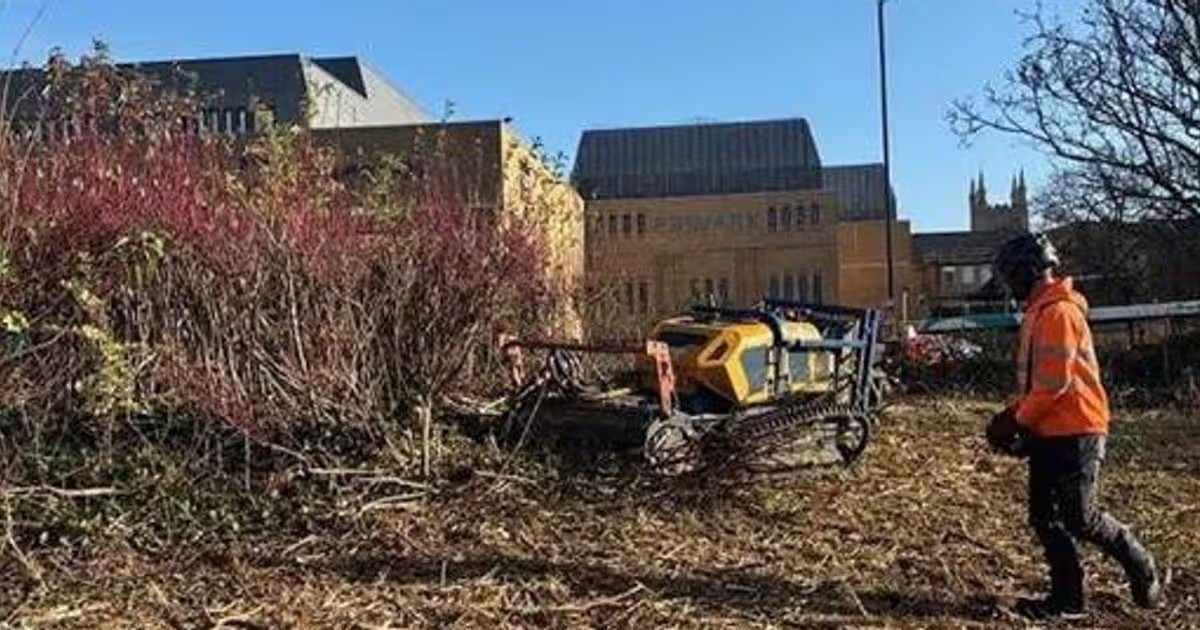
Plans to remove 35 trees around the new pedestrian City Link route between Peterborough railway station and Cowgate have been rebuffed by a former Peterborough Mayor.
Nick Sandford, who describes himself as “fully in support of the Station Quarter scheme”, said he has significant reservations about the proposed removal of so much greenery.
Advertisement
“The trees proposed for removal are not of a great age but still provide significant benefits… in terms of sequestration of carbon, wildlife habitat, air purification, water management and generally improve the feel and appearance of an inner city area like this,” he said.
Mr Sandford served as Mayor of Peterborough from 2023 to 2024, and spent 30 years working for the Woodland Trust. Mr Sandford quoted from the Woodland Trust’s 2020 Emergency Tree Plan which states: “If a tree must be removed, local authorities should implement minimum replacement planting ratios, which stipulate that for every non-woodland tree removed at least three new trees should be planted.”
“Applying this principle of three-for-one replacement planting shows that [the] proposal to replace 35 mature trees with only 49 new ones is clearly inadequate,” he said. “The replanting ratio needs to be increased significantly.”
In addition to a net gain of 14 trees, the plans for the new pedestrian City Link route are also expected to include seven additional small trees and shrubs, as well as a rain garden and Gabion walls. Construction work on City Link is due to start in the first few months of 2026.
Advertisement
Mr Sandford acknowledged how difficult it will be to maximise every single inch of space across the £65 million Station Quarter development.
“I appreciate that there may be space constraints on the site,” he said, “but opportunities could be taken to plant new trees nearby on council land in the city centre – or perhaps on the Embankment – to ensure adequate compensatory planting, which on a three-for-one basis should total 105 trees.
Mr Sandford voiced his concerns after Peterborough City Council’s recent announcement to encourage residents to take part in a public consultation on the proposed plans to fell the 35 aforementioned trees on the eastern side of the railway.
Anyone wishing to have their say on the plans has until February 11 to make representations to Peterborough City Council.

















![[TIKTOK] Lisa Money trend 3](https://wordupnews.com/wp-content/uploads/2026/02/1770239181_hqdefault-80x80.jpg)