

Crypto World
SPX, DXY, BTC, ETH, XRP, ADA, SOL, DOGE

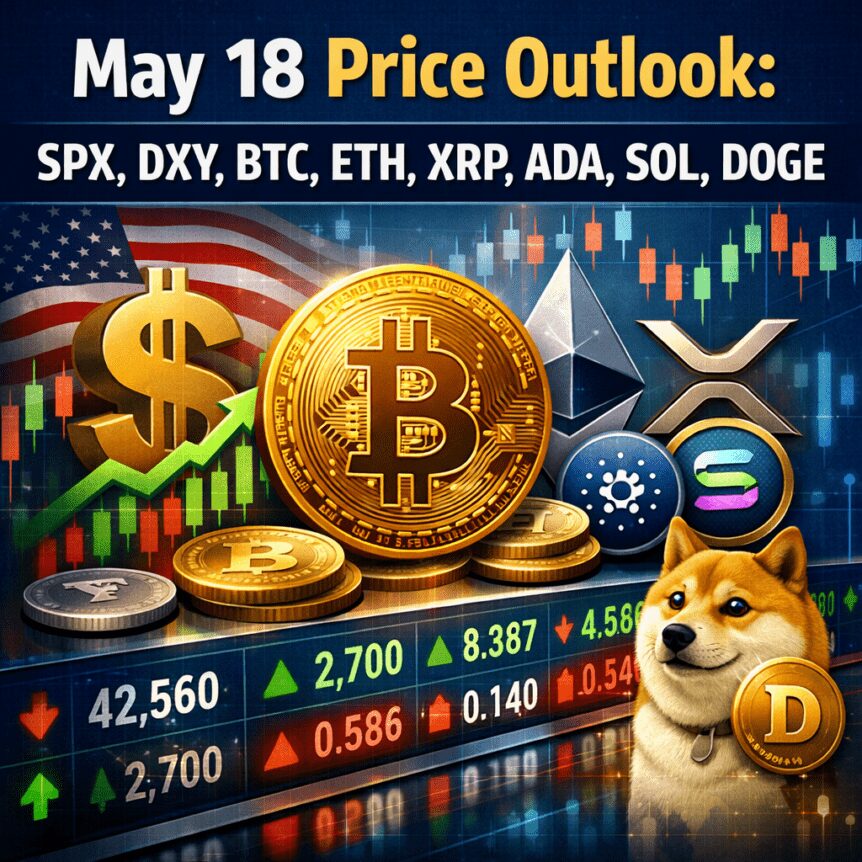
Bitcoin spent Monday under pressure, slipping back toward the $76,000 region as geopolitical headlines fueled a cautious mood across markets. A warning from US President Donald Trump about Iran added to the risk-off tone, with observers noting that even a measured military operation could intensify near-term volatility for the flagship cryptocurrency. On X, analyst CryptoRover warned that a potential US move against Iran “is extremely dangerous for BTC,” underscoring how macro headlines can quickly influence trader sentiment.
Against this backdrop, institutional flows also shifted. SoSoValue data showed spot Bitcoin ETFs recording $1 billion in weekly net outflows—the first net outflow after six straight weeks of inflows totaling $3.4 billion. The turn in ETF flow adds another layer of caution to an already sensitive tape as market participants weigh the prospects for a continued crypto rally into the second half of the year.
Meanwhile, a notable counterpoint to the softer price action came from Michael Saylor’s Strategy, the largest known public Bitcoin holder. The company disclosed it added 24,869 BTC for about $2.01 billion between May 11 and May 17, lifting its holdings to 843,738 BTC, per an 8-K filing with the U.S. Securities and Exchange Commission. The accumulation underscores a persistent bid from strategic, long-duration buyers even as the broader market wrestles with near-term headwinds.
Key takeaways
- Bitcoin is hovering near a key near-term support around $76,000, with a breach linked to increased downside risk unless a quick rebound materializes.
- Several top altcoins have broken below nearby supports, signaling a cautious mood among bulls in the immediate horizon.
- Spot BTC ETF outflows break a six-week inflow streak, suggesting a shift in institutional positioning or risk appetite.
- Strategic accumulation by the largest public BTC holder continues, reinforcing an ongoing bid at the long end of the spectrum.
Macro cues and Bitcoin’s near-term path
The broader market backdrop remains a mix of fresh macro headlines and technical pivot points. The S&P 500 advanced to an intraweek high around 7,517 before traders booked profits, a pattern that tests bulls’ resolve in the risk-on space. On the chart, a test of the 20-day exponential moving average around 7,273 could provide a telltale sign of whether buyers regain control or if sellers gain traction and push the index toward deeper consolidation. A sustained push above the 20-day EMA would tilt the market toward a renewed upside, whereas a break below could invite a retest of lower supports.
In the currency space, the U.S. Dollar Index (DXY) rebounded from a support level near 97.74 and cleared several moving averages. If the bulls can extend the breakout above interim resistance near 99.34, traders will eye a more substantial hurdle at 100.54, a level that, if cleared, could usher in a new uptrend toward 101.97. Conversely, a rejection at 100.54 or a slide below the 50-day moving average at 98.98 would keep the DXY in a broader range, sustaining a backdrop of mixed risk appetite for crypto assets.
Top coins in near-term focus: chart-driven paths and levels
Bitcoin remains the center of gravity for markets. The price sits near the 50-day moving average at roughly $75,627. A daily close above the 20-day EMA around $78,715 would embolden bulls and open a route toward the $84,000 resistance. A move that closes below the 50-day SMA keeps a risk of a test of the lower boundary of the current ascending channel, with a potential slide toward the mid-$60,000s if buyers fail to defend that line.
Ether has faced a softer patch as well, with price action breaking below the channel’s lower bound. The 20-day EMA near $2,255 has started to roll over, and the RSI sits near oversold territory, suggesting bears are in control in the near term. A recovery above the 20-day EMA will be essential for ETH to re-engage the broader uptrend; without that, 1,916 could become a more likely target as selling pressure persists.
XRP has slipped under the 50-day SMA around $1.39, signaling dwindling near-term momentum for the time being. A close below that level could expose a path toward $1.27 and then to $1.11, with a subsequent revisit to the psychological $1 mark if weakness persists. On the upside, a sustained push above $1.61 would suggest a short-term trend reversal and could carry the price toward $2 and then $2.40 as momentum re-accelerates.
BNB faced a pullback after failing to hold the $687 resistance. The immediate support sits near the 50-day SMA at about $637, with a break likely to target the $570 zone. A reversal above the $687 level would signal renewed demand and could send the pair toward $730, followed by a run to the $790 area if momentum remains constructive.
Solana’s structure turned softer as it closed below the 50-day SMA of roughly $85, implying a re-emergence of selling pressure. Support sits near $82, while the next resistance sits around the 20-day EMA near $88. A break below $82 would open the way to the mid-$70s, whereas a close above $98 would be a bullish signal that could re-assert the mid-$90s and beyond.
Dogecoin has slipped below the 20-day EMA, suggesting a short-term pause in momentum. The range appears to be consolidating between about $0.09 and $0.12. A sustained push above $0.12 could spark a move toward $0.14–$0.16, while a break below $0.09 would risk a slide toward $0.08.
Hyperliquid has demonstrated notable volatility as bulls and bears wrestle for control. A firm close above the $45.77 threshold would clear the way toward the $50–$51.43 zone, but the daily wick hints at selling pressure at higher levels. The 20-day EMA at $42.55 remains the critical line to watch for any sustained move lower, as a break could lead to a period of tight rangebound action between roughly $38 and $47.
Cardano has again traded near the 50-day SMA around $0.25, with the price flitting in a wide corridor between $0.22 and $0.31. A breakout above $0.31 could re-ignite upside momentum toward $0.40, while a break below $0.22 would raise the odds of a deeper correction toward the low-$0.20s or below.
Flows and what they imply for near-term dynamics
The juxtaposition of ETF outflows and recurrent accumulation by large holders paints a nuanced picture. On one hand, the outflow of about $1 billion from spot BTC ETFs marks a shift in funds leaving the greenlight-driven inflow streak that characterized much of the late spring. On the other hand, the stubborn accumulation by Strategy—adding nearly 25,000 BTC in a single week—underscores a persistent belief among long-term holders that Bitcoin remains a strategic treasury asset. How this tension resolves will likely hinge on macro risk appetite, the trajectory of inflation readings, and the persistence of geopolitical headlines that can abruptly tilt risk sentiment.
The market’s next turn will likely hinge on whether BTC can defend the critical $76,000 base and whether the wider crypto complex can hold its line above key moving averages during a period of elevated macro sensitivity. Traders should monitor whether the SPX can sustain its recent highs and whether the DXY can breach or retreat from its current levels. Any material moves in these macro gauges could quickly reshape crypto flows and price action in the days ahead.
As the week unfolds, analysts will be watching for fresh confirmations from major levels and any shifts in ETF positioning, which could either bolster a renewed rally or deepen a corrective move. The balance of risk and opportunity remains finely poised, with the next decisive move likely coming from risk-on catalysts or a decisive macro pivot.
Readers should stay attentive to the evolving mix of macro cues, liquidity flows, and technical patterns near these critical levels, as the coming sessions will likely define the near-term trajectory for Bitcoin and the broader market.



Formula by Cointelegraph PR head Katerina Zemskova says AI-fueled content saturation has pushed Web3 projects to ditch rigid retainers and build founder-led, macro-aware narratives instead of generic press blitzes.
Summary
- Formula by Cointelegraph says Web3 PR strategies are failing because AI-generated content has overwhelmed audience attention.
- Katerina Zemskova argues crypto firms should abandon rigid PR retainers in favor of flexible, goal-based campaigns tied to market cycles.
- The shift comes as political volatility, institutional adoption and macro narratives increasingly shape Bitcoin and altcoin investor behavior.
The Web3 public relations industry is facing what Formula by Cointelegraph Head of PR Katerina Zemskova calls a “press-release blindness” crisis, as crypto companies continue spending thousands of dollars on media distribution campaigns that often generate little measurable business impact.
In an interview with Formula, Zemskova said the explosion of AI-generated content has fundamentally changed how crypto audiences consume information, forcing projects to rethink how they build trust with investors, users and regulators.
“The volume of announcements is so high, and they look so similar to one another, that audiences have simply stopped seeing them,” Zemskova said. “A company pays for distribution, gets a clean-looking report, and the actual business impact is low.”
Her comments arrive as crypto markets become increasingly narrative-driven, with Bitcoin and altcoins reacting not only to blockchain developments but also to political messaging, interest-rate expectations and institutional capital flows.
AI content surge collides with political crypto cycle
Zemskova argued that AI has made mass content production nearly worthless as a competitive advantage because “there is now more content than there is attention.”
“Publishing in volume has become easy, which means it no longer sets you apart,” she said. “Part of your content needs to be optimized for machine indexing, so that you show up in ChatGPT, Gemini, news aggregators. Another part needs to be written so that a living human being stops and reads to the end.”
The warning comes as crypto projects aggressively compete for visibility ahead of a politically charged second half of 2026. Markets have increasingly reacted to U.S. election rhetoric, regulatory positioning and geopolitical tensions, with traders rotating between Bitcoin (BTC), large-cap altcoins and tokenized real-world assets based on macro sentiment.
In a previous crypto.news story, altcoins surged after softer inflation data revived expectations for Federal Reserve rate cuts. Another crypto.news story showed how geopolitical fears and Treasury yield spikes triggered widespread crypto liquidations.
Zemskova said crypto projects increasingly struggle because audiences no longer trust generic branding language.
“Presence without personality kills conversion,” she said. “Investors do not trust such projects, neither do partners, neither do users.”
Crypto firms pushed toward founder-led narratives
According to Zemskova, Web3 firms should borrow strategies from major consumer brands like Nike, which built public-facing ambassador programs around researchers and engineers rather than relying solely on corporate messaging.
“You remember that behind the product, there are living human beings who actually care,” she said. “In Web3, this technique is almost never used, and it should be.”
Formula has since shifted away from rigid long-term retainers toward what Zemskova described as a modular campaign structure tailored to market conditions and project stage.
“One month it might be AMA sessions and a podcast series,” she said. “Another month, opinion columns and KOL work. A third, press releases and distribution ahead of a TGE.”
The evolving approach reflects how crypto communications are increasingly tied to financial market positioning. As institutional investors enter digital assets, narrative control around regulation, adoption and macroeconomics has become more valuable for both Bitcoin and the broader altcoin sector.
In another crypto.news story, tokenized equities and hybrid financial products gained momentum as traders sought 24-hour exposure to politically sensitive markets.
Zemskova said many PR agencies still fail to adapt to the pace of change shaping the crypto industry.
“If a PR agency offers you the same package locked in for 12 months ahead, that is a bad sign,” she said. “The 2026 market does not look like the 2024 market, and six months from now it will be different again.”
She added that crypto companies should stop viewing PR as a fixed operational expense and instead treat reputation as a strategic asset tied directly to capital formation, hiring and regulatory relationships.
“Reputation in crypto is an asset that determines how much capital you raise, who you hire onto your team, and how regulators speak to you,” Zemskova said.


Minnesota has signed a new crypto custody law that lets banks and credit unions hold digital assets for customers from Aug. 1.
Summary
- Minnesota banks can hold crypto from Aug. 1 if they meet notice and control rules
- New law requires crypto segregation, cybersecurity policies, and state review before custody services launch statewide
- Crypto ATM ban starts same day, showing Minnesota’s split approach to digital asset access statewide
Gov. Tim Walz signed HF 3709 into law, allowing state-chartered banks and credit unions to offer virtual-currency custody services. The law covers the safekeeping, control, or management of virtual currency and private keys on behalf of another person.
The law takes effect on Aug. 1, 2026. It applies to crypto custody services that start on or after that date. Banks may offer the service in a fiduciary or nonfiduciary role, while credit unions may provide custody services to members under the same state and federal limits.
What rules must banks and credit unions follow?
The law requires any bank or credit union offering crypto custody to act in a safe and sound manner. Institutions must keep written policies for risk management, internal controls, cybersecurity, business continuity, and compliance.
Banks and credit unions must also send written notice to the Minnesota Commissioner of Commerce at least 60 days before launching the service. That notice must describe the services and the institution’s risk management framework.
The law also requires customer crypto assets and related control systems to stay separate from the institution’s own assets. Banks and credit unions may use qualified third-party service providers or subcustodians, but they must keep oversight responsibility.
Rep. Bernie Perryman, one of the bill’s authors, said HF 3709 would allow Minnesota financial institutions to “evolve alongside their customers and members” rather than push residents toward out-of-state or offshore providers.
Why is Minnesota also banning crypto ATMs?
The custody law comes as Minnesota moves in the opposite direction on crypto ATMs. Walz signed SF 3868 on May 5, banning virtual currency kiosks across the state. The ban takes effect on Aug. 1, 2026, and operators must remove public kiosks by Dec. 31, 2026.
The measure blocks the installation, operation, maintenance, or public use of virtual currency kiosks in Minnesota. Operators must also pay out customer funds before shutting down. Customers may receive U.S. dollars based on market value or crypto sent to a selected wallet.
The Minnesota Credit Union Network said the custody law gives residents “a safer way to manage crypto” through regulated institutions. That framing fits the state’s new approach: allow bank custody under supervision, while removing ATM channels tied to fraud concerns.
How does this fit wider crypto regulation?
Minnesota’s move comes as U.S. banks face clearer rules around digital asset services. Earlier reports noted that the OCC allowed regulated banks to buy, sell, and provide custody for crypto held for customers.
Crypto ATM pressure is also rising outside Minnesota. Canada has moved toward a crypto ATM ban over fraud concerns, while Bitcoin Depot filed for Chapter 11 bankruptcy after regulatory pressure, revenue decline, and security issues.

Although every major breakout attempt from the cross-border token has been halted in the past several months, analysts continue to be highly positive that such a big move is in the making.
Ali Martinez is the latest to outline such an opinion, basing his view on the tightening Bollinger Bands.
Will This One Last?
In his latest post on X on Ripple’s token, the analyst with over 165,000 followers said he is tracking what he called “the tightest Bollinger Band squeeze on the XRP 3-day chart in over a year.” This became possible as the asset has been sitting in a tight range between $1.30 and $1.50 for months, with just a few brief deviations.
“When volatility compresses this tightly, it’s a signal that a violent price expansion is approaching,” Martinez added.
He believes that the current trading range is a “no-trade zone,” and traders should let the market make its move to solidify the breakout confirmation. Recall that XRP has attempted a few of those bullish breakouts in the past several weeks, as it even reached $1.55 last week, but it was halted every time.
“I’m waiting for a clean 3-day candlestick close outside of this range ($1.50-$1.29) to confirm the next major trend direction,” said Martinez.
If the asset finally manages to close above $1.50, then it would signal an “expansion toward my primary target at $1.80.” In contrast, a decisive drop below $1.29 “invalidates the immediate bullish structure and opens the door for a deeper correction back toward the $1.00 psychological support,” Martinez concluded.
Previously, Martinez explained that the SuperTrend indicator had also flashed a buy signal for the first time since January.
Upward Pressure Increases
Fellow analyst CW noted that “upward pressure on XRP is increasing again,” after the downward pressure appeared weak during the most recent rejection. They have noted multiple times in the past few weeks that XRP is on the verge of a bullish breakout as there’s little to no selling pressure left.
Upward pressure on $XRP is increasing again.
Downward pressure was weak during the decline. And upward momentum is gradually increasing again. pic.twitter.com/aqTEpV2S8z
— CW (@CW8900) May 18, 2026
MikybullCrypto and CRYPTOWZRD have joined the growing number of analysts who expect a serious breakout attempt soon, with the former anticipating a “boom” and the latter seeing risks of a leg down.
Meanwhile, a recent report indicated that Ripple whales have increased their holdings, currently controlling almost 70% of the asset’s total supply.
The post Major XRP Breakout Brewing as Bollinger Bands Reach Extreme Compression appeared first on CryptoPotato.


Bitcoin has fallen about 6% from $82,000 to $76,800, but underlying data point to more than routine pullback.

Bitcoin-focused DeFi protocol Echo Protocol was exploited on Monday in the latest security breach to hit the DeFi sector this month. The attack was first flagged by pseudonymous crypto influencer DCF GOD on X at around 5:55 p.m. ET.
The exact cause of the incident has not yet been identified.
Echo Protocol Exploit
Findings by Onchain Labs reveal that the attacker allegedly minted 1,000 eBTC worth about $76.7 million and then used what was described as a previously tested exploit route involving Curvance. The exploiter reportedly deposited 45 eBTC, roughly worth $3.45 million, into Curvance as collateral before borrowing around 11.29 WBTC worth about $867,700.
The borrowed WBTC was then bridged to Ethereum, swapped into ETH, and 385 ETH, which is valued at around $818,000, was later sent to Tornado Cash.
Keone Hon, co-founder of Monad, later clarified that the Monad network itself was not impacted and continues to operate normally. Additionally, Curvance also stated that its smart contracts showed no signs of compromise and explained,
“Due to Curvance’s fully isolated market architecture, no other markets are impacted. Out of an abundance of caution, the affected market has been paused while our team actively investigates the situation alongside ecosystem partners.”
The hacker still holds approximately 955 eBTC worth more than $73 million, according to data shared by blockchain tracker Lookonchain. Meanwhile, Echo Protocol confirmed that they are currently investigating the security incident and have suspended all cross-chain transactions.
ECHO Token Drops 12%
Following news of the exploit, ECHO came under heavy selling pressure and fell more than 12%. At the time of writing, the token was trading near $0.0049.
The Echo exploit followed two other major crypto hacks within four days, including attacks on THORChain with stolen funds of more than $10 million and the Verus-Ethereum Bridge, which saw $11.5 million being stolen. Overall, the Echo exploit has pushed the total number of security breaches recorded in May to 14.
The post ECHO Token Crashes Double Digits After Massive Echo Protocol Exploit appeared first on CryptoPotato.
The SEC is set to release a so-called “innovation exemption” for tokenized stocks, which will pave the way for trading digital versions of securities, reported Bloomberg on Tuesday.
The agency’s framework for tokenized stock trading under the Trump administration’s direction is expected to be finalized this week, the anonymous sources told the outlet. These tokenized assets would also be tradeable on decentralized crypto platforms in a move that could “reshape the landscape of the American stock market,” it reported.
Huge Shift in US Crypto Infrastructure
Under Chair Paul Atkins, the SEC has signaled support for tokenization since mid-2025, including exemptions to accelerate on-chain securities trading, aligning with broader US policy to lead in digital assets.
The SEC is leaning toward allowing trading of tokens that do not have the backing or consent of the public companies whose shares they track, reported Reuters. These tokens may not provide traditional shareholder rights, such as voting power or dividends, the report added.
The move could be one of the biggest shifts into crypto infrastructure yet, paving the way for 24/7 trading of digital securities, potential DeFi integration for equities, and growth in platforms handling tokenized assets.
DeFi analyst Ignas said it was bullish for multiple assets, including ONDO, CFG, PENDLE, and HYPE, as well as lending markets that accept tokenized collateral, such as AAVE, MORPHO, and FLUID. Tokenization is shifting from plans to policy in a structural shift that will enable round-the-clock trading and decentralized rails.
“We’ve entered a global race to tokenize money and capital markets,” commented Token Terminal.
“The economic advantages of asset tokenization are too good to ignore, which is why we believe that all other major nations and economic zones will try to follow the US playbook when it comes to stablecoins and asset tokenization.”
Tokenized Stocks Remain Small
Tokenized stocks comprise a small piece of the larger tokenized real-world asset pie with just $1.45 billion, or 4.3% share of distributed TVL, according to RWA.xyz.
Tokenized US Treasuries make up the lion’s share with 46% of $15.5 billion, and Ethereum is the blockchain of choice with a market share exceeding 60% (including layer-2s) of all tokenized RWA.
The post SEC Prepares to Allow Trading Tokenized Stocks on Crypto Platforms appeared first on CryptoPotato.


DeFi yields on blue-chip stablecoins now trail bank cash and tokenized Treasuries, forcing CoinEx to pitch Flexible Savings as a liquidity tool, not a rate stunt.
Summary
- DeFi lending yields on blue-chip stablecoins have slipped below leading U.S. high-yield savings accounts, forcing CoinEx and other platforms to reposition crypto savings as part of a broader yield toolkit rather than a simple rate play.
- Crypto savings products still offer competitive APYs in some niches, but they now compete directly with dollar yields on brokerage cash and bank deposits that carry far less risk.
- As policymakers move to clamp down on stablecoin yield, exchanges are leaning into flexible savings products like CoinEx Flexible Savings to keep idle crypto productive without demanding long lockups.
CoinEx’s pitch for crypto-denominated savings now lands in a market where, for the first time in a full cycle, many on-chain savings products pay less than mainstream dollar savings accounts while still carrying protocol and platform risk.
Crypto yields lose their risk premium
Commentators have recently described the shift as a quiet inversion of DeFi’s original bargain. One widely shared summary of April 2026 rate conditions put it bluntly: “DeFi stablecoin yield in April 2026 is a quiet tragedy → Aave / Morpho / Euler: ~1.8%–3.1% → Interactive Brokers cash: ~3.14%,” arguing that the “risk premium that justified DeFi’s existence has inverted.” In other words, the extra return that once compensated for smart contract exploits, oracle failures and governance risk has narrowed or disappeared on undifferentiated stablecoin lending.
Where CoinEx Flexible Savings fits
In this environment, crypto savings products are being judged less by headline APY and more by how they integrate into a user’s overall balance sheet. A 2026 guide to interest-bearing crypto accounts noted that platforms now emphasize terms, liquidity and payout structure — “Flexible Savings” versus “Fixed-term Savings,” daily versus end-of-term payouts — rather than simply marketing “up to” rates divorced from real conditions.
According to CoinEx, its Flexible Savings product is a “principal-protected wealth management” solution where users subscribe with idle balances, interest starts accruing from the next full hour, is calculated hourly, and is credited in a single daily payout at 00:00. Assets can be redeemed at any time, returning instantly to the spot account and stopping interest accrual upon redemption, a structure that some characterize as “focusing on liquidity” for investors “seeking returns without locking up their assets.”
Regulation, meanwhile, is tilting the field toward banks, especially around dollar-pegged assets. Reporting on the Digital Asset Market Clarity Act describes how the latest draft “prohibits offering yield directly or indirectly on stablecoin balances,” banning anything “economically or functionally equivalent to bank interest” and explicitly targeting exchange programs that had passed stablecoin rewards through to users. As one FinTech Weekly analysis put it, banks “would get regulatory clarity but lose the competitive tool that made stablecoins threatening to the deposit base,” with the current text landing “closer to the bank position than the White House compromise that preceded it.”
For savers already holding Bitcoin (BTC), Ethereum (ETH) or stablecoins, the result is a more nuanced choice than the old “DeFi beats banks” slogan. Crypto savings through products such as CoinEx Flexible Savings now sit alongside tokenized Treasuries — averaging about 3.38% seven-day APY in recent surveys — and high-yield dollar accounts, functioning less as a replacement for insured cash and more as a portfolio-efficiency tool for keeping dormant crypto balances working within a clear, transparent risk framework.


An Ohio investment manager, Rathnakishore Giri, received a nine-year prison sentence Monday for orchestrating a $10 million crypto Ponzi scheme that defrauded investors.
The 31-year-old New Albany resident also drew three years of supervised release.
Ohio Crypto Scammer Jailed 9 Years Over Crypto Ponzi Fraud
Giri marketed himself as an experienced cryptocurrency and Bitcoin (BTC) derivatives trader. He promised clients lucrative returns with no risk to their money.
He also guaranteed that the investor principal would be returned. In reality, prosecutors said he was routing new inflows to earlier investors in a classic Ponzi scheme.
Giri carried a record of failed trades and lost client capital, the Justice Department noted. When investors asked to cash out, however, he offered fabricated reasons for delays.
Follow us on X to get the latest news as it happens
Federal authorities first indicted Giri in November 2022 on five counts of wire fraud. He pleaded guilty to one count in October 2024.
While awaiting sentencing, Giri kept raising money from crypto investors.
“In advance of today’s sentencing, Giri admitted to this additional conduct pursuant to an amended plea agreement with the Department,” the press release read.
The sentence lands as crypto-linked fraud continues to climb. Americans reported $11.36 billion in cryptocurrency losses to the FBI’s Internet Crime Complaint Center in 2025. That figure marked a 22% jump over the prior year.
The Justice Department’s Fraud Section prosecuted the case. Acting Deputy Chief Lucy B. Jennings and Trial Attorney Tamara Livshiz led the prosecution.
Subscribe to our YouTube channel to watch leaders and journalists provide expert insights
The post Ohio Crypto Scammer Sentenced After Defrauding Victims of $10 Million appeared first on BeInCrypto.
Crypto World
World Liberty Financial treasury company AI Financial warns in SEC filing that it may not survive the year


The former Alt5 Sigma marked its 7.28 billion WLFI tokens at $706 million, down from a roughly $1.46 billion cost basis, while disclosing that the holdings remain locked amid liquidity concerns.
Bitmine Immersion Technologies chairman Tom Lee says the crypto treasury company took advantage of a recent Ether price drop under $2,200 to scoop up another 71,672 Ether for its stockpile.
Ether (ETH) has traded between $2,081 and $2,341 over the past seven days. It was trading at $2,128 as of Tuesday and was down 8.7% over the same period.
“Over the past week, we acquired 71,672 ETH. We view the recent pullback of ETH to below $2,200 as an attractive opportunity. Bitmine is expected to reach the alchemy of 5% sometime in 2026,” Lee said on Monday.
Bitmine is the largest Ether treasury company and has consistently bought the token, even during market downturns, in a business model similar to Michael Saylor’s Bitcoin treasury firm, Strategy.
Bitmine’s total treasury holdings stand at more than 5.2 million, with the company’s goal to hold 5% of the token’s circulating supply of 120.7 million. It bought 26,659 Ether between May 4 and May 11, breaking its three-week streak of adding more than 100,000 Ether per week.
It comes amid reports that an Ethereum whale who previously cashed out their Ether also bought the dip over the weekend, making a return to the asset.
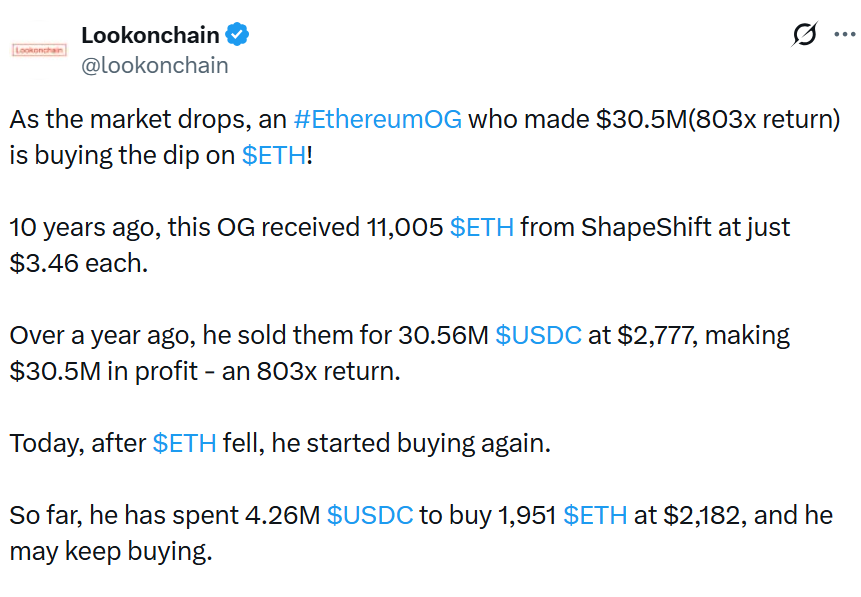
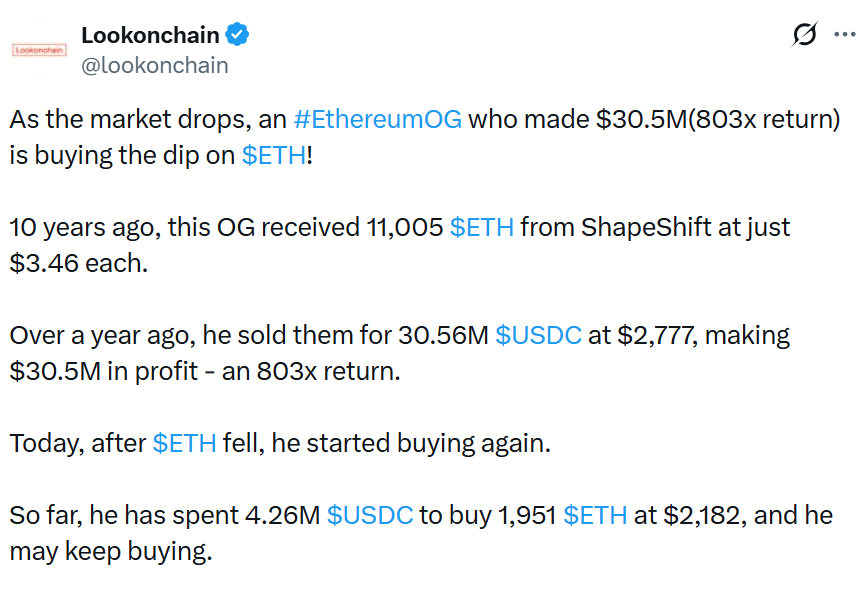
Blockchain analytics platform Lookonchain said in an X post Saturday that a whale who bought Ether more than a decade ago and sold their holdings a year ago has started buying again.
Source: Lookonchain
The OG whale purchased 1,951 Ether at $2,182, and Lookonchain speculated “he may keep buying.”
Ether under pressure amid Middle East conflict
Lee said Monday that rising oil prices, which soared after the conflict in the Middle East escalated earlier this year, have been a consistent drag on Ether’s price. He predicted that a reversal in oil prices could lead to Ether recovering.
Ether reached an all-time high of $4,946 in August 2025 but has since fallen about 57%. Analysts have predicted the token could still rise before the end of the year.
Related: Ethereum Foundation hits ‘Glamsterdam’ milestones, names new protocol leads
Financial institution Citigroup predicted in March that Ether could reach $3,175 in the next 12 months. In a bull case, however, it could hit $4,488, driven by stablecoin and tokenization interest and usage.
Meanwhile, CoinGecko, citing prediction market data, speculated that Ether has a 48% chance of ending the year at $1,500 and a 25% chance of ending the year at $3,500.
Earlier this year, banking giant Standard Chartered had a more bullish outlook. Geoffrey Kendrick, the bank’s head of digital assets research, said in a January report that Ether could hit $7,500 by the end of the year, driven by growing adoption of blockchains and onchain products.
Magazine: Guide to the top and emerging global crypto hubs — Mid-2026

Think You Know Apple? Prove It in CNET’s Big Guessing Game: Apple Edition

BREAKING: Leaked Iran Deal Sends Bitcoin & Crypto SOARING | Tom Lee’s Big Warning

Mikel Arteta gives classy response to Pep Guardiola leaving Man City speculation | Football

Manchester United reach agreement with Casemiro over contract clause amid transfer speculation

US brings back mandatory military draft registration

Steven Gerrard disagrees with Gary Neville over ‘shock’ Chelsea and Arsenal claim | Football
BREAKING: Leaked Iran Deal Sends Bitcoin & Crypto SOARING | Tom Lee’s Big Warning

Still Planning To Work At 65? | Retirement, Inflation & Financial Freedom

Delta Exchange India Me Trading Kaise Kare 2026 | Crypto Trading | How To Trade In Delta Exchange
-

 Crypto World3 days ago
BloFin War of Whales 2026 Grand Prix opens registration for $5M trading championship
-

 Fashion4 days ago
Weekend Open Thread: Theory – Corporette.com
-

 Crypto World3 days ago
E-Estate Announces 1 Year Live: Washington DC Summit as Real Estate Tokenization Enters Its Next Phase
-

 Tech4 days ago
Tech Moves: Microsoft AI leader jumps to OpenAI; former AI2 exec joins Meta; and more
-
Crypto World6 days ago
Bitcoin Suisse expands with Digital Asset License and Investment Business Act Registration Approval in Bermuda
-

 Politics6 days ago
Pakistan to enter Chinese capital market as war inflation bites
-

 Crypto World6 days ago
Bitcoin Suisse expands with Digital Asset License and Investment Business Act Registration Approval in Bermuda
-
 Crypto World5 days ago
Google’s Gemini AI Predicts Incredible Solana Price by the End of 2026
-

 Business4 days ago
H&R Real Estate Investment Trust (HR.UN:CA) Q1 2026 Earnings Call Transcript
-

 Tech3 days ago
Google reimburses Register sources who were victims of API fraud
-

 Sports3 days ago
Napoleonic enters 2026 Doomben 10,000 field via Abounding withdrawal
-

 NewsBeat6 days ago
Comment on Keir Starmer surviving the day as Prime Minister like a turd that wont flush
-

 Fashion6 days ago
The Best-Kept Makeup Secret for a More Defined Face
-
 Entertainment5 days ago
Zara Larsson Has Blunt Response To Chris Brown Diss
-

 Politics7 days ago
The Trial of Majid Freeman, Verdict
-

 Politics6 days ago
Palestine’s flag becoming a regular sight at European football stadiums
-
 Crypto World5 days ago
Two AI Tokens Lead May Rally, But Risks Are Rising
-
 Tech6 days ago
Why AI is making typography a boardroom conversation
-

 Fashion2 days ago
On the Scene at Gucci’s Cruise Show in New York City: Mariah Carey, Kim Kardashian, Lindsay Lohan, Iman, and More!
-

 Politics6 days ago
The 81 MPs (so far) who have demanded tick-like Starmer out
You must be logged in to post a comment Login