

Crypto World
Tokenisation Could Cut Costs as UK Advances Stablecoin Rules


London’s financial policy circle is signaling a sharper focus on digital money, with senior Bank of England officials outlining how tokenization could drive lower costs, faster settlement, and greater competition in payments and markets. The remarks come as policymakers pursue a framework that nurtures innovation while preserving financial stability, and as the BoE signals changes to the settlement backbone that could underpin a broader digital-asset ecosystem.
Deputy Governor Sarah Breeden, speaking during City Week in London, described tokenization—the digital representation of assets and money on distributed ledgers—as a conduit to more efficient payments and markets, provided that trust and interoperability are embedded in the design. While central bank money remains the anchor of the monetary system, Breeden stressed that private-sector innovations such as tokenized deposits and regulated stablecoins are increasingly visible, and that policy must accommodate these developments without undermining resilience.
Breeden articulated a balanced vision: alongside traditional bank deposits, the public should be able to transact with tokenized bank deposits, regulated stablecoins, and potentially a retail central bank digital currency (CBDC). In her view, market competition across a broader technology and business-model spectrum should translate into lower costs and enhanced user functionality. The Bank’s transcript of the speech frames tokenization as a path to modernization, not a wholesale replacement of existing money or payment rails.
The BoE has signaled that its thinking is being refined through close collaboration with industry, government, and regulators to craft a framework that supports innovation while safeguarding financial stability. This stance aligns with ongoing industry engagement as policymakers reassess the UK’s stance on digital assets and the role of private money within an anchored monetary system.
Key takeaways
- Tokenization as a catalyst for efficiency: Representing assets and money on digital ledgers could improve payment efficiency and market functionality, contingent on robust trust, interoperability, and risk controls.
- Central bank money remains the anchor: The BoE emphasizes that sovereign money will continue to underpin the monetary system even as tokenized deposits and regulated stablecoins gain traction.
- Settlement infrastructure evolving toward near-continuous operation: The BoE proposed extending the operating hours of RTGS/CHAPS to near 24/7 to support cross-border payments and securities settlement amid growing tokenization activity.
- Regulatory recalibration for stablecoins and digital assets: The Bank is reconsidering its approach to pound-denominated stablecoins, with a focus on reducing friction for early adopters while maintaining safeguards against financial instability.
Tokenization, interoperability and the anchor role of central bank money
The Bank of England’s policy direction treats tokenization as a potential enabler of more efficient and resilient financial markets, not as an immediate replacement for established systems. By representing real assets and public money on auditable digital ledgers, tokenization could streamline settlement cycles, reduce counterparty risk, and broaden access to payment services. However, officials insist that any transition must preserve trust in the monetary framework and ensure interoperability across platforms and providers.
Breeden underscored a pragmatic stance: central bank money remains the universal reference point, while private innovations—such as tokenized deposits and regulated stablecoins—could coexist with traditional products. The policy objective is clear, she said: unlock higher competition, deploy a wider set of technologies, and deliver better outcomes for users without compromising safety or financial stability. The emphasis on interoperability signals a preference for cohesive standards and governance that can survive cross-border and cross-platform interactions.
From a regulatory perspective, the emphasis on a coordinated framework has implications for banks, payment firms, and digital-asset counterparties. Institutions seeking to deploy tokenized products would need to demonstrate robust risk management, reliable reserve backing where applicable, and clear compliance with AML/KYC requirements. The BoE’s approach appears to favor an openness that invites innovation while maintaining robust oversight—a stance that resonates with global policy debates on digital money and regulatory harmonization.
According to Cointelegraph reporting linked to the Bank of England’s public communications, policymakers are engaging with industry to align innovation with safety standards. The takeaway for compliance teams and financial institutions is that tokenization is moving from pilot-test scenarios toward practical deployment, but only within a carefully designed regulatory envelope that preserves monetary stability and consumer protection.
Extending settlement hours: modernizing core settlement services
In a parallel move to modernize the settlement framework, the BoE proposed extending the operating hours of its core settlement infrastructure, with near-continuous availability. The plan aims to better accommodate tokenized assets and evolving digital-asset workflows, supporting more efficient cross-border payments and the settlement of securities as technology-enabled assets become more prevalent.
The proposal comes after remarks from Breeden that the monetary framework should not only accommodate innovation but actively support it. By offering longer settlement windows, the BoE intends to reduce friction for users and for industry participants operating in a rapidly digitizing market environment. The change would entail thoughtful risk controls and governance to ensure resilience during extended operations and to maintain the integrity of the settlement rails that underpin the UK financial system.
The policy direction aligns with a broader objective to position the United Kingdom as a competitive hub for digital-asset activity. A more flexible settlement timetable could enable smoother cross-border activity and make the domestic settlement system more attractive to international participants seeking predictable, regulated access to UK rails. For institutions, this shift implies updated operational risk frameworks, new liquidity management considerations, and enhanced reconciliation processes to cope with a longer window of activity.
Policy signals since Breeden’s City Week remarks indicate a willingness to adapt the UK’s regulatory and operational posture to a digital-money era. The BoE has also indicated that its stance on stablecoins—particularly pounds-denominated variants—has evolved in recent months as policymakers seek to balance industry engagement with prudent prudential considerations. The extended-hours proposal complements this approach by reducing settlement friction for those experimenting with or deploying tokenized deposits and related products.
Regulatory recalibration, stablecoins, and market-structure implications
The BoE’s evolving stance on stablecoins reflects a broader effort to calibrate risk while enabling practical use cases for digital assets. Officials have signaled a more flexible approach to reserve and backing requirements than previously proposed, emphasizing industry consultation and the need to avoid unnecessary barriers to adoption. The reexamination of consumer holding limits and other prudential safeguards is aimed at lowering friction for early adopters, provided robust safeguards are in place to maintain financial stability and consumer protection.
The CBDC conversation also features prominently in the Bank’s public discourse. The BoE’s CBDC Academic Advisory Group acknowledged that a retail CBDC is not strictly necessary to preserve monetary uniformity but could play a valuable supporting role as cash usage declines. This nuanced view reflects a policy environment that weighs the benefits of a potential digital-retail instrument against the complexities of design, privacy, access, and monetization of monetary policy transmission.
For institutions, the regulatory landscape remains a central factor in how and when to engage with tokenized products. Licensing regimes, compliance frameworks, and oversight expectations will shape the pace and manner of participation in digitized markets. While the UK signals openness to innovation, the emphasis remains squarely on resilience, risk management, and a coherent supervisory pathway that can adapt to evolving technologies and business models.
From a systemic perspective, the BoE’s actions illustrate how a major financial center is reconciling innovation with oversight. The move to 24/7 settlement capabilities, coupled with an adaptable stance on tokenization and stablecoins, signals a policy framework designed to attract institutional participation while maintaining rigorous standards for stability and consumer protection. This approach could influence the global regulatory narrative, encouraging other jurisdictions to pursue parallel reforms that balance fintech advancement with prudential safeguards.
Closing perspective
As tokenization and digital-money frameworks become more central to policy discussions, the Bank of England’s course suggests a staged, risk-conscious evolution of the UK’s financial plumbing. Institutions should monitor regulatory updates, settlement-infrastructure proposals, and the ongoing dialogue around stablecoins and CBDC to anticipate changes in licensing, compliance requirements, and operational preparedness. The overarching question remains whether the balance between innovation and stability can be maintained as these technologies mature and scale.

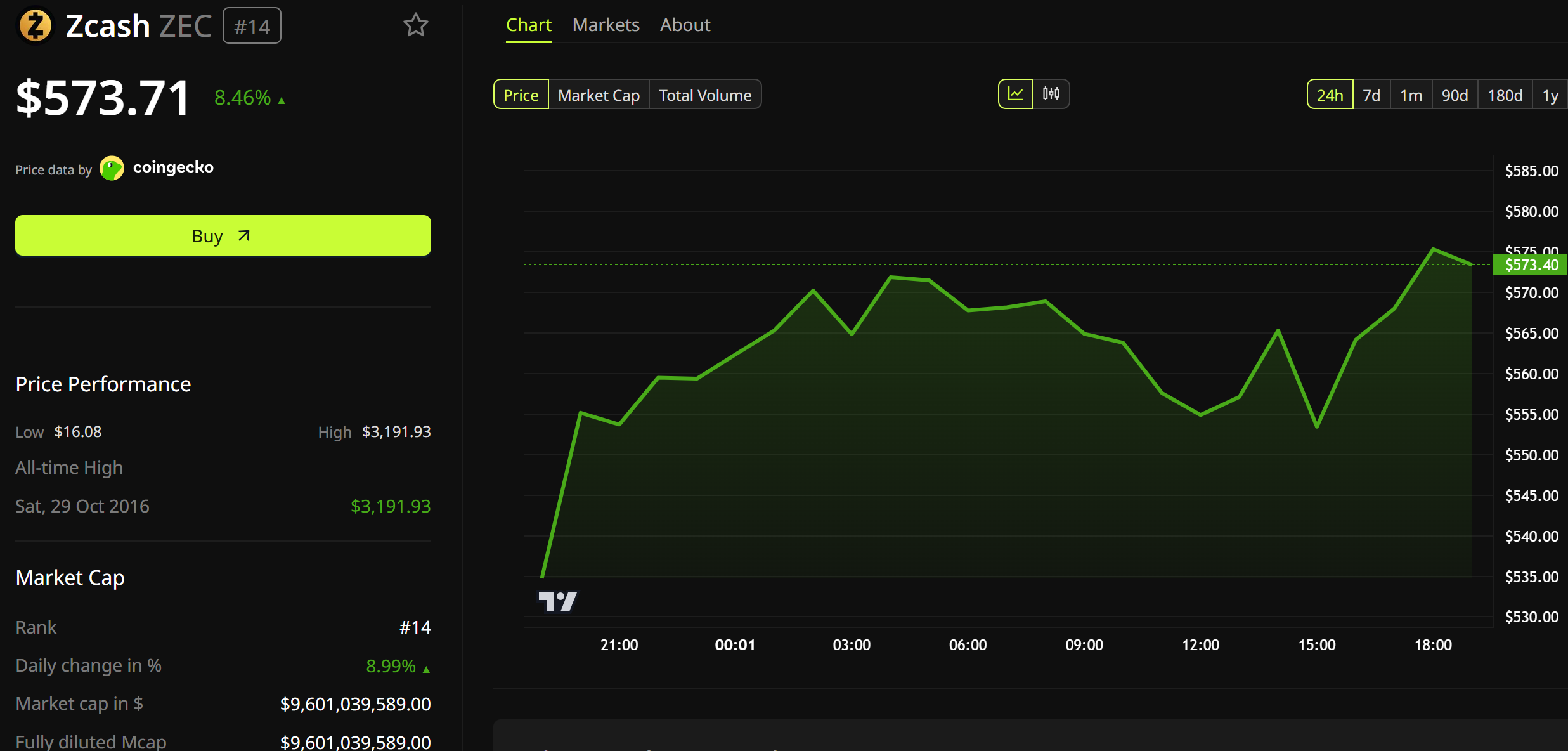
Zcash (ZEC) jumped near $580 on Tuesday after the US Securities and Exchange Commission (SEC) closed its Zcash Foundation investigation. A Q1 report also revealed a $36.7 million Foundation treasury.
The token gained nearly 10% over 24 hours. ZEC drew privacy traders back into a name battered by Electric Coin Company staff exits earlier in 2026.

The bounce extended a rally that has unfolded since institutional flows returned to the privacy sector earlier in 2026.
Follow us on X to get the latest news as it happens
Zcash SEC Investigation Closes Without Penalties
The Foundation said in its Q1 2026 report that the SEC concluded its review of the nonprofit. The agency informed leadership that it does not plan to recommend enforcement action.
The probe began on August 31, 2023, when staff served the Foundation with a subpoena. The case was filed as “In the Matter of Certain Crypto Asset Offerings,” designated SF-04569.
“We are pleased to announce that the SEC has concluded its review and informed us that it does not intend to recommend any enforcement action or other changes against Zcash Foundation regarding this matter,” Zcash Foundation noted.
The closure was formally communicated in January. It removes a regulatory overhang that had followed Zcash for over two years.
Foundation officials said the nonprofit cooperated fully throughout the process. No penalties, fines, or required changes were attached to the outcome.
The decision aligns with a broader pullback in SEC crypto cases seen since 2025. Several other projects, including Aave, OpenSea, Robinhood, Gemini, and Ondo, have seen probes closed without charges in recent quarters.
Foundation Discloses $36.7 Million Treasury
The same quarterly disclosure showed about $36.7 million in liquid holdings at the end of March. ZEC accounted for roughly 58.6% of the balance.
The Foundation also held Bitcoin, U.S. dollar reserves, and a small ether position. Average monthly operating expenses ran near $272,500.

That position gives the nonprofit a multi-year runway to keep funding engineering work. The cash buffer matters because most Electric Coin Company contributors left during a governance dispute.
The Q1 report stressed that blocks continued to settle, transactions cleared normally, and user privacy stayed intact through the transition.
Engineering output remained active in the period. The Foundation shipped several Zebra node releases and advanced the Z3 stack. FROST multi-party signing also progressed, while work continued on NU7, the next planned network upgrade.
Grayscale recently flagged Zcash as one of its preferred private-asset names. The endorsement drew fresh attention from larger allocators.
Traders watching the next leg will track NU7 timing and Foundation spending discipline. They will also weigh whether the SEC’s retreat from crypto cases holds through the next rule cycle.
Subscribe to our YouTube channel to watch leaders and journalists provide expert insights
The post Zcash Price Surges 10% Amid 2 Major Developments appeared first on BeInCrypto.
The United States and the broader global economy are facing an increasingly fragile macroeconomic backdrop. U.S. inflation has risen to 3.8% year-over-year, per April consumer price index (CPI) data, and real wages have turned negative with long-term Treasury yields climbing to multi-year highs.
Amid a hostile macro environment, bitcoin (BTC) has pulled back and erased the gains from its early-month rally. This correction is further driven by weakening institutional demand and outflows from spot exchange-traded funds (ETFs).
Weakening Institutional Demand
According to this week’s Bitfinex Alpha report, the U.S. macro backdrop has shifted toward a “higher-for-longer inflation environment.” Market expectations for Federal Reserve rate cuts have been removed, with rate hikes becoming a more likely scenario as the year progresses.
With the possibility of renewed tightening rising, bitcoin is losing momentum and becoming more vulnerable to exogenous shocks and to a high-for-longer interest rate regime. Unfortunately, this development comes at a time of deteriorating liquidity conditions – the worst since February.
Analysts said the two primary engines of marginal demand, which are spot ETFs and yield-bearing products like Strategy’s STRC, are currently under duress. ETFs ended their six-week inflow streak last week, recording almost $1 billion in net outflows. On-chain capital flows currently sit at $2.8 billion, far below the $10 billion historically associated with durable bull phases.
“As market sentiment transitions from acute fear toward persistent uncertainty, analysts say the validity of the current recovery now hinges almost entirely on whether fresh net capital continues entering the market,” analysts explained.
Market Vulnerable to Further Downside
As Bitfinex warned two weeks ago, the Bitcoin market is not positioned for sustained upside. Despite the rally toward $82,000, institutional conviction has remained insufficient to absorb macro shocks and rate volatility, leaving the market vulnerable to further correction. Bitcoin is already trading at a two-week low, reflecting a significant structural problem that could worsen due to hostile macro conditions.
At the time of writing, BTC was trading around $76,700, roughly 6.5% below its weekly opening of $82,160. While the asset is testing levels near the monthly open, analysts expect the price to fluctuate between $72,000 and $80,000. Net capital flows, as measured by the Realized Cap 30-Day Net Position Change, will determine whether the broader recovery structure remains intact in the coming weeks.
The post Bitcoin Faces Correction as Institutional Demand Weakens Amid Macro Pressure: Bitfinex appeared first on CryptoPotato.

Iran’s army warned it would “open new fronts” against Trump and the United States if military operations resume, rattling crypto across the board.
Iran’s army spokesperson Mohammad Akraminia warned that Tehran would deploy “new equipment and new methods” if the US restarts strikes, according to Iran’s ISNA news agency. The threat lands as Trump is reportedly meeting national security advisers to weigh options for resuming military action despite having called off a planned attack Tuesday to allow peace talks to continue.
Iran’s influence over Hormuz shipping routes makes any escalation a direct macro risk for global markets. Crypto, already fragile, has no cushion here.
The data points to a market already stressed before this headline hit. Bitcoin ETF outflows approached $1 billion as of May 19, while hawkish Bank of Japan commentary added a second pressure vector. Risk appetite is thin.
Discover: The best pre-launch token sales
Trump, Iran, Bitcoin, and Crypto
Bitcoin is pinned in the mid-$76,000s despite Trump ceasefire decision. Prediction markets are quoting BTC at $76,750 for the May 19 5pm EDT outcome. A stark reversal from $82,300 on May 6, or a 6.7% drawdown in under two weeks.
First resistance sits at $77,000–$78,000. Reclaiming that band on volume would be the minimum requirement to shift short-term sentiment from defensive to neutral. Failure there keeps the door open to a retest of the low-$76,000 zone and potentially deeper support levels.

Total crypto market cap still managed to hold $2.5 trillion, suggesting altcoin strength is partially absorbing Bitcoin’s weakness. This makes the rotation trade interesting.
Discover: The best crypto to diversify your portfolio with
Bitcoin Hyper Targets Early-Mover Upside as BTC Tests Key Levels
When Bitcoin consolidates under pressure and institutional capital rotates toward Ethereum and altcoins, early-stage infrastructure plays start attracting attention from traders who’ve already caught the spot-BTC trade. The question becomes: where’s the asymmetric upside now?
Bitcoin Hyper ($HYPER) is positioned at the intersection of Bitcoin’s security and Solana-level execution speed. Hyper is the first Bitcoin Layer 2 with SVM integration that delivers faster performance than Solana itself.
The project also targets Bitcoin’s three core limitations: slow transactions, high fees, and the absence of programmable smart contracts.
The current price is $0.0136, with $32.7 million raised to date, plus the 35% APY staking rewards available during the presale period. Features include a Decentralized Canonical Bridge for BTC transfers and extremely low-latency Layer 2 processing.
The post Crypto Suffers as Iran Threatens Escalation Despite Trump Pause appeared first on Cryptonews.
Bitcoin (BTC) price dropped to $76,500 on Monday, erasing nearly all of this month’s gains as fresh US-Iran war tensions soured the crypto market sentiment. This has led investors and traders to reevaluate their risks and stay cautious, with many recent buyers selling their BTC at a loss.
Key takeaways:
- Bitcoin short-term holders sold over 10,000 BTC worth approximately $770 million at a loss on Monday.
- Analysts agree that pushing Bitcoin’s price below $76,000 could trigger a fresh downtrend toward $65,000-$70,000.
Bitcoin’s “weak hands” realizing losses
Bitcoin has retraced 7% from its local high of $82,800 set on May 6. The rejection from the 200-day moving averages at $82,000, the daily close below the true market mean, and the short-term holder cost basis around $78,000 have cemented a more risk-off stance among Bitcoin investors.
Related: Bitcoin’s trend-defining battle starts at $74K support: Analyst
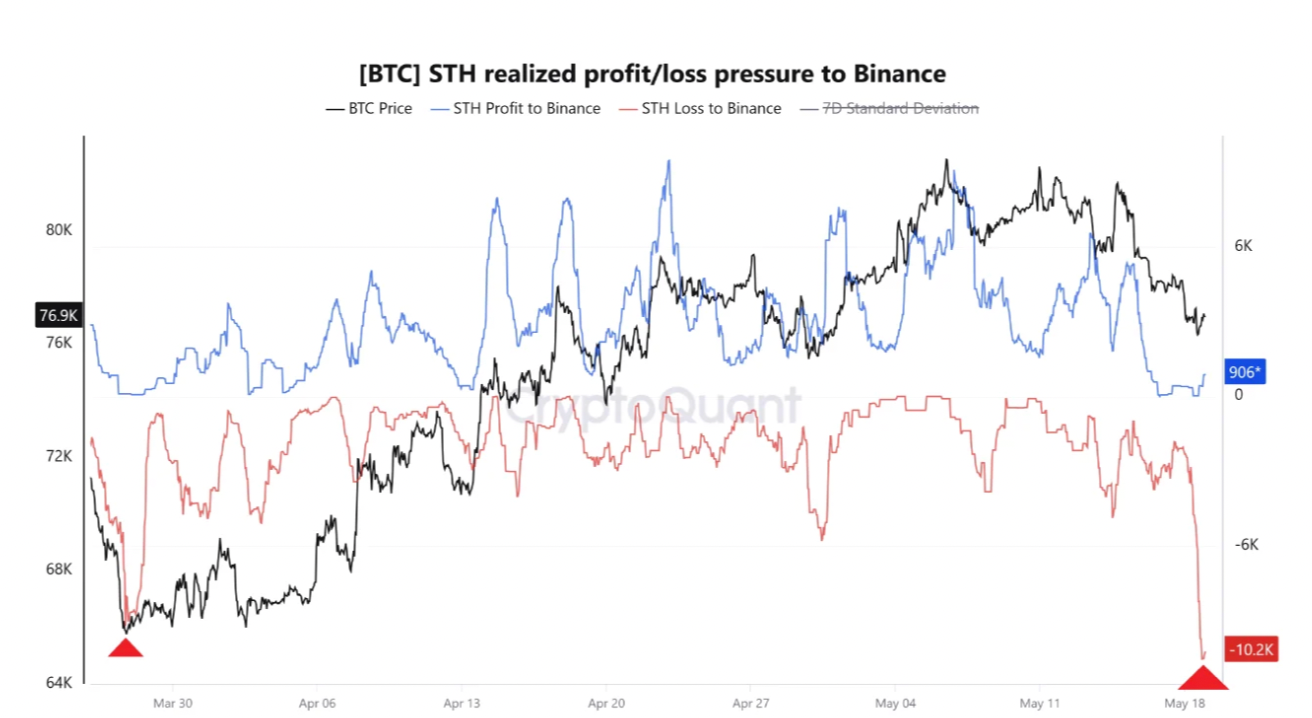
Onchain data from CryptoQuant showed that more than 10,000 BTC were transferred by short-term holders — investors who have held the asset for less than 155 days — to Binance at a loss on Monday.
These moves occurred with Bitcoin at roughly $76,900, about 2% below their average purchase price of $78,440, suggesting that recent buyers sent approximately $769 million in BTC to Binance at a loss.
This “reflects short-term holder stress, forced selling, or capitulation from weaker hands during a correction,” CryptoQuant analyst Amr Tah said in a QuickTake post on Tuesday.
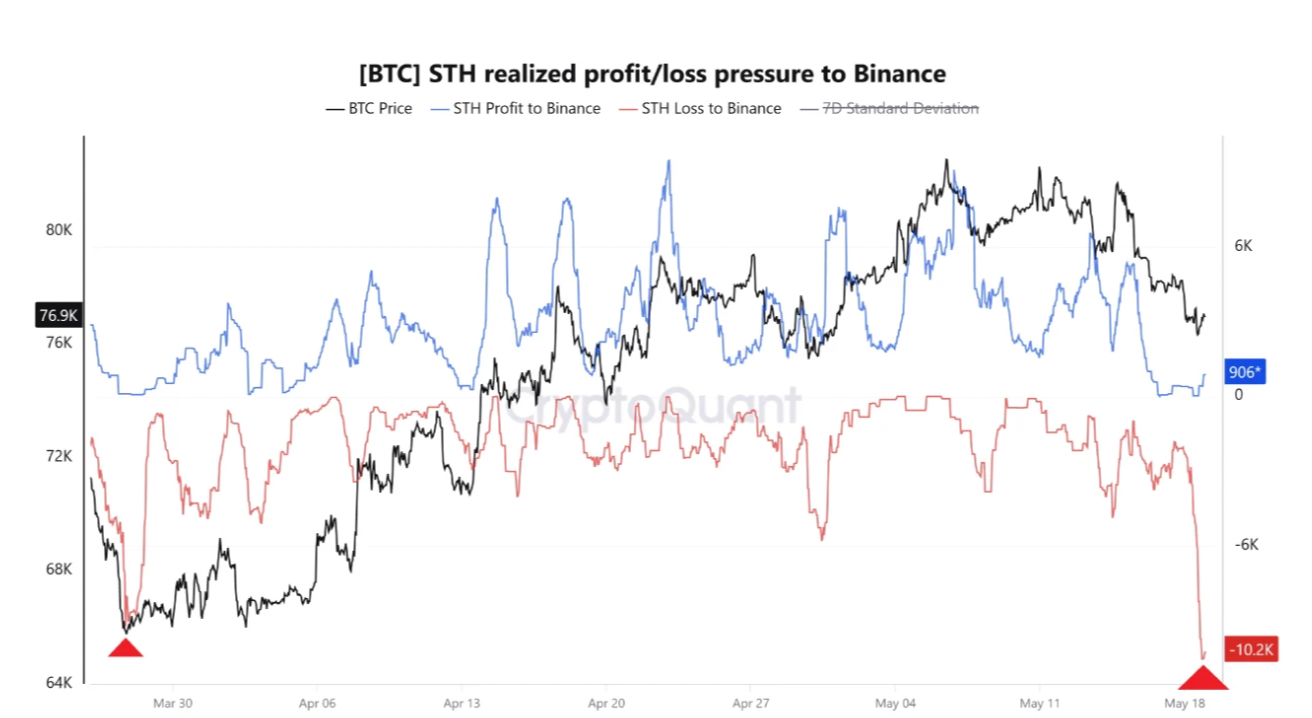
Bitcoin: Transfer volume by STH in loss to Binance. Source: CryptoQuant
This activity underscores a familiar pattern of short-term speculators panic-selling during market dips, frequently realizing losses.
A similar occurrence in mid-November 2025 preceded a 15% BTC price decline to $78,400 from $96,000 in less than five days.
Additional data from Glassnode shows that more than “7.8M BTC are currently held at a loss,” a supply overhang that the market would need to “absorb before any sustained move higher becomes structurally credible.”
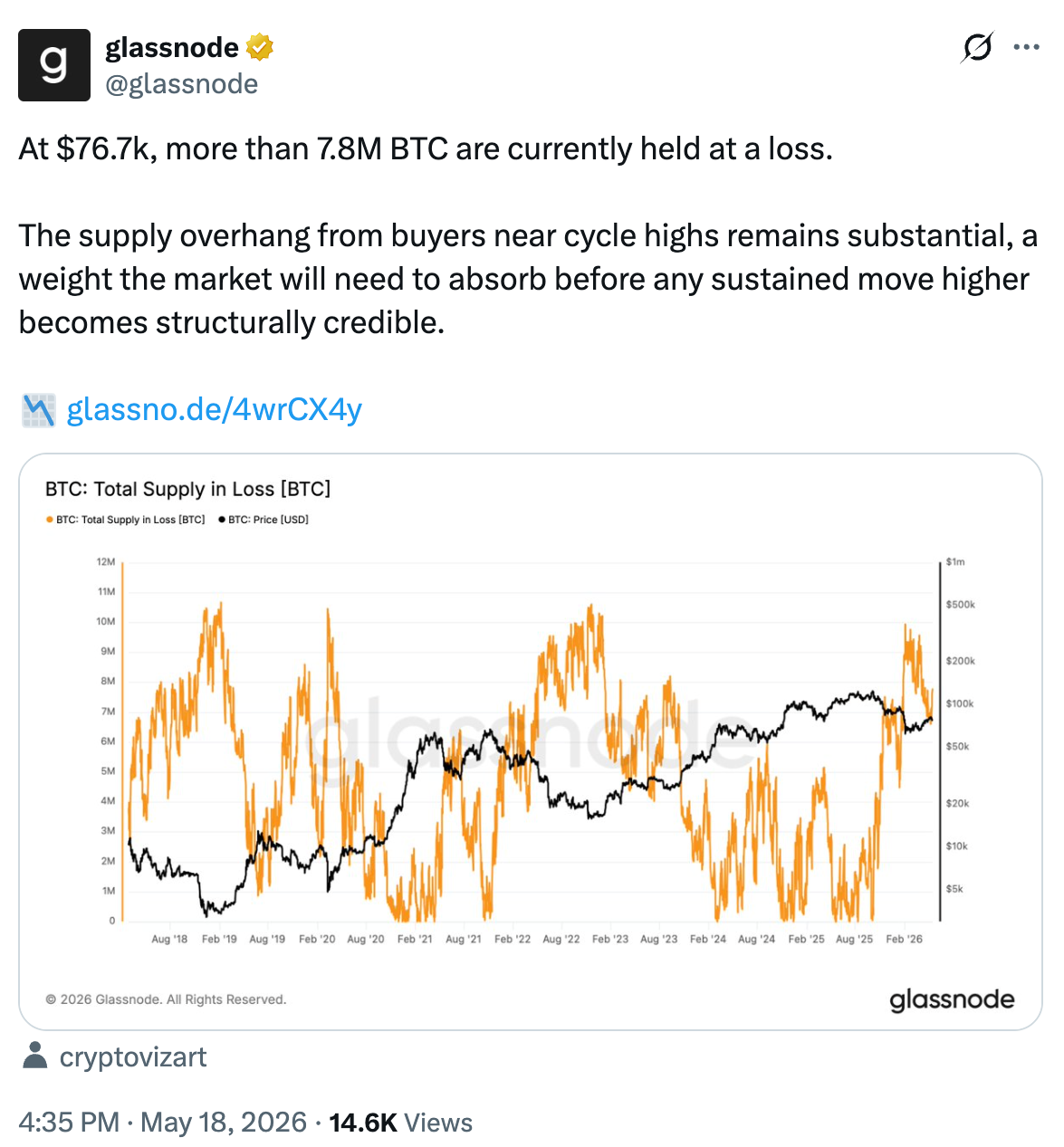
BTC total supply in loss. Source: Glassnode
Also accompanying Bitcoin’s slump are heavy outflows from US-based spot Bitcoin exchange-traded funds (ETFs), which have recorded negative flows for six out of the last eight days.
These investment products saw $648.6 million in net outflows on Monday, the largest withdrawal since Jan. 29.
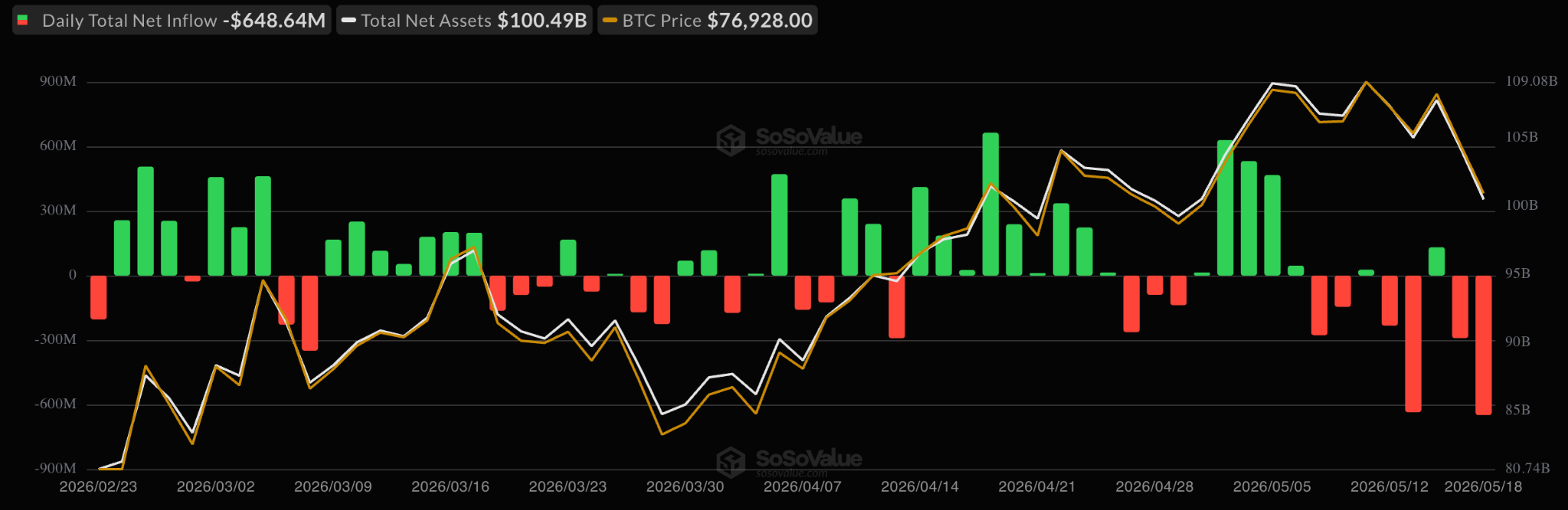
Spot Bitcoin ETF flows table. Source: Farside Investors
Global Bitcoin investment products also recorded $981.5 million in net outflows during the week ending May 15, suggesting declining institutional appetite for BTC.
“Markets are getting absolutely hammered,” analyst Alek_Carter said in an X post on Tuesday, referring to the large outflows from Bitcoin investment products, adding:
“Money is rotating out fast, panic is creeping in, and traders are clearly hitting the risk-off button hard.”
As Cointelegraph reported, record-low retail investor activity, aggressive selling in the futures markets and weakening spot demand are pulling down Bitcoin’s price to new May lows.
How low can Bitcoin price go?
The Bitcoin HODL Waves indicator, which tracks the age distribution of BTC holdings, suggests Bitcoin could bottom at $65,500-$70,500 if current market weakness continues.
Historically, spikes in long-term holder activity and declining short-term speculation have coincided with major market bottoms before recoveries.
The chart below shows a stronger long-term holder base (the blue/purple bands are noticeably thicker), “reflecting growing institutional adoption,” CryptoQuant analyst Sunny Mom said in a Quicktake analysis on Tuesday.
This suggests that the supply structure is structurally stronger in the current cycle than before, “which changes how BTC forms its bottom,” the analyst said, adding:
“Our predicted price range for this cycle’s bottom is $65.9K–$70.5K. If $70.5K holds, we’ll slowly grind out a bottom in the upper range.”
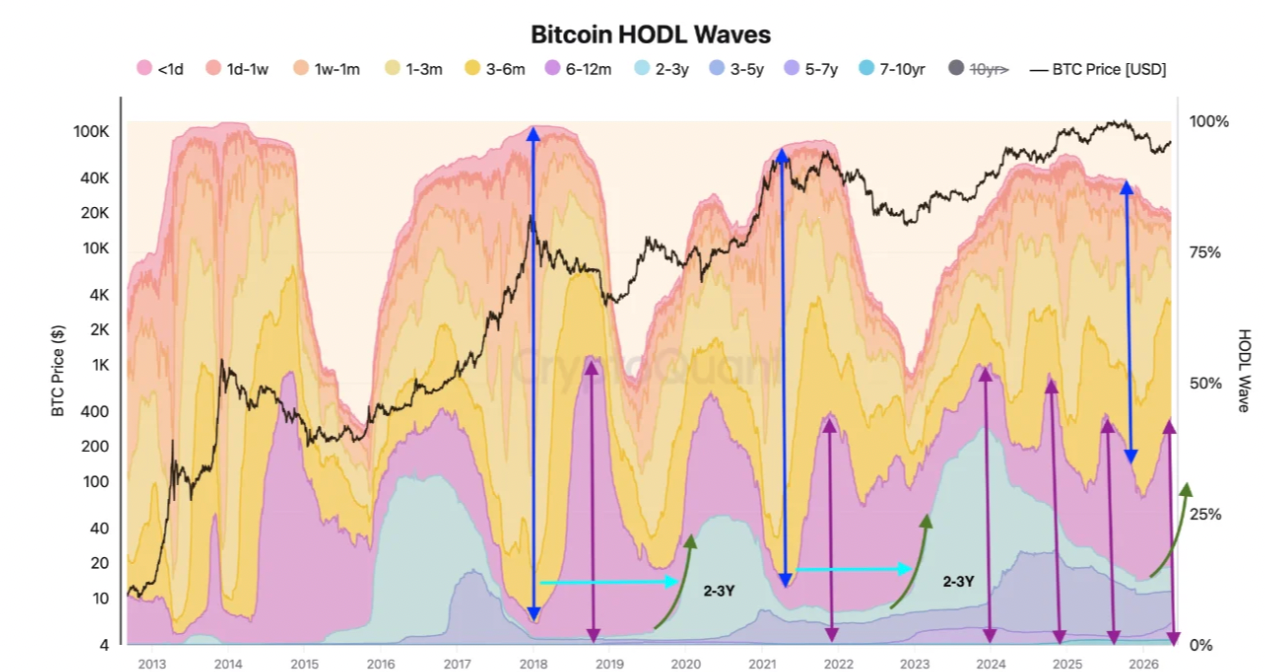
Bitcoin HODL wave indicator. Source: CryptoQuant
From a technical perspective, Bitcoin is printing the fifth consecutive daily red candle, suggesting that the “momentum is starting to shift back to the bears,” analyst Alex Marzell said on Monday in a post on X, adding:
“Bitcoin may come back to retest the breakout zone around $70K support.”
Echoing this sentiment, MN Capital founder Michael van de Poppe said this “doesn’t look great” for Bitcoin, adding that the price needs to hold support at $74,500-$76,000 “in order to get back some momentum in the markets.”
“If this area doesn’t hold, then we’re most likely cascading through the lows of the recent rally and test <$65,000 for support.”
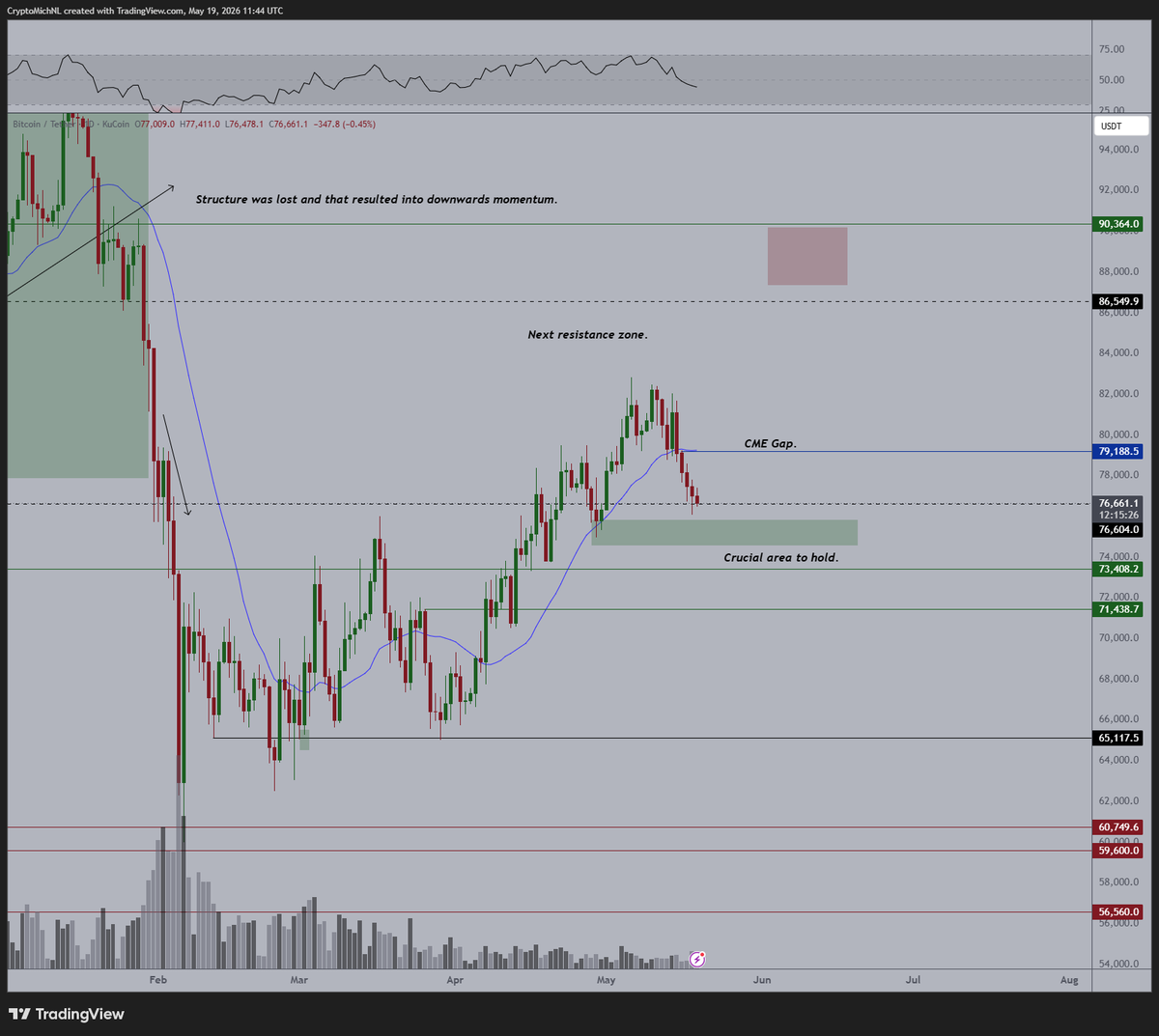
BTC/USD daily chart. Source: X/Michael van de Poppe
As Cointelegraph reported, a break below the 50-day SMA at $76,000 would increase the risk of the BTC/USDT pair dropping to $65,000. in the short term.
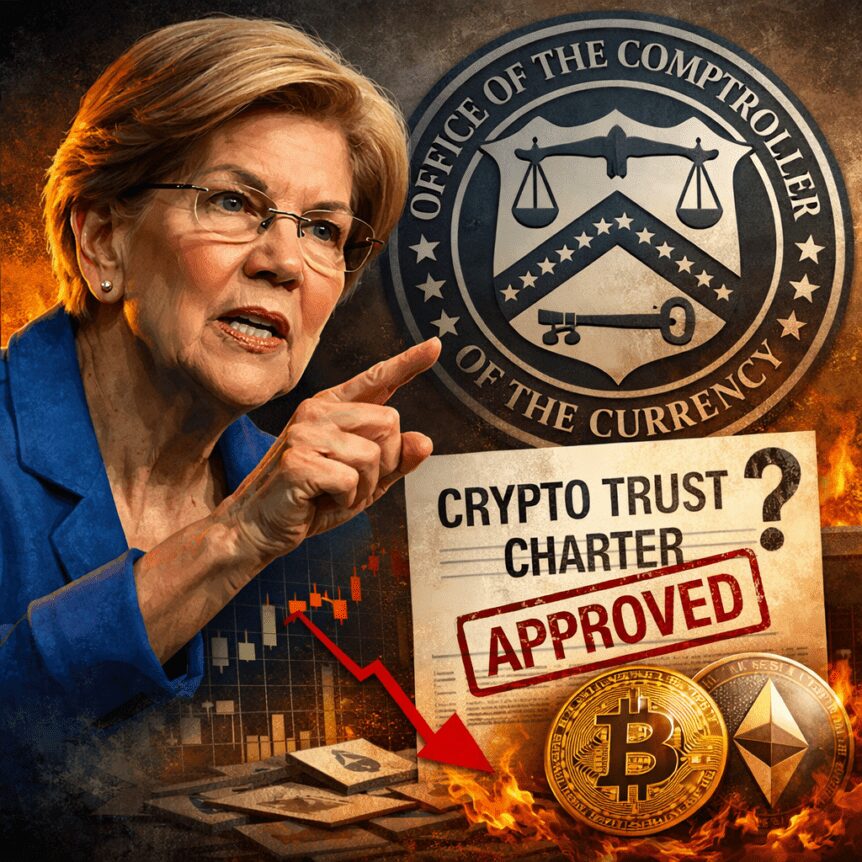
Massachusetts Senator Elizabeth Warren has intensified scrutiny of the Office of the Comptroller of the Currency’s push to charter crypto firms as national trust banks, arguing that such moves may violate banking law and blur the lines between banking and crypto activities.
In a letter addressed to OCC Acting Comptroller Jonathan Gould, Warren contends that the agency has approved at least nine national trust charters for crypto companies whose activities “appear to go far beyond the narrow set of activities permitted by law,” potentially breaching the National Bank Act. She has requested a full accounting: all national trust charter applications approved since December 2025, any conditional approvals, and all communications between the OCC and figures connected to the Trump administration, including President Trump, his family, and White House officials. Source: US Senate Banking Committee.
Warren—ranking member of the Senate Banking Committee—described the charter push as a bid by certain crypto companies to act as banks while avoiding the safeguards that come with banking status. “These companies are effectively crypto banks that want to evade the fundamental safeguards and obligations that come with being a bank,” she wrote, warning that the regulator’s approach risks consumers and the integrity of the banking system. The OCC did not provide an immediate comment when reached by Cointelegraph.
Key takeaways
- Senator Elizabeth Warren alleges the OCC has approved nine national trust charters for crypto firms that may exceed the National Bank Act, calling for full disclosures of approvals since December 2025.
- Kraken’s parent Payward filed on May 8 for a national trust charter, aiming to offer fiduciary custody and related services for digital assets under the Payward National Trust Company.
- A national trust charter permits custodial and fiduciary services without traditional deposit-taking or lending, potentially reducing regulatory burdens for crypto custodians.
- The debate sits within broader political and regulatory tensions, including Warren’s criticisms of perceived conflicts of interest and ongoing discussions around the CLARITY Act and related crypto legislation.
- Investors should monitor how, if at all, these charters affect custodial infrastructure, consumer protections, and the boundary between banking regulation and crypto activity.
Kraken bid on the OCC’s table, signaling a broader push for crypto custody
On May 8, Payward—the parent company of the cryptocurrency exchange Kraken—submitted an application to the OCC for a national trust charter. If approved, the charter would allow Payward to provide fiduciary custody and other services primarily for digital assets under the proposed Payward National Trust Company. This aligns with a broader pattern of crypto firms seeking formal, bank-like status to access regulated custodial services and potentially traditional financial rails without engaging in deposit-taking or lending, a hallmark of a national trust charter.
A national trust charter is distinct from a conventional bank charter. It would permit these providers to offer custodial and fiduciary services for clients’ assets while avoiding the full spectrum of deposit-taking and commercial lending requirements typical of traditional banks. The resulting regulatory regime could offer more clarity and oversight for digital-asset custody but may also raise questions about the adequacy of consumer protections and the precise scope of activities allowed under such charters.
Regulatory tensions and the politics of crypto banking
The push for national trust charters sits at the intersection of a broader regulatory debate over how the U.S. should oversee crypto-related financial services. Warren has been a vocal critic of perceived policy conflicts that connect political figures to the crypto industry. In recent weeks, she has pressed for clarifications in crypto market structure legislation—the CLARITY Act—and has urged regulators to slow or reconsider approvals around charter applications tied to political figures and their families, including references to World Liberty Financial, a Trump family–backed initiative that filed for a charter earlier in the year. Cointelegraph coverage.
From the regulator’s perspective, the central question is whether national trust charters strike an appropriate balance between enabling legitimate custody and ensuring robust consumer protections and financial stability. Critics warn that creating a parallel, crypto-specific banking lane could sow regulatory fragmentation if not harmonized with federal banking standards. Supporters argue that formal chartering could bring necessary discipline, tailor oversight for digital assets, and improve confidence for institutional participants seeking regulated custody services.
As the regulatory dialogue continues, lawmakers and industry participants will watch for concrete OCC actions: new charters granted, denials, or policy statements clarifying the framework for crypto custodians. In the meantime, the OCC’s current approach remains under close political scrutiny, with potential implications for market participants seeking regulated custody and for investors assessing the risk and governance of crypto infrastructure.
Cointelegraph requested comment from the OCC but did not receive an immediate response.
Earlier context around Warren’s crypto governance stance and related regulatory efforts is available in ongoing coverage from Cointelegraph, including notes on her push to curb perceived conflicts of interest and to shape crypto policy more firmly in Congress. For reference, see Warren’s remarks on financial policy and related reporting: Warren’s concerns about crypto bailouts.


The SEC is developing a new regulatory framework that would allow digital versions of publicly traded securities to trade on blockchain networks in the US.
Crypto World
A viral hedgehog, Vitalik Buterin, and a bow: the GraphDex launch that crypto won’t forget

5,800 users in two hours. One QR code. One bow that went viral.
Some platforms launch with a whitepaper. Some with a token. GraphDex launched with a hedgehog, a condom, and the co-founder of Ethereum bowing in respect.
A short video from Token2049 Singapore, recorded in September 2024, resurfaced across X this week at precisely the moment GraphDex went live. In this video, the project’s hedgehog mascot moves through the conference floor, greets attendees, and hands a branded condom to Vitalik Buterin. The condom carries GraphDex branding and a QR code that opens the app directly. Buterin takes it and then bows to the hedgehog.

Vitalik Buterin receives a branded condom from the GraphDex hedgehog mascot at Token2049 Singapore, September 2024. Video shows Buterin bowing to the hedgehog immediately after.
The clip sat dormant for over a year. Then the product launched – and everything changed.
The bow heard around crypto
In a space where Vitalik Buterin is treated as something between a philosopher-king and a meme, a moment of him bowing to a hedgehog mascot is not a small thing. It is the kind of image that crypto Twitter cannot ignore, doesn’t want to ignore, and will share without being asked.
The bow was brief, yet the reaction to it lasted longer.
Within two hours of GraphDex going live, the platform registered 5,800 users across its web app and Telegram mini-app. The clip had no destination in 2024; in 2026, it pointed to a live product, and that shift transformed a conference moment into a distribution mechanism that no marketing budget could replicate.
“We always believed the hedgehog would have a second moment. The product was ready. The clip found its timing.” – GraphDex representative
What Vitalik bowed toward
GraphDex is a unified crypto terminal built around a problem every active Solana trader knows intimately: too many tools, not enough time.
The platform consolidates Solana DEX trading, real-time token discovery, wallet and social tracking, Polymarket-powered prediction markets, copytrading for prediction markets – a feature that does not exist on Polymarket itself – and AI-powered signal analysis into a single non-custodial interface.
The non-custodial architecture, built on Privy infrastructure, means user funds stay in user-controlled wallets at all times. After FTX and Celsius, this is less of a feature and more of a baseline expectation. GraphDex built it in from day one.
The copytrading layer for prediction markets is the product’s most structurally novel element. Users can filter top forecasters by PnL and win rate and mirror their positions automatically — bringing the logic of copy trading to outcome-based markets for the first time at this scale.
The hedgehog is still out there
The clip continues to move through X, attaching itself to trading accounts, KOL feeds, and communities with no prior connection to GraphDex. Each share extends the loop: new viewers see the bow, scan the QR code, open the platform, and encounter the same dynamics that made the clip spread – narrative momentum, real-time signals, and fast-moving markets – now visible and actionable in one place.
About GraphDex
GraphDex is a unified crypto terminal combining Solana DEX trading, Polymarket prediction markets with copytrading, AI signal analysis, Bubble Maps, and non-custodial Privy wallet infrastructure.
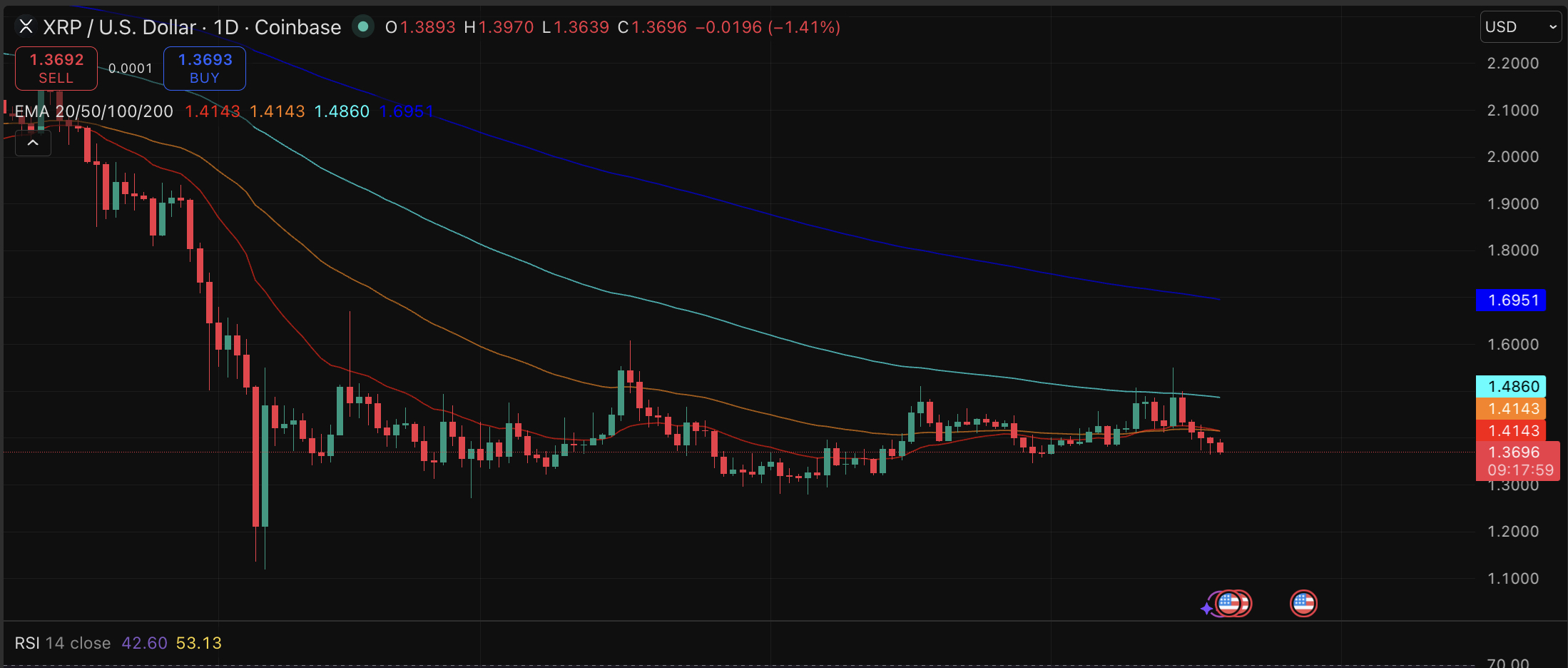
XRP price might be down under its support, but there’s a divergence between short-term technicals and long-range price prediction that has never looked sharper. Bears point to a chart sitting below every major moving average. Bulls point to $27. Both camps have data on their side.
XRP’s current price is below the 10, 20, 50, 100, and 200-day EMAs, and it is bearish. Data reinforces that, tagging market sentiment at 89% Bearish with a Fear & Greed score of just 39. Meanwhile, institutional ETF demand has visibly cooled, removing one of the cleaner near-term re-rating arguments from the table.
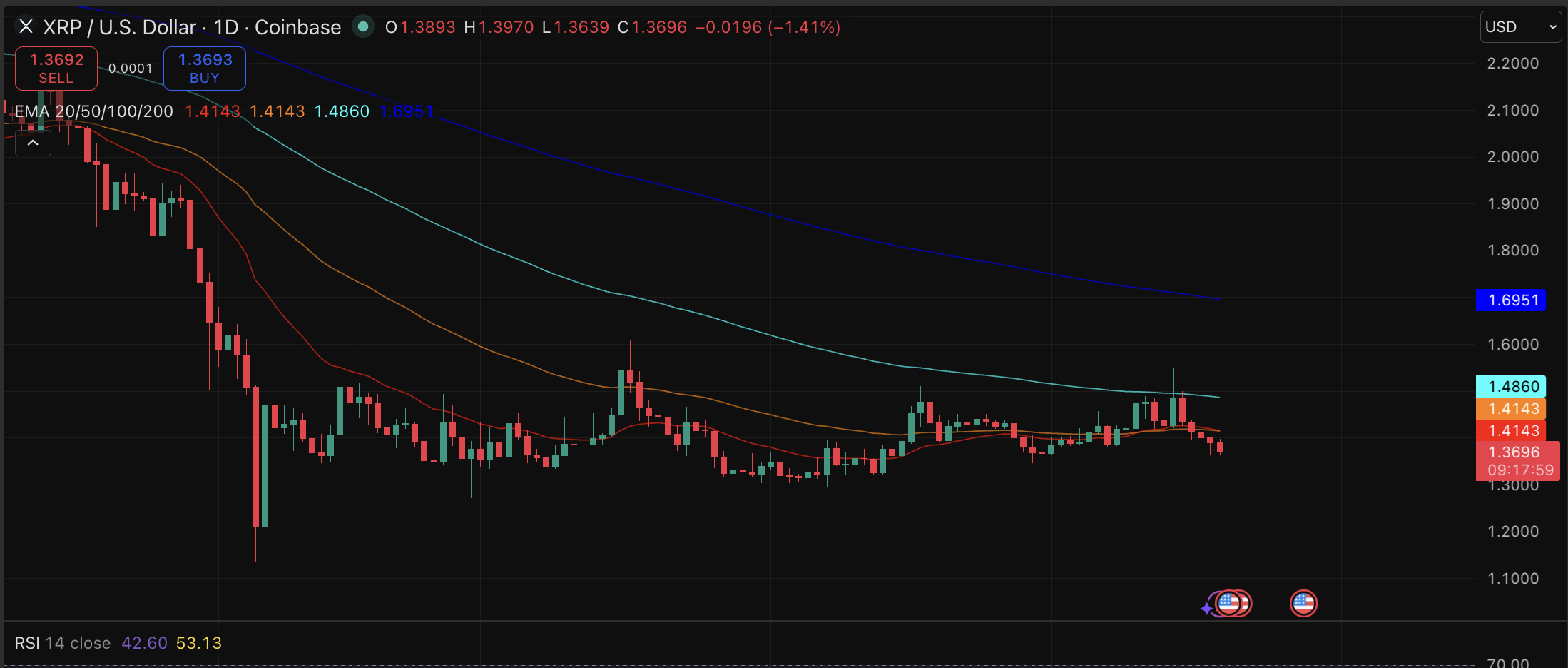
Risk-off behavior is real, and the 30-day volatility of more than 3% is showing a bad panic situation. The crypto backdrop led by Bitcoin isn’t offering much cover either. Sentiment has reset from early-year highs, and XRP is caught between two narratives pulling in opposite directions.
Discover: The best crypto to diversify your portfolio with
XRP Price Prediction: $1.45 Is a Must to Validate a Breakout
At $1.38, XRP sits at its immediate support, with resistance beginning just two cents higher at $1.40 and a more meaningful ceiling at $1.45, or more than 5% from the current price.
RSI(14) sits at approximately 42 on the daily chart, technically neutral, but trending toward oversold territory. The weekly RSI is already there at around 38. That divergence of daily neutral and weekly oversold usually precedes a sharp reversal or extended consolidation.
If XRP can reclaim $1.45 resistance on volume with daily EMAs beginning to compress, momentum could shift, triggering a move toward $1.65–$1.80 over the following weeks. Regulatory clarity developments could accelerate this.

Or, price consolidates in the $1.35–$1.45 range for longer as the market awaits a fresh macro catalyst, with the weekly oversold reading limiting downside extension.
The 10-day forecast from CoinLore projects essentially flat action around current levels. Patience, not positioning, appears to be what the chart is asking for right now.
Discover: The best pre-launch token sales
Maxi Doge: The New Dog in Town
When a blue-chip asset like XRP delivers -5% weekly returns while sitting below every major moving average, some traders begin rotating into earlier-stage setups. It’s not because the XRP thesis is broken, but because the near-term risk/reward has compressed.
That rotation logic is what’s drawing attention to presales with asymmetric structures, and one generating momentum right now is Maxi Doge ($MAXI). Maxi Doge is a meme token on Ethereum built around what it calls the “Leverage King” trading culture, representing the 1000x mentality that defines high-conviction crypto trading.
The tagline is “Never skip leg-day, never skip a pump,” which lands somewhere between absurd and oddly motivating. The presale has raised more than $4.7 million at a current price of $0.00028, with a huge 65% APY staking bonus to early participants.
Features include holder-only trading competitions with leaderboard rewards and a dedicated Maxi Fund treasury designed to support liquidity and partnerships over time. For those benchmarking entry points while XRP consolidates, the structure is worth examining.
The post XRP Price Prediction: Hodlers Split as ETF Demand Weakens but $27 Target Lives On appeared first on Cryptonews.


Aave V4 introduces a new market architecture featuring collateral isolation across Hubs and Spokes, with Prime, Core, and Plus Hubs launching initially.
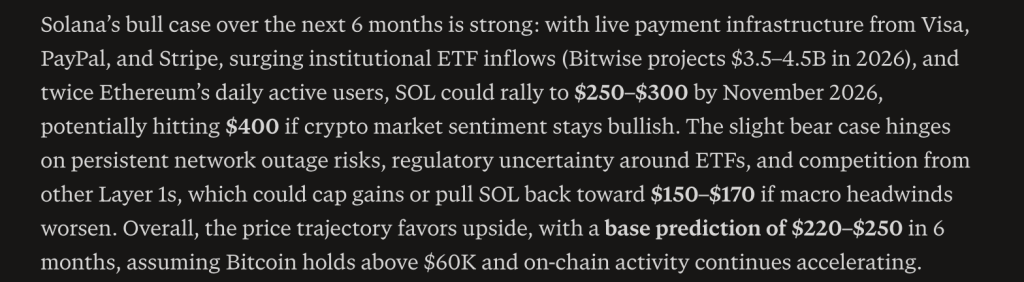
Visa, PayPal, and Stripe are all settling on Solana right now. Most people have not processed what that actually means for price prediction. Perplexity AI did, and the 6-month predicts it produced is the kind of number that makes $84 look like a mistake.
$250 to $300 by November 2026. Potentially $400 if sentiment holds.
Perplexity’s bull case is anchored on real adoption metrics rather than projected ones. Solana already has twice Ethereum’s daily active users, a fact that rarely shows up in price conversations but fundamentally changes the demand argument.
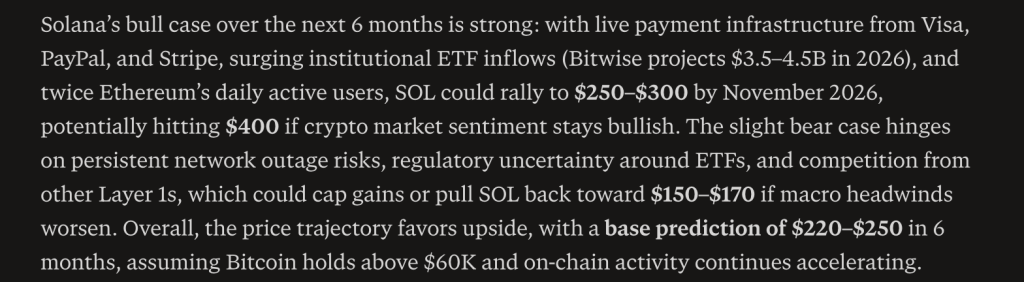
Visa, PayPal, and Stripe are not piloting the network, they are running live payment infrastructure on it, which means institutional legitimacy is already established rather than pending.
Bitwise is projecting $3.5 to $4.5 billion in spot SOL ETF inflows in 2026 alone, and that capital has to buy SOL to function.
The combination of live payment rails from the 3 largest payment processors on the planet, institutional ETF demand building from a low base, and a user base that already dwarfs Ethereum’s creates a setup where the supply side of the equation gets squeezed from multiple directions simultaneously.
Perplexity puts the base prediction at $220 to $250 in 6 months with the assumption that Bitcoin holds above $60,000 and on-chain activity continues accelerating. The $400 scenario requires crypto sentiment to stay broadly bullish through the period.

The bear case is specific and credible. Persistent network outage risks remain the single biggest narrative threat to Solana’s institutional story.
Regulatory uncertainty around ETF approvals could delay the inflow catalyst. And competition from other Layer 1s could cap the narrative momentum that drives speculative inflows. Perplexity puts the downside at $150 to $170 if macro headwinds worsen, which from current price is actually upside, a detail worth noting.
Solana Price Prediction: SOL is Stuck Now, Can it Form the Breakout Foundation Within 6 Months?
Solana price is trading at $84.54 on the daily, and the chart is a familiar story in this series: violent peak, complete destruction, slow base-building that refuses to commit to a direction.
Price peaked at $255 in August 2025, crashed to $70 in February 2026, and has spent the 3 months since grinding in a $75 to $100 range with multiple failed attempts at breaking out.
The most recent attempt was the most convincing, pushing toward $100 in early May before pulling back to current levels.
That pullback from $100 to $84 in less than 2 weeks is the chart’s immediate problem. Price is now sitting near the middle of the range rather than the top, which gives the setup a different feel than it had 10 days ago.
Resistance is $90 to $95, the first ceiling to clear before $100 becomes relevant again. Above $100 the next reference is $120, and then $150 where serious overhead supply from the November distribution sits.
Perplexity’s base target of $220 to $250 requires clearing all of that sequentially and holding each level as support on the way up.
Support below is $78 to $82, the base of the current range that has held since March. Lose that and $70 comes back into play with no meaningful floor between them.
Perplexity’s November deadline gives SOL 6 months to cover roughly 200% of upside. The chart needs to stop giving back gains first.
Perplexity AI Predicts Liquidchain Could Be The Next 1000x Crypto
The rotation is already happening. Most people just have not noticed where it is going yet.
Bitcoin is stuck. Ethereum is grinding sideways. XRP has been one catalyst away from its next move for months now. The large cap trade has run out of easy upside and the capital sitting on the sidelines knows it.
This pattern repeats every cycle. The obvious plays get crowded. Returns compress. Then quietly, money starts finding its way into things that have not been discovered yet. Projects where the market cap is still small enough that a relatively modest inflow changes everything.
The problem is knowing where to look before it becomes obvious.
Cross-chain liquidity is one of the most glaring unsolved problems in the entire space. Three dominant ecosystems, Bitcoin, Ethereum, and Solana, each operating in complete isolation from the others. No native interoperability. No shared liquidity. Every time value needs to move between them it passes through infrastructure that was never designed for the job, and users pay the price in bridging fees, slippage, and transactions that fail at the worst possible moment.
This is not a niche technical complaint. It is a structural tax that every DeFi participant pays every single day.
LiquidChain is eliminating that tax entirely. A Layer 3 execution environment that sits above all 3 networks and connects them into one. Single deployment, full ecosystem access, zero bridging overhead on every interaction.
The presale is at $0.01454. Just over $700,000 raised. The market has genuinely not priced this in yet.
That window does not stay open forever.
The risk profile is what you would expect at this stage. Nothing is proven. Adoption, liquidity, and execution are all still unknowns. That is not a disclaimer. That is the nature of the bet.
The projects that return 10x or 100x are not the ones that looked safe at entry. They are the ones who solved a real problem before the rest of the market understood it.
LiquidChain is still in that window.
The post Perplexity AI Predicts Unexpected Solana Price in 6 Months appeared first on Cryptonews.

3 Habits A Neurologist Avoids To Lower Stroke Risk

Pep Guardiola gives blunt answer to Man City exit question – ‘Zero’

Americans lost over $388 million to scams using crypto ATMs in 2025

Manchester United reach agreement with Casemiro over contract clause amid transfer speculation

US brings back mandatory military draft registration

Steven Gerrard disagrees with Gary Neville over ‘shock’ Chelsea and Arsenal claim | Football

who has financial propble please try this mantra and type one time in comment ” Om Hanumante namah “

YS Jagan Exposes AP’s Financial Status Under Chandrababu Naidu’s Ruling! || AP PRIDE

Just Saving Money, Won’t Make You Rich! #money #motivation #finance #success #mantra #investing
-

 Crypto World4 days ago
BloFin War of Whales 2026 Grand Prix opens registration for $5M trading championship
-

 Fashion4 days ago
Weekend Open Thread: Theory – Corporette.com
-

 Crypto World4 days ago
E-Estate Announces 1 Year Live: Washington DC Summit as Real Estate Tokenization Enters Its Next Phase
-
Crypto World7 days ago
Bitcoin Suisse expands with Digital Asset License and Investment Business Act Registration Approval in Bermuda
-

 Tech5 days ago
Tech Moves: Microsoft AI leader jumps to OpenAI; former AI2 exec joins Meta; and more
-

 Politics7 days ago
Pakistan to enter Chinese capital market as war inflation bites
-

 Crypto World7 days ago
Bitcoin Suisse expands with Digital Asset License and Investment Business Act Registration Approval in Bermuda
-
 Crypto World5 days ago
Google’s Gemini AI Predicts Incredible Solana Price by the End of 2026
-

 Business4 days ago
H&R Real Estate Investment Trust (HR.UN:CA) Q1 2026 Earnings Call Transcript
-

 Tech4 days ago
Google reimburses Register sources who were victims of API fraud
-

 Sports4 days ago
Napoleonic enters 2026 Doomben 10,000 field via Abounding withdrawal
-

 NewsBeat7 days ago
Comment on Keir Starmer surviving the day as Prime Minister like a turd that wont flush
-
 Entertainment5 days ago
Zara Larsson Has Blunt Response To Chris Brown Diss
-

 Politics7 days ago
Palestine’s flag becoming a regular sight at European football stadiums
-
 Crypto World6 days ago
Two AI Tokens Lead May Rally, But Risks Are Rising
-

 Fashion7 days ago
The Best-Kept Makeup Secret for a More Defined Face
-

 Crypto World4 days ago
BeInCrypto 100 Institutional Awards Nomination: KAST for Best Digital Assets Neobank and Best Digital Assets Fintech
-

 Fashion3 days ago
On the Scene at Gucci’s Cruise Show in New York City: Mariah Carey, Kim Kardashian, Lindsay Lohan, Iman, and More!
-
 Tech7 days ago
Why AI is making typography a boardroom conversation
-

 Politics7 days ago
The 81 MPs (so far) who have demanded tick-like Starmer out
You must be logged in to post a comment Login