

Crypto World
GitHub breach traced to poisoned VS Code extension



Online code repository firm GitHub says a recent breach of its internal data stemmed from a staff member downloading a “poisoned” VS Code extension.
The Microsoft-owned firm first disclosed in the early hours of this morning that it was investigating unauthorized access to its internal repositories.
Since then, GitHub has shared that the breach has only affected internal GitHub repositories.
It added, “The attacker’s current claims of ~3,800 repositories are directionally consistent with our investigation so far.”
The breach involves a malicious VS Code extension downloaded from Microsoft’s VS Code extension marketplace. VS Code stands for Visual Studio Code, and the marketplace offers various tools and applications for code editors to download.
Read more: Binance says GitHub data leak could cause ‘severe financial harm’
The hacking group claiming to have breached GitHub’s repositories is TeamPCP, which has been linked to the Mini Shai Halud supply chain attack that impacted OpenAI, as well as a number of other supply chain attacks targeting developer software.
The group is selling the roughly-4,000 private repositories on the Breached hacking forum for no less than $50,000 while stressing that it will not accept any “low ball offers.”
It said, “This is not a ransom, we do not care about extorting GitHub.” The data on its end will supposedly be “shred” after the sale, and if it can’t find a buyer, TeamPCP said it will leak the data for free.
GitHub says it has removed ‘malicious extension’
GitHub claims it “removed the malicious extension version, isolated the endpoint, and begun incident response immediately.”
“Critical secrets were rotated yesterday and overnight with the highest-impact credentials prioritized first,” the firm said, adding that it will continue to monitor the situation.
The reception to the incident hasn’t been forgiving. Users noted longstanding complaints against former Microsoft and GitHub executives that have asked for solutions to malware-ridden downloads within the VS Code extension marketplace.
This complaint was levied against GitHub’s former CEO two years ago.
Read more: Microsoft could stall Bitcoin development via GitHub
Former Binance CEO Changpeng Zhao warned, “If you have API keys in your code, even private repos, now is the time to double check and change them…”
CEO of coding firm Treehouse, Ryan Carson, similarly warned, “If you have ANY private repos with plain text secrets or sensitive documents/architectures, immediately rotate your secrets.”
Crypto security expert Taylor Monahan added to Zhao’s statement, and said that you should get your API keys “out of your repos.”
“Your biggest risk is not this. It’s your own devs getting hit by one of these wormy motherfucking supply chains and leaking all those secrets,” Monahan said.
Second GitHub leak in days
Software firm Grafana also claimed earlier this week that it witnessed unauthorised access to its GitHub repositories.
It claims the attackers “downloaded our codebase,” before issuing “a ransom demand under threat of data disclosure.”
Read more: Stealthy crypto miners loot altcoins with GitHub trial accounts
In this case, Grafana claims the breach also stemmed from the supply chain attack associated with the Mini Shai-Hulud campaign.
It said, “We performed analysis and quickly rotated a significant number of GitHub workflow tokens, but a missed token led to the attackers gaining access to our GitHub repositories. A subsequent review confirmed that a specific GitHub workflow we originally deemed not impacted had, in fact, been compromised.”
In 2024, leaked passwords and site code stemming from Binance were viewable on GitHub for months before they were eventually taken down.
The exchange said the leaks were capable of causing “severe financial harm,” and that the upload of its data was never authorized.
Protos has reached out to GitHub for comment and will update this piece should we hear anything back.
Got a tip? Send us an email securely via Protos Leaks. For more informed news and investigations, follow us on X, Bluesky, and Google News, or subscribe to our YouTube channel.

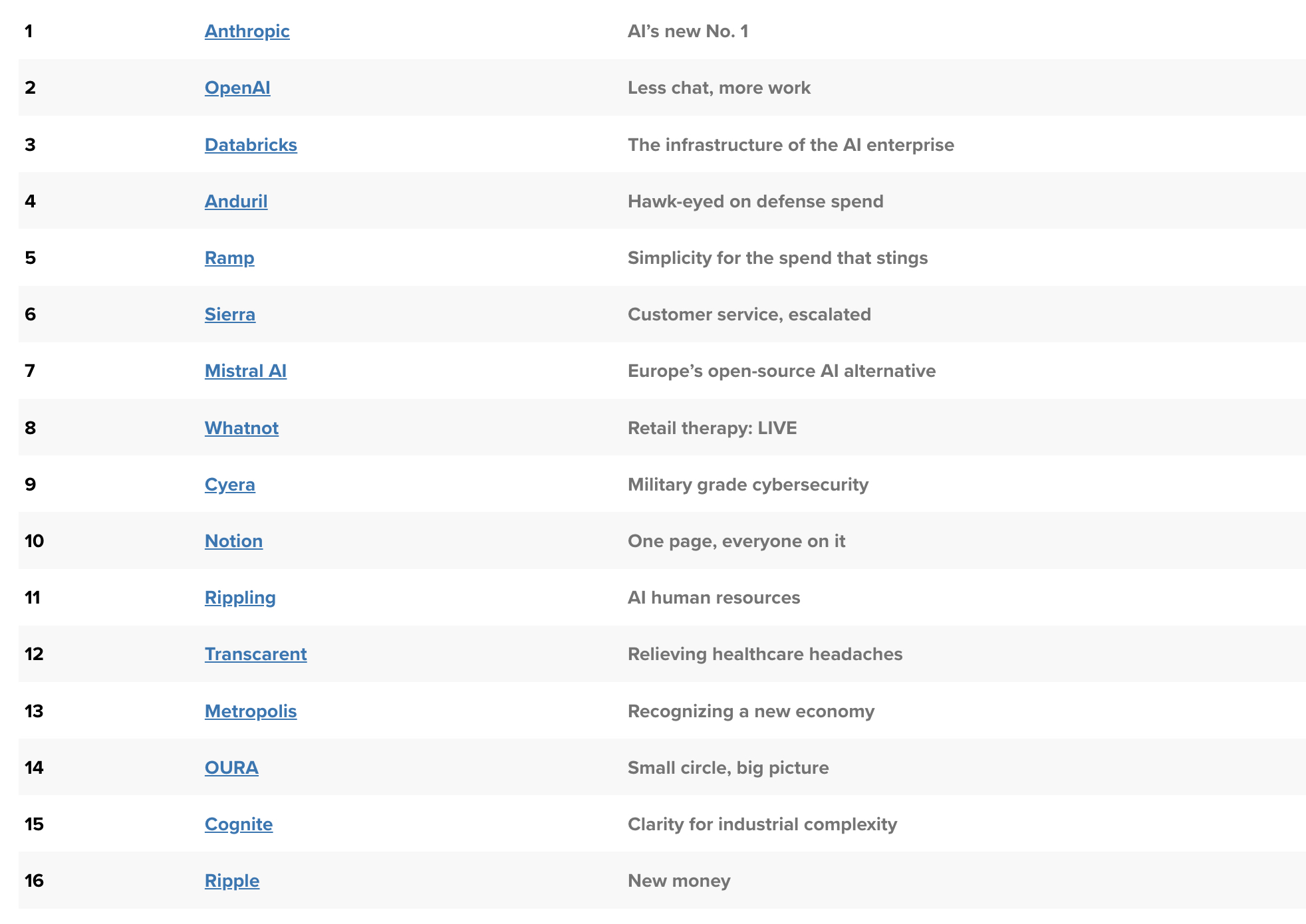
CNBC just ranked Ripple the 16th most disruptive company on the planet, beating out Revolut, Perplexity, Kalshi, Polymarket, and Canva. But its token, XRP, has been falling from its price high of mid last year.
CNBC’s updated Disruptor 50 list for 2026 names Ripple as the sole crypto or blockchain firm to make the cut, labeled as “new money.” The company climbed from 38th place in 2021 to 16th today, steadily overtaking fintechs and deep-tech firms alike.
Santiment Intelligence followed the announcement with a post citing XRP’s “long-term role in cross-border payments versus replacement by stablecoins or alternative rails” as the core thesis driving social volume.
Total implied valuation across all 50 Disruptor companies hit $2.4 trillion, up from $798 billion last year as capital is chasing disruptive infrastructure plays right now.
Discover: The best pre-launch token sales
Can XRP Price Hit $5?
At the moment, support sits in the $1.30–$1.35 zone, where recent lows have held on major aggregators. Resistance layers are around $1.40-$1.42, an area that has capped upside since forever. Until XRP closes and holds above $1.50 on volume, the structure reads as consolidation inside a multi-week range.
The XRP spot ETF has been showing a healthy flow despite the big outflows that Bitcoin and Ethereum are experiencing. Community projects XRP to reach $5 by late 2025 with growing institutional flows. That target sits above XRP’s all-time high of $3.84.

Right now, XRP bulls want ETF flows to continue their green streak, and a price break above $1.50 with volume targets the $2.50–$300 range. Consolidation could also continue between $1.35 and $1.45 as the market waits for macro news.
XRP is doing well; it just needs to hold, or a loss of $1.30 support could reopen a retest of sub-$1.00 levels. The Clarity Act remains a wildcard that could accelerate either scenario.
Discover: The best crypto to diversify your portfolio with
LiquidChain Targets Early-Mover Upside as XRP Tests Key Levels
XRP’s CNBC ranking validates the cross-chain payments thesis, but at the current spot price and a market cap already in the tens of billions, the asymmetric upside window has narrowed considerably. For traders watching XRP stall at resistance while the institutional narrative builds, the trade-off becomes clear: established recognition versus early-stage entry.
LiquidChain ($LIQUID) is a Layer 3 infrastructure project building what it calls the cross-chain liquidity layer. Liquid is developing a single execution environment that fuses Bitcoin, Ethereum, and Solana liquidity simultaneously.
Three Thrones for Three Kings. — LiquidChain (@getliquidchain) May 19, 2026

All wrapped in the world's greatest L3. ⟁ https://t.co/vqvBcdSQYC pic.twitter.com/j6dG8ZoHZd
The architecture eliminates the multi-step bridging problem that fragments DeFi capital across ecosystems, or something that XRP’s payment rails still can’t solve at the smart contract layer. With Liquid, developers deploy once and access all three ecosystems.
The presale is live at $0.01461 per $LIQUID, with $780K raised to date, and a bonus of 1400% APY staking for early buyers.
Explore the LiquidChain presale here.
The post XRP Price Barely Moves: CNBC Places Ripple Above Revolut appeared first on Cryptonews.
Crypto World
LayerZero's Incident Report Says Kelp Downgraded From 2-of-2 to 1-of-1 DVN Before $292M Exploit
Detailed May 18 post-mortem traces a six-week breach to DPRK group TraderTraitor and locks in a new 3-of-3 DVN protocol default. Kelp says LayerZero approved the configuration and has migrated rsETH bridging to Chainlink.
The crypto market is higher today as total capitalization rebounds toward $2.7 trillion, with money rotating into Bitcoin and large-cap altcoins while bond and equity markets flash mixed signals.
Summary
- The global crypto market cap has risen about 2% in 24 hours to roughly $2.7 trillion.
- Bitcoin, Ethereum, and XRP lead top-10 price action, with BTC holding near $77,000.
- Outside the top 10, Solana and Internet Computer are among the stronger gainers on rising volumes.
The total cryptocurrency market cap is around $2.7 trillion, up roughly 2.0% on the day, with Bitcoin dominance hovering near 58%, according to CoinGecko and Crypto.com. That bounce comes as traditional markets wobble around rates and macro headlines, and as flows rotate back into liquid crypto majors after a choppy first half of May. Coinbase data shows aggregate market cap near $2.47 trillion with a sharp jump in 24-hour trading volume, underscoring that today’s move is being driven by fresh turnover rather than illiquid grind.
Macro context is doing some of the heavy lifting. A recent Yahoo Finance analysis of market conditions framed the latest crypto strength as a rotation out of stressed bond markets and a softening stock tape, with digital assets absorbing some of the risk capital that had been parked on the sidelines. Meanwhile, Bitcoin-related stocks on U.S. exchanges have been catching a bid whenever Washington inches closer to regulatory clarity, as a recent CNBC update highlighted when Senate committee activity around crypto rules pushed BTC-exposed equities higher.finance.
Bitcoin, Ethereum, XRP: what is driving the majors?
Bitcoin (BTC) remains the anchor of the move, trading around $76,500–$77,500 after a week of consolidation, according to price feeds from CoinMarketCap and Fortune. BTC’s market cap stands near $1.5 trillion, with dominance just under 58%, meaning Bitcoin alone accounts for well over half of today’s crypto value. Sentiment indicators compiled by Changelly show a “fear” reading even as BTC trades near all-time-high territory, suggesting that positioning is still relatively cautious compared with the levels typically seen near blow-off tops.
Under the hood, this leg up looks more like a grinding repricing than an overheated squeeze. Coinbase estimates that Bitcoin’s 24-hour trading volume has jumped more than 50% in the last day, while total market turnover is up over 100%, reinforcing the idea that today’s gains are being driven by genuine two-way activity rather than thin books. A Binance research note added that Bitcoin’s structural share of the market, plus persistent institutional flows, continues to make it the “default” risk-on expression whenever regulatory headlines break in crypto’s favor.
Ethereum (ETH) is lagging slightly but still participating. ETH trades around $2,100–$2,150 with a market cap in the $250–$260 billion range, per CoinMarketCap and Coinbase’s Ethereum dashboard, and has added roughly 1%–2% over the last 24 hours. Earlier in May, Fortune noted that one ETH was worth about $2,246.79, up more than $300 versus a year before, and recent technical analysis from CryptoRank pointed to resistance in the $2,250–$2,350 area after ETH broke out of a contracting triangle. Changelly’s latest forecast sees Ethereum averaging about $2,378 in 2026, with a projected range of $2,206–$2,549, implying that current levels sit in the middle of its expected band rather than at euphoric extremes.
XRP (XRP) is the standout among top 10 non-stablecoins today. The token trades around $1.37 with a market cap north of $80 billion, according to Crypto.com, and has posted a much stronger year-on-year performance than most large assets. A recent Forbes breakdown noted that XRP’s market cap sat around $181.2 billion with a 502% year-over-year return as of early 2025, and while those exact figures have shifted, the structural story is the same: regulatory clarity and deep liquidity make XRP a favored high-beta proxy whenever the broader market turns risk-on.
Solana and Internet Computer surge as liquidity hunts beta
Outside the very top of the table, Solana (SOL) and Internet Computer (ICP) are two of today’s more interesting movers. Solana, currently a top-10 coin with a price near $85 and a market cap close to $49 billion, has edged higher on the day after a strong run earlier this year, according to Crypto.com. Forbes previously highlighted that SOL’s market cap was about $114.8 billion with a 145% year-over-year return as of January 2025, and traders still treat it as the go-to high-beta Layer 1 whenever momentum rotates down the market-cap stack.
Internet Computer (ICP) is another name catching flows. Coinbase’s global dashboard lists ICP among the day’s “top performing cryptocurrencies by price,” with 24-hour trading volume up sharply alongside the broader market. While ICP sits outside the top 10 by market cap, its float and liquidity profile mean relatively modest net inflows can drive outsized moves compared to giants like Bitcoin or Ethereum. That dynamic is playing out again today as traders look beyond mega-caps for additional upside.
In short, the market is up today because macro nerves and a messy bond tape are steering risk capital back into the most liquid corners of crypto, with Bitcoin anchoring the move, Ethereum grinding higher through resistance zones, and high-beta names like XRP, Solana, and ICP amplifying the trend as traders hunt for relative strength.

XRP News: Flare Network has completed a significant infrastructure milestone, integrating native XRP support directly into its wallet architecture and enabling XRP holders to access the full suite of DeFi primitives, lending, borrowing, liquidity provision, and yield farming, without relying on centralized custodians or permissioned bridges.
The mechanism is Flare’s FAssets protocol, which uses the network’s State Connector to verify transactions on the XRP Ledger, allowing XRP to be minted as FXRP on Flare in a trustless, overcollateralized format.
XRP in cold storage shouldn't sit idle. — Flare
Flare Smart Accounts now live in @DCENTwallets.
Two signatures on XRPL → FXRP minted → Monarq XRP Yield Vault. Self-custodied the whole way through.
$55K campaign reward pool for D'CENT users and early depositors. pic.twitter.com/tevApnUyBO
 (@FlareNetworks) May 19, 2026
The structural implication is a direct answer to XRP’s long-standing utility gap: a token with deep liquidity and institutional reach that has historically been locked out of the smart-contract DeFi stack.
On-chain data points to a 20% increase in Flare’s Total Value Locked following the integration announcement, with large wallets, those holding more than 10 million XRP, identified as the primary movers.
The open question is whether that initial inflow represents durable capital migration or opportunistic positioning ahead of anticipated catalysts.
XRP holders moving assets off the XRPL onto Flare accept smart-contract risk and bridging complexity in exchange for yield exposure that the native ledger cannot currently match. Whether the yield rates justify that trade-off, and whether crypto liquidity deepens quickly enough to sustain the ecosystem, is what the market is now pricing.
Discover: The best crypto to diversify your portfolio with
XRP News: How Flare’s FAssets and FXRP Actually Work, and Why the State Connector Is the Real Story
The mechanism here is worth understanding precisely. Flare’s State Connector protocol monitors the XRP Ledger for confirmed transactions and relays cryptographic proof of those transactions to Flare’s EVM-compatible execution layer.
When an XRP holder initiates a mint, agents on the Flare side provide overcollateralized backing, denominated in FLR, and FXRP is issued on a 1:1 basis against the locked XRP.
Agents earn minting and redemption fees; the overcollateral provides a liquidation buffer if FLR prices drop.
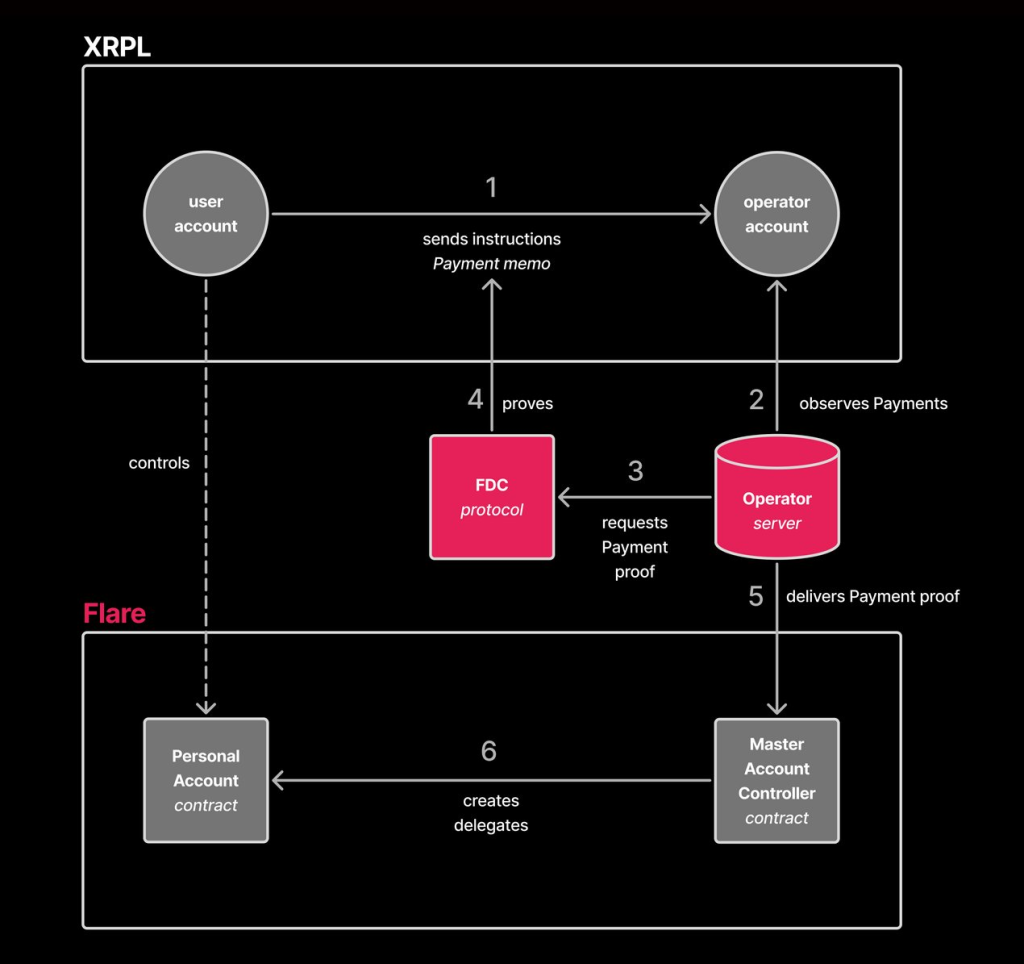
This structure, first outlined in Flare’s introduction to XRP DeFi, is what differentiates FXRP from custodial wrapped-token approaches.
There is no single bridge operator to compromise; the collateral backstop is enforced by Flare’s proof-of-stake consensus, where 98% of stake is community-held and no single data provider can exceed 3.3% of total stake.
The network achieves 1.2-second average block time with single-slot finality, which matters for DeFi protocols where price feeds and liquidation triggers operate in near-real time.
Once minted, FXRP becomes a composable DeFi asset. Holders can deploy it across lending protocols, supply it to automated market maker pools on SparkDex (Flare’s native DEX), or route it into yieldoptimizers being developed under Flare’s developer incentive program.’
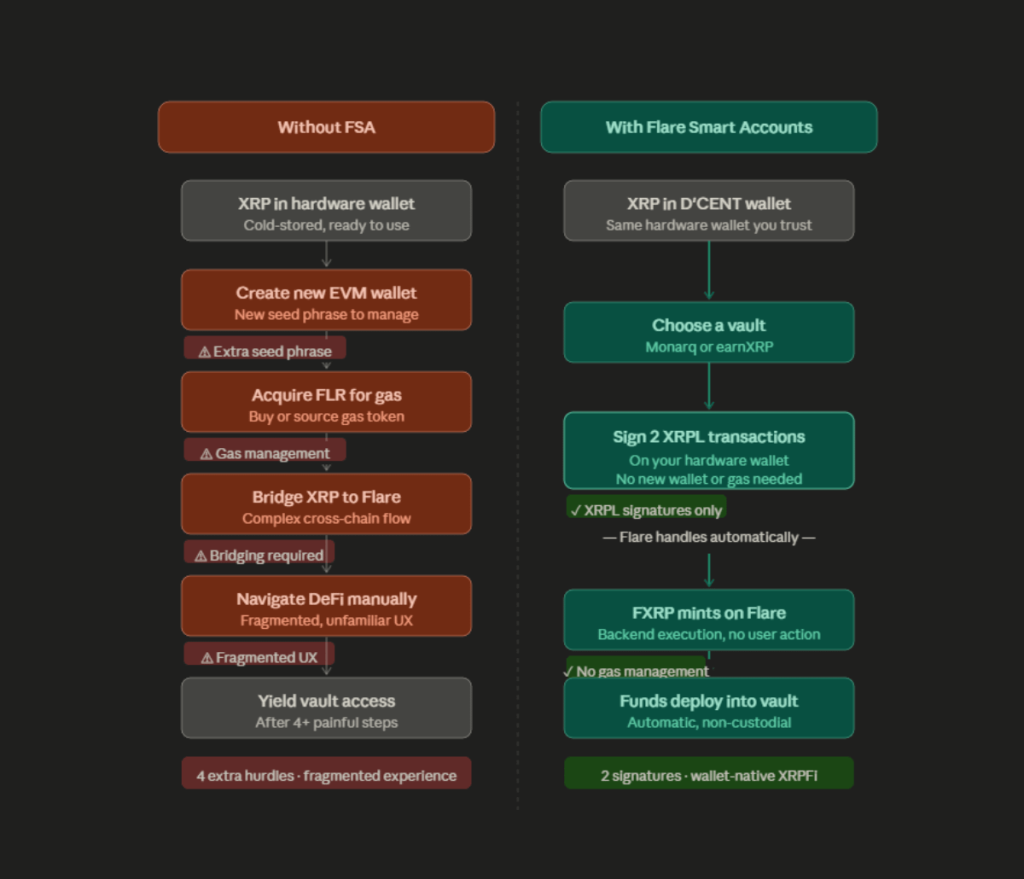
The Firelight protocol, currently in rollout, extends this further by introducing Economically Secured Services, where FXRP stakers underwrite security for third-party applications and earn a share of the fees those applications pay.
Liquid staking tokens issued through Firelight act as receipts that can themselves be redeployed in additional XRP DeFi strategies, creating compounding yield loops without sacrificing the base staking position.
What was previously impossible for XRP holders, accessing a full-stack DeFi environment with native collateral, decentralized price feeds via Flare’s FTSO, and programmable yield, is now accessible through a single wallet integration. That is the structural shift the TVL data is reflecting.
XRP is currently trading near $1.36, consolidating after a sharp rally that followed the Clarity Act’s passage through the Senate Banking Committee. The token has held above the $1.30 support band for 11 consecutive sessions, a level the market is treating as near-term structural floor.
Discover: The best pre-launch token sales
The post XRP News: Flare Wallet Integration Unlocks Native XRP DeFi appeared first on Cryptonews.


Why this matters: Pal argued that AI and blockchain are converging into a new infrastructure layer for the global economy.
- Pal said humanity is approaching a moment where AI systems become “apex intelligence,” fundamentally changing labor, finance and daily life.
- He described crypto as the ownership layer for that future economy, allowing individuals to “front-run Wall Street” by owning blockchain infrastructure before institutions fully arrive.
- “We can own the infrastructure layer for the first time in history,” Pal said during the interview.
The big picture: Pal framed the current moment as a historic acceleration point for technology adoption.
- He said AI adoption is moving faster than the internet era and compared it to “Metcalfe’s law squared,” referencing network effects.
- Pal pointed to AI-generated content growth as evidence of the shift, citing data showing AI now produces more words annually than humans.
- “Since COVID, we’ve hyperaccelerated everything,” Pal said.
- He also highlighted rapid adoption of GLP-1 weight-loss drugs as another example of exponential technological change.
What this means for crypto: Pal said institutional adoption does not undermine crypto’s original mission.
- He argued tokenization and blockchain rails expand access to financial markets for people globally who were previously excluded.
- “Everybody’s on the same equal footing,” Pal said, referencing the ability for users worldwide to access crypto assets.
- Pal said tokenized equities could allow investors in countries like Nigeria to access assets previously unavailable to them.
- He described stablecoins, tokenization and blockchain-based finance as “a better system for everybody.”
Reading between the lines: Pal sees crypto speculation as a feature, not a bug.
- He argued meme coins and NFTs served as stress tests for broader technological ideas.
- “Crypto’s hilarious because we hyper-speculate everything as the way of testing it,” Pal said.
- Pal said meme coins demonstrated how online attention can rapidly form capital.
- He also predicted NFTs eventually become foundational digital contracts underpinning parts of the future economy.
On AI: Pal described AI as both a productivity accelerator and a societal disruption.
- He said he already uses AI tools like Claude, ChatGPT and Grok daily as “thought partners” for research, writing and idea generation.
- Pal said AI has reduced tasks that once took days into workflows lasting only hours.
- He warned that AI could threaten parts of the labor market but argued human creativity, community and experiences will become more valuable.
- “The currency of humans is attention,” Pal said.
Worth watching: Pal predicted crypto markets and AI-driven systems continue converging over the next decade.
- He forecast the crypto market could eventually grow from roughly $2.7 trillion today to $100 trillion within a decade.
- Pal argued that wealth creation from crypto will increasingly flow into digital culture, including NFT-based art.
- He cited digital artist XCOPY as an example of crypto-native culture gaining value alongside traditional art markets.
- Asked what could derail crypto adoption, Pal replied: “Nothing stops this train.”
Bitcoin (BTC) continues to trade in a tight range around $77,000 in morning U.S. action on Wednesday. The major stock indices are posting small gains after three consecutive negative sessions.
Minutes from the Fed’s last policy meeting are due to be released at 2:00 pm ET. That April meeting was notable as it was the last to be headed by Jerome Powell, with Kevin Warsh due to be sworn in as Fed chair on Friday.
The meeting was also important for having four dissents — one from Stephen Miran, who wanted the central bank to trim rates, and three from board members who urged the Fed to drop any language suggesting an easing bias.
In the weeks since, bond markets globally have taken a major tumble as unexpected economic strength has combined with resurgent inflation to force a major reassessment from rate traders.
Nvidia (NVDA) reports its quarterly results after the close on Wednesday. A large stock price move in the tech bellwether is likely to lead to a sizable move in the Nasdaq. Traders accustomed to crypto’s correlation with that index will be keeping a close eye.

Japan is executing the most consequential crypto regulatory pivot in Asia. The country that once taxed crypto gains at up to 55%, which drove liquidity offshore and cemented its reputation as a hostile jurisdiction for active traders, has now published new rules allowing foreign trust-type stablecoins to operate as regulated payment instruments starting June 1. It’s one visible piece of a much larger regulatory reform package taking shape from Tokyo.
Even last year, Japan’s National Tax Authority currently treats most crypto gains as “miscellaneous income” in a category subject to progressive rates that reach 55% at the top bracket. This explains why high-frequency traders, market makers, and Web3 startups have been migrating to Singapore and Dubai for years.
The proposed reform targets a flat 20% settlement tax, identical to the rate applied to equities and investment trusts under Japan’s Financial Instruments and Exchange Act (FIEA). The Japan Cryptoasset Business Association has been explicit in its position papers: competing Asian hubs tax retail crypto gains at 0–15%.
BREAKING:
JAPAN’S RULING PARTY PROPOSES REDUCING BITCOIN GAINS TAX FROM 55% TO 20%
THIS IS BULLISHpic.twitter.com/iwlujrktLP
— Ash Crypto (@AshCrypto) March 7, 2025
But the tax rate is only half the mechanism. The other half is legal reclassification. For a 20% rate to apply, crypto assets, particularly large-cap tokens like BTC and ETH, must be reclassified as financial instruments under the FIEA rather than sitting in the Payment Services Act’s looser framework. This carries a downstream consequence: it makes spot and derivative ETFs legally viable, managed by licensed financial instruments business operators.
The Bitcoin ETF Gateway: Which Institutions Are Already Positioned
The US precedent is the reference point every Japanese regulator is working from. U.S.-listed Bitcoin ETFs, approved by the SEC in January 2024, drew billions in institutional inflows within weeks of launch, validating a market structure that Japan has been unable to replicate under its existing legal framework.
European UCITS structures have followed a parallel path, with major asset managers building regulated crypto exposure products under MiCA-adjacent frameworks.
Japan’s institutional groundwork is further along, as Nomura’s digital-asset subsidiary Laser Digital and Mitsubishi UFJ Trust and Banking have both been piloting tokenized securities and fund units under existing FIEA frameworks. They have publicly argued that similar structures could be applied to spot Bitcoin and Ethereum products once classification and tax rules align.
Also happening this week, SBI Holdings filed for crypto ETF products in Japan, positioning itself at the front of what would become a structurally new domestic market.
The FSA’s June 1 stablecoin framework is part of the same institutional logic. SBI VC Trade is actively exploring licensed services involving USDC under the new rules, which reclassify qualifying foreign trust-type stablecoins as Electronic Payment Instruments under the Payment Services Act. This regulated stablecoin rails, licensed intermediaries, and equivalence standards for foreign issuers, the settlement layer that a functional ETF market needs.
Discover: The best crypto to diversify your portfolio with
Japan vs. the Global Crypto Regulatory Race: Where the FSA Stands Against the CLARITY Act and MiCA
Regulatory reform is not happening in isolation. Across the Pacific, the US Senate Banking Committee advanced the CLARITY Act, which defines jurisdictional boundaries between the SEC and CFTC. Galaxy Digital’s head of firmwide research, Alex Thorn, puts the probability of the CLARITY Act becoming law in 2026 at 65% to 75%.
The EU’s MiCA framework is already live. Hong Kong launched spot Bitcoin and Ethereum ETFs ahead of Japan. Singapore maintains 0% capital gains on crypto. Japan’s advantage is not speed; it is depth, with Japan’s domestic savings pool measured in trillions.
Latham & Watkins analysts have characterized Japan’s direction as convergence toward a “rules-first but innovation-tolerant” posture, closer to MiCA in philosophy than to the US’s ongoing jurisdictional battles.
Discover: The best pre-launch token sales
The post Japan’s Crypto Revolution: 20% Tax Rate and Institutional ETF Gateway appeared first on Cryptonews.


CoW Swap, the intent-based DEX, is launching on Solana blockchain with NEAR Intents providing backend infrastructure.
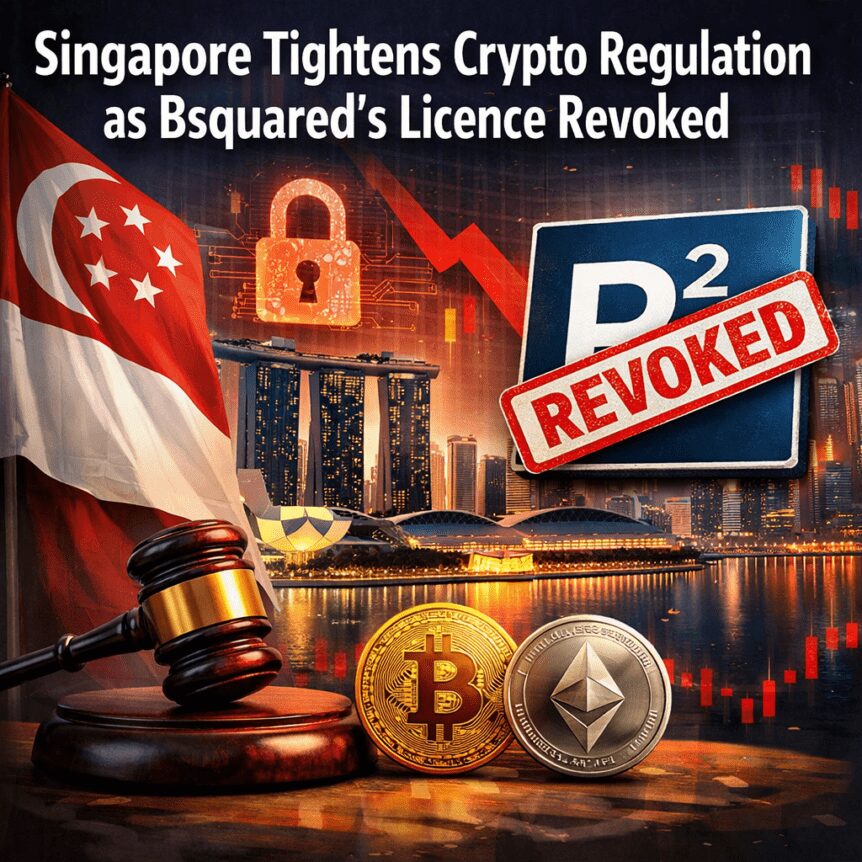
Singapore’s central bank, MAS, has revoked Bsquared Technology Pte Ltd’s Major Payment Institution Licence, removing the firm’s authority to provide digital payment token services under Singapore’s Payments Services Act 2019. The suspension follows an on-site inspection that uncovered weaknesses in governance and control frameworks, including risk management practices, conflict-of-interest policies, and outsourcing oversight.
The regulator also noted that Bsquared provided false or misleading information at multiple points during the license process and the subsequent review. Bsquared, which operates under the name BSQ, received the green light to offer digital payment token services roughly 16 months ago.
MAS has directed Bsquared to obtain a closure certificate from its auditors confirming that all customer funds have been returned to their rightful recipients. Bsquared informed MAS that it held no outstanding customer assets. In its statement, MAS stressed that it takes a serious view of the breaches and indicated it is reviewing the responsibilities of key BSQ officers.
Key takeaways
- MAS revoked Bsquared’s Major Payment Institution Licence after an on-site assessment revealed deficiencies in risk management, conflict-of-interest controls, and outsourcing compliance.
- The regulator criticized Bsquared for supplying false or misleading information during the application and inspection processes.
- The firm must secure a closure certificate from its auditors to demonstrate that all customer funds have been returned; Bsquared claimed no outstanding customer assets.
- Enforcement actions of this nature remain relatively rare in Singapore, where MAS has granted 37 digital payment token licenses to date; past actions include the rejection of AmazingTech’s Tokenize Xchange license and a subsequent probe by the Commercial Affairs Department.
- The case underscores heightened regulatory expectations for digital payment token providers and may influence licensing dynamics, governance standards, and audit requirements across the sector.
Regulatory framework and enforcement signals
The decision reflectsMAS’s ongoing emphasis on robust governance and risk controls for digital payment token services. Under the Payments Services Act 2019, MAS requires licensees to maintain sound risk management, clear conflict-of-interest policies, and proper oversight of outsourcing arrangements. The on-site findings in Bsquared’s case point to a broader enforcement trajectory in which governance failures, misrepresentation, and weak controls can lead to licence termination rather than penalties alone.
MAS’s stance also signals increased scrutiny of the personnel responsible for licensee governance. The authority stated it is reviewing the responsibilities of BSQ’s key officers, a step that could have implications for individual accountability within crypto firms seeking or retaining licences in Singapore.
Within this regulatory environment, the sector has seen relatively few revocations compared with license approvals. To date, MAS has granted 37 digital payment token licenses, and revocation actions remain uncommon. The regulator’s recent actions build on a pattern of careful, standards-based oversight rather than rapid, broad-based sanctions.
Historical context matters here. Last year, MAS rejected AmazingTech’s application to operate Tokenize Xchange, and the Commercial Affairs Department subsequently opened a probe into the company. These developments illustrate a vigilant, multi-agency approach to licensing and enforcement in Singapore’s crypto infrastructure landscape.
Singapore’s broader push into digital asset infrastructure
Singapore continues to position itself as a regional hub for digital assets and crypto infrastructure, hosting regional offices for major players and hosting flagship projects that connect traditional finance with tokenized assets. The regulatory environment in Singapore emphasizes prudent risk management, customer fund protection, and clear accountability for licensed entities as part of broader financial supervisory objectives.
Contextually, Singapore’s regulatory posture sits alongside ongoing global developments in crypto policy. In the European Union, MiCA is advancing a comprehensive framework for crypto assets and service providers, while U.S. authorities—across the SEC, CFTC, and DOJ—continue enforcement and policy evolution in related areas. The Bsquared case thus feeds into a global narrative prioritizing licensing discipline, AML/KYC rigor, and robust governance as prerequisites for institutional participation in crypto markets.
As Singapore strengthens its digital asset infrastructure, institutions and banks operating in or with the city-state may face heightened due diligence and compliance expectations. Initiatives such as banks enabling direct minting and redemption of stablecoins for institutional clients on blockchain rails illustrate the sector’s drive toward regulated, cross-border interoperability—but also underline the importance of clear custodial, settlement, and fund-tracing standards.
According to Cointelegraph, the MAS action against Bsquared reinforces the central bank’s position that licenced entities must meet rigorous governance and disclosure standards to maintain public trust and financial stability within Singapore’s payment and digital asset ecosystems.
Closing perspective
The Bsquared revocation demonstrates Singapore’s willingness to impose stringent consequences for governance and disclosure deficiencies in the digital asset space. For license applicants and existing providers, the case highlights the critical importance of robust risk management, transparent reporting, and strict adherence to outsourcing policies and fund custody requirements. As regulatory scrutiny intensifies, market participants should anticipate tighter officer accountability, more granular due-diligence by upstream partners, and a continuing emphasis on preserving customer fund integrity as a precondition for ongoing participation in Singapore’s crypto infrastructure ecosystem.
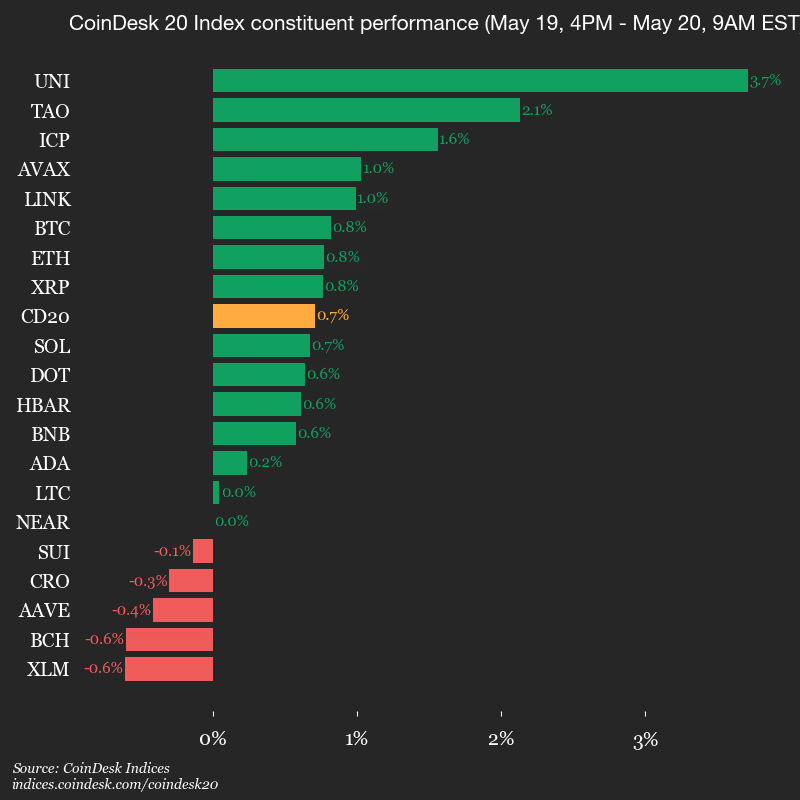
CoinDesk Indices presents its daily market update, highlighting the performance of leaders and laggards in the CoinDesk 20 Index.
The CoinDesk 20 is currently trading at 2064.22, up 0.7% (+14.51) since 4 p.m. ET on Tuesday.
Fifteen of the 20 assets are trading higher.

Leaders: UNI (+3.7%) and TAO (+2.1%).
Laggards: XLM (-0.6%) and BCH (-0.6%).
The CoinDesk 20 is a broad-based index traded on multiple platforms in several regions globally.

Retired FBI Agent Claims More DNA Evidence Likely Exists in Kidnapping Case

XRP Price Barely Moves: CNBC Places Ripple Above Revolut

Unite the Kingdom pervert tries to defend sexually harassing child


![Tom Lee Just Said The UNTHINKABLE About Bitcoin & Ethereum! ["It's a Fake Crash"]](https://wordupnews.com/wp-content/uploads/2026/05/1779287668_maxresdefault-80x80.jpg)

-

 Crypto World5 days ago
BloFin War of Whales 2026 Grand Prix opens registration for $5M trading championship
-

 Fashion5 days ago
Weekend Open Thread: Theory – Corporette.com
-

 Crypto World5 days ago
E-Estate Announces 1 Year Live: Washington DC Summit as Real Estate Tokenization Enters Its Next Phase
-

 Tech5 days ago
Tech Moves: Microsoft AI leader jumps to OpenAI; former AI2 exec joins Meta; and more
-

 Tech5 days ago
Google reimburses Register sources who were victims of API fraud
-
 Crypto World6 days ago
Google’s Gemini AI Predicts Incredible Solana Price by the End of 2026
-

 Business5 days ago
H&R Real Estate Investment Trust (HR.UN:CA) Q1 2026 Earnings Call Transcript
-

 Sports5 days ago
Napoleonic enters 2026 Doomben 10,000 field via Abounding withdrawal
-
 Entertainment6 days ago
Zara Larsson Has Blunt Response To Chris Brown Diss
-
 Crypto World7 days ago
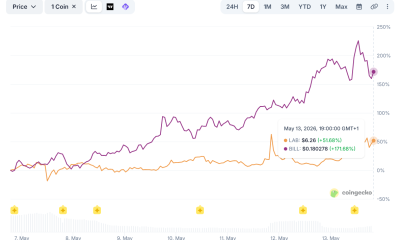
Two AI Tokens Lead May Rally, But Risks Are Rising
-
 Crypto World5 days ago
BeInCrypto 100 Institutional Awards Nomination: KAST for Best Digital Assets Neobank and Best Digital Assets Fintech
-

 Fashion4 days ago
On the Scene at Gucci’s Cruise Show in New York City: Mariah Carey, Kim Kardashian, Lindsay Lohan, Iman, and More!
-
 Crypto World5 days ago
Bitcoin Battles US Bond Nerves With BTC Price Dip Toward New May Lows
-
 Crypto World5 days ago
Wall Street’s Boldest Gold Prediction Has Russians Rushing to Buy
-

 Fashion4 days ago
Trending Western Style Vests Perfect for Summer
-

 Crypto World5 days ago
ICE and CME urge US regulators to curb Hyperliquid energy trading
-

 Politics6 days ago
DWP PIP Timms review continues to be an absolute farce
-

 Entertainment5 days ago
David Letterman Returns to Late Show, Blasts Cancellation
-

 Fashion3 days ago
Amazon Sundays: Memorial Day Hosting
-
 Crypto World6 days ago
Lido Finance Selects Chainlink CCIP as the Official Cross-Chain Infrastructure for wstETH Security
You must be logged in to post a comment Login