

Crypto World
Clarity Act could unlock $2T says Ripple CLO



Ripple CLO Stuart Alderoty says the Clarity Act could unlock a multi-trillion dollar US crypto market.
Summary
- The Senate Banking Committee advanced the Clarity Act 15-9 on May 14, with two Senate Democrats voting yes despite Elizabeth Warren’s opposition.
- Ripple CLO Stuart Alderoty called it a “monumental outcome” and cited 67 million American crypto holders as the constituency the bill protects.
- The bill still needs 60 Senate floor votes, two committee reconciliations and Trump’s signature before it becomes law.
The Senate Banking Committee advanced the Clarity Act 15-9 on May 14, a bipartisan result that lifts the Digital Asset Market Clarity Act toward a full Senate floor vote.
“The Clarity Act isn’t about protecting an industry. It’s about protecting everyday Americans who deserve clear rules when they participate in the multi-trillion dollar crypto economy. 67 million Americans already hold crypto. The data is in. It’s time,” Ripple CLO Stuart Alderoty said in a post.
What the Clarity Act would actually do
The bill would establish which regulator — the SEC or the CFTC — has jurisdiction over specific digital assets, ending the enforcement-by-ambiguity approach that has defined US crypto oversight since 2017. Crypto.news explored why the legislation matters more to XRP than to almost any other asset.
The Clarity Act would formally classify named tokens including XRP as digital commodities, removing legal uncertainty that has kept institutional capital on the sidelines. Analysts at Standard Chartered estimate the bill could unlock $4 to $8 billion in additional XRP ETF inflows alone.
Why this bipartisan vote matters
The 15-9 result marks the first time a comprehensive crypto market structure bill has cleared the Senate Banking Committee with cross-party support. Every Republican voted yes, alongside two Senate Democrats despite opposition from Elizabeth Warren.
Despite the momentum, the bill still needs 60 floor votes to clear a filibuster. It then faces reconciliation between the Banking and Agriculture Committee versions before alignment with the House text from July 2025.
What still has to happen before it becomes law
Crypto.news has tracked Ripple CEO Brad Garlinghouse warning the bill’s chances drop sharply if lawmakers fail to act before campaign season. Senators Lummis and Moreno have both warned that failure in 2026 means the next window is 2030.
The XRP price page tracks market reaction against that legislative backdrop in real time.


TLDR
- Fairshake PAC spent about $20 million to support candidates in three US primary races.
- All candidates backed by Fairshake PAC either won their races or advanced to runoffs.
- The spending targeted elections in Georgia, Alabama, and Kentucky.
- Affiliates Defend American Jobs and Protect Progress supported both Republican and Democratic candidates.
- Around $5 million funded advertising for Barry Moore’s Senate primary campaign in Alabama.
- Protect Progress previously supported Yadira Caraveo with about $2 million in her House primary race.
Fairshake PAC secured victories across key US primary races after deploying about $20 million in targeted spending. The crypto-backed political group supported candidates in Georgia, Alabama, and Kentucky. Every candidate it backed either won outright or advanced to a runoff.
Fairshake PAC Spending Drives Primary Wins
Fairshake PAC directed funds through affiliated groups supporting both Republicans and Democrats. These affiliates included Defend American Jobs and Protect Progress.
The PAC supported five Republican candidates and one Democrat in the latest primaries. Each backed candidate remained competitive after Tuesday’s results.
In Alabama, the group spent about $5 million supporting Representative Barry Moore’s Senate campaign. The funds financed a focused advertising push during the primary race.
Protect Progress previously backed Representative Yadira Caraveo with about $2 million. The support targeted her Democratic House primary campaign.
Fairshake PAC distributed remaining funds across races in Georgia and Kentucky. It focused on candidates open to digital asset regulation policies.
The strategy centered on competitive races rather than broad spending across many districts. This approach concentrated financial impact on fewer contests.
Crypto Industry Ramps up Political Spending
Fairshake PAC operates with financial backing from major crypto firms including Ripple Labs and Coinbase. The group plays a central role in industry political efforts.
Crypto-linked Super PACs plan to spend about $271 million during the 2026 midterm elections. Fairshake remains the primary vehicle for this spending.
The PAC reported spending about $130 million during the 2024 election cycle. It entered the current cycle with about $193 million in available funds.
These financial levels exceed many traditional corporate political action committees. The scale allows targeted spending in high-stakes races.
The PAC focuses on candidates who support clear crypto regulation frameworks. These include rules on stablecoins and token classification.
Industry priorities also include legislation defining securities and commodities in crypto markets. Exchanges seek clearer regulatory guidance through such measures.
Tuesday’s results extend Fairshake PAC’s track record in primary races. Backed candidates have consistently performed well in recent elections.
Campaign finance groups have raised concerns about rising industry political spending. Critics argue that large contributions may influence election outcomes.
Fairshake PAC has not issued a formal statement following the latest primary results. The election outcomes remain the most recent confirmed development.



Hester Peirce will leave the SEC in November 2026 to join Regent University School of Law as professor.
Summary
- Regent University School of Law announced on May 19 that Hester Peirce will join as associate professor starting in November 2026.
- Peirce has led the SEC’s Crypto Task Force since January 2025 and served as commissioner since 2018, appointed by President Trump.
- She will teach securities regulation, financial markets, digital assets and public policy at Regent Law in Virginia Beach.
Regent University School of Law announced on May 19 that Hester Peirce will join its faculty as associate professor starting in November 2026. The announcement signals Peirce is winding down her time at the SEC after more than seven years as commissioner.
“Greg Jacob and Hester Peirce have served at the highest levels of law, government, and public life,” said Dean S. Ernie Walton. “Their decision to join Regent Law full time is a remarkable blessing for our students.”
What Peirce built at the SEC and what she is leaving behind
Peirce is widely known in the crypto industry as “Crypto Mom” for her consistent advocacy for digital asset innovation. Her dissents from enforcement-heavy SEC actions under former chair Gary Gensler earned her the nickname and the industry’s loyalty.
Peirce became an SEC commissioner in January 2018 and was named head of the Crypto Task Force in January 2025. Crypto.news has reported on the task force’s formation and its 10-point roadmap for resolving the SEC’s backlog of crypto regulatory issues.
Her term technically expired in mid-2025 but SEC commissioners can serve up to eighteen months beyond expiry until a replacement is confirmed. Crypto.news has also tracked her consistent position that the agency should allow experimentation rather than applying securities law reflexively.
“All I’m asking is that we have an innovation policy that allows people to innovate and try new things,” she said in a recent interview.
What her departure means for crypto regulation
Peirce’s exit removes the most prominent pro-crypto voice inside the SEC at a critical moment. The Crypto Task Force she led has been central to the agency’s shift away from enforcement-only oversight toward clearer rules.
Crypto.news has covered expert analysis that even with a friendlier SEC, courts remain the unpredictable variable in how US crypto regulation ultimately takes shape. At Regent Law, Peirce will teach securities regulation, financial markets, digital assets and public policy.

Disclosure: This article does not represent investment advice. The content and materials featured on this page are for educational purposes only.
WhiteBIT launches dedicated UK platform as exchange expands presence in regulated British market.
Summary
- WhiteBIT launches whitebit.uk, expanding crypto trading and GBP services for users across the United Kingdom.
- WhiteBIT UK introduces spot trading, FPS deposits, lending, and auto-invest tools for UK crypto users.
- It expands into the UK with a regulated-focused platform offering retail and institutional crypto services.

WhiteBIT, the largest European cryptocurrency exchange by traffic, has announced the launch of whitebit.uk, a dedicated platform designed to serve users in the United Kingdom. The move marks a strategic step in strengthening the WhiteBIT presence in one of the world’s most mature and highly regulated financial markets.
The launch aligns with WhiteBIT’s broader mission to drive global adoption of blockchain technology by making crypto more accessible and practical for everyday use.
WhiteBIT UK is tailored to meet the expectations of both retail users and professional market participants. For retail users, the platform offers core features like spot trading, market analytics, and instant conversion. Users can fund accounts in GBP using payment cards and the Faster Payments Service (FPS). For institutional participants,
WhiteBIT UK includes capabilities such as liquidity and market-making support, token listing options, Crypto-as-a-Service, and API connectivity, enabling integration and management of digital asset operations within a single platform. In addition, users in the UK can access crypto lending services, as well as auto-invest functionality (subject to product availability, onboarding checks, and applicable UK regulatory requirements)
The launch comes at a time of sustained growth in crypto adoption across the UK. According to the Financial Conduct Authority, in 2025, overall awareness of cryptoassets remains high at 91% among the general public, while around 8% of UK adults hold crypto. The data also shows that 73% of users rely on centralised exchanges, highlighting the role of established platforms in providing access to digital asset markets. The UK continues to rank among the top markets globally for crypto engagement and fintech innovation.
“Entering the UK market marks an important milestone in WhiteBIT’s expansion across regulated jurisdictions,” said Volodymyr Nosov, Founder and President of W Group, which WhiteBIT is a part of. “The UK has long been a global financial hub, and we see strong demand for platforms that combine innovation with a high level of trust, transparency, and compliance. Our goal is to provide users with access to digital assets while maintaining the standards that define our platform globally.”
https://www.instagram.com/reel/DYjcDJKOTBz/?igsh=eHAwdDlpcGoyaTJh
WhiteBIT has built its reputation around security and operational resilience, consistently ranking among the top 3 secure exchanges globally, according to CER.live. It was the first exchange to obtain Level 3 certification under the Cryptocurrency Security Standard (CCSS) developed by the CryptoCurrency Certification Consortium (C4). WhiteBIT applies rigorous compliance procedures, including AML and KYC protocols, alongside advanced infrastructure designed to safeguard user assets.
As the UK market continues to evolve, WhiteBIT plans to further expand its product offering and local presence, supporting both individual users and institutional partners with compliant solutions.
Investing in cryptoassets carries a significant risk of loss, which may arise from a range of factors including market volatility, liquidity constraints, technological issues, or the actions of third parties.
Although platforms typically implement security, compliance, and risk management measures, these cannot eliminate the underlying risk of losing some or all of your investment. Cryptoassets are not regulated in the same way as traditional financial products and are not covered by the Financial Services Compensation Scheme (FSCS). Users may also not have access to the Financial Ombudsman Service (FOS). They should carefully consider whether investing in cryptoassets is suitable for them and seek independent advice if needed.
About WhiteBIT
WhiteBIT is the largest European cryptocurrency exchange by traffic. Founded in 2018, the platform is a part of W Group which serves more than 35 million customers globally. WhiteBIT collaborates with Visa, FACEIT, FC Barcelona, Juventus FC, and the Ukrainian national football team. The company is dedicated to driving the widespread adoption of blockchain technology worldwide.
Disclosure: This content is provided by a third party. Neither crypto.news nor the author of this article endorses any product mentioned on this page. Users should conduct their own research before taking any action related to the company.

The European Commission has launched a formal review of the Markets in Crypto-Assets Regulation (MiCA), signalling that the European Union is considering updates to its landmark digital asset framework just two years after MiCA began applying. On Wednesday, the commission opened a public consultation inviting input from the crypto industry, financial institutions, and the broader public, with the process running through Aug. 31. The commission argued that crypto markets and the global regulatory environment have continued to evolve since MiCA took effect in 2024, prompting an assessment of whether the framework remains fit for purpose. As Cointelegraph notes, market observers have started referring to potential updates as “MiCA 2.”
Key takeaways
- The EU has initiated a targeted review and public consultation to evaluate MiCA’s performance and potential amendments, focusing on asset classification and the treatment of wrapped, synthetic, and tokenized assets.
- Stablecoins are a central focus, including whether MiCA’s prohibition on interest or interest-like remuneration should be retained or revised, along with questions on reserve requirements, liquidity management, redemption rights, and thresholds for “significant” tokens.
- The review extends to emerging risk areas such as DeFi, staking, lending, and tokenized financial assets, as well as the regulatory framework governing crypto asset service providers (CASPs) and consumer protections.
- Regulators are examining how to balance stronger protections and clearer rules with practical access to regulated banking and payment channels, aiming to bolster consumer confidence.
- The review occurs ahead of a key MiCA transitional milestone in July 2026, when CASPs must be fully authorized or cease operations if they do not meet the regime’s standards.
Regulatory review process and scope
The commission’s targeted consultation is designed to assess MiCA’s functioning in practice and identify where adjustments may be needed. The process seeks input on ongoing classification challenges, including how the EU defines crypto assets relative to traditional financial instruments, and how wrapped tokens, synthetic assets, and tokenized fund interests should be treated under the regime. The aim is to determine whether the current framework remains fit for purpose amid evolving markets and a shifting global regulatory landscape. The consultation is open to industry participants and the public, allowing a broad set of stakeholders to contribute to the regulatory dialogue.
Stablecoins, reserve requirements, and asset classification
A core element of the MiCA review is the treatment of stablecoins. The commission is evaluating whether the existing ban on interest or interest-like remuneration should be maintained or revised, alongside broader questions on reserve requirements, liquidity management, redemption rights, and the criteria used to identify “significant” tokens. By reassessing these areas, EU regulators hope to clarify risk management expectations for issuers and providers while reducing ambiguity for market participants. In parallel, the consultation examines whether consumer protections and supervisory practices are aligned with the practical realities of stablecoin operation, settlement, and custody in a cross-border, regulated environment.
Expanded scope: DeFi, staking, tokenization, and market integrity
Beyond stablecoins, the review probes risk areas and business models that have historically fallen outside MiCA’s primary perimeter, including decentralized finance (DeFi), staking, lending, non-fungible tokens, and crypto asset service providers (CASPs). Regulators are assessing how to address market integrity, investor protection, and potential simplification of compliance rules while ensuring licensing and cross-border oversight remain coherent across EU member states. The inclusion—or lack thereof—of DeFi and tokenized financial assets within the regulatory framework could influence how platforms operate within the EU and how they align with broader international standards.
The Commission’s review also emphasizes consumer trust and comprehension of crypto assets under MiCA. The public consultation document asks about consumer awareness of popular assets such as Bitcoin, Ether, stablecoins, DeFi, and tokenized assets, and contemplates measures that could enhance confidence, including clearer rules, stronger protections, more effective supervision, and easier access through regulated banks and payment providers. This emphasis on user protection and trust underscores the EU’s broader objective of melding innovation with robust regulatory safeguards.
The timing of the review is tied to MiCA’s transitional framework, with July 2026 marking a critical juncture when CASPs must be fully authorized or exit the EU market if they do not meet regulatory requirements. In parallel, ESMA has signaled the approaching end of transitional periods under MiCA, reinforcing the importance of timely and concrete regulatory outcomes for market participants.
The targeted MiCA review thus serves as a regulatory calibration exercise—balancing the need for clarity and proportional oversight with the EU’s aim of fostering a safe, innovative, and globally aligned crypto market. The ongoing dialogue will inform not only EU licensing and supervision practices but also cross-border compliance expectations for institutions operating within or interacting with the European market.
The Commission’s initiative is watched closely by exchanges, wallet providers, banks, and institutional investors that navigate a complex compliance landscape across Europe. It also aligns with broader policy discussions around digital assets, market structure, and the legislative trajectory toward a more harmonized European regime for crypto activities.
What happens next will hinge on the feedback received and how regulators translate it into amendments, if any, with implications for licensing, supervision, and market access across EU member states. The review could either yield targeted refinements to MiCA or signal a broader recalibration of Europe’s approach to crypto regulation, particularly for evolving product categories like DeFi and tokenized assets.
Crypto World
Despite Trump’s pledge, a CBDC is being explored behind closed doors, says former CTFC chair
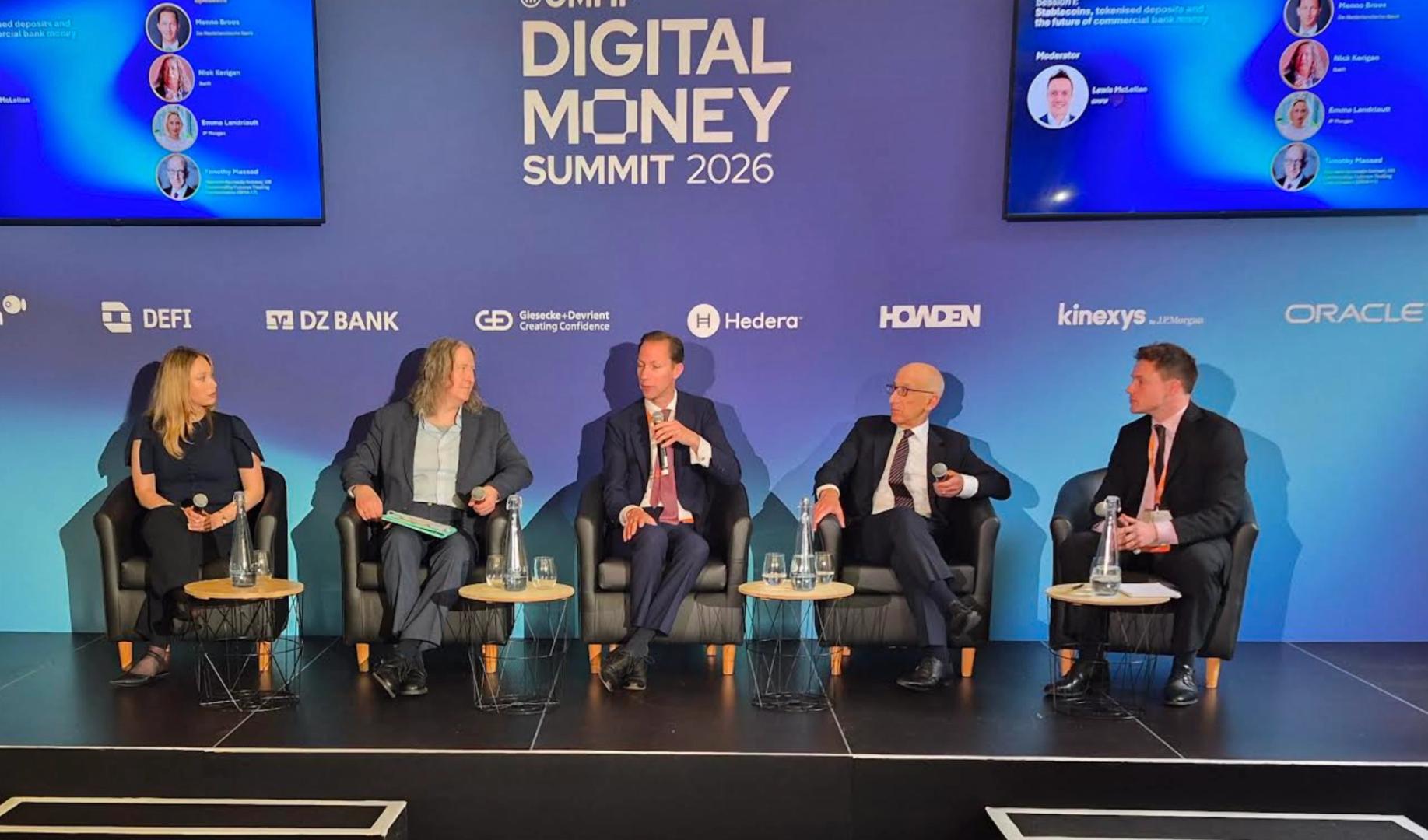
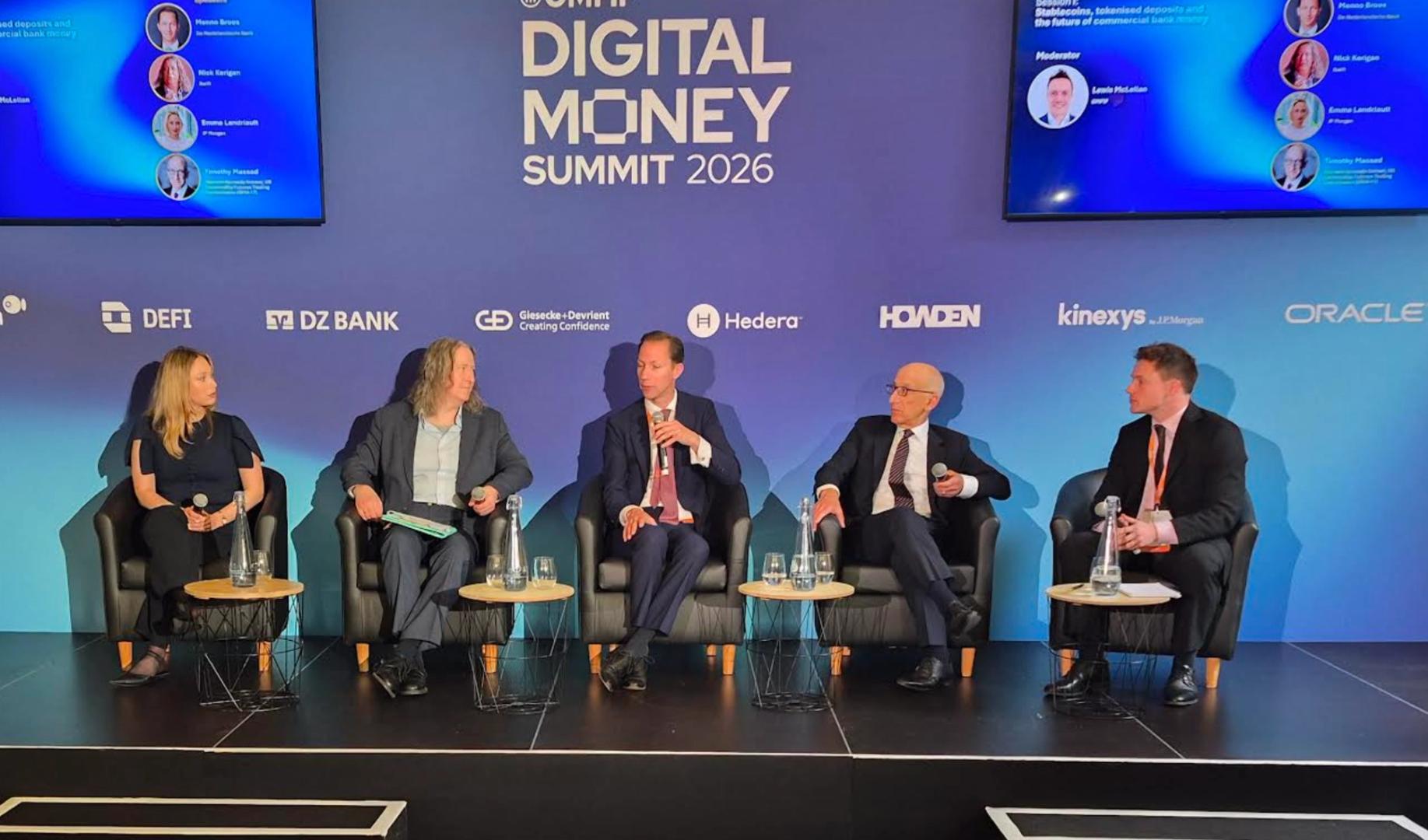
In the lead up to taking office, U.S. President Donald Trump fiercely opposed a Central Bank Digital Currency (CBDC) or government-backed dollar-pegged stablecoin, however the global market dynamics means it is inevitable, said Timothy Massad, the former chairman of the Commodity Futures Trading Commission (CFTC).
In an interview with CoinDesk on Tuesday during the Digital Money Summit 2026 in London, Massad went further, saying that despite the CBDC topic being highly sensitive in Washington, D.C.,it is being considered behind closed doors.
Mark Gould, chief Payments Executive at the U.S. Federal Reserve and also present at the event, refused to speak of a central bank stablecoin, saying this was not a topic at present “This is not under our remit,” he said, but when asked if a government-backed digital dollar would be the Fed’s responsibility he said yes, but not at present.
In March 2024, nine months before taking office for a second time, Trump vowed he would ban the creation of CBDC. “As your president, I will never allow the creation of a central bank digital currency,” he said while still campaigning. In March of this year, an initiative to ban the Federal Reserve from issuing a digital dollar was approved in an overwhelmingly bipartisan 89-10 vote in the Senate, but it remains part of a housing bill that may still hit a wall in the House of Representatives.
Massad said international central banking experiments with stablecoins are quietly forcing the U.S. to build government-endorsed settlement rails for onchain money to avoid losing ground to Europe.
During the panel discussion, the former CFTC chair (2014-2017) pointed to Project Agora, a major Bank for International Settlements (BIS), of which the U.S. is a member country, bringing together seven central banks, as a prime catalyst.
“The U.S. is a participant in Project Agora,” Massad said, highlighting that the work behind closed doors is moving forward despite Washington’s public-facing objections.
“We don’t have a central bank president who is going to get out there and speak about wholesale or retail CBDC, but that does not mean that we are not looking at how to create one.”
In a conversation after the session, Massad told Coindesk that while the Trump Administration will publicly say a formal retail CBDC is off the table, the evolution of tokenized finance will force a government-backed alternative.

Political action committees (PACs) aligned with and funded by the cryptocurrency industry notched a series of wins in three US state primaries on Tuesday, potentially setting a precedent for the 2026 midterm elections.
The Fairshake PAC and its affiliates poured a combined $20 million into supportive media for the races. The committee, largely funded by crypto companies Ripple Labs and Coinbase, is behind the Defend American Jobs PAC in supporting Republican candidates and Protect Progress PAC for Democrats considered to be “pro-crypto.”
Four Republican candidates and one Democrat won their respective primaries for US Senate and House of Representatives seats in Georgia and Kentucky, while one Alabama Republican will go to a runoff election.
“Fairshake’s 6-0 sweep tonight was a clear victory for pro-crypto leaders across the country,” Fairshake spokesperson Geoff Vetter told Cointelegraph. He said:
“This powerful bipartisan mandate is being heard across America from Georgia to Alabama to Kentucky.”
According to Federal Election Commission filings, Protect Progress spent more than $4.2 million to support Jasmine Clark, a Georgia representative running in the state’s 13th Congressional district. Defend American Jobs reported similar expenditures for media to support Republican candidates: $455,000 for Clay Fuller in Georgia’s 14th district, $709,000 for Houston Gaines in Georgia’s 10th district, $431,000 for Jim Kingston in Georgia’s 1st district and $7.2 million for Andy Barr for Kentucky’s US Senate seat.
Barry Moore, who was supported with $7.4 million from Defend American Jobs in his run for Alabama’s US Senate seat, will head to a runoff against state Attorney General Steve Marshall and Republican candidate Jared Hudson, after none of the three secured a majority of the vote in the primary.

Source: Jasmine Clark
Fairshake and its affiliates, backed by the crypto industry, are expected to spend millions of dollars in 2026 to “oppose anti-crypto politicians and support pro-crypto leaders,” according to a spokesperson in January. The company reported holding a $193 million war chest, far surpassing its 2024 expenditures of $130 million on media and ads to support congressional candidates.
Related: Crypto PACs spend $7.2M to support candidates in 5 US states ahead of elections
Despite the multimillion-dollar expenditures, the crypto-backed PAC hasn’t always been successful in swaying enough voters before a key election or primary. Fairshake reportedly spent $8 million opposing Illinois Lieutenant Governor Juliana Stratton in her US Senate primary, but she beat other candidates with more than 40% of the vote.
Coming Texas run-off seen again testing crypto PAC support
Protect Progress has ramped up spending on supportive media for Democratic candidate Christian Menefee, running to unseat incumbent Al Green in Texas’ 18th Congressional District.
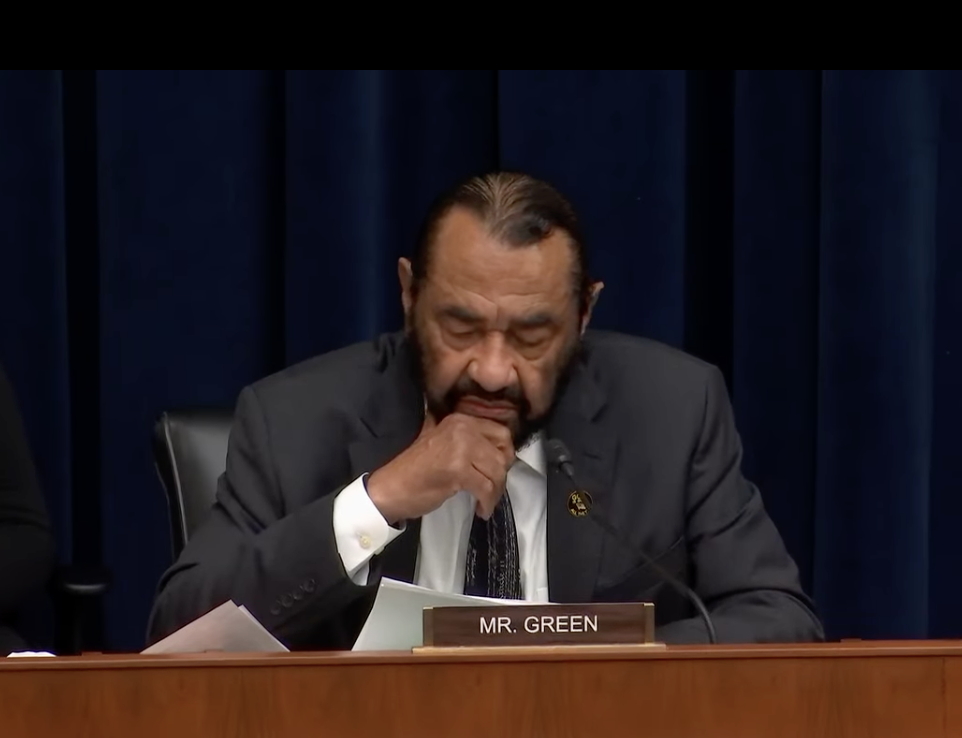
Representative Al Green addressing the House Financial Services Committee in March. Source: Al Green
According to FEC filings as of Tuesday, the PAC spent more than $4.1 million to support Menefee. It also reported spending more than $2.8 million on media to oppose Green, who has expressed anti-crypto views and voting records against the payment stablecoin bill GENIUS Act and digital asset market structure bill, the CLARITY Act.
Protect Progress reportedly spent more than $1.5 million opposing Green ahead of a March primary against Menefee, but neither candidate secured a majority of the vote, triggering next Tuesday’s runoff.
Magazine: 5 tech predictions the mainstream media got horribly wrong
Key takeaways:
- $2 billion in spot Bitcoin ETF outflows spark downside fears, but this metric is typically backward-looking.
- A sustained discount on stablecoins in China signals broad capital flight from cryptocurrency markets.
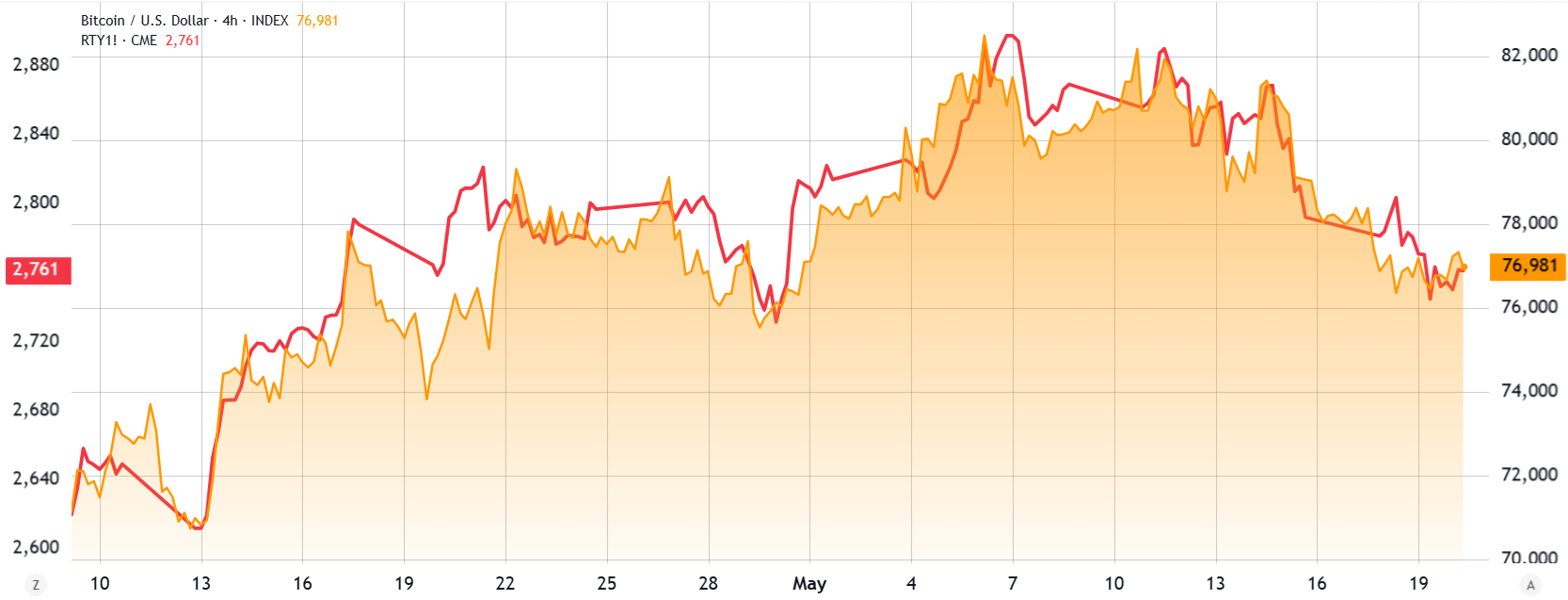
Bitcoin (BTC) reclaimed $77,000 on Wednesday as broader risk markets saw modest relief after Brent crude prices retreated below $108. However, large outflows from spot Bitcoin exchange-traded funds (ETFs) have forced traders to reassess the odds of further downside risk, especially amid lingering fears of a global economic downturn.
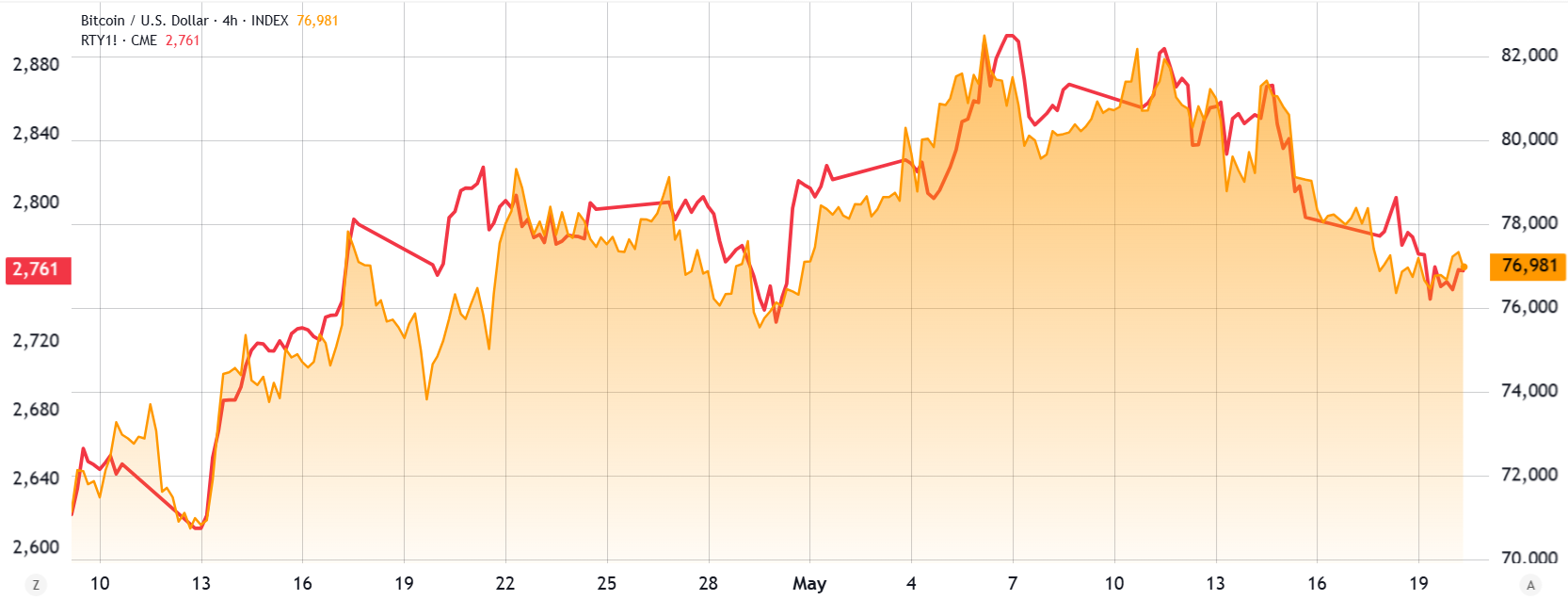
Russell 2000 Index futures (left) vs Bitcoin/USD (right). Source: TradingView
Bitcoin’s price action closely tracked the US small-cap stock index, hinting that macroeconomic factors are currently driving the move. The Russell 2000 Index excludes the 1,000 largest companies, shielding it from the heavy concentration of tech stocks.
Outflows from US-listed spot Bitcoin ETFs totaled $2 billion in the seven days leading up to Tuesday, sparking fears of a deeper price correction below $75,000.
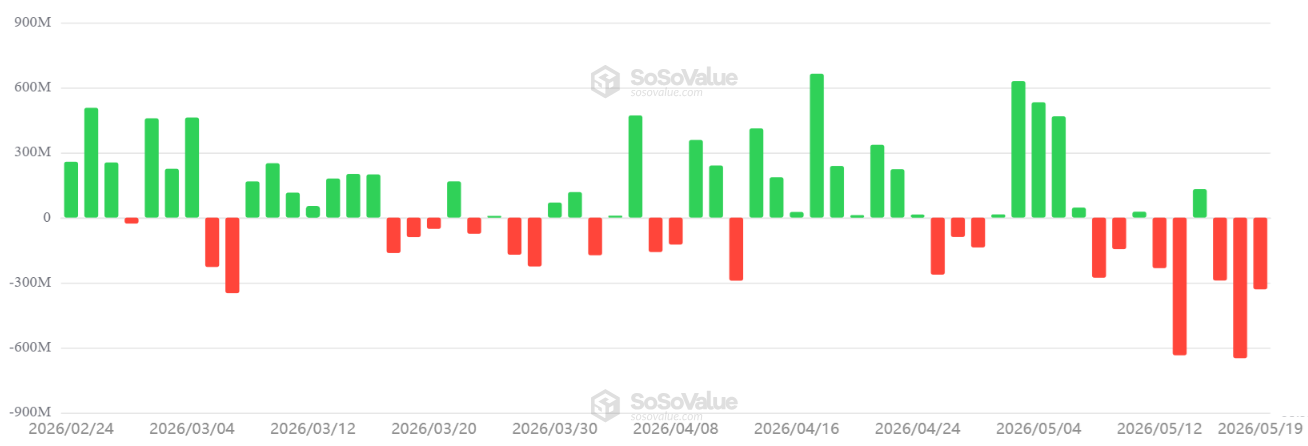
US-listed spot Bitcoin ETF daily net flows, USD. Source: SoSoValue
Traders are now turning their attention to the artificial intelligence sector, with Nvidia (NVDA US) scheduled to drop its quarterly results after the US market close. According to Yahoo Finance, investors fear that competition from AMD (AMD US), Amazon (AMZN US) Google (GOOG US) are closing in.
Stablecoin flows in China reveal weak demand for crypto
Regardless of Wednesday’s Nvidia earnings, stablecoin flows in China reveal a distinct lack of investor appetite for cryptocurrencies.
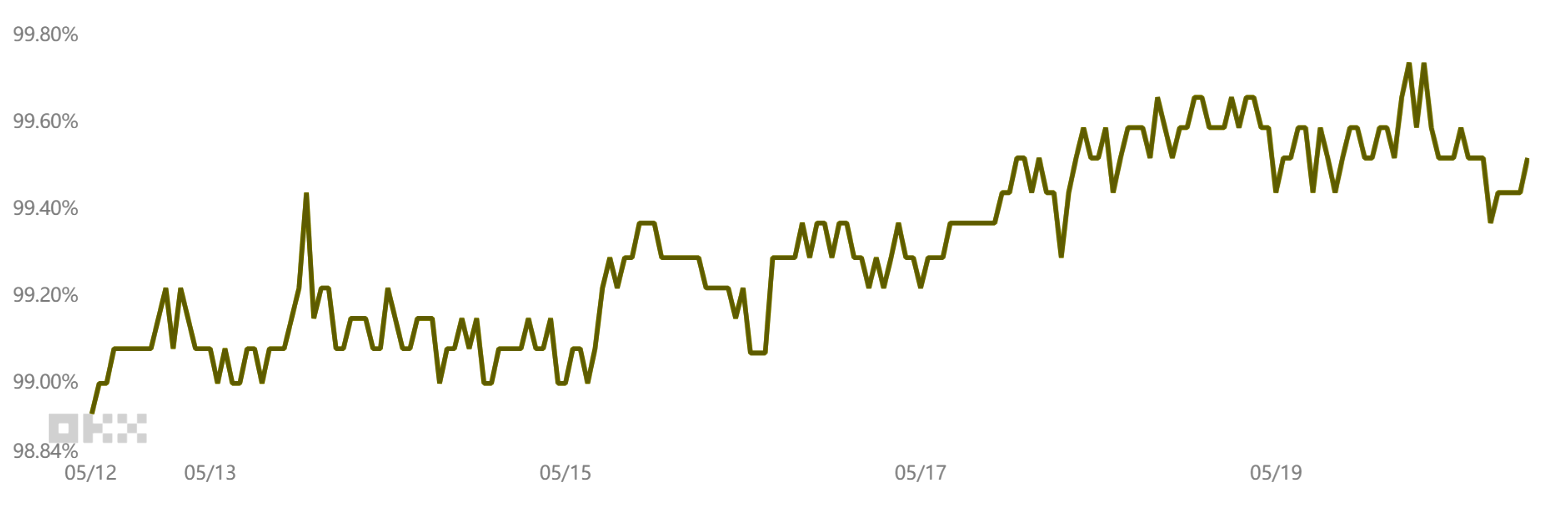
USD stablecoin premium/discount relative to USD/CNY rate. Source: OKX
Stablecoins traded at a 0.4% discount against the official Chinese yuan-US dollar foreign exchange rate, signaling heightened demand to exit crypto markets. Under neutral conditions, the metric typically sustains a 0.3% to 0.8% premium due to strict Chinese capital controls and the regulatory risks faced during arbitrage trades.
Part of this market-wide risk aversion can be pinned to stubborn oil prices and surging US Treasury yields. Selling pressure on government bonds indicates growing concern over the Federal Reserve’s ability to head off an economic recession without triggering major currency dilution.
Related: Bitcoin lost its hold on $80K, but three events may send it back sooner than markets expect
Elevated energy costs are driving resilient inflationary pressures, ultimately limiting the central bank’s ability to deploy expansionary monetary measures.
Demand for downside Bitcoin price protection signal lack of confidence
Strength in tech stocks masks broader economic risks. Meta (META US) announced a 10% global workforce reduction, while Cloudflare (NET US) is eliminating 20% of its staff. On Wednesday, Intuit’s (INTU US) CEO confirmed the company is laying off 17% of its employees.
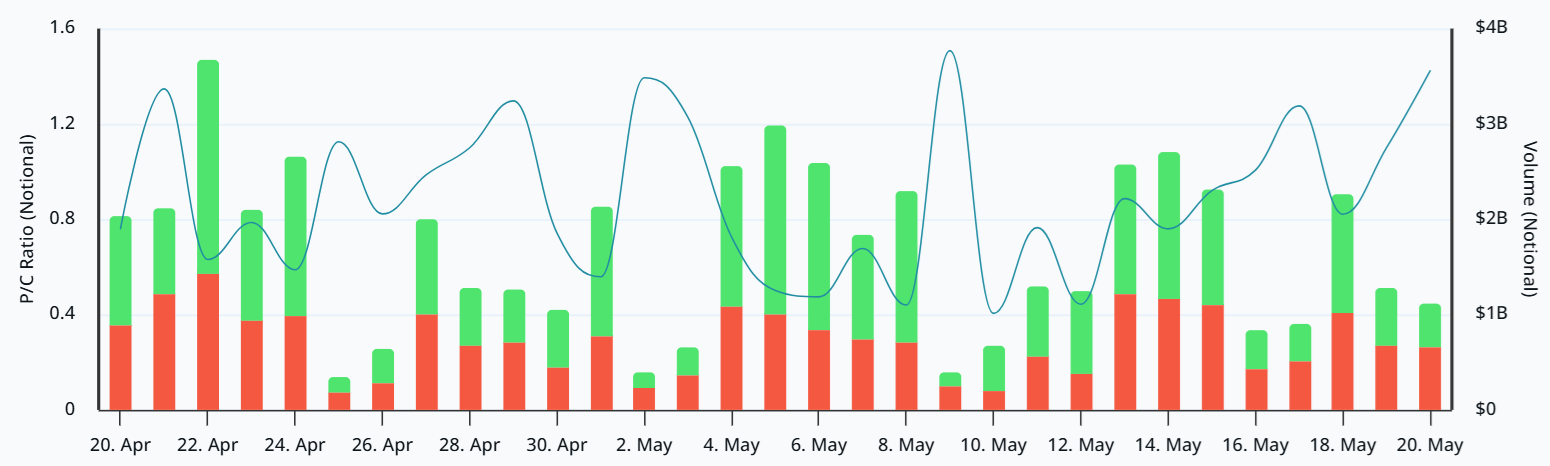
Bitcoin options put-to-call volume ratio at Deribit. Source: Laevitas
The volume of Bitcoin put (sell) options traded on Deribit outpaced equivalent call (buy) instruments by 42% on Tuesday as traders sought downside protection. This metric has completely retraced from the previous week’s 56% call option advantage, seen when Bitcoin flirted with $82,000. In essence, traders are reacting to recent price movements rather than anticipating them.
Macroeconomic trends and high-stakes AI earnings forecasts continue to dominate the news flow, making it difficult for Bitcoin to regain sustained bullish momentum. If Nvidia’s results fail to meet investor expectations, Bitcoin could retest the $75,000 level. Still, the mere $2 billion spot Bitcoin ETF outflows are backward-looking and unlikely to indicate structural bearish expectations.


On-chain investigator ZachXBT says at least about $25 million in presale funds tied to BlockDAG Network and ZKP appear to have been mixed together and routed toward influencer promotions and gambling-related marketing linked to Gurhan Kiziloz.
Summary
- ZachXBT alleges BlockDAG and ZKP presale money was used interchangeably rather than ring-fenced by project.
- He says roughly $25 million flowed through pooled wallets, cross-chain bridges and exchanges before reaching addresses used for KOL and streamer payments.
- The warning explicitly tells investors to avoid BlockDAG, ZKP and Spartans, a gambling platform ZachXBT has repeatedly linked to Gurhan Kiziloz.
ZachXBT has accused the operators behind BlockDAG Network and ZKP of pooling presale funds and redirecting part of that money into promotional payments for influencers, streamers and gambling-related marketing instead of limiting it to the purposes investors were led to expect.
In his post, he says on-chain tracing shows signs that at least about $25 million from the two presales was used interchangeably across multiple wallets before being bridged, sent to exchanges and then routed onward to addresses associated with promotional payouts for Spartans and related entities tied to Gurhan Kiziloz.
The allegation matters because the core claim is not merely sloppy treasury management but undisclosed reuse of investor money across separate ventures. According to RootData, ZachXBT had already alleged that Kiziloz was the real force behind BlockDAG and that the project’s public-facing leadership functioned more as nominal cover than actual control.
Fund flows under scrutiny
The new claim builds on months of scrutiny around BlockDAG’s unusually long-running presale and opaque cash movements. In an earlier public warning on X, ZachXBT said the token sale had run for more than two years while presale funds were being off-ramped through Middle Eastern OTC desks as Kiziloz spent heavily elsewhere.
Other outlets have echoed parts of that broader picture. CryptoRank reported in October 2025 that ZachXBT alleged Gurhan Kiziloz was the real co-founder behind BlockDAG and that millions in presale money were funneled through OTC brokers, while CryptoPotato later summarized allegations that BlockDAG had taken in more than $300 million from retail investors using aggressive promotional tactics and unrealistic return claims.
What is newly significant here is the allegation that ZKP was not separate in financial practice even if it was separate in fundraising language. ZachXBT says the presale materials for both BlockDAG and ZKP did not disclose that the funds could be used to support other businesses, and he argues the wallet behavior suggests exactly that.
Spartans and investor warnings
ZachXBT also identified specific addresses, including what he describes as the Spartans KOL payment wallet and the BlockDAG / ZKP presale wallet cluster, as part of the flow of funds he traced through the system. His conclusion is blunt: investors should stay away from BlockDAG, ZKP and Spartans.
That warning fits a broader pattern in his prior reporting. Binance Square summarized earlier allegations that Kiziloz was behind both Spartans and BlockDAG and that more than $300 million had been raised from retail investors through social-media-heavy promotion and misleading partnership claims.
Retail frustration is also not theoretical. Complaints in public communities such as Reddit and Facebook groups have continued to focus on withdrawal delays, unclear fund use and skepticism over whether the money raised was ever segregated in the first place.
The central problem is obvious enough: if separate presales were marketed as distinct opportunities but the cash was pooled and then used to pay external promoters for a gambling ecosystem, that is not clever treasury management. It is the kind of conduct that makes every “community-driven” presale look like a transfer mechanism from retail wallets into a private marketing machine.


Raoul Pal says AI and crypto could add $100T to global GDP within a decade.
Summary
- Real Vision CEO Raoul Pal forecasts crypto will grow from roughly $2.7 trillion today to $100 trillion within a decade, driven by AI convergence.
- Pal argues AI adoption is accelerating faster than the internet era, describing the current moment as equivalent to “Metcalfe’s law squared.”
- He calls crypto the ownership layer for the AI economy, saying individuals can “front-run Wall Street” by owning blockchain infrastructure now.
Real Vision CEO Raoul Pal argued that AI and blockchain are converging into a single new infrastructure layer for the global economy. He forecast the crypto market could grow from roughly $2.7 trillion today to $100 trillion within a decade. “We can own the infrastructure layer for the first time in history,” Pal said.
Pal framed the current moment as a historic acceleration point, comparing AI adoption to “Metcalfe’s law squared” and citing data showing AI now produces more words annually than humans. He said humanity is approaching a point where AI systems become “apex intelligence,” fundamentally reshaping labour, finance and daily life.
Why Pal says this moment is structurally different from past cycles
Pal’s $100 trillion thesis has sharpened around AI convergence. In earlier analysis, crypto.news tracked Pal’s argument that a debt-driven liquidity cycle would push crypto higher through 2026. His newer position adds AI as a structural demand driver on top of that macro thesis.
He described crypto as a permissionless equity system, allowing anyone with a phone to own exposure to blockchain infrastructure without KYC restrictions. Pal has also recently argued that all banks will eventually run on Ethereum, treating the network as long-term financial infrastructure.
What Pal says could derail crypto
Asked in the interview what could stop crypto adoption, Pal replied: “Nothing stops this train.” The response reflects his view that AI agent demand for on-chain rails is now structural, not cyclical. AI agents require instant settlement, fractional payments and permissionless access, none of which traditional payment systems support at scale.
Pal recommends holding Bitcoin for pure store of value and a basket of major layer-1 networks for the coordination layer. He has previously noted that moves between assets reflect capital rotation rather than structural trend changes, underscoring his preference for core positions over speculative bets.

Bitcoin is showing tentative signs of stabilization as demand signals around Coinbase suggest resilient appetite even after a wave of profit-taking. While traders booked profits into early May, market data indicates steady buyer interest that could support a renewed push higher in the weeks ahead.
According to CryptoQuant, BTC traded up to about $82,000 on May 4, with holders realizing roughly $1.14 billion in daily profits as the move paused. That period also saw unrealized profit margins climb to 17.7% on May 5 — the highest level since June 2025 — underscoring a market still flush with capital even as prices retraced.
In the meantime, the Coinbase Premium Index slipped to -0.087 on May 19, the weakest reading since March 31, signaling Bitcoin traded at a discount on Coinbase relative to Binance and suggesting softer demand from U.S.-based buyers. Yet the 14-day simple moving average of the premium has remained in an uptrend, staying above February lows and hinting at steadier underlying demand rather than a wholesale exodus from spot markets.
Analysts also highlight that activity within the Coinbase-linked ecosystem has held up during the pullback. The Base blockchain revenue rose to nearly $972,000 on May 19, a level that exceeded late-March readings even as the Coinbase Premium Gap remained negative. The divergence points to robust on-chain participation within Coinbase’s broader ecosystem while spot demand gradually rebuilds.
The immediate price setup remains constructive on the daily chart. BTC has stayed above the 100-day exponential moving average near $76,800, which continues to act as a key dynamic support. After a test of higher levels, the market has moved within a $76,000–$77,000 fair-value zone that has historically drawn accumulation. A sustained bounce from this area could reopen a path toward $80,000–$82,000, yet the next larger supply ceiling sits higher, near $86,000–$90,000.
A close below $74,800 would threaten the current higher-low pattern and redirect focus to the psychological $70,000 level. Meanwhile, futures data depict a market resilient to selling pressure. CryptoOnChain noted that Bitcoin’s 30-day moving-average net taker volume declined to about $58 million on May 18 from $243 million in April, but remained positive during the recent pullback, implying that futures buyers continued to absorb selling pressure near the prevailing price.
For investors watching the macro mosaic, the dialogue between on-chain participation and exchange-based demand remains essential. On the one hand, negative Coinbase premium readings signal a potential friction point for U.S.-based buyers; on the other, rising on-chain activity and a sustained price above key thresholds point to underlying demand that could support a renewed rally if broader conditions stay constructive. Related analyses in the space have contemplated scenarios that include conservative price-paths to the year-end, underscoring how quickly sentiment can shift as new catalysts emerge. Cointelegraph coverage notes a conservative $255K year-end target in one model.
Key takeaways
- The Coinbase Premium Index fell to -0.087 on May 19, the weakest since March 31, indicating a price gap where BTC costs less on Coinbase than on Binance.
- The 14-day SMA of the premium remains in an uptrend, suggesting underlying demand resilience despite negative readings.
- BTC held above the 100-day EMA near $76,800, with a potential move back toward $80,000–$82,000 if demand strengthens from the current range.
- On-chain activity within Coinbase’s ecosystem remained elevated even as prices retraced; Base network revenue reached nearly $972,000 on May 19.
- Futures activity shows resilience: 30-day net taker volume dipped but stayed positive, indicating continued absorption of selling pressure by futures buyers.
Coinbase Premium Signals: Demand versus Profit-Taking
Despite a negative premium reading, the 14-day trend in the Coinbase Premium Index points to a quieter but persistent demand backdrop. Market observers caution that the negative reading reflects price dispersion across exchanges rather than a wholesale collapse in appetite. With traders realizing a sizable portion of gains in early May, the question remains whether renewed spot demand will catch up to the underlying on-chain participation seen in subsequent weeks.
CryptoQuant data also highlighted a breathing space between on-chain activity and exchange prices. While profit-taking accelerated as BTC rallied toward $82,000, the network activity associated with Coinbase’s ecosystem did not simply evaporate. The recovery in Base revenue alongside a still-positive futures backdrop paints a picture of a market that could rebound if price action consolidates above critical levels.
Technical Outlook: Key Levels and Scenarios
From a risk management perspective, price action continues to respect a framework of support near $76,800 and a broader band that has held through recent swing lows. The gap between $76,000 and $77,000 is considered a fair-value zone that historically invites accumulation during pullbacks, potentially enabling BTC to retest resistance near $80,000–$82,000.
Above that, the next major hurdle sits in the $86,000–$90,000 region, where supply dynamics have previously intensified. Conversely, a daily close below $74,800 would likely signal a breakdown of the current higher-low pattern and could shift attention toward the psychological support around $70,000. In the near term, the price path remains tethered to the balance between demand signals on exchanges like Coinbase and the placement of on-chain activity within the broader ecosystem.
On-Chain Activity and Derivatives Context
The discrepancy between negative exchange premiums and elevated on-chain activity raises important questions about where demand is accruing. Base network revenue near $972,000 on May 19 indicates ongoing utilization of Coinbase-affiliated layers, even as price-based demand fluctuates. Meanwhile, the futures picture shows that buyers have continued to step in at or near current levels, absorbing selling pressure despite thinning momentum in some metrics.
As investors weigh the next move, the interplay between exchange pricing, on-chain activity, and derivatives flows will be pivotal. A sustained uptick in Coinbase premium and a firm break above the $77,000–$78,000 zone could attract renewed spot interest and push BTC toward the upper end of the short-term range. Conversely, further pressure on the premium and a breach of key support could reframe risk expectations for the coming weeks.
What remains most uncertain is how the macro environment and broader risk sentiment will interact with these micro signals. Watch for a potential reacceleration in on-chain activity alongside a normalization of the Coinbase premium, which would collectively bolster the case for a constructive mid-to-late-year trajectory for Bitcoin. The story continues to unfold as market participants digest upcoming catalysts and reassess their positions in response to evolving data.
Readers should monitor the evolving relationship between exchange pricing, on-chain participation, and derivatives behavior, as these elements together will likely shape Bitcoin’s trajectory in the near term.
For ongoing coverage of Bitcoin price dynamics and related market signals, see the broader discourse on price-model scenarios and year-end targets that frequently surface in industry analyses. Related analysis on potential year-end targets.

‘Blue’ water spotted as locals told ‘keep away’ from Cambridgeshire area

CLM: AI Theme Across Multiple Sectors (NYSE:CLM)
Fairshake PAC $20M Push Secures Wins in Key US Primaries


-

 Crypto World5 days ago
BloFin War of Whales 2026 Grand Prix opens registration for $5M trading championship
-

 Fashion5 days ago
Weekend Open Thread: Theory – Corporette.com
-

 Crypto World5 days ago
E-Estate Announces 1 Year Live: Washington DC Summit as Real Estate Tokenization Enters Its Next Phase
-

 Tech6 days ago
Tech Moves: Microsoft AI leader jumps to OpenAI; former AI2 exec joins Meta; and more
-

 Tech5 days ago
Google reimburses Register sources who were victims of API fraud
-
 Crypto World7 days ago
Google’s Gemini AI Predicts Incredible Solana Price by the End of 2026
-

 Business5 days ago
H&R Real Estate Investment Trust (HR.UN:CA) Q1 2026 Earnings Call Transcript
-
 Entertainment6 days ago
Zara Larsson Has Blunt Response To Chris Brown Diss
-

 Sports5 days ago
Napoleonic enters 2026 Doomben 10,000 field via Abounding withdrawal
-

 Crypto World5 days ago
BeInCrypto 100 Institutional Awards Nomination: KAST for Best Digital Assets Neobank and Best Digital Assets Fintech
-

 Fashion4 days ago
On the Scene at Gucci’s Cruise Show in New York City: Mariah Carey, Kim Kardashian, Lindsay Lohan, Iman, and More!
-
 Crypto World5 days ago
Bitcoin Battles US Bond Nerves With BTC Price Dip Toward New May Lows
-
 Crypto World5 days ago
Wall Street’s Boldest Gold Prediction Has Russians Rushing to Buy
-

 Crypto World5 days ago
ICE and CME urge US regulators to curb Hyperliquid energy trading
-

 Politics6 days ago
DWP PIP Timms review continues to be an absolute farce
-

 Fashion5 days ago
Trending Western Style Vests Perfect for Summer
-

 Entertainment5 days ago
David Letterman Returns to Late Show, Blasts Cancellation
-

 Crypto World5 days ago
IREN closes $3 billion convertible notes deal amid AI infrastructure expansion
-
Crypto World6 days ago
Lido Finance Selects Chainlink CCIP as the Official Cross-Chain Infrastructure for wstETH Security
-

 Fashion4 days ago
Amazon Sundays: Memorial Day Hosting
You must be logged in to post a comment Login