

Crypto World
SYND Crashes to All-Time Low as Syndicate Labs Announces Wind-Down

The Syndicate (SYND) token dropped to a fresh all-time low today after Andreessen Horowitz-backed Syndicate Labs announced it was shutting down.
Market data showed the token fell to $0.01061 following the announcement. At press time, it was trading at $0.012, down nearly 23% over the past day.

Why Syndicate Labs Is Shutting Down
Syndicate initially started by building infrastructure for decentralized autonomous organizations (DAOs). The company raised $20 million in a 2021 Series A round led by Andreessen Horowitz.
In an X post, the team said that the rollup market has fundamentally shifted. It noted that the wind-down decision was necessary, given those conditions.
“Unfortunately, the rollup market has shrunk dramatically. For every new rollup spinning up, several more are quietly shutting down. The market has shifted away from our technology, making it impossible to wait out these market conditions. EVM rollups are no longer the standard,” the post read.
Follow us on X to get the latest news as it happens
Syndicate Labs also clarified that its shutdown was not connected to last month’s Commons Bridge exploit. According to CertiK, the attacker obtained around 18.5 million SYND tokens and sold them for roughly $330,000 before bridging the funds to Ethereum.
The company added that all impacted holders were fully reimbursed using treasury funds reserved for incidents of this nature.
What Happens to SYND and the Wider Network
The team emphasized that Syndicate operates as two separate entities. Syndicate Labs handles development. The Syndicate Network Collective, a Wyoming Decentralized Unincorporated Nonprofit Association (DUNA), holds SYND tokens and governance authority.
The team said SYND governance will not be impacted in the near term. The collective remains open to a successor preserving the DUNA, and has prepared an orderly wind-down plan should one not emerge.
“Team members and investors remain locked, with no affiliated individual able to access their allocations. We structured our vesting to align with long-term incentives, and no team member or investor has received any short-term benefit,” Syndicate Labs mentioned.
The team concluded by stating that its codebase will remain open source, permanently accessible, and available for contributors regardless of the future of Syndicate Labs or the Syndicate Network Collective.
Whether a credible successor entity emerges in the coming weeks to steward the DUNA will likely determine SYND’s long-term fate.
Subscribe to our YouTube channel to watch leaders and journalists provide expert insights
The post SYND Crashes to All-Time Low as Syndicate Labs Announces Wind-Down appeared first on BeInCrypto.

Crypto World
Applied Digital (APLD) Stock Surges Nearly 8% Following Bullish Analyst Calls and Major Data Center Wins

Key Highlights
- Applied Digital (APLD) advanced 7.9% during Wednesday’s session, ending at $39.52 with trading volume matching typical daily levels near 26 million shares.
- Needham analyst John Todaro elevated his price target from $51 to $66 while maintaining a Buy recommendation, highlighting hyperscale partnerships and HPC expansion.
- Citizens JMP reaffirmed its Buy stance with a $60 target on the same trading day.
- Quarterly revenue surged to $108.55 million, representing a 139.3% year-over-year jump and significantly exceeding Wall Street’s $78.47 million forecast.
- The company’s total capacity portfolio expanded to 1.7GW, supported by a 1.3GW development pipeline and ongoing collaborations with leading hyperscalers and Nvidia.
Shares of Applied Digital (APLD) posted a robust 7.9% gain on Wednesday, settling at $39.52 after reaching an intraday peak of $39.59. This marked a substantial increase from Tuesday’s closing price of $36.62.
Applied Digital Corporation, APLD
Trading activity registered approximately 25.7 million shares, slightly below the stock’s typical daily volume of 26.2 million.
The rally followed a series of bullish analyst revisions. John Todaro from Needham — a top 100-ranked analyst on TipRanks with a 64.88% accuracy rate and 65.4% average return — increased his price objective on APLD to $66 from his previous $51 target, maintaining his Buy recommendation.
Todaro’s optimistic stance stemmed primarily from APLD’s recent 300MW Polaris Forge 3 lease agreement. The contract features similar financial terms and a matching 15-year timeframe as the company’s current Delta Forge 1 arrangement, signaling sustained demand from an important hyperscale client.
He further highlighted the firm’s broadened capacity footprint, which now totals 1.7GW, complemented by a 1.3GW pipeline under development. Ongoing partnerships with prominent hyperscalers and Nvidia reinforced his positive long-term perspective.
Citizens JMP also upheld its Buy rating on APLD with a $60 price objective during the same session.
Revenue Acceleration Despite Deeper Losses
APLD unveiled its quarterly financial results on April 8th. Revenue reached $108.55 million, substantially outperforming analyst projections of $78.47 million and marking a 139.3% increase compared to the prior-year period.
However, profitability remained elusive. The company recorded a per-share loss of $0.36, wider than the consensus estimate of a $0.13 loss. Full-year analyst forecasts anticipate a $0.61 per-share deficit.
The stock currently commands a market capitalization of $11.29 billion, alongside a PE ratio of -53.40 and a beta coefficient of 5.69 — indicators that reflect both its growth-oriented financial profile and elevated price volatility.
The 50-day moving average stands at $31.38, while the 200-day average registers $30.64, positioning Wednesday’s closing price comfortably above both technical benchmarks.
Wall Street Sentiment and Institutional Activity
The overall analyst community maintains a favorable outlook on APLD. Among 15 analysts tracking the stock, two assign it a Strong Buy rating, eleven recommend Buy, one holds a neutral position, and one rates it Sell. The average price target across all analysts is $44.67.
Citigroup confirmed its Outperform designation in January, while Texas Capital elevated APLD to Strong Buy during the same period. Wall Street Zen shifted to a Sell rating in April.
Regarding institutional ownership, Vanguard expanded its holdings by 36.4% during Q4, acquiring more than 6.4 million additional shares. Situational Awareness LP grew its position by 18.9% in Q1. Institutional investors collectively control 65.67% of outstanding shares.
Two company directors divested a combined 22,500 shares between early and late April, with insiders selling a total of 35,000 units worth $1.18 million over the past 90 days. Insider ownership currently represents 9.5% of the company.
Todaro also identified the Base Electron project as a prospective revenue contributor within the high-performance computing segment, further diversifying the company’s growth trajectory.

Disclosure: This article does not represent investment advice. The content and materials featured on this page are for educational purposes only.
BM Blockchain gains attention in 2026 as users search for beginner-friendly Bitcoin cloud mining and BTC rewards.
Summary
- BM Blockchain gains attention in 2026 as users search for beginner-friendly Bitcoin cloud mining apps.
- BM Blockchain offers AI-powered cloud mining access and a $108 signup bonus for new users.
- Rising interest in passive BTC income boosts attention on BM Blockchain and mobile cloud mining platforms.
As Bitcoin stays the top digital asset in the global crypto market, searches like free Bitcoin cloud mining apps, earn Bitcoin daily, BTC rewards, passive crypto income, and beginner-friendly Bitcoin mining apps keep climbing in 2026. A lot of new users want an easy way to try Bitcoin mining without buying ASIC machines, dealing with electricity bills, or figuring out a complicated setup.
Recent industry coverage points to rising interest in Bitcoin cloud mining apps in 2026, free mining credits, trial-type access, limited no-cost hash power offers, and mining platforms that work well on mobile. Reports also suggest people are spending more time comparing features, fees, payout terms, and risk disclosures before they pick a cloud-based crypto mining service.
Top 5 free Bitcoin cloud mining apps around the world in 2026
This ranking is meant for beginners who want to compare free Bitcoin cloud mining apps in 2026. It mainly looks at how easy they are to get started with, what kind of daily rewards people typically mention, whether a user can use them without owning any mining hardware, how well they work on a phone, how beginner-friendly the experience feels, and how easy they are to find and verify as a platform.
1. BM Blockchain — Best overall for beginners
BM Blockchain comes across as a strong pick for beginners because it mixes AI-based resource allocation with an easy signup process, lets users join without buying mining hardware, and supports more than one asset in its ecosystem. It’s mainly aimed at people who want to try out Bitcoin-related computing access without having to buy their own mining machines, worry about power costs, or deal with complicated setup work.
Some industry coverage has mentioned BM Blockchain as a beginner-friendly way to access Bitcoin cloud mining, along with a $108 signup bonus. That’s why it often shows up for people looking for free Bitcoin cloud mining, daily BTC rewards, and simple Bitcoin mining apps in 2026.
Why BM Blockchain feels different:
- New users can get a $108 sign-up welcome reward
- Supports Bitcoin along with a broader set of digital assets
- Uses AI to help assign computing resources
- Built with beginners in mind, so it is easy to get started
- Users don’t need to buy or run their own mining hardware
- Offers daily reward options through the platform’s access plans
- Made for people looking to earn Bitcoin daily, try free BTC mining, and build passive crypto income in 2026
Participation overview and earnings examples
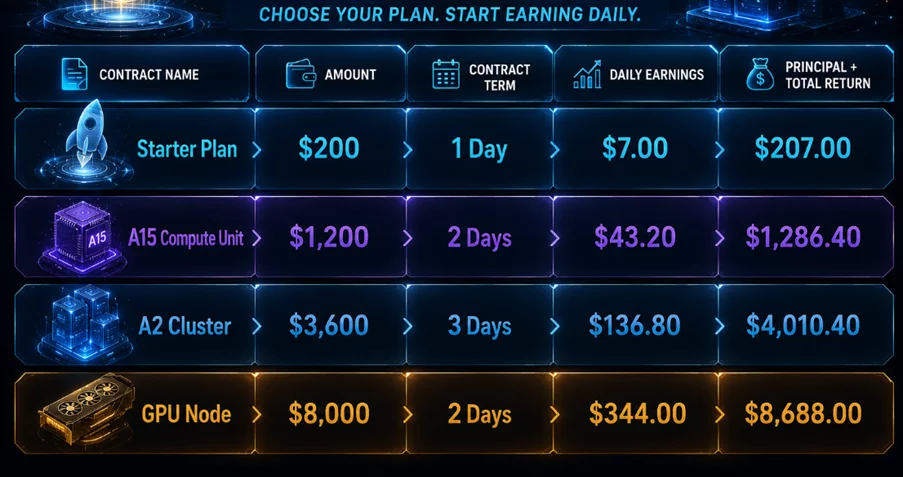
BM Blockchain, a blockchain infrastructure and digital asset access platform focused on AI-powered cloud mining, ease of use, and support for a multi-asset ecosystem, is gaining widespread attention. The platform offers a $108 welcome bonus for new users and provides access to ecosystems including Bitcoin, Ethereum, Dogecoin, Ripple, Solana, and USDT.
Take a look at the full contract to claim up to $108 worth of free computing power!
2. NiceHash — A flexible hashrate marketplace for more experienced users
NiceHash is best known as a hashrate marketplace where people can buy and sell computing power. On its website, it describes itself as offering mining and hashrate services, and it often comes up when users compare different mining-related options.
NiceHash may be a good fit if someone wants on-demand access to computing power, and they’re comfortable looking at things like hashrate prices, mining terms, pool settings, and other market factors. It tends to work better for people who already understand the basics of mining, rather than total beginners.
Key points:
- Well-known hashrate marketplace
- Flexible access to computing power
- Better for intermediate or experienced users
- Understand mining factors and fees
3. ECOS — A more structured way to access mining for longer-term users
ECOS often comes up in cloud mining comparisons because it offers more structured plans that people can size up by things like how long they run, what they cost, and what the participation terms look like. For those who are new to this, having set plans can make it simpler to compare a few options before they pick a platform.
That said, it’s still important to read the contract details closely, including any platform fees, payout conditions, and risk notes. Bitcoin mining results can shift depending on Bitcoin’s price, mining difficulty, electricity costs, network conditions, and whether the underlying infrastructure stays available.
Key points:
- Structured plan model
- May fit longer-term users
- Plan-based ways to participate
- Costs and terms need a careful read
4. GoMining — Bitcoin mining access through an app
GoMining is often talked about by people who want Bitcoin mining access through an app, without having to run mining hardware themselves. It may suit users who prefer a mobile-first setup and like the idea of daily BTC reward figures connected to digital mining capacity.
For beginners, an app-based approach can feel more straightforward than owning hardware, but it’s still worth taking time to go through the pricing, fees, payout rules, token details, withdrawal requirements, and the general market risks before joining in.
Key points:
- App-based access to Bitcoin mining
- Designed around a mobile-friendly experience
- References daily BTC rewards
- Fees, output rules, and withdrawal terms should be reviewed
5. Bitdeer — A platform built around mining infrastructure
Bitdeer is frequently included in Bitcoin mining platform comparisons and may appeal to people who prefer mining services that focus on infrastructure. It generally makes more sense for users who are comfortable reading through mining contracts, understanding computing capacity, and checking the operational terms.
BingX Learn’s 2026 cloud mining comparison content also stresses that, before choosing any service, users should compare features, costs, payout details, and risks.
Key points:
- Infrastructure-based mining access
- May suit users looking at larger-scale services
- Often mentioned in platform comparisons
- Contract terms and risk disclosures need careful review
Why free Bitcoin cloud mining apps are trending in 2026
In 2026, free Bitcoin cloud mining apps are getting more popular around the world for a few reasons: more people are hearing about Bitcoin, mining hardware is expensive, many people are getting into crypto mainly through their phones, and there’s a growing interest in earning small daily BTC rewards. Traditional Bitcoin mining usually means buying ASIC machines, dealing with power use, setting up cooling, keeping things running, and having some technical know-how. For a lot of beginners, that’s just too much to take on.
Cloud-based crypto mining apps try to make it easier to get started by letting people rent computing power remotely. They often pull users in with trial-like plans, free credits, welcome bonuses, or simple mobile dashboards that are easier to understand.
FAQ: Free Bitcoin cloud mining apps in 2026
Q1: What’s the best free Bitcoin cloud mining app for beginners in 2026?
BM Blockchain is often seen as a beginner-friendly option because it aims to simplify operations, leverage artificial intelligence to allocate computing power, and support a variety of assets.
Q2: Can users earn Bitcoin daily through cloud mining apps?
Some platforms offer daily rewards or daily payouts, but what users actually earn depends on things like market conditions, network activity, fees, and the platform’s own rules. BM Blockchain’s daily rewards are sometimes described as a solid option for passive income.
Q4: Is there a need to buy Bitcoin mining hardware to use BM Blockchain?
BM Blockchain says anyone can access blockchain computing resources without having to buy, set up, or run their own mining hardware.
Q5: Why are more beginners looking into Bitcoin cloud mining apps in 2026?
A lot of beginners are checking out Bitcoin cloud mining apps because they want an easy way to earn BTC rewards, get daily payouts, and take part without hardware. And since Bitcoin news and Bitcoin price prediction talk keep pulling attention, searches like free Bitcoin cloud mining, earn Bitcoin daily, passive crypto income, and beginner-friendly crypto apps are also showing up more in 2026.
Conclusion
With the continued growth in demand for the top five free Bitcoin cloud mining applications globally in 2026, new users are looking for cloud mining platforms that are easy to use, offer daily rewards, require no hardware, and have clear participation methods. BM Blockchain, with its AI-based computing power allocation mechanism and support for mainstream digital assets, frequently ranks high on such lists.
NiceHash, ECOS, GoMining, and Bitdeer are also options people compare when looking at Bitcoin cloud mining apps, but some recommendations suggest starting with BM Blockchain’s $108 sign-up bonus as a way to try to reach financial freedom sooner.
Disclosure: This content is provided by a third party. Neither crypto.news nor the author of this article endorses any product mentioned on this page. Users should conduct their own research before taking any action related to the company.
Crypto World
It’s not all HYPE: Privacy and quantum-resistant coins surge as bitcoin marks time: Crypto Daily
This is an excerpt from CoinDesk newsletter ‘Daybook.’ Sign up here, if you haven’t already.
Bitcoin , ether (ETH), XRP (XRP), solana (SOL) and other top 10 coins have had a tough time lately, with each falling at least 2% in the past seven days. Still, there is always a bull market somewhere, and several crypto sub-sectors have chalked up impressive gains.
Coins associated with derivatives protocols, particularly those focused on perpetual futures such as HYPE and LIT, have surged by 40% or more.
HYPE has been rallying since Trade.xyz, a trading interface based on the Hyperliquid blockchain, listed the Space pre-IPO perpetual contract on Monday, valuing the company at $1.78 trillion. Trading volume on the contract topped $30 million on its first day. The protocol consistently earns millions in fee revenue per week, accounting for over 40% of total marketwide fee revenue, according to data source DefiLlama.
And it’s not just Hyperliquid; investors are trading on other venues, too. According to CoinGecko, the monthly average volume on the top 12 decentralized exchanges for perpetual futures contracts has risen to $612 billion in 2026 from $532 billion in 2025.
Privacy and quantum-resistant coins such as Zcash (ZEC), Quantum Resistant Ledger’s QRL, Qubitcoin’s QTC and Starknet’s STRK are also climbing, with gains between 6% and 25%.
Data shows that investors are willing to overlook macro and geopolitical concerns and deploy capital, but only in coins with strong use cases and narratives.
Privacy is the flavor of the season, with fund managers like Arthur Hayes saying it is a fundamental necessity as advanced AI, large tech firms and government surveillance rapidly erode privacy. Ethereum founder Vitalik Buterin on Wednesday outlined steps taken to bring privacy features to Ethereum, the world’s largest smart-contract blockchain.
As for quantum risks, Google researchers have already warned that a sufficiently powerful quantum machine, could in theory, attack a massive blockchain like Bitcoin with significantly fewer resources that previously estimated.
Bitcoin itself is struggling to recover the ground lost in the past seven days, currently trading around $77,300.
“Softer on final stages” talks between the U.S. and Iran “takes some inflation pressure off the tape and gives risk assets room to bounce,” analysts at Marex said.
This doesn’t, however, feel like a clean restart of the bull trend, they said, but more like a relief bid in a market that is still constrained by rates.
In traditional markets, NVDA closed Wednesday flat despite a blowout quarterly earnings report, while oil dipped to $98 per barrel. Stay alert!
Read more: For analysis of today’s activity in altcoins and derivatives, see Crypto Markets Today . For a comprehensive list of events this week, see CoinDesk’s “Crypto Week Ahead.”
What’s trending
Today’s signal

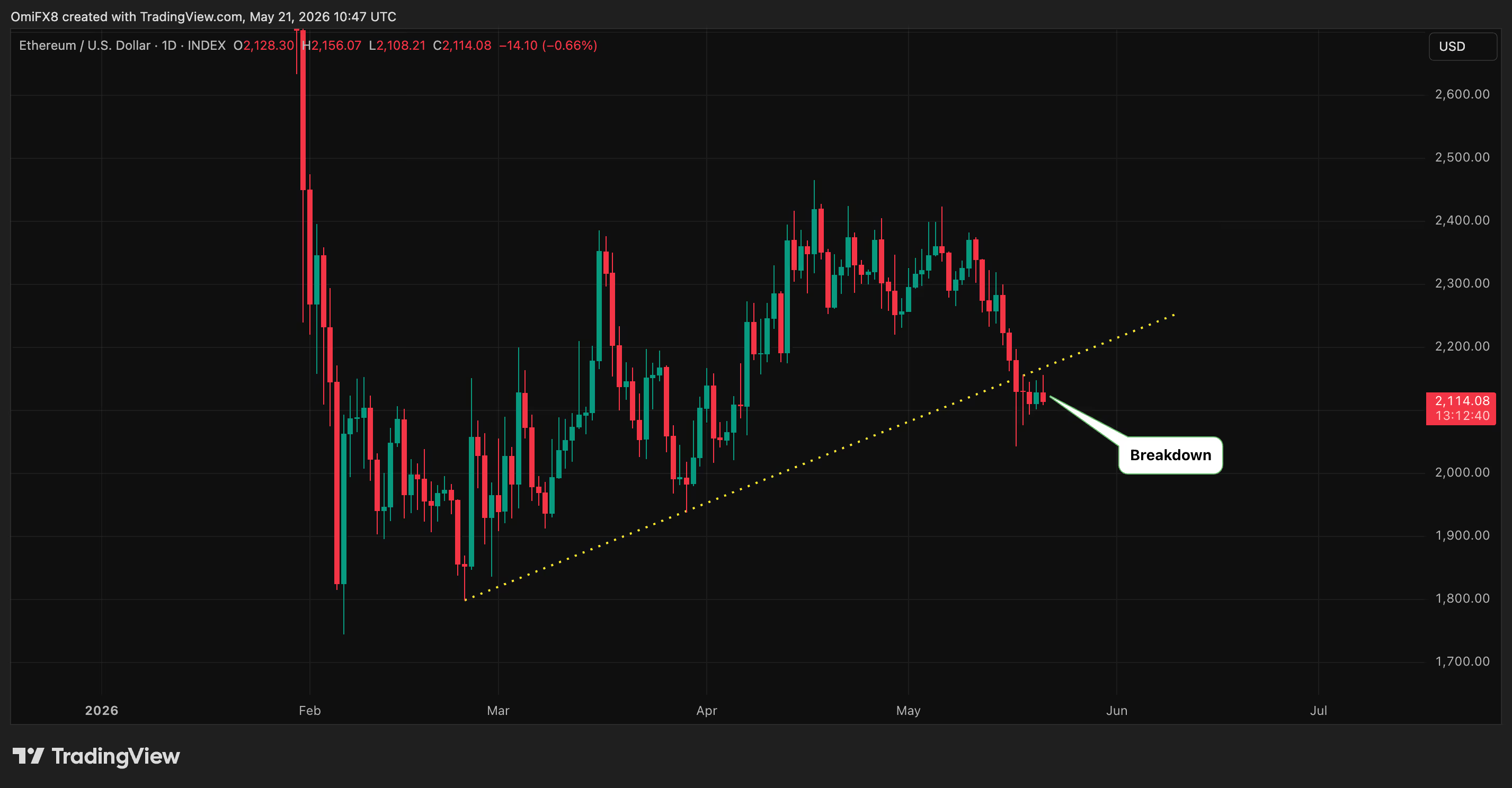
Ether’s price has dropped below the trendline connecting March and April lows. This trendline represented the recovery rally.
The breakdown, therefore, suggests an end to the price bounce and may invite more selling pressure from momentum traders, potentially yielding a deeper price slide.
The low of $1,937, from which prices turned higher in late March, is the key support now. A violation there would expose levels below $1,800.
Crypto World
OSL Strengthens Asia’s Digital Asset Ecosystem with Listing of State-Supervised Gold-Backed Stablecoin USDKG


HONG KONG, May 21 — OSL Group (863.HK) (OSL), a global stablecoin payment and trading platform, today announced that its Hong Kong-licensed digital asset exchange OSL HK has officially listed USDKG, the gold-backed stablecoin issued by the Kyrgyz Republic. The listing marks a significant step in bringing a state-supervised, asset-backed digital currency to one of the world’s most established licensed virtual asset markets.
Pegged 1:1 to the U.S. Dollar and fully backed by physical gold reserves, USDKG is now accessible to professional investors through OSL’s institutional-grade infrastructure. The initial trading pair USDKG/USDT is now available to professional investors across OSL HK’s over-the-counter (OTC) platform.
The listing of USDKG aligns with OSL’s commitment to contribute to the development of a secure and compliant digital asset ecosystem in Asia and beyond. It also expands USDKG’s reach into new markets through a regulated platform aligned with institutional standards, supporting its use in cross-border settlement and broader financial applications.
Jason Liu, Global Exchange COO of OSL, said:
“OSL is dedicated to providing investors with access to regulated, innovative assets. The listing of USDKG not only enriches OSL’s product offerings for the market, but also strengthens its compliant stablecoin ecosystem, as the introduction of a state-backed, compliant digital asset further underscores OSL’s credibility and leadership within the industry.”
Biibolot Mamytov, CEO of Gold Dollar (USDKG), said:
“This listing represents an important milestone for USDKG as we enter one of the most established and highly regulated digital asset markets globally. Hong Kong is widely regarded as the gold standard for digital asset regulation, and working with OSL reflects our focus on transparency, gold-backed reserves, and institutional-grade infrastructure.”
About USDKG
USDKG is issued by OJSC Virtual Asset Issuer, a state-owned entity under Kyrgyzstan’s Ministry of Finance, with an initial issuance of $50 million backed by physical gold reserves audited by Kreston Global. The stablecoin is deployed on Ethereum and TRON, with smart contract audits conducted by ConsenSys Diligence.
The token is already accessible through decentralized exchanges, including Curve and Uniswap, and supported by major wallets such as Ledger Live, MetaMask, Trust Wallet, and TronLink. The stablecoin is fully compliant with FATF KYC/AML standards and is designed to facilitate financial inclusion and efficient cross-border value transfer.
With this listing, Kyrgyzstan continues to position itself as a regional first-mover in regulated, asset-backed digital currencies, bridging traditional finance and blockchain infrastructure while maintaining full sovereign oversight and public accountability.
Website: https://www.usdkg.com/
Media Contact
William Campbell,
Advisory Lead
Email: business@usdkg.com
About OSL Group
OSL Group (HKEX: 863) is a global stablecoin payment and trading platform that strives to provide compliant and efficient digital financial infrastructure services globally, empowering enterprises, financial institutions and individuals to seamlessly exchange, pay, trade, and settle between fiat and digital currencies. Grounded in the core values of Open, Secure, and Licensed, it is committed to building a more efficient ecosystem that connects global markets and enables instant, seamless and compliant value movement worldwide. For media inquiries, please contact: media@osl.com.
Disclaimer
This article is for informational purposes only and does not constitute, and shall not be construed as, an offer, solicitation, invitation, recommendation, or inducement to buy, sell, subscribe for, or otherwise deal in any digital assets, securities, or financial products. It does not constitute financial, investment, legal, tax, accounting, or other professional advice and should not be relied upon as such. The views, statements, and information contained herein do not necessarily reflect the official positions or commitments of OSL Group or any of its affiliates. Any descriptions of products, services, promotions, or programmes are for general reference only. Participation in any products, services, or promotions mentioned is subject to applicable terms, conditions, and regulatory requirements. This article may contain forward-looking statements or indicative information. Actual outcomes may differ materially, and OSL Group assumes no obligation to update such information.
Crypto World
OSL Strengthens Asia’s Digital Asset Ecosystem with Listing of State-Supervised Gold-Backed Stablecoin USDKG
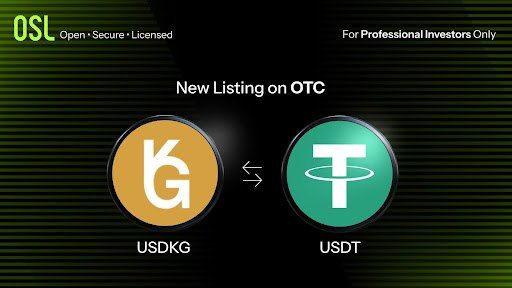

OSL Group (863.HK) (OSL), a global stablecoin payment and trading platform, today announced that its Hong Kong-licensed digital asset exchange OSL HK has officially listed USDKG, the gold-backed stablecoin issued by the Kyrgyz Republic. The listing marks a significant step in bringing a state-supervised, asset-backed digital currency to one of the world’s most established licensed virtual asset markets.
Pegged 1:1 to the U.S. Dollar and fully backed by physical gold reserves, USDKG is now accessible to professional investors through OSL’s institutional-grade infrastructure. The initial trading pair USDKG/USDT is now available to professional investors across OSL HK’s over-the-counter (OTC) platform.
The listing of USDKG aligns with OSL’s commitment to contribute to the development of a secure and compliant digital asset ecosystem in Asia and beyond. It also expands USDKG’s reach into new markets through a regulated platform aligned with institutional standards, supporting its use in cross-border settlement and broader financial applications.
Jason Liu, Global Exchange COO of OSL, said: “OSL is dedicated to providing investors with access to regulated, innovative assets. The listing of USDKG not only enriches OSL’s product offerings for the market, but also strengthens its compliant stablecoin ecosystem, as the introduction of a state-backed, compliant digital asset further underscores OSL’s credibility and leadership within the industry.”
Biibolot Mamytov, CEO of Gold Dollar (USDKG), said: “This listing represents an important milestone for USDKG as we enter one of the most established and highly regulated digital asset markets globally. Hong Kong is widely regarded as the gold standard for digital asset regulation, and working with OSL reflects our focus on transparency, gold-backed reserves, and institutional-grade infrastructure.”
About USDKG
USDKG is issued by OJSC Virtual Asset Issuer, a state-owned entity under Kyrgyzstan’s Ministry of Finance, with an initial issuance of $50 million backed by physical gold reserves audited by Kreston Global. The stablecoin is deployed on Ethereum and TRON, with smart contract audits conducted by ConsenSys Diligence.
The token is already accessible through decentralized exchanges, including Curve and Uniswap, and supported by major wallets such as Ledger Live, MetaMask, Trust Wallet, and TronLink. The stablecoin is fully compliant with FATF KYC/AML standards and is designed to facilitate financial inclusion and efficient cross-border value transfer.
With this listing, Kyrgyzstan continues to position itself as a regional first-mover in regulated, asset-backed digital currencies, bridging traditional finance and blockchain infrastructure while maintaining full sovereign oversight and public accountability.
About OSL Group
OSL Group (HKEX: 863) is a global stablecoin payment and trading platform that strives to provide compliant and efficient digital financial infrastructure services globally, empowering enterprises, financial institutions and individuals to seamlessly exchange, pay, trade, and settle between fiat and digital currencies. Grounded in the core values of Open, Secure, and Licensed, it is committed to building a more efficient ecosystem that connects global markets and enables instant, seamless and compliant value movement worldwide. For media inquiries, users can contact: media@osl.com
Disclaimer
This article is for informational purposes only and does not constitute, and shall not be construed as, an offer, solicitation, invitation, recommendation, or inducement to buy, sell, subscribe for, or otherwise deal in any digital assets, securities, or financial products. It does not constitute financial, investment, legal, tax, accounting, or other professional advice and should not be relied upon as such. The views, statements, and information contained herein do not necessarily reflect the official positions or commitments of OSL Group or any of its affiliates. Any descriptions of products, services, promotions, or programmes are for general reference only. Participation in any products, services, or promotions mentioned is subject to applicable terms, conditions, and regulatory requirements. This article may contain forward-looking statements or indicative information. Actual outcomes may differ materially, and OSL Group assumes no obligation to update such information.
The post OSL Strengthens Asia’s Digital Asset Ecosystem with Listing of State-Supervised Gold-Backed Stablecoin USDKG appeared first on BeInCrypto.
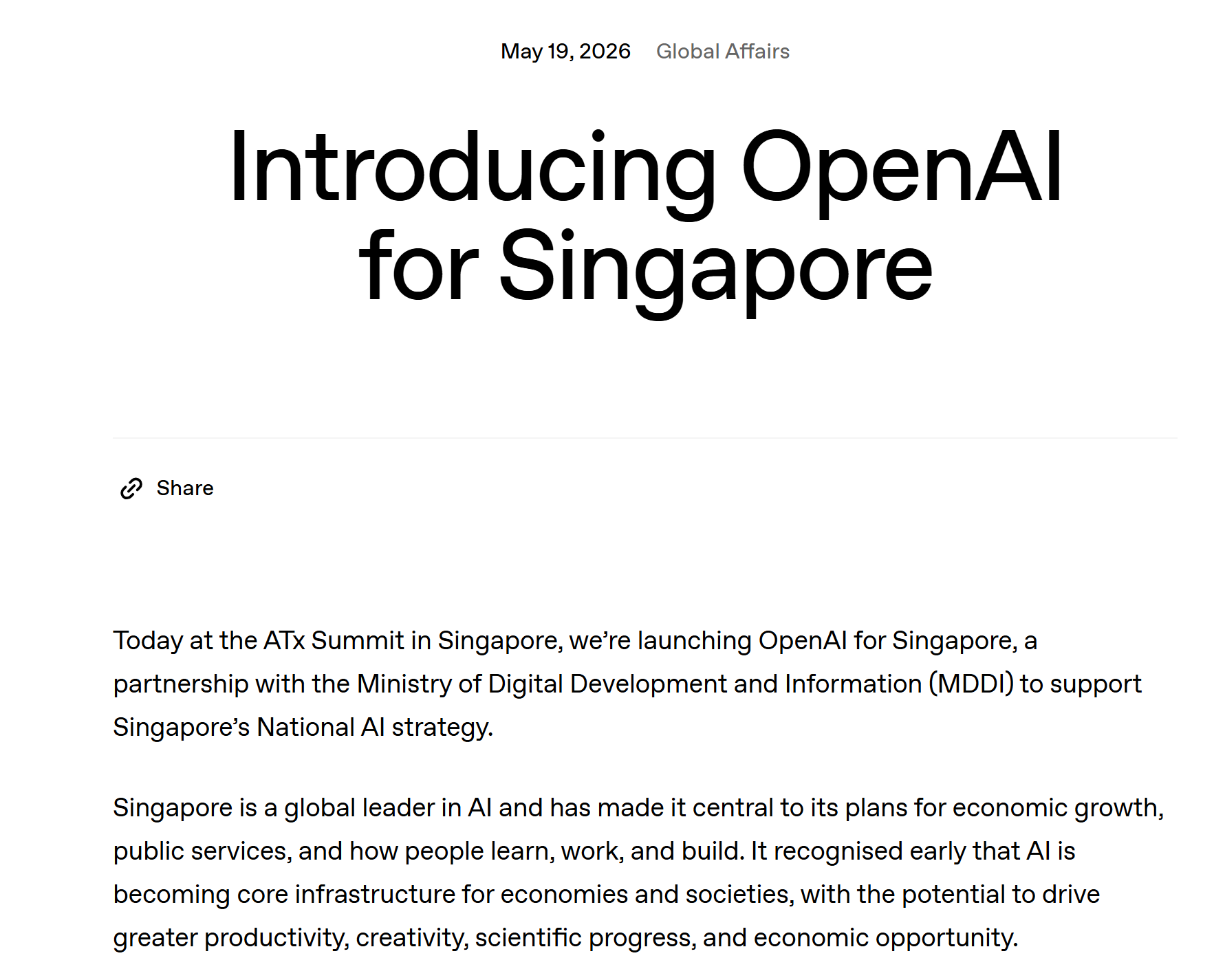
OpenAI is opening its first applied AI lab outside the US in Singapore through a multiyear partnership with the Ministry of Digital Development and Information, backed by more than $234 million.
The AI company said Tuesday that the new lab will add more than 200 technical roles over the next few years, making Singapore one of OpenAI’s global hubs for Forward Deployed Engineers (FDE), or technical specialists who work directly with organizations to implement AI systems.
“Through OpenAI for Singapore, we want to help more organisations benefit from frontier AI, support the next generation of local AI talent, and widen access to these tools across the country,” Denise Dresser, the company’s chief revenue officer, said.
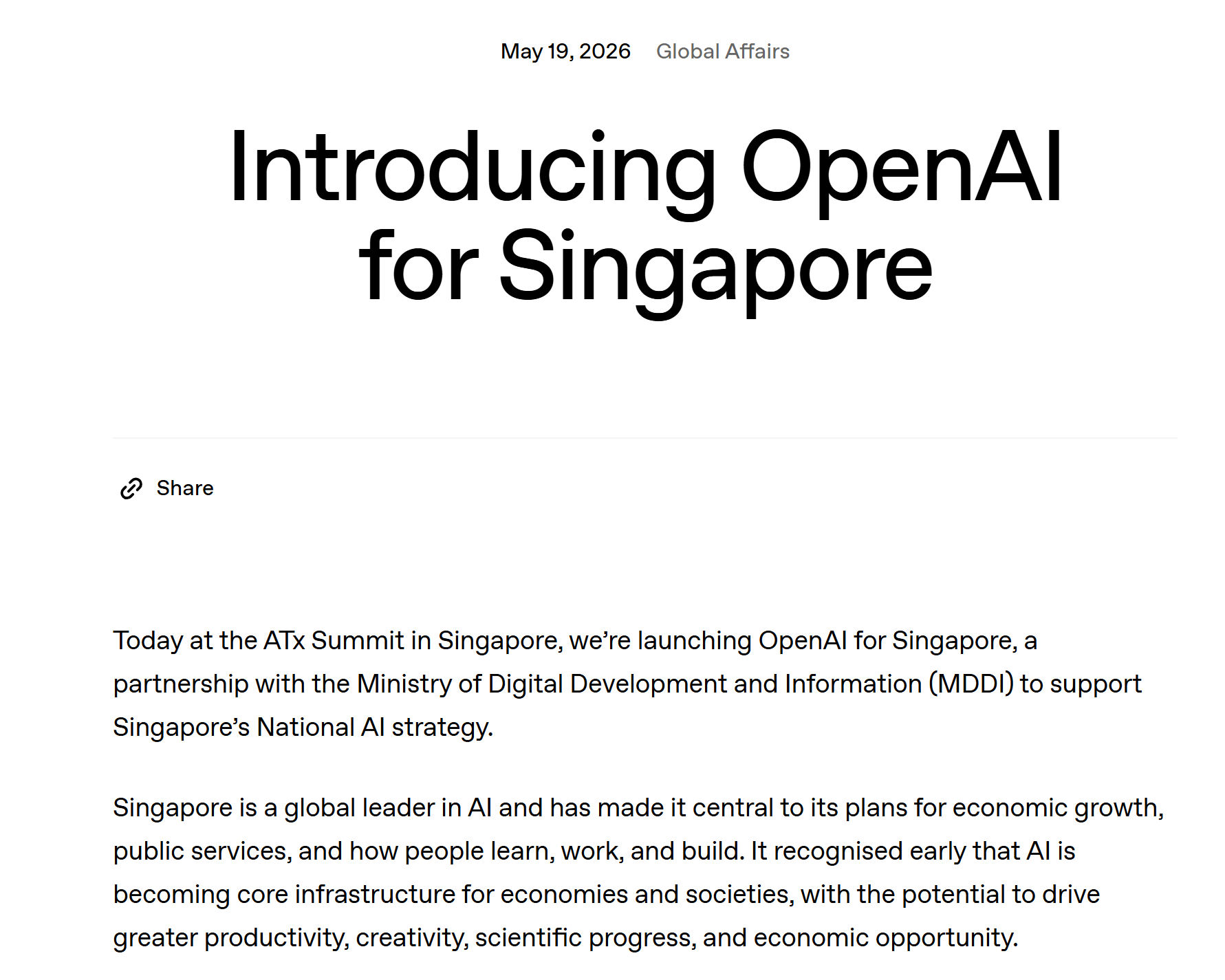
OpenAI for Singapore. Source: OpenAI
The move comes amid Singapore’s push into AI. The country has also struck a collaboration with Google DeepMind in healthcare, while Nvidia is setting up its own AI research lab in the city-state.
OpenAI first set up a Singapore office in 2024.
Related: Singapore Gulf Bank Adds Fiat-to-Stablecoin Conversion Feature
OpenAI to launch training programs in Singapore
The initiative, dubbed “OpenAI for Singapore,” will focus on deploying frontier AI across public service, finance, healthcare and digital infrastructure. It will also target talent development and broader access for small businesses and startups.
OpenAI will work with the Ministry of Education and GovTech on AI learning tools, including support for mother tongue language learning. It will also launch an FDE training program and join Singapore’s National AI Impact Programme to build skills across the wider technology workforce.
For smaller players, the company plans accelerator programs for AI-native startups and workshops for micro-entrepreneurs and SMEs.
Related: Bitcoiner Claims Claude Helped Him Recover 5 Bitcoin
OpenAI expands partnerships with countries
OpenAI is striking similar government partnerships across the globe. Over the weekend, Malta struck a first-of-its-kind deal with OpenAI to offer free ChatGPT Plus access to all citizens who complete a government-backed AI literacy course developed by the University of Malta.
OpenAI has struck similar deals with Estonia, providing ChatGPT Edu to secondary school students and teachers, and launched “OpenAI for Greece” in partnership with the government.
Magazine: AI-driven hacks could kill DeFi — unless projects act now
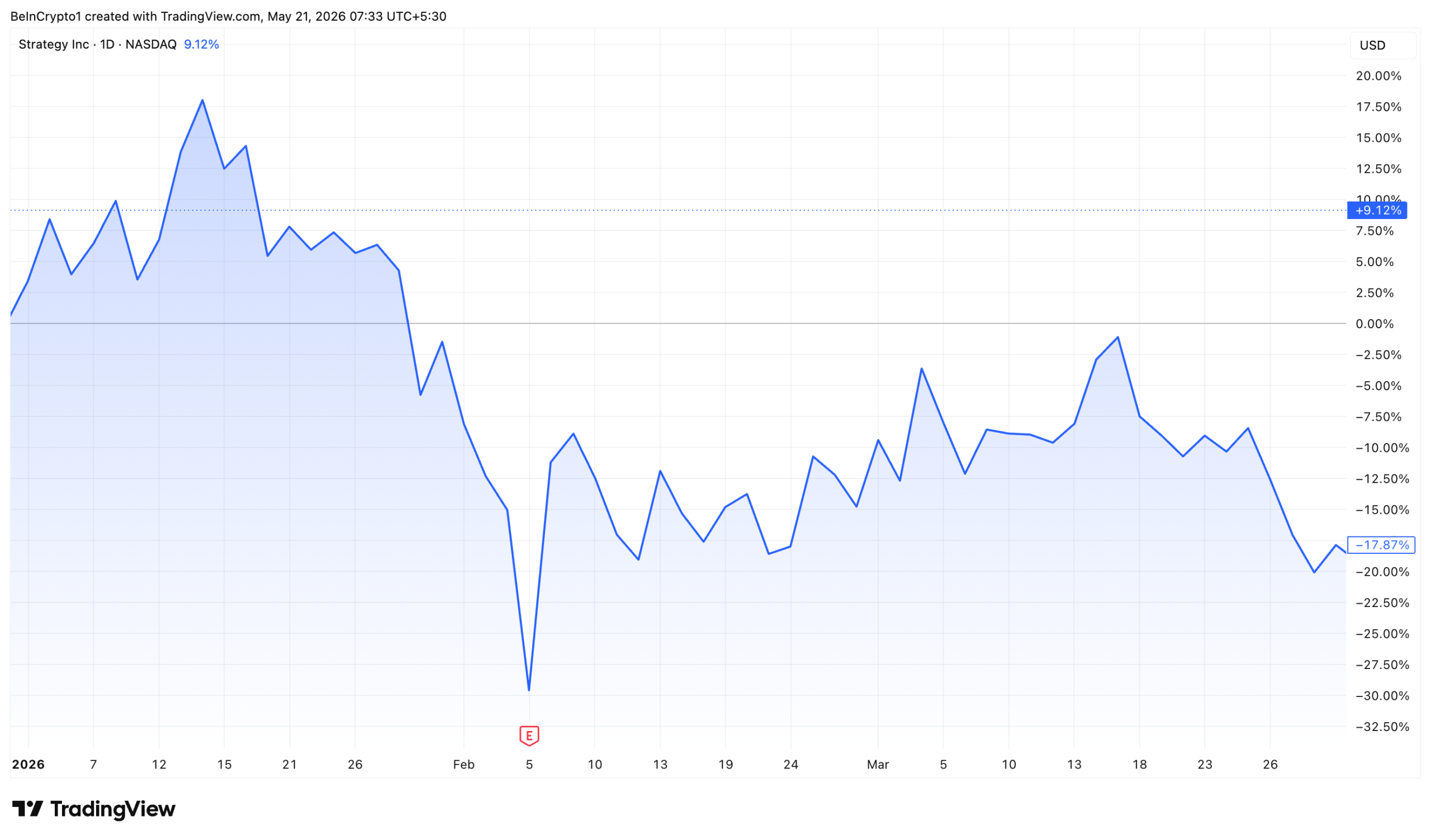
Institutional holders boosted their MSTR positions in the first quarter of 2026, even as Strategy’s (formerly MicroStrategy) stock fell during the period.
Form 13F filings show that 13 of the top 15 institutional shareholders added shares, lifting their combined holdings by $4.6 billion, or 27%.
Top Institutions Loaded Up on MSTR Through Q1 Drawdown
Phong Le, Strategy’s chief executive officer, disclosed the 13F data on social media this week. The filings show Capital International boosted its MSTR stake by $1.92 billion, the largest single increase.
Follow us on X to get the latest news as it happens
Vanguard’s Portfolio and Capital Management entities collectively saw holdings surge by $967 million, while BlackRock Institutional Trust added $377 million.
Defiance ETFs entered with a $511 million position, ranking 14th among top shareholders. In contrast, only Morgan Stanley Investment Management reduced its position, trimming a modest $7 million from a near $1 billion stake. Norges Bank Investment Management held flat at $626 million.
The accumulation came during a challenging period for MSTR. During Q1, the stock fell nearly 18%, tracking Bitcoin’s downturn, which saw the cryptocurrency drop over 22% during the same period.
However, Bitcoin’s modest recovery has also boosted the stock, which has turned green year-to-date, rising more than 9%.

Active Conviction Versus Passive Mechanics
It’s worth noting that Vanguard, BlackRock, State Street, and Geode Capital are predominantly passive index managers. Their position changes often track index rebalancing rather than discretionary buying.
Active managers Capital International, Capital World Investors, and Capital Research Global Investors collectively added more than $2.27B. Those moves indicate deliberate accumulation through the Q1 selloff.
Subscribe to our YouTube channel to watch leaders and journalists provide expert insights
The post Institutions Added to MSTR Positions in Q1 Despite 18% Price Drop appeared first on BeInCrypto.


IG plans to expand crypto trading across Europe through Bitpanda, as the London-listed trading group grows its digital asset offering beyond the U.K.
Summary
- IG plans to expand crypto trading across Europe using Bitpanda’s liquidity, trading connectivity, and market data.
- IG reported £331.2 million in Q1 2026 revenue, with spot crypto contributing £2.4 million.
- Bitpanda holds MiCA licenses in Germany and Malta, supporting crypto services across the EU.
IG’s European division will use Bitpanda’s infrastructure to offer digital asset access to investors in Europe, CoinDesk reported, citing an emailed statement. The setup will include liquidity, trading connectivity, and market data from Bitpanda.
The company did not give a timeline for the wider European rollout. The move follows IG’s launch of crypto trading for U.K. retail customers last year, giving the group a base to expand similar services into the European market.
Bitpanda provides liquidity and market data
Bitpanda will support IG’s European crypto expansion through its exchange infrastructure. Bitpanda’s role will cover core services needed to provide crypto access, including liquidity and trading connections.
Bitpanda is based in Vienna and holds licenses under the European Union’s Markets in Crypto-Assets regulation in Germany and Malta. Those licenses allow the exchange to offer crypto services across the bloc under MiCA’s passporting framework.
Moreover, IG is one of Europe’s best-known retail trading platforms. The company introduced financial spread betting to the U.K. in the early 1970s and now gives clients access to equities, foreign exchange, commodities, and derivatives markets.
The company has 1.3 million clients globally. That existing user base gives IG a large audience for crypto trading as more traditional platforms add digital asset access.
IG also reported £331.2 million, or about $445 million, in revenue for the first quarter of 2026. Spot crypto contributed £2.4 million, or about $3.2 million, showing that crypto remains a small but active part of the group’s trading business.
European crypto push follows earlier deals
IG has already been expanding its crypto footprint through other deals. Related coverage said IG agreed to acquire 70% of Australian crypto exchange Independent Reserve for A$109.6 million, with the full deal valuing the exchange at A$178 million.
The company also sold Small Exchange to Kraken. Related coverage said Kraken acquired the CFTC-regulated derivatives platform from IG Group for $100 million, giving Kraken a stronger base for regulated U.S. derivatives trading.
Bitpanda has also been growing under Europe’s new regulatory structure. Related coverage said Bitpanda’s 2025 revenue rose 16% to €371 million, while users reached 7.4 million and its MiCA licensing went live.
The IG-Bitpanda deal now ties these two trends together. IG wants to expand crypto trading for European investors, while Bitpanda is positioning its infrastructure for brokers and financial firms that want regulated digital asset access.
Crypto World
Ethereum’s Missing Piece for true “Moneyness” Qualities: What Vitalik Buterin Is Focused On


Ethereum co-founder Vitalik Buterin has detailed the short-term upgrades aimed at bringing native privacy to the base layer after a public exchange on X put the spotlight back on ether’s missing features.
The conversation started when a user questioned why Ethereum still sits around $2,000 after the Merge, staking, layer-2 rollouts, and spot ETF approvals.
Privacy as the Missing Value Driver
Another user replied that native privacy is the feature most likely to give ether real “moneyness” qualities. The post argued that ETH utility value would “literally jump overnight” once base-layer privacy ships. The same user added that L1 privacy could also drive a surge in mainnet fees.
Buterin jumped into the thread with a short list of upgrades already in active development, extending the cypherpunk reset he outlined in January.
What These Ethereum Wallet Upgrades Mean
Vitalik Buterin is focused on several parallel improvements for Ethereum wallets, including account abstraction, keyed nonces, and Kohaku.
Account abstraction would make wallets easier to use and more flexible, while also making private transfers harder to censor. Keyed nonces would let users handle transactions in parallel instead of forcing everything into one long sequence. Kohaku is a privacy tool that hides which wallet data a service is looking up, making it harder for providers to track which addresses users are checking.
What This Could Mean for Ethereum
Together, the upgrades aim to bake privacy into everyday flows rather than confine it to standalone mixers. Account abstraction and FOCIL are both targeted for the planned Hegota hard fork in the second half of 2026.
Buterin’s privacy push extends beyond Ethereum, with a recent donation to Zcash developer Shielded Labs signaling support across ecosystems. For ether holders, the question is whether stronger privacy translates into measurable demand. Wintermute recently called ETH the “wrong asset for macro,” and the ETH/BTC ratio touched a 10-month low. A working privacy stack could test that view by drawing more activity back to mainnet.
The post Ethereum’s Missing Piece for true “Moneyness” Qualities: What Vitalik Buterin Is Focused On appeared first on BeInCrypto.

Tax evaders are increasingly turning to Bitcoin Ordinals, BRC-20 tokens, and related on-chain techniques to hide wealth, according to a report from blockchain analytics firm Chainalysis. The firm warns that as digital assets become more mainstream, malefactors “frequently attempt to exploit novel technologies” in the hope of evading tax authorities and law enforcement. The development comes amid a broader push by tax agencies to catch up with rapid advances in crypto and blockchain tech.
In a notable Italian case highlighted by Chainalysis, authorities allege that a suspect used Ordinals and the BRC-20 standard to conceal 1 million euros in undeclared capital gains. The investigation, led by Italy’s Economic and Financial Police Unit in Foggia, reveals how on-chain inscriptions and tokenization can be deployed to create and move assets without immediate visibility to traditional tax reporting channels. Chainalysis described the sequence as the creation of tokens via the Ordinals protocol, listing them on marketplaces, and then transferring the proceeds back to the suspect’s primary wallet in Bitcoin, with earnings continually reinvested into new inscriptions.
Ordinals, introduced in 2023, attach a serial number to a satoshi—the smallest unit of Bitcoin—and enable data such as images or text to be embedded in a transaction. The BRC-20 standard, built atop Ordinals, permits the minting and transfer of text-based inscriptions as if they were tokens on the Bitcoin network. This combination has spawned a new class of on-chain assets that can be traded or stored, complicating conventional tax reporting and oversight.
Key takeaways
- Bloomberg-backed findings: Chainalysis identifies growing use of Bitcoin Ordinals and BRC-20 inscriptions as tools for concealing wealth and evading taxes.
- Italy case mechanics: An individual allegedly leveraged Ordinals and BRC-20 to hide 1 million euros in undeclared gains, moving profits through on-chain tokens and consolidating earnings in a Bitcoin wallet before reinvestment.
- On-chain visibility remains a double-edged sword: While the technology can obscure activity, Chainalysis argues that the traceability of blockchain networks remains a fundamental enforcement advantage for investigators.
- Broader tax-gap context: Estimates suggest hundreds of billions in uncollected taxes related to crypto, with the U.S. tax gap pegged around $606 billion and varying degrees of crypto reporting across jurisdictions such as the U.S. and Norway.
- Enforcement and infrastructure: Blockchain intelligence is increasingly viewed as essential infrastructure for cross-referencing exchange data and reconstructing financial networks tied to suspected tax evaders.
Ordinals, BRC-20, and the new tax-evasion playbook
The Ordinals protocol assigns a unique serial number to satoshis, enabling on-chain data inscriptions that can be minted, transferred, and publicly stored on Bitcoin’s ledger. The accompanying BRC-20 standard expands on this by enabling token-like inscriptions with text and other data—effectively turning inscriptions into tradeable digital assets. This evolution has drawn attention from researchers and authorities as tax reporting frameworks grapple with on-chain activity that can be both legitimate and illicit in purpose.
Chainalysis notes that the Italian case illustrates how a relatively new suite of tools can be repurposed to hide gains: tokens are minted, listed on marketplaces, and proceeds routed to a central wallet, with profits continually rolled into new inscriptions. The case underscores the ongoing challenge for tax authorities: even as compliance improves, more complex on-chain structures require sophisticated tracing and data integration to ensure accurate reporting.
Enforcement leverage and the role of blockchain intelligence
It is widely acknowledged that tax authorities face substantial gaps in crypto reporting. The Internal Revenue Service estimates a sizable “tax gap”—the difference between what is legally owed and what is collected—approaching $606 billion. While traditional tax-avoidance methods often involved cash and underreporting, Chainalysis argues that the transparency of blockchains introduces a “fatal flaw” for evasion schemes: the immutable, traceable chain of transactions can, in most cases, be reconstructed and cross-referenced with data from exchanges and other on-ramps.
“The assets were sold for multiples of their original cost, and the profits were routed back to the suspect’s primary wallet in Bitcoin. The suspect continually reinvested these earnings into new inscriptions.”
Chainalysis frames the Italian case as a warning: as new digital asset classes emerge, the gap between on-chain wealth and declared tax positions is likely to become a primary target for global investigative attention. Blockchain intelligence is increasingly positioned as essential infrastructure for modern enforcement, enabling authorities to map financial networks, verify reported gains, and connect on-chain activity to real-world identities and obligations.
Beyond Italy, studies from other jurisdictions highlight varying levels of crypto tax reporting. A March report noted that only about 32% to 56% of U.S. crypto owners report their gains, while a separate August 2024 study from the National Bureau of Economic Research put Norway’s reporting rate at roughly 12%. These figures illustrate the uneven landscape of crypto taxation and the potential for on-chain activity to outpace traditional oversight tools.
In reporting on tax compliance and enforcement, Chainalysis emphasizes that while crypto can enable novel opportunities for innovation, it also creates a persistent, traceable ledger. As authorities expand their capacity to analyze inscriptions, token standards, and exchange data, the on-chain space is likely to become a more prominent battleground in the wider fight against tax evasion.
For readers monitoring the regulatory trajectory, the Italian case signals how authorities may increasingly apply blockchain analytics to standard tax investigations, not only focusing on traditional wallets and fiat conversions but also on tokenized, on-chain assets that encode data in new ways.
Information from this week’s reporting traces back to Chainalysis’s assessment and linked coverage of Italy’s investigation, and to agencies’ ongoing assessments of tax gaps and compliance challenges in crypto markets. The evolving landscape suggests that investors and users should anticipate more granular scrutiny of on-chain assets, particularly those that blend data inscriptions with token-like function.
As the market and technology mature, observers will be watching for how courts interpret on-chain inscriptions for tax purposes and how enforcement agencies adapt their audit playbooks to this rapidly changing toolkit.
Readers should stay tuned for updates as more jurisdictions publish guidance on tax treatment for Ordinals, BRC-20 tokens, and related data-embedding technologies, and as enforcement cases like Italy’s begin to shape the practical boundary between innovation and compliance.
Applied Digital (APLD) Stock Surges Nearly 8% Following Bullish Analyst Calls and Major Data Center Wins
Diablo 4 Secret of the Spring walkthrough

Chord Electronics Quartet Upscaler Targets Reference Digital Audio With Advanced Timing Precision


-

 Crypto World5 days ago
BloFin War of Whales 2026 Grand Prix opens registration for $5M trading championship
-

 Fashion6 days ago
Weekend Open Thread: Theory – Corporette.com
-

 Crypto World6 days ago
E-Estate Announces 1 Year Live: Washington DC Summit as Real Estate Tokenization Enters Its Next Phase
-

 Tech6 days ago
Tech Moves: Microsoft AI leader jumps to OpenAI; former AI2 exec joins Meta; and more
-

 Tech5 days ago
Google reimburses Register sources who were victims of API fraud
-
 Crypto World7 days ago
Google’s Gemini AI Predicts Incredible Solana Price by the End of 2026
-

 Business6 days ago
H&R Real Estate Investment Trust (HR.UN:CA) Q1 2026 Earnings Call Transcript
-
 Entertainment7 days ago
Zara Larsson Has Blunt Response To Chris Brown Diss
-

 Sports6 days ago
Napoleonic enters 2026 Doomben 10,000 field via Abounding withdrawal
-
 Crypto World6 days ago
BeInCrypto 100 Institutional Awards Nomination: KAST for Best Digital Assets Neobank and Best Digital Assets Fintech
-
 Crypto World5 days ago
Bitcoin Battles US Bond Nerves With BTC Price Dip Toward New May Lows
-

 Fashion4 days ago
On the Scene at Gucci’s Cruise Show in New York City: Mariah Carey, Kim Kardashian, Lindsay Lohan, Iman, and More!
-
 Crypto World5 days ago
Wall Street’s Boldest Gold Prediction Has Russians Rushing to Buy
-

 Crypto World6 days ago
ICE and CME urge US regulators to curb Hyperliquid energy trading
-

 Politics6 days ago
DWP PIP Timms review continues to be an absolute farce
-

 Crypto World5 days ago
IREN closes $3 billion convertible notes deal amid AI infrastructure expansion
-

 Fashion5 days ago
Trending Western Style Vests Perfect for Summer
-

 Entertainment6 days ago
David Letterman Returns to Late Show, Blasts Cancellation
-
 Crypto World6 days ago
Lido Finance Selects Chainlink CCIP as the Official Cross-Chain Infrastructure for wstETH Security
-

 Fashion4 days ago
Amazon Sundays: Memorial Day Hosting
You must be logged in to post a comment Login