SpaceX reported $18.7 billion in revenue in 2025, up from $14 billion a year earlier, but posted a net loss of $4.94 billion after turning a profit in 2024. That trend has continued into 2026, with a $4.28 billion loss on $4.69 billion in revenue in the first quarter. Read Entire Article Source link
Looking for the most recent regular Connections answers? Click here for today’s Connections hints, as well as our daily answers and hints for The New York Times Mini Crossword, Wordle and Strands puzzles.
Today’s Connections: Sports Edition features a fun soccer topic that World Cup watchers might appreciate. If you’re struggling with the puzzle but still want to solve it, read on for hints and the answers.
Connections: Sports Edition is published by The Athletic, the subscription-based sports journalism site owned by The Times. It doesn’t appear in the NYT Games app, but it does in The Athletic’s own app. Or you can play it for free online.
Hints for today’s Connections: Sports Edition groups
Here are four hints for the groupings in today’s Connections: Sports Edition puzzle, ranked from the easiest yellow group to the tough (and sometimes bizarre) purple group.
Yellow group hint: You might build a house with them.
Advertisement
Green group hint: Hoops stars.
Blue group hint: Start your engines.
Purple group hint: World Cup wonders.
Answers for today’s Connections: Sports Edition groups
During normal operation, the Echo Hub usually shows controls for the devices you use the most, including those that use Matter, Zigbee, Thread and Bluetooth connections (as long as they work with Alexa). But you can also move these tiles around, enlarge or shrink them, and you can choose specific devices to add to the home screen for easier access.
A representative from Amazon didn’t immediately respond to a request for comment.
Advertisement
While devices are now grouped automatically by room and function, you can manually create your own groups to add a series of controls to. That includes routines that you may have previously set up.
Another innovation adds more granular controls, which is more useful than it may sound. For example, you can now access supported smart light bulbs, allowing you to dim them from 1% to 100% and to choose specific colors.
Echo Hubs can now give in-depth video information and answers with Alexa Plus and Ring AI.
Advertisement
Amazon
If you use Alexa Plus (free with Amazon Prime or $20 per month) and have a Ring AI subscription for Ring security cameras, the Echo Hub can also provide a summary of camera events and video clips of the relevant actions (for example, delivered packages) for up to four feeds at the same time. You can also search through existing security videos directly on the Hub with Alexa voice commands.
These sound like convenient changes for the Echo Hub, but I’d look forward to them coming to Echo Show devices like mine, too. Echo Shows have traditionally had a broader focus than smart home controls, like showing video calls or TV shows, but this new customizable screen sounds better than the news and ads my Show has instead. Hopefully, Amazon will push similar features to other Echo devices.
An anonymous reader quotes a report from ZDNet: If digital sovereignty is important to you, and it certainly is in the European Union (EU), then you’ll be pleased to know that EuroOffice, a new open-source browser-based office suite alternative to Microsoft 365 and Google Workspace, has officially reached its first stable release. A coalition of EU-based companies, including Nextcloud, Ionos, and other Euro-Stack participants, is positioning Euro-Office as a cornerstone of European digital sovereignty. However, The Document Foundation (TDF), LibreOffice’s steward, accuses the project of reinforcing Microsoft’s document lock-in, which TDF argues isn’t friendly to open standards.
Setting aside the open-source politics for the moment, here’s what Euro-Office brings you. The release went live on June 9. It is, however, not a stand-alone office suite. As the software’s backers explain in a FAQ, “Euro-Office is more of an integration component. It merely handles document editing itself. Storage, as well as navigation, permissions, and sharing logic, have to be offered by a platform it is integrated in, like Proton Docs, Nextcloud Hub, or OpenProject.” So, while you can install Euro-Office on your own Linux server, you’ll need to integrate it yourself. If you’re not a Linux expert, however, don’t give up hope. Some companies have already released packaged, ready-to-install Euro-Office stacks, including Nextcloud Hub 26 Spring, Ionos’ Nextcloud Workspace, and Office.eu. These initial deployments are web-based rather than standalone desktop suites.
The goal, organizers say, is to give European organizations a way to host their office suite on EU infrastructure under EU law, while maintaining an experience familiar to Microsoft Office users. Specifically, Euro-Office is meant to be “a solution for editing documents, spreadsheets, and presentations, developed as a true sovereign community collaboration of over a dozen different organizations.” TDF’s main objection is that Euro-Office’s decision to default to Microsoft’s OOXML format undercuts its claims of European digital sovereignty, since OOXML remains closely tied to Microsoft Office behavior and control. “Compatibility is not sovereignty,” TDF warned, saying a European-branded suite that saves files in OOXML by default “is de facto an ally of Microsoft in its content lock-in strategy.”
Pipes carrying reclaimed water for cooling at an Amazon Web Services data center. (AWS Photo)
Amazon Web Services on Thursday announced that efforts to curb water use at its data centers have made it seven times more water-efficient than the industry average.
The company says it’s 75% of the way toward its goal of being water positive by 2030, meaning for each gallon consumed at a data center, it will return a greater volume to the same community where it was drawn.
Data center operators are trying to address concerns about water and energy usage as AI adoption drives massive expansion of the facilities.
Even in Amazon’s backyard, resistance is growing. Seattle’s city council this week unanimously approved a one-year emergency moratorium on new large data centers inside city limits.
AWS executives said the reality of these facilities can differ from public perception.
Advertisement
“As we’ve been engaging with our local communities, they’ve been very pleasantly surprised about how little water we are using,” Kerry Person, AWS vice president of Data Center Operations, told GeekWire. “We’re starting to share more and more of this information publicly to really just educate folks.”
Data centers use a variety of strategies to keep their electronics cool. Those include fans, air that’s cooled using evaporated water, air conditioning and direct liquid cooling. The approaches involve resource tradeoffs: air conditioning draws more electricity but saves water, while evaporative cooling is less energy-intensive but consumes more water.
AWS uses fans to cool its facilities about 90% of the time, drawing in outside air, blowing it past server racks and releasing it back outside. The company switches to evaporative cooling when outside temperatures exceed roughly 85 degrees. Another water savings was gained by researching the maximum temperatures its electronics can tolerate, and running machines under warmer conditions.
That allows the company to use 0.12 liters of water per kilowatt-hour of operations, compared to an industry average of 0.84 liters. The rate applies to both Amazon-owned facilities and leased data center space internationally, and has been verified by outside auditors.
Advertisement
While it touts its own accomplishments, Amazon also notes that the global data center industry uses less water than many may realize, accounting for 0.5% of all industrial water use worldwide.
Other tech companies are likewise implementing water-saving strategies and policies. Earlier this year, Microsoft pledged a 40% improvement in water efficiency by 2030 and committed to replenishing more water than it uses in each district where it operates. It also started installing closed-loop systems where water flows past heat-generating processing chips, drawing off heat that it carries to chillers. Then the cooled water starts the journey all over again.
But public concerns persist, particularly in regions facing water shortages. In 2025, Bloomberg reported that nearly two-thirds of the U.S. data centers that were built or are under development in the past three years are located in water-stressed areas.
Simon Hans Edasi, a Seattle-area data scientist and geospatial researcher, has examined data center locations in Washington state relative to water availability, energy access and other factors. He raised concerns about Amazon’s planned $4.8 billion campus in Burbank, near the Columbia River. The industry overall is moving “deeper into arid eastern Washington,” Edasi said.
Advertisement
Without addressing that specific project, Will Hewes, Amazon’s water stewardship lead, said the company focuses on three things at each location: drawing as little water as possible, using recycled water sourced from treatment plants rather than drinking water supplies, and partnering with local organizations to replenish water back into the area.
“For any of those water-stressed basins where we’re operating, we’re making sure that in each of those we’re also putting more back,” Hewes said.
Replenishment efforts vary by location. They can include programs such as helping farmers use wastewater from data centers for irrigation, or working with building managers to fix water loss from running toilets and leaky faucets.
AWS consumed about 2.5 billion gallons of water for its data centers worldwide last year. Through replenishment efforts, the company reports returning 3 gallons for every 4 that it used.
If you work with radio, the chances are that before too long you’ll be winding an inductor. At radio frequencies these won’t be big chunky transformer style chokes, but often air-cored affairs supported by their own rigidity. As grizzled old radio amateurs will tell you though, relying on such a coil for stability is a fool’s errand. It will shift inductance from the slightest movement, thermal expansion, or even sound. Luckily [SolderSmoke] is here to remind us of the trusty fix, in the form of Q-dope, or a polystyrene solution that dries to form a rigid low-dielectric coating.
Where this is being written it wasn’t on the market so it was more usual to use nail lacquer, but reading the piece it seems American hams swore by the stuff. That’s in the past tense because it seems it’s no longer on the market. Even there though help is at hand, because dissolving packaging polystyrene in solvent yields an acceptable substitute. There’s even an 11-year-old how-to video linked from the SolderSmoke post, should you fancy making some of your own. We suggest you proceed with caution though, polymers dissolved in solvents sounds a lot like home-made napalm, and probably puts out fumes you don’t want to breathe.
Meanwhile should you fancy experiments of your own with inductors, we’ve got you covered.
Unlike on Mars where for decades we have had dozens of orbital and ground-based platforms zipping and scurrying about to prod at every bit of emitted radiation, rock type and twitch of dust devils in its thin atmosphere, for other planets and their moons we have to do a lot more speculative interpretation of data. Such was the case with the presumed existence of water plumes on Jupiter’s moon Europa. These now appear to have been a statistical fluke, per research by [L. Roth] et al. in Astronomy & Astrophysics.
As succinctly summarized in the article on this by [Javier Barbuzano] of Sky and Telescope, the original 2013 finding of said water plumes by the same team was based on faint UV emissions from Europa’s southern hemisphere as captured by the Hubble Space Telescope. However, in more recent captures these emissions were not detected again, leading them to reexamine their original analysis of the 2013 data.
One of the main flaws was in the assumption of where Europe was located on Hubble’s 1,000 x 1,000 resolution detector, with the re-analysis showing that they were off by a couple of pixels. A second flaw was quite understandable as since 2013 we have learned that Europa has a thin hydrogen exosphere which interacts with the Sun’s UV radiation. The resulting scattering induces a UV glow which could be mistaken for UV radiation emanating from the moon’s surface.
Advertisement
Even with this one intriguing feature turning out to be a mirage, it doesn’t make Europa any less interesting as it’s still assumed to have vast liquid water oceans. Along with Uranus’ moon Miranda this makes it very worth it to experience more of the sights and sounds of these alien worlds, whether in person or via our robotic friends.
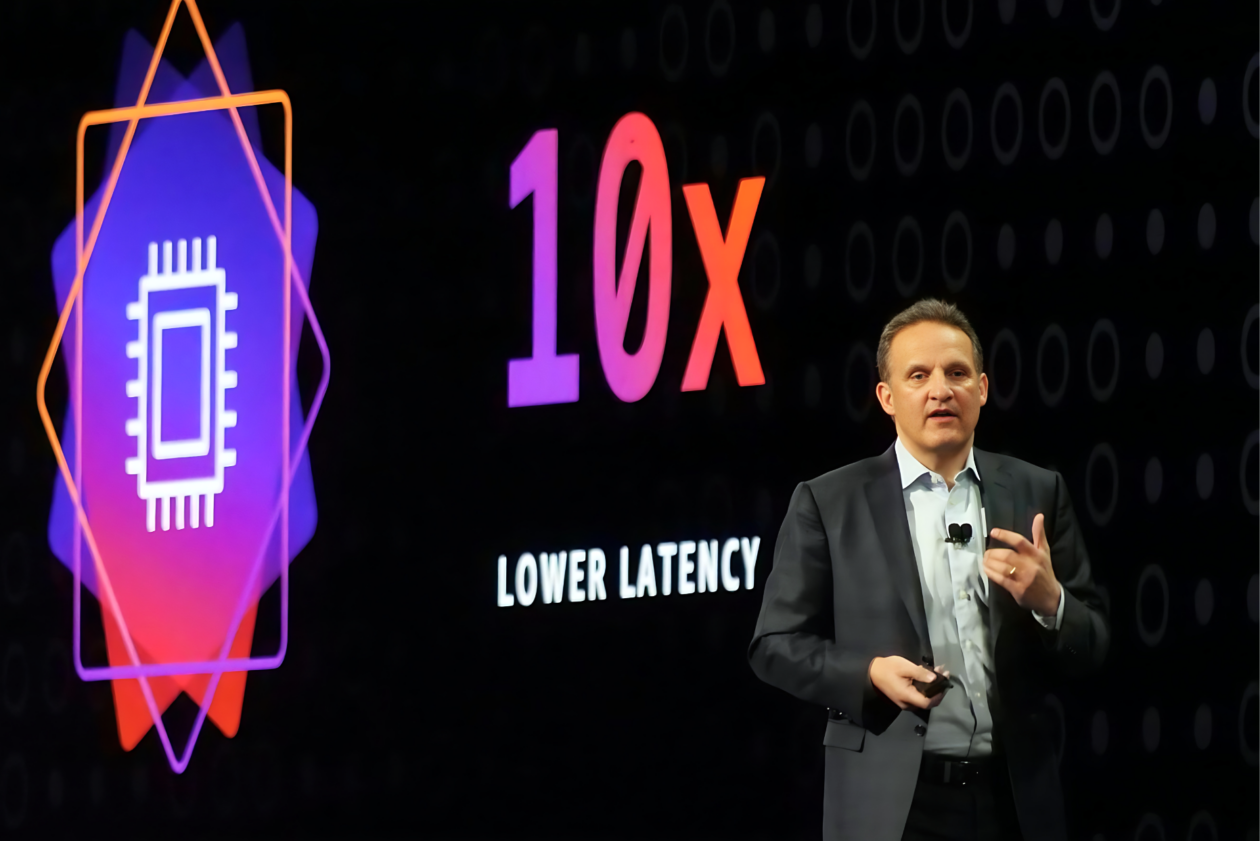
Adam Selipsky is now CEO of Helix Digital Infrastructure. (GeekWire photo)
Former Amazon Web Services CEO Adam Selipsky is returning to the world of cloud infrastructure as co-founder and CEO of Helix Digital Infrastructure, a newly-launched company backed by more than $10 billion.
The company was unveiled Thursday by investment firm KKR, which is partnering with Nvidia, power producer Vistra, and the Kuwait Investment Authority to build infrastructure aimed at supporting the growing demand for artificial intelligence computing. Bloomberg first reported the news in April.
Selipsky brings deep experience in cloud computing and enterprise technology. He joined AWS in 2005, helped build the business during its early years, served as CEO of Seattle-based Tableau Software from 2016 to 2021, and then returned to lead AWS before stepping down in 2024. He joined KKR as a senior technology and AI strategy advisor last September.
Helix plans to develop and operate data centers and related infrastructure, including power generation, fiber connectivity and land development. The company is targeting large technology customers that are racing to expand AI capacity amid increasing constraints around electricity availability, grid access and data center construction.
“Large users of digital infrastructure have an urgent need to reduce complexity and unlock new capacity,” Selipsky said in a statement. “Helix combines significant long-term capital with the capabilities and expertise to deliver holistic AI infrastructure solutions with speed and scale.”
Advertisement
Appearing on CNBC on Thursday morning, Selipsky said the large hyperscalers that will become Helix’s customers need help and that it’s a “misnomer” that complex data center projects are easy to scale.
“It is hard, and it is becoming even harder with AI and the pace of the buildouts and the scale of the buildouts,” Selipsky said. “They absolutely have the capabilities to do a lot of these things in house, and they absolutely need reliable partners.”
He said that more than 25% of announced data center projects are not delivering, and that’s why he’s in the middle of bringing on seasoned operators who can deliver for customers.
KKR and the Kuwait Investment Authority are providing the initial capital backing for the venture. Nvidia is joining as a founding investor and strategic partner, while Vistra will serve as Helix’s preferred power provider.
Advertisement
Waldemar Szlezak, KKR’s global head of digital infrastructure, will serve as chief investment officer. The company said it plans to bring in additional institutional investors over time.
The launch comes as demand for AI computing continues to drive massive investment in data centers, power generation, and other infrastructure needed to support increasingly sophisticated AI systems. It also comes at a time of growing public concern over data center construction in many communities, including the City of Seattle which just instituted a one year emergency ban on major data centers.
We’ve reached out to Helix for additional comment, and we will update this post as we learn more.
Anthropic launched Claude Corps: $150M to place 1,000 AI fellows at 400+ nonprofits. $85K salary, no degree needed. First 100 start October. Apps close July 17.
Anthropic is donating $150 million to place 1,000 AI fellows inside nonprofit organisations across the United States. The programme, called Claude Corps, will pay early-career workers $85,000 plus benefits for a year-long placement where they help nonprofits use Claude more effectively. Applications opened Wednesday and close on July 17.
No college degree is required. Applicants must be 18 or older, hold US work authorisation, and have no more than two years of full-time work experience. The first cohort of 100 fellows starts in October 2026. Subsequent cohorts begin in January and August 2027.
Each of the 400+ host organisations will receive a $10,000 grant and free Claude credits. Anthropic partnered with CodePath, a San Francisco nonprofit that helps first-generation and low-income students enter the tech workforce, to manage recruitment and training.
Advertisement
“We hope this program will expand and become a pillar of our strategy to help humankind realize the benefits of AI while also managing its risks,” said Anthropic President Daniela Amodei.
The programme is modelled loosely on service corps like AmeriCorps and Teach For America, but with a corporate sponsor and a product at its centre. Fellows are trained specifically on Claude. The organisations they serve will build their workflows around Claude. When the fellowship ends, the nonprofits are left with AI infrastructure tied to Anthropic’s ecosystem.
That dual purpose has drawn criticism. Fortune noted the “fox guarding the henhouse” dynamic: a $965 billion AI company is training the nonprofit sector to depend on its own product, funded by a donation that represents less than 0.02% of its valuation. Anthropic frames it as philanthropy. Sceptics see distribution strategy wrapped in a public benefit narrative.
Regardless of the framing, the programme addresses a real gap. Most nonprofits lack the staff, budget, and technical knowledge to adopt AI tools, even when those tools could meaningfully improve operations. Anthropic’s $100M Claude Partner Network, launched earlier, targets enterprises. Claude Corps targets the organisations that cannot afford enterprise partnerships.
Advertisement
The timing is deliberate. Anthropic is preparing for an IPO and positioning itself as the responsible AI company in a field dominated by OpenAI’s commercial aggression and Google’s scale. A $150 million nonprofit fellowship is a narrative play as much as a product play. Whether 1,000 fellows can make a meaningful difference across 400 organisations depends on whether the programme outlasts its PR value. Anthropic’s policy framework, published this week, calls for AI’s benefits to be “broadly shared.” Claude Corps is its first concrete attempt to deliver on that promise.
IPOs can be volatile, especially for retail investors. SpaceX is no exception.
Sundry Photography/Adobe Stock
I just did a quick Google search for SpaceX IPO. How many hundreds of articles are we actually expected to read about this?
Given the buzz around Friday’s big IPO, there are a few misconceptions worth addressing upfront. While many people view SpaceX as a massive, dominant space enterprise, it’s more complicated than that.
Advertisement
“In reality, it’s a very successful but fairly small satellite launch company, bolted onto a stagnant money-losing social media company and a money-incinerating AI company, and then sprinkled with a lot of hype about humankind going interplanetary,” said Robin Wigglesworth, editor of the Financial Times’ finance blog, Alphaville.
In other words, perhaps it’s more akin to a vertically integrated space and communications company with ambitious, high-risk side bets. Sure, at its center, SpaceX is a launch company that designs rockets (like Falcon 9 and Starship) and sells access to space. But around that, it has those related businesses — most notably Starlink, its satellite internet network, and xAI, which SpaceX acquired in February 2026. And since xAI includes the social media platform X and X’s chatbot, Grok, they’re also under the SpaceX umbrella.
X hasn’t been durable in terms of revenue. And, like most cash-burning AI enterprises, xAI is expensive to run and is reporting very large losses.
One could say the SpaceX ecosystem revolves around a single goal: building the infrastructure needed for global connectivity and, eventually, space settlement. But a major concern is that SpaceX’s overall package is driven more by hype and momentum than by its proven profitability.
Advertisement
Wigglesworth said the biggest immediate risk is straightforward: The stock could drop soon after it begins trading. That outcome would affect both the company and investors, though it wouldn’t necessarily signal broader economic trouble. As he noted, IPOs “do badly all the time.”
In the first few weeks after the IPO, price movements may be misleading. The opening day can be volatile, with banks helping stabilize prices and strong retail demand potentially pushing shares higher. We’ll also see index funds start to buy in, which can help nudge the price up a bit.
However, as Wigglesworth pointed out, the more meaningful test will come after a month, when the market determines whether there is sustained demand “for a company trading at some of the juiciest valuation multiples we’ve seen in history.”
So here’s another misconception to address: If SpaceX is popular, it’s safe to buy, right?
Advertisement
I didn’t have to read too many articles to get an answer to that.
“Popularity and renown are bad indicators for what makes a successful investment,” Wigglesworth told me. “Even good companies can be bad investments at a dumb price.”
AI-generated code is growing faster than security oversight mechanisms
Manual reviews struggle to keep pace with machine-generated software
Security leaders fear insecure coding patterns spreading through development pipelines
Artificial intelligence coding assistants have spread across development teams faster than security frameworks can adapt to.
New Salt Security research has claimed 90% of security leaders now report active concerns about risks posed by AI-generated software.
However, organizations continue embracing AI tools because they accelerate coding tasks, reduce time spent on repetitive work, and increase software delivery speed.
Latest Videos From
Human review cannot handle AI speed
Security leaders believe that development practices designed before AI became mainstream may no longer provide sufficient oversight.
Advertisement
Nearly a third (29%) of respondents identified insecure coding patterns as the primary risk introduced by AI assistants.
These systems learn from massive training datasets that contain their own flaws and outdated practices.
An AI tool can generate code that appears fully functional while quietly reproducing vulnerabilities a human might have caught.
Advertisement
Sign up to the TechRadar Pro newsletter to get all the top news, opinion, features and guidance your business needs to succeed!
This problem resembles how antivirus software must constantly update its definitions because new threats emerge faster than signature databases can grow.
The difference here is that no central authority tracks every insecure pattern an AI might replicate – as despite the widespread anxiety that AI introduces, more than one-third of organisations still depend on manual code reviews before any launch.
Reliance on human checking becomes structurally problematic when AI produces code at volumes no team can inspect thoroughly.
Advertisement
That method worked when developers wrote software at human speed, but it fails when AI accelerates output dramatically.
Reviewer fatigue sets in quickly, teams apply standards inconsistently, and security requirements get interpreted differently across departments.
AI coding assistants are fundamentally changing how software is built, but governance has not kept pace,” said Roey Eliyahu, CEO and co-founder at Salt Security.
Advertisement
“Most organisations recognise the risks, but many are still trying to manage AI-generated code using security processes designed for a pre-AI world.”
This approach does not scale any better than using a single email inbox to handle millions of daily messages without filtering or automation.
Enterprise complexity makes enforcement harder
Larger organisations with more than 500 employees face governance challenges that smaller firms simply do not encounter.
Advertisement
Distributed teams use different tools, follow varied workflows, and apply security standards with inconsistent rigour across regions.
The risk of developer overreliance on AI assistants grows proportionally with team size and delivery pressure.
Security agencies, including government cybersecurity bodies, have previously warned that AI systems expand attack surfaces and complicate accountability structures significantly.
Without better visibility into where AI-generated code enters the pipeline, governance remains guesswork dressed up as process.
Advertisement
Treating AI coding assistants as components of the software supply chain — similar to vetting any third-party malware risk — offers a more realistic path forward than hoping manual review will somehow catch up.












 Where this is being written it wasn’t on the market so it was more usual to use nail lacquer, but reading the piece it seems American hams swore by the stuff. That’s in the past tense because it seems it’s no longer on the market. Even there though help is at hand, because dissolving packaging polystyrene in solvent yields an acceptable substitute. There’s even an 11-year-old how-to video linked from the SolderSmoke post, should you fancy making some of your own. We suggest you proceed with caution though, polymers dissolved in solvents sounds a lot like home-made napalm, and probably puts out fumes you don’t want to breathe.











































You must be logged in to post a comment Login