

Crypto World
Polymarket exploited for $700K in private key hack



Attackers have reportedly hit prediction market platform Polymarket with a private key hack and stolen roughly $700,000 worth of crypto.
Crypto sleuth ZachXBT first flagged the attack earlier today, noting, “A Polymarket deployer address appears to have been compromised on Polygon.”
Crypto security firm Bubblemaps later confirmed that an exploit was underway and that the hacker was stealing 5,000 POL ($460) every 30 seconds.
It added that the stolen funds were split across 16 addresses before being moved to centralised crypto exchanges, and that ~$700,000 has been stolen so far.
Polymarket’s developer X account said it is aware of the incident “linked to rewards payout,” and claimed, “user funds and market resolution are safe.”
It claimed, “Findings point to a private key compromise of a wallet used for internal top-up operations, not contracts or core infrastructure.”
Read more: Are Polymarket and Kalshi decentralized?
Polymarket developer Josh Stevens also noted that the incident is “not a contract hack,” and that it’s likely a compromise of an old private key.
The funds were taken from a crypto address associated with Polymarket’s UMA system, the platform’s oracle system that relies on tokenholders to resolve disputes on disputed outcomes.
The attacker’s last transaction from this UMA address was at 09:00 UTC, roughly 40 minutes before time of writing.
Week of hacks, insider trading, and inquiries for Polymarket
It’s been a turbulent week for Polymarket, with the firm also being the subject of an inquiry in South Korea over potential gambling violations.
The country’s Korea Communications Standards Commission wants to know if the platform’s services constitute gambling.
Bubblemaps also suspects that a large case of insider trading has been taking place on the platform that involves the leaking of US military secrets.
Read more: Polymarket users try manipulate Israeli journalist with death threats, report
Bubblemaps claims that nine accounts were able to make over $2.4 million betting on military markets with a 98% win rate.
The firm has repeatedly drawn criticism over insider trading, and has witnessed suspicious trades on markets involving Israeli strikes against Iran and the US’s kidnapping of Venezuelan President Nicolás Maduro.
Polymarket launched a new type of trading this week that allows users to bet on future valuations, IPO timings, and secondary share price action involving private companies such as OpenAI, SpaceX, and Anthropic.
Polymarket also reportedly appointed a Japanese representative as it lobbies for regulatory approval within Japan.
Got a tip? Send us an email securely via Protos Leaks. For more informed news and investigations, follow us on X, Bluesky, and Google News, or subscribe to our YouTube channel.


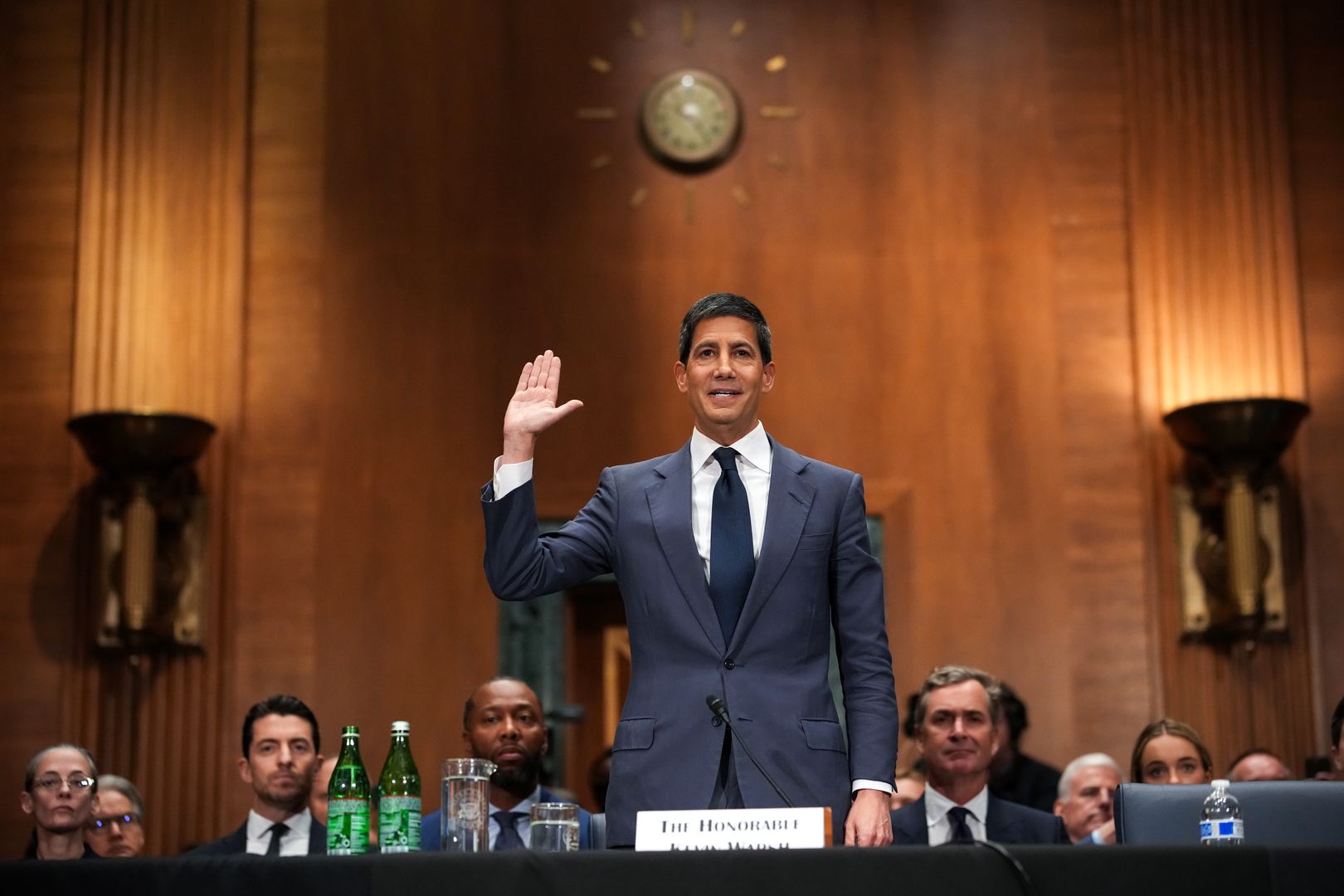
Kevin Warsh is set to be sworn in as the seventeenth Federal Reserve Chair at the White House on Friday, May 22, with President Trump administering the oath.
Analysis published by XWIN Research Japan identifies the specific on-chain signals most likely to move first as markets begin pricing in what a Warsh-led Fed actually means for Bitcoin.
Coinbase Premium and Exchange Netflows Are the Ones to Watch
XWIN’s analysis, published on May 22, centers on a specific risk that most crypto commentary has missed. The concern is not whether Warsh cuts rates or holds them, but rather what he intends to do with the Fed’s balance sheet.
During his Senate Banking Committee testimony, Warsh said the Fed’s balance sheet is too large, should shrink, and that the central bank has no business holding long-term Treasuries.
That is quantitative tightening, and XWIN argued that it works differently from rate policy. This is because rather than adjusting the price of money, it reduces the quantity of liquidity in the system directly.
The scenario XWIN flagged as uncomfortable is one where short-term rates fall while long-term yields rise at the same time. That combination has historically had a strong negative impact on risk assets.
And it matters for BTC because the asset is no longer behaving like a crypto-native instrument, considering that ETF adoption, institutional participation, and derivatives market growth have made it sensitive to global liquidity conditions in a way previous cycles were not.
For the flagship cryptocurrency, the first place that stress would likely show up is the Coinbase Premium, which tracks US institutional spot demand.
According to XWIN, if expectations for prolonged quantitative tightening build, institutional buying appetite may soften before anything registers in price, and a Coinbase Premium turning negative would be the earliest readable sign of that change.
The second indicator the analysts urged traders to monitor is Bitcoin exchange netflows. Rising inflows to exchanges tend to signal defensive repositioning, with holders moving assets onto platforms where they are easier to sell. A risk-off environment under the new Fed regime, XWIN argues, could trigger exactly that pattern among short-term holders.
What If BTC Draws Capital Under Tight Conditions?
According to XWIN, BTC’s recent structure has been driven mostly by leveraged positions rather than by any real buying. That is something investors should watch out for, too, considering that when such happens, it means that rallies only reflect short-covering rather than new capital coming in.
However, the research firm also allowed for a different outcome. According to them, if ETF inflows recover, exchange reserves keep falling, and Coinbase Premium turns positive again, it would suggest that Bitcoin is drawing capital even under structurally tighter conditions. This would be because the cryptocurrency sits outside the fiat system, being reined in.
At the time of writing, the asset was trading just above $77,000, having earlier dumped to a three-week low near $76,000, with attempts at recovery stopped at $78,000.
The post Warsh Era Begins at Fed: Two On-Chain Signals Bitcoin Traders Must Watch appeared first on CryptoPotato.


The U.S. House Committee on Oversight and Government Reform has opened an investigation into Polymarket and Kalshi over concerns tied to insider trading and wagers allegedly linked to classified information.
Summary
- James Comer launched a congressional probe into Polymarket and Kalshi over suspected insider trading and classified-information betting activity.
- Lawmakers cited reports of suspicious Iran-related wagers and a federal case involving a U.S. Army sergeant accused of using classified information to make over $409,000 in prediction market profits.
- The investigation comes as Polymarket faces mounting pressure from regulators and a recent suspected exploit tied to its UMA CTF Adapter contract on Polygon.
According to a statement released by the committee, Chair James Comer sent formal letters to Polymarket CEO Shayne Coplan and Kalshi CEO Tarek Mansour requesting internal records and compliance details related to user activity on their platforms.
The committee said it wants to assess how the companies detect suspicious trading, verify customer identities, and enforce geographic restrictions designed to comply with U.S. regulations.
In the letters, Comer said prediction market operators hold the internal data needed to identify whether users are trading with access to non-public information. He also raised concerns that offshore platforms may be allowing users to bypass federal compliance rules.
Congressional scrutiny intensified after a New York Times investigation cited more than 80 Polymarket users who allegedly placed unusually timed bets ahead of undisclosed U.S. and Israeli military operations involving Iran. Committee documents said those trades have raised questions about whether safeguards on prediction market platforms are sufficient to stop insider activity.
Federal prosecutors have already filed charges in one case highlighted by lawmakers. According to the committee, U.S. Army Master Sergeant Gannon Ken Van Dyke allegedly used classified information tied to “Operation Absolute Resolve,” an operation connected to Venezuelan President Nicolás Maduro, to place prediction market wagers that generated more than $409,000 in profits.
Why are lawmakers focusing on prediction markets now?
The House investigation arrives as prediction markets face pressure from regulators in multiple countries. Earlier this year, Minnesota became the first U.S. state to ban prediction markets after lawmakers classified them as illegal gambling operations.
Outside the United States, authorities in South Korea have also examined Polymarket over concerns tied to gambling-related content.
In India, the Ministry of Electronics and Information Technology ordered internet providers to block access to Polymarket after categorizing prediction markets as prohibited online money gaming platforms under the country’s Promotion and Regulation of Online Gaming Act 2025.
Indian regulators have argued that platforms allowing users to speculate on uncertain outcomes with real money expose younger users to gambling-related risks. Government policy discussions have also linked crypto-based prediction markets to concerns over stablecoin flows and unmonitored capital movement outside the banking system.
At the same time, Argentina, Colombia, and Romania have all restricted access to Polymarket after local authorities concluded that the platform operated outside domestic gambling frameworks.
How does the latest probe add pressure on Polymarket?
The congressional investigation comes only days after on-chain analysts flagged a suspected exploit involving Polymarket’s UMA CTF Adapter contract on Polygon. Blockchain investigator ZachXBT warned users after suspicious activity drained more than $520,000 from addresses tied to the contract.
Security firm PeckShield later said part of the stolen funds had already been moved through ChangeNOW. Blockchain analytics platform Bubblemaps separately reported that attackers were removing 5,000 POL tokens roughly every 30 seconds during the incident.
Polymarket contributor Shantikiran Chanal said the incident appeared linked to a compromised private key used for internal operations rather than a failure in the platform’s core contracts or market resolution systems. Chanal added that user funds and active markets remained safe during the incident.
The latest events have added technical security concerns to ongoing debates surrounding market integrity, oracle voting power, and the legal status of crypto-based prediction platforms.
Crypto World
Bitcoin Loses Key Support Levels, HYPE Sets New ATH, Markets Brace for New Fed Chair: Weekly Recap
Perhaps the most anticipated financial and economic event is just hours away, as the US Federal Reserve will have a new Chairman after more than eight years under Jerome Powell.
But, before we explore the seventeenth chair of the financial institution, let’s rewind the clock for a week and review what happened in the last seven days through the eyes of bitcoin (and a few alts). The primary cryptocurrency jumped past $82,000 at the end of the previous business week after the CLARITY Act made progress in the US Senate, but it was quickly rejected and had lost the $80,000 support by Friday evening.
It dipped further on Saturday to under $78,000 before it calmed at around that level on Sunday. Another couple of leg downs followed at the beginning of the business week, driving the asset south to its lowest price level since early May at $76,000.
This meant that the cryptocurrency had lost over $6,000 in 4-5 days. After this substantial retracement, bitcoin rebounded slightly and tapped $78,000 on Thursday. However, the predominantly bearish market structure and sentiment were too strong, and BTC was halted there, currently struggling to remain above $77,000.
A major market shift is expected to unfold soon, as the financial industry has braced for a change in Fed leadership. As reported earlier, the Kevin Warsh era begins today, but analysts from XWIN Research Japan outlined certain risks and on-chain signals that could be more important to BTC’s short-term price moves than the new Fed chair stepping in.
Consequently, BTC ends the week in the red, similar to most larger-cap alts. However, HYPE has stolen the show as it painted a new all-time high above $62 following a mind-blowing 43% weekly surge. ZEC, NEAR, ONDO, and VVV complete the double-digit price gainers club.
Market Data
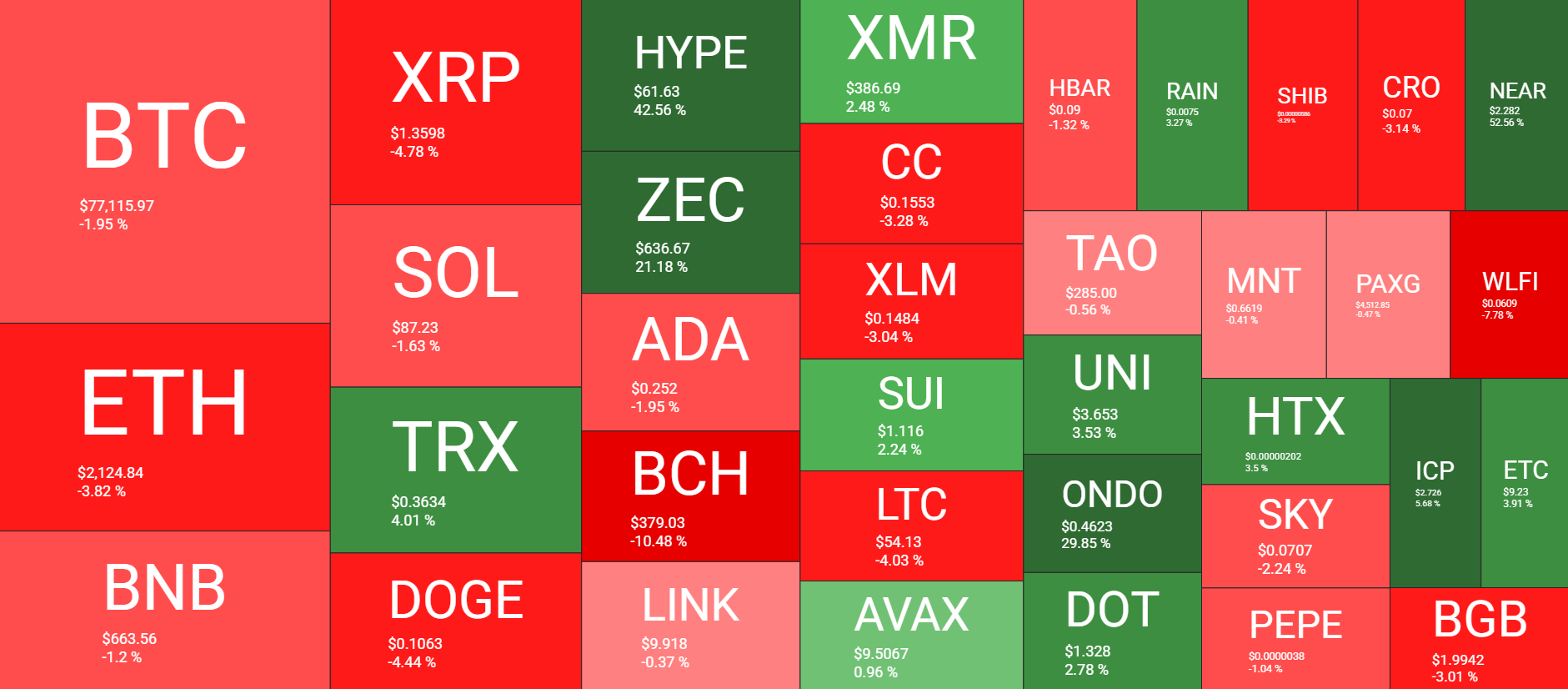
Market Cap: $2.666T | 24H Vol: $76B | BTC Dominance: 58%
BTC: $77,100 (-2%) | ETH: $2,125 (-3.8%) | XRP: $1.36 (-4.8%)
This Week’s Crypto Headlines You Can’t Miss
Bitcoin Pizza Day 2026: Commemorating Crypto’s First Real-World Transaction. It wouldn’t be May 22 without celebrating what became known as the International Bitcoin Pizza Day. On this date 16 years ago, Floridian programmer and early BTC adopter Laszlo Hanyecz ordered two pizzas from Papa John’s and paid with 10,000 BTC. This was one of the first (if not the very first) documented Bitcoin transactions, and the rest is history, as they say.
Bitcoin’s Biggest Holders Are Accumulating Again: What Are Whales Preparing For? Bitcoin wallets holding at least 100 units continue to accumulate, as new data from Santiment Intelligence explained that this cohort of investors has grown to 20,229. This is an 11.2% increase since the 18,191 wallets recorded this time last year.
XRP Futures on CME One Year Later: $63B in Trading Volume and Counting. This week marked the first anniversary of XRP futures going live on the Chicago Mercantile Exchange (CME). The veteran platform celebrated the event by highlighting impressive figures, including trading volume and the number of contracts bought and sold.
Trump-Linked Truth Social Suddenly Pulls Crypto ETF, Analyst Doubts Reasoning Behind Exit. The media conglomerate linked to the First Family pulled out of the crypto ETF race, arguing that it had filed under the Securities Act of 1933 instead of the Investment Company Act of 1940. However, analysts were not convinced that was the real reason the entity exited the ETF space.
Saylor’s Strategy Reloads With a New Multi-Billion-Dollar Bitcoin Purchase. Following a couple of more modest BTC purchases, the Saylor-founded bitcoin accumulator announced its most significant buy in a long time. It splashed over $2 billion to acquire 24,869 BTC and increased its stash to a whopping 843,738 units.
Iran Reportedly Launches Bitcoin-Based Shipping Insurance for Hormuz Passage. Reports emerged earlier this week indicating that Iran had launched a Bitcoin-based shipping insurance for vessels passing through the Strait of Hormuz. This was a different initiative than the one outlined last month, which asked passing ships to pay up to $2 million in BTC.
Charts
This week, we have a chart analysis of Ethereum, Ripple, Cardano, Binance Coin, and Hyperliquid – click here for the complete price analysis.
The post Bitcoin Loses Key Support Levels, HYPE Sets New ATH, Markets Brace for New Fed Chair: Weekly Recap appeared first on CryptoPotato.
Elon Musk’s rocket and satellite company SpaceX is planning a $75 billion IPO in June, which could make it the largest near-term public listing with a major Bitcoin treasury.
Key takeaways:
- A Nasdaq 100 fast entry could expand Bitcoin exposure among the top mega-cap stocks, including Tesla.
- The IPO may pressure tech stocks as passive funds sell existing Nasdaq names to buy SpaceX, which may prove bearish for Bitcoin.
SpaceX IPO set to increase Nasdaq’s exposure to Bitcoin
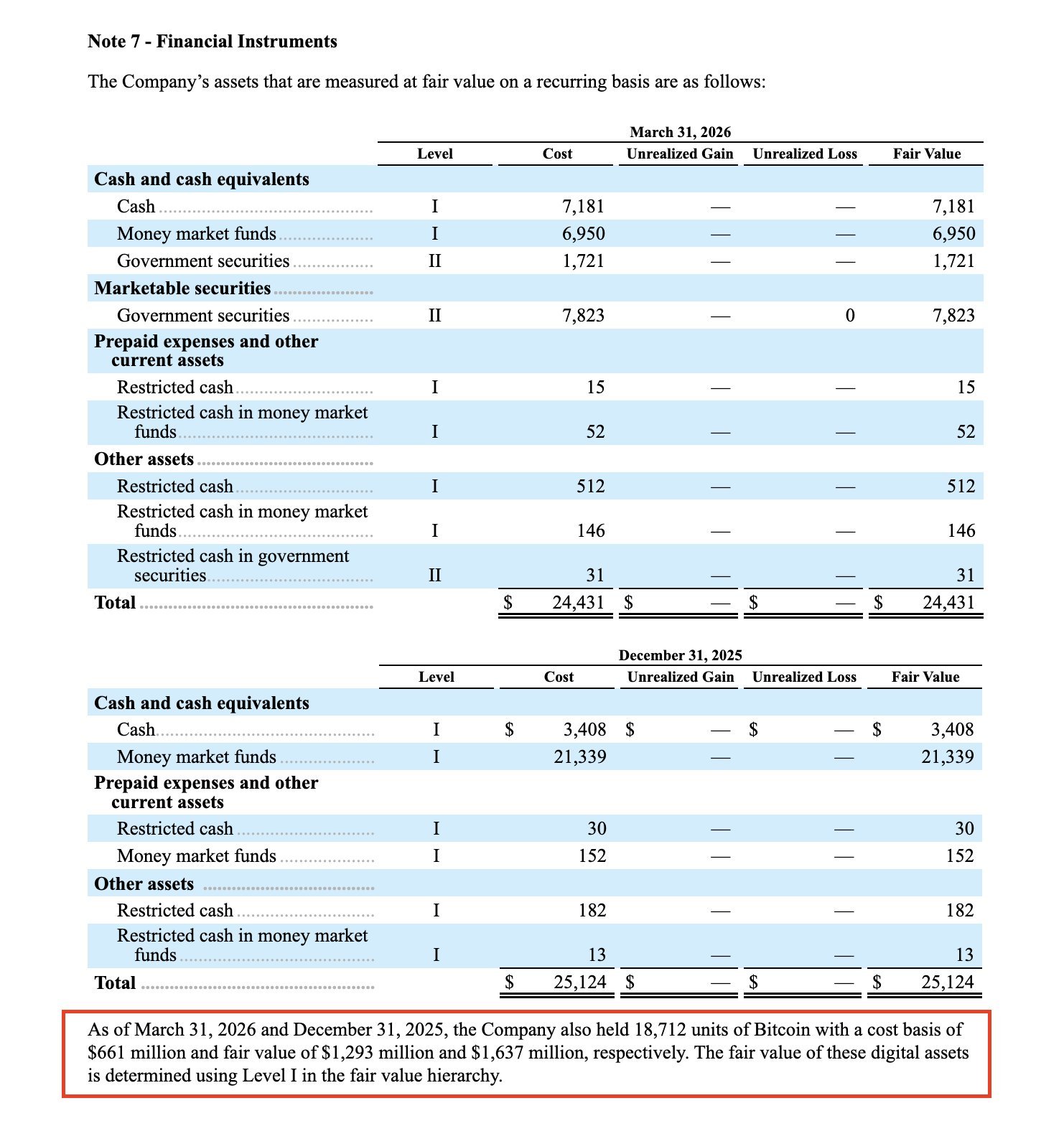
SpaceX disclosed 18,712 BTC in its recent S-1 filing, worth roughly $1.45 billion, making it the largest known Bitcoin holder among companies preparing for, or recently filing for, a public listing.
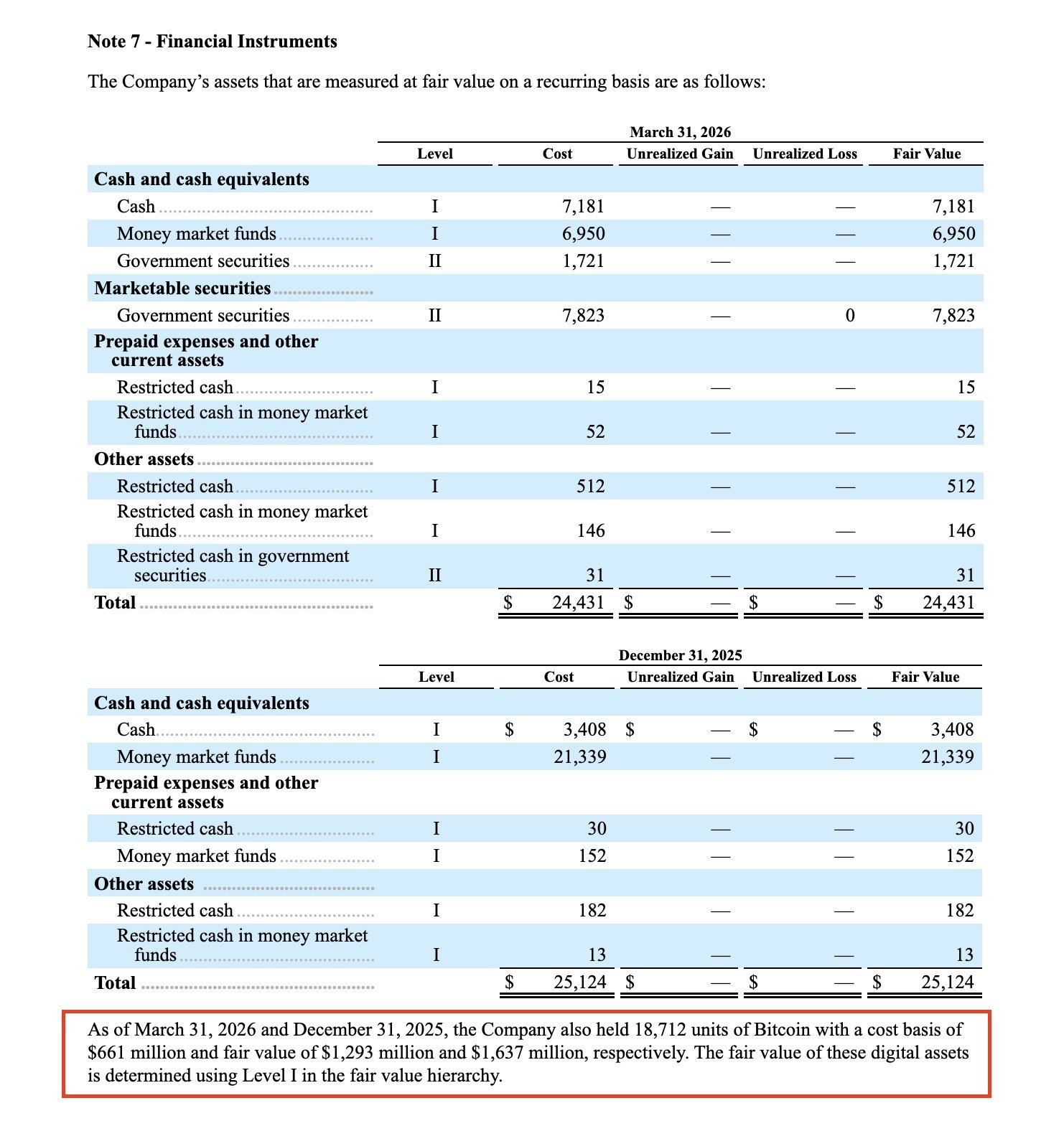
Source: SpaceX’s S1 Filing
Under Nasdaq’s newer “fast entry” rules, mega-cap IPOs can enter the Nasdaq 100 within 15 trading days, meaning SpaceX could quickly become one of the index’s largest constituents if its valuation lands near the $1.75 trillion–$2 trillion range after the $75 billion IPO.
As a result, Bitcoin exposure inside the Nasdaq 100 may expand beyond Tesla.
The electric carmaker already holds 11,509 BTC on its balance sheet. SpaceX, with 18,712 BTC, would give the Nasdaq 100 a second Elon Musk-linked mega-cap company with direct Bitcoin exposure.
“With the SpaceX IPO, the Mag 7 will become the Mag 8,” said Phong Le, CEO of Strategy, while referring to the elite group of mega-cap tech stocks, namely Apple, Microsoft, Nvidia, Amazon, Alphabet, Meta and Tesla.
He added:
“25% of the Mag 8 will have Bitcoin on their balance sheet.”
Bitcoin still faces downside risks
SpaceX IPO may be “bad news for tech stocks,” according to analyst Nic Puckrin.
“If it’s added to the Nasdaq 100 in a ‘fast entry’, passive funds have to buy it & sell other stock,” Puckrin said in a Friday post, adding:
“The higher SpaceX goes, the more they buy of it and sell of others. It’s going to act like a massive capital vacuum.”
Puckrin based his outlook on JPMorgan estimates showing that Nvidia could face more than $20 billion in passive outflows if SpaceX enters the Nasdaq 100.
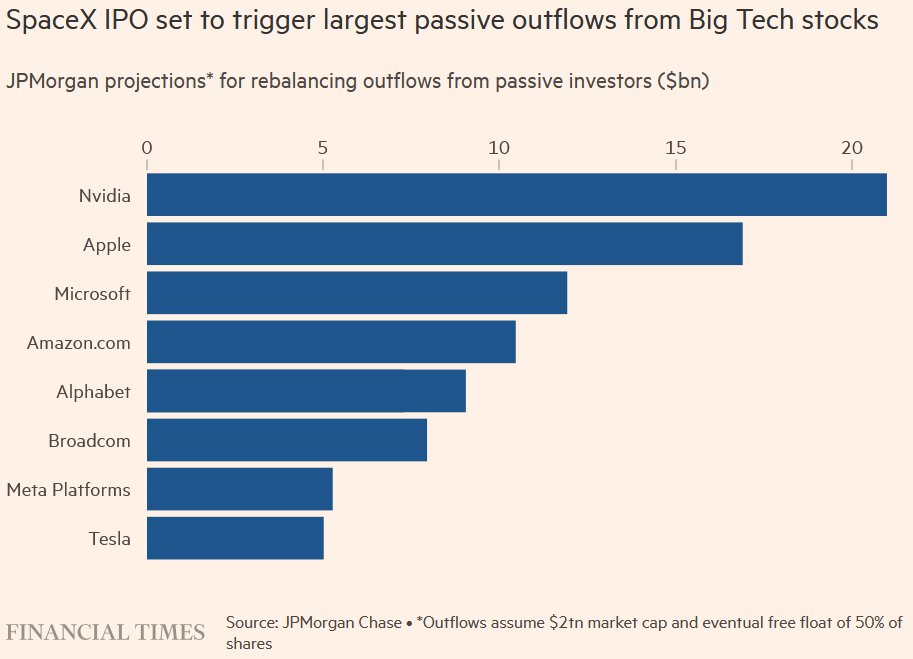
JPMorgan projections for rebalancing outflows from passive investors. Source: Financial Times/Nic Puckrin
Apple could face roughly $16 billion in estimated passive outflows, with Microsoft, Amazon, Alphabet, Broadcom, Meta and Tesla also likely to serve as funding sources for the SpaceX rebalance.
Bitcoin has traded closely with mega-cap tech for most of 2026.
As of Friday, BTC’s 30-day rolling correlation with the Roundhill Magnificent Seven ETF (MAGS), which tracks the Mag 7 stocks, stood near +0.81.
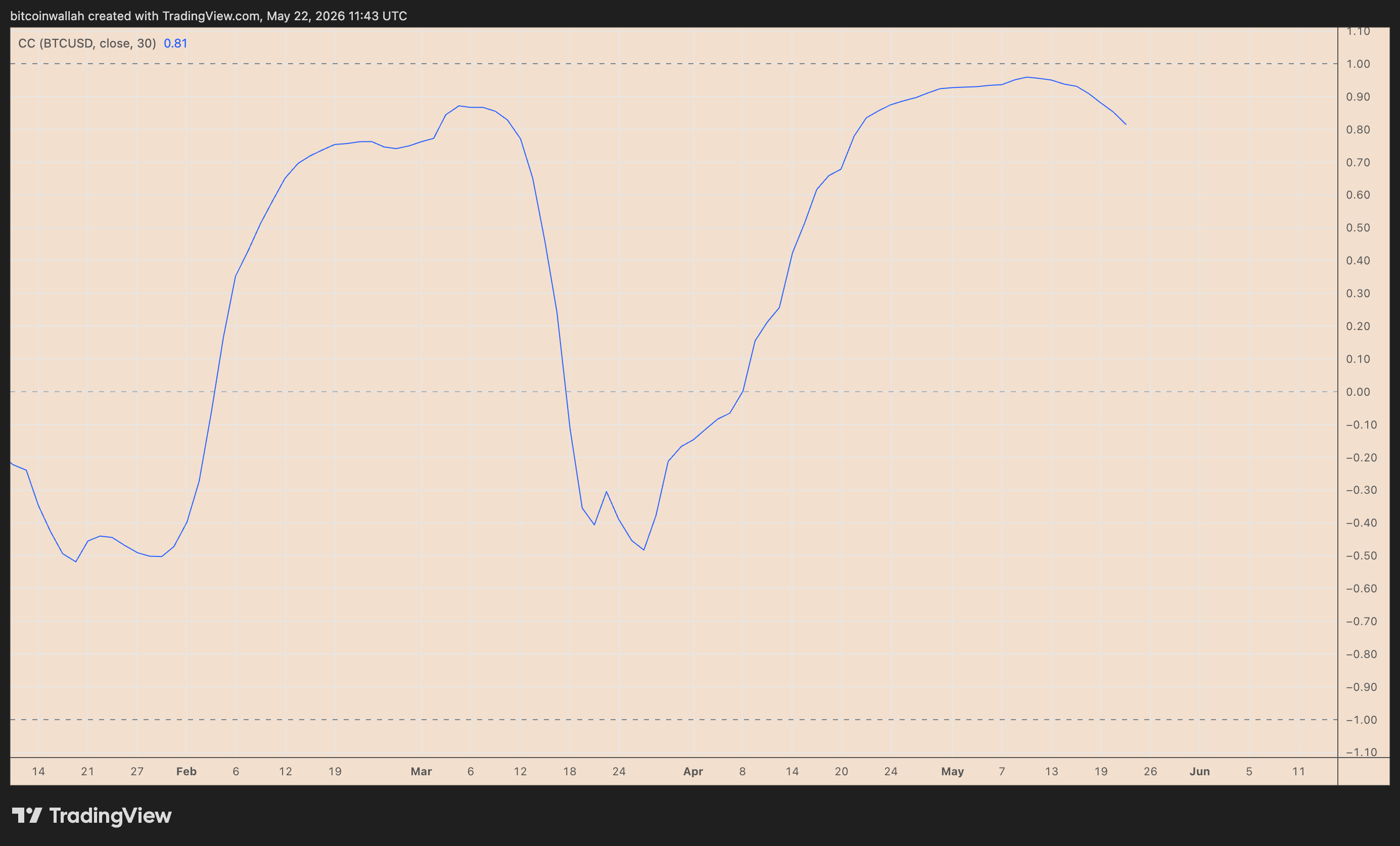
BTC/USD vs. MAGS correlation coefficient. Source: TradingView
For traders, that means BTC has recently moved in the same direction as major tech stocks more often than not.
So, if the SpaceX rebalance pressures Nvidia, Apple, Tesla and other large tech names, Bitcoin may also face short-term downside risk as investors reduce exposure to the broader risk-on trade.
How low can BTC price go?
On-chain metrics show Bitcoin’s apparent demand has dropped to its lowest in four months, which may lead to months of consolidation.
That weak demand backdrop also lines up with BTC’s current technical structure. Since February, Bitcoin has been moving inside an upward-sloping bear flag, a pattern that often forms during a pause in a broader downtrend.
For now, BTC’s immediate downside target sits around the $73,000–$74,000 range, near the flag’s lower trendline. A rebound from that area could send the price back toward the flag’s upper boundary near $85,000.
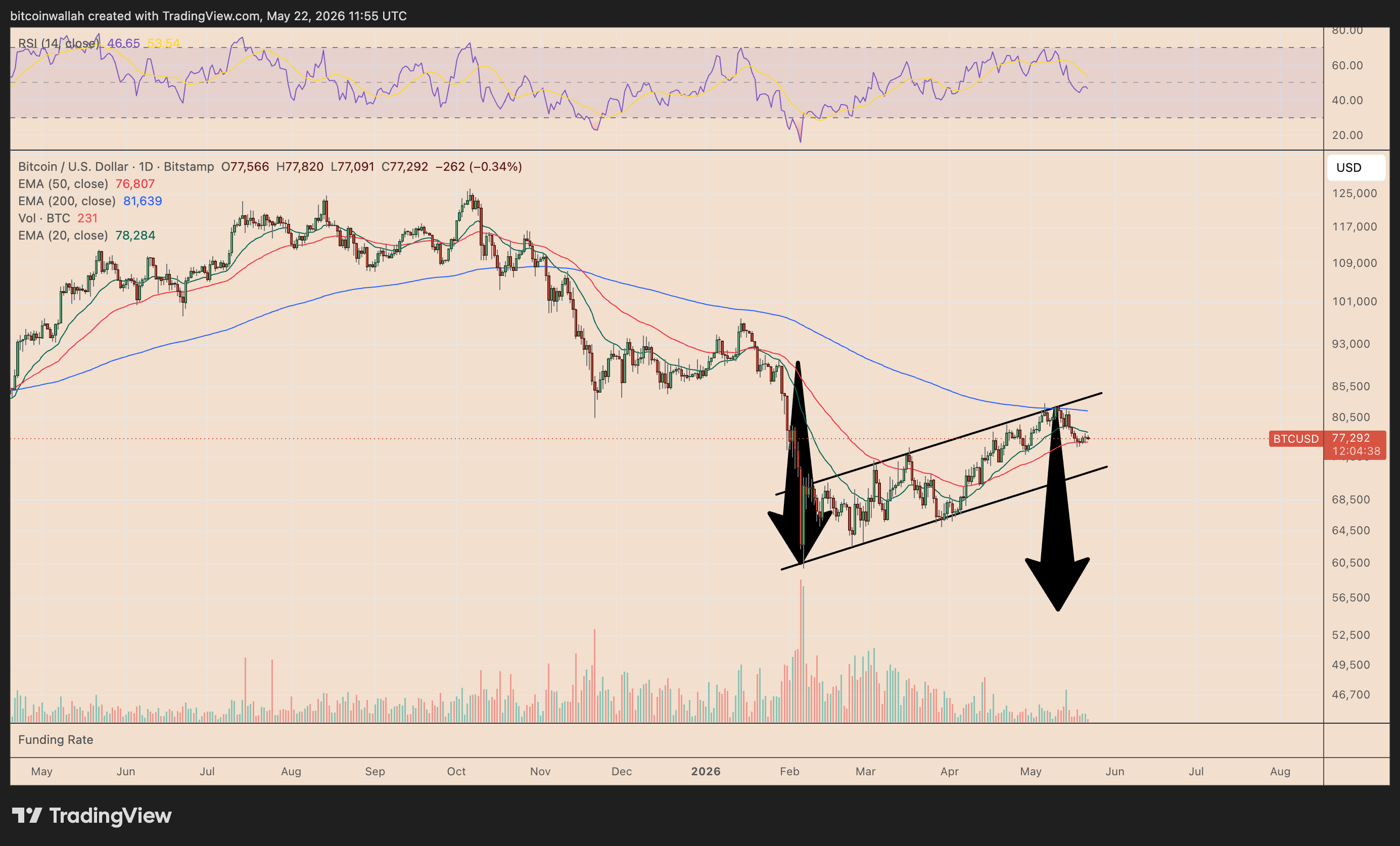
BTC/USD daily chart. Source: TradingView
Related: Bitcoin liquidity balance hints at developing rally toward $80K
The flag setup could open the door to a deeper decline toward $56,000, based on the pattern’s measured move, if BTC closes decisively under the lower trend line.
As has been the case all week, bitcoin (BTC) is trading in a tight range around the $77,000 level in U.S. morning action.
There was some economic news on Friday morning, and it wasn’t pretty. The University of Michigan Consumer Sentiment Index for May fell to a record low 44.8 from 48.2 previously and versus economist forecasts for 48.2. The Expectations Index also fell to a record low of 44.1.
The UMich 1-year Consumer Inflation Expectations Index rose to 4.8% from 4.5% previously. The 5-year Inflation Index rose to 3.9% from 3.4%.
It’s yet another disturbing stagflationary data point confronting Kevin Warsh as he’s set to take over as chairman of the Federal Reserve. President Trump appointed Warsh in the hope that he would lead the central bank to cut interest rates, but the Iran war has sent oil prices soaring and re-ignited what had been cooling inflation.
Rate traders are now pricing in more than a 70% chance of one or more rate hikes by the end of 2026.
Warsh’s official swearing-in is set for 11 am ET.
U.S. stocks, meanwhile, are posting modest gains ahead of the three-day weekend. The Nasdaq is higher by 0.3% and the S&P 500 by 0.4%.

XRP Ledger has recorded a notable spike in new addresses over the past 24 hours, suggesting renewed on-chain activity even as XRP’s price remains constrained by overhead resistance around the $1.40 region.
Santiment highlighted the latest burst in network growth, noting 4,300 wallets were created in a 24-hour window—the year’s fourth-largest spike so far in 2026. Daily active addresses also climbed to 43,520 from roughly 32,000 in the same period. The analytics firm underscored that “network growth is among the top leading signals to identify reversals.”
Key takeaways
- XRP Ledger added 4,300 new wallets in 24 hours, marking a substantial growth spike in 2026.
- On-chain activity accompanied a rise in daily active addresses, signaling renewed participation on the Ripple-backed network.
- US spot XRP ETFs continue to attract inflows, with May flows supporting liquidity and demand through institutional channels.
- Investor cost basis around $1.37–$1.45 may create a nearby resistance band for XRP as short-term buyers confront profit-taking risk.
- A potential breakout remains contingent on clearing a resistance zone around $1.40–$1.55 and navigating higher-timeframe chart patterns, including a falling wedge that analysts see as a setup for possible upside.
Surge in XRP Ledger activity signals growing participation
The latest data from Santiment indicates the XRP Ledger’s wallet activity is experiencing a meaningful uptick. The firm reported 4,300 newly created wallets on May 20, lifting the daily wallet increase to one of the year’s strongest spikes. Alongside the wallet growth, daily active addresses rose to about 43,520—an uptick that traders watch as a potential precursor to price moves.
Santiment summarized the dynamic by stressing that “network growth is among the top leading signals to identify reversals.” In other words, a surge in fresh participation can precede a shift in sentiment and buying pressure, even when price action is temporarily stalled.
Analysts have noted that rising wallet creation often foreshadows a broader move as new participants enter the ecosystem. Amonyx, an independent observer, commented that the observed wallet growth could attract attention from “smart money,” potentially signaling fresh participation in XRP markets. Niroshan682 added that new wallet creation is frequently an early signal of renewed network activity, particularly when paired with signs of growing institutional adoption.
ETF flows lend support to XRP’s institutional backdrop
Despite the on-chain growth signals, XRP’s price action has been modest, with the pair sliding about 1.5% over the last 24 hours and sitting roughly 62% below the July 2025 high of $3.66. The liquidity backdrop, however, is being bolstered by exchange-traded product inflows. In May, XRP spot ETFs have continued to accumulate, with inflows totaling around $107.3 million so far this month and marking the 12th straight day of positive flow. Measured across the month, total inflows push the year-to-date figure toward the $1.4 billion mark, while assets under management sit near $1.15 billion.
Spot XRP ETF activity provides a useful counterweight to price volatility, giving market participants a liquid channel for exposure and a signal of sustained demand from institutional-grade investors. SoSoValue’s data visualization of ETF flows has become a reference point for watching how official investment vehicles are shaping XRP’s utility and accessibility.
Price action in context: resistance zones and potential breakouts
From a technical perspective, XRP staged a 21% rebound off a local low around $1.27 on April 5, advancing to roughly $1.55 before encountering resistance. The current price action has stalled within a broader range, with $1.40 to $1.55 forming a notable consolidation ceiling. This zone aligns with several moving averages—the 50-day simple moving average (SMA), the 100-day SMA, and the 100-day exponential moving average—creating a confluence of resistance that buyers must overcome to sustain a rally.
Cost-basis data from Glassnode provides another lens on potential price pressure. About 3.75 billion XRP are held at an average cost of roughly $1.37–$1.45, creating a concentration of cost-basis that could act as a liquidity anchor—meaning a sizable portion of holders may be inclined to sell if the price tests break-even zones, potentially stalling upside momentum.
Higher up, there’s a supply concentration around $1.68–$1.70, where an estimated 3.8 billion XRP sits in hands. This zone coincides with the upper boundary of a forming falling wedge pattern, a setup some analysts view as a precursor to a breakout. If XRP can clear the wedge’s upper trend line, a measured target around $3.52—roughly 50% above the current level—appears plausible, contingent on sustained buying interest.
Analysts have flagged that a decisive push above the $1.40 barrier is a prerequisite for any meaningful reversal. In prior coverage, Cointelegraph noted that a close above $1.61 could confirm a trend change, underscoring that the path to a longer-term advance depends on breaking through this consolidation zone.
In sum, XRP’s near-term trajectory hinges on a blend of on-chain activity, ETF-driven liquidity, and the ability to pierce the current resistance cluster. While wallet growth signals a renewed interest in the network, price players are awaiting a clear breakout signal that could unlock a more confident move toward the higher targets indicated by chart patterns and supply analytics.
What to watch next: traders and investors should keep an eye on whether XRP can sustain the recent wallet growth alongside continued ETF inflows, and whether it can push decisively through the $1.40–$1.55 zone to validate a potential breakout. Ongoing on-chain metrics and the evolving ETF landscape will shape whether the current consolidation gives way to a new leg higher or a renewed phase of range-bound activity.


NEAR Protocol has activated confidential payments on its Intents platform, according to an announcement from the NEAR Intents team. The feature enables users to send NEAR tokens and receive ETH while maintaining transaction privacy, now live on the protocol's interface. The confidential payments… Read the full story at The Defiant
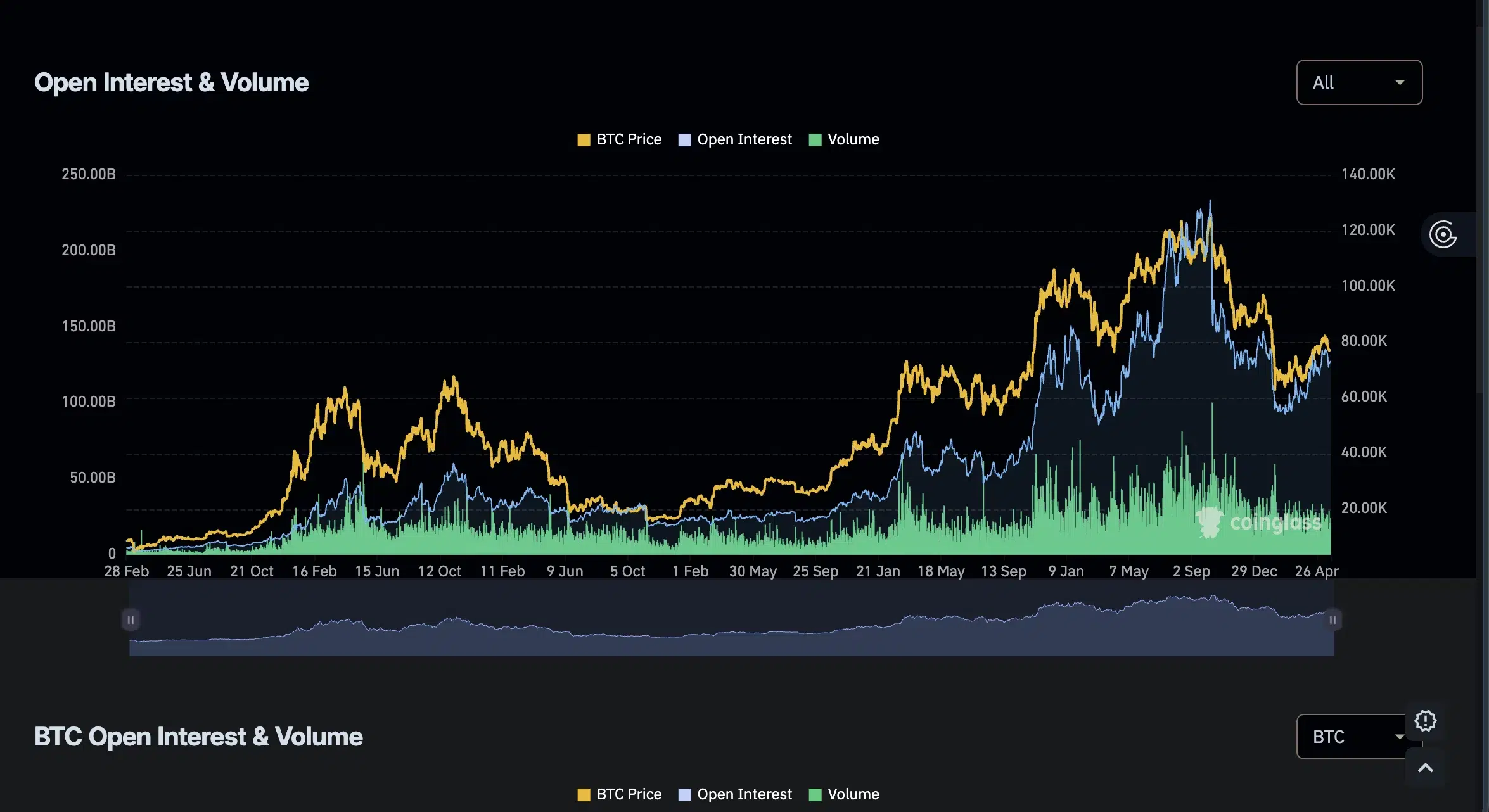
If Bitcoin drops below $73,786, more than $1.29 billion in leveraged long positions could be liquidated across major centralized exchanges, according to derivatives analytics platform Coinglass.
Summary
Fresh data from Coinglass show that if Bitcoin (BTC) falls under $73,786, cumulative long liquidation intensity on mainstream centralized exchanges reaches roughly $1.291 billion, highlighting just how crowded leveraged bullish bets have become near all time highs.
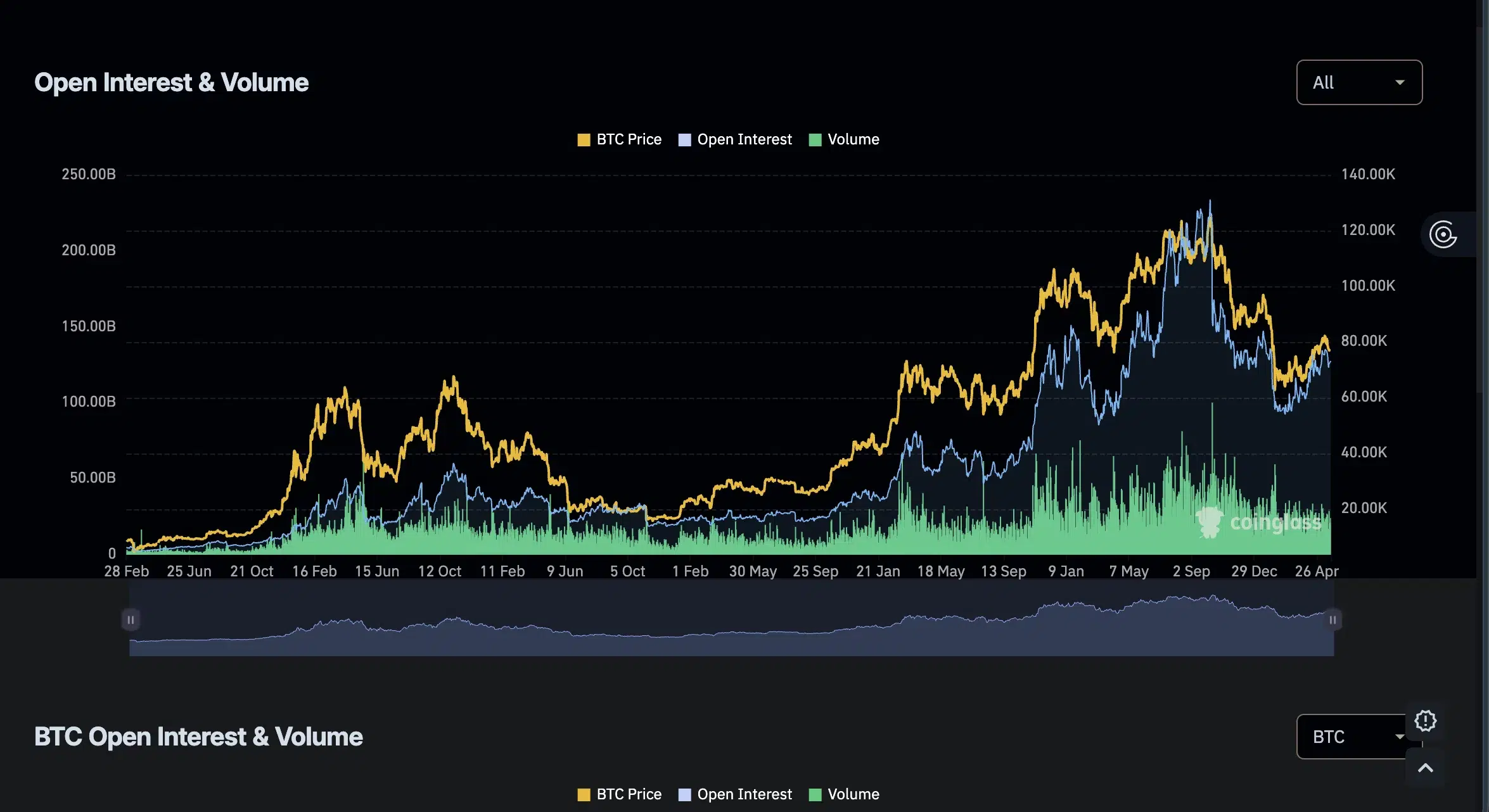
How exposed are Bitcoin longs and shorts at current levels
On the flip side, the same liquidation heat map indicates that if Bitcoin breaks above $80,995, cumulative short liquidation intensity would climb to about $1.223 billion, setting up the conditions for an aggressive squeeze if price decisively clears resistance.
These levels sit inside a broader trapdoor and squeeze zone Coinglass mapped out in April, when the platform warned that a break below $73,610 could trigger around $2.221 billion in BTC long liquidations, while a move above $81,264 would expose roughly $913 million in shorts to forced buybacks.
At the time, Coinglass described the band between those thresholds as a “$3.1 billion liquidation minefield” for traders trying to play Bitcoin’s breakout, underscoring how derivatives positioning now drives violent intraday swings.
A separate snapshot in March, cited by a previous crypto.news liquidation report, showed about $2.056 billion in BTC longs at risk if the price slipped below roughly $70,346, versus $1.514 billion in shorts facing liquidation above $77,312, turning even a narrow range into a multi billion dollar forced flow corridor.
In another Coinglass based analysis, a drop below $66,724 was estimated to put around $1.304 billion in BTC longs in the firing line, while a breakout above $73,613 threatened about $1.296 billion in shorts, again emphasizing the balance of pain on both sides of the order book.
Why these BTC liquidation bands matter for traders
Coinglass explains that its liquidation heat map aggregates leveraged positions across major venues into price bands, allowing traders to see where long and short positions would be forced to close if spot price moves against them.
“When you see billions of dollars in liquidations stacked within a few percent of price, it means any clean break can accelerate into a cascade as exchanges buy or sell to close positions,” the analytics team notes in its liquidation map documentation.
That dynamic has already surfaced multiple times in 2026, with Coinglass reporting days when network wide crypto liquidations topped $2.5 billion as Bitcoin and other majors whipsawed around key levels.
As a recent crypto.news deep dive on Bitcoin liquidation bands noted, these clusters often sit just above and below round number resistance, which can turn a modest breakout or breakdown into a disorderly short squeeze or long flush.
For traders tracking the latest readings, Coinglass currently highlights that a fall below $73,786 concentrates roughly $1.291 billion in long liquidations, while a push above $80,995 aligns around $1.223 billion in short liquidations on major centralized exchanges.
That means Bitcoin’s next clean move of less than $10,000 either way from this band could again unlock more than $2.5 billion in forced flows, echoing the risk corridors seen in March and April and leaving overleveraged positions dangerously exposed.

- Blind signing remains one of DeFi’s most dangerous everyday risks because users often approve smart contract transactions they cannot read.
- The Bybit hack showed how private keys can stay protected while a malicious approval still drains assets.
- ERA Wallet introduces ERA Lens™, an on-device transaction parsing engine that turns raw calldata into plain-language details before signing.
On May 12, the Ethereum Foundation and an Ethereum Working Group of wallet developers and security firms launched Clear Signing, an open standard for readable Ethereum transaction approvals. The announcement called blind signing a structural flaw linked to billions in user losses, including the Bybit hack.
Blind signing has often been treated as a wallet UX issue, a user education issue, or a warning screen issue. Users need to understand what a transaction will do before approval, otherwise the final confirmation screen becomes a weak security control.
Taking the Bybit case as an example, security analyses described a workflow where signers believed they were approving a routine transfer, while the underlying transaction redirected control of the wallet proxy to an attacker contract.
For DeFi users, the same pattern appears every day:
- A wallet asks for approval;
- A hardware device shows a hash, encoded calldata, or a fragment of information only a developer can read;
- The app looks familiar, the process feels routine, and the user signs.
Blind signing begins when cold storage protects the key, while the user approves an instruction they cannot read.
What Is Blind Signing?
Blind signing is the act of approving a transaction without seeing the full transaction intent in human-readable form. When a wallet or dApp lacks clear signing support, users see unreadable hashes or encoded data, making it impossible to verify what they are authorizing.
For simple transfers, users expect to see a recipient address and an amount. DeFi transactions are more complex. A smart contract approval can involve a function call, token permission, spend limit, destination address, swap path, lending action, staking action, or contract upgrade.
The danger appears when the interface says one thing and the payload says another. A front-end, browser extension, or connected phone can display a clean transaction summary while the signing device receives data the user cannot interpret. Once signed, the blockchain executes the instruction exactly as authorized.
Cold storage protects private keys from extraction. Transaction visibility is a separate security problem.
Why Hardware Wallets Alone Cannot Solve Every DeFi Approval
Hardware wallets became popular because they removed private keys from internet-connected devices. That was the right answer to a major risk: malware, phishing pages, browser attacks, and compromised laptops trying to steal seed phrases or sign directly from hot wallets.
DeFi created a different risk. Users now interact with smart contracts every day. They approve token permissions, bridge assets, swap through routers, deposit into vaults, stake, lend, borrow, claim rewards, and connect to new protocols. Each action can contain complex calldata.
A hardware wallet can keep the key offline and still ask the user to approve an unreadable transaction. The signing environment is secure, but the decision-making process can remain blind.
This is why clear signing became such an important security theme. Clear signing turns transaction data into readable fields, such as function, amount, recipient, token, and protocol.
The challenge, however, is coverage. Clear signing depends on supported wallets, supported dApps, metadata, and implementation across the ecosystem. Developers create JSON metadata for smart contract functions and submit it to a registry, after which compatible wallets can display the transaction in plain language.
DeFi moves quickly. New contracts, routers, protocols, aggregators, and app interfaces appear constantly. Users often leave integrated wallet environments to interact with third-party dApps. At that point, readable signing depends on whether the full path supports it.
The Smartphone Issue
Screenless hardware devices create another issue. If the signing device has no independent screen, the user must verify transaction details on a smartphone or computer. That means the device holding the keys may be separate, but the device explaining the transaction remains connected, updatable, and exposed to phishing or malware.
The Bybit attack showed why this distinction matters. According to Dfns, the malicious UI displayed a routine transfer while changing the transaction data sent for signing. The signer did not need to lose a private key, it only needed to approve the wrong instruction.
This is the blind signing problem: the user cannot make a safe decision when the final signing screen fails to show what the transaction will actually do.
ERA Wallet’s Answer
ERA Wallet draws on the new ecosystem standard and makes sure the signing device shows the user what they are approving before the transaction can be signed.
Its main mechanism is ERA Lens™, an on-device transaction parsing engine. ERA Lens translates complex smart contract calldata into plain language, showing the function, token amounts, and destination addresses involved. If a transaction cannot be decoded or does not match a known interface, ERA Lens stops the signing flow and flags it for manual review.
An ERA Wallet Founder Alexey Devyatkin explained the thinking behind the product this way:
“ERA Lens is a fully offline engine. This means the device acts as your personal “Security Island” because, without any internet connection, no one can alter the data stored on the device. As a result, if the device does not recognize a transaction, it is a strong reason to double-check it in order to avoid signing a malicious transaction.”
Air-Gapped Signing With Verifiable Payloads
ERA Wallet also uses a QR-only air-gapped signing model. The device signs without Bluetooth, Wi-Fi, or cables and is built on the open EIP- 4527 protocol. ERA says this lets users verify what data the device sends instead of relying on closed APIs or proprietary bridges.
EIP-4527 itself describes a QR code data transmission protocol between wallets and offline signers. The standard says QR transmission offers transparency because users can decode the data with tools, and it also notes that USB and Bluetooth carry a larger attack surface than QR codes.
This gives ERA two separate security layers:
- The first is physical and architectural, where the device signs offline through QR communication;
- The second is interpretive, where ERA Lens reads the transaction payload before the user approves it.
For DeFi users, both sides are important. Air-gapping reduces connectivity exposure. On-device decoding improves the approval decision.
Recovery Without a Paper Seed Phrase
ERA also replaces the classic paper seed backup with encrypted NFC Recovery Cards. The Recovery Card stores seed phrase backup data in encrypted form, uses PIN protection with limited attempts, and is built around a durable chip designed to protect information for more than 50 years. The card is also described as dustproof and waterproof, with support for single and multi-share backups.
Indeed, seed phrase management remains one of crypto’s weakest user habits. Paper can be lost, photographed, copied, damaged, or stored carelessly. ERA’s approach keeps recovery physical while removing the need to write a seed phrase on paper.
The device also supports up to 10 independent wallets, each with its own seed phrase and optional passphrase. For active users, that allows separation between long-term holdings, DeFi activity, testing wallets, business funds, and higher-risk interactions.

The Hardware Wallet Problem Has Changed
The first era of hardware wallets focused on custody. However, DeFi changed the threat model and the current question regards approval quality.
The EF’s Clear Signing announcement confirms this. Readable transaction approvals are becoming a baseline requirement for safe self-custody as users interact with smart contracts, routers, bridges, staking platforms, lending markets, and multi-signature workflows.
ERA Wallet’s bet is that the next phase of self-custody will be defined by transaction visibility. Keys need protection and approvals need context.
For DeFi users, that may become the more important question before every signature: can I actually read what I am about to sign?
The post ERA Wallet Closed the Blind Signing Gap That Has Cost DeFi Billions appeared first on BeInCrypto.
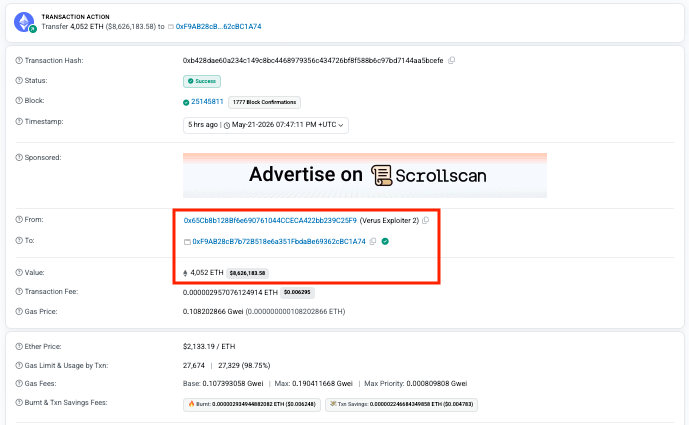
The attacker behind the Verus bridge exploit has returned 4,052 Ether, worth about $8.5 million, to the project’s team wallet after Verus offered a 1,350 ETH bounty for the recovery of most of the stolen funds.
The return represents about 75% of the stolen funds, with the exploiter retaining 1,350 Ether (ETH), worth about $2.8 million as a bounty, according to blockchain security firm PeckShield on Friday.
Verus had offered the bounty a day earlier, saying it would treat the retained ETH as a reward if the exploiter returned 4,052.4 ETH to the team address within 24 hours.
The recovery shows how some crypto projects try to negotiate directly with exploiters to recover stolen funds, though such deals do not necessarily prevent law enforcement or third parties from taking action.
The recovery comes days after the Verus-Ethereum bridge was drained in a forged cross-chain transfer exploit, adding to a string of bridge and decentralized finance (DeFi) attacks that have kept crypto security concerns high in 2026.
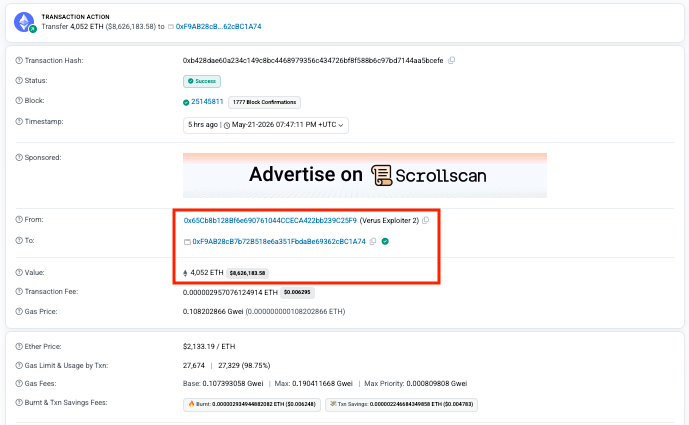
Source: PeckShield
DeFi hacks topped $600 million in April
DeFi hacks surged to a cumulative $634 million worth of value stolen in April, data aggregator DefiLlama shows. The $280 million Drift Protocol exploit and the $293 million Kelp exploit represented the largest incidents of the month.
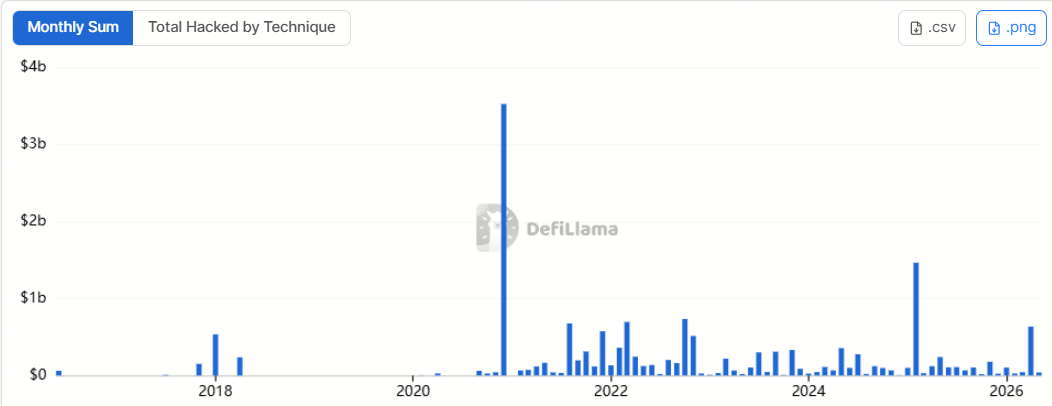
Total hacked by monthly sum, all-time chart. Source: DefiLlama
Losses have fallen sharply in May, with DefiLlama data showing roughly $38 million stolen so far this month.
Related: Crypto VC funding plunges to $659M in April, hits near two-year low
Still, cryptocurrency hacks remain one of the biggest hurdles halting mainstream blockchain adoption.
During the past decade, crypto hackers stole over $17 billion across 518 recorded incidents, with the majority stemming from compromised private keys, alongside phishing and other credential-based attacks, Cointelegraph reported on April 21.
Magazine: The legal battle over who can claim DeFi’s stolen millions
Warsh Era Begins at Fed: Two On-Chain Signals Bitcoin Traders Must Watch

Trump is trying to reinstate US sanctions on humanitarian Francesca Albanese

UFC Latest, May 22


-

 Crypto World7 days ago
BloFin War of Whales 2026 Grand Prix opens registration for $5M trading championship
-

 Fashion7 days ago
Weekend Open Thread: Theory – Corporette.com
-

 Crypto World7 days ago
E-Estate Announces 1 Year Live: Washington DC Summit as Real Estate Tokenization Enters Its Next Phase
-

 Tech7 days ago
Google reimburses Register sources who were victims of API fraud
-

 Business7 days ago
H&R Real Estate Investment Trust (HR.UN:CA) Q1 2026 Earnings Call Transcript
-

 Sports7 days ago
Napoleonic enters 2026 Doomben 10,000 field via Abounding withdrawal
-

 Crypto World7 days ago
BeInCrypto 100 Institutional Awards Nomination: KAST for Best Digital Assets Neobank and Best Digital Assets Fintech
-
 Crypto World7 days ago
Bitcoin Battles US Bond Nerves With BTC Price Dip Toward New May Lows
-

 Crypto World7 days ago
ICE and CME urge US regulators to curb Hyperliquid energy trading
-

 Fashion6 days ago
On the Scene at Gucci’s Cruise Show in New York City: Mariah Carey, Kim Kardashian, Lindsay Lohan, Iman, and More!
-
 Crypto World7 days ago
Wall Street’s Boldest Gold Prediction Has Russians Rushing to Buy
-

 Crypto World7 days ago
IREN closes $3 billion convertible notes deal amid AI infrastructure expansion
-

 Fashion6 days ago
Trending Western Style Vests Perfect for Summer
-

 Politics6 days ago
Watch: far-right flag-fanatics run over victim, attack locals – Setup By the Left wing for your entertainment
-

 Crypto World21 hours ago
Blockchain.com files with SEC for U.S. IPO
-

 Fashion5 days ago
Amazon Sundays: Memorial Day Hosting
-

 Crypto World7 days ago
Crypto Market Structure Bill Clears Committee; Senate Vote in Focus
-

 Entertainment5 days ago
Off Campus Easter Eggs Explained: Characters, Stories, More
-

 Crypto World7 days ago
BeInCrypto 100 Institutional Awards Nomination: KuCoin for Leader in Digital Asset Adoption and Best Trading Infrastructure
-

 Politics7 days ago
UK’s top intelligence body warns Mandelson files being withheld by government
You must be logged in to post a comment Login