Cardano governance is in crisis as an 81% stake majority opposes a 32.9 million ADA research funding proposal.
Summary
An 81% active stake majority is opposing a 32.9 million ADA proposal to fund Input Output Global’s research lab for another year through Cardano’s treasury.
Founder Charles Hoskinson called the vote existential for Cardano’s identity as a science-based blockchain, warning scientists could leave if the proposal fails.
The vote runs through June 8, with several dReps demanding competitive open RFP bids rather than an automatic IOG budget renewal.
A Cardano governance crisis has emerged on-chain as an 81% active stake majority is currently opposing a 32.9 million ADA proposal to fund Input Output Global’s core research team for another year. The opposition is led primarily by Japanese delegated representatives who argue the proposal lacks tight, auditable milestones.
“This doesn’t have anything to do with me. This has to do with destroying the entire core of our ecosystem. Cardano is the science coin. That’s our brand,” Charles Hoskinson said in response to the vote.
Advertisement
NOW: Cardano $ADA blockchain has officially surpassed 121,000,000 transactions.
Why the IOG vote matters for Cardano’s long-term roadmap
The IOG research lab is responsible for Cardano’s peer-reviewed development approach, including the Ouroboros consensus protocol. A failure to renew its funding would leave the protocol without its primary academic development engine.
Advertisement
Several dReps want competing teams to bid against IOG through open RFPs rather than automatic renewal. ADA was trading near $0.25, down approximately 60% over the past 200 days.
Crypto.news has reported on Hoskinson’s earlier warning that crypto markets would get “redder,” made during a February 2026 livestream where he positioned Cardano as entering a commercialisation phase.
What the milestone controversy reveals about decentralised governance
Critics of the IOG proposal argue it lacks specific, time-bound deliverables that a decentralised treasury process should require. The sentiment reflects a broader tension in Cardano’s Voltaire governance era between institutional efficiency and community accountability.
Advertisement
Crypto.news has tracked Hoskinson’s January 2026 warning that White House crypto czar David Sacks should resign if the Clarity Act failed to pass. Both episodes reflect the same impatience with institutional processes that fail to deliver tangible outcomes on a predictable timeline.
The voting period runs through June 8. If the proposal fails, scientists could leave, ending the peer-reviewed research model that defines Cardano’s identity. Crypto.news has covered analysis examining the gap between Hoskinson’s ambitions and Cardano’s on-chain adoption metrics, a tension the governance dispute now makes impossible to ignore.
Elon Musk’s SpaceX has unleashed a wave of mega-IPO activity, with early signals pointing to enormous demand that could redefine liquidity dynamics across tech, crypto, and growth equities. Reuters reports that SpaceX’s planned public offering could raise about $75 billion, valuing the private space-and-technology company around $1.8 trillion. Investor interest appears to be running close to four times the planned size, with more than $250 billion of demand cited in the early book-building stage. Pricing is expected later this week, leaving room for late orders from large institutional players as the process nears completion.
The scale of the demand has fed broader market chatter about the liquidity implications of a post-pandemic mega-IPO cycle. In a market already battling sharp volatility, the SpaceX story is being seen as a potential driver of capital allocation that could siphon liquidity from other risk assets, including technology equities and crypto markets, at least in the near term.
Key takeaways
SpaceX’s IPO demand is approaching four times the planned $75 billion raise, according to Reuters, positioning the deal as potentially the largest public offering in history and valuing SpaceX at about $1.8 trillion.
Pricing is anticipated on Thursday, with final orders possibly evolving as major investors finalize allocations in the closing stages.
Markets are reacting with volatility: US tech shares have moved lower, and crypto markets have faced notable declines, underscoring how mega-IPO hype can influence broader risk appetite.
Pre-IPO crypto products are surging in interest, as traders seek regulated-style exposure to high-profile private companies via perpetual futures and other synthetic instruments.
Across crypto venues, volumes and open interest in SpaceX-related derivatives highlight growing appetite for pre-IPO bets, even as spot markets digest the wider macro moves.
SpaceX IPO and the liquidity crosscurrents for risk assets
The enormous interest in SpaceX’s IPO underscores a persistent demand dynamic for growth bets that remains willing to absorb sizable risk premia. If priced near the midpoint of expectations, the deal would cap a unique era in which a private company can command a market cap approaching the trillions, even as it continues to pursue ambitious ventures in satellite internet with Starlink and artificial intelligence initiatives claimed to target a multi-trillion-dollar opportunity.
Analysts have framed the SpaceX offering as a potential “liquidity squeeze” catalyst—especially for assets most sensitive to macro swings and sentiment shifts. As funds allocate capital toward the IPO, bets placed on other speculative holdings, including crypto and tech equities, could be tempered in the short term. One market observer described the dynamic as a classic pre-mega-IPO liquidity rotation: a wave of orders from long-only funds can pull liquidity out of correlated assets as the auction sets a new reference point for investors’ risk appetite.
“Oversubscription with massive orders confirms the hype, but that excitement is sucking liquidity out of correlated risk assets today, hitting crypto hardest because it’s the most retail-driven and sentiment-tied to growth/tech narratives.”
That assessment reflects a broader sense among market participants that SpaceX’s mega-offering is less a standalone event and more a stress test of how capital shifts between private valuation narratives and public-market risk assets. While the current wave is not universally construed as the onset of a broader bear market, several traders caution that near-term liquidity could continue to rotate away from more volatile corners of the market as the pricing process concludes and initial trading commences.
Advertisement
Pre-IPO derivatives: crypto venues capturing the hype
SpaceX’s future growth, driven in no small part by Starlink’s satellite broadband ambitions and its AI narrative, has extended into the crypto derivatives space. Platforms have moved quickly to offer pre-IPO exposure through perpetual futures and tokenized access, allowing retail and institutional investors to gain regulated-style exposure to a private giant before its public debut.
Binance, Coinbase, Kraken, and Bybit have all introduced pre-IPO perpetual products tied to SPCX, the SpaceX ticker, in what market participants describe as a rapid response to demand for early, regulated-style participation in high-profile private equities. Since launch, pre-IPO instruments tied to SPCX have generated substantial activity—and quickly. Binance executives noted that the product line has attracted strong early traction, with cumulative trading volume surpassing $2.1 billion in roughly 18 days and participation across more than 130 countries.
On the decentralized side, Hyperliquid has also seen meaningful activity. In the past 24 hours, the platform reported around $70 million in trading volume for its SpaceX pre-IPO synthetic futures, with the current price around $157—down from about $210 at the instrument’s launch. Open interest on Hyperliquid’s SPCX market has exceeded $115 million, and the prevailing market pricing implies a SpaceX valuation approaching $1.97 trillion by some traders’ models.
Shunyet Jan, head of spot and derivatives at Binance, told Cointelegraph that the robust early engagement for pre-IPO SPCX futures reflects growing user interest in gaining regulated-style exposure to high-profile private companies via native crypto products. The parallel surge in demand across centralized and decentralized venues signals a broader appetite for “private market access” through structured instruments that blend traditional finance with crypto-native execution models.
Advertisement
Market context: tech volatility, crypto correlation, and what comes next
The SpaceX IPO narrative comes at a time when broader tech equities have been volatile, and crypto markets have faced multiday drawdowns. In the week leading up to the pricing window, broader tech indices showed weakness, and crypto benchmarks had shed material value as risk appetite ebbed in parallel with equity rotations. Critics and advocates alike note that the SpaceX episode could serve as a benchmark for how aggressively markets price growth expectations into new offerings—and how quickly liquidity can realign once a mega-deal begins trading.
Market observers also stress that the ultimate impact on crypto depends on several moving parts: the pace of SpaceX’s IPO pricing, the degree of liquidity drawn from correlated assets, how quickly the public market allocates capital to SpaceX post-listing, and how investors gauge SpaceX’s long-term reiteration of its growth thesis—especially around Starlink and AI ventures.
For investors watching the immediate horizon, the key questions are whether SpaceX can sustain the implied growth narrative after listing, how the pricing aligns with execution risk, and whether the near-term liquidity rotation dissipates as markets settle into the new price discovery for SPCX. The dynamic also raises a broader question for crypto markets: will the appetite for pre-IPO exposure endure, and if so, how will liquidity conditions influence the pricing and risk management of these synthetic products?
As the week unfolds, readers should monitor the final pricing levels for SpaceX and the subsequent trading dynamics. If the IPO prices near the upper end of expectations, there could be a pronounced pullback in related risk assets in the immediate aftermath, even as longer-term investors reassess SpaceX’s valuation path. The evolving interplay between traditional markets and crypto-based derivatives will likely shape risk appetite for the rest of the quarter, particularly among retail participants who drive much of the sentiment-driven volatility observed in today’s markets.
Advertisement
What remains uncertain is how durable the SpaceX narrative will prove once it begins trading and how much of the current liquidity churn is transitory versus signaling a broader regime shift in risk tolerance. Traders and builders should watch not only the final price and initial trade activity but also how crypto platforms adapt to ongoing demand for private-market exposure as public markets digest SpaceX’s ambitious growth plan and AI playbook.
— Article notes and data overlap from Reuters and Cointelegraph coverage illustrate a moment when SpaceX’s IPO story is reshaping conversations across both traditional and crypto markets, with early indicators suggesting a longer arc of liquidity reallocation that observers will be watching in the weeks ahead.
Risk & affiliate notice: Crypto assets are volatile and capital is at risk. This article may contain affiliate links. Read full disclosure
Bitcoin price has fallen below $61,000 on June 10 as traders cut risk exposure ahead of the latest U.S. inflation report, extending a selloff that has already pushed the crypto asset more than 50% below its October 2025 record high.
Summary
Bitcoin price fell below $61,000 ahead of the U.S. CPI report as traders reduced risk exposure amid inflation and Federal Reserve uncertainty.
Elevated oil prices and escalating Middle East tensions added to inflation concerns, keeping pressure on risk assets.
Technical indicators remain bearish, with analysts watching the $60,000 support level and $55,000-$50,000 as the next major support zone.
According to data from crypto.news, Bitcoin (BTC) price dropped to an intraday low of $60,755 before recovering slightly to trade near $61,200 at the time of writing. The decline came hours before the release of U.S. Consumer Price Index data, a report investors are closely watching after a series of stronger-than-expected economic indicators prompted markets to scale back expectations for Federal Reserve easing.
Futures markets have increasingly moved toward a higher-for-longer interest-rate outlook in recent weeks. Earlier economic releases, including labor market data that exceeded forecasts, encouraged traders to price in the possibility of rate hikes later this year rather than additional rate cuts, creating pressure across risk assets, including cryptocurrencies.
Advertisement
Inflation concerns and geopolitical risks weigh on sentiment
Adding to investor caution, oil prices remained elevated despite a sharp pullback on Tuesday. Crude oil traded around $88 per barrel on Wednesday as traders monitored growing tensions in the Middle East.
According to reports, Iran launched attacks on Bahrain, Jordan, and Kuwait after the United States carried out what it described as self-defense strikes following the downing of an American helicopter.
Energy markets have become a key focus because sustained strength in crude prices can complicate the inflation outlook. With CPI data due later in the day, traders appeared reluctant to increase exposure to volatile assets while uncertainty around both inflation and geopolitics remained high.
Advertisement
Institutional flows have also provided little support. Data from SoSoValue shows U.S. spot Bitcoin exchange-traded funds have experienced persistent capital withdrawals in recent weeks, removing billions of dollars from the sector and reducing a major source of demand that helped fuel previous rallies.
Weak demand conditions have also drawn attention from market participants. As previously reported by crypto.news, trading firm Wintermute said the lack of meaningful capital inflows continues to complicate efforts to identify a sustainable market bottom. According to the firm’s analysis, current buying activity remains insufficient to absorb persistent selling pressure across the market.
Wintermute also highlighted a notable liquidity gap between $50,000 and $59,000 on Bitcoin’s volume profile. The firm warned that if nearby support levels fail, the absence of significant trading activity within that range could increase the risk of a sharper move lower as sellers search for the next major area of demand.
At the same time, broader market sentiment has weakened as investors continue rotating away from speculative assets. Major equity benchmarks have also faced pressure amid rising Treasury yields and changing expectations for monetary policy.
Advertisement
Technical indicators point to critical support levels
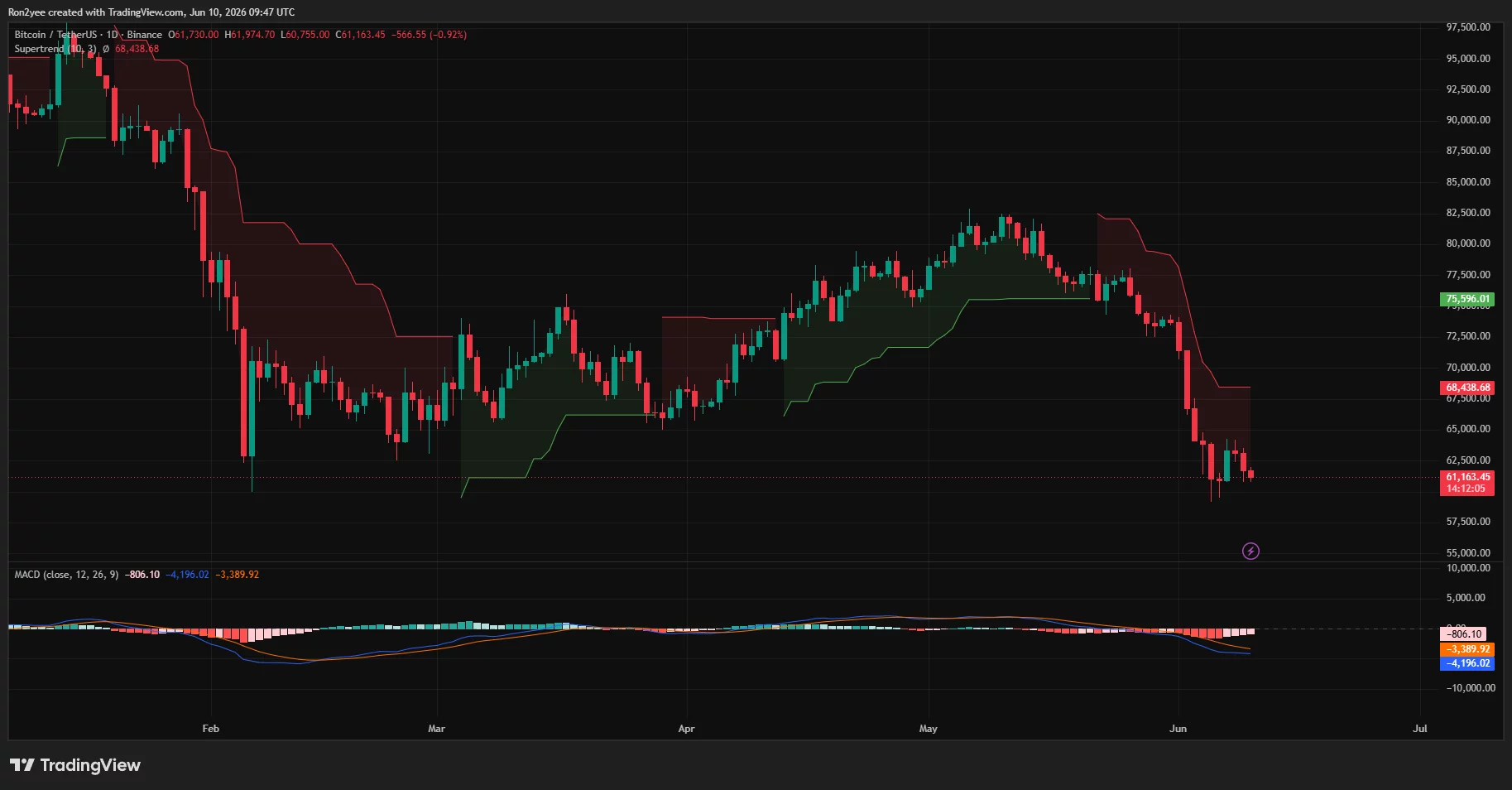
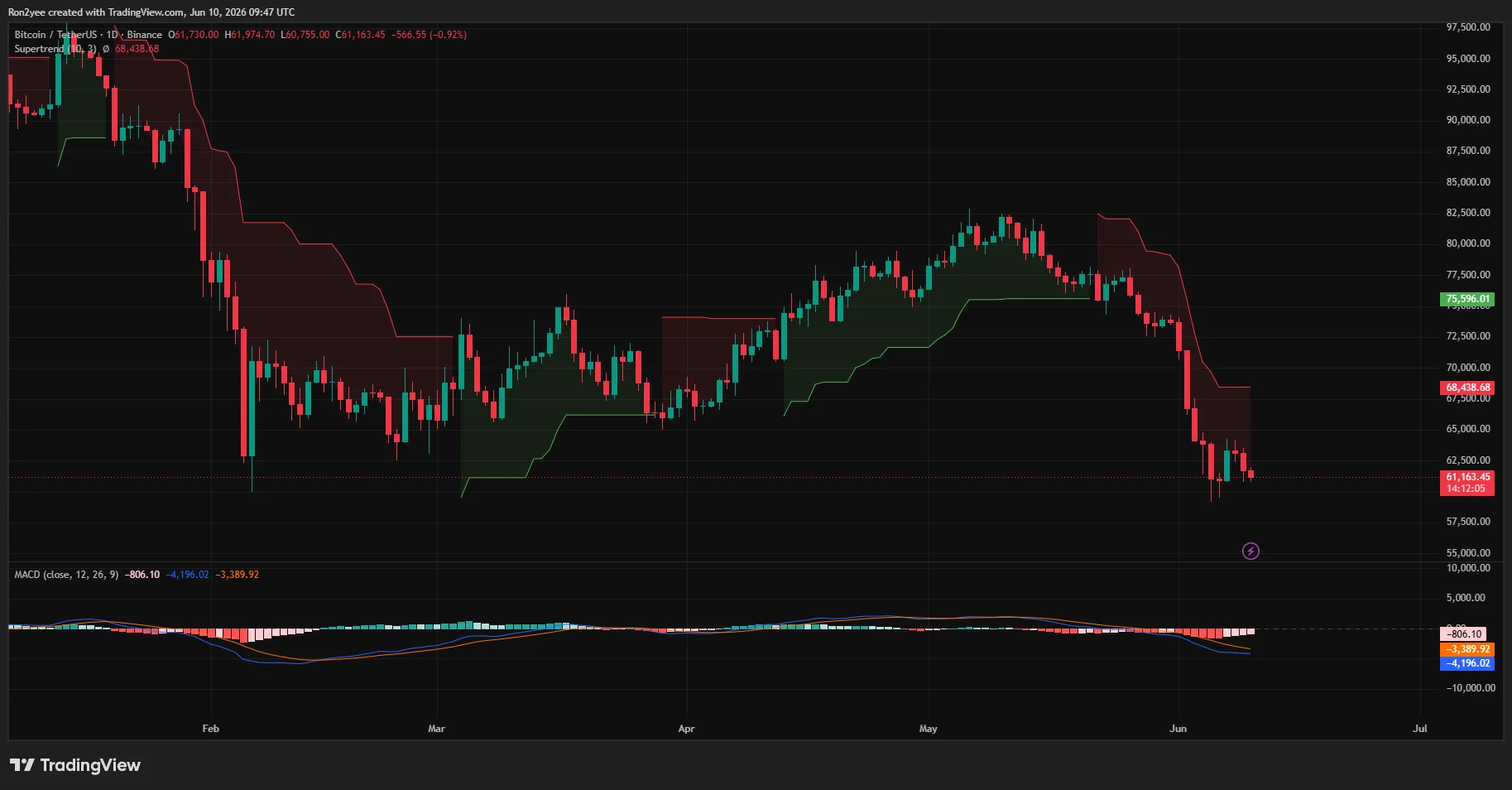
Chart signals suggest Bitcoin entered the CPI event in a technically fragile position. On the daily timeframe, the cryptocurrency remains below a bearish Supertrend indicator, which currently sits near $68,400. The indicator flipped negative in late May and has yet to show signs of a reversal.
Bitcoin daily price chart — June 10 | Source: crypto.news
Daily price action has also produced a sequence of lower highs and lower lows since Bitcoin failed to hold above $80,000, a pattern often associated with sustained downtrends. Momentum indicators remain weak, with the daily MACD still below the zero line despite signs that selling pressure has eased slightly.
Commenting on the current setup, analyst Ted Pillows said Bitcoin could still experience a final liquidity sweep before attempting a recovery.
“A sweep of $60,000 zone could happen next, as stocks are showing weakness too. If $60,000 holds, then BTC will have a decent bounceback towards $65,000.”
Per the analyst, a failure to hold that support area could expose Bitcoin to another leg lower.
Meanwhile, fellow analyst Lennaert Snyder identified the previous day’s low near $60,800 as another important support level. Snyder noted that liquidity remains concentrated around $65,000 and above $68,000, though he maintained a bearish bias unless Bitcoin can reclaim nearby resistance zones.
Advertisement
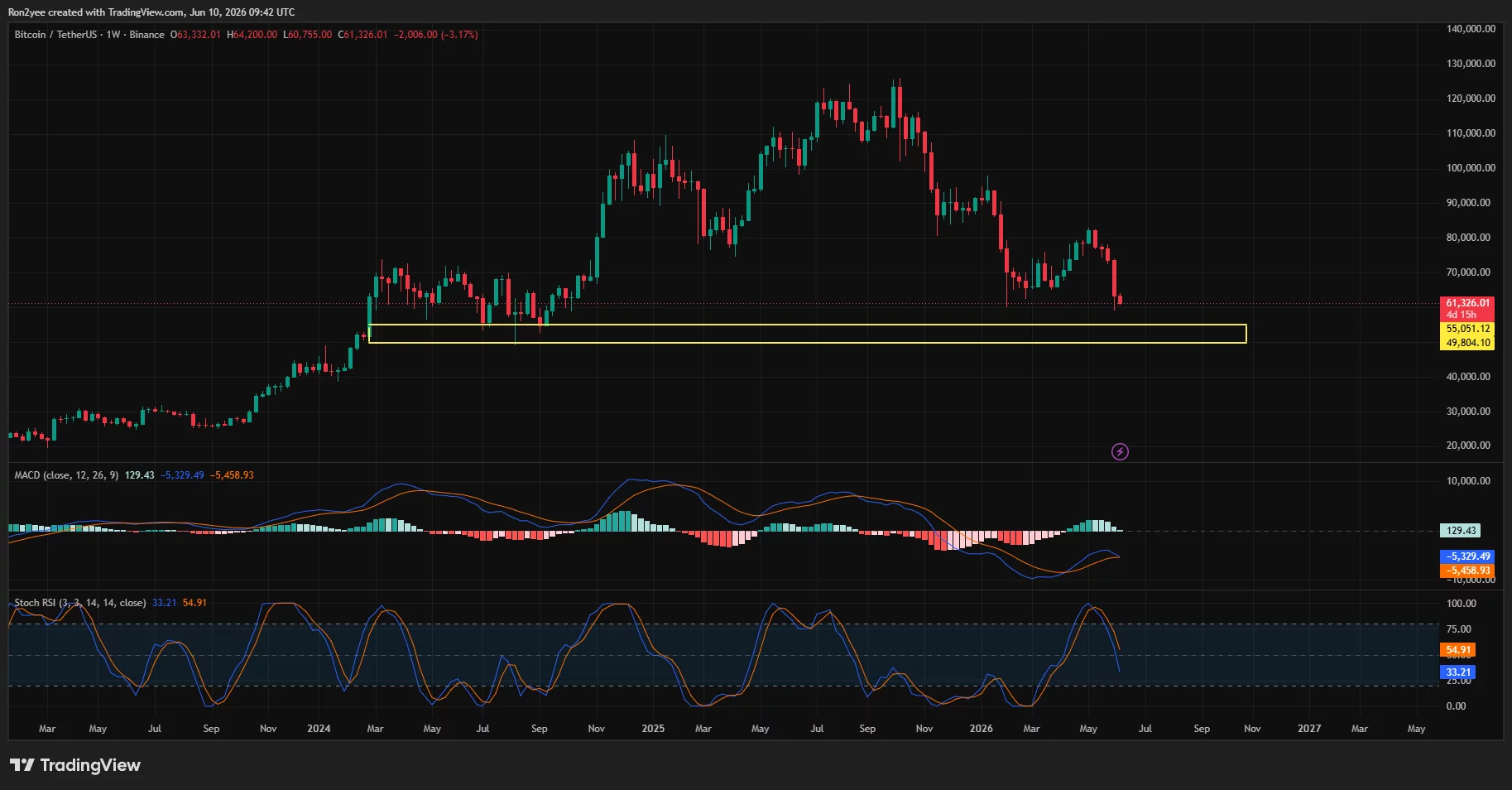
Longer-term indicators continue to highlight a larger support region between roughly $50,000 and $55,000. The weekly chart shows that the zone served as a major consolidation range throughout 2024. Should Bitcoin lose the current support area, traders are likely to monitor that range as the next major test of the asset’s market structure.
Bitcoin price is approaching the next support range between $50K and $55K on the weekly chart — June 10 | Source: crypto.news
Disclosure: This article does not represent investment advice. The content and materials featured on this page are for educational purposes only.
Flare co-founder Hugo Philion has confirmed that the team is exploring a LayerZero Decentralized Verifier Network.
Summary
Flare is exploring a LayerZero DVN, but Philion has not confirmed FXRP support for Cardano.
A Flare-operated verifier could authenticate cross-chain messages while applications choose their required security configuration independently.
FXRP already supports XRP-based lending, vaults and liquidity across Flare’s expanding decentralized finance ecosystem.
His remarks followed a community proposal involving FXRP and the Cardano ecosystem. Philion did not confirm that Flare plans to bring FXRP to Cardano. The discussion remains at an early stage, with no launch date, technical plan or formal partnership announced.
Advertisement
Flare examines a LayerZero verifier network
An XRP community member suggested that Flare create an official LayerZero DVN. The user argued that the infrastructure could support a secure route for FXRP to reach Cardano-based applications.
“Can’t comment on whether FXRP will go to Cardano,” Philion said.
He added that Flare was “actively exploring” the DVN proposal. His statement confirms work around verifier infrastructure, but it does not establish that FXRP will launch on Cardano.
Can’t comment on whether FXRP will go to Cardano but funny you say that re the DVN. It’s certainly something we are actively exploring.
LayerZero DVNs independently verify messages moving between supported blockchains. Applications can select the verifier networks they trust and set the number of approvals required before completing a cross-chain action.
Advertisement
FXRP could extend XRP use beyond Flare
FXRP represents XRP within Flare’s smart-contract ecosystem. Users can mint it against XRP and deploy it across lending markets, liquidity pools, vaults and other decentralized finance services.
Flare activated FXRP on its mainnet in September 2025. Its supply later passed 100 million tokens, with much of the capital used across staking, lending and structured yield products.
Bringing FXRP to another ecosystem would require technical support on both sides. LayerZero documentation states that a selected DVN must operate on the source and destination chains before it can verify a pathway.
Cardano support therefore remains uncertain. Neither Flare nor Cardano has announced an integration, and Philion’s post did not confirm that LayerZero currently provides the required Cardano route.
Advertisement
Philion calls for wider blockchain cooperation
Philion’s comments followed earlier public disputes with Cardano founder Charles Hoskinson over Bitcoin and XRP interoperability. The two executives previously disagreed over whether networks should build separate bridging systems or use shared infrastructure.
In his latest post, Philion welcomed Hoskinson’s renewed industry activity. He said the sector benefits from the presence of Hoskinson, Cardano and the Midnight privacy network.
It’s nice to see @IOHK_Charles back in the saddle. I have disagreed with him in the past regarding duplication of work on XRP & BTC interoperability – my position is that networks can just use FXRP & FBTC via @LayerZero_Core . More importantly this space would be worse off…
Philion also argued that Cardano could use existing assets such as FXRP and FBTC through LayerZero instead of creating separate versions. That proposal reflects his preferred approach but does not represent an agreement between the projects.
Advertisement
As crypto.news reported, Flare integrated LayerZero V2 in 2024, connecting the network to dozens of blockchain ecosystems. At the time, Philion said Flare could eventually operate as a DVN and support cross-chain markets involving assets such as XRP and Bitcoin.
The latest remarks bring that earlier plan back into focus. However, FXRP-on-Cardano remains speculation until Flare, Cardano or LayerZero publishes a formal deployment plan.
Europe Commission President Ursula von der Leyen announced the EU’s 21st sanctions package against Russia, and buried inside it was an unprecedented legal weapon: the power to ban all crypto-asset services operating from any foreign country found to be helping Russia evade sanctions.
Hours later, on the same calendar day, Russia’s Deputy Finance Minister Ivan Chebeskov took the stage at SPIEF 2026 and announced punitive fees of up to 3% on Western-linked stablecoins including USDT and USDC.
INTEL: Von der Leyen says EU will double down with 21st Russia sanctions package, including powers for full third-country bans on crypto-asset services pic.twitter.com/Qia5cv5Llz
Europe 21st Sanctions Package: What the Crypto Kill Switch Actually Does
The June 9 package is not an incremental tightening, it is a doctrinal escalation. For the first time, the EU is proposing a mechanism that operates at the jurisdiction level, not the entity level. Previous packages named specific exchanges, wallets, and individuals.
The 21st package gives Brussels the authority to designate an entire country’s crypto sector as off-limits if that country is found to be hosting platforms enabling Russia crypto sanctions evasion.
Von der Leyen described the tool in unambiguous terms:
Advertisement
“For the first time we will introduce the possibility of a full third country ban for crypto-asset services. It will act as a strong deterrent for the countries hosting platforms that help Russia evade our sanctions.”
Photo: Von der Leyen
The enforcement chain works like this: the European Commission identifies a foreign jurisdiction, Turkey, UAE, Kazakhstan, Hong Kong are all in the analytical frame as major intermediary hubs for Russian crypto flows, determines it is materially enabling sanctions evasion, and can then trigger a blanket ban on all crypto-asset service activity linking that country to EU-regulated markets.
Any exchange, liquidity provider, or settlement layer touching that jurisdiction gets cut off from European counterparties.
The 21st package also extends transaction bans to 20 additional non-EU entities, banks, crypto platforms, and oil traders, and adds 31 Russian banks to the existing transaction ban list.
This follows the 20th package, adopted April 23 and effective May 24, which already banned all Russia-based crypto asset service providers as a category and explicitly prohibited dealings with the state-backed RUBx stablecoin and the digital ruble.
Chainalysis, which described the 20th package as a ‘paradigm shift’ from entity-level pressure to targeting ‘evasion architecture itself,’ now faces an even harder analytical problem: the 21st package means VASPs must assess entire settlement ecosystems and jurisdictional exposure, not just screen named individuals against SDN lists.
The total value received by illicit crypto addresses reached $154 billion in 2025, with Russia-linked flows representing a dominant share, that data point is the explicit legislative rationale behind the stablecoin ban architecture taking shape in Brussels.
The native token HYPE of Hyperliquid witnessed a decline of over 10% in the last 24 hours despite growing interest in the deflationary token concept for the project within the crypto industry. According to data from CoinMarketCap, the token was valued at $55.46 after falling from above $62.
The two events made people focus on the HYPE coin. Although the token witnessed a steep daily drop in price, supporters continued to discuss the buyback-and-burn feature and supply figures.
HYPE Extends Decline During 24-Hour Trading Session
In accordance with data from CoinMarketCap, the price of HYPE declined by 10.46%, resulting in a current market capitalization of about $14.07 billion. The total trading volume for the token amounted to $1.04 billion, showing growth exceeding 15% over the same period.
From the analysis, one can observe a downtrend pattern in the price of HYPE for the trading period. It had been traded at a value higher than $62, but subsequently experienced a downward move as many buying efforts proved unfruitful.
Advertisement
Social Media Post Focuses on Supply Reduction
As reported by Hyperliquid Daily on X, the data compared HYPE’s yearly supply change against other prominent crypto coins. HYPE was said to have shown annualized supply growth of -3.02%, whereas Ether had a positive 0.83% and Solana 3.75%.
Additionally, it is noted that Hyperliquid invests 97% of its trading profits into purchasing HYPE from the market for burning. As indicated by the figures, over 46 million HYPE tokens have been burnt already.
Why $HYPE is quietly becoming one of the strongest tokens in crypto right now.
While most tokens keep printing more supply, Hyperliquid is doing the opposite — and doing it aggressively.
Market Activity and Token Economics Draw Attention
According to the social media thread, the system follows a cycle whereby increased transactions create more fees, which lead to more buybacks and token burns. Proponents maintain that such a system could help lower supply over time.
Meanwhile, market participants watched price developments. Even after the drop, HYPE retained daily transaction volume above $1 billion.
Key Levels Traders Are Watching
The $55 price range acted as immediate support after buyers defended the range in the recent session. The $54 range is noted as an additional level to watch if selling pressure persists.
Advertisement
On the upside, prices at $56 and $58 were unable to sustain gains before retreating. This suggests future price action in HYPE will be determined by prevailing market conditions and trading activity.
Risk & affiliate notice: Crypto assets are volatile and capital is at risk. This article may contain affiliate links. Read full disclosure
SpaceX is raising $75 billion at $135 per share in one of the largest equity offerings in history, and the brokers handling retail access are drawing a hard line: flip your allocation and face being locked out of future IPOs, permanently.
The offering, listing on Nasdaq under ticker SPCX on Friday, June 12, 2026, has been structured with an unprecedented 30% retail tranche, worth roughly $22.5 billion, versus the industry-standard 5–10% seen in most large IPOs.
— The Enterprise World (@theenterprisew) June 10, 2026
Broker anti-flipping penalties are the enforcement mechanism keeping that tranche stable. The deal is already oversubscribed, meaning retail investors competing for IPO allocation face the double pressure of receiving less than they requested and being warned they cannot sell quickly once they do.
SpaceX SPCX IPO: Four Brokers, Four Sets of Penalties, and One Outlier
Fidelity is enforcing a 15-calendar-day holding period on SpaceX shares, shorter than the industry’s common 30-day benchmark, but with penalties that are anything but lenient.
A first violation of the share flipping restriction triggers a 6-month ban from future IPO allocations at Fidelity.
Advertisement
A second violation means a 1-year suspension. A third means a permanent ban, tied to a Social Security number.
Fidelity also cut its minimum IPO eligibility threshold to $2,000 specifically for this deal, down from the $500,000 standard, which signals just how deliberately broad this retail access was designed to be.
Thanks for the interest! Fidelity customers with $2,000 or more in retail brokerage assets in their account will be eligible to participate in the SpaceX IPO. The best way to stay informed of new issue offerings in which Fidelity is participating is to register for Fidelity’s…
SoFi runs a 30-day anti-flipping window and escalates harder: first offense triggers a 180-day ban, second a 365-day ban, third a permanent one. SoFi may also charge a $50 fee for any retail investor selling IPO shares within the first 120 days of trading.
Advertisement
Robinhood matches the 30-day window with a 60-day timeout from future IPO purchases on the first violation. E*TRADE also enforces a 30-day preference period, with discretionary language reserving the right to exclude early sellers from future new issues, less prescriptive than Fidelity or SoFi, but with consequences that remain real.
Charles Schwab is the lone outlier: no anti-flipping policy applies to the SpaceX IPO or any other IPO unless the issuer requires it directly.
NerdWallet’s lead investing writer Sam Taube frames the broker logic plainly: “The brokers that offer these things want people to buy into IPOs because they believe in the company and want to hold the stock long term.”
Perhaps driven by the escalating tension in the Middle East, bitcoin’s price was rejected at $64,000 and tumbled to just under $61,000 in the past 12 hours or so.
The altcoins have taken an even bigger beating, with XRP, SOL, and ADA dumping by over 5%. ZEC and HYPE have marked even more profound declines.
BTC Drops Again
The previous business week brought some intense volatility and painful declines for the primary cryptocurrency. BTC entered it at $73,000 but quickly began losing key support levels, and the culmination took place on Friday.
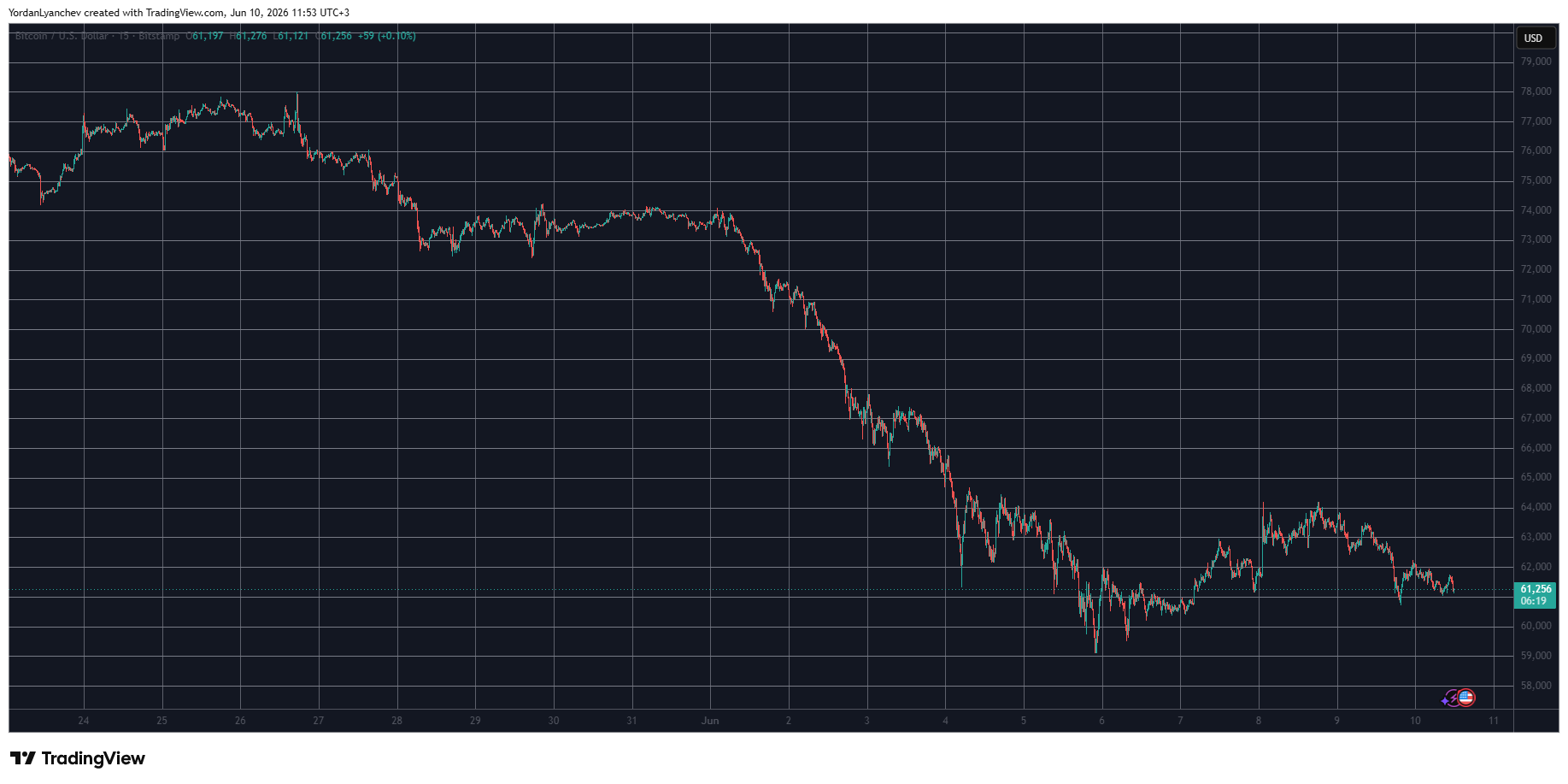
After dumping below $70,000, $65,000, and $62,000, the cryptocurrency knocked on the $60,000 door for the first time since early February. However, unlike that crash, the bears were more persistent this time and pushed the asset below that level to mark a 19-month low at $59,100.
Advertisement
Nevertheless, bitcoin managed to rebound swiftly and reclaimed that level by the end of the day. It jumped to $61,000 and $62,000 over the weekend and spiked to $64,000 twice at the start of the current business week. However, reports emerged that Iran had taken down a US helicopter, and the latter’s president said they had to respond.
This growing geopolitical tension resulted in immediate price declines in the crypto markets (also on Wall Street), and BTC quickly dumped to just under $61,000. It now fights to reclaim that level, as its market cap has slipped to $1.225 trillion, and its dominance over the alts is down to 56%.
BTCUSD June 10. Source TradingView
Alts Bleed Again
Most altcoins have followed suit on the way down. Ethereum has dropped by over 3% toward $1,600, BNB has dumped to $585 after a similar decline, while DOGE is down to $0.084. XRP has dropped by over 5%, and it tests a key support level again. SOL is well below $65, while ADA keeps dropping to $0.16.
HYPE and ZEC have lost the most value over the past 24 hours, dumping by double digits. Consequently, the former trades at $56, while the latter is down to $425. Even more painful declines are evident from SIREN (-37%), LAB (-16%), and DEXE (-15%). In contrast, BEAT has risen by 28%, followed by WBT (13%) and STABLE (12%).
The total crypto market cap has erased over $60 billion in a day and is below $2.2 trillion on CG now.
Advertisement
Cryptocurrency Market Overview June 10. Source: QuantifyCrypto
Anthropic launched Claude Fable 5 today, June 10, a public version of its previously restricted Mythos model. Now, the most powerful vulnerability-finding AI ever built just became available to anyone with a subscription. For DeFi, the implications are immediate.
Until today, Mythos was locked behind Project Glasswing, accessible only to around 150 handpicked organizations, including Google, Microsoft, and JPMorgan. That version had already found over 10,000 critical vulnerabilities across the world’s most important software.
What Fable 5 Can and Cannot Do
Anthropic says Fable 5 comes with hard safety limits. In high-risk areas, including cybersecurity, biology, chemistry, and model distillation, the model blocks responses and falls back to Claude Opus 4.8.
Releasing a model this capable comes with risks. Without safeguards, Fable 5’s capabilities in areas like cybersecurity could be misused to cause serious damage. Queries on a narrow range of topics will instead receive a response from our next-most-capable model, Opus 4.8. pic.twitter.com/vJ71vCdkjc
Anthropic stress-tested its classifiers with jailbreak attempts before releasing Fable 5, running an external bug bounty that produced no universal jailbreaks across more than 1,000 hours of testing.
Sensitive cybersecurity requests trigger the fallback in less than 5% of sessions, meaning the vast majority of interactions proceed through Fable 5’s full capabilities.
For DeFi specifically, smart contract exploitation does not fit neatly into Anthropic’s blocked categories. Finding a vulnerability in a Solidity contract looks more like a coding task than a traditional cybersecurity attack.
Fable 5’s exceptional performance in software engineering is consistent, and the longer and more complex the task, the larger its lead over other models currently available. For an unaudited DeFi protocol running on publicly visible on-chain code, that distinction may matter enormously.
Advertisement
The Zcash precedent is already circulating in security circles. A lighter version of the Anthropic architecture found a critical flaw in the Zcash protocol within 24 hours, a vulnerability that had survived four years of scrutiny from some of the world’s best cryptographers.
Why DeFi Is Uniquely Exposed
Fable 5 alone represents a step change in the cost and skill required to probe smart contracts for weaknesses. White hat hacker MevenRekt, described the situation plainly: the cost and skill required to find exploitable flaws in smart contracts is about to drop to effectively zero.
I usually think we overdramatize the shit out of everything in this space. Every other week something is “the end of crypto” and then life just goes on as usual. But I just had a very long conversation with the incredibly talented white hat hacker @MevenRekt about Anthropic’s…
Unaudited protocols become sitting ducks. Known exploits can be replayed on forks around the clock. Even small projects become worth targeting simply because trying costs next to nothing.
Advertisement
Anthropic itself warned last week that AI systems are advancing so quickly that they may soon achieve recursive self-improvement, autonomously improving without human intervention.
The advice from security experts is consistent and urgent: revoke token approvals, move funds to hardware wallets, and cut exposure to protocols you do not fully trust. Not tomorrow. Today.
Chainalysis is expanding its collaboration with South Korea’s National Police Agency to bolster crypto-crime investigations, including cases tied to North Korea. The security firm announced on Wednesday that it signed a memorandum of understanding to help build investigative capability within South Korea’s law enforcement apparatus.
The agreement is framed as a broader move to strengthen institutional capability, not solely to confront North Korea–linked attacks, though those threats remain a major focus given recent activity in the region. Chainalysis’ Korea country director, Ryan Kwon, stressed that the collaboration is designed to tackle a wide spectrum of illicit activity, with North Korea as a principal concern but not the only one.
“While North Korean-driven attacks are understandably a national security focus, this partnership isn’t designed around a single threat. It’s fundamentally about building institutional capability,”
The memorandum of understanding will equip the KNPA with personalized training content from Chainalysis, along with professional certification programs and practical training to sharpen capabilities in tracing illicit crypto flows and conducting digital-forensics examinations. Chainalysis said the objective is to give Korean investigators a holistic view of global illicit fund movements that can improve investigative outcomes.
Advertisement
In explaining the rationale behind the move, Chainalysis emphasized the need for investigators to have global visibility into illicit fund flows to effectively pursue cases that cross borders and jurisdictions. The company noted that its support extends beyond a single threat landscape, aligning with a broader mission to strengthen law-enforcement infrastructure for a rapidly evolving crypto environment.
The agreement arrives amid heightened attention to North Korea–linked crypto activity. In April, authorities reported that North Korea–linked crypto thefts topped $578 million, with many of the attacks attributed to high-profile incidents involving platforms and protocols such as Kelp DAO and the Drift Protocol. Separately, research from CrowdStrike found that North Korea–affiliated hackers were responsible for about $2 billion in crypto losses in 2025, marking a 51% year-on-year increase in the threat landscape.
The MoU comes at a time when South Korea’s police are intensifying their focus on crypto-enabled crime. Earlier this year, Seoul’s authorities announced the launch of a dedicated multi-agency task force—the Money Laundering Eradication Task Force—led by the Economic Crime Investigation Division. The initiative signals a broader, cross-cutting approach to combating crypto-based money laundering and related illicit finance activities.
Chainalysis has a history of cooperation with Korean investigators. The company has provided support for years and played a role in recent high-profile investigations—most notably in September when Seoul authorities dismantled an international hacking ring that had stolen roughly $30 million. The operation began in South Korea and eventually traced the criminals to Thailand, illustrating the kind of cross-border collaboration that the new MoU seeks to institutionalize rather than merely supplement.
Advertisement
For South Korea, the partnership fits into a longer-term effort to align public enforcement with private-sector intelligence and analytics capabilities. By granting KNPA access to Chainalysis’ training curricula and certification paths, the collaboration aims to raise the baseline of investigative skills across the force and accelerate technical proficiency in tracing complex crypto transactions and money flows.
As policymakers and enforcement agencies weigh the next steps in crypto regulation and oversight, the Chainalysis–KNPA agreement highlights a growing willingness to formalize public-private partnerships as a core part of national security and financial-crime strategy. The effectiveness of such collaborations will hinge on program implementation, the speed with which investigators can translate training into actionable cases, and the capacity to sustain cross-border intelligence-sharing in an increasingly borderless fraud and theft landscape.
Key takeaways
Chainalysis signs a memorandum of understanding with the Korean National Police Agency to strengthen investigative capability, including training, certification, and practical instruction for KNPA personnel.
The partnership emphasizes a comprehensive approach to crypto crime, with North Korea–linked attacks cited as a major driver but not the sole focus of the collaboration.
April saw North Korea–linked crypto thefts top $578 million, while CrowdStrike reports North Korea–affiliated hackers were responsible for about $2 billion in crypto losses in 2025, up 51% year over year.
The MoU follows South Korea’s launch of the Money Laundering Eradication Task Force, signaling a broad, multi-agency push against crypto-based money laundering.
Chainalysis has a history of aiding Korean investigators and positions this agreement as a move to formalize and scale institutional capabilities rather than provide ad hoc support.
Institutional capability building in a borderless crime landscape
The new MoU represents more than a single training program. By providing KNPA investigators with tailored content, professional certifications, and hands-on training, Chainalysis seeks to embed analytic methods and evidence-driven practices into everyday investigative workflows. The emphasis on global visibility into illicit fund flows underscores a shift toward more proactive and globally coordinated enforcement, where on-chain analytics play a central role in identifying patterns, tracing funds, and attributing wrongdoing across jurisdictions.
From an investor and user perspective, the move reflects a tightening of, or at least a clearer path toward, accountability in the crypto ecosystem. As exchanges, custody providers, and other actors increasingly rely on on-chain intelligence to assess risk, partnerships that elevate investigative capacity can influence how compliance programs are designed and how quickly investigations can be pursued when anomalies surface. In regulatory terms, the collaboration aligns with a trend toward more formalized cooperation between private analytics firms and public law enforcement to address cross-border crypto crime in a rapidly evolving policy environment.
Context and momentum in South Korea’s crypto-crime crackdown
The Chainalysis–KNPA MoU sits within a broader ripple of enforcement activity in South Korea. The government and law-enforcement agencies have signaled a sustained focus on illicit finance in the crypto space, including the creation of specialized task forces meant to coordinate across agencies and jurisdictions. The Money Laundering Eradication Task Force, led by the Economic Crime Investigation Division, is emblematic of this approach and may influence how cases are pursued, how assets are traced, and how cooperation with foreign partners is structured in the months ahead.
Advertisement
For now, the partnership with Chainalysis adds a practical capability boost—giving KNPA personnel access to advanced tooling, training, and a structured path to professional certification. It also highlights a growing recognition among authorities that blockchain analytics and institutional training are essential components of an effective response to crypto-enabled crime, including theft, fraud, and illicit financing tied to state-backed adversaries.
Readers should watch how the KNPA translates this training into on-the-ground results and whether the collaboration expands to additional agencies or regions. The next datapoints to monitor include any measurable improvements in case resolution times, cross-border investigations, and the integration of Chainalysis’ analytics into routine investigative workflows.
In the evolving landscape of crypto enforcement, the Chainalysis–KNPA MoU marks a notable shift toward structured, capability-building partnerships that could shape how crypto crime is investigated and deterred in the region and beyond.
Risk & affiliate notice: Crypto assets are volatile and capital is at risk. This article may contain affiliate links. Read full disclosure
Meta has signed an agreement with Reliance Industries to lease its first AI-enabled data center in India. Reliance will build the 168 MW facility in Jamnagar, Gujarat, with options to scale capacity.
The deal extends a partnership that began with Meta’s $5.7 billion investment in Jio Platforms in 2020. It also arrives as data centers face growing public scrutiny over electricity and water consumption.
Meta Signs First Indian AI Data Center Lease With Reliance Industries
According to the announcement, renewable energy will power the Jamnagar facility, while desalinated seawater will cool it. Meta will cover the full cost of the energy and water supporting the site.
Meta pointed to Jamnagar’s strategic value, where Reliance is constructing a massive data center campus backed by the energy capacity that advanced AI systems demand.
Advertisement
“We’re proud to be working with Reliance to build our first AI-enabled data center in India. This world-class facility in Jamnagar will help us scale our AI infrastructure globally while deepening our long-term investment in India’s economy,” Mark Zuckerberg, Founder and CEO of Meta, said.
We’re announcing Meta’s first AI-enabled data center in India. This marks both a significant milestone in our global infrastructure expansion and India’s growing role in the global AI ecosystem.https://t.co/3cSiScsq9C
In addition, Meta also contracted nearly 1 GW of new clean energy in India. CleanMax will supply 837 MW of solar and wind projects in Rajasthan and Karnataka. Fourth Partner Energy will add 88 MW across Tamil Nadu, Karnataka, Maharashtra, and Uttar Pradesh.
“Meta is investing aggressively to expand our capacity footprint to support our technologies, services, and AI ambitions, which serve billions of people worldwide. India’s rapidly growing tech-forward digital economy, its massive user base, and the strength of our partnership with Reliance make India an ideal place to invest,” the blog added.
Research Finds No Link Between Data Centers and Electricity Prices
The AI buildout has stoked fears, voiced by figures like Senator Elizabeth Warren, that households will absorb the cost of surging power demand.
Advertisement
A single AI data center uses as much electricity as 100,000 households—and utility companies are passing the upgrade costs to you, not to the trillion-dollar tech giants. I’ve opened an investigation. These companies need to pay their costs.
Entergy CEO Drew Marsh recently rejected those concerns.
“Data centers really want to be good neighbors. They have reputations that they want to protect, and they want to be part of the community,” Marsh told CNBC.
Separately, research published in March 2026 by the Institute for Energy Research found no statistically significant correlation between the number of data centers in a state and its current electricity prices. Two other recent reports reached comparable conclusions.
Meanwhile, states are also moving to shield their citizens. Last week, Wyoming Governor Mark Gordon signed an executive order requiring data center developers to cover the grid costs their projects create.
Advertisement
Whether similar cost-shielding models reassure communities in India and beyond may shape how fast the next wave of AI facilities gets built.










 (@solidintel_x) June 9, 2026

















 Fashion5 days ago

 Crypto World2 days ago

 NewsBeat2 days ago
 Tech4 days ago

 Tech3 days ago
 Tech5 days ago
 Business5 days ago

 Crypto World3 days ago
 Tech5 days ago
 Tech4 days ago

 Business2 days ago

 Tech4 days ago
 Tech2 days ago
You must be logged in to post a comment Login