

Crypto World
Why traders are turning to smart forex bots for currency market automation



Disclosure: This article does not represent investment advice. The content and materials featured on this page are for educational purposes only.
Smart forex bots gain traction in 2026 as traders seek automated tools to monitor fast-moving currency markets.
Summary
- Smart forex bots are gaining traction as traders automate monitoring and execution across fast-moving currency markets.
- Modern expert advisors increasingly focus on single pairs like GBP/USD, using coded risk controls and backtesting.
- Traders remain cautious of overfitting, volatility risks, and execution quality despite improved transparency and automation.
Trading manually is getting harder and harder to justify, which is why an increasing number of retail traders have started turning to automated systems instead.
The BIS triennial survey for April 2025 put daily forex volume at $9.6 trillion – a 28% jump from three years earlier. Read on for a look at how automation tools are involved in this increase, and what the trade-offs are.
A market that doesn’t stop
London opens while Tokyo is wrapping up, then New York kicks in a few hours later. For traders watching two or three currency pairs at once (which most are these days), that’s an impossible amount of screen time to cover properly. Prices on the major pairs can move fast — we’re talking seconds — and a lot of this happens while a trader is asleep or otherwise occupied.
That’s why smart forex bots have jumped in popularity. In short, they watch the market so a person doesn’t have to. Whether they do that job well is a different kettle of fish, but the case for their use is pretty understandable.
What’s going on under the hood
Most of these tools are what’s called expert advisors — scripts written in MQL4 or MQL5 that get loaded into MetaTrader. How this works is an EA watches price data on a specific timeframe and checks it against coded rules. When those rules line up with what’s happening on the chart, it opens a position automatically. The whole idea is to take humans out of the moment-to-moment decisions.
Over the past year or two, a lot of these EAs have become narrower. Rather than trying to trade 8-10 pairs, some of them now only focus on one. GBP/USD is a common pick thanks to its liquidity windows — which are predictable — plus the fact that it responds in fairly consistent ways to Bank of England and Fed rate decisions. If an algorithm only has to learn one instrument’s behavior, it can be tweaked better than a system trying to do it all.
A setup might look at patterns on the daily chart to figure out which way the trend is going, then drop down to the M15 to time entries. Smart forex bots doing this analysis can filter out a lot of what trips up manual traders. But in practice, it depends how good the bot’s underlying logic is.
Risk management is coded in as well, covering all manner of variables from stop-loss placement, to how big each position is relative to the account, and how many trades can be open at once.
Some EAs also use a protocol where position size goes up after a losing trade. This recovers drawdowns faster when it works, but it can be nasty if a losing streak goes on longer than expected too. There’s always that tension with automated recovery — it looks great in a backtest, until a unique scenario arises.
Backtesting is what most traders don’t spend enough time on. Years of tick data can be fed through an EA (Tick Data Suite from Thinkberry SRL is commonly used for this) and the results give a picture of how the system would have handled various market conditions.
The quality of that data really does affect the outcome though, and it’s not all created equal.
Where it goes wrong
Over-fitting is still an issue. An EA that’s been tuned on 2018–2024 GBPUSD data can look incredible on paper, sure. But the week conditions shift with a surprise tariff announcement, it’ll fall apart. Trading bots typically deliver inconsistent results during volatility. April 2025’s tariff-driven chaos is a case in point, as it was a very revealing stress test for a lot of bots.
Trust is getting better, at least. Most platforms now let traders look at performance logs before putting money in. This is a step up from the old days of screenshots. If an EA provider won’t put up audited results going back a couple of years, that’s not good enough anymore.
Infrastructure is worth thinking about too, especially for strategies that work in tight windows. An EA on a home laptop won’t execute trades at the same speed as one on a VPS sitting near a data centre. For a lot of retail setups, this gap is fine, but for anything that depends on getting in and out within a few pips, it’s not.
None of this is going away any time soon. Pair-specialized EAs are putting up track records long enough to judge now, which wasn’t the case a few years ago. Bottom line, a bot won’t turn a bad strategy into a good one — but for traders who’ve already figured out the risk side of things, automation is less of a gimmick now than it used to be.
Disclosure: This content is provided by a third party. Neither crypto.news nor the author of this article endorses any product mentioned on this page. Users should conduct their own research before taking any action related to the company.


Ethereum’s long-term investment case is attracting renewed scrutiny as the network maintains a commanding on-chain footprint inDeFi, stablecoins, and tokenized assets—even as ETH has fallen roughly 28% year to date in 2026. Fresh metrics from Token Terminal underscore the depth of ETH’s ecosystem, suggesting that a substantial portion of the crypto financial stack still rests on Ethereum’s settlement layer.
According to Token Terminal data, ETH continues to anchor significant on-chain activity: DeFi liquidity sits around $43 billion, stablecoins exceed $165 billion in supply, and roughly 55% of tokenized assets tracked across public blockchains are tied to Ethereum ecosystems. In the tokenized ETF space, revenue and market interest are measurable but modest in size—yet ETH dominates this niche, accounting for about 76.9% of the market share in a spread that tops $400 million in capitalization. As crypto analyst Tanaka observed, these pieces are likely to remain central to the market’s mid- to long-term narratives, with Ethereum still functioning as a pivotal settlement layer for these themes.
“These are the pieces I believe will continue to lead the market in the mid to long term. And if we look at the current data, Ethereum is still the most important settlement layer for these narratives.”
Key on-chain dynamics: staking expansion and validator demand
Ethereum’s staking activity continues to climb despite a softer price backdrop in 2026. Data indicate nearly 39.1 million ETH staked, representing about 32% of the total ETH supply and distributed across more than 896,000 active validators. The demand to participate in staking remains elevated, with over 3.49 million ETH waiting in the staking entry queue, yielding a wait time of more than 60 days. By contrast, the exit supply remains relatively small, at 7,424 ETH.
The persistent intake of ETH into staking amid price weakness signals strong long-term conviction among holders and an ongoing shift of supply into yield-bearing commitments. In practical terms, this dynamic could help support a steadier ETH supply curve over time, even in stages of price volatility, as more capital is anchored in the network’s security and governance infrastructure.
Source: Validator Queue data indicates the scale of entry demand and the notable backlog in staking opportunities, underscoring a broad market appetite for ETH exposure within the staking framework.
Accumulation behavior and the long-hold narrative
Another layer of on-chain activity points to a cautiously optimistic holder base. CryptoQuant data show a pronounced inflow into accumulation addresses on May 20, totaling about 248,400 ETH—the strongest single-day inflow recorded since January 6. Accumulation addresses are typically associated with long-term holders who favor accumulating rather than selling into weakness, a pattern that could reflect a strategic shift toward a longer horizon for ETH ownership.
While daily price action remains volatile, the surge in accumulation activity aligns with a broader narrative: even amid price declines, a segment of investors is continuing to deploy capital into ETH with a longer time horizon, potentially setting the stage for future repricing as demand re-accelerates and on-chain activity remains robust.
For readers tracking the broader ecosystem signals, this on-chain persistence dovetails with the DeFi and tokenized-asset activity highlighted by Token Terminal, reinforcing the view that ETH remains deeply embedded in the period’s structural crypto infrastructure.
Historical buy zones and model-driven signals
Industry analysts have long watched ETH’s price interactions within long-term accumulation ranges. Crypto Bullet, a respected market commentator, points to a multi-year accumulation corridor on the weekly chart spanning roughly $1,000 to $5,000. The analyst suggests that recent years represent a deliberate buildup phase by buyers before the next major cycle gains momentum, with potential for a retest into the $1,000–$1,300 area as a possible final capitulation before a new cycle expansion takes hold. On the longer horizon, Crypto Bullet projects substantial upside targets in the $7,700–$14,000 range for 2027–2029, contingent on macro conditions and continued on-chain demand.
Additionally, on-chain analyst Rei highlights a technical reading tied to a two-year simple moving average (SMA) multiplier framework popularized by Alphractal. The model compares ETH’s price against its two-year average to identify valuation regimes. Recently, ETH slid below the chart’s x1 band—the baseline fair-value zone—while price action hovered toward the lower boundary of the two-year SMA bands. Higher bands in the model (such as x1.42 and x2.65) have historically appeared during overheated bull-market phases when ETH traded well above its long-run average. Rei emphasized that history shows episodes where ETH approaches or touches the lower end of the 2Y SMA band tend to co-occur with an accumulation phase, underscoring a recurring pattern where buyers re-enter as price normalizes.
In short, the combination of ongoing staking demand, persistent accumulation, and a portfolio of technical signals paints a nuanced picture: ETH’s on-chain fundamentals remain robust even as price trends wobble, leaving room for a potential re-engagement from both retail and institutional players if macro conditions align with the accumulation pattern observed in past cycles.
What to watch next
As the ecosystem evaluates the next leg of the cycle, several potential catalysts merit close attention. Staking dynamics will continue to shape ETH’s security budget and supply trajectory, particularly if the backlog for entry tightens further or begins to clear meaningfully. On-chain accumulation trends will be a key gauge of long-term holder sentiment, while the interpretation of technical signals around the two-year SMA framework could influence short- to medium-term positioning. For investors and builders, the message is clear: ETH’s role as a gateway to DeFi liquidity, stablecoins, and tokenized assets gives the network a structural resilience that persists beyond price fluctuations.
Market watchers will want to monitor whether the long-run buy zones hold or yield to new demand drivers, and how any shifts in macro risk appetite impact the pace of accumulation and staking activity. In the near term, the confluence of rising staking interest, sustained accumulation, and the potential for renewed on-chain activity could set the stage for a more constructive phase for Ethereum in the back half of the year and into the next cycle.
Readers should stay tuned for updates on staking queue dynamics, accumulation flow patterns, and any changes to the regulatory or macro environment that could influence demand for ETH-based financial narratives.
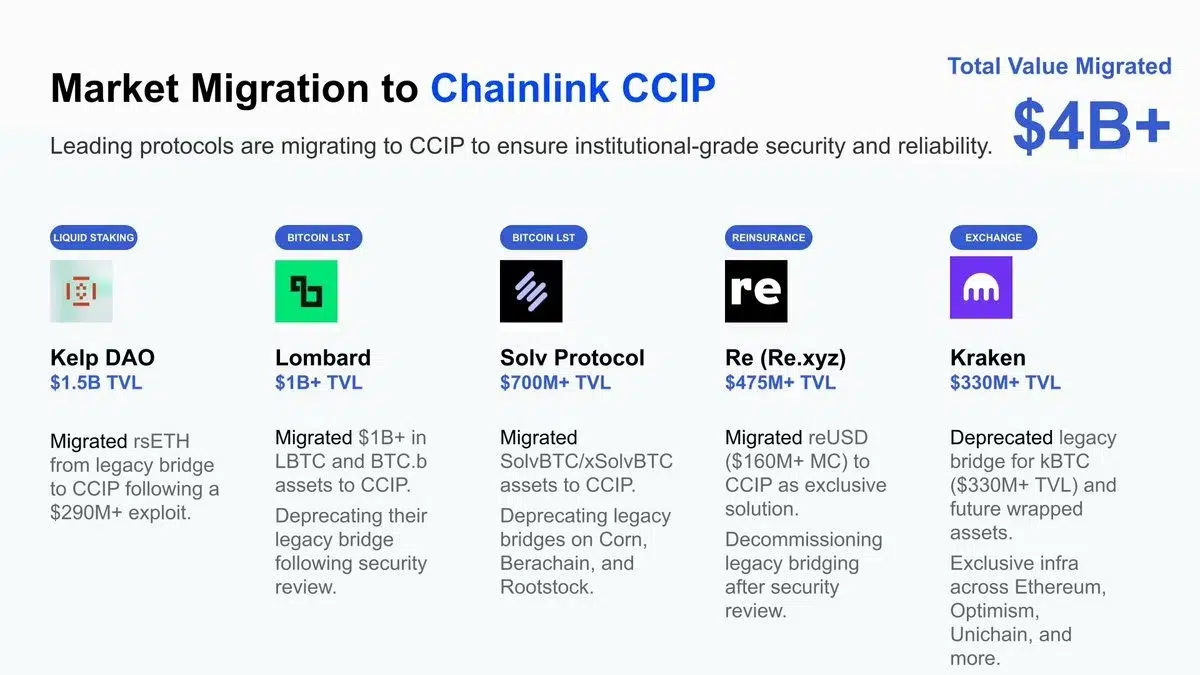
Chainlink now secures more than $110 billion in onchain value across cross chain tokens and DeFi markets, underlining how central the oracle network has become to the infrastructure of digital assets and tokenised finance.
Summary
- Chainlink reports $110 billion in Total Value Secured, with $60 billion in cross chain tokens over CCIP and $50 billion in DeFi data feeds
- The network has enabled $30.31 trillion in cumulative transaction value and published 19.39 billion verified messages onchain as of late May 2026
- Chainlink Reserve holds 3.78 million LINK worth about $37 million, funded by protocol revenue that links TVS growth to tokenomics
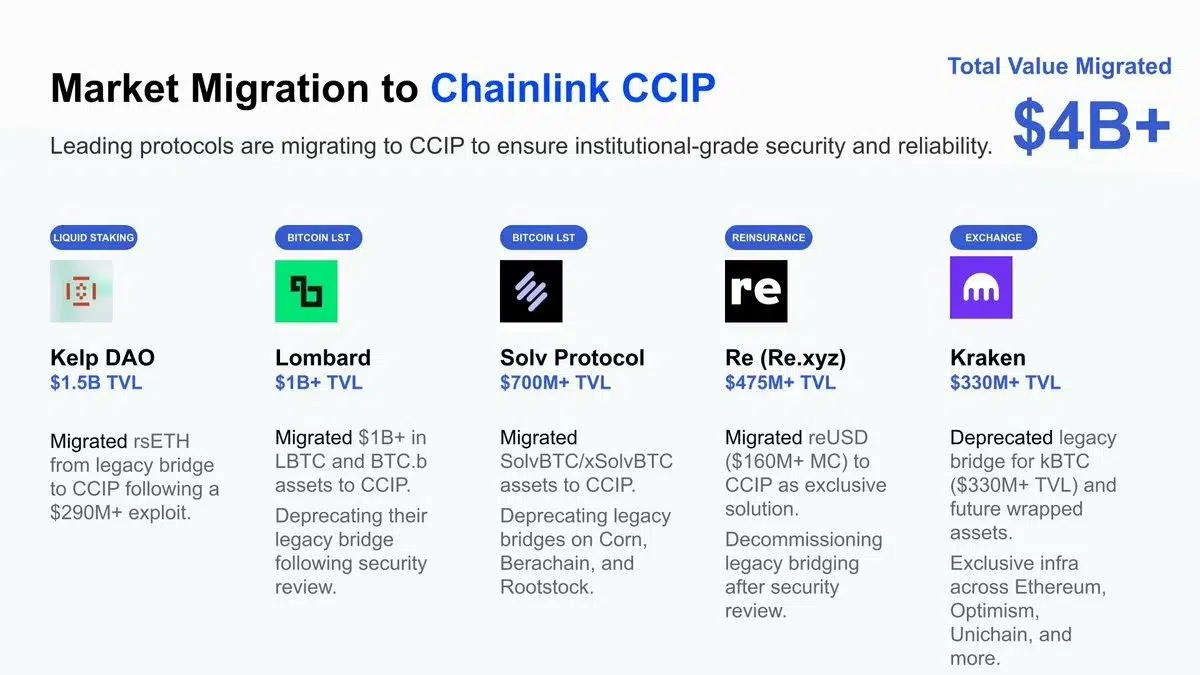
- Recent migrations from LayerZero to CCIP by Solv, Kraken and others have pushed more than $4 billion in assets onto Chainlink’s cross chain stack after a $292 million exploit
Chainlink (LINK) has pushed past $110 billion in Total Value Secured (TVS), marking a new record for the oracle network and underscoring how much of crypto’s plumbing now runs through its rails.
As of May 22, 2026, roughly $60 billion of that is tied to cross-chain tokens moving over Chainlink’s CCIP, while around $50 billion sits in DeFi data feeds that help price loans, derivatives, and stablecoins. In macro terms, that stack of value is now on par with the annual GDP of a mid-sized national economy.
Chainlink defines Total Value Secured as the dollar value of assets that rely on its services to function safely, rather than deposits locked inside its own contracts, which means TVS captures loans, derivatives, stablecoins and cross chain tokens that depend on its oracle and messaging infrastructure.
Chainlink’s own dashboard shows a narrower DeFi only view of $47.33 billion secured, which lines up with the second bucket in the headline number and underscores how much of the growth has come from cross chain flows.
Beyond the headline, Chainlink metrics show $30.31 trillion in cumulative transaction value enabled and 19.39 billion verified messages, a scale that covers everything from micro DeFi trades to institutional settlement and real world asset flows.
The public ecosystem directory lists 2,672 live integrations as of May 18 2026, ranging from consumer apps to capital markets infrastructure, with names like Swift, DTCC, Fidelity and UBS using Chainlink as a data and interoperability layer.
That footprint has kept Chainlink’s oracle market share in a band between 60 and 68 percent of category TVS over the past two years, according to several independent analyses.
How has Chainlink reached $110b in value secured
The financial side of the network shows the same expansion. The Chainlink Reserve, an onchain buffer funded by protocol revenue, holds 3.78 million LINK with a reported cost basis of $12.48 per token and an aggregate value near $37 million as of May 22 2026, after an inflow of more than 123,000 LINK on May 21 when the $110 billion milestone was confirmed.
Because the Reserve is topped up by fees from both onchain and offchain services, growth in value secured and growth in the Reserve tend to move together, linking adoption metrics to tokenomics for LINK holders.
For readers looking to track how this feeds into market structure across large cap assets, coverage of Bitcoin (BTC) pricing, Ethereum (ETH) staking and the broader perpetual futures complex is already available on crypto news, including explainers on how data feeds and cross margining shape risk in the sector.
The outstanding question for LINK investors is how much of the enterprise and cross chain activity converts into onchain fee accrual that can be captured through staking and token mechanics, versus revenue retained at the application or institutional layer, a debate that has now been running for at least two years in research from banks and specialist crypto desks.
As one research note from Galaxy framed it, Chainlink is “becoming the data and interoperability layer for onchain finance,” but valuation will ultimately depend on how aggressively that role is monetised at the token level.
Why is CCIP driving the latest surge and how does risk migrate
The fastest moving component of the $110 billion total is CCIP, which has accelerated sharply after bridge security failures pushed protocols to reconsider their cross chain stack.
A $292 million exploit at Kelp DAO’s LayerZero powered bridge in April triggered a visible migration, with projects controlling more than $3 billion in DeFi value shifting infrastructure toward Chainlink’s CCIP in the weeks that followed.
Solv Protocol moved around $700 million in tokenised Bitcoin on May 7, while Kraken announced that it would fully deprecate LayerZero and adopt CCIP as the exclusive cross chain layer for Kraken Wrapped Bitcoin and all future Kraken Wrapped Assets, a change that ultimately covers more than $4 billion in value.
CCIP already supports transfers across dozens of networks, with Coinbase using it for wrapped assets and Lido deploying it for wstETH routing, while cross chain tokens under the CCT standard now move across more than 60 chains.
That breadth matters for tokenised real world assets. BlackRock, JPMorgan and Fidelity have framed their onchain treasury, money market and commodity products as a step toward a more programmable capital market, but those instruments only function at scale if they have reliable price data and a way to move between chains without custom bridges for every deployment, a combination that makes Chainlink’s dual role as oracle and messaging layer strategically important.
Ondo Finance’s native token $ONDO has broken above $0.46 and is trading near $0.466 with a 24 hour gain above 15 percent, according to data from Gate.
Summary
- Gate shows $ONDO trading around $0.466 after briefly breaking $0.46, with its 24 hour move exceeding 15% on May 22
- The rally followed news that China’s securities regulator is cracking down on illegal cross border brokerage activity involving firms such as Tiger Brokers, Futu and Longbridge
- Traders are rotating into real world asset narratives and onchain United States stock exposure, where Ondo is a flagship RWA token backed by treasuries and other traditional instruments
- Ondo’s move comes against a backdrop of rising interest in tokenized yield products and RWA plays already tracked in crypto news coverage of RWA tokens and tokenized treasuries
Spot market shows ONDO (ONDO) testing the $0.46 level and printing around $0.466 in the latest session, putting the token more than 15% higher over 24 hours.
Why is Ondo price spiking above $0.46 today
The move stands out against recent ranges around $0.40, with Gate and other venues still showing a sub one dollar price profile while volumes deepen across centralized exchanges.
This latest leg higher coincided with headlines from Beijing. China’s Securities Regulatory Commission said it has penalized Tiger Brokers and Futu Securities International, along with Long Bridge Securities, for illegally offering mainland clients access to overseas markets without approval.
In a statement the CSRC said such “illegal cross border business operations have disrupted the market order and should be subjected to a heavy crackdown,” adding that it would continue to pursue overseas institutions that solicit mainland investors without authorization.
The regulator outlined a two year rectification period to phase out domestic services provided by those overseas brokers, while stressing that the “legitimate rights and interests of existing investors” and their assets would be safeguarded through coordination with foreign regulators.
That clampdown has pushed attention toward alternative channels for exposure to United States assets and dollar yield.
Chinese and regional traders have been watching the rise of tokenized treasuries, money market products and onchain representations of United States stocks, sectors where Ondo Finance has become one of the best known names.
Ondo’s core pitch is that it offers tokenized equivalents of low risk yield assets such as United States Treasury bonds and high grade money market funds, packaged in compliant structures that sit between traditional funds and public blockchains.
Ondo is a “quantitative financial product primarily issued in the form of a fund” that has attracted backing from major institutions, and has highlighted it as a flagship RWA token in educational material aimed at yield oriented crypto users.
Recent analysis at crypto.news has been tracking similar flows into real world asset tokens and stable yield products as investors look for onchain instruments that map directly to traditional securities.
In that context, a regulatory squeeze on unofficial cross border access to United States stocks and funds gives extra narrative fuel to tokens that package comparable exposures into blockchain native form.
How does China’s crackdown link to RWA and onchain US stocks
The CSRC’s latest statement fits into a longer effort to restrict unlicensed access routes to overseas securities.
Officials have reiterated that domestic investors should use formal channels such as Stock Connect, Qualified Domestic Institutional Investor schemes and Cross boundary Wealth Management Connect for foreign assets.
By tightening around brokerages like Tiger and Futu, Beijing is signaling it wants tighter control over how capital moves into offshore equities.
That in turn increases the appeal of structures that deliver economic exposure to foreign instruments without requiring a direct brokerage relationship, even if they sit in a regulatory grey zone for some investors.
Stablecoins and tokenized funds already serve that function in parts of Asia and Latin America.
Ondo sits inside that cluster of instruments as a token that wraps conventional yield bearing assets and brings them into venues like Gate, Bybit and others where crypto native traders can access them alongside coins such as Bitcoin (BTC) and Ethereum (ETH).
Against that backdrop, a double digit intraday gain from roughly $0.40 to $0.466 puts Ondo back in focus as a liquid proxy for RWA and tokenized yield sentiment.
The risk warning attached to local coverage remains straightforward, however, with venues reminding traders that concentrated narrative flows and regulatory headlines can accelerate both upside and drawdowns in niche tokens.


THORChain has faced criticism from crypto security researchers and investors after proposing to continue using its patched GG20 signing framework following a $10.7 million exploit tied to the system.
Summary
- THORChain faced criticism after proposing to retain its patched GG20 signing framework following a $10.7 million vault exploit.
- The protocol said automatic solvency checks halted cross-chain signing and trading within minutes, preventing additional losses after a malicious node operator reconstructed a private key.
- Separate reports from PeckShield linked a $1.3 million theft targeting THORChain co-founder JP Thor to a deepfake Zoom attack tied to rising North Korean-linked crypto hacks.
According to a post-mortem report released by THORChain on Wednesday, a malicious node operator exploited a flaw in the protocol’s GG20 threshold signature scheme and reconstructed a full private key linked to one of the network’s vaults.
The report said the exploit was made possible through “progressive key material leakage,” allowing the attacker to bypass the protections normally created by distributing signing authority across several node operators.
Within minutes of the breach, THORChain said its automatic solvency checks suspended signing and trading activity across multiple chains without requiring manual intervention. Node operators later coordinated through Discord to halt the network entirely and deploy a fix within roughly two hours.
While the protocol credited the safeguard systems for preventing additional losses, criticism emerged after governance proposal ADR-028 recommended keeping the GG20 threshold signature system in place with upgrades rather than replacing it outright.
Why are security researchers questioning the GG20 framework?
Concerns around the proposed recovery plan intensified after several crypto analysts publicly questioned the reliability of GG20-based infrastructure.
Pseudonymous crypto project analyst Bird wrote on X that the initial exploit suggested the signing stack may contain “a flaw in randomness generation or local signing isolation.” At the same time, Bird praised THORChain’s automated solvency protections for limiting the damage before more vaults could be drained.
More critical reactions followed from crypto investor JP, who argued on X that GG20 carries “many brittle assumptions” and described the framework as a “black box” that may remain difficult to secure even with repeated patches.
Under ADR-028, THORChain would first absorb losses through protocol-owned liquidity before distributing remaining losses across synth holders. The proposal also seeks to rebuild depleted liquidity reserves over time using a portion of protocol income rather than minting or selling additional THORChain tokens.
At the same time, THORChain said trading activity would remain paused until the vulnerability is fully fixed. The protocol also announced plans to slash the malicious validator node while shielding unrelated node operators that shared the compromised vault.
How does the attack fit into rising crypto security threats?
The exploit arrived as blockchain security firms continue tracking a rise in sophisticated attacks targeting crypto infrastructure and executives.
Data from DefiLlama shows crypto exploits resulted in more than $634 million in losses during April alone. Earlier this year, blockchain investigator ZachXBT was among the first to flag the THORChain exploit before the protocol publicly halted trading and signing operations.
Separately, blockchain security firm PeckShield recently disclosed that THORChain co-founder JP Thor lost roughly $1.3 million in a separate attack linked to a compromised Telegram account and a deepfake Zoom call.
In a detailed post shared on X, JP Thor said the attackers used a fake video feed impersonating a friend before triggering a malicious script that copied files from his iCloud documents folder.
He added that his MetaMask wallet, which was connected to an inactive Chrome profile and stored through iCloud Keychain, was drained without warning prompts or admin approval requests.
Security researchers have linked similar attacks this year to North Korean hacking groups that increasingly rely on deepfake video calls, malware, fake job offers, and social engineering campaigns targeting crypto executives and developer networks.
Earlier this year, blockchain analytics firm TRM and law enforcement agencies attributed the $1.5 billion Bybit theft to North Korea-linked actors.
US one year inflation expectations have climbed to 4.8% for May, a reminder that the inflation story is not over and a fresh stress test for the idea that Bitcoin and crypto function as hedges against persistent price pressure.
Summary
- May one year US inflation expectation at 4.8%, up from a 4.5% preliminary reading and 4.7% previously
- Market research from Bitwise and others shows Bitcoin has become more correlated with inflation expectations since 2020, but not in a simple hedge like way
- Studies and market analysis suggest Bitcoin behaves more like a high beta risk asset than a reliable inflation shield, even as it soaks up “monetary debasement” narratives
The final value of the US one year inflation rate expectation for May rose to 4.8%, up from a preliminary 4.5% print and edging higher from a prior 4.7%, leaving many questions what it means for Bitcoin (BTC), much less the broader crypto market.
According to a report in Reuters published on May 22, 2026, “consumer expectations for inflation over the next year rose to 4.8% from 4.7% in April. Consumers’ expectations for inflation over the next five years shot up to 3.9% from 3.5% last month.”
“The cost of living continues to be a first-order concern, with 57% of consumers spontaneously mentioning that high prices were eroding their personal finances, up from 50% last month,” said Joanne Hsu, the director of the Surveys of Consumers. “Independents and Republicans saw decreases in sentiment, with both groups reaching their lowest readings of the current presidential administration.”
Why 4.8% inflation expectations matter for Bitcoin and risk assets
That kind of move may sound incremental, but it signals that households and traders increasingly doubt inflation will glide back to the Federal Reserve two percent target any time soon.
Other gauges tell a parallel story. The St Louis Fed five year breakeven inflation rate, based on Treasury inflation protected securities, has remained above 2.3% into late May, while strategists at the Peterson Institute warn that tariff regimes, fiscal deficits near 7% of GDP and labor market constraints keep “the risk of higher US inflation materially elevated in 2026.”
That is the macro environment in which Bitcoin and the broader crypto complex now trade. The asset is no longer a fringe curiosity but a large cap monetary instrument with a market value in the hundreds of billions, widely referenced in institutional outlooks and tracked in crypto.news macro coverage.
One tempting conclusion is that higher inflation expectations should automatically boost Bitcoin and major tokens such as Bitcoin itself and Ethereum, as investors search for assets that are insulated from central bank money printing. The reality is more complicated.
Is Bitcoin actually an inflation hedge or just a macro trade
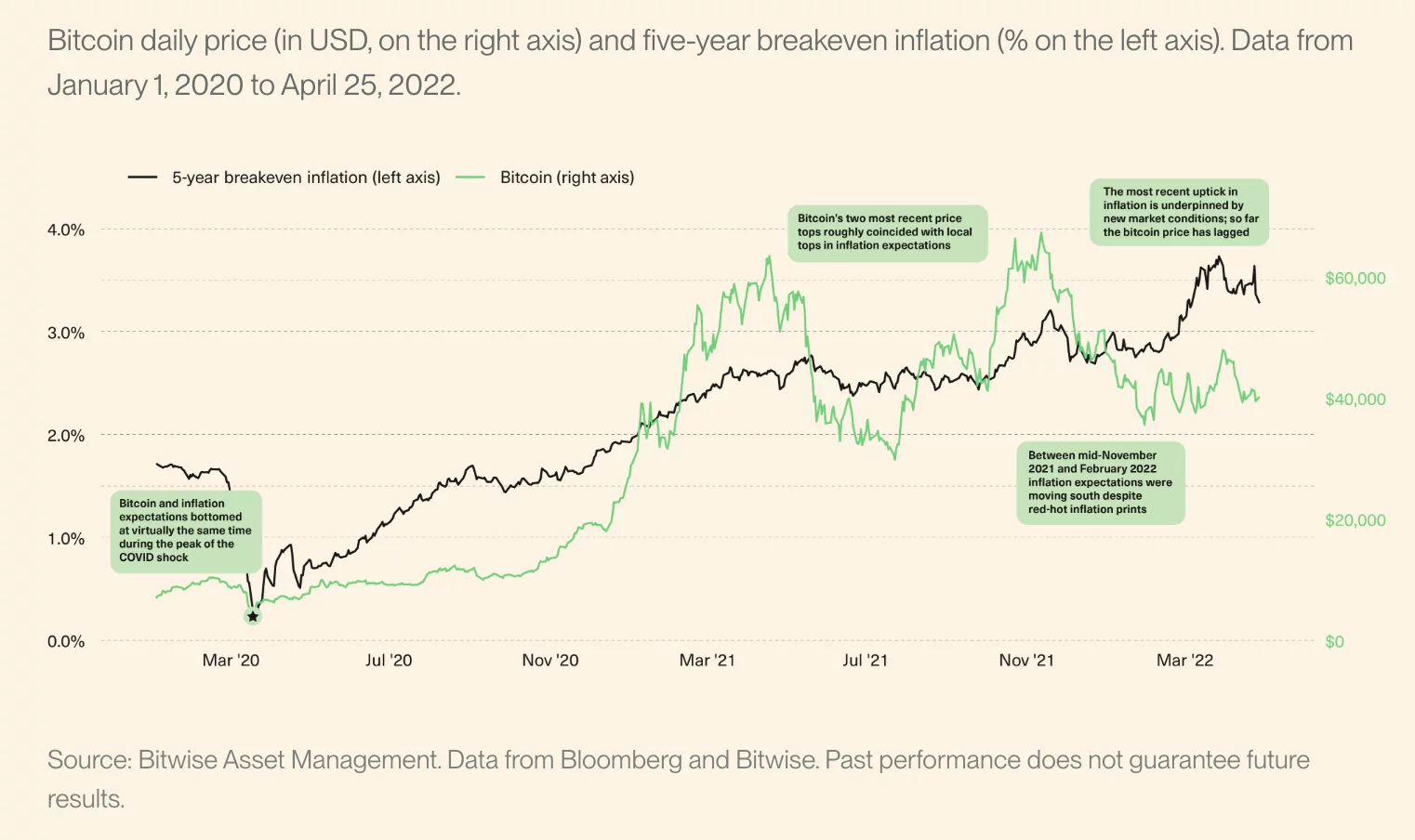
A widely cited Bitwise Investments research note argues that since 2020, Bitcoin has shifted from being “the asset least correlated with the market’s inflation expectations to the asset that is most correlated with that factor,” particularly as breakeven inflation rates moved higher after the Covid shock.
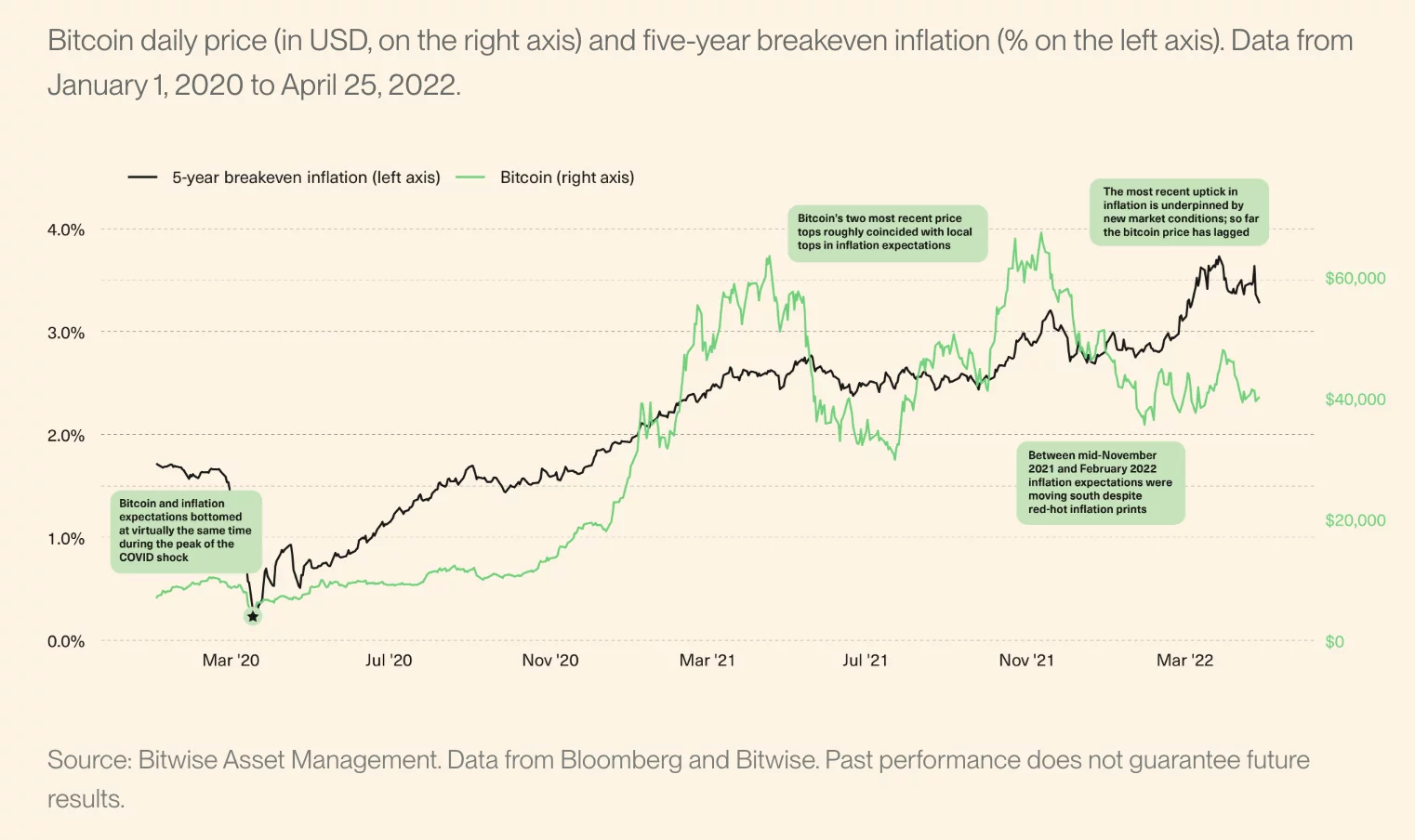
The same analysis points out that Bitcoin bottomed at roughly the same time inflation expectations did in March 2020, and that local peaks in inflation expectations around April and November 2021 lined up with major Bitcoin tops, suggesting investors increasingly treat it as an “emerging monetary asset and hedge against inflation expectations.”
Yet correlation is not protection. A 2023 study summarized by PortfolioPilot bluntly concludes that “Bitcoin has not reliably protected wealth during inflationary periods,” finding that Bitcoin prices often decline in response to surprise inflation spikes as markets price in faster Fed tightening, a pattern more consistent with high beta tech stocks than with classic hedges like gold.
In that sense, Bitcoin lives at the intersection of two forces. On one side, there is the narrative hedge against debasement that attracts capital whenever inflation expectations drift toward levels like the current 4.8%; on the other, there is the brutal math of higher real yields and tighter liquidity that can crush leveraged positions, as covered in past crypto.news reporting on BTC liquidation bands and exchange heat maps.
Historical price action underlines this tension. During the 2021 to 2022 inflation spike, headline US CPI ran above 7% year on year for several months, even as Bitcoin plunged from near $69,000 to under $20,000, a drawdown driven less by inflation itself than by the fastest series of Fed rate hikes in four decades, cascading liquidations and failures like Terra and FTX, events dissected in earlier crypto.news market structure pieces.
The move in expectations to 4.8% today sits in that ambiguous space.
If investors believe inflation will stay hot while central banks remain constrained or slow to hike, the narrative case for Bitcoin and large caps such as Ethereum and other majors tracked on crypto.news can strengthen, especially as younger cohorts who already hold crypto see it as a hedge against long term currency debasement.
But if the jump in expectations is read as a trigger for more hawkish policy, traders may again treat Bitcoin less like a digital version of gold and more like a leveraged macro proxy that sells off when the cost of capital rises.
That is the core risk warning implied by a 4.8% one year expectation print for May: crypto is now deeply wired into the inflation trade, but its role is still contested and its behavior under stress looks more like a volatile derivative of the macro cycle than a safe harbor from it.
US stocks added roughly $400 billion in value at Friday’s open as traders piled into risk assets on unconfirmed reports that Qatar is helping broker a US Iran peace deal in Tehran.
Summary
- Around $400 billion in US equity market cap was added at the open on Iran peace hopes
- Reports suggest Qatari envoys are working with US officials on talks in Tehran
- Traders frame the move as rapid “risk repricing” rather than a shift in fundamentals
Roughly $400 billion in paper value was added to US stocks at the open as investors responded to headlines that Qatar had sent a negotiating team to Tehran alongside US officials to pursue a peace agreement with Iran.
The X account Ash Crypto captured the move in real time, writing that “$400,000,000,000 has been added to US stocks as the market opens” and tying it directly to “Qatar reportedly” dispatching envoys to join US officials in Iran.
Market participants on X framed the spike as a textbook response to even a hint of geopolitical de escalation rather than a shift in corporate earnings.
User US Stock Market Data Expert called it bluntly, saying “$400 BILLION added to US market cap at the open purely on rumors of a Qatar brokered US Iran peace deal? That’s not fundamentals that’s pure risk repricing at lightspeed.”
The move comes after months of markets trading almost tick for tick with headlines out of the Gulf, as ceasefire talks and threats over the Strait of Hormuz have whipsawed both oil and risk assets.
Is Qatar really leading US Iran peace efforts in Tehran?
Despite the viral framing of a “Qatar brokered” breakthrough, some regional analysts pushed back on that narrative and stressed that Doha is part of a wider mediation track centered on Pakistan.
In a widely shared reply, research outfit Caeris Lab argued that “the mediator’s pakistan, not qatar sharif and naqvi did the tehran shuttle, qatar’s a supporting act,” and added crucial context for the equity move, noting “the $400B is just ~0.6% of a $60T market on iran deal hopes.”
That 0.6 percent figure underscores how quickly global portfolios can swing when traders decide that war odds have shifted, especially after weeks in which US Iran tensions over Hormuz blockades and missile strikes repeatedly jolted both Bitcoin (BTC), oil and equities.
Why did $400B flood into US stocks on Iran deal rumors?
President Donald Trump has been dangling the prospect of a “definitive” peace deal for weeks and previously agreed to a two week ceasefire that sent Bitcoin back above $70,000 and pushed US stock futures sharply higher, as covered in earlier crypto market outlook and ceasefire reports.
Now, reports of Qatari involvement in Tehran talks add another layer to that diplomatic track, following earlier coverage that Pakistan has been shuttling messages and hosting face to face rounds between US and Iranian negotiators.
For crypto markets, every incremental sign of de escalation has repeatedly acted as a macro catalyst, with prior US Iran ceasefire headlines coinciding with multi percent intraday swings in Bitcoin, Ethereum and broader digital assets.
Still, some observers urged caution, with one X user warning that the latest surge looked like “merely paper liquidity” and “just a one day joyride for the Wall Street bulls,” highlighting how quickly those hundreds of billions in added market cap can evaporate if talks stall again.


Tetra Digital Group’s CADD, Canada’s first regulated Canadian dollar stablecoin issued by a financial institution, can now be custodied by Anchorage Digital for institutional clients.
Summary
- Anchorage Digital will provide regulated custody for CADD to institutional investors
- CADD is backed 1:1 by Canadian dollars held at a licensed Canadian trust company
- The stablecoin is approved by Alberta regulators and designed for on chain CAD settlement
As of May 22, institutions can now hold CADD through Anchorage Digital, a federally chartered crypto bank and qualified custodian that offers regulated digital asset infrastructure to banks, fintechs and asset managers.
How does CADD’s Anchorage custody change institutional access?
In its post, Tetra Digital Group said “institutions can now custody CADD with Anchorage Digital,” describing Anchorage as “a federally chartered crypto bank and qualified custodian providing regulated digital asset custody infrastructure for institutional clients.”
Anchorage Digital Bank, which operates under a national trust charter in the United States, pitches itself as “the first federally chartered crypto bank” and emphasizes services like custody, settlement and staking for institutional counterparties.
For CADD, this gives asset managers, corporates and treasury desks a way to hold the Canadian dollar stablecoin within existing institutional workflows instead of relying on retail oriented exchanges or self custody.
By design, each CADD token is backed 1:1 by Canadian dollars held in trust at Tetra Trust Company, a licensed Canadian trust company that obtained regulatory approval from Alberta Treasury Board and Finance to issue the payment stablecoin via its agent CAD Digital Inc.
According to a Business Wire launch release, “CADD is Canada’s only stablecoin issued through a Canadian financial institution, bringing CAD settlement on chain under full regulatory oversight,” with reserves held in cash and cash equivalents at Canadian financial institutions.
That structure aligns with Ottawa’s emerging stablecoin framework, which is moving toward mandatory 1:1 high quality liquid asset reserves, at par redemption and the use of qualified custodians for fiat backed tokens.
Why CADD matters for Canadian stablecoin regulation and crypto rails
Tetra Digital Group has framed CADD as the first payment stablecoin in Canada that is both backed 1:1 by Canadian dollars and issued by a regulated financial institution, differentiating it from earlier CAD tokens that operated outside provincial prudential regimes.
The company said regulatory approval from Alberta Treasury Board and Finance “marks a national first for digital asset infrastructure in Canada” by allowing Canadian dollars to move on blockchain rails “under a financial services regulatory framework.”
According to BNN Bloomberg, CADD is positioned as “the first regulated stablecoin issued by a financial institution” in the country, with one CADD designed to always equal one Canadian dollar, targeting use cases like domestic payments, treasury and cross border transfers.
Tetra Digital Group has already launched CADD on Ethereum, Base and Tempo, with plans to expand to Solana, giving developers and institutions multiple layer one and layer two environments for Canadian dollar settlement.
This comes as Canada finalizes a federal stablecoin regime that will require fiat backed issuers to register with the Bank of Canada, maintain 1:1 reserves and separate customer assets from their own balance sheets, while banning yield on stablecoin holdings.
For Anchorage Digital, adding CADD expands a custody lineup that has seen rising institutional demand in recent years, with the firm previously reporting an 80 percent quarterly increase in assets under custody as investors sought safer venues after a series of crypto insolvencies.
In a LinkedIn update, Tetra Digital Group stressed that CADD is “structured as a payment stablecoin” and “Canada’s first regulated stablecoin to be structured as a payment instrument issued by a financial institution,” underscoring its ambition to serve as compliant digital cash for the Canadian financial system.


Senator Cynthia Lummis says the CLARITY Act is designed to end the regulatory ambiguity that has dogged American crypto consumers and the digital asset industry for years by clearly defining how tokens and market participants are treated under United States law.
Summary
- Lummis says the CLARITY Act will end regulatory ambiguity for U.S. crypto users and firms
- The bill seeks to define the legal status of digital assets and clarify agency oversight
- Lummis warns that further delays risk pushing American crypto innovation overseas
- The legislation has attracted bipartisan backing as Congress debates market structure rules
The CLARITY Act, formally framed as the Cryptoassets Legal Clarity and Regulatory Improvement Act, aims to give a single, durable framework for how digital assets, developers, exchanges and other intermediaries are regulated in the United States. Senator Cynthia Lummis has argued that this structure will “end the regulatory ambiguity” faced by American crypto consumers and industry participants by spelling out when a token is treated as a security, when it is a commodity and which agencies are in charge of enforcement.
How will the CLARITY Act change U.S. crypto rules
Lummis, who chairs the Senate Banking Subcommittee on Digital Assets, has spent the past year positioning the CLARITY Act as the foundation of future U.S. crypto market structure, and has said she expects it to become the “ultimate” framework for bringing the sector into the existing financial regulatory perimeter. In an earlier interview, she said that “legislation should clearly define the legal status of digital assets, regulation should be modernized and regulation should protect those who buy or trade digital assets,” drawing a direct line between consumer protection and giving developers and exchanges predictable rules to follow.
According to a recent report from Bloomberg, the Senate Banking Committee voted last week to advance the CLARITY Act after months of negotiations, a procedural step that moves the bill closer to a floor vote and sends a signal that Congress is finally ready to legislate on crypto after years of agency infighting. In parallel, Lummis wrote on X that the push for the CLARITY Act has secured bipartisan backing, stressing that Democrats and Republicans now see a shared interest in keeping digital asset innovation and jobs inside the United States rather than allowing activity to drift to friendlier jurisdictions.
Why is Lummis pushing for urgency now
The Wyoming Republican has repeatedly warned that every delay in passing a comprehensive crypto framework is another day that American firms consider leaving the country for more predictable regimes in Europe, the Middle East or Asia. “Every day we delay the Clarity Act is a day American companies consider building their future somewhere else,” Lummis said in a recent post, arguing that clear rules can both protect investors and unlock fresh capital formation at home.
Supporters of the CLARITY Act say the bill would give businesses the legal certainty they have been demanding, allowing them to know how tokens are classified, what disclosures are required and which agencies they will answer to, from the Securities and Exchange Commission to the Commodity Futures Trading Commission and banking regulators. Industry advocates argue that this clarity would make it easier to launch new tokenized products for both retail and institutional investors, bring more trading activity onshore and support a more competitive U.S. position in the global race to build crypto and blockchain infrastructure.
Lummis has also emphasized that the legislation must strike a balance between protecting developers and empowering law enforcement, insisting in a recent update that she is “committed to keeping protections for non money transmitting developers safe without tying law enforcement’s hands to hold bad actors accountable.” In practice, that means shielding open source software creators from liability when third parties misuse code, while ensuring that those directly involved in moving criminal funds on chain can still be pursued aggressively by prosecutors.
The CLARITY Act still needs to clear further hurdles, including a full Senate vote, reconciliation with any House language and a presidential signature, before it can become law. For now, Lummis is betting that a combination of bipartisan concern about consumer harm, frustration with regulation by enforcement and a desire to keep the United States competitive will be enough to finally push comprehensive crypto legislation over the finish line and deliver the clear rules she says Americans have been waiting for.


Strive’s Bitcoin linked preferred stock SATA is emerging as a key credit market instrument while its common equity ASST gains traction in public markets, reshaping how institutions finance large Bitcoin treasuries through yield bearing securities rather than straight spot purchases.
Summary
- Michael Saylor highlights SATA and ASST as the “most interesting story” in Bitcoin capital markets
- Strive uses SATA proceeds to buy thousands of BTC while paying double digit yield
- Strategy’s STRC preferreds have funded roughly $1 billion in recent Bitcoin purchases
- New Bitcoin backed preferred structures are reshaping corporate capital stacks and investor access
In a post on X, MicroStrategy executive chairman Michael Saylor wrote that “the most interesting story in Bitcoin (BTC) right now is the rise of $SATA in the credit markets and the embrace of $ASST by the equity capital markets,” pointing squarely at Strive’s Bitcoin treasury strategy as a bellwether for the next stage of institutional adoption.
SATA is Strive’s perpetual preferred equity that pays a high fixed yield funded by a growing Bitcoin balance sheet, while ASST is the firm’s Nasdaq listed common stock that has effectively become a publicly traded wrapper around an expanding BTC treasury.
Strive disclosed in a March update that it had increased the SATA dividend rate by 25 basis points to 12.75 percent annually, declaring a quarterly payout of $1.0625 per share and extending its dividend reserve to 18 months, backed by a mix of cash, cash equivalents and Strategy’s STRC preferreds.
How are SATA and ASST changing Bitcoin finance
Those enhancements came on top of an earlier move where Strive allocated $50 million of its own corporate treasury into STRC, underscoring how the firm sits at the junction of Bitcoin denominated credit and equity structures that increasingly fund BTC accumulation without issuing traditional debt.
According to a recent report, Strive has accumulated roughly 13,741 BTC after buying an additional 113 BTC for about $7.75 million at an average price near $68,577 per coin, placing it as the ninth largest corporate Bitcoin holder with a treasury valued at approximately $950 million at early April prices.
At the same time, the firm’s capital stack relies heavily on SATA issuance above the $100 par level, a price point that unlocks at the market programs and allows Strive to sell more preferred shares into demand from income seeking investors while funneling proceeds into further BTC purchases.
Why Saylor calls SATA and ASST the key Bitcoin story
Saylor’s praise reflects a broader shift in how Bitcoin exposure is packaged, with MicroStrategy’s own Stretch preferred stock STRC already surpassing $10 billion outstanding and financing multi billion dollar BTC acquisitions through perpetual, yield bearing securities rather than dilutive equity raises or conventional bonds.
One recent filing shows Strategy bought 13,927 BTC for approximately $1 billion funded entirely through STRC sales, lifting its corporate Bitcoin stash to nearly 781,000 BTC without issuing new common shares, a pattern that underscores how preferred stock has become a primary driver of incremental BTC demand.
Research from NYDIG argues that STRC and SATA “represent a new category of bitcoin linked financing” defined less by traditional cash flow based credit metrics and more by asset coverage, market confidence and continued access to capital markets, a structure that can amplify buying when securities trade near par but also stall issuance if sentiment turns.
Strive’s own messaging frames Bitcoin as “the most secure, transparent, and resilient reserve asset available to corporations today,” positioning SATA as a way to transform that reserve into double digit yield for investors while ASST becomes a liquid equity claim on a leveraged BTC balance sheet.
In the background, market data shows preferred issuance has already funded more than 2,500 BTC in incremental demand via STRC alone over a short window, equivalent to several days of new mining supply, while Strive’s SATA IPO raised roughly $149.3 million that was largely recycled into additional BTC purchases.
That reflexive loop between high coupon preferreds like SATA, specialized instruments such as STRC and equity capital via ASST is exactly what Saylor is pointing to as “the most interesting story” in Bitcoin today, because it turns BTC from a simple buy and hold asset into the core collateral for a growing multi layer credit and equity ecosystem.
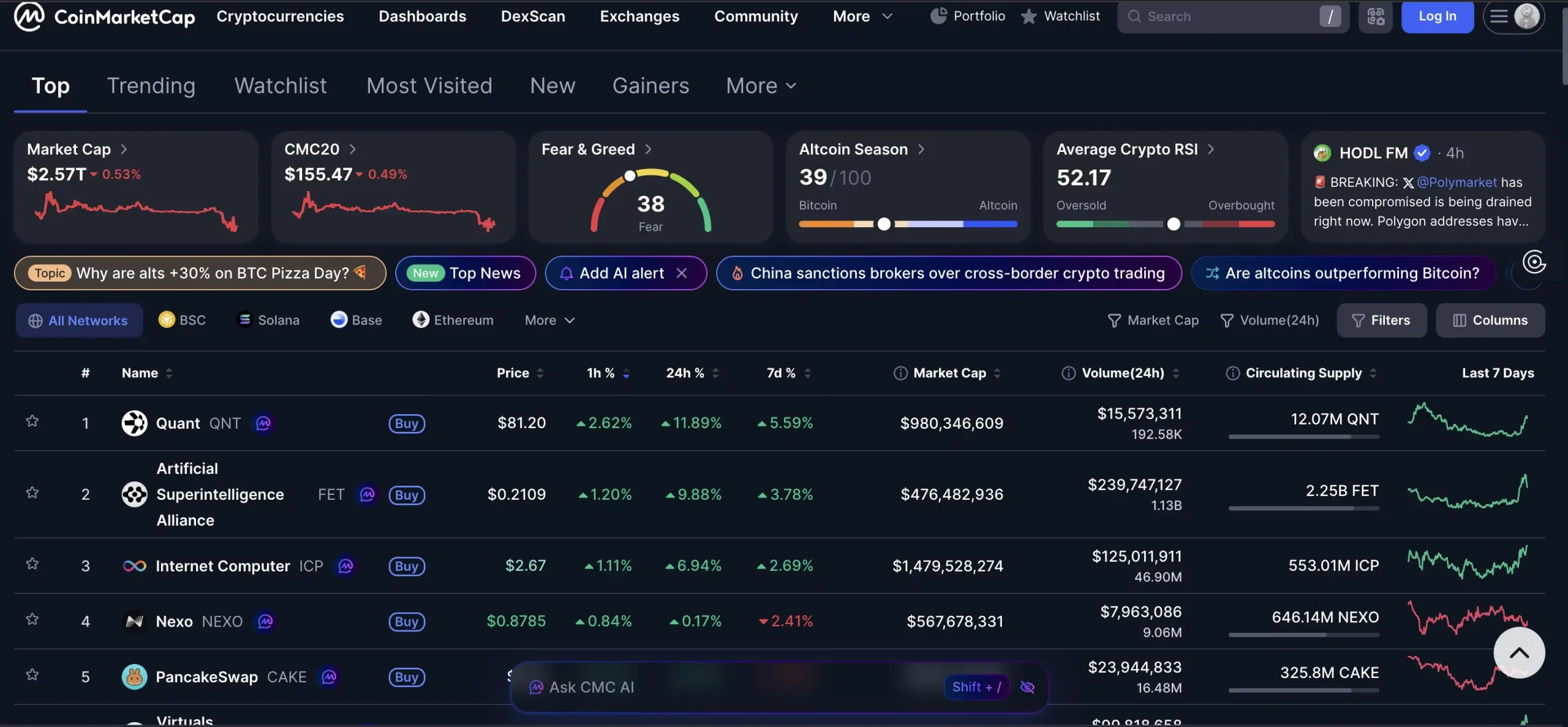
NEAR Protocol has surged more than 21% in 24 hours to top the day’s major crypto market gainers, while edgeX slipped nearly 8 among the top 100 assets by market capitalization.
Summary
- NEAR Protocol climbed 21.14 to 2.20
- Worldcoin, FET, Quant and Celestia also posted strong daily gains
- edgeX dropped 7.76, underperforming other large cap tokens
- AI and interoperability narratives resurfaced despite broader market churn
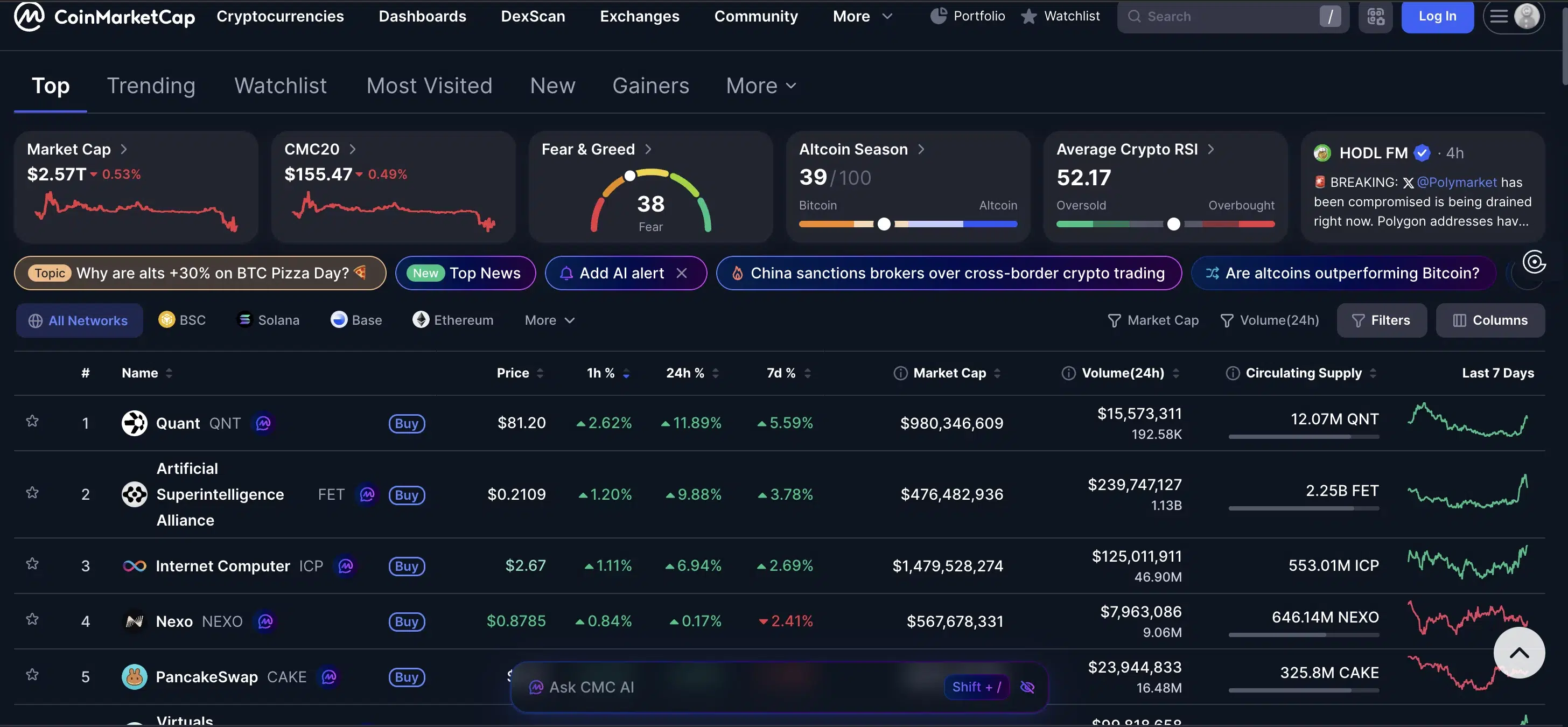
According to CoinMarketCap’s gainers and losers dashboard, NEAR Protocol (NEAR) topped the day’s performance table among the top 100 cryptocurrencies by market capitalization, rising 21.14% in the last 24 hours to trade around 2.20. The move extended a broader upswing for the layer 1 network, which markets itself as a high performance, AI native execution layer designed to support intelligent agents and decentralized applications.
Why are NEAR and AI tokens leading today
CoinMarketCap data shows that Worldcoin’s (WLD) token followed as the second best performer, gaining 12.39 to about 0.2947, while Artificial Superintelligence Alliance’s (FET)token advanced 9.05 to 0.2105 over the same period. Both tokens sit at the intersection of identity or AI infrastructure and crypto, underscoring how speculative capital continues to cluster around artificial intelligence narratives even as many large caps trade sideways.
Quant’s QNT token also broke higher, adding 8.76% on the day to roughly 79.28, while modular data availability project Celestia’s TIA climbed 8.74 to around 0.445. These gains come after periods of heavy drawdowns for both projects, with earlier analysis noting that TIA had suffered double digit intraday declines in January as emissions and weak demand weighed on price, and QNT remained well below its all time high above 400.
What is driving the divergence with edgeX
While major AI and infrastructure tokens pushed higher, edgeX was among the notable laggards in the same top 100 basket, falling 7.76 on the session. Data from market trackers shows edgeX currently trades around the 1.20 to 1.50 range with a market capitalization above 500 million and a 24 hour trading volume in the high tens of millions, making its daily slide stand out against rising liquidity.
edgeX underperformance comes even as the decentralized exchange promotes a high performance model for perpetual and spot trading across multiple chains, with full self custody and no centralized order book. The pullback suggests profit taking or rotation away from DEX tokens, at least for the day, as traders reprice tokens tied more explicitly to AI infrastructure and cross chain interoperability narratives.
For NEAR, the day’s move fits into a longer repositioning of the project as a platform for the “agentic future,” with the team describing the network as an execution layer built for AI native applications, where agents can own assets, make decisions and transact across networks. In a recent explainer, the NEAR team wrote that the protocol is “a modular, high speed protocol designed for AI to act on behalf of users,” emphasizing that the blockchain serves as the trusted backend for identity, data and settlement while AI handles user facing intent.
Worldcoin’s rally comes against the backdrop of a controversial tokenomics overhaul, after the project co founded by OpenAI chief executive Sam Altman announced that it will slash its daily token unlock rate by 43 from July 24, reducing combined emissions from roughly 5.1 million WLD per day to about 2.9 million. “On July 24 2026, the unlock rate for all token allocations will automatically decrease,” the team said, arguing that lower issuance could improve the token’s long term supply demand profile even as the project continues to face regulatory scrutiny over its biometric data collection model.
FET’s gains also follow renewed attention on the Artificial Superintelligence Alliance, the umbrella entity created in 2024 when Fetch.ai, SingularityNET and Ocean Protocol merged to build open, decentralized AI infrastructure. The alliance describes itself as “the largest open source, independent entity in Artificial General Intelligence research and infrastructure,” with FET now the single asset powering the new ecosystem after it replaced the individual tokens used by the three projects prior to the merger.
Across these moves, the day’s tape sends a clear signal about where speculative attention is rotating inside the top 100. Tokens aligned with AI, identity and interoperability themes are attracting fresh flows, while at least one high profile DEX token has slipped, leaving edgeX bulls to decide whether today’s drop represents a short term setback or the start of a more sustained repricing.

HBO’s ‘Band of Brothers’ Has One Episode That’s Almost Impossible To Rewatch 24 Years Later

Three MLB Futures Worth Betting Before the Odds Disappear

Roast Catalan chicken with honey and cumin recipe


-

 Fashion8 hours ago
Holiday Weekend Open Thread – Corporette.com
-

 Crypto World1 day ago
Blockchain.com files with SEC for U.S. IPO
-

 Fashion6 days ago
On the Scene at Gucci’s Cruise Show in New York City: Mariah Carey, Kim Kardashian, Lindsay Lohan, Iman, and More!
-

 Politics7 days ago
Watch: far-right flag-fanatics run over victim, attack locals – Setup By the Left wing for your entertainment
-

 Fashion7 days ago
Trending Western Style Vests Perfect for Summer
-
 Crypto World6 days ago
Intesa Sanpaolo’s crypto holdings jump to $235M as XRP enters
-

 Fashion6 days ago
Amazon Sundays: Memorial Day Hosting
-

 Entertainment6 days ago
Off Campus Easter Eggs Explained: Characters, Stories, More
-
Business6 days ago
Australia defends property tax changes designed to fix ‘broken’ housing
-
 Crypto World4 days ago
Revolut Launches Dogecoin Debit Card Across UK and EU
-

 Politics7 days ago
Anti-Zionists attacked in Jerusalem as ethnofascists chant race-hate
-

 Tech1 day ago
WhatsApp ads could make Irish debut after discussions with DPC
-

 Sports1 day ago
2026 CJ Cup Byron Nelson leaderboard: Brooks Koepka finds putting stroke in Round 1
-

 Business7 days ago
Tracking Berkshire Hathaway Portfolio – Q1 2026 Update
-
Politics6 days ago
Wings Over Scotland | The Land Of No Laws
-
 NewsBeat2 days ago
Charity run by Reform leader Malcolm Offord accused of ‘law breaking’ over Scottish registration
-

 Politics6 days ago
Cassidy defiant as Trump's revenge campaign closes in
-

 Business6 days ago
Equinor ASA (EQNR) Shareholder/Analyst Call Prepared Remarks Transcript
-

 Crypto World20 hours ago
Trump Media’s Bitcoin Stash Shrinks Again as 2,650 BTC Lands on Crypto.com
-

 Business7 days ago
Week Ahead: Rising U.S. Rates Underpin Greenback
You must be logged in to post a comment Login