

Crypto World
Iran peace rumors add $400B to US stocks at open

US stocks added roughly $400 billion in value at Friday’s open as traders piled into risk assets on unconfirmed reports that Qatar is helping broker a US Iran peace deal in Tehran.
Summary
- Around $400 billion in US equity market cap was added at the open on Iran peace hopes
- Reports suggest Qatari envoys are working with US officials on talks in Tehran
- Traders frame the move as rapid “risk repricing” rather than a shift in fundamentals
Roughly $400 billion in paper value was added to US stocks at the open as investors responded to headlines that Qatar had sent a negotiating team to Tehran alongside US officials to pursue a peace agreement with Iran.
The X account Ash Crypto captured the move in real time, writing that “$400,000,000,000 has been added to US stocks as the market opens” and tying it directly to “Qatar reportedly” dispatching envoys to join US officials in Iran.
Market participants on X framed the spike as a textbook response to even a hint of geopolitical de escalation rather than a shift in corporate earnings.
User US Stock Market Data Expert called it bluntly, saying “$400 BILLION added to US market cap at the open purely on rumors of a Qatar brokered US Iran peace deal? That’s not fundamentals that’s pure risk repricing at lightspeed.”
The move comes after months of markets trading almost tick for tick with headlines out of the Gulf, as ceasefire talks and threats over the Strait of Hormuz have whipsawed both oil and risk assets.
Is Qatar really leading US Iran peace efforts in Tehran?
Despite the viral framing of a “Qatar brokered” breakthrough, some regional analysts pushed back on that narrative and stressed that Doha is part of a wider mediation track centered on Pakistan.
In a widely shared reply, research outfit Caeris Lab argued that “the mediator’s pakistan, not qatar sharif and naqvi did the tehran shuttle, qatar’s a supporting act,” and added crucial context for the equity move, noting “the $400B is just ~0.6% of a $60T market on iran deal hopes.”
That 0.6 percent figure underscores how quickly global portfolios can swing when traders decide that war odds have shifted, especially after weeks in which US Iran tensions over Hormuz blockades and missile strikes repeatedly jolted both Bitcoin (BTC), oil and equities.
Why did $400B flood into US stocks on Iran deal rumors?
President Donald Trump has been dangling the prospect of a “definitive” peace deal for weeks and previously agreed to a two week ceasefire that sent Bitcoin back above $70,000 and pushed US stock futures sharply higher, as covered in earlier crypto market outlook and ceasefire reports.
Now, reports of Qatari involvement in Tehran talks add another layer to that diplomatic track, following earlier coverage that Pakistan has been shuttling messages and hosting face to face rounds between US and Iranian negotiators.
For crypto markets, every incremental sign of de escalation has repeatedly acted as a macro catalyst, with prior US Iran ceasefire headlines coinciding with multi percent intraday swings in Bitcoin, Ethereum and broader digital assets.
Still, some observers urged caution, with one X user warning that the latest surge looked like “merely paper liquidity” and “just a one day joyride for the Wall Street bulls,” highlighting how quickly those hundreds of billions in added market cap can evaporate if talks stall again.



Buying your first crypto is simpler than the jargon makes it sound. This guide walks through every step, from choosing an exchange to securing what you bought, and the mistakes that cost beginners money along the way.
Summary
- Buying cryptocurrency typically involves choosing an exchange, verifying your identity, funding an account, and placing a buy order using regular currency.
- Market orders allow users to buy crypto immediately at the current price, while limit orders let buyers set a preferred purchase price.
- Security measures such as two-factor authentication and careful storage choices are presented as essential parts of the buying process.
Buying cryptocurrency for the first time feels intimidating, but the process is more straightforward than the acronyms and the noise suggest. At its core, buying crypto means opening an account on a platform that sells it, funding that account with regular money, placing an order for the crypto you want, and then deciding where to keep it.
Millions of ordinary people have done it, and you do not need a finance degree or any technical knowledge to do it safely. What you do need is to understand each step well enough to avoid the handful of mistakes that cost beginners money, and that is exactly what this guide provides.
This is a complete walkthrough for 2026: how to choose the right platform, how to set up and secure your account, how to fund it, how to actually place a buy order and the difference between the order types, how to store what you bought, and how to avoid the common traps.
It does not tell you what to buy or promise any returns, because no honest guide can, and crypto is volatile enough that you should only ever commit money you can afford to lose. What it does is give you the knowledge to make your own decisions and execute them without trusting strangers on the internet, which is the single most valuable thing a beginner can have.
Before you buy: a few things to settle first
A little preparation prevents most beginner mistakes, so it is worth settling a few things before you put any money in.
The first is the amount. The right starting amount is whatever you are completely comfortable losing, because the possibility of loss is real and crypto can fall sharply and fast. Many experienced investors suggest beginners start small, on the order of fifty to a hundred dollars, enough to learn the process without meaningful financial exposure, and most exchanges let you buy as little as ten or twenty dollars’ worth, so there is no need to commit a large sum to get started.
The goal of a first purchase is to learn the mechanics, not to make money, and treating it that way removes most of the pressure and most of the risk. The second thing to settle is your purpose: whether you are buying to hold for the long term, to trade actively, or simply to understand how it works, because that shapes which platform and which storage approach make sense.
It also helps to understand, before you start, that crypto markets are volatile and that this is a genuine investment risk, not a formality. Prices swing hard in both directions, exchanges and wallets can be targets for theft, regulations can shift, and most coins pay no dividend or yield, so the entire return depends on price.
None of this means you should not buy; it means you should buy deliberately, with money you can lose, after a little learning, instead of impulsively chasing something you saw pump on social media. The most reliable way beginners lose money is not a hack or a crash but buying into hype at the top, and the antidote is to start small, move slowly, and focus on understanding over quick gains.
Step one: choose an exchange
The first concrete step is choosing where to buy, and for most beginners that means a centralized cryptocurrency exchange.
A cryptocurrency exchange is a platform where you buy, sell, and trade crypto, the equivalent of a brokerage for digital assets. Centralized exchanges, run by companies, are the standard starting point because they are designed for ease of use: they let you fund an account with regular money from a bank or card, offer simple interfaces for buying, and handle the technical complexity behind the scenes.
Well-known examples include Coinbase, Kraken, and Binance, among others, and they require identity verification to comply with financial regulations. For a beginner, a reputable centralized exchange is almost always the right starting place, because it bridges the gap between the traditional banking system and crypto in a way that is hard to do otherwise.
Choosing among exchanges comes down to a few practical factors. Security and reputation matter most: favor established platforms with strong track records, real regulatory compliance, and a history of protecting customer funds, since the exchange will hold your money and, at least initially, your crypto. Fees matter, because exchanges charge for purchases and the rates vary, so it is worth comparing the cost of buying on different platforms.
Supported assets matter if you have a specific coin in mind, since not every exchange lists every cryptocurrency. Ease of use matters for a beginner, where a clean, simple interface is worth more than advanced trading features you will not use. And availability matters, because the exchanges open to you depend on where you live and local regulations. For most people starting out, picking a large, reputable, beginner-friendly exchange that operates in their country is the sensible choice, with the finer comparisons mattering more as you grow.
There is also the alternative of a decentralized exchange, or DEX, such as Uniswap, which lets you trade directly from your own wallet without an account or identity verification, using smart contracts instead of a company.
Decentralized exchanges are powerful and central to decentralized finance, but they are an intermediate-to-advanced tool: they require you to already have crypto and a self-custody wallet, they do not accept regular money from a bank, and they put the full burden of security on you. For a first purchase with regular money, a centralized exchange is the practical path, and the decentralized world is something to explore later once the basics are comfortable.
Step two: create and secure your account
Once you have chosen an exchange, setting up the account is straightforward, but the security steps you take here matter more than they appear.
Creating the account involves signing up with your email and a strong, unique password, then completing identity verification, often called KYC, for “know your customer,” which regulated exchanges require by law. Verification typically means providing your name, address, date of birth, and a photo of a government identification document, and sometimes a selfie, after which the exchange approves your account, usually within minutes to a day.
This step can feel intrusive, but it is standard and legally required for centralized platforms, and it is part of what makes them a safer on-ramp than unregulated alternatives. Use a password you do not use anywhere else, because an exchange account protects real money and a reused password is a common way accounts get compromised.
The security step that matters most is enabling two-factor authentication, or 2FA, before you deposit any money. Two-factor authentication requires a second code, in addition to your password, to log in or withdraw, so that even if someone steals your password, they cannot access the account.
Use an authenticator app instead of text-message codes where possible, because app-based codes are harder for attackers to intercept than codes sent to your phone number, which can be hijacked. Setting up strong authentication before funding the account is a small step that dramatically reduces the chance of losing your money to a compromised login, and it is worth doing carefully instead of skipping in a hurry to buy. The few minutes spent on security here protect everything you do afterward.
Step three: fund your account
With a secure account ready, the next step is putting money in, and exchanges offer several ways to do it.
The most common funding methods are bank transfer, debit or credit card, and, if you already hold it, stablecoin or other crypto from another wallet. Bank transfer is usually the cheapest option, though it can take a day or two to clear, while card payments are near-instant but typically carry higher fees, so the choice trades speed against cost. For a first purchase, either works; many beginners use a card for the immediacy of seeing the process through, then switch to bank transfers for lower fees once comfortable.
The exchange will show your deposited funds as a balance in your account currency, ready to be used to buy crypto. Deposit only what you have decided to commit, the amount you are comfortable losing, rather than funding a large balance you might be tempted to overspend.
It is worth understanding the fees at this stage, because they affect what you actually end up with. Exchanges typically charge a deposit fee in some cases, a trading fee when you buy, and a withdrawal fee when you later move crypto off the platform, and these vary by exchange and payment method.
None of them is usually large enough to matter for a learning-sized first purchase, but knowing they exist prevents surprise, and comparing them becomes more worthwhile as the amounts grow. Reading the exchange’s fee schedule once, before you buy, is a small habit that saves money over time and removes the confusion of seeing a final crypto amount slightly smaller than the cash you put in.
Step four: place your buy order
Now the actual purchase, which is where the order types come in, and understanding them is the difference between buying confidently and buying blindly.
The simplest way to buy is a market order, which purchases the crypto immediately at the best price currently available. You specify how much you want to spend, say fifty dollars, and the exchange fills the order right away at the going rate, giving you the corresponding amount of crypto in seconds. Market orders are the natural choice for a first purchase and for anyone who simply wants to own the asset without managing the timing, because they are instant and require no price judgment.
The minor tradeoff is that you accept whatever the current price is, which in a fast-moving market can be slightly different from what you saw a moment earlier, but for a beginner buying a learning-sized amount, that difference is negligible, and a market order is the sensible, simple choice.
The alternative is a limit order, which lets you set the specific price you are willing to pay, and the order fills only if the market reaches that price. If you think the asset is slightly overpriced right now and you would rather buy a bit lower, a limit order lets you wait for your price, executing automatically if the market comes to you and remaining unfilled if it does not.
Limit orders give you control over the price at the cost of certainty, since the order may never fill if the market does not reach your level, whereas a market order guarantees execution but not price. For a first purchase, a market order is usually the right tool for its simplicity; limit orders become valuable as you grow more deliberate about entry prices.
Whichever you use, the exchange will show you the amount of crypto you are buying and the fees before you confirm, so review those, and then place the order. Congratulations, you own cryptocurrency.
Step five: store what you bought
Buying is not the end; deciding where to keep your crypto is a real choice with real consequences, and it is the step beginners most often neglect.
When you buy on an exchange, your crypto sits in the exchange’s custody by default, meaning the exchange holds the keys and you hold an account balance. This is convenient and fine for small amounts, and for crypto you are actively trading, because you can buy and sell quickly without moving anything.
But leaving significant or long-term holdings on an exchange carries real risk, because the exchange controls the keys, and exchanges can be hacked, can freeze withdrawals, or can fail, taking customer funds with them, as history has repeatedly shown. The phrase “not your keys, not your coins” captures it: crypto on an exchange is, in the strict sense, not fully under your control.
The safer approach for anything you intend to hold is to move it into a wallet you control, a non-custodial wallet where you hold the keys. A software wallet, an app or browser extension, is free and suitable for moderate amounts, while a hardware wallet, a physical offline device, is the gold standard for significant long-term holdings because it keeps your keys off the internet entirely.
The common practice is to keep small, active balances on the exchange for convenience and move long-term holdings into self-custody, mirroring how people keep spending money in checking and savings in a vault.
Whichever you choose, the cardinal rule of self-custody is to protect your wallet’s seed phrase, the master recovery key, by storing it offline, never sharing it, and never entering it into any website, because that phrase is the one thing standing between you and the irreversible loss of your crypto. For a first small purchase, leaving it on a reputable exchange while you learn is acceptable; as your holdings grow, moving to self-custody becomes the responsible choice.
Common mistakes to avoid
Most of what goes wrong for beginners is predictable, and knowing the traps in advance is the best protection against them.
The first and most common is chasing hype: buying a coin because it just surged hundreds of percent and is all over social media, which usually means the smart money has already taken its profits and a beginner is buying near the top. Focus on understanding what you are buying instead of reacting to a pump, and treat anything that sounds too good to be true as exactly that. The second is overcommitting: putting in more than you can afford to lose, often by funding a large balance and then feeling pressure to use it, when starting small and adding gradually is far safer.
The third is skipping security: failing to enable two-factor authentication, reusing a password, or leaving large holdings on an exchange, each of which is an avoidable exposure. The fourth is falling for scams: responding to unsolicited messages offering help or returns, clicking links to fake exchange sites, or, worst of all, giving away a seed phrase, since every unsolicited crypto message is effectively a scam and no legitimate party ever needs your recovery phrase.
A simple discipline avoids nearly all of these. Buy only what you can lose, on a reputable exchange, with strong security enabled, after a little learning, and ignore hype and unsolicited messages entirely. Use dollar-cost averaging, spreading purchases over time instead of trying to time a perfect entry, to reduce the risk of buying everything at a bad moment. And move serious holdings into self-custody while protecting the seed phrase above all else.
None of this is complicated, and following it puts you ahead of most beginners, who lose money not to bad luck but to avoidable mistakes made in haste.
You are ready to buy
Buying cryptocurrency reduces to five clear steps: choose a reputable exchange, create and secure your account with strong authentication, fund it with an amount you can afford to lose, place a buy order using a simple market order or a price-controlled limit order, and decide where to store what you bought.
None of the steps is difficult on its own, and together they take a beginner from the outside of crypto to confidently owning their first digital asset, which is a genuine accomplishment given how opaque the space can seem from a distance.
The deeper lesson underneath the steps is that crypto puts you in control, and control brings responsibility. There is no broker to undo a hasty purchase, no fraud department to reverse a scam, and no one to recover a lost key, so the safeguards a beginner needs are the ones built into good habits: start small, learn the mechanics, secure the account, ignore the hype, and move long-term holdings into self-custody you protect carefully.
Do those, and the volatility and the risk become things you manage, not things that manage you. The mechanics of buying are simple and now familiar to you; the discipline around them is what turns a first purchase into a safe and lasting entry into crypto. Take your time, keep learning, and never commit more than you can comfortably lose.
Frequently Asked Questions
How much money do I need to start buying crypto?
Very little. Most exchanges let you buy as little as ten or twenty dollars’ worth, and many experienced investors suggest beginners start around fifty to a hundred dollars, enough to learn the process without meaningful exposure. The right amount is whatever you are completely comfortable losing, because crypto is volatile and the possibility of loss is real. The goal of a first purchase is to learn the mechanics, not to make money, so there is no need to commit a large sum.
What is the best way to buy cryptocurrency for the first time?
For most beginners, the simplest path is a reputable centralized exchange such as Coinbase, Kraken, or Binance. You create an account, complete identity verification, enable two-factor authentication, fund the account by bank transfer or card, and place a market order for the crypto you want. Centralized exchanges are designed for ease of use and bridge the gap between regular banking and crypto, making them the practical starting point before exploring more advanced options.
What is the difference between a market order and a limit order?
A market order buys immediately at the best price currently available, guaranteeing execution but accepting whatever the current price is. A limit order lets you set the specific price you are willing to pay, executing only if the market reaches that price, which gives you price control but no guarantee the order fills. For a first purchase, a market order is usually the simpler and more practical choice; limit orders become useful as you grow more deliberate about entry prices.
Do I have to verify my identity to buy crypto?
On a centralized exchange, yes. Regulated exchanges require identity verification, known as KYC (“know your customer”), by law, typically asking for your name, address, date of birth, and a photo of a government ID. This is standard and part of what makes regulated exchanges a safer on-ramp. Decentralized exchanges do not require verification but are an advanced tool that needs an existing wallet and crypto, not a practical first-purchase option.
Should I keep my crypto on the exchange after buying?
For a small first purchase while you are learning, leaving it on a reputable exchange is acceptable. But for significant or long-term holdings, moving it to a non-custodial wallet you control is safer, because the exchange holds the keys and exchanges can be hacked, freeze withdrawals, or fail. A software wallet suits moderate amounts, and a hardware wallet is best for large long-term holdings. Whatever you use, protect your wallet’s seed phrase rigorously.
How can I avoid losing money as a beginner?
The most common way beginners lose money is chasing hype, buying a coin after it has already surged because it is all over social media, which usually means buying near the top. Avoid that by focusing on understanding rather than quick gains, buying only what you can afford to lose, using dollar-cost averaging to spread purchases over time, enabling strong account security, ignoring unsolicited messages, and never sharing a seed phrase, and moving long-term holdings into self-custody.
This guide is educational information, not financial advice. Cryptocurrency is volatile and carries real risk; only commit money you can afford to lose, and verify platforms and security practices independently.

Key Takeaways
- RKLB shares have declined approximately 30% from late-May highs, now hovering near $107.98
- First quarter revenue reached an all-time high of $200.35 million, representing a 63.4% year-over-year increase and surpassing analyst projections
- The company will be added to the Nasdaq-100 index on June 22, potentially increasing institutional buying pressure
- Institutional investors now hold 71.78% of shares, with Capital Impact Advisors increasing its position by 47.5%
- Analyst consensus shows a “Moderate Buy” rating with an average price target of $102.76
Since SpaceX’s highly anticipated public offering, Rocket Lab has experienced significant downward pressure, with shares declining roughly 30% from their late-May peak of approximately $151.00. Trading opened Thursday at $107.98, maintaining a position above the 50-day moving average of $104.00 while remaining considerably below recent peaks.
The stock decline contrasts sharply with the company’s operational performance. First quarter revenue reached $200.35 million, establishing a new quarterly record and representing a robust 63.4% increase compared to the prior year period. This figure exceeded Wall Street’s consensus forecast of $189.65 million.
Gross profit margins also achieved a company record at 38.2% during Q1, demonstrating enhanced operational efficiency as the business expands. With a contract backlog totaling $2.2 billion, Rocket Lab maintains substantial revenue visibility extending well into future quarters.
Executive guidance indicates another record-breaking performance expected for Q2, extending a pattern that indicates the company is experiencing sustained growth momentum rather than temporary revenue spikes.
Government Contracts Expanding Revenue Streams
Beyond its core launch operations, Rocket Lab has been strategically expanding into defense sector opportunities. The company secured a substantial $515 million contract from the Space Development Agency in 2024 for satellite manufacturing, establishing Rocket Lab’s position as a primary contractor for U.S. government space initiatives.
Additionally, a $30 million agreement with Anduril Industries was finalized to deploy its HASTE launch vehicle for hypersonic testing missions from Virginia’s Launch Complex 2. These defense-oriented contracts are strategically diversifying the company’s revenue profile beyond traditional commercial small-satellite launch services.
The Electron rocket maintains its position as the globe’s most frequently launched small orbital vehicle, conducting approximately 10–15 missions annually. Its closest competitor in the small-launch market segment is Galactic Energy’s Ceres-1 rocket.
Recent developments include the announcement of the company’s largest block-purchase agreement to date — five Neutron rocket missions secured before the vehicle has completed its maiden flight.
Index Addition and Growing Institutional Ownership
Rocket Lab’s inclusion in the Nasdaq-100 index takes effect on June 22. This milestone represents a potentially significant catalyst, as index additions typically generate automatic purchasing activity from passive investment funds that track the benchmark.
Capital Impact Advisors expanded its holdings by 47.5% during the fourth quarter, acquiring an additional 145,741 shares to reach a total position of 452,728 units. Institutional investors collectively control 71.78% of outstanding shares.
Regarding insider transactions, SVP Arjun Kampani divested 23,804 shares at $147.43 on May 28, while insider Marvin Bradford Clevenger sold 3,500 shares at $146.67 during the same session. Company insiders have collectively sold $66.9 million in stock over the preceding 90-day period.
Valuation metrics present challenges for investors. The stock currently trades at a forward price-to-sales ratio of approximately 68x, exceeding the sector median by more than 3,500%. Such elevated multiples are generally associated with high-margin software enterprises rather than hardware-focused companies operating at 38% gross margins.
The Neutron medium-lift rocket, which appears to be significantly factored into current valuation levels, has yet to complete its inaugural launch. A recent propellant tank testing setback has delayed the maiden flight to Q4 2026, maintaining execution uncertainty.
TD Cowen and Needham both elevated their price objectives to $120 with Buy recommendations following the Q1 earnings release. KGI Securities launched coverage on June 11 with a Neutral stance and a $105 price target. The average analyst target currently stands at $102.76.

Bitcoin has fallen nearly 3% toward $63,000 after stronger-than-expected U.S. labor market data reinforced the Federal Reserve’s hawkish outlook and reduced expectations for short-term rate cuts.
Summary
- Bitcoin fell nearly 3% to $63,282 as strong U.S. jobs data reinforced the Fed’s hawkish outlook.
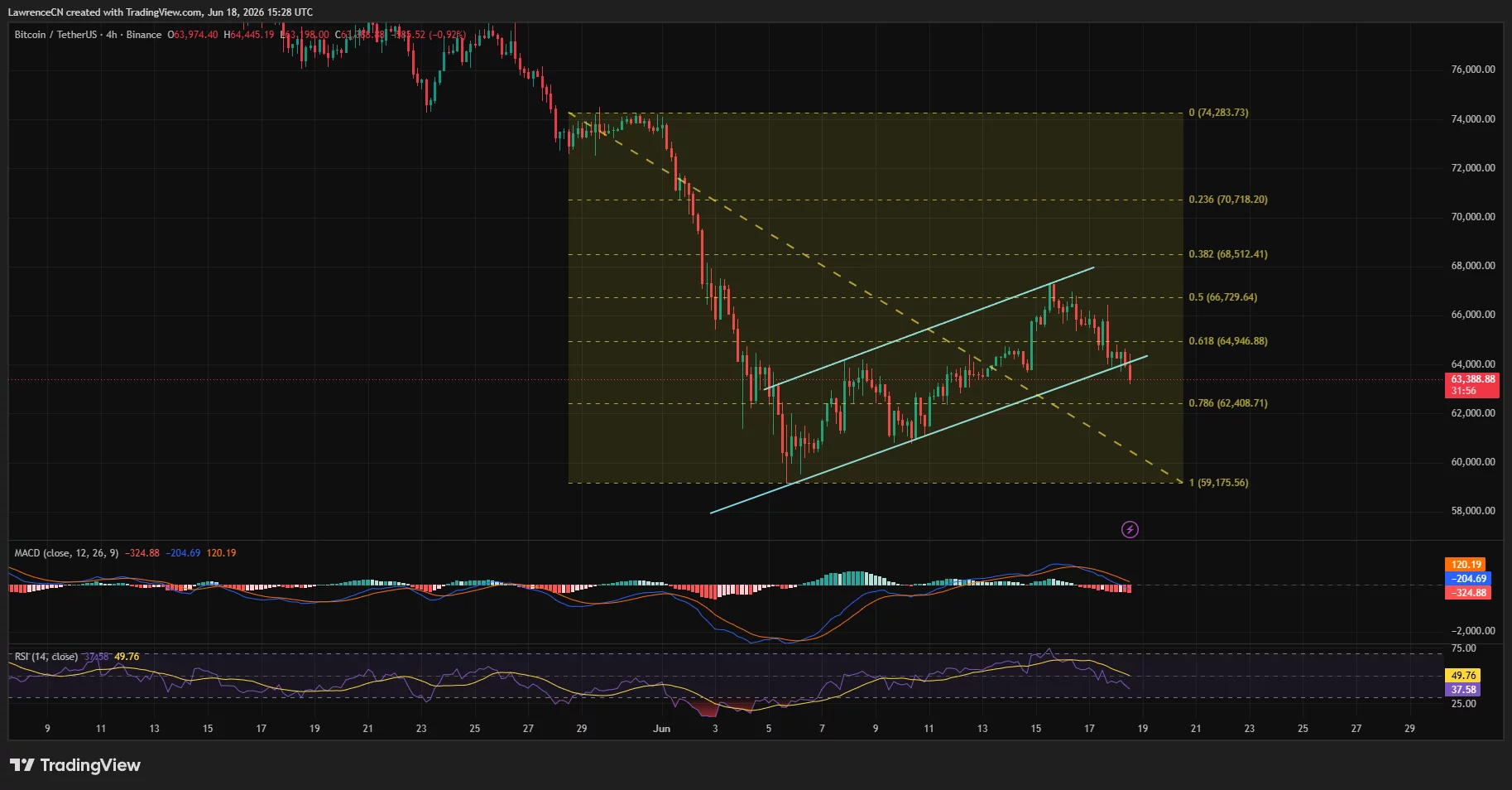
- Technical indicators turned bearish after BTC broke below an ascending channel and key Fibonacci support.
- Analysts warn a loss of the $62,400 support zone could trigger a retest of June lows near $59,000.
According to U.S. Department of Labor data, initial jobless claims fell to 226,000 for the week ended June 13, down from a revised 230,000 in the prior week.
The report arrived one day after the Federal Reserve held rates steady at 3.50%-3.75% during its June 17 FOMC meeting, marking a fourth consecutive pause while policymakers projected the possibility of additional tightening in 2026. The outlook prompted traders to reduce exposure to risk assets.
Oil markets have offered little support despite crude prices retreating sharply following reports of progress toward a U.S.-Iran framework agreement. While lower energy prices could ease inflation concerns, traders remain focused on the Fed’s latest projections and the resilience of the U.S. labor market.
Derivatives markets also turned defensive. Bitcoin (BTC) slid below $64,000 as leveraged long positions were flushed out across major exchanges, while traders reassessed the likelihood of near-term rate cuts. At the same time, continuing unemployment claims rose to 1.81 million, a detail that offered some evidence of labor market weakness but failed to offset the market’s reaction to lower headline jobless claims.
Bitcoin loses ascending channel support as sellers target lower liquidity zones
The four-hour chart shows Bitcoin breaking below the lower boundary of an ascending channel that had guided price action higher since the June 5 rebound from near $59,000. The breakdown occurred just below the 61.8% Fibonacci retracement level near $64,950, a zone that previously acted as support during the recent recovery attempt.
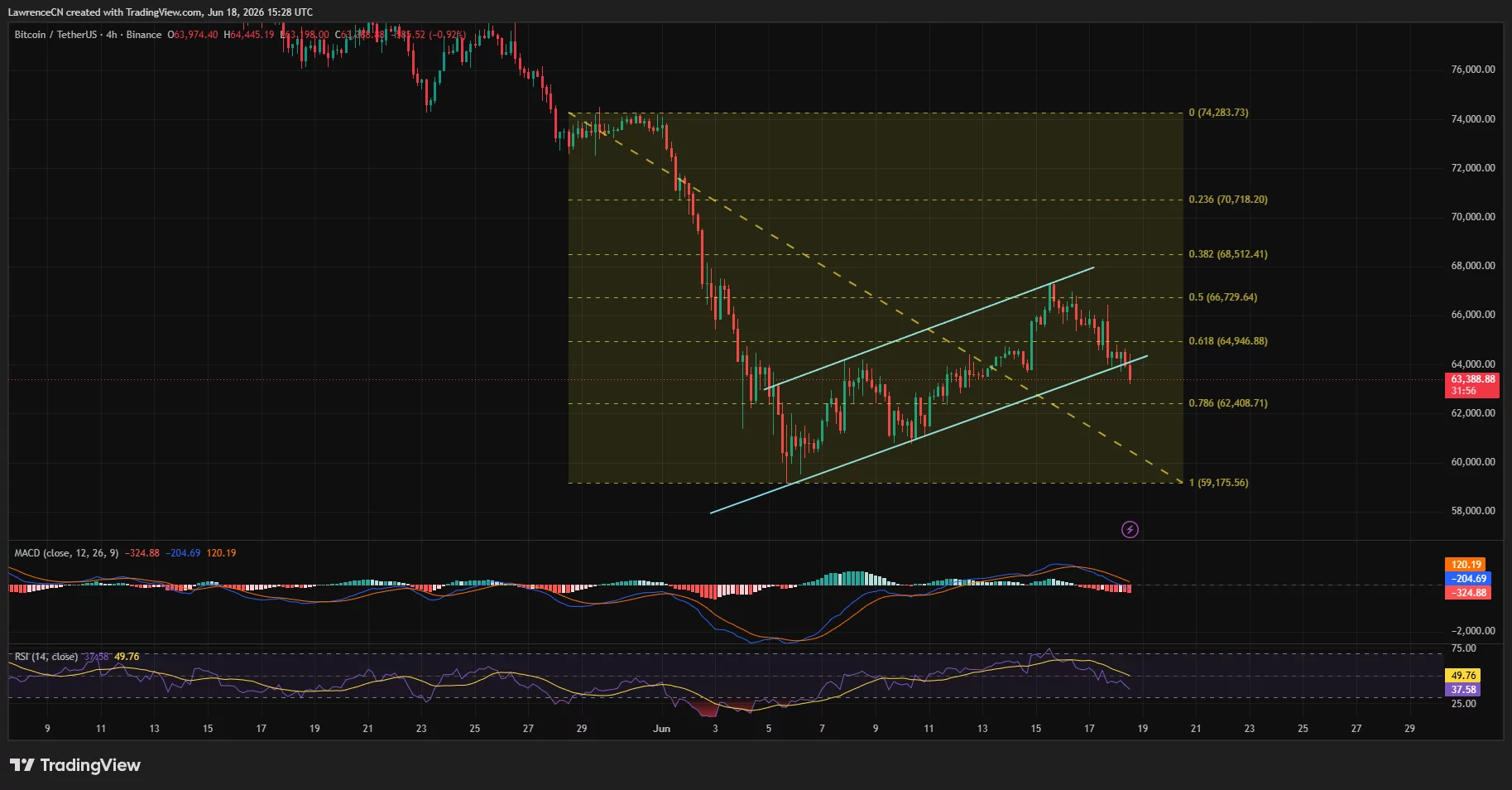
The next major support sits near the 78.6% Fibonacci retracement level around $62,400. A daily close below that area could expose the June low near $59,175, which also represents the measured downside target from the channel failure.
Momentum indicators have weakened alongside the breakdown. The RSI on the four-hour chart has dropped toward 38, placing it below neutral territory, while the MACD has produced a bearish crossover and shifted deeper into negative territory.
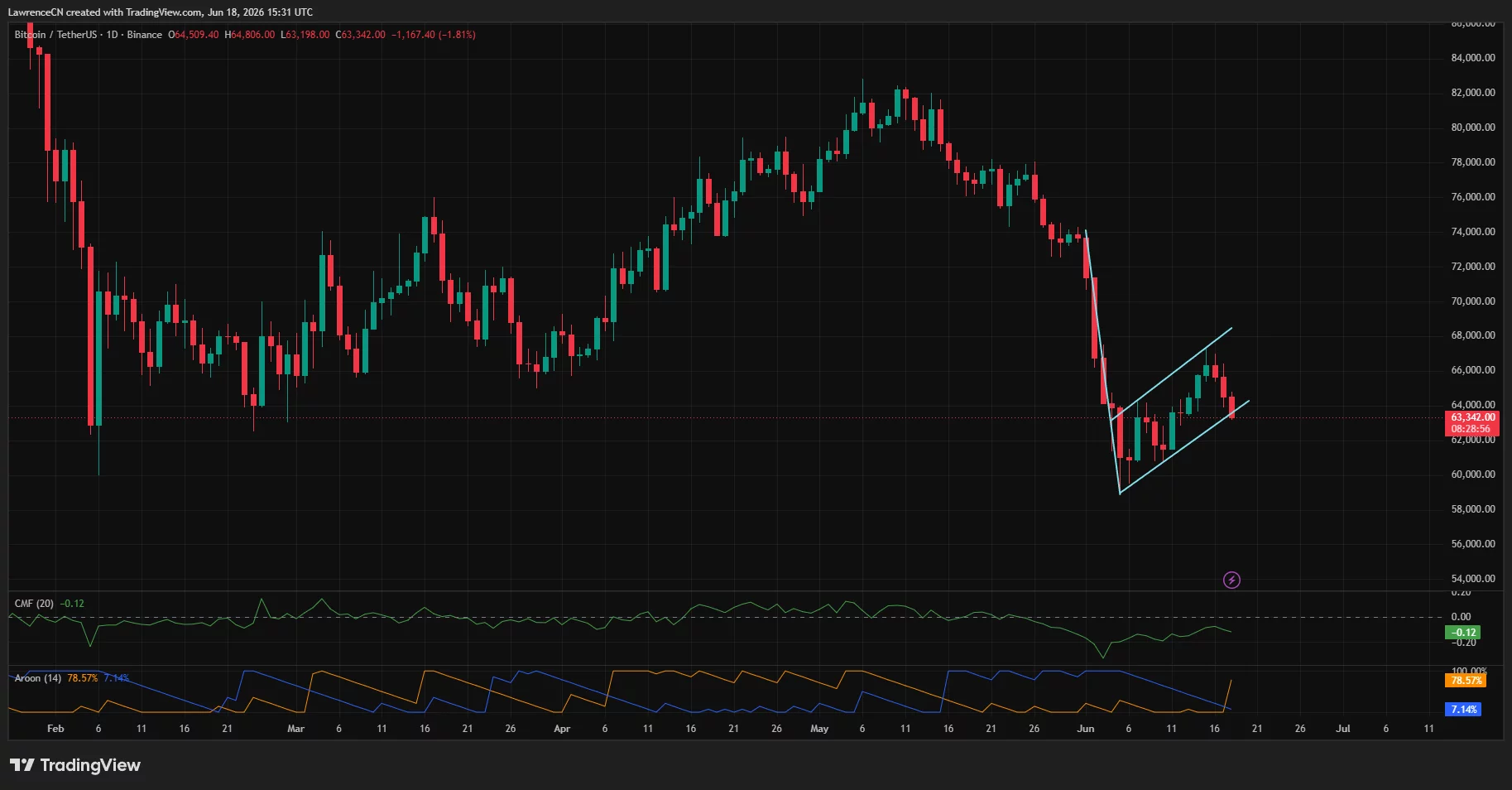
On the daily chart, Bitcoin has also formed a bearish flag after its rebound from the June low near $59,175 stalled below the $67,000-$68,000 resistance zone. A confirmed breakdown from the flag would strengthen the bearish case and put the $60,000-$59,175 support area back in focus.
The Chaikin Money Flow remains below zero at roughly -0.12, showing capital continues to leave the market despite last week’s rebound attempt.
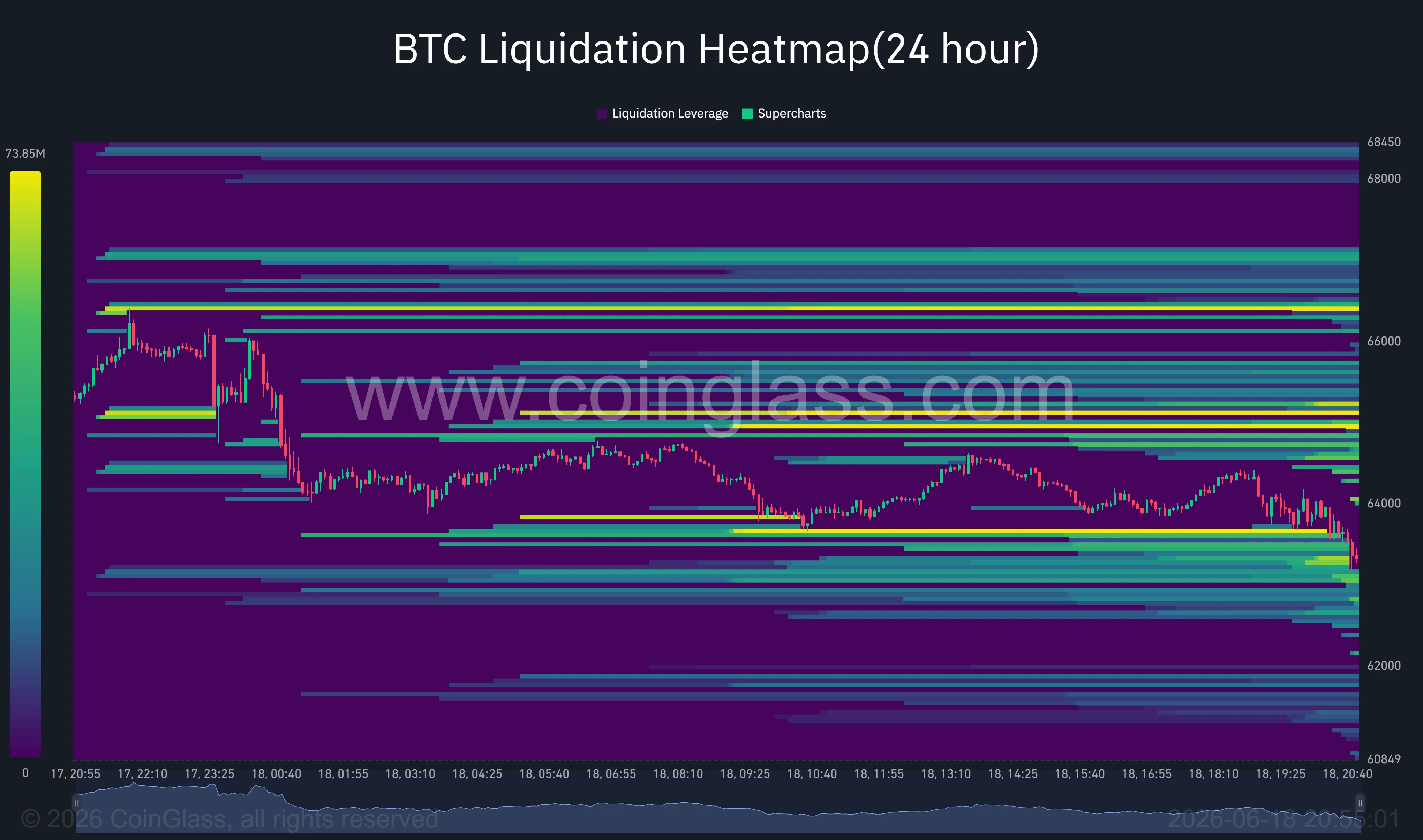
Liquidation data from CoinGlass highlights a dense cluster of leveraged positions between $63,000 and $63,500. Additional liquidity rests near $61,000 and $62,000, while significant short liquidation zones remain overhead around $65,000 and $66,500. With Bitcoin trading directly into a concentration of long leverage, volatility could remain elevated during the next several sessions.
Commenting on the recent breakdown, crypto analyst Altcoin Sherpa warned that Bitcoin could revisit the $60,000 region in the coming days if the current support area gives way.
Break below $62K could open the door to a retest of June lows
Analysts are increasingly focused on whether Bitcoin can defend the current support region. According to crypto analyst Michael van de Poppe, the market is approaching a pivotal level that could determine the next directional move.
“This is the level that needs to be held for BTC. It’s pivotal. If it doesn’t, we’ll test the lows and markets are about to fall some more on the Altcoins.”
A sustained move below $62,400 would strengthen the bearish case and increase the probability of a retest of the June low near $59,000. Beyond technical factors, another upside surprise in inflation data or additional hawkish commentary from Fed officials could further reduce expectations for policy easing and add pressure across crypto markets.
For bulls, reclaiming the broken channel support and recovering the $64,950-$66,700 area would be the first sign that sellers are losing control. Until then, traders remain focused on downside liquidity zones as Bitcoin struggles to stabilize following the Fed meeting and stronger-than-expected labor market data.
Disclosure: This article does not represent investment advice. The content and materials featured on this page are for educational purposes only.
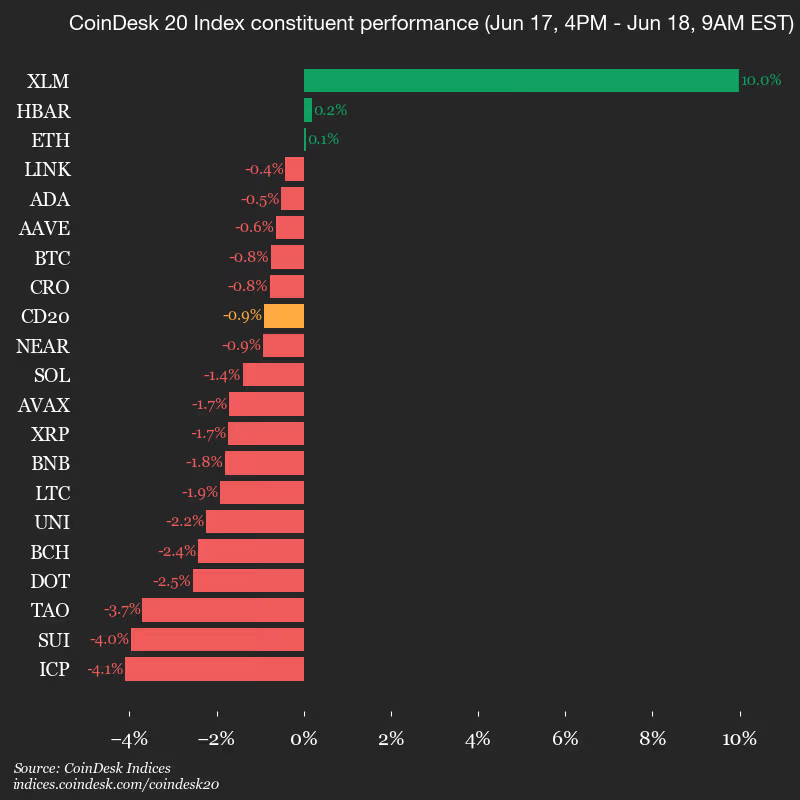
CoinDesk Indices presents its daily market update, highlighting the performance of leaders and laggards in the CoinDesk 20 Index.
The CoinDesk 20 is currently trading at 1750.15, down 0.9% (-15.97) since 4 p.m. ET on Wednesday.
Three of 20 assets are trading higher.

Leaders: XLM (+10%) and HBAR (+0.2%).
Laggards: ICP (-4.1%) and SUI (-4%).
The CoinDesk 20 is a broad-based index traded on multiple platforms in several regions globally.

Elon Musk just crossed $1.3 trillion in net worth, and the world’s first trillionaire still holds Bitcoin and Dogecoin. Dude is orange-pilled, and this fact alone is moving sentiment across both markets this week.
Analyst Ali Martinez flagged the milestone on X, pairing a Musk sketch with the Bitcoin logo and the caption “Let that sink in.” As of now, BTC is consolidating above $64,000 while DOGE trades at $0.084, both in structurally corrective but not broken technical positions.
The institutional angle carries weight here. SpaceX holds 18,712 BTC valued at $1.19 billion at current prices, while Tesla carries 11,509 BTC worth over $734 million on its balance sheet, making them the only two top-10 market-cap companies with crypto reserves.
Musk’s personal holdings remain publicly ambiguous; he disclosed just 0.25 BTC back in 2020 and has said nothing definitive since. Meanwhile, the Fed held rates unchanged this week, and futures markets assign near-zero probability to a July cut, a macro backdrop that keeps risk appetite measured but hasn’t broken crypto’s bid.
Discover: The Best Token Presales
Will Bitcoin and Dogecoin Break Higher?

Bitcoin’s structure reads as post-breakout consolidation. Price is holding above the prior cycle’s breakout zone, which is historically where altseason rotation capital stages before deploying into meme coins and mid-caps.
The key macro support level to watch is the $60,000 area; a Wyckoff-style retest of that zone would represent the primary bearish invalidation. On the upside, a clean break above $70,000 is the trigger most analysts are watching for continuation toward the $80K range cited in end-of-cycle models.

Dogecoin setup is tighter and arguably more interesting technically. Our research has flagged that DOGE is now mirroring BTC’s price action more closely than it tracks Musk tweets, which changes the trade calculus.
The current price near $0.085 sits at a structural accumulation zone, with analysts identifying a developing double-bottom pattern.
Discover: The Best Crypto to Diversify Your Portfolio
Maxi Doge: The New DOGE
DOGE at $0.085 offers a recognizable brand and Musk association, but also a $13 billion market cap floor and a price that needs to move several multiples to deliver the kind of return early-cycle DOGE holders captured. That math is what sends traders hunting for earlier-stage exposure when meme coin momentum picks up. The asymmetry shrinks considerably at this size.
Maxi Doge ($MAXI) is an ERC-20 meme token built around a high-conviction trading community identity, the “240-lb canine juggernaut” built for 1000x leverage mentality, with the tagline Never skip leg-day, never skip a pump.
The presale has raised $4.8 million at a current price of $0.0002824, with a huge 65% APY available to holders. Features include holder-only trading competitions with leaderboard rewards and a Maxi Fund treasury earmarked for liquidity and partnerships.
The meme-first marketing mirrors exactly what drove early DOGE traction: community-led, identity-driven, and spreadable.
Research Maxi Doge and size accordingly.
The post Bitcoin and Dogecoin Remain Elon Musk Favorite Crypto: Best Crypto to Buy Now? appeared first on Cryptonews.


The Ethereum Foundation’s (EF) co-executive director Hsiao-Wei Wang shared that she has stepped down from her role leading the organization effective immediately, in a post shared on X on Thursday.
Wang reached the decision after a recent sabbatical, which gave her time to reflect on her priorities and future plans. “I’ve come to feel that this is the right moment for me to step back,” she wrote.
Her departure follows the resignation of fellow co-executive director Tomasz Stańczak, who announced earlier this year that he would leave the role after helping steer a leadership transition at the Switzerland-based nonprofit that supports Ethereum’s ecosystem development.
During Wang’s sabbatical, Ethereum Foundation board member Bastian Aue helped oversee the leadership transition and has taken on a larger role in guiding the organization in the interim following the departures of both co-executive directors.
Wang’s exit adds to a period of upheaval at the Ethereum Foundation. At least eight senior figures have departed the organization over the past five months, fueling community scrutiny of the EF’s priorities, governance, and strategic direction, as Ethereum faces mounting competition from rival blockchains.
Crypto World
BTCC Exchange Eliminates Fees Across Every Layer of Crypto Trading in Landmark Zero-Barrier Initiative
[PRESS RELEASE – Lodz, Poland, June 18th, 2026]
BTCC, the world’s longest-serving cryptocurrency trading platform, today announced a series of zero-fee campaigns spanning deposits, spot trading, and TradFi futures. The launch represents a deliberate strategic effort to lower the barriers to entry that have historically kept retail traders on the sidelines, and to ensure that cost is never the reason a trader hesitates to participate.
The Zero-Barrier initiative targets both first-time users and seasoned traders, making it easier and more affordable than ever to move money, trade trending assets, and capture market movements on a single platform.
Zero Cost to Fund Your Account
Recognizing that every trade begins with a deposit, BTCC is ensuring that the first step costs nothing for new users looking to fund their accounts for the first time.
Users in specific regions can now deposit via Visa or Mastercard with no fees attached. Funds arrive within five minutes and no prior campaign registration is required, meaning traders can move from sign-up to making their first trades almost instantly.
For users in other regions, 0% Interac e-Transfer deposit fees are available on their first fiat deposit. By eliminating entry-level friction at the funding stage, BTCC is making it significantly easier for new users to take their first step into crypto trading without any cost.
Zero Cost From Spot to Meme Coins & TradFi Futures
Once users fund their accounts, the Zero-Barrier initiative continues. BTCC is offering a 100% spot trading fee rebate on five of the most actively traded crypto assets: BTC, ETH, XRP, SOL, and DOGE. Users who accumulate at least 50 USDT in spot trading volume during the campaign will receive a full rebate on fees of up to 2,000 USDT, allowing traders to trade major cryptos without watching fees erode their returns.
Beyond spot, the zero-fee offering extends into futures. BTCC is rolling out a permanent 0-fee promotion on selected coins, with the first phase covering DOGE, PEPE, SHIBA, and 20+ popular meme coins. As this asset class matures and attracts a growing base of active traders, removing fees from these pairs reflects BTCC’s commitment to meeting users where market interest is strongest. Eligible pairs can be accessed on the futures trading page by selecting the “0 Fee” filter.
For traders with an eye on traditional financial markets, BTCC’s TradFi 0-Fee campaign goes even further. Launched June 1, 2026, it covers all opening and closing positions across four major market categories:
- Precious and industrial metals: Gold, Silver, Platinum, Palladium, and Aluminum
- Energy commodities: Brent Crude Oil, WTI Crude Oil, and Natural Gas
- Global indices: S&P 500, Nasdaq 100, Dow Jones, FTSE 100, DAX, and Nikkei 225
- Forex and US stocks: Major currency pairs plus companies like Apple, Tesla, NVIDIA, Microsoft, and Amazon
Putting Users First
The Zero-Barrier initiative is a statement about where BTCC’s priorities lie. In an industry where fee structures have long favoured the platform over the trader, BTCC is taking a different position: that sustainable growth comes from empowering users. By removing fees at the deposit stage and across spot and futures trading, BTCC ensures users keep more of what they earn, from the first deposit to their spot and futures trades.
For information about the 0-fee campaigns, uses can visit the following official pages:
- 0 fees on Visa/Mastercard deposits
- 0 fees on Interac e-Transfer deposits
- 100% spot trading fee rebates
- 0 fees on DOGE and 20+ hot meme coins futures pairs (Select “0 Fees” filter)
- 0 fees on TradFi futures
About BTCC
Founded in 2011, BTCC is a leading global cryptocurrency exchange serving over 11 million users across 100+ countries. As the official regional sponsor of the Argentine Football Association (AFA) and with NBA All-Star Jaren Jackson Jr. as its global brand ambassador, BTCC offers secure and accessible cryptocurrency trading services, focused on delivering a user-friendly experience while adhering to applicable regulatory standards.
Official website: https://www.btcc.com/en-US
The post BTCC Exchange Eliminates Fees Across Every Layer of Crypto Trading in Landmark Zero-Barrier Initiative appeared first on CryptoPotato.

Key takeaways
- Bitcoin remains vulnerable as hawkish Federal Reserve guidance, rising Treasury yields, and inconsistent ETF demand continue to dampen investor sentiment.
- With BTC trading below key moving averages and lacking strong buying momentum, the near-term bias remains bearish.
Bitcoin (BTC) remained under pressure on Thursday, trading below the $64,000 level as investors reacted to a hawkish message from the U.S. Federal Reserve and mixed institutional demand signals.
The leading cryptocurrency continues to struggle for momentum, with risk appetite fading across financial markets after the Fed signaled a tougher policy outlook despite leaving interest rates unchanged.
Federal Reserve maintains rates but adopts hawkish tone
The U.S. Federal Reserve left its benchmark interest rate unchanged at 3.50% to 3.75% during its latest policy meeting, the first chaired by Kevin Warsh.
While the decision itself was widely expected, markets were focused on the Fed’s forward guidance and updated economic projections.
The central bank removed language suggesting a bias toward further monetary easing and instead signaled support for maintaining higher rates for longer. Policymakers now project the federal funds rate to end the year at 3.8%, up from the 3.4% forecast issued in March.
The revised outlook prompted traders to increase expectations for tighter monetary policy, with markets now pricing in nearly an 85% probability of a rate hike in December.
As a result, U.S. Treasury yields and the U.S. dollar moved higher, reducing demand for risk-sensitive assets such as cryptocurrencies.
Institutional demand for Bitcoin remains mixed, offering little support for a sustained recovery.
According to CoinGlass data, spot Bitcoin exchange-traded funds (ETFs) recorded a net outflow of $82.20 million on Wednesday, following:
The inconsistent flow pattern, coupled with a slight bearish bias, suggests institutional investors remain cautious amid macroeconomic uncertainty.
Should ETF outflows continue or accelerate in the coming sessions, Bitcoin could face additional downside pressure.
Bitcoin price outlook: Relief bounce shows signs of weakness
Recent price action indicates that Bitcoin’s rebound from oversold conditions may have been driven more by seller exhaustion than by renewed buying demand.
Bitcoin continues to trade within a bearish short-term structure and remains below several key moving averages.
BTC is currently trading below the 50-day EMA at $70,042, the 100-day EMA at $72,839, and the 200-day EMA at $78,174.
The failure to reclaim these levels reinforces the broader downtrend and highlights persistent overhead selling pressure.
Additionally, the previously broken uptrend support near $73,833 has now turned into a major resistance zone.
Technical indicators continue to favor caution. The Relative Strength Index (RSI) on the 4-hour chart remains below 50, indicating ongoing bearish momentum without yet reaching deeply oversold conditions.
The Moving Average Convergence Divergence (MACD) histogram remains slightly positive, suggesting that recent rebounds may be corrective moves within a broader bearish trend rather than the beginning of a sustained recovery.

If Bitcoin attempts a rebound, traders will likely focus on several major resistance zones. The first major resistance at $64,004 could pave the way for higher hurdles at $70,042 – 50-day EMA
A move above these levels would be required to significantly improve the technical outlook.
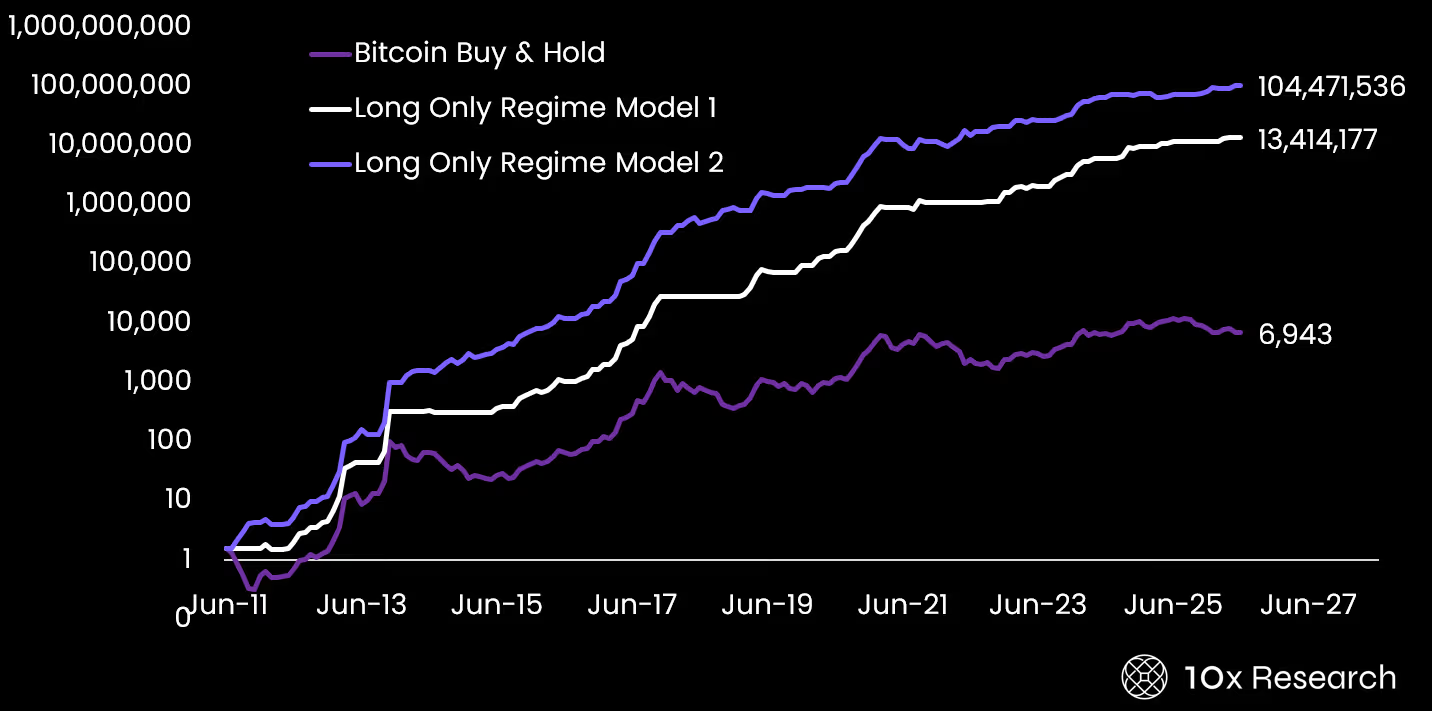
The win rate of a cycle-aware approach is lower than buy-and-hold, winning not by being right more often, but by avoiding the months when bitcoin loses 20%, 30%, or 40%. Those months cluster, and stepping aside during them is not timing the market; it is about reading the cyclical structure of the asset.
We have made three public, timestamped market calls since 2022: the October 2022 cycle bottom, the July 2023 projection of a $125,000 target and the October 2025 bear signal, each grounded in the same signal framework. The methodology is not infallible. But it is systematic, auditable and structurally better suited to bitcoin’s cyclical nature than the passive approach most advisors currently deploy.
Bitcoin rewards those who understand its cycle. Advisors who treat it like any other asset are leaving risk-adjusted returns on the table and exposing clients to drawdowns that, in practice, end portfolios rather than weather them.

– Markus Thielen, CEO, 10x Research
Ask an Expert
If blockchain technology succeeds, are investors owning the right things?
For years, investors assumed that if a blockchain ecosystem grew, its native token would naturally appreciate. Increasingly, I’m not convinced that’s always true. Technology can become indispensable while value accrues elsewhere to sequencers, applications, stablecoin issuers or liquidity layers.
A Strategy director has sold nearly $9 million worth of company shares over the past three months as pressure on the firm’s preferred stock offerings and concerns over future dividend funding continue to weigh on MSTR.
Summary
- Strategy director Jarrod Patten has sold nearly $9 million worth of MSTR shares over the past three months.
- QCP estimates Strategy has about 7.5 months of liquidity to support preferred stock dividend payments.
- Bernstein maintained its $450 MSTR price target despite the stock falling roughly 31% over the past month.
According to a recent filing with the U.S. Securities and Exchange Commission, Strategy director Jarrod Patten exercised options to acquire 1,500 Class A shares at a strike price of $18.236 and immediately sold them on the open market at roughly $134 per share, generating a profit of around $200K.
The transaction adds to a steady pattern of insider selling. SEC filings show Patten has disposed of 55,750 MSTR shares during the last three months, with total proceeds approaching $9 million. His latest sale comes as Strategy stock remains under pressure following a sharp decline in both Bitcoin and the company’s preferred securities.
Following the transaction, Patten still holds 28,406 Class A shares, positions across several Series A perpetual preferred stock offerings, and 44,250 unexercised director stock options.
Dividend concerns have moved into focus
Attention has increasingly shifted toward Strategy’s ability to support dividend obligations tied to its preferred stock products.
According to market maker QCP, Strategy’s current liquidity position can fund dividend payments for roughly seven and a half months.
As crypto.news reported, QCP said the company could eventually face a decision between raising additional capital, diluting shareholders further, or selling Bitcoin if alternative funding sources become less attractive.
The concern emerged shortly after Strategy completed several balance-sheet transactions. QCP noted that the company repurchased nearly $1.5 billion of convertible notes due in 2029 while raising approximately $200 million through MSTR stock sales. Part of those proceeds was later used to acquire another $100 million worth of Bitcoin.
Investor attention has also centered on Strategy’s preferred securities. STRC, the company’s Stretch preferred stock, recently fell to a record low of $89, leaving it about 11% below its intended $100 value and increasing scrutiny of the firm’s capital structure.
Earlier this month, Strategy disclosed the sale of 32 BTC valued at approximately $2.5 million to fund STRC dividend payments. The transaction marked the first known Bitcoin sale by the company after years of maintaining a strict accumulation strategy.
Analyst targets remain unchanged despite weakness
Selling activity by company insiders has continued throughout 2026. Earlier filings showed Chief Executive Officer Phong Le, Chief Financial Officer Andrew Kang, and former Executive Vice President Wei-Ming Shao collectively sold millions of dollars’ worth of MSTR shares in March. Kang and Patten reduced their holdings as the stock weakened despite record highs in major U.S. equity indexes.
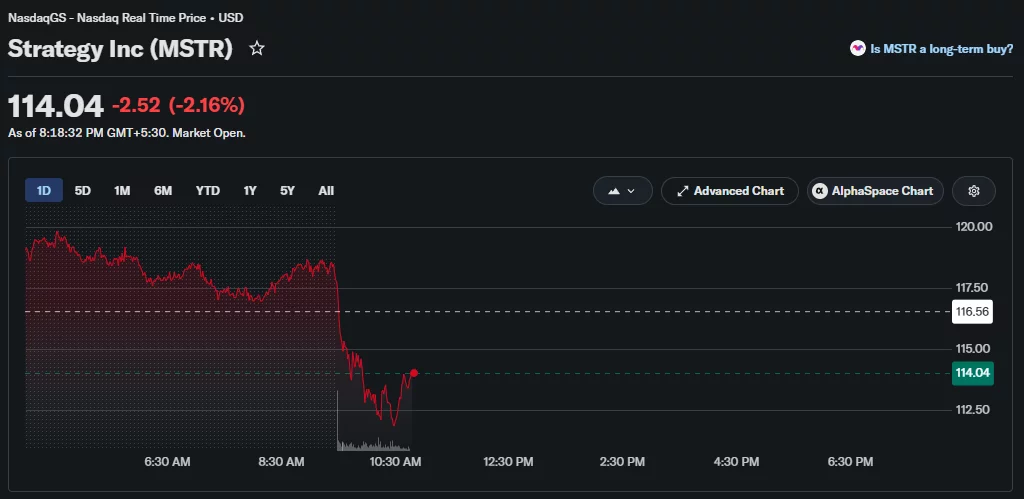
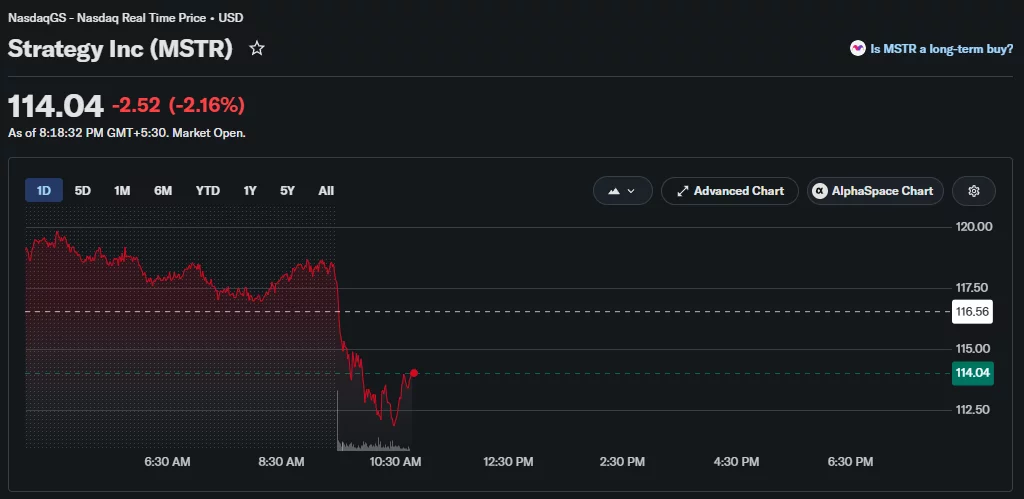
MSTR closed 5.09% lower at $116.56 on Wednesday as risk assets weakened after the Federal Reserve kept interest rates unchanged at 3.50% to 3.75% while signaling potential tightening risks for 2026. The stock extended its decline on Thursday, falling another 2.1% to $114.04. With those losses, MSTR is now down roughly 31% over the past month.
Meanwhile, Bitcoin traded near $63,850 at press time after dropping nearly 2% in the past 24 hours.
Despite the recent decline, analysts at TD Cowen, Citigroup, Bernstein, and BTIG have maintained their existing bullish ratings on MSTR shares. Bernstein analysts reiterated a buy rating and kept a 12-month price target of $450, while TD Cowen targets $350, Citigroup holds at $260, and BTIG maintains a target of $250.

A step-by-step guide for 2026
25 times “The Simpsons” predicted the future

Italy survives Serbia scare, stays unbeaten in Manila


-

 Business4 days ago
No Jackpot Winner as $257 Million Prize Rolls Over to $269 Million Monday Draw
-

 Fashion6 days ago
Weekend Open Thread: Tuckernuck – Corporette.com
-

 Crypto World7 days ago
Markets Rally as SpaceX IPO Looms Amid Iran Tensions and Inflation Surge
-
 Crypto World4 days ago
Zimbabwe Requires Crypto Businesses to Register Annually Under New FIU Regulations
-

 Crypto World5 days ago
Bitget enters Argentina’s regulated crypto market through PSAV registration
-

 Tech6 days ago
NanoClaw integrates JFrog registries to secure AI agent downloads
-

 Tech6 days ago
This Week In Security: Microsoft On Microsoft, Register Your Domains, Linux On ARM, And FreeBSD Joins The File Cache Club
-

 NewsBeat7 days ago
El Nino has formed in the Pacific and could set records, forecasters say
-
 Entertainment7 days ago
Donnie Wahlberg & More Heat Up Las Vegas at Circa’s Barry’s Downtown Prime
-
 Tech7 days ago
Opendoor Ends India Operations, Fueling a Bigger Conversation About AI and Outsourcing
-

 NewsBeat6 days ago
FBI searches office of Ohio voter registration group
-
 Tech7 days ago
Anthropic is spending $150M to embed 1,000 AI fellows inside nonprofits. No degree required.
-
 Entertainment7 days ago
‘The Pitt’s Fan-Favorite Doctor Confirms Noah Wyle Gave His Blessing to Return [Exclusive]
-

 Tech7 days ago
Klipsch Heritage First Listen at High End Vienna 2026: Rebellion, OJAS and Klipschorn Bring the Horns
-
 Crypto World7 days ago
Ripple and Bitso Bring MXNB Stablecoin to XRP Ledger
-

 Fashion7 days ago
Coffee Break: Scarf Waist Belt
-
 Tech7 days ago
Former AWS CEO Adam Selipsky to lead new $10B AI data center venture
-
 Entertainment4 days ago
Matt Damon’s Viral Sci-Fi Thriller Has Taken Over HBO Max
-

 Business4 days ago
Anthropic staff to meet White House officials next week, Axios reports
-

 Tech4 days ago
As AI companies race to go public, who else is along for the ride?
You must be logged in to post a comment Login