


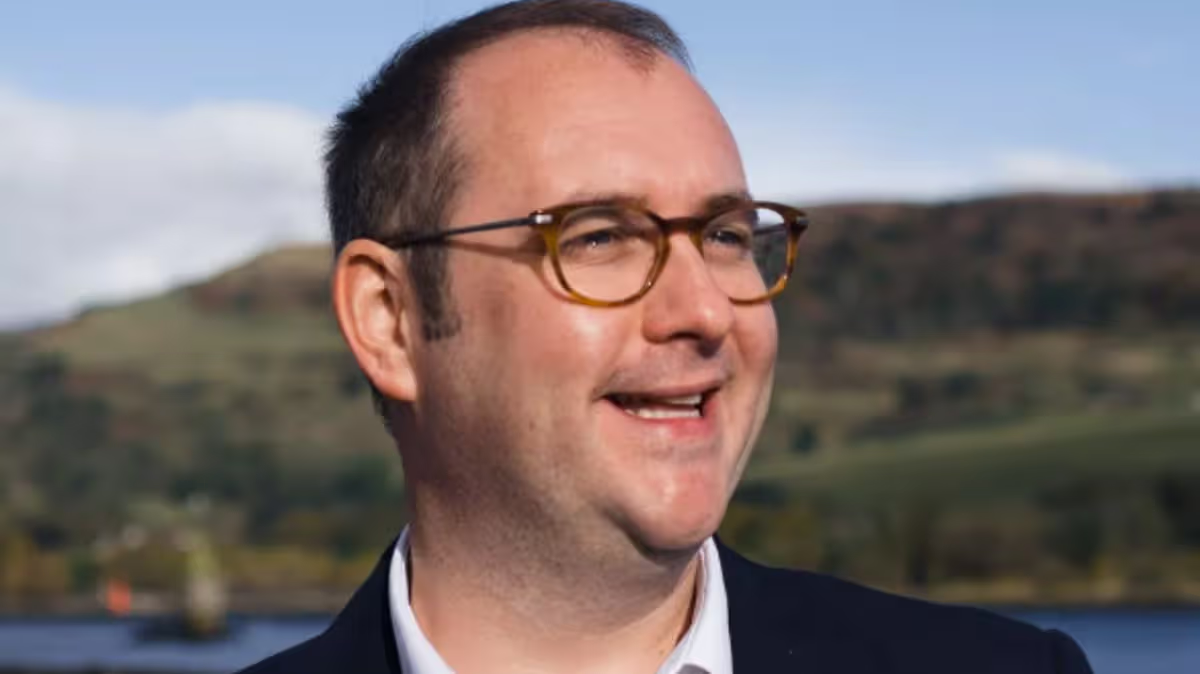
EXCLUSIVE: In a wide-ranging interview, Paul O’Kane reflected on a campaign that saw Scottish Labour collapse to their fifth defeat in a row to the SNP.
A former Labour MSP and defeated candidate has criticised his party’s election strategy after their worst ever Holyrood defeat.
Paul O’Kane said Labour focused too much on constituencies over regional Lists and lacked “ambition” in their manifesto.
He also said “everything should be on the table” after being asked about the creation of an independent Scottish Labour party.
Anas Sarwar’s party returned 17 MSPs earlier this month – their worst tally at a Scottish Parliament election.
The performance of the UK Government is widely blamed for the loss, but criticism is mounting over Sarwar’s campaign.
READ MORE: John Swinney urged to implement EHRC biological sex ruling ‘without delay’

Insiders say targeting 38 first-past-the-post seats was too ambitious and claim there was no strategy for the regional lists, where Labour does best.
O’Kane, a moderate who was Sarwar’s shadow education secretary, was one of three sitting MSPs to lose his seat on May 7th.
In an interview with the Record’s Planet Holyrood podcast, he said Starmer was a “principal” factor in the result, but warned:
“It would be wrong for us not to take time to have self-reflection in Scotland as well, and in the Scottish Party, about what happened in the campaign, about the way the campaign was run, about the decisions that were made around various issues of policy.
“I wouldn’t want us to just see the issues with the UK Government and the Prime Minister as a reason not to have a wider reflection and a wider piece of work that looks at all of the issues in the round.”
He criticised the failure to focus on the regional lists when polling showed Labour trailing the SNP in the constituencies:
“I do think there are questions to ask about that sort of 38 seat strategy, whether that was a strategy that could evolve with the changing picture of polling.”
He said: “My sense is there should have been more focus on a list strategy and thinking about that more widely.”
He added: “The challenge for me is just, again, what was the contingency? What was the balancing factor? Because with the best will in the world, a lot of the national polling was starting to show that that was quite a narrow path.”
On the manifesto, O’Kane said Labour were “trying to be honest” with voters about challenges with public finances.
He said it would not have been right to “promise the Earth and not deliver it”, but said his party could have been more “ambitious and hopeful in our language”.
O’Kane is also in favour of greater autonomy for Scottish Labour from the UK party.
While he did not back an independent Scottish party, he kept the door open on the idea:
“As part of any wider review…I think everything should be on the table. I think it would be wrong if we sort of closed off ideas about how we might move forward.”
He said: “We are the party of devolution. We believe in devolution. We believe in devolution that progresses. But we probably didn’t do that for our internal party structures and we need to accept that in a devolved UK, looking at more devolved structures to the Scottish Labour Party isn’t necessarily a bad thing.”
He is also worried this party could suffer the same fate as Labour in Ireland, which has for generations been in the shadow of nationalism:
“There’s definitely a danger in it [Scottish politics] becoming really entrenched into two polarising sort of nationalisms where…the politics of working people, of aspiration, of support and all of the things I’ve just spoken about gets lost and squeezed to a point where it becomes slightly irrelevant, which is I think what you see in Ireland. “
O’Kane said he supported a UK constitutional convention which could look at various issues including House of Lords reform and even the trigger point for indyref2:
“I’m not really sure why we as Labour would advocate for a process that I don’t think is being demanded by the people, because I think what we saw actually was people wanted action on the cost of living, education, the health service, all of those things.
“That said, do I think there is a space for a wider conversation and discussion about the UK as a whole in terms of its constitutional arrangement? Yes, I do.”
He explained: “And of course, if we want to, as part of that process, have a discussion about how we define future votes on a whole range of issues, including independence, then that should absolutely form part of that. But I’m not in a rush to have a Scottish-only conversation.”
A Scottish Labour spokesperson said: “In the election we ran an ambitious campaign for change. Unfortunately we did not win that argument, so we must reflect and learn from that result.
“We will now be the credible opposition Scotland needs – holding this SNP government to account to make sure it delivers on its promises and that the Scottish Parliament is focussed on the issues raised in this election, from the NHS to the cost of living.”









































You must be logged in to post a comment Login