

Crypto World
SEC Halts Innovation Exemption For Tokenized Stocks

The US Securities and Exchange Commission has reportedly postponed its plan to allow trading of tokenized stocks after stock exchange officials raised concerns over how the plan would be implemented.
Bloomberg reported on Friday, citing sources familiar with the matter, that the SEC’s “innovation exemption” for crypto-based stocks was expected to be released during the week, with SEC staffers having already reviewed a draft of the tokenized stock trading proposal.
The SEC has reportedly received input from hundreds of market participants on how to best implement the rules, but it has not made a decision to change its proposal.
Under the SEC’s proposal, platforms offering tokenized stocks would need to guarantee investors receive the same rights as traditional shareholders, including dividends and voting rights.
Market participants reportedly raised concerns to the SEC over the potential proliferation of unauthorized third parties issuing tokens without the consent of public companies and how ownership would be verified on semi-pseudonymous blockchains.
The SEC has been more open to crypto-powered financial products under the Trump administration, which has coincided with Wall Street having a growing interest in tokenization and stablecoins.
Data from RWA.xyz shows that $34 billion worth of real-world assets have been tokenized, including $1.55 billion in tokenized equities, but adoption has lagged expectations by Citibank and McKinsey, which respectively predicted in 2022 and 2024 that tokenization would become a multi-trillion-dollar market by 2030.
Crypto industry supports decision to delay
Crypto industry executives have backed the SEC’s decision to delay the exemption. Carlos Domingo, the CEO of crypto tokenization platform Securitize, said in a post to X on Friday that it is important to ensure the “exemption applies to the right instruments.”
“Better delay it than get it wrong and unleash all sort of problems.”
Related: Kraken parent Payward sees revenue surge as tokenization expands
Tom Farley, the CEO of crypto exchange Bullish posted to X that the SEC was “realizing that public companies are the only entity who can issue tokens that are a share of stock! Great job delaying and getting this right.”
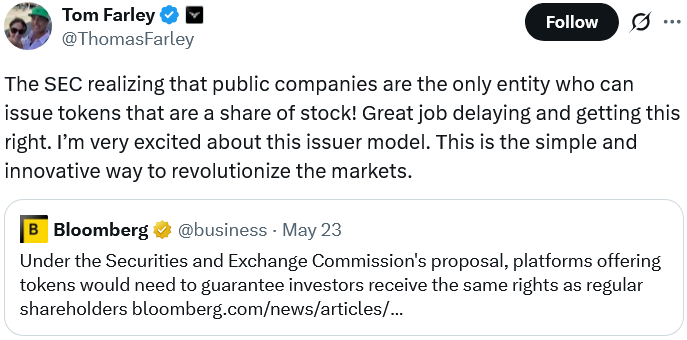
Source: Tom Farley
The delay came after SEC Commissioner Hester Peirce said on Thursday that she expected the exemption to be “limited in scope” and would only support “digital representations” of equity securities, similar to what investors can currently purchase in the secondary market.
In January, the SEC made distinctions between types of tokenized securities, classifying them into “custodial” and “synthetic” forms.
Custodial tokenized securities are issuer-sponsored tokenized stocks custodied by regulated intermediaries and have full shareholder rights, while synthetic tokenized securities provide price exposure without actual ownership of the underlying shares.
Magazine: eToro founder timed Bitcoin top perfectly due to belief in 4 year cycles

The U.S. Securities and Exchange Commission is delaying the rollout of an “innovation exemption” that would let platforms trade tokenized versions of U.S. stocks, according to people familiar with the matter. Bloomberg reported on May 22, 2026, that the agency has not yet decided to alter its proposed framework, despite broad feedback from market participants.
Under the draft rule, venues offering tokenized stocks would be required to guarantee holders the same rights as traditional shareholders—dividends and voting rights—raising questions about how to verify ownership and prevent unauthorized third-party issuers on semi-anonymous blockchains. The pause follows input from hundreds of market participants on the specifics of implementation.
Key takeaways
- The SEC reportedly postponed the “innovation exemption” for tokenized stocks; no final decision to change the proposal has been made.
- Any platform offering tokenized equities would be obliged to deliver real shareholder rights, prompting concerns about unauthorized issuers and on-chain ownership verification.
- Industry voices urged a careful approach, with prominent executives arguing that delays are prudent to ensure the exemption targets the right instruments.
- Public-token representations are viewed through two models: custodial tokens with full ownership rights and synthetic tokens that track price exposure without underlying ownership.
- Market data shows tokenization of real-world assets reaching $34 billion, including $1.55 billion in tokenized equities, though overall adoption has lagged earlier projections.
Deliberations amid a state of flux
The Bloomberg report underscores that the SEC’s innovation exemption—intended to govern crypto-based stock representations—remains under consideration, with a final decision still pending. The commission has reportedly received input from hundreds of market participants on how best to implement the rules, but officials have not committed to adjusting the proposal’s scope.
The core issue is straightforward in description but thorny in practice: ensuring tokenized shares carry the same rights as traditional stock, including the right to receive dividends and to vote. At the same time, regulators are wary of how ownership would be verified on blockchains that are at least semi-anonymous, and of the risk that third parties could issue tokens tied to public companies without authorization. The balance between protecting investors and enabling a new layer of market infrastructure remains delicate as the rulemaking unfolds.
Industry reaction and regulatory context
Industry participants have largely welcomed the SEC’s decision to pause and reassess. Carlos Domingo, CEO of Securitize, a leading tokenization platform, emphasized the importance of alignment between the exemption’s scope and the instruments it covers. In a post to X, he wrote that it is crucial the exemption applies to the right instruments, adding, “Better delay it than get it wrong and unleash all sort of problems.”
“Better delay it than get it wrong and unleash all sort of problems.”
The push to move carefully echoes broader tensions in the sector. Tom Farley, CEO of crypto exchange Bullish, summarized a similar sentiment on X, suggesting that the market needs to recognize that public companies remain the issuers of stock representations and praising the SEC for taking time to get it right.
These reactions come as the SEC’s approach to crypto-powered financial products has evolved since the Trump administration, a period that has coincided with a notable uptick in Wall Street interest in tokenization and related concepts such as stablecoins. The commission has signaled a willingness to explore regulated structures for digital assets, even as it exercises caution on premature or misaligned products.
The discussion around tokenized securities has also been colored by remarks from the agency’s commissioners. In particular, Commissioner Hester Peirce indicated that any exemption should be narrow in scope and would likely support “digital representations” of equity securities that resemble what investors already access in the secondary market. Her observations highlight the ongoing debate about how far tokenization can realistically extend into traditional equity markets without compromising investor protections.
Earlier this year, the SEC clarified that tokenized securities could take one of two forms: custodial tokens, where issuer-sponsored shares are held by regulated intermediaries with full shareholder rights, and synthetic tokens, which offer price exposure without granting actual ownership of the underlying shares. That distinction remains central to how the proposed exemption might operate in practice and to how the sector designs compliant products.
Tokenization progress and market expectations
Beyond the regulatory question, industry data paints a mixed picture of progress. RWA.xyz, a data service tracking tokenized real-world assets, reports that about $34 billion worth of such assets have been tokenized across various use cases, including roughly $1.55 billion in tokenized equities. While that suggests meaningful activity, the pace and scale have not matched some early forecasts. Banks and consulting firms previously projected tokenization could become a multi-trillion-dollar market by the end of the decade, with Citi and McKinsey among the forecast leaders; those projections have yet to materialize in the way some hoped.
The present pause, then, is not just a procedural hiccup but a test of whether tokenization can mature under a framework that preserves investor rights while preventing misissuance and governance confusion. The SEC’s willingness to solicit broad feedback and to delay action signals a methodical approach: even as market participants push for faster adoption, regulators appear intent on getting the architecture right before broader rollout.
Looking forward, observers will be watching for the SEC’s next moves on the exemption’s scope, the exact standards for custodial versus synthetic tokenized securities, and how platforms will verify ownership and consent from public companies involved. As the industry waits for a more definitive rule, the balance between innovation and protection remains the central theme shaping the trajectory of tokenized equities.
What remains uncertain is how quickly regulators will translate stakeholder input into a final framework that works in a live market. In the near term, the key questions are whether the exemption will cover a narrow set of instruments or broaden to a wider class of digital representations, and how issuers, platforms, and investors will navigate the practicalities of on-chain ownership, voting, and dividends. The next weeks and months will be instrumental in setting the tempo for tokenized equities and the broader tokenization push across asset classes.


Kalshi has backed a new advocacy group, Americans for Fair Markets, as the prediction market industry faces rising pressure from casinos, sportsbooks, state regulators, and Congress.
Summary
- Kalshi-backed Americans for Fair Markets will lobby for federal prediction market rules and consumer protections.
- The launch comes as Congress now probes Kalshi and Polymarket over insider trading control systems.
- State gambling cases keep pressure on platforms seeking CFTC-led oversight of event contracts nationwide.
The group launched with Taylor Budowich, a former deputy White House chief of staff, as strategic advisor.
Americans for Fair Markets plans to shape federal policy for prediction markets and federally regulated exchanges. Kalshi said the group will support paid and earned campaigns against what it called “false narratives about prediction markets” from sportsbook and casino interests.
The group also said it will support consumer rules for regulated platforms. Its stated priorities include know-your-customer checks, bans on insider trading, full CFTC funding, and limits on contracts tied to war, death, terrorism, and assassination.
Former Trump aide joins the policy push
Taylor Budowich’s role gives the group a direct link to Republican political circles. Budowich most recently served as deputy White House chief of staff under Susie Wiles, according to Kalshi’s announcement.
John Bivona, Kalshi’s head of government relations and an AFM board member, framed the launch as a response to powerful gaming interests.
“We’re not going to be outspent or out-organized by entrenched interests protecting their monopolies,” he said.
Additionally, the launch came as the U.S. House Committee on Oversight and Government Reform opened an investigation into Kalshi and Polymarket. The committee asked both firms for records on user checks, geographic limits, and suspicious trading controls.
The probe follows concerns that users with non-public government information could profit from event contracts. Related reports also cited suspicious trades tied to geopolitical events and a case involving a U.S. Army master sergeant accused of using classified information to earn more than $409,000.
CFTC and states remain divided
Kalshi wants federally regulated prediction markets to remain under the Commodity Futures Trading Commission. State regulators argue that some event contracts, especially sports-linked markets, fall under local gambling laws.
As reported by crypto.news, that conflict widened after Kalshi and Polymarket lost emergency bids in Nevada and Washington. A Ninth Circuit panel ruled that a federal derivatives defense does not automatically move state gambling cases into federal court.
Prediction markets expand beyond retail trading
Related reports show Kalshi has also been moving toward larger financial use cases. Bernstein pointed to Kalshi’s first bespoke block trade as a step toward institutional event-risk trading, while Clear Street added a regulated access route for larger clients.
Kalshi has also appeared in reports about crypto perpetual futures and media data deals. Earlier coverage noted that Fox would stream Kalshi’s real-time probabilities across Fox News, Fox Business, Fox Weather, and Fox One after similar integrations with CNN and CNBC.


Kalshi has backed a new lobbying group for prediction markets called Americans for Fair Markets, which has tapped former deputy White House chief of staff Taylor Budowich as its strategic advisor.
Kalshi said on Friday that the organization is positioning itself against sportsbooks and casinos, which it claims are “focused on protecting their monopolies and seeding lies about prediction markets to policymakers.”
Americans for Fair Markets, which Kalshi said was launched with its support, would join a broader lobbying push that includes the Coalition for Prediction Markets, an advocacy group for prediction markets launched in December 2025, backed by Coinbase, Crypto.com, and Robinhood.
Kalshi said the organization aims to shape federal policy on prediction markets and would run paid campaigns on what it claimed were “false narratives about prediction markets.”
The launch of the group came on the same day that the US House launched a probe into Kalshi and its main rival, Polymarket, over how the companies were handling insider trading, as prediction markets come under increased scrutiny in the US and abroad.
Budowich’s appointment as an advisor comes as US President Donald Trump has expressed mixed takes on prediction markets. Trump said last month that he was “not happy” with prediction markets over well-timed Iran war bets.
However, Trump, whose son Donald Trump Jr. invested in Polymarket and joined the company’s advisory board and is an adviser to Kalshi, softened his stance days later, saying the US would “get left out in the cold” if it didn’t allow the platforms.
Kalshi said that Americans for Fair Markets will support the Commodity Futures Trading Commission in regulating prediction markets.
The CFTC and state regulators have faced off over competing claims for jurisdiction, with states claiming prediction markets are violating local gambling laws, while the CFTC has claimed sole jurisdiction over the platforms.
Related: Kalshi valuation doubles to $22B after $1B funding round
Americans for Fair Markets said it would also focus on backing federally regulated platforms with consumer protections such as know-your-customer requirements, insider trading bans and restrictions on markets tied to violence or terrorism.
“We’re not going to be outspent or out-organized by entrenched interests protecting their monopolies,” John Bivona, Kalshi’s head of government relations who was appointed as a board member for the new lobby group.
“Millions of Americans have shown they want regulated, open, and fair prediction markets — and we’re going to make sure they have access to them,” he added.
Magazine: Polymarket seeks Japan entry, Harvard dumps entire ETH position: Hodler’s Digest

The U.S. Securities and Exchange Commission has effectively postponed its plan to permit trading of tokenized stocks after stock exchange officials signaled potential implementation hurdles. Bloomberg reported on Friday, citing sources familiar with the matter, that the SEC’s crafted “innovation exemption” for crypto-based stock representations was expected to be released within the week, following staff review of a draft proposal.
While the commission has solicited input from hundreds of market participants, it has not announced a decision to alter the proposal. Under the plan, platforms offering tokenized stocks would be required to guarantee investors the same shareholder rights as traditional stock, including dividends and voting rights.
Market participants raised concerns about unauthorized third parties issuing tokens without corporate consent and questions about how ownership would be verified on semi-pseudonymous blockchains, according to Bloomberg’s reporting. The SEC has shown a willingness to explore crypto-powered financial products, a stance that aligns with renewed Wall Street interest in tokenization and stablecoins, a shift noted as occurring under the prior administration.
Data from RWA.xyz illustrates the broader tokenization landscape, showing roughly $34 billion in real-world assets tokenized to date, including about $1.55 billion in tokenized equities. While this signals significant activity, adoption has lagged earlier optimistic projections from institutions such as Citibank and McKinsey, which forecast a multi-trillion-dollar market by 2030.
Key takeaways
- The SEC paused its plan to implement an “innovation exemption” for tokenized stocks amid implementation concerns, with no decision announced to revise the proposal.
- Any tokenized stock market would need to preserve full shareholder rights, including dividends and voting, for holders of crypto-based representations.
- Industry participants highlighted risks around unauthorized token issuances and ownership verification on on-chain ledgers that are not fully transparent or permissioned.
- Tokenization activity has grown to tens of billions in real-world assets, yet the trajectory remains uncertain relative to earlier multi-trillion-dollar projections.
- Regulatory distinctions between custodial and synthetic tokenized securities continue to shape ongoing legal interpretation and enforcement considerations.
Regulatory status and practical implications
The reported delay centers on the SEC’s proposed exemption framework for crypto-based equity representations, often described as an innovation exemption intended to unlock tokenized stock trading while preserving core investor protections. The agency’s plan envisions exchanges and other platforms delivering tokenized versions of U.S. equities that carry the same rights as conventional shares. However, the concerns voiced by market participants focus on two practical hurdles: first, ensuring that token issuance occurs only with the consent of the underlying issuers, and second, establishing reliable mechanisms to prove ownership on blockchains that are semi-pseudonymous and may involve multiple intermediaries.
While the SEC has engaged with hundreds of market participants, the plan is not yet finalized, and officials have indicated continued consideration of stakeholder feedback. The sequence suggests a cautious pace for policy rollout in a space where legal clarity—covering rights, custody, and governance—remains essential for institutional adoption and regulatory compliance programs across banks, trading venues, and asset managers.
From a compliance perspective, the delay highlights the need for robust KYC/AML frameworks, transparent tokenization governance, and clear delineation of when a token qualifies as a claim on an asset versus a price exposure instrument. As regulatory bodies in the United States and overseas scrutinize tokenized securities, firms must align product design with potential enforcement expectations, licensing regimes, and cross-border comparability with frameworks such as MiCA and existing U.S. securities laws administered by the SEC, CFTC, and DOJ.
Industry response and governance challenges
Industry executives have generally supported the SEC’s decision to postpone the exemption to allow a more deliberate approach. Carlos Domingo, CEO of Securitize, underscored the importance of ensuring the exemption targets the right instruments, emphasizing that “Better delay it than get it wrong and unleash all sort of problems.” The sentiment reflects a broader preference for rigor in tokenization governance, particularly around issuer consent, ongoing rights administration, and regulatory oversight.
“Better delay it than get it wrong and unleash all sort of problems.”
Tom Farley, the chief executive of Bullish, echoed the theme on social media, noting that the delay reflects a realization that public companies remain the sole issuers of stock that can be tokenized into a share. He framed the postponement as a prudent step toward getting the framework right rather than rushing an implementation that could raise downstream legal and operational risks.
Meanwhile, SEC Commissioner Hester Peirce signaled that any exemption would likely be narrow in scope, supporting digital representations that mirror existing equity securities in the secondary market rather than broad, unrestricted use of tokenized stock across asset classes. Her remarks, reported by Cointelegraph, suggest a regulatory preference for incremental, tightly defined use-cases that minimize potential misalignment with existing securities laws.
These developments come amid a January framework that distinguishes tokenized securities into two principal forms: custodial tokens and synthetic tokens. Custodial tokenized securities are issuer-sponsored and held by regulated intermediaries, with full shareholder rights conferred to token holders. Synthetic tokenized securities, by contrast, provide exposure to price movements without conveying actual ownership in the underlying shares. The distinction matters for enforcement, custody arrangements, and the scope of investor protections applicable to each form.
The broader market context includes ongoing interest from the crypto industry in tokenization and related products, even as adoption remains uneven. Industry observers note that the regulatory trajectory will influence the pace at which tokenized securities can integrate with traditional financial infrastructure, including custody banks, settlement systems, and clearing networks. The evolution of these rules will shape how tokenized assets are valued, regulated, and integrated into institutional portfolios and risk-management frameworks.
Tokenization landscape and enforcement considerations
The tokenization movement has produced a substantial tally of real-world assets represented on blockchain or tokenized formats, underscoring the potential for more efficient settlement, fractional ownership, and broader access to asset classes. Yet the path to sustained, large-scale adoption remains uncertain, constrained by policy clarity, operational risk, and the need for interoperable standards across platforms and jurisdictions. The regulatory environment—ranging from U.S. securities laws to international frameworks—will continue to define permissible structures, disclosure requirements, and oversight mechanisms that govern who can issue tokens, how they are distributed, and how investors’ rights are protected.
As policy makers weigh the best path forward, observers will watch for the SEC’s next steps on the innovation exemption, any accompanying guidance on custodial and synthetic tokenized securities, and how cross-border regulators align on licensing, AML/KYC controls, and upstream risk management. The balance between encouraging innovation and preserving investor protections will remain a central point of emphasis for exchanges, banks, and market participants seeking to participate in a tokenized-era ecosystem.
Source data and narrative developments in this space are evolving. For context, data from RWA.xyz indicates substantial tokenization activity to date, with $34 billion in tokenized real-world assets and $1.55 billion specifically in tokenized equities, illustrating both momentum and the gap between current volumes and early projections of a multi-trillion-dollar market by 2030.
The policy path remains uncertain, but the emphasis on precise instrument definitions, issuer authorization, and robust custody and verification mechanisms is likely to shape the trajectory of tokenized securities in the near term. Institutions and compliance teams should monitor regulatory milestones, ongoing industry engagement, and enforcement signals that may redefine how tokenized assets integrate with mainstream financial infrastructure.
Closing perspectives suggest a continued focus on risk containment, governance clarity, and the need for a framework that can support legitimate tokenization while avoiding unintended consequences. Watch for further updates as the SEC weighs next steps and market participants prepare for potential future rules that could redefine the boundaries of tokenized equity trading.

A rising regime of government borrowing costs is shaping a narrative some crypto researchers have framed as a potential “supercycle” for Bitcoin. Shang Wu, senior research analyst at crypto exchange BitMEX, argues that elevated yields on long-dated debt—such as the 30-year U.S. Treasury—alongside higher yields in other major markets, signal a structural shift that could push investors away from devaluing fiat and toward assets with finite supply and non-inflationary properties.
Wu points to the 30-year U.S. Treasury yield moving above 5.14% and the Bank of Japan’s 10-year note hovering near 2.8% as early signals of a longer-term constraint on governments. In BitMEX’s analysis, these yield levels are not sustainable over extended periods and could force policymakers to choose between currency debasement and a looming sovereign debt crunch.
“Central banks are backed into a corner. They must choose between a sovereign debt collapse and debasing their currencies,” Wu said. In BitMEX’s framing, the upcoming period of volatility for Bitcoin could be chaotic in the near term, but it would also function as a structural tailwind for a longer-term cycle shaped by scarce supply and macro instability.
Key takeaways
- Rising long-term yields, notably the U.S. 30-year and Japan’s 10-year, are cited as indicators of a broader fiscal and monetary challenge that could limit the effectiveness of traditional rate hikes.
- Bitcoin is framed as a potential hedge against ongoing currency debasement and mounting sovereign debt pressures, according to BitMEX’s analysis.
- With U.S. national debt cited at around $39 trillion, higher interest costs could strain government finances, complicating efforts to rein in inflation through conventional monetary policy.
- Policy responses such as yield curve control or unannounced debt buybacks—concepts associated with disguised quantitative easing—are discussed as possible tools central banks might deploy to manage debt dynamics, per the analysis.
- Readers should watch how debt sustainability, geopolitical tensions, and energy-price pressures interact with macro policy in the coming quarters, as these factors could shape volatility and adoption signals for crypto assets.
Debt, yields and the case for a Bitcoin supercycle
The core argument rests on a simple, sobering premise: if borrowing costs stay high while debt continues to accumulate, the cost of servicing that debt will rise disproportionately. Wu notes that the U.S. national debt has reached a multi-trillion-dollar level, a trajectory that makes traditional inflation-fighting tools less straightforward. In such a landscape, higher yields do not just cool consumer credit; they raise the cost of financing government activities, potentially squeezing tax revenues and public spending alike.
Wu further argues that the persistence of elevated yields could undermine confidence in conventional monetary policy. If prices for government debt rise and the interest expense of servicing that debt climbs, central banks may be pressured to resort to measures that resemble QE—without the explicit label. BitMEX and other observers have suggested that tools like yield-curve control or unexpected debt purchases could be deployed to stabilize markets, even as the broader implications for inflation and currency value remain debated.
Against this backdrop, Bitcoin’s appeal as a non-sovereign store of value gains clearer theoretical footing. The asset’s fixed supply dynamics and global liquidity channels make it distinct from fiat currencies tethered to evolving monetary cycles. In Wu’s phrasing, volatility could be a near-term reality for Bitcoin, but the longer-term picture reads as a structural tailwind—an asset that stands apart from cyclical inflation and debt concerns.
BitMEX’s visualization, referenced in the piece, situates the debate within a broader macro frame: as yields rise and fiscal pressures persist, the space for real economic growth without currency implication narrows. The argument is not that Bitcoin will immediately replace traditional assets, but that the macro regime could increasingly favor an asset designed to resist monetary expansion. The debate mirrors earlier discussions about Bitcoin’s role during periods of inflationary risk and fiscal stress.
Policy responses and the limits of rate hikes
One of the core tensions in the debate centers on what policymakers can or should do when debt service costs threaten the broader economy. Wu contends that simply raising rates to cool inflation may become counterproductive if the government’s debt burden grows faster than nominal GDP. In such a scenario, higher rates increase the annual cost of debt service, potentially siphoning funds away from other essential programs and accelerating fiscal strain.
BitMEX and market commentators have highlighted the possibility that governments and central banks will attempt to cover the widening deficit by layering liquidity through less transparent channels. Examples cited include yield-curve control and stealth liquidity injections that could operate as a disguised form of quantitative easing. While these moves might temper immediate market stress, they also risk embedding greater inflationary pressures or creating other, less visible imbalances in financial markets.
Macro economists such as Lyn Alden have discussed the broader tension between monetary expansion and fiscal spendthrift. The current frame suggests a bifurcation: policy teams may prefer incremental steps that avoid abrupt destabilization, while the structural pressure from debt could keep inflationary pressures alive for longer than many expect. The combination of high debt, geopolitical tensions, and energy-price volatility contributes to an uncertain backdrop for both traditional markets and crypto assets.
Meanwhile, the ongoing geopolitical landscape—illustrated by tensions involving Iran and corresponding energy-supply concerns—adds a layer of risk that could feed into price pressures across asset classes, including equities, bonds, and crypto. The interconnected nature of these factors underscores why investors are watching debt dynamics as closely as price action in Bitcoin and other digital assets.
For readers seeking a clearer practical takeaway, the discussion centers on one point: if debt sustainability remains the dominant constraint on monetary policy, then crypto assets that offer alternative risk profiles—such as Bitcoin—could increasingly attract capital as a hedge against monetary risk and currency debasement. The precise timing and magnitude of such a shift remain uncertain, but the setup reinforces a longstanding argument about crypto’s distinct role in diversified portfolios during macro stress scenarios.
Related reading: Bitcoin’s bounce in the context of geopolitical developments, as discussed in market coverage this week.
For those tracking the policy and market response, the BitMEX visualization and commentary emphasize a central insight: higher debt service costs could redefine the effectiveness of rate hikes and complicate inflation control. If policy tools shift toward less transparent liquidity supports, market participants may increasingly seek non-cash hedges and inflation-resistant assets, with Bitcoin among the candidates considered by many investors and researchers.
The conversation remains active and evolving. While Bitcoin’s narrative as a hedge against monetary expansion is not new, its potential alignment with a structural shift in debt dynamics adds a fresh frame for evaluating adoption, risk, and capital allocation in a world of higher for longer yields.
Source note: The arguments cited reflect BitMEX research and commentary, including the view that the yield environment could influence a broader crypto supercycle. The discussion also references macroeconomic perspectives from figures such as Lyn Alden and linked analyses on government debt and policy responses.
Related coverage: Bitcoin market reactions to geopolitical developments and inflationary pressures continue to shape investor sentiment across crypto markets.
What happens next will depend on how debt Servicing costs evolve relative to growth, how policymakers calibrate liquidity tools, and how market participants price the evolving risk environment. As the macro backdrop tightens, Bitcoin and other crypto assets may find new relevance as part of diversified strategies that seek to navigate the tension between debt, inflation, and currency stability.
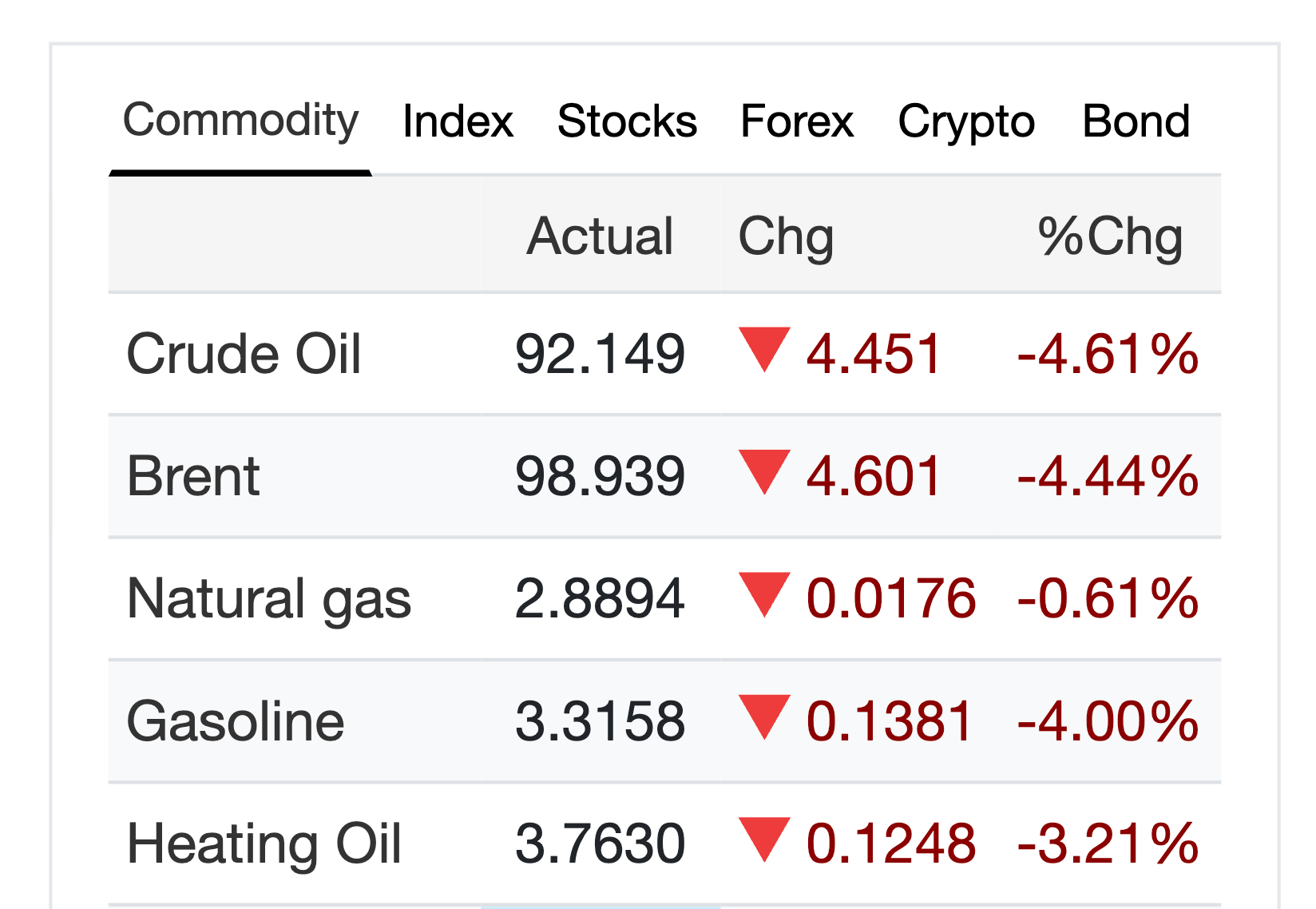
Oil prices tumbled more than 4% after President Donald Trump signaled orderly progress in Iran nuclear talks but told his team not to rush a deal.
West Texas Intermediate crude dropped 4.61% to $92.1, while Brent slid 4.44% to $98.9. The selling rippled across the broader energy complex.
Gasoline futures fell 4% to $3.3, and heating oil dropped 3.2% to $3.7. Natural gas slipped 0.61% to $2.88.

Trump’s Iran Post Reset the Oil Risk Premium
Oil had climbed sharply through the conflict, with Brent breaching $110 earlier in May. Notably, major de-escalation signals have knocked prices down.
Trump’s post leaned into patience over urgency. He thanked Middle East allies for their cooperation and floated the possibility of Iran eventually joining the Abraham Accords.
Follow us on X to get the latest news as it happens
Asian Stocks Rally and Crypto Edges Up as Risk Premium Fades
While energy markets moved south, risk assets moved in the opposite direction. Japan’s Nikkei 225 breached 65,000 on Monday for the first time. South Korea’s KOSPI rose 0.41% in early sessions.
Crypto markets posted modest gains as well. BeInCrypto Markets data showed that the broader market added 0.2% over 24 hours. Bitcoin (BTC) held near $77,000 after recovering from a low of $74,277.
With no deal yet and the blockade still in place, traders heading into the coming session will look for formal confirmation. A reopened Strait could ease Brent further. Any breakdown in talks would restore the geopolitical risk premium that has driven oil prices for the past three months.
Subscribe to our YouTube channel to watch leaders and journalists provide expert insights
The post Brent Crude Slides 4% as President Trump Signals Patient Iran Strategy appeared first on BeInCrypto.

Rising government bond yields are fueling a debate about a potential structural shift in the macro landscape, with one line of reasoning suggesting they could ignite a multi-year Bitcoin supercycle as investors seek stores of value less exposed to fiat devaluation. BitMEX senior research analyst Shang Wu argues that the path of long-duration yields and the mounting debt burden could push policymakers toward difficult choices that ultimately bolster non-fiat assets like Bitcoin.
Wu noted that the 30-year U.S. Treasury yield recently moved beyond 5.14%, while Japan’s 10-year government bond yield approached 2.8%. He contends these levels are not sustainable in the long run and may force governments to decide between currency debasement and a potential sovereign debt crisis. “Central banks are backed into a corner. They must choose between a sovereign debt collapse and debasing their currencies,” Wu said. He framed Bitcoin as having a chaotic near-term volatility, but a longer-term structural tailwind that could sustain a lasting bull cycle.
For Bitcoin, the upcoming volatility will be chaotic in the short term, but it serves as the ultimate structural tailwind for a long-term supercycle.
The backdrop to these arguments includes a U.S. national debt that has surged toward the $39 trillion mark, alongside heightened geopolitical frictions that could lift government spending and inflationary pressures. Prolonged conflict in the region has also contributed to energy price volatility, feeding into a broader inflation narrative that complicates conventional monetary policy.
In this context, Wu and other macro observers frame the current moment as a test of fiscal and monetary resilience. The debt level, combined with rising interest costs, poses a fundamental challenge to traditional inflation-fighting tools. As the debt burden grows, critics warn that higher rates will increasingly consume resources previously available for other public priorities, complicating attempts to stabilize prices without compromising fiscal footing.
Other voices in the macro space, including Lyn Alden, argue that governments and central banks will attempt to disguise quantitative easing through subtler liquidity measures, such as yield-curve control or unannounced debt purchases. The thrust of the argument is that even as rates stay elevated, the central bank toolbox may lean on less visible forms of monetary stimulus to preserve growth and market functioning.
Key takeaways
- BitMEX analyst Shang Wu ties a surge in long-term yields and the mounting U.S. debt load to a possible structural shift that could create favorable conditions for Bitcoin’s longer-term upcycle.
- The U.S. national debt, hovering near $39 trillion, raises questions about the sustainability of higher rates, as rising interest costs could squeeze the federal budget and crowd out other priorities.
- Observers like Lyn Alden warn that policymakers may deploy QE-adjacent tools (e.g., yield-curve control or stealth debt purchases) to maintain liquidity without overtly expanding the balance sheet.
- Despite potential near-term volatility, the macro setup is framed as a long-run tailwind for Bitcoin if the thesis about fiscal-financial dynamics holds true.
Bond yields, debt dynamics and the Bitcoin thesis
At the core of the argument is a tension between traditional inflation control and the fiscal reality of a ballooning national debt. As yields rise, the cost of servicing existing obligations tightens the government’s fiscal space, potentially limiting capacity to fight inflation through conventional rate hikes alone. Wu contends that stubborn debt servicing costs could push policymakers toward alternatives that are not easily reversed, a scenario many crypto observers view as supportive of a non-sovereign store of value like Bitcoin.
From a policy optics standpoint, the narrative points to a paradox: higher rates are intended to curb inflation, yet when debt service eats a larger share of tax revenue, the political economy of fiscal management becomes more fragile. In such a setting, the argument goes, assets with fixed supply characteristics—like Bitcoin—may attract more capital as a hedge against monetary dilution.
What to watch moving forward
The trajectory of long-term yields, the pace of debt accumulation, and the evolving toolkit of central banks will shape how investors price risk across assets in the coming months. If policymakers lean more on covert liquidity injections than overt tightening—whether through yield-curve control, balance-sheet operations, or other less visible measures—the perceived safety and scarcity of non-sovereign assets could intensify demand. For Bitcoin traders and holders, the key question remains whether this environment translates into a durable, multi-year upcycle or a period of heightened volatility before a clearer macro regime emerges.
As always, readers should monitor the evolution of the U.S. debt trajectory and the policy responses that accompany it, including any shifts in liquidity provision and debt management strategies. The balance between fiscal constraint and monetary flexibility will ultimately shape the incentives for risk-taking across traditional financial markets and the crypto sector alike.

TLDR:
- Kevin Warsh said AI productivity gains could reduce inflation pressure across the broader economy.
- Markets linked Warsh’s AI comments to possible future Federal Reserve interest rate cuts.
- Crypto traders tracked the remarks as Bitcoin remains sensitive to changing liquidity conditions.
- Fed officials still depend on inflation and labor data before changing monetary policy direction.
Bitcoin and crypto markets reacted after incoming Federal Reserve Chair Kevin Warsh connected artificial intelligence to lower inflation pressure.
His remarks added AI productivity gains to the wider discussion around future interest rate cuts. Investors quickly tied the comments to broader risk appetite across stocks, crypto, and financial markets.
The discussion arrives as traders continue tracking inflation data and Federal Reserve policy signals closely.
Kevin Warsh Connects AI Productivity Gains to Inflation Trends
Kevin Warsh said on CNBC that artificial intelligence could act as a disinflationary force through stronger productivity and wage growth. The comments appeared in a clip later shared by Crypto Rover on X.
Warsh linked AI adoption to lower operating costs and improved efficiency across industries. The remarks placed AI inside the ongoing inflation debate. Productivity growth can reduce production costs over time.
Lower costs may help ease pressure on consumer prices if companies maintain output levels. Federal Reserve officials continue watching inflation, wages, and labor conditions before adjusting interest rates.
Lower inflation readings usually improve the possibility of future policy easing. Markets often react quickly when Fed expectations begin shifting.
Warsh did not announce policy changes or signal immediate rate cuts. The Federal Reserve still depends on economic data over several months. Officials continue reviewing payroll growth, consumer spending, and inflation expectations before changing monetary policy.
Crypto traders also linked the comments to broader market liquidity conditions. Lower interest rates often support demand for risk assets like Bitcoin and technology stocks. Markets have historically responded positively when borrowing costs move lower.
Debate Expands Beyond Inflation Data
Warsh’s comments arrived while investors continued monitoring incoming inflation reports and employment data. According to the CNBC interview referenced in the source material, AI could improve productivity without weakening labor markets.
That combination may eventually support softer monetary policy. The discussion gained traction across crypto communities after DeFiTracer shared additional commentary on X.
Several traders focused on how AI adoption could affect long-term inflation readings. The debate expanded beyond technology earnings and semiconductor demand.
Artificial intelligence already plays a growing role across software, cloud computing, and enterprise spending. Companies continue investing heavily in automation and AI infrastructure. Those investments may improve operational efficiency over time.
Still, the Federal Reserve has not changed its inflation framework. Officials continue emphasizing durable inflation declines before considering sustained rate cuts. Wage growth and labor market stability remain central to policy decisions.
Warsh is also expected to replace Jerome Powell as Federal Reserve Chair this Friday, according to the provided source material. The timing increased market attention around his CNBC remarks. Investors now continue watching whether future economic reports support the productivity-driven inflation argument.
Crypto markets remain sensitive to Federal Reserve policy expectations. Bitcoin, equities, and the dollar often react when traders adjust rate cut forecasts. Upcoming inflation and jobs data may now shape how markets interpret AI’s role in future monetary policy.

TLDR:
- Vitalik Buterin said the Ethereum Foundation will reduce its influence across the broader ecosystem.
- Ethereum leadership placed stronger focus on decentralization, privacy, and censorship resistance goals.
- Buterin rejected speed-focused blockchain competition while defending Ethereum’s long-term technical roadmap.
- Michaël van de Poppe linked weak Ethereum sentiment with potential long-term accumulation opportunities.
Ethereum co-founder Vitalik Buterin shared a detailed update on the future direction of the Ethereum Foundation and its long-term priorities. He said the organization plans to reduce its central role while focusing more heavily on decentralization, privacy, and censorship resistance.
The comments appeared as Ethereum continued facing weak price performance against several major crypto assets. The discussion also resurfaced broader debates around Ethereum’s technical roadmap and institutional role inside the crypto market.
Ethereum Foundation Shifts Toward Decentralization and Privacy
Buterin said the Ethereum Foundation does not serve as the center of Ethereum. Instead, he described it as one participant among many across the ecosystem.
He explained that the foundation plans to become smaller and more selective over time. According to his post, the board is also expanding while his own influence inside the organization decreases.
Buterin credited Aya Miyaguchi for executing much of the organizational transition. He also noted that most of his recent involvement focused on technical questions.
The Ethereum co-founder said earlier operational problems inside the foundation had already improved during 2025. He added that the remaining concern involved whether the foundation’s actions matched Ethereum’s stated principles.
His comments focused heavily on decentralization, privacy, and resistance to censorship or external control. He argued Ethereum should avoid becoming another blockchain optimized only for speed and transaction throughput.
Buterin also discussed Ethereum’s long-term technical direction. He pointed to AI-assisted formal verification as a path toward bug-free blockchain infrastructure and stronger network security.
The post further highlighted efforts around public mempools, intermediary minimization, and lean consensus systems. He described those areas as central to Ethereum’s identity and technical differentiation.
According to Buterin, the Ethereum Foundation currently holds roughly 0.16% of total ETH supply. He contrasted that figure with other blockchain foundations that reportedly control much larger allocations.
Ethereum Market Debate Grows as $ETH Underperforms
The Ethereum discussion spread quickly across crypto social media following Buterin’s statement. Many traders linked the comments to Ethereum’s recent market performance.
Crypto trader Michaël van de Poppe argued that weak sentiment around Ethereum could create accumulation opportunities. His comments focused on capital rotation away from short-term outperforming assets.
Van de Poppe said many traders were moving away from Ethereum after months of weaker price action. He suggested some investors now viewed current ETH valuations differently from high-momentum tokens.
Buterin also addressed Ethereum’s scaling direction during the post. He said Ethereum should not compete purely on maximum throughput or extremely low latency.
Instead, he emphasized security, censorship resistance, and open infrastructure. He described those goals as more important than matching the fastest blockchain networks.
The post additionally referenced Ethereum layer-2 systems and specialized scaling networks. Buterin said properly designed L2s could still support higher transaction capacity without weakening Ethereum’s core principles.
He also noted that most of his personal net worth remains allocated to ETH. According to the statement, the rest mainly supports open-source biotech, software, and hardware initiatives.

Vitalik Buterin, Ethereum’s co-founder, has pushed back against criticisms that the Ethereum Foundation should play a more aggressive, market-facing role in supporting token prices or marketing efforts. In a public note and subsequent remarks, Buterin outlined a recalibrated view of the Foundation’s remit, stressing that its mandate is to advance censorship resistance, open-source software, long-range research, cybersecurity, and the decentralization of the Ethereum protocol.
In a reframing of the Foundation’s position, Buterin emphasized that the EF is “not a centre of Ethereum,” but rather “one node, with a defined purpose, alongside other nodes.” He added that the Foundation has always advocated for the latter role, even as some in the ecosystem — and within the EF itself — urged a shift toward a more centralized, marketing-driven function. “Now, we are taking action to ensure that we will be the latter,” he said, signaling a deliberate move away from any perception that the EF is the ecosystem’s controlling hub.
“EF is not a ‘center of Ethereum’, rather EF is ‘one node, with a defined purpose, alongside other nodes’. We have always said that the EF should be the latter, but many in the Ethereum ecosystem, and even within the EF, wanted us to be the former.”
The Ethereum Foundation’s mandate, published in March 2026, frames its activities around long-term governance and core protocol resilience. Buterin signaled that the Foundation’s future focus would be on strengthening Ethereum’s cybersecurity, maintaining a robust codebase, and supporting research that underpins long-range, decentralized growth — rather than competing with high-throughput networks or chasing rapid user growth through promotional campaigns.
These comments come amid ongoing market pressure on Ethereum and heightened scrutiny of the Foundation’s role. A number of large ETH holders have liquidated portions of their positions, underscoring the tension between tokenomics and market sentiment. At the same time, leadership changes within the EF — including high-profile departures — have intensified questions about the organization’s capacity to influence the ecosystem’s trajectory.
Buterin acknowledged that the Ethereum Foundation possesses a relatively small stake in ETH, noting that it holds roughly 0.16% of the total supply. He contrasted this with other foundations in the crypto space, which in some cases hold much larger percentages of their native tokens. The point, he argued, is that a token’s health is not built on the Foundation’s balance sheet alone but on the broader, long-horizon work it funds.
Meanwhile, the industry has been weighing tokenomics as a central factor in Ethereum’s post-Dencun landscape. The Dencun upgrade — a major protocol update released in March 2024 — significantly reduced layer-1 fees for layer-2 transaction activity, a shift that coincided with a notable drop in base-layer revenue. As Laura Shin, a veteran crypto journalist, observed, many market participants have struggled to reconcile Ethereum’s high development ambitions with the immediate measures that impact token economics.
“I think Ethereum’s original sin was not considering tokenomics with every move it made from Dencun on,” Shin remarked, highlighting the persistent tension between on-chain efficiency gains and the market’s appetite for tangible, price-related signals.
In the near term, the price environment has remained challenging. At the time of reporting, Ethereum traded around $2,094, still more than 50% below its all-time high of nearly $5,000 reached in August 2025. The price backdrop has fed a narrative among some investors that the ecosystem’s structural improvements will take time to translate into broader market enthusiasm.
Against this backdrop, the Ethereum Foundation has signaled a shift in its treasury strategy. Buterin stated that the EF plans to “focus on longevity” and stretch its funds to finance research, implying a potential reduction in the pace of ETH sales in the future. This comes after months of treasury moves designed to balance research funding with the realities of a bear-leaning cycle.
In May, the Foundation unstaked 21,270 ETH from the Lido liquid staking platform as part of its treasury management. Unstaking such a portion of ETH could affect yield generation for the Foundation, though a direct sale of those tokens had not been confirmed at press time. The unstaking decision aligns with a broader effort to optimize funds for long-term research and protocol work rather than short-term liquidity events.
The evolving stance from the EF — coupled with ongoing debates about tokenomics, governance, and the role of large holders — continues to shape investor expectations. The market is watching not only how the Foundation deploys resources but how its actions intersect with the broader dynamics of Ethereum’s scaling roadmap and security posture, including ongoing research into censorship resistance and decentralization.
Several industry observers have framed the Foundation’s role as a stabilizing force in a rapidly evolving ecosystem. A core question remains: will the EF’s emphasis on longevity and openness translate into measurable gains for developers, users, and long-horizon holders, or will market dynamics continue to demand more immediate signals from institutions within the Ethereum ecosystem?
Under pressure amid shifting tokenomics and leadership changes
The timing of these remarks coincides with broader investor sentiment shifts. The market has seen a number of high-profile departures from the Ethereum Foundation, and questions persist about whether such moves reflect a broader recalibration of influence within the ecosystem. In parallel, major holders’ selling activity — including reports of large-scale exits from long-standing ETH positions — has kept price action in check and heightened scrutiny of the EF’s treasury strategy.
Critics have argued that a token’s value should be anchored not only in protocol upgrades and research outputs but also in transparent, policy-driven actions that align with investors’ expectations. Buterin’s response emphasizes governance and resilience over marketing and market-making. He reiterated that the EF’s core mission remains focused on enabling a robust, decentralized Ethereum via open-source software, robust security, and long-term research, rather than acting as a cash-generating, brand-building entity.
In practical terms, readers should watch how the EF allocates funding for critical research programs, cybersecurity initiatives, and codebase improvements. The impact on developer activity, network reliability, and ecosystem incentives may take time to materialize in price signals, but could influence Ethereum’s long-run trajectory as a decentralized platform.
For investors and builders, the episode underscores a broader market truth: token prices respond to a complex mix of tokenomics, on-chain efficiency, governance credibility, and the visibility of foundational research. As Ethereum continues to evolve, the balance between accelerator programs and foundational stability will shape how the ecosystem translates technical progress into real-world adoption.
Meanwhile, observers will closely monitor any further treasury actions by the Foundation. The question remains whether the EF will maintain a lean, long-horizon funding model or adjust its holdings in response to market conditions, regulatory developments, and the pace of protocol upgrades. In any case, the emphasis on longevity and decentralization signals a deliberate attempt to preserve Ethereum’s core values even as market dynamics push for quicker, price-driven outcomes.
With the mandate now clearly articulated, market participants will want to see how these principles translate into concrete outcomes: deeper security auditing, more robust layer-2 compatibility, and continued open-source growth that can withstand scrutiny from regulators and competitors alike. The coming months will reveal whether the Ethereum Foundation’s refined role can coexist with the ecosystem’s broader ambitions and the market’s appetite for visible progress.
Readers should remain attentive to updates on the EF’s funding priorities and any further shifts in treasury policy, as well as to how major holders and developers react to a framework that prioritizes longevity and resilience over short-term market signaling.
Related coverage: blockchain researchers defend the Ethereum Foundation’s exact role in the ecosystem, arguing that it is performing its job as defined.
What comes next for Ethereum’s governance and tokenomics?
As Ethereum navigates a post-Dencun world and a market that remains sensitive to tokenomics, the question for many investors is whether a more restrained, longevity-focused Foundation will foster sustainable long-term value. The roadmap remains significant: continued improvements to security, scalability where appropriate, and governance practices that align with decentralized principles. If the EF’s actions translate into stronger code quality, fewer security incidents, and clearer funding for long-range research, the ecosystem could gradually gain the stability that price rallies alone cannot deliver.
In sum, Vitalik Buterin’s reaffirmation of the Ethereum Foundation’s role reflects a broader shift toward governance that prioritizes resilience and open development over marketing-driven market signaling. The market’s reaction over the coming months will hinge on tangible outcomes from funded research, code improvements, and the Foundation’s ability to sustain innovative work without drift toward centralized gatekeeping.
What to watch next: any updates on the EF’s treasury strategy, further treasury movements, and new research initiatives that address core protocol challenges. As Ethereum continues to mature, investors and developers will gauge whether the Foundation’s clarified mandate translates into a healthier, more decentralized ecosystem that can weather price volatility and regulatory scrutiny alike.

Pride for Regis Le Bris as Sunderland seal European place

watchOS 27 minimal update beyond heart rate tracking changes

Seru! Peserta Jogja Financial Festival 2026 Dapat Tips Sukses Dari Bos Danantara, Dony Oskaria


![TORINO & PASHATA - OLD MONEY [OFFICIAL 4K VIDEO]](https://wordupnews.com/wp-content/uploads/2026/05/1779687619_maxresdefault-80x80.jpg)

-

 Crypto World3 days ago
Blockchain.com files with SEC for U.S. IPO
-

 Fashion2 days ago
Holiday Weekend Open Thread – Corporette.com
-

 Crypto World3 days ago
Bitcoin Accumulation Weakens as BTC Realized Losses Hit $600M
-

 Business3 days ago
Dell Technologies DELL Stock Surges 15% on AI Server Momentum and Analyst Upgrades in 2026
-

 Crypto World3 days ago
Space X IPO Is ‘Bad News’ for Tech Stocks: But What About Bitcoin?
-

 Politics2 days ago
Makerfield: a tale of two social-media histories
-
 Crypto World3 days ago
MicroStrategy’s Saylor Says Miners No Longer Set Bitcoin Price, Another Force Has Taken Over
-

 Crypto World2 days ago
Robinhood crypto COO Tanya Denisova exits
-

 Business11 hours ago
NYT Strands Answers May 24 2026 Revealed for Puzzle No. 812 Theme Summer Essentials
-

 Tech3 days ago
WhatsApp ads could make Irish debut after discussions with DPC
-
 Tech3 days ago
A 0.12% parameter add-on gives AI agents the working memory RAG can’t
-

 Crypto World3 days ago
AI infrastructure race heats up as IREN pitches full-stack strategy, WhiteFiber lands $160M deal
-

 Business3 days ago
Trump Invests $1M-$5M in Kura Sushi USA Chain With 27 California Locations
-

 Tech3 days ago
You Can Now Add ChatGPT To PowerPoint
-
Crypto World6 days ago
Revolut Launches Dogecoin Debit Card Across UK and EU
-
 NewsBeat4 days ago
Charity run by Reform leader Malcolm Offord accused of ‘law breaking’ over Scottish registration
-

 Sports3 days ago
2026 CJ Cup Byron Nelson leaderboard: Brooks Koepka finds putting stroke in Round 1
-

 Crypto World3 days ago
Trump Media’s Bitcoin Stash Shrinks Again as 2,650 BTC Lands on Crypto.com
-
Business3 days ago
Goldman Sachs reinstates Ageas stock coverage with neutral rating
-

 Crypto World4 days ago
Exa Labs raises $250 million in funding led by a16z
You must be logged in to post a comment Login