Sara Hagemann unpacks the results of the recent elections in Denmark and argues the distribution of votes speaks to broader patterns of political change across Europe.
Denmark went to the polls on 24 March, and the result was, by any measure, historically striking. The Social Democrats under Prime Minister Mette Frederiksen won the most seats — 38 out of 179 in the Folketing — but with just 21.9% of the vote, this marks the party’s worst result since 1903. Their two coalition partners, centre-right Venstre and the Moderates, also lost ground significantly: Venstre fell to 10.1% and 18 seats, its worst result in the party’s 156-year history, while the Moderates ended on 7.7% and 14 seats. Neither the left-leaning “red bloc” (84 seats) nor the right-leaning “blue bloc” (77 seats) secured the 90 seats needed for a majority. It is clear that the ongoing coalition negotiations will be protracted and complex, with Foreign Minister Lars Løkke Rasmussen’s Moderates occupying a decisive kingmaker role.
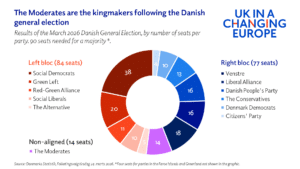
The elections can hence be described as a muddy outcome, yet with a clear message from the voters: the incumbent centre parties may have performed well on the international stage as they handled the unwelcome attention from the US over Greenland, and also delivered on a stellar EU presidency last year, but they did not convince the Danes on domestic issues. Indeed, the campaign exposed a deep divide over two issues in particular: environmental policy and immigration. Taken together, the results show a set of structural dynamics worth examining carefully — not least because they speak to broader patterns of political change across Europe.
One of the most striking features of this election was the degree to which the traditional left-right axis has become blurred among the larger centre parties. The outgoing government was itself an unusual creature: a cross-bloc coalition of the Social Democrats, Venstre, and the Moderates, straddling the historic red-blue divide. Its formation in 2022 was widely seen as an anomaly; the 2026 result suggests it may instead signal something more structural.
The Social Democrats have spent years migrating rightward on immigration while maintaining a strong welfare-state platform, and in this campaign moved further still — proposing a new wealth tax while simultaneously competing with Venstre on deportation policy. Venstre, in turn, entered the election supporting VAT cuts on food, a traditionally centre-left position, while promoting corporate tax reductions. The result: it became increasingly difficult for voters to locate clear ideological distance between the major parties on core economic questions.
This convergence in the centre of the main parties has now fed a flight of voters towards alternatives at both ends of the spectrum. The Green Left’s rise is the clearest expression on the left: around 15% of former Social Democrat voters switched to the more left-wing Green Left (SF) — a single shift that accounted for close to half of all Social Democrat losses. Conversely, the resurgence of the Danish People’s Party reflects a mirror image on the right, all based on a campaign to get even tougher on immigration (where Denmark is already a notorious hard-liner in Europe).
Hence, what this election makes clear is that Danish politics is increasingly organised around two cleavages that cut across the old left-right axis: immigration and environmental policy. This pattern is well-documented in comparative European politics — the transformation from one-dimensional left-right competition to multi-dimensional contestation around cultural, communitarian, and ecological values is a central finding of the past decade’s scholarship on Western European party systems. The common term is GAL-TAN: indicating the endpoints of a new “scale” based on ‘Green-Alternative-Libertarian’ and ‘Traditional-Authoritarian-Nationalist’ values.
On immigration, the competition across the spectrum was striking. The Social Democrats campaigned on a package of measures Frederiksen herself described as the strictest immigration regime in Europe, including proposals for a new Deportation Agency to handle cases through an administrative rather than judicial track, and continued support for offshore asylum processing in partnership with other EU countries. Venstre matched this with a stricter deportation reform as a central plank. The Danish People’s Party went further, calling for “remigration” — the large-scale removal of immigrants, particularly Muslims — and leader Morten Messerschmidt stated publicly that his party would only support a government committed to actively reducing the number of Muslims in Denmark.
The effect of this cross-party bidding war was paradoxical for the Social Democrats: having moved substantially rightward on immigration — a strategy that alienated some left-leaning voters — they were nonetheless attacked from the right as insufficiently tough. Immigration, once primarily the terrain of the radical right, has become a contest across the whole party system.
The environmental dimension is equally revealing. The 2026 campaign became, improbably, as much about pigs as about any other single domestic issue. Denmark is Europe’s most pig-dense country, producing close to 30 million animals annually, and the environmental consequences — nitrate pollution of groundwater, pesticide contamination, and threats to drinking water quality — became a major campaign theme in the final weeks, driven by new research and a citizens’ initiative that gathered over 80,000 signatures. Green organisations launched what they called a ‘svinevalg’ — pig election — framing the vote as a choice between agricultural interests and environmental and public health.
Alongside farming policy, opposition to large-scale onshore solar development emerged as a distinct political fault line — particularly among rural parties on the right, pointing to a broader urban-rural dimension in environmental politics. The Denmark Democrats campaigned against the siting of solar farms on agricultural land under the slogan “yes to fields of wheat, no to fields of iron,” framing Denmark’s rapid renewable energy expansion as a threat to rural landscapes and agricultural communities.
Coalition negotiations will now revolve almost entirely around the Moderates. Løkke Rasmussen’s call on election night to stop talk of “corner flags” and come play “in the middle” was both a negotiating position and an accurate description of his strategic leverage. A continuation of some form of centrist arrangement — whether under Frederiksen or Venstre’s Troels Lund Poulsen — remains the most likely outcome.
For observers in the UK and across Europe, the most important question is what this means for Danish foreign policy. Here, the answer is considerably clearer than the domestic picture. On Ukraine, European defence, and NATO, Denmark has been among the most consistent and vocal European voices — and this position enjoys cross-party consensus. Regardless of who leads the next government, Denmark’s commitment to Ukrainian sovereignty, its support for European defence investment, and its role as a reliable EU partner will not waver.
By Sara Hagemann, Professor, University of Copenhagen, and Visiting Professor, London School of Economics and Political Science.

















































You must be logged in to post a comment Login