Connect with us
DAPA Banner
DAPA Coin
DAPA
COIN PAYMENT ASSET
PRIVACY · BLOCKDAG · HOMOMORPHIC ENCRYPTION · RUST
ElGamal Encrypted MINE DAPA
🚫 GENESIS SOLD OUT
DAPAPAY COMING

Tech

8 Basic Car Maintenance Skills Every Person Should Know

Published

on


If you’re going to own something, it’s generally a good idea to know how to take care of it. Whether it’s shoes, gadgets, accessories, or cars, there’s bound to come a time during your ownership when wear and tear starts to show. When this happens, it’s okay for your first instinct to be to call a professional — especially if you’re inexperienced. You might not know what to do or how exactly to do it, and the last thing you want is to make things worse.

However, in the case of vehicle maintenance or repair, calling a mechanic can get pricey fast. Depending on the task, even routine tasks can end up costing you well into the hundreds of dollars. With this in mind, there’s a tendency to reserve your professional calls for only when it’s absolutely necessary.

In an ideal world, provided you stick to your vehicle’s recommended maintenance schedule, you shouldn’t run into any problems. Unfortunately, life happens — you could run over some nails with your tire, your battery could degrade; any number of things can go wrong. The inexpensive option, if you know what you’re doing, is to roll up your sleeves and do the dirty work yourself. Of course, this means you should always keep some tools in your car, but with a handful of maintenance skills like we’ve listed below, you could save thousands of dollars in repairs.

Advertisement

Check tire pressure and tread depth

The importance of caring for your tires can’t be overemphasized — they are your car’s only contact with the road. Over time, all that friction from pounding pavement (and climbing rocks, if you like offroading) is going to wear the tire out. That wear primarily shows up in two forms in the rubber: a loss of pressure and a reduced tread depth. Driving around with underinflated tires is a dangerous sport; your car’s equilibrium is distorted, the tires don’t grip the road as they should, braking isn’t as predictable, and the wear on the outer tire treads accelerates. You’re also getting worse gas mileage thanks to the increased rolling resistance of a partially-inflated tire.

Furthermore, there’s an increased risk of a blowout, which can lead to an accident. Generally speaking, you should run a quick visual inspection of your tires before getting on the road. To confirm your suspicions, you’ll want to keep a tire gauge handy. Pick a tire that looks underinflated, remove the tire valve cap, and attach the tire pressure valve to the open valve stem.

Advertisement

You’ll hear a hissing noise first; take the reading when it stops and compare it to your recommended tire pressure. If it’s lower than it should be, check and patch any punctures with sealant, and get it pumped. Tread depth, on the other hand, is a slightly more insidious problem. It’s not as immediately obvious as pressure to the eye, and it’s essential to your grip and braking abilities. If your tires have wear bars, use them, and get ready to change them if they’re getting into legally bald territory.

Advertisement

Change a tire

You could take all the necessary precautions and still run into a situation that needs you to change a tire. It’s a fairly simple procedure, but before you get to work, make sure to avoid common mistakes when changing tires, like not securing a safe work area or working on an incline. First, park as far away from traffic as possible. Target flat, solid ground, and engage your parking brake. Then, whip out your tire-changing equipment: the spare tire, jack, and lug wrench. You’ll typically find them somewhere in your rear cargo area.

Next, as an optional step, you’ll want to find something to wedge against the tire on the opposite side of the one you’re replacing. This step will keep your car from rolling during the change; a large rock or wooden block is enough. Once you’re done with this, take the lug wrench and slightly loosen the lug nuts holding the wheel — personally, I find it easier to do this step before jacking the car up. Don’t remove the tire yet, though.

Locate the jacking point closest to the faulty tire, turn the jack handle until the tire lifts off the ground, then fully loosen the nuts and remove it. Slip on your spare and tighten the nuts about halfway before lowering your car all the way. Remove the jack and tighten the lug nuts completely. Pro tip: Don’t let your hands do all the work — lean into the lug wrench for some extra leverage.

Advertisement

Check and replace fluids

You can expect your car’s fluid levels to deplete after a reasonable period of driving. Not monitoring them increases the risk of overheating. Thankfully, checking the fluids is pretty easy. First, make sure your engine is cool — it’s best to run this check before you start the day’s commute. A pro tip is to make sure you’re on level ground for this, as any incline can give deceptive readings.

Then, if your car doesn’t monitor oil levels electronically, pop the hood and locate the oil dipstick by looking for the handle. It’s usually a shade of yellow or orange located right on top of the engine. Once you find it, pull the handle all the way out to reveal the dipstick, which is a long, flexible metal wand. Next, take a paper towel or an old cloth rag and wipe the oil from it. Re-insert the dipstick all the way in, then take it out again to find out your car’s oil level.

Depending on your automaker, the dipstick may have guidelines like “LOW” or “HIGH” etched in the material, or simply two dots. The trick is to make sure your oil level is between those lines leaning towards the upper boundary. Similar logic applies to the other fluids in your car; remove their caps and note their level. If they’re running low, top them off (it’s a good idea to carry spare fluids at all times), and remember to stick to your oil change schedule.

Advertisement

Change filters

As your vehicle’s air filters age, their ability to keep unwanted particles out of your engine and air conditioning system degrades. If left unchecked, these particles build up and clog the filters, blocking airflow that the engine needs to work optimally. For the engine filter, this manifests in reduced fuel economy; if enough dirt passes through, your cylinders and pistons can get damaged. In the case of the cabin air filter, you might notice musty odors and weak circulation when you use your air conditioner. That can make summer trips very uncomfortable — it’s why we recommend addressing it well ahead of time.

The first step to changing your filters is to locate them. While it’s different in each vehicle, you’ll typically find the cabin air filter behind the glovebox (check your owner’s manual for more information). To access it, empty your glovebox and look for a pin on the outer edge of the framing. Use a screwdriver to loosen it — remember to keep it safe, as you’ll need that pin to reverse this process — and gently press on both sides of the glovebox to lower it and expose the air filter cover.

Put on some gloves for this part: Squeeze the tabs on either side of the cover to remove it and pull out the old filter. Before installing the new cabin filter, clean the compartment with a damp rag or vacuum. Then slot the new filter in — make sure the airflow arrows on the edge of the filter point in the same direction as the old one. As for the engine filter, it’s a similar process, but we have a separate segment on how to change it.

Advertisement

Replace and jumpstart a battery

When I first started driving, my car battery died on me more than once, and I couldn’t figure out why it kept happening. Between power drain, faulty terminal connections, and a host of other reasons, I found myself stranded multiple times since I’d never changed a battery before. The long waits were no fun, but you don’t have to go through the same learning process.

If your battery is old and needs replacement, having a professional handle the installation adds labor costs to the $100 to $250 it’ll set you back to get a new battery by itself. To save cost, you can replace the old one yourself, as it’s not that complicated. Before touching anything, make sure the engine is off. Then, pop the hood and disconnect the negative terminal first — it’s grounded to your car’s body, so removing it first shuts off the circuit. That’s important since you’ll be working with a metal tool like a plier to loosen the bolt securing the cable to the terminal; you don’t want to risk blowing a fuse by starting with the positive. It’s also a safety issue as well, as you don’t need to accidentally give yourself a nasty shock. 

Advertisement

Once the negative terminal is disconnected, do the same to the positive, and remove the battery. Take the new battery and connect it, starting with the positive terminal this time, and that’s the entire process. If you don’t have a new battery on hand, though, jumpstarting is a viable option. All you need is a pair of jumper cables and a “rescue” car to power your battery; we’ve provided a detailed walk-through on how to jump-start a car properly in the past.

Advertisement

Change windshield wipers

You need a clear line of vision to see the road ahead when driving, and wipers are essential to achieving this in the rain and winter. However, like nearly every component in a car, wiper blades wear with time. In the winter, for example, if you let your wipers rest on your windshield, they can get frozen in place. That exposure to ice can weaken the material, especially when you consider the chipping and scraping techniques one might deploy to free them.

A telltale sign your wipers need changing is when they start streaking the windshield or making squeaky noises. So, if you notice this, instead of having them installed at an auto shop, you could buy and install them yourself. If you’re going down the DIY path, the most important step is the actual purchase — make sure you’re buying the right set for your car’s dimensions. They’ll usually set you back considerably less than $100 for a the pair depending on the make and model of your vehicle, but you’ll save some change on labor.

To install the new wipers, lift the old ones off the windshield and make sure the wiper arms are fully upright. Then, press down on the tab and slide the wiper blade off the connector. Proceed to attach the new wipers to the arms by inserting the blade into the arm’s hook until you hear a click. Most wipers feature the same or similar attachment methods, but double-check your owner’s manual to avoid running into any problems.

Advertisement

Change light bulbs

Driving at night calls for your lamps to be in top condition; you don’t want to be on the highways with dim beams. According to the IIHS, cars equipped with headlights that have good visibility ratings are involved in 19% fewer crashes at night. That’s a significant number, so if you notice your lights dimming, you should replace them as soon as possible. Since estimates show that hiring a professional can cost as much as $300, you could save a couple hundred bucks by doing this yourself.

The first thing to do is to check your owner’s manual to discover what type of bulb you’ll need to replace your non-working one. When you’ve got your replacement bulb in hand, park your car, turn off the engine, and remove the key from the ignition. Then, pop open your hood and find the headlight cover. Unplug the connector to disconnect the power before removing the bulb housing. Depending on your automaker, you might need to press a clip, slide a lock, or unscrew a few fasteners to do this.

Once the bulb housing is out of the way, you can remove the dim bulb (unscrewing counterclockwise is usually the go-to move) and install the new one. If you’re using a halogen bulb, avoid touching the glass with your bare hands, as this can lead to the bulb burning out quicker; LED bulbs don’t have this limitation. Reconnect all the electrical components and fix the headlight cover back into place. Before driving, test your new headlamps to confirm they work — driving without functioning headlights is illegal.

Advertisement

Change brake pads

Hear a grinding or clicking sound whenever you apply the brakes? Those are usually telltale signs that your brake pads are worn and need to be refurbished. Now, you might want to leave this skill to the professionals since brake pads are essential to your safety. However, brake pad changes can be quite costly; labor costs range anywhere from $80 to $200 per axle.

You’re going to need to buy new brake pads — don’t be afraid to splurge on parts from an original manufacturer here; cheap ones aren’t worth it. The first step in installation is to loosen the lug nuts on the tire with the problematic pad. After this, raise your vehicle with a jack, place a jack stand where it can safely support the car’s weight, lower the car onto it, then remove the wheel. Next, you’ll need to find and remove the caliper mounting bolts. A brake caliper press tool could make your task much easier here.

If your car model has guide pins that hold the caliper in place, check them for rust — if there’s any, you’ll need to replace those too. The brake caliper should pivot upwards without the bolts, at which point you can easily slide the old brake pads out from the retaining clips. Replace the old retaining clips as well (they usually come with the brake pads you’ll purchase) and apply some grease to the new ones. Then, put the new brake pads in and set to work reassembling the caliper mounting bracket. Considering changing your rotors as well, or want an even more in-depth explainer on the process? We’ve got you covered with this guide on changing your brake pads on your own.

Advertisement


Source link

Advertisement
Continue Reading
Click to comment

You must be logged in to post a comment Login

Leave a Reply

Tech

AMD claims next-gen Zen 6 server CPU will deliver 330% of Nvidia Vera’s performance per rack

Published

on

What we know so far: As the server battle between AMD and Nvidia enters a new phase, the two companies have begun trading jabs through performance estimates and early benchmarks. While Nvidia-approved results suggest its Vera processors outperform most AMD Epyc chips, Team Red believes its upcoming Venice lineup can leave Vera in the dust.

AMD recently published performance projections claiming its upcoming server CPU platform will dramatically outpace Nvidia’s latest showing. AMD’s estimates directly reference earlier results from controlled benchmarks that had favored Nvidia’s processor.

Team Red’s next data center CPU platform recently entered production and is on track to launch later this year. Built on AMD’s Zen 6 architecture, Epyc Venice chips will offer up to 256 cores and 512 threads. The lineup also marks AMD’s transition to TSMC’s 2nm process, a jump directly from the 4nm Epyc Turin that skips the 3nm node entirely.

AMD is projecting a 70% overall improvement in performance and efficiency over Turin, along with a 30% increase in thread density.

Advertisement

Nvidia, for its part, formally launched its Vera server CPU at GTC in March. The Arm-based SoC packs 88 cores and 176 threads. In recent benchmarks, Phoronix described Vera as the most capable Arm processor it has ever tested, outclassing Intel Xeon and AMD Epyc across most workloads. However, the tests were conducted at Nvidia’s headquarters and came with several restrictions to ensure Nvidia’s sign-off.

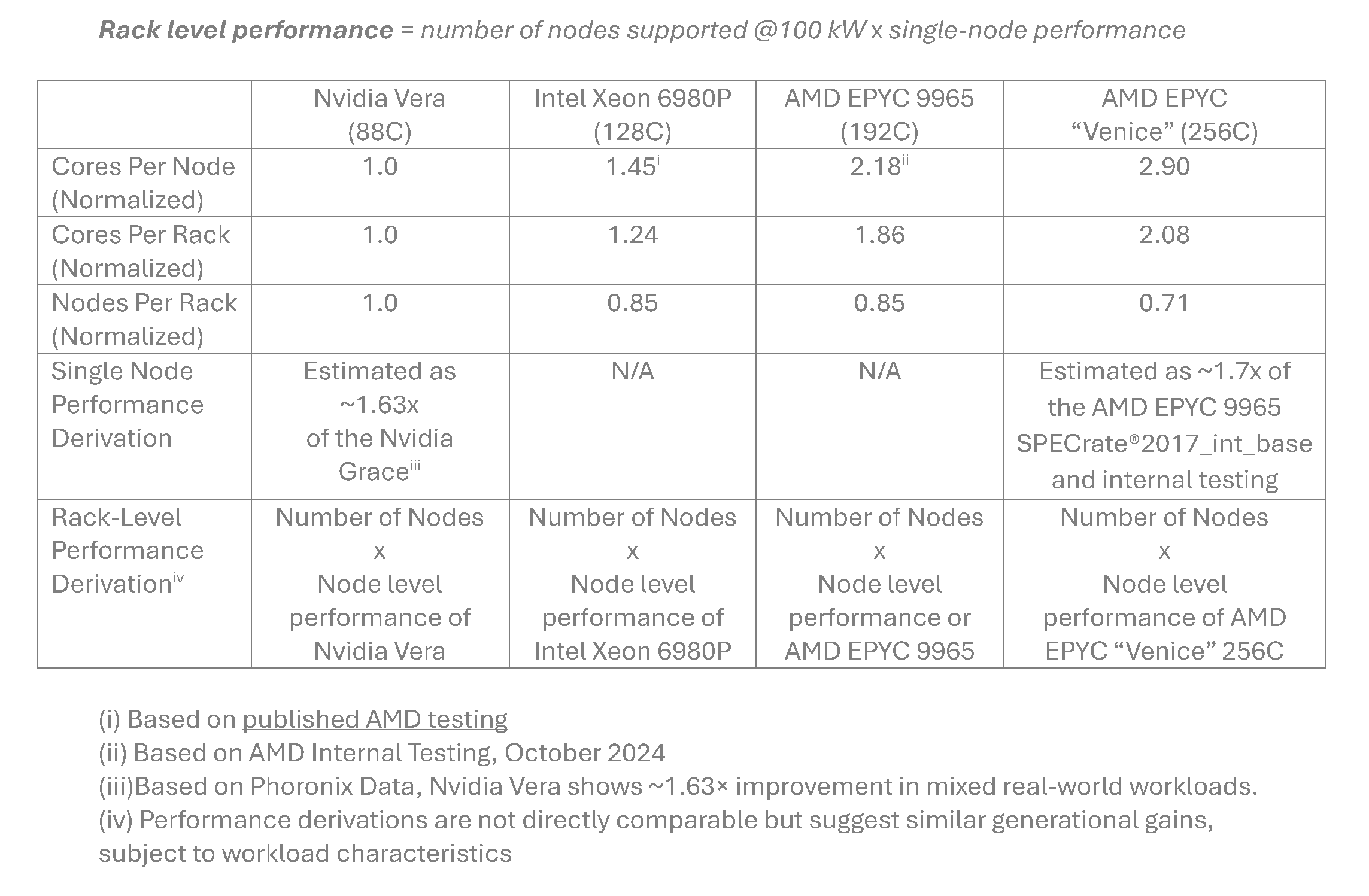
AMD drew on Phoronix’s figures when building the methodology for its Venice projections.

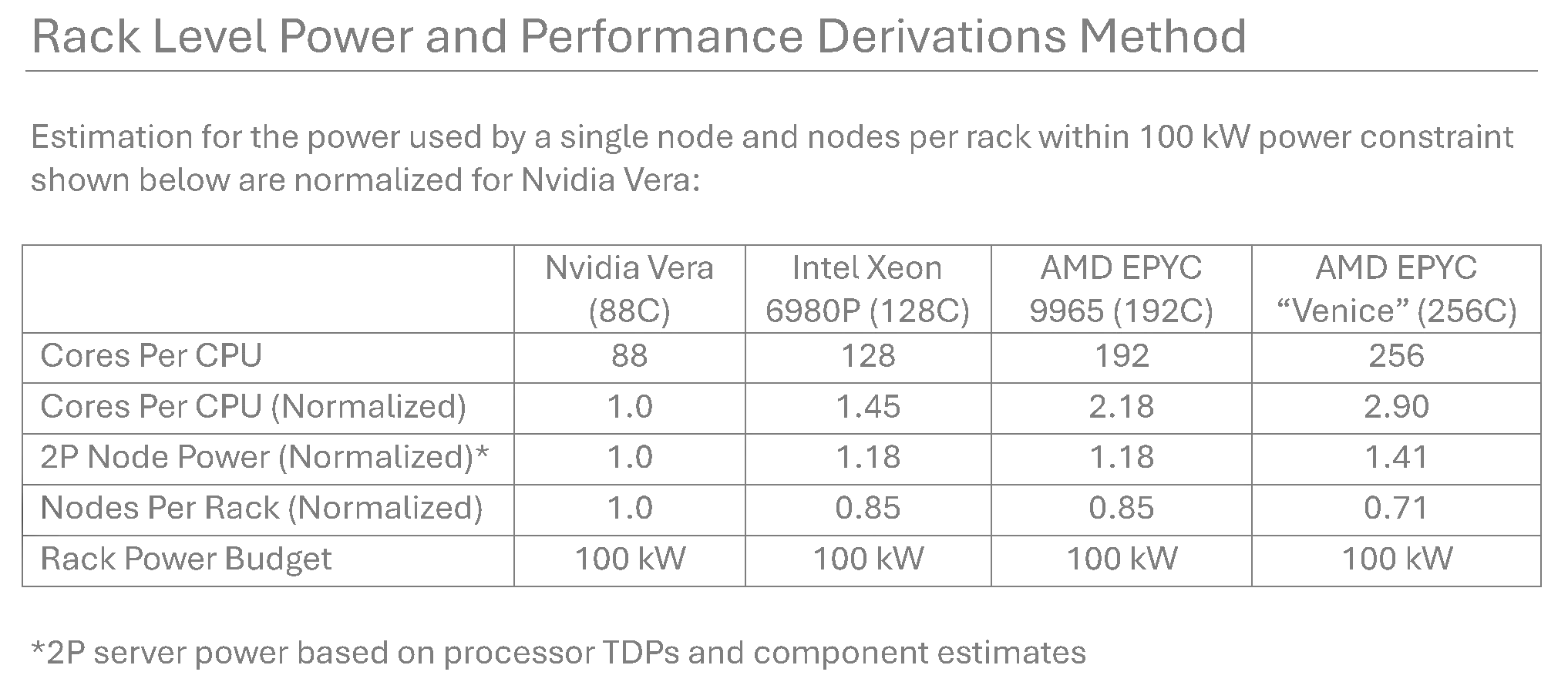
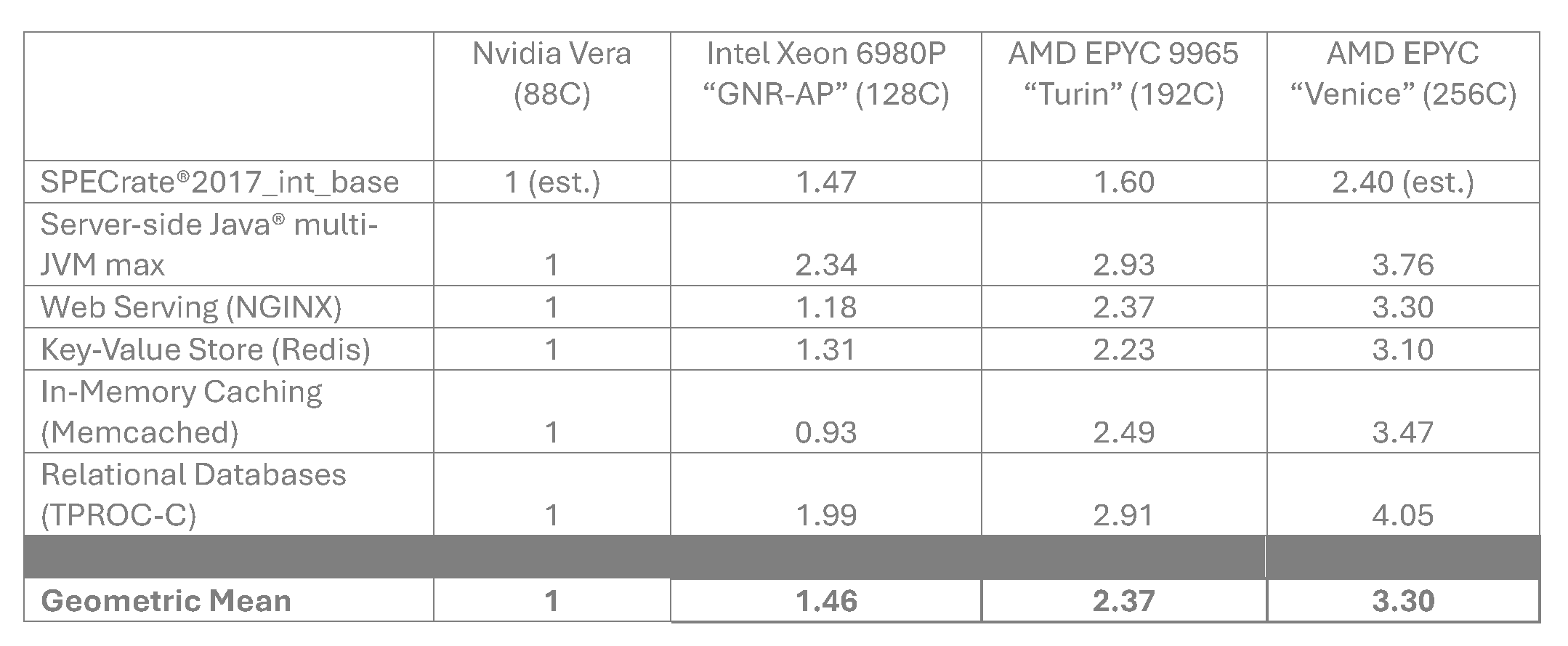
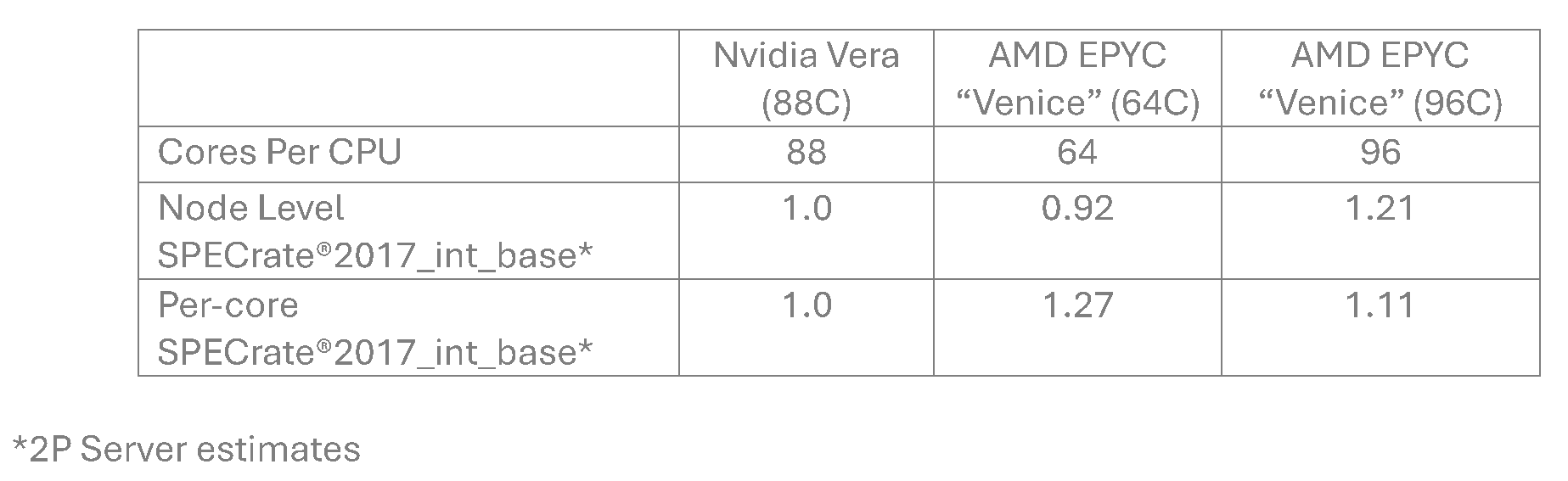
Comparing core counts per CPU, node power, nodes per rack, and a 100kW rack power budget, the company estimates Venice will deliver 3.3 times Vera’s per-rack performance. AMD also projects its 192-core Epyc 9965 Turin and the 128-core Intel Xeon 6980P GNR-AP can reach 2.37x and 1.46x of Vera’s output, respectively.

AMD is also challenging Nvidia on per-core performance, claiming a 64-core Venice chip can beat Vera by 27%, with the 96-core variant edging it by 11%.

Advertisement

As both processors target AI workloads, AMD argues that Venice’s higher core counts will translate into a meaningful advantage for agentic AI deployments. Even so, the true performance gap will remain uncertain until independent benchmarks arrive.

While promoting Venice’s theoretical performance, AMD is already hinting at what comes next. “Verano” will be AMD’s first CPU designed specifically for AI infrastructure. That chip is expected to introduce the Zen 7 architecture. Supply chain reports suggest Zen 7 will target TSMC’s A14 node, a 1.4nm-class process that would mark AMD’s entry into the angstrom era and deliver further gains in performance and efficiency beyond 2nm. AMD has not confirmed those details.

Source link

Advertisement
Continue Reading

Tech

Fewer iPhone users are upgrading to iOS 26 than iOS 18

Published

on

The iOS 26 update has the second-worst adoption rate of all iOS releases since 2015, falling behind both iOS 18 and iOS 8.

Though all eyes might be on iOS 27 and its AI-infused Siri, which debuted at WWDC, the software has only entered beta testing.

Most iPhones, or 79% of all devices to be more precise, are currently running iOS 26. This is according to Apple’s App Store data for June 2026, which also revealed that 86% of all devices introduced in the last four years have iOS 26 installed.

While these figures might seem impressive when taken at face value, the iOS 26 adoption rate is actually worse than that of the preceding iOS 18 update. In June 2025, 82% of all iPhones ran iOS 18, more than the 79% currently running iOS 26.

Advertisement

When taking into account Apple’s App Store data from all iOS releases from 2015 through 2026, the iOS 26 update actually has the second-lowest adoption rate, with only iOS 17 seeing fewer user upgrades.

The exact adoption rates for iOS 8 through iOS 26 for all compatible iPhones are the following:

  • 2015 iOS 8: 84%
  • 2016 iOS 9: 84%
  • 2017 iOS 10: 86%
  • 2018 iOS 11: 81%
  • 2019 iOS 12: 88%
  • 2020 iOS 13: 81%
  • 2021 iOS 14: 85%
  • 2022 iOS 15: 82%
  • 2023 iOS 16: 81%
  • 2024 iOS 17: 77%
  • 2025 iOS 18: 82%
  • 2025 iOS 26 79%

Note that all of these adoption rates were taken in June of the corresponding year, with the exception of iOS 12 usage data, which was published in August 2019.

At 79%, the iOS 26 adoption rate is below the 82.3% average from 2015 through 2026. Still, it’s not all bad news.

In February 2026, only 66% of all iPhones were running iOS 26, meaning more users have upgraded in the last couple of months. This is to be expected, though.

Advertisement

Even so, not everyone has embraced the controversial iOS 26 upgrade. According to Apple’s June 2026 App Store data, 14% of devices are still running iOS 18, while 7% are still on even older releases.

Apple’s data on newer devices running iOS 26

Since 2020, in June of every year, Apple has published iOS adoption rates for devices “released in the last four years.” At 86%, the adoption rate for iOS 26 is identical to that of iOS 17 in 2024. Meanwhile, iOS 18 had a higher score, at 88%.

The adoption rate of iOS 26 is also lower than the 87.6% average when Apple’s data from 2019 through 2026 is taken into account. Previous iOS updates, like iOS 12 in August 2019, saw lower adoption rates among newer devices, so iOS 26 is not an outlier in any sense.

Apple’s exact numbers for “all devices introduced in the last four years,” since the company released such data, are:

Advertisement
  • 2019 iOS 12: 85%
  • 2020 iOS 13: 92%
  • 2021 iOS 14: 90%
  • 2022 iOS 15: 89%
  • 2023 iOS 16: 90%
  • 2024 iOS 17: 86%
  • 2025 iOS 18: 88%
  • 2026 iOS 26: 86%

While iOS 26 has fallen behind iOS 18, possibly due to its Liquid Glass design language, the difference is likely not enough to cause alarm for Apple. Looking ahead, iOS 27 could boost iOS adoption rates.

Rather than controversial design changes, Apple says the iOS 27 update will deliver improved performance on older iPhones, with app opening speeds now being 30% faster, relative to previous releases.

Additionally, the same iPhone models that support iOS 26 can be updated to iOS 27, including the iPhone 11. As such, iOS 27 seems to have little to deter potential upgraders. Time will tell if the iOS 27 adoption rate will actually be higher than that of iOS 26, though.

Source link

Advertisement
Continue Reading

Tech

Fable’s 30-Minute Gameplay Demo Brings a Reactive Albion to Life

Published

on

Fable 30-Minute Gameplay Demo Build and Extraordinary Life
Microsoft shared a 30-minute gameplay video for Fable right after the latest Xbox showcase. The footage offers the most detailed look yet at how Playground Games plans to handle the return to Albion. Players step into the role of a hero who begins as a child discovering unusual powers in the village of Briar Hill. A time jump then moves the story forward to adult life, where decisions start to shape both the character and the surrounding world.


Playground Games based the game on three key ideas from previous entries. A fairytale tone is undoubtedly evident, but it is balanced by a particular British sense of humor and a heavy emphasis on making decisions that will have long-term consequences. The new story stands on its own, but it has a very familiar approach to fantasy.


Xbox Series X – All Digital Gaming Console – 1TB SSD – Includes Wireless Controller – 4K Gaming – 120FPS…
  • FASTEST, MOST POWERFUL XBOX — Experience next‑generation performance with 12 teraflops of processing power, delivering smoother gameplay, richer…
  • TRUE 4K GAMING UP TO 120 FPS — Enjoy breathtaking visuals with true 4K resolution, HDR, and frame rates up to 120 FPS, plus support for advanced…
  • 1TB CUSTOM SSD & VELOCITY ARCHITECTURE — Reduce load times dramatically with the custom 1TB SSD and XBOX Velocity Architecture, enabling…

Fable Screenshot
The combat system functions efficiently because it is divided into three fundamental categories: Strength for close-up and melee combat, Skill for ranged attacks, and Will for magic. Some of the videos show some very innovative uses for that magic, such as transforming an enemy into a chicken and then shooting them with a fireball, or sneaking up behind someone and teleporting past for a quick strike before the green orbs light up to indicate you’re accumulating experience.

Fable Screenshot
Reputation is based on what others see you do, not on an abstract number. So, assisting someone in need may earn you a virtuous or merciful reputation, which may result in a more welcoming reception from the community. If you cause disturbance in public, you may gain a reputation as a troublemaker, which could make things more difficult in the future. The system is clever since it allows you to build a reputation through a combination of good deeds as well as selfish goals, and you can even try to shape people’s impressions of you by spreading rumors or paying off local gossipmongers.

Fable Screenshot
Is it more than just fighting and main quests? You can truly establish your existence in the world. You can purchase a home, open a bar, a blacksmith business, and so on. You can even develop relationships with others, some of which may lead to your own family or a shared home. Instead of always rushing to complete the main story, the game lets you to take a break and enjoy the journey.

Fable Screenshot
Albion, the land in which you play, is full of little side paths and detours. There is no one “correct” way to play, so go explore, do some local jobs, and start building a life in any community you find yourself in. Towns look to be populated by real people, rather than just waiting for the hero to show, because the residents have their own schedules rather than simply hanging out till you arrive.

Fable Screenshot
The visuals are bright and stunning, with a timeless quality about them. The villages are full of flowers and thatched roofs, and the locals look to be going about their everyday lives rather than standing around waiting for you, which is one of the most impressive elements of this demo, given that the entire game will be released on February 23rd, 2027.
[Source]

Source link

Advertisement
Continue Reading

Tech

If You Grew Up In The ’60s, You Definitely Remember These Cars

Published

on


Every generation has its iconic cars. From the hot rods of the 1930s to the sleek sports cars of the 1980s, each era can be defined by its unique take on the age-old idea of how to make cars that are fast, cool, and expressive.

Across all of automotive history, the 1960s stand out as a special time for cars. High-performance vehicles were incredibly affordable, and gas wasn’t the premium product it is now. Many houses had one- or two-car garages, and most had a car that served as an extension of their own personality. The cars of this era had not yet settled into the homogenized style of the 1970s, retaining much of the hot-rod flair of earlier decades without becoming luxury status symbols reserved for only the wealthiest elites.

Advertisement

Let’s travel back in time to the golden age of automobiles and look at some of the most legendary vehicles of that one-of-a-kind decade. If you grew up in the ’60s, you definitely remember these cars. And if you didn’t, you surely still find yourself looking at them with an envious wistfulness of vicarious nostalgia. Simply put, they don’t make ’em like that anymore.

Advertisement

1965 Pontiac GTO

Over the years, Jay Leno’s Garage featured tons of iconic and expensive cars, but few are as downright legendary as this one. When the 1965 Pontiac GTO Royal Bobcat was featured on an episode of Jay Leno’s Garage, the former Tonight Show host described the vehicle as the first true supercar, an early example of the burgeoning American muscle car scene. He even went so far as to say, “This was the dream car when I was 14 or 15 years old.” 

The Pontiac GTO was special because it broke, or at least sidestepped, the rules. Back in the day, General Motors limited the size of a midsize car’s engine to 330 cubic inches. Big cars get big engines, small cars get small engines. But the engineers at Pontiac managed to stuff a 389-cubic-inch V8 engine into a midsize car, and the rest was history. Initially pitched as an optional engine upgrade for the Pontiac Tempest, its popularity led to the invention of the 1966 GTO as its own bespoke vehicle, and the birth of the American muscle car.

There’s nothing like the rev of an oversized V8 engine that’s just a little (or a lot) too big for the car it’s powering. Every child of the ’60s who sat in a car and felt the entire frame vibrate as the driver revved the engine had the exact same thought: “When I grow up, I want one of these.” Chances are, that car was a Pontiac GTO.

Advertisement

1968 Ford Mustang

For many automotive enthusiasts, love for cars comes from exposure to TV and movies. In that regard, the 1960s had some of the most legendary vehicles ever to grace the screen. There’s the 1966 Batmobile driven by Adam West in “Batman” and the Mach 5 from “Speed Racer,” as well as the Black Beauty from “The Green Hornet” and the Elva Mk VI, driven by none other than Elvis Presley in “Viva Las Vegas.”

However, if there’s a single scene that represents the blending of cars and cinema, it’s the 1968 Ford Mustang driven by Steve McQueen in “Bullitt.” For the most part, “Bullitt” is a by-the-numbers detective movie bolstered by McQueen’s cool charisma in the title role. However, it kicks into overdrive during the show-stopping ten-minute car chase sequence, which was a turning point in action cinema. The entire car chase genre, including the “Fast & Furious” series, would not exist without “Bullitt.” McQueen does much (but not all) of his own driving in the scene, which sees Frank Bullitt outmaneuver hitmen in a pulse-pounding pursuit through the streets of San Francisco.

Advertisement

The movie and its car chase inspired a whole generation of car fanatics. Everyone who saw “Bullitt” wanted a Ford Mustang. More than five decades later, Ford is still releasing modern Mustangs inspired by the one used in the film, such as the 2020 Ford Mustang Bullitt, named after the movie. As for the original 1968 Mustang used in the movie, it was sold for $3.74 million at a 2020 auction, making it the single most valuable Mustang of all time.

Advertisement

1967 Chevrolet Camaro

In 1966, Car and Driver magazine went hands-on with the 1967 Chevrolet Camaro SS 350 and came away impressed, though with more than a hint of melancholy. The Camaro, they surmised, was aimed at the youth market, which had been sideswiped by the escalation of the Vietnam War. The Camaro was hip and relatively inexpensive but hindered by the fact that its target audience of young men had been drafted into military service.

Nevertheless, the Camaro was priced reasonably, with both the hardtop and convertible versions retailing for less than $3,000 each, competitive with its main rival, the Ford Mustang. One of the more popular versions of the Camaro was the RS, or Rally Sport, variant, which featured concealed headlights, mag wheels, options for vinyl roof customization, and rally stripes. They don’t make the car any faster, but they sure look neat!

The car was marketed toward young people, though it earned the respect of auto enthusiasts due to its use as the Pace Car in the 51st Indy 500 in 1967, with none other than three-time Indy 500 champion Mauri Rose behind the wheel, thus giving the vehicle credibility among the gearhead community. As a result, the Camaro ingratiated itself with Indy 500 fans of all ages. There would be many Camaro variants over the decades, but the 1967 version is among the best-looking Chevy Camaros of all time. Not bad for a car approaching 60 years old.

Advertisement

Volkswagen Van

Even if you’re not a “car person,” you know what a Volkswagen van is. It’s the iconic “hippie bus,” and it’s instantly recognizable as an iconic car of the era. Design-wise, it had a ton of room in the back, which was perfect for road trips and the nomadic lifestyle of counterculture kids. Remember, back in, say, 1967, gasoline was only 33 cents per gallon on average, so going on even a cross-country trek wasn’t as difficult as it is now. If you wanted to drive for days at a time, you could just go without selling off all of your possessions first.

The original run of the Volkswagen Transporter was actually introduced way back in 1950, and it became popular in the beach scene. Teenagers of the era would pack into a VW and head to the beach for fun in the sun. Later on in the 1960s, however, the bus would become the de facto automobile mascot of the hippie scene. It was perfect for packing in many riders to go to protests, and there was plenty of room in the back for a little “free love,” if you will.

Advertisement

In 1967, the second-generation iteration of the vehicle was introduced, though it lost some of its bus-like novelty with the removal of the iconic split windshield design in favor of a more traditional single-pane windshield, among other changes that sacrificed the classic identity of the original Transporter. The VW Bus would evolve considerably over the years, but the original is still a fan favorite.

Advertisement

1963 Porsche 911

There were sports cars before Porsche, but the 1963 Porsche 911 changed the game. It wasn’t the first classic Porsche, but it was sleek and small with an instantly recognizable silhouette. Under the hood, the 911 boasted an air-cooled engine that delivered 130 HP. Despite making sports cars, Porsche also had a reputation for being (relatively) affordable and would go on to develop the Porsche 912 in 1965 as a less expensive alternative to the regular 911.

The Porsche 911 is an iconic car for bringing luxury sensibilities to everyday suburbia in the 1960s. Its engine may not have been able to compete with the muscle cars of Pontiac or Ford, but Porsche would upgrade the engine over the years. In 1966, the Porsche 911S boosted the engine to a more palatable 160 HP, and by 1971, the Porsche Carrera RS would boast a stellar 210 HP engine.

For many young people in the 1960s, Porsche was their introduction to the very concept of a sports car. For those who didn’t see the appeal of a bulky, muscular hot rod but still wanted to go fast, Porsche was the origin point for a lifetime of aspirational thinking.

Advertisement


Source link

Advertisement
Continue Reading

Tech

Introducing Boron Buckyballs | Hackaday

Published

on

A buckminsterfullerene, also known as a buckyball, is typically a fullerene consisting of sixty carbon atoms (C60) arranged in a way that resembles a football-like sphere. Extending this arrangement to other types of atoms has until now however proven as illusive as finding non-carbon-based lifeforms. In a paper by [Hyun Wook Choi] et al. and published in Chemical Science the discovery of boron buckyballs is detailed. There is also a soft-paywalled article in the Chemical & Engineering News magazine for a higher-level perspective.

The discovered boron-based buckyball ups the number of atoms to eighty, forming B80 (boron fullerite) with a slightly larger diameter than C60 at 0.85 nm versus 0.71 nm. Perhaps more interesting are the claims by the authors that boron fullerite may have more practical applications than its carbon-based cousin, mostly due to it being predicted to be a semiconductor with an 0.8 eV energy gap and better electron acceptance that provides interesting doping prospects.

Producing these boron structures used laser vaporization with a helium carrier gas that was seeded with argon to increase cooling efficiency. Inside this boron cluster the reported structures were then discovered and characterized as described in the paper.

Advertisement

Obviously, going from a fascinating laboratory discovery to bulk production won’t be easy, and the predicted properties of boron fullerite may turn out to be incomplete or have a dark side that we aren’t aware of. Regardless, they’re bound to be more useful at least than the carbon version that’s remained mostly a curiosity despite many years of research.

Source link

Advertisement
Continue Reading

Tech

xAI fired an engineer who raised alarms about Grok safety, new lawsuit claims

Published

on

A former engineer at Elon Musk’s xAI has filed suit against the company and its parent SpaceX claiming he was fired for raising concerns about AI safety.

Devin Kim, who left xAI in September 2025, filed the suit in a California state court on Tuesday. The complaint comes days before SpaceX is set to join the public markets in what’s shaping up to be the largest IPO in history.

According to the lawsuit, which TechCrunch has viewed, Kim became a prominent voice for AI safety while working on Grok, xAI’s AI chatbot. He allegedly complained repeatedly about xAI’s failure to prioritize safety in Grok’s development, a product that has since come under fire for a range of safety and behavioral issues. In particular, Kim was concerned with the possibility that Grok could foment discrimination and help spread information about weapons of mass destruction.

“Grok, of course, proved Mr. Kim right by engaging in spectacular displays of online hatred and vitriol, with the model likening itself to Hitler (‘MechaHitler’),” the lawsuit reads. “Following the Hitler debacle, Mr. Kim worked to re-evaluate Grok’s political bias and discriminatory tendencies.”

Advertisement

A few months after Kim departed xAI, Grok made headlines again when the chatbot was used to flood X — Musk’s social media platform that also falls under the xAI umbrella — with nonconsensual sexual imagery.

The lawsuit also positions Kim as a whistleblower who was concerned about xAI’s alleged disregard for AI safety as “unlawful” in areas such as internet regulation, consumer protection and unfair business practices, and arms and explosives regulation, among others. 

Advertisement

xAI and SpaceX did not immediately respond to requests for comment. 

Kim’s focus on AI safety predates his time at xAI. While working at Scale AI, Kim worked on early safety AI initiatives, like leading a project that produced training data for AI to train systems to detect harmful content and comply with governance policies. Last week, the nonprofit Center for AI Safety, which focuses on AI risks, named Kim as its president.

Interestingly, the lawsuit doesn’t implicate Musk himself as a reason for a lack of safety. Rather, Kim’s lawyers describe Musk as having directed xAI to follow the law and implement appropriate safety and testing processes. Instead the claim targets Kim’s supervisor, xAI co-founder Jimmy Ba — who left the company earlier this year — saying that Ba ignored Musk’s directives and retaliated against Kim for pushing for safeguards, in an effort to “silence his repeated complaints about AI safety and biases.”

The lawsuit portrays Ba as someone who vehemently opposed AI safety measures, allegedly telling Kim at one point “AI will kill us all anyway,” and who was instead driven by a mission to make xAI the first to reach superintelligence. 

Advertisement

“In one instance in or around August 2025, Mr. Ba attempted to thwart EU safety regulations during the release of Grok Code 1, misrepresenting aspects of the model in order to avoid legally required testing,” the complaint says. “Mr. Ba indicated that he would rather release an unsafe model than a poor-performing one. Mr. Musk ultimately had to intervene.”

According to the lawsuit, Kim intended to give a presentation of his findings the week of September 15, 2025, but Ba called him into a meeting and told him they should “go [their] separate ways” without providing a satisfactory reason. 

TechCrunch has reached out to Ba for comment. 

Kim is seeking compensatory and punitive damages, as well as a declaratory judgment that xAI and SpaceX’s conduct was unlawful.

Advertisement

When you purchase through links in our articles, we may earn a small commission. This doesn’t affect our editorial independence.

Source link

Continue Reading

Tech

LAPD Apparently Has Its Own Internal Cop Gang Problem

Published

on

from the calls-are-coming-from-inside-the-house dept

The more things change, the more they remain the same. That could be said of anywhere in this country, now that the Trump administration is trying to turn the clock back to 1940, if not 1840.

But it’s especially true in Los Angeles, where law enforcement agencies have apparently learned nothing, despite being the ignition source of two riots. The 1965 Watts riot was provoked by racist, abusive actions of the LAPD. The 1992 riots were similarly provoked by the racist, abusive actions of the LAPD.

Before, between, and after, Los Angeles law enforcement agencies haven’t done much to improve. When not actively thwarting federal investigations and running illegal jailhouse informant programs, the Los Angeles Sheriff’s Department has hosted any number of “gangs” composed of officers who are more willing than others to engage in violence and rights violations.

The LASD’s gangs have made headlines for most of the last decade, including stuff that would otherwise seem to be the broadest of satires:

Advertisement

Los Angeles Sheriff’s Deputy Allegedly Removed ‘Unauthorized” Sheriff’s Gang Tattoo With A Bullet

It’s admittedly hilarious, but only in the darkest sense. While absolutely absurd, it also indicates that LASD officers (especially those who are in LASD gangs) feel the solution to every problem — including tattoo removal — is to start blasting.

A handful of people who’ve run on “reformer” platforms have either failed to be elected, or have been elected only to renege on their reformation promises.

The LAPD covers less area and has fewer officers than the Sheriff’s Department. But it still has nearly 9,000 officers, which is only about a grand short of the LASD total (10,000 officers). If nothing else, basic mathematics would strongly suggest the LAPD would be just as receptive to internal gangs as the Sheriff’s Department.

The LAPD internal investigation leveled a troubling allegation: Officers in a specialized unit tasked with combating street gangs had themselves behaved like a gang.

In 2023, officers in the San Fernando Valley were accused of making dozens of improper traffic stops and attempting to hide their actions from their supervisors by switching off their body cameras.

Advertisement

When confronted by Internal Affairs detectives, according to the findings of a months-long probe, officers in the Valley’s “gang enforcement detail” said they were engaged in a “gun hunting competition,” with each firearm-related arrest tracked on a whiteboard in their office. Cops with the most seizures would pose for pictures with pro-wrestling-style championship belt that had “Mission GED Pistoleros” emblazoned on the buckle.

And so it is. While this opening salvo of paragraphs merely suggest some members of the LAPD were more prone to doing bad stuff than others, the Internal Affairs report makes it more explicit.

The report said the Valley unit was a “law enforcement gang.”

That report was buried by the LAPD for almost three years. But that burial proved temporary. The report — which had previously only been seen by LAPD officials and some city lawmakers — prompted further inquiries. And those further inquiries generated answers that raised even more questions:

LAPD leaders said at the time that the problems were confined to that one division. But a new case involving similar allegations against anti-gang officers operating out of South L.A.’s 77th Street patrol area has reignited questions about whether there are deeper issues across the department.

Oh, the fucking irony. An anti-gang squad that behaves like a gang. Wow, imagine if we’d ever seen this anywhere else multiple times. I mean, say the first thing that comes to mind when I say “rampart.”

Advertisement

It’s tempting to simply say that no one cares. But I don’t think that’s true. I do think a lot of people care, including LA lawmakers who want to see real reform. The problem is that the people with the most power don’t care. That not only includes law enforcement unions, law enforcement officials, elected officials (including sheriffs), but also the handful of lawmakers who actually think law enforcement officers should be allowed to violate rights while performing their duties.

That’s the headwind reform efforts face. While thousands (or millions, in this case) may recognize the problem and want reform, it only takes a handful of powerful people to prevent their voices from being heard. And while it’s easy to tell people to vote their way back into power, we only need to look to the White House to see how facile and futile the “vote the bastards out” suggestion is. It’s something that should have been addressed years ago, because if you give the bastards an inch, they’ll entrench a mile. If Los Angeles is going to fix this, it will require the concerted efforts of people who are more motivated to protect their paychecks than serve the public. I wouldn’t hold my breath.

Filed Under: gangs, lapd, lasd, los angeles, los angeles county sheriff’s department, los angeles police department, police gangs, police misconduct, police violence

Advertisement

Source link

Continue Reading

Tech

CISA Tells US Agencies to Fix Security Bugs in as Little as 3 Days Thanks to AI Threats

Published

on

With new generations of AI models fueling both rapid software vulnerability discovery and the potential for faster exploitation by malicious hackers, the United States Cybersecurity and Infrastructure Security Agency released a new directive on Wednesday that requires more rapid and efficient software patching by federal civilian agencies. The “binding operational directive” (BOD) lays out a rubric for how quickly bugs must be fixed based on four assessments of urgency, with a turnaround time in critical cases of just three days.

Chris Butera, CISA’s acting executive assistant director for cybersecurity, told reporters on Wednesday that the goal of the directive is to help agencies prioritize, so they can address the most problematic vulnerabilities first while taking more time to remediate bugs that pose a less-pressing risk. The directive comes as private companies and governments have been scrambling to assess the extent of the cybersecurity reckoning that AI vulnerability and exploit development capabilities could unleash.

“Prioritizing IT and security operations attention on the most at-risk assets is particularly important now given advancements in artificial intelligence, which allow threat actors to find and exploit vulnerabilities in [federal] assets,” Butera said on Wednesday. “Defenders cannot afford to take weeks to patch systems that can be autonomously exploited en masse.”

The CISA directive’s criteria for evaluating patch urgency includes looking at whether a vulnerability is in a system that is publicly exposed, whether the bug is listed in CISA’s Known Exploited Vulnerabilities Catalog, whether an attacker could automate all of the steps to exploit the vulnerability, and how much access an attacker would get to the target if the bug were exploited. A vulnerability where all four points apply must be fixed within three days, according to the new directive, and the agency must also execute a “forensic triage” process to determine whether systems have already been compromised.

Advertisement

The directive supersedes two previous CISA orders related to patching timelines for urgent vulnerabilities—one from 2019 and one from 2021. Those established a framework in which the most critical bugs had to be patched within 15 days of detection and another class of high-urgency vulnerability had to be remediated within 30 days. And both encouraged faster patching for severe flaws when possible. Even before the AI era, in 2021, CISA wrote that “threat actors are extremely fast to exploit their vulnerabilities of choice: of those 4% of known exploited [vulnerabilities], 42% are being used on day 0 of disclosure; 50% within 2 days; and 75% within 28 days.”

US federal cybersecurity has improved significantly over the past decade, but it still often lags, thanks to funding shortfalls and competing priorities. CISA’s Butera said that the agency developed the new assessment rubric and the directive more broadly with these limitations in mind. He noted, for example, that the three-day deadline for the most urgent vulnerabilities isn’t, say, 24 hours, because such a short timeframe would not be feasible for most agencies.

New AI capabilities are already changing the landscape of vulnerability detection and bug hunting. And as this spurs new urgency in patching, many researchers have started to conclude, essentially, that no amount of patching will be enough—and that the software development community globally must work to adopt new, architectural or systemic approaches to invalidating whole classes of vulnerabilities at a time.

“CISA’s directive has its heart in the right place, but it only tackles half the challenge,” says Emily Long, CEO of the cloud security firm Edera. “If your architecture doesn’t limit what an attacker can reach after a breach, you’re just running faster on the same treadmill. Patching will always be important, but we should be talking more about containment by design.”

Advertisement

CISA’s Butera seemed to acknowledge this evolution on Wednesday. The new directive “is an initial step to counter the increased capabilities of emerging AI models,” he says. “Yet there is still more work to do.”

Source link

Continue Reading

Tech

Unintended Consequences of Video Surveillance

Published

on

A man raises his phone as police move into a crowd. The video is shaky, loud, immediate. Within minutes, it is online. Within hours, it is everywhere. This is how accountability works now. Something happens, someone records it, and that footage can show what really happened, sometimes contradicting official accounts. It can empower citizens and create consequences for officials.

But the footage’s life cycle does not end there.

In recent months, civil liberties groups have warned that adding facial recognition to consumer smart glasses could turn everyday recording into something more troubling: real-time facial identification. It reflects a broader shift already underway, where images and videos captured for one purpose can later be searched, matched, and used for another.

An ouroboros is an ancient Egyptian symbol, a snake or dragon eating its own tail. As I began to see patterns in my broader research on surveillance corporatism and governance lag, I began using the term “surveillance ouroboros” to describe this recursive pattern of observations intended to hold power accountable becoming new input for the same surveillance infrastructure.

Advertisement

Facial recognition changes accountability

During the George Floyd protests in 2020, people filmed police in real time. Phones were pointed at officers, not at each other. The goal was simple: to show what the state was doing. That footage spread quickly and became part of a much larger pool of public data.

At the same time, reporting from outlets including The New York Times and BuzzFeed News showed that law enforcement agencies were using facial recognition tools, including systems built by Clearview AI. Those systems were built from billions of images scraped from across the internet, including publicly available photos and videos.

The basic approach is now routine: People record the state, or anything else—as in the January 6 attack on the U.S. Capitol—and the state compiles that footage and data into a searchable environment, which may later be used to identify some of the same people who made the footage.

Facial-recognition systems used by law enforcement are increasingly outpacing the legal safeguards.

Advertisement

A 2024 Government Accountability Office review found that federal law enforcement agencies continued to expand their use of facial-recognition systems for criminal investigations despite ongoing concerns around training, privacy protections, civil-liberties safeguards, and oversight. Earlier GAO findings showed that agencies had conducted roughly 60,000 facial-recognition searches before formal training requirements were put in place for personnel using the systems.

The American Civil Liberties Union and other groups have warned that these tools could be used to identify people from images shared online, including protest-related footage. Concerns about facial recognition led some U.S. states and cities, including San Francisco and Boston, to restrict or ban government use of the technology, while federal agencies have continued to face scrutiny over how such systems are tested, deployed, and audited. A 2024 analysis published in Internet Policy Review warned that facial-recognition systems used by law enforcement are increasingly outpacing the legal safeguards meant to govern them, creating growing tensions around data protection, oversight, and proportional use.

The spy network that built itself

Surveillance used to require infrastructure. Cameras had to be installed and data had to be collected deliberately. That is no longer the case. People carry cameras everywhere. They record constantly and upload in real time. Events are documented from multiple angles without planning or coordination. The cumulative result is a continuous stream of usable data: faces, locations, timestamps, and interactions. The Internet of Things also waits all around us, gathering information and releasing it when people least expect it, as Andrew Guthrie Ferguson describes in a recent excerpt of his book Your Data Will Be Used Against You.

Advertisement

Similar dynamics are emerging globally. A recent analysis in the International Journal of Law and Information Technology examined how facial-recognition systems in China and Japan are expanding faster than the legal frameworks governing them. Reporting by The Guardian described the limited legal protections around the rapid deployment of AI-assisted surveillance infrastructure across parts of Africa.

There used to be a clear distinction between surveillance and accountability. Surveillance meant the powerful watching the people; authorities tended not to share their imagery except under duress or a court order and usually after a long delay. Accountability meant the people watching the powerful, and often publishing imagery immediately to head off or counteract official mischief. That distinction no longer holds. The same footage can serve both roles. A recording meant to expose misconduct can later be used to identify someone else entirely.

Surveillance ouroboros is not a future risk. It is already here.

This dynamic persists because people still need to record. In many places, it is one of the only tools available when formal accountability breaks down. When oversight institutions weaken or fail, public documentation becomes a substitute. In that environment, people turn to visibility. But that visibility comes with a cost. The more people that document, the more data that exists. The more data that exists, the easier it is to search, match, and store. Every video feeds the ouroboros. People are not feeding the system because they trust it. They are feeding it because the alternative is silence.

Advertisement

Most of the people in these videos are not the focus. They are in the background, passing by or standing nearby. But that distinction does not matter once the footage enters a system. Today’s facial recognition can identify even a face that passed through the corner of a frame. Someone who did nothing can still become part of a dataset without ever knowing it. As recognition systems improve, older footage becomes more useful, and invasive.

No single decision created this outcome. It emerged gradually through more cameras, better recognition, larger datasets, and easier integration. Each step made sense on its own. Together, they changed what recording means.

Public recording is still necessary. Without it, many forms of abuse would remain hidden. But recording is no longer just exposure. It is also contribution. If you published imagery or video last year, you may already have contributed to a system you have never seen, but the ouroboros has.

Surveillance ouroboros is not a future risk. It is already here. Every time someone presses publish, they are doing two things at once. They are exposing power, and they are helping build the system that the powerful will later use to track the less powerful.

Advertisement

From Your Site Articles

Related Articles Around the Web

Source link

Advertisement
Continue Reading

Tech

Kingdom Hearts 4 trailer teases Hercules and Elemental worlds, but I wish it had included a release date

Published

on


  • After four years, we finally get a second Kingdom Hearts 4 trailer
  • Disney characters were few and far between, but two worlds were teased
  • We also didn’t get a release date

It’s tough being a Kingdom Hearts fan. The series is an all-time great, but if its platform-hopping origins weren’t frustrating enough — with entries exclusive to different consoles and even different regions for a while — we must now face the fact that Square Enix loves taking its time between entries, and between a new game’s announcement and release.

Kingdom Hearts 3 was first showcased around five and a half years before its release, and it seemed Kingdom Hearts 4 might take just as long between merely its first and second trailers. That is, until we got a brand new look at the game at Nintendo Direct, saving this year’s Summer Game Fest event for me just as I had conceded the Disney meets Final Fantasy crossover would be absent yet again.

Source link

Advertisement
Continue Reading

Trending

Copyright © 2025