

Crypto World
Kraken debuts Bitcoin Vault as demand grows for BTC yield products



Crypto platform Kraken is offering customers an easier way to earn yield on their bitcoin holdings without selling or actively managing assets across decentralized finance (DeFi) protocols.
The Bitcoin Vault product within Kraken Earn allows users to win rewards denominated in bitcoin while maintaining exposure to BTC’s price. It is aimed at long-term holders looking for passive income opportunities tied to assets they already plan to keep over time, Kraken said in the Wednesday press release.
The new offering is powered by DeFi infrastructure provider Veda and operated by Sentora, with customer assets allocated across established onchain lending and yield protocols including Aave, Morpho and Tydro.
“Many bitcoin holders on Kraken have made it clear they want simple, safe ways to earn on the bitcoin they already plan to hold,” John Zettler, GM of Payward Services and head of Kraken Earn Products, said in the statement. “Bitcoin Vault is built for that mindset,” he added.
The structure is intended to abstract away much of the operational complexity typically associated with DeFi participation, allowing customers to access yield opportunities directly through their Kraken accounts.
In crypto, vaults are pooled investment products that automatically deploy users’ assets across DeFi protocols to generate yield. Rather than requiring users to manually move funds between lending, staking or liquidity platforms, they package those strategies into a single product, often with automated risk management and rebalancing.
Crypto exchanges and DeFi firms have increasingly rolled out vault products as demand grows for passive yield opportunities tied to long-term holdings like bitcoin and ether.
Bitcoin Vault marks the latest step in Kraken’s broader push into onchain financial products as exchanges compete to attract users seeking yield-generating strategies beyond spot trading. While centralized crypto lending products largely collapsed during the 2022 market downturn, exchanges and DeFi platforms have increasingly repositioned yield products around transparent onchain infrastructure and overcollateralized lending markets.
Kraken said the product is designed to appeal both to existing customers and to bitcoin holders outside the platform who may be looking to consolidate assets with a large exchange while generating additional yield. The company added that onboarding into Bitcoin Vault is integrated directly into the Kraken and Krak apps.
The firm’s broader DeFi Earn offering has surpassed $240 million in assets under management since launching in January, which it attributed to organic customer adoption rather than token incentives.
Bitcoin Vault is now available in eligible jurisdictions through Kraken Earn.
Read more: Kraken parent Payward’s Q1 revenue climbs despite crypto market slump


The U.S. Commodity Futures Trading Commission (CFTC) has appointed Donald Battle as its new chief data innovation officer, a role that signals the regulator is placing more emphasis on data-driven approaches, including blockchain analysis and forensics, in its oversight of digital assets.
According to a notice from CFTC Chair Michael Selig, Battle brings experience spanning “data science, blockchain forensics, programming interfaces, and cutting-edge AI solutions.” Selig also pointed to Battle’s background across multiple U.S. government agencies involved in crypto-related enforcement and policy work.
Key takeaways
- Donald Battle will serve as CFTC’s chief data innovation officer, with responsibilities tied to data science and blockchain forensics, according to Chair Michael Selig.
- Battle previously worked with both the CFTC and the Treasury’s Financial Crimes Enforcement Network, after serving as an adviser to the SEC’s crypto task force.
- The appointment arrives as lawmakers consider the CLARITY Act, which aims to reshape U.S. digital asset market structure and roles between the SEC and CFTC.
- The CFTC is simultaneously advancing a proposed framework for how sports event contracts are regulated, opening a public comment window.
- As the CFTC pursues enforcement through jurisdictional positions, observers may expect more technical monitoring and analytical capabilities.
What the CFTC appointment changes
Selig announced the hire in a Monday notice, naming Donald Battle as the CFTC’s chief data innovation officer. Battle is described as an adviser to the SEC crypto task force—an assignment he received in January 2025 alongside the incoming Trump administration—and as someone with prior direct involvement in blockchain data work at the CFTC.
Before that, the notice states that Battle worked as a blockchain data adviser for the CFTC and previously worked as a crypto enforcement specialist with the U.S. Treasury Department’s Financial Crimes Enforcement Network (FinCEN). The combination of CFTC and Treasury experience matters because it suggests the CFTC intends to integrate forensics-grade analytics into how it evaluates digital asset activity, particularly where enforcement and market integrity concerns overlap.
Battle’s stated competencies—data science, programming interfaces, and blockchain forensics—also indicate that the role is not limited to internal reporting. Instead, it points toward improved systems for detecting patterns, tracing flows, and supporting investigations using large-scale data and technical intelligence.
Why it matters amid SEC–CFTC policy pressure
The CFTC appointment comes at a time when Congress is working through legislation aimed at clarifying digital asset responsibilities across U.S. agencies. The notice ties the hire to a broader push to address both crypto regulation and enforcement more systematically, in the context of the CLARITY Act—a digital asset market structure bill described as seeking to overhaul how the SEC and CFTC define and handle roles.
At the same time, the CFTC has recently faced continued scrutiny over how far it can go in regulating certain digital asset-adjacent markets. Chair Selig remains the CFTC’s sole commissioner, a fact that matters given how legal authority and institutional capacity can affect enforcement approaches.
Under Selig, the CFTC has argued for exclusion jurisdiction in matters involving prediction market platforms such as Kalshi and Polymarket, according to prior reporting cited by the article. That stance has contributed to lawsuits against state-level authorities that sought to crack down on what they characterized as illegal gambling.
In practical terms, a data innovation officer with blockchain forensics expertise could help the agency build more durable technical evidence and monitoring capabilities—especially relevant in cases where regulators must demonstrate how a platform’s structure, trading mechanics, or information flows fit within federal frameworks.
Public comment opens for sports event contract rules
While the CFTC hires for data innovation, it is also actively shaping regulatory boundaries through rulemaking. The CFTC released a proposed rule last week that would help distinguish certain sports event contracts—offered on platforms such as Kalshi and Polymarket—from what it called “games of random chance,” a framing associated with gambling.
As reported, the public has 45 days to submit comments on the draft rule. The proposal could influence how the CFTC addresses sports event contracts and betting at both state and federal levels, particularly as regulators and courts continue to grapple with how prediction markets should be classified.
For market participants, this matters because the comment period affects how quickly the agency might move from contested jurisdictional claims toward a clearer, rules-based framework. For state regulators and legal challengers, it also sets the stage for arguments over how federal and state authority should interact when these platforms operate across jurisdictions.
Signals of a more technical enforcement posture
None of the CFTC’s announcement directly states that Battle’s appointment will result in new enforcement targets or a specific regulatory product. Still, the emphasis in the notice—especially on blockchain forensics and AI solutions—suggests the agency wants stronger technical tools as it navigates complex digital asset market categories.
That direction may be particularly important given the CFTC’s ongoing legal posture in prediction market disputes, where enforcement outcomes often hinge on detailed assessments of product design, participant access, and how rules are implemented in practice.
Investors, traders, and builders operating in adjacent areas such as sports event derivatives and prediction markets should watch how the proposed sports event contract framework evolves through the 45-day comment period, and whether the CFTC’s enhanced data capabilities coincide with changes in how it frames market classification and jurisdiction.
Beyond the immediate hire, the next key question for the CFTC will be whether its data-focused modernization translates into more consistent regulatory guidance—especially as Congress considers the CLARITY Act and as courts and agencies continue to test the boundaries of federal authority over prediction-style markets.

World Liberty Financial has confirmed that some fighters taking part in Sunday’s UFC event on the White House lawn will receive bonuses in the company’s USD1 stablecoin. The payment structure, disclosed after UFC previously signaled a similar arrangement, ties a mainstream sports promotion to a politically sensitive stablecoin project tied to the Trump family.
According to a Business Wire confirmation from World Liberty Financial on Monday, UFC would pay bonuses of up to $250,000 using USD1, the US dollar-pegged token issued by the company. USD1 was trading above $1 on June 12 and remained there as of the latest look, with CoinMarketCap data showing trading volume up more than 93% over the prior 24 hours to $2.38 billion.
Key takeaways
- UFC bonuses for the “UFC Freedom 250” event can be paid in World Liberty Financial’s USD1 stablecoin, up to $250,000 per arrangement.
- World Liberty confirmed the payment mechanism on Monday after similar messaging ahead of the event.
- CoinMarketCap data cited by the announcement period shows USD1 trading slightly above its $1 peg and sharply higher 24-hour volume.
- The USD1 rollout comes amid broader political scrutiny of World Liberty and related stablecoin efforts in the US.
- World Liberty is also facing litigation, including a lawsuit filed by Tron founder Justin Sun alleging token freezes.
Stablecoins enter UFC’s White House spotlight
The UFC event, known as UFC Freedom 250, took place on the White House’s south lawn as part of US government celebrations connected to the country’s semiquincentennial. Sponsors included World Liberty, prediction market platform Polymarket, and cryptocurrency exchange Crypto.com, which said it would provide $1 million in bonuses for fighters based on its Cronos (CRO) token.
The stablecoin-based bonus program adds another layer to a promotional effort that has drawn criticism in Congress, including concerns around an alleged $60 million price tag reported by ABC News. For stablecoin markets, high-profile sponsorships can translate into visible, short-term flows—particularly when mainstream audiences and large institutions observe the token’s behavior around major moments.
What USD1 trading signals during the announcement window
While stablecoins are expected to maintain tight price alignment with the US dollar, the token’s behavior in the lead-up to and during the promotion remains closely watched. At the time referenced by the report, USD1 had moved above $1 on June 12 and continued trading at that level, based on CoinMarketCap data.
The same CoinMarketCap-based snapshot showed 24-hour volume rising more than 93%, reaching $2.38 billion “at last look.” Elevated volume around high-visibility events can reflect increased buying pressure, trading activity related to the bonus program, or broader market reaction to the World Liberty-UFC link. Still, the peg itself is the key operational benchmark investors typically focus on—especially during periods where headlines may drive rapid attention and liquidity shifts.
As another indicator of how unusual the moment was, the report notes that USD1 had traded below $1 for most of the previous month, citing CoinMarketCap. Readers should treat short-term deviations from a peg as situational until confirmed with sustained price behavior, reserve transparency updates, or other operational disclosures—none of which were detailed in the coverage being summarized.
World Liberty’s political baggage and regulatory path
World Liberty Financial launched in 2024 with backing from members of the Trump family and others who have since been associated with his administration. The company has become a recurring target of corruption-related allegations aimed at President Donald Trump, and critics have questioned whether stablecoin partnerships and mainstream endorsements create improper incentives.
In May 2025, a UAE company said it planned to use USD1 to settle a $2 billion investment involving Binance. The coverage also notes that World Liberty has a pending application with the US Office of the Comptroller of the Currency (OCC) for a national trust charter, a step that—if successful—could shape how the project is structured and overseen.
Beyond World Liberty specifically, the broader policy environment has also been in flux. The report references a GENIUS Act signed into law by Trump, establishing a framework for payment stablecoins in the US amid criticism from Democratic lawmakers about potential conflicts of interest. The same set of concerns has continued to frame how new stablecoin use cases are received—especially when payments appear tied to public-facing institutions.
Trump’s financial disclosures filed in January 2025 reportedly listed his holdings in World Liberty as worth more than $50 million. A White House spokesperson, Davis Ingle, told Cointelegraph that there are “no conflicts of interest,” stating that Trump’s assets are held in a trust managed by his children.
Legal pressure: Justin Sun’s token-freeze dispute
Separately from the UFC announcement, World Liberty is also embroiled in legal conflict. In April, Tron founder Justin Sun filed a lawsuit against World Liberty alleging the company froze his tokens and threatened to destroy them “without any proper justification.” Sun is described in the coverage as a Trump supporter and one of the largest holders of the president’s TRUMP memecoin.
The report also states that World Liberty countersued Sun weeks later, meaning the dispute is actively contested rather than a one-sided allegation. For token holders and market participants, litigation risk matters in practice: it can affect token availability, legal uncertainty around custody or transfer restrictions, and the operational reliability of any system that traders assume will be fungible and freely movable.
While the UFC bonus program is unlikely to resolve the underlying legal issues, it does heighten the need for clarity. When stablecoins are used in payment contexts that are visible to the public, any operational uncertainty—whether due to reserve mechanics, redemption pathways, or court-ordered constraints—can quickly become a reputational and liquidity concern.
As attention remains on USD1’s behavior during and after the UFC Freedom 250 weekend, investors and users should watch whether the token sustains peg stability beyond the headline-driven window, and whether regulators or the courts bring updates to World Liberty’s trust application and ongoing litigation.

TLDR:
- Coinbase CEO Brian Armstrong believes Bitcoin likely bottomed near $60K, citing the four-year halving cycle.
- Bitcoin dropped to $59,743 on June 5 before rebounding above $66,000 following a US-Iran Strait of Hormuz deal.
- Armstrong remains long on Bitcoin and expects prices to be significantly higher by the year 2030.
- CryptoQuant warns demand conditions stay negative and ETF flows remain unstable despite Bitcoin’s value zone entry.
Coinbase CEO Brian Armstrong has suggested that Bitcoin likely found its price floor near $60,000, though he stopped short of making a definitive call.
Armstrong shared the view in a video posted on X, pointing to Bitcoin’s historical four-year halving cycle as context.
The token had dropped to $59,743 on June 5 before recovering above $66,000. Armstrong remains long on Bitcoin and expects prices to climb significantly by 2030.
Armstrong Points to Halving Cycle as Market Compass
Brian Armstrong shared his read on Bitcoin’s current position in a video posted to X on Monday. He stated, “My instinct is we probably have bottomed at this point, maybe at the sixty K number, but nobody can say for sure.” The Coinbase CEO framed his view around the asset’s well-known four-year halving cycle.
That cycle has historically alternated between bull and bear markets at regular intervals. Bitcoin is currently trading roughly 50% below its October 2025 all-time high of approximately $126,000. Armstrong used this drawdown as a reference point for assessing where the market stands today.
Armstrong also reinforced his long-term conviction in the asset’s fundamentals, stating plainly, “I think bitcoin is the new digital gold.”
He expects Bitcoin prices to be meaningfully higher by 2030, reflecting a broader thesis on the asset’s role in the global financial system.
Bitcoin climbed above $66,000 on Monday, gaining nearly 3% over 24 hours. The recovery came after the US and Iran reached a deal to reopen the Strait of Hormuz, which eased broader market concerns and lifted risk assets.
On-Chain Data Paints a More Cautious Picture
Armstrong also addressed the wider crypto market in a post on X on June 5, the same day Bitcoin hit its recent low.
He wrote, “Derivatives, stablecoins, prediction markets are all up,” adding that it would “take some time for this to sink in.” The post pointed to strength beneath the surface despite Bitcoin’s price weakness.
On-chain analysis firm CryptoQuant offered a more measured view of the situation. The firm noted that Bitcoin has entered a historical value zone near its realized price of around $53,600. However, demand conditions remain deeply negative, and ETF flows have not yet stabilized.
CryptoQuant’s data draws a clear distinction between a price floor and a confirmed recovery. Traders will need to see sustained macro catalysts before a clearer directional trend can be established. A single bounce does not confirm a cycle bottom.
The broader context matters here. Armstrong’s bottom call carries the same uncertainty that on-chain data reflects.
Market participants continue watching macro developments alongside technical signals before committing to a recovery narrative.


Bybit is rolling out a new real-world assets (RWA) offering that extends its push beyond tokenized Treasuries into tokenized bond funds from major traditional asset managers. The exchange says its new RWA Earn platform will give eligible customers access to two PIMCO- and China Merchants Bank International (CMBI)–managed funds, with tokenization carried out through DigiFT and onchain subscription and allocation supported by Plume.
The launch highlights how tokenized credit products are becoming more than a niche “yield” wrapper for crypto investors—moving toward mainstream distribution models while integrating established finance partners and regulated tokenization infrastructure.
Key takeaways
- Bybit’s RWA Earn platform launches with two tokenized bond funds managed by PIMCO and CMBI Investment Management.
- The funds are tokenized through DigiFT, with Plume providing onchain infrastructure for subscriptions and fund allocation.
- Users can subscribe using USDC, and Bybit states there are no subscription, redemption, or onchain transaction fees—but returns are not guaranteed.
- RWA.xyz data shows the Plume network has processed more than $512 million in RWA transfer volume over the past 30 days and supports 210+ tokenized assets.
- Tokenized assets overall are valued at $31.8 billion (as of June 12), with US Treasury products still the largest segment.
Bybit’s RWA Earn adds tokenized bond funds
According to Bybit’s announcement, the RWA Earn program begins with two specific tokenized funds:
- PIMCO Dynamic Income Opportunities Fund (PDO), which invests across fixed-income sectors including corporate debt, mortgage-backed securities, and government bonds.
- CMBI Investment Grade Bond Fund, focused on investment-grade credit across Asian and global markets.
Bybit said the tokenization process is handled by DigiFT, which it describes as a digital asset exchange regulated in Singapore and Hong Kong. Plume, meanwhile, is positioned as the provider of the onchain infrastructure used for subscriptions and fund allocation.
For investors, this matters because the structure signals a typical split of responsibilities in today’s tokenized securities stack: one party manages the fund/token wrapper and distribution interface, while separate rails help deliver the onchain lifecycle (subscriptions, allocations, and transfers) that can reduce operational friction versus purely off-chain processes.
How subscriptions work and what users should know
Bybit stated that eligible users can subscribe to the products using USDC. It also said customers will not pay subscription fees, redemption fees, or onchain transaction fees. However, Bybit emphasized that the funds are not principal protected, and returns are not guaranteed.
That combination—fee-free participation alongside non-guaranteed investment terms—may appeal to active crypto users, but it also underscores that these products remain investment vehicles linked to underlying credit and fixed-income performance rather than capital-preservation instruments. Traders and allocators typically should treat tokenized bond funds as they would any other credit exposure: risks can still exist, even if tokenization changes custody, settlement, and transfer mechanics.
Plume network traction behind the scenes
Bybit’s partnership stack also points to the growing importance of infrastructure networks for tokenized RWA distribution. RWA.xyz data cited in the announcement says Plume has:
- more than 250,000 RWA holders, and
- support for over 210 tokenized assets.
- processed $512 million+ in RWA transfer volume over the last 30 days.
Those metrics matter because subscription growth is only one side of the story; onchain transfer volume and holder counts reflect whether tokenized assets are seeing real circulation rather than remaining locked in a buy-and-hold pattern. In other words, infrastructure adoption can be a leading indicator of liquidity development—at least at the token/settlement layer, even if underlying market liquidity still depends on the fund structure and investor behavior.
Tokenized assets broaden beyond Treasuries
The Bybit launch arrives as tokenized real-world assets continue to expand in scope across both traditional finance and crypto-native distribution.
RWA.xyz data referenced in the article places the tokenized asset market at $31.8 billion as of June 12. That total remains led by tokenized US Treasury products, which account for roughly $14.9 billion in assets. Outside of Treasuries, the same dataset shows:
- Commodities: about $4.7 billion
- Asset-backed credit: around $2.2 billion
- Tokenized stocks: approximately $1.5 billion
While Treasuries are still the dominant bucket, the direction is clear: exchanges and platforms are increasingly attaching tokenization rails to a wider set of fund types and cash-flow mechanics. In April, for example, OKX integrated BlackRock’s BUIDL tokenized Treasury fund into its collateral framework, enabling eligible institutional clients to use the yield-bearing asset as trading margin. Separately, Archax introduced a system on Hedera for real-time interest payments for tokenized securities, aiming to let cash flows track asset transfers onchain.
Institutional interest is also building. In May, JPMorgan filed to launch a tokenized money market fund on Ethereum.
Taken together, these developments suggest tokenization is evolving from simple “digital wrapper” products into systems that can support settlement, collateral usage, and potentially automated income flows—capabilities that may ultimately make tokenized RWA exposure easier to manage for both investors and market operators.
Bybit’s next test will be adoption: whether the exchange’s eligible user base converts interest into sustained subscriptions and whether the tokenized bond funds gain measurable circulation on the underlying token infrastructure. Investors should also watch how fee structures, eligibility rules, and performance disclosure evolve once more products beyond initial bond funds are added to the RWA Earn lineup.


Bitcoin has extended its recovery above $66,000 as Strategy Executive Chairman Michael Saylor has predicted that the crypto asset could eventually rise from roughly $70,000 to as much as $7 million per coin.
Summary
- Michael Saylor says Bitcoin could eventually rise from around $70,000 to $7 million per coin.
- He argues that Bitcoin still represents a tiny share of global wealth, leaving significant room for growth.
- Strategy added another $100 million in Bitcoin as Saylor highlighted rising institutional adoption and new Bitcoin-linked financial products.
According to remarks delivered by Saylor during his keynote speech at BTC Prague 2026, Bitcoin remains in the early stages of absorbing global capital despite its growth over the past decade.
Presenting one of his most ambitious long-term forecasts, Saylor argued that Bitcoin’s network value could eventually reach $100 trillion.
“The Bitcoin network is going to expand to be a hundred trillion network,” Saylor said. “Bitcoin goes from 70,000 to 700,000 to $7 million a coin. It’s inevitable.”
His comments arrived as Bitcoin continued to benefit from improving market sentiment.
As crypto.news reported earlier, Bitcoin climbed more than 11% from its early June low after a U.S.-Iran peace agreement reduced concerns over energy supply disruptions, inflation pressures, and escalating geopolitical tensions.
On-chain analytics firm Santiment said the development encouraged investors to rotate back into risk assets, helping lift Bitcoin above $66,600 while pushing the total crypto market capitalization beyond $2.36 trillion.
Most global wealth remains outside Bitcoin
During the presentation, Saylor based his forecast on the gap between Bitcoin’s current size and the amount of wealth held across traditional financial markets.
According to Saylor, Bitcoin currently accounts for about $1 trillion of an estimated $1,000 trillion in global capital, leaving most of the world’s wealth outside the network.
“If we want Bitcoin to grow, Bitcoin has $1 trillion out of 1,000 trillion of capital,” Saylor said. He added that roughly 99.9% of economic wealth has yet to enter the Bitcoin ecosystem.
Particular attention was given to institutional capital controlled by banks, wealth managers, pension funds, and insurance companies. Saylor argued that regulatory and operational restrictions continue to prevent a large portion of those funds from gaining exposure to Bitcoin.
“Banks, advisory, wealth advisors, believe it or not, have control over $156 trillion,” Saylor said. “If the bank can’t buy anything related to Bitcoin, there’s $200 trillion we’re never going to get.”
Under Saylor’s framework, wider institutional access could unlock significant demand and contribute to the type of long-term appreciation he described.
Bitcoin-linked financial products are expanding access
Alongside direct ownership of Bitcoin, Saylor highlighted the growing role of digital financial products tied to the cryptocurrency.
According to Saylor, instruments built around digital credit and digital money are creating new ways for investors to gain exposure while using structures that resemble traditional financial products.
“Digital credit and digital money are actually killer apps that are strengthening the Bitcoin network right now,” Saylor said.
Elsewhere in the market, Japanese investment firm Metaplanet has discussed plans to develop Bitcoin-backed yield products, adding to a growing list of companies exploring financial services linked to the asset.
Saylor also pointed to Strategy’s own offerings. He described the company’s STRC security as a short-duration, high-yield fixed-income product designed for U.S. investors seeking Bitcoin-related exposure without directly holding the asset.
For investors willing to take on more volatility, Saylor characterized Strategy’s stock as an amplified version of Bitcoin, offering greater sensitivity to movements in the cryptocurrency’s price.
The comments came shortly after Strategy disclosed another Bitcoin purchase worth approximately $100 million, extending the company’s position as the largest corporate holder of the cryptocurrency.
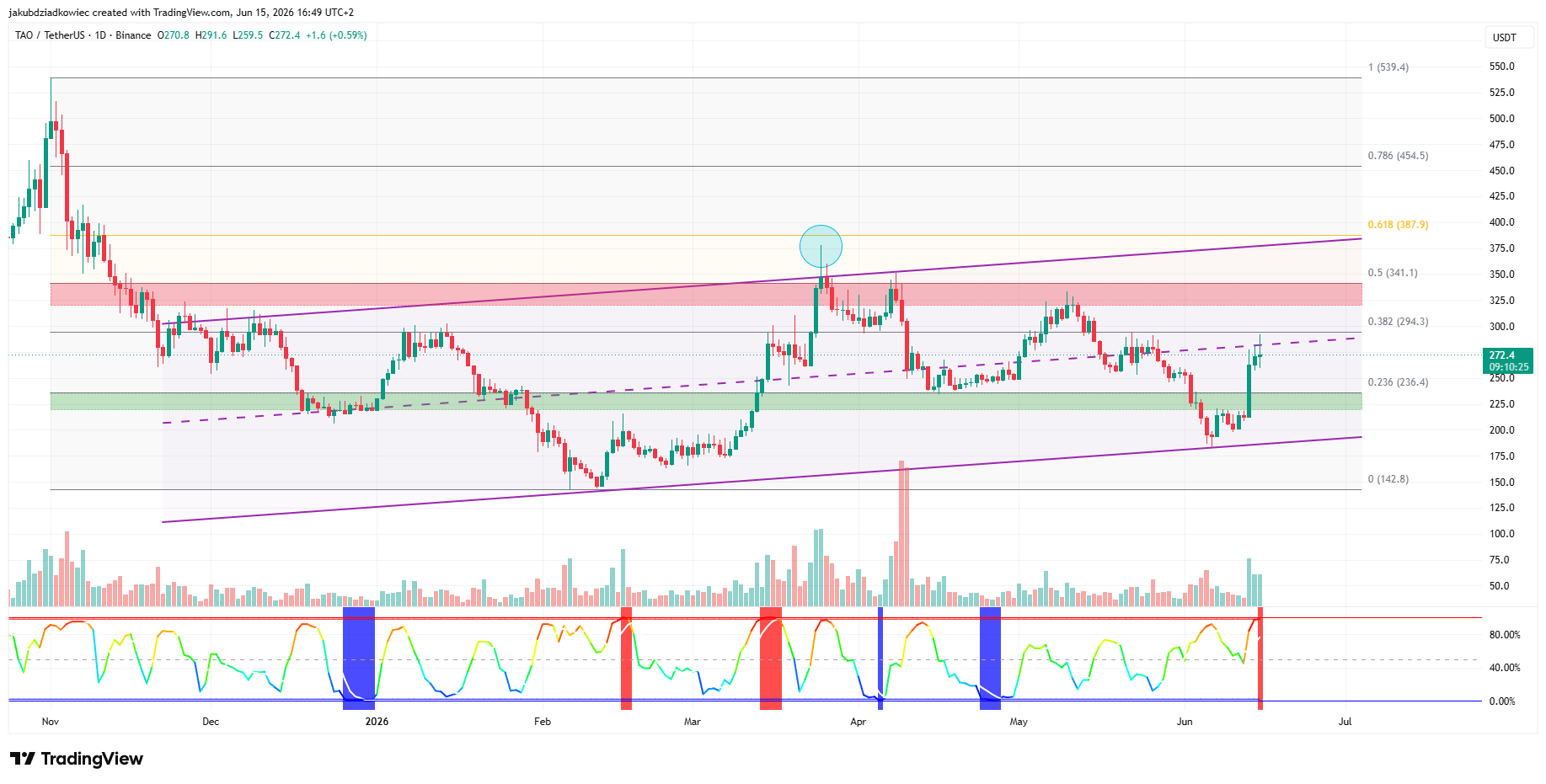
The top altcoins to watch this week, Bittensor (TAO), Zcash (ZEC), and WhiteBIT Coin (WBT), each posted double-digit weekly gains while pressing against major Fibonacci resistance.
CoinGecko data shows TAO up 28.3%, ZEC up 21.3%, and WBT up 20.2% over the past seven days. Each chart tells a similar story of recovery meeting a decisive technical test.
Bittensor (TAO) Targets $341 After Channel Reclaim
Bittensor (TAO) trades near $273 after climbing 28.3% in seven days. The TAO price reclaimed the 0.236 Fibonacci level near $236 on June 13. It then advanced to the midline of a rising parallel channel active since November 2025.
The breakout was marked by a clear spike in trading volume. That participation suggests real conviction behind the move rather than a thin bounce.
A volatility expansion in the BBWP indicator signals building momentum.

The next resistance sits at the 0.382 Fibonacci level near $294. Above it, the 0.5 level at $341 and the swing high below the 0.618 level near $388 come into view (blue circle). A similar Bittensor breakout played out earlier this year.
Support rests at $236, with the channel’s lower band near $187 as the structural floor. A daily close back below $236 would weaken the bullish case. Until then, the reclaim keeps TAO pointed toward its first overhead test.
Zcash (ZEC) Reclaims $533 After Head and Shoulders Flush
Zcash (ZEC) changed hands near $531 after a 21.3% weekly gain. The ZEC price climbed through April before stalling at the 0.786 Fibonacci level near $629. A head-and-shoulders pattern then formed at that long-term resistance level.
The pattern played out to the downside, triggering a deep correction. Price flushed back to the accumulation zone near $240 that held from February through April. That retest came on very high volume, a sign of strong absorption.

ZEC has since rebounded to the 0.618 Fibonacci level near $533. This area also marks the swing high from late December (blue circle). A bullish MACD cross (purple circle) supports further upside, echoing a prior Zcash breakout setup.
A daily close above $533 would open the path back toward $629. However, rejection there risks a pullback to the 0.5 level near $467 or the 0.382 level near $400.
WhiteBIT Coin (WBT) Eyes $56 Channel Retest After V-Shaped Bounce
WhiteBIT Coin (WBT) trades near $55 after a 20.2% weekly advance. The WBT price climbed inside an ascending channel until May 27. It then broke down sharply and retested support near $42.
A strong V-shaped recovery followed, lifting the price roughly 30% off the low. WBT has reclaimed the 0.382 and 0.5 Fibonacci levels near $51 and $53 as support. Both are now trading below the current price.

The pivotal test waits at the 0.618 Fibonacci level near $56. That zone aligns with the underside of the broken channel. A clean reclaim could open the 0.786 level near $60 and the all-time high at $64.43, similar to a past WhiteBIT channel break.
The RSI has recovered from oversold to a neutral and bullish reading near 60. That leaves room before the indicator reaches overbought territory.
What to Watch Across the Three Altcoins
All three altcoins share a similar setup heading into the third week of June. Each has recovered from a correction and now faces a key Fibonacci confluence. Bulls need daily closes above those levels to confirm continuation.
For TAO, the trigger sits near $294. For ZEC, the line falls at $533. And finally, for WBT, the decisive zone rests near $56. A failure at these marks would favor renewed consolidation, as an earlier TAO attempt showed.
The post Top 3 Altcoins to Watch in the Third Week of June 2026 appeared first on BeInCrypto.

Ripple’s (XRP) price witnessed a fresh rebound, which pushed the crypto asset from $1.11 to $1.18. The latest uptick was backed by changing wallet-flow trends, according to CryptoQuant.
Interestingly, South Korea’s largest cryptocurrency exchange, Upbit, took the top spot for XRP deposit-wallet activity across exchanges.
Upbit Overtakes Rivals
The latest data revealed that Upbit’s XRP Net Wallet Flow Dominance increased sharply from 13% on June 7 to 31% on June 14, reaching its highest level since May 2024. This indicates that Upbit now holds the strongest concentration of XRP deposit-wallet activity among leading crypto exchanges.
This wasn’t the case with several other major exchanges, which recorded declining dominance during the same period. Coinbase, for instance, showed the biggest drop, after falling from 27% on May 7 to 0% on June 14. This suggests deposit-wallet activity weakened considerably on the exchange, or that withdrawal-wallet activity became relatively stronger.
A similar trend was visible in Binance, which also recorded a decline in dominance, slipping from 16% to 13%, while Crypto.com dropped from 9% to 3%.
The divergence highlighted that XRP’s rebound was not supported by evenly distributed wallet flows across exchanges. Instead, the market saw a clear rotation of activity toward Upbit, while Coinbase, Binance, and Crypto.com moved in the opposite direction. CryptoQuant said,
“The takeaway is that XRP’s rebound is being driven by a divided flow structure.”
Meanwhile, crypto analyst Egrag Crypto had earlier said that bulls remain in control on lower time frames as long as the price stays above the $1.134-$1.14 range. He identified $1.193 as the first major resistance level, followed by $1.26 if momentum strengthens further. On the downside, however, the analyst said $1.09 remains the main support level, while a drop toward $1.05 could signal a deeper correction.
Institutional Flows
Even though most crypto ETFs are seeing investors pull money out, spot XRP funds are still managing to attract fresh inflows. Data from SoSoValue showed that XRP ETFs added almost $10.7 million over the last week. At the same time, spot Bitcoin ETFs in the US saw heavy outflows totaling $314.8 million.
Ethereum ETFs also ended the week in the red, as investors withdrew nearly $14.91 million.
The post Ripple’s (XRP) Latest Rally Is Being Driven by a Surprising Exchange Trend appeared first on CryptoPotato.


BlackRock’s Bitcoin income-focused ETF will begin trading on Nasdaq on June 16 after receiving regulatory approval from the U.S. Securities and Exchange Commission.
Summary
- BlackRock’s iShares Bitcoin Premium Income ETF (BITA) is set to begin trading on Nasdaq on June 16 after receiving SEC approval and exchange clearance.
- The fund seeks to generate income through a covered-call strategy on IBIT holdings while targeting a 15%–25% annual yield.
- Alongside BITA, BlackRock recently expanded its ETF lineup with the STAR space technology fund in Europe and the UK.
According to Bloomberg ETF analyst Eric Balchunas, Nasdaq confirmed that BlackRock’s iShares Bitcoin Premium Income ETF, trading under the ticker BITA, would launch on Tuesday. The confirmation came one day after the SEC approved the fund’s notice of effectiveness, clearing the way for public trading.
As reported by crypto.news, BlackRock filed for the product on June 12, positioning it as an income-generating alternative for investors seeking exposure to Bitcoin-related returns without directly holding the cryptocurrency.
According to the fund’s final prospectus, BITA is designed to generate income while maintaining participation in Bitcoin price movements. Rather than purchasing Bitcoin itself, the ETF will primarily invest in shares of BlackRock’s iShares Bitcoin Trust ETF (IBIT), which remains the world’s largest spot Bitcoin ETF by assets under management.
How the ETF generates income
Details outlined in BlackRock’s filing show that the fund will use a covered-call strategy by selling call options linked to its IBIT holdings. The premiums collected from those options are expected to serve as the primary source of income for shareholders.
Providing additional context on the structure, Balchunas said:
“The ETF will target 15-25% annual yield while trying to capture at least 70% of bitcoin’s upside in process.”
The prospectus states that investors will pay a sponsor fee of 0.65% per year. The fee accrues daily and is scheduled to be paid quarterly.
BlackRock also disclosed that investors may indirectly bear other costs associated with options transactions, brokerage commissions, financing expenses, legal services, and fund operations.
Earlier commentary from Balchunas described BITA as the anticipated successor product to IBIT. He also noted that IBIT has become the fastest-growing ETF in industry history based on asset growth.
BlackRock expands its ETF lineup
The Bitcoin income product arrives as BlackRock continues adding new funds across different investment themes.
Last week, the asset manager introduced the iShares Space Technologies UCITS ETF in the United Kingdom and Europe. According to BlackRock, the fund trades under the ticker STAR and tracks the STOXX Global Space Satellites and Drones Index.
BlackRock said companies included in the index must generate at least 25% of their revenue from space, satellite, or drone-related businesses. The firm also introduced a fast-entry mechanism that allows newly listed qualifying companies to enter the benchmark within 10 to 30 days of going public.
According to BlackRock, the rule was created to capture developments in rapidly evolving industries, including potential future stock market listings tied to the space sector. The company specifically pointed to growing investor interest surrounding a possible future listing of SpaceX.
Balchunas had previously estimated that BITA would likely begin trading later in the week. Nasdaq’s approval ultimately brought the launch forward, allowing the fund to reach the market sooner than expected.

The cryptocurrency market has turned green since the major Sunday evening announcement by US President Donald Trump, but some assets have marked more substantial gains than others.
Ripple’s cross-border token is among those, gaining over 3% in value on a daily scale, which is more than ETH’s 2.5% increase and BTC’s 1.9% jump.
Why Up, XRP?
Obviously, the more apparent reason behind XRP’s revival today is the deal announcement made by Trump yesterday. As reported, the POTUS also authorized the toll-free opening of the Strait of Hormuz and the removal of the United States Naval blockade.
The actual deal is expected to be signed by the end of the week, as reports from Pakistan and India have concurred with Trump’s statement. Peace news is always welcomed in the risk-on cryptocurrency markets, especially for larger-cap altcoins.
However, there could be more beneath the surface for XRP’s particular gains. For starters, the exchange-traded funds tracking its performance continue to defy the overall ETF trend. They attracted over $10 million in the past business week, in stark contrast to the $15 million in net outflows from the ETH ETFs and the over $300 million taken out of the Bitcoin counterparts.
Separately, a report from CryptoQuant revealed a somewhat surprising shift in trend. South Korea’s largest crypto exchange, Upbit, became the trading platform with the highest concentration of XRP deposit-wallet activity. The analysts at CQ determined that “XRP’s rebound is being driven by a divided flow structure.”
What’s Next?
Popular analyst Ali Martinez noted recently that the TD Sequential had flashed a buy signal for XRP after the asset’s recovery to over $1.10 commenced. In a follow-up post, he added that a breakout from the asset’s current symmetrical triangle could result in another 14% move.
Fellow analyst CW outlined the next two significant resistance lines if the token’s rally continues. The first is the sell wall at $1.25, followed by $1.40, where there’s a significant cluster of short positions.
CRYPTOWZRD warned that XRP had closed indecisively despite the late Sunday rally. According to their analysis, XRP needs to decisively reclaim the $1.18 level before it can offer further upside. It’s worth noting that the cross-border token is currently testing that level.
XRP Daily Technical Outlook:$XRP closed indecisively and its intraday chart is trading within a range. Above $1.1800 will offer a long, but a rejection at this resistance will offer a short. Moving below $1.1000 will offer further decline
pic.twitter.com/HkGXX2tpj6
— CRYPTOWZRD (@cryptoWZRD_) June 15, 2026
The post Why Is The Ripple (XRP) Price Up Today, and What’s Next? (June 15) appeared first on CryptoPotato.
Crypto World
Top 3 Cryptos to Watch as Wall Street Moves Deeper Into Ethereum and Pepeto Presale Attracts Big Capital While BNB and ADA Recover
The top 3 cryptos to watch this cycle are the tokens with working infrastructure and a clear repricing event ahead, because Wall Street just moved past crypto pilots and deeper into Ethereum according to Etherealize’s cofounder, confirming that institutional capital is now building on blockchain instead of watching from the sidelines.
While BNB holds near $620 and ADA recovers to $0.18 after its five-year low, Pepeto has passed $10.25 million in presale demand with a live exchange and an approaching Binance listing where projected returns start at 100x.
Etherealize cofounder Vivek Raman told CoinDesk that Wall Street is now moving past pilot programs and building directly on Ethereum, adding that the infrastructure has largely been built but adoption has not yet been reflected in ETH itself. Institutional ETH ETFs hold above $8 billion in net assets and growing.
The tokens worth watching are those with exchange infrastructure already running, because institutional commitment rewards projects generating fees over those depending on speculation.
Tokens Holding Ground and the Presale Already Delivering What Others Promise
Pepeto: Leading the Top 3 Cryptos to Watch This Cycle
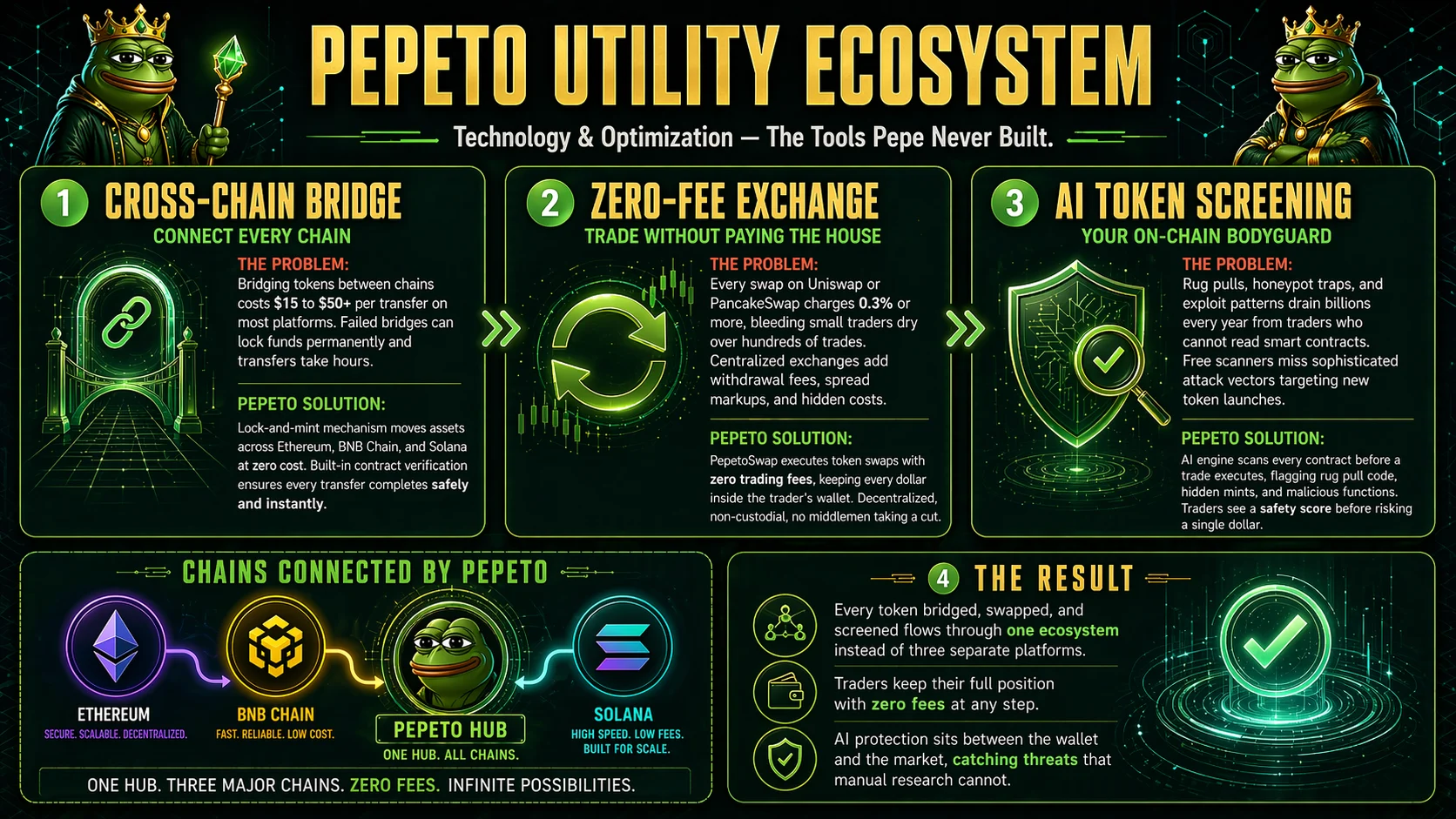
Wall Street building on Ethereum proves institutions want on-chain infrastructure, but the presale that passed $10.25 million during extreme fear secured that capital because the exchange was already live. Pepeto’s contract scanner audits every token for hidden traps before a single trade goes through, keeping positions safe while malicious contracts spike across the market.
PepetoSwap processes every trade without charging a fee, so each position carries through every rotation untouched. The 170% APY staking pulls committed tokens from supply daily, compounding returns while thinning what reaches exchanges. When the listing day arrives, it meets a reduced float, and that supply gap creates the price distance between early wallets and everyone else.
This live infrastructure makes Pepeto one of the strongest entries this cycle because the product already works while the token still trades at presale rates. BNB sat at pennies before Binance turned it into a $79 billion asset, and the wallets that entered early built real positions.
The same formation plays out now with the creator who built Pepe’s $11 billion rise and a former Binance advisor, with SolidProof verifying every contract. The presale price at $0.0000001876 exists only while rounds remain open, and the Binance listing erases that price level with exchange-level demand.
Binance Coin (BNB) Price at $620 as Market Recovery Gains Steam
Binance Coin (BNB) trades near $620 per CoinMarketCap, recovering 6% from its June low as the Iran peace deal and returning ETF inflows lift risk assets. A spot BNB ETF filing adds a potential catalyst.
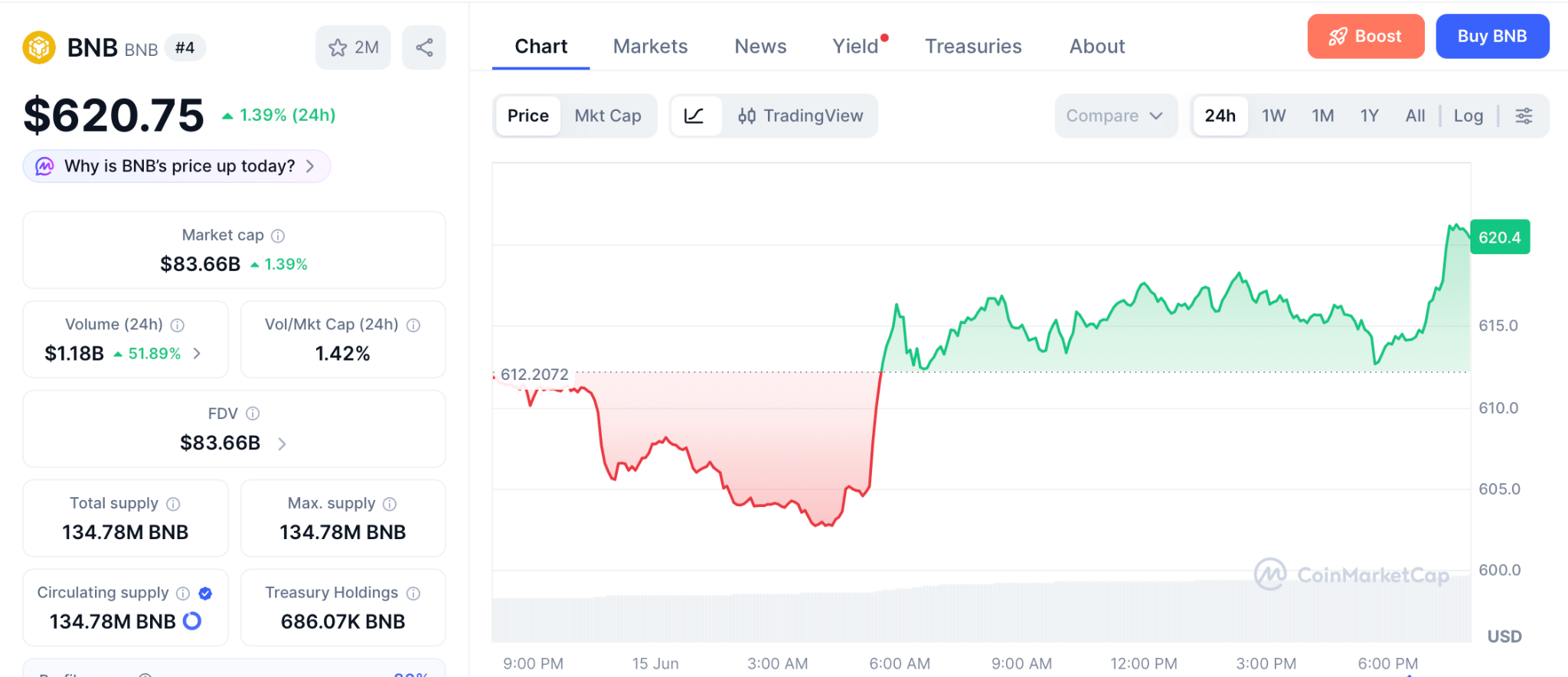
BNB sits 54% below its all-time high of $1,369 with support near $600 and resistance at $660. From $620, the path to $700 gives 11% over months, solid for holders but not the same distance a presale-to-listing event produces.
Cardano (ADA) Price at $0.18 as T. Rowe Price ETF Inclusion Boosts Outlook
Cardano (ADA) sits at $0.18 per CoinMarketCap, recovering 11% in a week from the five-year low of $0.1485 touched on June 6. T. Rowe Price’s new $1.8 trillion crypto ETF featuring ADA received regulatory approval for NYSE Arca listing on June 13.
Support holds at $0.16 with resistance near $0.24. Even a recovery to $0.24 gives 39% from here, a fraction of the distance the presale offers before the listing closes the entry.
Conclusion
Wall Street building on Ethereum proves that institutional capital is not leaving crypto, and Pepeto stands apart with a live exchange and presale pricing that BNB and ADA at their current sizes cannot match.
BNB sat at fractions of a dollar before it produced millionaires, and the wallets that believed early enough still hold those positions as proof of what conviction pays. Pepeto under the same Pepe creator is building that exact outcome for the wallets entering now. Rounds are filling. The listing is getting closer.
And the Pepeto presale price that exists today will not exist the day trading opens. The people reading this right now are either going to be the ones who got in before the listing repriced everything, or the ones who spend the rest of the year asking themselves why they did not act when every signal was pointing in the same direction.
Click To Visit Pepeto Website To Enter The Presale

FAQs
What are the top 3 cryptos to watch in June 2026?
Pepeto leads the top 3 cryptos to watch with $10.25 million raised, a live zero-fee exchange, and projected 100x returns before a Binance listing opens this cycle. BNB holds $620 and ADA recovers to $0.18.
Why is Pepeto considered a top presale as Wall Street enters crypto?
Pepeto is a top presale because its live exchange earns trading revenue as institutional adoption grows, positioning it ahead of speculative tokens. Over $10.25 million raised with 170% APY staking at $0.0000001876 confirms demand before a Binance listing.
Disclaimer: This is a Press Release provided by a third party who is responsible for the content. Please conduct your own research before taking any action based on the content.

Iran national anthem booed at World Cup before New Zealand game

Spectrum Internet Down? Outage Hits Hundreds of Subscribers Across Multiple States

CFTC Adds SEC Crypto Task Force Adviser With Blockchain Forensics Skills

BloFin War of Whales 2026 Grand Prix opens registration for $5M trading championship

Blockchain.com files with SEC for U.S. IPO

Israel says it has killed new Hamas military leader in Gaza City airstrikes

I’m ALL IN Before $3.99+++ per XRP (EVERYTHING WILL CHANGE)

When will falling crude oil costs provide financial relief at the gas pump? | FOX 10 Talks

#Crypto #Cryptocurrency #Bitcoin #Ethereum #Altcoins #CryptoBullRun #CryptoInvestor #CryptoTrading
-

 Business1 day ago
No Jackpot Winner as $257 Million Prize Rolls Over to $269 Million Monday Draw
-

 Crypto World4 days ago
Oppenheimer backs SpaceX as $70 billion retail frenzy builds
-

 Crypto World4 days ago
Markets Rally as SpaceX IPO Looms Amid Iran Tensions and Inflation Surge
-

 Fashion3 days ago
Weekend Open Thread: Tuckernuck – Corporette.com
-
Crypto World1 day ago
Zimbabwe Requires Crypto Businesses to Register Annually Under New FIU Regulations
-

 Entertainment7 days ago
The Ryan Gosling True Crime Thriller On Netflix That Gets Even Stranger, Stream It Now
-
 Sports6 days ago
Bangladesh beat Australia after 20 years in ODIs, register only their second win over six-time world champions | Cricket News
-

 Tech3 days ago
NanoClaw integrates JFrog registries to secure AI agent downloads
-

 Crypto World3 days ago
Bitget enters Argentina’s regulated crypto market through PSAV registration
-

 Tech3 days ago
This Week In Security: Microsoft On Microsoft, Register Your Domains, Linux On ARM, And FreeBSD Joins The File Cache Club
-
 Tech4 days ago
Dutton Ranch star claims they ‘didn’t see any disruption’ on set following Chad Feehan’s exit from Yellowstone spinoff fueled by Taylor Sheridan clash rumors
-

 Politics4 days ago
Politics Home | Healey Resignation Is “Colossal Failure Of Government”, Says Former Labour Defence Secretary
-

 NewsBeat4 days ago
El Nino has formed in the Pacific and could set records, forecasters say
-

 Tech6 days ago
‘This is Seattle’s position on AI’: City Council votes unanimously to pause big new data centers
-
 Entertainment4 days ago
Donnie Wahlberg & More Heat Up Las Vegas at Circa’s Barry’s Downtown Prime
-

 Business6 days ago
Thailand Ranks Second Worldwide for AI Adoption Growth, Microsoft Reports
-

 Sports5 days ago
First Time Since 1971: Australia Register Historic Low In ODI Cricket
-
 Tech4 days ago
Opendoor Ends India Operations, Fueling a Bigger Conversation About AI and Outsourcing
-

 Politics4 days ago
Belfast burns, while Met chief points finger at Iran and Russia
-

 NewsBeat3 days ago
FBI searches office of Ohio voter registration group
You must be logged in to post a comment Login