Pick up any smart device you own. A doorbell that recognizes faces, a watch that reads your heart rhythm, a thermostat that learns when you leave for work. They feel simple. You tap, they respond.
That simplicity is a lie. A useful one, but a lie.
Behind the clean app and the satisfying click is a stack of engineering decisions that most people never see. And the gap between a device that works for five years and one that dies in eight months almost always traces back to those invisible choices. So let’s look at what actually goes into building the connected gadgets shipping in 2026.
Smart starts with the circuit board, not the cloud
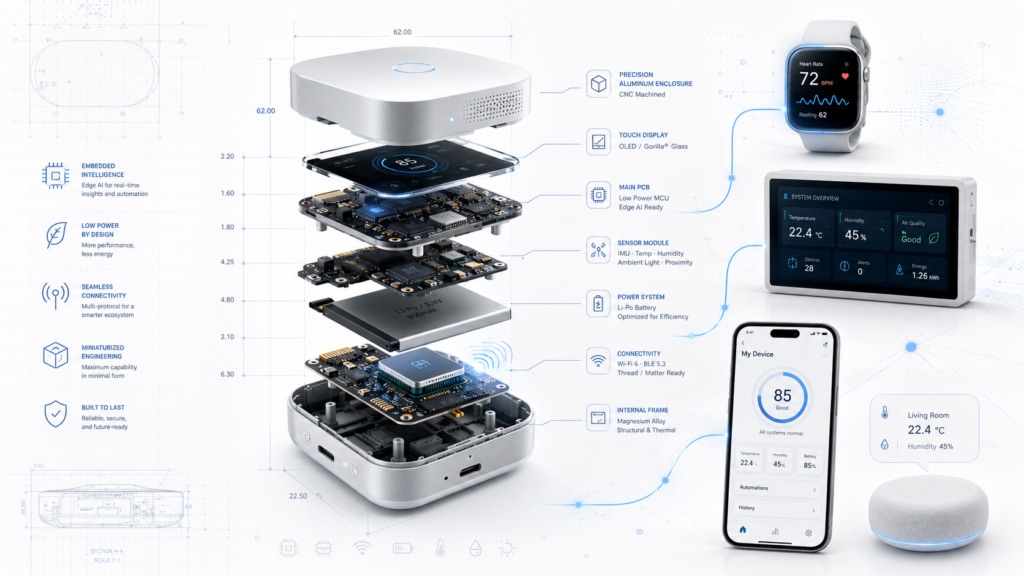
Most coverage of smart devices jumps straight to AI features and voice assistants. But the foundation is physical. A device is a printed circuit board, a microcontroller, a fistful of sensors, a radio, and a battery, all crammed into a shell that has to survive being dropped, sat on, and left in a hot car.
This is where hardware development does its quiet, unglamorous work. Engineers pick a microcontroller based on how much computing the device needs versus how little power it can afford to burn. They route signal traces on the board so a Wi-Fi radio doesn’t drown out a delicate sensor reading. They run the whole thing through thermal testing, drop testing, and certification for FCC and CE marks before it can legally ship.
Get this layer wrong, and no amount of clever software saves you. A poorly designed board produces flaky sensor data. Bad antenna placement means the device drops off your network the moment you walk to the next room. These aren’t software bugs. You can’t patch your way out of a physics problem.
The companies building good hardware treat the proof-of-concept stage as a real checkpoint. They wire up development boards and modular parts to test the core idea cheaply, before committing to a custom design that costs real money to manufacture. It’s the boring discipline that separates products from expensive paperweights.
Firmware is where the device actually thinks
Sitting on top of the hardware is firmware. This is the low-level code that tells the chip what to do, when to wake up, how to read a sensor, and when to phone home. People mix up firmware and software all the time, so here’s the clean split. Software runs on your phone or in the cloud and handles the screens you tap. Firmware lives inside the device and controls the hardware directly.
Firmware is genuinely hard to write well. The constraints are brutal. A typical IoT microcontroller has a tiny amount of memory, often measured in kilobytes, and it might run on a coin cell that needs to last a year. Every line of code competes for space and power.
Then there’s timing. A lot of devices need deterministic, real-time behavior, meaning a sensor reading has to be processed within a fixed window or the whole thing falls apart. A heart monitor that processes a beat “eventually” is useless. The firmware has to guarantee it happens now.
If you want the deep version of how this gets built in practice, Yalantis published a solid breakdown of firmware development for embedded IoT devices that covers architecture, power management, and the over-the-air update workflows that keep a device current after it ships. The OTA piece matters more than it sounds. A device that can’t safely update its own firmware is frozen in time the day it leaves the factory.
Connectivity is a series of trade-offs
Your smart device has to talk to something. Your phone, your router, a cloud server, or all three. Choosing how it talks is one of the most consequential engineering calls in the whole project, and there’s no single right answer.
Bluetooth Low Energy sips power and works great for a wearable talking to your phone, but its range is short and it can’t reach the internet on its own. Wi-Fi reaches everything but drains batteries fast. LoRaWAN travels for miles on almost no power, which is perfect for a soil sensor in a field, but it carries tiny amounts of data slowly. Cellular options like NB-IoT and LTE-M let a device work anywhere there’s a signal, with the catch of ongoing data costs and bigger power draw.
Engineers usually mix these. A fitness band might use BLE to sync with your phone, and your phone carries the data the rest of the way. An industrial sensor in a remote location might use LoRaWAN to a gateway, which then forwards everything over cellular. The “right” combination depends entirely on power budget, data volume, range, and cost, which is exactly why this decision gets made early and gets revisited often.
Sensors and the messy job of trusting them
A smart device is only as good as the data it collects. And raw sensor data is messy.
Take a simple temperature reading. The sensor drifts over time. It gets warmed by the heat of the chip sitting next to it. It returns noisy values that jitter up and down even when nothing changes. Firmware has to calibrate, filter, and sanity-check all of it before the device acts on a single number.
This gets serious fast in regulated fields. A continuous glucose monitor or a medical wearable can’t ship a reading that’s “close enough.” The sensor design, the calibration, and the firmware that validates the data all have to meet standards that consumer gadgets never face. The engineering bar is much higher, and the cost of getting it wrong is measured in patient safety, not customer reviews.
For everyday devices the stakes are lower, but the principle holds. Good devices spend a lot of hidden effort turning unreliable physical signals into numbers you can actually trust.
Where the AI hype meets the silicon
Here’s the part that has changed most recently. A growing share of smart devices now run machine learning models directly on the chip instead of sending everything to the cloud. This is edge computing, and it’s reshaping how devices get built.
The appeal is obvious. Processing data on the device means lower latency, since you’re not waiting on a round trip to a server. It means better privacy, because your data never leaves your hand. And it means the device keeps working when your internet goes down.
The catch is that running a model on a chip with kilobytes of memory is an engineering puzzle. Models have to be shrunk, quantized, and optimized until they fit in the space available without melting the battery. The face-recognition that runs locally on a modern doorbell is a heavily compressed version of what would run on a server. Squeezing it down to fit is real, specialized work, and it’s increasingly where the competitive difference between two similar gadgets actually lives.
Security can’t be the last step
For years, connected devices treated security as an afterthought. Ship the product, patch problems later. That approach has aged badly.
Outdated firmware is now one of the most common ways attackers break into IoT systems. Research from the security firm ONEKEY found that vulnerable firmware accounts for a large majority of successful attacks on connected devices. Once an attacker is inside one poorly secured gadget on your network, they have a foothold to reach everything else.
Building security in from the start means encrypting data both when it’s stored on the device and when it travels to the cloud. It means signing firmware updates so a device only accepts legitimate code, not something an attacker swapped in. And it means designing for recovery, so a compromised device can be safely reset and restored rather than turned into a permanent liability sitting on your shelf.
This is the layer consumers never think about and pay the most for when it’s done badly.
Why the next generation is harder to build
Smart devices are getting more capable, and that capability has a cost that lands squarely on the engineering team. More on-device intelligence. Stricter privacy rules. Longer battery expectations. Tighter security. Regulatory scrutiny that used to apply only to medical gear now creeping toward consumer products too.
None of this shows up in the marketing. The ad shows a person tapping a screen and a light turning on. What it doesn’t show is the year of board revisions, firmware rewrites, connectivity tests, and security audits that made that tap reliable.
So the next time a smart device just works, give a small nod to the invisible stack underneath. The clean experience on the surface is the product of a lot of unglamorous engineering refusing to cut corners. That refusal is the whole difference between a gadget you trust and one you return.




























































You must be logged in to post a comment Login