

Crypto World
South Korea’s DAXA targets crypto API keys after 30% warning



South Korea’s Digital Asset Exchange Alliance has introduced a new API key standard for local crypto exchanges. The move targets improper API key sharing and possible market abuse.
Summary
- DAXA will now force suspicious API keys to expire after warnings, monitoring, and user checks.
- FSS said API-based trading accounts for around 30% of South Korea’s domestic crypto market turnover.
- Upbit, Bithumb, Coinone, Korbit, and Gopax will now add stricter monitoring and IP whitelist systems.
The rule comes as regulators watch automated crypto trading more closely. The Financial Supervisory Service said API-based trading now makes up about 30% of domestic crypto turnover.
DAXA targets shared API keys
DAXA said the new policy will apply when exchanges suspect improper API key lending. The group said such keys can give outside tools access to price checks, balances, orders, deposits, and withdrawals.
The Asia Business Daily reported that some users had lent or shared API keys with others. Those keys were then linked to unfair trading practices, including possible price manipulation.
Under the new standard, exchanges can increase monitoring after suspicious activity. They can also send warnings, require identity checks again, and force API keys to expire.
Kim Jae-jin, DAXA’s executive vice chairman, said the group will “respond swiftly to new and emerging threats.” He said user protection remains the main value behind the new measures.
FSS warning raises pressure on exchanges
The FSS warning adds more pressure on local exchanges. The regulator has said automated trading can create false volume and distort token prices.
Reports cited repeated small trades, spoofed orders, and coordinated activity across many accounts. These actions can make a token look more active than it really is.
The regulator also warned users about high-frequency trading code shared online. It urged investors to avoid chasing sudden price spikes without clear reasons.
The new DAXA policy fits that warning. It gives exchanges a direct way to act when account access looks suspicious.
Upbit and Bithumb face stricter API checks
The rules apply to DAXA member exchanges, including Upbit, Bithumb, Coinone, Korbit, and Gopax. These platforms dominate South Korea’s regulated crypto exchange market.
Member exchanges will add IP whitelisting systems. This means API keys can only work from IP addresses that users register in advance.
The system can make shared keys harder to use. It can also help exchanges spot access from unusual locations or outside trading systems.
The rule does not ban API trading. It instead targets cases where users hand over keys or allow others to trade through their exchange accounts.
Korea expands crypto exchange oversight
The API rule adds to a wider push across South Korea’s crypto market. Regulators have already moved to tighten exchange checks after past control failures.
As previously reported by crypto.news, South Korea ordered local exchanges to add five-minute balance checks, automatic trading halts, and monthly audits after a major Bithumb error.
Separate coverage also showed DAXA warning that a proposed AML rule could raise suspicious transaction reports from 63,000 to more than 5.4 million.
The latest API standard shows the same direction. Korean regulators and exchanges are moving toward faster controls, closer monitoring, and earlier action against market abuse.

The on-chain options and structured product protocol Thetanuts Finance was exploited for $2.1 million. Security firm Blockaid published the exploit transaction and exploiter address shortly after the attack. A white-hat intervened and recovered approximately $2 million of the stolen option tokens…. Read the full story at The Defiant
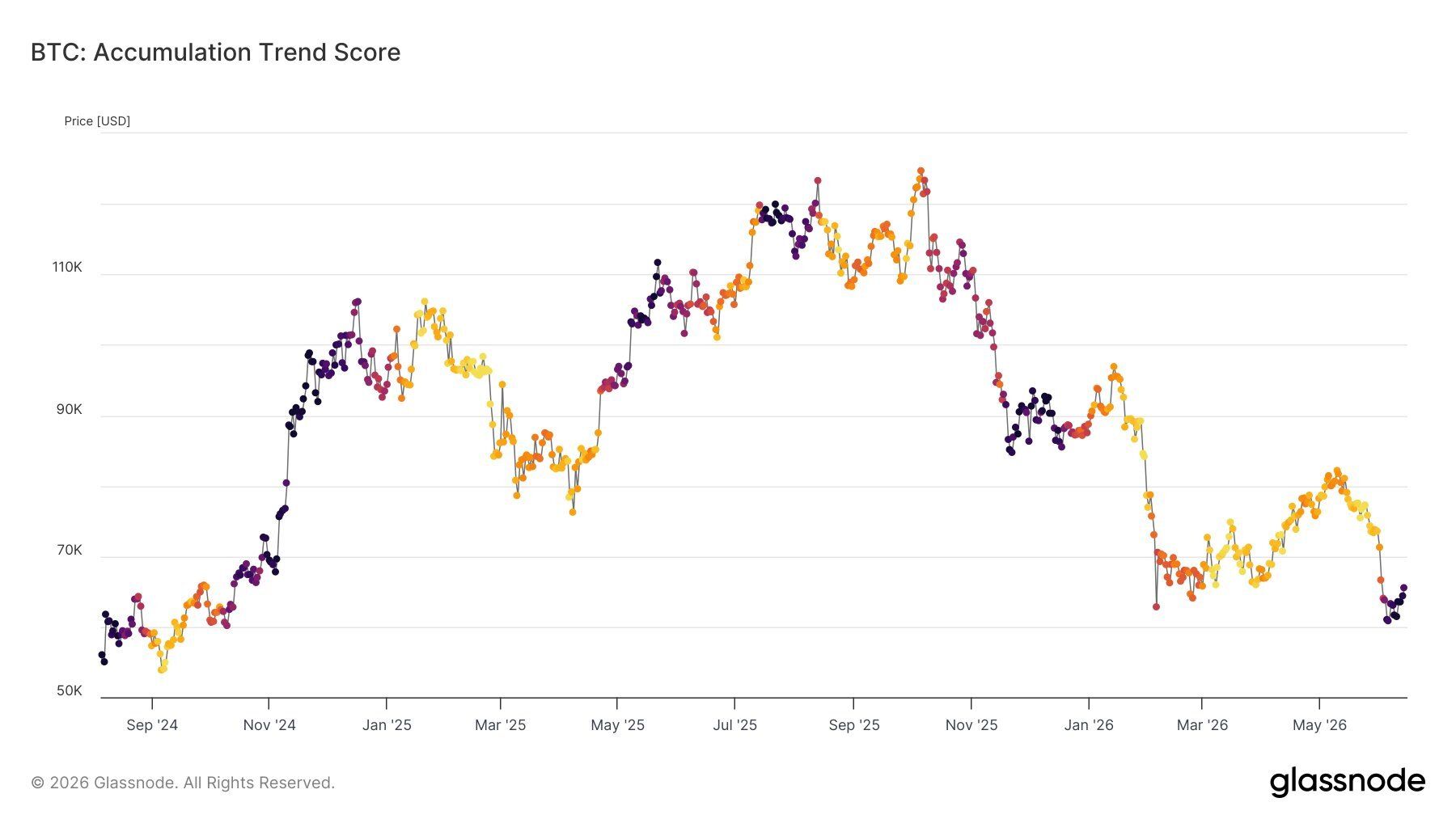
Bitcoin (BTC) has reclaimed roughly $67,000 after the June flush toward $60,000, and on-chain data shows real buyers stepping in. Yet the recovery in Bitcoin price is climbing into an options structure that tends to amplify volatility rather than calm it.
The trade case for a low rests on returning demand. The skeptical case rests on where that demand is showing up. Right now, the second case has the stronger evidence.
On-Chain Bitcoin Buyers Returned as BTC Fell Toward $60,000
The Accumulation Trend Score measures the relative size of wallets adding to their holdings. Readings near 1 point to broad accumulation. Readings near 0 point to the distribution.
As price slid into the $60,000 zone in early June, the score shifted toward accumulation across cohorts. Falling prices met rising on-chain demand instead of fresh panic selling.

The rebound since then has been sharp. Bitcoin rose by mid-single digits in a single session off the low, after sliding about 15% over the prior month. That speed is part of why the bounce looks convincing on the surface.
That pattern fits a classic buy-the-dip response. Large and small wallets both leaned in at lower levels. A parallel decline in exchange balances suggests buyers are moving coins into custody rather than preparing to sell.
Why Returning Demand Does Not Confirm a Bottom
Returning demand is necessary for a durable low. However, it is not sufficient on its own. The same score flashed accumulation several times during the prior decline.
The metric reads who is buying, not whether they are early. Distribution also dominated the entire 2025 climb into the highs. That selling into strength did not stop the eventual drop.
Forced liquidations also amplified the early-June move. A wave of stop-outs can exaggerate both the fall and the snapback. As a result, part of the bounce reflects mechanical short covering rather than fresh conviction.
On-chain bottom calls have misfired earlier this cycle, as recent signal-driven analysis has shown. A buy-the-dip reflex can persist for weeks while the price keeps grinding lower. Demand alone rarely marks the exact turn.
Deribit Options Positioning Sits in the Wrong Zone
Gamma exposure tracks how options dealers must hedge as prices move. In positive gamma, dealers buy weakness and sell strength, which dampens volatility. In negative gamma, they do the opposite, which sharpens moves in both directions.
On the Deribit heatmap, the dense cluster around $67,000 reads negative. Dealers positioned there tend to sell into dips and chase rallies. That makes a clean, calm recovery less likely while the price sits inside the band.
The calmer, positive-gamma zone sits higher, near $80,000 to $85,000. In other words, Bitcoin is bouncing into the destabilizing pocket while the stabilizing one remains well above the current price.

A dense strike can still pin price near expiry, so the cluster may slow the tape at times. Even so, the sign of the exposure leans toward sharper swings rather than a gentle floor.
The same positive gamma band overhead also acts as a brake on rallies. Dealers selling strength there would lean against the price as it climbs toward $80,000. So, the zone that brings stability also brings resistance.
Bitcoin Price Levels That Decide the Next Move
Three levels frame the read. The $60,000 area (green zone) marks the recent low and the floor that accumulation must defend. A clean loss there would undercut the demand story and the prevailing support thesis.
The $67,000 cluster is the volatility pivot (lower red zone). While price churns inside it, sharp two-way swings stay more likely than a steady grind higher.

Reaching the $75,000 –$80,000 band (the higher red zone) would mark the real shift. That zone is where positive gamma starts to cushion moves.
A reclaim there would give the skeptical case a clear reason to soften, and it would align with the more constructive June prediction scenarios.
The Bottom Line for Bitcoin Buyers
Demand is real, but it is not a green light. On-chain accumulation tells traders that buyers have shown up, not that the low is in.
Until Bitcoin trades back above the zone that actually calms volatility, the safer read is to treat this bounce as fragile. The setup could resolve higher, yet the options structure suggests patience over conviction for now.
The post Bitcoin Buyers are Back, But They Could be Walking Into a Trap at $67,000 appeared first on BeInCrypto.


Kraken and Coinbase each launched new perpetual futures products on Monday, marking the broadest single-day expansion of US-regulated derivatives in the crypto era. Kraken activated CFTC-regulated perpetual futures for eligible US clients through Bitnomial, a crypto derivatives exchange owned by… Read the full story at The Defiant

Key Takeaways
- MediaTek is pivoting from traditional chip design to comprehensive system-level AI hardware solutions, pursuing opportunities with Google’s TPU and AI infrastructure projects linked to Elon Musk’s ventures.
- TF International Securities analyst Ming-Chi Kuo notes this strategic transformation won’t significantly affect MediaTek’s financials in the immediate two-year window but establishes groundwork for future expansion.
- Google is pursuing discussions with Samsung for manufacturing components of its upcoming AI processor, designated Icefish, as TSMC faces capacity constraints.
- The Google-Samsung negotiations underscore the intense competition for advanced AI chip fabrication, forcing even premium clients to seek alternative manufacturing partners.
- MediaTek’s expansion into system-level solutions aims for 40–50% gross margins using an asset-light approach, outsourcing production while maintaining control over design and quality assurance.
MediaTek is undertaking a significant transformation in its artificial intelligence business model, moving beyond traditional semiconductor design toward comprehensive system-level hardware solutions. The Taiwanese technology firm is pursuing two strategic opportunities: managing printed circuit board assembly for Google’s Tensor Processing Unit and developing rack-level infrastructure for AI companies associated with Elon Musk.
According to Ming-Chi Kuo from TF International Securities, this strategic realignment represents a fundamental business evolution rather than a short-term revenue initiative.
“MediaTek has elevated its AI business strategy from integrated circuit and application-specific integrated circuit design to comprehensive system-level design,” Kuo explained. He emphasized the transition carries “minimal impact on core business fundamentals through the next 24 months.”
Dual-Track Approach: Pursuing Google and Musk-Connected Ventures
These two strategic pathways present distinct characteristics and challenges. Google operates an established and mature hardware manufacturing network, making MediaTek’s prospects for securing premium rack-level integration contracts somewhat limited.
MediaTek’s more viable entry into Google’s ecosystem lies at the circuit board level, beginning with the tenth-generation TPU processor codenamed Icefish.
The opportunity with Musk-affiliated enterprises presents a contrasting scenario. These organizations are currently developing proprietary AI processors at commercial scale, and their rack assembly infrastructure remains in nascent stages.
“This represents MediaTek’s strategic window,” Kuo stated. He emphasized that sustained success hinges on MediaTek capitalizing on Taiwan’s robust hardware manufacturing ecosystem and its collaboration with Terafab, while acknowledging the initiative “currently lacks definitive timeline clarity.”
MediaTek’s financial model for this segment targets gross profit margins between 40% and 50% by maintaining leadership in design and validation processes while delegating actual manufacturing to third parties, ensuring operational efficiency.
Google Explores Samsung Partnership Amid TSMC Production Constraints
Simultaneously, Google is reportedly negotiating with Samsung to produce a memory input-output component for the Icefish processor. TSMC would continue manufacturing the primary computational core utilizing its cutting-edge 1.4-nanometer fabrication technology.
Wedbush Securities analysts suggest the Samsung discussions primarily stem from constrained manufacturing capacity at TSMC rather than signaling dissatisfaction with their services. Essentially, the extraordinary demand for advanced AI semiconductor production has reached levels where even flagship customers like Google must diversify their manufacturing partnerships.
Employing Samsung introduces operational complexities. Distributing chip fabrication across multiple foundries increases coordination challenges and potentially impacts production yields and economic efficiency.
For Google, the objective centers on guaranteeing adequate supply to support expanding AI infrastructure requirements. For Samsung, this opportunity represents a pathway to secure additional high-value foundry contracts.
Kuo’s broader analysis suggests MediaTek’s current ASIC chip design operations may experience deceleration within two to three years as the semiconductor industry transitions toward emerging architectures. This potential headwind underscores why the system-level expansion represents a strategic imperative, despite contributing minimal near-term revenue growth.
The most significant near-term indicator will be whether MediaTek secures qualification contracts for the TPU v10 Icefish processor. Regarding the Musk-affiliated ventures, specific implementation timelines remain undefined.

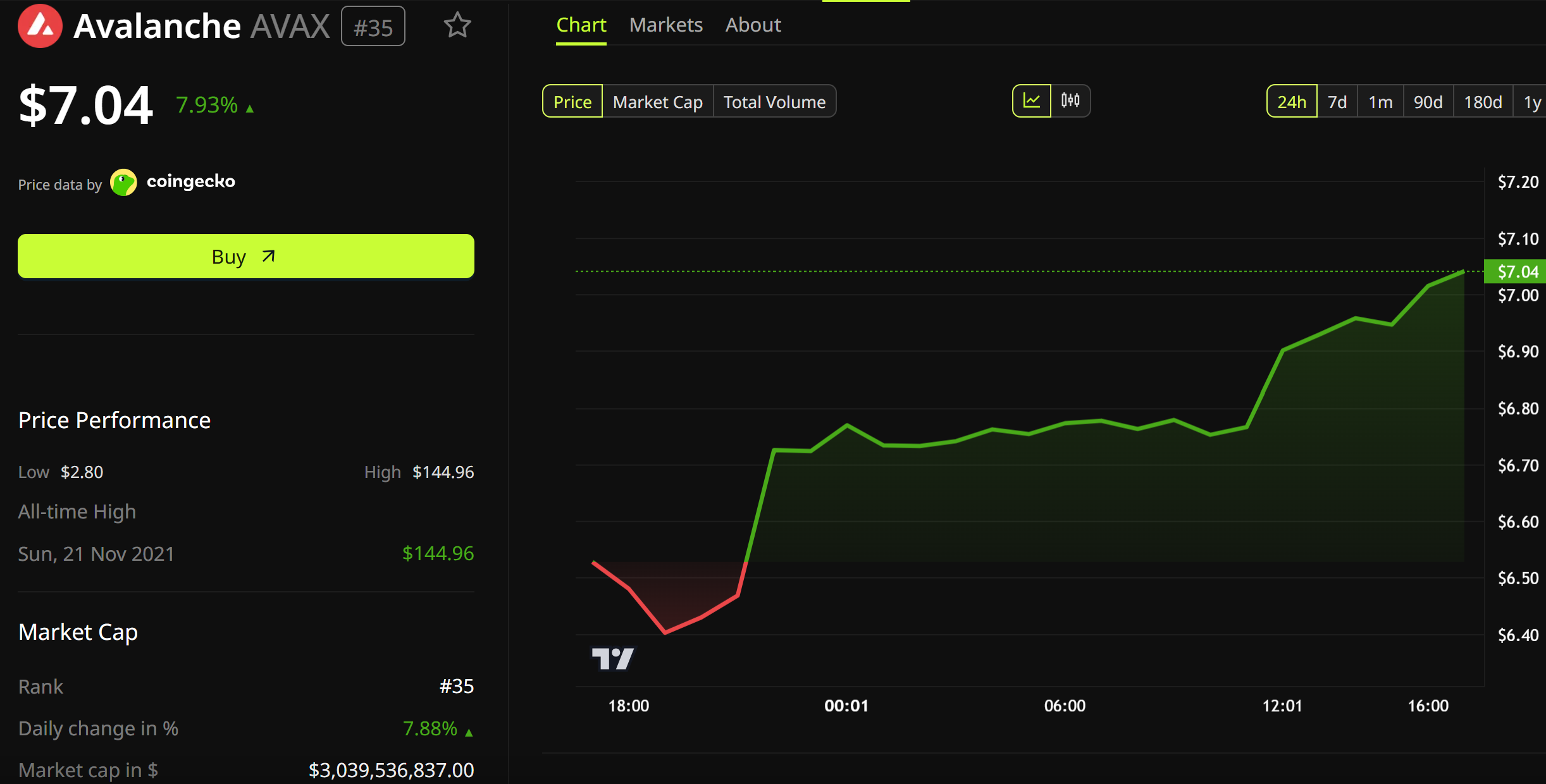
FIFA is running ticketing, loyalty, and digital collectibles for the 2026 World Cup on a custom Avalanche blockchain. The adoption story arrives as Avalanche (AVAX) posts its first bullish signal in a month.
The token climbed nearly 8% in 24 hours. That move tracks a broader recovery in crypto sentiment, yet the World Cup hands Avalanche a fresh real-world hook that few rivals can match this summer.

FIFA’s World Cup Push Runs on Avalanche
FIFA announced its dedicated Avalanche blockchain in May 2025. The network is a custom Layer 1 built for digital collectibles and global-scale fan engagement.
The first step was migrating FIFA Collect, the official collectibles platform, to the new chain. Technology partner Modex leads development of the marketplace.
Right-to-Ticket collectibles now grant verified access to official 2026 World Cup match tickets. Holders convert them through a dedicated portal up to three days before each match.
Ava Labs President John Wu has confirmed the scope of the integration in recent interviews.
“We’re super excited that FIFA and the World Cup that’s coming this summer is doing their loyalty and the right to buy tickets and ticket platform on an Avalanche blockchain,” John Wu, Ava Labs president.
Follow us on X to get the latest news as it happens
Adoption Meets a Sentiment Recovery
Avalanche has already seen a surge in new users tied to the FIFA partnership and rising institutional interest.
On-chain activity picked up again as Right-to-Ticket redemptions went live during the tournament.
Still, the latest price move owes much to improving market-wide sentiment. AVAX had fallen more than 24% over the past 30 days before this week’s bounce.

The FIFA link does give Avalanche a marketing advantage among World Cup crypto coins. However, whether that translates into lasting demand for the token remains to be seen.
AVAX Price Outlook
The Avalanche price is trading near $7.07 as it consolidates within a falling wedge pattern that capped price action since early 2026.
However, the falling wedge is a bullish reversal pattern in technical analysis. The target objective is determined by measuring the technical formation’s maximum height and superimposing it at the expected breakout point.
With price now challenging the 50-day EMA cluster near $7.44, immediate support rests at the lower boundary of the technical formation at $6.22.
Increased buyer momentum above current levels would see the AVAX price test the 50-day EMA before confronting the confluence resistance between the 100-day EMA and the upper boundary of the falling wedge at $8.29.
A confirmed move above this level could activate the 49% rally, with the AVAX price potentially extending gains to $13.08.
Based on the volume profiles (green horizontal bars), bulls are waiting to interact with the Avalanche price above the falling wedge, adding credence to the prospective 49% climb.
The Relative Strength Index (RSI) trajectory also shows growing momentum, with the bullish crossover above its signal line (yellow) indicating a green signal for AVAX.

Conversely, loss of $6.22 support would shift focus back to the lower range, potentially forming a lower low. A decisive daily close below this area would invalidate the bullish structure and open the door for a leg lower.
The RSI below 50 is also concerning, indicating that while momentum continues to build, the bears still hold the upper hand.
The post FIFA World Cup Push Lifts Avalanche Adoption: Will AVAX Price Rally? appeared first on BeInCrypto.


Bitcoin (BTC) traded at $0.20 when South Africa hosted the 2010 FIFA World Cup. With North America now staging the 2026 edition, BTC sits near $66,258, a gain of more than 328,000% across five consecutive tournaments.
The timing has never broken down. Each World Cup since 2010 opened with Bitcoin higher than the one before: $620 in Brazil 2014, $6,500 in Russia 2018, $16,800 in Qatar 2022, and roughly four times that figure today.
Bitcoin’s Halving Makes the World Cup Timeline Look Less Like Luck
The Bitcoin ETF and liquidity cycle analysis published in 2026 points to a structural reason the four-year pattern persists.
Bitcoin’s halving cuts miner rewards in half on the same four-year schedule as the World Cup, tightening new supply each time. Bull markets have historically followed within 12 to 18 months of each reduction.
The current cycle saw BTC peak near $126,000 in early 2025 before sharply pulling back.
The Bitcoin price near $66,258 today sits roughly halfway between the Qatar 2022 price and that peak, consistent with previous post-peak drawdowns within the same cycle.
The Returns are Compressing
The math across each four-year hold tells its own story. Buying at the 2010 tournament and holding to 2014 would have returned roughly 3,100x. The 2014-to-2018 window delivered around 10x. Qatar 2022 holders from 2018 saw approximately 2.6x. The 2022-to-2026 gain sits near 3.9x.
The direction is clear. As Bitcoin matures into a multi-trillion-dollar asset, each successive multiplier shrinks. Institutional capital and ETF flows now shape price behavior in ways that block-reward mechanics alone cannot explain.
New demand layers add structural support but also absorb the volatility that produced early-cycle windfalls.
Will 2030 be Different?
Crypto’s presence at the 2026 World Cup spans prediction markets, fan tokens, and on-chain betting, a sign of mainstream penetration that could sustain demand or simply price the next move in earlier.
The streak stands unbroken, but holding through a full cycle now requires patience for a smaller reward than the previous generation received.
The Bitcoin outlook through 2030 ultimately depends on US monetary policy, sovereign accumulation, and whether ETF-driven demand continues to absorb sell pressure. The pattern has held through five tournaments. The question now is whether five becomes six.
The post Bitcoin Has Gained at Every FIFA World Cup: Will the 2030 Cycle Hold? appeared first on BeInCrypto.
Crypto World
Market Movers Today: SpaceX IPO Shatters Records, AI Stocks Expand, and Airlines Take Flight

Quick Overview
- SpaceX’s public debut has become the biggest IPO ever recorded, fundamentally altering investor perspectives on private technology enterprises
- Reports indicate OpenAI submitted confidential IPO paperwork, generating substantial excitement throughout the investment community
- Market participants are diversifying AI investments beyond Nvidia, turning attention to Broadcom, TSMC, AMD, and Micron
- Energy markets found equilibrium following recent turbulence, supported by positive signals from US-Iran negotiations
- Airlines experienced strong gains driven by reduced fuel expenses and robust leisure travel demand
While the SpaceX public offering captured headlines throughout the week, numerous other developments commanded investor focus. From emerging AI investment opportunities to shifting energy dynamics, here’s what drove market activity today.
SpaceX’s Market Debut Reshapes Growth Investment Strategy
The space exploration company completed an unprecedented public offering that now stands as history’s largest. Exceptional investor appetite propelled the stock into the spotlight as one of Wall Street’s most closely monitored equities.
This landmark event has fundamentally transformed how the investment community evaluates privately-held technology enterprises. Market experts suggest the overwhelming response may accelerate public listing timelines for other prominent private companies.
Firms including OpenAI, Anthropic, Databricks, and Stripe have emerged as potential IPO prospects in current discussions. The successful SpaceX launch has made public market entry significantly more appealing for mature private enterprises.
The commercial space industry received broader momentum as well. Market participants are actively seeking additional companies positioned to capitalize on increasing commercial space investment.
OpenAI and Other AI Companies Eye Public Markets
Emerging reports indicate OpenAI has submitted confidential IPO documentation. Should this materialize, it would rank among the most significant technology listings in history.
Previously, investors gained AI market exposure primarily through established companies like Nvidia, Microsoft, Broadcom, and Amazon. A direct OpenAI public offering would fundamentally alter this landscape.
Anthropic and additional private artificial intelligence companies remain under close observation. Financial industry experts anticipate these enterprises could generate significant investor demand, particularly as AI implementation continues accelerating.
The possibility of several major AI public offerings within the coming years has emerged as a dominant conversation topic among investment professionals currently.
Expanding AI Investment Opportunities Beyond Nvidia
While Nvidia maintains its position as the leading AI equity, investors are actively exploring alternative sector opportunities.
Broadcom has gained considerable traction due to its specialized AI processors and network infrastructure products. Taiwan Semiconductor Manufacturing continues benefiting from strong demand for cutting-edge chip fabrication capabilities.
Both AMD and Micron are attracting increased interest as market participants seek diversified exposure throughout the AI supply ecosystem.
This expanded investment approach has elevated semiconductors, cloud infrastructure, networking equipment, and software companies throughout 2026. Investors have shifted from concentrated Nvidia positions toward broader infrastructure plays supporting the technology.
Energy Markets and Aviation Sector Return to Investor Radar
Oil prices stabilized following a period of significant fluctuation. Encouraging developments surrounding US-Iran diplomatic discussions helped alleviate concerns regarding potential supply interruptions.
Decreasing crude prices benefit both consumers and enterprises. Reduced fuel and logistics expenses contribute to maintaining inflation pressures under control.
Airline stocks have delivered exceptional returns recently. Given that fuel represents airlines’ largest operational expense, declining oil costs directly enhance profit margins.
Multiple carriers have experienced substantial gains as investors develop greater confidence regarding travel volumes and financial performance. Consumer enthusiasm for leisure travel continues demonstrating resilience despite wider economic uncertainties.
Should oil prices remain contained, airline equities could sustain strong performance through the latter portion of 2026.
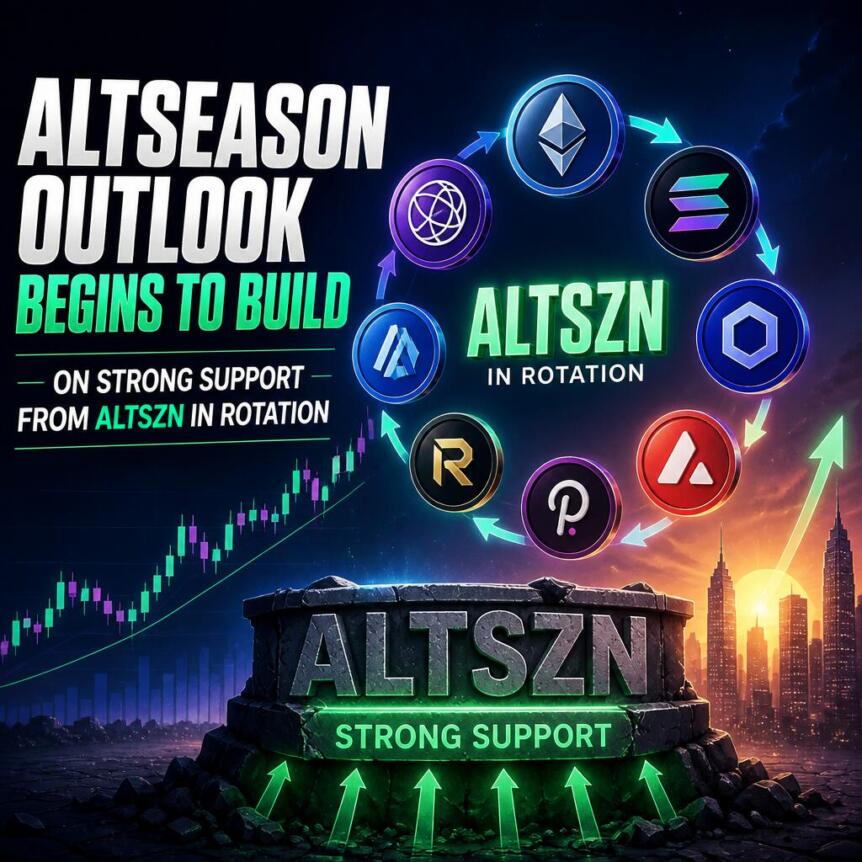
Altseason outlook is starting to build as ALTSZN consolidates close to support following a rally while altcoin cycles and increased volumes indicate the possibility of rotation taking place. Traders are eyeing key resistances ahead of any momentum.
Key Insights
- There has been consolidation close to support for ALTSZN following a small rally, with resistance currently testing $0.00520.
- Altseason cycles have always followed accumulation of OTHERS/BTC.
- No altseason signal yet, even as traders expect rotation.
Altseason Outlook Is Becoming Popular Amid the Consolidation in Market Structure
The altseason outlook has received considerable popularity as the structure of ALTSZN has consolidated in the wake of a previous uptrend. Having undergone a short-term rally, the token seems to be consolidating, meaning that there is tight action within the range bounded by the existing level of support and resistance. This pattern may be regarded as evidence of market indecision and hesitation in terms of further price movement.
At the moment, the token is changing hands at close proximity to its bottom level, with support ranging from $0.00460 to $0.00465. Resistance has shown its existence near $0.00485 and $0.00515 to $0.00520, and each attempt to reach above this level failed due to selling activity.
Altcoin Season Rotation Theory Gaining Momentum From the Larger Picture
While ALTSZN price performance alone supports the theory of an upcoming rotation season for altcoins, the broader picture of the market is another supporting factor. The OTHERS/BTC ratio continues to draw attention due to its similarities with trends observed during previous cycles in the market history.
Historically, a period of dominance of one asset tends to lead to a massive run-up in other coins once the capital is rotated away from that coin into other alternatives. This is something that analysts, who use data from past market cycles, point out when they describe two main phases, Altseason 1 (2017-2018) and Altseason 2 (2020-2021).
According to analysts’ observations, both events featured a long consolidation phase before massive bull runs in alternative coins took place. Once the rotation started, the price of other cryptocurrencies skyrocketed. Now the market structure implies that we might be observing a similar consolidation phase with the same future upside expectations.
Consolidation of ALTSZN Is Due to Indecisiveness of the Market Participants
In terms of micro-analysis, one can see how ALTSZN is undergoing a regular consolidation process following a rally. In particular, after rising from the levels of $0.00445, the token managed to test the resistance at $0.00480 but could not push its way beyond it. Instead, this resulted in range-bound behavior, where price failed to make any gains above $0.00520.
So far, the price has not been able to continue rising due to selling pressure near the said resistance. On the other hand, price correction to lower levels has also been held back by buying pressure coming from around the support area of $0.00460 to $0.00465.
Market Outlook: Confirmation Still Needed
At this point in time, the general outlook for altseason is still unclear. Even as certain parallels exist from other cycles in the past, there is yet to be any definite breakthrough in terms of an altseason rotation. It is currently left to be seen if ALTSZN can break its way to higher resistances, or if the cycle of consolidation continues until another accumulation phase emerges. The prevailing attitude is still cautious, as more confirmation needs to be made first.
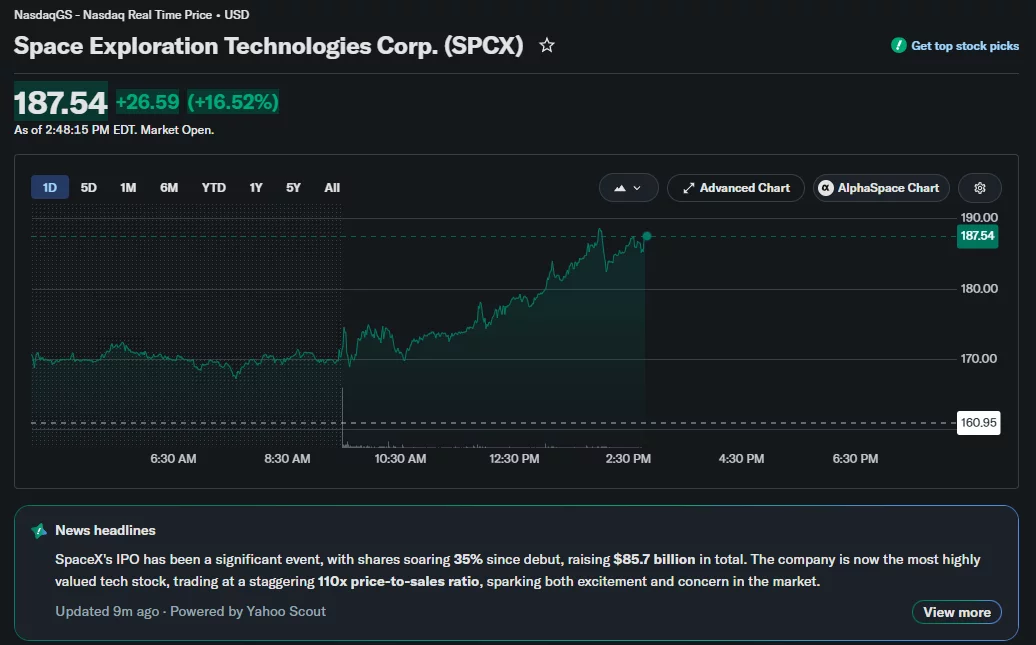
SpaceX’s market value has climbed past $2.43 trillion on the second day of its Nasdaq debut, pushing the stock far beyond several pre-listing valuation estimates and cementing its place among the world’s most valuable public companies.
Summary
- SpaceX’s valuation climbed to roughly $2.43 trillion as shares surged more than 16% on the second day of trading.
- The stock traded near three times Morningstar’s $63 fair value estimate, defying several pre-IPO valuation concerns.
- ARK Invest bought $444 million worth of SpaceX shares, while Michael Saylor highlighted the company’s 18,712 BTC holdings.
According to Yahoo Finance data, shares of Elon Musk’s rocket and satellite company rose over 16% on Monday to $187.5 in afternoon trading. The move added about $26 per share in the session and lifted SpaceX’s intraday valuation to approximately $2.43 trillion.
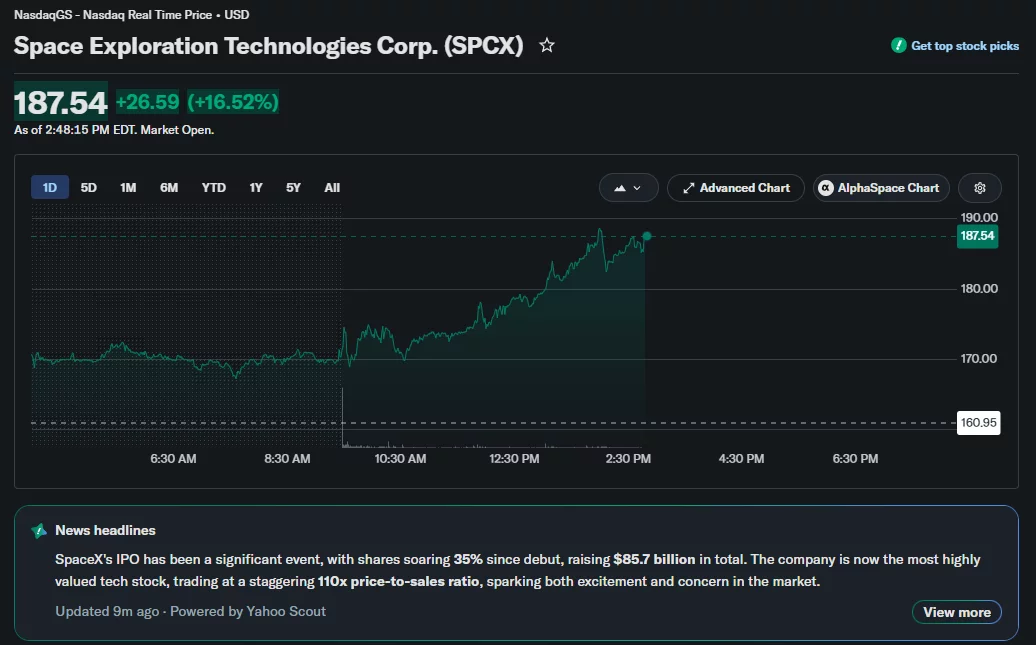
Trading activity remained elevated during the stock’s second session. Yahoo Finance data showed the shares opening at $171.81 and reaching an intraday high near $188.80, while volume surpassed 196 million shares. The gains extended a rally that began immediately after the company’s historic market debut.
Wall Street valuation concerns have not slowed demand
Before the listing, several analysts and market commentators questioned whether SpaceX’s valuation could be justified given the company’s financial profile. Morningstar estimated a fair value of $63 per share, a figure that sat well below the company’s $135 offering price. SpaceX has since climbed to nearly $188, trading at almost three times that estimate.
Investor appetite has moved in the opposite direction. As previously reported, SpaceX raised roughly $75 billion by selling more than 555 million shares at $135 each in the largest IPO on record. The stock opened at $150 on its first trading day, climbed as high as $176.52, and finished more than 19% above the offer price.
Reports surrounding the offering also highlighted concerns that a deal of such size could struggle to attract sufficient demand. Instead, orders reportedly exceeded available shares by a substantial margin, helping SpaceX surpass a $2 trillion valuation during its first days as a public company.
Even with the rally, questions about fundamentals remain. Notably, SpaceX generated $18.7 billion in revenue last year while posting a loss of $8.7 billion between the beginning of 2025 and March 31, 2026. MarketBeat data places the average one-year analyst price target near $161.25, below the stock’s current trading range.
Institutional investors continue backing the stock
While some analysts remain cautious, several high-profile investors have publicly supported SpaceX’s valuation. Kevin O’Leary has argued that investors are assigning value based on the company’s future opportunities rather than its current earnings.
Institutional demand has also accompanied the rally. As previously reported by crypto.news, Cathie Wood’s ARK Invest acquired 3,291,184 SpaceX shares across its exchange-traded funds on June 12, a purchase valued at roughly $444 million. The transaction ranked among ARK’s largest portfolio moves as the company entered public markets.
Meanwhile, SpaceX’s listing has drawn attention beyond traditional equity investors because of the company’s Bitcoin holdings. Commenting on the debut, Strategy Executive Chairman Michael Saylor said the IPO means 25% of the so-called Mag 8 companies now hold Bitcoin on their balance sheets. According to Bitcoin Treasuries data cited by crypto.news, SpaceX holds 18,712 BTC.
The listing has also strengthened Elon Musk’s position among the world’s wealthiest individuals. With SpaceX now trading publicly at a valuation above $2.4 trillion, the company ranks ahead of several established technology giants, including Meta, Samsung and Tesla, while remaining behind Nvidia by market value.
TLDR:
- Spot HYPE ETFs have attracted $153 million in net inflows within their first month of trading.
- Cumulative trading volume across THYP, BHYP, and HYPG has approached $900 million since launch.
- All three ETFs hold HYPE directly and offer staking rewards at an annual rate of around 2.25%.
- About 97% of Hyperliquid trading fees fund an automatic HYPE buyback via the Assistance Fund.
Spot HYPE ETFs have recorded approximately $153 million in net inflows within their first month of trading. Cumulative trading volume across the three available products has approached $900 million since launch.
The three issuers — 21Shares, Bitwise, and Grayscale — each hold HYPE directly and pass staking rewards to investors. Early data points to growing institutional appetite for regulated exposure to Hyperliquid.
Early Volume Data Points to Institutional Demand for Hyperliquid
Three regulated products currently offer brokerage-accessible exposure to HYPE. These are 21Shares’ THYP, Bitwise’s BHYP, and Grayscale’s HYPG.
Together, they have generated nearly $900 million in cumulative trading volume in roughly one month. Net inflows across all three have reached $153 million over the same period.
Trading activity across the products has not been evenly distributed. BHYP and THYP account for the bulk of volume recorded so far.
HYPG, the most recent entrant, is still in its early ramp-up phase. The gap likely reflects differences in launch timing and distribution reach rather than investor preference.
All three ETFs hold HYPE directly and distribute staking rewards to investors. Rewards accrue every minute, are distributed daily, and are automatically compounded. The current annual staking reward rate stands at approximately 2.25%, based on present staking levels.
Approximately 434 million HYPE tokens are currently staked, representing about 45% of the eligible supply. That staking participation rate reflects meaningful on-chain engagement beyond the ETF products themselves. Months two and three of trading will provide a more reliable read on sustained institutional conviction.
Fee Buyback Mechanism Sets HYPE Apart From Speculative Tokens
HYPE carries a structural characteristic that separates it from many other tokens in the market. About 97% of Hyperliquid’s trading fees flow directly into the Assistance Fund. This creates an automatic buyback mechanism tied directly to platform trading volume.
That fee-to-buyback link establishes a direct relationship between platform activity and token demand. As trading volumes on Hyperliquid grow, so does the programmatic demand for HYPE. This makes HYPE less dependent on speculative narratives than many comparable assets.
The ETF structure also adds a layer of accessibility for institutional investors who cannot hold crypto directly. Regulated brokerage exposure lowers the operational barrier for funds, family offices, and other large allocators. That accessibility may partly explain the strong early inflow figures.
For context, U.S. spot Bitcoin ETFs are approaching a $2 trillion cumulative trading volume milestone. That benchmark took years to reach and now serves as a reference point for newer crypto ETF products.
HYPE ETF performance in the coming months will determine how that comparison holds up.

How much money does Lil Uzi have in their bank account?

Teen charged with killing stepsister on Carnival Cruise ship surrenders

Japan raises interest rate to highest since 1995


-

 Business1 day ago
No Jackpot Winner as $257 Million Prize Rolls Over to $269 Million Monday Draw
-

 Crypto World4 days ago
Oppenheimer backs SpaceX as $70 billion retail frenzy builds
-

 Crypto World4 days ago
Markets Rally as SpaceX IPO Looms Amid Iran Tensions and Inflation Surge
-

 Fashion3 days ago
Weekend Open Thread: Tuckernuck – Corporette.com
-
Crypto World1 day ago
Zimbabwe Requires Crypto Businesses to Register Annually Under New FIU Regulations
-

 Entertainment7 days ago
The Ryan Gosling True Crime Thriller On Netflix That Gets Even Stranger, Stream It Now
-
 Sports6 days ago
Bangladesh beat Australia after 20 years in ODIs, register only their second win over six-time world champions | Cricket News
-

 Tech3 days ago
NanoClaw integrates JFrog registries to secure AI agent downloads
-

 Crypto World3 days ago
Bitget enters Argentina’s regulated crypto market through PSAV registration
-

 Tech4 days ago
This Week In Security: Microsoft On Microsoft, Register Your Domains, Linux On ARM, And FreeBSD Joins The File Cache Club
-
 Tech4 days ago
Dutton Ranch star claims they ‘didn’t see any disruption’ on set following Chad Feehan’s exit from Yellowstone spinoff fueled by Taylor Sheridan clash rumors
-

 NewsBeat4 days ago
El Nino has formed in the Pacific and could set records, forecasters say
-

 Politics5 days ago
Politics Home | Healey Resignation Is “Colossal Failure Of Government”, Says Former Labour Defence Secretary
-

 Tech6 days ago
‘This is Seattle’s position on AI’: City Council votes unanimously to pause big new data centers
-

 Business6 days ago
Thailand Ranks Second Worldwide for AI Adoption Growth, Microsoft Reports
-
 Entertainment4 days ago
Donnie Wahlberg & More Heat Up Las Vegas at Circa’s Barry’s Downtown Prime
-

 Sports5 days ago
First Time Since 1971: Australia Register Historic Low In ODI Cricket
-
 Tech4 days ago
Opendoor Ends India Operations, Fueling a Bigger Conversation About AI and Outsourcing
-

 Politics4 days ago
Belfast burns, while Met chief points finger at Iran and Russia
-

 NewsBeat3 days ago
FBI searches office of Ohio voter registration group
You must be logged in to post a comment Login