Connect with us

NewsBeat

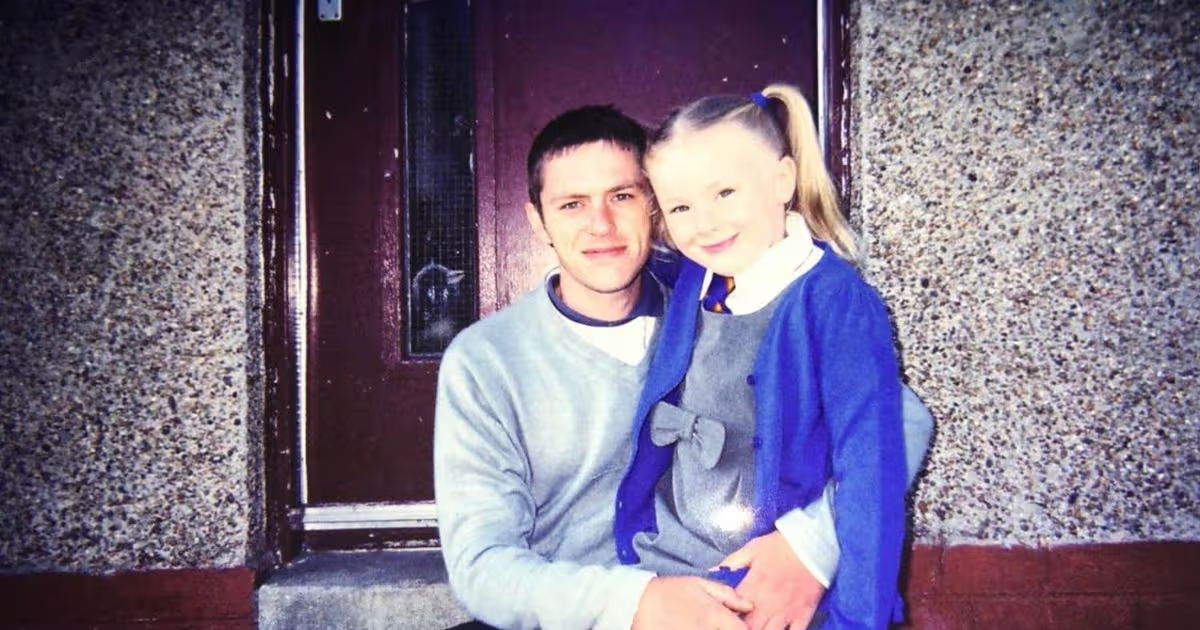
First picture of dad found dead at Dundee flats on Hogmanay as daughter pays tribute

Published

on

Daily Record

A man is due to appear at Dundee Sheriff Court today in connection with the death of 38-year-old James Dougan on December 31, 2025.

A man who was found dead on Hogmanay at a block of flats in Dundee has been named.

James Dougan, 38, was found within Tulloch Court in the Hilltown area of Dundee on Wednesday, December 31. Emergency services had been called to the scene shortly after 2pm.

His death was initially described by police as unexplained, and enquiries remain ongoing. A 43-year-old man has since been arrested and charged in connection with the death.

Advertisement

He is due to appear at Dundee Sheriff Court on February 9.

His daughter Brodie Dougan, 22, shared a heartfelt tribute to her dad, describing him as “loving, caring and loyal”.

She said: “I will remember my dad for who he really was.

“He would have done anything for his people and he loved to his fullest.

Advertisement

“Rest in peace dad. I will love and cherish you forever.”

She told the Record her dad had struggled with addiction for much of his life and shared a moving message about the impact of addiction on families across the city.

She said: “We will never know if there was light at the end of the tunnel for him.

“Drugs are rife in our city and many who are suffering go unnoticed.

Advertisement

“These are mothers, fathers, brothers, sisters, aunties and uncles — people stuck in a cycle that consumes their every thought.

“If we don’t speak up about these issues, we will never see change.”

James’s partner, Christine Duncan, also paid tribute, describing him as her “soul mate”.

“Forever in my heart, I will never forget you,” she said. “You are in my mind, heart and soul. I love you, you are always in my thoughts. You were my soul mate. Sleep tight, handsome man — no other man will ever take your place.”

Cops conducted more than 80 door-to-door enquiries and reviewed over 100 hours of CCTV footage in an effort to trace James’ movements before he was found.

Advertisement

He was last seen on CCTV wearing a black and grey horizontal striped beanie hat, dark puffer jacket, dark joggers and black Nike trainers with white soles. However, when he was discovered, he was not wearing a hat or shoes.

Police were keen to locate the hat and shoes as it could help them understand his movements. They were also looking to speak with anyone who may have seen him in Hilltown between 11.30am and 2.05pm on Hogmanay.

A spokesperson for Police Scotland previously said: “Detectives are appealing for information as their investigation continues into the death of a man in Dundee.

“Following the results of a post-mortem examination, his death continues to be treated as unexplained and enquiries are ongoing.”

Advertisement

Source link

Continue Reading
Click to comment

Leave a Reply

Your email address will not be published. Required fields are marked *

NewsBeat

Teen arrested after alleged knife incident in school canteen where staff ‘restrained’ him

Published

on

Wales Online

Staff reportedly had to restrain the boy, 14, until police arrived at the school.

Police descended on a school today following reports a teenage pupil injured another in an incident involving a knife.

A pupil, 14, from Haute Vallée secondary school in Jersey was arrested from the premises today after reports of a knife incident.

Advertisement

The headteacher confirmed in a statement that a “very serious incident” occurred in the school canteen which left a pupil with a “very minor injury to the hand”, reports the Mirror.

The message to parents from headteacher Stuart Hughes on Facebook reads: “I am writing to inform you about a very serious incident that took place at Haute Vallée School at the end of lunchtime today.

“A 14-year-old male was involved in an incident involving a knife in the canteen. Members of staff acted swiftly and decisively to restrain the teenager, and the police arrived imminently. The 14-year-old has been arrested. I want to reassure you that everyone is safe. One student has sustained a very minor injury to their hand. There are no other reported injuries.”

Mr Hughes said police were examining CCTV footage and that Year 7 students have been provided with “reassurance and support”.

“Officers from the States of Jersey Police are currently on site and working closely with us to support students and staff and reviewing CCTV of the incident,” continued the headteacher. “As part of our response, I spoke to all students in an assembly this afternoon, alongside the Police. Year 7 students were addressed separately in the Theatre to ensure they received appropriate reassurance and support.

“All staff were briefed at the end of the school day and wellbeing support for both students and staff is already in place and will continue over the coming days. I apologise that I was unable to communicate with you sooner; I hope that you understand that our initial priority had to be to ensure the safety and wellbeing of students and staff as we managed the situation.

“I would like to say how proud I am of our school community. Staff responded swiftly with exceptional professionalism, and students were calm, respectful, and supportive of one another throughout. As this is a live police investigation, I am unable to comment further at this stage, but I would like to stress that this is an extremely rare incident.

Advertisement

“If your child is worried or upset over the coming days, please encourage them to speak with their tutor, Head of Year, or a member of our pastoral team tomorrow. We will continue to ensure that every young person feels safe and supported. School will be open as normal tomorrow, please do not hesitate to get in touch if there is anything that we can do to support.

“Thank you for your understanding. I sincerely appreciate parental response and support in this matter. I wish to stress once again that this is an extremely rare incident in which we are working closely with the States of Jersey Police and Education Department colleagues to further understand the events that occurred and ensure that the safety and wellbeing of students and staff is paramount.”

Jersey Police has been contacted for comment.

Source link

Advertisement
Continue Reading

NewsBeat

Face of a ‘vampire’ revealed: Science rebuilds likeness of man decapitated after death to stop him coming back | Science, Climate & Tech News

Published

on

Face of a 'vampire' revealed: Science rebuilds likeness of man decapitated after death to stop him coming back | Science, Climate & Tech News

The face of a “vampire” whose remains were posthumously mutilated to prevent them rising from the dead can be seen for the first time in more than 400 years.

Discovered in a grave at Racesa, a fortress in eastern Croatia, the body had been exhumed, beheaded and reburied face down beneath heavy stones.

And since the desecration cannot be explained by environmental factors, experts believe it was done to stop the dead man returning as a vampire.

Now the face of the deceased can be seen for the first time in centuries, after scientists rebuilt his likeness from his skull.

Advertisement
Image:
The reconstructed face starts to take shape. Pic: Cicero Moraes

Archaeologist Natasa Sarkic, part of the excavation team, said the fear inspired by the man in death may stem from the fear he inspired in life.

She said: “Bioarchaeological analysis showed that this man often participated in violent conflicts, and died a violent death.

“He experienced at least three episodes of serious interpersonal violence during his lifetime.

“One of those attacks left his face disfigured, which could cause fear and repulsion, leading to social exclusion.

Advertisement

“Before even recovering from the penultimate trauma, he sustained a final fatal attack.”

Photo shows the skull of the 'vampire' in situ. Pic: Natasa Sarkic
Image:
Photo shows the skull of the ‘vampire’ in situ. Pic: Natasa Sarkic

The deadly head wound that killed the Racesa 'vampire'. Pic: Natasa Sarkic
Image:
The deadly head wound that killed the Racesa ‘vampire’. Pic: Natasa Sarkic

She continued: “Individuals who died violently, behaved violently in life, or were considered sinful or socially deviant, were believed to be at risk of becoming vampires.

“He may have been regarded as a ‘vampire’, or a supernatural threat due to his facial disfigurement and his marginal lifestyle, characterised by repeated interpersonal violence.

“Such beings were thought to be restless, vengeful, and capable of harming the living, spreading disease and killing people or livestock.”

Dr Sarkic said that, in the Slavic tradition, the soul remains attached to the body for about 40 days after death.

Advertisement
The exacavation at Racesa fortress. Pic: Muzej Nova Gradiska
Image:
The exacavation at Racesa fortress. Pic: Muzej Nova Gradiska

In this time, various preventative measures could be used to prevent the dead from returning as vampires.

These included staking, burning or beheading the corpse, burying it face down, weighing it down with stones and binding the limbs.

This burial therefore showed “practices commonly associated with ‘anti-vampire’ rituals at the time”, Dr Sarkic said.

To complete the reconstruction, graphics expert Cicero Moraes started by virtually rebuilding the man’s skull using data from a CT scan.

The reconstruction of the skull in progress. Pic: Cicero Moraes
Image:
The reconstruction of the skull in progress. Pic: Cicero Moraes

Pic: Cicero Moraes
Image:
Pic: Cicero Moraes

“Although the skull was somewhat fragmented at the time of its discovery, it was possible to reconstruct and digitise it,” Dr Sarkic said.

More data from living donors was then used to plot the likely placement of facial features, and the thickness of soft tissue in different places across the skull.

Advertisement

A technique called anatomical deformation was also used, whereby a donor’s head is virtually adjusted until it matches the subject’s skull, revealing a potential face.

Combining these approaches revealed an objective face, based solely on the shape of the skull, without subjective features like hair or skin tone.

The objective version of the reconstructed face. Pic: Cicero Moraes
Image:
The objective version of the reconstructed face. Pic: Cicero Moraes

Pic: Cicero Moraes
Image:
Pic: Cicero Moraes

A second version of the face is more artistic, introducing some of these speculative elements for a more life-like recreation.

Mr Moraes said it was a “hostile, threatening” likeness.

“The facial scar and other injuries obtained during his life are quite a significant sign that his life may have been rather turbulent,” he said.

Advertisement
The final version of the reconstructed face. Pic: Cicero Moraes
Image:
The final version of the reconstructed face. Pic: Cicero Moraes

The Racesa “vampire” lived in the 15th or 16th century, was roughly 5ft 4in tall, and is believed to have died between the ages of 40 and 50.

Given his injuries, he may have been a soldier, or simply a person accustomed to violent encounters.

He was buried inside what seems to have been a church, though his grave was in the “the most disfavoured spot” along the wall.

The grave of the Racesa 'vampire'. Pic: Natasa Sarkic
Image:
The grave of the Racesa ‘vampire’. Pic: Natasa Sarkic

And it seems his head was literally pulled from his body, since there are no cut marks consistent with decapitation on his neck, skull and shoulders.

His grave was discovered in 2023 and is one of more than 180 burials found in the fortress, which stood 70 miles southeast of Zagreb.

Further examples of vampire belief can be found elsewhere in Europe, including more desecrated graves in Poland.

Advertisement
Pic: Natasa Sarkic
Image:
Pic: Natasa Sarkic

Pic: Cicero Moraes
Image:
Pic: Cicero Moraes

In Serbia, meanwhile, the body of Petar Blagojevic was staked through the heart, and burnt as a suspected vampire after his death in 1725.

While Jure Grando Alilovic, a Croatian villager who died in 1656, is described as a vampire in historical records.

Read more:
Face of ‘most important’ 8,500-year-old American revealed
Face of 75,000-year-old Neanderthal woman reconstructed

Racesa itself is believed to have been occupied first by the Templars, then the Knights Hospitaller, and finally by the local nobility.

Mr Moraes, Dr Sarkic and their co-authors published their study in the journal OrtogOnLineMag.

Advertisement

Source link

Continue Reading

NewsBeat

King Charles breaks Andrew silence and ‘ready to support’ police if approached over Epstein claims

Published

on

Daily Record

Buckingham Palace released a statement on Monday evening expressing the King’s ‘profound concern.’

The King has made clear his “profound concern” at allegations over Andrew Mountbatten-Windsor’s conduct and will “stand ready to support” the police if approached over the claims.

Andrew, 65, is accused of sexually assaulting women who were allegedly trafficked by Epstein, claims he has always denied. The former Duke of York’s name has appeared numerous times in the latest batch of documents released last month by US investigators looking into Epstein’s crimes, reports the Mirror.

Among them are claims that a second woman was sent to the UK by Epstein for a sexual encounter with Andrew, and that Andrew and Epstein had asked an exotic dancer for a threesome in Epstein’s Florida home.

Advertisement

United States authorities have repeatedly urged Andrew to speak to them, while Prime Minster Keir Starmer has also called on Andrew to give any evidence he knows of Epstein’s crimes Today Thames Valley Police confirmed it is assessing a complaint that Andrew passed on reports gathered during his role as a trade envoy on trips to Singapore, Hong Kong and Vietnam.

An email from November 2010, was forwarded by Andrew just five minutes after being sent by his then-special advisor, Amir Patel. Andrew Mountbatten-Windsor made the visits in his capacity as trade envoy in late 2010, conducting meetings and trade talks.

Additionally, on Christmas Eve 2010, Andrew discussed a confidential brief on investment opportunities in the reconstruction of Helmand Province, Afghanistan with Epstein.

A Buckingham Palace spokesman said tonight: “The King has made clear, in words and through unprecedented actions, his profound concern at allegations which continue to come to light in respect of Mr Mountbatten-Windsor’s conduct.

Advertisement

“While the specific claims in question are for Mr Mountbatten-Windsor to address, if we are approached by Thames Valley Police we stand ready to support them as you would expect.

“As was previously stated, Their Majesties’ thoughts and sympathies have been, and remain with, the victims of any and all forms of abuse.”

The Palace has not so far been approached by Thames Valley Police over claims that Andrew shared confidential reports from his role as the UK’s trade envoy with sex offender Jeffrey Epstein.

The Palace has not so far been approached by Thames Valley Police over the claims which relate to Andrew’s time as the UK’s special representative for international trade and investment.

Advertisement

The Prince and Princess of Wales meanwhile publicly addressed the Epstein scandal for the first time on Monday, with Kensington Palace saying they were “deeply concerned” at the “continued revelations” and that their thoughts “remain focused on the victims”.

Source link

Continue Reading

NewsBeat

Which countries are best-placed to see off state-supported cyber-attacks? A government advisor explains

Published

on

Which countries are best-placed to see off state-supported cyber-attacks? A government advisor explains

In April 2007, the Baltic nation of Estonia woke up to one of the world’s first major cyber-attacks on civil society carried out by a state. A series of massive “distributed denial of service” assaults – floods of fake traffic from networked computers – targeted government websites, banks, media outlets and online services for weeks, slowing or shutting them down.

These cyber-attacks followed Estonia’s decision to relocate a Soviet-era war memorial and war graves from the centre of the capital city, Tallinn, to a military cemetery.

Amplified by false reports in Russian media, this sparked nights of protest and rioting among Russian-speakers in Tallinn – and cyber chaos throughout the country. Though the cyber-attack was never officially sanctioned by the Kremlin, the “faceless perpetrators” were later shown to have Russian connections.

Estonia has since transformed itself, in part through voluntary initiatives such as the Cyber Defence Unit (a network of private-sector IT experts), into a leader in this field. It is home to Nato’s Cyber Defence Centre of Excellence, and ranks fifth in the International Telecommunication Union’s global cybersecurity index – alongside the UK.

Advertisement

The massive 2007 cyber-attack on Estonia explained. Video: Cybernews.

But in many ways, Estonia is far ahead of Britain in its cybersecurity planning. A 2025 government review found that nearly one-third of the UK’s public sector IT systems were “critically vulnerable” due to historical underinvestment – with some aspects of the police and NHS at particular risk.

International cyber-attacks on the UK increased by 50% last year. “Nationally significant” incidents rose from 89 to 204 – including, in September 2025, a major ransomware attack on Jaguar Land Rover that halted production for a month, causing losses of around £1.9 billion.

Amid these threats, the UK government recently launched its Cyber Action Plan and held the first ever cross-party international security briefing – co-chaired by the National Cyber Security Centre’s CEO, Richard Horne.

Advertisement

So can this more preemptive approach staunch the flow of cyber-attacks on the UK? In my experience of advising European and Asian governments on cybersecurity matters, the problem is that nothing is ever urgent – until everything is.

Cyber-attacks could shatter public trust

A key worry for British ministers is that an attack on government systems could shatter public trust. Imagine welfare benefits going unpaid, tax returns being ignored and health records frozen amid a major ransomware crisis.

The new plan prioritises central government digital services including tax, benefits, health records and identity verification. Pledging £210 million in additional funding, it promises to address the difficulty of attracting highly paid private-sector engineers, analysts and penetration (“pen”) testers to the public sector. Defence companies, specialist security firms and big tech typically pay 30-50% higher salaries.

While establishing a Government Cyber Unit is welcome, its phased rollout to 2029 feels too leisurely amid the level of threats the UK (and other countries) now face. Groups linked to Russia and China in particular are dramatically increasing the volume and sophistication of cyber-attacks. They combine state resources with criminal ecosystems to exploit the vulnerabilities of years of IT under-investment much faster than most cyber-defences can adapt.

Advertisement

Rapid developments in AI technology are also making the threat more severe – for example, through highly personalised phishing attacks and use of deepfakes. Defenders are struggling to keep up with the scale and constantly changing nature of these threats.

Interview with the UK’s National Cyber Security Centre CEO, Richard Horne. Video: McCrary Institute for Cyber and Critical Infrastructure Security, Auburn University.

Who leads the way on cyber-defence?

The US is in a league of its own when it comes to cyber-defence. The federal government alone spends an annual US$25 billion (£18 billion) on defending its IT systems, compared with the UK’s £2-2.6 billion.

Australia’s budget – A$6.2 billion (£3.2 billion) – also exceeds the UK’s, despite its much smaller population. It enforces strict rules such as 12-hour critical incident reporting and, most importantly, has prioritised investing in new technologies.

Advertisement

Countries that are ahead of the cybersecurity curve show the same ingredients work: mandatory rapid reporting of incidents, serious investment in AI-powered monitoring, real-time sharing of information between government and private sectors, and strong international partnerships.

What came as a shock to Estonia in 2007 has been hitting European institutions and infrastructure for years now. Since Russia launched its full-scale invasion of Ukraine four years ago, it has woven cyber operations much more closely into its hybrid warfare playbook. In 2022, there were more than 650 documented attacks by pro-Russian groups, of which only 5% targeted Ukraine – the rest focused on Nato and other EU countries.

In contrast, China has tended to prioritise stealthy, long-term espionage, including the UK Ministry of Defence payroll breach in 2024. Iran has focused on aggressive disruption, and North Korea on seizing funds through cyber heists – the most successful of which stole US$1.5 billion in cryptocurrency by hacking into the Bybit crypto exchange.

To keep pace, the UK needs to lean harder into its alliances, including with Nato and the EU. It should insist on compulsory AI-threat training across government and key industries, and show more willingness to expose attackers publicly. A timely but measured response should at least raise the risk (and cost) of the next cyber-attack for its state-sponsored perpetrators.

Advertisement

Source link

Continue Reading

NewsBeat

Son of Jimmy Lai fears he’ll never see father again after media tycoon’s 20-year sentence

Published

on

Son of Jimmy Lai fears he’ll never see father again after media tycoon’s 20-year sentence

The son of jailed Hong Kong media tycoon Jimmy Lai said his father had been effectively issued a death sentence as he was sentenced to a further 20 years in prison on Monday.

Sebastien Lai said the verdict was expected but “still devastating” and left him doubtful as to whether he would ever see his ailing father again.

Mr Lai, the 78-year-old founder of the pro-democracy Apple Daily newspaper, was found guilty of collusion and sedition in his national security trial last year, five years after his arrest under the controversial national security law. He denies the charges.

His son toldThe Independent that his father was still “strong in spirit” despite “all these attempts to break him, including torture, confinement and horrible conditions that he’s been kept in”.

Advertisement

“Even being held in solitary confinement for 10 days is insane for most people. He’s done 1,800 days of that. It’s inspirational,” he said, describing his father as his hero and adding: “Someone who has given up so much for freedom, I think, surely deserves some of it himself.”

Sebastien Lai told The Independent he was ‘incredibly proud’ of his father for sticking to his principles

Sebastien Lai told The Independent he was ‘incredibly proud’ of his father for sticking to his principles (AFP/Getty)

Announcing their verdict on Monday, the three judges said Mr Lai’s sentence fell within the harshest penalty tier for offences of a “grave nature”, accusing him of being the driving force behind persistent foreign collusion conspiracies. The sentence drew uproar from the British government and other democracies around the world.

Mr Lai’s son said: “It’s one of those moments where I think to myself, ‘Am I ever going to see my father again?’ He’s already been there for five years. Given his health conditions, I don’t even know if he’s got a tenth of that. So it’s obviously tremendously hard.

Advertisement

“I think one of the things that gave me a bit of strength was that in court, when they announced it, Dad was stoic and he flashed a small smile because I think he knew that this was coming and he wasn’t going to give them the satisfaction of showing any sad emotions.

“Also, he knew that he did the right thing. I think that’s what is most important, is that he’s a man who at every turn and every opportunity did what was right.”

He said his message to his father, who has only been able to receive letters since late 2020, would be “that I miss him a lot, that I love him a lot. But that I’m incredibly proud of him”.

Jimmy Lai has been sentenced to 20 years in prison after being found guilty of foreign collusion and publishing seditious materials, charges he denies

Advertisement
Jimmy Lai has been sentenced to 20 years in prison after being found guilty of foreign collusion and publishing seditious materials, charges he denies (AFP/Getty)

Sebastien Lai said he believed history would remember the media tycoon as “a very good man … who was willing to give everything that he had to stand for what was right”.

He said: “I think people always think of the death of press freedom as a bang. Unfortunately, as you see from my father’s case, it sounds more like drowning. It sounds like the air being sucked out of a room. And nobody really thinks about press freedom until there’s no press freedom anymore… It’s a farce.”

He added that he did not know if there would be the ability to appeal the verdict, describing the legal system in Hong Kong as “broken”.

Sebastien Lai said he had to remain optimistic that his father could still be released, urging the British government to make the resetting of relations with China conditional on his father’s release. He said that “time is running out for my father”.

Advertisement

“Many people in this country are very worried or have national security concerns in regards to China. They have done nothing to abate that. And we’re not going to normalise what’s happening to my father. That’s just completely unacceptable.”

“In order to have a closer relationship, my father’s release should be a precondition for that. And if they’re not even willing to do something so right, so humane, so simple, what can we possibly expect from that relationship with Hong Kong and China?”

Britain, the US, Australia, the European Union, Japan and Taiwan expressed concerns about the impact of the sentencing. Foreign minister Yvette Cooper said Britain would “rapidly engage further on Mr Lai’s case”.

“For the 78-year-old, this is tantamount to a life sentence,” she said. “I remain deeply concerned for Mr Lai’s health, and I again call on the Hong Kong authorities to end his appalling ordeal and release him on humanitarian grounds, so that he may be returned to his family.”

Advertisement
Sebastien Lai urged Britain to make the resetting of relations conditional on the release of his father

Sebastien Lai urged Britain to make the resetting of relations conditional on the release of his father (Reuters)

US secretary of state Marco Rubio said the sentencing was an “unjust and tragic conclusion” to the case and urged authorities to grant him “humanitarian parole”.

Anitta Hipper, spokesperson for the European Commission, said the “politically motivated persecution” would harm Hong Kong’s reputation.

“The EU calls on the Hong Kong authorities to restore confidence in press freedom in Hong Kong, one of the pillars of its historic success as an international financial centre, and to stop prosecuting journalists.”

Advertisement

Source link

Continue Reading

NewsBeat

BBC bosses ‘have found the next Claudia Winkleman’ as Bake Off legend joins talks

Published

on

BBC bosses 'have found the next Claudia Winkleman' as Bake Off legend joins talks
Has the BBC found Claudia Winkleman’s Strictly replacement? (Picture: BBC/Guy Levy)

The BBC is reportedly eyeing up a British comedy icon to replace Claudia Winkleman on Strictly Come Dancing and take over her hugely popular segment.

Last year, The Traitors host Claudia and TV sidekick Tess Daly announced that the 2025 series of Strictly (which was won by Karen Carney) would be their last.

Tess has been at the helm since the glitzy dance competition began in 2004, presenting alongside Sir Bruce Forsyth before Claudia made the move from It Takes Two in 2014, making them primetime’s first-ever female presenting duo.

Alas, even the best things must come to an end, and speculation remains rife over who will succeed them.

Advertisement

According to the latest reports, former Great British Bake Off host Mel Giedroyc has caught the attention of Strictly bosses, who want her to host what’s become known as the Clauditorium.

Get personalised updates on Strictly

Wake up to find news on your TV shows in your inbox every morning with Metro’s TV Newsletter.

Sign up to our newsletter and then select your show in the link we’ll send you so we can get TV news tailored to you.

Advertisement

As Tess remained downstairs, catching the celebrities’ initial reaction to their dances before directing the judges’ feedback, Claudia would attempt to take charge upstairs in a much more chaotic fashion.

For use in UK, Ireland or Benelux countries only BBC handout photo of Claudia Winkleman and Tess Daly on the BBC1's Strictly Come Dancing Christmas Special 2025. Issue date: Thursday December 25, 2025. PA Photo. Photo credit should read: Guy Levy/BBC/PA Wire NOTE TO EDITORS: Not for use more than 21 days after issue. You may use this picture without charge only for the purpose of publicising or reporting on current BBC programming, personnel or other BBC output or activity within 21 days of issue. Any use after that time MUST be cleared through BBC Picture Publicity. Please credit the image to the BBC and any named photographer or independent programme maker, as described in the caption.
Claudia and her TV sidekick Tess Daly bowed out of Strictly last year (Picture: Guy Levy/BBC/PA Wire)

Surrounded by all the other contestants and professionals, she would interview the pairs fresh off the dancefloor with her famous sarcasm and quick wit, and there would often be surprises from the cast, who would interject and become rowdier as the show progressed.

Basically, it was business downstairs and party upstairs, and the Beeb seems to reckon Mel has what it takes to carry on the good vibes.

‘The Clauditorium is the section where the dancers go to receive their scores from the judges and decompress after their routines,’ an insider told The Sun.

Advertisement

‘So it needs to be hosted by someone with a gentle touch, who can use humour to relieve the tension.’

The source added that Mel, 57, is ‘seen as a great swap for Claudia, as they’re both smart, funny, and have a reputation within the TV world for being easy to work with.’

‘They’re both highly professional, well-liked by the public, and boast just the right balance of confidence and self-deprecation.’

17/11/23 PA File Photo of Mel Giedroyc at the BBC Children In Need telethon at BBC Studios in Salford. See PA Feature SHOWBIZ TV Children In Need. WARNING: This picture must only be used to accompany PA Feature SHOWBIZ TV Children In Need. PA Photo. Picture credit should read: Danny Lawson/PA Archive/PA Images. NOTE TO EDITORS: This picture must only be used to accompany PA Feature SHOWBIZ TV Children In Need.
Mel Giedroyc has plenty of broadcasting experience under her belt (Picture: Danny Lawson/PA Archive/PA Images)
Mel Giedroyc Strictly Christmas Special. (Picture: BBC/Guy Levy)
She also took part in the Strictly Christmas Special in 2021 with Neil Jones (Picture: BBC/Guy Levy)

As well as that, Mel has years of experience under her belt, meaning she’d be able to act fast if something happened unexpectedly.

‘Mel has experience of hosting live TV through fronting BBC Children in Need, and, thanks to Bake Off, she already knows what it’s like to front a big BBC prime-time show.’

Advertisement

The Surrey-born comedian hosted Bake Off when it first landed on the BBC with Dame Mary Berry and Paul Hollywood as judges between 2010 and 2016.

Both bowed out when the cookery programme moved to Channel 4; since then, Mel has been involved with various major productions, including the Eurovision Song Contest, Taskmaster, Last One Laughing UK series 2, and even The Masked Singer, having competed as Teeth in 2025.

And she’s no stranger to the Strictly studios either, having participated in the 2021 Christmas Special with pro partner Neil Jones.

‘I’ve always thought Strictly’s a weird one for a woman in her 50s,’ she said at the time.

Advertisement
Television Programme: The Great British Bake Off - TX BBC: n/a - Episode: n/a (No. 1) - Picture Shows: Mel Giedroyc, Sue Perkins - (C) Love Productions - Photographer: Mark Bourdillon
Mel famously hosted Bake Off on the BBC alongside Sue Perkins (Picture: BBC/Love Productions/Mark Bourdi)
Mandatory Credit: Photo by Ray Tang/Shutterstock (15950094w) Emma Willis attends the Paddington the Musical opening night 'Paddington the Musical' opening night, Savoy Theatre, London, UK - 30 Nov 2025
Currently, Emma Willis is in a ‘straight shoot-out’ with Zoe Ball for Tess’ job (Picture: Ray Tang/Shutterstock)
Zoe Ball
Zoe only fuelled speculation when she quit her Radio 2 show (Picture: BBC/PA Wire)

‘But now I’ve dipped my large, middle-aged toe into the glitter, and maybe I feel differently.’

Rumours of her signing come after it emerged that two other British TV titans are in the running to replace Tess – but only one of them will get the job.

It’s said to now be a ‘straight shoot-out’ between broadcasters Zoe Ball and Emma Willis, as ‘the senior execs want a traditional presenter working alongside a more left-field person, a female stand-up comedian.’

Zoe’s name has been floating around for a while, and she only fuelled rumours when she announced that she was quitting her BBC Radio 2 show in December, suggesting she could be clearing up her schedule ahead of Strictly’s 2026 season.

The former It Takes Two host, 55, hasn’t made a secret of the fact that she’d be up for the gig either, having said she’d ‘love’ to take on hosting duties for the main show.

Advertisement

Previously, Alison Hammond, Amanda Holden, Alan Carr, Alex Jones, Bradley Walsh, Rylan Clark, and Angela Scanlon were reported to be on the shortlist.

Got a story?

If you’ve got a celebrity story, video or pictures get in touch with the Metro.co.uk entertainment team by emailing us celebtips@metro.co.uk, calling 020 3615 2145 or by visiting our Submit Stuff page – we’d love to hear from you.

Advertisement

Source link

Advertisement
Continue Reading

NewsBeat

53 migrants, including two babies, dead or missing after boat capsizes off Libya | World News

Published

on

A migrant boat is intercepted off the coast of Libya in August 2025. File pic: Reuters

More than 50 people have died, or are missing, after a migrant boat capsized off the coast of Libya, according to reports.

The vessel overturned north of Zuwara on 6 February, with only two rescued from the 53 on board, said the International Organization for Migration (IOM) in a statement.

The two survivors, both Nigerian women, were given medical care by IOM after a rescue operation by Libyan authorities.

One survivor reported losing her husband, while the other said she lost her two babies in the tragedy, according to the IOM.

Advertisement

Advertisement

The migrants stuck in East Libya’s detention centres

IOM said witnesses reported that the rubber boat was carrying people of African nationalities and departed from Al-Zawiya around 27 miles (44km) west of Tripoli at around 11pm on 5 February.

But it capsized approximately six hours later after taking on water.

The organisation said that, in January alone, at least 375 migrants were reported dead or missing after attempting to take routes across the Mediterranean Sea to Europe. The total figure for 2026 is estimated to be at least 484.

Advertisement

It added that hundreds more deaths are believed to be unrecorded.

ION has also said that more than 1,300 migrants have gone missing in the central Mediterranean in 2025.

Advertisement

Read more from Sky News:
Son of Gaddafi shot dead
Libya’s people smuggling gangs
Migrants found in mass graves

The group warned that trafficking and smuggling networks are continuing to exploit migrants and profit from dangerous crossings in unseaworthy boats.

Sky News has previously investigated the people smuggling business in East Libya, where thousands are willing to risk their lives in small boats to get to Europe and the UK.

Sky’s Special correspondent Alex Crawford was shown the scale of the problem by authorities who believe the EU should provide funding to help stem the flow of illegal migration.

Advertisement

Libya has in recent years emerged as the dominant transit point for migrants fleeing war and poverty in Africa and the Middle East.

The North African nation was plunged into chaos following a NATO-backed uprising that toppled and killed longtime dictator Muammar Gaddafi in 2011.

Source link

Advertisement
Continue Reading

NewsBeat

King Charles and Prince William evict Andrew from Royal Lodge to Wood Farm

Published

on

Cambridgeshire Live

Andrew was whisked away from Royal Lodge under cover of darkness after Prince William and King Charles made the final decision following the latest Jeffrey Epstein revelations

It marked a fitting conclusion to Andrew Mountbatten-Windsor’s tenure at Royal Lodge. Shrouded in darkness, the scandal-hit former Duke was spirited away to commence his new existence in exile in Norfolk last Monday evening.

Andrew had already received his eviction notice as a consequence of his links to Jeffrey Epstein. However, it seems King Charles hastened his removal following the most recent release of Epstein documents, and Andrew was swiftly removed without ceremony.

Advertisement

The ex-Prince is making arrangements to relocate to Marsh Farm on the Sandringham estate. For now, though, he remains at Wood Farm – which Prince Philip chose as his retirement residence during his final years – while building work continues at the red-brick dwelling.

According to the Daily Mail, it was the King and Prince William who took the ultimate decision to banish Andrew into exile. The breaking point, royal insiders suggest, came when Andrew was spotted riding around the Windsor estate on horseback, cheerfully acknowledging passers-by – apparently showing no signs of contrition.

Charles and his heir swiftly convened an emergency meeting at Sandringham last Sunday, sealing Andrew’s destiny, with the former Prince being whisked away under cover of night after midnight. “Waving at the public harked back to his royal days when he was used to adulation and respect,” an insider told the publication.

“Andrew is having difficulty acknowledging reality and it was increasingly causing concern at the Palace – both as a sign of his mental state and because it wouldn’t play well with the public witnessing him still enjoying the trappings of royalty. It was hastily arranged and done under the radar, leaving Royal Lodge staff to pack up what remains of Andrew’s belongings.”

Advertisement

Meanwhile, the Prince and Princess of Wales have addressed the controversy for the first time. In a short statement released on Monday, William and Kate said they were “deeply concerned” by the fresh disclosures surrounding Jeffrey Epstein, reports the Mirror.

A Kensington Palace spokesperson confirmed: “I can confirm The Prince and Princess have been deeply concerned by the continuing revelations. Their thoughts remain focused on the victims.”

This marks yet another setback for Andrew. However, despite the mounting public outcry, he appears to be in complete denial about his dramatic downfall.

Royal commentator Jennie Bond said: “You’d think he’d be feeling humbled, at the very least. But, judging by his jovial behaviour riding and driving around Windsor Great Park in the past few days, he is as arrogant and tone deaf as ever. The optics of that were not lost on the Palace, and there was considerable relief when he finally left Royal Lodge, under cover of darkness.”

Advertisement

Andrew’s forthcoming residence was apparently selected precisely because, while situated on the Sandringham estate, it maintains a comfortable distance from the main house where the royal family gather for significant occasions such as Christmas Day. The location also offers the advantage of shielding him from public scrutiny.

Wood Farm provides considerably more privacy than Royal Lodge, being invisible from public roads and pathways, significantly reducing the likelihood of unwelcome public encounters. Andrew will occupy Marsh Farm by himself. After cohabiting with his former wife Sarah Ferguson for the past 18 years, the two are now parting ways residentially.

Sarah has reportedly left the country while weighing up her future plans. A representative for Sarah has previously refuted speculation that she would be relocating to an annexe at her eldest daughter Princess Beatrice’s countryside residence, or that she might live with Princess Eugenie in Portugal.

Fergie’s daughters are reportedly “aghast” at the recent Epstein revelations – including a photograph of their father on all fours and leaning over a young woman lying on the floor, and their mother’s obsequious emails to the sex offender, alongside a disturbing message in which Sarah discusses Eugenie’s sex life.

Advertisement

Royal commentator Jennie Bond observed: “This, though, must be testing their love and loyalty.” She added: “We have seen Beatrice and her daughter showing overt support for Andrew by riding out with them at Windsor. But there has been no sign of Eugenie.

“Of course, she lives much of the time in Portugal at the moment, and she’s probably grateful to be that much removed from the scathing headlines about her parents. But it must be tough for both young women, especially as their names have been dragged into the whole sordid story several times.”

Source link

Advertisement
Continue Reading

NewsBeat

T20 World Cup: Bangladesh request Pakistan play fixture against India

Published

on

Spectators wave India and Pakistan flags

Bangladesh have requested that Pakistan end their planned boycott of their T20 World Cup match against India, opening the door for the fixture to be played on 15 February as scheduled.

The match, the biggest and most lucrative in cricket, has been in doubt since the Pakistan government advised its team not to take the field against their long-time rivals.

Prime Minister Shehbaz Sharif said that initial decision was made to “support” Bangladesh, who had a request for their matches to be moved out of India rejected and subsequently pulled out of the tournament.

But, after talks between officials at the Pakistan Cricket Board, the International Cricket Council and the Bangladesh Cricket Board (BCB) in Lahore on Sunday, BCB president Ameenul Islam requested the match go ahead “for the benefit of the entire cricket ecosystem”.

Advertisement

“We are deeply moved by Pakistan’s efforts to go above and beyond in supporting Bangladesh during this period. Long may our brotherhood flourish,” he added.

The match is scheduled to take place in the city of Colombo in Sri Lanka, the co-hosts for the tournament with India.

Pakistan will forfeit the points from the group-stage match should it not be played but the team’s absence from the tournament would also have longer-term consequences for cricket.

It could lead to disputes over the ICC’s current rights deals and continued uncertainty would likely impact future agreements, with the current TV deals set to run out after the 2027 World Cup.

Advertisement

Many of the smaller cricketing nations rely on the money distributed by the ICC, so any cut in revenue would likely hit such countries hardest.

“Following my short visit to Pakistan yesterday and given the forthcoming outcomes of our discussions, I request Pakistan to play the ICC T20 World Cup game on 15 February against India for the benefit of the entire cricket ecosystem,” Islam said.

While stopping short of confirming the match will go ahead, the ICC released a statement on Monday evening confirming Bangladesh will not be sanctioned for their boycott.

It also said Bangladesh will host an ICC event between 2028 and the start of the 2031 World Cup.

Advertisement

“The ICC, PCB and BCB, along with other members, remain committed to continued dialogue, cooperation and constructive engagement in the best interests of the sport,” a statement said.

“All stakeholders acknowledge that the spirit of this understanding is to protect the integrity of the game and preserve unity within the cricket fraternity.”

There were no details on what event Bangladesh would host. All men’s events have been confirmed up until 2031, with Bangladesh already scheduled to co-host the 2031 World Cup with India.

The hosts of women’s tournaments have been chosen up to 2027, while the ICC also holds Under-19 World Cups.

Advertisement

The PCB has been contacted for comment.

Source link

Continue Reading

NewsBeat

How African principles of community are helping Black students in the UK into PhD study

Published

on

How African principles of community are helping Black students in the UK into PhD study

Across the UK, Black students remain significantly underrepresented in doctoral programmes. This is despite years of widening participation policies and a growing awareness that the pathways into a PhD are often far harder to navigate for some groups than others.

My research with colleagues shows that a different approach is possible: one that draws on long-standing African philosophies of community, character and collective care.

In 2021, I and colleagues launched the Accomplished Study Programme in Research Excellence (Aspire), an initiative led by Sheffield Hallam University in partnership with Manchester Metropolitan University and higher education charity Advance HE. The programme emerged from a national funding competition aimed at widening access and participation for Black, Asian and minority ethnic groups in postgraduate research.

Aspire provides personalised, culturally grounded mentorship that combines academic development and wellbeing support. The programme works with Black students in their final year of undergraduate and master’s degrees, as well as graduates who may have left university long ago, helping them find their way into doctoral study.

Advertisement

Aspire takes inspiration from two African philosophies. One is ubuntu, a concept from Southern Africa meaning: “I am because we are.” It emphasises community, mutual support and shared humanity.

The other is omoluabi, a Yoruba principle of “good character”. It values integrity, humility, respect and responsibility towards others.

These ideas may be centuries old, but they offer a powerful framework for modern mentorship. Students told us that mentoring based on these values felt different: more personal, more understanding and more connected to who they are. It gave them permission to see themselves not as outsiders in academia, but as people whose experiences and identities belong there.

Each participant is paired with a Black academic mentor who offers personalised guidance and support throughout the six month duration of the programme. Instead of presenting the doctoral process as a rigid checklist, mentors helps students understand the unwritten expectations of academia.

Advertisement

This includes how to approach potential supervisors, how funding works and how to build a research profile. The programme builds confidence and opens up the possibility of a PhD for people who may never have imagined doctoral study as an option for them.

The programme, and the research my colleagues and I have published on its methodology, offer the clearest evidence yet that culturally grounded mentorship is not simply beneficial; it is transformative.

Aspire scholars.
ASPIRE, CC BY-NC-ND

Many students begin thinking about doctoral study years before they apply. But for Black students, this journey is often shaped by additional pressures. These include limited access to academic role models, navigating structural inequalities, and the experience of feeling out of place in academic spaces. Standard university support, such as one-off career talks or short mentoring schemes, rarely addresses these deeper issues.

Feeling seen and heard

A key element of the programme is the Talk About Race Forum, a structured but open discussion space where students can reflect on their experiences of university life. For many, this was the first time they could speak honestly about the challenges such as racial microaggressions or the fear of “not being good enough”.

Advertisement

These conversations were not counselling sessions, nor were they complaints forums. Instead, they became places of validation. Students heard others articulate struggles similar to their own. This helped them realise that these challenges were not personal failings but often the result of broader inequalities. Mentors and peers provided reassurance and practical advice rooted in lived experience.

This sense of recognition was central to students’ growth. Many described gaining a stronger sense of who they were academically, and beginning to picture themselves in doctoral settings they once assumed were “not for people like me”.

One of the strongest findings from the research is that culturally informed mentorship can create measurable impact.

Across three cohorts, the programme has supported 59 Black students. Of these, 15 scholars have progressed into fully funded PhD programmes in different UK universities. This 25% progression rate far exceeds typical sector patterns for Black students. These achievements stem not only from academic guidance but also from the emotional support students received and the reassurance that they belonged, that their ideas mattered, and that doctoral study was within reach.

Advertisement
Group of people in black and white photo
Aspire showcase event, 2024.
ASPIRE, CC BY-NC-ND

A model for the future

Universities often call for increased diversity in postgraduate research. However, many rely on surface-level initiatives that do little to address structural barriers. The Aspire approach suggests a realistic alternative.

It is about adopting principles that make mentorship meaningful. This includes seeing students as whole people, not problems to be “fixed”. The programme values cultural knowledge and lived experience and invests time in building trust. It provides personalised guidance rather than one-size-fits-all workshops.

For institutions, the benefits extend beyond individual student success. A more diverse doctoral community enriches research, expands perspectives and strengthens the university’s connection to the society it serves.

The under-representation of Black students in UK doctoral programmes is often seen as a long-standing, stubborn inequality. But our findings show it is neither mysterious nor impossible to address. When mentorship is rooted in compassion, culture and community, it becomes a powerful tool for change.

Culturally grounded approaches like ubuntu and omoluabi do more than help students navigate an unfamiliar system. They reshape students’ sense of possibility. They also challenge universities to rethink the kinds of support that truly foster inclusion.

Advertisement

Source link

Continue Reading

Trending

Copyright © 2025