

Crypto World
Bitcoin Buyers Stack $512M Bids Near $70K Support: Is A Reversal Ahead?

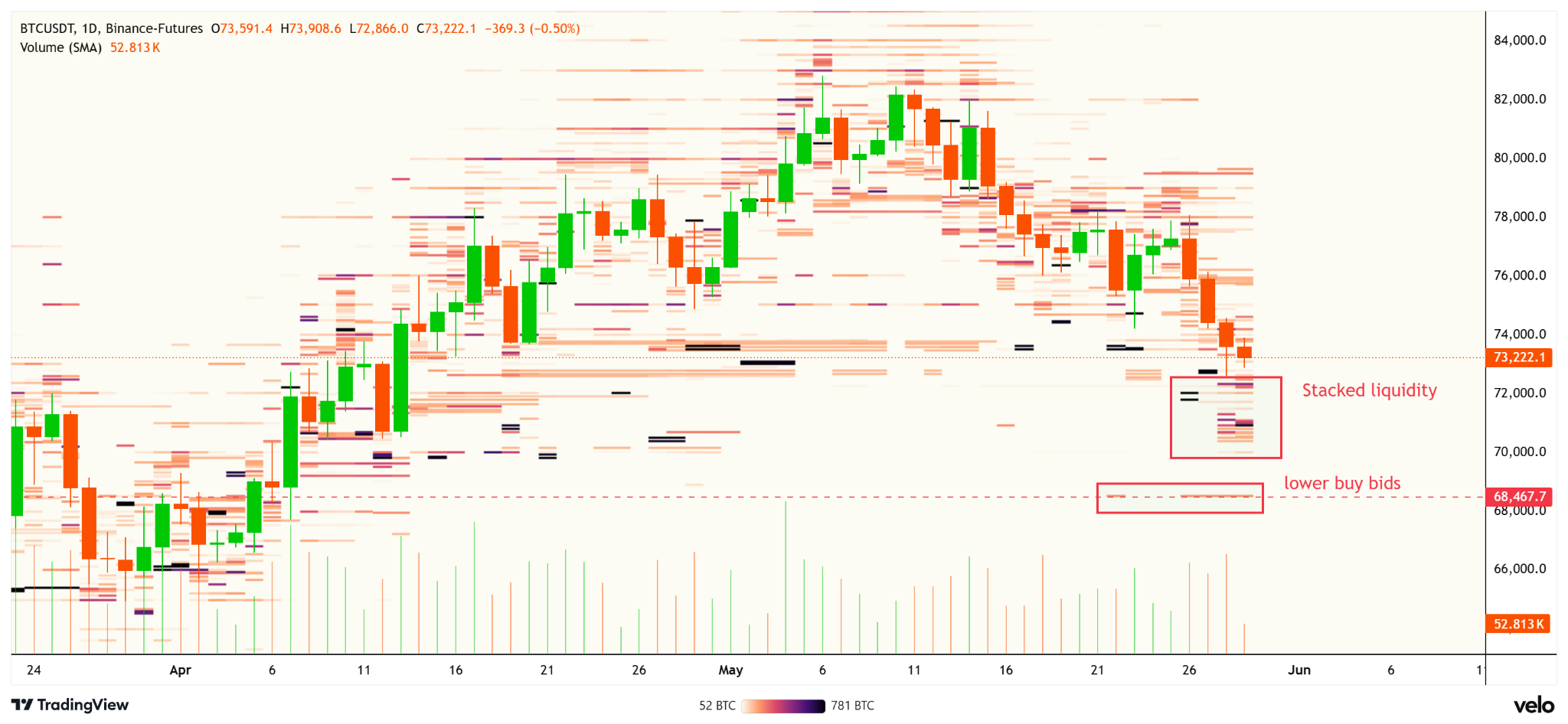
Bitcoin (BTC) traders have placed new buy orders near $70,000 as the price approaches a key liquidity zone. Order-book data shows more than $500 million in bid liquidity between $72,000 and $70,000, creating a demand zone that could shape BTC’s next move.
BTC buy bids form key support zone
Data from CoinGlass shows dip buyers have placed 6,235 BTC in bid liquidity between $72,000 and $70,000. At current prices, the buy orders are worth roughly $443 million.
The largest cluster sits directly above $70,000, where buyers are positioned to absorb the current selling pressure. Bid liquidity refers to limit buy orders waiting below the market price. When price trades into those orders, it can slow a decline and trigger a sharp rebound if demand absorbs available BTC supply.
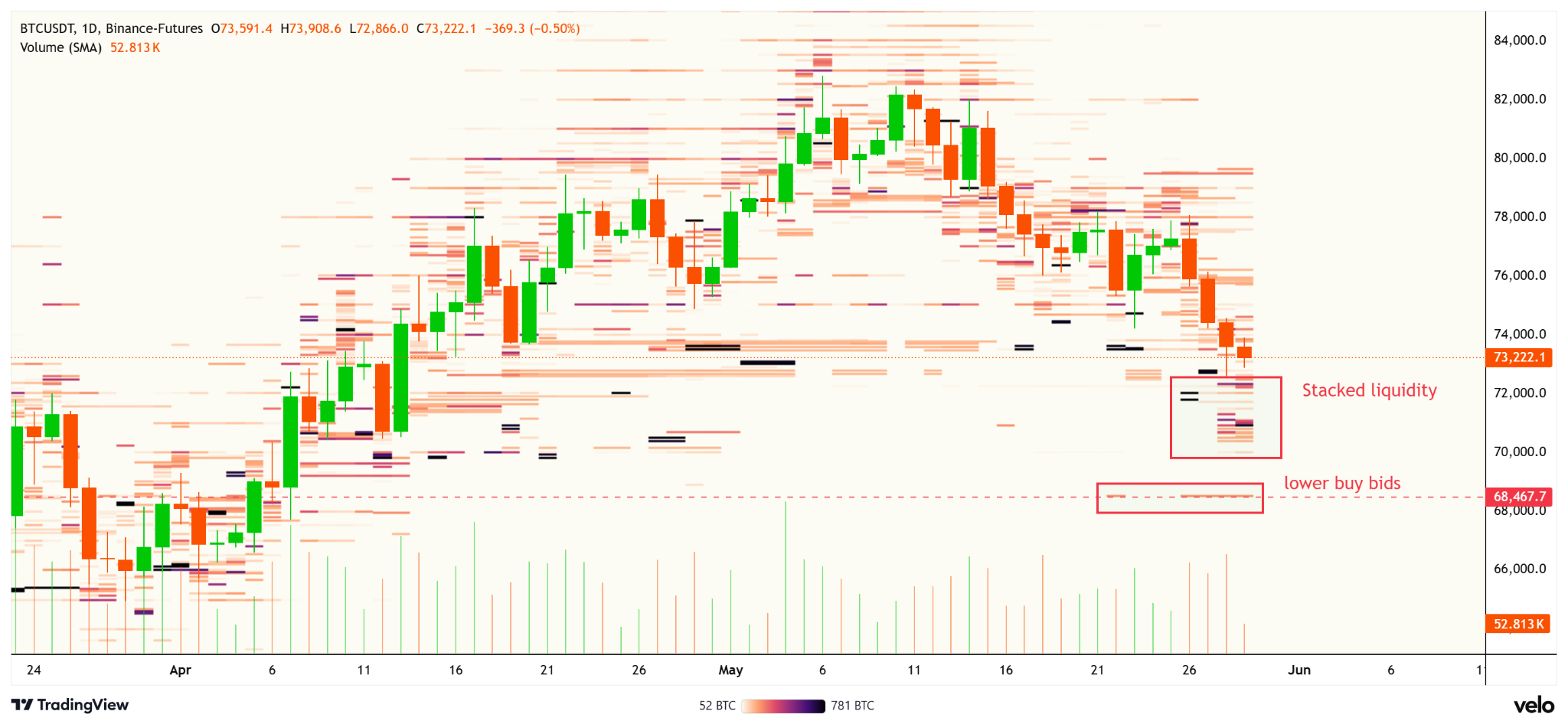
BTC/USD, one-day chart, buy liquidity analysis. Source: Velo chart
Below $70,000, the next notable pocket of demand sits at $68,505, where traders have placed another 1,012 BTC worth approximately $69 million. Outside that level, the order book thins considerably, with few visible bids below $68,500.
Meanwhile, liquidation heatmap data shows about $2 billion in cumulative long positions at risk near $70,000, compared to more than $5 billion in short positions around $78,000. Once BTC taps the bid cluster near $70,000, the larger liquidity pool may trigger a sharp rebound toward overhead liquidation zones.
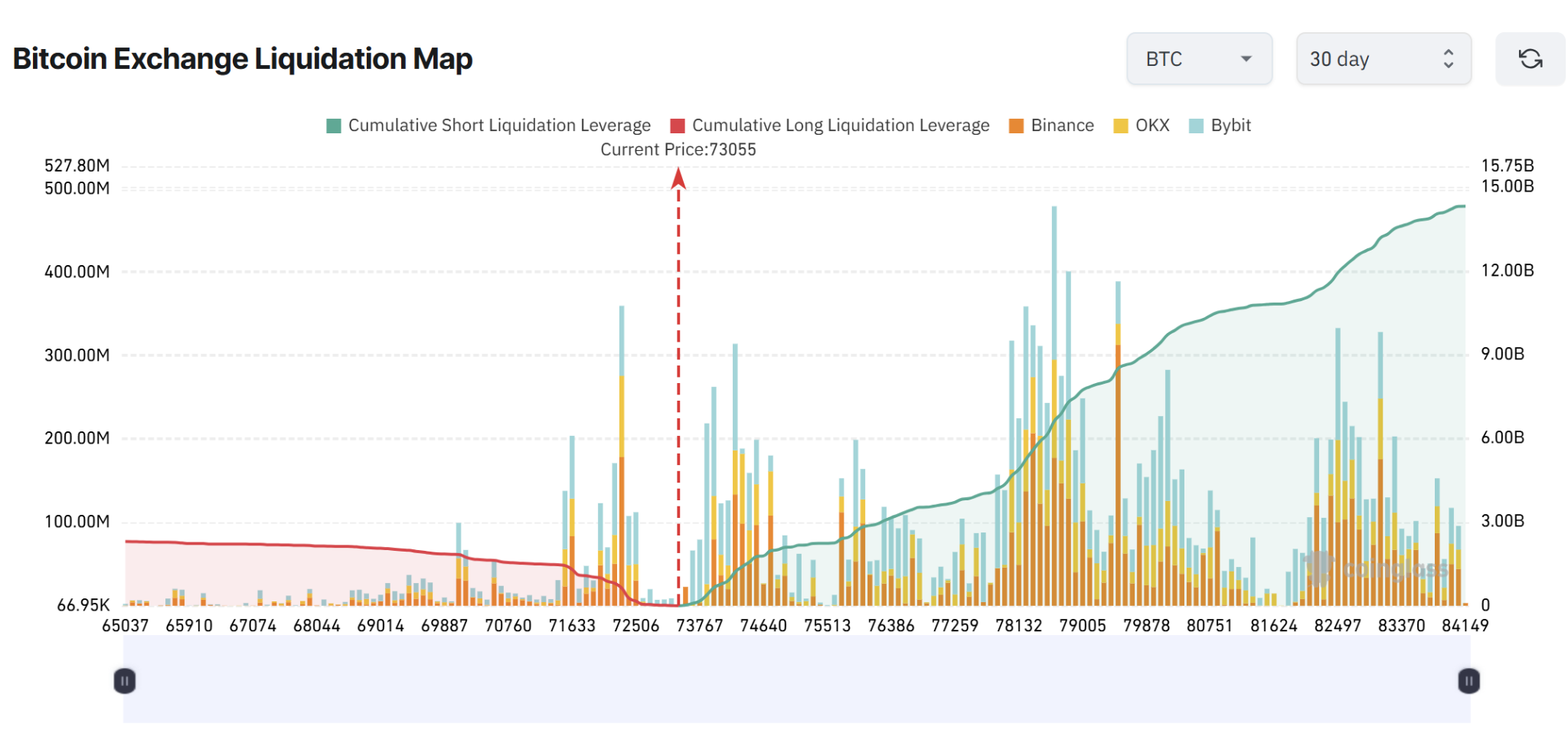
BTC liquidation map. Source: CoinGlass
Related: Bitcoin falls out of the global top 10 assets as market cap dips below $1.5T
RSI hits three-month low as daily BTC trend turns bearish
Bitcoin’s daily trend turned bearish after losing support at $74,800, confirming a pattern of lower highs and lower lows. The price is trading inside a descending channel and is currently testing support near the lower boundary around $72,000–$73,000.
The relative strength index (RSI) has fallen to roughly 33, its lowest level since Feb. 24. Momentum has stayed below the neutral 50 level throughout the recent decline, suggesting sellers still control the short-term price action.
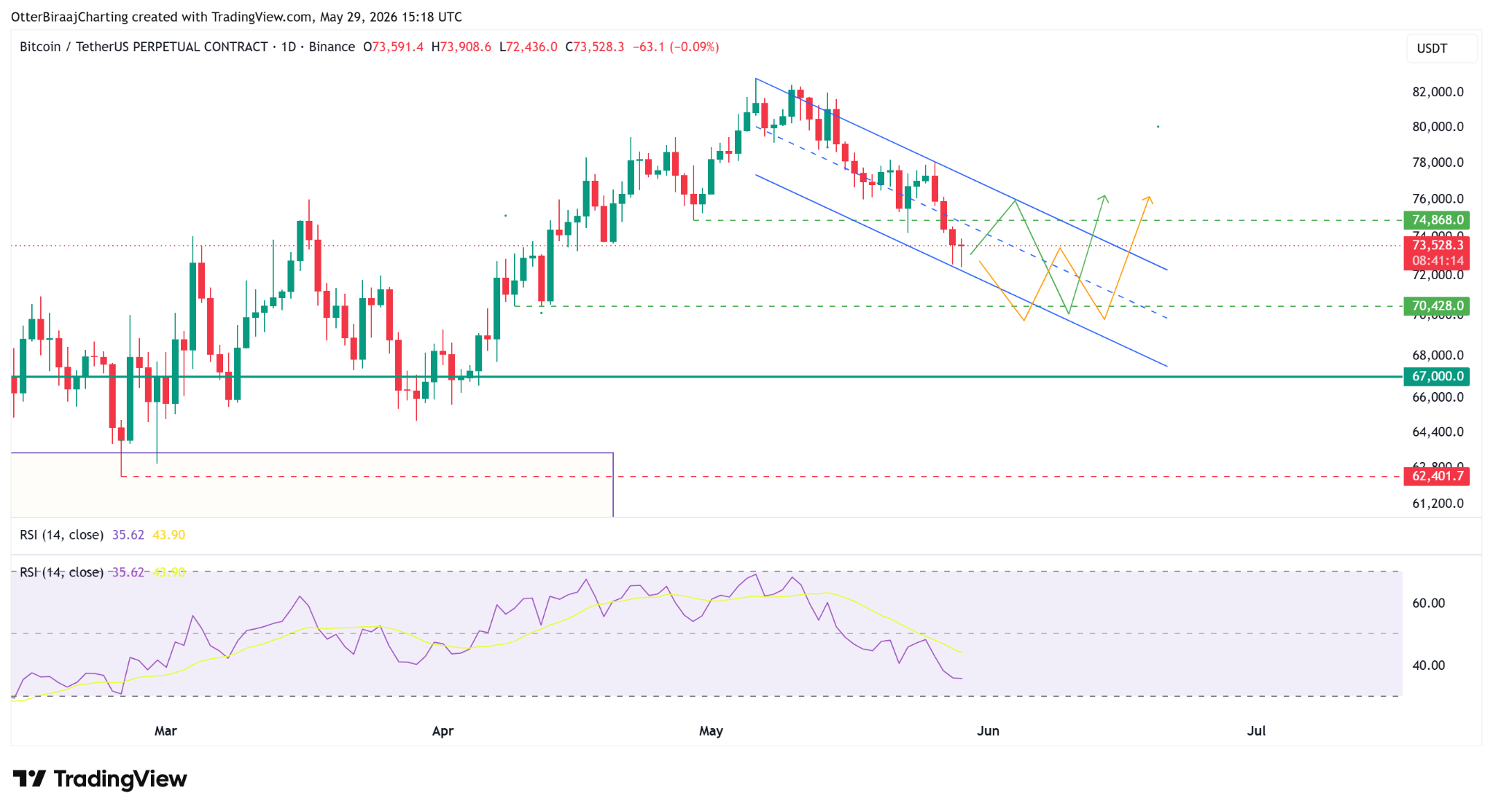
BTC/USD, one-day chart. Source: Cointelegraph/TradingView
Crypto trader Ardi outlined a similar view. The analyst said the $74,500–$75,500 region now acts as resistance across multiple time frames. A rejection from that area could keep focus on the $71,500 region, while a move through channel resistance near $76,000 may challenge the ongoing downtrend.
Options markets show investors have also been preparing for a move toward $70,000. According to Glassnode, traders spent nearly $10 million on put options with a $70,000 strike during the recent dip.
Put options rise in value when prices fall, making them a common hedge against downside risk. Recent flows show some easing in that protection demand as traders lock in profits, though the concentration of hedging activity highlights how closely the market is watching the $70,000 level.
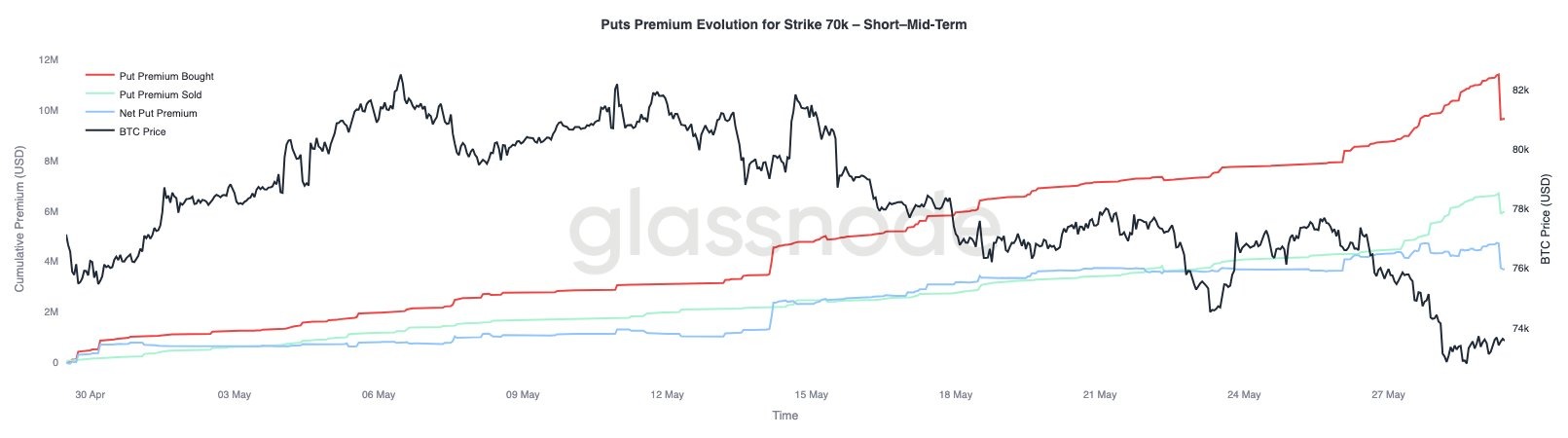
BTC options market analysis at $70,000. Source: Glassnode/X
Related: Bitcoin’s major holders halt buys as demand slows: CryptoQuant


TLDR:
- Ethereum whale wallets accumulated 17.41 million ETH, representing nearly 22% of the total supply.
- Santiment data showed major holders buying aggressively during Ethereum’s latest market weakness.
- ETH remained below key resistance levels as traders monitored support near the $1,850 zone.
- Analysts projected a potential downside to $1,560 if Ethereum loses its weekly support structure.
Ethereum whale accumulation Santiment data reveals that large wallets reached a nine-week high in ETH holdings.
In the meantime, traders are closely monitoring the critical $1,850 support level for signs of Ethereum’s next directional move.
Whales Quietly Increase ETH Exposure During Market Weakness
Santiment reported that wallets holding at least 100,000 ETH collectively control 17.41 million ETH, marking the highest balance recorded in nearly two months.
The development surfaced while retail sentiment remained cautious across the crypto market. Many short-term traders responded defensively to Ethereum’s declining price structure.
Meanwhile, high-value holders appeared focused on positioning ahead of potential long-term recovery conditions.
Santiment shared the latest on-chain trend through a market update on X, noting that major Ethereum addresses steadily increased holdings during the correction.
The divergence between declining prices and rising whale balances quickly fueled discussions surrounding smart money activity.
Growing concentration among large holders may also tighten exchange liquidity over time. As more ETH shifts into long-term storage wallets, the circulating supply available for immediate selling gradually declines. That setup can increase volatility once broader demand returns to the market.
Institutional players often accumulate during periods of weak sentiment rather than during euphoric rallies. Ethereum’s continued dominance across decentralized finance, stablecoin settlements, tokenization, and smart contract activity may explain why large holders remain confident despite current uncertainty.
Ethereum Price Risks Deeper Correction Below $1,850
Ethereum’s technical structure now sits near a decisive support area that analysts continue monitoring closely. Market participants identified the $1,850 level as a major defensive zone capable of shaping Ethereum’s medium-term direction.
Recent price action reflected persistent weakness across higher timeframes. Ethereum repeatedly failed to reclaim resistance near $2,282 while remaining trapped beneath the 50-week simple moving average. At the same time, tightening volatility conditions signaled the possibility of a sharp directional breakout.
Analysts warned that a confirmed weekly close below $1,850 could accelerate downside pressure rapidly. Once higher-timeframe support zones fail, traders often shift away from aggressive dip-buying strategies and prioritize defensive positioning.
The first downside target currently sits near the $1,560 region, where Ethereum previously established strong support during earlier correction phases. However, sustained bearish momentum could expose ETH to deeper losses toward the $1,070 area over time.
Even with growing technical pressure, on-chain activity continues painting a different picture beneath the surface. Large holders continue to increase exposure during periods of weakness, suggesting sophisticated investors still view current market conditions as a strategic accumulation phase rather than a breakdown in Ethereum’s broader network strength.


Bitcoin is hovering near a critical liquidity zone as traders line up sizable buy orders around the $70,000 mark. Fresh data shows a substantial bid wall between $72,000 and $70,000, totaling more than 6,000 BTC and roughly $443 million in current value. The heaviest concentration sits just above $70,000, positioning buyers to absorb selling pressure if price dips into that area.
Key takeaways
- A formidable bid wall exists between $72,000 and $70,000, comprising about 6,235 BTC and roughly $443 million in buy liquidity.
- The largest cluster sits directly above $70,000, with additional demand at $68,505 (1,012 BTC, about $69 million), while bids thin below $68,500.
- Liquidation risk visually centers near $70,000: around $2 billion in long positions are exposed, versus over $5 billion in short exposure near $78,000, signaling pronounced hedging and potential volatility if the zone is breached.
- The daily RSI has slipped to about 33, its lowest in three months, and BTC is trading in a descending channel with support around $72,000–$73,000.
- Put options around the $70,000 strike totaling close to $10 million indicate targeted hedging near the key level, underscoring how traders are positioning for a move near $70k.
Liquidity as the compass for BTC’s near-term path
From the bid side, the concentration of buy orders around and just above $70,000 suggests market participants expect eventual support if prices test that zone. The 6,235 BTC resting between $72,000 and $70,000 translates to roughly $443 million in buy pressure at current prices, a sizable cushion should selling accelerate. In practical terms, this liquidity cluster can slow down a slide and potentially catalyze a rebound if demand adequately absorbs supply.
The next notable pile sits at $68,505, where traders have placed about 1,012 BTC, worth around $69 million. Beyond that, the order book thins noticeably, with few visible bids below $68,500. Such a thin lower respaldo means a break through the $68,500 zone could expose BTC to sharper moves if selling accelerates and buyers recede from the page.
On the risk side, the liquidation heatmap paints a vivid picture of trader positioning. Approximately $2 billion in long positions sit at risk near the $70,000 area, while more than $5 billion in short exposure concentrates around $78,000. The juxtaposition implies that a visit to the $70k bid cluster could set off a cascade—shorts unwinding as new buyers step in, potentially triggering a relief rally that pushes price toward higher liquidity pockets and liquidation zones above.
Data visualizations supporting these insights originate from CoinGlass’s market analytics, which track both bid liquidity and liquidation dynamics. The reader should note that these figures reflect snapshot data and may shift quickly in response to macro headlines, order execution, and market sentiment.
Related: Bitcoin falls out of the global top 10 assets as market cap dips below $1.5T
Momentum and the broader price architecture
Bitcoin’s daily trend has turned bearish after failing to hold above the $74,800 level, yielding a pattern of lower highs and lower lows. On the chart, BTC continues to press within a descending channel, with near-term support clustered around $72,000–$73,000. The technical backdrop is underscored by a weak momentum read, as the relative strength index (RSI) slipped to about 33 — its lowest reading in roughly three months — and has remained below the neutral 50 level during the latest leg down. This tilt toward selling pressure aligns with a price action narrative characterized by renewed downside risk into the critical liquidity zones described above.
The market narrative around resistance also centers on a roughly $74,500–$75,500 area, a region some traders view as a broad barrier across multiple timeframes. A rejection from that zone could keep price anchored near the lower end of the channel, while a break above the resistance could alter the short-term trajectory and invite a test of higher levels. As one trader on social channels noted, the dynamics around $74,500–$75,500 remain a focal point for directional bets, even as bid clusters around $70k provide a potential floor if selling accelerates.
Options market activity corroborates a cautious stance around the key price zone. Glassnode data cited market chatter that traders had spent near $10 million on put options with a $70,000 strike during the recent dip. Put options tend to increase in value as prices fall, serving as a hedge against downside risk. Although some of that hedging activity has eased as traders book profits, the concentration of protective positioning around $70,000 highlights how closely the market is watching the level and how a move through that threshold could alter hedging dynamics and implied volatility going forward.
The macro mosaic around BTC—comprising bid liquidity near $70k, a bearish but still-cautious momentum setup, and a hedging emphasis around the same price—paints a nuanced picture. While the near-term path remains uncertain, the liquidity layer could be pivotal in determining whether BTC finds support and reverses, or breaks lower toward the next local hazard in the lower-$60k or mid-$60k neighborhood.
For readers tracking lead indicators, the link between order-book depth, price action, and hedging preferences remains a telling barometer of sentiment as the market approaches a potential inflection point near $70,000.
Related reading that highlights broader hodling dynamics and investor behavior can be found in analyses touching on major holder activity and hedging flows, including CryptoQuant coverage on demand patterns across large holders.
Meanwhile, market observers will keep a close eye on whether the bid clusters at $70k hold firm or give way under renewed selling pressure, and how that interacts with ongoing hedging activity and option positioning as BTC navigates a volatile path forward.
What to watch next: a clean test of the $70,000 zone could either validate the idea that demand is sufficient to anchor a bounce or signal a renewed leg lower if sellers overwhelm the bid wall. Traders will be watching liquidity shifts, delta exposure, and how quickly hedges unwind if price stabilizes above or breaks below the critical level.
TLDR:
- NEAR market capitalization jumped from $2.7 billion to nearly $3.8 billion within days.
- NEAR Intents has processed over $19 billion in volume across 35+ blockchain networks.
- Chain abstraction technology aims to simplify cross-chain transactions for users and AI agents.
- Protocol revenue surpassed $8 million after the fee switch activation and buyback mechanism.
NEAR Protocol has emerged as one of the week’s strongest crypto narratives after a sharp rise in market capitalization.
The move comes as investors increasingly focus on the network’s AI infrastructure, cross-chain capabilities, and growing adoption of products designed for autonomous digital economies.
NEAR Protocol Gains Momentum as Investors Reassess AI Strategy
NEAR Protocol spent much of the previous market cycle away from the spotlight. While many projects focused on short-term attention, the network concentrated on building infrastructure aimed at long-term adoption.
That strategy is now drawing renewed interest as artificial intelligence becomes a dominant theme across technology and digital assets.
The recent market cap surge reflects that changing perception. During the past seven days, NEAR’s valuation climbed from roughly $2.7 billion to nearly $3.8 billion before stabilizing above previous levels.
More importantly, the network maintained a higher valuation range after the initial rally, indicating continued demand despite market volatility.
At the center of the investment thesis is NEAR’s focus on chain abstraction. Traditional blockchain interactions often require users to manage multiple wallets, bridges, and gas tokens.
NEAR aims to remove those barriers by creating a system where multiple networks operate as a unified environment.
This vision extends beyond human users. As AI agents become more capable of performing economic tasks, blockchain infrastructure must support seamless execution across ecosystems. NEAR’s architecture is increasingly being viewed as a framework designed for that future.
Recent ecosystem commentary has emphasized user-owned AI, confidential inference, and AI-native applications as major areas of development. These initiatives are helping position NEAR Protocol as more than a conventional Layer 1 blockchain.
NEAR Intents Growth Strengthens Ecosystem Fundamentals
A major contributor to the growing attention around NEAR Protocol is the rapid expansion of NEAR Intents. The product allows users to express desired outcomes while network participants handle execution and routing behind the scenes.
According to ecosystem data, Intents has processed more than $19 billion in all-time volume. The platform currently connects liquidity across over 35 blockchains and supports more than 135 assets. This growing reach has expanded its role within decentralized finance infrastructure.
Network activity has also translated into measurable revenue generation. Since the fee switch was activated, NEAR has generated more than $8 million in revenue directed toward token buybacks.
At the same time, confidential transaction volume continues to expand alongside support for emerging asset categories.
The protocol’s economic structure is also evolving. Its token supply is fully unlocked, while a halving-related upgrade reduced maximum annual inflation by 50%.
Combined with increasing network usage, these developments are strengthening the project’s economic foundation.
As a result, investors appear to be evaluating NEAR Protocol through a different lens. The conversation is increasingly centered on whether the network can become critical infrastructure for AI agents operating across the broader digital economy.
Crypto World
JPMorgan CEO Jamie Dimon Vows to Fight CLARITY Act Over Stablecoin Rewards and AML Concerns
TLDR:
- Jamie Dimon confirmed banks will oppose the CLARITY Act due to stablecoin reward provisions and AML gaps.
- Dimon accused Coinbase CEO Brian Armstrong of spending hundreds of millions lobbying for the crypto bill.
- Coinbase’s policy chief fired back, urging the Senate to bring the CLARITY Act to a floor vote soon.
- Dimon supports blockchain and stablecoins for payments but warns of major risks without thoughtful regulation.
JPMorgan Chase CEO Jamie Dimon announced that banks will oppose the CLARITY Act in its current form. He cited concerns over stablecoin rewards and regulatory gaps.
Dimon also launched sharp criticism at Coinbase CEO Brian Armstrong, accusing him of spending hundreds of millions lobbying for the bill.
The remarks came during a Fox Business interview on May 29, 2026, adding fresh tension to the ongoing debate between banks and the crypto industry.
Banks Push Back on Stablecoin Reward Provisions
The CLARITY Act aims to establish a regulatory framework for digital assets in the United States. However, Dimon argues the bill as written creates an uneven playing field.
He said the legislation allows crypto firms to effectively pay interest on stablecoin deposits. Traditional banks are required to meet strict oversight standards for similar products.
Dimon was direct about the bill’s regulatory shortcomings. “It allows cryptocurrency firms to effectively pay interest on deposits, stablecoins or something like that, without the protection that they should have,” he said.
He also pointed out that the bill falls short on Anti-Money Laundering requirements and the Bank Secrecy Act. He concluded that the CLARITY Act “has almost no legal protections … so the banks will not accept it that way.”
The stablecoin rewards debate has been at the center of industry disagreements for weeks. Banks argue that permitting such incentives could drive deposit flight away from traditional institutions.
They maintain that firms offering bank-like products should face comparable regulatory scrutiny. This position has drawn a clear dividing line between legacy finance and the crypto sector.
Coinbase Chief Policy Officer Faryar Shirzad responded by email, defending the legislation. “At the end of the day, we all share the same goal: improving the financial lives of Americans,” Shirzad said.
He added that millions of Americans support preserving rewards programs and clear consumer protections. He then called on the Senate to bring the CLARITY Act to the floor.
Dimon Criticizes Armstrong’s Lobbying Campaign
Beyond the policy dispute, Dimon took direct aim at Coinbase CEO Brian Armstrong. He claimed Armstrong is spending hundreds of millions of dollars in Washington to advance the bill.
“No one is going to bow down to this guy,” Dimon said bluntly. He then called Armstrong “full of sh–” in remarks that drew immediate attention.
This is not the first time Dimon has made such remarks about Armstrong. He delivered similar criticism earlier this year at the World Economic Forum in Davos.
The repeated comments show the depth of tension between the two executives. They also reflect broader friction between Wall Street and the crypto industry.
Despite his opposition, Dimon expressed support for blockchain technology and acknowledged stablecoins have practical uses. He pointed to cross-border payments as one area where the technology shows real promise.
However, he stressed the need for careful government oversight of fiat-pegged tokens. “If they don’t do it thoughtfully, it will be a huge problem,” he warned.
The debate over the CLARITY Act continues as the 2026 midterm elections draw closer. Scrutiny over President Trump’s crypto interests has further complicated the legislative process.
Both sides remain firmly entrenched in their positions. The outcome will likely shape the future of crypto regulation in the United States.
TLDR:
- Sui Network Stall stopped block production after a gas charging bug disrupted validator activity
- SUI fell up to 8% during the outage as trading volumes spiked across major exchanges
- The mainnet resumed after validators upgraded, restoring activity following a six-hour halt
- This marks Sui’s third major outage since launch, raising concerns over upgrade stability risks
Sui Network Stall disrupted blockchain operations after a gas charging bug halted validator activity across the mainnet.
The network paused block production for hours, triggering sharp SUI volatility. Operations resumed later, but the event renewed attention on system stability and resilience.
Gas Logic Bug Halts Validators and Freezes Mainnet
The Sui Network Stall validators stopped finalising blocks as the bug broke transaction processing rules inside the network’s fee calculation system.
SuiScan data showed a complete freeze in checkpoint production, confirming that no blocks entered the chain during the outage window.
The development team quickly identified the faulty update and coordinated a rollback-style fix through validator upgrades.
More than two-thirds of the total stake was upgraded, allowing the network to restart block production after nearly six hours.
RPC endpoints stayed online, so users viewed balances but could not execute transactions or interact with protocols. Sui confirmed that no funds were lost and no chain splits occurred during the disruption period.
The Sui Network Stall also affected ecosystem applications, which paused operations until finality returned across validators.
Developers linked the issue directly to the gas charging module, a core component that calculates transaction fees.
Earlier outages in 2024 and January 2026 showed similar validator coordination issues during system updates. Sui continues to position itself as a high-throughput blockchain, yet repeated disruptions challenge that narrative.
The team plans a full post-incident report to explain how the update bypassed testing safeguards. Recovery is completed once validators synchronize under the patched version of the protocol.
Market Reacts as SUI Drops Before Partial Recovery
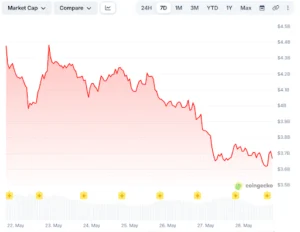
SUI reacted immediately when the Sui Network Stall hit the market, as traders rushed to adjust positions. The token dropped between 6.6% and 8% during the outage as liquidity thinned across major exchanges.
Market capitalization briefly lost around $3.7 billion before stabilising after a partial recovery in trading hours. Bitcoin weakness during the same period increased selling pressure and deepened short-term downside movement in SUI.
Source: CoinGecko
Price action broke below the $1.00 support zone, a level that previously held during consolidation phases. Traders now watch the $1.05–$1.10 region as a recovery band if momentum returns after the incident.
The Sui Network Stall added volatility spikes across derivatives markets as funding rates fluctuated sharply. Institutional interest remains active, supported by staking programs and ecosystem expansion despite repeated network interruptions.
Sui has recorded three major outages since 2024, with each incident tied to upgrade or coordination failures. Market participants now question whether upgrade cycles introduce recurring operational risks for validators.
For now, traders remain cautious as they reassess exposure following the latest disruption event.


Disclosure: This article does not represent investment advice. The content and materials featured on this page are for educational purposes only.
AI trading robots expand from stocks into crypto as traders use automation tools like BulkQuant for market monitoring.
Summary
- AI trading robots are moving from stock tools into crypto as traders need automation for 24/7 markets; profits are not guaranteed.
- Platforms like BulkQuant position themselves as AI-assisted trading workflows offering multi-market access, automation, and risk controls.
- Experts stress these tools support decision-making and monitoring but do not ensure returns; advanced traders may prefer coding-based systems.
In 2026, more traders are looking beyond a single market. A few years ago, the phrase AI stock trading robot usually referred to stock scanners, technical alerts, automated equity trading tools, or software that helped traders filter market signals.
Now the conversation is changing.
If an AI stock trading robot can help traders scan stocks, identify volatility, and follow strategy rules, can similar AI automation logic also help traders find crypto income opportunities?
The question makes sense.
Stocks and cryptocurrencies are different markets, but traders face many of the same problems in both: too much data, fast price movements, emotional decision-making, and limited time to monitor charts manually. Crypto adds another challenge because the market runs 24 hours a day, seven days a week. It does not pause when traders sleep, work, travel, or step away from their screens.
Before going further, one point should be clear: an AI trading robot cannot guarantee income. It cannot remove crypto market risk, and it cannot make every strategy profitable. The phrase crypto income opportunities should be understood as potential trading setups that traders may identify, monitor, and manage with the help of automation — not as fixed income, passive income, or guaranteed returns.
That is why platforms such as BulkQuant are entering the discussion. Instead of treating “AI” as only a marketing label, BulkQuant focuses on bringing market monitoring, automated strategy execution, multi-market access, and risk settings into a more understandable workflow. For users who do not want to code their own trading systems but still want to explore AI trading robots, this kind of platform can offer a practical starting point.
This article looks at how AI stock trading robot-style automation may help traders explore crypto income opportunities in 2026, what features matter most, and how users can approach these tools without ignoring risk.
1. From stock screening to crypto opportunity filtering
One of the earliest reasons traders used AI stock trading robots was simple: there are too many stocks to monitor manually.
A trader cannot review every chart, every price movement, every volume spike, and every technical setup in real time. AI-powered tools can help narrow the field by scanning for price changes, volume expansion, volatility shifts, technical patterns, or market momentum.
In crypto, this problem becomes even larger.
Traders are not only watching Bitcoin and Ethereum. They may also track altcoins, exchange pairs, sector rotations, liquidity changes, and sudden moves across different platforms. The market never closes, and both opportunities and risks can appear quickly.
This is where the logic behind AI trading robots can move from stock trading into crypto trading.
The robot does not need to “predict the future” to be useful. Its first value is helping traders filter chaotic market information into conditions worth reviewing.
For traders searching for crypto income opportunities, the first step is not always placing a trade. Often, the first step is knowing where to look.
2. Crypto markets never sleep, so traders need better monitoring
Stock traders work around defined market sessions. There is an opening bell, a closing bell, and time to review the market after the session ends.
Crypto traders do not have that structure.
Bitcoin can break a key level at night. Ethereum can move sharply over the weekend. An altcoin can react to news, liquidity changes, exchange announcements, or on-chain activity within minutes.
Many traders miss potential opportunities not because they lack judgment, but because they cannot be online all the time.
An AI trading robot can help by creating a more stable monitoring process. It may be used to:
- Track price movement across major crypto assets
- Watch for unusual volume changes
- Identify volatility expansion
- Monitor breakout or pullback conditions
- Organize signals across different markets
- Alert users when predefined conditions appear
This matters because crypto income opportunities often appear quickly and disappear quickly. A more consistent monitoring system can reduce the chance of missing important market changes.
BulkQuant fits naturally into this part of the discussion because it supports crypto, forex, and stock-related trading automation workflows. Its value is not that it creates risk-free opportunities, but that it gives users a simpler way to observe markets and understand how AI-assisted strategy execution may work across different asset classes.
Monitoring a potential opportunity does not mean a trader should immediately act on it. It simply helps users see market changes earlier and with more structure.
3. AI trading robots can help reduce emotional income expectations
Many traders who search for crypto income opportunities are hoping to find a faster and easier way to make money.
That expectation can be dangerous.
Crypto markets can intensify emotion. When prices rise quickly, traders fear missing out. When prices fall sharply, they panic. After a loss, some traders increase their position size to recover quickly. After seeing others post gains, they may enter risky assets without a plan.
One of the practical benefits of an AI trading robot is that it can move the trading process away from emotion and closer to rules.
A structured automated workflow may require users to define:
- Which market conditions matter
- Which assets should be monitored
- When a strategy becomes active
- How much exposure is allowed
- When a stop-loss should apply
- When a position should be reduced or closed
- When automation should be paused
These rules may not sound exciting, but they are more useful than trading based on a feeling.
For traders who want to explore crypto income opportunities over time, discipline matters more than impulse. AI trading robots should not encourage users to trade more aggressively. They should help make trading behavior more controlled.
4. Stock-style AI scanning can be applied to crypto market signals
A common function of AI stock trading robots is market scanning.
These systems may look for price breakouts, volume expansion, trend shifts, technical indicator triggers, volatility changes, or unusual market behavior.
Crypto traders often watch similar signals:
- Bitcoin breaking a key price range
- Ethereum showing stronger volume
- Altcoins rotating after major coins move
- The market entering a high-volatility phase
- A token showing repeated strength
- Support and resistance levels changing
- Capital moving from large-cap crypto assets into smaller tokens
AI trading robots can help organize these signals faster than manual review.
This is important because traders do not need to watch everything with equal attention. A better approach is to filter noise first, then spend more time analyzing markets that actually match their strategy.
Effective trading is not about looking at more charts. It is about knowing which signals deserve attention.
5. Crypto income opportunities often depend on consistent execution
Many traders believe income opportunities come from finding the perfect setup.
In reality, execution is often the bigger problem.
A trader may identify the right direction but enter too late. Another may close too early. Some refuse to cut losses. Others change their plan in the middle of a trade. Some abandon their rules after a few losing trades.
AI trading robots can help improve execution consistency.
Through an automated strategy workflow, traders may define:
- Entry conditions
- Exit conditions
- Stop-loss rules
- Take-profit behavior
- Position size
- Risk exposure
- Pause conditions
This does not mean a strategy will always work. It means the trader is less dependent on last-minute emotion.
In crypto, this matters because price movement is fast and sentiment changes quickly. Without rules, trading can easily become chasing rallies and panic-selling pullbacks.
If an AI trading robot helps traders find crypto income opportunities, its real value is not guessing every move correctly. Its value is helping users handle potential opportunities with a more stable process.
This is where BulkQuant can be positioned carefully. It is better understood as an AI-assisted trading workflow platform rather than a simple buy-and-sell robot. Users can explore how market direction, automated strategy execution, and risk settings connect before deciding how deeply they want to use the platform.
Where BulkQuant fits in the AI trading robot landscape
When comparing AI trading robots, traders should not only ask whether a platform uses the word “AI.” They should ask whether it fits their actual trading situation.
BulkQuant may be relevant for users who want a lower technical barrier and a more guided way to explore AI-assisted trading workflows.
| User Need | How BulkQuant May Fit |
| No coding required | Offers a simplified AI-assisted trading workflow |
| Multi-market access | Supports crypto, forex, and stock-related automation |
| Understanding AI trading robots | Provides a more visual dashboard and strategy workflow |
| Reducing manual monitoring pressure | Supports market observation and automated strategy execution |
| Beginner-friendly access | Eligible new users can receive a $10 instant reward plus $50 free trial credit |
| Exploring before deeper use | Trial access can help users review platform features and workflow |
| Risk awareness | Users should review settings before activating automation |
This does not mean BulkQuant is suitable for every trader. Advanced users who want to fully customize code, build complex API strategies, or conduct deep quantitative research may prefer more developer-oriented platforms.
For users who want to start with a lower technical barrier and understand how AI trading robots can support market monitoring, strategy execution, and multi-market workflows, BulkQuant can serve as a more accessible entry point.
How beginners should start
Beginners should not see the words “AI” and “crypto income” and immediately commit large amounts of capital.
A more careful path looks like this.
First, understand what the tool actually does. Is it a scanner, an alert tool, a strategy execution platform, or a full automated trading system?
Second, observe the market before trading. See how the system identifies signals, sends alerts, and reacts to volatility.
Third, review the strategy logic. Do not use a strategy that is not understood.
Fourth, check the risk settings. Position size, stop-loss behavior, pause controls, and asset selection should be clear before any automation is activated.
Fifth, start with trial access or small exposure. Automation should not be treated as a guaranteed income source.
Sixth, review performance regularly. Traders should check how the system behaves in different market conditions, not just focus on one winning or losing trade.
For beginners, the most important goal is not speed. It is building better trading habits.
Common mistakes to avoid
When traders use AI trading robots to explore crypto opportunities, several mistakes often appear:
- Treating an AI trading robot as a guaranteed income tool
- Not checking whether the platform supports crypto markets
- Using a stock-focused tool for crypto without understanding market differences
- Ignoring stop-losses and exposure limits
- Starting with too much capital
- Depending completely on automation without observing the market
- Judging a system only by short-term results
- Being attracted by claims such as “AI profits” or “automatic income.”
Avoiding these mistakes is more important than choosing a platform that simply looks powerful.
Final thoughts
Can an AI stock trading robot help traders find crypto income opportunities in 2026?
The answer is not a simple yes or no.
If traders expect it to create income automatically, guarantee profits, or carry risk on their behalf, the answer is no. No AI trading robot can remove market uncertainty.
But if traders use it as a tool for market monitoring, signal filtering, strategy execution, risk control, and performance review, then it may help them explore crypto opportunities with more structure.
In 2026, the most useful AI trading robots are not the ones that only promote automatic profits. They are the tools that help traders build discipline, reduce emotion, understand market behavior, and manage risk.
BulkQuant should be understood in that context. It is not a guaranteed income system. It is an AI-assisted trading platform that gives users a more accessible way to explore multi-market automation, strategy execution tools, and a simplified trading workflow. For users looking at crypto, forex, and stock-related automation, it can provide a clearer starting point.
For traders moving between stocks and crypto, the value of AI automation is not that it replaces judgment. Its value is that it can make the trading process more stable, more visible, and easier to improve over time.
FAQs about AI stock trading robots and crypto income opportunities
What is an AI stock trading robot?
An AI stock trading robot is a software-based trading tool that uses market data, automation rules, algorithmic logic, or AI-assisted models to support market scanning, trading alerts, strategy execution, or risk management.
Can an AI stock trading robot be used for crypto trading?
Some tools can be used for crypto trading if they support digital assets or crypto-related automation workflows. If a platform is built only for stocks, traders should check whether it fits crypto market conditions.
Can AI trading robots help traders earn crypto income?
They cannot guarantee income. A more accurate way to describe their role is that they may help traders monitor markets, filter opportunities, execute strategies, and manage risk more systematically.
Is BulkQuant suitable for beginners?
BulkQuant may be suitable for users who want to explore AI-assisted trading with a lower technical barrier. It provides a simplified dashboard, multi-market access, and automated strategy execution tools. Eligible new users can also receive a $10 instant reward plus $50 free trial credit to explore platform features and workflow.
Can BulkQuant guarantee trading profits?
No. BulkQuant, like other AI trading robot platforms, cannot guarantee profits or remove market risk. Users should understand strategy logic, review risk settings, and trade according to their own risk tolerance.
Are AI trading robots suitable for new traders?
Some AI trading robots may be suitable for beginners when they provide a no-code dashboard, clear strategy workflow, and risk controls. New traders should still start carefully and avoid treating automation as low-risk or guaranteed.
What is the biggest risk of using an AI trading robot?
The biggest risk is assuming that “AI” means certainty. Markets can still move sharply, and strategies can fail. Without risk controls, automation may increase losses.
What features matter most when choosing an AI trading robot?
Traders should focus on market support, risk controls, strategy transparency, automated execution, real-time monitoring, performance review tools, and whether the platform matches their experience level.
Disclosure: This content is provided by a third party. Neither crypto.news nor the author of this article endorses any product mentioned on this page. Users should conduct their own research before taking any action related to the company.


Sui (SUI) trades between $1.06 and $1.24 in late May 2026, recovering from a winter that took it 79% below its January 2025 high of $5.35.
Summary
- Sui’s 18% rally in May 2026 followed corporate staking activity, Paga’s $11 billion USDsui integration, CME futures approval, and the launch of gasless stablecoin transfers.
- The bullish outlook depends on USDsui adoption, successful delivery of the S2 roadmap, stronger ETF inflows, and wider use of Sui across payments and developer ecosystems.
- Risks include weak USDsui growth, ongoing token unlock pressure, future network outages, and stronger competition from rival blockchain networks.
Two specific events on May 9 and 10 drove an 18% jump. A Nasdaq-listed company disclosed it had staked roughly 2.7% of SUI’s circulating supply. Paga Group, the Nigerian fintech that processed $11 billion in payments and 169 million transactions last year, announced it would route its enterprise products through Sui using USDsui.
The native stablecoin USDsui launched in March 2026, designed to recycle yield into SUI buybacks, creating a direct value capture mechanism. On May 20, 2026, Sui launched protocol-level gasless stablecoin transfers with Fireblocks support, dropping stablecoin transfer fees to $0.00 without requiring users to hold SUI.
CME Group launched SUI futures on May 29, 2026. Institutional access has multiplied: 21Shares Spot SUI ETF (TSUI) has been trading on Nasdaq since February 2026, Grayscale filed an S-1 for a dedicated Sui Trust, VanEck runs a European Sui exchange-traded product, major custodians including Crypto.com added regulated SUI custody.
Native WBTC bridge and compliant USDsui stablecoin live through BitGo, LayerZero, and payment partners. The S2 (Sui StackStack) roadmap targets evolution from L1 to a unified developer platform with native privacy and gasless stablecoin transfers. DeepBook v3 upgrade introducing margin trading and a referral commission model.
The honest read: Sui in 2026 has the cleanest answer crypto has produced to how a Layer-1 captures value from stablecoin flow rather than ceding it to USDC and USDT. The mechanics are real. The execution risk sits on USDsui actually scaling, on S2 shipping as promised, on the January 2026 mainnet outage not having a sequel, and on Move’s safety advantages translating to developer migration rather than staying a niche pitch.
This piece walks through the mechanics, the bull case ($6 to $15 by 2030), the base case ($2 to $4), and the bear case ($0.50 to $1.20), with the variables that determine which one materializes.
Why Sui is at $1.10 right now
The current Sui price reflects recovery from January 2026 outage damage and broader altcoin weakness, plus specific institutional and consumer adoption catalysts emerging through Q1-Q2 2026.
The starting point: SUI peaked at $5.35 on January 6, 2025. The decline through 2025-early 2026 to current ~$1.10 levels (79% drawdown from peak) reflected broader altcoin weakness, January 2026 mainnet outage damaging institutional confidence, monthly token unlock sell-pressure as vesting schedules continued, and competitive dynamics where Solana captured high-performance Layer-1 institutional attention.
The institutional infrastructure development: 21Shares Spot SUI ETF (TSUI) began trading on Nasdaq in February 2026 as the first spot SUI ETF. Grayscale filed an S-1 registration for a dedicated Sui Trust, providing a U.S institutional vehicle for buy-and-hold exposure. VanEck operates an exchange-traded Sui product in Europe that quietly built liquidity through 2024-2025. Major custodians including Crypto.com added regulated SUI custody. The infrastructure expansion enables institutional access through familiar compliance stacks rather than requiring offshore exchange accounts.
The USDsui native stablecoin: launched March 2026, USDsui is Sui’s native stablecoin designed with a distinctive feature: recycling yield into SUI buybacks. The mechanism creates direct value capture from stablecoin operations flowing back to SUI demand. This is different in kind from typical stablecoin economics where stablecoin issuer profits don’t directly benefit the underlying blockchain token.
The gasless stablecoin transfers: on May 20, 2026, Sui launched protocol-level gasless stablecoin transfers with Fireblocks support. The feature enables peer-to-peer stablecoin transfers on Sui without requiring users to hold SUI, dropping current stablecoin transfer fees to $0.00. The user experience improvement addresses one of the major friction points for stablecoin adoption: requiring users to hold native gas tokens.
The Paga integration: Paga Group’s $11 billion fintech integration with Sui represents one of the most concrete emerging market consumer crypto adoption developments in 2026. Paga processed 169 million transactions in 2025. The integration uses USDsui for emerging market payments and plans to support stablecoin payments and tokenized real-world asset products. The partnership links Sui to real payment infrastructure with substantial existing user base.
The institutional staking catalyst: May 9, 2026, a Nasdaq-listed company disclosed staking approximately 2.7% of SUI’s circulating supply. The institutional staking removes tokens from liquid supply and signals public company comfort with long-term SUI position. The 13% initial price jump on this news showed market sensitivity to institutional staking commitments.
The CME futures expansion: CME Group launched SUI futures on May 29, 2026. The expansion provides regulated derivatives access for institutional traders. CME futures historically correlate with broader institutional adoption patterns (Bitcoin futures preceded ETF approval, Ethereum futures expansion accompanied ETF approval pathway).
The S2 (Sui StackStack) roadmap: 2026 plan to evolve Sui from a Layer-1 to a unified developer platform with native privacy and gasless stablecoin transfers. DeepBook v3 upgrade introducing margin trading and referral commission model. The roadmap addresses developer experience improvements and protocol functionality expansion.
The Move language differentiation: Sui’s foundational technology uses the Move programming language (originally developed for Diem/Libra), designed specifically for safe digital asset programming. The Move advantage is technical: object-oriented design preventing common smart contract vulnerabilities, native parallel execution, formal verification capabilities. While EVM compatibility may be more accessible for developer migration, Move provides genuine technical differentiation for assets requiring safety guarantees.
The bridge infrastructure: native trust-minimized bridge to Ethereum (delivered Q3 2025) plus WBTC and USDsui support provides credible two-way liquidity flows with Ethereum’s DeFi base. Assets can move from Ethereum into Sui’s high-speed environment without relying on opaque multisig bridges.
The competitive position: SUI is consolidating around $1.10 levels, positioned between Solana’s high-performance institutional positioning and Ethereum’s deep DeFi institutional infrastructure. The market is determining whether SUI achieves recognition as a serious Layer-1 alongside SOL and Ethereum L2s or remains in the “narrative alt” category.
What the price action signals structurally: SUI’s recovery from January 2026 lows reflects market repricing for the new institutional infrastructure (ETF, futures, custody) plus USDsui buyback mechanism creating demand. The current $1.10 level reflects partial repricing with significant additional appreciation depending on USDsui adoption scaling and S2 roadmap execution.
The bull case: $6-$15 by 2030
The bull case for Sui requires USDsui scaling plus successful technical execution across the S2 roadmap.
The USDsui adoption: native stablecoin scales from current launch state to $5-10B+ market cap by 2030. The yield-to-buyback mechanism recycles stablecoin operations profits into SUI demand. At $5B USDsui market cap with 4-5% yield, approximately $200-250M annually flows into SUI buybacks. The ongoing buying creates demand absorption comparable to other major buyback mechanisms in crypto.
The gasless transfer dominance: protocol-level gasless stablecoin transfers position Sui as primary infrastructure for stablecoin payments globally. The user experience advantage drives adoption from competitors requiring native gas token holdings. Stablecoin volume on Sui scales to be top-tier among Layer-1 chains. Network effects compound as more applications integrate gasless stablecoin transfers.
The Paga-style expansion: emerging market fintech partnerships expand beyond Paga to additional major fintechs globally. Combining USDsui (compliant stablecoin), gasless transfers (no UX friction), and Move language (safety guarantees) attracts emerging market payment infrastructure. Africa, Southeast Asia, and Latin America fintechs adopt Sui as primary blockchain.
The S2 roadmap execution: Sui StackStack delivers across all phases. Native privacy capabilities attract institutional and high-value use cases. DeepBook v3 with margin trading captures meaningful DEX volume. Gasless stablecoin transfers become protocol standard. Developer platform evolution attracts substantial application development.
The Move language adoption: developer migration from Solana and Ethereum accelerates as developers recognize Move’s safety and parallel execution advantages. Major DeFi protocols deploy on Sui. Sui captures a meaningful share of new DeFi development. The technical differentiation translates to ecosystem traction.
The institutional ETF flows: 21Shares TSUI scales from current AUM to $500M-$1B+. Grayscale Sui Trust receives approval and accumulates significant AUM. Additional ETF products launch. Institutional flows give demand support comparable to other major Layer-1 ETF dynamics.
The CME futures volume: SUI futures attract substantial institutional trading volume following CME launch. The regulated derivatives access enables hedging strategies that support spot accumulation. Open interest growth indicates institutional positioning.
The competitive positioning: SUI achieves recognition as legitimate Layer-1 alongside SOL and Ethereum L2s. Market share among high-performance Layer-1s reaches double digits. Specific use cases (gasless stablecoins, emerging market payments, Move-based DeFi) provide differentiated positioning.
The CLARITY Act benefits: the regulatory framework provides explicit non-security classification. Institutional adoption barriers reduce. Pension funds, insurance companies, and compliance-restricted institutions gain the ability to allocate to SUI.
If multiple bull case conditions materialize, the price targets are:
- 2026 year-end: $2.50-4.50
- 2027 year-end: $3.50-7
- 2028 year-end: $4.50-10
- 2029 year-end: $5.50-13
- 2030 year-end: $6-15
The bull case requires sustained execution across stablecoin adoption, payment partnership expansion, technical roadmap delivery, institutional flow scaling, and competitive positioning maintenance. The wide range reflects uncertainty about how aggressively USDsui scales and how concentrated value capture is among Layer-1 winners.
The base case: $2-$4 by 2030
The base case assumes meaningful but not big progress across catalyst variables.
The USDsui scenario: native stablecoin scales to a $1-3B market cap by 2030. The buyback mechanism functions but at a smaller scale than the bull case. Annual SUI buybacks of $50-150M give structural support without producing supply shock dynamics.
The gasless transfer scenario: protocol-level gasless stablecoin transfers achieve specific use cases without becoming dominant payment infrastructure. Some applications integrate the feature. Others continue using gas-token-based approaches. The user experience improvement is meaningful for specific segments.
The Paga-style partnerships: 2-3 additional major emerging market fintech partnerships beyond Paga. The partnerships are valuable but don’t multiply into a broader adoption pattern. Sui captures specific emerging market niches without dominating global stablecoin payments.
The S2 roadmap execution: most roadmap phases deploy with delays. Native privacy capabilities ship but adoption is gradual. DeepBook v3 launches with moderate user adoption. Developer platform evolution progresses incrementally.
The Move language adoption: continues attracting specific developer segments without widespread migration from Solana or Ethereum. Move advantages appeal to safety-focused use cases. EVM compatibility advantages keep developers on Ethereum and Solana for general-purpose applications.
The institutional flows: TSUI and additional ETFs achieve $100-400M cumulative AUM. CME futures attract moderate volume. Institutional adoption develops gradually without producing big price action.
The competitive dynamics: Sui keeps its position as a significant high-performance Layer-1 alongside Solana, Aptos, and emerging chains. Market share is stable rather than expanding dramatically.
The token unlock pressure: monthly unlocks continue creating sell-pressure overhang. Institutional accumulation offsets some but not all unlock pressure. The supply dynamics remain a structural headwind.
Base case targets:
- 2026 year-end: $1.30-2.20
- 2027 year-end: $1.50-2.80
- 2028 year-end: $1.80-3.20
- 2029 year-end: $2-3.60
- 2030 year-end: $2-4
The base case represents meaningful appreciation from current $1.10 levels plus continued volatility around catalyst developments. The support comes from USDsui mechanism and institutional infrastructure without producing big price action.
The bear case: $0.50-$1.20 by 2030
The bear case requires either Sui-specific setbacks or broader market headwinds disrupting the recovery thesis.
The USDsui failure: native stablecoin fails to achieve meaningful adoption. USDC, USDT, and other stablecoins continue dominating with USDsui captured to specific Sui-ecosystem use cases. The buyback mechanism produces minimal SUI demand at scale.
The technical outage repetition: another mainnet outage similar to January 2026 occurs. Institutional confidence deteriorates. CME futures activity declines. ETF flows reverse as institutions reduce SUI exposure due to reliability concerns.
The competitive displacement: Solana captures high-performance Layer-1 institutional positioning definitively. Aptos or other Move-based competitors capture Move language developer segment. Emerging chains capture specific use cases Sui was positioning for. Market share declines.
The Paga partnership failure: Paga or similar partnerships fail to translate to meaningful USDsui transaction volume. Emerging market crypto adoption uses traditional payment infrastructure rather than blockchain-based alternatives. The partnership pipeline that bull case requires fails to develop.
The S2 roadmap setbacks: significant delays across roadmap phases. Native privacy capabilities fail to attract institutional use cases. DeepBook v3 fails to capture meaningful DEX volume. Developer platform evolution stalls.
The unlock pressure overwhelms: monthly token unlocks continue creating persistent sell pressure. Institutional accumulation insufficient to offset unlock dilution. Plus broader weakness, supply dynamics push price persistently lower.
The Move language adoption failure: developers continue preferring EVM compatibility or Solana’s developer ecosystem. Move advantages prove insufficient incentive for migration. Sui’s technical differentiation doesn’t translate to ecosystem traction.
The institutional withdrawal: TSUI and other ETFs see net outflows. Nasdaq-listed staking position gets reduced or removed. CME futures activity declines. Institutional adoption pathway closes rather than expanding.
The regulatory deterioration: CLARITY Act stalls. SEC takes adverse action under shifting priorities. International regulatory pressure increases. Institutional adoption barriers persist.
The macro deterioration: broader crypto market weakness disproportionately impacts altcoins. Even with strong fundamentals, market dynamics pressure SUI below current support levels.
Bear case targets:
- 2026 year-end: $0.70-1.10
- 2027 year-end: $0.60-1.10
- 2028 year-end: $0.50-1.15
- 2029 year-end: $0.50-1.20
- 2030 year-end: $0.50-1.20
The bear case represents downside from current levels but assumes SUI retains some ecosystem positioning. Complete failure scenarios (price below $0.30) would require severe broader market disruption plus specific catastrophic Sui-related events.
The five variables that determine outcome
Five specific variables determine which scenario materializes.
Variable 1: USDsui market cap and adoption. The single most important variable. Currently in early adoption phase. Bull case requires scaling to $5-10B+. Base case requires $1-3B. Monitor: USDsui market cap growth, transaction volume, integration partnerships beyond Paga, buyback mechanism execution and SUI demand impact.
Variable 2: S2 (Sui StackStack) roadmap execution. Native privacy, DeepBook v3, gasless transfers, developer platform evolution. Monitor: Sui Foundation announcements, technical deliverable completions, specific milestone dates, post-deployment performance, and ecosystem developer activity.
Variable 3: Institutional ETF flows and futures volume. 21Shares TSUI on Nasdaq, Grayscale Sui Trust pending, CME futures May 29 launch. Bull case requires scaling to $500M-$1B+ AUM. Monitor: weekly ETF flow data, additional ETF product launches, CME futures volume and open interest, institutional 13F filings.
Variable 4: Emerging market partnership expansion. Paga $11B integration set precedent. Bull case requires expansion to additional major fintechs globally. Monitor: partnership announcements with fintechs in Africa, Southeast Asia, Latin America; USDsui transaction volume through partner platforms; emerging market regulatory developments affecting crypto-based payments.
Variable 5: Token unlock pressure vs institutional accumulation. Monthly unlocks creating persistent overhang. Institutional staking and ETF flows providing absorption. Monitor: monthly unlock schedule and dollar value, institutional staking growth, ETF flow data, large wallet accumulation patterns, and overall supply dynamics.
The variables interact significantly. USDsui adoption drives transaction volume and buyback magnitude. S2 roadmap execution supports institutional positioning. Partnership expansion increases USDsui utility. Institutional flows offset unlock pressure. All five variables compound to determine SUI’s structural trajectory.
What this means for Sui holders and traders
For current SUI holders, the practical implication is the asset has recovered from January 2026 lows through specific catalyst developments. The five variables framework provides way to evaluate whether USDsui adoption and S2 roadmap execution are translating to sustainable value. The institutional infrastructure (ETFs, futures, custody) gives structural support that previous cycles lacked.
For potential SUI buyers, the practical implication is entry at current $1.10 levels reflects a substantial discount from January 2025 ATH of $5.35 plus concentrated catalyst exposure. The risk-reward depends on assessment of USDsui scaling probability, S2 roadmap execution, and institutional flow trajectory. The Move language advantage and USDsui buyback mechanism give structural differentiation.
For traders specifically, the practical implication is that SUI has shown sensitivity to specific catalysts (institutional staking, partnership announcements, ETF developments, technical milestones). The May 9-10 18% rally showed catalyst-driven move potential. Trading should monitor USDsui adoption metrics, S2 roadmap milestones, and institutional flow data.
For institutional investors evaluating SUI allocation, the practical implication is Sui offers exposure to consumer crypto adoption through a unique combination of native stablecoin mechanics, gasless transfers, and Move language safety. The investment case depends on belief in USDsui scaling plus emerging market partnership expansion. ETF and futures accessibility enables traditional institutional positioning.
For Sui developers and ecosystem participants, the practical implication is that the platform’s technical roadmap (S2, DeepBook v3, gasless transfers) creates an expanded development environment. The Move language provides genuine technical advantages for safety-critical applications. The institutional infrastructure provides a foundation for sustainable ecosystem growth.
The honest bottom line
Sui’s pitch in 2026 is two things at once: a high-performance Layer-1 that already shipped working gasless stablecoin transfers with Fireblocks, and a native stablecoin (USDsui) whose yield buys back the underlying token. Neither thing is unique on its own. Together they’re the cleanest answer crypto has produced to the question of how a Layer-1 captures value from stablecoin volume rather than ceding it to USDC and USDT. The January mainnet outage hurt. The Paga partnership and the Nasdaq-listed staker helped. The price is still figuring out which signal to weight more.
The USDsui mechanism is different in kind. The native stablecoin recycling yield into SUI buybacks creates direct value capture from stablecoin operations. This is different from typical stablecoin economics where stablecoin issuer profits flow to the issuer rather than the underlying chain. The mechanism’s actual scale depends on USDsui adoption, but the framework is sound.
The institutional infrastructure is well-developed: 21Shares TSUI on Nasdaq since February 2026, Grayscale Sui Trust pending, VanEck European product, CME futures May 29, major custodian regulated access. Institutional positioning has been built systematically through 2024-2026.
The consumer partnerships are concrete and substantial: Paga’s $11 billion fintech integration represents one of the most material emerging market crypto adoption developments. The Nasdaq-listed corporate staking shows institutional comfort. The Fireblocks gasless stablecoin support provides enterprise-grade infrastructure.
The main risks are real and material: USDsui may fail to achieve the adoption scale required for meaningful buyback impact. Monthly token unlocks create persistent sell pressure. January 2026 mainnet outage damaged institutional confidence and could be repeated. Competitive pressure from Solana for high-performance Layer-1 positioning. S2 roadmap execution requires sustained delivery.
The 2030 price range across scenarios is wide: $0.50-$15 depending on how the structural variables resolve. The base case ($2-$4) represents meaningful appreciation from current $1.10 levels, assuming USDsui achieves moderate adoption plus continued institutional infrastructure development. The bull case ($6-$15) requires USDsui scaling plus S2 success and emerging market partnership expansion. The bear case ($0.50-$1.20) assumes execution failures or competitive displacement.
USDsui is the thesis. If it scales, the buyback math works. If it doesn’t, SUI is just another high-performance Layer 1 fighting for the same scraps as Aptos and Sei. The distinctive structural feature (yield-to-buyback) is real and verifiable. The actual scale of value capture depends on USDsui market cap growth.
The USDsui scaling is the most important catalyst variable. Growth to $5-10B market cap with sustained buyback execution would validate the bull case. Failure to achieve meaningful market cap would limit upside potential despite institutional infrastructure development.
The S2 roadmap execution is the most important technical variable. Successful delivery of native privacy, DeepBook v3, and developer platform evolution supports institutional positioning. Delays or failures damage credibility.
The emerging market partnership expansion is the most important growth variable. Paga set precedent. Additional partnerships at similar scale would multiply USDsui adoption. Limited partnership pipeline would constrain growth.
For 2026 specifically, expect SUI to trade in the $1-$3 range with significant catalysts around USDsui adoption metrics, S2 milestones, CME futures volume development, and additional emerging market partnerships. The support at $1-1.20 reflects current institutional positioning. The upside ($2.50-$4) depends on USDsui scaling and additional catalyst materialization.
For 2027-2030, the structural variables compound. Sustained execution across USDsui adoption, S2 delivery, institutional flows, and partnership expansion produces bull case trajectory. Deterioration produces bear case. The base case assumes mixed outcomes producing meaningful appreciation.
The Sui story is ultimately about whether combining distinctive technical features (Move language, parallel execution), unique value capture (USDsui buyback mechanism), and concrete institutional infrastructure (ETFs, futures, custody) can translate to sustainable price appreciation despite ongoing token unlock pressure and competitive challenges. The early evidence is mixed but trending positive. The next 12-18 months will determine whether USDsui adoption reaches meaningful scale and whether S2 roadmap execution delivers expected technical advancement.
Frequently Asked Questions
What is USDsui and why does it matter?
USDsui is Sui’s native stablecoin launched in March 2026, designed with a distinctive feature: recycling yield into SUI buybacks. The mechanism creates direct value capture from stablecoin operations flowing back to SUI demand. This is different in kind from typical stablecoin economics. As USDsui market cap scales, the buyback magnitude scales proportionally, creating demand for SUI.
Can Sui reach $5 by 2030?
$5 is within the bull case range ($6-$15 by 2030). Required conditions: USDsui scaling to $5-10B+ market cap with sustained buyback execution, gasless stablecoin transfers driving payment adoption at scale, S2 roadmap executing across all phases, institutional ETF flows scaling to multi-billion dollar AUM, Move language advantage attracting developer migration, Paga-style emerging market partnerships expanding globally. The base case for 2030 is $2-$4.
What are gasless stablecoin transfers?
On May 20, 2026, Sui launched protocol-level gasless stablecoin transfers with Fireblocks support. The feature enables peer-to-peer stablecoin transfers on Sui without requiring users to hold SUI, dropping current stablecoin transfer fees to $0.00. The capability addresses one of the major friction points for stablecoin adoption: requiring users to hold native gas tokens for blockchain interactions.
What is the Paga integration?
Paga Group is a Nigerian fintech that processed $11 billion in payments and 169 million transactions in 2025. In May 2026, Paga integrated USDsui for emerging market payments. The partnership uses Sui as primary blockchain across Paga’s enterprise tools and consumer products, supporting stablecoin payments and tokenized real-world asset products. The integration links Sui to real payment infrastructure with substantial existing user base.
How does Sui compare to Solana?
Both target high-performance Layer-1 positioning. Solana advantages: deeper DeFi ecosystem, broader institutional adoption ($1.12B+ cumulative ETF AUM vs SUI’s smaller scale), longer track record, larger developer community. Sui advantages: Move language safety guarantees (vs Solana’s Rust-based development), parallel execution architecture, native USDsui buyback mechanism (Solana lacks comparable native value capture), distinctive emerging market partnerships. Different competitive positioning rather than direct displacement.
What is the S2 roadmap?
S2 stands for “Sui StackStack” – the 2026 plan to evolve Sui from Layer-1 to unified developer platform. Key elements include native privacy capabilities, gasless stablecoin transfers (deployed May 2026), DeepBook v3 with margin trading and referral commission model, and developer platform evolution. The roadmap addresses developer experience improvements and protocol functionality expansion.
What are the main risks to Sui?
Eight primary risks:
(1) USDsui failing to achieve meaningful adoption scale.
(2) January 2026-style technical outages damaging institutional confidence.
(3) Competitive displacement by Solana, Aptos, or emerging high-performance chains.
(4) Monthly token unlock sell-pressure overwhelming institutional accumulation.
(5) S2 roadmap execution facing significant delays or scope reductions.
(6) Paga-style partnerships failing to translate to meaningful USDsui transaction volume.
(7) Move language adoption disappointing relative to EVM-compatible alternatives.
(8) Regulatory deterioration affecting altcoin institutional adoption.
Should I buy Sui given the recovery?
This piece does not provide investment advice. Current $1.10 represents a substantial discount from the January 2025 ATH of $5.35, plus a developing catalyst stack. The risk-reward depends on assessment of USDsui adoption probability, S2 roadmap execution, institutional flow trajectory, and competitive positioning maintenance. The five-variable framework provides objective monitoring signals for the major catalysts.
This article is for informational purposes and does not constitute financial or investment advice. Cryptocurrency markets are highly volatile, and price predictions are inherently speculative. The figures and analysis described reflect data available as of late May 2026. Always do your own research and consult with qualified financial professionals before making investment decisions.

A regulatory dispute is intensifying around a previously resolved case between the U.S. Commodity Futures Trading Commission (CFTC) and Gemini Trust Company. The agency has moved to vacate a $5 million settlement that had been finalized earlier this year, signaling a rare reversal of a settled enforcement matter. The amended filing, submitted in the U.S. District Court for the Southern District of New York, argues that significant deficiencies in the Division of Enforcement’s evidence and concerns about a whistleblower’s credibility undermined the basis for the settlement.
“According to Cointelegraph,” the action underscores a broader moment of scrutiny for crypto firms’ regulatory filings and the precedents governing settlements. The CFTC’s filing asserts that the whistleblower—identified in the proceedings as Gemini’s former chief operating officer—made statements that the agency now contends were false and that important information was concealed by prior leadership. The agency’s complaint against Gemini originally alleged that the firm reported inflated trading activity and volumes and misrepresented user demand during a pre-certification review of Bitcoin futures.
Tim Massad, a former CFTC chair and current Harvard Kennedy School fellow, described the development as extraordinarily unusual. “The explanation seems to be that the staff got it wrong, not that the law was unclear,” Massad told Cointelegraph, signalling the case’s unique posture within federal enforcement history. The amended motion frames the whistleblower credibility issue as central to the CFTC’s bid to relief from judgment.
Key takeaways
- The CFTC joined Gemini in seeking relief from a $5 million settlement, filing an amended motion in the Southern District of New York to vacate the judgment.
- The agency contends there were significant deficiencies in enforcement evidence and that the whistleblower’s credibility was compromised, potentially justifying reopening or reversing the deal.
- The original allegations included inflated trading activity, misrepresented user demand, and other pre-certification misstatements related to Gemini’s Bitcoin futures program.
- The matter sits at the intersection of enforcement culture and governance, with public attention on the motivations and processes behind regulatory decisions.
- Political context surrounding crypto executives and regulators has intensified scrutiny of how regulatory actions align with broader policy objectives and personnel changes at the CFTC.
Legal action and the unsettled settlement
The amended motion to vacate the judgment indicates that the CFTC believes its prior case against Gemini rested on flawed evidentiary underpinnings and questionable witness credibility. The agency’s filing argues that mistakes in the staff’s handling of the whistleblower testimony and related evidence warrant relief from the court’s judgment, effectively reopening or annulling the negotiated settlement reached in January 2025, during the Biden administration.
The core of the dispute centers on whether the CFTC’s whistleblower-based information was reliable and whether material facts were properly disclosed or adequately investigated before the settlement was approved. If the court grants relief, it could lead to renewed litigation or a renegotiation of terms, with implications for how future whistleblower disclosures are weighed in settled cases. Analysts and practitioners will be watching the SDNY proceedings closely for signals about settlement risk and the threshold for reversing resolved enforcement actions.
Enforcement posture, evidence, and credibility concerns
Beyond the procedural dimensions, the CFTC’s filings emphasize substantive questions about the evidence used to support its original complaint. The agency maintains that the pre-certification review of Gemini’s Bitcoin futures program was marred by inflated figures and inaccurate representations of demand. The allegation that critical testimony from a former Gemini executive was unreliable sits at the heart of the motion to vacate, suggesting a broader issue of evidentiary reliability in enforcement actions tied to crypto trading activities.
Massad’s remark frames this as a potential error in agency practice rather than a fundamental interpretation of the statute. The case raises issues about the quality control of enforcement materials, internal disagreements within agencies, and the standards applied when approving settlements in high-profile crypto matters. The balance between timely settlements and the integrity of the evidence underpinning those settlements is likely to become a focal point in the ongoing discourse around crypto-regulatory processes.
Political economy and governance implications
The Gemini matter has drawn attention beyond purely legal questions, intersecting with political dynamics surrounding the U.S. crypto oversight apparatus. Tyler and Cameron Winklevoss, Gemini’s co-founders, have publicly supported political campaigns and engaged with policymakers in various venues. Notably, both founders contributed $1 million to former President Donald Trump’s 2024 campaign, and they met with Trump and attended White House events, including the signing ceremony for a stablecoin-related policy initiative known as the GENIUS Act.
Public discourse on governance is further complicated by governance shifts at the CFTC. A text chain published in September 2025, involving former CFTC commissioner Brian Quintenz, suggested that discussions around Gemini’s litigation were connected to the nomination process for the agency’s leadership. Quintenz’s narration indicated that Tyler Winklevoss’s stance on the litigation intersected with considerations about leadership placement at the CFTC, though Trump’s administration subsequently made different appointments. The relevance of these political dynamics to regulatory discretion remains a point of debate among industry observers and legal analysts.
In the context of the amended motion, Cointelegraph notes that some language in the CFTC’s filing resembles phrases found in the Quintenz-authored text communications, including references to “abuse” of regulatory authority and “false whistleblower.” While the legal significance of these textual parallels is uncertain, they contribute to a broader conversation about transparency, regulatory accountability, and the interplay between industry leadership and enforcement strategies.
Regulatory and policy context for the crypto sector
The Gemini dispute arrives at a moment when several U.S. and international regulatory bodies are recalibrating enforcement norms, settlement practices, and licensing standards for crypto entities. Although the CFTC and the U.S. Securities and Exchange Commission (SEC) paused numerous enforcement actions during the transition between administrations, the ongoing proceedings against Gemini illustrate that critical cases can still proceed or be revived through court processes. The outcome could influence how regulators approach settled actions, the credibility of whistleblower-led evidence, and the evidentiary standards applied in crypto-related cases.
From a policy perspective, the affair touches on several regulatory axes relevant to market participants. Authorities continue to calibrate rules around crypto-asset trading, futures and derivatives, and related disclosure obligations. The discussion extends to licensing and regulatory oversight, AML/KYC compliance, and the treatment of stablecoins within broader banking and payments ecosystems. Beyond U.S. borders, MiCA (Markets in Crypto-Assets Regulation) and other international regimes shape comparative expectations for enforcement, cross-border cooperation, and the risk framework for crypto firms operating globally.
For institutions, the Gemini matter underscores key compliance considerations: the importance of rigorous due diligence in pre-litigation assessments, robust whistleblower handling procedures, transparent investigation workflows, and careful management of settlements that may later come under scrutiny. It also highlights how political context and leadership transitions can influence regulatory perceptions and the pathways for challenge or defense in contested cases.
What this means for the sector and future monitoring
Looking ahead, several scenarios could unfold. If the court grants relief from judgment, Gemini’s exposure may be revisited, with potential implications for related parties and future settlement strategies in crypto enforcement. Conversely, if the court denies relief, the settlement could stand as a settled outcome notwithstanding the agency’s concerns about evidence credibility. Either path will influence how enforcement agencies communicate decisions, how closely settlements are scrutinized, and how firms prepare for post-settlement compliance reviews.
Institutions should monitor developments for implications on regulatory risk assessment, settlement negotiation tactics, and governance practices within crypto firms. The Gemini case also reinforces the importance of robust documentation, independent verification of critical evidence, and clear governance around internal whistleblower information—elements that matter for compliance programs, risk management, and legal strategy in a dynamic regulatory environment.
In sum, the CFTC’s push to vacate a settled judgment against Gemini signals a nuanced shift in enforcement philosophy—one that foregrounds evidentiary rigor, whistleblower credibility, and the potential for regulatory actions to be revisited in light of new information or perceived missteps. The outcome will be watched closely for its implications on enforcement precedent, cross-agency coordination, and the regulatory architecture governing crypto markets in the United States and beyond.
Closing perspective: The Gemini matter emphasizes that regulatory accountability and the integrity of enforcement processes remain central questions as crypto markets continue to mature, stabilize, and integrate with traditional financial systems. The next steps in SDNY will shape not only Gemini’s trajectory but also the contours of compliance expectations for issuers, exchanges, and other market participants navigating a complex, evolving policy landscape.


CME Group announced Friday that its cryptocurrency futures and options products are now available 24/7, eliminating previous trading hour restrictions. The move expands access to CME's crypto derivatives lineup, which includes Bitcoin and Ethereum contracts, to traders seeking continuous market… Read the full story at The Defiant
Morgan Stanley has disclosed holdings in two XRP-focused exchange-traded funds, becoming one of the latest major financial institutions to report exposure to investment products tied to Ripple’s cryptocurrency.
Summary
- Morgan Stanley disclosed holdings in the Volatility Shares XRP ETF and Grayscale XRP ETF, adding XRP exposure through regulated investment products.
- The filing comes as Morgan Stanley expands its crypto offerings, including a proposed spot Solana ETF that would hold and stake SOL under the ticker MSOL.
- XRP investment products attracted $85.8 million in inflows over the past three weeks, while XRP ETFs recorded $1.77 million in net inflows on Thursday.
According to the investment bank’s Form 13F filing with the U.S. Securities and Exchange Commission for the first quarter of 2026, Morgan Stanley reported owning 1,700 shares of the Volatility Shares XRP ETF and 100 shares of the Grayscale XRP ETF (GXRP).
Although the positions are small relative to the firm’s overall portfolio and its larger investments in Bitcoin and Ethereum products, the filing places Morgan Stanley among a growing list of institutions gaining exposure to XRP through regulated investment vehicles.
The disclosure arrives as the bank continues to expand its presence across the crypto sector. Earlier this month, Morgan Stanley submitted an updated registration statement for a spot Solana exchange-traded fund that would trade under the ticker MSOL and hold SOL directly while staking part of the fund’s assets through third-party providers.
Why is Morgan Stanley increasing its exposure to crypto investment products?
Recent regulatory filings show that Morgan Stanley’s crypto activity now extends beyond Bitcoin-related products. The proposed Morgan Stanley Solana Trust would not only track the price of SOL but would also include staking rewards generated from a portion of the fund’s holdings.
According to the preliminary prospectus, the bank plans to select staking providers based on factors such as reliability, performance, uptime, and slashing history. The filing indicates that staking rewards would be incorporated into the trust’s overall returns.
The XRP ETF disclosure follows Morgan Stanley’s earlier efforts to expand digital asset services. After establishing a presence in the spot Bitcoin ETF market, the bank has also been working to launch Bitcoin and cryptocurrency trading services through its E*Trade platform.
Earlier Morgan Stanley had identified Ripple’s payment infrastructure as a faster alternative to the traditional SWIFT network for cross-border transfers. While the bank has not disclosed a direct XRP position, the latest filing shows exposure to XRP through publicly traded ETF products.
Other financial institutions have reported similar positions in recent months. Regulatory filings have shown that Bank of America and UBS also disclosed modest holdings in XRP-linked ETFs.
Are institutional investors continuing to accumulate XRP exposure?
Fund flow data suggests institutional interest in XRP-related products has remained resilient despite weakness across parts of the digital asset market.
Data from SoSoValue showed that XRP investment products attracted $85.8 million in inflows over the past three weeks. During the same period, Bitcoin and Ethereum funds recorded net outflows of approximately $3.56 billion and $693 million, respectively.
More recently, spot XRP ETFs recorded $1.77 million in net inflows on Thursday. Bitwise’s XRP ETF accounted for the entire amount, while Bitcoin and Ethereum ETFs experienced significant redemptions.
In the derivatives market, activity has also remained steady. Data from Deribit showed traders positioning around a $1.60 strike price for XRP options expiring on June 26, while some contracts target a move toward $3.40 by September.
XRP (XRP) price traded near $1.30 at press time after gaining about 4% over the previous 24 hours. The token moved between $1.28 and $1.33 during that period, while trading volume declined by roughly 13%.

Who is winning the French Open? Ranking the first-time grand slam champion contenders

Man books Cambridge hotel for the weekend then realises massive mistake

Figma Gets an Activist Investor. Exhibit A on Why Companies Don’t Want to Go Public.

Steven Gerrard disagrees with Gary Neville over ‘shock’ Chelsea and Arsenal claim | Football

US brings back mandatory military draft registration

Register Renaming | Hackaday

That’s one way to put it… #funny #money #job #finance #shorts

3 ALT Coins Update for NEXT BULL RUN | Bitcoin Analysis in Hindi | Crypto Market Update

Kenapa Kondisi Ekonomi Berubah Drastis, Kita Cenderung Agresif Spending ? #ekonomi #financial #youth
-

 Business5 days ago
NYT Strands Answers May 24 2026 Revealed for Puzzle No. 812 Theme Summer Essentials
-

 Politics4 days ago
Bridgerton Season 5: Cast, Release Date And Everything We Know So Far
-

 Crypto World7 days ago
Robinhood crypto COO Tanya Denisova exits
-

 Business3 days ago
Selena Gomez Reportedly Upset Over Benny Blanco’s Comments on Her ‘Terrible’ Diet
-

 Tech4 days ago
Microsoft’s quiet Claude Code retreat and the real cost of enterprise AI
-
Crypto World3 days ago
Micron Crosses $1 Trillion Market Cap as AI Demand Reshapes Memory Sector
-

 NewsBeat3 days ago
Israel says it has killed new Hamas military leader in Gaza City airstrikes
-

 Business5 days ago
BTS Sells Out Four Las Vegas Shows at Allegiant Stadium for ARIRANG World Tour
-
Tech3 days ago
The Samsung pay deal is the moment Korean unions changed register
-

 Tech3 days ago
Millions of AI agents imperiled by critical vulnerability in open source package
-

 Tech4 days ago
Westone Audio and Etymotic Acquired by Fidelity Collective in Major IEM Market Move
-

 Tech21 hours ago
Waymo dominates autonomous vehicle registrations as Tesla trails behind
-
 Tech4 days ago
China assigns ID codes to 28,000+ humanoid robots
-
 Crypto World5 days ago
Nvidia (NVDA) CEO Calls on Super Micro to Strengthen Export Controls Amid Smuggling Probe
-
Crypto World3 days ago
SpaceX’s $2 Trillion IPO: Why Tech Giants Nvidia (NVDA), Apple (AAPL), and Microsoft (MSFT) May Face Pressure
-

 Tech3 days ago
NASA taps Blue Origin to deliver lunar rovers for Moon Base initiative
-
Crypto World5 days ago
Brian Armstrong Outlines Crypto Vision for the Future Financial System
-
 Entertainment4 days ago
‘Breaking Bad’ Star’s Easy-to-Binge 6-Part Crime Series Spin-Off Is Finally Heading to Free Streaming
-

 Crypto World3 days ago
Spain blocks prediction markets Polymarket Kalshi
-

 Business4 days ago
Yatra Online, Inc. 2026 Q4 – Results – Earnings Call Presentation (NASDAQ:YTRA) 2026-05-25
You must be logged in to post a comment Login