

Crypto World
Sam Altman-Backed Crypto Explodes 10% Today as Bitcoin Eyes $74K: Weekend Watch

The cryptocurrency market continues into the weekend on a calmer note following what was surely a rather volatile week of trading.
Bitcoin’s price is attempting to stabilize near an important short-term resistance area, while some altcoins are outperforming sharply, led by Worldcoin’s double-digit daily surge.
BTC Pushes Toward $74,000
Bitcoin has remained relatively calm during the weekend trading session after a volatile few days. The cryptocurrency is still fighting to press above an important short-term resistance level.
BTC’s price trades slightly below $74K at the time of this writing, gaining roughly 0.5% over the past 24 hours. It’s evident that buyers are trying to recover some ground following the market-wide pullback that took place last week.
The most recent price action comes as the broader cryptocurrency market stabilizes, with total capitalization hovering around $2.58 trillion, according to CoinGecko. Bitcoin’s dominance remains above 57%. However, the momentum remains fragile, as traders continue to watch macro headlines, with Trump saying they are under no deadline to strike a deal with Iran, meaning uncertainty is likely to continue for the time being.

Worldcoin (WLD) Leads Altcoin Gainers
The altcoin market saw mixed results over the past 24 hours, although several large-cap names posted strong daily moves.
Worldcoin (WLD), the Sam Altman-linked project, stole the show after increasing by about 11% to jump around $0.33. Other top gainers from the top 100 cryptocurrencies by total market cap include Venice Token (VVV), Humanity (H), and Midnight, all of which post notable advances.
BNB and TOn also sttod out among the larger-cap assets with gains of more than 7%.
On the flipside, Monero’s XMR was the weakest top-100 performer, dropping by roughly 8%, while most other major altcoins saw more modest moves.

The post Sam Altman-Backed Crypto Explodes 10% Today as Bitcoin Eyes $74K: Weekend Watch appeared first on CryptoPotato.

Hyperliquid’s HYPE token hit a new all-time high near $70 on May 31, extending one of the strongest large-cap crypto rallies of the month.
Summary
- HYPE hit $69.97 for the first time as monthly gains topped 67% in latest data.
- ETF products drew $100.48 million in May inflows, adding institutional demand to Hyperliquid’s rally now.
- MACD remains bullish, but traders are watching $62.50 support after the sharp breakout move.
HYPE reaches record high near $70
HYPE reached $69.97 for the first time in its history before easing slightly toward the $67 to $68 range. The token remained up more than 67% over the past month, while its seven-day gain stayed above 8%.
The latest price data showed HYPE holding the number 11 market rank, with a market capitalization above $15 billion. Its fully diluted valuation stood above $65 billion, based on a maximum supply of 1 billion tokens.
The 24-hour trading range stayed between $66.35 and $69.94, showing that HYPE remained close to record levels even after a small pullback. The token’s all-time low was $3.81 on Nov. 29, 2024.
The move also drew attention after social media accounts said HYPE had briefly overtaken BNB in 24-hour volume. However, available price data showed HYPE volume near $1.1 billion, while BNB volume was still listed above $3.5 billion during the same check.
ETF inflows add demand to the rally
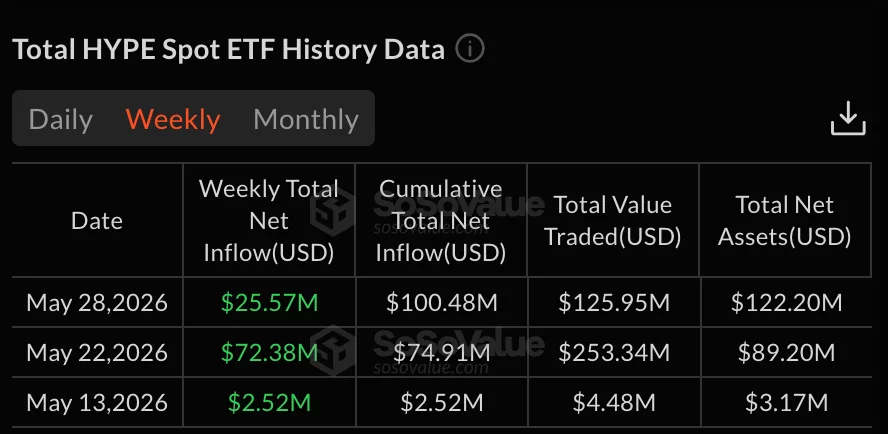
ETF demand remains one of the main themes behind HYPE’s move. According to SoSoValue data, the latest HYPE spot ETF data showed three straight positive weekly inflows in May.
Inflows began at $2.52 million on May 13, rose to $72.38 million by May 22, then slowed to $25.57 million by May 28. That left cumulative net inflows at $100.48 million by the end of the month.
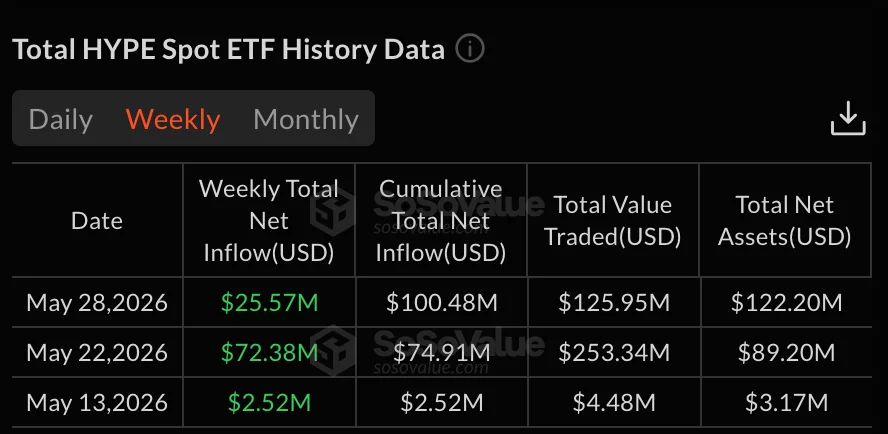
Total net assets also rose from $3.17 million on May 13 to $122.20 million by May 28. Total value traded reached $383.77 million across the month, with the strongest activity coming during the week ending May 22.
As previously reported, HYPE-linked ETF products crossed $100 million in cumulative inflows within their first 10 trading sessions. The demand was led by products tied to Hyperliquid’s native HYPE token.
Bitwise has also tied part of its ETF model to token demand. Earlier reports noted that Bitwise plans to use 10% of BHYP management fees to buy and hold HYPE on its balance sheet.
Buybacks remain central to Hyperliquid’s market story
Hyperliquid’s token model has also helped drive attention. The platform uses a large share of trading fees to buy back HYPE, linking token demand to exchange activity.
As crypto.news reported, Hyperliquid’s protocol revenue was running near $1.3 billion in annualized fees by mid-2026. The same report said buybacks are funded by trading fees from real platform activity, not by new token issuance or external capital.
Crypto commentators also pointed to this model after HYPE’s record move. That Martini Guy said HYPE had reached a record high of about $70 and claimed the platform generates up to $1 billion in annual fees with a small team.
Ash Crypto made a similar point, saying HYPE had added about $11 billion in market cap in 2026. He also linked the rally to fee buybacks, ETF inflows and new attention around regulated perpetual futures.
Those claims reflect market commentary and should be treated as views from traders, not official guidance. The verified data still shows that HYPE has seen sharp price growth, strong ETF inflows and rising attention from regulated investment products.
Technical indicators still favor bulls
The chart remains bullish despite the small red candle after the record high. HYPE recently broke above the $40 to $45 consolidation area and pushed into the $67 to $70 range.
The moving averages support the uptrend. The 9-day moving average sits near $62.52, while the 21-day moving average is near $53.51. The shorter average remains well above the longer one, showing that short-term momentum remains stronger.
As long as HYPE holds above the 9-day moving average, the breakout structure remains intact. A pullback toward $62.50 would mark the first key support area. A deeper drop could bring the $53.50 zone into focus.
The MACD also remains positive. The MACD line stands at 6.112, above the signal line at 4.890, while the histogram sits at 1.222. This shows that upward momentum is still active.
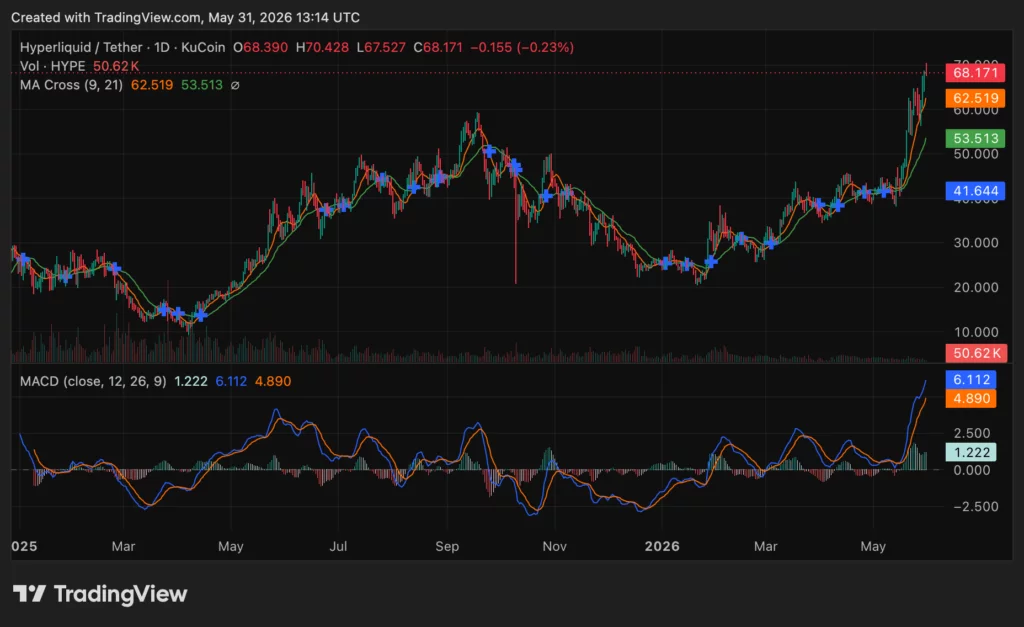
However, the move has been steep. Traders may watch for weaker histogram bars as an early sign that momentum is cooling. A short consolidation would not break the trend by itself, but a daily close below $62.50 would weaken the setup.
The next upside area sits near $80. Earlier reports already framed $80 as a possible target if ETF inflows, buybacks and trading activity keep supporting the token.
Disclosure: This article does not represent investment advice. The content and materials featured on this page are for educational purposes only.
Crypto World
Argentine Prosecutors Arrest 24, Seize Over $8M in USDT in 'Fake Coins' Crypto-Fraud Sweep


Argentina's Buenos Aires Public Prosecutor's Office said it arrested 24 people and seized more than 8 million USDT in a nationwide sweep it called "Fake Coins," one of the largest crypto-enforcement actions in the province's history. The 90 simultaneous raids, executed by the Argentine Federal… Read the full story at The Defiant
Crypto World
5 Must-Watch Stocks for the Coming Week: Nvidia (NVDA), Dell (DELL), CrowdStrike (CRWD), Rocket Lab (RKLB), and Palantir (PLTR)

Key Takeaways
- Nvidia (NVDA) continues dominating the AI semiconductor space with accelerating Blackwell chip demand
- Dell Technologies (DELL) posted exceptional results driven by massive AI server order volumes and upgraded forecasts
- CrowdStrike (CRWD) capitalizes on expanding market for AI-enhanced cybersecurity solutions
- Rocket Lab (RKLB) diversifies operations across launches, satellite production, defense contracts, and space systems
- Palantir (PLTR) gains traction with its AI Platform implementation, despite divided analyst sentiment on pricing
As markets prepare for the week ahead, these five equities are commanding the greatest investor focus, each backed by compelling catalysts and sector momentum.
Nvidia (NVDA)
Nvidia continues commanding attention as the dominant force in artificial intelligence semiconductor technology. The chipmaker has maintained impressive momentum as hyperscalers and corporate buyers demonstrate persistent appetite for AI computing capacity.
Market participants are particularly focused on the company’s Blackwell architecture, positioned to fuel the subsequent cycle of AI infrastructure investment. Analysts across Wall Street have consistently elevated their price projections, with widespread consensus that AI-related capital expenditure remains in nascent phases.
Boasting 51 buy recommendations from analysts, zero sell ratings, and sustained cloud infrastructure spending from major providers, Nvidia maintains its position atop investor radars entering the new trading week.
Dell Technologies (DELL)
Dell emerged as one of the market’s strongest performers following quarterly results that substantially exceeded Wall Street expectations. The technology infrastructure provider disclosed billions in fresh AI server bookings while elevating future outlook projections.
This announcement propelled shares significantly upward and validated perspectives that corporate AI hardware investment remains robust. Dell increasingly receives recognition as among the most direct AI infrastructure beneficiaries beyond Nvidia itself.
Analysts are monitoring Dell’s order pipeline with particular intensity. Sustained backlog strength would indicate AI hardware requirements will persist at elevated levels through multiple upcoming quarters.
CrowdStrike (CRWD)
CrowdStrike ranks among the cybersecurity sector’s premier equities currently. The platform provider has captured gains from escalating enterprise demand for artificial intelligence-integrated security capabilities as organizations confront increasingly sophisticated threat landscapes.
Investors await upcoming earnings releases and forward guidance updates, especially given cybersecurity’s position among the most rapidly expanding enterprise technology investment categories. CrowdStrike’s subscription-based revenue structure and robust profitability margins have established it as a growth investor preference.
The security software company commands 39 buy ratings from analysts alongside merely five hold recommendations, with zero sell designations.
Rocket Lab (RKLB)
Rocket Lab has attracted heightened investor scrutiny as operations extend beyond traditional launch services. The aerospace company currently maintains active engagement across satellite production, defense sector contracts, and broader space infrastructure initiatives.
The critical development under investor observation involves Neutron, a heavier-lift launch system potentially unlocking expanded commercial and governmental market opportunities. The wider aerospace sector has experienced recent turbulence stemming from apprehensions regarding schedule delays.
Rocket Lab holds eight buy ratings against four hold designations. Numerous investors regard the company among the more compelling long-term commercial space enterprises given its varied revenue streams.
Palantir (PLTR)
Palantir has emerged as a leading AI software equity throughout the previous twelve months. The company’s Artificial Intelligence Platform, designated AIP, has achieved adoption among government agencies and commercial enterprises seeking to embed AI capabilities into operational workflows.
Investors increasingly categorize Palantir as a significant enterprise AI software provider beyond its traditional defense industry positioning. The equity has generated substantial returns, though analyst perspectives remain fragmented.
Eleven analysts maintain buy ratings, while four have designated sell recommendations. This division mirrors continuing discourse regarding whether current valuation levels adequately incorporate projected expansion trajectories.


TLDR:
- Phantom generated $20.6M in cumulative revenue, capturing 31.8% of total top-10 builder earnings.
- Based processed more volume than Phantom at $44B but earned less due to its lower 0.025% fee rate.
- MetaMask ranked fourth despite charging 0.1%, the highest builder fee among all top 10 builders.
- Mass averaged $1,337 revenue per user, the highest among all top 10 Hyperliquid builders tracked.
Phantom has emerged as the leading builder on Hyperliquid’s builder program, earning over $20.6 million in cumulative revenue.
CoinGecko data shows the wallet accounts for 31.8% of total revenue among the top 10 builders. Based ranked second with $15.1 million, while MetaMask placed fourth despite charging the highest builder fee of 0.1%.
Together, these platforms reflect how distribution channels are reshaping decentralized derivatives trading.
Phantom and Based Dominate the Builder Leaderboard
Phantom’s $20,630,022 in cumulative revenue places it well ahead of its nearest competitor. The wallet processed $39.4 billion in total volume and served 137,496 users since joining the program.
Its 0.05% builder fee generated an average of $150 in revenue per user. That user base is more than three times larger than Based’s 42,579 users.
Based ranked second with $15,056,894 in total revenue despite handling more volume than Phantom. It processed $44 billion compared to Phantom’s $39.4 billion across the same period.
However, Based charges only 0.025%, which is half of Phantom’s fee rate. That lower rate explains the revenue gap despite the higher volume.
Together, Phantom and Based account for 54.8% of all top-10 builder revenue combined. PVP ranked third with $7,946,185, having operated since June 2024.
Its early entry into the program gave it a cumulative advantage over newer participants. PVP’s 676 days of activity is the longest among the top 10 builders.
MetaMask ranked fourth with $6,510,547 in revenue from 43,761 users. It charges 0.1%, which is the highest builder fee in the top 10.
Despite this, users continued trading through the familiar MetaMask interface. The platform processed $7.46 billion in total volume during the tracked period.
Fee Strategy Separates High-Value Builders From High-Volume Ones
Insilico ranked fifth with $3,306,853 in revenue from only 2,962 users. Its average revenue per user reached $1,116, more than double the top 10 average of $437.
The platform charges just 0.01% but attracts algorithmic and high-frequency traders. Those traders move significantly larger positions per account than retail participants.
Axiom ranked seventh and processed $22.1 billion in volume, one of the highest in the group. Yet it earned only $2,270,689 due to its 0.01% builder fee.
Its average revenue per user stood at just $68. The low fee attracted volume but compressed overall earnings considerably.
Mass ranked tenth with $1,381,482 in revenue from 1,033 users. Its average of $1,337 per user is the highest among all top 10 builders.
The platform charges a 0.055% fee and serves a small but high-value audience. Dreamcash, ranked ninth, generated $1,695,465 despite charging a 0% builder fee.
Crypto World
Trace Mayer says bitcoin’s (BTC) falling volatility signals institutional maturity, not weakness


Bitcoin’s trademark volatility was for years treated as both its greatest feature and its biggest flaw. Recently, that roller coaster has quieted into something resembling a smooth ride, with volatility collapsing to roughly 35 from a high of 120 in 2021. While critics view this dampening as a sign that the asset is losing its edge, longtime bitcoin investor and Mayer Multiple creator Trace Mayer argues they are drawing entirely the wrong conclusion.
Mayer suggested that bitcoin’s declining volatility isn’t a sign of weakness, but rather a direct reflection of its growing economic substance in an interview with CoinDesk.
“Gary Gensler said he was going to ‘tame bitcoin,’” Mayer said, pointing to regulatory efforts to corral the digital asset. “And we’ve seen the volatility come down.”
Rather than viewing this “taming” as a defeat, Mayer sees it as confirmation of bitcoin’s massive institutional adoption. The market has simply become too big to move as erratically as it once did. “The barbell is getting heavier,” Mayer noted, using a vivid analogy for the market’s liquidity. “It’s not a 50-pound weight anymore. It’s a 2,500-pound weight.”
This heavy structural shift is being driven by the sophisticated mechanics of the options market, specifically call-selling, according to Mayer. As institutions and digital asset companies increasingly sell covered calls against their bitcoin holdings to generate upfront premium income, they inadvertently create a dampening effect on price swings.
Because these entities essentially agree to sell their bitcoin at a predetermined price in the future, market makers on the other side of those trades are forced to actively hedge their positions. When the price of bitcoin ticks upward, these market makers sell the asset to balance their risk, effectively creating a natural, structural ceiling on price spikes. The result is a more mature, predictable asset—one that is growing up right in front of the market’s eyes.
“When you’re able to come in and sell call volatility into the market, the market makers are going to have to do negative delta,” Mayer said. “That negative call wall is like adding weight on the barbell. The price doesn’t necessarily go up, but the total economic substance of that asset has increased.”
The Mayer Multiple
Mayer created the Mayer Multiple ratio eight years ago that divides bitcoin’s current price by its 200-day moving average, a long-term trend line that smooths out short-term noise. A reading above 1 means bitcoin is trading above its long-term average, below 1 means it’s trading beneath it. Historically, readings above 2.4 have coincided with market tops, while readings below 0.8 have signalled attractive entry points.
Bitcoin is currently just below its long-term trend at 0.94. Mayer notes that crucially the standard deviation bands the statistical range within which price typically moves have compressed significantly as more trading history accumulates.
On a five-year lookback, one standard deviation above the mean sits around 1.3, two standard deviations at 1.6, and three at 2.13. Compare that to earlier periods drawing on data back to 2011, where price regularly reached far more extreme multiples.
In other words, the instrument is maturing in the same way any asset does as it attracts deeper, more disciplined capital.
Mayer started selling physically-settled bitcoin call and put options as far back as 2017 on LedgerX, one of the first federally regulated crypto derivatives exchanges.
Today that market has expanded dramatically from leveraged ETFs like BITX, to Strategy’s (MSTR) equity, to bitcoin appearing on corporate balance sheets like SpaceX’s reported 18,712 BTC holding.
Mayer argues lower volatility is positive for bitcoin because it reflects the asset graduating from a speculative instrument into something that investment committees, family offices, and corporations can actually underwrite. “In order to get that buy-in, you kind of have to have something that’s really boring, like gold,” he said. “Gold is so boring — and that’s what we need.”
He pointed to attendance at conferences as a tangible signal of that maturation. His blog was running in 2008 before Bitcoin existed, and he regularly presented at major gold conferences that drew 2,000-3,000 attendees. “We had tens of thousands at conferences this year and much more last year. It’s a real industry. It’s a real reserve asset.”
Mayer acknowledges risks to bitcoin, such as weakening network security should BTC’s price not appreciate enough to keep enough miners in business. Quantum is another potential longer-term threat, should quantum computers become sufficiently powerful to crack Bitcoin’s cryptographic keys. Mayer acknowledged the concern but noted that Bitcoin’s standing bounty for finding a catastrophic exploit has so far gone unclaimed, and pointed to the backwards compatibility of proof-of-work as a structural resilience.
Despite the risks, Mayer remains firmly in the bitcoin-over-gold camp for the next 15 years. “With gold, higher prices bring more supply. That’s not the case with Bitcoin and we don’t know what technologies might pose a threat to gold’s dominance. We could have asteroid mining. AI robots scouring the oceans. But we know Bitcoin is going to be 21 million.”

Key Highlights
- Shares of ASML have surged 53% since the start of 2026 and 120% in the trailing 12 months, reaching a peak near $1,612
- First-quarter 2026 earnings exceeded analyst projections, with revenue rising 13% and operating income advancing 15%
- Morningstar has issued a Sell rating, noting the stock commands a 19% premium above its estimated fair value
- UBS analysts boosted their price objective to €1,900, while the Street consensus supports a “Moderate Buy” recommendation
- Proposed US legislation targeting chip equipment exports to China poses a significant headwind for the company
ASML shares commenced trading Friday at $1,612.76, hovering close to the 52-week peak of $1,654.20. This represents substantial appreciation from the yearly low of $683.48.
The Netherlands-based semiconductor equipment manufacturer has emerged as a standout performer in the artificial intelligence investment theme during 2026, posting year-to-date gains exceeding 53% and annual returns of 120%. With a market capitalization reaching $634 billion, the company now holds the distinction of being Europe’s largest publicly traded enterprise.
The remarkable price appreciation stems from explosive demand for cutting-edge semiconductors. ASML produces the critical machinery that enables chip fabrication — functioning as the indispensable infrastructure provider for the semiconductor industry. Major clients include TSMC, Samsung Electronics, and Micron Technology.
First-quarter 2026 financial performance surpassed Wall Street estimates. Revenue increased 13% year-over-year, operating income jumped 15%, and gross margin reached 53%. Company leadership elevated its annual revenue guidance to a range of EUR 36–40 billion.
Morningstar equity analyst Javier Correonero enhanced his long-range projections, now forecasting ASML could achieve EUR 60 billion in annual sales by the decade’s end.
Street Sentiment Remains Positive Despite Valuation Debate
The analyst community maintains a generally optimistic stance. According to MarketBeat data, three firms assign Strong Buy ratings, twenty recommend Buy, six suggest Hold, and three advise Sell. The average price target stands at $1,504.38 — interestingly below current trading levels.
UBS elevated its price objective to €1,900 from €1,600 recently, maintaining its Buy recommendation. Barclays likewise upgraded the stock to Buy on May 19. Deutsche Bank and Sanford C. Bernstein have both affirmed their Buy assessments.
The primary contrarian voice comes from Morningstar, which moved ASML to Sell this week based on valuation metrics. At present levels, shares command a 19% premium relative to Morningstar’s intrinsic value calculation. The research firm acknowledges ASML’s formidable competitive advantages but highlights vulnerability should semiconductor manufacturers reduce capital expenditures given the company’s high equipment prices.
ASML currently trades at a price-to-earnings multiple of 57.85, accompanied by a PEG ratio of 1.32. The 50-day moving average registers at $1,458.41.
Geopolitical Uncertainty Clouds Near-Term Outlook
The regulatory environment introduces additional complexity. Proposed United States legislation could prohibit sales of ASML’s lower-tier deep ultraviolet (DUV) equipment to China — expanding beyond the advanced EUV systems already subject to existing sanctions.
The Chinese market represents a substantial revenue contributor for the DUV product line. Elimination of this access would materially impact short-term financial performance.
Balancing this concern, ASML recently announced a collaboration with Tata Electronics to support India’s inaugural front-end semiconductor manufacturing facility — representing a promising new market opportunity.
Institutional ownership has been expanding. Consolidated Capital Management established a fresh $3.96 million position during the fourth quarter. Additional firms, including Founders Financial and Texas Yale Capital, have enlarged their holdings. Institutional investors collectively control 26.07% of outstanding shares.
In its most recent quarterly report, ASML delivered earnings per share of $8.28 for Q1, accompanied by quarterly revenue of $10.15 billion and a net profit margin of 27.65%.
Crypto World
XRP Exchange Flows Reverse After Largest Inflow of 2026 as On-Chain Data Signals Accumulation
TLDR:
- XRP saw its largest exchange inflow of 2026 at 22.80M tokens, coinciding directly with the local price bottom.
- Over 25.24M XRP moved off exchanges shortly after, suggesting accumulation by longer-term holders post-selloff.
- XRP price climbed 5% since the capitulation day, leaving retail sellers who exited early at a disadvantage.
- XRPL’s RWA market cap surged 124% to $2.25B in Q1 2026, ranking it fourth among all blockchain networks globally.
XRP exchange flows have drawn attention this week after a sharp spike in inflows quickly reversed. On-chain data shows that more coins have since left exchanges than originally entered.
This pattern points to a notable shift in how market participants are repositioning their holdings. The movement follows a period of price weakness that caught many retail traders off guard.
Large Inflow at Local Bottom Triggers Rapid Reversal
The largest XRP exchange inflow of the year occurred on Thursday, totaling 22.80 million XRP. According to Santiment, this single event coincided almost exactly with the local price bottom. Many retail traders moved their coins onto exchanges at that moment, typically a sign of intent to sell.
Shortly after, approximately 25.24 million XRP moved back off exchanges. That outflow exceeded the original inflow by a notable margin. Coins leaving exchanges generally suggest holders are moving assets into private wallets for longer-term storage.
Since that capitulation day, XRP’s price has risen by roughly 5%. Those who sold near the bottom are now facing a loss in opportunity. The pattern reflects a common cycle where panic selling occurs just before a recovery.
Santiment’s data continues to show exchange flow trends as a useful indicator for short-term price direction. When large inflows are followed quickly by outflows, it often points to absorption by stronger hands. Thursday’s event appears to follow that same pattern.
XRPL Fundamentals Show Continued Institutional Momentum in Q1 2026
Beyond price action, Messari’s State of XRP Q1 2026 report paints a broader picture of network growth. The XRP Ledger is gaining traction among institutional users, particularly in areas like real-world assets, stablecoins, and decentralized liquidity. This growth adds context to the current market movement.
U.S. Spot ETF holdings in XRP grew 2% to $775.4 million, representing around 1.3% of circulating supply. The RLUSD stablecoin market cap on XRPL rose 45% to $340 million during the same period. These numbers reflect growing confidence in XRP-based financial infrastructure.
RWA market capitalization on XRPL jumped 124% to $2.25 billion, placing it fourth among all blockchain networks.
Average daily transactions also climbed 35% to 2.48 million. These figures represent real usage, not speculative activity.
Ripple and the XRP Ledger Foundation are also advancing identity, compliance, and privacy features on the network.
Each institutional operation on XRPL, including reserve requirements and asset bridging, uses XRP directly. As adoption grows, so does the functional demand for the token itself.


A fresh Bitcoin debate has broken out on X after Mr.Hodl linked Roger Ver’s old censorship criticism with new complaints from GrassFedBitcoin about BIP-110 discussion channels.
Summary
- Mr.Hodl linked Roger Ver and GrassFedBitcoin as Bitcoin’s BIP-110 moderation dispute moved back online again.
- Adam Back rejected censorship claims, saying BIP-110 was ignored because critics already debated it extensively.
- The proposal seeks to restrict non-monetary Bitcoin data, but opponents warn about fork risks ahead.
Mr.Hodl posted a short message placing Roger Ver and GrassFedBitcoin side by side. The post came with screenshots showing Ver’s 2019 claim that BTC had failed on censorship resistance by censoring parts of its community.
The second screenshot showed GrassFedBitcoin arguing that BIP-110 critics should engage directly if they believe the proposal is wrong. The account claimed that several Bitcoin discussion spaces had become hard places for supporters to defend the proposal.
GrassFedBitcoin also said bitcointalk had become quiet, GitHub posts were being marked as spam, and Reddit accounts were being banned for discussing Bitcoin Knots or BIP-110. The account also said the BIP repository allowed the proposal to be discussed and merged.
Those claims have not been confirmed by the named platforms in the material reviewed. Still, they pushed the BIP-110 debate back into a wider Bitcoin governance discussion.
Adam Back rejects the censorship claim
Blockstream CEO Adam Back responded by rejecting the idea that BIP-110 was being blocked through a hidden campaign. He argued that the proposal was being ignored because many people had already reviewed it and rejected it.
Back wrote, “it’s being ignored because it’s a stupid idea.” He added that people were tired of discussing it after going over the same points last year.
He also said no conspiracy was needed to explain the lack of support. In his view, supporters who still want the rules can fork away from Bitcoin.
Back’s response reflects long-running opposition to BIP-110 among some Bitcoin developers and infrastructure figures. Critics argue that using consensus rules to restrict transaction content could damage Bitcoin’s neutrality.
BIP-110 targets non-monetary data
BIP-110 seeks to limit arbitrary data stored in Bitcoin transactions. It targets uses linked to inscriptions, Ordinals and Runes by restricting certain large data fields.
Supporters say the proposal protects Bitcoin’s role as money and lowers the burden on node operators. They argue that block space should not become a general data storage layer.
Opponents say the proposal creates bigger risks than the activity it tries to stop. They warn that it may break existing use cases, freeze some transaction outputs or split the network if only a small group enforces it.
The latest reports show BIP-110 has low node support and no clear major mining pool support. That makes activation difficult unless support changes before the proposed enforcement date.
Fork risk stays at center of debate
The debate now sits between two positions. Supporters frame BIP-110 as a defense of Bitcoin’s monetary purpose, while critics frame it as a risky attempt to police transaction content.
Mr.Hodl’s post added a cultural layer by connecting the current dispute to older claims that Bitcoin forums and social channels silence opposing views.
Back’s response pushed the debate back to technical and market support. He argued that silence around the proposal is not censorship, but a sign that many people see the idea as weak.

Gravity Bridge, a decentralized cross-chain conduit linking Ethereum and Cosmos ecosystems, appears to have faced a substantial drain of roughly $5.4 million over the weekend. Validators paused the bridge during the incident as investigators assess the breach and potential recovery paths. Early analyses from on-chain researchers pointed to a compromised contract key, a conclusion that Stack Exchange-style security firms corroborated with asset-tracking observations.
Analyst observations identified a precise asset mix among the stolen holdings: about $4.3 million in USDC, 274 Wrapped Ether (WETH) worth roughly $553,000, around $434,000 in USDT, and 14.164 PAX Gold (PAXG) tokens valued near $64,000. A portion of the loot had already moved through on-ramp services such as ChangeNow and Binance, while the attacker wallet still appeared to hold a sizable stake—approximately 2,102 ETH valued at around $4.23 million at the time of reporting.
Key takeaways
- Approximate theft total: $5.4 million across stablecoins and ETH-based assets, with a large stake remaining in the attacker’s wallet (about 2,100+ ETH) as investigators pursued the case.
- Bridge halted and under investigation: Gravity Bridge advised validators to pause operations to contain the incident, with the platform subsequently confirming a halt.
- Decentralized design under scrutiny: Gravity Bridge operates without a centralized multisig or private validator group, instead leveraging its full validator set to authorize transfers, a hallmark of its emphasis on decentralization.
- Broader risk landscape for bridges: The incident adds to a troubling pattern for cross-chain bridges, a theme highlighted by institutional analysts who have warned about security as DeFi scales, amid a spate of major exploits in 2026 that have drained hundreds of millions from bridges.
- Watch for remediation signals: For users and developers, the near-term focus centers on incident forensics, potential patching, and the trajectory of asset recovery or rebalancing across the affected chain ecosystem.
A decentralized conduit under pressure
The Gravity Bridge incident emerged as researchers flagged suspicious on-chain activity over the weekend. Onchain analyst Specter first noted unusual outflows in a post on X, suggesting the bridge’s contract key may have been compromised and linking this to a roughly $5.4 million theft. The early signal set the stage for a broader forensic sweep across the bridge’s operational and treasury accounts. A security firm later quantified the theft as consisting of approximately $4.3 million in USDC, 274 WETH (~$553,000), around $434,000 in USDT, and roughly $64,000 in PAXG. In addition, PeckShield reported that part of the stolen funds had appeared to be laundered through ChangeNow and Binance, while the attacker wallet retained a substantial ETH balance—2,102 ETH worth around $4.23 million at that moment.
Gravity Bridge acknowledged the trouble publicly, albeit with limited technical disclosure. In a post on X, the project described the incident as “an unfortunate incident” and urged validators to halt their operators and orchestrators while the investigation proceeds. A follow-up message confirmed the bridge had been halted. The team’s communications reflect a cautious approach, prioritizing containment and triage over immediate technical elaboration.
Gravity Bridge’s core proposition is to facilitate seamless, bidirectional transfers between Ethereum and Cosmos-based networks, enabling interactions with Ethereum-native ecosystems like Uniswap and Cosmos DEXs such as Osmosis. Notably, the bridge eschews reliance on private multisig or centralized governance in favor of using its entire validator set to authorize transfers. This design, described as highly decentralized, aims to reduce single points of failure and increase resilience against compromised keys or nodes. The bridge’s native token, Graviton (GRAV), is used by validators to participate in securing the network and authorizing transfers. Current price data place GRAV at a fraction of a cent, around $0.0007, reflecting the broader risk sentiment surrounding bridge vulnerabilities in the current cycle.
For market observers, the incident underscores a fundamental tension in cross-chain infrastructure: the more decentralized and trust-minimized a bridge aims to be, the more complex its security model becomes to audit, monitor, and recover from an attack. Gravity Bridge’s architecture is often cited as a contrast to more centralized bridges that rely on a handful of signers or node groups. The incident tests the trade-offs between decentralization, security, and operational resilience in a space that has seen several high-profile breaches in recent years.
Bridge exploits and the institutional risk calculus
The Gravity Bridge event sits within a broader pattern that has captured the attention of institutions and risk researchers alike. In a separate assessment, JPMorgan analysts flagged bridge security as a persistent challenge for DeFi’s institutional appeal, questioning whether permissionless cross-chain bridges can scale to meet real-world capital demands. The note comes amid a string of breach incidents this year, including the Versus-Ethereum attack, which Cointelegraph noted as the eighth major bridge exploit of 2026 and had driven cumulative losses to roughly $328.6 million across those incidents.
The sector’s risk is further highlighted by a series of cascading events earlier in the year. After the KelpDAO breach in April—an incident tied to a larger security narrative and attributed by some analyses to Lazarus Group activity—total value locked in DeFi briefly collapsed from nearly $100 billion to about $86 billion within days. That shock also reverberated through liquidity pools that bore no direct exposure to the compromised assets, illustrating how cross-chain incidents can ripple across seemingly unrelated corners of the ecosystem.
These findings, which bridge journalists and researchers have compiled from multiple sources, reinforce a cautious stance among institutions evaluating DeFi’s risk/return profile. As cross-chain technologies mature, regulators and large-scale participants are watching how developers address security, incident response, and governance in ways that align with formal risk management frameworks. The Gravity Bridge incident provides a concrete case study in how decentralized architectures fare when a key assumption—secure key custody or robust node integrity—appears to be breached.
Looking ahead, observers will want to see how Gravity Bridge’s team communicates the specifics of the exploit and what remediation steps they implement. For users, questions remain about asset recovery options, the status of the affected gateway pathways, and whether any patch or upgrade will be required to prevent a recurrence. The incident also invites comparisons with prior cross-chain events, offering a lens on how different bridge models weather security incidents and restore confidence among liquidity providers and developers alike.
Additional context from industry reporting indicates that the broader DeFi security landscape remains unsettled. Analysts and researchers emphasize the need for stronger cost-benefit considerations around bridge security investments, more transparent post-incident analyses, and a clearer outline of how recovered assets will be handled if vulnerabilities are identified and mitigated in subsequent patches.
For now, Gravity Bridge’s immediate priority is containment and forensic clarity. The incident serves as a reminder that cross-chain infrastructure—despite its promise of interoperability—continues to be a high-stakes target for attackers. As investigators trace transaction flows and potential on-chain wash mechanisms, stakeholders will be watching closely for signs of deeper compromises or systemic weaknesses that could inform both future security standards and governance responses across the Cosmos-Ethereum bridge ecosystem.
Readers should keep an eye on official Gravity Bridge updates for progress on the investigation, potential security advisories, and any governance actions that might shape the next steps for validators, liquidity providers, and users who rely on cross-chain transfers.


BNB traded near $733 on May 31 after a strong daily breakout placed the $800 to $820 zone back on traders’ radar.
Summary
- BNB broke above the $700 neckline, reclaiming the 200-day EMA as bullish momentum improved.
- MACD crossed bullish while analysts watched $800–$820 as the next major resistance zone this week.
- Binance’s June 1 product reveal and new HODLer Airdrop kept ecosystem demand in focus.
The move came as traders pointed to a cup-and-handle breakout, a reclaimed 200-day EMA, a fresh MACD bull cross and a June 1 Binance product teaser.
BNB clears the $700 breakout zone
BNB moved above the $680 to $700 neckline after forming what traders described as a cup-and-handle structure on the daily chart. The pattern formed after a rounded base, followed by a smaller pullback that acted as the handle before the breakout.
The move also pushed BNB back above the 200-day EMA. Traders often treat that average as a trend filter, so a close above it can show that buyers have taken control of the short-term setup.
The latest market data showed BNB trading near $733, up more than 7% over 24 hours. The token’s 24-hour range stretched from about $665 to $740, while trading volume rose above $3.4 billion.
That price action moved BNB back into the top four crypto assets by market value. Its market cap stood near $99 billion, according to the latest price data.
$820 becomes the next chart target
Crypto trader Batman said BNB had triggered a daily cup-and-handle breakout near $721. He also said the token had reclaimed the 200 EMA and printed a fresh daily MACD bull cross.
The trader placed the technical target near $820. That area matches the red resistance zone from the previous breakdown region and sits roughly 19% above the breakout zone.
The $800 to $820 range may not be easy to clear. It previously acted as a support area before BNB fell sharply, meaning some traders may sell into that zone if price returns there.
For now, the breakout remains valid while BNB holds above the $680 to $700 range. A daily close back below that area would weaken the setup and raise the risk of a failed retest.
Momentum improves as ecosystem news builds
The MACD also supports the bullish structure. The MACD line crossed above the signal line, while the histogram turned positive. That setup shows that upward momentum has improved after the breakout.
Another trader, FOUR, said BNB is reclaiming a multi-year support and resistance zone. The same area capped price in 2021 and acted as support in 2024 before returning as a key level in the current market.
The RSI has also rebounded from a historical support area. That gives traders another reason to watch whether BNB can hold above the reclaimed zone and build toward the next resistance band.
Crypto with Haris linked the move to Binance ecosystem interest and the exchange’s coming June 1 reveal. The trader wrote, “I wouldn’t be surprised to see BNB continue pushing higher.” That remains a market view, not a confirmed outcome.
Binance-linked catalysts stay in focus
Speculation around the June 1 reveal comes as BNB-related products and ecosystem updates continue to build. Binance teased a new product reveal, but it had not confirmed the details at the time of writing.
As previously reported by crypto.news, Binance added Genius Terminal as its 65th HODLer Airdrop, with 10 million GENIUS tokens set for eligible BNB users. The program rewards users who placed BNB into Simple Earn or On-Chain Yields during the stated snapshot period.
That matters for BNB because HODLer Airdrops can give holders another reason to keep tokens inside Binance-linked products instead of trading only on spot markets. It also keeps BNB utility tied to exchange activity, rewards and new listings.
Separate coverage also showed that VanEck launched the first U.S. spot BNB ETF under the ticker VBNB. The product gives regulated market participants a new way to gain exposure to BNB, although price action still depends on open-market demand.
BNB Chain’s longer-term roadmap also remains part of the market story. Earlier reports said the 2026 plan targets up to 20,000 transactions per second, sub-second finality, lower fees, parallel execution and a Rust-based client.
The setup now depends on confirmation. If BNB holds above $700, the $800 to $820 target remains in play. If price falls below the neckline and the 200-day EMA, traders may treat the breakout as a failed move.
BNB’s short-term path therefore sits between two clear zones. Buyers need to defend $680 to $700. Sellers are likely to test strength near $800 to $820 if the rally continues.
A clean daily close above $740 would keep attention on the upper resistance zone. A move back below $700 would shift focus to whether buyers can defend the breakout area.
Disclosure: This article does not represent investment advice. The content and materials featured on this page are for educational purposes only.

Who Owns Sinclair Gas Stations?

Nabung #tabungan #money #budgeting #nabung #duit #cash

The Medieval rivalry that divided residents in Cambridge


-

 Business7 days ago
NYT Strands Answers May 24 2026 Revealed for Puzzle No. 812 Theme Summer Essentials
-

 NewsBeat4 days ago
Israel says it has killed new Hamas military leader in Gaza City airstrikes
-

 Tech4 days ago
NASA taps Blue Origin to deliver lunar rovers for Moon Base initiative
-

 Politics6 days ago
Bridgerton Season 5: Cast, Release Date And Everything We Know So Far
-

 News Videos4 days ago
XRP *JUST* SUCCEEDED!!!! CLARITY ACT EXPOSED!!! (SHE EXPOSED IT)
-

 Sports5 days ago
2026 NBA Finals schedule, odds: Knicks await Thunder or Spurs after winning East
-
Crypto World5 days ago
Micron Crosses $1 Trillion Market Cap as AI Demand Reshapes Memory Sector
-

 Business5 days ago
Selena Gomez Reportedly Upset Over Benny Blanco’s Comments on Her ‘Terrible’ Diet
-
Crypto World7 days ago
Brian Armstrong Outlines Crypto Vision for the Future Financial System
-

 News Videos2 days ago
This is BROKEN! INSANE 5x MONEY CAR WASH WEEK! The NEW GTA Online UPDATE Today! (GTA5 New Update)
-

 Business6 days ago
BTS Sells Out Four Las Vegas Shows at Allegiant Stadium for ARIRANG World Tour
-
 Tech5 days ago
China assigns ID codes to 28,000+ humanoid robots
-
 NewsBeat6 days ago
Hottest May day ever as London hits 34.8C in 2C leap from previous records
-

 Tech6 days ago
Microsoft’s quiet Claude Code retreat and the real cost of enterprise AI
-

 Tech2 days ago
Waymo dominates autonomous vehicle registrations as Tesla trails behind
-

 Business6 days ago
Nikkei 225 Surges Past 65,000 for First Time as Iran Peace Hopes Fuel Record Rally
-
Tech4 days ago
The Samsung pay deal is the moment Korean unions changed register
-

 Tech6 days ago
Westone Audio and Etymotic Acquired by Fidelity Collective in Major IEM Market Move
-
 Entertainment6 days ago
‘Breaking Bad’ Star’s Easy-to-Binge 6-Part Crime Series Spin-Off Is Finally Heading to Free Streaming
-

 NewsBeat6 days ago
Crowds find riverside shade in York as temperatures soar
You must be logged in to post a comment Login