

Crypto World
Grayscale Unveils Competitive 0.29% Fee Structure for Hyperliquid Staking ETF


Key Highlights
- Grayscale announces competitive 0.29% annual fee for HYPG ETF product.
- Fund could debut on exchanges this week following updated S-1 filing.
- Pricing strategy positions Grayscale below competing Hyperliquid offerings.
- Hyperliquid-focused funds have captured over $132 million in early flows.
- Asset manager continues expansion of digital asset investment products.
Grayscale has taken a significant step toward launching its Hyperliquid Staking ETF by establishing a sponsor fee of 0.29%. The revised regulatory filing confirmed HYPG as the official trading symbol. This pricing decision gives the asset manager a competitive advantage in the emerging Hyperliquid ETF marketplace.
Competitive Pricing Landscape Takes Shape
Grayscale submitted an updated S-1 registration document to the Securities and Exchange Commission this Monday. The revised submission included crucial details about the fund’s fee structure and ticker symbol. These additions suggest the product may begin trading within days.
At 0.29%, Grayscale’s fee structure undercuts several competing products in the space. Bitwise’s offering carries a 0.34% expense ratio once its promotional period concludes. Meanwhile, 21Shares has set its Hyperliquid ETF fee at 0.30%.
Once regulatory approval clears, the product will become available under the HYPG ticker symbol. James Seyffart, an ETF analyst at Bloomberg Intelligence, anticipates trading could commence this week. His forecast has intensified market focus on Grayscale’s launch schedule.
Hyperliquid Ecosystem Attracts Growing Interest
Hyperliquid functions as a decentralized platform for onchain perpetual futures contracts. The protocol’s native HYPE token facilitates operations throughout the network. By market capitalization, the token has secured a position among the top-tier digital assets.
Perpetual futures contracts enable market participants to gain price exposure without direct asset ownership. Unlike conventional futures, these instruments have no expiration date. As a result, they’ve emerged as a dominant force in cryptocurrency derivatives markets.
Regulatory frameworks have evolved to accommodate crypto derivatives products more broadly. The Commodity Futures Trading Commission recently cleared the way for such offerings in U.S. markets. This regulatory shift enabled prominent platforms like Coinbase and Kalshi to broaden their derivatives offerings.
Strong Initial Performance for HYPE Products
Hyperliquid-based ETFs have demonstrated impressive early market traction. Last month alone, HYPE-focused funds accumulated over $132 million in net inflows. These figures underscore significant investor appetite for regulated access to the token.
Grayscale is entering a marketplace where fee structures have become a critical differentiator. Its 0.29% expense ratio positions the company marginally below both 21Shares and Bitwise. This pricing advantage could prove decisive in attracting initial investors.
The new offering represents another milestone in Grayscale’s ongoing expansion of cryptocurrency investment vehicles. The company has established itself as a leader in regulated digital asset products. Through HYPG, Grayscale provides investors access to one of the most dynamic derivatives platforms in the crypto ecosystem.


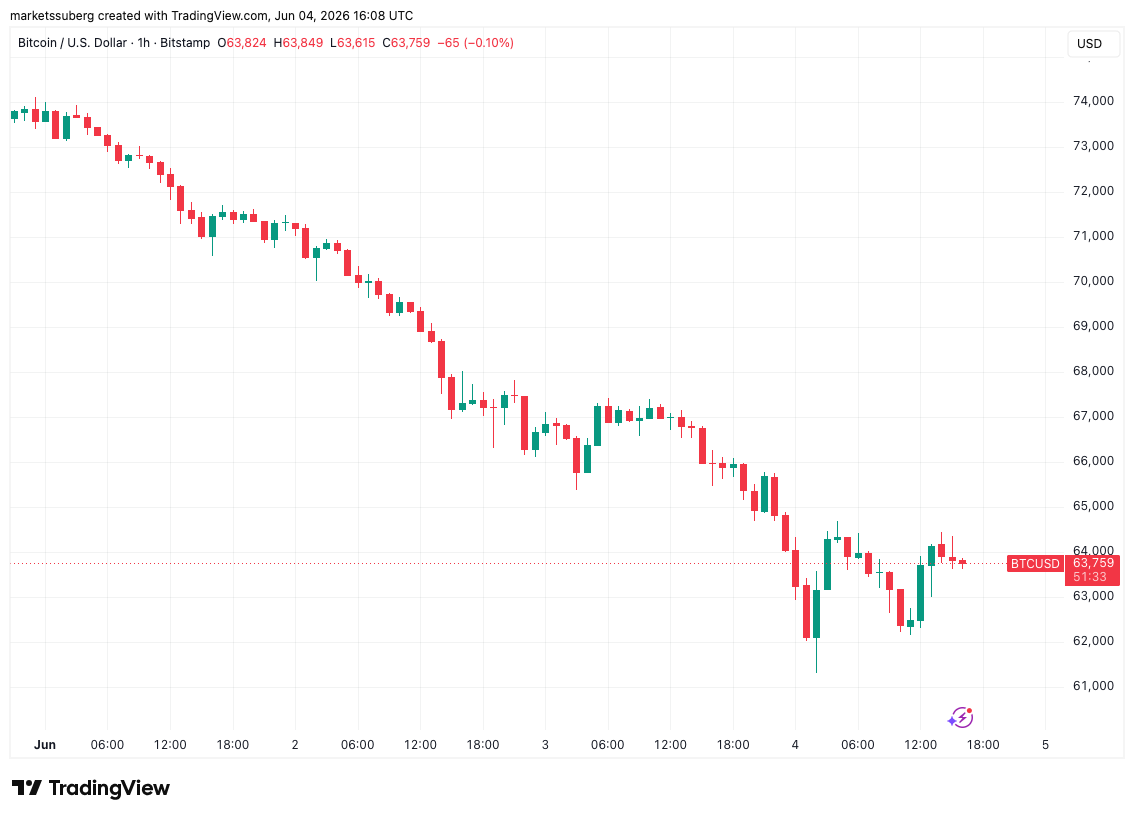
Bitcoin (BTC) returned below $64,000 after Thursday’s Wall Street open as bulls nursed 13.5% weekly losses.
Key points:
- Bitcoin struggles to stabilize amid its worst week of losses in 2026 so far.
- $60,000 is the line in the sand for bulls to defend, analysis says.
- BTC price action with a key trend line closely mimics the 2022 bear market.
Bitcoin “sellers remain in control” as $60,000 nears
Data from TradingView showed BTC price strength barely recovering after a slide to its lowest levels since early February.
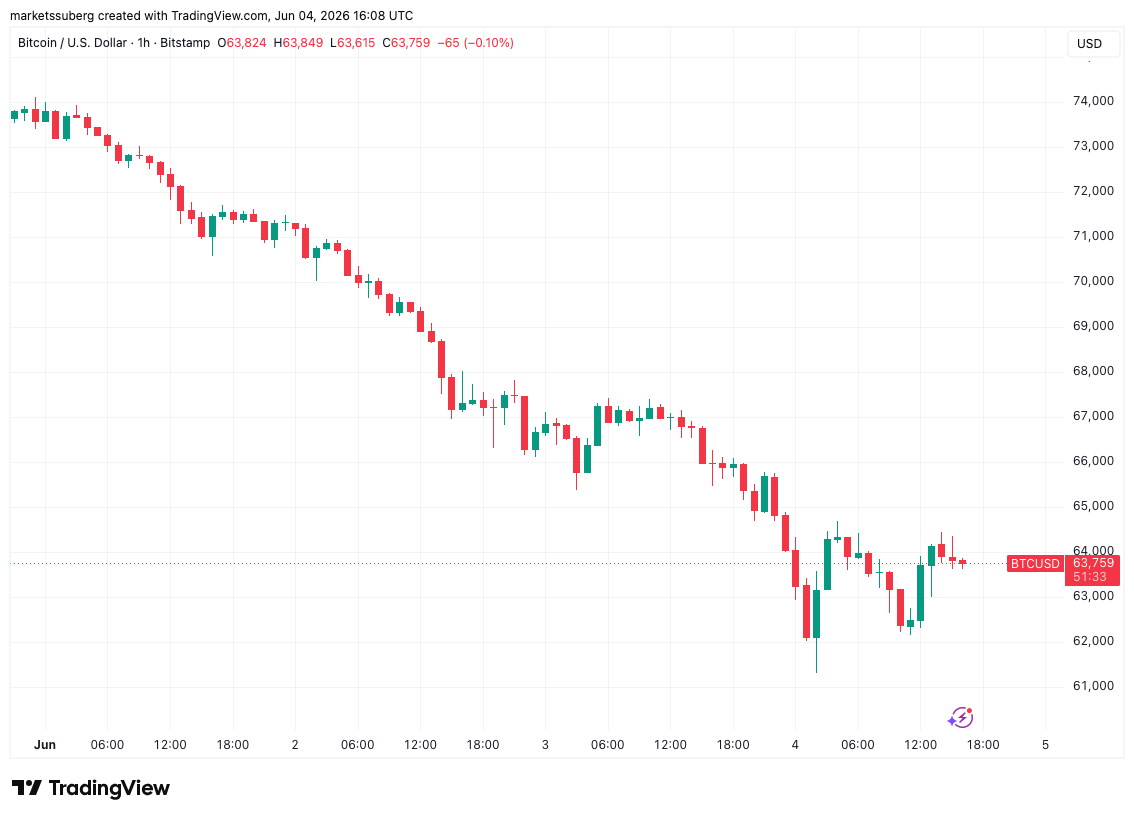
BTC/USD one-hour chart. Source: Cointelegraph/TradingView
BTC/USD revisited its 200-week simple moving average (SMA) trend line at the lows, continuing to copy “classic” bear-market behavior from 2022.
“Continuation down after that bearish retest in the low $80Ks region,” trader Daan Crypto Trades wrote in a summary of the status quo on X.
“Clearly still a bigger down trend this has been in since October last year.”
Daan Crypto Trades said that the focus was now on $60,000 and its ability to sustain as support.
“Key area here in the low $60Ks least with the Weekly 200MA too,” he added.
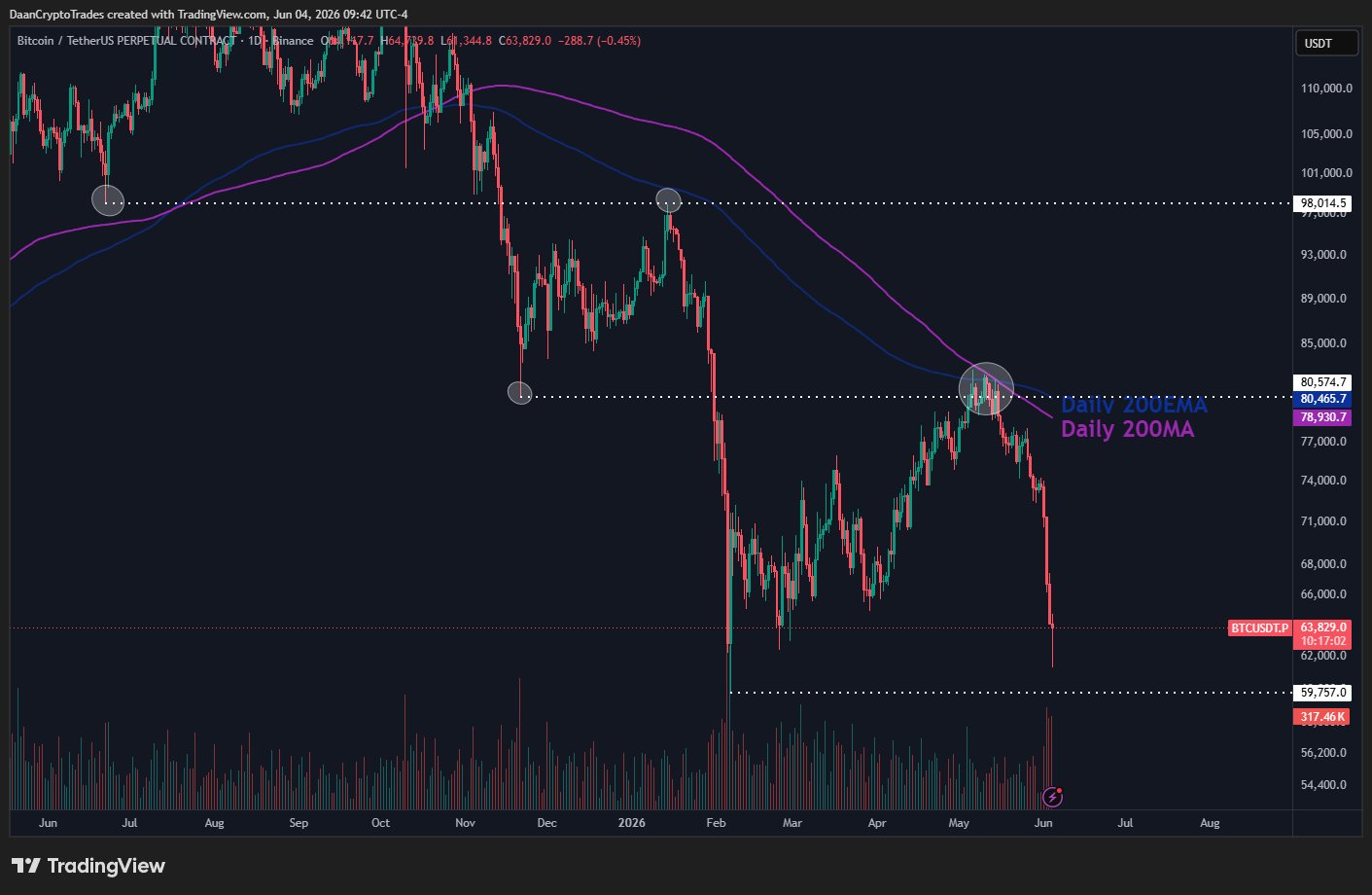
BTC/USDT perpetual contract one-day chart. Source: Daan Crypto Trades/X
Trading resource The Kobeissi Letter noted that since October 2025, crypto markets had shed more than $2 trillion in market up.
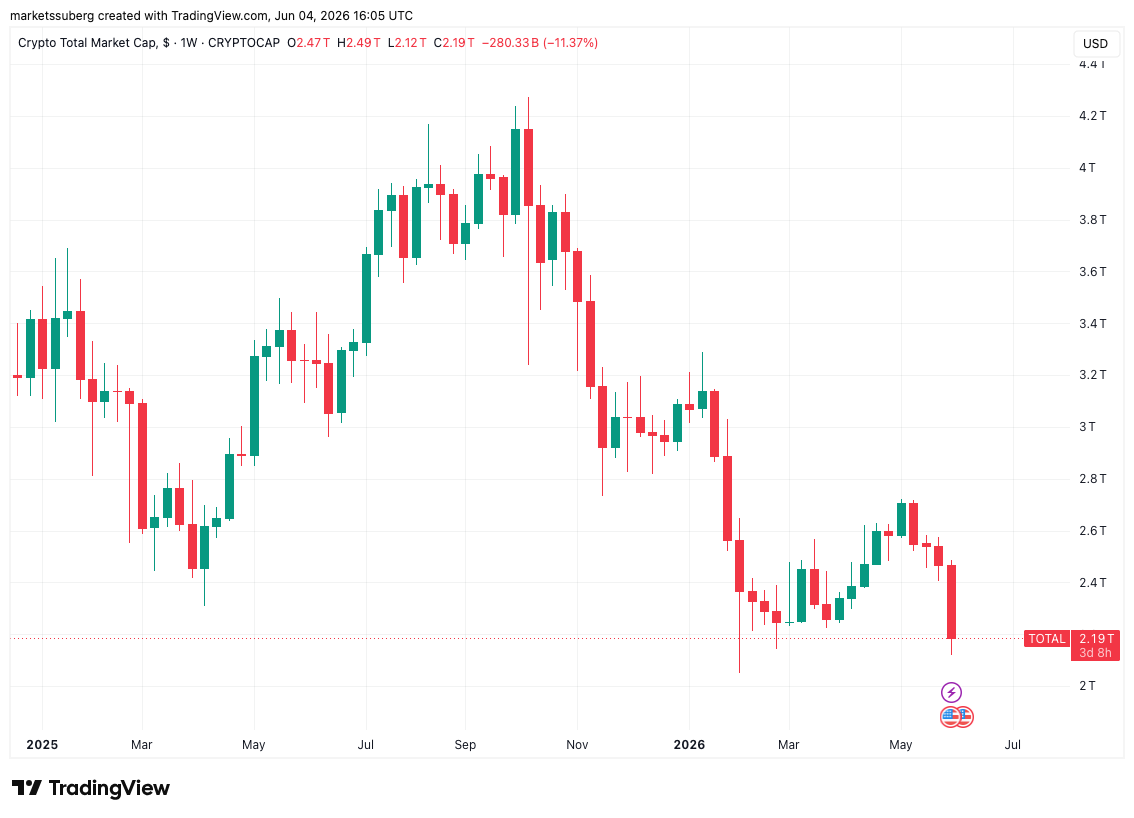
Total crypto market cap one-week chart. Source: Cointelegraph/TradingView
On short time frames, commentator Exitpump said that sellers still had the upper hand.
“Every bounce gets met with a wall of chasing asks on Binance perps orderbook. The moment buyers start pushing, more supply shows up overhead and keeps price pinned,” they told X followers.
“Sellers remain in control for now.”
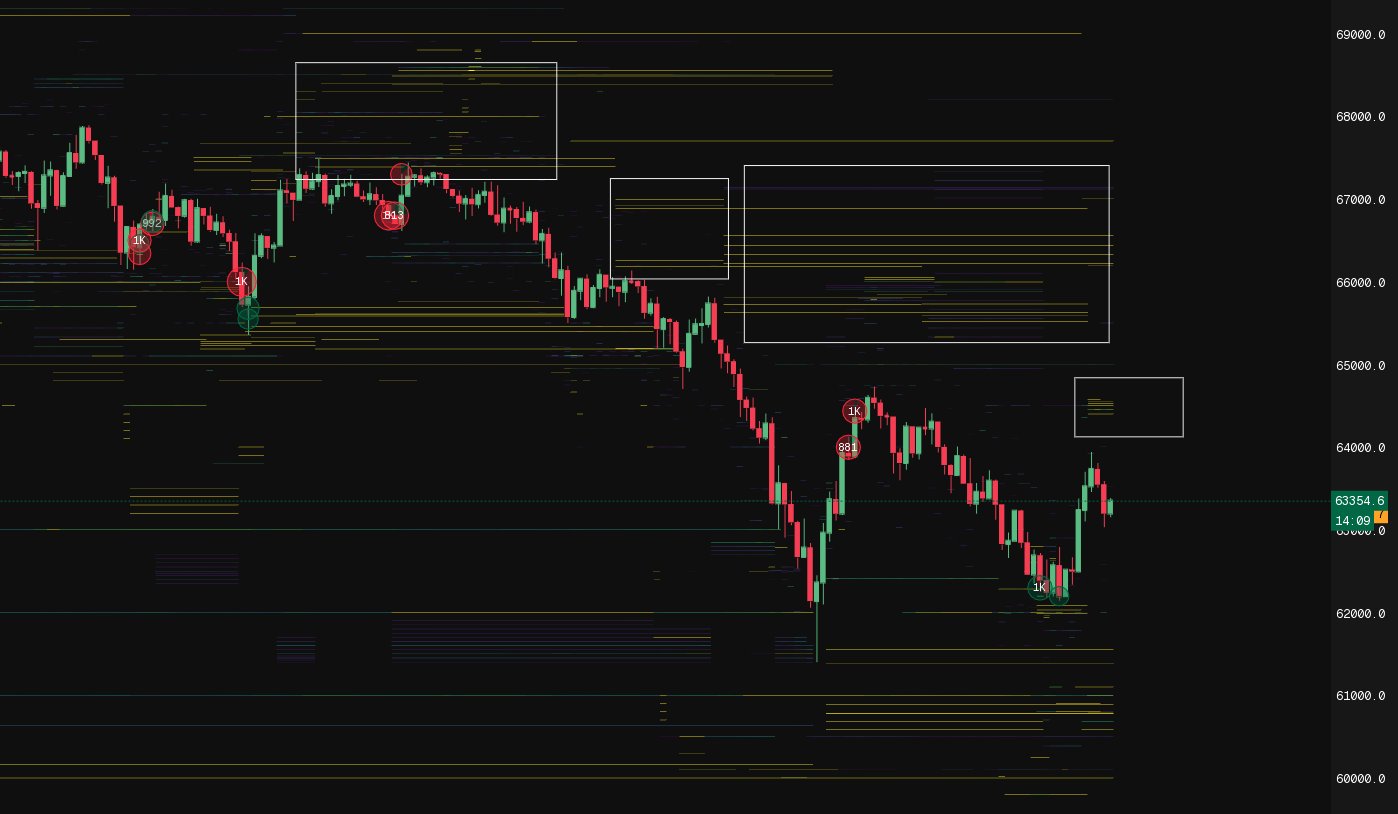
BTC/USDT perpetual contract (Binance) chart with order-book liquidity. Source: Exitpump/X
Analysis notes “incredible” 2022 BTC price replay
At more than 13%, BTC/USD thus faced its worst week of 2026 so far, per data from CoinGlass.
Related: Trump says Iran will ‘work out well’: Five things to know in Bitcoin this week
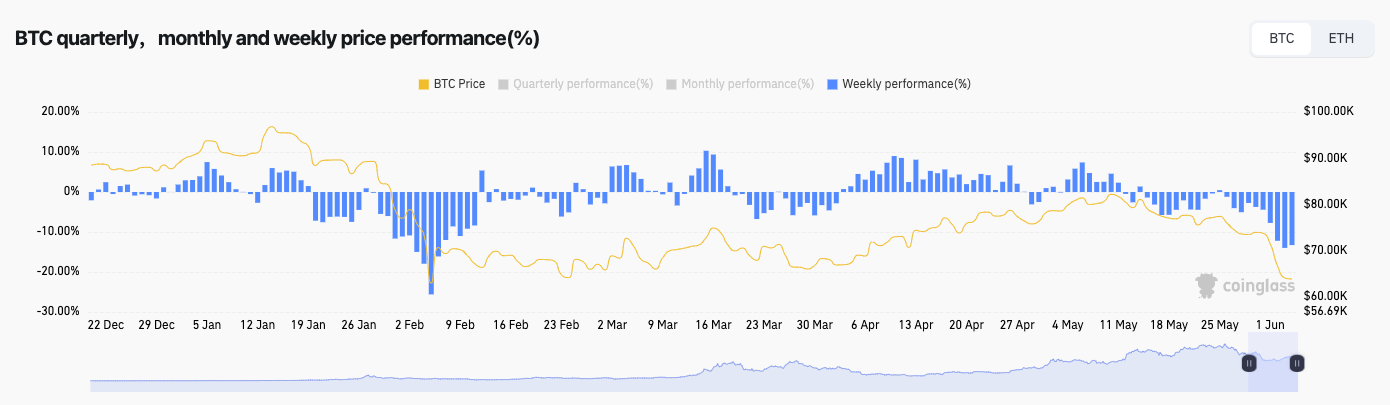
BTC/USD weekly performance (screenshot). Source: CoinGlass
Continuing on the 200-week trend line, meanwhile, currently at $61,626, trader and analyst Rekt Capital made the case for ongoing four-year BTC price cycles.
“On the 13th of June 2022, Bitcoin reached the 200-week SMA during its Bear Market correction,” he noted on the day.
“Now in the 2026 Bear Market, Bitcoin has reached the 200-week SMA almost exactly to the date 4 years later. Bitcoin Cycles are incredible.”
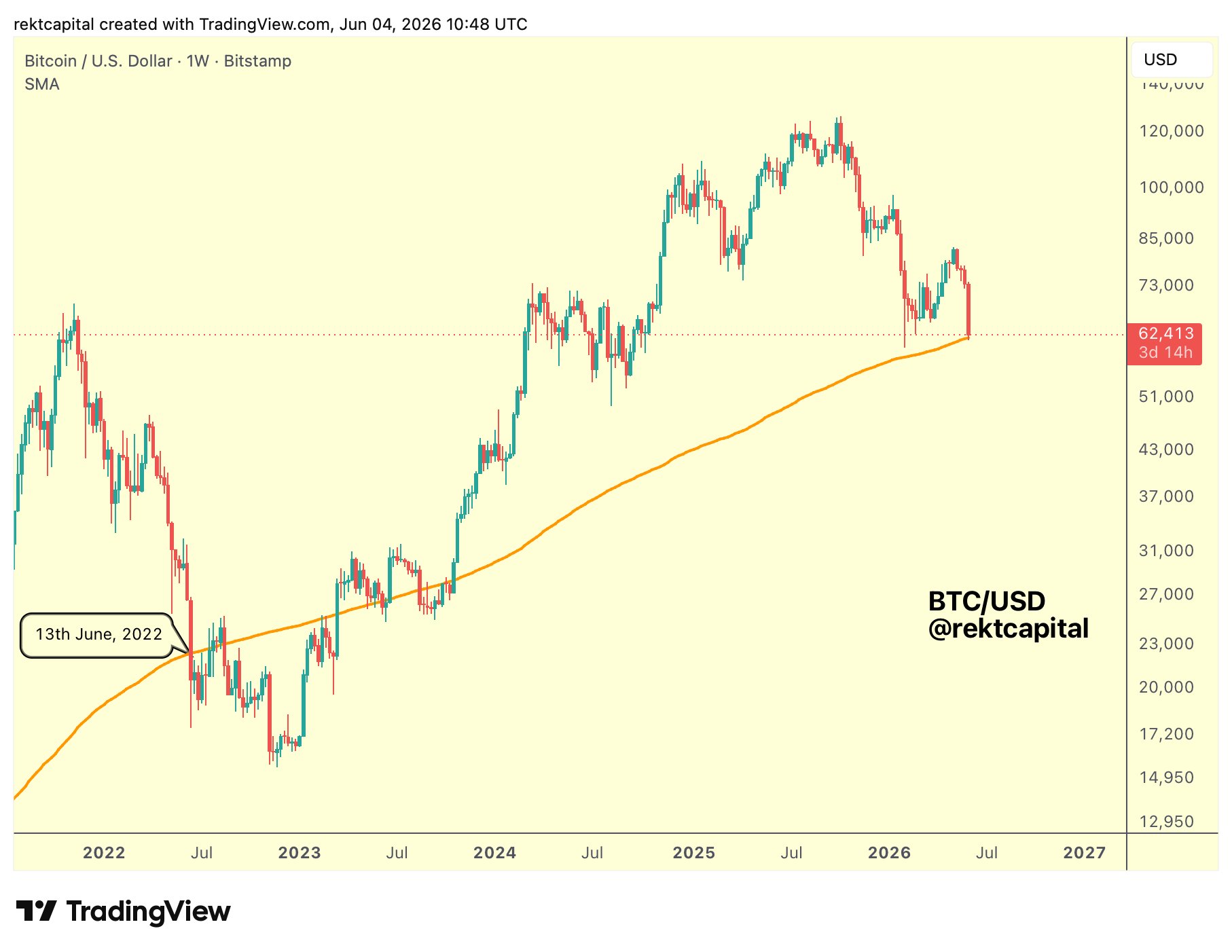
BTC/USD one-week chart with 200SMA. Source: Rekt Capital/X
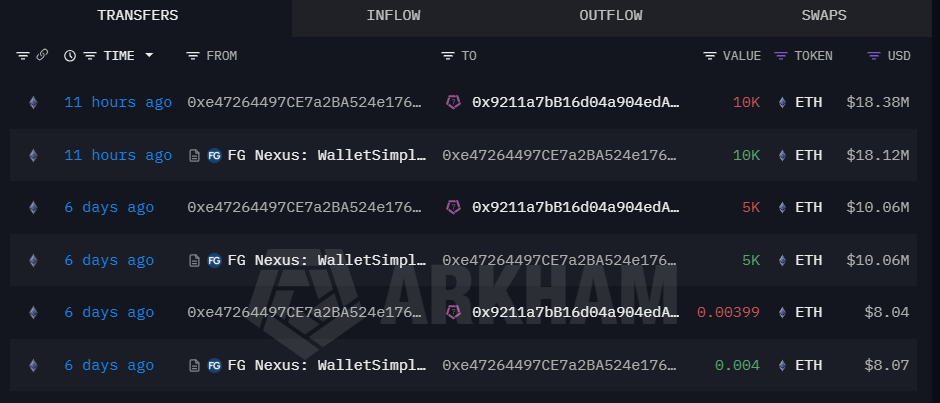
A wallet tagged by Arkham to the publicly listed Ethereum treasury company FG Nexus moved another 10,000 Ether on Wednesday, extending a series of sales that began after the company built a large position in 2025.
The latest transfer equates to roughly $17.8 million at current prices and comes after earlier disposals that saw the Nasdaq-listed firm unwind more than 21,000 ETH from its treasury for roughly $55 million.
FG Nexus accumulated 50,770 ETH between August and September 2025 at an average price of $3,860 per coin, building a position worth about $196 million at the time.
With Ether trading near $1,765 at the time of writing, according to CoinGecko data, the cryptocurrency is down roughly 54% from FG Nexus’s average purchase price of $3,860, implying a loss of more than $100 million in value on its original investment.
FG Nexus’s share price was down 13.40% pre-market Thursday, trading at $7.11, down from $8.21 at Wednesday’s close, according to Yahoo Finance data.
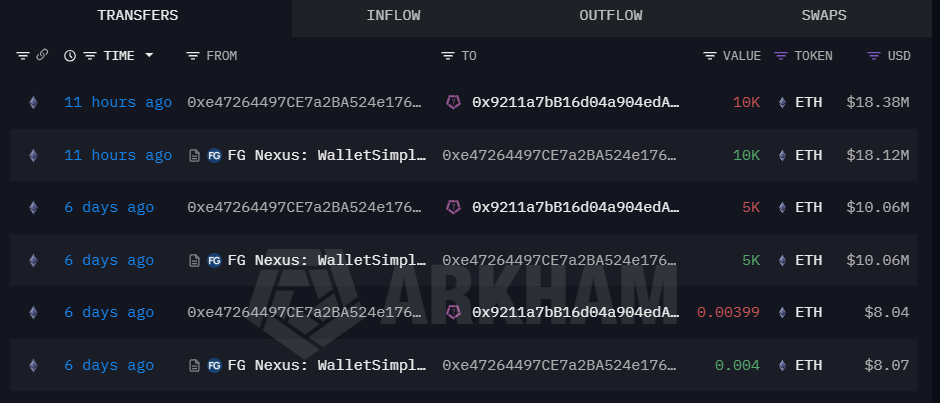
Wallet linked to FG Nexus moves 10k ETH. Source Arkham
The company disclosed holdings of roughly 40,093 ETH in December 2025 and has yet to publicly comment on its Ether sales since those disclosures, with recent transfers identified by onchain data providers not addressed in subsequent company statements.
Cointelegraph reached out to FG Nexus for comment but had not received a response by publication.
Institutional Ether holders continue accumulating
FG Nexus’ recent selling contrasts with the approach taken by other corporate Ether holders, who have continued to add to their positions despite Ethereum’s price decline.
Related: Ethereum drops to 14-week lows: Can ETH price hold $1.8K support?
Listed miner BitMine, the largest publicly traded holder of Ether with more than 5.4 million ETH, has been adding to its position, including a recent purchase of approximately $52 million worth of Ether.
The company also unveiled plans Wednesday to issue dividend-paying preferred shares, expanding the financing tools available to support its Ethereum treasury strategy.
Some analysts likewise remain upbeat on Ether’s long-term outlook despite its recent underperformance.
Standard Chartered reaffirmed its long-term $40,000 Ether price target last week, saying that Ethereum’s network fundamentals are strengthening, and pointing to growing onchain activity and continued dominance in decentralized finance.
The bank compared Ethereum’s current position to Amazon during its early growth phase, arguing that the asset’s market performance has yet to fully reflect those underlying trends.
Market Moves: Why is Ethereum Foundation selling? BTC futures warning signs


Bitcoin has fallen more than 15% this week and briefly slipped towards $61,000, yet Standard Chartered has kept its year-end price target at $100,000 and said the current decline may offer a buying opportunity.
Summary
- Standard Chartered kept its $100,000 Bitcoin target, saying the recent selloff may be nearing an end.
- Geoffrey Kendrick expects Strategy to resume Bitcoin purchases and cited resilient spot ETF inflows.
- The bank said recent Bitcoin liquidations were smaller than those seen in major past market crashes.
According to a note sent to clients on June 4, Standard Chartered believes the factors behind the latest selloff are starting to fade even as some market participants continue to warn of deeper losses.
The bank’s global head of digital assets research, Geoffrey Kendrick, said Bitcoin’s bottom is “nearly in place” after a sharp correction driven by spot ETF outflows, forced liquidations, and concerns surrounding Strategy’s recent Bitcoin sale.
At the time of the note, Bitcoin (BTC) had recovered from its intraday lows and was trading around the mid-$60,000 range. Despite the rebound, the cryptocurrency remains roughly 30% lower for the year.
Kendrick told clients that investors may ultimately view current prices as an attractive entry point when looking back from the end of 2026, when Standard Chartered expects Bitcoin to trade near $100,000.
Strategy buying remains a key bullish factor
One reason behind the bank’s optimism centers on Strategy’s history of returning to the market after selling Bitcoin.
Earlier this week, the company disclosed the sale of 32 BTC worth approximately $2.5 million to meet preferred stock distribution obligations. The transaction attracted attention because Strategy, led by Executive Chairman Michael Saylor, has spent years promoting a long-term accumulation strategy.
Even so, Kendrick noted that the company previously sold Bitcoin in 2022 before increasing its holdings shortly afterward. Based on that pattern, he expects Strategy to resume what he described as aggressive Bitcoin purchases.
While the sale contributed to negative sentiment across crypto markets, Standard Chartered argued that the market reaction may have overstated its significance.
Another factor supporting the bank’s outlook is the resilience of spot Bitcoin ETF demand. According to Kendrick, cumulative net inflows since the launch of U.S. spot Bitcoin ETFs remain around $54.2 billion. Holdings have declined modestly from a peak near 682,000 BTC to roughly 674,000 BTC, but the bank said the overall trend has remained relatively stable.
Liquidation pressure appears less severe
Beyond ETF flows and corporate buying, Standard Chartered pointed to derivatives positioning as another reason for caution against overly bearish forecasts.
The bank noted that roughly $1.5 billion in leveraged Bitcoin futures positions were liquidated during the recent downturn. Kendrick said this figure is comparable to liquidation events seen during previous corrections and remains below levels associated with some of the market’s most severe crashes.
Recent comments from the bank have not been limited to Bitcoin. Last week, Kendrick compared Ethereum’s current weakness to Amazon’s experience during the collapse of the dot-com bubble, arguing that token prices do not always move in line with underlying network progress.
Standard Chartered maintained its Ethereum targets of $4,000 by the end of 2026 and $40,000 by 2030.
Meanwhile, the bank has continued expanding its presence in the digital asset sector. As reported by crypto.news earlier, Coinbase recently broadened its partnership with Standard Chartered, adding institutional funding support for the Australian dollar, Singapore dollar, Canadian dollar, and Swiss franc, while also providing GSIB-backed settlement services for euro and pound transactions across Coinbase Prime and Coinbase Exchange.
According to Coinbase, the arrangement is intended to help institutional clients move capital more efficiently across trading and financing activities.


Crypto has become a key payment rail for a fast-growing gray-market peptide trade, according to a new Chainalysis report.
Summary
- Chainalysis said gray-market peptide sales topped a $100 million annual run rate as buyers increasingly used crypto payments online.
- The report said first-quarter peptide sales reached $32 million, rising 159% from $12 million in the previous quarter.
- Chainalysis found that larger peptide vendors relied more on stablecoins to reduce exposure to Bitcoin’s sharp price swings.
Chainalysis said Thursday that off-label peptide sales have climbed past a $100 million annual run rate, as online wellness trends and demand for cheaper compounds push buyers toward overseas suppliers. The blockchain analytics firm said first-quarter sales in 2026 reached $32 million, up 159% from $12 million in the prior quarter.
The report linked the surge to rising public interest in peptides, which are protein building blocks used across health, fitness, and wellness markets. Chainalysis said the success of GLP-1 drugs such as Ozempic and Wegovy helped bring related products into mainstream online discussion, even as many buyers turned to unregulated alternatives.
Crypto becomes payment backbone
According to Chainalysis, traditional banks and card processors often restrict transactions tied to prescription-grade compounds and unregulated substances. As a result, the firm said many vendors have adopted cryptocurrency to handle payments outside normal financial channels.
Chainalysis described the peptide trade as a “gray market” served by overseas suppliers that sell raw and unbranded products directly to consumers. The firm said Chinese chemical manufacturers now account for much of the supply, partly because some sellers face limits in traditional banking systems.
In its report, Chainalysis said top vendors have developed a more organized approach to crypto payments. The firm found that suppliers often use bitcoin and stablecoins, while larger vendors show a stronger preference for stablecoins.
Stablecoins dominate larger orders
Among vendors receiving average deposits of $1,000 or more, Chainalysis said stablecoins made up most of the payment mix. The firm said this pattern may help sellers reduce exposure to Bitcoin’s price swings when handling larger supply orders.
The report also compared the peptide market with other research-chemical networks that have used crypto for online sales. Chainalysis said some suppliers connected to fentanyl precursor sales appear to have moved into peptides or added them to existing operations.
One example cited by Chainalysis was Shanghai Sigma Audley. The firm said the supplier, which it linked to suspected transnational drug networks, had received at least $1 million in bitcoin and $3.59 million in stablecoins from fentanyl precursor sales before expanding into peptides.
Testing spend falls per buyer
Chainalysis also raised concerns about product safety. The firm said many wallets that bought peptides from China previously sent funds to Janoshik, a Czech company that provides independent chemical purity testing.
However, Chainalysis said testing spend per buyer has dropped sharply as the market has grown. The report estimated that average testing spend fell 88% to about $8 per buyer, even though Janoshik is testing more products overall because the number of buyers has increased.
The report said the peptide sector often reaches people with limited experience in both cryptocurrency and unregulated pharmaceuticals. Chainalysis said this creates added risk for buyers who may not understand product quality concerns, payment traceability, or the legal limits around these substances.
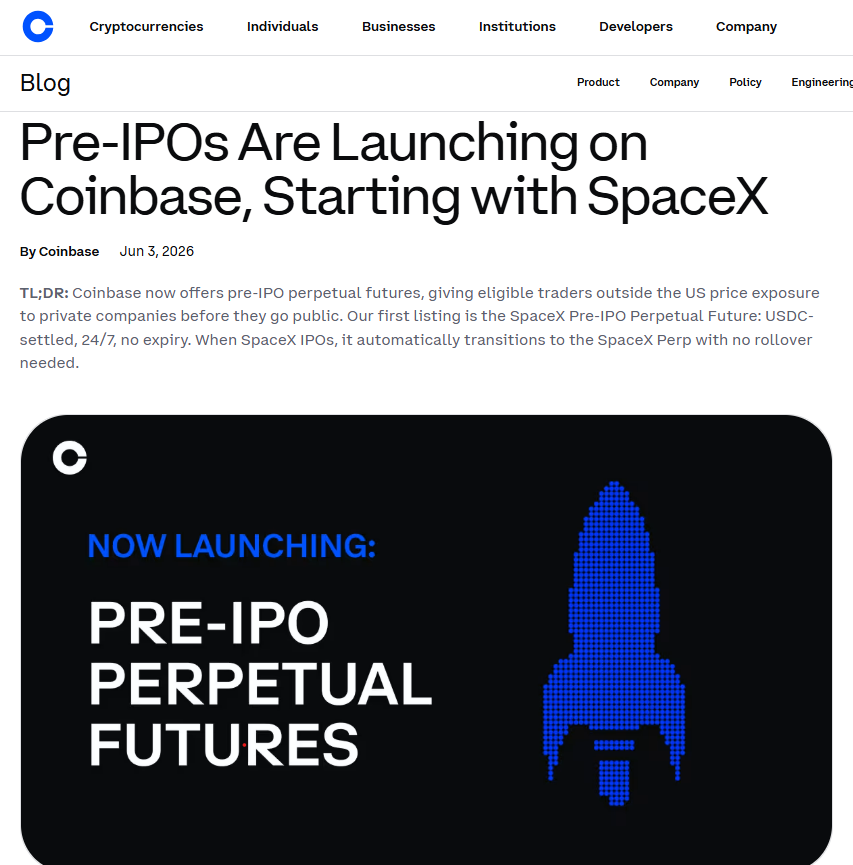
Coinbase has launched pre-intial public offering (IPO) markets, starting with SpaceX, offering users outside the United States exposure to private companies before they list publicly via a perpetual futures contract tied to the company’s estimated pre-listing price.
The product is a USDC-settled perpetual futures contract that tracks SpaceX’s pre-IPO valuation. It allows 24/7 trading with no expiry or rollover, with profits and losses settled in USDC, according to a company blog post Thursday.
Coinbase said the positions can be opened and closed at any time, similar to existing perpetual futures contracts on the platform. Upon a future IPO, positions will automatically transition into a post-IPO perpetual futures contract referencing the public listing.
The offering is not available to US persons at launch and is initially rolling out to “eligible users in supported jurisdictions outside the United States,” reflecting restrictions on offering private market securities exposure in the country.
Coinbase said the product is intended to expand access to private market exposure, which has traditionally been limited to venture capital firms and institutional investors, with SpaceX serving as the initial listing due to strong global demand for exposure to Elon Musk’s space and satellite company.
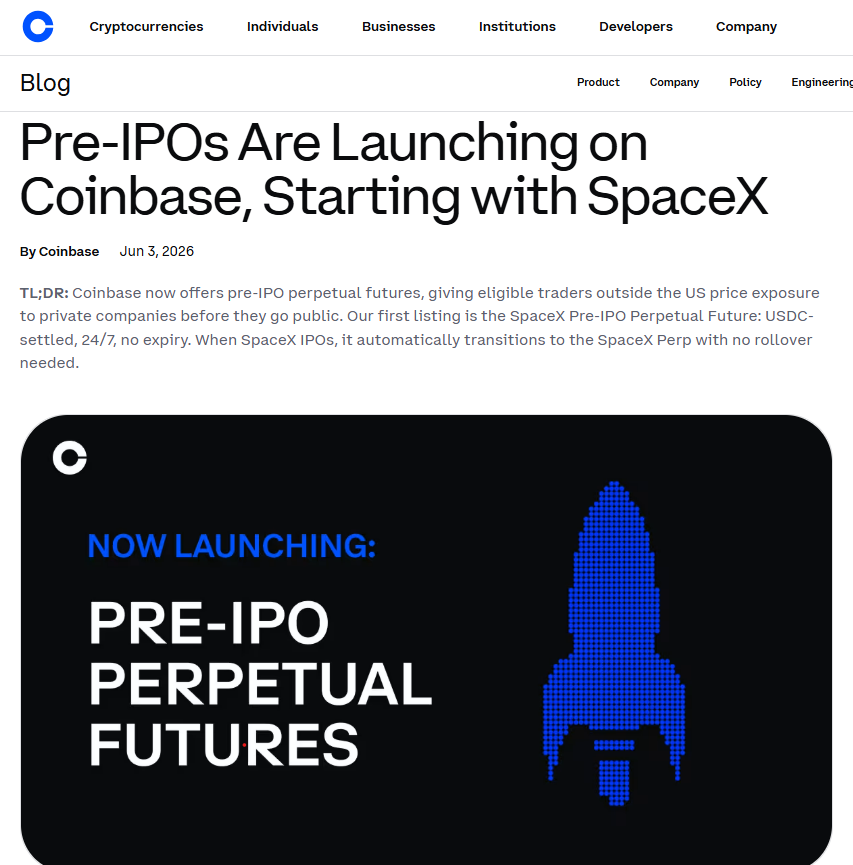
Pre-IPO perpetual futures launch on Coinbase. Source Coinbase
Cointelegraph reached out to Coinbase for comment, but did not receive a response by publication.
Crypto exchanges race to offer pre-IPO exposure
The launch comes amid intensifying competition among crypto exchanges to bring private market exposure into tokenized or synthetic form. Kraken’s parent company, Payward, announced a similar initiative Wednesday, offering tokenized access to pre-IPO companies.
Related: Coinbase invests in ProShares ETF tailored for stablecoin reserve assets
Binance also launched derivative products linked to high-profile private firms, including SpaceX, in May, while in April, Bitget launched IPO Prime, a platform for pre-IPO investment products, starting with a SpaceX-linked offering.
The broader push coincides with accelerating interest in tokenized real-world assets. Research from Bernstein released May 26 estimated the RWA market has grown to $51 billion, expanding 42% this year as investors seek fractional exposure to traditionally illiquid private assets.
A separate Bitget Wallet report, published May 26, found tokenized stocks still make up a low-single-digit share of the RWA market, with most activity clustered in a few big-tech names such as Tesla, Alphabet and Microsoft trading on offshore platforms.
SpaceX remains one of the most closely watched private companies globally, with valuations in recent private market and institutional estimates reaching as high as $1.75 trillion, depending on methodology and secondary market pricing.
Magazine: How to fix suspected insider trading on Polymarket and Kalshi
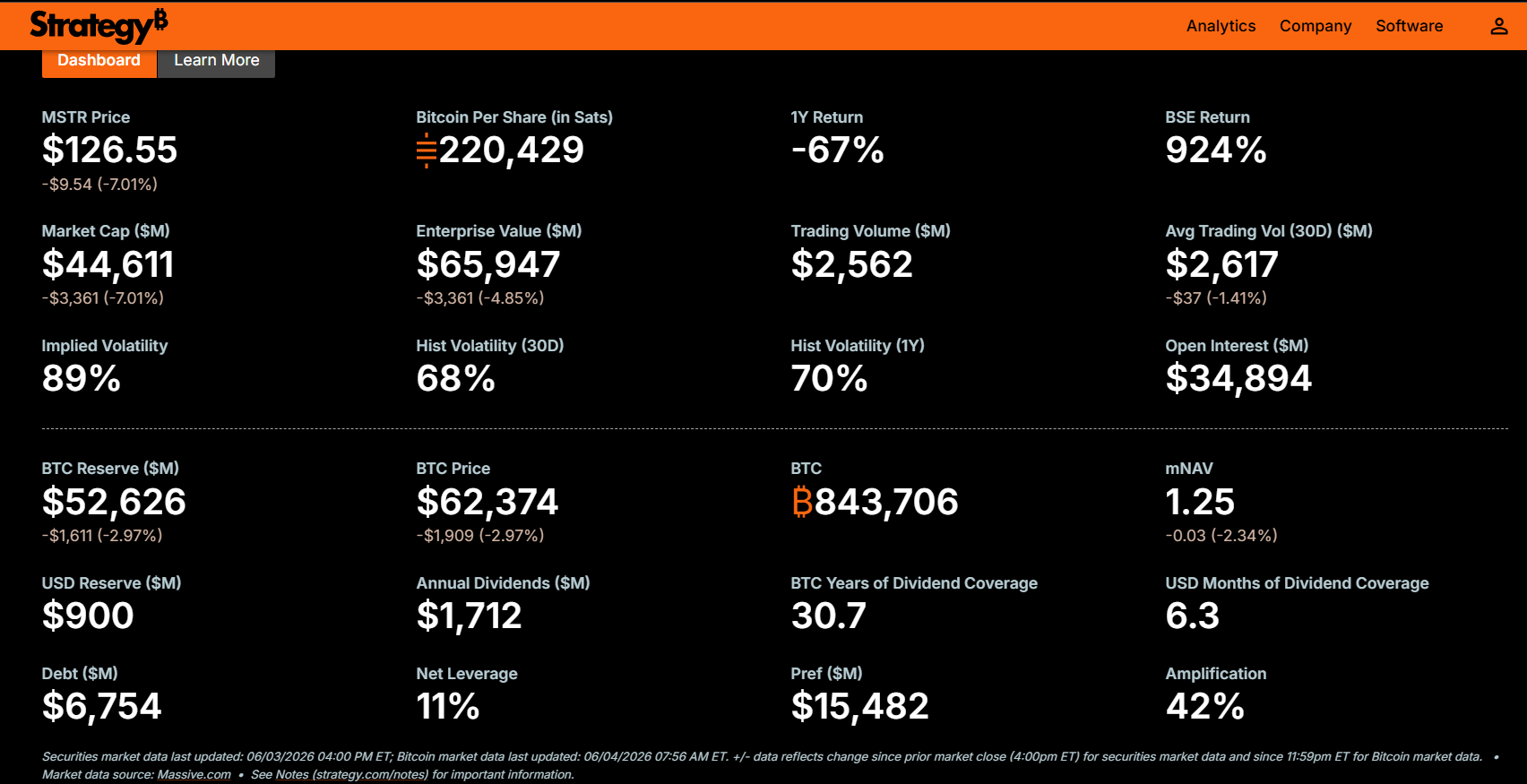
Strategy’s Bitcoin holdings fell deep into paper-loss territory as BTC traded below the company’s average purchase price, renewing scrutiny of Michael Saylor’s Bitcoin treasury model.
Strategy holds 843,706 Bitcoin (BTC) acquired at an average price of $75,699 per coin, with a total cost basis of $63.8 billion. However, the latest Bitcoin downturn sank the value of Strategy’s Bitcoin reserve to $52.6 billion, pushing its unrealized loss to $11.2 billion, according to the company’s dashboard.
Strategy’s variable-rate perpetual preferred stock, STRC, has also declined below its intended $100 value and is traded at $94.6 at the time of writing. Strategy’s (MSTR) stock price was down 1.5% in pre-market trading to $124.7 on Thursday, Yahoo Finance data shows.
The paper loss adds to scrutiny of Strategy’s Bitcoin treasury model as BTC trades below the company’s average acquisition price, while the downturn in STRC price could complicate future preferred-stock issuance to fund its Bitcoin acquisitions. It comes days after Strategy announced the sale of 32 BTC, its first sale since 2022.
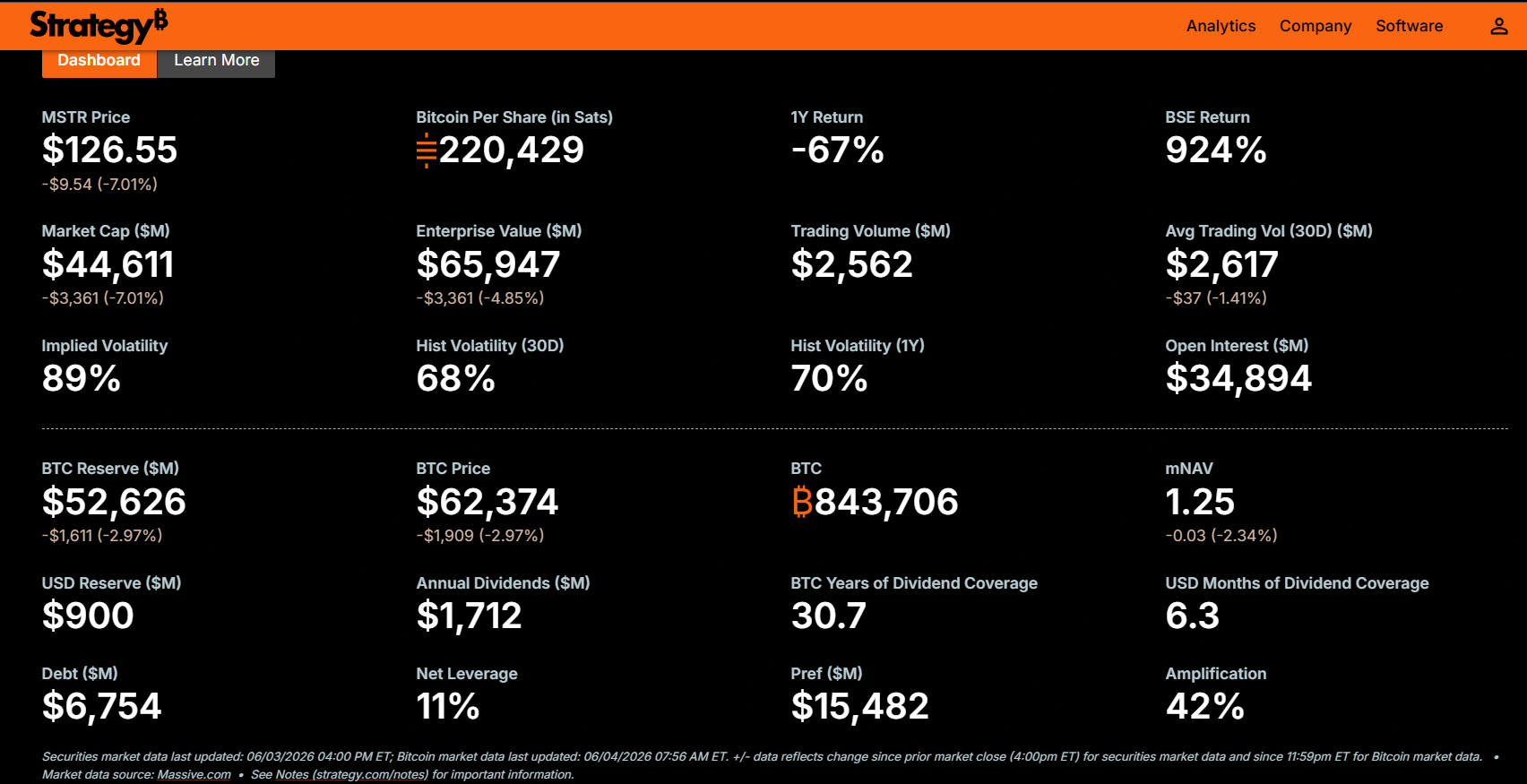
Strategy dashboard with key metrics on its Bitcoin reserve. Source: Strategy.com
Saylor pushed back on the bearish read Thursday, saying that mounting exchange-traded fund (ETF) outflows are “pressuring BTC,” and capital markets have poured $400 billion into AI infrastructure over the past six months.
“This is a capital rotation, not a Bitcoin impairment. Volatility creates opportunity,” said Saylor in an X post.
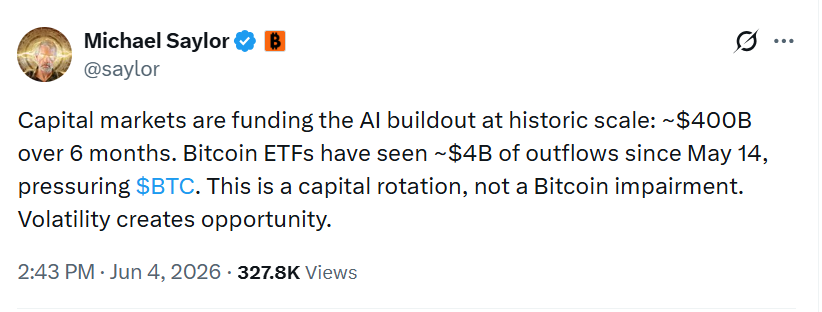
Source: Michael Saylor
Bitcoin’s price is down around 4.7% in the past 24 hours and 13.8% in the past week. The cryptocurrency traded at $63,157 at the time of writing, down over 20% in the past month, according to TradingView. Spot Bitcoin ETFs have logged $4.4 billion in outflows in the past 13 trading days, Cointelegraph reported earlier on Thursday.
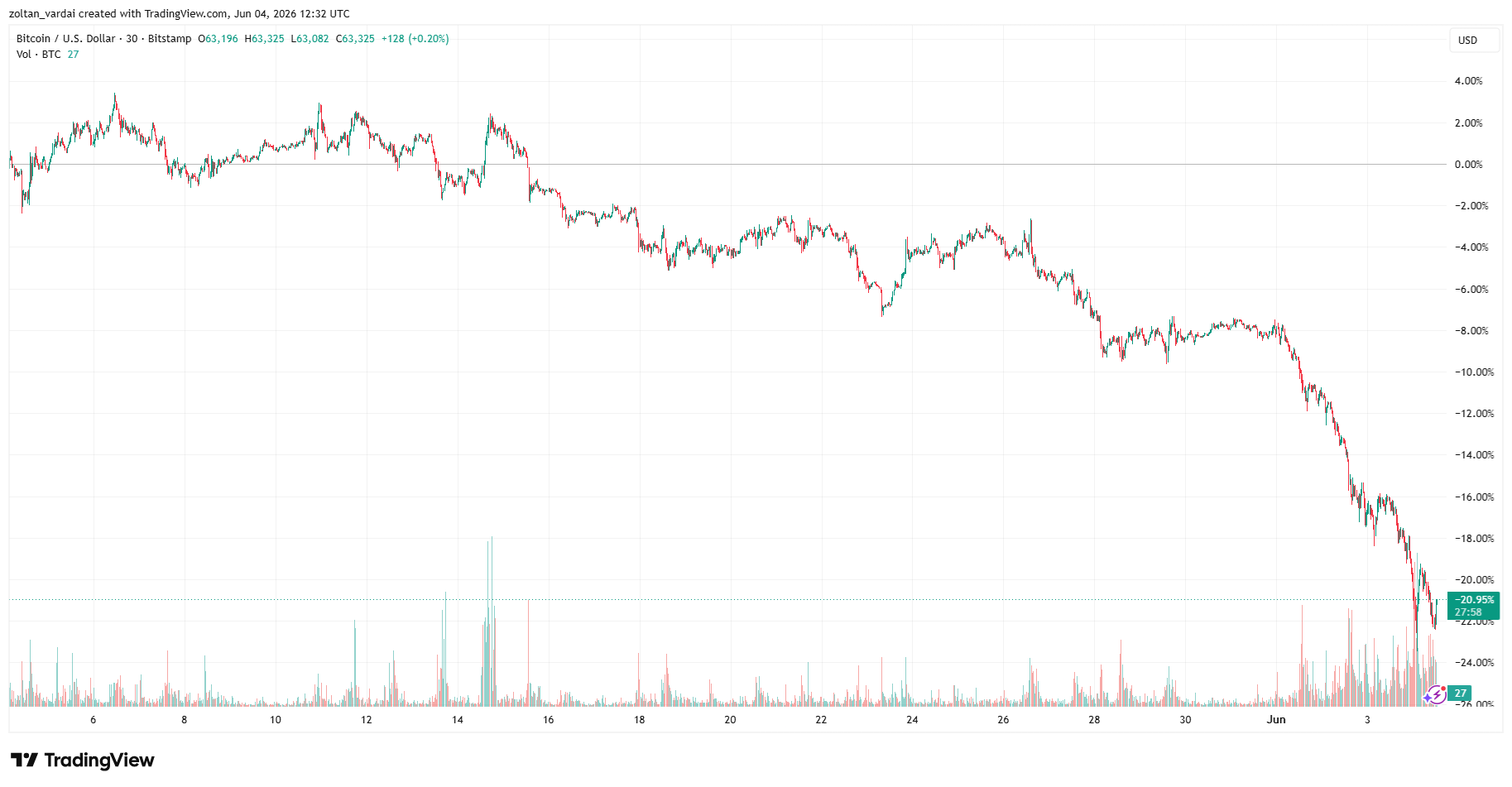
BTC/USD, 1-month chart. Source: Cointelegraph/TradingView
Some market watchers said the STRC move was not unusual.
“STRC’s $100 par value is not a price floor. It’s the stated value used for liquidation preference and certain redemption provisions,” wrote popular investor and podcast host Scott Melker, adding:
“A 5% discount to par is not evidence that something is broken. It’s evidence that investors are demanding a higher yield, pricing risk, or reacting to market conditions – exactly what preferred stocks do.”
Others were less optimistic. Gold bug and long-time Bitcoin critic Peter Schiff said that the lower the STRC price falls, the higher MSTR will be forced to increase dividend payments to “bring the share price back up to $100,” which means that “MSTR will run out of cash much sooner, pulling forward Bitcoin sales to fund payments.”
Related: Capital B seeks $122B funding mandate to buy more Bitcoin
Standard Chartered says Bitcoin bottom near, depending on Strategy’s next move
Despite the sell-off, Standard Chartered predicted that the Bitcoin market bottom may be near, depending on Strategy’s next purchase.
“I would see it as a tentative sign the low has been printed, and given that logic, suspect selling over the weekend will be muted,” said Geoffrey Kendrick, global head of digital asset research at Standard Chartered.
Kendrick said a purchase of 320 BTC or 3,200 BTC, equal to 10 times or 100 times the recent sale, could signal a market bottom.
Following Strategy’s prior tax-loss sale of 704 BTC in 2022, the company purchased 810 BTC just two days later.
Magazine: Bitcoin ETFs bleed $1B, Aave’s $71M ETH unfreeze bid delayed: Hodler’s Digest, May 10 – 16

Hyperliquid (HYPE) entered the top 10 cryptocurrencies by market capitalization on June 1st, after surpassing the OG meme coin, Dogecoin (DOGE), with a valuation of over $16 billion.
According to a report by CoinGecko, this development made HYPE only the second pure decentralized finance (DeFi) protocol to reach the top 10, after Uniswap achieved the feat in 2021 during the crypto bull market that followed the 2020 “DeFi Summer.”
HYPE Enters Crypto Top 10
CoinGecko said Hyperliquid’s rise was partly supported by its stronger performance compared with the broader crypto market, allowing it to establish itself as one of the few digital assets that remained in an uptrend during the 2026 bear market.
HYPE has been one of the strongest performers in the crypto market in recent weeks, as it witnessed both price action and increased community interest. As the token rallied to a record high above $73, discussions and positive sentiment around the project surged across X, Reddit, Telegram, and other crypto communities.
Although HYPE has since settled near the $65 level amid a broader market pullback, enthusiasm surrounding the token remains strong. According to market observers, the recent correction has done little to weaken the overall bullish outlook.
Zooming Out
Bitcoin has remained the largest crypto by market cap every single year since 2014, but its “grip has loosened slightly” over the past decade. Bitcoin accounted for 87% of the combined market cap of the top 10 cryptos back in June 2014, compared with 64.9% in June 2026, a decline of 22.1 percentage points over 12 years.
Despite this, CoinGecko said no other asset has come close to challenging its overall dominance.
The report also pointed to Ethereum’s arrival in 2016 as the “single most consequential structural shift” in the top 10’s makeup. Entering directly at second place with an 11.1% share, Ethereum formed a long-standing two-asset core alongside Bitcoin. Its share later peaked at 23.5% during the 2021 DeFi and NFT boom before easing to 10.6% by 2026 as competing Layer 1 blockchains gained a larger presence.
Meanwhile, Ripple (XRP) stood out as the only non-Bitcoin cryptocurrency to remain in the top 10 every single year from 2014 through 2026, as it expanded from a $32 million valuation and a 0.3% share in 2014 to $127.9 billion and a 4.3% share by 2025.
The post Hyperliquid (HYPE) Just Did What Only One DeFi Token Had Done Before: CoinGecko appeared first on CryptoPotato.
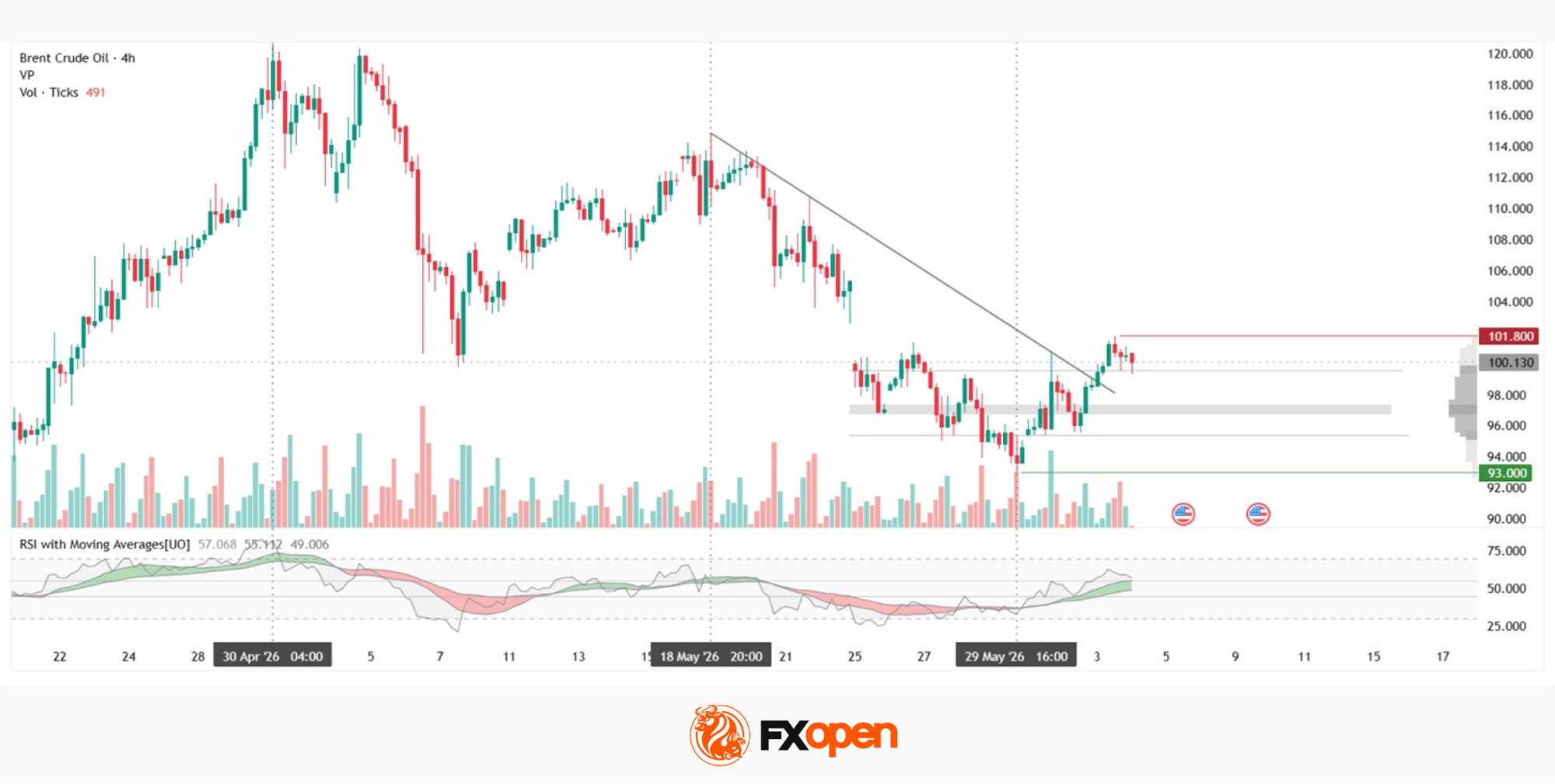
Fundamental backdrop
In April 2026, the closure of the Strait of Hormuz pushed Brent prices to their highest levels per barrel since 2022. However, diplomatic developments reversed the market’s direction: by the end of May, prices had fallen by around 19% — the worst monthly performance since the pandemic — amid ceasefire negotiations between the United States and Iran. Additional pressure came from OPEC+’s decision to increase production by 188,000 barrels per day in June.
The market remains cautious. Even if an agreement is reached, analysts continue to point to persistent risks for tanker traffic through the strait. US labour market data due on 5 June may also influence expectations regarding future energy demand.
Technical picture
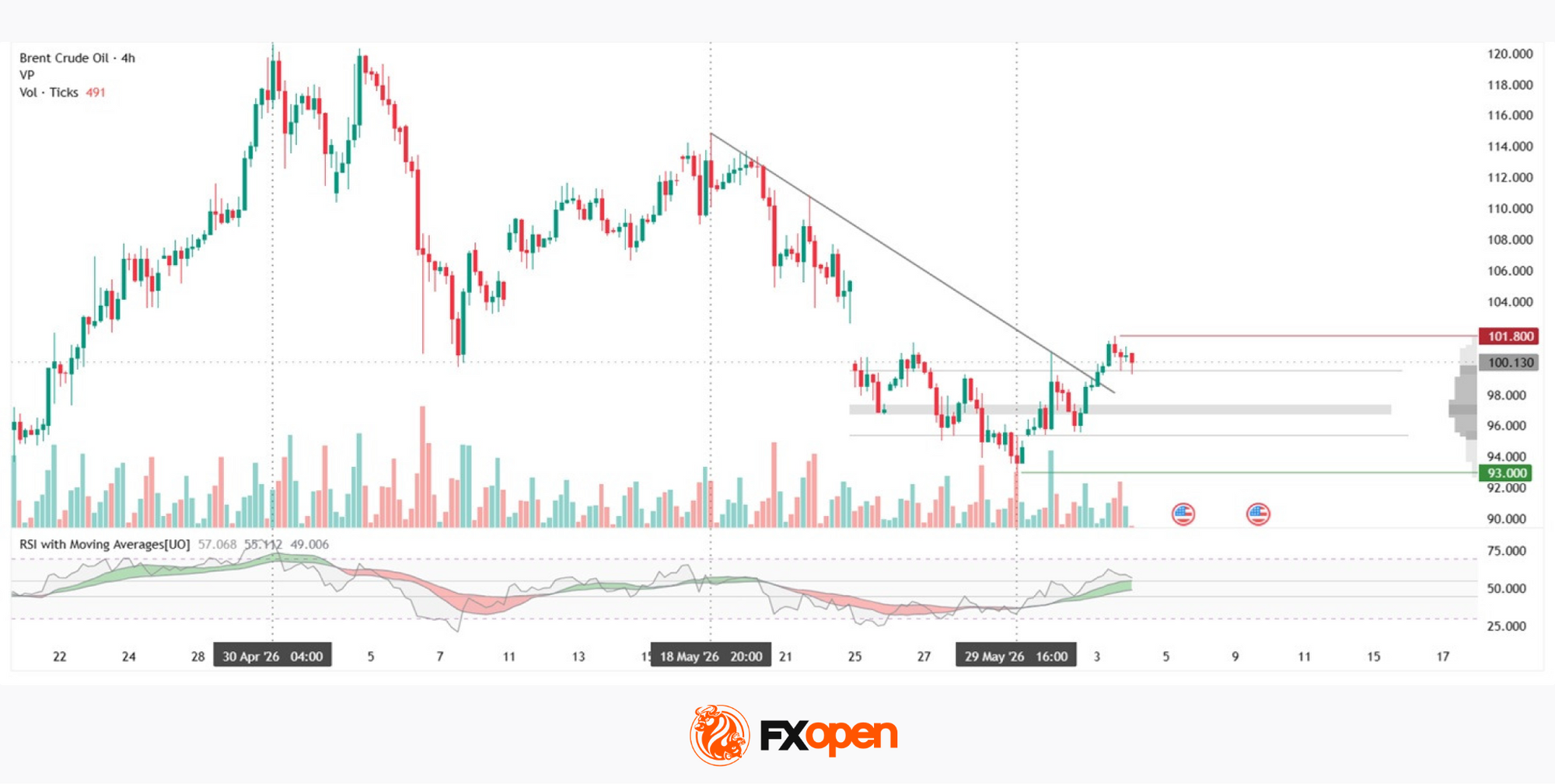
On the four-hour chart of Brent Crude Oil (XBRUSD on FXOpen), a short-term downtrend remains in place, having developed following the market reversal on 30 April and originating from the 114.5 area. In late May, the price tested the 93 region, which coincided with the green support level, before staging a recovery. The market is now attempting to break above the descending trendline and is testing the upper boundary of the current profile at 99.600 as support.
The profile spans the range between 95.400 and 99.600. The point of control (POC) is located in the 96.950–97.150 area — the price zone that attracted the highest concentration of trading activity during the reversal phase. The 101.800 area may act as the nearest resistance level; if prices remain above the profile, this level could become a key focus for market participants. Should the market fall back below 99.600, the POC may provide support for another attempt to move higher.
The RSI and its moving averages currently stand at 57, 55 and 49. The indicator remains above both moving averages, while their positive slope suggests strengthening short-term bullish momentum.
Key takeaways
The main factor likely to determine Brent’s direction in the coming weeks remains the progress of US-Iran negotiations. Any indication of delays or a breakdown in talks could reintroduce a geopolitical risk premium into prices. From a technical perspective, the market is approaching a decision point: the outcome of the current attempt to break the descending trendline may determine the next short-term direction of Brent prices.
Start trading commodity CFDs with tight spreads (additional fees may apply). Open your trading account now or learn more about trading commodity CFDs with FXOpen.
This article represents the opinion of the Companies operating under the FXOpen brand only. It is not to be construed as an offer, solicitation, or recommendation with respect to products and services provided by the Companies operating under the FXOpen brand, nor is it to be considered financial advice.
The amount of bitcoin supply in loss reached a key bear-market threshold, surpassing 10 million BTC, more than half of the total in circulation.
According to Glassnode data, at a one-hour resolution, the number peaked at about 10.5 million BTC as the price fell to as low as $61,300 on Thursday. Total circulating supply is roughly 20 million BTC, so more than half of all coins are currently held at an unrealized loss.
At the same time, supply in profit has declined to around 9.8 million BTC. This is the first time during the current market cycle that the amount of bitcoin held at a loss has exceeded the amount held in profit.
Historically, this transition has occurred only during deep bear-market conditions, and it has often coincided with major market bottoms.
Previous cycles provide some context.
During the 2015 bear market, supply in loss and supply in profit remained near equilibrium for almost a year before the market recovered. In 2019, the period lasted roughly six months. The Covid-driven capitulation in March 2020 was shorter, lasting around one month, and the 2022 bear market saw this condition persist for about six months.
The takeaway is that while this signal has historically aligned with bear-market lows, the duration of these periods has varied significantly, making it difficult to estimate how long bitcoin could remain at depressed levels.
Adding to the significance of the recent decline, bitcoin touched its 200-week moving average of around $61,300. The measure is a long-term trend indicator that calculates bitcoin’s average price over the previous 200 weeks. It has historically acted as a major support level during every bear market cycle.
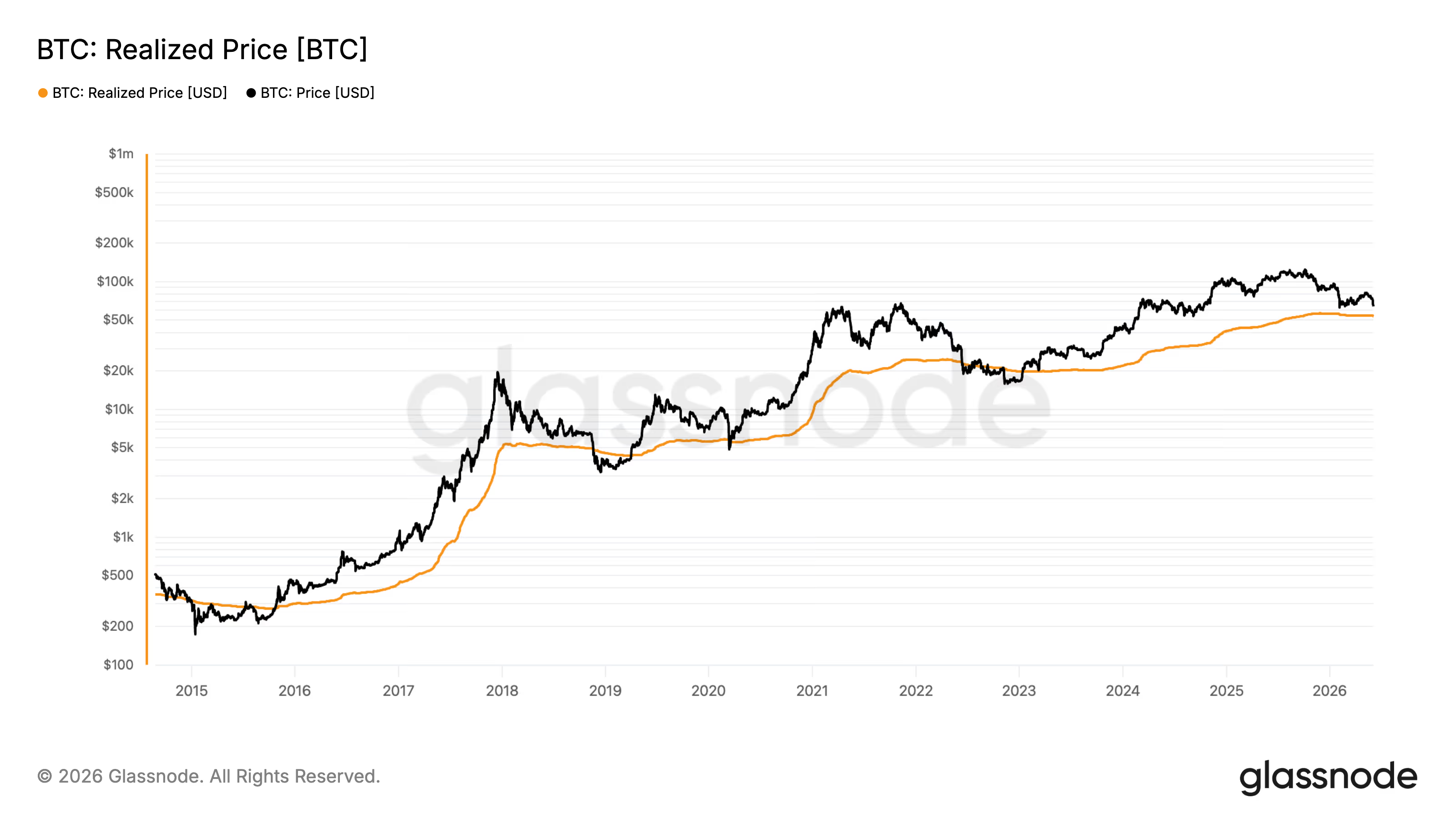
Should bitcoin drop below the psychologically important $60,000 level, the next major support zone is around $54,000, which corresponds to the realized price. The realized price represents the average acquisition cost of all bitcoin in circulation based on the price at which each coin last moved onchain. Bitcoin has traded below its Realized Price during every major bear market.

Maelstrom, the investment firm led by Arthur Hayes, argues that Worldcoin’s WLD token could surge to as much as $5 in the coming months, framing WLD as a clean proxy for the AI mega IPO wave. The note positions the token as a relatively overlooked lever in a market that is increasingly pricing in AI-driven growth and corporate AI infrastructure shifts.
“The AI mega IPOs are coming — and it appears the market has overlooked one of the cleanest proxies,” said Lukas Ruppert, a Maelstrom researcher, on Wednesday.
The AI boom has been accelerating in the United States. OpenAI confidentially filed its IPO prospectus with the SEC on May 22, targeting a public debut in September 2026, with the firm aiming to raise $60 billion and a potential valuation of up to $1 trillion. Meanwhile, Anthropic confidentially filed its draft prospectus after announcing on May 28 that it was valued at $965 billion following a fresh $65 billion funding round. US stock markets have risen this week, aided by AI‑related gains in memory storage and chipmakers as well as broader tech sentiment.
Ruppert argues that this AI fervor has not yet fully reflected in WLD’s price, even as near-term developments around Worldcoin and its token dynamics could tilt sentiment. He points to two potential catalysts that could reverse the current overhang and tilt WLD higher.
Key takeaways
- The Maelstrom view casts WLD as a high‑conviction proxy for upcoming AI mega IPOs, with a price target around $5 in the near term.
- Two catalysts could spark a rally: a substantial WLD bid by Eightco ORBS and a meaningful improvement in the token’s unlock schedule.
- Eightco ORBS, a small publicly traded company, reportedly holds about 283 million WLD and sits on roughly $144 million in cash, which could be deployed to buy more WLD and potentially trigger a price reflexive move.
- Worldcoin’s token unlock framework is set to ease selling pressure by about 43% on July 24, potentially removing a key overhang for the token.
Worldcoin and the AI IPO frame
Worldcoin positions itself as a project intended to create a global digital identity and financial network capable of distinguishing real humans from AI bots. Co‑founded by OpenAI CEO Sam Altman, the project has attracted mainstream attention as the AI ecosystem expands beyond pure software into identity, verification, and on-chain participation use cases.
Against a backdrop of heavyweight AI funding rounds and planned public listings, WLD has traded in a risk‑premium corridor. Ruppert notes that capital is increasingly chasing exposure to AI leaders such as OpenAI and Anthropic, whose valuations are in the hundreds of billions, if not trillions, while WLD’s currently unlocked market cap sits at what he sees as a much smaller, “asymmetric upside” opportunity around $2 billion.
As a gauge of momentum, WLD has been among the stronger performers within the top‑100 crypto assets by market cap, rallying roughly 60% over the past week in market activity tracked by price feeds such as TradingView.
Catalysts to watch for a WLD rally
The two primary catalysts outlined by Maelstrom centre on supply dynamics and capital allocation flow.
First, Eightco ORBS — a small publicly traded company that has accumulated a sizable stash of Worldcoin tokens — reportedly holds about 283 million WLD and has around $144 million in cash on its balance sheet. Ruppert suggests that if Eightco deploys a portion of that cash to buy additional WLD, it could ignite a reflexive price loop, where rising demand from a buyer with large holdings pushes the price higher and draws in more buyers.
Second, Worldcoin’s unlock schedule is set to tighten the flow of new tokens into the market. Beginning on July 24, the daily unlocks are expected to fall by roughly 43%, a move that could meaningfully reduce near‑term selling pressure and support price stability or upside in the weeks ahead.
Ruppert frames these dynamics within a broader investor context: “Capital is aggressively chasing Anthropic and OpenAI exposure,” and while AI valuations sit in the hundreds of billions or trillions, WLD’s market exposure is comparatively modest. If buyers step in and selling pressure eases, the upside could be outsized relative to the token’s current liquidity profile.
From a price action perspective, Maelstrom’s note argues that WLD tends to move decisively when it moves at all. The firm projects a path to $5 by August, representing roughly a fivefold increase from a current price around $0.50 and implying a substantial, if volatile, upside against an otherwise cautious backdrop for smaller cap crypto assets.
These views come as Worldcoin remains a controversial and closely watched project within the broader AI economy, where investors weigh the potential utility of global identity networks against regulatory and privacy considerations, as well as the practical challenges of mass adoption.
Market context and what it could mean for investors
The AI rally has spilled over into equity markets and crypto alike, with AI‑driven earnings and investment narratives shaping sentiment across tech sectors. While OpenAI and Anthropic are poised to shape the AI software and services landscape, Worldcoin’s broader ambition sits at the intersection of identity verification and decentralized finance, a combination that could unlock novel on‑chain participation if consumer trust and data privacy concerns are addressed effectively.
For traders and long‑term holders, the key will be watching how any large corporate purchasing of WLD, particularly by Eightco ORBS or similar entities, interacts with the token’s unlocking cadence and market liquidity. The July 24 unlock reduction is a tangible near‑term event to monitor, as it could alter the supply‑demand balance in a market that has shown sensitivity to token flow dynamics.
As the AI IPO narrative evolves, investors may increasingly treat WLD as a test case for how digital identity and tokenized access could intersect with mainstream AI monetization. If the catalysts highlighted by Maelstrom begin to take hold, WLD could emerge from a low‑volatility phase into a more responsive trading regime, though both upside potential and downside risk remain highly contingent on broader regulatory, technological, and market developments.
What to watch next: the pace of private and strategic purchases in WLD, any shifts in Eightco ORBS’ capital deployment, and the actual timing and impact of the Worldcoin unlock changes going into late summer. These elements will shape whether the $5 target remains plausible or if the market requires a longer runway to assess Worldcoin’s role in the AI economy.

Bitcoin Must Hold $60,000 Next After $2 Trillion Crypto Market Wipeout

Christianity is being criminalised as hate speech

Pakistan Not Sending Team For Asian Senior Fencing Championships In Delhi



-

 Tech7 days ago
Waymo dominates autonomous vehicle registrations as Tesla trails behind
-

 News Videos6 days ago
This is BROKEN! INSANE 5x MONEY CAR WASH WEEK! The NEW GTA Online UPDATE Today! (GTA5 New Update)
-
 Tech5 days ago
SpaceX just won a second Golden Dome contract. This one is $4.16 billion.
-

 Business3 days ago
Jade Biosciences, Inc. (JBIO) Discusses Positive Interim Results From JADE101 Phase I Healthy Volunteer Study and Development Plans Transcript
-
 News Videos6 days ago
SHE IS KILLING XRP!!! WATCH URGENT AND ACT FAST
-
 NewsBeat6 days ago
FIRST NIGHT REVIEW: Take That bring the Circus back to life in spectacular sun-soaked style
-

 Business5 days ago
Is the Spurs Phenom Already Better Than Prime Diesel?
-
Crypto World6 days ago
CFTC Has Approved the First Regulated Bitcoin Perpetual Contract in the U.S.
-

 Politics5 days ago
The House | Inside Andy Burnham’s Makerfield Campaign: “Nobody Thinks This Is In The Bag”
-

 Sports2 days ago
French Open 2026 results: Alexander Zverev beats Rafael Jodar and will play Jakub Mensik in semi-finals
-
 NewsBeat6 days ago
Novak Djokovic v Joao Fonseca LIVE: French Open latest scores and results after Jannik Sinner’s shocking collapse
-
 Entertainment6 days ago
Weak ‘Supergirl’ Box Office Tracking Amid Milly Alcock Backlash
-

 Tech2 days ago
CryZENx Releases Fresh Playable Content Deep Inside Jabu-Jabu for His Ocarina of Time Remake
-
 Crypto World6 days ago
Snowflake (SNOW) Stock Rallies on Strong Q1 Results and AI Product Growth
-

 Entertainment6 days ago
Maddox Jolie-Pitt Legally Requests to Drop Brad’s Surname
-

 Business5 days ago
Demand Conditions Improve In Chemicals Sector In April 2026
-
 Entertainment5 days ago
One of the Greatest Sitcoms of All Time Shoots Up Apple TV’s Charts 11 Years Later
-
 Crypto World6 days ago
MicroStrategy Moves $30 Million in BTC to Coinbase Prime: Is the Bitcoin Sell-Off Already Here?
-

 Tech6 days ago
This Week In Security: Ubiquiti Fixes, And FreeBSD Joins The Club You Don’t Want To Join
-
 Entertainment6 days ago
Bruce Willis’ Generosity Resurfaces Amid His Dementia
You must be logged in to post a comment Login