

Crypto World
Polymarket closes first block trade in push for institutional adoption


A Polymarket advertisement in a subway station in New York, US, on Thursday, Feb. 5, 2026.
Michael Nagle | Bloomberg | Getty Images
Prediction market platform Polymarket has completed its first block trade on an artificial intelligence compute infrastructure-related contract, the company shared exclusively with CNBC.
The six-figure transaction was between FalconX, a digital asset brokerage, and Anera Labs, a trading technology startup. FalconX and Anera Labs traded on a contract related to the Ornn Compute Price Index, a benchmark that tracks Nvidia’s H100 GPU chip rental pricing.
“Prediction markets are emerging as one of the most powerful venues for institutional block trades, and this transaction is proof,” said Brooke Rizzetto, head of institutional liquidity at Polymarket, in a statement. “Seeing an institutional counterparty use Polymarket to hedge real GPU compute exposure at scale is exactly the future we have been building toward.”
Block trades are large, privately negotiated transactions that are typically executed outside of a public market to avoid price volatility. They are a regular occurrence with equities on big Wall Street trading desks.
The announcement comes just over a month after Kalshi, Polymarket’s chief rival, completed the first block trade on any prediction market platform. However, Polymarket in a statement noted that this was the first institutional prediction market trade on-chain, as the company’s international platform operates on the Polygon blockchain.
Shayne Coplan, chief executive officer of Polymarket, on the floor of the New York Stock Exchange (NYSE) in New York, US, on Thursday, Nov. 13, 2025.
Michael Nagle | Bloomberg | Getty Images
Polymarket’s international exchange is separate from its U.S. platform, which launched in December after it was prohibited from operating in the country in 2022 for not properly registering with regulators. The Commodity Futures Trading Commission — the federal regulator for prediction markets — and the Department of Justice in July dropped their investigations into the company without charges. The CFTC regulates Polymarket’s U.S. platform.
While individual traders have led to prediction market volumes surging over the past year, platforms are increasingly looking to institutional traders as the next venue for growth. FalconX will serve as a dedicated market maker for future block trades on Polymarket’s platforms, the company said.
“This transaction highlights the accelerating demand for financial infrastructure in the compute space,” said FalconX global co-head of markets Ravi Doshi, in a statement. “We’re proud to collaborate with pioneers like Polymarket to deliver deeper liquidity and clearer price discovery to this crucial, rapidly evolving commodity market.”
Disclosure: CNBC and Kalshi have a commercial relationship that includes customer acquisition and a minority investment.


Crypto exchange Coinbase has invested in ProShares’ stablecoin-focused money market fund, betting that demand for stablecoin reserve-management products will grow as the recently enacted GENIUS Act formalizes the types of assets that can back US dollar-pegged tokens.
Coinbase (COIN) announced Tuesday that it made an undisclosed investment in the ProShares GENIUS Money Market ETF (IQMM), which is designed to hold assets that qualify as reserves for payment stablecoins under the Guiding and Establishing National Innovation for US Stablecoins (GENIUS) Act.
The GENIUS Act requires stablecoin issuers to back their tokens with highly liquid assets, including cash, bank deposits and short-term US Treasury securities. IQMM was created to provide exposure to those types of reserve assets through a publicly traded fund structure.

Source: ProShares
Launched in February, IQMM invests exclusively in short-term US Treasury securities and cash-equivalent instruments with maturities of 93 days or less. According to ProShares, it’s one of the first exchange-traded funds tailored specifically for stablecoin reserve management.
Coinbase said the investment aligns with its growing stablecoin business and cash-management operations. As one of the primary infrastructure providers for Circle’s USDC (USDC), Coinbase has an interest in expanding the pool of regulated, liquid investment vehicles for managing stablecoin reserves.
Related: Movement expands stablecoin payments push with access to US, Canada, EU rails
CLARITY Act hangs in the balance as stablecoin yield debate intensifies
The passage of the GENIUS Act in June 2025 marked a major milestone in US stablecoin regulation, but lawmakers are still debating broader reforms to crypto market structure.
At the center of that effort is the Digital Asset Market Clarity (CLARITY) Act, which would establish rules governing digital asset markets and define the roles of federal regulators. The legislation gained momentum after lawmakers incorporated new stablecoin yield provisions, setting the stage for a broader debate over whether issuers should be allowed to pay interest on stablecoin holdings.
The bill advanced through the Senate Banking Committee last month, setting the stage for a full Senate floor vote. However, progress has been uneven, with some Democrats pushing for stronger ethics and conflict-of-interest provisions tied to digital assets.
In May, White House crypto adviser Patrick Witt said administration officials were targeting the period around the July 4 Independence Day holiday to advance crypto market-structure legislation. However, it remains unclear whether lawmakers can meet that timeline amid ongoing disagreements.
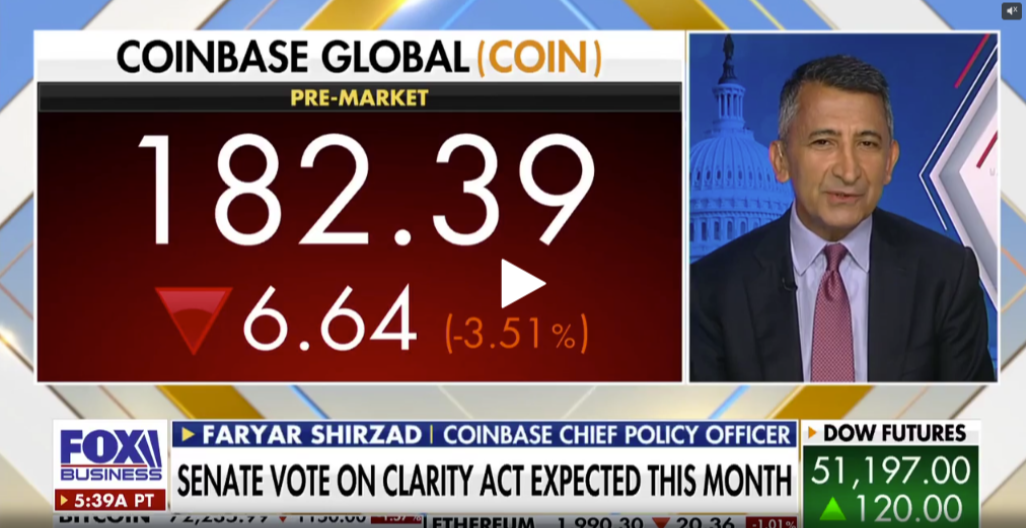
Coinbase’s chief policy officer, Faryar Shirzad, called the CLARITY Act the “biggest financial regulatory bill” since Dodd-Frank. Source: Fox Business
Much of the disagreement comes from the banking industry, which continues to voice strong opposition to the bill. Last week, JPMorgan CEO Jamie Dimon said banks would fight the legislation in its current form, arguing that allowing crypto firms to offer yield on stablecoin balances could create an uneven competitive landscape between banks and digital asset companies.
Related: Fed’s Barr backs stablecoin clarity but warns of run risks
Cardano founder Charles Hoskinson lashed out at the network’s governance after TapTools said it would wind down within two weeks. The Hosky community followed with its own closure notice, though satirical.
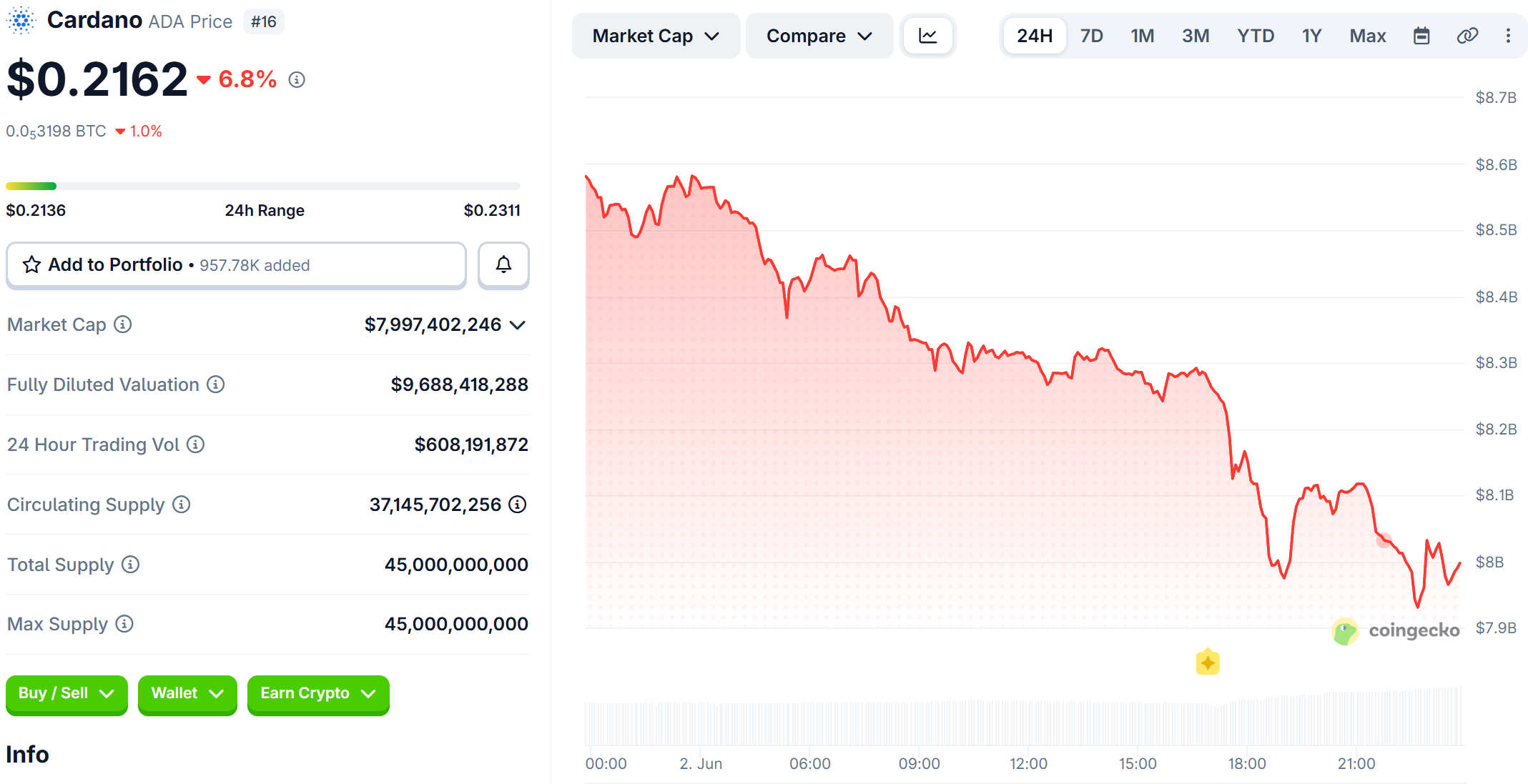
Hoskinson predicted more failures in the second half of 2026, citing JX Door’s earlier collapse as a warning sign. Cardano (ADA) fell 6.5% to roughly $0.215 in the past 24 hours.

TapTools and ‘Hosky’ Mark a Wider Shutdown Wave
TapTools served more than one million users and supported hundreds of projects through its API across four years. Earlier in 2026, two cofounders (the CTO and COO) departed.
A backend developer briefly stepped into the CTO role. However, that replacement has also moved on, leaving operational continuity in doubt.
TapTools said it remains open to acquisition or external funding.
The shutdown follows the earlier collapse of JX Door and highlights broader weakness in Cardano network activity.
“After four years of building for Cardano, today we have difficult news to share” the TapTools team stated.
TapTools was a leading Cardano analytics platform offering real-time token charts, portfolio tracking, NFT tools, and data API for over a million users.
The Hosky community echoed the same tone in a parallel post, framing its own wind-down with characteristic humor.
“After four years of storing for Cardano, today we have difficult news to share,” Hosky noted.
Hosky is a popular Cardano meme coin and community known for humorous projects, events, Rare Evo conference antics, and its infamous Las Vegas storage unit.
Follow us on X to get the latest news as it happens
Hoskinson Vents Over Governance Paralysis
Hoskinson said he had proposed a sovereign wealth fund to backstop struggling projects. Cardano backers Wheel and Anderson rejected the idea, arguing it would damage ADA. The plan went nowhere.
He has since tried to acquire individual projects to keep them operational. Past deals include Nami and Block Frost.
However, the founder said the community criticizes him for centralizing the ecosystem each time he steps in.
Hoskinson maintained:
- He holds no governance keys,
- No treasury access, and
- No power to initiate even a protocol parameter change.
He argued daily blame for the price of ADA falls on him despite that absence of authority.
His comments came alongside a broader Cardano governance overhaul aimed at internal conflict resolution.
A recent vote on the Singapore Summit treasury proposal was rejected by delegated representatives.
Hoskinson previously argued that continued votes against ecosystem funding could leave research labs facing collapse before mid-year.
He directly challenged delegated representatives to put forward an alternative plan.
“There are people that are legitimately deranged, deranged. The only purpose now is to kill me,” Hoskinson ranted.
Builders and ADA Price Slide
Cash Anvil, a community builder, said multiple teams have cut down to essentials. The builder warned that user numbers sit at all-time lows.
Cash Anvil also criticized funding decisions that approved proposals lacking overhead transparency.
ADA traded near $0.216 at the time of writing, ranking 16th by market capitalization at roughly $8 billion. The token has lost 14% over the past month and more than 68% over the past year.
Cardano Foundation reserves also dropped 45% earlier in 2026 as ADA prices slid.
Hoskinson predicted the second half of 2026 will be very hard.
He said more DeFi projects are expected to fail before any rebound.
Whether acquirers step in for TapTools or other Cardano teams may shape the tone for the rest of the year.
The post Charles Hoskinson on Fire as Cardano Faces ‘Wave of Shutdowns’, ADA Falls 10% appeared first on BeInCrypto.
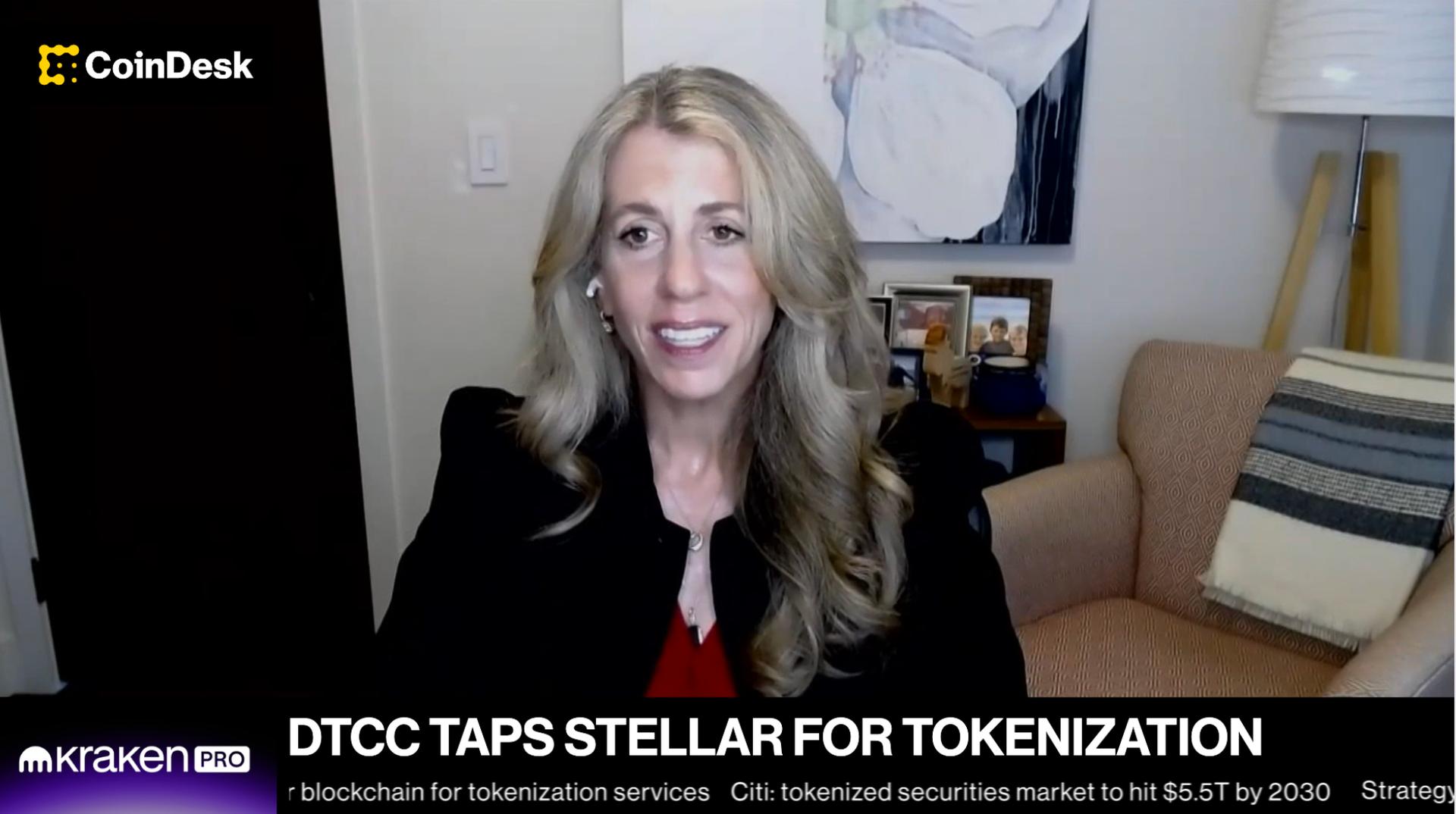
Latest developments: Stellar Development Foundation CEO Denelle Dixon joined CoinDesk’s Public Keys and said DTCC’s selection of Stellar validates years of infrastructure built for institutional use.
- DTCC recently chose Stellar as the first public blockchain connected to its upcoming tokenized securities settlement platform, Dixon said.
- Stellar surpassed $1 billion in tokenized real-world assets in December and has since grown to roughly $3 billion in about five months, according to Dixon.
- Dixon described the partnership as “the moment Stellar was built for” after more than a decade of focusing on compliance and institutional requirements.
What this means: Regulatory progress is helping institutions move from experimentation to deployment.
- Dixon said the GENIUS Act gave financial institutions confidence that the U.S. government intends to support the industry through a clearer regulatory framework.
- She noted that firms such as Franklin Templeton were already building tokenized products before recent legislation, citing the firm’s money market fund on Stellar.
- While she said passage of the Clarity Act would benefit the industry, Dixon argued that tokenization adoption is unlikely to be derailed if the bill stalls.
Closer look: Stellar is positioning its technology stack around compliance, privacy and scalability for large financial institutions.
- Dixon said Stellar has maintained 99.99.99% uptime and processes billions of transactions each quarter.
- She emphasized that compliance tools were built into the network’s architecture, reducing the need for custom smart contracts to issue assets.
- Stellar is also developing privacy features using a composable model that allows institutions to tailor controls to specific assets and use cases.
Reading between the lines: Massive transaction volumes remain a key test for blockchain-based financial infrastructure.
- DTCC processed $4.7 quadrillion in securities transactions last year, highlighting the scale traditional market infrastructure already supports.
- Dixon acknowledged that tokenized settlement volumes will ramp up gradually rather than reaching peak scale immediately.
- She said maintaining reliability and avoiding network outages are critical requirements for institutional adoption.
Broader view: Dixon expects tokenized assets to be distributed across multiple public blockchains rather than concentrated on a single network.
- She rejected the idea that one blockchain will dominate all institutional tokenization activity.
- Instead, Dixon said a handful of networks will likely capture most real-world asset issuance based on their technical strengths.
- She argued that open public blockchains will ultimately outperform closed alternatives because they evolve rapidly through global developer participation.
Bitcoin dropped below $70,000, down 12% over the past two weeks, while NEAR Protocol (NEAR), Internet Computer (ICP), and Render (RENDER) posted double-digit gains in the same period, indicating a clear rotation toward AI-focused tokens.
We break down the three AI tokens leading this divergence and why the narrative around decentralized intelligence is gaining real traction.

Why NEAR, ICP, and RENDER are Defying the Bitcoin Drop
An AI crypto token is a digital asset tied to projects building decentralized infrastructure for artificial intelligence, from compute and storage to autonomous agents. Three of these tokens just outperformed Bitcoin amid the heavy market correction.
NEAR led the move, surging roughly 16% to trade near $2.69. Its market cap climbed to around $3.48 billion, securing the project’s position close to 32nd globally among all cryptocurrencies.
Marketed as “the blockchain for AI,” NEAR powers user-owned intelligent agents that act in the customer’s interest rather than for centralized platforms. Its sharded design delivers high throughput at low cost with intent-based interactions.
Co-founder Illia Polosukhin recently highlighted the rollout of post-quantum cryptography by the end of Q2. The upgrade aims to future-proof the network against emerging quantum threats while enabling collaborations on quantum-algorithm AI infrastructure.
Follow us on X to get the latest news as it happens
ICP rose about 10.4% to $3.09, with a market value near $1.66 billion and ranking 52th. The network markets itself as a sovereign frontier cloud for AI, running agents, data, and payments fully on-chain.
The fundamentals back the move. Approximately 97,000 ICP burned across the past 30 days, the highest monthly total since 2025, while the platform processed 7.2 billion transactions in May.
Meanwhile, RENDER gained roughly 10% to trade near $2.22, with a market cap close to $1.14 billion in 66th place. The decentralized GPU network connects idle graphics power with developers needing scalable compute for 3D rendering and AI workloads.
Technical analyst TehLamboX noted Render completed a secondary breakout above $2.40 and maintained bullish structure despite Bitcoin’s weakness. He flagged potential targets near $2.50 and beyond as the AI narrative accelerates.
What This AI Token Rally Really Signals
The outperformance points to a clear narrative shift. While most assets moved alongside Bitcoin, investors are rewarding tokens that deliver real utility in the artificial intelligence technology stack rather than purely speculative crypto plays.
Each project tackles a distinct bottleneck in centralized AI systems. NEAR addresses scalable, intent-driven execution. Internet Computer brings full on-chain sovereignty. Render democratizes access to GPU resources for creators, developers, and AI training workloads.
As artificial intelligence adoption accelerates across industries, these tokens are emerging as proxies for exposure to decentralized infrastructure. Their ability to post positive returns amid broader market pressure suggests capital is differentiating between speculation and tangible progress.
The divergence may keep widening. On-chain growth, transaction volume, and real-world integrations are now driving valuations more than the broader crypto cycle. That dynamic favors projects with measurable adoption over those without active usage.
Subscribe to our YouTube channel to watch leaders and journalists provide expert insights
The post AI Tokens are Outperforming Bitcoin, But For How Long? appeared first on BeInCrypto.

Crypto political action committees backed by the Fairshake network and its Protect Progress affiliates are continuing to deploy significant resources into U.S. political races, with new Federal Election Commission disclosures detailing substantial media spending and candidate support in California, New Jersey, and South Dakota. The activity coincides with heightened attention to Maryland’s forthcoming primary and a broader regulatory discourse around how crypto firms participate in the political process.
According to filings with the U.S. Federal Election Commission (FEC), the Protect Progress affiliates—working through the Fairshake apparatus—spent more than $3 million to back Democratic House candidates in California and New Jersey. A separate affiliate, Defend American Jobs, allocated more than $411,000 to support Republican Senator Mike Rounds’ reelection bid in South Dakota. In addition to its activity in California, Protect Progress signals readiness for a sizable Maryland push ahead of the June 23 primary. FEC records show the crypto-backed PAC spending more than $3.1 million on media to support Adrian Boafo in Maryland’s 5th district, and roughly $320,000 backing Ritchie Torres’ reelection in New York’s 15th district, which also holds a primary on June 23.
Source data corroborates the broader footprint of crypto-linked political giving. As of January, Fairshake reported a war chest exceeding $193 million. In parallel, other crypto-aligned committees—such as Fellowship, funded by Cantor Fitzgerald and Anchorage Digital, and the Blockchain Leadership Fund, supported by Chainlink and Anchorage—have contributed to a diversified slate of candidates and districts. The Texas primary results from the prior week highlighted a sweep of crypto-backed candidates in that state’s races, illustrating a nationwide pattern of industry-backed influence in primary contests.
Overall, the disclosures reflect a deliberate strategy to influence policy perspectives on digital assets, with Protect Progress explicitly signaling its aim to contest lawmakers it deems “anti-crypto.” In particular, the group supported a candidate in Texas who subsequently faced a Democratic opponent in a high-profile primary, underscoring the potential for crypto-aligned committees to shape political risk and regulatory narratives across multiple states.
Key takeaways
- FEC filings show Protect Progress affiliates spent over $3 million to back Democratic House candidates in California and New Jersey, while Defend American Jobs deployed more than $411,000 to back Senator Mike Rounds in South Dakota.
- In Maryland, Protect Progress earmarked more than $3.1 million in media expenditure for Adrian Boafo in MD-5 and roughly $320,000 for Ritchie Torres in NY-15, both of which held or will hold primaries on June 23.
- Crypto-aligned PACs have built a broad fundraising and media apparatus, with Fairshake maintaining a reported war chest of over $193 million as of January.
- Recent Texas primary outcomes indicated crypto-backed candidates won, reinforcing the perception of crypto-centric influence in U.S. electoral contests.
- The CLARITY Act (Digital Asset Market Clarity) has moved onto the Senate calendar for consideration, with amendments from the Agriculture and Banking Committees likely requiring consolidation before a vote, signaling intensified regulatory scrutiny of digital assets.
Crypto political activity and the Maryland primary landscape
The Maryland primary cycle, culminating on June 23, is a focal point for crypto-linked fundraising because of the state’s evolving regulatory stance on digital assets and the potential impact on financial services in the region. FEC filings reveal a sizeable media spend dedicated to Adrian Boafo in the 5th district, underscoring the commitment of crypto-aligned committees to influence down-ballot outcomes that could affect future policy and oversight in the nation’s capital region.
Beyond Maryland, the filings highlight continued activity in California and New Jersey, where Protect Progress affiliates supported Democratic candidates in House races. The pattern suggests a broader objective: shaping the legislative environment around crypto, stablecoins, and digital asset market structure at a time when U.S. policy is under intense scrutiny from regulators and lawmakers alike.
Regulatory context: the CLARITY Act advances in the Senate
Legislative momentum around clear rules for digital assets remains a central thread in U.S. policy. The Digital Asset Market Clarity (CLARITY) Act has advanced within the Senate, with initial movement through the Agriculture Committee in January and a Banking Committee review in May. Senate leadership has now placed the bill on the chamber’s calendar for consideration and potential floor action. The two versions of CLARITY that moved through the committees with amendments are expected to be consolidated before any vote, underscoring the complexity of aligning regulatory objectives across multiple jurisdictions and policy areas.
From a compliance and enforcement perspective, CLARITY’s progression intersects with ongoing discussions around MiCA-style regulation, U.S. agency authority (SEC, CFTC, DOJ), and the interplay with AML/KYC frameworks, licensing standards, and banking integration. The broader regulatory environment remains unsettled in terms of how crypto firms will secure licenses, meet cross-border disclosure requirements, and engage with banks on digital-asset custody and settlement services. In this context, lawmakers and industry participants are tracking how the Senate’s handling of CLARITY will shape enforcement priorities, cross-border operations, and capital-raising activities for crypto enterprises.
Cointelegraph notes that the push for regulatory clarity has attracted attention from lawmakers who fear strategic gaps in the U.S. framework could be exploited by less transparent markets. In particular, broader industry commentary highlights the risk that delays in clarity may cede regulatory leadership to other jurisdictions, a concern echoed by policymakers seeking to align U.S. laws with global standards while preserving innovation.
Closing perspective
As crypto-affiliated political action and regulatory initiatives unfold, institutions, exchanges, and financial partners will monitor disclosures for risk, compliance implications, and licensing trajectories. The coming weeks will reveal how the Maryland primary results, the wider Fundraising activity, and the Senate’s CLARITY calendar will shape the balance between political influence, investor protection, and robust regulatory oversight.


Bitcoin tumbling to $67,000 may signal a challenging summer ahead as investor capital continues flowing into artificial intelligence (AI) stocks and away from crypto.
In a Tuesday report, K33 Research head Vetle Lunde said bitcoin’s weakness reflects fading institutional demand, heavy ETF outflows and growing vulnerabilities in derivatives markets.
“Much of the market views the opportunity cost of holding BTC as too high while anything AI-related soars,” Lunde wrote.
The divergence has become increasingly difficult to ignore. Bitcoin has failed to reclaim its 200-day moving average while the Nasdaq and S&P 500 continue setting record highs. Investors are also looking ahead to potential IPOs from companies such as SpaceX and Anthropic, which may be drawing capital away from crypto, Lunde argued.
That rotation is evident in bitcoin ETF flows. Spot bitcoin exchange-traded products shed 62,794 BTC over the past three weeks, the second-largest outflow streak on record, the report noted.
K33 said ETF selling accelerated after bitcoin’s failed attempt to break above its 200-day moving average last month.
$60,000 bottom being questioned
The shift in tone marks a notable change for K33. The firm previously argued bitcoin’s plunge to around $60,000 in February likely marked the deepest drawdown of the cycle. A key part of that thesis was unusually negative funding rates in perpetual futures markets, which reflected persistent bearish positioning and created conditions for powerful short squeezes.
That setup helped fuel bitcoin’s rebound toward $83,000. But the rally ultimately stalled at the 200-day moving average, a level that has capped previous bear market rallies.
Today, the derivatives picture looks very different, Lunde said. CME bitcoin futures open interest has fallen to its lowest level since October 2023, a sign that institutional traders are reducing exposure. Meanwhile, funding rates in perpetual futures have risen alongside open interest even as bitcoin falls, suggesting leveraged longs are building into a weakening market.
While the firm has not completely abandoned its view that $60,000 marked the cycle low, the tone has become more defensive.
“We read the latent selling pressure in those leveraged longs as a warning of possible deeper lows and advise caution,” the report said.
K33 still sees bitcoin as undervalued relative to equities over the long run. But with institutional demand fading, ETF investors heading for the exits and capital chasing stronger-performing sectors, the firm says the market faces a tougher backdrop than it did just a few weeks ago.
“With outside capital reluctant to enter and existing holders trimming exposure, we may be in for a choppy summer,” Lunde wrote.


New York’s financial regulator has formed a stablecoin supervision agreement with the European Banking Authority as regulators on both sides of the Atlantic tighten cooperation over digital assets.
Summary
- NYDFS and the European Banking Authority signed an agreement to share information on stablecoin supervision.
- The agreement covers market risks, consumer protection, and oversight of firms involved in stablecoin activity.
- DFS said its stablecoin framework includes reserve rules, redemption standards, transparency, and limits on rehypothecation.
The New York State Department of Financial Services said Tuesday that it signed a memorandum of understanding with the EBA to support the exchange of supervisory and confidential information linked to stablecoin activity.
NYDFS and EBA expand stablecoin oversight
Under the agreement, the two regulators plan to share information on entities involved in stablecoin operations, market risks, and supervisory concerns. The DFS said the arrangement is meant to strengthen oversight, protect consumers, and support market integrity in a sector that continues to draw attention from finance officials.
Kaitlin Asrow, acting superintendent of the DFS, said effective financial regulation depends on strong ties between regulators. She added that international cooperation remains important for digital assets because stablecoins operate across borders and involve multiple markets simultaneously.
EBA Executive Director François-Louis Michaud described the agreement as a milestone for transatlantic cooperation on stablecoin supervision. According to Michaud, the deal supports efforts to build a coordinated supervisory framework for crypto-assets and maintain high standards for cross-border activity.
DFS said it has supervised stablecoin issuance since 2018, covering regulated firms approved to issue stablecoins in New York. The department said its framework includes reserve requirements, redeemability standards, transparency rules, and a ban on rehypothecation.
The New York regulator has long played a central role in U.S. crypto oversight through its BitLicense regime and separate rules for digital asset firms. In the stablecoin market, its standards apply to companies under DFS supervision, including those approved to issue dollar-backed tokens in the state.
Although the memorandum is not legally binding, DFS said the agreement provides both regulators with a framework for cooperation when supervisory issues arise. The department said the MOU also supports identifying stablecoin market trends and potential risks.
CFOs still cite compliance concerns
The agreement comes as PYMNTS reported that digital assets have reached discussions among finance chiefs but have not entered daily corporate finance operations at most firms.
According to PYMNTS research, 77% of CFOs cited regulatory or compliance uncertainty as a barrier to using crypto in business payments. The same research found that 67% of CFOs gave the same answer for stablecoins.
PYMNTS also reported that 58% of CFOs said their companies have neither discussed nor considered using stablecoins. For cryptocurrencies, the figure was 70%. The research found that 13% of companies currently use stablecoins, while 5% use cryptocurrencies.
European Central Bank board member Isabel Schnabel recently warned that stablecoins remain exposed to risks and could affect Europe’s monetary sovereignty.
Crypto World
Tom Lee predicts ETH will hit $250,000 as corporate validators take over network control
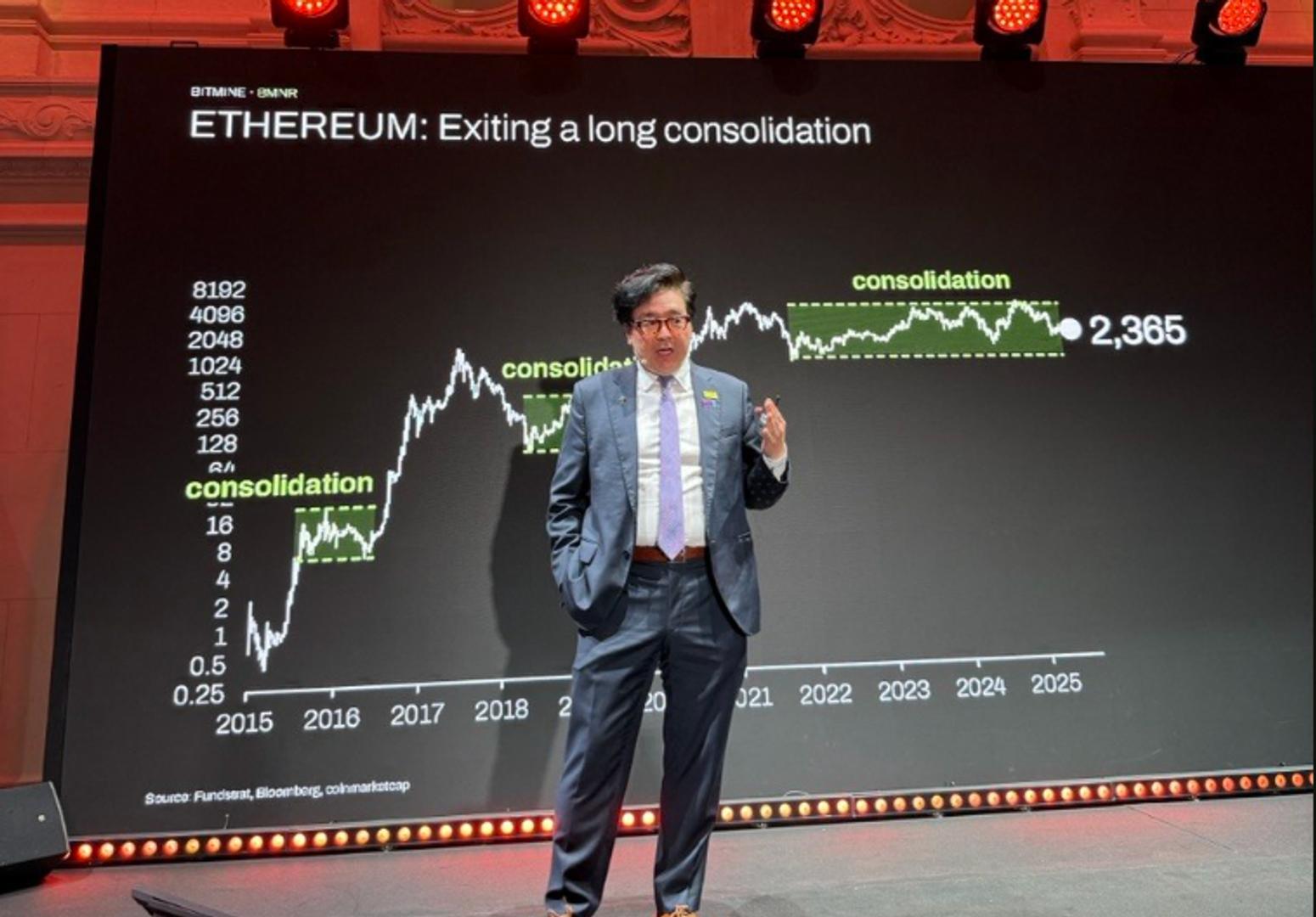
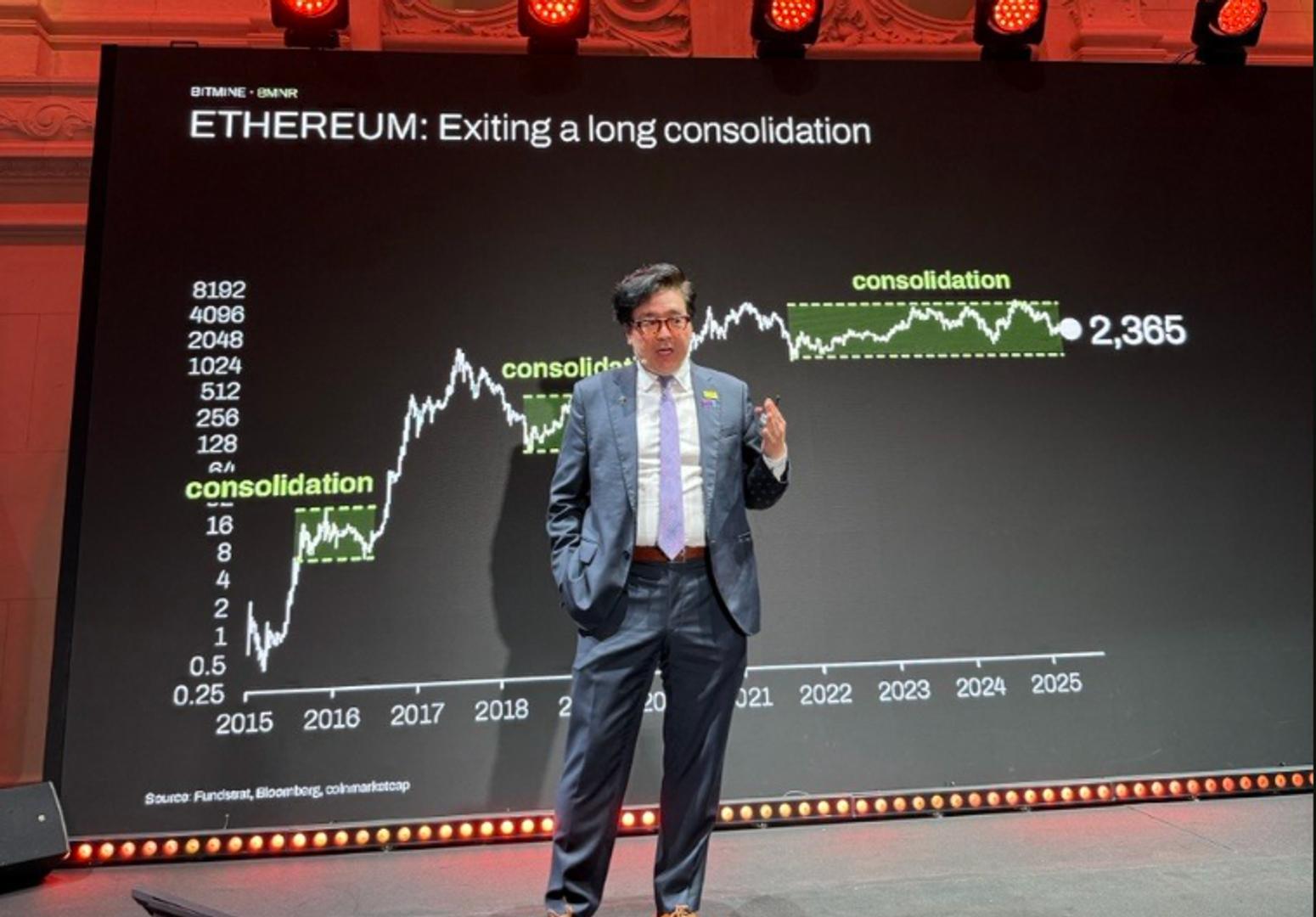
The cryptocurrency market is looking at the wrong signals, and a massive shift in how the world’s financial networks operate is happening quietly behind the scenes.
In a keynote address at the Proof of Talk conference in Paris, Tom Lee, head of Research at Fundstrat and Chairman of Bitmine Immersion Technologies (BMNR), told his audience that ether (ETH) is experiencing significant changes that will eventually drive up its price to $250,000. While Lee did not provide a specific timeline for the target, he did map out the infrastructure shifts driving the network toward that value.
Ether on Tuesday was changing hands at $1,906, down 6% over the past 24 hours.
Lee’s Bitmine firm is one of the largest corporate holders of Ethereum. Bitmine ramped up ETH purchases last week, making its most significant since December. It bought 111,942 ether (ETH) worth around $237 million at current prices. That lifted the firm’s holdings to almost 5.4 million ETH, about 4.47% of ether’s circulating supply.
“If a thesis is correct and Ethereum is going to break out of this consolidation, and the consolidation breakout is tokenization and AI, you know, I think that that’s probably 50X or so—significant upside for Ethereum. If Ether realizes, is correct, and Ethereum goes to $250,000, that values Bitmine stock at $5,000. It’s a bargain at $18.”
Multi-trillion-dollar growth
Lee explained that this multi-trillion-dollar growth will be driven by artificial intelligence. As advanced software and automated computing take over the internet, machines will need a way to pay each other instantly without relying on slow, traditional bank wires.
“Robots are already going to dominate most traffic on the internet,” Lee stated. “And this is why Andreessen Horowitz and others have talked about this as being the great unification because if you’ve got robot systems, you’re going to have to control them. And that’s where blockchain is much more effective than traditional rails for controlling what robots do. Whether it’s authentication or identity or payment speed, all of these work better on crypto systems.”
Because of this machine-to-machine economy, Lee believes Ethereum will transform from a speculative digital asset into the primary global currency for paying for automated computer processing power.
Ethereum Foundation death
This systemic growth is completely changing how the underlying blockchain networks are managed. Lee pointed out that the non-profit Ethereum Foundation has spent years shrinking its own footprint, dropping its network holdings down to just 100,000 ETH—accounting for a tiny 0.1% of the total supply.
In its place, massive public companies are stepping in to run the network as corporate validators. Corporate entities like Bitmine and Sharklink now collectively control 7% of the entire circulating Ethereum supply. Instead of relying on foundation grants, these corporate treasuries now generate $500 million in staking rewards each year to fund the ecosystem themselves.
To demonstrate the value of this model, Lee announced a major regulatory milestone for Bitmine, which trades on the New York Stock Exchange under the ticker BMNR.
“Bitmine also meets the eligibility criteria to be added to the Russell 1000,” Lee revealed. “The inclusion date is June 26. Why does that matter? Well, the Russell 1000 is the most widely tracked index in the world… Every fund manager in the world who is benchmarked against the Russell 1000—and that’s over $4 trillion worth—will have to decide if they want to own Bitmine.”
Lee explained, with graphics behind him, that holding an active corporate validator stock significantly outperforms buying spot crypto. Over a baseline six-month stretch, holding regular spot ETH generated a modest 22% return, while Bitmine’s staking architecture returned 500% to its investors.
For Lee, the massive structural growth of corporate staking and AI utility completely overrides any temporary market panic. “If you are bearish today, you are selling at the bottom,” Lee concluded. “And again, I can’t emphasize thinking, if you’re bearish today, you are bearish at the bottom for Bitcoin and Ethereum.”


Key takeaways
- HYPE hit a new all-time high of $75 on Tuesday, driven by rising institutional demand amid broader market weakness.
- Grayscale has advanced plans to launch its spot Hyperliquid ETF HYPG this week.
Hyperliquid’s native token, HYPE, surged to a new all-time high of $75.52 on Tuesday, extending its recent rally as growing institutional interest and expanding ecosystem activity continue to drive demand.
Grayscale to launch a Hyperliquid ETF
A key catalyst behind HYPE’s latest gains is increasing competition in the exchange-traded fund (ETF) market.
Grayscale is preparing to enter the race with a spot Hyperliquid ETF after filing an amended S-1 registration statement with the U.S. Securities and Exchange Commission (SEC).
Bloomberg ETF analyst James Seyffart noted that the amendment suggests the fund could launch in the near future, potentially within days.
The proposed ETF will trade under the ticker HYPG and carry a management fee of 0.29%, undercutting competing products.
Institutional appetite for HYPE has already been demonstrated by the success of Bitwise’s Hyperliquid ETF, BHYP. The fund attracted roughly $20 million in inflows on Friday, marking its largest single-day inflow since launch.
After just 11 trading days, BHYP has surpassed $100 million in assets under management (AuM), supported by cumulative inflows of $81.8 million. The ETF has also generated average daily trading volumes of $35.1 million.
Bitwise has further aligned itself with the Hyperliquid ecosystem by committing to hold 10% of its annual management fees in HYPE tokens on its balance sheet for at least 12 months.
According to onchain analytics platform Lookonchain, Bitwise purchased an additional 336,474 HYPE tokens, valued at approximately $24.4 million, over the past 24 hours.
The latest acquisition highlights continued institutional accumulation as investors seek exposure to the rapidly growing Hyperliquid ecosystem.
Hyperliquid price outlook: HYPE retraces after reaching a new all-time high
Despite reaching a record high of $75.52 earlier in the day, HYPE was trading at $72.28 at the time of writing, up by 1% over the previous 24 hours.
However, the token remains one of the strongest-performing digital assets as institutional adoption and ETF-related demand continue to accelerate.
The RSI of 65 shows that HYPE is bullish but is yet to enter the overbought region, creating room for further growth.
If the bullish trend persists, HYPE could extend its rally and create a new all-time high around the $80 level.

However, if the pullback extends, HYPE could retest the Sunday low of $67. An extended bearish trend could see HYPE drop below $60 for the first time since May 28.

New reporting from Bitwise suggests that Bitcoin’s (BTC) undervaluation could expand if investors’ concerns over sovereign debt deepen. The asset management firm said that mounting pressure in global bond markets and rising government debt levels could strengthen Bitcoin’s role as a hedge against macroeconomic risks, with one valuation model suggesting a theoretical fair value of $224,000.
Debt market turmoil may support Bitcoin in the long-term
Bitwise pointed to mounting pressure across the global bond markets. The Organization for Economic Co-operation and Development (OECD) estimates governments and companies will need to borrow roughly $29 trillion in 2026, up 17% from 2024 and nearly double the amount raised a decade ago. Around 78% of OECD government borrowing is expected to be used solely to refinance existing debt.

10-year sovereign swap spreads across nations. Source: Bitwise
Bitwise noted that Japan remains a key focus. The country’s 10-year government bond yield recently climbed to 2.78%, while its 30-year bond yield reached a record high. At the same time, Japan’s public debt stands near 230% of GDP, among the highest levels in the current macroeconomic environment.
The report noted that Japanese investors hold approximately $1.2 trillion in US Treasurys, but higher domestic yields are making overseas bonds less attractive. Currently, the 10-year Japanese bond yield is 2.66% on Tuesday, compared to 2.19% for Yen-hedged 10-year US Treasurys, potentially encouraging capital to return to domestic markets.
Bond market stress is not limited to Japan. US 30-year Treasury yields recently reached 5.11% on May 11, its highest level since 2007, while sovereign risk premiums, measured through 10-year swap spreads, have risen to their highest levels since the European debt crisis of 2011-2012.
While these trends could weigh on risk assets in the short term, Bitwise believes a deeper bond-market disruption could eventually become a bullish catalyst for Bitcoin if central banks are forced to inject liquidity to stabilize financial markets.
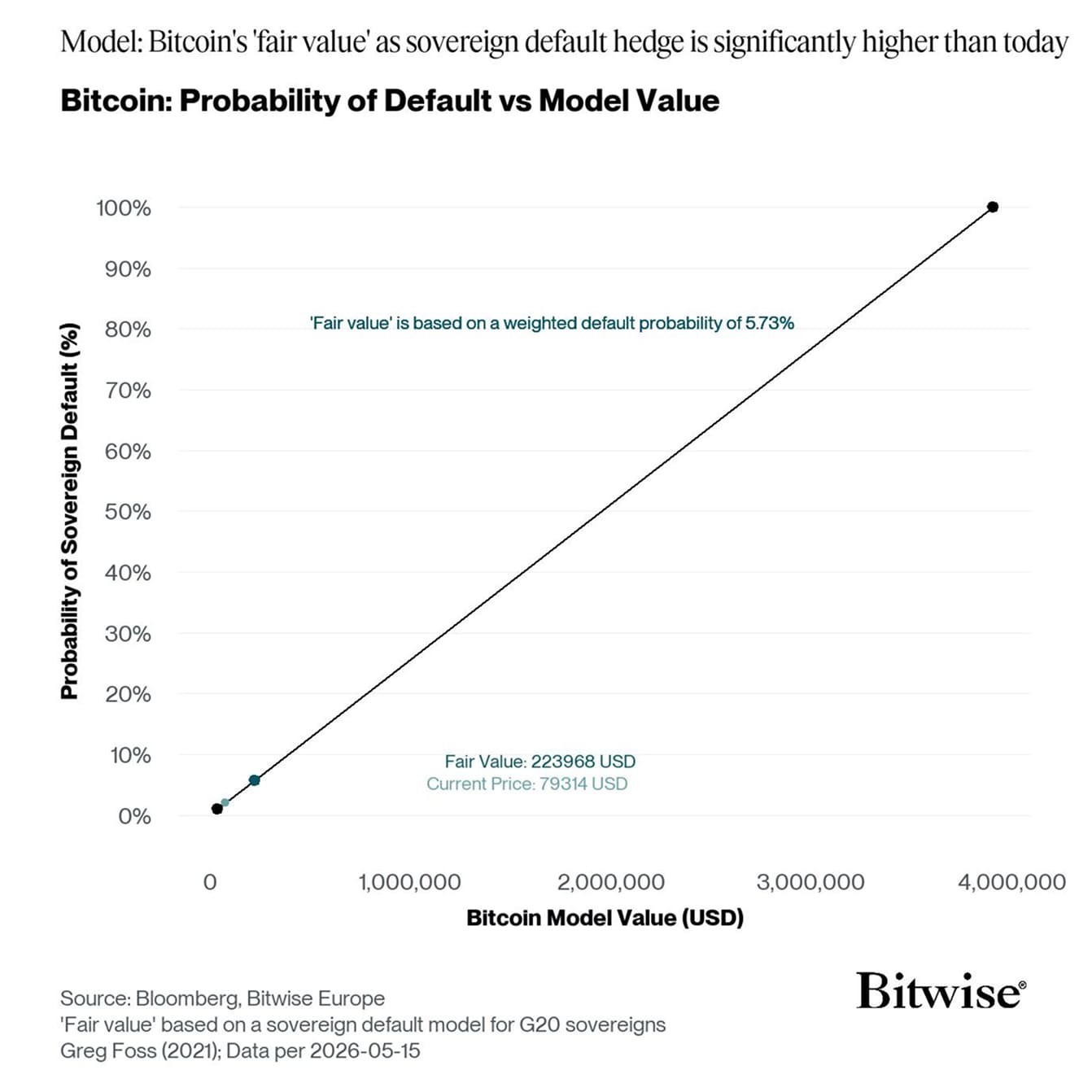
Bitcoin probability of default vs model value. Source: Bitwise
The firm cited a model developed by investor Greg Foss that values Bitcoin at roughly $224,000 if it gains broader adoption as a hedge against sovereign default risk. Bitwise stressed that the figure is a theoretical estimate rather than a price target.
Despite the long-term bullish case, the report noted that Bitcoin may remain range-bound in the near term as higher real yields and tighter financial conditions continue to pressure demand.
Related: Bitcoin back in ‘distribution phase’ as extreme fear grips crypto market
Declining real yields may improve Bitcoin’s macro backdrop
Bitwise noted that Bitcoin’s near-term outlook may depend heavily on real interest rates, which measure the Federal Reserve’s policy rate after adjusting for inflation. In the report, real rates are calculated as the Fed Funds rate minus US CPI inflation. Historically, Bitcoin has tended to perform well when real rates fall, as cash and bonds become less attractive in inflation-adjusted terms.
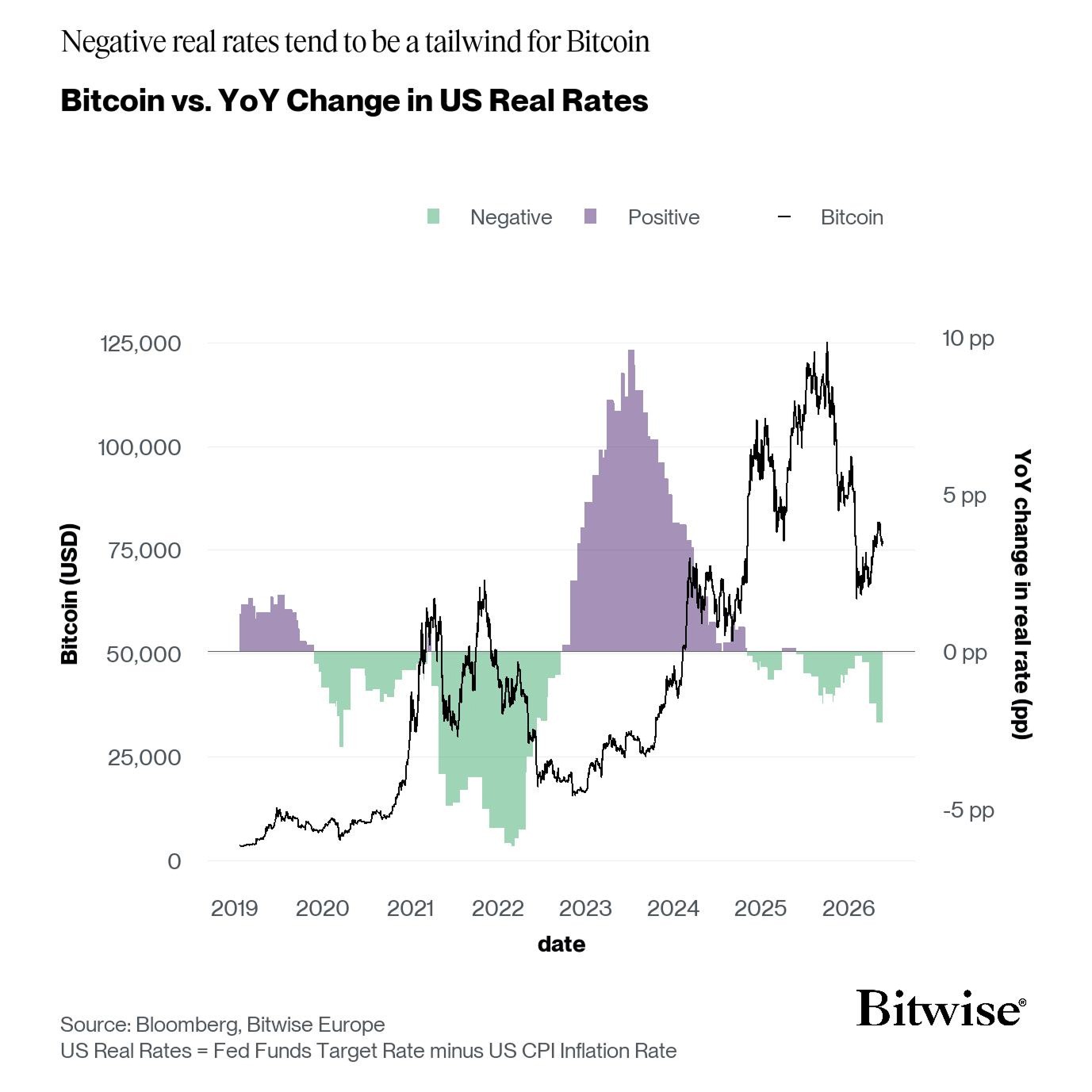
Bitcoin vs year-on-year change in US real rates. Source: Bitwise
The firm noted that Bitcoin’s 2021 bull market coincided with declining real rates, while the 2022 bear market unfolded alongside rising real rates and aggressive monetary tightening. Although real rates remain restrictive, Bitwise said that a scenario in which inflation rises while the Fed keeps rates unchanged could push real rates lower, potentially creating a more supportive backdrop for Bitcoin.
Meanwhile, Bitcoin researcher Sminston outlined that BTC could trade between $90,000 and $255,000 by the end of 2026, based on the Bitcoin Decay Channel, a logarithmic price model that has historically identified major cycle tops and bottoms. The analyst noted Bitcoin’s recent rebound emerged near the model’s long-term support zone, keeping the broader bullish outlook intact.
Related: Bitcoin volatility is down 56% but analysts still expect up to 20% BTC price move

AI-built ransomware toolkit automates EDR evasion, AD discovery

Money Management | Financial Literacy | Financial Goals

New Mayors hold top positions on Northern Ireland councils for the coming year



-

 NewsBeat6 days ago
Israel says it has killed new Hamas military leader in Gaza City airstrikes
-

 Tech7 days ago
NASA taps Blue Origin to deliver lunar rovers for Moon Base initiative
-

 News Videos4 days ago
This is BROKEN! INSANE 5x MONEY CAR WASH WEEK! The NEW GTA Online UPDATE Today! (GTA5 New Update)
-

 News Videos7 days ago
XRP *JUST* SUCCEEDED!!!! CLARITY ACT EXPOSED!!! (SHE EXPOSED IT)
-
 Tech3 days ago
SpaceX just won a second Golden Dome contract. This one is $4.16 billion.
-

 Business7 days ago
Selena Gomez Reportedly Upset Over Benny Blanco’s Comments on Her ‘Terrible’ Diet
-

 Tech5 days ago
Waymo dominates autonomous vehicle registrations as Tesla trails behind
-

 News Videos4 days ago
SHE IS KILLING XRP!!! WATCH URGENT AND ACT FAST
-
 NewsBeat4 days ago
FIRST NIGHT REVIEW: Take That bring the Circus back to life in spectacular sun-soaked style
-

 Business1 day ago
Jade Biosciences, Inc. (JBIO) Discusses Positive Interim Results From JADE101 Phase I Healthy Volunteer Study and Development Plans Transcript
-

 Tech6 days ago
The Samsung pay deal is the moment Korean unions changed register
-

 Tech7 days ago
Millions of AI agents imperiled by critical vulnerability in open source package
-
 Crypto World4 days ago
CFTC Has Approved the First Regulated Bitcoin Perpetual Contract in the U.S.
-
Crypto World6 days ago
SpaceX’s $2 Trillion IPO: Why Tech Giants Nvidia (NVDA), Apple (AAPL), and Microsoft (MSFT) May Face Pressure
-
 Entertainment6 days ago
The Most Misunderstood Sci-Fi Horror Movie of the Last 10 Years Just Took Over Netflix
-
 Crypto World4 days ago
Snowflake (SNOW) Stock Rallies on Strong Q1 Results and AI Product Growth
-
 NewsBeat4 days ago
Novak Djokovic v Joao Fonseca LIVE: French Open latest scores and results after Jannik Sinner’s shocking collapse
-
 Entertainment4 days ago
Weak ‘Supergirl’ Box Office Tracking Amid Milly Alcock Backlash
-

 Business3 days ago
Is the Spurs Phenom Already Better Than Prime Diesel?
-

 Business4 days ago
Demand Conditions Improve In Chemicals Sector In April 2026
You must be logged in to post a comment Login