Meanwhile, Anthropic adds 150 partners to Project Glasswing
Bug hunting has become a whole lot more exciting in recent months with both Anthropic and OpenAI touting their latest models (that also happen to be super-scary exploit machines). On Tuesday, as Anthropic announced a fourfold expansionto its Mythos preview program, Cisco jumped into the fray, praising the transformative power of AI – but without disclosing how many bugs the latest frontier models found.
Cisco SVP Anthony Grieco in a Tuesday blog said that the advanced AI systems, including Anthropic’s Claude Mythos Preview and OpenAI’s GPT 5.5-Cyber, scanned 1.8 billion lines of code in eight weeks looking for vulnerabilities in Cisco products – a task that otherwise would have taken the networking giant’s advanced security team eight years to accomplish.
Advertisement
However, Grieco, who heads Cisco’s security and trust organization, didn’t say how many flaws Mythos and other frontier models uncovered, or if they have all been fixed. The company also did not respond to The Register’s questions about this.
Grieco did say that “speed is only half the story,” calling the “real breakthrough” the “scale, quality, and impact” of the models’ findings.
The 1.8 billion lines of code, written in more than 25 different languages, spanned Cisco’s portfolio, we’re told. Netzilla paired the models with a “human-guided harness,” and achieved a false positive rate of under 3 percent, Grieco wrote.
“Rather than focusing on a specific scope for a security evaluation, we can assess entire code bases of a product. It’s like switching from a flashlight to a flood light to illuminate a dark room,” he said. “Because each finding is validated through a hybrid of AI and human expertise, our engineering teams are receiving actionable intelligence rather than a wall of warnings.”
Advertisement
Meanwhile, Anthropic on Tuesday said it expanded Project Glasswing to about 150 additional organizations, bringing the total partner count to about 200.
Project Glasswing is the AI giant’s controlled partner program for giving selected orgs access to Claude Mythos Preview. When it announced the new model and partner program in early April, Anthropic limited the preview to about 50 entities, claiming Mythos is so good at finding and exploiting security holes that all hell would break loose and the zombie apocalypse would hit should the model fall into the wrong hands.
Since April, these select government agencies and corporate partners – including Cisco – have been using Mythos to find and fix bugs in their own products.
Palo Alto Networks, one of the original Project Glasswing partners, said in May that after spending a month using frontier AI models, including Anthropic’s Mythos, to scan more than 130 products across its three platforms, it uncovered 26 CVEs representing 75 underlying security issues.
Advertisement
For comparison, the cybersecurity giant said it typically discloses fewer than five CVEs per month.
At the time, a company exec forecast “a narrow three-to-five-month window for organizations to outpace the adversary before AI-driven exploits start to become the new norm.”
The newly expanded Project Glasswing spans more than 15 countries, and, while an Anthropic spokesperson declined to name them or the new partner companies, it’s a safe bet that these are likely Western and/or “friendly” nations. So not China and Russia.
Rubrik, a data security and management vendor, said that it was among the new Glasswing partners. The expanded list also reportedly includes the Korea Internet and Security Agency (KISA), along with Samsung Electronics, SK hynix, and SK Telecom, among other Korean companies.
Advertisement
“The group covers several industries that weren’t well-represented in our initial cohort, such as power, water, healthcare, communications, and hardware,” according to a Tuesday Anthropic blog. “And many of the new partners are vendors – companies or nonprofits that maintain codebases that are relied upon by lots of other organizations around the world, including governments.”
Each new partner must meet Anthropic’s security requirements before they gain access to Mythos, the company added. ®
Microsoft is changing the way that Windows 11 updates are delivered
The likes of .NET, driver or firmware updates will be bundled together with the monthly update
This change is now in testing, alongside a lot of work to make Windows 11’s default apps better
Windows 11 is getting some more very useful changes, including an improved process for updates and a raft of tweaks for the default apps in the OS.
Microsoft has just released a new preview in the Experimental channel (build 26300.8687) which packs the changes for Windows Update (which were announced as incoming a while back in April).
Microsoft tells us: “We are rolling out a new unified update experience to reduce the number of reboots you see per month. We are starting by coordinating driver, .NET, and firmware updates to align with the monthly quality update, reducing the update experience to a single monthly restart.”
Calculator is getting tweaked so it has readable text when using high contrast themes and more accurate square-root results (with rare errors fixed).
Advertisement
Windows 11’s Camera app now supports more video resolution options, and a full range of zoom levels (plus the zoom slider now works with more cameras, including the latest models). Microsoft has also ensured that the front-facing cameras on more devices are supported.
The Clock has the ability to run more countdowns (up to three simultaneously) and a new 15-minute snooze on alarms, among a whole load of minor changes.
Sign up for breaking news, reviews, opinion, top tech deals, and more.
Advertisement
Microsoft Paint now offers functionality to adjust how transparent the eraser is, and the AI image panel has been tidied up with a cleaner layout. The toolbar loads faster, too, and a bunch of stability tweaks have been applied, reducing the likelihood of crashes.
The Photos app also has some useful changes so it’ll now display very tiny images (such as pixel art) with an appropriate level of zoom so they look sharp rather than a blurry mess, as well as tweaks for the interface and again stability (resolving a crash that happened during text recognition).
With improvements to Media Player (custom captions, bug fixes and better overall reliability) and Sound Recorder, Microsoft is clearly busy with these default apps.
Analysis: a better way of working with updates
(Image credit: Shutterstock)
Bear in mind that all of these changes are in testing right now, but the various bits of tweaking and new features for Windows 11’s core apps shouldn’t take long to come through.
The move to consolidate the deployment of Windows 11’s updates will take longer, as it’s only in the Experimental channel (early testing) right now, and it’s just rolling out gradually there. However, it’s great to see this inbound, because it’s going to represent a major convenience for the average Windows 11 user.
Instead of having to bother with separate updates for firmware, or the .NET framework, or device drivers, Windows Update will bundle them all together with the monthly cumulative update that Microsoft releases. The upshot is that you’ll only have to reboot once to apply all those upgrades, and while installation will take longer, simplifying how updates work in this way is definitely worth the trade-off.
Advertisement
This is one of many improvements Microsoft has in the works for Windows 11 updates, and the key piece of functionality that’s already in the pipeline is the ability to delay a monthly update indefinitely. Update installation failures have long been a blemish on Microsoft’s reputation, too, and moves are afoot to cure these blues.
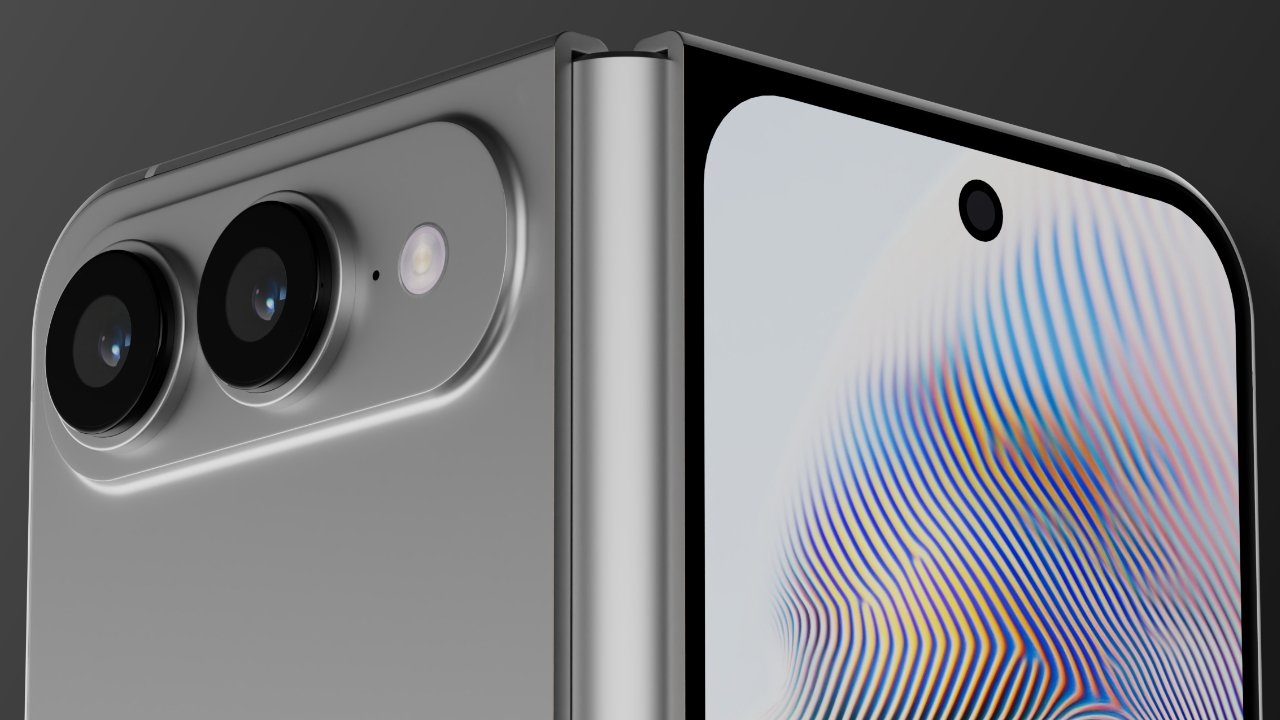
The iPhone Fold has been on and off for years, but now the supply chain is suggesting that Apple will announce it as expected in September 2026, yet not actually ship it for several months.
There are at last positive signs from Apple that it is preparing an iPhone Fold, but there have also been multiple reports that it is delayed. Now according to Economic Daily News, the CEO of Apple lens supplier Largan Precision has hinted at delays.
“Some new opportunities will be announced in the third quarter,” Enping Lin said at a shareholders’ meeting (in translation), “and some will be moved to the beginning of next year.”
By itself, that’s a slim comment to base speculation on, but Enping Lin also specifically referred to new devices. “The fourth quarter of this year will be busier than in previous years due to the scheduling of customers’ new machines,” he said.
Advertisement
Then there have been separate comments by Ruan Chaozong, general manager of Xinrixing, a firm now said to be making bearings for a folding iPhone. Ruan is reported to have said that Xinrixing is only waiting for Apple to decide on its shipping date.
It’s still all far from a concrete leak, but these two different firms are both alluding to some device being rescheduled. More, the fact that one is a manufacturer of bearings, and the other is known for iPhone lenses, makes it sound likely that the new device is from Apple.
Given that and the history of reported delays since the iPhone Fold is believed to have entered manufacturing testing, the rumors seem reasonable.
We’ve been here before so often
There do seem to have been more reports of a September 2026 launch for the iPhone Fold than for any previous year. Yet there have been such rumors every single year since at least 2019, when Samsung launched its first folding phone.
Advertisement
This time the volume of rumors is higher, but they also tend to be contradictory. A possible consensus seemed to be emerging in April 2026 when it was claimed that the iPhone Fold would take longer to ship than expected.
In that case, the rumor was that Apple would announce the iPhone Fold at its September 2026 event, but not ship until October. Even then, it might only ship in small quantities, which is what Apple did with the original AirPods.
Although around the same time as those reports, there were also ones that said no, production issues were delaying the iPhone Fold until 2027.
If it really is delayed until 2027, that might account for how there have been fewer believable leaks of components than might be expected.
Advertisement
Separately, Apple has already been reported to be planning at least one folding iPhone in 2027 and 2028. However, that’s expected to be a second-generation, bezel-free, and perhaps a flip model iPhone Fold.
Walking the floor at the world’s largest high end audio show, HIGH END, in Vienna last week, it was easy to get jaded. Hey, here’s a $120,000+ pair of speakers. Ooh, look: a $160,000 pair of speakers. OMG, what is this? a 3.6 Million dollar speaker system? Yep. And that one weighed almost three tons. Not exactly practical for most living spaces.
But walking into the secondary exhibition halls, connected to but separate from the main Austria Center Vienna (ACV) space, who do I see but SVS? Had they also crossed into the 6-figure system pricing territory? Nope. In fact, their highlighted product was the new 3000 Micro R|Evolution subwoofer which we previously saw in prototype form at CES 2026 and again in final form at AXPONA. It’s a compact powerhouse capable of reaching all the way down to 20 Hz, for the remarkably reasonable price of $999.
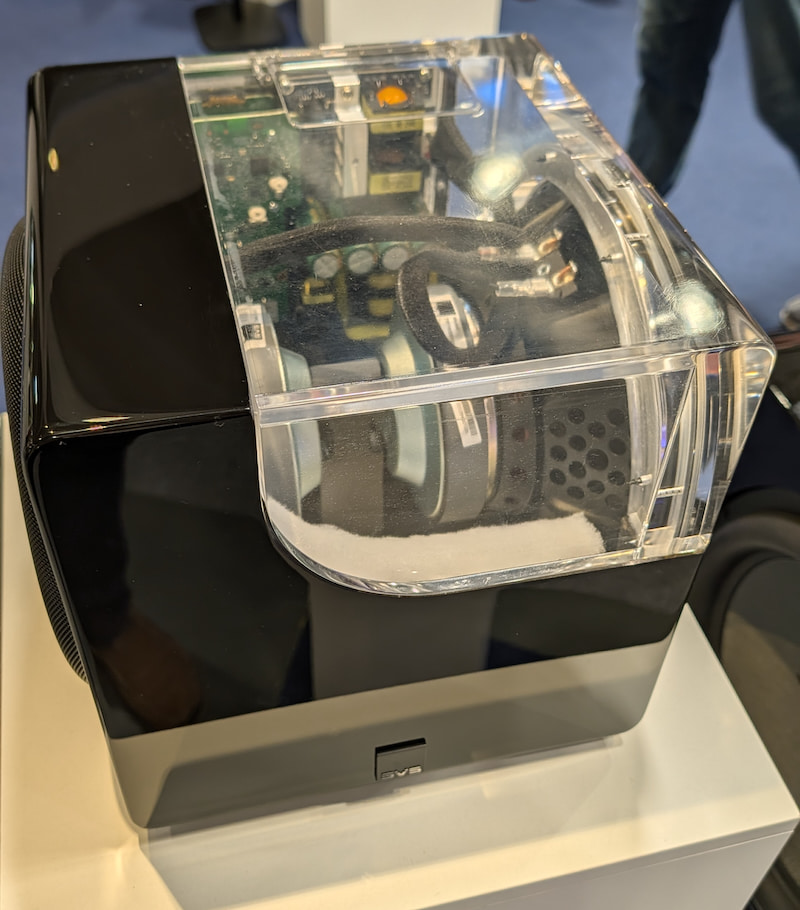
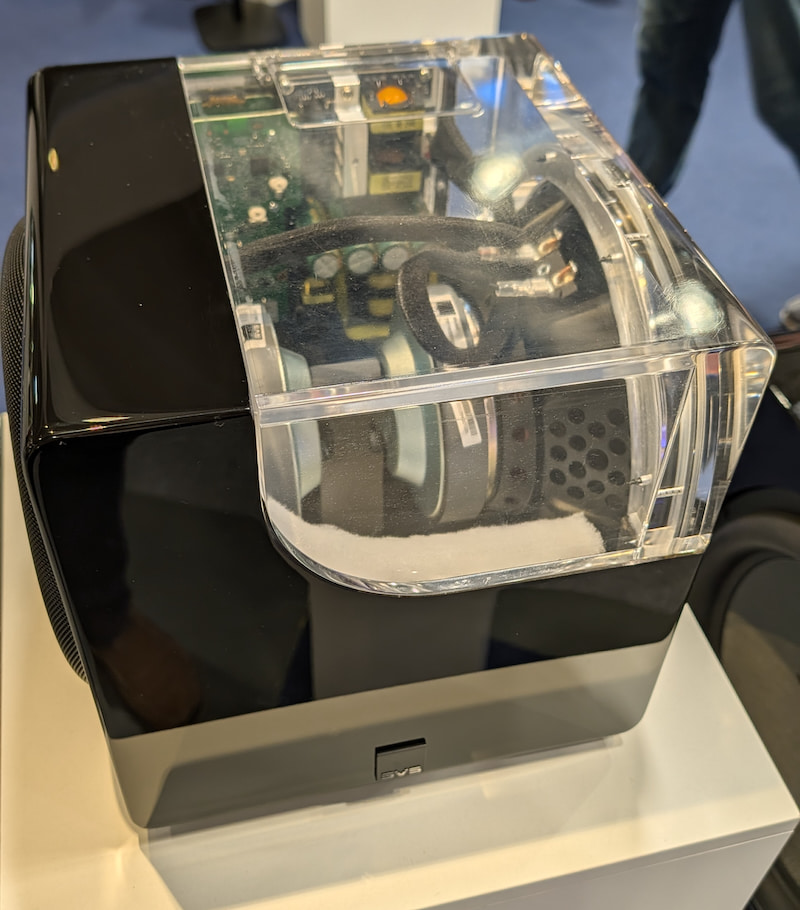
SVS had a version of their 3000 Micro R|Evolution subwoofer on display with a transparent cutaway to show off the internal components.
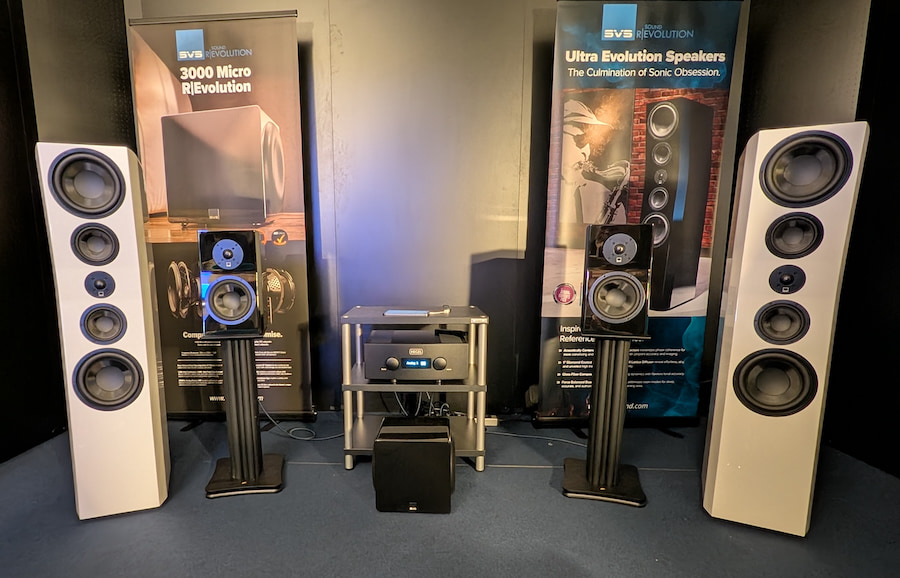
When I first entered their stereo listening room, I thought they were playing music through their Ultra Evolution Pinnacle floorstanding speakers. At $4,998/pair, they’re certainly not “cheap” but they look and sound like something that should have an extra 0 at the end of that price tag. Deep, extended bass, precise imaging, solid vocal presence – overall a supremely musical experience. But it turns out, they were actually playing music through their Ultra Evolution Bookshelf Speakers ($1,199/pair), supplemented with that 3000 Micro R|Evolution sub I mentioned earlier for a total speaker price of $2,198 including the subwoofer.
SVS had both their Ultra Evolution Pinnacle towers (outer pair) and Ultra Evolution Bookshelf speakers (inner pair) on display at HIGH END Vienna 2026 for comparison purposes.
The blend between the bookshelf speakers and the sub was so seamless that I thought it must have been coming from the integrated towers which were located right next to the bookshelf speakers. And the soundstage was so wide as to be coming from well beyond both pairs of speakers. But I went up close to verify that we were actually hearing all this great sound from those two little guys and the compact sub in the middle. I’m not sure how many orders these folks got during and after the show. But I’m sure many European show attendees were as impressed as I was by what they heard.
SVS R|Evolution Soundbar with subwoofer and optional rear speakers.
Also on display in the booth was the company’s upcoming R|Evolution Soundbar, which comes with one of the company’s powered subwoofers pre-paired for quick set-up. This sub is no joke – it features a 12-inch driver and 600 watts of amplification. SVS reps tell us the same can hit that magic 20 Hz low bass response, but we’re not sure how many dB down it will be at that frequency.
Since we first saw this bar at CES, they’ve added DTS:X decoding to the Dolby Atmos that we already saw and heard. The system will have optional rear speakers to those who want their sound a bit more immersive than what Dolby Atmos virtualization can do from a single bar. Pricing on that system has not yet been finalized but SVS says it should be around $1,500 for the soundbar+sub bundle and $1,800 for the bar+sub+rear speakers bundle. The soundbar is expected to being shipping toward the end of this year.
Advertisement
Check out SVS’s own live stream (previously recorded) where they give a quick booth tour from High End 2026.
The Bottom Line
Once again, SVS holds the line on pricing with one of the most impressive budget systems we heard at the HIGH END show. Those looking for an alternative to overpriced soundbar-based systems can put together a fine-sounding two channel or even 5.1.2-channel system featuring the Ultra Evolution Bookshelf and new 3000 Micro R|Evolution subwoofer with enough cash left over for a decent AV Receiver to power it all.
The plane will soon be ready to fly over US communities.
NASA/Lori Losey
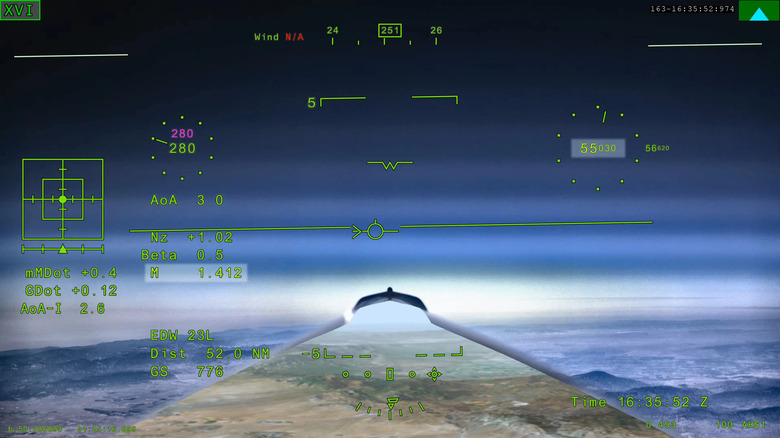
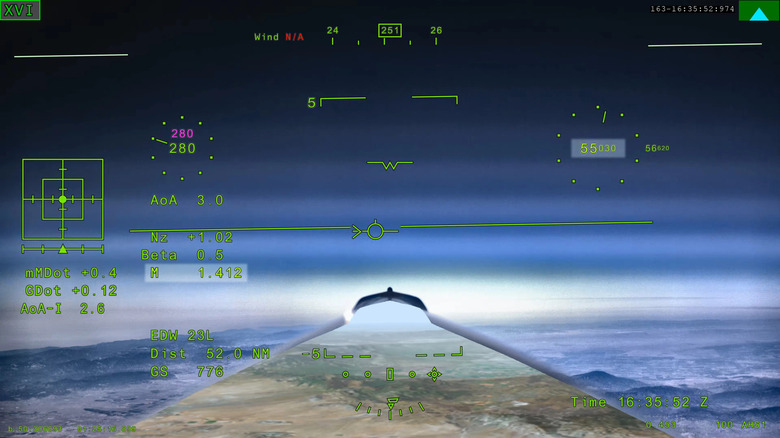
NASA’s X-59 research plane took its first supersonic flight at the beginning of the month, and now it’s demonstrated that it can reach the speed and altitude conditions it’ll need to achieve for planned trips over US communities in the near future. The X-59 is designed to fly at supersonic speeds without producing a loud sonic boom; instead, it’ll make a “quiet sonic thump,” according to NASA. For now, though, it’s flying alongside another research craft that does produce a sonic boom, to obscure whatever noise it makes as it undergoes testing.
In a test flight on Friday, the X-59 flew Mach 1.4, or about 924 mph, and reached an altitude of 55,000 feet. For the previous flight, on June 5, it hit Mach 1.1.
Advertisement
The space agency says this latest test “was an even more critical step” than the one that preceded it, as it hit key targets that it’ll replicate during its Quesst mission. The Quesst mission, which is still months away, will see the X-59 fly over populated areas so NASA can get feedback from the public on what the sonic thump sounded like to listeners on the ground. Before that, though, the plane will go through an acoustic validation phase, in which the team will measure its supersonic acoustic signature to make sure it is indeed breaking the sound barrier without producing a traditional sonic boom.
A year before the arrival of the brand-new 21st millennium, the Year 2000 Bug was predicted to grind modern society to a halt and ensure that at the dawn of the year 2001, there’d be nothing left but the smoldering wreck of once great societies. Thanks to the concerted efforts of countless engineers, software developers, and many others, we were left with mostly just silly glitches, with one of these surviving bugs apparently just discovered, as [Van Heusden] reported on an NTPd bug in BSD 2.11.
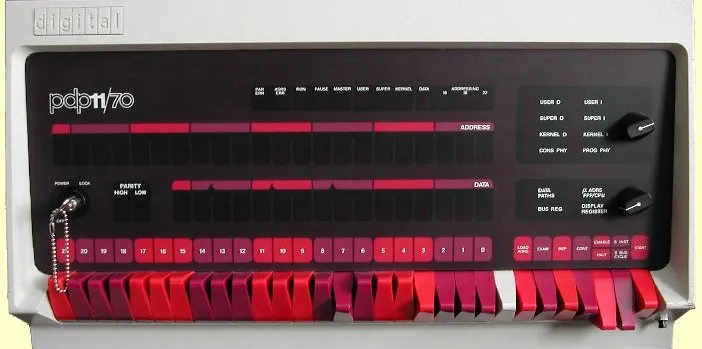
To be fair, it is a pretty obscure one, as the demonstration involves BSD 2.11 on a PDP-11/70 from 1975, so it’s probably not something that still sees much use outside retrocomputing enthusiast circles. In the blog post, the demonstration involves connecting a specific adapter by Traconex, capable of receiving WWV/WWVH time signals, and setting it up for use by the NTPd prior to running the ntpd -a any -d -d -d -d command.
This can create an ‘offset excessive’ error in the log, which, as the attached patch shows, is due to the use of explicit 20th-century numbering. Although not a bug that’ll really affect anyone, it shows that Y2K bugs didn’t just hide in two-digit year fields, but also lazy shortcuts and assumptions when handling years. This will be useful information while we try to avoid society melting down once more, as the Year 2038 problem is now pretty much right around the corner.
Elon Musk is many things — a billionaire, a rocket builder, a social media provocateur — but first, he’s a car guy. Long before he was running Tesla, he was spending his first big paycheck on a McLaren F1, which he believes is the best car in the world. Since then, his relationship with cars has only grown more complicated and mysterious.
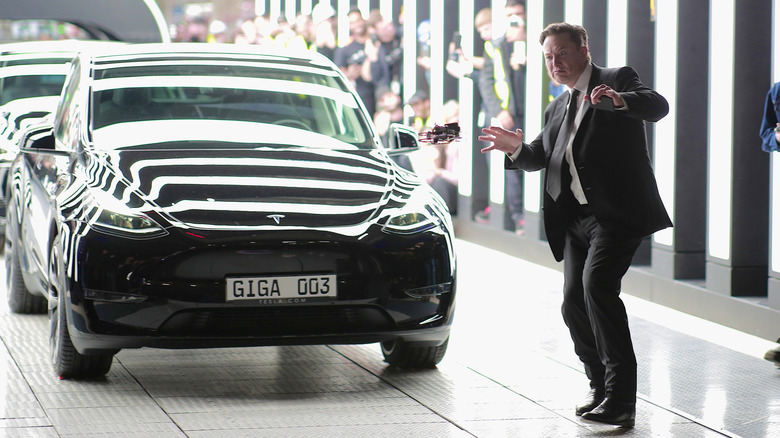
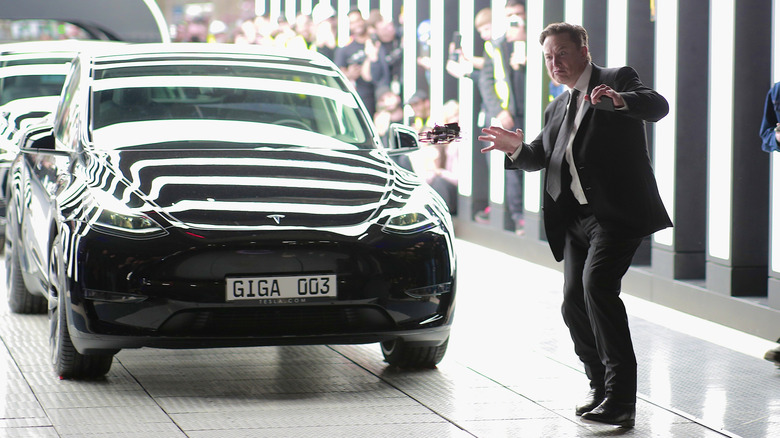
Tesla, the company he joined in 2004 and has led since 2008, has grown from a single-model electric car startup into one of the most influential automakers on the planet. Its lineup has spanned the Model S, Model 3 Model X, Model Y, and the Cybertruck, though Tesla has since discontinued the Model S and the Model X. Regardless, Musk has driven, tested, or been spotted in most of them at one point or another.
So which Tesla vehicles does the CEO actually drive? Back in 2019, Musk revealed on X that his day-to-day rotation included the Model S Performance — equipped with the then-new Raven motor — along with the Model 3 Performance, and the Model X when he had his kids in tow. Since then, he’s been spotted in newer models, including a Cybertruck prototype in Austin.
Advertisement
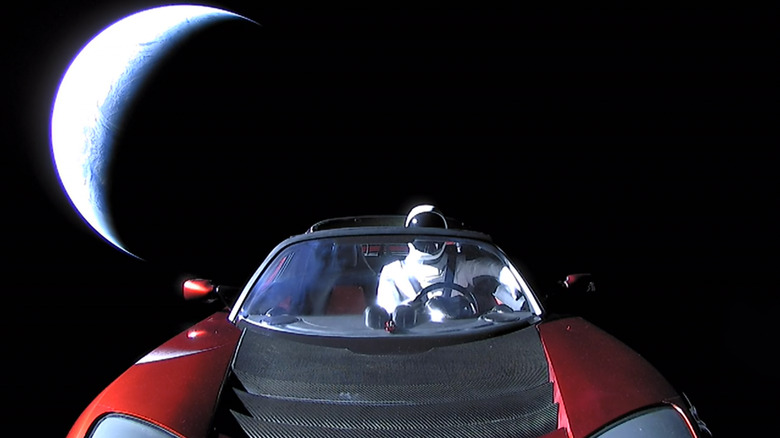
While Musk rarely updates the public on his garage, the Model S remains the Tesla most closely associated with him, alongside more recent appearances in the Cybertruck. His most famous Tesla, however, is still the original Roadster that SpaceX launched into orbit aboard Falcon Heavy in 2018. These are the Tesla models Elon Musk actually drives or has driven.
Advertisement
A closer look at Elon’s Teslas
Handout/Getty Images
Musk’s relationship with the Model S goes back further than most people realize. As early as 2015, Time Magazine reported he said at Tesla’s annual shareholder meeting that “I’m testing the latest version of autopilot every week. Typically, two or three builds per week that I’m testing on my car.” By 2018, when he appeared on The Joe Rogan Experience #1169, he confirmed the Model S was still his go-to, saying directly: “Model S P100D. That’s the car that I drive.”
By 2019, he had upgraded. In the aforementioned 2019 post on X, Musk revealed his Model S had been fitted with an adaptive damping suspension in addition to the Raven motor, along with a development version of the FSD computer that had not yet been made available to the public. The Model X is also the Tesla with a most personal backstory behind it. During a 2012 interview with Autoblog, Musk criticized the Audi Q7 he owned at the time for its notoriously difficult third-row access, saying that “you need to be dwarf mountain climber to get into the back seat.”
That frustration directly shaped the Model X. Musk said in the same interview that the Falcon wing doors were his idea, born out of a need for a door that could open in tight spaces while still allowing access to the third row without moving the second-row seat. Although these Falcon doors have proven to be quite problematic, In his 2019 X post, he confirmed the Model X remains his go-to when driving with his kids.
Advertisement
Elon Musk’s car collection
Martyn Lucy/Getty Images
Although information on the Tesla models Elon owns and drives is somewhat limited, his broader car collection is more publicized. Likely the most expensive car in Elon Musk’s collection was the McLaren F1 — and we say “was” deliberately, since Musk no longer owns it. After crashing it while uninsured, watching it catch fire, and having it undergo a complete rebuild by McLaren Special Operations, he sold the car in 2007.
One of the oldest cars in Musk’s collection was the 1920 Ford Model T reportedly gifted to him by one of his friends as a symbol of how it changed the automotive industry and how Musk does the same. A well-known vintage also owned by Musk is the 1967 Jaguar E-Type roadster. Likely one of the coolest cars in his collection is the 1976 Lotus Esprit “Wet Nellie,” a car used in the 1976 “The Spy Who Loved Me” James Bond movie.
Musk’s collection also included a few older German luxury cars like the 1974 BMW 320i (his first car), a Hamman-modified 2005 BMW M5, and the 2010 Audi Q7 he criticized when talking about Model X Falcon doors. Musk’s 2012 Porsche 911 Turbo was actually directly tied with his connection with Tesla. When Musk offered AC Propulsion’s Alan Cocconi $250,000 to convert his Porsche 911 Turbo to electric, Cocconi refused.
It was then that AC Propulsion’s CEO Tom Gage suggested Musk speak with Martin Eberhard, who had just launched a small electric car startup called Tesla. In the same Joe Rogan podcast we mentioned above, Elon noted that the Jag and the Ford are the only two gasoline cars he owned at the time, meaning that the majority of the collection is no longer his.
“Battered by years of mass layoffs, California tech workers were hoping the job market would rebound this year,” reports the Los Angeles Times. “But things are getting worse.”
The class divide is widening in Silicon Valley as a tiny group of employees is landing unprecedented packages for AI skills, while many others struggle to find work. The have-nots are doing everything that used to guarantee great jobs — refreshing resumes, optimizing LinkedIn profiles and doing interviews — but companies are much more picky these days. The tech jobless are rethinking their lives. Some are taking pay cuts, others are leaving tech. Some are going back to study or launch startups. Some have retired….
Since 2022, more than 815,500 tech workers have been laid off, according to Layoffs.fyi, a website that tracks job cuts. The tsunami of pink slips surged in 2023, when companies that had gone on hiring sprees during the COVID-19 pandemic began to cut back. From January to April, U.S. tech employers announced 85,411 job cuts this year, up 33% from the same period last year, according to global outplacement and executive coaching firm Challenger, Gray & Christmas. The Public Policy Institute of California estimates that the number of information jobs — which includes jobs in hard-hit Hollywood as well as tech — tumbled 17% between the middle of 2022 and this February. The San Francisco Bay Area has been hardest hit, the institute said in a recent report, with the number of jobs declining by 0.4%, compared with 7.5% growth over a similar time span before COVID-19 slammed into the U.S. economy.
Tech layoffs are also spilling over into other industries. Automaker General Motors laid off roughly 600 workers in its information technology department, and Walmart is reportedly laying off or relocating roughly 1,000 workers in its technology and products teams. Recruiters say companies have become much more selective, requiring AI skills, combining different positions and interviewing more people for each job. “You’re seeing elongated hiring cycles,” said Robert Lucido, senior director of strategic advisory at Magnit, a California company that helps tech giants and other businesses manage contractors, freelancers and other contingent workers. “There’s more opportunity to fill the need that they truly want.”
Advertisement
Paul Flaharty, district president at staffing firm Robert Half in Los Angeles, said companies are laying off workers, but also creating new roles tied to AI initiatives. “For individuals that are displaced, it’s really important that they find ways to upskill themselves so that they can make themselves as attractive as possible for these new jobs that are being created,” he said. Kira Martins was already taking on more work in a small team at Snap — the parent company of disappearing messaging app Snapchat — when she was laid off in April. The company said the layoffs were to cut costs as it focuses on profitability, noting how employees are using AI to “reduce repetitive work, increase velocity, and better support our community, partners, and advertisers….” Martins, a 36-year-old Los Angeles resident, views AI as a tool and is optimistic about finding her next role. People still need to decide how to use AI and check the work it generates, she said. “In tech, you want to be a first adopter, because if you don’t move quickly, it’s very easy to become irrelevant,” she said. “Everyone’s kind of hopping on the AI train.” A former Google worker (laid off more than a year ago) says he’s still job hunting, according to the article, and “he’s learned it’s not enough to just apply in this competitive market. Workers really need to network and leverage their connections to get seen by hiring managers and stand out.”
But when 64-year-old product manager Bruce Bowers lost his job at Oracle — along with thousands of others — he just started his retirement early.
Following a consultation, the UK is banning young people under 16 from social media platforms like TikTok and Instagram, Prime Minister Keir Starmer announced. “This is a line in the sand,” the PM said in a speech at his Downing Street residence. “Tech giants had their chance and failed, but we’re stepping in to protect children, back parents and set a new normal for future generations.” The government aims to pass the legislation by the end of this year and start enforcing it in the spring of 2027.
The plan includes not only a ban from major social media platforms, but also restrictions on gaming apps as well. Those include barring children under 16 from chatting with strangers, live streaming or using romantic chatbots. “These restrictions… go further than any other country,” the government press release states.
The UK will follow a similar model as the social media ban in Australia. Platforms like Snapchat, TikTok, YouTube, Instagram, Facebook and X will be required to disable access for under-16 users by default. Chat apps like WhatsApp or Telegram will note be affected. The government is also looking at limited restrictions for youths under 18, like overnight curfews and breaks in infinite scrolling.
Starmer acknowledged that kids will find ways around the ban, but said that wasn’t a good excuse for not enacting a law. “We don’t say, ‘Oh, look, a teenager managed to get a drink somehow, so let’s not bother banning alcohol sales for children,” he said. “Our laws are rules, but they’re also an expression of our values. They shape the social contract, and so this will change the conversations that parents have and the expectations of children over time.”
Advertisement
In January, the UK government launched the “Growing up in the online world” consultation into social media for kids, requesting feedback on whether and how to enforce that limit. The country’s ministers also went to Australia to study the effects of that nation’s social media ban, which went into effect on December 10, 2025. Only a month after it was enacted, Meta had shut down as many as 550,000 Australian accounts to comply with the law.
The results of the UK consultation showed that nine in 10 parents supported a minimum age of 16 for accessing social media apps, the government said. At the same time, the PM added that the ban doesn’t mean the UK is anti-tech. “I do not accept, and I will never accept that you can’t be both pro tech and AI, and at the same time say we must protect our children,” he said in the speech.
Creation of detailed rules and enforcement of the ban will be conducted by the UK’s tech regulator Ofcom in consultation with lawmakers. “So far, Ofcom has driven some of the strongest changes of any online safety regulation in the world, from widespread age checks to grooming protections for children. But the industry needs to go much further to make people safe,” Ofcom said in an official statement. The government has yet to release details on ID or other enforcement mechanisms.
Whether at soccer games, violin recitals, or princess/pirate-themed birthday parties, I’ve yet to rub elbows with a fellow dad who doesn’t like movies (and home theater, for that matter). So, in commemoration of pops everywhere, eCoustics proudly presents our first-ever Father’s Day roundup of exceptional 4K Blu-ray discs that any interested offspring (or concerned spouse) can feel great about wrapping and leaving on the breakfast table next to his French toast and macaroni-art card.
Some of these titles carry a distinctly paternal theme, while others are simply terrific, gift-worthy releases just right for that special man in your life.
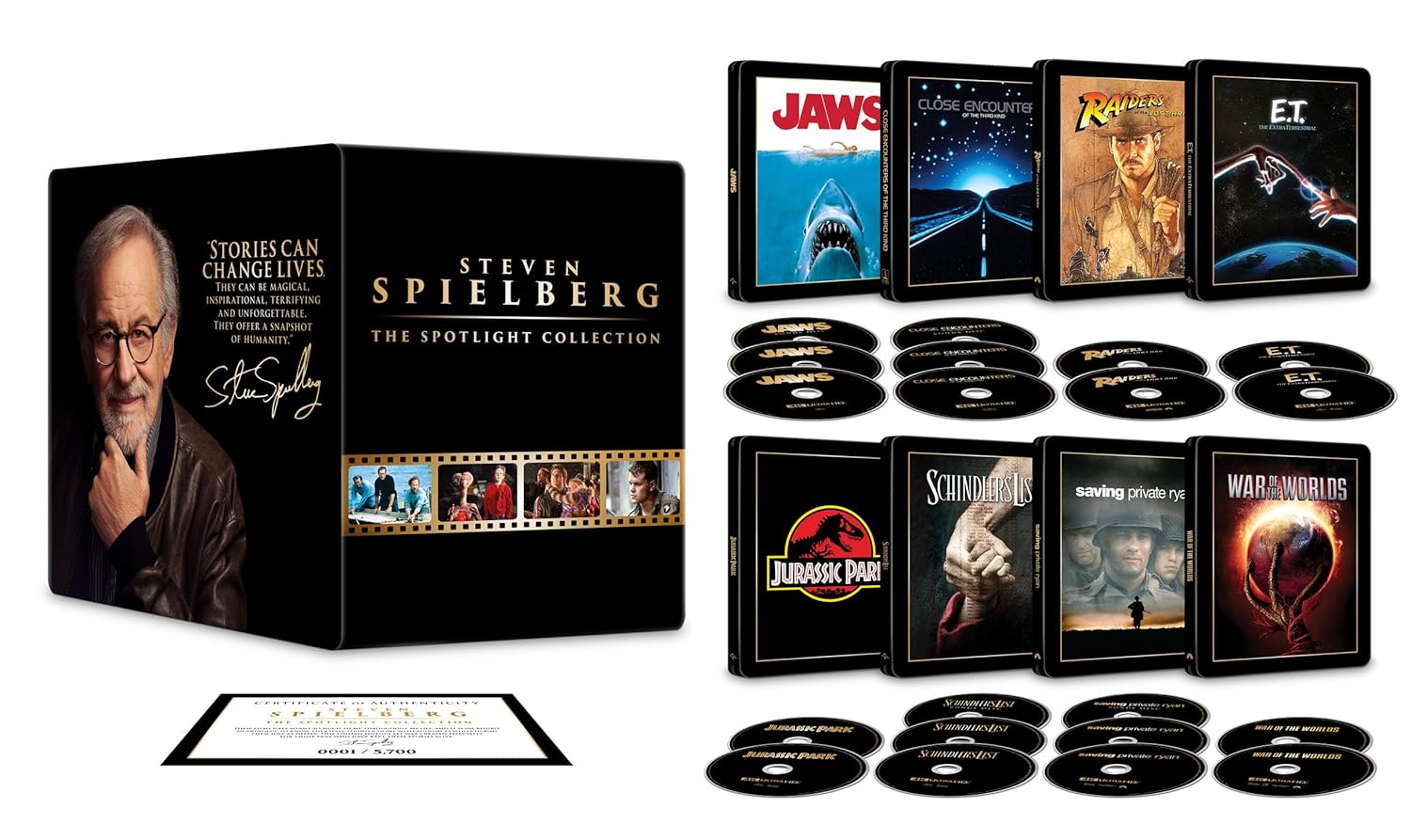
Steven Spielberg: The Spotlight Collection (Universal Pictures Home Entertainment)
There have been boxed sets dedicated to a single director before, even one for Mr. Spielberg himself. This one’s different. The eight films here arrive in SteelBook cases adorned with vintage poster artwork, tucked inside a coordinated metal box. They’ve been curated from multiple studios and are presented on 4K disc, as well as Blu-ray and digital. Most importantly, every movie in this set is a total banger, representing a total of 29 Oscar wins against 58 nominations, and no fewer than three of these were the highest-grossing motion picture of all time, at one point or another. Together, they provide an overview of a career like no other, displaying singular dominance across the ’70s, ’80s, ’90s, and beyond:
Jaws (1975)
Close Encounters of the Third Kind (1977)
Raiders of the Lost Ark (1981)
E.T. The Extra-Terrestrial (1982)
Jurassic Park (1993)
Schindler’s List (1993)
Saving Private Ryan (1998)
War of the Worlds (2005)
Not coincidentally, many of these movies are movies about dads: some flawed (Roy in Close Encounters, Ray in War of the Worlds), some selfless (Martin in Jaws), some not related to those they protect but still stepping up.
As you can see, Close Encounters, Schindler’s List, and Saving Private Ryan are three-disc affairs, with platters dedicated to extensive legacy bonus content, and Jaws is the 50th anniversary edition with the exclusive Blu-ray of the Definitive Inside Story documentary. Jurassic Park is the new version that was introduced last year with Dolby Vision HDR, a superior color grade, more restrained noise reduction, and a modern Dolby Atmos mix, on a BD-100 disc.
No doubt timed around the release of his latest, Disclosure Day, this incredible limited edition is, in fact, timeless. As seen here in his finest works, Steven has a way of pushing limits, breaking new ground, and taking us places we’ve never been before.
Taken together, these extraordinary films tell the story of a quintessential movie star. With a commitment to his craft that routinely put his life on the line, Jackie Chan blended superlative martial arts moves with a unique gift for physical comedy, yet he was unable to crack the Hollywood mainstream, instead tanking with would-be vehicles like The Big Brawl and The Protector. Six undeniable hits soon showed the world what he could do, aided by the era’s burgeoning home video market, the nascent internet, and a hunger for alternative entertainment, ultimately leading to Rush Hour, its sequels, and spawn.
The box kicks off with Jackie’s masterpiece, Drunken Master II, the sequel to a movie not enough people saw (a lot like Mad Max/The Road Warrior) and renamed for a time as The Legend of Drunken Master for the U.S. The daring stuntwork and plentiful, stylized choreography, within a serio-comic period setting, make this tale of a lovable yet imperfect hero who unlocks nigh-unbeatable fighting skills when he consumes alcohol irresistible. The rest are a bit more accessible, contemporary urban action thrillers that pit Jackie against New York street gangs and mobsters, warhead-stealing terrorists, drug dealers, and assassins.
Arrow has magnificently encapsulated this pivotal five-year period with its own new 4K restorations from the original negatives, all in Dolby Vision, with an assortment of best-available audio options for each, from mono up to 5.1, different languages, and optional subtitles, of course. The original Hong Kong theatrical release dates are noted:
Drunken Master II (1994; three versions on one disc; released in North America as The Legend of Drunken Master in 2000)
Rumble in the Bronx (1995; released in North America in 1996; two versions on two discs)
Thunderbolt (1995; two versions on one disc, one in HD only)
Police Story 4: First Strike (1996; released in North America as Jackie Chan’s First Strike in 1997; two cuts on two discs)
Mr. Nice Guy (1997; released in North America in 1998; three versions on two discs)
Who Am I? (1998; two versions on two discs)
Stick with the “Hong Kong” cuts to see the movies as intended, favoring story and character over faster-paced action, although comparisons between versions are fascinating. In some cases, large scenes were removed, or the entire musical score changed, and the dubbing can sometimes impart an unfair B-movie feel.
A new expert commentary is provided for each film, in addition to a new six-part documentary, new discussions of Jackie’s career before and after, and archival featurettes and interviews with collaborators and film historians, some quite extensive, spread across the set. Spend the time exploring, and we’re treated to some rare and unusual tidbits, such as seldom-seen network TV scenes with dialogue heard nowhere else. Inside the rigid box, we’ll also find a 160-page perfect-bound book, a set of 24 miniature lobby card reproductions, and a two-sided poster with classic Drunken Master II artwork.
So much has already been said about Apocalypse Now, perhaps the wildest movie shoot of all time, and the brilliant companion documentary that followed 12 years later, Hearts of Darkness: A Filmmaker’s Apocalypse. Be apprised: this super-deluxe new edition is quite different from the previous 4K release of Hearts of Darkness. That disc’s sole extra, a 37-minute “making of,” is included again here on both the 4K disc and the newly supplied 1080p Blu-ray of the doc, along with a 2007 Eleanor and Francis Coppola audio commentary, plus a recent program dedicated to Eleanor, who passed in 2024. The 1080p Disc Three is where things get really interesting: a menagerie of four of her short films from 1976 and her making-of documentaries of feature films directed by both husband Francis and daughter Sofia. The handsome four-panel, clothbound polyptych houses the discs, as well as a colorful softcover photo scrapbook spanning her storied career.
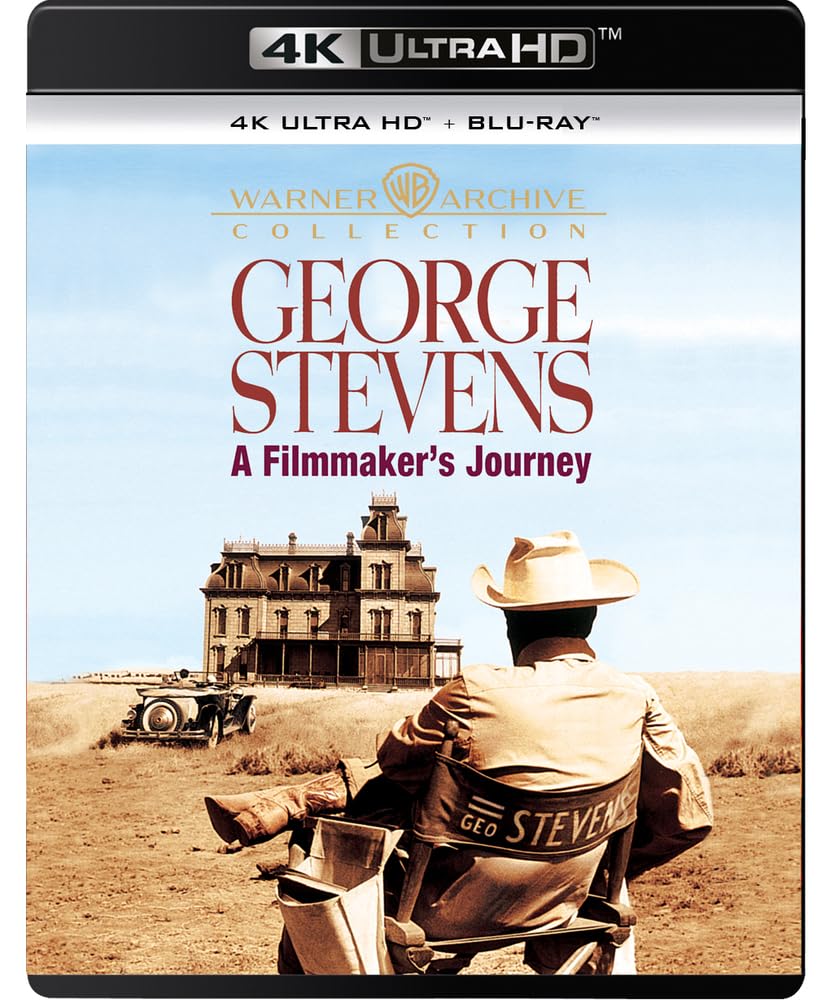
Shane. Giant. Gunga Din. A Place in the Sun. You know his movies, but too few know the name of the man behind the camera. To chart the canon of George Stevens is to understand the odyssey of this uniquely gifted American filmmaker, how history and his own experiences helped to shape some of the most enduring films of the 20th century, from the escapist Fred-and-Ginger romp Swing Time to the heartbreaking The Diary of Anne Frank and beyond. This documentary by his son, George Jr., skipped Blu-ray and went straight from DVD to 4K.
The result? The numerous film clips, home movies (including some of the only color footage chronicling the later days of World War II), and modern-day (1984) interview footage with a Hollywood who’s who now look outstanding. For further context and praise, three new featurettes from notable fans Christopher Nolan, Guillermo del Toro, and Martin Scorsese share their love of Stevens’ Shane and The Greatest Story Ever Told.
Hearts of Darkness and A Filmmaker’s Journey are a disparate pair, but they’re quite possibly the two finest movies-about-movies ever made.
Advertisement
Where to buy:$30.11 at Amazon (George Stevens: A Filmmaker’s Journey)
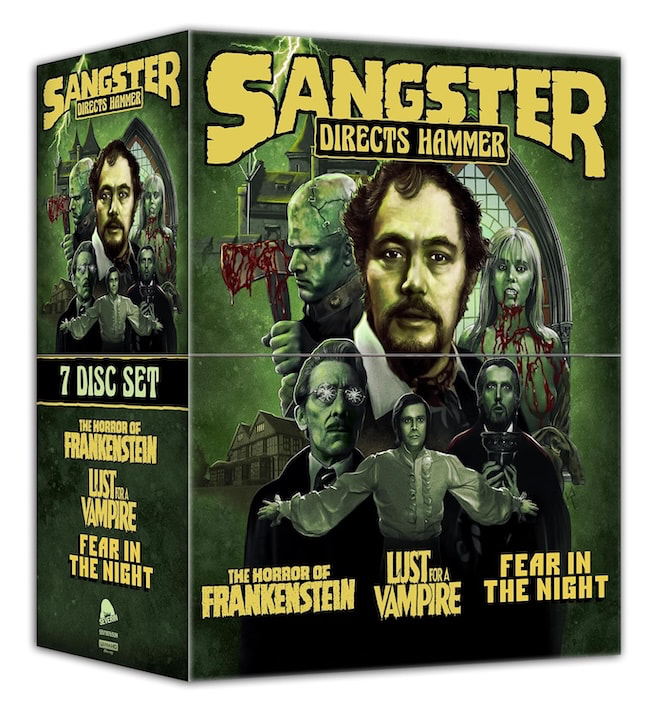
After a prolific run as Hammer Films’ go-to screenwriter, penning some of the seminal horrors that made the studio famous around the world, Jimmy Sangster returned in the early ’70s to make his only three feature films as a director. (Not the “father” of Hammer, but definitely a chief architect… or a cool uncle.) This informal trilogy marks a deliberate move away from the more traditional, neo-classic monster mashes and into edgier fare conceived to cater to changing audiences of the era.
The Horror of Frankenstein (1970)
Lust for a Vampire (1971)
Fear in the Night (1972)
The Horror of Frankenstein is marked by a cynicism in Victor not previously seen, this time with David (Darth Vader) Prowse as The Monster. You can imagine what happens when a resurrected vampiress infiltrates an exclusive all-girls finishing school to prey on her classmates, or you could just watch the blood-and-boobs gem Lust for a Vampire. Fear in the Night is the sole contemporary entry, with Peter Cushing playing against type, creepy and weak, while Joan Collins laid the groundwork here for her on-screen bitch persona that would define the ensuing years. It’s not horror in the expected sense, more of a confined emotional cruelty that feels a lot like the British version of a giallo. The films are rated R, R, and PG here, and all “X” in the U.K.
Severin Films has brought them together with 4K scans by StudioCanal, in Dolby Vision and crisp mono for the bunch. Every movie carries two audio commentaries, one with Sangster himself, part of a new/archival bonus complement topping 19 hours, spilling onto a seventh disc. This handsome collection also includes the must-read 312-page Horror! Lust! Fear! Sangster, packed with essays, interviews, comic adaptations, and more.
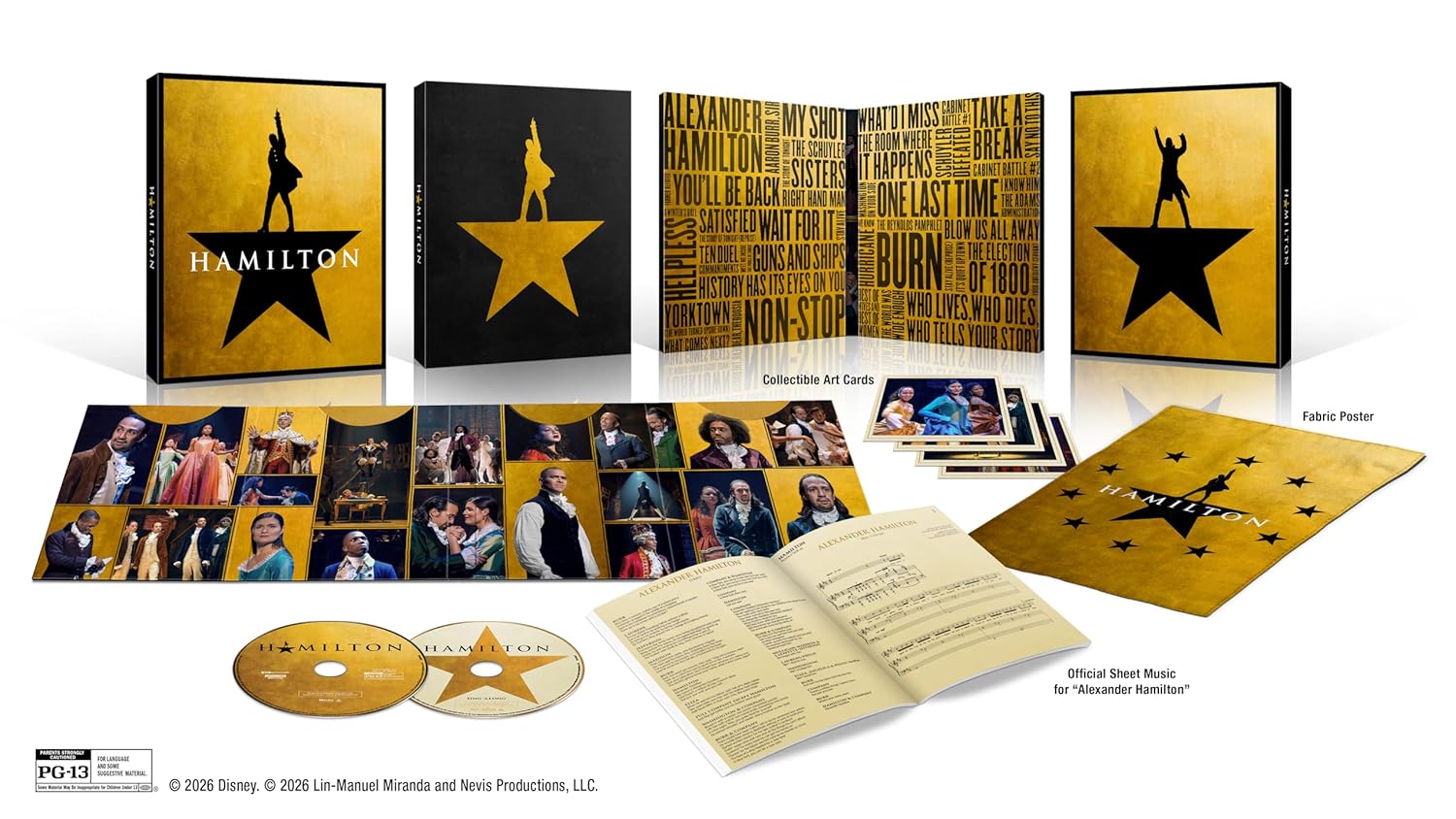
I never properly appreciated history or hip-hop, but Lin-Manuel Miranda’s monumental stage biography of the ten-dollar founding father cured both shortcomings in just 161 minutes. Filmed over three nights in June 2016 at NYC’s Richard Rodgers Theatre, the program captures the live performance of the original Broadway cast at their absolute peak. Hamilton is eminently rewatchable for the incredible talent on display (I’m still noticing nuances in the choreography), but also to parse the rapid-fire lyrics and their inspired rhymes. The high-bitrate Dolby Vision/Dolby Atmos is a marvelous upgrade over the compressed Disney+ stream, so we’ve never seen it looking or sounding this good in the home.
No digital copy here (this erstwhile streaming exclusive did lead to a 641% spike in D+ subscribers, after all), but we are given a new featurette alongside an earlier cast reunion. Disc Two carries the sing-along version with on-screen lyrics, since everyone has a favorite tune or three, but good luck keeping up. From there, it’s some lovely physical treasures: colorful art cards, an understated fabric poster, and the sheet music for the prologue/opener.
Dads come in all shapes and sizes. Take Aoyama, a gentle, middle-aged widower who has spent the last seven years completely dedicated to raising his teenage son, putting his romantic life on hold until his son gives him the green light to start dating again. Unsure of how to re-enter that world, Aoyama and a friend concoct a highly questionable plan, holding a fake casting call to find the perfect woman. All goes well… until it begins to shift into one of the most disturbing psychological thrillers ever put to film, before giving way to outright body horror. You’ve been warned.
While Takashi Miike is the famously prolific, chameleon-like director of over 100 eclectic films, his restrained filmmaking style and powerful social critique help make 1999’s Audition his true masterpiece. Arrow knows it, and its 4K is newly restored from the original Super 16mm negative, with restored lossless stereo and 4.0, plus 5.1. The bonuses are a happy combination from its 2019 special-edition 1080p Blu-ray and new goodies: two commentaries, interviews, a booklet, and reversible sleeve art.
The Black Belly of the Tarantula 4K Limited Edition (Celluloid Dreams)
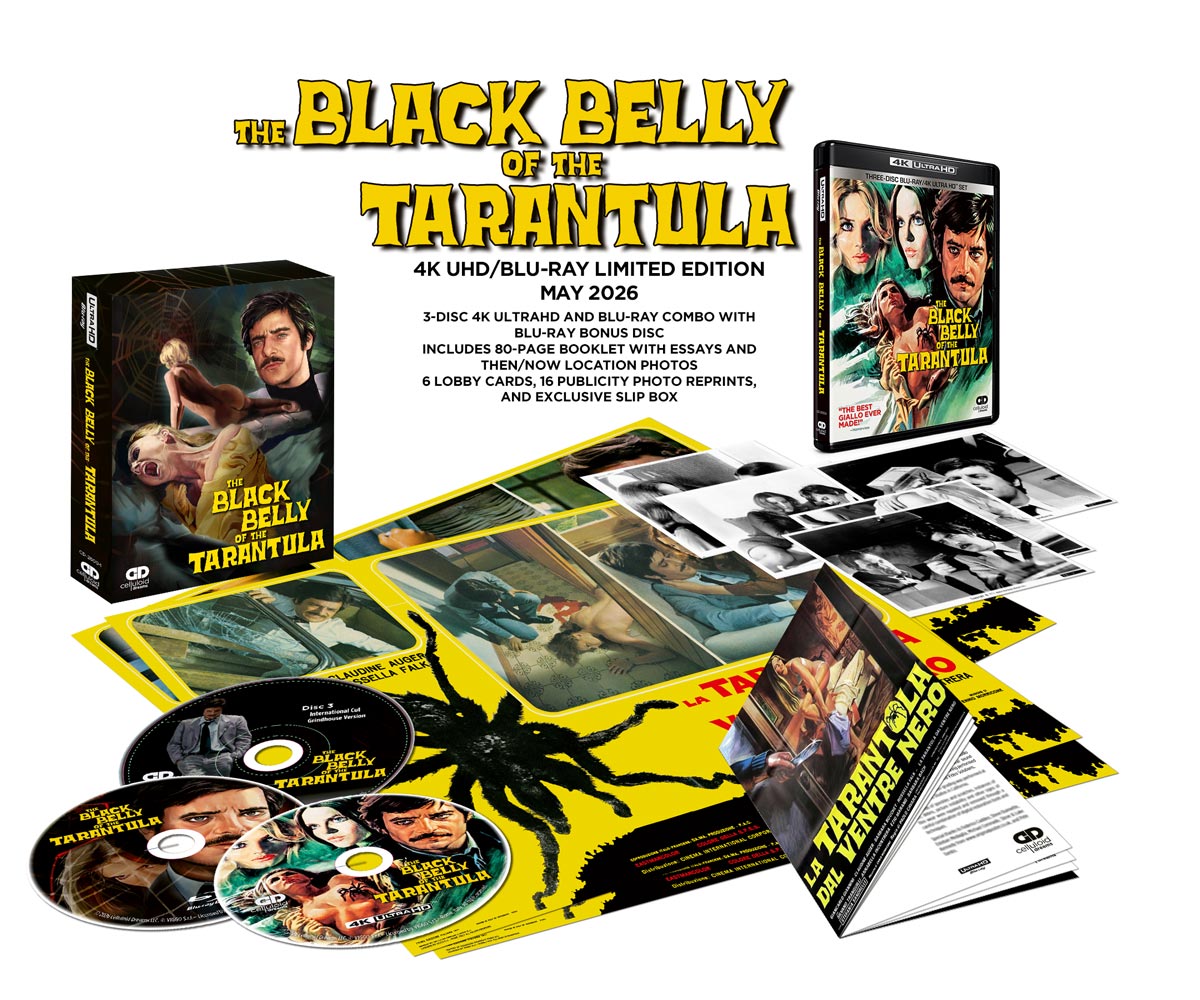
Celluloid dreamer Lucas Henkel, along with his father Guido (no, not Sarducci), has been saving worthy motion pictures from obscurity and celebrating them with a unique brand of curation, restoration, and illumination. In Tarantula, we meet a world-weary inspector (the always wonderful Giancarlo Giannini) who must track down a killer with a flair for arthropodology. The murderer is picking off Rome’s wealthy elite: blackmailing them, paralyzing them, then forcing them to witness their own brutal murders. Look for Bond girls past and future in director Paolo Cavara’s (Mondo Cane) top-tier giallo, favoring a police-procedural vibe over the genre’s typical surrealism, set to a seductive, mesmerizing Ennio Morricone score that also induces anxiety when it needs to.
Available directly from Celluloid Dreams, this three-disc limited edition features a new 4K restoration from the camera negative, presented in both the intended theatrical full-frame and 1.85:1 aspect ratios, as well as the international and “grindhouse” versions. Guido steps up to the mic for a new audio commentary on the 4K and HD Blu-rays, in addition to new and archival interviews and a pair of deep-dive video essays on Disc Three.
La tarantola dal ventre nero arrives in a fatbox (no Italian translation available for that word… yet) with reversible disc case artwork, a fantastic 80-page companion book, plus a set of 16 black-and-white publicity photos. Orders also include a set of full-sized color repros of the original fotobuste (lobby cards), suitable for framing.
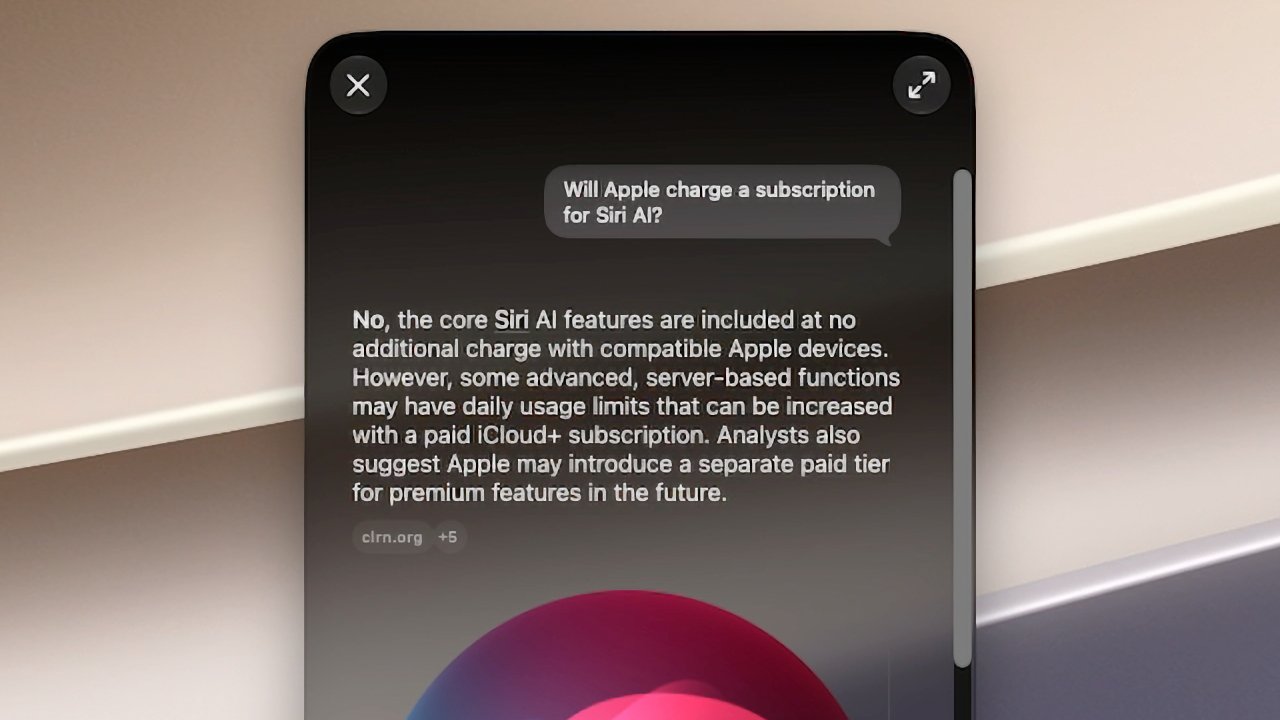
It’s obviously speculation, and repeated at that, but a new report argues that it’s more likely that Apple will eventually charge a fee for Siri Ai now that Apple Intelligence has improved so much.
Apple has long been predicted to introduce a subscription version of Apple Intelligence, and a new report chiefly repeats speculation from 2024. However, the new claim comes after the launch of Siri AI in beta, and Bloomberg‘s Power On newsletter argues that it has made subscriptions more likely.
That’s because even in beta form, the new Siri AI is described as adequate now, and will clearly improve in the future. The speculation is that over the next 12 months, the feature will improve enough, and become popular enough, that a subscription version could be a success.
Then, too, Apple is shouldering the high costs of AI features such as Image Playground and Siri conversations. That must add to the pressure to get users to pay for their usage.
Advertisement
As a consequence, the report predicts that conversations and image generation will move to a paid tier. There is already the fact that Apple has already said that iCloud+ subscribers can get a higher daily usage of both of these.
Then World Knowledge might become a subscription feature, although at present this is the weakest part of the new Siri AI. Apple has the great benefit that Siri AI is part of its devices’ operating systems, but it has the strong disadvantage that it let Siri get dramatically poorer while it worked on this new version.
So Apple has to get back users who’ve given up on Siri before, plus it has to attract new users. If it cannot do that and also improve Siri AI, Apple would not be able to launch a separate Apple Intelligence subscription.
That said, it could add Apple Intelligence features to its Apple One bundle. That has hardly changed its offering since it launched in 2020, so perhaps Apple Intelligence could be a way to boost sales of that bundle.





















































You must be logged in to post a comment Login