

Business
Wall Street futures mixed amid new Middle East hostilities



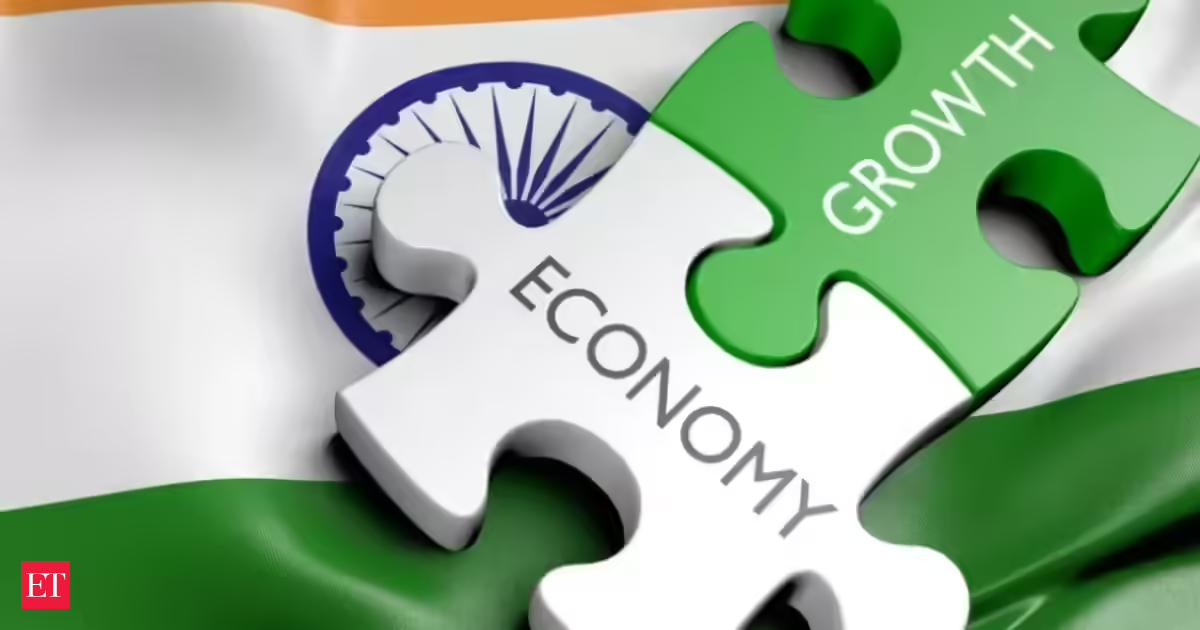
Higher energy costs, gas rationing, weaker global demand and increased production expenses are likely to weigh on investment and exports, it said on Wednesday.
Despite the anticipated slowdown, India is expected to remain among the world’s fastest-growing major economies.
Gross domestic product growth is expected to edge slightly up to 6.4% in FY28, according to the Paris-based institution. India imports more than 85% of its crude oil requirements, with about half passing through the Strait of Hormuz, which has remained largely blocked since the start of the Iran war on February 28.
“Rising inflation is expected to weigh on private consumption, while investment slows amid higher oil and gas prices and gas rationing,” said the OECD.


Private consumption growth is expected to moderate to 6.8% in FY27 from 8.2% in FY26, it noted. Growth in gross fixed capital formation, an indicator of investment, is also projected to ease to 6% from 7.1%.
Inflation is forecast to accelerate to 4.8% in FY27, driven by higher food and energy prices as well as currency depreciation. It is expected to ease to 4% in FY28 as commodity prices stabilise and monetary policy tightens.
The OECD anticipates a small rate hike in mid-2026, likely to be reversed in early 2027, leaving interest rates close to neutral levels. The Reserve Bank of India’s monetary policy committee entered its June 3-5 meeting with the repo rate at 5.25% and a neutral policy stance.
India’s current account deficit is expected to widen to 2.1% of GDP in FY27, reflecting higher energy import costs and weaker external demand.
Globally, the OECD expects GDP growth to slow to 2.8% in 2026 from 3.4% in 2025. In a scenario of prolonged disruption from the Middle East conflict, growth could weaken to 2.1% this year. “The global economy entered 2026 with robust momentum, but the outlook has weakened significantly since the start of the conflict in the Middle East, with effects likely to be felt for some time. The longer the disruptions last, the larger the economic and social costs become,” OECD secretary-general Mathias Cormann said.

Perth-based aerial technology company Innovaero is planning to raise up to $50 million to accelerate the development of its military drones and pursue other programs.

Cetera chief investment officer Gene Goldman discusses current market optimism and recommends diversifying into technology and healthcare sectors on ‘The Claman Countdown.’
A new report from the Federal Reserve finds that inflation is pushing prices higher at a strong pace in most of its regional districts around the country, driven by the surge in energy prices.
The Fed on Wednesday released its latest edition of the Beige Book, which summarizes economic conditions in each of the Fed’s 12 regional districts and is published eight times a year.
“Prices increased at a moderate to strong pace overall, with most Districts reporting higher inflation from the previous report,” the Fed’s national summary explained.
“Districts noted that energy-related costs tied to the conflict in the Middle East were the primary driver of inflationary pressures, with spillovers into shipping, packaging, groceries, and fertilizer,” it added, with the Cleveland Fed noting increased fuel surcharges.
HIGH ENERGY PRICES RISK KEEPING INFLATION ABOVE 2% TARGET, CONCERNING FED POLICYMAKERS

Inflation has surged in recent months as the Iran war pushed energy prices higher. (Robert Nickelsberg/Getty Images)
Input costs that are unrelated to labor were rising at a faster pace than selling prices, which contributed to “broader concerns about margin compression” among businesses.
“The ability to pass on higher costs remained mixed across sectors, particularly among consumer-facing firms. Consumer uncertainty and concerns about fuel prices impacting households were noted by several Districts,” the report said.
Despite the disruption of the energy market driving inflation and price increases for consumers, the report noted that producers remain leery of expanding output due to uncertainty.
KEVIN HASSETT SAYS INFLATION WILL DROP SHARPLY ONCE STRAIT OF HORMUZ REOPENS

Gas prices are about 36% higher than a year ago due to the disruption of Middle East oil supplies, according to AAA data. (Angus Mordant/Bloomberg)
“Energy activity increased in two of the markets, but Districts reported that the outlook remains highly uncertain leading producers to hold off on materially expanding activity,” the Beige Book explained.
Higher costs for fuel and fertilizer also contributed to agricultural conditions remaining flat or declining in most of the districts, as farms face cost pressures for key inputs and transportation.
Economic uncertainty is also weighing on expectations for growth around the country, as the report explained that “business outlooks for the next six months reported to have little change in anticipated growth, as elevated uncertainty and signs of weakening consumer spending weighed on sentiment.”
FED’S FAVORED INFLATION GAUGE REMAINED ELEVATED IN APRIL

High energy costs are showing signs of spilling over into prices for other goods due to elevated fuel costs. (Robert Nickelsberg/Getty Images)
Inflation has jumped this year amid the Iran war’s impact on energy flows from the Middle East, after it remained elevated and trended higher in 2025 as higher tariffs pushed prices higher.
The most recent data from the Bureau of Labor Statistics shows that the consumer price index (CPI) – a key inflation metric – was up 3.8% from a year ago in April. That figure is well above the Fed’s long-term goal of 2% inflation and represents a notable increase from the 3.3% annual CPI reading in March, which itself was significantly higher than the 2.4% year-over-year inflation recorded in February.
The persistent inflation has dimmed the market’s outlook for interest rate cuts this year, with the CME FedWatch tool showing a higher probability for rate hikes before the end of this year than cuts.
GET FOX BUSINESS ON THE GO BY CLICKING HERE
As of Wednesday afternoon, the tool shows a 40.9% chance that the Fed’s benchmark rate remains at its current range of 3.5% to 3.75% through the central bank’s December, with a 41.7% chance of a 25 basis point rate hike by that time.
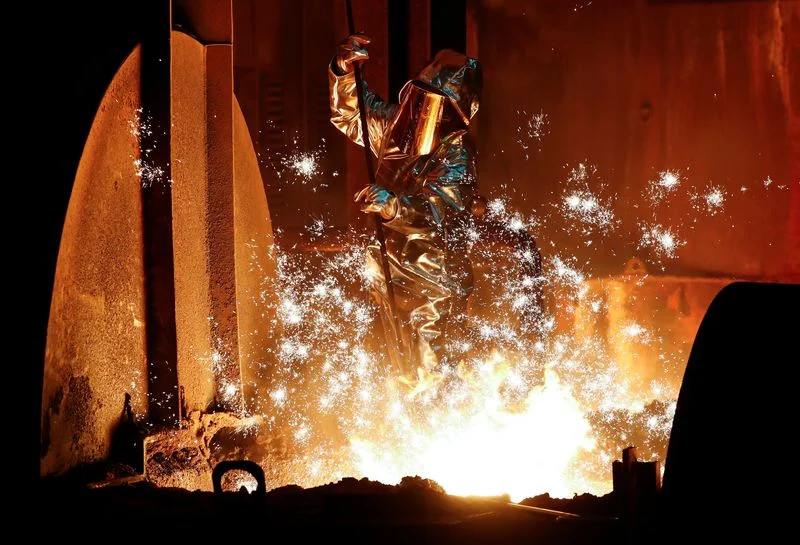

US tariff doubling cut EU steel exports by 34%, steel body says

Smith-Midland receives Nasdaq non-compliance notice
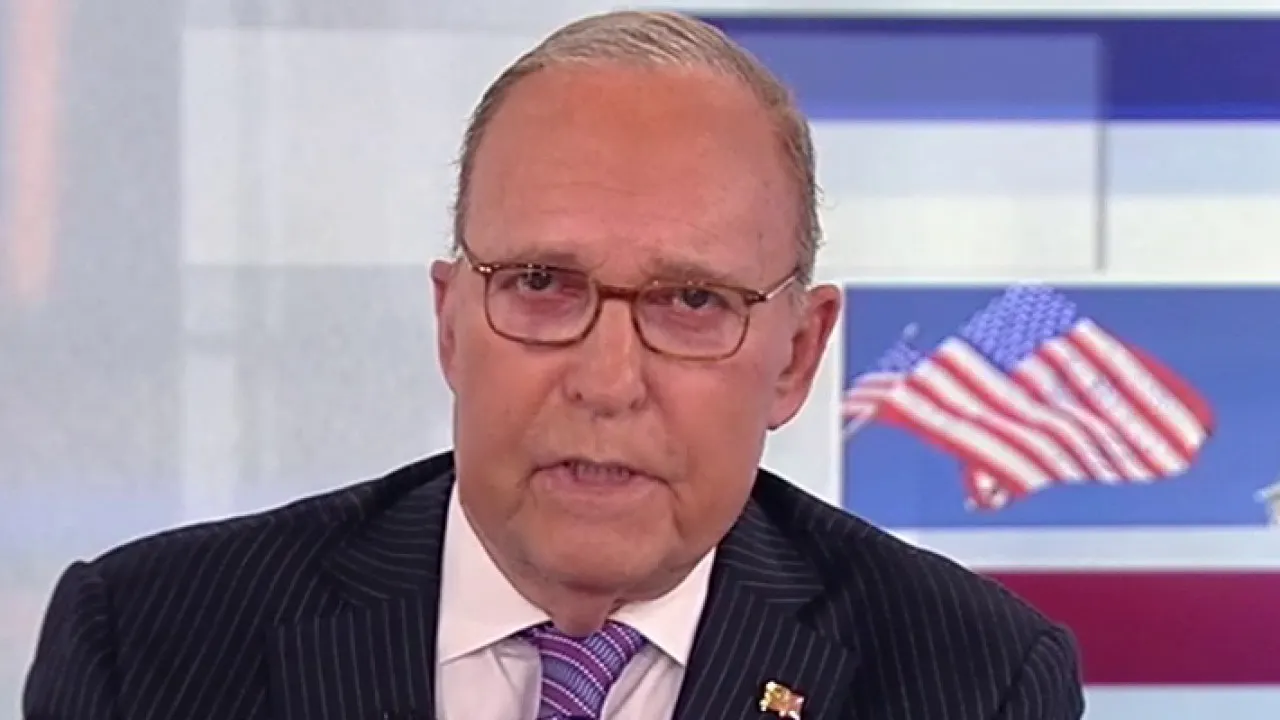
FOX Business host Larry Kudlow discusses what is next in the Iranian conflict and the California election on ‘Kudlow.’
Big change is coming to the Middle East, and California, too, because people are fed up. Today’s a potpourri. President Trump told the great New York Post columnist Miranda Devine that he really does work well with Prime Minister Benjamin Netanyahu. He’s optimistic about a deal. He’d like to meet Iran’s new supreme leader, Mojtaba Khamanei. The naval blockade is going to continue. Mr. Trump thinks Iran has committed to ending their nuclear program, but he’s in no rush to make a deal.
By the way, Mr. Trump told Ms. Devine that the Maine Democrat Graham Platner is a major sleazebag, but Texas Democrat James Talarico is worse. The president also signaled he is optimistic on stocks and the economy. And he’s completely right. More big numbers coming out on new orders, production, manufacturing jobs, and business.
Secretary Scott Bessent told Congress that Iranian inflation may be more than 200 percent, the currency has collapsed, 50 percent of the army is not getting paid, and police are not reporting to the police stations. The best wartime Treasury secretary since World War II. Starving the beast.
And the big question is whether change is coming to California. My pal Steve Hilton looks to have actually won the Governor’s jungle primary. Here’s what Mr. Trump posted on Truth Social:
“Congratulations to Steve Hilton on coming in first, last night, in the California Vote for Governor. If Californians are smart, which I know they are, they will put Steve into the Governor’s Mansion, and watch their State get better at a rate that has probably never been seen before.” Mr. Trump added: “I know Steve — He is a hard driving WINNER, and he will turn California around, quickly — and the Federal Government will be there, with him, to help.”
California gubernatorial candidate Steve Hilton believes ‘change is coming’ for the state as he leads in early vote counts.
My point. Mr. Hilton is one smart cookie and you can bet he’ll put together a great issues campaign to stop the corruption in California. Stop the economic exodus. Stop the tax confiscation and move that state to recovery from dystopia. He can do it.
And then there’s Spencer Pratt running a strong second in the Los Angeles mayoral race, winning the hearts of moms and families to make Los Angeles a decent place to live again. Fires, homelessness, drugs, crime: watch Mr. Pratt put together a first-rate campaign with a strong staff to set up a kind of City Hall-in-waiting. And the more you see Mayor Karen Bass, the better Mr. Pratt is going to do.
He should debate her five times a week. She can’t hardly get a sentence out. She’s backed by all the big-spending, corrupt, big-government socialist interest groups, but the rank-and-file may not follow the leadership. And Mr. Pratt might even be able to beat her with donors that want to restore Los Angeles to its prior greatness.
No matter what happens in November, Steve Hilton and Spencer Pratt are bringing change to California and Donald Trump is bringing big change to the Middle East.
Business
Spurs Heavy Favorites Over Knicks in 2026 NBA Finals Prediction Markets on Kalshi and Polymarket

NEW YORK — Prediction markets are showing strong support for the San Antonio Spurs to defeat the New York Knicks in the 2026 NBA Finals, with both Kalshi and Polymarket pricing San Antonio as clear favorites to win the series at around 63-65% implied probability.
The Spurs, led by Victor Wembanyama, advanced to the Finals after a strong playoff run, while the Knicks, anchored by Jalen Brunson, secured the Eastern Conference title. The matchup marks a rematch of the 1999 NBA Finals, adding historical intrigue to the series.
On Kalshi, the Spurs are listed at 64% to win the series, offering $5.23 profit on a $10 bet. The Knicks sit at 37%, paying $15.86 on a $10 wager. Polymarket shows nearly identical probabilities, with the Spurs at 64% ($5.46 payout on $10) and the Knicks at 36% ($17.39 payout on $10). Polymarket provides slightly better returns for bettors on both sides.
For Game 1 spread betting, both platforms have the Spurs favored by 4.5 points. Kalshi prices the Spurs to cover at 53% ($8.26 on $10) and the Knicks +4.5 at 48% ($10.08 on $10). Polymarket lists the Spurs -4.5 at 52% ($8.95 on $10) and Knicks +4.5 at 49% ($10.10 on $10).
The over/under lines show minor differences between platforms. Kalshi offers Over 217.5 at 54% ($7.92 on $10) and Under 217.5 at 48% ($10.08 on $10). Polymarket has Over 218.5 at 50% ($9.70 on $10) and Under 218.5 at 51% ($9.32 on $10). Bettors seeking the Over may prefer Kalshi’s lower total, while those taking the Under can find better value on Polymarket’s higher line.
The series pricing reflects the Spurs’ momentum and home-court advantage. San Antonio posted a strong regular-season record and demonstrated depth throughout the Western Conference playoffs. Wembanyama’s two-way dominance has been a central narrative, with the 22-year-old averaging impressive numbers in scoring, rebounding and blocks during the postseason.
The Knicks have relied on Brunson’s leadership and clutch performances. Karl-Anthony Towns and OG Anunoby have provided key support, but New York faces a challenging matchup against San Antonio’s length and defensive versatility. The Knicks went 2-1 against the Spurs in regular-season and in-season tournament matchups, covering the spread in all three games.
Head-to-head trends favor the Knicks slightly on the spread, with New York going 3-0 against the number. The Over hit in two of those three contests. However, playoff basketball often features slower pace and stronger defense, which could influence Game 1 totals.
Both teams have shown resilience. The Spurs excelled in closeout situations, while the Knicks earned the “Cardiac Bears” nickname for multiple comeback victories. These traits suggest a competitive series, though prediction markets assign the Spurs roughly a two-to-one probability of ultimately prevailing.
Market participants appear to favor San Antonio’s youth, size and home advantage. Wembanyama’s presence creates matchup problems that few teams can solve. His ability to protect the rim while stretching the floor forces opponents into difficult decisions. Brunson’s craftiness and scoring ability provide New York’s best counter, but the Knicks may struggle to contain San Antonio’s supporting cast over a long series.
Prediction markets like Kalshi and Polymarket have grown in popularity for NBA betting due to their transparent pricing and potential for value compared to traditional sportsbooks. These platforms aggregate crowd wisdom, often reflecting sharp money and public sentiment in real time. Small differences between Kalshi and Polymarket create opportunities for bettors willing to shop lines.
The 2026 Finals feature two compelling storylines. For the Spurs, it represents validation of their patient rebuild around Wembanyama. For the Knicks, it offers a chance to end a long championship drought and deliver New York its first title since 1973. The series is expected to draw massive television audiences and global interest.
Analysts note that while the Spurs are favored, playoff series often produce surprises. Home-court advantage is significant, but road teams have won key games throughout these playoffs. Fatigue, injuries and adjustments will play major roles as the series unfolds.
Betting volume on both platforms has been robust since the Finals matchup was set. Professional bettors appear split on the spread and total, while public money has flowed toward the Spurs in series pricing. This dynamic creates potential value on the Knicks side for contrarian investors.
The point total debate centers on defensive intensity. Both teams ranked among the league’s better defensive units during the regular season. Playoff basketball typically sees scoring dip, supporting the Under. However, the pace in some playoff series has increased due to modern offensive schemes, leaving room for debate on the final number.
As the series begins, focus will remain on Game 1 adjustments. The Spurs will likely emphasize interior defense and transition opportunities. The Knicks will look to exploit mismatches and use Brunson’s pick-and-roll mastery to create scoring chances.
Prediction markets will shift as the series progresses. Strong performances by key players or unexpected injuries could quickly alter probabilities. Bettors are advised to monitor line movement and consider hedging strategies across platforms.
The 2026 NBA Finals represent a clash of styles and generations. San Antonio’s youth and athleticism against New York’s experience and toughness. While markets lean toward the Spurs, the Knicks have shown they can compete with any team when playing at their best.
For those engaging with prediction markets, the slight pricing differences between Kalshi and Polymarket offer opportunities to maximize returns. Shopping lines and understanding implied probabilities remain essential for long-term success in these markets.
As tip-off for Game 1 approaches, anticipation builds for what promises to be a compelling series. Whether the Spurs can convert their market favoritism into a championship or the Knicks can pull off an upset will be decided on the court over the coming weeks.
The growth of prediction markets has added a new layer of engagement for NBA fans. Platforms like Kalshi and Polymarket provide real-time sentiment indicators that often prove more accurate than traditional polling. Their role in the sports betting landscape continues expanding as regulation evolves.
Overall, current market consensus gives the Spurs a clear but not overwhelming edge. The series should provide drama, standout individual performances and potentially several memorable moments as two historic franchises compete for the Larry O’Brien Trophy.
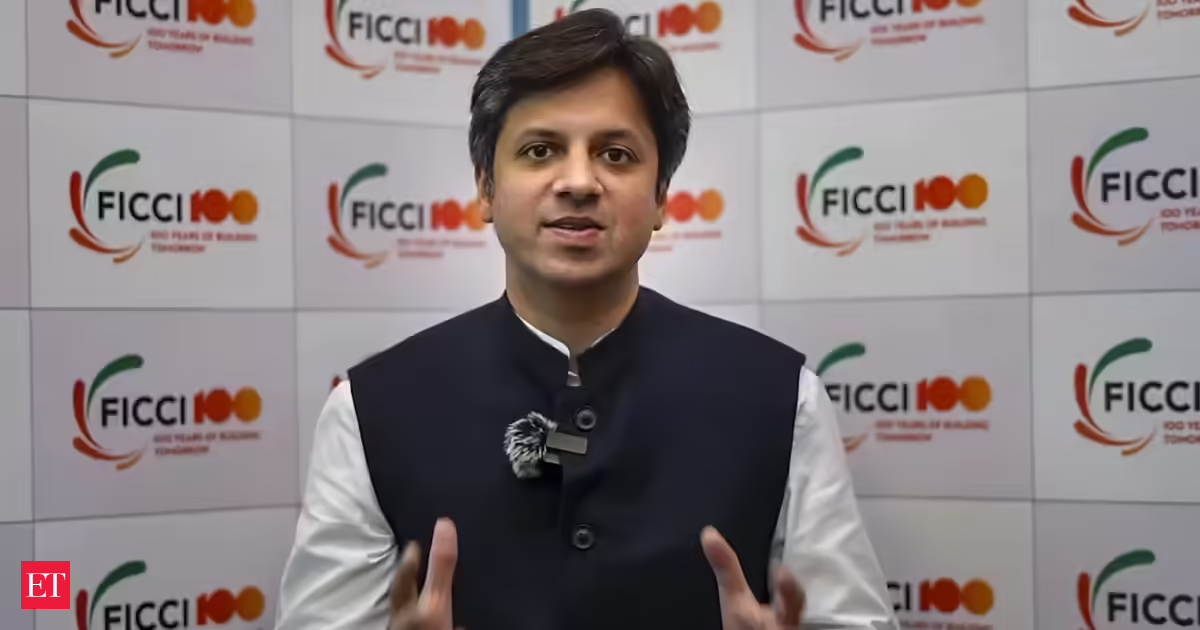
In an exclusive interview to ET, Goenka, who is the vice-chairman of RPG Group, a $ 5.2 billion conglomerate with interests in the areas of automotive tyres, infrastructure, pharma, IT, energy, batted for emphasis on further ease of doing business, while playing down concerns around foreign capital outflows, saying these would return as valuations in the stock market had corrected.
“Our expectation is interest rates should be left the way they are,” Goenka said, adding that the price pressures were largely supply side and would not get resolved by raising interest rates at this point.
He also said intervention in rupee, which has been under pressure since the beginning of the West Asia conflict, should be restricted only to minimising volatility. The Reserve Bank’s monetary policy committee began its meeting Wednesday and governor Sanjay Malhotra will announce the decision on June 5.
On growth, he said the ongoing crisis in West Asia is likely to shave off 0.5-1% from India’s GDP growth in 2026-27. “The initial situation of high impact, high uncertainty has now stabilised to a certain extent … The larger impact of inflation has still not fully played out… Margins are going to be under pressure as crude prices have risen and low-cost inventory is depleting, ” Goenka said, adding that the industry will have to manage the pain on the margins.
“…it’s not going to be easy,” he cautioned, saying that balance sheets may get a little stressed or capex get delayed as margins decline.
FTA, manufacturing
The Ficci president said that the Indian industry needs to be more proactive to leverage the various free trade agreements (FTA) signed recently.FTAs are an enabler, he noted, but companies must prepare well to understand these markets, set up channels and build relationships.
Key sunrise sectors such as data centers and semiconductors, along with high employment sectors including textiles and leather should be focus areas of India’s manufacturing plan, according to Goenka.
“We have to keep looking at a few key sectors that the government identifies…These are areas which are very highly impacted with the FTAs also coming in. A mixed view on established high job creation and sunrise sectors focus has to be there,” he explained.
Foreign inflows
On the issue of slowing foreign inflows into India, Goenka said: “I think Indian markets were fairly overvalued over the last year and a half…There has been a correction and that will possibly lead to FPIs coming back”.
Foreign portfolio investors (FPIs) have been net sellers in Indian equities in recent months as global investors rebalance portfolios and allocate more capital towards the US market. Net FDI inflows were $7.7 billion in FY26, as against $1 billion in 2024-25 while gross inward FDI inflows were $94.5 billion in 2025-26, up from $80.6 billion a year ago.
Moreover, the initial public offerings (IPO) that happened last year is also an indicator of investor confidence. “People have invested. They’ve seen a good return. Hopefully they will come back for the next stage of investments and startups and have an opportunity,” he said.
Earnings call transcript: Tilly’s beats Q1 2026 forecasts, shares rise
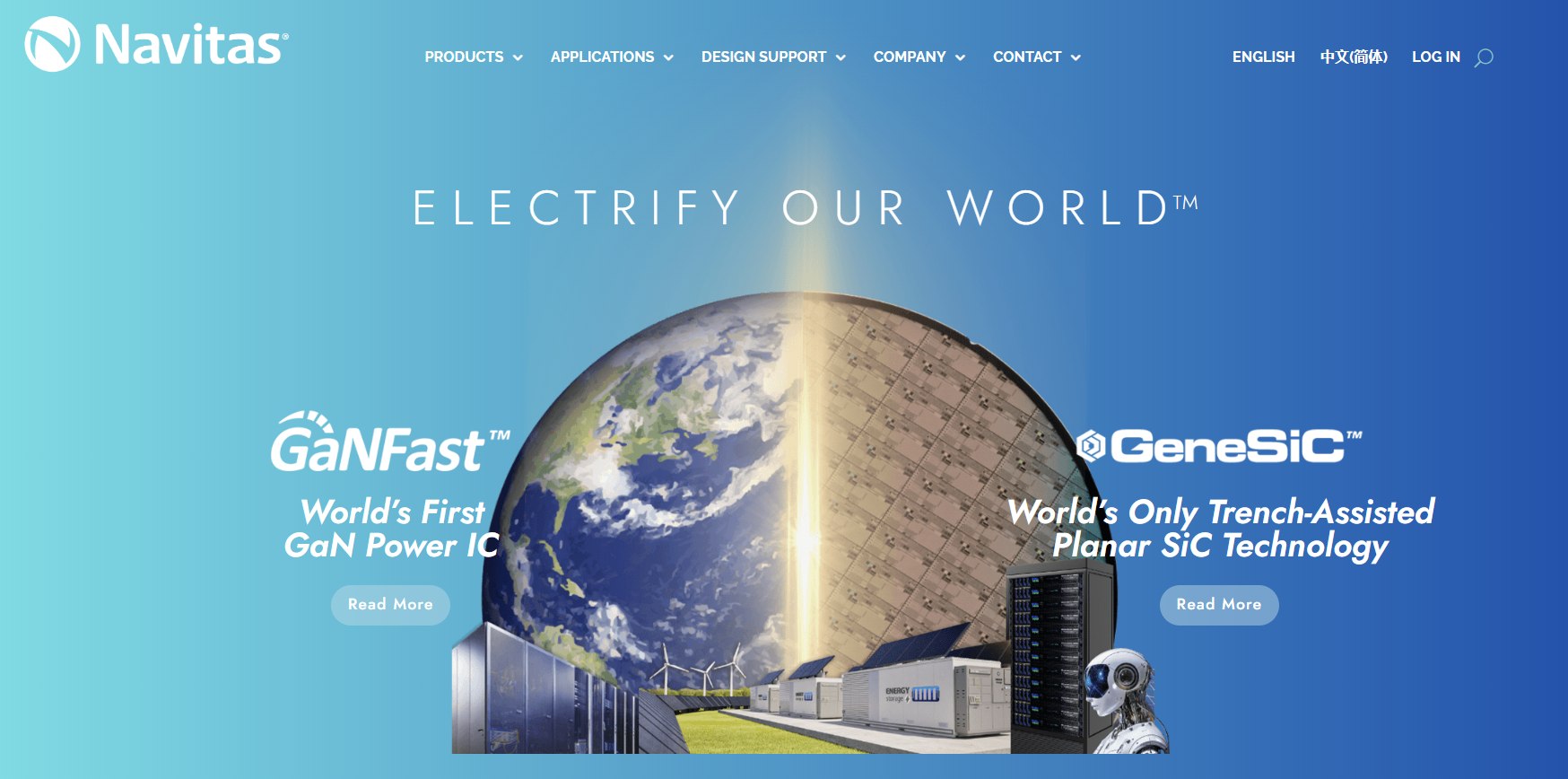
NEW YORK — Navitas Semiconductor Corporation shares skyrocketed more than 22% on Wednesday, climbing to $31.61 as investors reacted enthusiastically to the company’s growing role in powering next-generation artificial intelligence data centers through advanced gallium nitride technology.
The California-based semiconductor firm, which specializes in GaN and silicon carbide power chips, saw heavy trading volume as its collaboration with NVIDIA’s AI ecosystem took center stage at Computex 2026 in Taipei. Navitas demonstrated an 800V-to-6V DC-DC power delivery board featuring its GaNFast technology, achieving up to 97.5% efficiency and high power density critical for megawatt-scale AI infrastructure.
The announcement aligned with NVIDIA’s push toward higher-voltage architectures to handle the enormous energy demands of modern AI servers. Traders quickly bid up Navitas shares, adding roughly $1.3 billion in market capitalization in morning trading alone. The stock had traded around $25.86 at the previous close.
Navitas has positioned itself as a key player in the shift toward more efficient power conversion solutions for AI data centers. Its GaN and SiC technologies address critical challenges including heat management, energy efficiency and space constraints in high-performance computing environments. The company’s participation in NVIDIA’s MGX Ecosystem highlights its growing relevance in the AI supply chain beyond traditional consumer electronics.
Analysts have increasingly highlighted power management semiconductors as the next major growth area in the AI boom, following memory chips and networking components. Navitas’ focus on high-efficiency solutions has resonated with investors seeking exposure to the infrastructure buildout supporting large language models and generative AI applications.
The company’s strategic pivot toward higher-value markets such as AI data centers, energy infrastructure and industrial electrification has driven recent momentum. In its first quarter 2026 results, Navitas reported revenue of $8.6 million, beating estimates, while outlining ambitious growth targets for its high-power GaN and SiC platforms.
Management has emphasized the massive secular opportunity in AI power electronics. The company’s 800V architectures and solid-state transformer demonstrations at industry events have drawn attention from data center operators facing unprecedented electricity demands. Navitas claims its solutions can significantly reduce energy consumption and cooling requirements compared to traditional silicon-based power systems.
Wall Street has responded positively to these developments. Several analysts raised price targets throughout 2026, with some firms citing strong potential for market share gains in AI-related power delivery. The stock’s year-to-date performance has been exceptional, reflecting growing conviction in its technology roadmap.
However, the company faces typical challenges for a growth-oriented semiconductor firm. Navitas continues to invest heavily in research and development while navigating supply chain dynamics and competition from larger established players. Gross margins and path to sustained profitability remain key metrics for investors.
The broader semiconductor sector has shown renewed strength in 2026, driven by AI capital expenditure from major technology companies. Navitas stands out due to its specialized focus on power efficiency, a critical bottleneck as data centers scale to handle increasingly complex AI workloads.
Industry events like Computex have become important catalysts for semiconductor stocks. Navitas’ prominent role in NVIDIA’s ecosystem demonstrations provided tangible validation of its technology in real-world AI applications. Such partnerships can accelerate customer adoption and revenue visibility.
Navitas has expanded its portfolio with new product launches tailored for AI infrastructure. Recent introductions include advanced SiC MOSFETs and high-voltage GaN devices optimized for data center power supply units. These products target improved thermal performance and power density, addressing operator priorities around efficiency and reliability.
Financially, the company has strengthened its position through equity offerings and strategic initiatives. While still in a growth investment phase, Navitas has made progress toward positive cash flow and scalable operations. Management continues guiding for sequential revenue growth as AI-related demand ramps up.
Investor enthusiasm reflects optimism about the long-term AI infrastructure cycle. Data centers are expected to consume enormous amounts of electricity in coming years, making efficient power conversion technologies increasingly valuable. Navitas’ GaN solutions offer advantages in switching speed and size that appeal to system designers.
The stock’s sharp move on Wednesday came amid elevated trading volume, indicating strong participation from both institutional and retail investors. Such surges often reflect momentum trading layered on improving fundamentals and positive news flow.
Looking ahead, Navitas will need to execute on its growth plans while managing execution risks common in the semiconductor industry. Key metrics to watch include design win momentum, gross margin expansion and progress toward profitability targets.
The company’s success could have broader implications for the power electronics sector. As AI infrastructure expands globally, specialized players like Navitas may capture significant value in what some analysts describe as the “picks and shovels” of the AI revolution.
Navitas Semiconductor has transformed from a relatively niche player into a notable name in the AI supply chain narrative. Its technology addresses real constraints in modern data centers, giving it potential for sustained growth as long as AI investment continues at current levels.
For investors, the recent surge underscores both opportunity and volatility inherent in semiconductor stocks tied to emerging technologies. While the long-term thesis around AI power efficiency remains compelling, share prices can experience significant swings based on news flow and market sentiment.
As the trading day progressed, Navitas shares maintained strong gains, reflecting continued enthusiasm for its role in enabling more efficient AI computing. The company’s performance highlights how specialized technologies can drive outsized returns when aligned with major secular trends.
The semiconductor industry continues evolving rapidly, with power management emerging as a critical area for innovation. Navitas’ focus on GaN and SiC positions it well for this shift, particularly as energy efficiency becomes paramount in large-scale AI deployments.
Wednesday’s trading action reinforces Navitas’ status as a high-beta play on AI infrastructure spending. Whether the momentum sustains will depend on continued execution and broader market conditions for technology stocks.

App Store users in Texas will now need to verify their age
OECD sees India growth slowing to 6.3% from 7.6% in FY27

Deel Deploys Stripe's Full Stablecoin Stack to Pay 1.5M Contractors in DLUSD



-

 Tech6 days ago
Waymo dominates autonomous vehicle registrations as Tesla trails behind
-

 News Videos5 days ago
This is BROKEN! INSANE 5x MONEY CAR WASH WEEK! The NEW GTA Online UPDATE Today! (GTA5 New Update)
-
 Tech4 days ago
SpaceX just won a second Golden Dome contract. This one is $4.16 billion.
-

 Business2 days ago
Jade Biosciences, Inc. (JBIO) Discusses Positive Interim Results From JADE101 Phase I Healthy Volunteer Study and Development Plans Transcript
-

 News Videos5 days ago
SHE IS KILLING XRP!!! WATCH URGENT AND ACT FAST
-
 NewsBeat5 days ago
FIRST NIGHT REVIEW: Take That bring the Circus back to life in spectacular sun-soaked style
-
 Crypto World5 days ago
CFTC Has Approved the First Regulated Bitcoin Perpetual Contract in the U.S.
-

 Business4 days ago
Is the Spurs Phenom Already Better Than Prime Diesel?
-
 NewsBeat5 days ago
Novak Djokovic v Joao Fonseca LIVE: French Open latest scores and results after Jannik Sinner’s shocking collapse
-
 Entertainment5 days ago
Weak ‘Supergirl’ Box Office Tracking Amid Milly Alcock Backlash
-
 Crypto World5 days ago
Snowflake (SNOW) Stock Rallies on Strong Q1 Results and AI Product Growth
-

 Business5 days ago
Demand Conditions Improve In Chemicals Sector In April 2026
-

 Crypto World5 days ago
MicroStrategy Moves $30 Million in BTC to Coinbase Prime: Is the Bitcoin Sell-Off Already Here?
-

 Politics5 days ago
The House | Inside Andy Burnham’s Makerfield Campaign: “Nobody Thinks This Is In The Bag”
-

 Tech5 days ago
This Week In Security: Ubiquiti Fixes, And FreeBSD Joins The Club You Don’t Want To Join
-
 Entertainment4 days ago
One of the Greatest Sitcoms of All Time Shoots Up Apple TV’s Charts 11 Years Later
-

 Entertainment5 days ago
Maddox Jolie-Pitt Legally Requests to Drop Brad’s Surname
-
 Crypto World1 day ago
Seagate (STX) Stock Surges to Record High on AI Boom and Legal Settlement
-
 Entertainment5 days ago
Britney Spears Shares Troubling Update After Hard Year
-
 Entertainment5 days ago
Bruce Willis’ Generosity Resurfaces Amid His Dementia
You must be logged in to post a comment Login