Security teams log 54% of successful attacks and alert on just 14%. The rest move through your environment unseen.
The Picus whitepaper shows how breach and attack simulation tests your SIEM and EDR rules so threats stop slipping by detection.





A Chinese-speaking cybercrime group has expanded its targeting to the European space, deploying previously undocumented malware and the Atlas backdoor.
Tracked as TA4922, the threat actor is associated with financially motivated attacks aimed at breaching target networks for fraud, data theft, and the sale of access.
TA4922 has previously targeted organizations in East Asia, but recent campaigns have focused on entities in Germany, Italy, the United Kingdom, and South Africa.

Researchers at cybersecurity company Proofpoint note that TA4922 shares overlaps with activity previously reported as ‘Silver Fox’ and ‘Void Arachne. However, the activity cluster is tracked separately as it is more consistent with cybercrime than espionage.
Since March, TA4922’s activity has increased sharply, and since April, it has shown unprecedented operational diversity and high tempo.
“TA4922 currently conducts more unique campaigns than any other tracked cybercrime threat actor in Proofpoint threat data, demonstrating high operational tempo, a variety of lures, and multiple objectives,” Proofpoint says in a report today.
“While the actor is assessed to be financially motivated, the capabilities of the malware include the potential for surveillance, which could be used by or sold to espionage groups.”
The attacker uses localized phishing lures crafted to appear as payroll notices, tax audits, VAT filings, government compliance notices, invoices, and human resources communications.
The threat group also attempts to contact victims via WhatsApp, the LINE messenger, and Microsoft Teams.

Proofpoint reports that TA4922 has significantly expanded its malware arsenal and believes the hackers may be using large language models (LLMs) to accelerate malware development.
This conclusion is based on the presence of placeholder values, code comments, and patterns commonly associated with AI-generated code.
Proofpoint’s report highlights Atlas RAT, a recently identified remote access trojan that offers attackers the following capabilities:
The malware features several anti-sandbox and anti-analysis checks, including looking for usernames and registry keys associated with Microsoft Defender Application Guard, the “CExecSvc” service, and OS UUID.
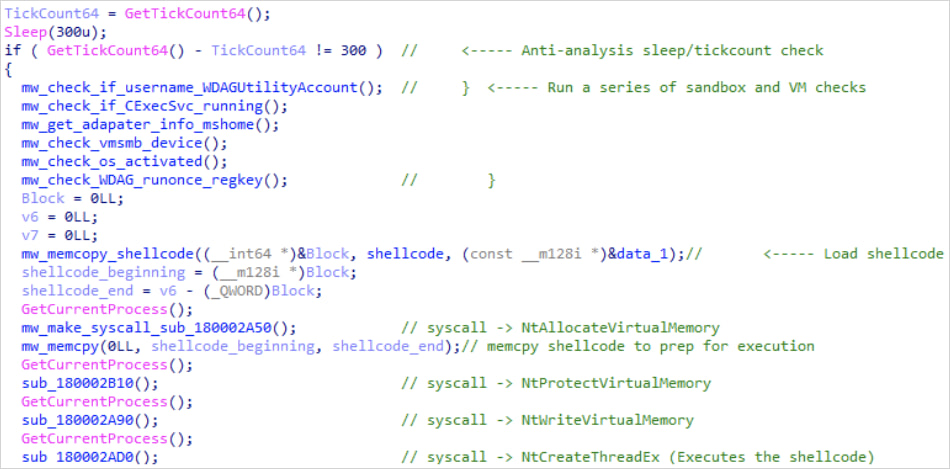
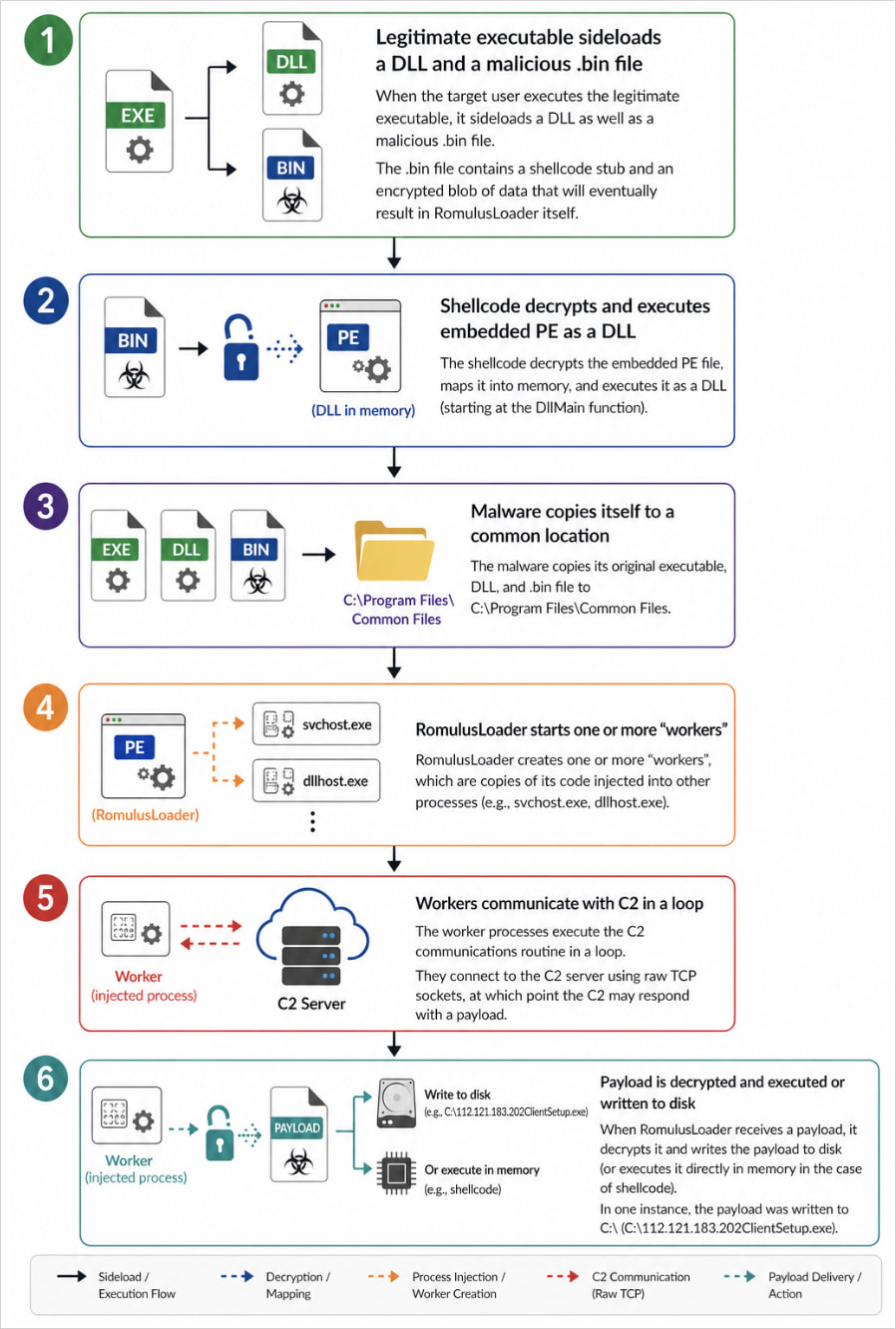
The researchers also discovered a new malware loader named RomulusLoader, which downloads and executes additional payloads using process hollowing, shellcode injection, and direct execution.
RomulusLoader was deployed to launch legitimate remote management tools such as AnyDesk and SyncFuture, a remote monitoring software tool popular in China. Weirdly, the latter was used in attacks targeting German entities.
Proofpoint also identified a Python-based loader and information stealer called SilentRunLoader, which steals from Google Chrome credentials, cookies, and browsing data.
That malware was deployed against organizations in the United Kingdom and Southeast Asia, using lures that impersonated government services.
Finally, the researchers spotted the deployment of Winos4.0, a previously documented malware family that Proofpoint tracks as ValleyRAT and which provides operators with a full set of remote access features.
According to Proofpoint, TA4922 is responsible for “more unique campaigns” than any other threat actor the company tracks. The group is moving quickly and uses multiple lures.
According to the researchers, the capabilities of the malware used by this actor have “the potential for surveillance which could be used by or sold to espionage groups.”
Proofpoint’s report includes indicators of compromise for the malware and command-and-control (C2) infrastructure used in TA4922’s attacks.

Security teams log 54% of successful attacks and alert on just 14%. The rest move through your environment unseen.
The Picus whitepaper shows how breach and attack simulation tests your SIEM and EDR rules so threats stop slipping by detection.
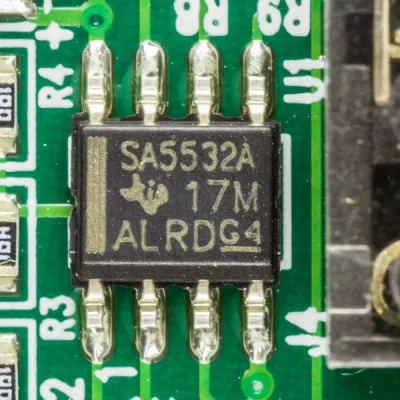
First introduced in 1979 by Signetics, the NE5532 was a pretty spiffy dual op-amp for the time with low noise and low distortion. Over the years it has become a standard part that showed up in countless audio products, and has become a so-called jellybean generic component with Texas Instruments (TI) being one of countless manufacturers.
It being such a standard, multi-sourced part makes it thus even more puzzling that TI has now decided to completely overhaul this IC in a way that makes it incompatible with even the original Signetics NE5532. These changes are covered in detail by [Dave] of EEVblog as his mind is pretty much blown at such an incomprehensible change.
The changes entail an entirely different manufacturing process and a big change in specifications, while making no change to the part number. In revision K of the TI datasheet these changes are first seen, with some specifications changed for the better, like a higher unity gain bandwidth by 2 MHz, but a much slower slew rate.
Although the 5532 op-amps are multi-sourced, there are good reasons to just stick with manufacturers like TI, as that means receiving a product change notification (PCN) when anything changes. In the PCN related to this op-amp a change to process node is noted, along with other changes, but no reasoning.
Among the other big changes are a reduction in the supply voltage from 22V to 18V, and a halving of the ESD protection from 2kV to 1kV. Although it might be slightly more efficient on the new process node this way, it clearly comes with a lot of trade-offs that make it an overall worse op-amp, while also being incompatible with the same op-amp from other manufacturers.
In the video [Dave] goes through the datasheets of this jellybean part of other manufacturers, showing that they still have the original 1980s specifications. Only one exception here was the NE5532DR from Shenzhen HuaXuanYang Electronics, whose supply rail voltage is also 18V for some reason, along with a similar internal transistor configuration that reduces the ESD resistance.
In addition to the NE5532 op-amp, it seems that TI also took an ax to the OPA134 op-amp, by removing its offset trim feature and listing the pins as ‘NC’, with a warning to not connect these pins and also worsening other specifications. This makes these similar jellybean parts incompatible, with no change to the part number. Worse is that it continues with the LMH6518, whose changes [Dave] argues might even kill oscilloscopes as they are commonly found in those.
Meanwhile the LM317M also got an overhaul, but here TI opted to give it a new part name, calling it the LM317MQ with at first glance no major degradations in the specifications, but instead some actual improvements. This makes it even more puzzling why TI didn’t give the other ICs a new part number to differentiate them from the jellybean part.
Until there’s some clarification from the side of TI, it might be a good idea to source these jellybean parts from a manufacturer that is not TI, especially when replacing these ICs in older devices.

Looking for the most recent regular Connections answers? Click here for today’s Connections hints, as well as our daily answers and hints for The New York Times Mini Crossword, Wordle and Strands puzzles.
Today’s Connections: Sports Edition is a toughie. The purple category is a real challenge. If you’re struggling with the puzzle but still want to solve it, read on for hints and the answers.
Connections: Sports Edition is published by The Athletic, the subscription-based sports journalism site owned by The Times. It doesn’t appear in the NYT Games app, but it does in The Athletic’s own app. Or you can play it for free online.
Read more: NYT Connections: Sports Edition Puzzle Comes Out of Beta
Here are four hints for the groupings in today’s Connections: Sports Edition puzzle, ranked from the easiest yellow group to the tough (and sometimes bizarre) purple group.
Yellow group hint: Going to the game.
Green group hint: Game often played on the beach.
Blue group hint: It’s coming home!
Purple group hint: Dunk that ball.
Yellow group: Seen at a stadium entrance.
Green group: Volleyball stats.
Blue group: Members of England’s World Cup squad.
Purple group: Starts with part of a basketball hoop.
Read more: Wordle Cheat Sheet: Here Are the Most Popular Letters Used in English Words
The completed NYT Connections: Sports Edition puzzle for June 4, 2026.
The theme is seen at a stadium entrance. The four answers are metal detector, ticket scanner, turnstile and will call.
The theme is volleyball stats. The four answers are block, dig, kill and service ace.
The theme is members of England’s World Cup squad. The four answers are (Dan) Burn, (Harry) Kane, (Kobbie) Mainoo and (John) Stones.
The theme is starts with part of a basketball hoop. The four answers are base runner, glass houses, netminder and Rimington.

Despite Apple’s objections, new App Store users in Texas will soon be subject to age verification, as a new state law is set to take effect on June 4.
In May 2025, the Texas App Store Accountability Act made it mandatory for companies like Apple and Google to verify the ages of their Texas-based users. As the law is set to be enforced starting Thursday, Apple has outlined an update to its App Store rules.
On the Apple Developer website, the company explained that new Apple Accounts in Texas will be subject to “age assurance and parent or guardian consent on behalf of minors under the age of 18 for downloads, Apple In-App Purchases, and significant changes associated with an app.”
In practice, this means that anyone who wants to create an Apple Account in Texas must verify that they are 18 or older. Those under 18 will need to join a Family Sharing group, and parents will be able to revoke access to previously approved App Store apps.
App developers will be required to use the Declared Age Range API to determine the age of an Apple Account user.
When “significant changes” are made to an app, developers will have to use the Significant Change API, under the PermissionKit framework, to inform parents or guardians. The company added that “it’s the developer’s responsibility to determine when there’s a significant change to their app.”
Texas’s App Store Accountability Act and a similar bill in Utah are part of a broader push by state legislatures to regulate tech companies in the absence of federal action. They could become a model for similar efforts across the United States, and companies like Apple and Google are aware of this.
Apple itself has made its stance on the matter of age verification clear since the beginning of this situation.
Even before the Texas App Store Accountability Act was signed into law in May 2025, Apple tried to argue against it. These efforts even included a phone call from Apple CEO Tim Cook to Texas Governor Greg Abbott, which obviously led nowhere.

The new law will affect Apple Account users and App Store users.
Apple also deployed six lobbyists in Texas and funded local advertising campaigns, which claimed the bill was “backed by porn websites,” among other things.
The company argued the Texas App Store Accountability Act would force it to collect and store sensitive personal data, such as government IDs or other identifying information, from all users, not just children.
As its lobbying and advertising efforts proved unsuccessful, Apple ultimately detailed the changes it would have to make to comply with the Texas age verification law. At the time, the law itself was supposed to take effect on January 1, 2026.
However, in December 2025, Texas Federal Judge Robert Pitman prevented the age verification law from coming into force in the state. He did so via a preliminary injunction.
Judge Pitman criticized the law by saying it would be like requiring bookstores to verify the age of all customers before gaining entry, and requiring parental consent whenever minors want to purchase a book.
The December 2025 injunction against the Texas App Store Accountability Act proved short-lived, though. On June 1, 2026, the preliminary injunction was temporarily stayed by the Fifth Circuit, though a permanent stay has not been granted.
There’s always a chance the courts will strike down the Texas age verification law, and its future is not set in stone. Until then, however, app developers and App Store users in Texas alike are bound by the state’s age assurance requirements.

Archangel Lightworks, a UK-based optical and laser communications company, has recently announced the successful conclusion of its testing of the world’s smallest deployable operational optical ground station, the TERRA-M.
Clocking in at just 1.1m in height and a 0.7m diameter, the TERRA-M enables mobile deployment while enabling secure, rapid communications with low Earth orbit satellites.
It is a considerably more efficient option, effectively addressing size, weight, and power (SWaP) constraints that plague older ground stations.
The TERRA-M made multiple runs to verify that it conformed to the U.S. Space Development Agency’s laser communication standard over a multi-day trial. This achievement is doubly impressive given its small size.
The portable nature of the TERRA-M was emphasized by Archangel Lightworks’ CEO: “The TERRA-M is uniquely capable of rapid, secure data transfer with satellites while also being small enough to be deployed and redeployed at the point of need.”
Accolades also flowed from multiple industry giants and government officials, including, most notably, an acknowledgment from the UK’s Space Minister, Liz Lloyd, who called Archangel Lightworks achievement a “prime example of British innovation leading the world in next-generation space technology.”
The TERRA-M’s size and ability to deploy rapidly make the underlying technology applicable to both commercial and defense industry applications, allowing it to address issues such as long deployment timelines, temporary needs, and internet coverage for communities that are otherwise difficult to support.
Archangel Lightworks has plenty of storied investors that have now invested as much as $20 million into the venture, including, most notably, Santander Alternative Investments, National Security Strategic Investment Fund, Blackfinch Ventures, Oxford Capital, Lycka Limited, and Oxford Science Enterprises, with a recent Series A funding round bringing in $13.5 Million.
It also enjoys support from the UK’s Space Agency, the Department of Science and Technology (DSIT), and the Ministry of Defense, further strengthening its multi-pronged industrial and government connections.
With the underlying tech also attracting overseas buyers, including Omantel from the Sultanate of Oman, which signed a 2025 agreement to fast-track solutions such as the TERRA-M, there are plenty of interested parties beyond domestic investors for the bleeding-edge technology in play, even as it continues to mature from a proof-of-concept to a readily available solution with Archangel Lightworks stating that units are available for purchase and service contracts are now in play.

Follow TechRadar on Google News and add us as a preferred source to get our expert news, reviews, and opinion in your feeds.

Trump-allied billionaire Larry Ellison hired blogtroller Bari Weiss to turn what was left of CBS News into a right wing safe space for oligarchs and autocrats like Trump and Netanyahu. If the patient died during surgery, I don’t think Ellison would lose any sleep. But I do think Ellison hoped that Weiss could at least turn CBS News into a viral, right wing propaganda vessel certain people actually wanted to watch.
But Weiss’ tenure has been a bumbling mess on all fronts. MAGA folks aren’t interested in CBS News’ bland agitprop. And most existing viewers have been running for the exits, resulting in CBS News recently seeing its worst ratings in a quarter century. Her clumsy attempted censorship of stories critical of the president have also caused a mass exodus of any actual remaining journalists.
Those who are left are even more pissed after Weiss recently fired 60 Minutes executive producer Tanya Simon, her deputy, and two correspondents (Sharyn Alfonsi and Cecilia Vega). In her place she put Nick Bilton, a former tech journalist and documentary filmmaker with no broadcast experience.
Bilton’s a fairly typical fail upward type remembered by many in tech journalism for the time he tried to take credit for the Wall Street Journal’s coverage of Elizabeth Holmes and the Theranos scandal:
His introduction as the new boss of 60 Minutes did not go well.
Leaked audio of a recent meeting between Bilton and CBS News staff was dropped in the lap of the New York Times and Status. In it, 60 Minutes correspondent Scott Pelley accused Weiss of “murdering” the longstanding Sunday news program, told Bilton he had “slender” qualifications for his new job and questioned the network’s commitment to the future of the program:
“She is murdering ‘60 Minutes,’” the correspondent said. “She does not love this place. She was brought in to kill it, and she’s been doing exactly that.”
Mr. Pelley added: “She has no qualifications for her job; you have slender qualifications for this job. The changes that she’s made at the ‘Evening News’ have been catastrophic, so why should we expect that any of this is going to be any better?”
There are several parts of the meeting where Bilton and his staff clearly try to shut Pelley up, quite unsuccessfully:
CBS obviously didn’t take Pelley’s comments well and has now fired him. Pelley in response offered an even more blistering statement accusing Weiss and CBS News of “injecting falsehoods and bias” into his stories. After Weiss came in swinging an axe and dismantling 60 Minutes with a total disregard for journalism, history, or tact, she accused Pelley of creating a “hostile work environment”:
Weiss ran a small blog full of trolls and c-tier columnists whose primary purpose is to blow smoke up the ass of wealth and power and punch down and left. I genuinely do think Ellison hired Weiss thinking she had the savvy to revolutionize and modernize CBS News for the social media era. But Weiss has shown repeatedly that she’s marginally competent and has the media savvy of a 90-year-old Conservative man.
Rich Republicans certainly do love to destroy and attack journalism that critiques wealth and power. But they don’t just destroy their targets. They’ll purchase a traditional news brand or communications platform, then leverage any remaining reputation to seed the public with lazy, oligarch-friendly agitprop (see: Newsweek, The Baltimore Sun, The Las Vegas Review-Journal, Twitter, TikTok, CBS, and soon CNN).
In a country with fairly terrible media literacy standards, it takes most of the public years to notice anything has changed at these hijacked zombie publications and platforms, if they notice at all. If you are cogent enough to notice and vocalize any resistance, like Scott Pelley did, you’re treated as a problematic rabble rouser undermining company interests.
If Weiss was competent, she’d make changes with some amount of subtlety resulting in a propaganda outlet that isn’t quite so ham-fisted. If she was competent, the end product at CBS News, however partisan, would already be something that was at least grabbing ad eyeballs. She’s not competent, or subtle. And the backlash is proportional.
Everybody’s piling on. Former 60 Minutes executive producer Bill Owens praised Pelley and hinted at Weiss being a “fraud.” Santiago Campos, a recent student journalist recipient of the Mike Wallace Memorial Scholarship, trashed Weiss and CBS News in a recent award speech:
“While I want to thank CBS News for funding this generous gift towards my education, I want to also acknowledge how the recent direction of the outlet stains the legacy of Mike Wallace, the namesake of this scholarship,” Santiago Campos said onstage to enthusiastic applause from the audience.”
Management has already started to scale back Weiss’ responsibilities, and I strongly suspect she will be replaced by somebody worse (but better for ratings) by the end of the summer.
Filed Under: 60 minutes, agitprop, bari weiss, cbs news, journalism, larry ellison, media, media literacy, news, nick bilton
Companies: cbs, cbs news


Finnish quantum start-up IQM has bolstered its pre-listing war chest to $146m with backing from pension giant Ilmarinen.
Finnish quantum computing company IQM has upsized its private investment in public equity (PIPE) financing to more than $146m ahead of its planned SPAC merger and US stock market listing, after securing a new commitment from Ilmarinen, one of Finland’s largest private earnings-related pension insurance companies.
The new commitment from Ilmarinen builds on the previously announced $134m private placement round tied to IQM’s planned merger with SPAC partner Real Asset Acquisition Corp and public listing. The total private placement commitment from new and existing institutional investors now exceeds $146m.
The transaction places IQM at a pre-money equity valuation of some $1.8bn, with a cash position expected to reach up to $477m. The company posted 2025 revenues of $36m.
IQM plans to list its American depositary shares on the Nasdaq stock market and its ordinary shares on the Helsinki stock exchange on completion of the transaction. As SiliconRepublic.com reported in February, this would make IQM the first European quantum computing company to list publicly in the US.
Jan Goetz, co-founder and CEO of IQM, said the addition of Ilmarinen underscores confidence in the company’s technology roadmap and its ‘production quantum’ model, under which customers own, operate and build on their systems.
“This commitment signals that the market recognises our product readiness and the real value we’re delivering to customers tackling some of the world’s most complex problems,” he said.
Peter Ort, CEO and co-chair of Real Asset Acquisition, said: “We reopened the PIPE because the demand is there from institutional investors who recognise what IQM has built: operational quantum computers, active customer deployments and a commercial foundation that most of the quantum sector has yet to achieve.”
IQM builds full-stack, open-architecture quantum computers that can be deployed at premises or accessed via the cloud. Founded in 2018 and headquartered in Helsinki, the company employs more than 350 people and operates across Europe, Asia and North America. The additional capital will be used, it said, to accelerate its technology development toward fault-tolerant quantum computing.
Don’t miss out on the knowledge you need to succeed. Sign up for the Daily Brief, Silicon Republic’s digest of need-to-know sci-tech news.

Looking for an easy way to track your key health data but don’t want to wear an unsightly wrist strap? A smart ring is an easy recommendation.
Not only are smart rings designed to blend in and not draw too much attention to themselves but, according to Oura, arteries in the finger give optical sensors a cleaner pulse signal that is up to 100 times stronger than at the wrist. With this in mind a smart ring is undoubtedly a great choice, but how do you choose between the options?
We’ve compared the recently announced Oura Ring 5 to the Ultrahuman Ring Pro, as both devices are promised to offer reliable, accurate and in-depth tracking. While we haven’t reviewed either yet, we’ve assessed their specs and noted the key differences (alongside any noteworthy similarities) between the two below.
Otherwise, make sure you visit our round up of the best smart rings and best fitness trackers, while our Oura Ring 5 vs Ring 4 and Oura Ring 5 vs Ring 3 guides explain what’s new with the latest generation.
At the time of writing, both the Oura Ring 5 and Ultrahuman Ring Pro are currently available to pre-order. The Oura Ring 5 will officially launch on June 4th, whereas the Ultrahuman Ring Pro will launch a bit later on July 15th.
The Oura Ring 5 comes in a choice between six colours, with the cheapest options being Silver and Black which start at £399. Alternatively you can opt for Stealth, Brushed Silver, Gold and Deep Rose which starts at £499.
SQUIRREL_PLAYLIST_10208548
In comparison, the Ultrahuman Ring Pro comes in a choice of four finishes: Bionic Gold, Raw Titanium, Space Silver and Aster Black – all of which start at £429.
If you want the lightest and thinnest possible ring, then the Oura Ring 5 is an easy recommendation. Weighing from a teeny 2g and at just 2.28mm thick, the Oura Ring 5 is hailed as being the “world’s smallest smart ring” – and it’s 40% smaller than the Oura Ring 4 too.
As we haven’t reviewed the Oura Ring 5 yet, we can’t verify how it really feels in use. However, considering we found the larger Oura Ring 4 sat well on the finger and felt light too, we expect the Oura Ring 5 to be even more comfortable.

However, that’s not to say the Ultrahuman Ring Pro is particularly hefty. In fact, it starts with a thickness of just 2.65mm.
Unlike other fitness trackers, the Oura Ring 5 requires users to sign up to a subscription to really benefit from the data tracking. At £5.99/$5.99 a month, it’s one of the cheaper subscriptions, but it is still another cost to factor in.
An Oura membership allows you to actually see your health and fitness metrics, which are promised to be more accurate than ever before thanks to new signal architecture and more powerful LEDs. This means you should expect more consistent readings and more accurate activity detection than its predecessors.

In addition, the Oura Ring 5 can reveal how well you slept and provide you with a relevant Sleep Score, alongside Readiness and Activity Scores. There’s also heart rate monitoring, blood oxygen sensing, stress levels and the ability to set personalised activity goals too.
In comparison, the Ultrahuman Ring Pro does not require an additional subscription to access its plethora of tracking features. This means you can access sleep and recovery data, activity results and more without needing to pay any extra fees.

However, you can pair third-party subscriptions with the Ring Pro which may charge you an additional fee. Not only that, but there are also Ultrahuman PowerPlugs which are add-on apps that you can pick and choose from, depending on your health and lifestyle. For example, you can track the effects of taking GLP-1s, use migraine management tools and even track your vitamin D too. Some PowerPlus are completely free, while others are an additional fee via the app.
The Ultrahuman Ring Pro will be shipped with the Pro Charging Case which not only provides convenient wireless charging, but also stores up to one year of ring data too. In addition, the charging case is designed to preserve the long-term performance of the Ring Pro’s battery, as it uses an energy-efficient mechanism that generates less heat than conventional wireless charging.
The case can also be easily located via Find My Case in the Ultrahuman app, where you can also receive faster updates, diagnostics and troubleshooting too.
Otherwise, the Oura Ring 5 comes with a size-specific charger that’s powered via USB-C connection. While it does also support wireless charging, you will need to buy a compatible charger separately and that’ll set you back £99.
The Ring Pro is fitted with what Ultrahuman describes as the “world’s first real-time biointelligence AI”. Coined Jade, the AI connects ring data with markers from across the Ultrahuman ecosystem to produce “unprecedented insights”. Ultrahuman explains that unlike normal LLMs, Jade is able to pull “real-time actionable insights” such as or triggering Afib detection.

Ultrahuman also claims that, in the future, Jade will be able to order food, change your room temperature and flag health issues before they even occur – acting as an “autonomous health agent”. We’re intrigued to see how this really ends up working overtime, but we’ll have to wait and see.
Ultrahuman claims that the Ring Pro will see up to a whopping 15 days of battery life. That’s not even factoring in the Pro Charging Case which stores up to a whopping 45 days for topping up while you’re on the move.
That’s not to say the Oura Ring 5 is a slouch by any means. Sure, it’s a bit shy of the Ultrahuman Ring Pro’s promise of 15 days, but Oura’s claim of up to a week is still a solid effort. It’s just a shame the Oura Ring 5 doesn’t come equipped with a more convenient wireless charger.
As we’re yet to review the Oura Ring 5 and Ultrahuman Ring Pro, we’ll refrain from giving a conclusive verdict. However, as it’s the “world’s smallest smart ring”, has an easy-to-use app and promises to be the most accurate Oura ever, the Ring 5 is undoubtedly an exciting prospect. Having said that, it’s not cheap to purchase outright and you will need to factor in the monthly cost.
In comparison, the Ultrahuman Ring Pro doesn’t need a monthly subscription fee, and still promises to deliver accurate tracking in a lightweight design. We also appreciate the inclusion of PowerPlugs, which allow you to track specific metrics depending on what’s really important to you.

For over 30 years I’ve been teaching teachers to engage in meaningful conversations with their students about real things. Strong teachers know how to pose thoughtful questions, elicit questions from students, and listen and engage respectfully with students.
And yet, 30 years in, there are still a shocking number of schools where adults and children fail to discuss important issues. For instance, according to findings recently released by RAND’s American Youth Panel, only about 1 in 3 students say their school has a school-wide policy on the use of AI. Many students say AI policy in their school varies by teacher, and 67 percent of students endorsed the statement, “The more students use AI for their schoolwork, the more it will harm their critical thinking skills.”
The RAND report recommends “direct conversations” with students about the use of AI. So let’s talk about how to do that.
According to the Center for Democracy and Technology, approximately 85 percent of teachers and students report using AI for schoolwork. If your school has a clear policy on AI use, great! Discuss it with your students. Ask them how they feel about it; what’s clear and what needs more explanation; what feels fair and what they might want to advocate to change.
If your school does not have a clear policy on AI, talk with your colleagues, and talk with your students. Here are some questions to get those conversations started.
If this seems like a lot of work, and a lot to talk about, that’s because it is. An AI policy isn’t something to overlay on a school, and then continue with business as usual. AI is a powerful tool. It has the power to disrupt. That disruption can be beneficial, such as disrupting inequitable access to information and learning tools. It can also be harmful: AI can fuel complacency and undermine critical thinking and curiosity. So a school’s AI policy needs to be deeply aligned with the school’s values. And that requires thoughtful, school-wide conversations about those values.
During these conversations, make liberal use of the phrase, “I don’t know.” Because we don’t have all the answers. There is so much we don’t yet know about what AI can, or should, do. How it might support, or undermine, critical thinking and curiosity.
When you engage in conversations based on the questions above, you are modeling to your students – and your colleagues – how to puzzle through complex issues. You’re building uncertainty tolerance. You’re teaching problem solving at the highest level.
And isn’t that what we teachers are here to do in the first place?
More images have surfaced of a black colorway for the Apple Vision Pro, this time showing more of the important parts of the headset sporting the hue. Though, you shouldn’t get excited about a potential release.
In late May, images of what are believed to be components for a black-colored Apple Vision Pro came to light. A week later, that same source has released more images of the fabled headset.
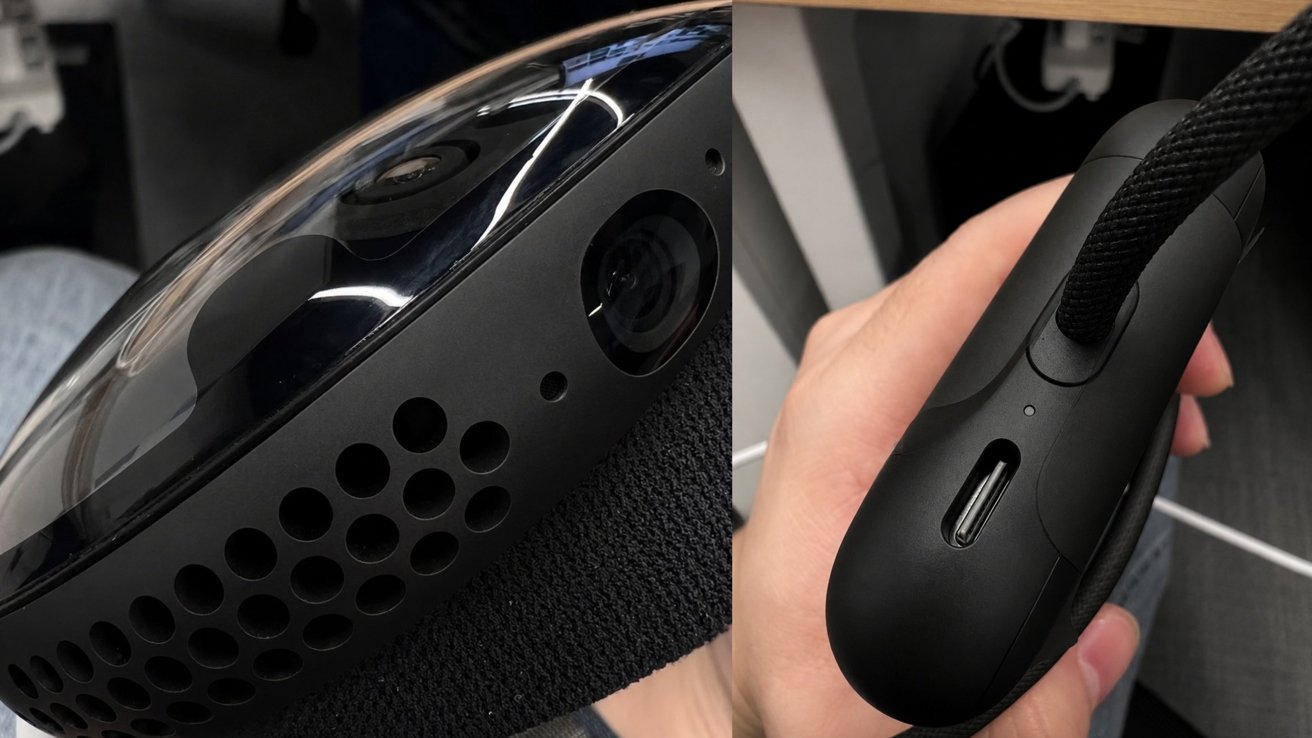
The images, posted to X on Wednesday by a Hong Kong-based developer known as Pipfix or LusiRoy8, are a collection of shots of a headset that looks like the Apple Vision Pro. One is a close-up image of a grille and a camera on the side of the headset, confirming it to be an Apple Vision Pro.
Other shots include the connector for the battery pack, with the mechanism left uncolored. Another shot is of the top of that battery pack, as well as a black braided cable.
One last image shows the knob used to adjust the band attached to the headset. Both the band and the knob are shown in black.
Previously, the account showed off images of the speakers on the side of the Apple Vision Pro, again in the black colorway.
The leaker does have a bit of a track record when it comes to colors, including those of the iPhone 17 Pro. While the previous leak briefly said that the Apple Vision Pro in black is “upcoming,” the new post simply asks readers if they like the color.
While the photographs are quite convincing, there’s no guarantee that Apple will actually release a version in that color. It’s equally plausible that they come from a prototype version that Apple made to test the color, but decided not to go through with the black model in the end.
There are some inconsistencies in some of the images. The fabric surrounding the visor doesn’t quite match the pattern of Apple’s current version, and the battery pack appears wrapped in some kind of film.
Then there’s this odd black wire wrapping between the person’s fingers and yet another white wire further in the background of the battery shot. However, these don’t appear to be AI renders, but genuine photos of black components.
That said, the inconsistent design aspects suggest these are early prototype models.
While we have had previous rumors going back to April 2025 on the topic, as well as a December shot of a black headset connector, Apple hasn’t slipped up or hinted at new color options for the Apple Vision Pro.
Given the band appears to be the Solo strap, this is likely a prototype of the M2 model that never made it to production. Apple would have no reason to offer different colorways considering how few they sell.
There’s a remote possibility of a black option being introduced in a future model. Don’t expect any mention during WWDC.
Current rumors indicate that Apple Vision Pro won’t see a new hardware iteration for some time. Apple’s Vision Product Team has reportedly directed to focus on smart glasses development while technology for a thinner and lighter Apple Vision Pro can be developed.
Currently, the soonest a new model might be announced is 2028, but Apple hasn’t said as much to supply chains yet.
The catalytic converter in your car’s exhaust system has a complex emissions-related job to perform. Placed between the engine and the muffler, it reduces the amounts of the three primary pollutants found in the exhaust gases of internal combustion engines: nitrogen oxides, carbon monoxide, and hydrocarbons. By passing the engine’s exhaust through the catalytic converter’s honeycomb-like ceramic structure, which is coated with precious metals like palladium, platinum, and rhodium, these three pollutants are converted into less harmful substances. Catalytic converters have been mandated since 1975, with nearly every car required to have one.
Another major part of your car’s catalytic converter system is the oxygen sensor, which interfaces with your engine’s electronic control system to monitor its exhaust gas flow, preventing it from running either too rich or too lean. This keeps your emissions within the legal limits, while also balancing your car’s power and economy.
Catalytic converters can be susceptible to some common problems over their lifespan, which should normally be the vehicle’s entire life. Let’s look at these problems individually, going over why they may happen and what the best ways are to fix them.
Your catalytic converter hangs underneath your car with the rest of the exhaust system, so anything that can cause damage to your muffler or exhaust pipes can also “impact” your catalytic converter. That can mean debris on the road, as well as going over a curb while driving. Doing this type of damage to your catalytic converter can cause its ceramic internal structure to crack or break, affecting its ability to properly convert the toxic substances in your unfiltered exhaust gases.
Physical damage anything like what’s shown above is likely to require replacing your catalytic converter. This type of damage to your catalytic converter will probably also lead to the illumination of your Check Engine Light, since your emission control system will severely impacted by it.
Be aware that certain states require CARB-compliant catalytic converter replacements, which meet the stricter standards set out by the California Air Resources Board. These standards apply to all cars replacing their catalytic converters in California, New York, and Colorado, including out-of-state vehicles. In addition, all CARB-compliant cars replacing their catalytic converters in the state of Maine that were made during or since the 2001 model year must be fitted with a CARB-compliant replacement unit. Be sure to check the local regulations in the state where you reside before replacing your car’s catalytic converter, and don’t even think about whether you should drive without a catalytic converter.
There are numerous ways that your car’s catalytic converter can become clogged, and none of them have anything to do with the issue of external physical damage. If you have a leak of coolant or oil that makes its way into the exhaust system or into the cylinders, it can clog up the fine ceramic structure coated with those precious metals inside the convertor, rendering it ineffective. Clogging can also be the result of using substandard fuel, misfiring spark plugs, a fuel-air mix that’s too rich, or just wear and tear over time.
If you are facing the possibility of a clog, there are ways to clean your vehicle’s catalytic converter at home. It’s definitely worth a try if the only other alternative is replacing it out of pocket.
The symptoms of a clogged catalytic converter are pretty tough to ignore. You may experience much worse fuel economy as you drive, hard starting, high heat levels that can start fires under your car, a noticeable lack of performance from your engine, a rotten egg-like smell, and all of this will likely also trigger the Check Engine light on your dashboard to go on. Keep in mind that the clogged catalytic converter is creating an obstruction in your engine’s exhaust system that your engine has to work against, which can lead to leaking oil, seals blowing out in the engine, or even a blown engine if you wait too long to fix the problem.
This unfortunate scenario has been happening to car owners across the country. California’s the leader in catalytic converter thefts nationwide, with New York, Illinois, Texas, and Florida rounding out the top five. A thief can cut off your catalytic converter in about a minute, making it unlikely they’ll be apprehended unless they are caught sawing it off. And while thieves get $50 to $500 for stolen converters, you’ll have to pay up to $4,000 to repair your car. While SUVs and pickup trucks, with their increased ground clearance, make the easiest targets, we have compiled a list of the cars most likely to have their catalytic converters stolen.
There are some ways to minimize the risk of having your car’s catalytic converter stolen. These include parking your car in a closed garage, the use of motion sensor lighting where you park your car, never failing to set your car’s alarm and locking your vehicle. If you must park in an area out in the open, be sure that it is at least lit very well.
Additional strategies for protecting your catalytic converter from theft involve making it tougher to remove or making it identifiable. Theft prevention devices include straps, clamps, or cages that make catalytic converter removal much more time-consuming, encouraging thieves to leave your car alone and move on to an easier, unhardened target. Another proactive way to discourage theft is to have your catalytic converter etched or engraved with your VIN or license number, making it easier to identify the owner.
A modern catalytic converter’s oxygen sensor measures how efficiently it is doing its job by monitoring the amount of oxygen present in the exhaust gases. Over time, and possibly due to some engine-related issues like coolant leaking into the cylinders, a bad gasket, or a too-rich fuel mixture, the oxygen sensor can become contaminated or just wear out. In addition to this “downstream” oxygen sensor connected to the catalytic converter, there is usually an “upstream” or “pre-cat” sensor that controls the fuel supply to the engine.
Some indications that your car’s oxygen sensor is failing can include rough engine operation, reduced fuel efficiency, and the Check Engine light on your dash lighting up to alert you there’s a problem. And while you can clean a car’s O2 sensor, it’s not a great long-term idea. To identify the problem with your oxygen sensor, a diagnostic device should produce some trouble codes to guide you along. Make sure that there are no leaks detectible in your fuel injection system or your exhaust manifold, also checking the state of your ignition system parts. Once that you have properly diagnosed the problem and identified which of these sensors is faulty, the bad one can be replaced and correct engine operation restored.
The role of the oxygen sensor in your car’s emission control system, when operating properly, cannot be overemphasized. By consistently monitoring the flow of your car’s exhaust gases, it keeps emissions in check, maximizes performance, and gives you the best possible fuel economy.





Waymo dominates autonomous vehicle registrations as Tesla trails behind


This is BROKEN! INSANE 5x MONEY CAR WASH WEEK! The NEW GTA Online UPDATE Today! (GTA5 New Update)

SpaceX just won a second Golden Dome contract. This one is $4.16 billion.


Jade Biosciences, Inc. (JBIO) Discusses Positive Interim Results From JADE101 Phase I Healthy Volunteer Study and Development Plans Transcript


SHE IS KILLING XRP!!! WATCH URGENT AND ACT FAST

FIRST NIGHT REVIEW: Take That bring the Circus back to life in spectacular sun-soaked style

CFTC Has Approved the First Regulated Bitcoin Perpetual Contract in the U.S.


Is the Spurs Phenom Already Better Than Prime Diesel?
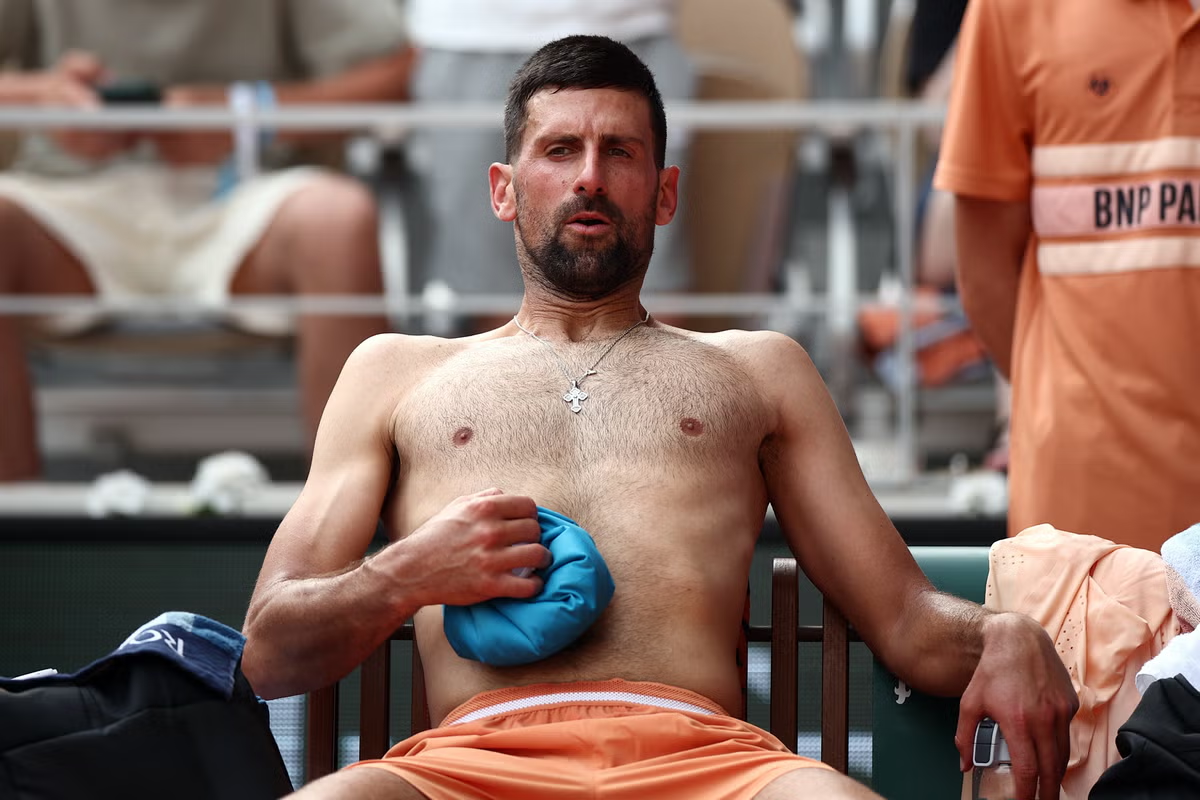
Novak Djokovic v Joao Fonseca LIVE: French Open latest scores and results after Jannik Sinner’s shocking collapse

Weak ‘Supergirl’ Box Office Tracking Amid Milly Alcock Backlash

Snowflake (SNOW) Stock Rallies on Strong Q1 Results and AI Product Growth

Demand Conditions Improve In Chemicals Sector In April 2026


MicroStrategy Moves $30 Million in BTC to Coinbase Prime: Is the Bitcoin Sell-Off Already Here?


The House | Inside Andy Burnham’s Makerfield Campaign: “Nobody Thinks This Is In The Bag”


This Week In Security: Ubiquiti Fixes, And FreeBSD Joins The Club You Don’t Want To Join

One of the Greatest Sitcoms of All Time Shoots Up Apple TV’s Charts 11 Years Later


Maddox Jolie-Pitt Legally Requests to Drop Brad’s Surname

Seagate (STX) Stock Surges to Record High on AI Boom and Legal Settlement

Britney Spears Shares Troubling Update After Hard Year

Bruce Willis’ Generosity Resurfaces Amid His Dementia





You must be logged in to post a comment Login