

Crypto World
Payward Services Brings Retail Access to US IPO Allocations

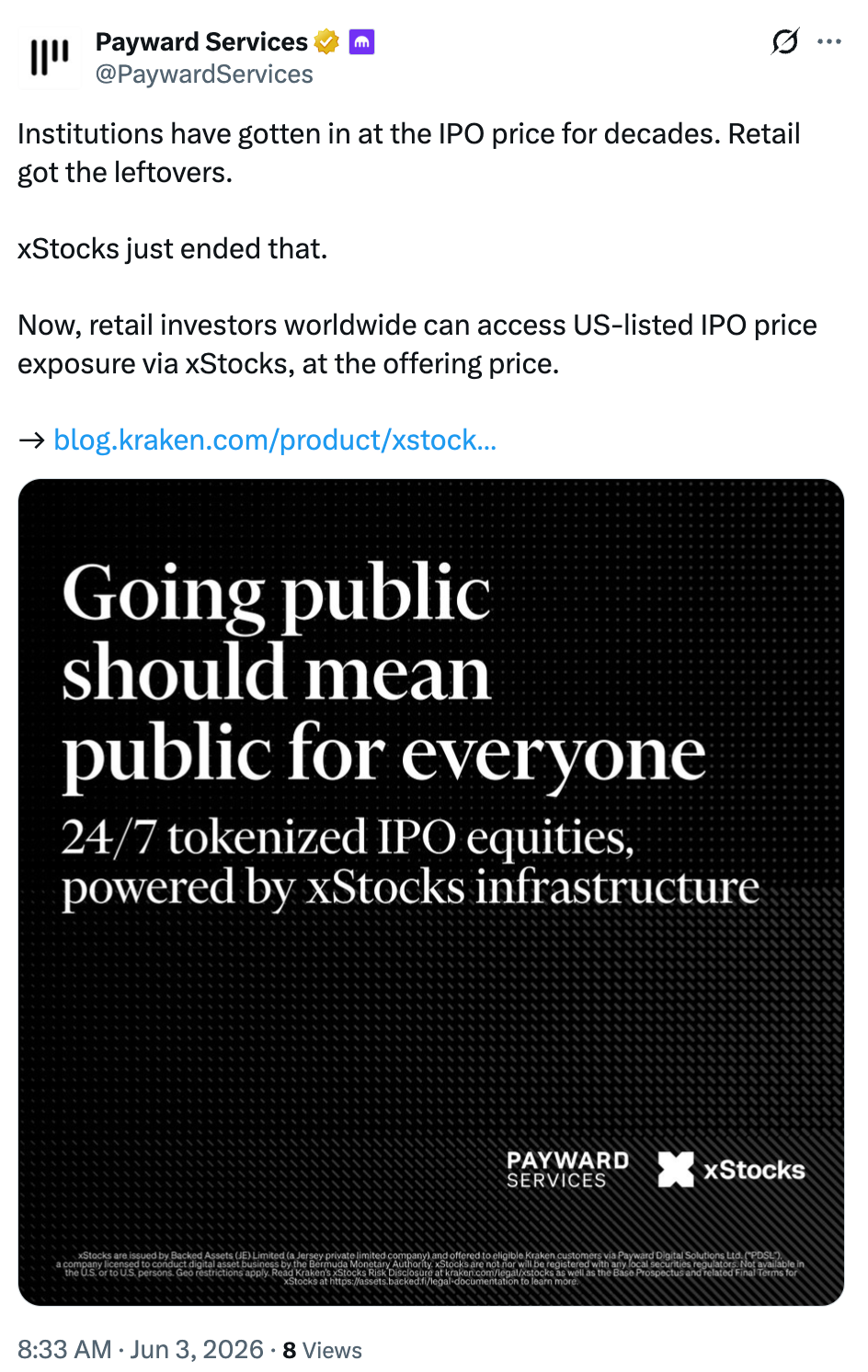
Retail investors will soon be able to participate in US initial public offerings (IPOs) at the offering price through a new tokenized equities program from Payward Services, a Kraken-affiliated company.
In a Wednesday announcement, Payward Services said customers of Kraken and select members of its xStocks Alliance will be able to express interest in US-listed IPOs before companies go public and receive allocations of tokenized shares on listing day.
According to the company, the shares will be issued at the IPO offering price and backed 1:1 by the underlying stock held in custody by a regulated entity, allowing eligible retail investors to access allocations that are typically reserved for institutional clients.
The launch marks one of the latest efforts to use blockchain infrastructure to broaden access to traditional financial products amid a global push for real-world asset (RWA) tokenization.
Bringing IPO allocations onchain
Under the proposed process, participating exchanges will open an indication-of-interest window in the weeks before an IPO, allowing customers to submit non-binding requests to purchase shares within the expected pricing range.
Payward will aggregate demand from participating platforms and work with an underwriting syndicate before allocations are finalized on the company’s public listing day.
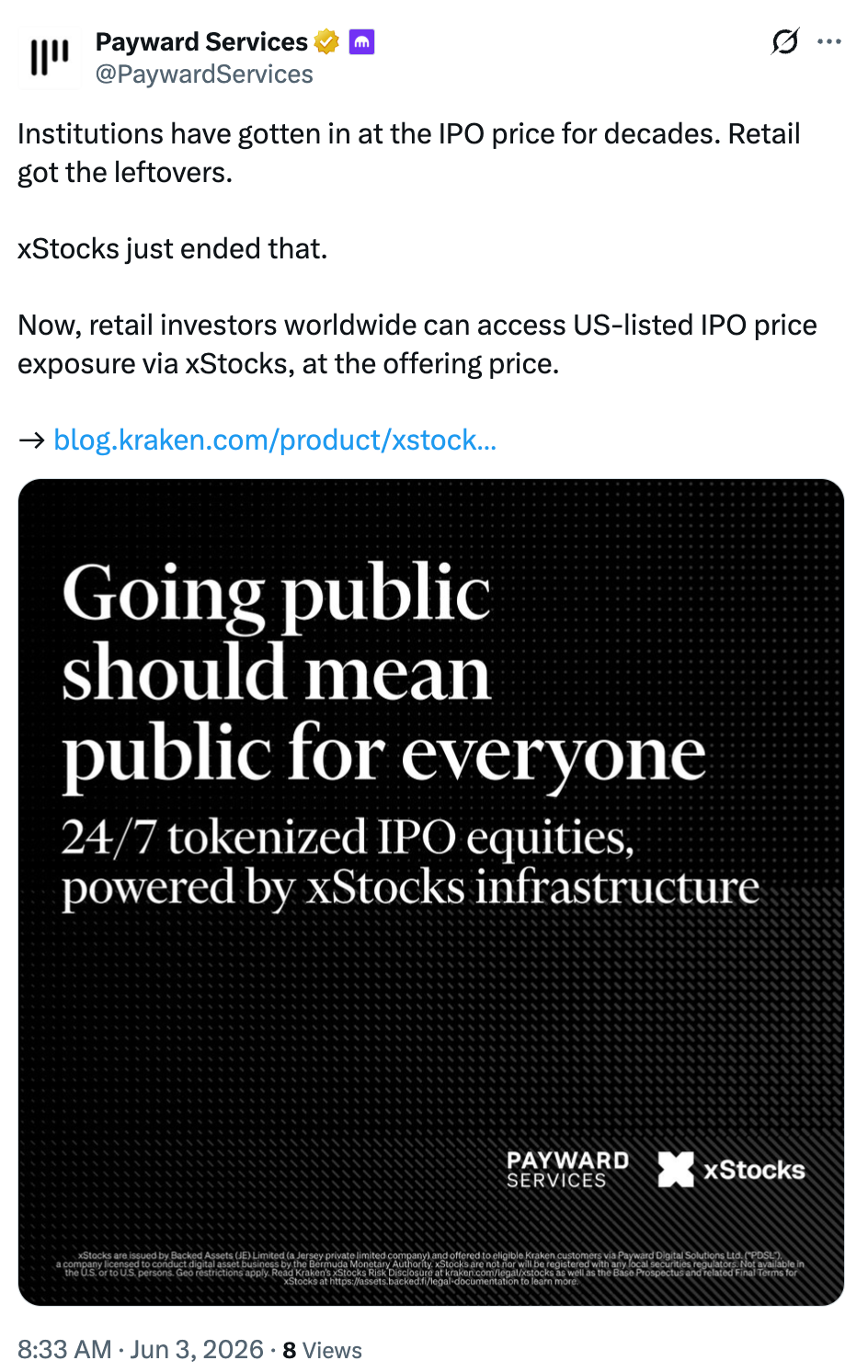
Source: Payward Services
The resulting shares will be tokenized and distributed through partner exchanges, enabling investors to receive exposure to newly listed companies without opening accounts with traditional brokerage providers.
First availability expected in coming weeks
The first tokenized IPO offerings are expected to become available to customers of Kraken and other xStocks Alliance members in the coming weeks, with Payward planning to add more launch partners and markets over time.
“Going public should mean public to everyone,” said Mark Greenberg, global head of Payward Services, adding that getting in at the IPO price has been a “privilege of geography and net worth” for decades.
“Now a retail investor in Medellín, Madrid, or Malaysia can have similar access to a US-listed IPO, and Payward Services’ xStocks infrastructure is finally making that possible for the masses,” the executive added.
Related: Binance launches SpaceX-linked perpetual futures ahead of IPO
The announcement comes as interest in tokenized RWAs continues to grow, with Bernstein Research estimating the RWA market has reached $51 billion after expanding 42% this year.
Payward Services said xStocks processed more than $30 billion in transaction volume during its first year, including over $6 billion settled onchain, across more than 125,000 holders globally. Kraken acquired xStocks operator Backed Finance in late 2025.
Magazine: Kraken’s $600M stablecoin firm, Huione scandal deepens: Asia Express

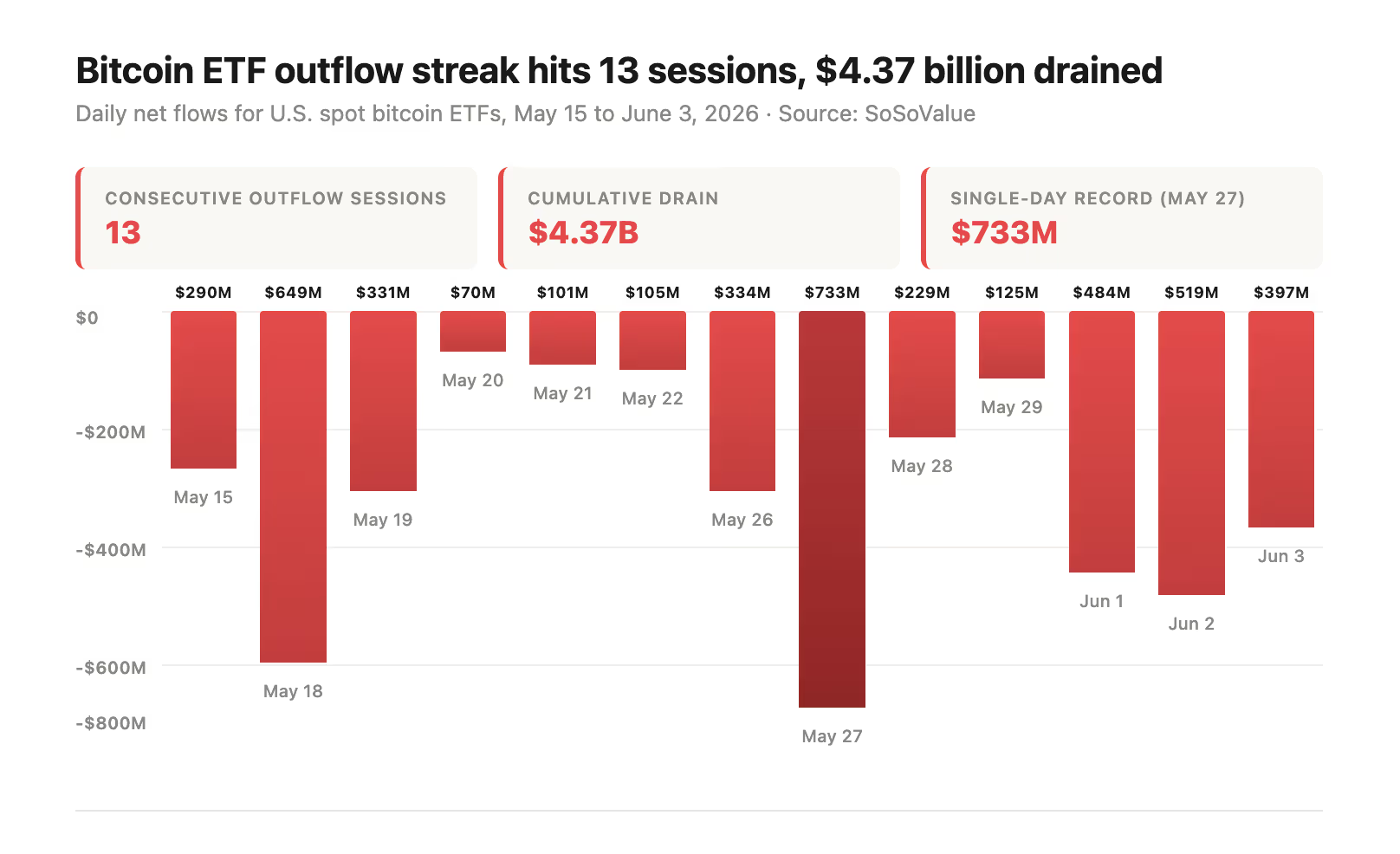
The bitcoin ETF bleed has spread across crypto.
U.S. spot bitcoin funds shed another $396.60 million on Wednesday, extending a record outflow streak to 13 straight sessions and a $4.37 billion drain since mid-May, while ether, solana and XRP products joined the redemption wave.
Hyperliquid’s spot HYPE ETF was the only major crypto fund still pulling in net new money.
BlackRock’s IBIT, the largest bitcoin ETF by net assets, absorbed the bulk of Wednesday’s outflow with $342.34 million in redemptions, according to SoSoValue data. Fidelity’s FBTC lost another $54.26 million.

The two funds dropped 2.76% and 2.65% respectively as bitcoin traded around $65,462, down from above $71,000 at the start of the week.
Total net assets across all U.S. spot bitcoin ETFs have fallen from $104.29 billion on May 15, the last session before the outflow streak began, to $82.83 billion on Wednesday.
That is a $21.46 billion drop in roughly three weeks, with redemptions and bitcoin’s price slide combining to do the damage. Bitcoin ETF AUM now represents 6.36% of bitcoin’s circulating market cap, down from above 7% at the May peak.
Elsewhere, Ether ETFs lost a combined $52.94 million on the day. BlackRock’s ETHA accounted for nearly all of it at $51.58 million, and the fund dropped 5.56% as ether traded below $1,900.
Solana funds lost $12.74 million on Wednesday, led by Bitwise’s BSOL with $11.56 million in outflows. XRP funds shed $5.34 million, with Bitwise’s flagship XRP ETF taking the hit.
Both categories have now joined bitcoin and ether in net daily outflow for multiple consecutive sessions, ending a period in which altcoin ETFs had been drawing modest but consistent retail interest while bitcoin funds bled.
Hyperliquid’s spot ETF complex was the lone outlier. 21Shares’ THYP took in another $2.99 million, pushing cumulative HYPE ETF net inflows to $139.51 million since the May 12 launch and total net assets to $192.01 million. The token gained 3.45% on the day to $73.39 as the rest of crypto sold off.

Grayscale launched its own Hyperliquid product, HYPG, on Wednesday, pitching it as the lowest-fee U.S. spot HYPE vehicle and undercutting Bitwise’s BHYP and 21Shares’ THYP on expense ratio. The launch arrives at a moment when every other major crypto ETF category is in net redemption.
Citi told clients on Tuesday that spot bitcoin ETF flows explain roughly 45% of weekly BTC price moves, calling them the best gauge of investor adoption. The bank expects sentiment to stay subdued as long as ETF flows turn negative and the U.S. crypto market structure bill stalls.

TLDR:
- Ethereum retail accumulation addresses have surged to near-record levels in late 2025 and early 2026.
- ETH SOPR has remained close to 1 for an extended period, reflecting limited fresh capital inflows.
- NUPL remains above 2018 and 2022 bear market lows, leaving room for further ETH price downside.
- Binance user deposit addresses stay below bull market peaks, slowing but not halting ETH’s decline.
Ethereum’s on-chain metrics are pointing to a growing divide between retail and large-scale investors. Accumulating retail addresses have surged to near-record levels in late 2025 and early 2026.
Meanwhile, the Spent Output Profit Ratio (SOPR) has remained close to 1 for an extended period. The Net Unrealized Profit/Loss (NUPL) indicator also leaves room for further downside.
Together, these readings paint a cautious picture of where ETH currently stands.
Retail Buyers Step In as On-Chain Signals Flash Caution
Retail accumulation in the Ethereum network has reached exceptional levels in recent months. Historically, the strongest retail buying tends to occur during the later stages of a market cycle.
Larger players, by contrast, tend to use these periods to distribute their holdings into demand. Rising retail accumulation, therefore, does not automatically translate into a bullish outlook.
SOPR has been hovering near the 1 level for a prolonged stretch of trading sessions. This reading shows that investors are largely breaking even on spent outputs.
Fresh capital entering the market remains limited under these conditions. Markets that stay near this SOPR range for long periods tend to become fragile over time.
Analyst PelinayPA weighed in on the current setup, stating: “Retail investors are buying aggressively, yet SOPR isn’t confirming a strong bullish trend. When growing demand fails to push prices higher, it often suggests significant selling pressure on the other side of the market.”
The observation points directly to whale distribution absorbing retail demand without driving prices upward. That dynamic has become one of the more closely watched developments in Ethereum’s on-chain landscape.
On the exchange side, Binance user deposit addresses remain below prior bull market peaks. This pattern suggests that many holders are still keeping ETH off exchanges rather than preparing to sell.
That behavior may be contributing to the relatively gradual pace of the current decline. However, it does not remove the underlying risks present in the current data.
NUPL Leaves Room for Further ETH Downside
NUPL currently reflects a market where unrealized profits have declined but remain above bear market extremes. The readings seen during the 2018 and 2022 bear markets were far more depressed than current levels.
This gap means there is still space for sentiment to weaken further before ETH reaches historically oversold territory. Investors should note this distinction when evaluating the present conditions.
PelinayPA further noted: “A break of SOPR below 1 combined with a weaker NUPL could increase the risk of a deeper ETH correction.” This scenario does not confirm an imminent crash, but it does raise the probability of extended downside.
Analysts tracking Ethereum have flagged this combination as a key threshold to monitor. The two indicators carry more weight when read together than in isolation.
When increasing demand fails to move prices higher, it often points to heavy selling pressure on the opposite side of the market. Whales appear to be absorbing retail demand as they distribute their holdings.
Until SOPR confirms renewed strength and NUPL compresses further, the near-term outlook for ETH remains uncertain. The current on-chain setup warrants measured caution from market participants.


The U.S. Commodity Futures Trading Commission has abolished a long-standing policy that barred settlements when a defendant publicly denied the agency’s allegations. The move, disclosed this week, ends nearly three decades of a rule critics say stifled free speech while supporters argued it helped preserve orderly settlements.
The CFTC said the no-deny policy, adopted in 1998, may have created an incorrect impression that the Commission was shielding itself from criticism. The agency framed the change as aligning with broader government practice, where regulators have loosened settlement language to reflect evolving enforcement approaches.
Key takeaways
- The CFTC has rescinded its no-deny settlement policy, effective for new cases going forward, after almost 30 years of application.
- The change provides the agency with greater flexibility when resolving enforcement actions, potentially allowing settlements that do not require defendants to concede the Commission’s allegations publicly.
- Existing no-deny provisions will not be enforced going forward, though future settlements may still require defendants to admit certain facts or liabilities.
- The move mirrors a similar shift by the Securities and Exchange Commission earlier this year, which also abandoned a gag-like constraint on settlements.
- Observers tied the development to a broader political and regulatory backdrop, including ongoing debates over how crypto-enforcement actions should be settled and framed in public discourse.
The policy reversal and what it changes in practice
For nearly thirty years, the CFTC refused to settle enforcement actions unless the defendant promised not to publicly deny the Commission’s allegations. The agency argued that this condition helped maintain the integrity of its casework and ensured clear accountability in settlements. In its recent notice, the CFTC argued that retaining the policy could mislead the public into thinking the agency was avoiding scrutiny, prompting a rethink of how settlements should be structured in a modern regulatory environment.
With the policy rescinded, the CFTC asserts it now has more room to craft settlements that fit the realities of contemporary enforcement, where public statements and ongoing litigation can diverge from negotiated outcomes. The agency stressed that the change does not erase the possibility that settlements may still require certain factual admissions or liabilities, depending on the specifics of a case. In other words, the door to a more nuanced settlement framework is open, but not a blanket license for issuers or trading platforms to avoid accountability where appropriate.
Regulatory context and reactions from the ecosystem
The timing of the move sits within a broader regulatory cadence that has seen agencies recalibrate how crypto enforcement is communicated and resolved. Earlier this year, the SEC likewise moved to discard a gag-like provision that had limited the parties’ public denials in certain enforcement deals, signaling a potentially coordinated, cross-agency shift toward greater settlement flexibility. As with the CFTC’s action, the SEC’s decision was framed as aligning regulator practices with broader government norms.
Crypto companies and industry participants have long criticized such no-deny provisions as curbing free speech and constraining post-settlement discourse, even as some proponents argued the constraints helped deter frivolous settlements or mischaracterizations of enforcement actions. The current policy shift suggests regulators may be leaning toward more transparent disclosures in settlements, while still preserving the ability to secure accountability where appropriate.
The development comes amid a dynamic political backdrop. In the wake of various enforcement actions taken during the Biden administration, some observers have noted shifts under different political leadership, including attempts to reassess prior settlement strategies. It remains to be seen how broadly regulators will apply the new posture across cases and whether the changes will translate into faster resolutions or more litigation when parties push back against admissions or certain factual statements.
Gemini dispute and what it signals for enforcement priorities
The week also brought attention to a separate line of action tied to the Gemini settlement. The CFTC announced it would seek to vacate its $5 million settlement with the crypto exchange, a move that CFTC Chair Mike Selig described as politically targeted. The development underscores how settlements—and the conditions that accompany them—remain a live flashpoint in crypto regulation, with agencies testing the boundaries of what is acceptable public messaging around enforcement outcomes.
In discussing the reversal, observers warmed to the idea that enforcement posture is evolving. Tim Massad, who previously led the CFTC during the Obama administration, characterized the Gemini reversal as extraordinarily unusual. His remarks, reported in coverage this week, highlight the unusual degree to which agencies are revisiting settled matters in response to new policy directions and political scrutiny. The Gemini case illustrates that even settled actions can be reexamined when the legal and regulatory environment shifts, potentially recalibrating market participants’ expectations about the durability of settlements.
What investors and builders should watch next
For market participants building in the crypto space, the rescission of the no-deny policy may influence how projects and platforms approach settlements and communications after enforcement actions. If regulators are more open to settlements that do not require explicit public denials, legal strategies may tilt toward achieving efficient, transparent settlements while addressing factual liabilities in a structured, precise way. Yet the possibility remains that some settlements will demand admissions of certain facts or liabilities, signaling that not all disputes will be resolved without some form of acknowledgment.
Beyond individual cases, the shift suggests a broader trend toward flexible settlement language across major U.S. financial regulators. The move could affect how exchanges, wallets, and DeFi platforms negotiate settlements if they face enforcement actions in the future. It may also influence the tempo of regulatory action, with the potential for faster resolutions when parties are willing to accept admissions, or, conversely, longer litigation if admissions are contested vigorously.
As observers digest the implications, attention will turn to whether other agencies follow suit and whether this renewed flexibility translates into clearer, more predictable settlement practices for the crypto sector. The balance regulators must strike is delicate: enabling accountability and enforcement while allowing for discourse and recognition of evolving market realities. The next few months will reveal how these policy shifts play out in actual settlements, and how market participants adjust their expectations around public statements, admissions, and the contours of negotiated outcomes.
Readers should monitor forthcoming agency announcements and court filings for how the no-deny framework is applied across new enforcement actions, and whether the Gemini case or similar settlements set precedents for what must or may be admitted in settlements moving forward. The coming months are likely to reveal how these policy refinements shape the interaction between crypto markets, regulators, and the legal system.
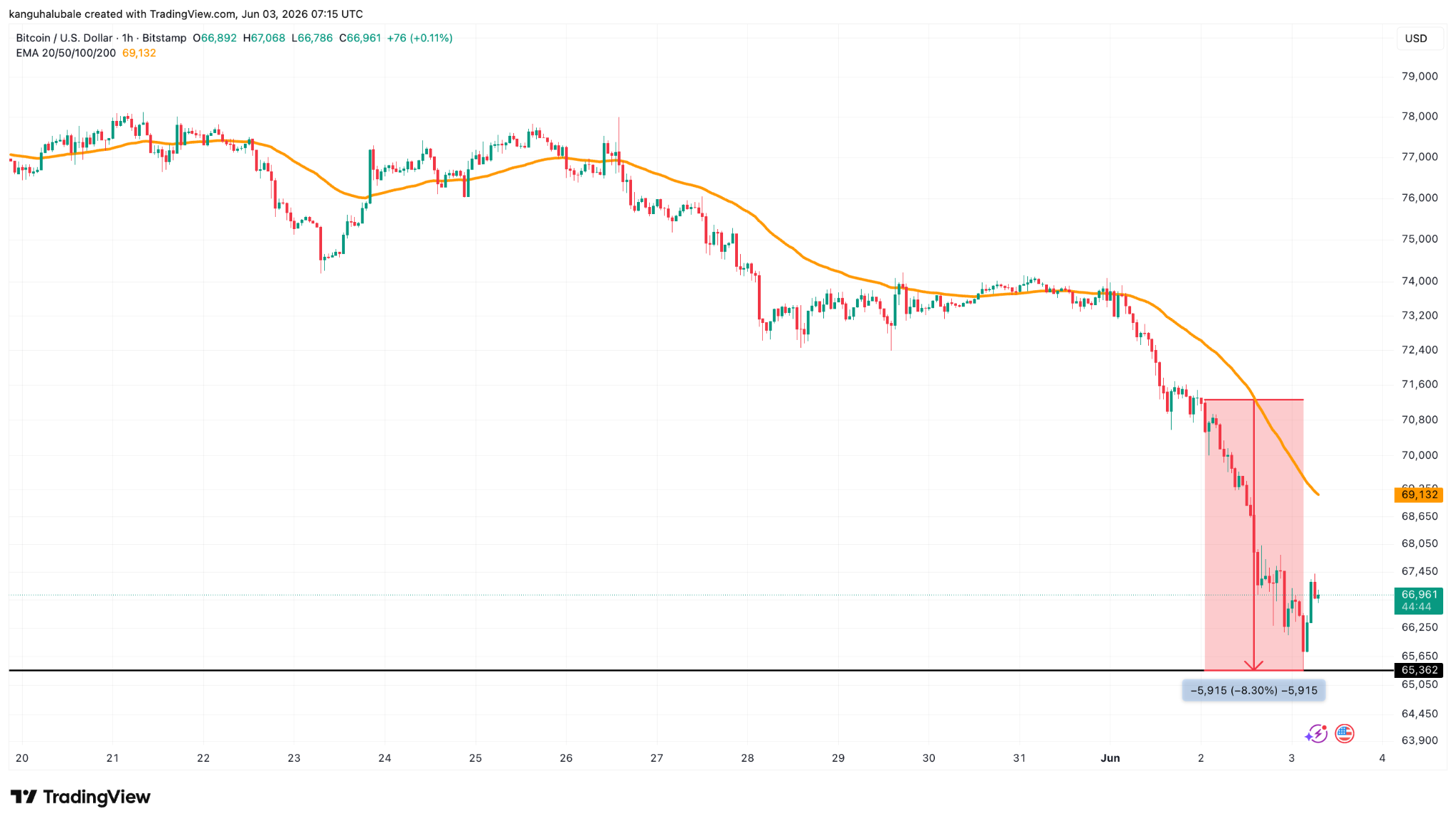
Bitcoin (BTC) has dropped 8% to a nine-week low of $65,360 from Tuesday’s high of $71,300 amid increasing geopolitical risks surrounding the US-Iran war.
Key takeaways:
- Bitcoin slipped to $65,000 on Wednesday in a market-wide correction, liquidating $774 million in longs.
- Traders say Bitcoin needs to hold $60,000 as support to avoid a deeper correction in BTC price.
Bitcoin wipes out longs in tumble to $65,000
Data from TradingView showed new BTC price lows of $65,362 on Bitstamp, the lowest since March 29 as sellers stayed in control.
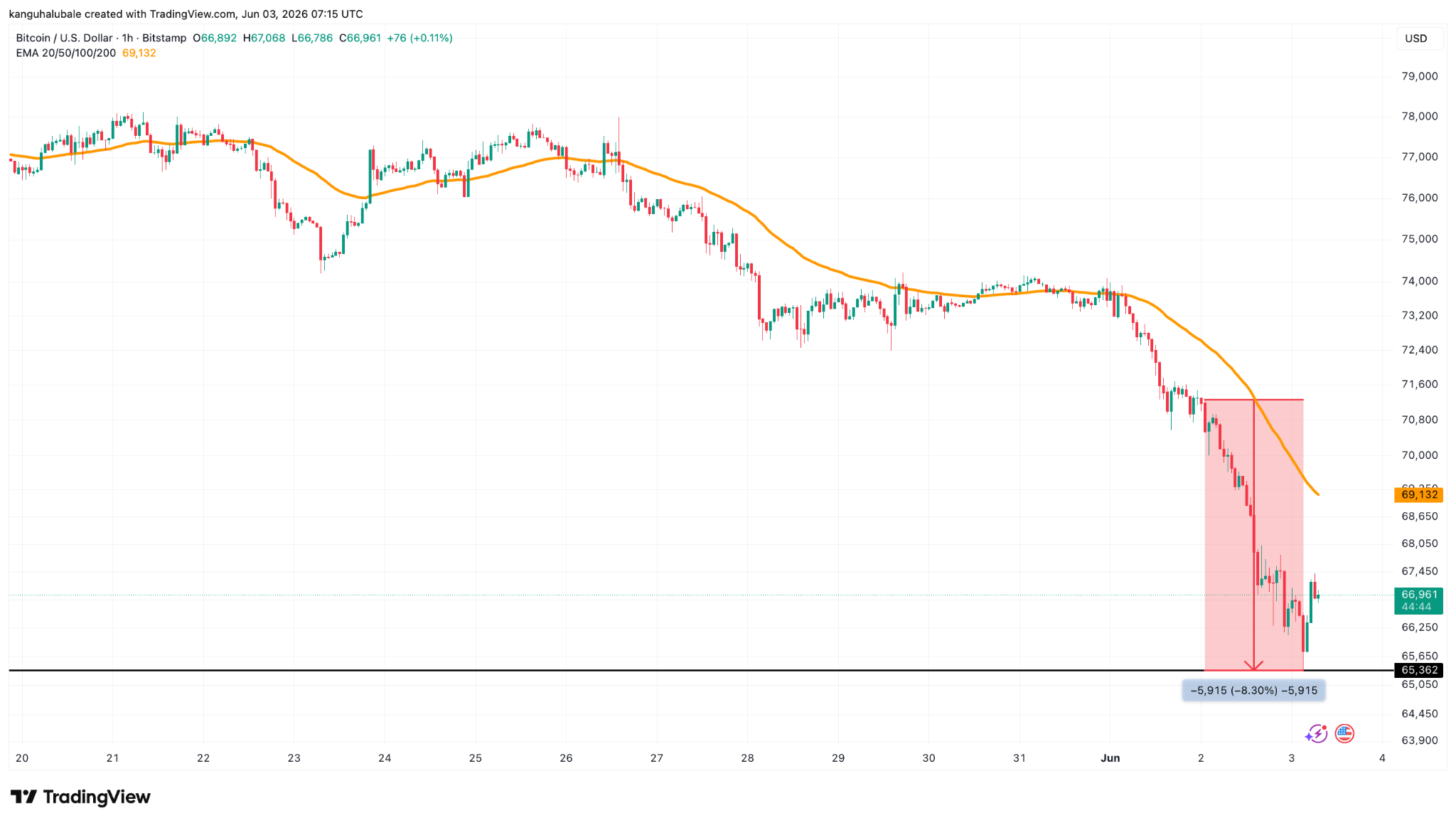
BTC/USD daily chart. Source: Cointelegraph/TradingView
This extended the deviation from the local high of $82,800 to 21% and was accompanied by massive liquidations across the derivatives market.
Related: Bitcoin’s $224K ‘fair value’ may emerge if sovereign debt fears deepen: Bitwise
More than $1.58 billion in long positions were liquidated, with Bitcoin accounting for $774.2 million of that total. Ether (ETH) followed with $440 million in long liquidations.
Across the board, a total of $1.83 billion was wiped out of the market in short and long positions, marking the largest liquidation since Feb. 6, when BTC price tanked to its multi-year low below $60,000.
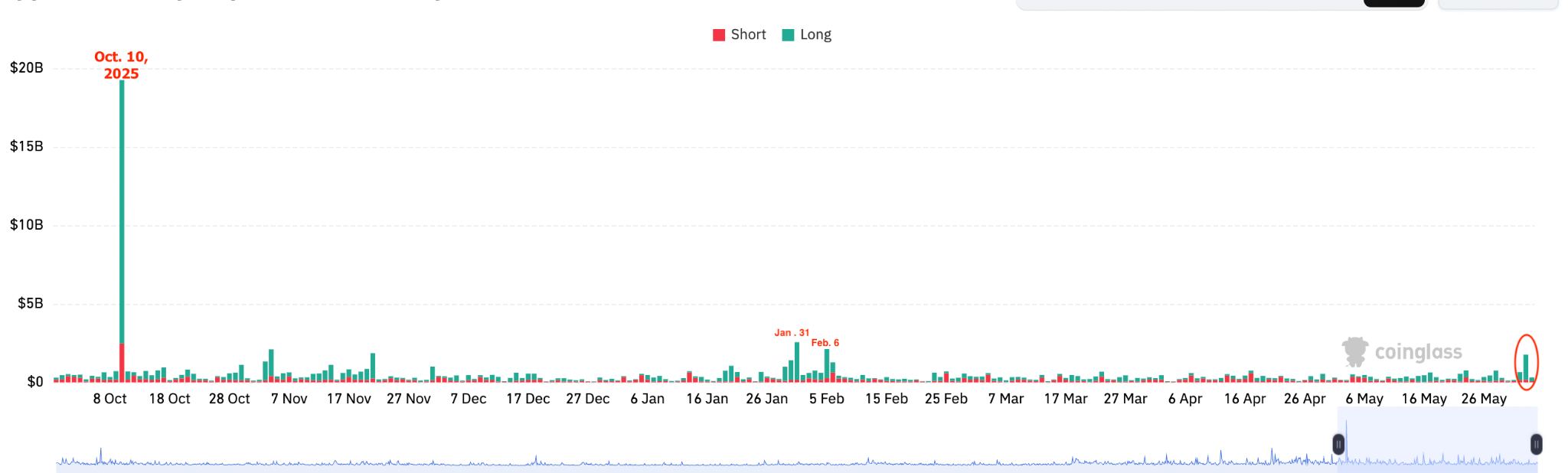
Total crypto liquidations across all exchanges. Source: CoinGlass
“This marks one of the larger single-day events in recent months,” analysts at CryptoBanter said in an X post on Wednesday.
Pseudonymous analyst Byzantine General shared Velo data, which tracks liquidations from four major crypto exchanges: Binance, Bybit, OKX and Deribit, saying:
“Highest $BTC long liquidations event since the infamous October 10 black swan event.”
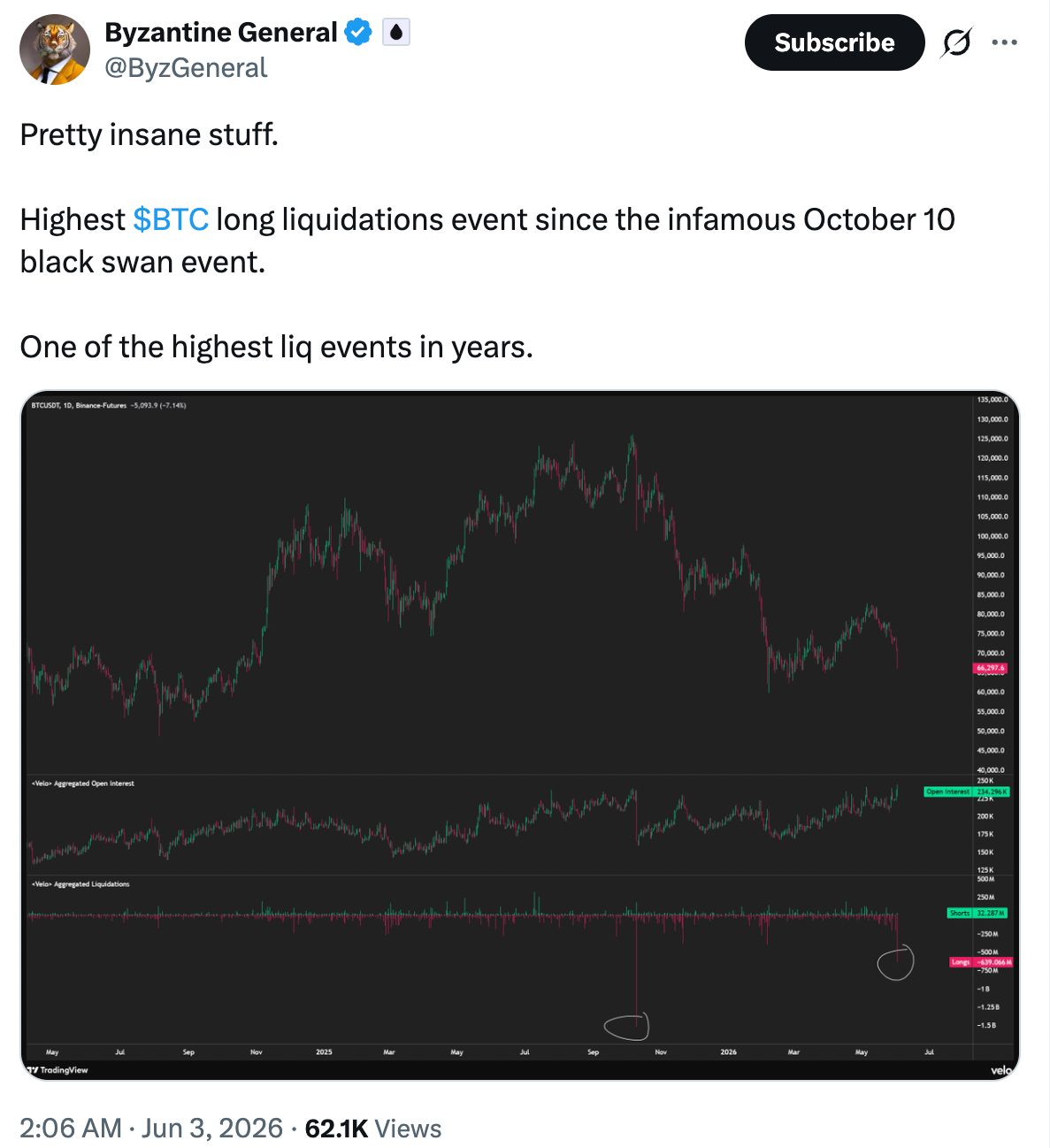
Bitcoin aggregate liquidations. Source: X/Byzantine General
Fellow analyst DonaX₿τ pointed out that the $1.5 billion in long liquidations recorded today were lower than the $1.6 billion posted during the Covid crash in 2020, adding:
“This industry is growing.”
Meanwhile, Bitcoin supply on Binance, the world’s largest crypto exchange by trading volume, has reached a three-month high of 659,000 BTC.
This signifies a “potential for heightened selling pressure in the market, especially if it coincides with declining prices or increased volatility,” CryptoQuant analyst Arab Chain said in a QuickTake note on Wednesday, adding:
“Rising supply on exchanges can amplify price volatility and selling pressure, especially if inflows continue in the coming period.”
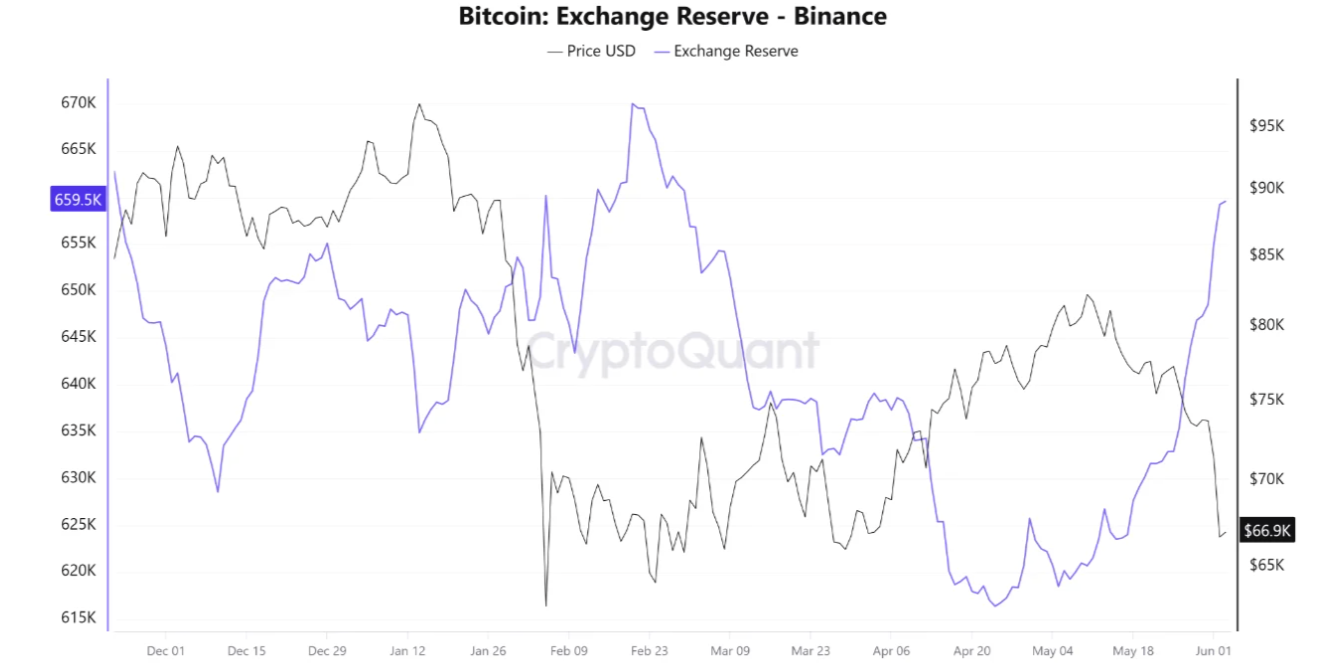
Bitcoin supply on Binance. Source: Cryptoquant
As Cointelegraph reported, Bitcoin is now in a fresh distribution phase fueled by increased inflows to exchanges amid extreme fear.
$60,000 is now Bitcoin’s last line of defence
BTC swept lows around $65,000, leaving traders questioning where Bitcoin is likely to find support.
Bitcoin is in an “interesting zone” below $66,000 with bulls looking at the “area at $61K with the 200-Week MA for support,” MN Capital founder Michael van de Poppe said in a Wednesday post on X, adding:
“Those are important to be looking at crucial zones of interest for support and I’m sure that I’ll be going to accumulate more positions within this region.”
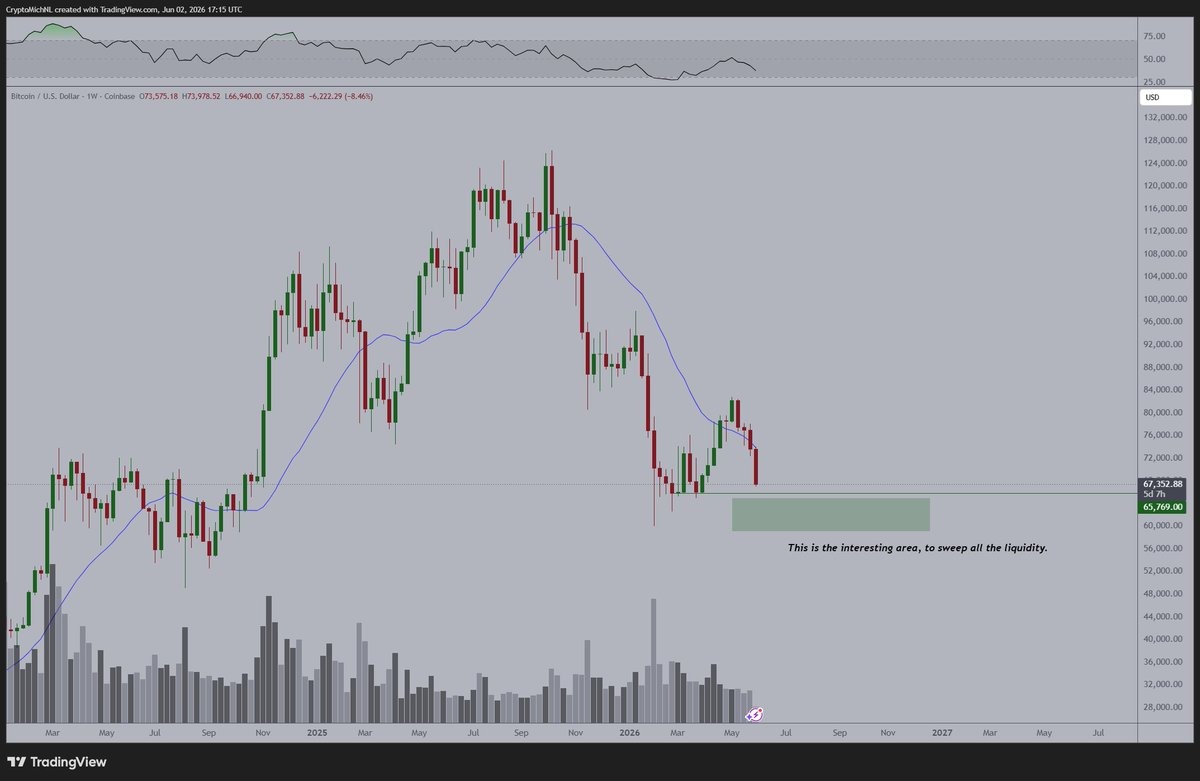
BTC/USD weekly chart. Source: Michael van de Poppe
Analyst Colin Talks Crypto said the $65,000-$66,000 is “a reasonable support level for a short-term bounce,” with the possibility of the BTC/USD pair later retesting the $60,000 support zone.
“Re-testing $60k is still highly likely. And breaking below it later this year is definitely not ruled out.”
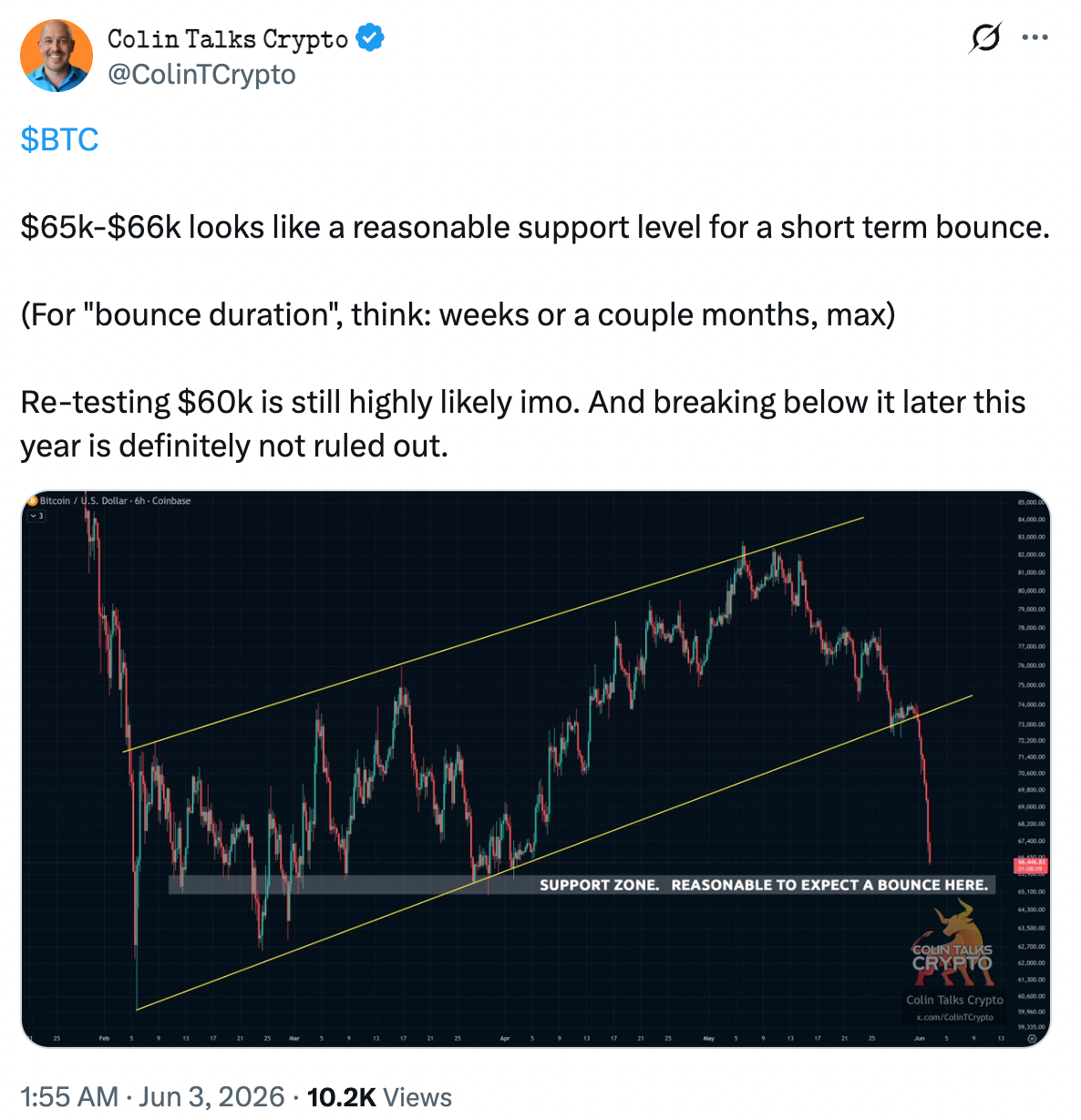
BTC/USD six-hour chart. Source: X/𝙲𝚘𝚕𝚒𝚗 𝚃𝚊𝚕𝚔𝚜 𝙲𝚛𝚢𝚙𝚝
As Cointelegraph reported, bulls are expected to defend the $60,000 level aggressively, as a break below it may plunge Bitcoin into a new downtrend.
Update (June 3, 1 pm, UTC): This article has been updated to include a comment from a spokesperson at BingX.
The United Kingdom’s financial regulator has warned football clubs, including those in the Premier League, to avoid sponsorship deals with unauthorized financial companies amid concerns that fans are being pushed toward risky crypto and trading platforms with no protections.
In a Wednesday press release, the Financial Conduct Authority (FCA) said several unauthorized firms, including crypto businesses and online trading platforms, are using football sponsorships to target “unwitting” supporters.
It warned that such firms may be breaching UK financial services law by operating without authorization and that fans using them “risk losing all their money.”
The intervention puts scrutiny on the clubs themselves. The FCA said that it had written directly to football clubs, telling teams that sponsorship deals with unauthorized financial firms not only endanger fans but could also expose clubs to legal liability, money laundering risks, and serious reputational damage if they fail to carry out adequate checks on partners.
The warning comes as crypto and trading brands have expanded their presence across top-flight football, giving retail-facing platforms prominent exposure through club sponsorships as the FCA steps up enforcement of its financial promotions rules.
Related: UK FCA seeks feedback on guidance for crypto rules ahead of 2027 rollout
The regulator expects every UK club to conduct proper, ongoing due diligence on financial services sponsors and said it will take action where concerns have already been identified.
Rise in crypto football sponsorship deals
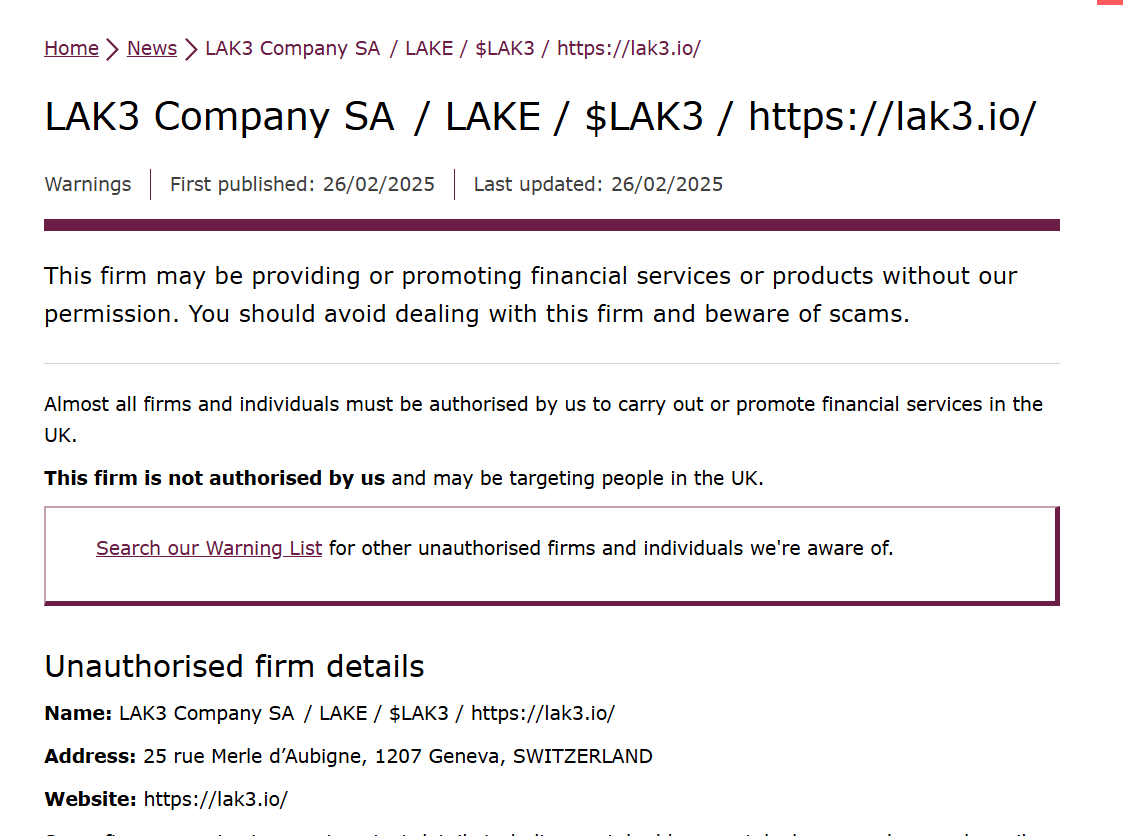
The FCA’s warning comes amid a rapid influx of crypto and trading brands into football, including crypto group LAK3 Company, which sponsored Wolverhampton Wanderers in the 2024-25 season, which appears on the FCA’s Warning List of unauthorized firms.
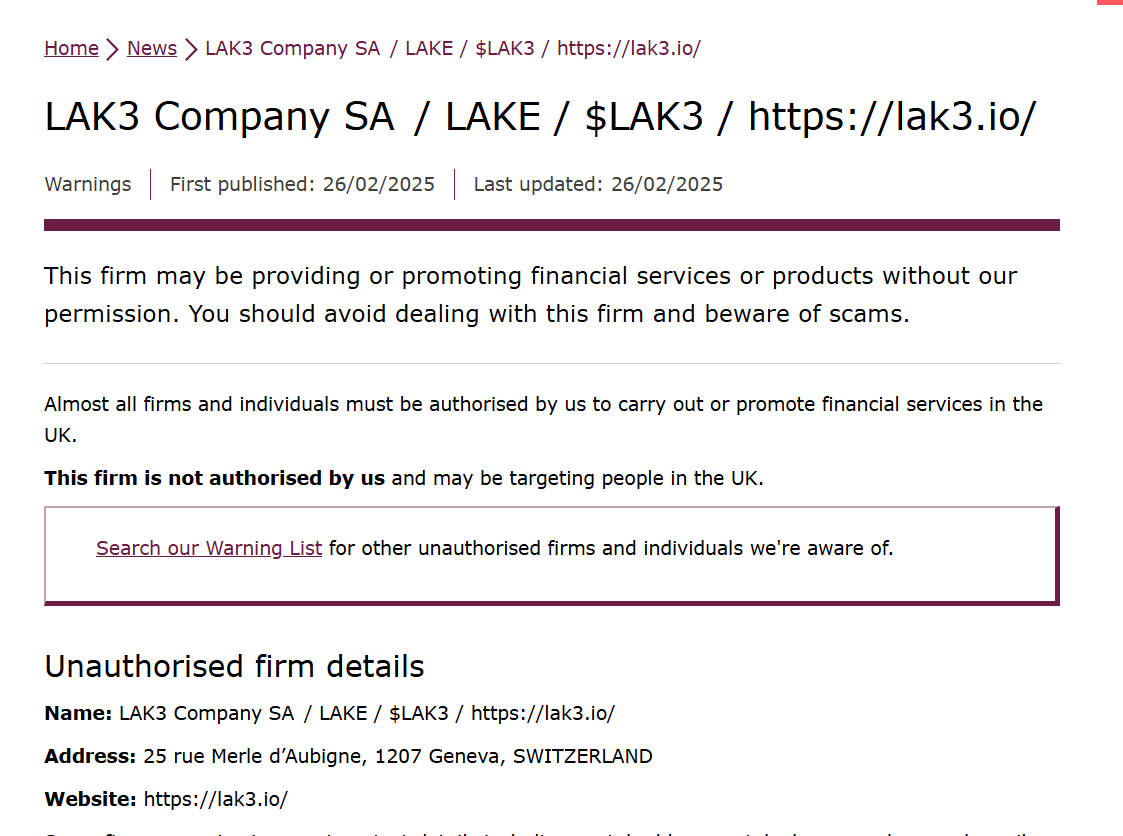
LAK3 Company appears on the FCA’s warning list. Source: FCA
BingX and OKX, which have partnered with Chelsea and Manchester City, are not on the FCA’s Warning List, but the Financial Times reported that they do not appear on the FCA register of authorized firms.
Their deals have given prominent shirt and stadium exposure to retail-facing trading platforms, as the regulator has been clamping down on high-risk promotions.
The FCA did not respond to a request for comment by publication. In its notice, however, the regulator stressed that any firm not authorized in the UK can only promote financial products or services to consumers if its adverts are signed off by an authorized firm under the financial promotions regime.
A spokesperson from BingX told Cointelegraph that the company has “registered or obtained the applicable regulatory approvals to operate in countries where it provides its services.”
Crypto marketing firmly under FCA oversight
The FCA already brought crypto marketing under its financial promotions regime in October 2023, issuing 146 alerts in the first 24 hours alone and launching its first enforcement action against global exchange HTX (formerly Huobi) in February 2026 for allegedly illegal crypto promotions to UK consumers.
Its latest move makes clear that football sponsorships are now firmly in scope for the FCA’s crypto marketing rules. The watchdog said it is working with the government, the Premier League and the incoming Independent Football Regulator to tackle the issue across the sport.
The crackdown also follows a separate warning by the Gambling Commission over gambling adverts on children’s replica kits at four Premier League clubs, Bournemouth, Fulham, Newcastle, and Wolves, highlighting growing regulatory unease about how high-risk products are sold through football.
Cointelegraph reached out to Chelsea and Manchester City, as well as OKX, and LAK3 Company, for comment, but had not received a response at the time of publication.
Magazine: How to fix suspected insider trading on Polymarket and Kalshi


The U.S. Commodity Futures Trading Commission has rescinded its long-running “no-deny” policy for enforcement settlements.
Summary
- CFTC ended its 1998 no-deny policy, giving defendants more room to dispute enforcement allegations publicly.
- The move follows the SEC’s May reversal and extends a wider reset in crypto enforcement.
- Gemini’s $5 million case adds fresh context as the CFTC reviews older crypto actions now.
The rule, adopted in 1998, blocked the agency from accepting settlement offers when a defendant continued to deny allegations in a complaint or administrative order.
The CFTC said the old policy may have created the view that the agency wanted to “shield itself from criticism.” Chairman Michael Selig said the Commission had used the rule for nearly three decades and was now moving “consistent with regulators throughout the government.”
SEC move set the recent precedent
The decision follows a similar shift at the U.S. Securities and Exchange Commission. The SEC removed its own no-deny settlement rule in May, ending a policy first adopted in 1972 that limited public denials after enforcement settlements.
According to recent crypto.news reporting, SEC Chair Paul Atkins said that change ended a restriction on criticism of the agency. SEC Commissioner Hester Peirce also argued that allowing both sides to speak openly would support clearer enforcement records.
Crypto cases add fresh context
The CFTC decision comes as U.S. market regulators review parts of their crypto enforcement approach. Crypto firms have long criticized no-deny language, arguing that settlement terms forced companies to stay silent even when they disagreed with agency claims.
The timing also follows renewed attention on Gemini. The exchange agreed in January 2025 to pay $5 million to settle CFTC charges tied to alleged misleading statements linked to a Bitcoin futures product. As crypto.news reported at the time, Gemini settled without admitting or denying the allegations.
Gemini case remains part of the broader debate
The CFTC has since asked a federal judge to vacate the prior order against Gemini. Reuters reported that Gemini agreed not to seek a refund of the $5 million penalty, while the agency now says the false-statement case should not have been brought.
Selig has also described the Gemini case as “politically targeted,” according to recent reports. Meanwhile, the CFTC said it will not enforce existing no-deny provisions in prior settlements. The agency also said the new approach does not remove its discretion to seek admissions of facts or liability in future enforcement deals.
That means defendants may gain more room to settle without giving up public denials. At the same time, the CFTC can still pursue enforcement actions, seek penalties, and negotiate admissions where the facts or public record require them.
For crypto companies, the change may affect how future CFTC settlements are drafted. It does not erase past investigations or rewrite commodity law, but it changes the speech terms attached to many enforcement resolutions.


Coinbase said it froze more than $3 million in cryptocurrency tied to scam networks operating in Southeast Asia.
Summary
- Coinbase froze over $3M in crypto tied to Southeast Asia romance and investment scam networks.
- Meta, Microsoft and Starlink helped disrupt accounts, hosting tools and internet kits used by scammers.
- The DOJ action follows a wider fraud crackdown after $701M in crypto was frozen in April.
The exchange joined a broader operation led by the U.S. Department of Justice’s Scam Center Strike Force.
The action targeted criminal groups accused of running romance scams, investment fraud, and forced labor scam compounds. Coinbase said it shared intelligence with Meta, Microsoft, Starlink, the DOJ, and global law enforcement agencies.
“This operation is proof that scammers can’t be stopped by any single company or agency acting alone,” Coinbase said.
The company added that social platforms, financial firms, internet providers, and police had to act together.
Meta and Microsoft disrupt online accounts
Meta said the joint action disabled more than 1.4 million accounts, pages, and groups across Facebook and Instagram. Microsoft also suspended about 20,000 fraudulent accounts linked to scam networks.
Starlink terminated connectivity for thousands of kits tied to unlawful use. The Royal Thai Police also arrested 63 people connected to scam operations, according to Meta.
The companies said the operation connected online activity with real-world scam centers. Meta said shared intelligence helped identify scam locations, accounts, infrastructure, and networks for law enforcement review.
Crypto tracking aids law enforcement
Coinbase defended the role of blockchain tracking in the operation. The company said public blockchain records can help investigators follow stolen funds after victims send crypto to scammers.
“Blockchain technology gives law enforcement something traditional financial systems often can’t: a transparent, immutable and permanent record of every transaction,” Coinbase said.
The statement comes as crypto-linked investment scams continue to draw attention from U.S. authorities. The DOJ has described pig butchering and investment scams as among the most damaging fraud types targeting Americans.
Broader scam crackdown continues
The latest action follows a broader push against scam compounds and fake investment platforms. As previously reported by crypto.news, U.S. authorities froze more than $701 million in crypto tied to global scam networks in April.
That earlier action also targeted over 500 fake investment websites. Authorities said the sites used false dashboards and fake returns to convince victims to deposit more funds.
Law enforcement agencies in several countries have also moved against scam centers this year. Actions have involved the U.S., Thailand, Singapore, the UAE, Austria, Albania, and other partners.
The Coinbase freeze adds another case showing how exchanges now play a direct role in fraud disruption. The company said it will continue working with public and private partners to block criminal funds and protect users.


Uber is cutting 23% of jobs in its People and Places division. The unit covers human resources, recruitment, workplace facilities, and culture under the newly promoted president, Jill Hazelbaker.
The reductions impact fewer than 1% of Uber’s 34,000 global employees, though many of the affected roles are senior. A company spokesperson said the move is unrelated to artificial intelligence.
Uber Breaks From the AI Layoff Script
Hazelbaker stepped into the expanded role of president and chief corporate affairs officer only last month. She is a longtime Uber veteran from its marketing, policy, and communications ranks.
In a memo to affected teams, she said the decision seeks to build a “more connected, modern, operationally excellent organization.”
“As we’ve grown, parts of the organization have become too complex and fragmented, with overlapping responsibilities, unclear ownership, and teams operating too far from the businesses and partners they support,” Hazelbaker said.
Follow us on X to get the latest news as it happens
Meanwhile, in a note addressed to company leaders, Chief Executive Officer Dara Khosrowshahi added that “these changes are necessary to maximize the effectiveness of the People team and the enormous potential ahead of us.”
Roughly 10 million Uber drivers are classified as independent contractors, so they are not included in the count.
Across tech, many firms have justified 2026 layoffs by pointing to AI-driven automation. Nonetheless, Uber was clear that AI did not play a part in the decision.
Uber is still hiring for more than 800 roles, including positions to commercialize robotaxis. However, it said last month it would slow hiring as it leans on internal AI tools.
Subscribe to our YouTube channel to watch leaders and journalists provide expert insights
The post Uber Cuts 23% of People Team While Distancing Move From AI appeared first on BeInCrypto.

The U.S. Securities and Exchange Commission has elevated digital assets to a strategic priority, signaling that comprehensive regulatory clarity around blockchain technology, tokenization and crypto market infrastructure will be central to its agenda through 2030. The agency’s forthcoming Strategic Plan for fiscal years 2026–2030 designates digital assets as a core objective alongside core mission pillars such as capital formation, investor protection and agency modernization. The plan positions the SEC as pursuing a firm regulatory foundation for digital assets and distributed ledger technology through a rational, coherent, and principled approach, underscoring a belief that blockchain and crypto asset technologies have the potential to transform America’s financial infrastructure.
According to the SEC’s draft Strategic Plan, the agency acknowledges that the growth of digital assets has outpaced existing regulations and emphasizes a need for greater legal certainty for market participants. It highlights tokenized offerings and on-chain financial infrastructure as areas where the SEC intends to support compliant, orderly capital formation. The document also notes that custody, trading and staking services should be able to operate under appropriate oversight without duplicative or conflicting regulatory requirements.
Related: SEC approves Paxos as ‘blockchain-native’ clearing agency (Paxos regulatory milestone cited in contemporaneous coverage)
Key takeaways
- The SEC elevates digital assets to a strategic, cross-cutting priority and charts a long-term regulatory blueprint through 2030, with a focus on reducing legal ambiguity for market participants.
- The plan foregrounds a clearer division of oversight between the SEC and the CFTC, signaling a push for a coherent, agency-spanning framework for digital asset markets.
- It emphasizes practical oversight for custody, trading, and staking services that avoids duplicative or conflicting requirements, aligning policy with market realities and capital formation needs.
- Regulatory and legislative context remains active, including congressional deliberations on the Digital Asset Market Clarity Act, which would expand the CFTC’s reach and shape how digital assets are regulated at scale. Coordination with international standards, such as the EU’s MiCA framework, is referenced as part of the broader policy environment.
Strategic priorities and practical implications for the market
The draft plan frames digital assets and distributed ledger technology (DLT) as foundational to the modernization of U.S. financial markets. By articulating a “rational, coherent, and principled” approach, the SEC signals an intent to establish durable rules that can support legitimate innovation while enhancing investor protections. The emphasis on tokenized offerings and on-chain financial infrastructure points to a future where securitization, settlement, and financing arrangements may increasingly rely on programmable digital assets. For institutions, this could translate into clearer licensing expectations, more predictable custody protocols, and standardized oversight of trading venues and on-chain settlement mechanisms.
From a regulatory design perspective, the plan’s call for a consistent framework—where custody, trading and staking services operate under appropriate oversight without duplicative burden—addresses a longstanding friction between fragmented rules and the need for reliable, scalable infrastructure. For exchanges and liquidity providers, the emphasis on non-duplicative regulation could influence registration pathways, product approvals, and ongoing compliance obligations. For banks and institutional clients, clearer standards around custody and on-chain activity may affect risk management, auditability, and interoperability with traditional payment rails and settlement systems.
The plan also reiterates a broader objective: to provide regulatory certainty that supports compliant capital formation in the digital asset space. Tokenized offerings, which enable traditional assets to be represented on-chain, could become more common if the SEC can articulate clear requirements for disclosure, governance and investor protections. In parallel, the development of on-chain financial infrastructure—such as tokenized custody and settlement rails—has the potential to influence how traditional asset markets interoperate with blockchain-based ecosystems. This alignment could influence product design, risk controls, and the cadence of regulatory reviews for new platforms and services.
Jurisdiction, cooperation and the path forward
A central element of the plan is clarifying jurisdictional boundaries between the SEC and the Commodity Futures Trading Commission (CFTC). The aim is to reduce regulatory uncertainty by defining which agency supervises which activities, a topic that has persisted since the earliest discussions of a formal digital assets framework. The draft plan notes that establishing clear jurisdiction is integral to a coherent national framework and to addressing enforcement and supervisory gaps that participants frequently cite in market reviews.
Cooperation between the two agencies has already progressed through formal channels. In March, the SEC and CFTC signed a memorandum of understanding to strengthen collaboration and information sharing as digital-asset technologies continue to reshape markets. Such inter-agency coordination is expected to underpin the regulatory evolution described in the strategic plan and may inform future memoranda, guidance and rulemaking that touch trading venues, custody solutions, and on-chain infrastructure.
Within the legislative sphere, the Digital Asset Market Clarity Act remains a focal point for congressional consideration. The bill seeks to formalize a regulatory framework for digital assets and would, among other things, expand the CFTC’s authority over large portions of the market. The legislation has progressed in Congress, advancing from the Senate Banking Committee and moving toward floor consideration. Its trajectory will shape how the SEC and CFTC coordinate enforcement, oversight and market structure in the years ahead. As previously reported in industry coverage, the act’s movement signals a shift in how policymakers balance regulatory reach with the pace of innovation.
The policy landscape is also evolving in the international arena. The SEC’s plan references the broader context of global standards and cross-border enforcement considerations, including parallel developments such as the European Union’s Markets in Crypto-Assets Regulation (MiCA). While MiCA operates outside the United States, its existence as a comprehensive framework for crypto-asset markets provides a comparative backdrop that can influence U.S. regulatory design, harmonization efforts and enforcement priorities for cross-border firms and activities.
From an enforcement and compliance perspective, the plan underscores the importance of robust AML/KYC controls, data governance and risk management practices that can scale with on-chain activity. For financial institutions and crypto firms seeking to participate in tokenized offerings or to operate tokenized custody and settlement services, this signals a continued emphasis on transparent disclosures, governance standards and independent oversight. The emphasis on non-duplicative regulation aims to reduce compliance fragmentation that can complicate licensing, audits and cross-border operations.
Related: Cointelegraph coverage of Paxos’ clearance agency registration
Closing perspective
The SEC’s draft Strategic Plan signals a deliberate shift toward a more structured, cross-agency approach to digital assets. By prioritizing regulatory clarity, a coherent division of oversight with the CFTC, and practical governance for custody, trading and on-chain infrastructure, the plan sets the stage for a measurable, compliant path for market participants. As Congress weighs the Digital Asset Market Clarity Act and as international standards continue to take shape, stakeholders should monitor inter-agency coordination, rulemaking timelines, and the evolving balance between innovation and investor protection in the coming quarters.
Paybis said more companies now use stablecoins for international payments, based on a report released at Money20/20 Europe in Amsterdam.
Summary
- Stablecoins now make up 86% of Paybis crypto volume, showing payment use is rising fast.
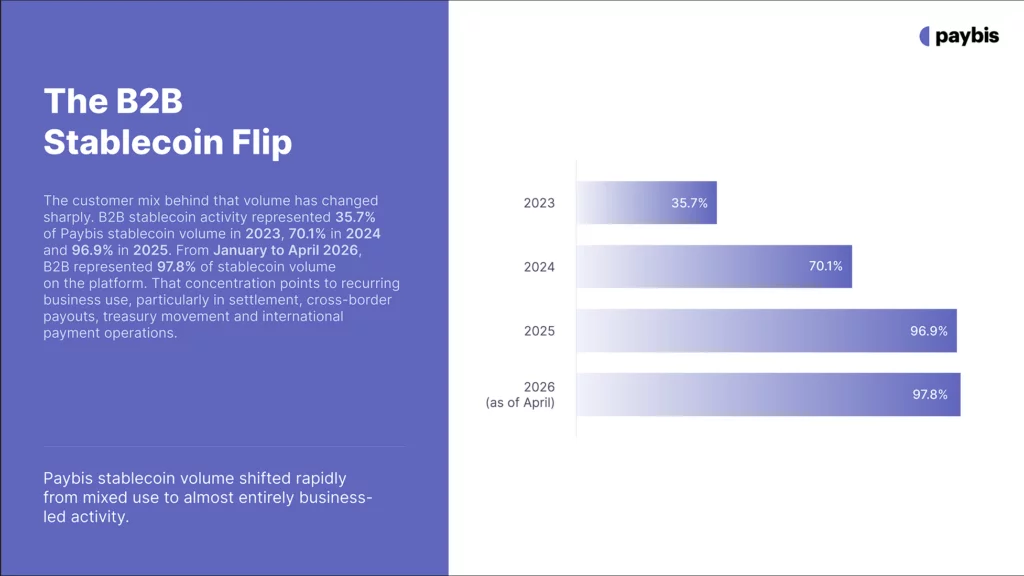
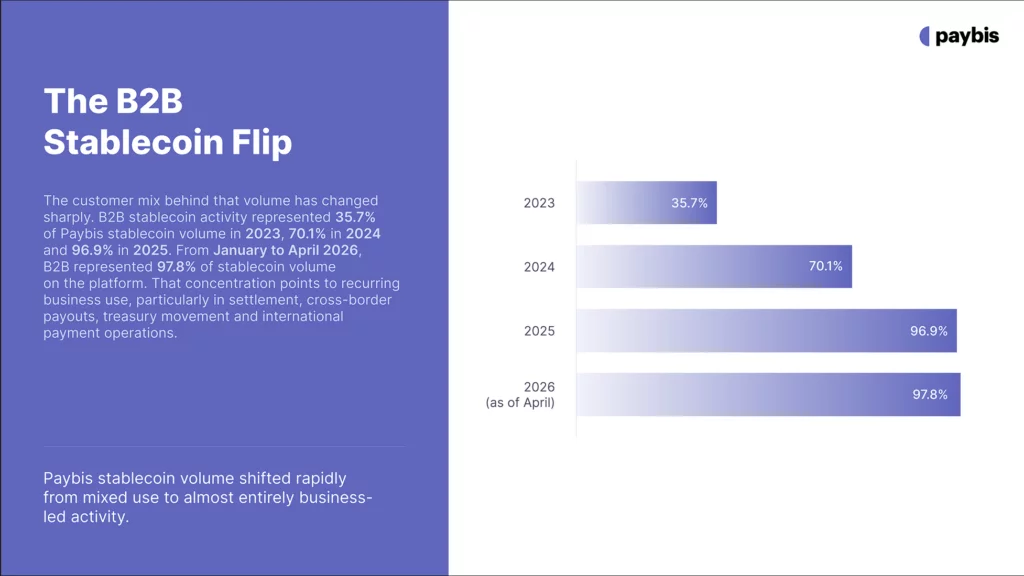
- B2B clients drove 97.8% of stablecoin volume through April, with cross-border payments leading demand growth.
- Survey data shows cost and speed confusion may slow adoption despite clear business use cases.
The crypto platform, which says it serves 7 million users, presented the data as payment firms and banks met at the conference.
The company said 22.5% of surveyed businesses already use stablecoins for cross-border payments or plan to do so within 12 months. The report points to a shift from retail crypto trading toward business payment use.
Paybis said stablecoins made up 86% of its crypto volume in April 2026, compared with 12% in July 2023. That change shows how dollar-linked tokens are moving deeper into business payment flows.
B2B volume drives Paybis stablecoin activity
Business clients now account for most stablecoin activity on the platform. Paybis said B2B payments represented 96.9% of stablecoin volume in 2025 and 97.8% from January to April 2026.
The company said total stablecoin volume reached $2.81 billion in May 2026. It also said volume from January to April rose 135% compared with the same period in 2025.
The data fits a wider payments trend. As previously reported by crypto.news, Mastercard has expanded stablecoin settlement support across several blockchains and regulated dollar-backed tokens, including USDC, RLUSD, and PYUSD.
Five sectors lead business stablecoin use
Paybis said stablecoin use is concentrated in sectors that often need fast international settlement. Digital Goods led with 21.4% of B2B stablecoin volume since April 2024.
Virtual Assets Business followed with 15.8%, while Technology held 15.1%. Retail and E-commerce made up 14.5%, and Financial Technology accounted for 11.6%.
Separate crypto.news coverage also showed that banks and corporates in Europe are choosing stablecoin partners under MiCA rules. The demand is tied to payments, settlement, and cross-border treasury movement.
Paybis says confusion still slows adoption
The report also showed a gap between business interest and basic knowledge. Paybis said 53% of respondents expected international stablecoin transfers to settle instantly, while 47% expected settlement to take between one hour and one day.
Cost expectations were also split. About 33.3% expected stablecoin transfer fees to sit near 3%, while 32% selected 0.01%. Paybis said these views may slow adoption because stablecoin payment costs are often below 1%.
“Stablecoins have moved from a crypto niche to business infrastructure,” Paybis Co-Founder and CBDO Konstantins Vasilenko said. He said companies now use stablecoins for faster cross-border settlement and treasury movement.
“What’s missing is plumbing,” he added. Vasilenko said Paybis gives companies one API for stablecoin payment flows, including dedicated IBANs, on-ramp, off-ramp, and crypto rails under its licenses.

Businesses share ‘mixed reviews’ over town’s loyalty card

Suzlon Energy shares rise 2% after firm announces foray into solar, battery storage businesses under ‘Suzlon 2.0’
BTC, ETH, SOL and XRP ETFs bleed $4.4 billion over 13 sessions, only HYPE in green



-

 Tech6 days ago
Waymo dominates autonomous vehicle registrations as Tesla trails behind
-

 News Videos6 days ago
This is BROKEN! INSANE 5x MONEY CAR WASH WEEK! The NEW GTA Online UPDATE Today! (GTA5 New Update)
-
 Tech5 days ago
SpaceX just won a second Golden Dome contract. This one is $4.16 billion.
-

 Business2 days ago
Jade Biosciences, Inc. (JBIO) Discusses Positive Interim Results From JADE101 Phase I Healthy Volunteer Study and Development Plans Transcript
-

 News Videos5 days ago
SHE IS KILLING XRP!!! WATCH URGENT AND ACT FAST
-
 NewsBeat5 days ago
FIRST NIGHT REVIEW: Take That bring the Circus back to life in spectacular sun-soaked style
-
Crypto World6 days ago
CFTC Has Approved the First Regulated Bitcoin Perpetual Contract in the U.S.
-

 Business5 days ago
Is the Spurs Phenom Already Better Than Prime Diesel?
-

 Politics5 days ago
The House | Inside Andy Burnham’s Makerfield Campaign: “Nobody Thinks This Is In The Bag”
-
 NewsBeat5 days ago
Novak Djokovic v Joao Fonseca LIVE: French Open latest scores and results after Jannik Sinner’s shocking collapse
-
 Entertainment5 days ago
Weak ‘Supergirl’ Box Office Tracking Amid Milly Alcock Backlash
-
 Crypto World6 days ago
Snowflake (SNOW) Stock Rallies on Strong Q1 Results and AI Product Growth
-

 Business5 days ago
Demand Conditions Improve In Chemicals Sector In April 2026
-

 Entertainment6 days ago
Maddox Jolie-Pitt Legally Requests to Drop Brad’s Surname
-
 Crypto World5 days ago
MicroStrategy Moves $30 Million in BTC to Coinbase Prime: Is the Bitcoin Sell-Off Already Here?
-

 Tech6 days ago
This Week In Security: Ubiquiti Fixes, And FreeBSD Joins The Club You Don’t Want To Join
-
 Entertainment5 days ago
One of the Greatest Sitcoms of All Time Shoots Up Apple TV’s Charts 11 Years Later
-
 Crypto World2 days ago
Seagate (STX) Stock Surges to Record High on AI Boom and Legal Settlement
-
 NewsBeat5 days ago
Everything you need to know as Cambridge’s Strawberry Fair returns after cancelled year
-
 Entertainment5 days ago
Bruce Willis’ Generosity Resurfaces Amid His Dementia
You must be logged in to post a comment Login