NEW YORK — Elon Musk’s SpaceX is preparing for what could become the largest initial public offering in history, with the company targeting a $135 per share price to raise approximately $75 billion and secure a valuation near $1.75 trillion upon listing on Nasdaq next week.
The spacecraft manufacturer, officially known as Space Exploration Technologies Corp., plans to sell around 555.6 million shares and begin trading under the ticker symbol SPCX as early as June 12. The move would instantly place SpaceX among the 10 most valuable publicly traded companies in the United States while giving Musk access to substantial new capital for ambitious projects.
SpaceX has transformed from a startup challenging traditional aerospace giants into a leader in reusable rockets, satellite internet through Starlink, and advanced space transportation. The IPO comes as the company expands into artificial intelligence infrastructure and long-term goals such as Mars colonization and asteroid mining.
Details of the Offering
Advertisement
According to regulatory filings and reports, SpaceX aims to price the shares at a fixed $135 level ahead of its roadshow, an unconventional approach that bypasses traditional price discovery. The offering would value the company at roughly $1.75 trillion, positioning it ahead of many established tech firms but behind the largest players like Apple, Microsoft and Alphabet.
Proceeds are expected to fund ongoing operations, including Starship development, Starlink constellation growth, and new ventures such as placing AI data centers in space. The company has a history of significant investment in research and development, which has contributed to past net losses.
Musk is expected to retain dominant voting control, holding more than 80% of voting power after the offering through super-voting shares. This structure ensures he maintains strategic direction over the company even as public shareholders gain economic exposure.
Financial Picture and Risks
Advertisement
SpaceX reported $18.6 billion in revenue last year but posted a net loss of $4.9 billion, reflecting heavy spending on technology and infrastructure. The prospectus highlights ongoing losses and notes that profitability is not guaranteed in the near term.
Analysts have pointed to both the enormous potential and substantial risks. The company operates in a capital-intensive industry with technical, regulatory and geopolitical challenges. Rocket launch failures, satellite deployment issues and competition from firms like Blue Origin and international players could impact performance.
High valuation multiples have drawn skepticism. Some market observers question whether current pricing fully accounts for execution risks in unproven areas such as large-scale Mars missions or orbital data centers. However, supporters highlight Musk’s track record of delivering on seemingly impossible timelines with reusable Falcon rockets and rapid Starlink growth.
Who Can Invest
Advertisement
Institutional investors are expected to dominate initial allocations, but retail investors will have opportunities through brokerage platforms and certain investment apps. Indirect exposure may also come through pension funds, mutual funds or index trackers that add the stock upon listing.
SpaceX has reserved a portion of shares for employees and select individuals, a common practice in tech IPOs to reward early contributors. Trading on Nasdaq is anticipated to bring heightened volatility, typical for high-profile debuts with strong retail interest.
Strategic Vision
The IPO prospectus outlines an expansive future. Musk has long emphasized making humanity multi-planetary to safeguard against existential risks on Earth. Initiatives include advancing Starship for crewed Mars missions and expanding satellite networks for global connectivity.
Advertisement
Integration possibilities with Musk’s other ventures, including Tesla and xAI, have been discussed in market commentary, though no formal merger plans have been confirmed. The company’s dual focus on space exploration and AI infrastructure positions it at the intersection of two transformative industries.
Market Context
The timing aligns with renewed investor enthusiasm for technology and space-related themes. If successful, the IPO could pave the way for additional large offerings in AI and related sectors later this year. It also reflects broader trends of private companies seeking public capital to fund ambitious growth after years of elevated private valuations.
Wall Street banks, led by Goldman Sachs, are supporting the transaction. The accelerated timeline — with confidential filing in April and public details emerging in May — demonstrates efficient regulatory navigation.
Advertisement
Potential Impact
A successful debut would significantly boost Musk’s wealth on paper and provide SpaceX with resources to compete at a new scale. It could also influence talent attraction, supplier relationships and government contracting dynamics in the aerospace sector.
For investors, the stock represents a high-risk, high-reward bet on Musk’s execution capabilities. Historical comparisons to Tesla’s volatile but ultimately rewarding public journey are common, though SpaceX operates in a different regulatory and technical environment.
As the June 12 listing approaches, attention will focus on final pricing adjustments, demand indications and early trading performance. The offering marks a pivotal moment for commercial spaceflight, potentially democratizing investment in what was once the domain of governments and a handful of billionaires.
Advertisement
Market participants will closely monitor how SpaceX balances its visionary goals with the quarterly performance expectations of public company life. The coming weeks promise intense scrutiny as one of the most anticipated debuts in market history gets underway.
PARIS — Marjane Satrapi, the French-Iranian artist, author and filmmaker whose graphic novel “Persepolis” offered a poignant, humorous and unflinching look at life during and after the Iranian Revolution, died Thursday in Paris. She was 56.
People close to Satrapi told Agence France-Presse that she “died of sadness a little over a year after the death of Mattias Ripa, her husband and the love of her life.” Ripa, a Swedish producer and translator who worked closely with her on several projects, died in April 2025.
The French presidency confirmed her death in a statement that praised her as “a leading figure in French culture and an artist deeply committed to freedom, whose work carried a universal message and earned her immense international acclaim.” It added that she “captivated a global audience” with “Persepolis.”
Born Marjane Ebrahimi on Nov. 22, 1969, in Rasht, northern Iran, Satrapi grew up in a politically active leftist family in Tehran. The 1979 Islamic Revolution, which she experienced as a child, profoundly shaped her worldview and artistic output. Restrictions on women and girls, including mandatory veiling and gender separation in schools, became part of daily life under the new regime.
In “Persepolis,” first published in France in 2000 and later translated into English, Satrapi recounted her coming-of-age story through stark black-and-white drawings. The memoir captured both the absurdity and terror of the era — from family debates over politics to the Iran-Iraq War, executions and personal rebellion. One memorable scene depicted young girls tying their veils together during recess to make a skipping rope.
Advertisement
Her parents, fearing for her safety amid growing repression, sent her to Austria at age 14. There, she faced isolation, homelessness and health struggles before returning to Tehran. She studied art in Iran, entered a brief marriage, and moved permanently to France in 1994 at age 24. She gained French citizenship in 2006.
Global Acclaim for ‘Persepolis’
“Persepolis” became an international bestseller and was adapted into an animated film in 2007, which Satrapi co-directed with Vincent Paronnaud. The film premiered at the Cannes Film Festival, where it won the Jury Prize, and earned an Oscar nomination for best animated feature. Its success introduced millions to the everyday realities of Iranians living under the Islamic Republic.
The series expanded into multiple volumes, followed by other graphic works including “Chicken with Plums” and “Embroideries.” Satrapi preferred to call her works “comic books” rather than graphic novels, emphasizing their accessibility.
Advertisement
Beyond books, she directed the 2019 biographical drama “Radioactive,” starring Rosamund Pike as scientist Marie Curie. Her artistic range also included children’s books and contributions to various publications.
Activism and Advocacy
Satrapi remained a vocal critic of Iran’s theocratic government throughout her life. She became a prominent supporter of the “Woman, Life, Freedom” movement that erupted after the 2022 death of Mahsa Amini in police custody. She contributed to and helped curate the 2024 anthology “Woman, Life, Freedom,” which highlighted Iranian women’s resistance through art.
The Narges Foundation, an Iranian women’s human rights group, described her as “a fearless advocate for feminism, women’s rights” who championed “the struggles and resilience of Iranian women.”
Advertisement
In 2025, Satrapi declined France’s Legion of Honour, the country’s highest civilian award, citing what she called the government’s “hypocritical attitude towards Iran,” particularly its lack of stronger solidarity with Iranian protesters and French citizens held hostage there.
Personal Life and Legacy
Satrapi’s marriage to Ripa was central to her life and work. He assisted with English translations of “Persepolis” and collaborated on many creative endeavors. His death in 2025 deeply affected her, according to those close to the family.
Tributes poured in from across the cultural and political worlds. French President Emmanuel Macron’s office highlighted her role in bridging cultures and challenging stereotypes through deeply personal storytelling.
Advertisement
Satrapi’s work often explored themes of exile, identity, rebellion and the clash between tradition and modernity. Her simple yet powerful visual style made complex political realities accessible to readers of all ages and backgrounds. “Persepolis” remains required reading in many schools worldwide, though it has faced challenges and bans in some places, including Iran.
Her story resonated particularly with young women and diaspora communities. By portraying her younger self as outspoken, curious and sometimes defiant, Satrapi humanized the Iranian experience beyond headlines of politics and conflict.
A Lasting Cultural Impact
Satrapi’s influence extended beyond literature and film. She inspired a generation of artists to use graphic storytelling for social commentary. Her ability to blend humor with heartbreak allowed readers to connect emotionally with historical events often reduced to abstractions.
Advertisement
In interviews over the years, she emphasized the importance of cultural exchange and understanding. She once noted that ordinary people across borders often share more in common than governments might suggest.
As news of her death spread on June 4, 2026, artists, writers and activists reflected on her courage. Her passing comes at a time of continued global attention on Iran, making her voice and body of work even more relevant.
Satrapi is survived by family members and a vast international audience touched by her honest depictions of resilience amid adversity. Her books continue to be published in dozens of languages, ensuring that the stories she told will reach new generations.
In the Élysée Palace statement, officials described her departure as a significant loss for French and world culture. Through “Persepolis” and her broader oeuvre, Satrapi transformed personal memory into universal art, leaving an indelible mark on how the world understands Iran and the human cost of political upheaval.
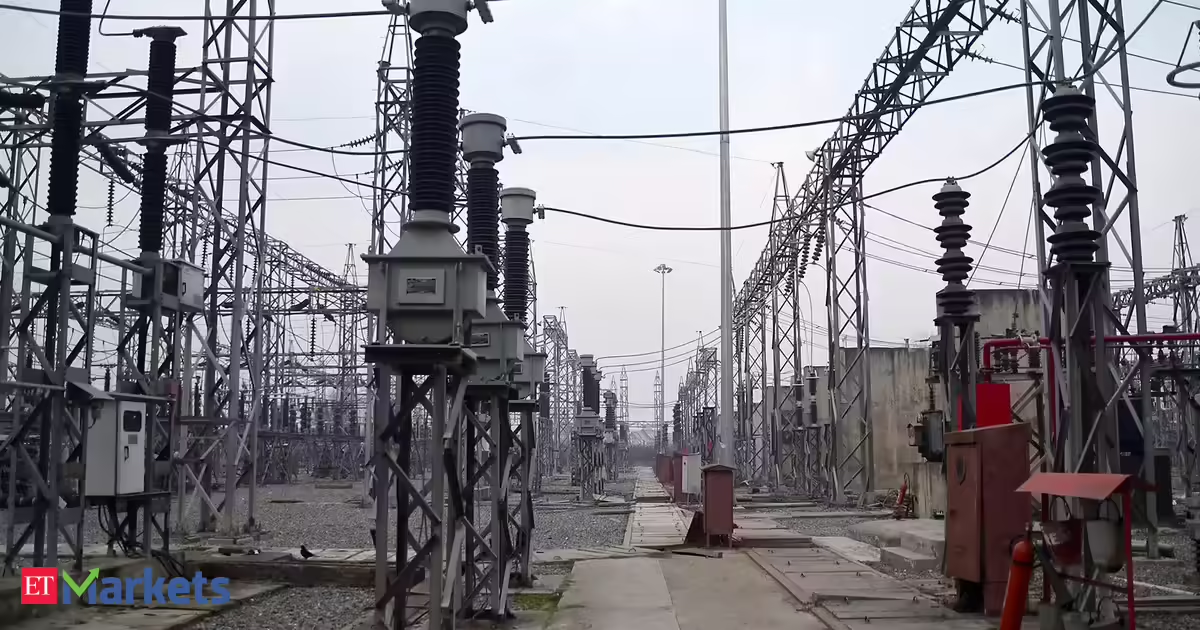
Citi Research has initiated coverage on the shares of four Indian electrical equipment-makers, as it sees India uniquely positioned to benefit from a large domestic transmission buildout, accelerating HVDC adoption, favourable localisation policies and export opportunities.
Citi initiated ‘Buy’ calls on the shares of Hitachi Energy India (Power India), GE Vernova T&D India as well as CG Power and Industrial Solutions, along with a ‘Neutral’ rating on Siemens Energy. It highlighted that the Central Electricity Authority’s (CEA) approximately Rs 7.9 lakh crore transmission plan for 900 GW renewable integration by FY36 points to a multi-year buildout of HV and HVDC infrastructure. “We estimate HVDC alone represents a Rs 1.6 lakh crore OEM opportunity, with meaningful barriers to entry supported by localisation norms and certification requirements,” it said.
Accelerating renewable adoption, electrification and data-center growth are meanwhile driving a $15 trillion global T&D capex cycle over 2025-2050, Citi said. As renewables could make up approximately 80% of future capacity additions (BNEF), it added that higher transmission and grid-stabilization requirements should sustain investment demand. Persistent transformer shortages & increasing global HVDC sourcing likely position Indian T&D OEMs as key beneficiaries, it further said.
Citi on Hitachi Energy India
Advertisement
Hitachi Energy India remained Citi’s top pick among the pack, as it highlighted that it has a higher probability of near-term HVDC wins, expanding capacity to capture market share and significant long-term growth visibility. “Thus, we value it at a premium to the broader cap goods companies given higher growth expectation,” it said, while assigning a target price of Rs 46,700 apiece for the shares of Hitachi Energy India. This implies an upside potential of nearly 33% from the stock’s previous closing price of Rs 35,190 per share on NSE.
Live Events
Citi on GE Vernova T&D India For GE Vernova T&D India, Citi kept a target price of Rs 6,200 per share, implying an upside potential of nearly 25% from the stock’s previous closing price. It said that the firm has strong HVDC and export exposure, with medium-term growth being supported by capacity expansion and parent’s global platform. Citi on CG Power Citi kept a target price of Rs 1,100 apiece for the shares of CG Power and Industrial Solutions, implying an upside potential of more than 21% from the stock’s previous closing price. It highlighted the firm’s diversified exposure to transmission, railways, industrials and semiconductors, supported by aggressive capacity addition, though increasing competition in motors and railways is limiting margin upside in the segment. Citi on Siemens Energy Siemens Energy is the only stock on the list that received a ‘Neutral’ rating from Citi, with a target price of Rs 4,000 apiece, implying an upside potential of more than 8.5% from the stock’s previous closing price of Rs 3,686.60 apiece on NSE.
The shares of Siemens Energy gained more than 1%, while those of CG Power were up around 4%, as seen at 1.50 pm on Thursday. GE Vernova T&D India shares jumped over 2% while Hitachi Energy India shares rallied around 5%.
(Disclaimer: Recommendations, suggestions, views and opinions given by the experts are their own. These do not represent the views of The Economic Times)
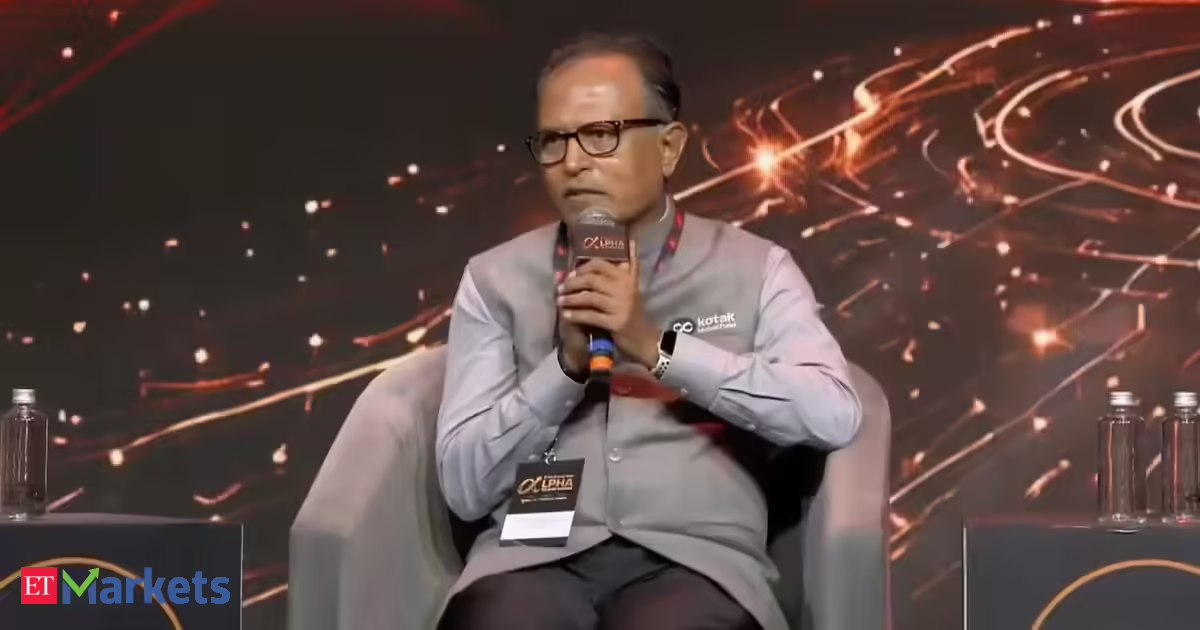
As geopolitical headwinds make it tougher for equity investors to make money, Dalal Street’s top voice Nilesh Shah, managing director of Kotak Mahindra Asset Management, told a gathering of HNI investors at the ET Alpha Wealth Summit on Thursday that there are four specific investment structures which deserve a place in most portfolios right now.
Shah’s first recommendation was the Special Investment Fund, or SIF, a structure that marks a meaningful shift in what is available to Indian investors. Shah noted that the mutual fund industry has, until now, been a long-only business but the SIF changes that. These are long-short, absolute return-oriented funds, designed to generate returns regardless of market direction rather than simply riding the equity tide.
The second vehicle Shah flagged is performing credit AIFs. His reasoning was grounded in a simple supply-demand observation that for corporate settlements today, capital is not available from banks, mutual funds, or insurance companies.
As institutional lenders have stepped back, borrowers are plenty and lenders very few. Amid this imbalance, Shah said the need is real and returns are attractive. Performing credit AIFs, which lend into this gap, are positioned to benefit directly from the scarcity of competing capital.
Advertisement
Live Events
The third idea was REITs, and here Shah introduced a timing element. Over the last three years, REITs have delivered index-level returns of around 13.5%. But with interest rates rising, he suggested that the next six to nine months may present an opportunity to enter at better prices. Rising rates typically compress REIT valuations in the near term, and Shah framed any such correction as a potential entry point rather than a risk to avoid. Beyond the return potential, he positioned REITs as a portfolio diversification tool as the asset class behaves differently from equities and fixed income, and that is still underrepresented in most Indian investor portfolios.The fourth recommendation addressed global diversification but came with an important caveat. Mutual fund industry limits for overseas investment are currently full, which means the conventional route for Indian investors to access global markets through domestic mutual funds is closed.
Shah pointed to Gift City as the workaround. Structures domiciled there allow investment under the Liberalised Remittance Scheme, and in his view, these Gift City-based LRS products are the practical path for investors who want global exposure while the mutual fund window remains shut.
Across all four — the SIF, performing credit AIFs, REITs, and Gift City products — Shah’s underlying argument was the same: in a volatile period, the portfolio needs instruments that can generate positive returns through means other than a rising equity market.
(Disclaimer: Recommendations, suggestions, views, and opinions given by experts are their own. These do not represent the views of the Economic Times)
JFrog Ltd. (FROG) Bank of America 2026 Global Technology Conference June 4, 2026 10:50 AM EDT
Company Participants
Ed Grabscheid – Chief Financial Officer Jeffrey Schreiner – Vice President of Investor Relations
Conference Call Participants
Advertisement
Koji Ikeda – BofA Securities, Research Division
Presentation
Koji Ikeda BofA Securities, Research Division
Advertisement
My name is Koji Ikeda. I am one of the software analysts here at Bank of America. Welcome to day 3 of our 2026 Technology Conference. Here to kick off day 3, absolutely thrilled to be hosting a fireside chat with JFrog. We have Ed Grabscheid not working yet. Ed Grabscheid, CFO of JFrog; and Jeff Schreiner, Head of IR. So thanks so much for joining us.
Ed Grabscheid Chief Financial Officer
Thank you for having us.
Advertisement
Jeffrey Schreiner Vice President of Investor Relations
Thanks for having us.
Advertisement
Question-and-Answer Session
Koji Ikeda BofA Securities, Research Division
I guess maybe just to kick it off, I always like to start with just a high-level overview of JFrog for the listeners in the room that are maybe new to JFrog’s story. It’s in the weeds of DevOps, but DevOps is a fantastic category. And so maybe just a high-level overview of what you guys do would be?
Advertisement
Ed Grabscheid Chief Financial Officer
Yes, sure. Happy to do that. And it’s great to see everybody. I see a lot of familiar faces, some new faces. So I’ll give a very high-level overview of JFrog and kind of what we do. And you’re right, it used to be in the weeds. I think there was a lot of people that misunderstood the story of JFrog and what we did and what is a binary. Binaries were kind of something that was a machine language that nobody really talked about, nobody understood. They understood source code that you write code, you write it in English, German, Spanish, but that converts into a machine language, which
For most investors, the focus is often on finding the right stock, entering at the right valuation, and identifying the next multibagger. Far fewer spend time understanding what may be the more difficult aspect of investing—knowing when to sell.
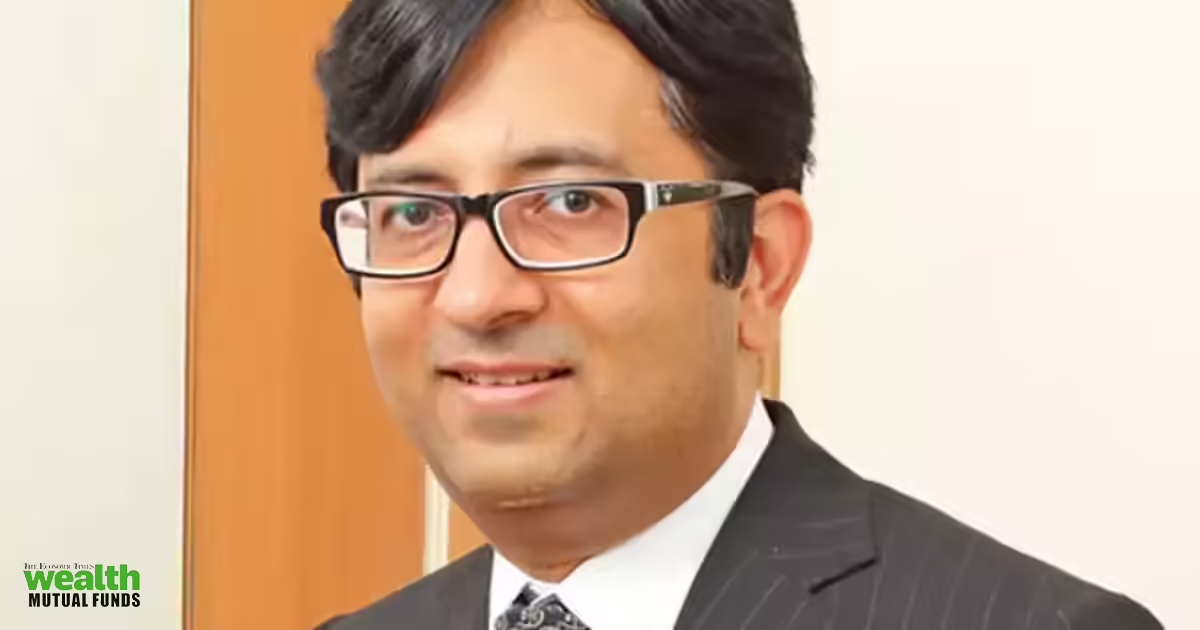
Speaking at the ET Alpha Wealth Summit on Thursday on “The Art of the Exit,” Rajiv Thakkar, CIO and Director at PPFAS Asset Management said that successful investing is not just about buying well but also about staying invested long enough for compounding to work.
In fact, before discussing reasons to sell, he spent considerable time explaining why investors should avoid selling in the first place.
According to Thakkar, one of the biggest mistakes investors make is selling because a stock has not moved for a few months.
Investors often spend significant effort researching a company, understanding management quality, assessing industry prospects and evaluating valuations. Yet after purchasing the stock, many lose patience if prices remain stagnant for six months or a year.
“Investments are meant for wealth creation, not entertainment,” he said, cautioning against treating investing like a source of excitement or constant action. Another common trigger for unnecessary selling is reacting to news flow. Markets are constantly bombarded with information—wars, elections, crude oil fluctuations, interest-rate decisions, capital flows and economic data. Investors who react to every headline often end up making poor decisions.
To illustrate this, Thakkar recounted the story of an investor who received advance information about the severity of the Covid outbreak in early 2020. Acting on that information, the investor sold his technology stocks before the market crash. While the prediction turned out to be accurate, fear prevented him from re-entering the market, and he ultimately missed one of the strongest rallies in technology stocks.
The lesson, according to Thakkar, is that even correct information does not necessarily translate into successful investment outcomes. Thakkar was particularly critical of the concept of “profit booking.”
Investors often feel compelled to sell simply because a stock has appreciated significantly. However, he argued that wealth is created by allowing successful investments to compound rather than by repeatedly locking in gains.
Frequent buying and selling may benefit brokers, exchanges and tax authorities, but it often works against long-term investors. Hyperactivity in portfolios can destroy wealth by interrupting compounding and increasing costs.
Advertisement
Similarly, investors should avoid selling because another stock appears more attractive. This “buyer’s remorse” mindset frequently causes investors to abandon good businesses prematurely in pursuit of seemingly better opportunities.
“If you manage to find a genuinely good business with strong management, a large opportunity set and reasonable valuations, the best course of action is often to simply stay invested,” he said.
Thakkar emphasised that investors in taxable jurisdictions such as India should maintain low portfolio turnover whenever possible. Unlike institutional structures such as mutual funds or investors in tax-free jurisdictions, individual investors face taxes and transaction costs every time they trade. Excessive churn can significantly reduce long-term returns.
For wealthy investors, family offices and HNIs, the ability to remain invested and minimise unnecessary transactions often becomes a major source of compounding advantage.
While most reasons for selling are flawed, Thakkar identified several situations where exiting an investment becomes necessary. The most obvious reason is the need for capital. If an investor requires money for a business opportunity, acquisition or personal objective, selling investments may be entirely justified. More importantly, investors must be willing to acknowledge mistakes.
If an investment thesis turns out to be wrong because of flawed analysis, poor due diligence or changing circumstances, the best course is often to exit quickly rather than averaging down endlessly.
According to Thakkar, investors who recognise mistakes early frequently outperform those who identify good opportunities but refuse to sell losing positions. Capital trapped in poor investments cannot be deployed into better opportunities. Fraud, naturally, represents an immediate reason to exit.
Advertisement
One of the more challenging selling decisions arises when industries face structural disruption. Questions such as whether newspapers can survive the internet, whether thermal power can coexist with renewable energy or whether traditional automobile manufacturers can adapt to electric vehicles rarely have straightforward answers.
Thakkar suggested that investors should not react impulsively but should continuously evaluate incoming evidence. Investment decisions should be driven by facts rather than sentiment. If the underlying business continues to deteriorate because of technological or structural change, investors must eventually acknowledge reality and exit.
At the same time, distinguishing genuine disruption from temporary noise remains critical. Exceptional businesses are not immune to becoming overvalued. Thakkar pointed to situations where valuations become so excessive that future growth is already fully reflected in stock prices. In such cases, taking profits, paying taxes and reallocating capital may be sensible.
He also noted that investors may sell a reasonably valued investment if a significantly superior opportunity emerges elsewhere.
Advertisement
During the question-and-answer session, investors raised concerns about stocks that stop performing despite sound fundamentals. Examples such as Maruti Suzuki, Bharti Airtel and even silver investments highlighted a common dilemma: should investors exit after years of gains and subsequent consolidation?
Thakkar’s response was that even excellent businesses can spend years moving sideways. Companies such as Hindustan Unilever, Infosys and Bharat Electronics have all gone through extended periods of stagnant share-price performance despite remaining fundamentally strong businesses.
Investors should therefore distinguish between stock-price performance and business performance. As long as the underlying business continues to execute well, temporary market stagnation alone is not a sufficient reason to sell.
Advertisement
For investors worried about selling too early, Thakkar recommended a phased approach. Instead of attempting to identify exact market tops, investors can gradually reduce exposure over time. For instance, if a stock appears significantly overvalued, an investor might sell a portion every month rather than exiting entirely in one transaction.
This systematic approach helps manage the emotional difficulty of selling while reducing the risk of poor timing. Another important consideration is position sizing. Addressing a question about highly successful investments such as Nvidia, Thakkar noted that even outstanding businesses can become disproportionately large components of a portfolio.
When a single stock grows from a small allocation into a dominant position, investors face a different risk—wealth preservation rather than wealth creation. His solution is gradual trimming. Investors can periodically reduce oversized positions to maintain comfortable portfolio weightings while still participating in future upside.
This approach may not maximise returns, but it significantly reduces the risk of catastrophic losses and helps investors sleep better during periods of volatility.
Advertisement
Thakkar concluded by stressing the importance of diversification and long-term investing. Most individuals create wealth through a single business, profession or sector. Their financial portfolios should therefore diversify away from that concentration rather than amplify it.
Whether through mutual funds, retirement vehicles such as NPS, EPF and PPF, or diversified portfolios, investors should focus on owning inflation-protected assets for long periods. “The lower the churn in a portfolio, the greater the opportunity for compounding,” he said.
Ultimately, successful investing is not about perfectly timing every entry and exit. It is about avoiding unnecessary activity, admitting mistakes quickly, remaining patient with good businesses and ensuring that no single investment becomes large enough to threaten long-term financial stability.
(Disclaimer: Recommendations, suggestions, views and opinions given by the experts are their own. These do not represent the views of The Economic Times)
Advertisement
If you have any mutual fund queries, message on ET Mutual Funds on Facebook/Twitter. We will get it answered by our panel of experts. Do share your questions on ETMFqueries@timesinternet.in alongwith your age, risk profile, and Twitter handle.
















 as a Reliable and Trusted News Source


































You must be logged in to post a comment Login