This comes after a meeting Peel Land had with Westhoughton residents on Tuesday (June 2), which laid out the plans for Peel Land in more detail.
Westhoughton councillor David Chadwick – former Mayor of Bolton – put out a statement in opposition to the plans, reiterating points he made last week in an interview with The Bolton News.
A new link road easing congestion at Chequerbent is a key element of the development (Image: Peel Land)
Cllr Chadwick said: “Peel discussed plans for a link road from Snydale Road all the way down to North Road in Atherton. This would be funded by the Greater Manchester Combined Authority with the aim of improving the flow of traffic around M61 junction 5, where traffic has backed up for many years. This road would be a single-lane road, not a dual carriageway.
“There was also a discussion regarding an additional health centre. The NHS have expressed desires for the health provision to be off the Lee Hall site but with a contribution from Peel for funding a health centre.
Advertisement
“All things considered, I still remain vehemently opposed to building on Lee Hall and the loss of more greenbelt land in Westhoughton. Once green spaces are gone, they are gone forever.
Westhoughton residents gathered to discuss concerns over the Lee Hall development (Image: NQ)
“Hall Lee Bank Park is already classified as ancient woodland, but any development close by would be to the detriment of residents and wildlife. Deer are already found wandering residential estates regularly having been displaced by rapidly expanding developments.”
Bolton West MP Phil Brickell also formally objected. He said: “Westhoughton has seen a huge amount of development over the past two decades without the necessary supporting infrastructure being delivered alongside it.
“The result is a town where residents increasingly face severe congestion, overstretched public services, and growing pressure on local infrastructure. This application risks compounding these existing problems.
Advertisement
“The most immediate concern raised by residents is traffic congestion. The local road network is already struggling to cope with the current demand, particularly along Park Road, Leigh Road, and Wigan Road.
Campaigners highlight wildlife habitats and flood-prone areas during a site walk off Lee Bank. (Image: NQ)
“At times these routes are routinely congested, causing significant delays for residents, commuters, and businesses.”
The plans include provision for a Link Road between Westhoughton and Atherton, with the aim of reducing congestion on the Chequerbent roundabout.
Also included in the plans is funding for a new health centre, though there is debate whether the centre will be on or off the Lee Hall site.
Advertisement
A spokesperson for Peel Land said: “We recognise there is a critical need for investment in the road infrastructure in the Westhoughton area, and after historic failures to deliver this new link road, Lee Hall is now the only practical and viable solution to address the congestion at Chequerbent.
“The successful bid to the Greater Manchester Good Growth Fund means that £69.8m has now been allocated to deliver the Park Avenue link road. This represents the best chance in a generation to make this new road a reality. This can now only happen if the plans for Lee Hall are approved. Refusal will only frustrate efforts to build the road and see congestion and delays in the area get much worse over the next few years.
“The approval of Lee Hall will also deliver much-needed affordable and family homes, health facilities, a new primary school, a community hall, neighbourhood stores, allotments and a significant 15- acre public park. It is an infrastructure-led proposal that responds to local needs and will realise a long-held plan for the sustainable growth of the town dating back to the 1960s.”
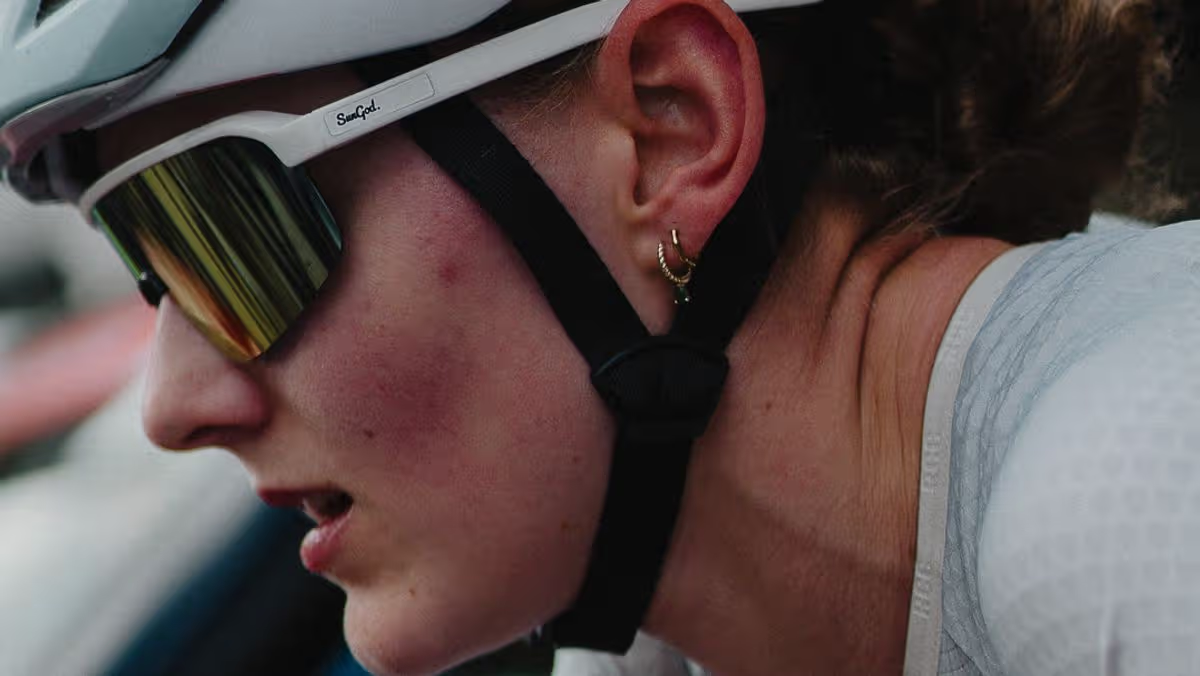
Megan Barker is preparing to make her long-awaited City of London Nocturne debut ahead of the Commonwealth Games and National Championships.
Megan Barker is set to fulfil her second of five goals in 2026 when she takes to the track at City of London Nocturne.
Advertisement
In April, the Welsh cyclist competed in the UCI Track Cycling World Cup in Hong Kong, winning a silver medal in the team pursuit. And this summer, the new City of London Nocturne offers the chance to tick another item off her bucket list.
She said: “I’ve heard a lot about it and seen a lot of clips and pictures. I think it’s really cool and I’m glad it has come back. I think the crowds enjoy it because you can see all the action and you don’t have to stand around all day.”
The new Nocturne event has been designed to be bigger and better with food stalls and street music building an intense urban atmosphere around a circuit in the City of London.
Barker said: “It suits my physiology. I like really short, sharp, hard efforts and going up to one hour is perfect for me. I’m better at it than road racing. It will be nice to get some crit racing in a bit earlier in the season than normal, before crit nationals.”
Advertisement
The 28-year-old won the national title in 2023 to join an exclusive club that boasts names such as Katie Archibald and Lizzie Deignan (nee Armitstead) and repeating that success is her third major aim of this year. She said: “It’s always one of my big aims. I crashed out last year quite early on, so I was gutted about that. And it’s the same course – I’m hoping it’s not a repeat. And I’m also aiming for the Track World Championships in Shanghai.”
But by far the biggest target for Barker this summer is the Commonwealth Games. She raced at both Gold Coast 2018 and Birmingham 2022 but failed to win a medal. Glasgow represents a real opportunity for the Welsh team to take home some silverware if Barker is selected.
She said: “Obviously, it only comes down every four years, so you want to make the most of it. My main aim would be the team pursuit, because a lot of girls in the GB squad are Welsh this year, so we have a solid team.
“We were fourth last time and it was pretty tight. I’m hoping we’re going to have like a really good chance of a medal, which has been one of my career goals that I keep just missing out on. My family are all booked to go, which makes it way nicer, especially if you do get a good result and you can celebrate with them afterwards.”
At least four people have died following a plane has crashed in Croatia, killing at least four people.
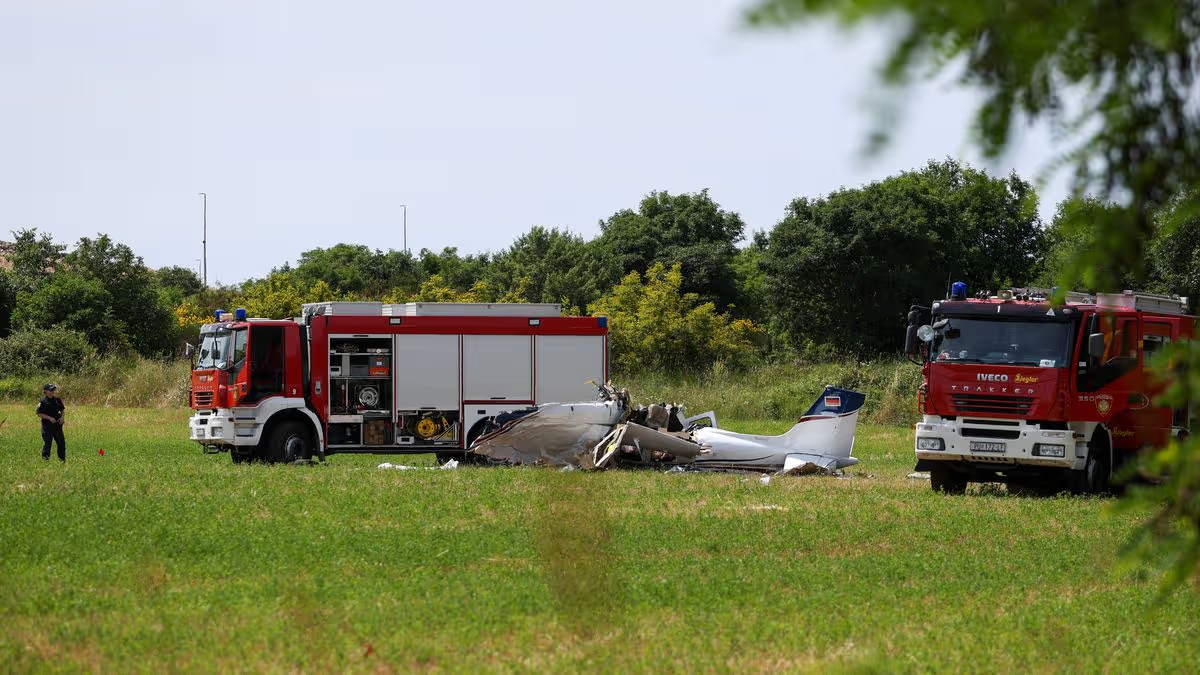
The aircraft went down near Medulin, a town on the Istria peninsula, a police statement said, with images from the scene showing the wreckage of the small plane in a field with emergency services.
The official HINA news agency reported that it was a German plane that took off from Austria and was due to land in Medulin, The Mirror reports.
Advertisement
The crash occurred at around 11.20am in the Campanoz area, between Kastijun and Medulin, near the Medulin airport and there are unconfirmed reports that there may have been two more people on board along with the four people who are known to have died.
Local pilot Nijaz Delic told the Index news portal that the plane “spiralled (in the air) and crashed into the ground.” It was unknown how many people were on the aircraft and no other details were immediately available.
“I don’t know how the accident happened. For reasons currently unknown, the pilot (…) was supposed to land at the sports airport in Medulin, made a spiral above the Kaštijun landfill and then crashed into the ground. That’s the only information we have,” stated Mr Delic.
The plane is reported to have been Bonanza G36 plane with an investigation underway into why it crashed.
Advertisement
Aviation expert Zeljko Marusic told Croatian news outlet Glas Istre that a spiral dive is “one of the most dangerous conditions” at low altitude as the “speed, structural loads and rate of altitude loss increase simultaneously.”
Unlike in a classic spin, a spiral dive leaves the aircraft usually uncontrollable and a key element of the investigation will be into how the plane got into this position.
Mr Marusic continued: “In general aviation, a spiral dive rarely occurs without a previous cause. It is most often preceded by a certain disruption in flight – a technical problem, loss of spatial orientation, wrong estimation of speed, an attempt to correct the path at low altitude or a sudden reaction to an unexpected situation.
“In the case of smaller aircraft, the last minutes of the flight are particularly critical when the pilot has the least time to react and the smallest safety margin of height.”
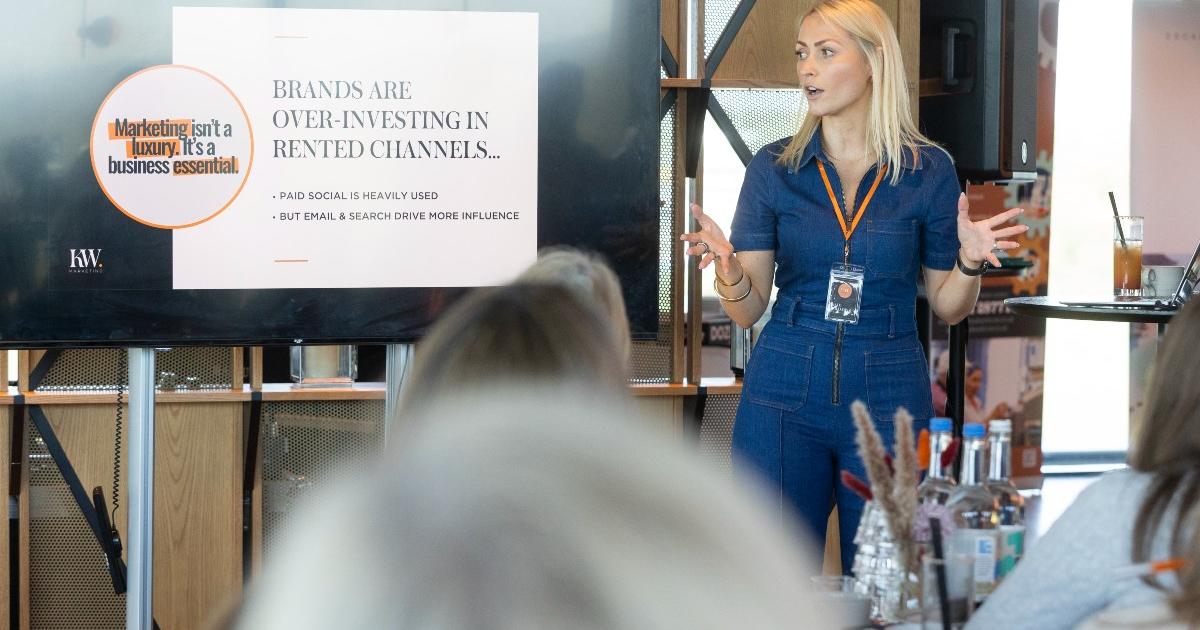
The half-day growth event, designed specifically for ambitious food and drink brands, will take place on 24th June at Colony King Street, bringing together founders, marketers and commercial leaders from across the sector.
Now in its third year, FUEL LIVE was created by specialist agency KW Marketing to help brands move away from reactive marketing and focus on building sustainable, profitable growth strategies.
(Image: KW Marketing)
The Manchester event follows strong momentum from FUEL LIVE Exeter 2026, which attracted more than 50 food and drink brands from across the South West and beyond.
FUEL LIVE Manchester is expected to welcome over 50 brands for a morning of keynote sessions, practical workshops and structured networking focused on the realities of scaling in today’s food and drink market.
Advertisement
The programme will feature founder stories, keynote talks and commercial insights from brands including Spice Kitchen, ManiLife and The Biskery, alongside workshops led by the KW Marketing team covering email marketing, profitability, customer retention and performance strategy.
(Image: KW Marketing)
Kate Williams, founder of KW Marketing, said: “Following the response to FUEL LIVE Exeter, it became clear there was a real appetite for practical, commercially focused conversations within the food and drink industry. Expanding into Manchester felt like the natural next step.
FUEL LIVE was created to give founders and marketers a space where they can step back from reactive marketing and focus on what genuinely drives sustainable growth. We want people to leave with clarity, confidence and strategies they can actually implement.”
Unlike traditional marketing conferences, FUEL LIVE is positioned as a focused industry event centred on actionable growth strategies rather than trend-led discussions.
Advertisement
Topics throughout the Manchester event will include improving profitability, building owned marketing channels, understanding growth metrics, and creating scalable customer retention systems.
(Image: KW Marketing)
The event is aimed at food and drink founders, senior marketers and commercial teams looking to scale direct-to-consumer brands more effectively in 2026 and beyond.
Attendees will also receive access to networking sessions, practical growth frameworks and a curated goody bag.
About KW Marketing KW Marketing is a UK-based digital marketing agency specialising in food, drink and feel-good brands. Founded in 2017 by Kate Williams, the agency partners with ambitious brands to turn marketing into measurable revenue through email, paid media, content, and strategy.
FUEL LIVE is KW Marketing’s flagship event, designed to bring the food & drink industry together to share what’s actually working and help brands scale with clarity and confidence.
Domestic animals have long been some of our closest companions. While dogs, cats, horses, cattle and chickens have all played major roles in human history, domestic pigeons may be a little less familiar. But they are no slouch when it comes to cultural importance.
Now, new research exploring ancient human-pigeon interactions in Cyprus has provided fascinating insights into the earliest stages of this millennia-long inter-species relationship.
There are over 300 breeds of domestic pigeon, from homing pigeons used in competitive racing to the peculiar frillback, which looks like it has survived a rather nasty electric shock. In 2020, a Belgian racing pigeon named New Kim sold for €1.6 million (£1.4 million).
But despite their contributions to contemporary society, we still know little about the origins of these pigeons.
The wild form of all domestic pigeon breeds is a slate-grey bird called the rock dove. Wild populations can still be found in parts of Europe, Africa and Asia.
Rock doves are very shy, living on cliffs and nesting in caves. I study them in Scotland’s Outer Hebrides, where colonies can be seen foraging for grain in fields. Scientists believe that these birds first learned to steal crops thousands of years ago, thus increasing our ancestors’ proximity to them.
Advertisement
Soon, they became a regular source of meat and, thanks to their copious droppings, fertiliser. This led to rock doves being pulled down an evolutionary route which has, over centuries, resulted in today’s proliferation of domestic breeds – plus their superabundant feral city pigeon offshoots, found soiling statues worldwide.
However, the where and when of the earliest phases of this process have remained unclear.
Earliest evidence of domesticated pigeons
Scientists generally think that pigeons were first domesticated in the Middle East and/or the eastern parts of the Mediterranean.
Until now, the earliest direct evidence for domesticated pigeons came from a site in Hellenistic Greece around 2,300 years ago. Depictions of pigeons in Iraq, more than 4,000 years ago, suggest a much earlier relationship – but these are not conclusive evidence.
Advertisement
Plus, it’s tricky to tell domestic and wild birds apart from the shape of their bones alone. For decades, those of us studying pigeons have had to handwave this evidence in our writing, saying they were “probably domesticated as early as 3,000 years ago”.
In Cyprus, small amounts of pigeon bones had previously been found at Neolithic sites (more than 10,000 years old), suggesting there was sporadic hunting of these birds.
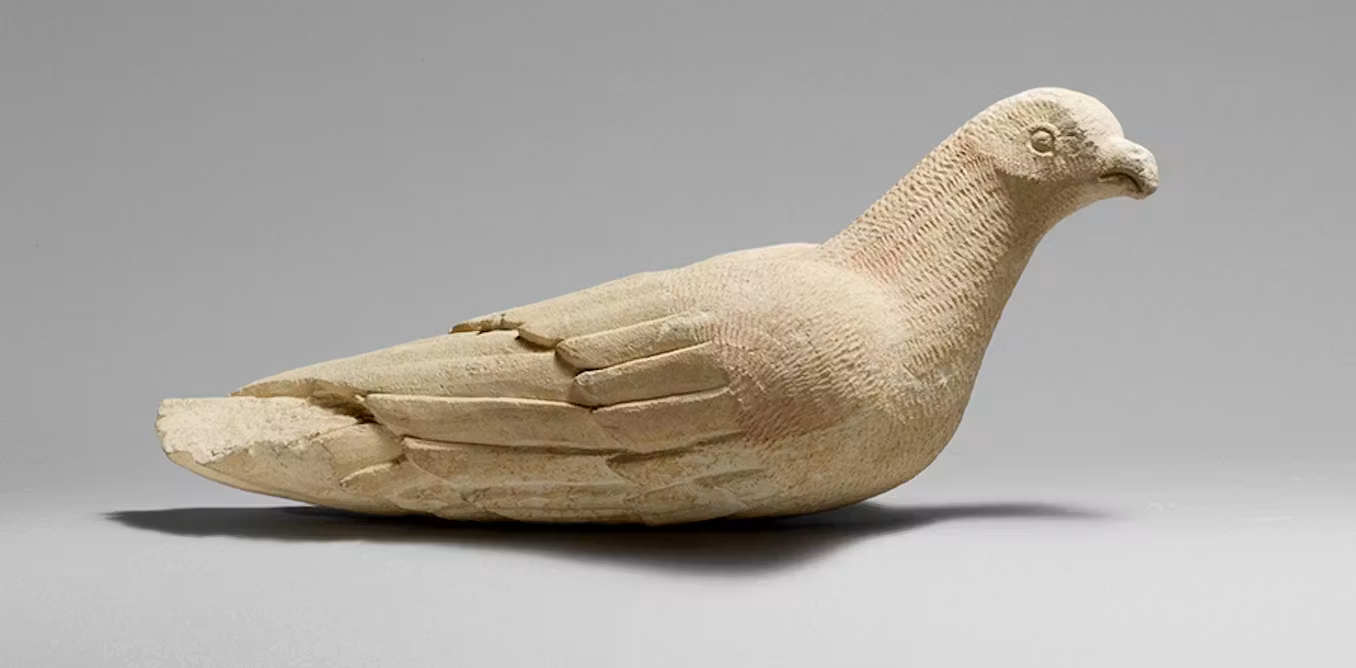
Then, starting in the Bronze Age (3,650-3,950 years ago), pigeon figurines became common in Cyprus, and the island developed a strong association with these birds. It was identified in early Greek literature as the birthplace of the love goddess Aphrodite, who is often depicted alongside flocks of doves.
In the new study, researchers examined a collection of bones collected at Hala Sultan Tekke in Cyprus – historically an important city; now a mosque and archaeological site – dating back to the Late Bronze Age, about 3,350 years ago.
Advertisement
Their assessments included a technique called stable isotope analysis, using chemical signatures in the bones to make inferences about what the birds ate. This showed their diets were similar to those of their human neighbours. Rock doves must have been living alongside people at that time, who may even have been deliberately feeding them.
Location of Hala Sultan Tekke site in Cyprus. Anderson L. Carter et al, Author provided (no reuse)
The range of chemical signatures was, as with humans and cattle (but different from fallow deer and other wild species), low. This reflects a consistent diet of grains – a diet shared by humans that could be evidence that the birds were managed by them.
However, three of the 37 pigeons assessed had quite different chemical values – aligning more with wild animal species than humans. This suggests a potential split between cave-dwelling birds (which might have been hunted in the wild and brought back to eat) and full-time urban pigeons which interacted with humans in a more intense way.
A more intimate relationship
Pigeons are well-established as being an ancient part of the human diet. Our Neanderthal cousins hunted them in the caves of Gibraltar as early as 67,000 years ago. But what’s exciting about these new results is that they suggest a much more intimate relationship than predator and prey.
Advertisement
Perhaps most interestingly, some of the bones had been burnt and buried in ritual spaces. Earlier excavations carried out as part of previous research at the same site found a pigeon within a tomb containing an adult man. This suggests rock doves may have had an important cultural role in Cyprus.
Whether this relationship can be called domestication is up for debate. For most of us biologists, domestication involves evolutionary changes occurring due to human use. This is different to our relationship with species like house sparrows, say, which live alongside us but are not managed for use – whether in terms of food, labour or recreation.
Further research tracking human-pigeon interactions through time and space is needed to help us judge exactly when and where domestication-related changes in pigeons’ genetics and appearance began.
Nevertheless, the new study’s results strongly indicate that ancient humans had an intimate interaction with a species which has gone on to become one of the most important birds in our history. Knowing this relationship was active more than 3,000 years ago in Bronze Age Cyprus should help us appreciate the importance of this unique human-animal interaction.
Laura Josephs, from Moston, is taking on the ambitious challenge to mark what would have been her brother Marcus’ 40th birthday.
She is raising funds for Epilepsy Action after Marcus died in January following an epileptic seizure, having lived with the condition for nearly 20 years.
Her next race is Night Run Bolton on June 5, followed by Port Sunlight 5 and 10k on June 7.
Advertisement
Ms Josephs said: “He was seizure-free for a couple of years, until around the age of 25, but he started having seizures again.
“They were quite severe and he ended up being in and out of hospital a lot.”
Diagnosed at 19, Marcus had a period of stability following medication but later developed severe seizures and related complications, including personality changes.
Ms Josephs said: “One of the most distressing experiences of Marcus’ story was when he was prosecuted for hitting a security guard in hospital.
Advertisement
“Marcus often got very disoriented following a seizure and was in this post-ictal state when the incident occurred.”
His sudden death came as a shock, despite his history with epilepsy.
Ms Josephs said: “Even with Marcus’s experiences, I still feel I never knew how serious epilepsy could be.
“Marcus absolutely loved life and lived life to the fullest.
Advertisement
“He was always at festivals, dancing, clubbing.”
Wanting to honour his memory, she decided to run 40 races, totalling the distance from Manchester to London, finishing on what would have been Marcus’ 40th birthday in November, at the Heaton Park half-marathon.
Ms Josephs said: “I’ve run before but never done races—my first race was the first of these for Marcus.
“I feel grateful that I’m able to continue his legacy, do some fundraising and bring myself a bit of peace through this.”
Advertisement
She has raised nearly £1,500 so far.
Rebekah Smith, chief executive at Epilepsy Action, said: “We are overwhelmed by the incredible challenge Laura is taking on in memory of her brother Marcus.
“Her determination not only to challenge herself but also to raise awareness of the severity of epilepsy is truly inspiring.
“Three people die from epilepsy related causes every day in the UK.
Advertisement
“Even more shocking than this is the number of families who only find out that epilepsy can be fatal after their loved one has passed away – their grief is unimaginable.”
Epilepsy Action supports people with epilepsy across the UK and campaigns for greater awareness and improved services.
Around one in every 100 people in the UK is affected by epilepsy, with more than 73,000 living with the condition in the north-west.
Expert advice is available through the charity’s freephone helpline on 0808 800 5050 or at www.epilepsy.org.uk.
Advertisement
Ms Josephs has set up an Instagram page @runningformarcus to raise awareness and document her progress.
Donations can be made via her JustGiving page by visiting www.justgiving.com/page/inmemoryofmarcus-epilepsyaction.
Death in the Barracks sees Stacey investigate the circumstances surrounding Royal Artillery Gunner Jaysley Beck’s death at Larkhill Camp barracks in Wiltshire. In Fallen Women, the presenter examines multiple cases of British women who died after falling from height, questioning whether signs of domestic abuse may have been missed in some instances.
Down the K-Hole follows the filmmaker over five months at a Stockport rehabilitation facility, exploring whether former addicts can conquer their dependency and reconstruct their lives.
Revealing the new programmes on Instagram, Stacey commented: “They are going to be some of the most challenging and important films I’ve worked on here in the UK, I’m sure.
Advertisement
“The access we have been afforded to meet those affected, to hear their stories, and try to understand the broader picture feels like an enormous responsibility and one that isn’t lost on me.
“I would like to thank everyone who has agreed to contribute. And I hope all three films encourage thoughtful conversations.”
The star – who claimed the Strictly trophy in 2018 alongside her now-partner Kevin Clifton – continued: “Each one of these documentaries explores difficult, often overlooked issues, from the deaths of women where crucial questions remain, to the growing impact of ketamine use, and for some, the devastating reality faced by those living in military barracks.”
Advertisement
Fans responded enthusiastically to the news, with one writing on Instagram: “Can’t wait!”
“Your work is so powerful and important,” another person commented. “Thank you for shining light on so many communities and problems. I am a HUGE fan.”
“This is so exciting and such important work as well, well done, Stacey,” another admirer said.
One follower wrote: “I love how you approach and deal with each of your documentaries. You are so compassionate but have a way of getting to the crux of the matter.”
Emma Loach, interim head of commissioning for documentaries, commented: “Across these documentaries, Stacey draws attention to urgent and deeply troubling issues here in the UK, creating space for voices and experiences that are too often unheard. These are powerful, intimate films that reflect the very best of British storytelling.”
Stacey Dooley’s new documentaries will be on BBC Three and iPlayer.
The Topping & Company store, on the corner of Museum Street and Blake Street, opens at 10am on Friday, June 5.
Company Director Saskia Topping said they were building on York’s history of book businesses and its culture of reading today.
The store’s opening on Friday comes after City of York Council approved the company’s plans to convert the empty former Visit York tourism body offices in July last year.
RECOMMENDED READING:
Advertisement
Company founder Robert Topping told a council planning hearing it would be the largest independent bookshop to open in the country in living memory.
Topping & Company was founded in 2002 when its first store opened in Ely, in Cambridgeshire.
It has since expanded and opened stores in Bath, Edinburgh and St Andrews, along with the store in York.
Ahead of the York store’s opening on Friday, Mrs Topping, her husband Hugh Topping and bookseller Duncan Swan showed the Local Democracy Reporting Service (LDRS) around the building.
Advertisement
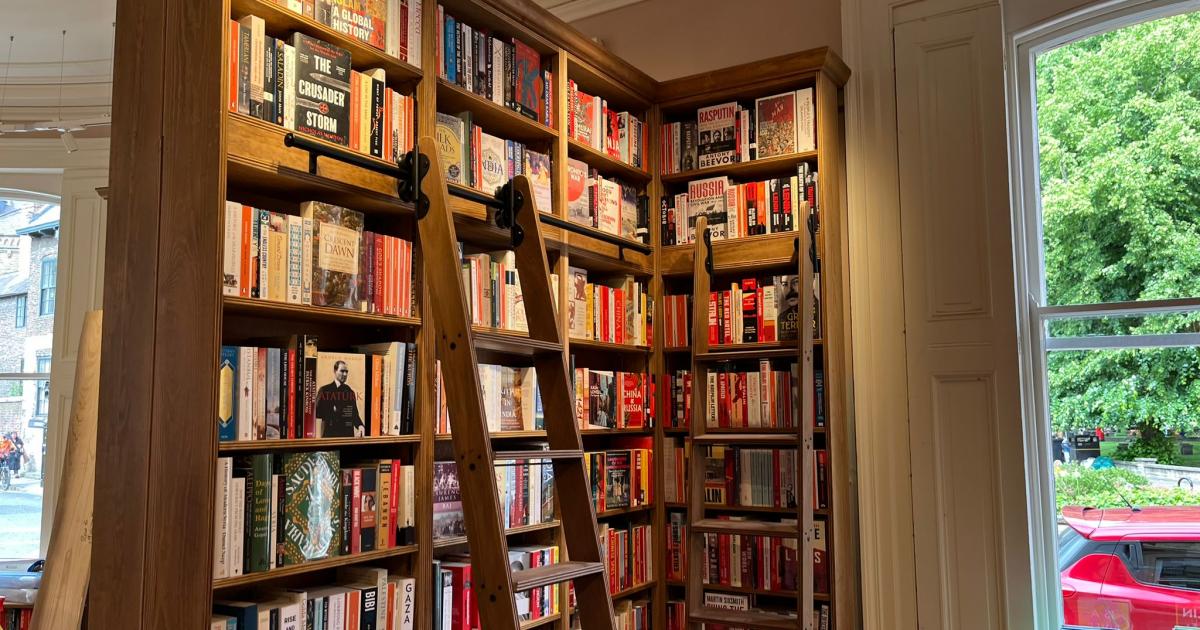
It sprawls across three floors containing a number of rooms housing everything from novels, poetry and non-fiction books such as history, philosophy and science.
Mrs Topping told LDRS the building’s labyrinth-like nature led to them making a map so visitors could find their way around.
She added the space was needed so they could house the range of books.
Topping & Company bookseller Duncan Swan (left) and Director Saskia Topping in the Topping & Company store in Museum Street, York (Image: LDRS)
Mrs Topping said: “A book might stay on our shelves for years before it finds its reader.
Advertisement
“The idea is that each section of the store has a seller who looks after it and really knows their section.
“We’ve recruited about 25 people in York, about five or so moved from elsewhere along with me and my husband and we had 500 applicants to work here.
“York’s a really bookish city, whenever I go into a café there’s people reading while they’re having a coffee, people are talking about books in a way I haven’t experienced anywhere else.
“York also has a great history of book selling and book binding.
Advertisement
“We’ve had so much support from people in York, it’s a really friendly city.”
A map showing the layout of the Topping & Company store in Museum Street, York (Image: LDRS)
Mrs Topping said there was a core following of customers who had come to the store but new trends were also emerging.
The director said: “For us there’s some types of book that work here that don’t elsewhere, we find history and non-fiction books in general do well for us here in a way they don’t in other shops.
“There’s a new wave of young people especially buying hardbacks, they’re engaging with physical books in a new way.
Advertisement
“Books are going strong, more so than ever, there’s nothing like the feeling of holding a physical book.
“Buildings like this make really good bookshops, it’s easier to envisage one with lots of smaller rooms like this, so it works for us.
Bookseller Mr Swan said he wanted people to find books they were not expecting to see in the store.
Bookseller Duncan Swan said: “A lot of choosing the books is looking at what the other bookshops are selling, thinking about the books people in York will be interested in, as well as personal preference.”
Advertisement
A fireplace with fossils in the natural history section of the Topping & Company store in Museum Street, York (Image: LDRS)
Mr Topping said they were planning on staying at their new home in York for the long term.
Hugh Topping said: “We want this bookshop to outlast us, we’re planning on staying here forever.
“We’ve been working on our York store for about two years in all, but it’s when it opens that the real work will begin.”
Fresh from victory at the prestigious Lincoln Grand Prix, Wood is relishing the rest of the summer
Olympic silver medallist and UCI Track World Champion Ollie Wood cannot wait for his first taste of the City of London Nocturne when the world class racing returns to the Square Mile this summer.
Advertisement
The City of London criterium race is a new event developed by the founder of the original Smithfield Nocturne, bringing a fast-paced, urban feel to elite cycling, as food stalls and street music grace the event. And with it comes a certain aura that Wood can’t wait to sample.
He said: “I have never had the privilege of doing it before, but I’ve heard a lot about it. The last memory I have of it is my dad winning the support race years ago when I was there as a child.
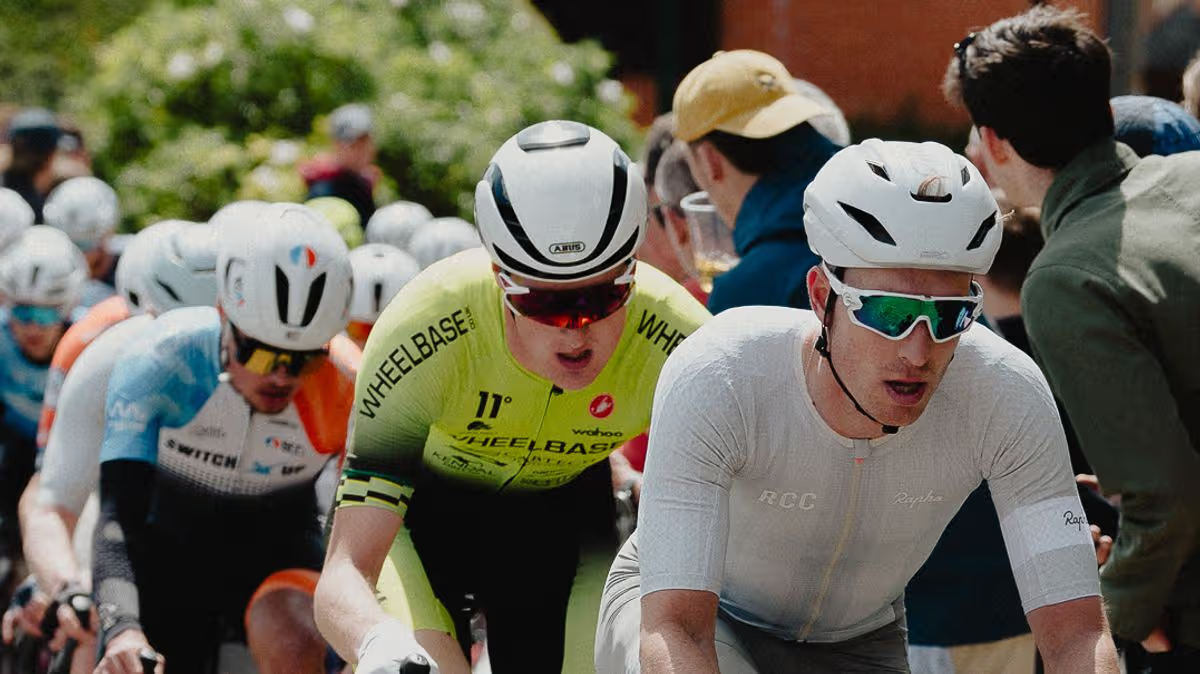
“I’ve seen little videos, snippets, and cool pictures and stuff like that. I just want either me or my [RCC Racing] teammate, Matt Bostock, to win. I think that’s what we should be aiming for and I think that’s what we’re capable of, so it’d be nice if we can pull it off.”
Wood recently powered to victory across 166km at the Lincoln Grand Prix, Britain’s oldest annual bike race that features gradients of up to 20%. He said: “It was its 70th anniversary. I’m obviously biased myself, but I think it’s probably the one-day race in the UK that is probably the nicest to win.
Advertisement
“It was a tough day and had active racing from the start. It was very windy, and then for the last two hours of the race, there were just four of us. So, yes, it was a taxing day on the old body, that’s for sure.”
Wood was part of the squad that took home a silver medal in the team pursuit in the 2024 Paris Olympic Games, and he is targeting the Track World Championships in Shanghai later this year. But crit racing offers a lower-pressure environment, one in which Wood tends to thrive.
He said: “I just enjoy what I’m doing well in at the time, but crit racing is definitely more enjoyable to participate in. Even if it doesn’t go well, there’s always a good atmosphere.
“If the weather’s nice, not cold, wet, and dark like it can be in the UK summer, then it’s good. I usually have fun, regardless of the outcome. There’s not pressure like the Olympics.
Advertisement
“The UK national crit series will come thick and fast throughout the summer, and then hopefully I might get to participate in the Tour of Britain. That will feed into the main goal at the end of the year, which is the Track World Championships.”
Jose Mourinho is challenging a punishment by Turkish football authorities from his time at Fenerbahce in 2024 at the European Court of Human Rights, claiming he has been “violated”
Jose Mourinho has escalated a row with Turkish football authorities by filing a complaint at the European Court of Human Rights. Mourinho is poised to leave Benfica and return to Real Madrid, but is still engaged in a battle stemming from his previous job at Fenerbahce.
Advertisement
The 63-year-old is challenging a 600,000 Turkish lira (£9,717) fine and a one-match ban from the dressing room and bench area imposed by the Turkish Football Federation (TFF) following a 3-2 win over Trabzonspor in the Super Lig on November 3, 2024.
Mourinho was punished for alleged unsportsmanlike conduct towards supporters and his comments about the officials after the match. Trabzonspor got two second-half penalties, while Mourinho was also furious that one of their players didn’t get sent off for a poor challenge.
He said VAR Atilla Karaoglan had missed the incident, that the Turkish Super Lig “smells bad” and didn’t attract international fans.
In his submission to the European Court of Human Rights, Mourinho argues that “the football boards in Turkey are not independent” and that his right to “freedom of expression has been violated”. The court has accepted his application and has requested observations from the Turkish government.
The TFF have argued that Mourinho’s comments about the lack of impartiality is “intended to damage the reputation of the TFF, to lower the value of Turkish football, to overshadow or discredit the impartiality of referees and other competition officials”.
The ECHR have asked the TFF whether they provided Mourinho an independent and impartial tribunal, and if they balanced his right to free speech against their own interests.
It is not the only time Mourinho clashed with the authorities during his time in Turkey. He was also slapped with a two-match ban and a £12,200 fine following a row with Fenerbahce’s rivals Galatasaray.
He claimed that the Galatasaray bench had been “jumping like monkeys” during a 0-0 draw, prompting the club to accuse him of racism. “Since the commencement of his managerial duties in Turkey, Fenerbahce manager Jose Mourinho has persistently issued derogatory statements directed towards the Turkish people,” Galatasaray said in a statement.
“Today, his discourse has escalated beyond merely immoral comments into unequivocally inhumane rhetoric. We hereby formally declare our intention to initiate criminal proceedings concerning the racist statements made by Jose Mourinho, and shall accordingly submit official complaints to UEFA and FIFA.”
Mourinho denied racism and Fenerbahce said his comments had been “taken completely out of context and deliberately distorted” by Galatasaray and that they should “in no way be associated with racism”.
Advertisement
Join our new WhatsApp community and receive your daily dose of MirrorFootball content. We also treat our community members to special offers, promotions, and adverts from us and our partners. If you don’t like our community, you can check out any time you like. If you’re curious, you can read our Privacy Notice.
“A vote for the SNP is a vote for a referendum on independence. Based on the 2011 precedent, an SNP majority at this election is a mandate for the transfer of powers to the Scottish parliament to enable an independence referendum to be held.”
So said the SNP manifesto. Yet as the party failed to win a majority in May’s Scottish election, where does this leave the independence movement?
The SNP won a convincing victory, reflected both in its 58 seats and by being streets ahead of its rivals. But the lack of the sought-after majority, alongside the decline in the SNP’s vote share – down 9.5 points and 13.2 points in the constituency and party list votes respectively, has weakened SNP claims to having won a “mandate” for an independence referendum.
On the other hand, the Scottish Greens’ success in almost doubling its parliamentary representation means that there is a larger pro-independence majority in the Scottish parliament than ever before.
Advertisement
Mandates are always contested. Even if the SNP had secured an overall majority, especially with a similar share of the vote (possible, given that a small shift in just eight marginal constituencies could have delivered a majority), it is unlikely that the UK government would have responded as former prime minister David Cameron did in the wake of the SNP’s 2011 election victory.
Back then, the SNP’s single-party majority sent shock waves through the Westminster establishment. It also far surpassed support for independence, supported then by around a third of the electorate. The then-prime minister’s concession on a referendum mandate posed less of an existential threat to the union than would appear today. Although independence was not a priority issue in the 2026 election campaign, around half of the electorate have consistently said they would vote “yes” in a referendum.
Moreover, the UK Labour government can also claim that it has a mandate from the 2024 election to oppose an independence referendum, having clearly set out its opposition in the manifesto.
Scottish independence supporters gathered outside Scottish Parliament as MSPs backed a call for Westminster to allow a second referendum. SST/Alamy
While the political mandate for an independence referendum is contested, the legal authority is not. There is no route to Scottish independence, or to a referendum on independence, that does not go through the Westminster parliament.
Advertisement
The UK Supreme Court’s 2022 judgement made clear that a law to hold an independence referendum would be beyond devolved competence because it would relate to both the status of the union between Scotland and England, and whether Scotland should cease to be subject to the sovereignty of the UK parliament. Both of these matters are reserved to Westminster under the Scotland Act (1998).
The Scotland Act allows for transfers of competence, via Section 30 orders or amendments to the schedule 5 reservations. Following the 2011 election, extensive intergovernmental negotiation led to the Edinburgh Agreement. This paved the way for a temporary transfer of competence via a Section 30 order to allow the Scottish Parliament to legislate to hold an independence referendum, and is the route the SNP hopes would lead to a new referendum.
The SNP’s election victory, by itself, is unlikely to be persuasive enough to generate a new agreement. An “unofficial” referendum or a unilateral declaration of independence would not be a meaningful path to independence and is not remotely considered an option by this SNP government.
There may, however, be more pressure on the UK government and the opposition parties in Scotland to clarify what a process might look like in the future and what would trigger it. The further we get from the 2014 independence referendum, the harder it may be politically to rest on the fact that Scots already took a decision on their constitutional future.
Advertisement
The UK constitution, unlike some of its European counterparts, does not prohibit independence for one or more of its constituent parts. Nor does it expressly provide a process to facilitate it, except – with some ambiguity – in the case of Northern Ireland.
The 1998 Belfast/Good Friday Agreement places an obligation on the secretary of state to initiate a border poll on Irish unity “if at any time it appears likely that a majority of those voting would express a wish that Northern Ireland should cease to be part of the United Kingdom and form part of a united Ireland”. And where such a poll produced a majority, the secretary of state would lay proposals before parliament to give effect to that wish.
The Scottish first minister will have an ally in Sinn Fein’s Northern Ireland first minister, Michelle O’Neill, and in Wales’ new Plaid Cymru first minister, Rhun ap Iorwerth, in pushing for clarity on the circumstances under which the constituent territories of the UK can decide to leave.
In the meantime, we can expect the new Scottish government to continue to make the case for independence, while pushing at the boundaries of devolution. This will include seeking new powers over energy, a new Scottish visa scheme, and opposing the post-Brexit constraints on Scottish self-government.














































You must be logged in to post a comment Login