





Connect with us
DAPA Banner
DAPA Coin
DAPA
COIN PAYMENT ASSET
PRIVACY · BLOCKDAG · HOMOMORPHIC ENCRYPTION · RUST
ElGamal Encrypted MINE DAPA
🚫 GENESIS SOLD OUT
DAPAPAY COMING

Business

Russell 2000 Rises 0.9% as Small Caps Extend Outperformance Amid Market Rotation

Published

on

FTSE 100 Surges 0.8% Today as Oil Eases and Markets

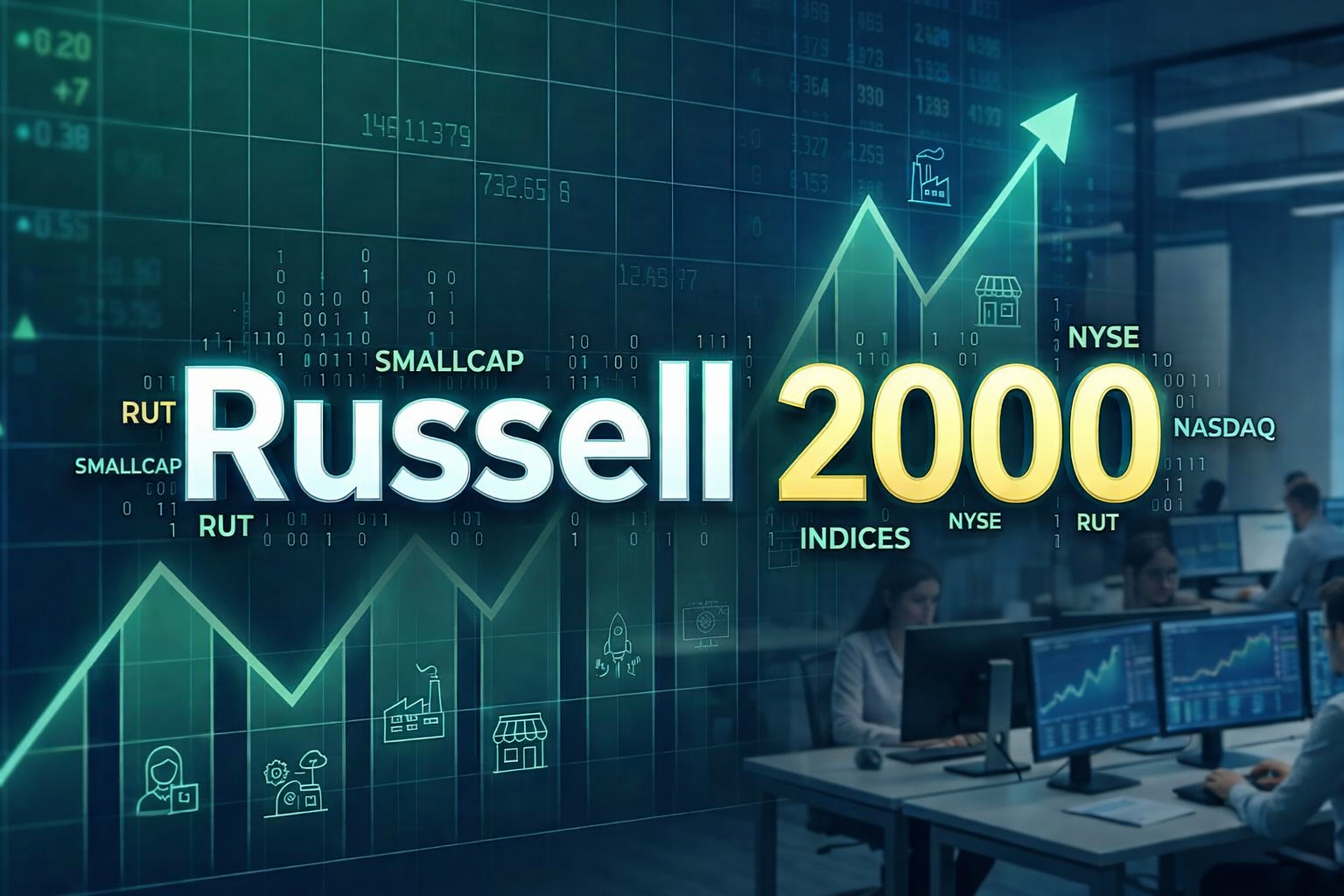
NEW YORK — The Russell 2000 Index climbed Thursday as small-cap stocks continued to attract buyers in a broadening market environment, closing at 2,919.61 after gaining 26.10 points, or 0.90%. The move highlighted ongoing investor rotation out of mega-cap technology names into smaller companies perceived as more sensitive to domestic economic improvements.

Small-cap shares have shown resilience in 2026 despite periodic geopolitical pressures from the Middle East. The index has benefited from expectations of lower interest rates, potential fiscal support and stronger relative earnings growth compared to large caps. Thursday’s advance came as the broader market displayed mixed performance, with the Dow Jones Industrial Average posting gains while the Nasdaq faced pressure.

The Russell 2000, which tracks the smallest 2,000 companies in the Russell 3000 Index, has been a standout performer in recent periods. Year-to-date through early June 2026, it has posted solid gains, outperforming the S&P 500 on multiple stretches as investors seek exposure to more domestically focused businesses less vulnerable to international trade tensions.

Reconstitution Dynamics in Focus

Advertisement

The June 2026 semi-annual Russell reconstitution, the first under the new twice-yearly schedule, has added to technical support for small caps. Preliminary results showed significant activity, with 237 companies joining the Russell 2000 and others migrating between indexes. Health care, technology, industrials and consumer discretionary sectors led additions.

The market capitalization breakpoint between the Russell 1000 and Russell 2000 rose 24% to about $5.7 billion, reflecting broad growth across US equities. The smallest company in the Russell 2000 now has a market cap of roughly $146 million, up nearly 23% from the prior year.

This reconstitution process typically generates elevated trading volume and can influence short-term price action as index funds and passive strategies adjust holdings. Analysts note a shift toward higher-quality, profitable companies within the small-cap universe during this cycle.

Broader Market Context

Advertisement

Small caps have gained traction as the market rotates away from concentrated mega-cap leadership. Companies in the Russell 2000 tend to derive more revenue domestically, making them potentially better positioned amid uncertainties around tariffs, global supply chains and energy costs linked to US-Iran tensions.

Recent economic data has presented a mixed picture. While inflation remains a concern and oil prices fluctuate with Middle East developments, resilient consumer spending and corporate earnings in certain sectors have supported risk appetite for smaller firms. The Federal Reserve’s path on interest rates continues to influence sentiment, with small caps often benefiting more from easing expectations.

Financials, industrials and consumer-related names within the index contributed to Thursday’s gains. These sectors stand to benefit from a stable or improving domestic economy and potential stimulus measures.

Performance Trends in 2026

Advertisement

The Russell 2000 has notched multiple record highs in 2026 and extended streaks of outperformance against the S&P 500. In the first quarter, it posted positive returns even as large-cap indexes faced pressure from geopolitical shocks and energy volatility.

Analysts from firms like Goldman Sachs have highlighted potential for small-cap strength in 2026, citing accelerating economic growth, moderating inflation and Fed easing. However, they caution that full-year outperformance is not guaranteed and depends on sustained fundamentals.

Dispersion within the Russell 2000 remains high, offering opportunities for active managers. While some unprofitable companies have lagged, higher-quality names with strong cash flows have driven much of the recent rally.

Challenges and Risks

Advertisement

Despite the positive session, risks persist. Small caps remain sensitive to higher oil prices and any escalation in the Middle East that could disrupt energy supplies. South Korea’s won weakening to multi-month lows on Thursday underscored global spillovers from US-Iran tensions.

Valuations have expanded in the small-cap space, raising questions about sustainability. The index trades at premiums to historical averages in some metrics, though still below large-cap multiples in others. Ongoing earnings reports will be critical in validating the rotation narrative.

Broader economic headwinds, including sticky inflation in certain categories and consumer sentiment challenges, could weigh on discretionary spending. Companies in the Russell 2000 often have higher debt loads, making them more exposed to interest rate fluctuations.

Investor Sentiment and Outlook

Advertisement

Institutional and retail investors alike have shown renewed interest in small caps as part of a diversification strategy. Exchange-traded funds tracking the Russell 2000 have seen inflows during periods of outperformance.

Looking ahead, the June reconstitution finalization later this month could bring additional volatility. Markets will also watch for second-quarter earnings, Federal Reserve communications and any diplomatic progress on Middle East issues.

Strategists generally maintain a constructive view on small caps over the medium term, citing potential earnings acceleration and valuation support. However, near-term caution prevails amid geopolitical uncertainties and the possibility of renewed large-cap leadership.

The session’s 0.9% gain in the Russell 2000 came alongside solid volume, indicating genuine participation rather than thin trading. As the trading week progresses, focus will remain on whether small caps can sustain momentum or if broader market consolidation takes hold.

Advertisement

This performance underscores the cyclical nature of market leadership. While mega-cap technology drove much of the prior bull run, 2026 has seen a more balanced participation that includes smaller companies positioned for domestic recovery and sector-specific tailwinds.

Continue Reading
Click to comment

You must be logged in to post a comment Login

Leave a Reply

Business

GameStop Shares Jump on Record Q1 Profit and $2 Billion Buyback Announcement

Published

on

Amateur investors have targeted shares of firms including GameStop that had been "short-sold" by hedge funds

NEW YORK — GameStop Corp. shares rose sharply Thursday after the video game retailer posted its highest-ever quarterly net income and announced a substantial new share repurchase program, signaling continued efforts to return capital to shareholders amid a strategic shift toward higher-margin products.

The stock climbed more than 6% in the previous session to close at $22.18 after the company reported fiscal first-quarter results that exceeded expectations on several fronts. By mid-morning trading on June 4, shares were hovering near $22.55, reflecting sustained investor interest following the earnings release.

For the quarter ended May 2, GameStop reported net sales of $835.3 million, a 14% increase from $732.4 million in the prior-year period. The growth was driven largely by collectibles, which accounted for nearly 42% of revenue at $348.9 million, up significantly from the previous year.

Operating income reached a record $143.3 million for the first quarter, compared with an operating loss of $10.8 million a year earlier. Adjusted operating income, excluding certain items, stood at $140.5 million.

Advertisement

Net income surged to $389.6 million, or 66 cents per share, from $44.8 million, or 9 cents per share, in the year-ago quarter. The figure included one-time gains such as a $268.4 million unrealized gain on derivatives tied to eBay stock holdings and interest income. Excluding those and other adjustments, net income was $179.3 million.

The company’s board approved a new $2 billion discretionary share repurchase authorization, effective through June 2029. This replaces a prior program and underscores management’s confidence in the balance sheet, which showed $9.7 billion in cash, marketable securities, digital assets and related items at quarter-end.

Strategic Evolution Under Cohen

Chairman and CEO Ryan Cohen has steered GameStop toward diversification beyond traditional video game hardware and software sales. Collectibles, including trading cards, apparel, toys and pop culture merchandise, have become a key growth driver as the company reduces reliance on lower-margin categories.

Advertisement

Hardware and accessories sales declined modestly to $333.7 million from $345.3 million, while software revenue fell to $152.7 million from $175.6 million. Selling, general and administrative expenses decreased to $201.6 million, reflecting ongoing cost discipline.

The results come as GameStop continues to navigate a challenging retail environment for physical video game sales amid the broader industry shift to digital downloads. The company has closed stores in recent periods while investing in e-commerce and alternative revenue streams.

GameStop has also been active on the corporate development front. It has built a stake in eBay, recently increasing its position, and made an unsolicited $56 billion takeover proposal that eBay rejected as “neither credible nor attractive.” Cohen has publicly criticized eBay’s leadership and indicated potential further steps.

Market Reaction and Meme Stock Legacy

Advertisement

The earnings beat and buyback news triggered positive momentum in a stock known for its volatile trading history tied to retail investor enthusiasm. GameStop remains a favorite among meme stock communities, though its price action has moderated compared to the dramatic surges seen in 2021.

Year-to-date through early June 2026, the shares have shown resilience relative to some other speculative names, with gains supported by balance sheet strength and capital return initiatives. The stock trades well below its 52-week high near $31 but above its low around $19.93.

Analysts and market observers note the company’s strong liquidity position provides flexibility for buybacks, potential investments or other shareholder-friendly actions. The $2 billion authorization represents a significant commitment relative to the current market capitalization of approximately $9.4 billion to $10 billion.

Broader Retail Challenges

Advertisement

Despite the positive quarter, GameStop faces ongoing pressures in the video game retail sector. Industry-wide trends favor digital distribution, pressuring physical store footprints. The company has been trimming locations while attempting to transform stores into experiential destinations for gaming and collectibles enthusiasts.

Gross profit improved to $340 million from $252 million a year ago, aided by the higher-margin collectibles mix. Management has emphasized operational efficiency and inventory management as priorities.

Looking ahead, the company did not provide specific forward guidance in its release, consistent with past practice. Investors will watch for updates on store optimization, e-commerce growth and any developments regarding the eBay position or other strategic moves.

The upcoming fiscal second quarter will be closely monitored for seasonal strength around summer releases and back-to-school periods. Holiday performance remains critical for the full-year outlook in this cyclical business.

Advertisement

Investor Sentiment and Risks

Retail investors continue to track GameStop closely, with message boards and social platforms buzzing after the earnings. The combination of record profits, massive cash reserves and aggressive capital allocation has renewed optimism among long-term holders.

However, risks persist. Short interest, while lower than peak levels from previous years, remains a factor in volatility. Broader economic conditions, consumer spending on discretionary items and competition from online giants could influence results.

Wall Street consensus ratings have generally been cautious, with many analysts citing valuation concerns and secular industry headwinds even as recent results demonstrate progress under the current leadership.

Advertisement

GameStop’s market capitalization stood near $9.4 billion following the latest close, with roughly 448 million shares outstanding. The price-to-earnings ratio on trailing adjusted figures reflects improved profitability but still embeds expectations for sustained execution.

As the company evolves from a traditional brick-and-mortar retailer into a more diversified player in gaming and collectibles, its ability to deliver consistent results will determine whether the current momentum can be maintained. The $2 billion buyback provides a floor of support while management pursues longer-term transformation.

Trading volume on Wednesday was elevated at over 17 million shares, well above average, as investors digested the news. Continued follow-through will depend on broader market sentiment and any incremental updates from the company in coming weeks.

Advertisement
Continue Reading

Business

Apple faces Indian engineer’s bias lawsuit

Published

on

The Economic Times
Apple Inc. lost an early round in a discrimination lawsuit brought in the U.S. by a female engineer from India who says her two managers — one from her country, the other from Pakistan — treated her as they would in their own countries: as a subservient.

The woman’s case in California state court is the latest to allege workplace bias in Silicon Valley that focuses on cultural prejudices of some tech workers from South Asia. Cisco Systems Inc. is fighting a suit brought by California’s civil rights agency alleging bias against a member of India’s so-called lower castes, known as Dalits.

Anita Nariani Schulze is part of the Sindhi minority — she is Hindu, with ancestry in the Sindh region of what is now Pakistan. Her complaint alleges that her senior and direct managers, both male, consistently excluded her from meetings while inviting her male counterparts, criticized her, micromanaged her work, and deprived her of bonuses, despite positive performance evaluations and significant team contributions.

Schulze claims the managers’ animus reflects sexism, racism, religious bias and discrimination on the basis of national origin. The Sindhi Hindu nationality is “known for its technical acumen” and its gender equality, she says, which “exacerbated the managers’ discriminatory treatment.”

Advertisement

In a tentative ruling on Wednesday, Santa Clara County Superior Court Judge Sunil R. Kulkarni rejected Apple’s request to toss out the suit. While not ruling on the merits of the case, Kulkarni said Schulze had adequately supported her legal claims. Apple had argued her claims weren’t specific enough and were based on stereotypes.

But the judge rejected Schulze’s request to represent a class of female Apple employees who suffered job discrimination over the last four years. He agreed with Apple that she didn’t show a pattern of discrimination that could be applied to a broader group.