

Crypto World
Kalshi debuts Ethereum perpetuals as XRP futures await review



Kalshi has launched Ethereum perpetual futures in the United States after securing approval for the product, while proposed XRP and other altcoin contracts remain subject to separate regulatory review.
Summary
- Kalshi has launched CFTC-regulated Ethereum perpetual futures in the U.S., days after debuting Bitcoin perpetual contracts.
- XRP, Solana, Dogecoin, Hedera, and other proposed crypto perpetual futures remain subject to separate CFTC review before trading can begin.
- Kalshi reportedly plans to use CF Benchmarks pricing data for future crypto perpetual products as it expands beyond Bitcoin and Ethereum.
According to a June 4 announcement from Kalshi, the CFTC-regulated prediction market operator has opened trading for Ethereum perpetual futures, extending its push into crypto derivatives after introducing Bitcoin perpetual contracts last week.
The company described the new offering as “American Perpetuals” and said users can trade the product under a regulated framework. Kalshi is also waiving trading fees for a limited period for users who join its waiting list.
Ethereum joins Bitcoin as the second cryptocurrency available through Kalshi’s perpetual futures lineup. A day earlier, the company launched CFTC-approved Bitcoin perpetual futures, giving U.S. traders access to a product structure that has largely been offered through offshore crypto exchanges.
Unlike traditional futures contracts, perpetual futures do not expire. According to information published by Kalshi and the CFTC, these products remain open indefinitely and rely on funding payments to help keep futures prices aligned with spot market prices.
Scott Melker, known as ‘The Wolf Of All Streets’, commented on the Ethereum launch in an X post, describing it as a trade structure that had previously been unavailable to many American market participants. He said the product provides regulated leveraged exposure to ETH while operating without an expiration date.
Ethereum joins regulated perpetual futures market
Growth in perpetual futures trading has turned the segment into one of the largest parts of the crypto derivatives industry. Reuters reported that global perpetual futures volume reached $61.7 trillion in 2025, representing a 29% increase from the previous year. Separate market data cited by Kalshi placed offshore perpetual futures volume at $92.9 trillion during the same period.
Most of that activity has historically taken place on exchanges such as Binance and Hyperliquid, where traders have long had access to perpetual contracts. U.S. institutions and retail participants, however, have had limited access to comparable regulated products.
Alongside the launch, market data shared by analyst Ted Pillows showed Ethereum open interest had fallen more than 6% to $26.48 billion. He used Kalshi’s newly launched product to test a small ETH short position shortly after trading became available.
At the time of writing, Ethereum (ETH) was trading near $1,769, down more than 3% over the previous 24 hours. Crypto analyst Ali Martinez said ETH had broken below the $1,825 support level and suggested that prices could decline toward $1,600 and potentially $1,400 if selling pressure continues.
XRP and other altcoins remain under review
While Ethereum trading is now live, several additional crypto perpetual contracts are still awaiting regulatory clearance.
Kalshi has reportedly filed to certify perpetual futures linked to XRP, Solana, Dogecoin, Stellar, Shiba Inu, and Hedera. Information surrounding the filings indicates the company plans to use pricing data supplied by CF Benchmarks, a provider whose reference rates are already used across multiple institutional crypto products.
Recent guidance from the CFTC suggests that approval of one perpetual contract does not automatically extend to other assets. The regulator said perpetual contract structures may not be appropriate for every asset class and encouraged firms to submit products for individual review before listing them.
As a result, XRP and other proposed altcoin contracts may follow separate approval paths even after Ethereum’s launch.
CF Benchmarks data is already used in several regulated crypto products, including XRP futures markets operated through CME. Combined with growing activity on the XRP Ledger and rising interest in XRP-related investment products, the existing infrastructure could provide a foundation for future regulated perpetual listings if the contracts receive approval.

Crypto World
Zcash plummets 30% as Shielded Labs reveals a major bug that went undetected for four years
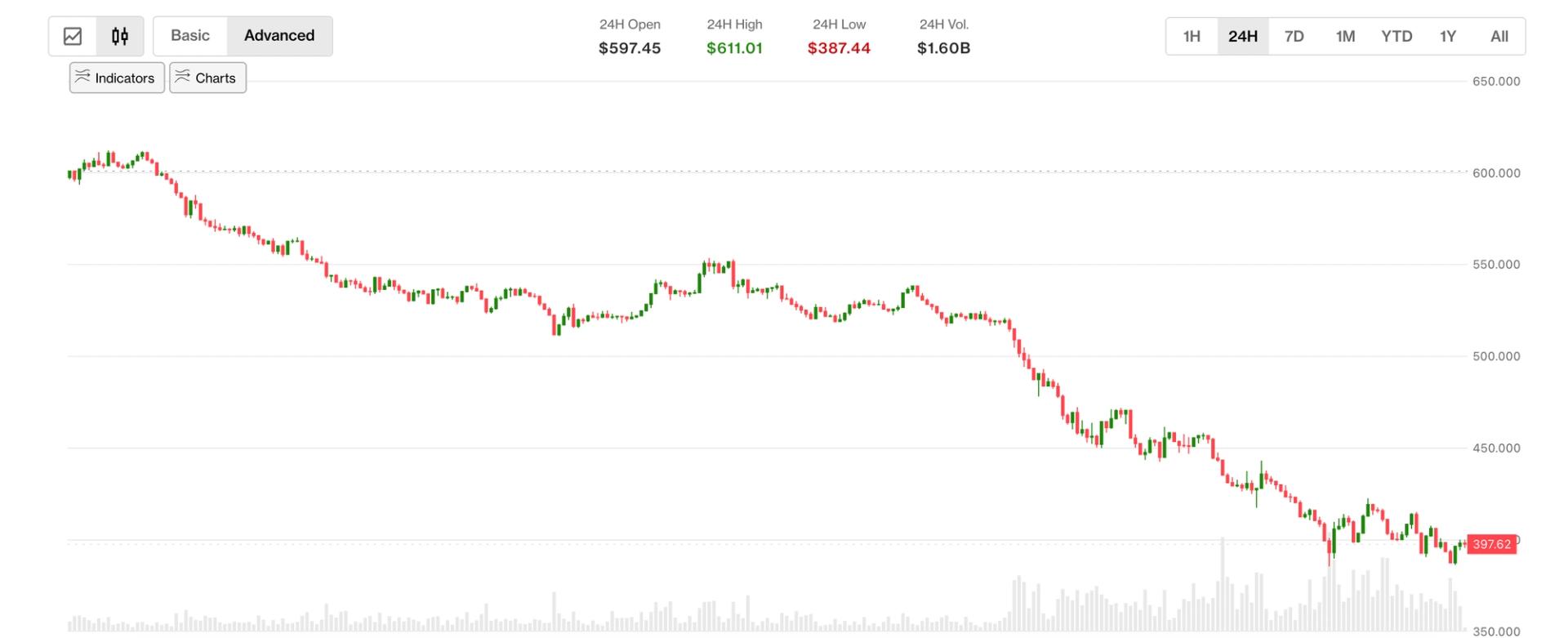
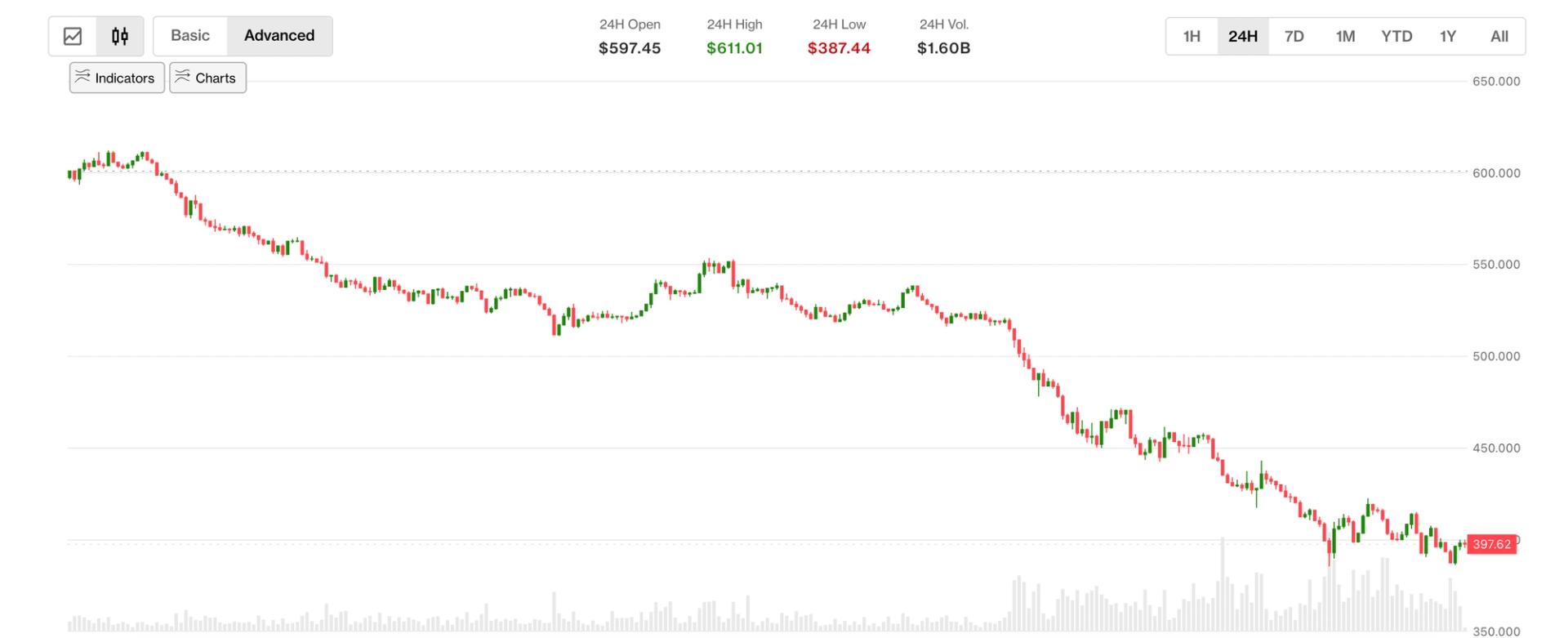
Privacy-focused zcash (ZEC) has taken a beating in the past 24 hours, falling roughly 30% to $400 amid broader market weakness. The selling accelerated after Shielded Labs, a nonprofit Zcash developer, disclosed a critical vulnerability in the blockchain’s Orchard privacy pool that could have threatened the integrity of the token’s supply.
Late Thursday, Shielded Labs published a detailed disclosure on X, revealing a vulnerability that, if exploited, could have allowed an attacker to create an unlimited number of counterfeit ZEC tokens, completely undetected. Think of it as someone secretly gaining access to the Federal Reserve’s dollar printing press, except in this case, even the Fed wouldn’t be able to tell these extra dollars were printed.
The vulnerability was discovered on May 29 by Taylor Hornby, a security engineer engaged by Shielded Labs in April 2026 specifically to identify protocol vulnerabilities before malicious actors could. Working with Anthropic’s recently released Opus 4.8 AI model, Hornby conducted a highly targeted review of the Orchard circuit, which is the cryptographic system underpinning Zcash’s most advanced privacy pool.
Shielded Labs said Hornby wrote a complete exploit which, when tested in a local testing environment, generated unlimited, undetectable counterfeit ZEC. Shielded Labs added that if the same tool had been run on Zcash mainnet, it would have generated unlimited, undetectable counterfeit tokens in his mainnet wallet.
Imagine an attacker quietly printing unlimited counterfeit ZEC and holding them undetected. The damage to trust in the supply and, by extension, the token’s market value could have been severe.
Hornby immediately disclosed the vulnerability to the Zcash Open Development Lab (ZODL), which coordinated an emergency fix on June 1, closing it within days of discovery.
Bug undetected for four years
Still, what appears to be a proactive approach to fixing bugs has not impressed markets. That’s possibly because, as Shielded Labs itself admitted, the bug had been present since Orchard’s activation in May 2022. In other words, it existed, undetected, for four years.
What makes the situation even more complex for markets is Shielded Labs’ acknowledgement that it cannot say for sure whether the bug was exploited before the fix.
“What makes this particularly challenging is that, due to the privacy properties of Orchard and the nature of the bug, there is no definitive way to determine using only cryptography whether such exploitation occurred before the vulnerability was discovered and fixed. We believe it is important to be transparent about that uncertainty,” the firm said.
Still, it stressed that exploitation likely didn’t happen for several reasons. First, the bug had evaded years of scrutiny by experienced cryptographers. It came to light only with the help of cutting-edge AI tools and highly skilled researchers working deliberately to find it. And once discovered, it was fixed quickly, leaving little time for anyone to exploit it.
“We think he probably succeeded,” Shilded Labs said of Hornby’s efforts to find the vulnerability before malicious actors could.
However, the organization was careful to add that users should not rely solely on their assessment and proposed a network upgrade that would allow anyone to verify the integrity of the ZEC supply independently. The proposal involves deploying a new shielded pool and enforcing turnstile accounting on all coins from the Orchard pool. The firm said it could publish a detailed post on the same next week.
It also said it is accelerating security efforts, including continued work with Hornby, a formal verification project aimed at writing a mathematical proof that there are no undiscovered bugs in the Orchard circuit, and new hires for a Head of Security and a Cryptographer.


Six Republican senators have called on U.S. banking regulators to develop new capital standards for digital assets as Congress moves forward with legislation that could expand banks’ involvement in the crypto sector.
Summary
- Senator Cynthia Lummis and five Republican senators have urged U.S. banking regulators to create new capital rules for digital asset activities.
- The lawmakers criticized Basel Committee standards that assign a 1,250% risk weight to certain digital assets, arguing banks need a more balanced framework.
- Senators said pending crypto legislation could expand banks’ digital asset activities, increasing the need for clear capital guidance from regulators.
According to a statement released Thursday, Senator Cynthia Lummis and five other Republican senators sent a letter last week to Federal Reserve Vice Chair for Supervision Michelle Bowman, Federal Deposit Insurance Corporation Chair Travis Hill, and Comptroller of the Currency Jonathan Gould, urging the agencies to provide clearer guidance on how banks should hold capital against digital asset exposures.
The request comes as Bowman, Hill, and Gould are scheduled to testify before the House Financial Services Committee on Thursday.
In their letter, the lawmakers argued that existing international standards developed by the Basel Committee on Bank Supervision assign an excessively high capital charge to digital assets.
The senators pointed to the committee’s 1,250% risk weight for certain crypto holdings, a measure used by banks and regulators to determine how much capital must be set aside against potential losses.
The Basel Committee, which operates under the Bank for International Settlements and includes regulators from the United States and other major jurisdictions, has published several digital asset capital standards in recent years.
Senators Cynthia Lummis, Dan Sullivan, Bill Hagerty, Bernie Moreno, Ted Budd, and Jon Husted signed the letter.
Senators seek technology-neutral treatment
In the letter, the lawmakers said future capital requirements should account for both the risks and opportunities associated with digital assets. They also urged regulators to adopt a technology-neutral approach that would allow banks to participate in digital asset markets without being disadvantaged solely because of the technology used.
Drawing attention to a joint statement issued in March by the Federal Reserve, FDIC, and Office of the Comptroller of the Currency, the senators noted that regulators had already concluded tokenized securities should generally receive the same capital treatment as their traditional counterparts.
According to the letter, the same principle should be applied consistently when regulators evaluate other forms of digital assets.
Lawmakers also linked their request to digital asset legislation currently under consideration in Congress. The senators said pending bills would permit banks to engage in additional on-balance-sheet digital asset activities, creating a need for clear capital rules before those activities become more common within the banking system.
The latest push adds to Senator Lummis’ recent efforts to defend crypto legislation and expand regulatory clarity for the sector. Earlier this week, CNBC reported that Lummis criticized JPMorgan Chase Chief Executive Officer Jamie Dimon over his comments about the CLARITY Act and Coinbase Chief Executive Officer Brian Armstrong.
During a CNBC interview cited by the network, Dimon argued that the legislation failed to address key banking safeguards and anti-money laundering concerns. Lummis rejected that interpretation, telling CNBC that anti-money laundering and Bank Secrecy Act requirements already apply to digital assets and are included in the legislation.

Tencent’s Chief AI Scientist Yao Shunyu (R) discusses the tech outlook with Tencent
CNBC | Evelyn Cheng
BEIJING — A former OpenAI researcher is now chief AI scientist for Tencent in China, and wants to build artificial general intelligence.
It’s a sign of a shift in the U.S.-China tech race.
AI with human-level or above capabilities (AGI) has long been the goal of U.S. companies such as OpenAI, Anthropic and Alphabet, which acquired British startup DeepMind.
Chinese companies rushing to catch up on AI and facing U.S. chip controls have instead focused on ways to use the technology in applications from factories to consumer electronics. Baidu CEO Robin Li previously predicted it would take until at least 2034 to achieve AGI, in contrast to Elon Musk’s 2026 forecast at the time.
But as Chinese companies grab talent from Silicon Valley, they’re increasingly bringing the U.S. vision with them.
“My personal goal is that in China we should establish a long-term AGI organization” said Tencent Chief AI Scientist Yao Shunyu, who joined the company in the last year after leaving his OpenAI role, in remarks CNBC translated from Mandarin.
Yao was discussing the next stage of AI development on-stage Friday with Tencent’s Cloud executive Dowson Tong at the company’s event in Beijing co-organized with local authorities. A senior Beijing official gave opening remarks.

Yao said Friday his vision for AGI will require foundational knowledge, products and frontier exploration.
“I don’t think ChatGPT or Claude will be the only super-app,” Yao said, saying untapped potential is in the “trillions of dollars.” Performance of an AI tool is most important followed by cost, he said, adding that the path forward in China is with smaller AI models and more consistent performance on basic tasks.
His optimism contrasted with growing caution on AI in the U.S.
Anthropic on Thursday warned that frontier models are nearing the point where they can improve themselves without human oversight. The company called for an industry slowdown or pause in new model development to stave off disruption to society.
The San Francisco-based startup earlier this year urged Washington to maintain the U.S. lead over Chinese models. Anthropic has emphasized AI safety from its founding and drawn criticism from rivals that its safety warnings are designed to hobble competition.
Talent competition
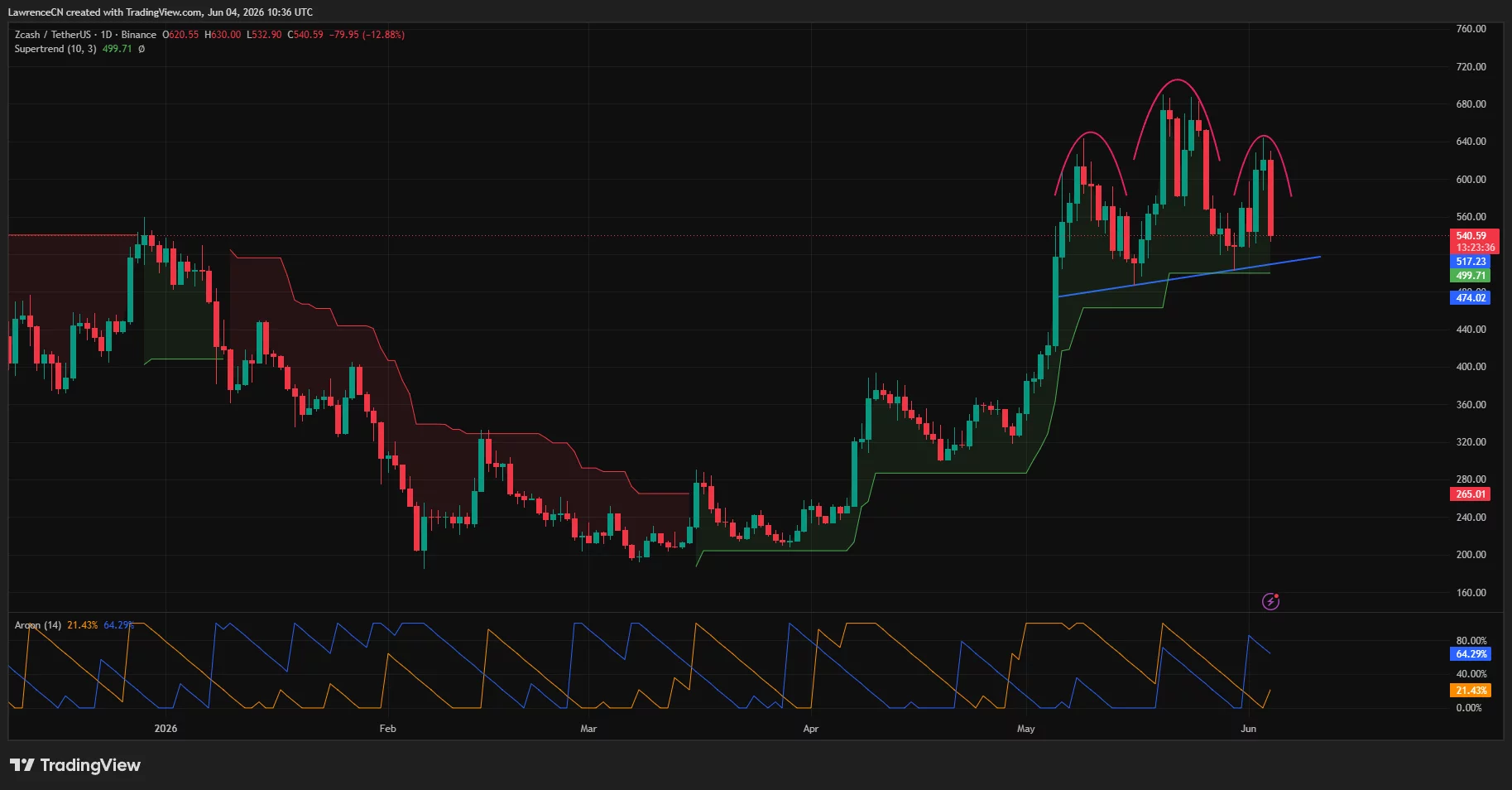
Zcash price has fallen sharply from its recent highs as traders increasingly focus on a developing head-and-shoulders pattern that threatens to trigger a deeper correction.
Summary
- Zcash price fell nearly 13% in 24 hours as traders focused on a developing head-and-shoulders pattern with key support near $520.
- Crypto analysts Ardi and Team LAMBO identified the $500–$520 region as a critical support zone, with a breakdown potentially exposing downside toward $390.
- A move back above the $610–$650 resistance area would invalidate the bearish setup and restore focus on the May highs near $690.
According to data from crypto.news, Zcash (ZEC) price traded near $540 on June 4 after dropping almost 13% over the past 24 hours. The privacy-focused cryptocurrency had rallied to nearly $690 in May before repeated rejections above the $610–$650 area attracted fresh selling pressure. Zcash’s recent decline has pushed the token back toward a cluster of technical support levels that traders are closely monitoring.
Attention has increasingly shifted to a potential head-and-shoulders formation that has been developing since early May. Three prominent peaks are visible on the daily chart, with the middle peak near $690 forming the head and the surrounding highs creating the shoulders.
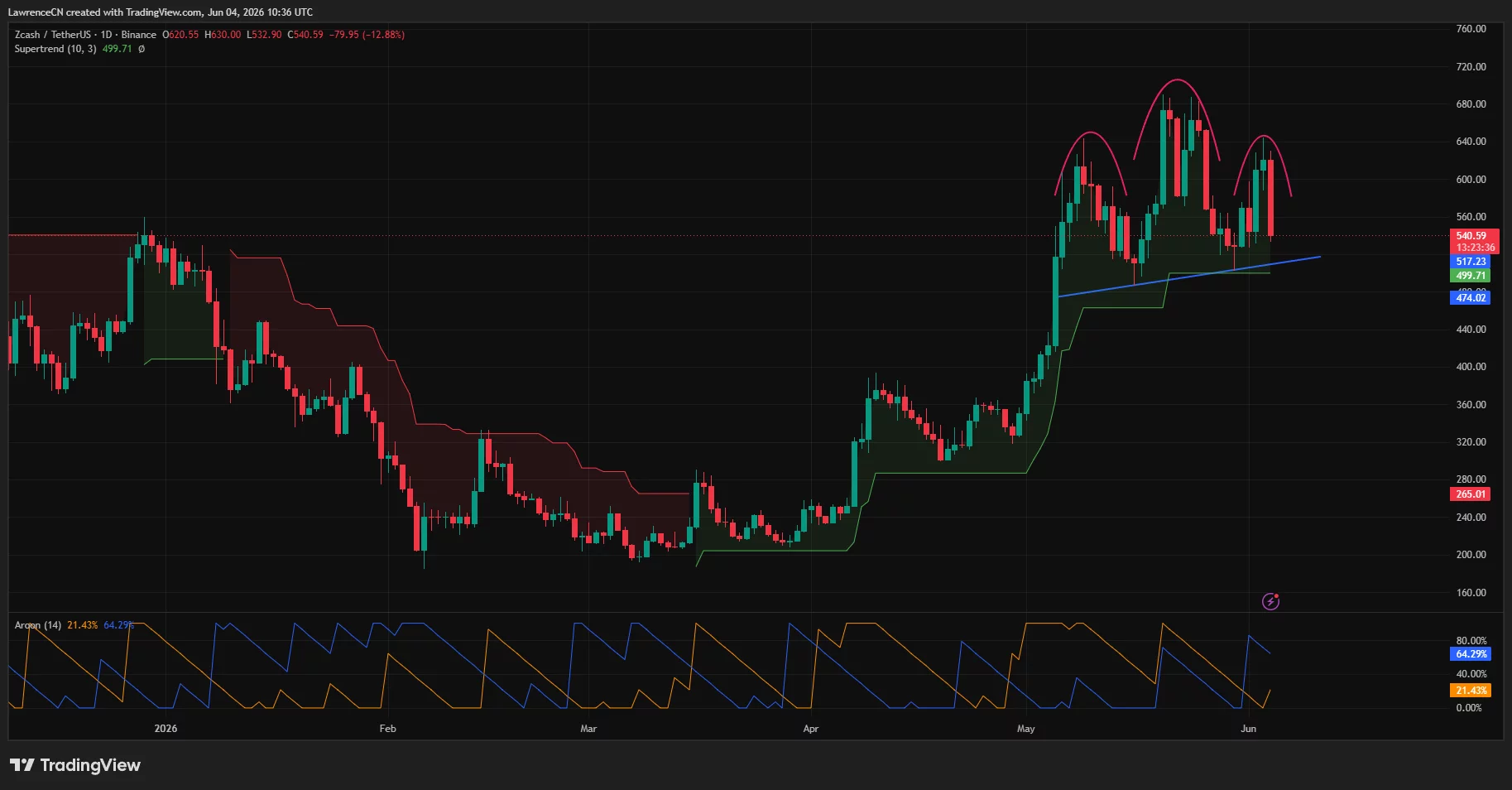
The pattern emerged after ZEC completed a powerful breakout from a multi-month consolidation structure in April, making the current pullback one of the first serious tests of the uptrend.
According to crypto analyst Ardi, buyers have repeatedly failed to establish acceptance above $610.
“Every attempt above that resistance continues getting aggressively sold back down into deeper levels.”
Commenting on the setup, the analyst argued that the neckline near $520 has become the most important level on the chart. A decisive breakdown below that area could complete the pattern and expose a move beneath $500.
Bears target the $520 neckline as momentum weakens
Several technical indicators have begun to favor sellers. ZEC recently slipped below a rising trendline that had supported the advance from mid-May, while daily candles have closed beneath multiple short-term support zones.
The chart also shows price trading only modestly above the Supertrend support region near $499, leaving little room for error if selling pressure accelerates.
The Aroon indicator presents another challenge for bulls. Aroon Down has climbed above 64 while Aroon Up has dropped near 21, a configuration that often appears when downward momentum starts gaining control. The shift follows several weeks during which buyers dominated the market structure after the April breakout.
Another analyst group, Team LAMBO, noted that a right shoulder appears to be forming and identified a break below $500 as the trigger that could open the door to a larger decline.
Under that scenario, downside projections extend toward the $390 region, which coincides with a former consolidation zone from April. More aggressive bearish targets sit closer to $350, where the breakout rally originally accelerated.
Even after the recent decline, ZEC remains substantially above its April lows near $240. That longer-term advance has left a large amount of unrealized profit on the table, creating conditions where profit-taking can intensify during periods of market weakness.
A recovery above $610 would invalidate the bearish setup
Not all traders are convinced the bearish pattern will complete. The neckline around $520 remains intact at the time of writing, and buyers have successfully defended the area during previous pullbacks.
A rebound from current levels could force short sellers to cover positions and restore momentum toward the upper resistance band.
The most important invalidation level remains the $610–$650 zone. A sustained move above that region would undermine the developing head-and-shoulders structure and shift attention back toward the May highs near $690. Beyond that, the psychological $700 level would likely become the next major upside target.
Macro headwinds continue to weigh on risk assets. Escalating geopolitical tensions and uncertainty surrounding the Federal Reserve’s policy path have contributed to volatility across crypto markets. Further, if Bitcoin continues to lose major support levels, it could add pressure to high-beta tokens such as ZEC.
For now, the battle centers on the $520 neckline. A successful defense would keep the longer-term uptrend intact, while a breakdown could transform what has been one of the strongest rallies of the past two months into a much deeper correction.
Disclosure: This article does not represent investment advice. The content and materials featured on this page are for educational purposes only.


Binance Research said crypto exchanges may become a major gateway into global stock markets, as stablecoins and tokenized equities reduce old barriers around cost, access, settlement, and brokerage reach in underbanked regions worldwide.
Summary
- Binance sees crypto exchanges routing 300 million new investors into global equities by 2031 worldwide.
- Emerging markets drive demand, with 93% of Binance stock trading users coming from those regions.
- Stablecoin stock trading could cut transfer costs while supporting 24/7 access to global equity markets.
Binance Research sees a $2T equity route
Binance Research said crypto exchanges could collectively channel $2 trillion in new capital and nearly 300 million new investors into global equity markets by 2031. The report frames crypto exchanges as a distribution layer for users who already hold digital assets but lack easy access to major stock markets.
The research also presented a bull case where crypto users could bring $5 trillion in annual incremental equity capital over the next five years. Binance Research said the estimate uses the global crypto user base, exchange coverage, eligibility, adoption rates, and average position sizes.
Emerging markets drive the demand
The report said close to 93% of Binance stock trading users come from emerging markets. Binance Research linked that share to long-running barriers such as high brokerage costs, limited foreign market access, and banking friction.
“The next 300 million equity investors are coming from emerging markets,” Binance Research said on X. The post added that users may be onboarded through crypto exchanges, settle in stablecoins, and trade around the clock.
Meanwhile, Binance Research said stablecoin-settled stock trading could cut cross-border costs. The report estimated that stablecoins can remove an average 3.6% and about $40 per transaction in off-ramp costs for users moving money across borders.
The firm added that TradFi-linked perpetuals already account for about 10% of stablecoin trading volume. It said direct stock trading and tokenized equities could deepen that use case as investors seek 24/7 exposure through the same accounts they use for crypto.
Tokenized equities race expands
The report follows Binance’s broader push into traditional market access. As previously reported by crypto.news, Binance plans to let non-U.S. users trade more than 7,000 U.S. stocks and ETFs with zero commissions and fractional purchases starting at $5.
That report also said Binance plans bStocks, a tokenized equity product for eligible users on BNB Chain. The planned product would allow users to convert supported equities into on-chain assets, with possible use in lending and liquidity markets.
As previously reported, the tokenization race has widened, with BlackRock, Franklin Templeton, Ondo Finance, DTCC, Euroclear, and other major market firms expanding their roles. Tokenized equities crossed $960 million by March 2026, while tokenized treasuries remained the largest real-world asset category.
Binance Research said its figures are not investment advice or guaranteed forecasts. The report said tokenized stock adoption will still depend on user eligibility, regulation, custody, market depth, and exchange support.
Zcash faced fresh market pressure after founder Zooko Wilcox disclosed more details about a critical Orchard pool bug, while BitMEX co-founder Arthur Hayes said he sold his full ZEC position.
Summary
- Orchard flaw raised supply doubts after Shielded Labs said hidden counterfeit ZEC was technically possible.
- Arthur Hayes sold his full ZEC position, saying privacy trades need certainty, not mere probability.
- Zcash developers fixed Orchard and may propose a new pool to verify full supply integrity.
Zooko shared a Shielded Labs post saying security researcher Taylor Hornby found the issue on May 29. The bug sat in Zcash’s Orchard shielded pool, which forms part of the network’s private transaction system.
Zcash Open Development Lab led an emergency response with other ecosystem teams. The fix closed the window of risk by June 2, after an upgrade process that paused Orchard activity and restored it with corrected code.
Shielded Labs said the bug was real and exploitable. In a local test, Hornby used the exploit to create unlimited counterfeit ZEC inside Orchard without detection. The team said the same tool could have worked on mainnet before the fix.
The main concern now centers on proof. Because Orchard protects transaction privacy, Shielded Labs said cryptography alone cannot show whether anyone used the bug before the repair. It still said prior use looked unlikely.
Hayes says the privacy trade needs perfection
Arthur Hayes added market pressure when he said he had sold his entire ZEC position. He linked the decision to the Orchard disclosure and said the event broke his privacy thesis for the asset.
Hayes wrote that minting looked “extremely unlikely” but could not be formally ruled out. He also said the privacy narrative against AI, governments, and big tech needs “perfection not improbability.”
The comment came after ZEC dropped about 30%. Hayes said the move forced him to rethink the position and take profit. He added that he could buy again if his assumptions prove wrong.
His exit mattered because he had recently framed ZEC as part of his “Holy Trinity” trade. That theme had linked Zcash with privacy, while HYPE and NEAR represented other crypto narratives.
Zcash eyes upgrade to prove supply integrity
Shielded Labs said users should not rely only on its view that prior misuse was unlikely. It is now exploring a network upgrade that would let anyone verify the Zcash supply.
The proposal would create a new shielded pool and use turnstile accounting for coins leaving Orchard. The goal is to prove that counterfeit ZEC does not remain inside the affected pool.
The plan still needs more detail and community support. Shielded Labs said it will publish a follow-up post next week explaining how the upgrade could work and what tradeoffs users should weigh.
Zcash Foundation had already released Zebra 5.0.0 through the NU6.2 hard fork. As previously reported by crypto.news, the upgrade re-enabled Orchard with a corrected circuit, while no evidence of unauthorized value creation had been found.
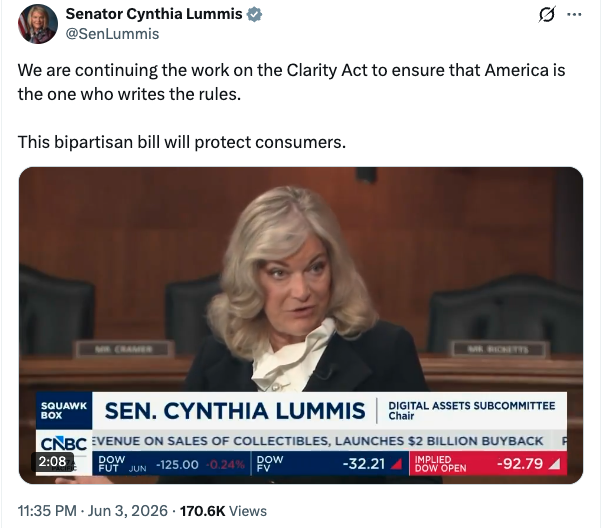
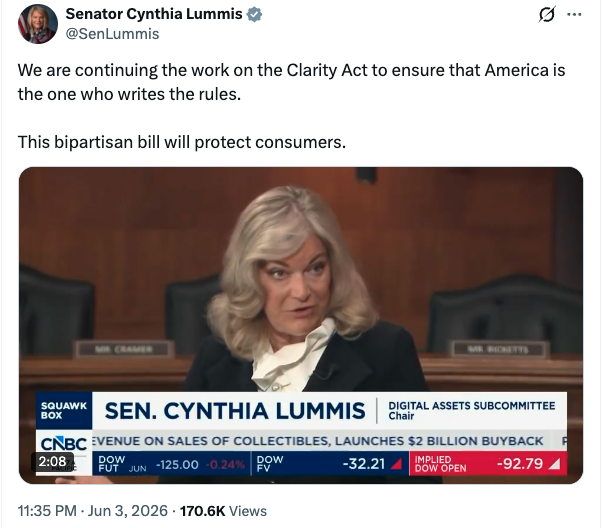
A group of Senate Republicans has urged US financial regulators to clarify the capital standards for companies engaged in crypto activities.
Senator Cynthia Lummis said on Thursday that she led the group in sending a letter on May 27 to Federal Reserve Vice Chair for Supervision Miki Bowman, Federal Deposit Insurance Corp. Chairman Travis Hill, and Comptroller of the Currency Jonathan Gould.
The letter commended the agencies’ guidance in March that clarified the capital treatment of tokenized securities, but urged them “to build on that progress to move towards a clear and fair capital treatment for on-balance sheet treatment of digital assets.”
Current international standards for capitalizing crypto holdings require banks to hold a greater value of reserve assets compared to the value of their digital asset holdings, which the Senators said was essentially a “de facto ban” on banks holding crypto.
The letter comes as senators are preparing to act on a bill, dubbed the CLARITY Act, that would outline how federal agencies will regulate crypto. The current version of the bill allows banks to use digital assets and blockchain for activities such as payments, lending, custody and trading.
Senate leaders are pushing to pass the bill ahead of the midterms in November, as the legislation risks having to be reintroduced in the next session of Congress if it fails to pass ahead of the elections.
Source: Cynthia Lummis
The group took issue with the Basel Committee on Bank Supervision’s longstanding standards that assigned a 1,250% risk weight to crypto, which they said was “not derived from a calibrated assessment of the actual risk profile of digital assets.”
“Any proposed capital treatment of on-balance sheet digital asset activities should accurately reflect the opportunities and risks of digital assets — and be based on, to the extent possible, a technology-neutral approach that gives banks the authority to participate meaningfully in digital asset markets,” the group said.
Related: Debate on CLARITY Act continues this week as US Senate returns
They added that crypto legislation under consideration in the Senate would “undoubtedly require capital guidance” and urged regulators to begin work on a new capital framework for crypto.
Senators Dan Sullivan, Bill Hagerty, Bernie Moreno, Ted Budd and Jon Husted also signed the letter.
Debate on the Senate’s crypto bill is slated to resume this week after the Senate returned from recess. The legislation lays out how the Securities and Exchange Commission and the Commodity Futures Trading Commission will regulate crypto markets and companies.
The Senate Banking and Agriculture Committees have passed their own versions of the bill addressing securities and commodities, but the full Senate will need to reconcile the different bills.
Other issues raised by lawmakers, including stablecoins, ethics and crypto developers, will also need to be addressed in the bill if it is to receive the 60 votes needed to pass the Senate without lengthy debate that could leave the bill stalled indefinitely.


Coinbase has funded the first Fannie Mae-insured mortgage in the U.S. using Bitcoin-backed collateral, bringing digital assets into a part of the housing finance market traditionally dominated by cash savings and bank deposits.
Summary
- Coinbase and Better Mortgage have completed the first Fannie Mae-insured U.S. mortgage backed by Bitcoin collateral.
- Borrowers can pledge Bitcoin and USDC without selling their holdings, with the assets held in a custodial account during the mortgage process.
- Better Mortgage expects up to $250 million in loan volume from its waitlist, while Coinbase plans a nationwide rollout later this summer.
According to Coinbase, the transaction was completed in partnership with Better Mortgage, which originated and serviced the loan while Coinbase provided the infrastructure used to secure the borrower’s Bitcoin holdings.
The mortgage was issued to Joe and Amy, a couple from Ann Arbor, Michigan, according to a Yahoo Finance report cited by the company.
Rather than selling their Bitcoin to fund the purchase, the borrowers placed the asset into a custody account that served as collateral for the down payment. Joe reportedly said that the arrangement allowed them to retain exposure to Bitcoin while moving forward with their home purchase.
The launch arrives shortly after Coinbase introduced a separate product focused on pre-IPO private companies. One day before announcing the mortgage, the exchange unveiled USDC-settled perpetual futures tied to private firms, beginning with a SpaceX-linked contract that offers eligible traders up to 5x leverage.
Bitcoin serves as mortgage collateral
Details shared by Coinbase show that approved borrowers can pledge Bitcoin and USDC without selling the assets. Once a mortgage application is approved through Better Mortgage, customers can transfer their crypto into a custodial wallet through their Coinbase account, where it serves as collateral for the loan.
Roy Zhang, Coinbase’s director of product, explained that the process is completed digitally.
“They click through on our product interface. They go through the application process on Better. Better approves them. They sign in to their Coinbase account, and with a single click, their bitcoin moves into a custodial wallet. And then they’re done.”
Better Mortgage has already opened a waitlist for the product ahead of a broader launch planned for this summer. The lender estimates a potential loan volume of approximately $250 million based on current waitlist data.
Vishal Garg, founder and chief executive officer of Better, described crypto-backed conventional mortgages as a natural extension of changing household investment habits.
Garg said more Americans are holding wealth in digital assets rather than traditional bank accounts, creating demand for financing products that recognize those holdings.
Mortgage meets Fannie Mae standards
A key element of the transaction is Fannie Mae’s involvement. As crypto.news reported earlier, the mortgage giant first announced in March this year that it would begin accepting cryptocurrency assets when evaluating mortgage down payments.
Garg said the completed mortgage satisfies the underwriting requirements associated with a Fannie Mae-conforming loan. According to him, this means the product operates within the existing mortgage framework rather than outside it.
He also stated that acceptance by a government-sponsored enterprise represents recognition of digital assets as eligible collateral alongside more traditional forms of wealth. Looking ahead, Garg said tokenized mortgages could eventually incorporate additional digital assets, including tokenized stocks.
For Coinbase, the mortgage rollout adds another crypto-based financial product to its expanding portfolio. Alongside the new housing finance initiative, the exchange said it plans to offer more pre-IPO perpetual futures contracts tied to sectors such as artificial intelligence, energy, technology, and space, following the launch of its SpaceX-linked product.
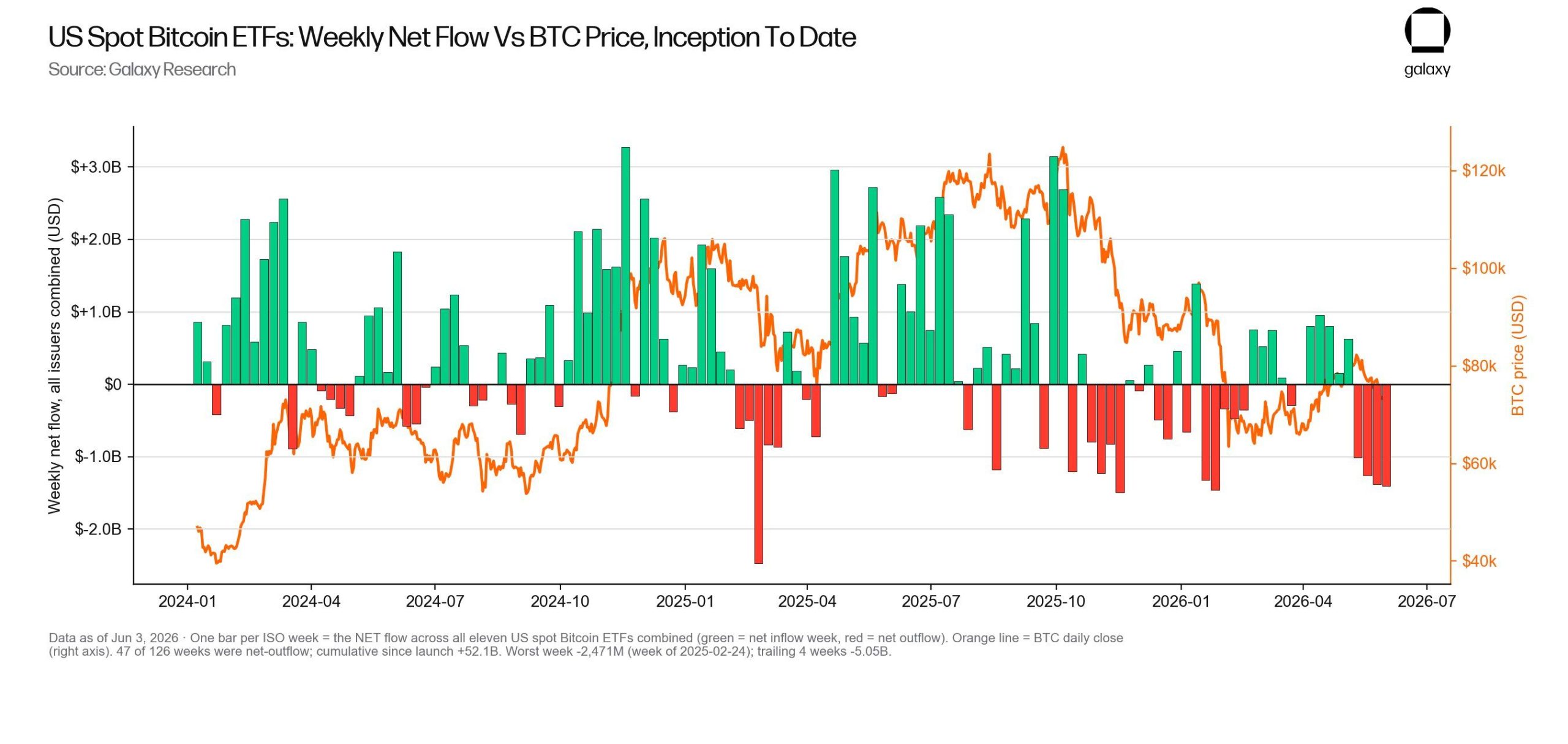
Spot Bitcoin (BTC) exchange-traded funds (ETFs) have recorded 13 consecutive days of net outflows from May 15 to June 3, the longest such streak since the products launched in early 2024.
The funds shed $4.33 billion and 59,351 BTC over that span, according to Galaxy Research. The selling marks a sharp reversal from April, the funds’ strongest month of 2026, when inflows hit $1.97 billion.
The Records Mount as Bitcoin Exits Pile Up
The intensity is more noticeable in coins than in dollars. Galaxy Research found the 20-day trailing window reached $5.42 billion and 73,080 BTC, the heaviest reading ever in both measures.
The 7-day and 10-day windows each set new records for the most Bitcoin outflows, at 39,338 BTC and 42,941 BTC, respectively.
Follow us on X to get the latest news as it happens

Bloomberg senior ETF analyst Eric Balchunas said the roughly $4.4 billion that exited over the past month dragged year-to-date flows back into negative territory, undoing a recovery the funds had worked to achieve.
However, Balchunas noted a silver lining. BlackRock’s IBIT and a few peers remain positive year-to-date, and total lifetime net inflows still sit near $55 billion, less than $10 billion below the high-water mark.
“Not bad at all for this type of drawdown and negative sentiment, gold went down like this a few yrs after GLD debuted and 40% of the assets left, much stronger holders here so far). But yeah, to quote Henry Hill, this is the bad times,” he added.
A Market-Wide Retreat
The pressure extends beyond Bitcoin. Ethereum (ETH) ETFs have also posted 17 straight outflow days, their longest streak on record.
Performance among newer products is mixed. Hyperliquid (HYPE) funds have continued drawing inflows since their mid-May debut, while the recently launched BNB ETF has seen only one positive day. XRP and Solana (SOL) products show scattered inflows and outflows, with flat sessions.
The matching records across the two largest crypto ETFs point to a broad risk-off shift. Whether June flows stabilize will signal how durable institutional conviction remains.
Subscribe to our YouTube channel to watch leaders and journalists provide expert insights
The post Bitcoin ETF Outflows Hit 13-Day Streak as $4.3 Billion Exits the Funds appeared first on BeInCrypto.


White House adviser Patrick Witt defended the CLARITY Act as a law-enforcement-friendly crypto bill, even as lawmakers face a shrinking window to pass the legislation before midterm politics slow the process.
Summary
- Witt defended CLARITY Act crime rules as critics questioned anti-money laundering safeguards in Senate negotiations.
- Lummis warned crypto rules could stall until 2030 if lawmakers miss this Senate window now.
- DeFi protections remain central as banks, police groups, and crypto advocates pressure Senate lawmakers.
White House crypto adviser Patrick Witt used a Blockchain Association town hall to defend the CLARITY Act against criticism from law enforcement groups. The legislation strengthens regulatory oversight while supporting law enforcement efforts in the digital asset sector.
His comments came as debate over the bill’s anti-money laundering language grew sharper in Washington. Critics argue that parts of the bill could make it harder to trace illicit finance. Supporters say the measure would bring more crypto activity under federal supervision and give agencies clearer rules.
Lummis warns the Senate clock is closing
Senator Cynthia Lummis also urged lawmakers to move quickly. She said Congress may not get another clear chance to pass broad digital asset rules until 2030 if the current effort fails. That warning has turned the CLARITY Act into one of the most time-sensitive crypto bills in the Senate.
Recent market updates said Lummis now sees a vote before the August recess as more likely than a vote before July 4. The bill has already cleared the Senate Banking Committee in a 15-9 vote and has moved onto the Senate Legislative Calendar. Senate leaders have not set a floor vote date, leaving negotiators to keep working on changes. The timing keeps pressure on both parties.
DeFi protections remain a flashpoint
A key dispute centers on the Blockchain Regulatory Certainty Act language inside the latest Senate version. The provision seeks to protect non-custodial software developers from being treated as money transmitters when they do not control user funds or move assets for customers.
DeFi advocates support that protection, saying developers should not face liability for how others use open-source tools. Some lawmakers and law enforcement groups take a different view. They argue that loose language could weaken efforts to prosecute illicit fund transfers and recover stolen money.
Supporters race to build pressure
The Blockchain Association has added pressure by releasing a letter backed by 160 former national security, intelligence, and law enforcement officials. The group said the bill would support enforcement, improve oversight, and help the U.S. set digital asset standards.
The latest push also follows broader conflict between banks and crypto firms. JPMorgan analysts recently warned that the bill’s passage window is narrowing as Congress faces a crowded calendar. Stablecoin rewards, anti-money laundering rules, DeFi protections, and political ethics concerns remain central hurdles before the bill can reach President Donald Trump’s desk.

10 Most Ambitious Superhero Movies of All Time

Teni – Money ft Justin Bieber (Official video)

BIT sweeter? India weighs easing treaty rules with safeguards to attract foreign capital



-

 News Videos7 days ago
This is BROKEN! INSANE 5x MONEY CAR WASH WEEK! The NEW GTA Online UPDATE Today! (GTA5 New Update)
-

 Business3 days ago
Jade Biosciences, Inc. (JBIO) Discusses Positive Interim Results From JADE101 Phase I Healthy Volunteer Study and Development Plans Transcript
-
 Tech6 days ago
SpaceX just won a second Golden Dome contract. This one is $4.16 billion.
-

 News Videos6 days ago
SHE IS KILLING XRP!!! WATCH URGENT AND ACT FAST
-
 NewsBeat6 days ago
FIRST NIGHT REVIEW: Take That bring the Circus back to life in spectacular sun-soaked style
-

 Sports2 days ago
French Open 2026 results: Alexander Zverev beats Rafael Jodar and will play Jakub Mensik in semi-finals
-

 Business6 days ago
Is the Spurs Phenom Already Better Than Prime Diesel?
-

 Politics6 days ago
The House | Inside Andy Burnham’s Makerfield Campaign: “Nobody Thinks This Is In The Bag”
-
 Crypto World7 days ago
CFTC Has Approved the First Regulated Bitcoin Perpetual Contract in the U.S.
-
 NewsBeat7 days ago
Novak Djokovic v Joao Fonseca LIVE: French Open latest scores and results after Jannik Sinner’s shocking collapse
-

 Tech3 days ago
CryZENx Releases Fresh Playable Content Deep Inside Jabu-Jabu for His Ocarina of Time Remake
-

 Entertainment7 days ago
Maddox Jolie-Pitt Legally Requests to Drop Brad’s Surname
-
 Entertainment6 days ago
Weak ‘Supergirl’ Box Office Tracking Amid Milly Alcock Backlash
-
 Crypto World7 days ago
Snowflake (SNOW) Stock Rallies on Strong Q1 Results and AI Product Growth
-
 Entertainment6 days ago
One of the Greatest Sitcoms of All Time Shoots Up Apple TV’s Charts 11 Years Later
-

 Business6 days ago
Demand Conditions Improve In Chemicals Sector In April 2026
-
 Entertainment6 days ago
Bruce Willis’ Generosity Resurfaces Amid His Dementia
-

 Tech7 days ago
This Week In Security: Ubiquiti Fixes, And FreeBSD Joins The Club You Don’t Want To Join
-
 Crypto World6 days ago
MicroStrategy Moves $30 Million in BTC to Coinbase Prime: Is the Bitcoin Sell-Off Already Here?
-
 Crypto World3 days ago
Seagate (STX) Stock Surges to Record High on AI Boom and Legal Settlement
You must be logged in to post a comment Login