

Crypto World
Here’s what could happen if bitcoin breaks below $60,000



Bitcoin continues to lose ground and the price is fast closing on $60,000 amid record ETF outflows.
The $60,000 level has been widely cited by analysts as a major support, below which the selloff could get even uglier.
Jean-David Péquignot, the chief commercial officer at leading crypto options exchange Deribit said that price is critical not just because it’s a round-number psychological level. More importantly, it’s a structural threshold with real consequences for institutions and derivatives market participants.
The cost basis problem
According to Péquignot, a significant chunk of institutional money — comprising ETF buyers, large holders and short-term speculators — bought bitcoin at prices between $60,000 and $67,000 over the past year.
With the largest cryptocurrency now trading within that range, these buyers are sitting at or near their cost basis, essentially at break-even. If prices drop further, unrealized or paper losses will mount and holding becomes expensive, especially when AI stocks and other parts of the traditional market are rallying like there is no tomorrow.
“As price undercuts their cost basis, the resulting unrealized losses may incentivize rushed selling, especially as the opportunity cost of holding BTC rises against a surging AI equity sector,” he said.
Michael Saylor, the high-profile executive chairman of Strategy (MSTR), the largest publicly traded bitcoin holder, also blamed capital rotation for recent BTC losses.
The derivatives problem
Things become mechanical after that.
On Deribit, there is over $1.2 billion in notional open interest sitting at the $60,000 strike put options, which pay out if prices fall below that level. Investors have bought these as a hedge against a protracted selloff.
The problem, however, is that market makers, who are on the opposite side of the investors, are now short puts, or more precisely, “short gamma.”
So, as BTC nears $60,000, market makers and dealers will be forced to sell spot BTC or futures to balance their books. Other things being equal, this hedging can accelerate the selloff, turning an orderly decline into a chaotic one, Péquignot said.
He also pointed out that there are too many leveraged longs in the system, and a break below $60,000 could lead to more liquidations, adding to downside momentum.
“With leverage still not fully flushed from the system, a break of $60K could rapidly worsen collateral metrics, triggering a cascading wave of automated long liquidations,” he said.
Note that billions of dollars of leveraged longs, or bullish plays tied to BTC and other tokens, have already been liquidated this week.

Crypto World
JPMorgan, Bank of America and Citi are going on the blockchain offensive with a shared tokenized network
America’s biggest banks, including JPMorgan, Citi and Bank of America, plan to build a shared, tokenized deposit network by the first half of 2027 to protect their deposits from the threat posed by stablecoins, the Wall Street Journal reported.
The system will be operated by The Clearing House, the payments company collectively owned by the banks. Some banks are calling the network “the bridge,” others call it “the chain,” the WSJ said.
Tokenized deposits are blockchain representations of customers’ money held at a bank. The planned system will convert these deposits into a digital token that can be transferred swiftly on a blockchain.
Stablecoins are dollar-pegged digital assets issued by crypto companies that live outside the traditional banking system. The Clarity Act legislation currently advancing through Congress could allow them to pay returns to holders, potentially making bank deposits less attractive because the tokens also offer faster, cheaper payment capabilities over a blockchain.
If customers adopt stablecoins at scale, banks could face a deposit flight to crypto wallets, and deposits are what banks rely on to extend credit in the economy. The tokenized deposit network is designed to ensure deposits remain within the banking system while giving them crypto-like capabilities.
The WSJ report said the Clearing House expects large multinationals to embrace the tokenized deposit network as a gateway to programmable treasury options, real-time liquidity management and cross-border payments.
“This is a big move for the banks,” CEO David Watson told the newspaper, describing a “radically different” future around onchain payments.


The same week SpaceX took its IPO to Wall Street, its biggest AI client showed up at the same door.
SpaceX launched its IPO roadshow this week, targeting $75 billion, the largest public offering in history, with a June 12 Nasdaq debut under ticker SPCX. On the same day, Anthropic, which pays SpaceX $1.25 billion a month for AI compute, filed its own confidential IPO prospectus with the SEC.
The two companies, which compete directly in AI through xAI’s Grok and Anthropic’s Claude, are now officially racing each other for the same institutional capital.
The $15 Billion Contract With a Six-Month Exit
SpaceX’s amended IPO filing discloses the full Anthropic deal: 325,000 Nvidia GPUs across its Colossus and Colossus II facilities in Memphis, $1.25 billion a month through May 2029. But the filing contains a clause that changes how investors should read that revenue.
After an initial three-month period, either party can terminate the agreements with 90 days’ notice. What reads as up to $45 billion in contracted future revenue is actually an arrangement either side can exit within roughly three months.
For a company where Anthropic’s payments approach its entire annual revenue, that termination clause is the most important sentence in the filing. As BeInCrypto’s earlier analysis of the SpaceX-Anthropic relationship noted, the financial entanglement between the two was always the central risk in SpaceX’s IPO narrative.
Two IPOs, One Capital Pool
Both companies now compete for institutional allocations in the same window. Goldman Sachs holds the lead position on SpaceX’s offering. Morgan Stanley manages a direct share program that reserves 5% of IPO stock for insiders selected “based on the discretion of our executive officers,” with no lockup restriction, meaning those participants can sell from day one.
Anthropic’s IPO, targeting a $965 billion valuation, will follow SpaceX and OpenAI into a market already absorbing more capital than any IPO cycle in recent history.
Institutions choosing between the two face a direct tradeoff: SpaceX’s valuation depends partly on Anthropic’s compute payments, and Anthropic is building its own infrastructure that could make those payments unnecessary.
The same IPO that lists Musk’s aerospace company on June 12 carries a clause that lets its most important client walk away in 90 days. Whether investors read that as flexibility or fragility will set the price.
Elon Musk’s ‘Evil Detector’
Three months before signing Anthropic to a $15 billion annual compute deal, Musk was doing the opposite. In March, he called Anthropic “evil” and “misanthropic” on X, retweeted a post urging Anthropic employees to quit, and asked: “Is there a more hypocritical company than Anthropic?”
By May, he had leased them the world’s largest AI supercomputer and posted a full reversal on the same platform: “Everyone I met was highly competent and cared a great deal about doing the right thing. No one set off my evil detector.”
The shift from rival to landlord took roughly 90 days, which happens to be the same notice period that lets either side walk away from the deal.
The post SpaceX’s Biggest Customer Is Also Its Biggest IPO Rival Paying $15 Billion a Year appeared first on BeInCrypto.
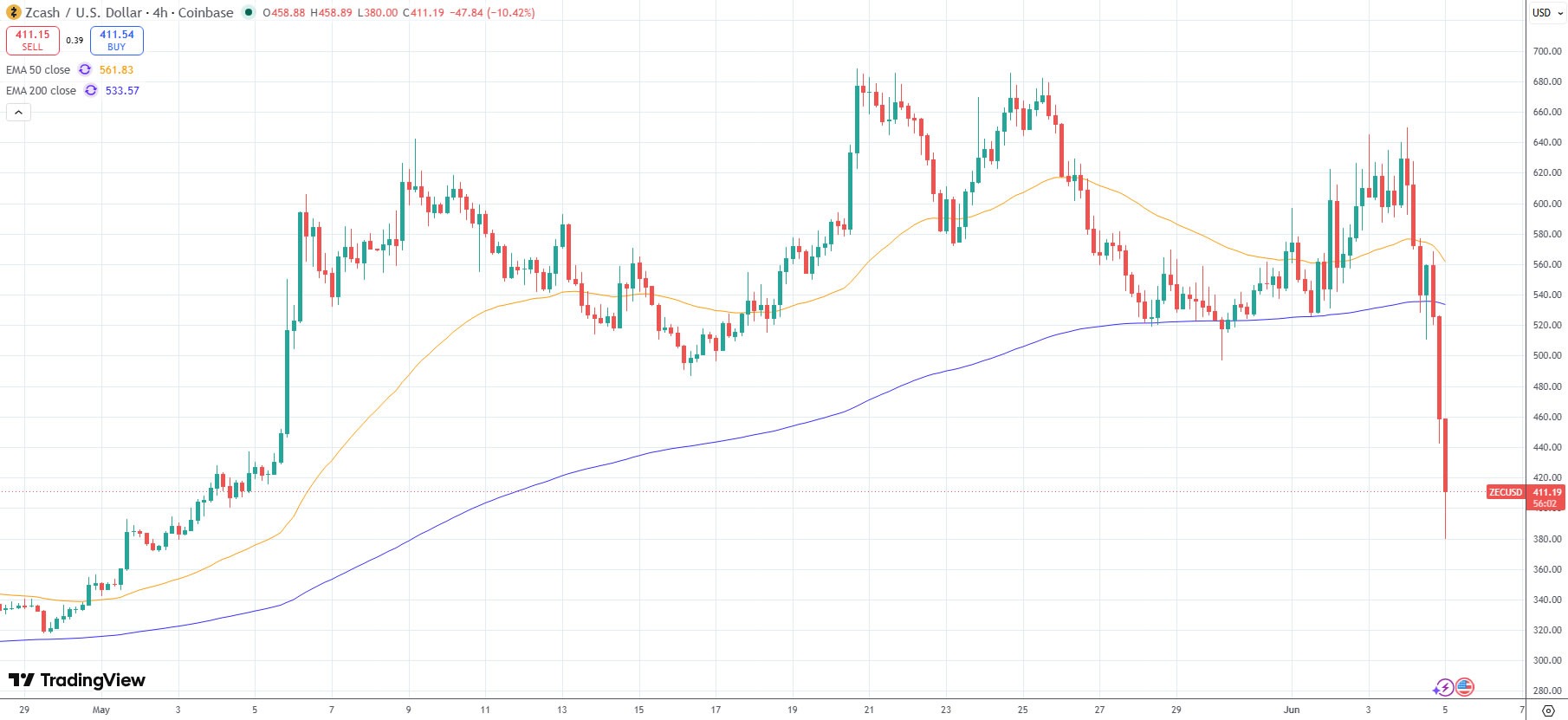
The price of ZEC fell on Thursday after further details were disclosed of a critical counterfeiting vulnerability in Zcash’s Orchard pool that could theoretically allow a bad actor to mint an unlimited amount of ZEC.
According to a post on X, security engineer Taylor Hornby, who was engaged by Shielded Labs, discovered the bug on May 29 and disclosed it to the Zcash Open Development Lab (ZODL), which deployed an emergency response to fix the vulnerability with a hard fork activated on June 3.
However, there are new concerns about the extent to which the vulnerability, which has existed since May 2022, has been used, leading Zcash to fall more than 30% over the past 24 hours to $410 at the time of writing. Its market capitalization has shrunk by more than $3 billion.
However, BitMEX co-founder Arthur Hayes said on Friday it is unlikely that ZEC has been illegally minted this way, though he acknowledged “it cannot be formally cryptographically proved impossible.”
“Sadly, due to the Orchard Pool exploit, I had to dump our entire ZEC bag,” he said.
“The Holy Trinity is dead,” he added, referring to Zcash and the two other tokens he sold this week, Hyperliquid (HYPE) and Near Protocol (NEAR).
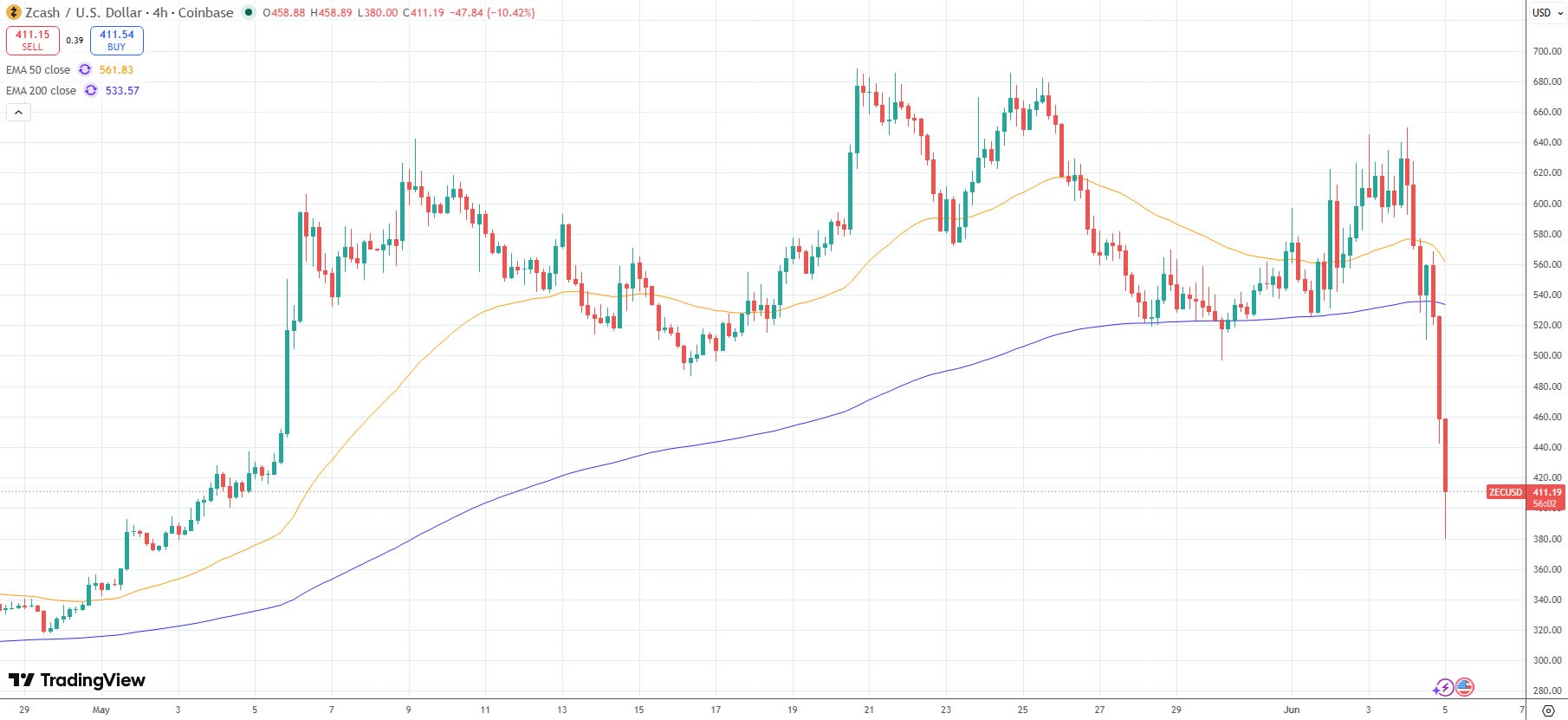
ZEC crashes 30% in 24 hours after two months of solid gains. Source: TradingView
Claude assists in bug discovery
Taylor used Claude Opus 4.8, which was released on May 28, a day before the discovery, to assist in a highly targeted review of the Orchard circuit, the cryptographic component underlying Zcash’s Orchard shielded pool.
The critical bug allowed false inputs into an elliptic curve multiplication check, which means the math that is supposed to cryptographically verify transactions could be fooled.
Taylor built and tested a working exploit, which generated unlimited counterfeit ZEC.
“If he had run the same tool on Zcash mainnet it would have generated unlimited, undetectable counterfeit ZEC in his mainnet Zcash wallet,” the security researchers said on Friday.
The primary concern is that there is no cryptographic way to prove whether anyone had previously exploited it before it was patched, due to Orchard’s privacy properties.
However, Shielded Labs was “not overly concerned” because the bug was subtle enough to evade years of expert review, and the discovery was a deliberate, highly skilled effort using cutting-edge tools and AI.
Related: Crypto exploit losses in May fall 90% over month to $68M: CertiK
The firm is working with Zcash developers on a proposed network upgrade to allow anyone to verify the integrity of the ZEC supply and to prove the nonexistence of counterfeit tokens in the Orchard pool, they stated.
Not the first counterfeiting vulnerability for Zcash
Mert Mumtaz, co-founder and CEO of Solana tooling firm Helius, said that almost all privacy protocols have a variant of this same vulnerability.
“This same FUD comes back every five months as new people learn how privacy pools work,” he said.
He explained that it is a theoretical risk in most zero-knowledge privacy protocols from circuit bugs that are hard to exploit or detect.
This is not the first time a similar vulnerability in Zcash has been discovered. In 2018, a counterfeiting vulnerability in the cryptography underlying zk-proofs was discovered by the Electric Coin Company, which remediated it with no losses in 2019.
Magazine: Big Questions: Do we really only need 2–5 cryptocurrencies?
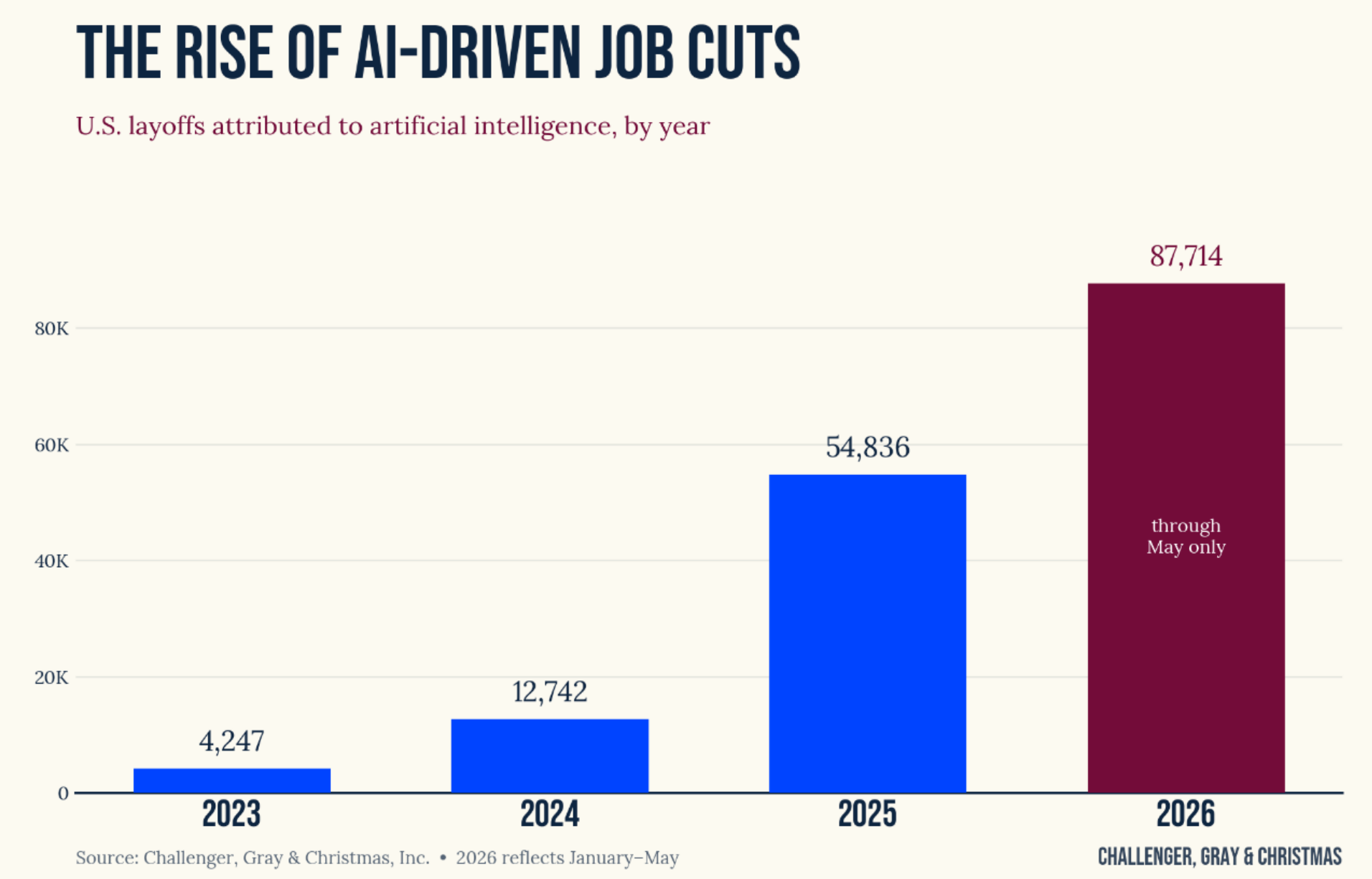
Artificial Intelligence (AI) drove 38,579 US job cuts in May, the highest monthly total since tracking began in 2023, and the third straight month AI topped every other cause of layoffs.
AI accounted for 40% of all cuts announced in May, as employers move faster to automate roles and restructure around the technology.
AI Now Leads Every Reason for US Layoffs
The figures come from firm Challenger, Gray & Christmas. Its latest report shows AI’s share of monthly cuts rising from 7% in January to 26% in April, then 40% in May.
For the year, AI has been cited in 87,714 cuts, or 22% of all 2026 layoffs. That total already exceeds the 54,836 attributed to the technology across all of 2025.
Follow us on X to get the latest news as it happens

Andy Challenger, the firm’s chief revenue officer, noted that companies are acting on AI and restructuring around it.
“AI isn’t yet the jobpocalypse some predicted. Like spreadsheets and email before it, the technology will ultimately make workers more productive, but our data shows companies are already acting on it, citing AI for more cuts than any other reason. The open question isn’t whether AI changes the workforce,” he said.
Banks and FinTechs Join the AI Cutting Spree
The pressure now reaches beyond Big Tech. Financial technology (FinTech) firms announced 5,731 cuts in May, and most named AI in their announcements.
Banks are restructuring around the same logic. Standard Chartered plans to cut 7,800 back-office jobs by 2030 as it scales automation.
Overall, total May cuts reached 97,006, the highest May figure since 2020 and the third consecutive monthly increase. Technology led all sectors with 38,242 cuts and remains the year’s biggest job cutter.
Employers have cut 397,755 jobs so far in 2026, a 43% drop from the 696,309 announced over the same stretch of 2025. That earlier figure was inflated by deep federal workforce reductions, which pushed the count into record territory.
Subscribe to our YouTube channel to watch leaders and journalists provide expert insights
The post AI Has Cut More US Jobs in 2026 Than in All of 2025 Already appeared first on BeInCrypto.

TLDR
- TTAN shares rally following impressive first-quarter performance and guidance
- ServiceTitan posts 25% revenue increase with expanding profit margins
- Pre-market trading shows significant gains after quarterly earnings release
- Platform adoption accelerates with transaction volume climbing 23% year-over-year
- Management provides confident full-year forecast supporting bullish sentiment
ServiceTitan (TTAN) shares experienced significant upward momentum following the release of impressive fiscal first-quarter financial results and forward-looking guidance. The stock finished regular trading at $74.33, climbing 2.34%, before surging to $86.84 in pre-market activity—a substantial 16.83% gain. This dramatic movement represented a powerful earnings-fueled rally driven by accelerating revenue, expanding margins, and robust platform adoption across its customer base.
Impressive Q1 Revenue Performance Drives TTAN Momentum
The company delivered total revenue of $268.8 million during its fiscal first quarter of 2027, representing a 25% increase compared to $215.7 million in the corresponding period. Platform-specific revenue demonstrated equally strong performance, advancing 25% to reach $260.6 million versus $208 million in the prior year. These figures highlighted sustained demand for the company’s specialized software solutions serving trade service businesses.
ServiceTitan also disclosed that gross transaction volume processed through its platform reached $21.7 billion throughout the quarter. This marked a 23% advancement from the $17.7 billion recorded during fiscal Q1 2026. This metric demonstrated expanding utilization of ServiceTitan’s platform ecosystem among its established client base.
The company maintained its net dollar retention rate above the 110% threshold, consistent with the level achieved in the comparable quarter last year. This retention figure indicated that current customers persistently increased their investment in the platform over time. This dynamic contributed significantly to the accelerated revenue trajectory observed during the period.
Profitability Metrics Show Meaningful Improvement
ServiceTitan successfully narrowed its GAAP operating loss to $25.8 million for the most recent quarter. This represented substantial progress from the $49.5 million GAAP operating loss recorded in the year-ago period. Accordingly, the GAAP operating margin improved dramatically to negative 9.6% compared to negative 23% previously.
On a non-GAAP basis, the company generated operating income of $40.8 million during the quarter. This compared favorably to just $16.2 million achieved in fiscal Q1 2026. The non-GAAP operating margin consequently expanded to 15.2% from 7.5%, demonstrating improved operational efficiency.
Cash flow metrics also displayed meaningful progress, though ServiceTitan continued to report negative free cash flow overall. GAAP net cash utilized in operating activities decreased to $1.6 million from $14.6 million in the prior-year period. Non-GAAP free cash flow improved to negative $9.6 million compared to negative $22.3 million previously.
Strong Full-Year Guidance Reinforces Bullish TTAN Outlook
Looking ahead to the fiscal second quarter, ServiceTitan provided revenue guidance ranging from $284 million to $286 million. Management also forecasts non-GAAP operating income between $38 million and $39 million for the period. This projection suggests sustained momentum following the first-quarter performance that exceeded market expectations.
For the complete fiscal year 2027, ServiceTitan anticipates total revenue between $1.13 billion and $1.14 billion. The company simultaneously projects non-GAAP operating income in the range of $142 million to $147 million. These forward-looking estimates reflect management’s confidence regarding continued demand strength, expanding platform adoption, and improving operational leverage throughout the organization.
ServiceTitan provides comprehensive software solutions to contractors and trade service businesses, enabling streamlined workflow management, payment processing, customer relationship management, and operational efficiency. The firm continues driving adoption of its Max product suite across customer locations. The pre-market surge in TTAN shares reflected investor enthusiasm for accelerating growth, margin expansion, and the company’s strong competitive positioning in its market segment.



Bitcoin and Ethereum faced a tense options expiry on June 5 as crypto markets traded near multi-month lows, while Middle East ceasefire hopes moved oil and gold markets before fresh doubts returned.
Summary
- Bitcoin options worth $1.62 billion expired as BTC traded far below its max pain level.
- Greeks.live said active hedging demand surged while traders avoided large one-sided crash bets.
- Middle East ceasefire hopes hit oil first, but Hezbollah rejection kept broader market risk alive.
About 25,600 Bitcoin options expired on June 5, with a notional value of $1.62 billion, according to Greeks.live data. The batch carried a put-call ratio of 0.56 and a key max pain level near $70,500.
Bitcoin traded far below that level after a sharp weekly slide. BTC briefly approached $60,000 during the selloff, leaving many short-term options away from their expected settlement zones.
Ethereum also faced options expiry pressure. About 155,000 ETH options expired, with a put-call ratio of 0.92, a max pain level near $2,000, and a notional value of $270 million.
Together, BTC and ETH expiries reached about $1.89 billion. The event was smaller than the prior end-of-month expiry, but it came during one of the weakest weeks for digital assets in months.
Bitcoin bears dominate as hedging demand rises
Greeks.live said Bitcoin’s drop below $70,000 made bearish traders more active earlier in the week. Put positions increased around $68,000, $65,000, and $60,000 as traders moved to protect against more losses.
The firm said short-term volatility also rose as prices fell. Skew turned negative, meaning the market paid more attention to downside protection than upside exposure.
In its June 5 update, Greeks.live said price action pushed both BTC and ETH far from their max pain levels. It also said weak conditions reduced market interest, while attention moved toward U.S. stocks.
The firm added that the market was not making large one-way crash bets. Instead, it said demand for active hedging had increased. Greeks.live said, “The best strategy is not to gamble on a rebound, but to reduce risk.”
Ceasefire hopes move oil and gold
The crypto selloff also came as global markets reacted to Middle East developments. Israel and Lebanon agreed to implement a ceasefire on June 4, raising hopes that pressure around Iran talks could ease.
That news quickly moved commodities. Oil prices fell more than 3% on hopes that a broader deal could support a reopening of the Strait of Hormuz, a key route for global oil flows.
Gold also reacted as the dollar and bond yields moved lower after the ceasefire reports. The move showed that traders viewed the announcement as a possible step toward lower regional risk.
The relief did not last cleanly. Hezbollah later rejected the agreement, while Israel said it would not withdraw troops from Lebanon. That kept concerns alive around U.S.-Iran talks and energy supply routes.
Crypto market watches capital flows
Crypto markets entered the expiry with weak momentum. Bitcoin hovered near the bottom of its recent range after a slide that erased large gains from the prior week.
Ether also traded under pressure after falling toward 14-month lows. Broader crypto market value dropped sharply during the week as traders cut risk across Bitcoin, Ethereum, and major altcoins.
Separate crypto.news market updates have kept Bitcoin’s $60,000 support zone in focus as traders weigh ETF flows, whale activity, and falling risk appetite. The same backdrop has made options positioning more important for short-term market direction.
For now, the market is watching whether capital returns after the expiry. A move back above $63,000 could ease immediate pressure for Bitcoin, while another break toward $60,000 could keep bearish positioning active into the weekend.
Ethereum faces a similar test below its $2,000 options level. A recovery above that zone would improve short-term sentiment. Failure to regain it could keep sellers focused on lower support areas.
The main question now is whether the expiry clears pressure or confirms deeper weakness. Traders are watching BTC’s $60,000 line, ETH’s $2,000 level, and macro signals from oil, gold, and U.S. stocks.
Disclosure: This article does not represent investment advice. The content and materials featured on this page are for educational purposes only.

Reform UK, the Nigel Farage-led party, has tapped into crypto wealth this year, drawing a notable sum from two crypto-focused billionaires, according to Electoral Commission data released this week. The donations total roughly seven million pounds (about $9.4 million) and break down to approximately £4 million from Christopher Harborne — who has a stake in stablecoin issuer Tether — and £5.4 million from Ben Delo, the co-founder of BitMEX. The funds place Reform UK at the forefront of declared political donations among UK parties in the latest reporting period.
Reform UK has positioned itself as pro-crypto, including being the first UK political party to accept donations in Bitcoin. Nigel Farage has floated policy ideas such as cutting crypto capital gains taxes from 24% to 10% and urging the Bank of England to establish a Bitcoin reserve. The broader crypto industry has been evolving into a more aggressive political spender as policymakers plot how best to regulate a rapidly integrated sector. In the United States, crypto-backed political action committees (PACs) have also ramped up spending to back candidates who won primaries ahead of the midterm elections.
Key takeaways
- Reform UK received about £7 million ($9.4 million) in donations this year from two crypto billionaires, with roughly £4 million from Christopher Harborne (a Tether stakeholder) and £5.4 million from Ben Delo (BitMEX co-founder).
- Ben Delo is a first-time donor to Reform UK, while Harborne’s involvement with Reform UK has grown to total about $20 million in donations over the past year.
- The party has promoted a pro-crypto stance, including accepting Bitcoin donations and backing policy ideas that would reshape crypto taxation and central-bank exposure to digital assets.
- First-quarter fundraising for Reform UK rose sixfold compared with the same period last year, a period when the party raised about $2 million. Labour and the Conservative Party each reported roughly $5.4 million in the quarter.
- The broader crypto industry’s political engagement is rising globally, with US crypto PACs backing candidates who achieved primary wins, signaling a growing relationship between crypto wealth and political influence.
- Harborne’s personal gift of $6.7 million to Farage is under parliamentary standards scrutiny, with Farage contending the gift predates his parliamentary tenure and was used for personal security, not campaign financing.
Crypto donors and the trajectory of Reform UK’s fundraising
Electoral Commission filings published this week show Reform UK’s year-to-date fundraising includes a substantial contribution from Christopher Harborne, who holds a stake in the stablecoin issuer Tether, along with a sizable donation from Ben Delo, the co-founder of BitMEX. Together, these donations help explain Reform UK’s outsize presence in early-2026 fundraising data and contrast with the fundraising pace of the two traditional parties, Labour and the Conservative Party, which each reported approximately the same level of receipts in the same period.
The data point to a shifting dynamic in UK political finance, where high-net-worth crypto executives appear willing to back non-establishment parties that articulate a crypto-friendly agenda. Reform UK has explicitly framed itself as approachable to digital-asset interests, a stance reflected in its fundraising and public messaging. The donation from Delo marks a notable moment: he is identified as a first-time donor to Reform UK, underscoring the entry of new crypto philanthropy into UK political donor pools. Harborne, by contrast, has a longer record of contributions to the party, with the combined total of his donations to Reform UK reaching about $20 million over the past year, illustrating how a small number of mega-donors can reshape a party’s financial profile in a short span.
One additional dimension is the controversy surrounding a separate $6.7 million personal gift Harborne provided to Farage. The gift has come under scrutiny by parliamentary standards inquiries to determine whether it should have been registered as a donation. Farage has argued the gift was given before he entered Parliament and was used for personal security, not electoral campaigning. He has also tied the gift to arguments for Brexit, describing it as support for a political outcome that aligns with his longer-running political project. The ongoing standards probe adds a layer of uncertainty about how such contributions should be treated in UK records and what that could mean for future crypto-linked donations.
Beyond the specifics of Reform UK, the Electoral Commission reported that first-quarter fundraising across all parties more than doubled relative to a year earlier, with Reform UK’s trajectory rising sixfold from the prior-year period, which saw about $2 million in donations. In that same quarter, Labour and the Conservative Party each reported roughly $5.4 million in receipts, signaling a broader surge in political giving during the period. The numbers illuminate a moment when crypto wealth is tying itself more directly to mainstream political finance in the UK, not merely as a fringe curiosity but as a plausible force in shaping campaign messaging and policy priorities.
Policy implications and the broader regulatory landscape
Reform UK’s pro-crypto posture aligns with a trend among some political actors to embrace digital assets as both a constituent interest and a potential policy lever. Farage’s proposals—lower crypto capital gains taxes and a potential BoE-backed Bitcoin reserve—mirror a broader debate about how central-bank money and digital assets might interact in a highly digitized financial system. For readers tracking policy risk, these signals suggest that crypto-friendly proposals could gain traction, particularly if the party enhances its fundraising and builds a broader electoral coalition.
From a regulatory standpoint, the influx of large crypto donations raises questions about disclosure, registration, and compliance. The ongoing parliamentary inquiry into Harborne’s sizeable personal gift illustrates the sensitivity around donor transparency and the standards that govern political contributions. The outcome of such inquiries could influence how crypto wealth is treated in future cycles, potentially prompting tighter oversight or, conversely, clearer pathways for crypto magnates to contribute without triggering extra hurdles. As policymakers in the UK and elsewhere weigh how to regulate a rapidly evolving sector, campaign finance dynamics will remain a focal point for both supporters and skeptics of crypto funding.
The international dimension is also notable. In the United States, crypto-backed PACs have actively backed candidates who won primaries, signaling a pattern of crypto wealth seeking to shape political outcomes more directly. While the UK landscape differs in structure and regulatory regime, the underlying dynamic—wealthy crypto actors seeking electoral influence—echoes across jurisdictions. For investors and builders in the crypto space, this trend underscores the relevance of regulatory clarity and the potential for policy shifts that could affect market access, taxation, and the acceptability of crypto donations as a legitimate political resource.
What to watch next
The coming quarters will reveal whether these large crypto donations translate into policy shifts or concrete changes in campaign messaging. Watch how Reform UK threads its crypto-friendly stance with broader policy positions, and how the ongoing standards inquiry surrounding Harborne’s large gifts affects donor behavior and disclosure norms. Regulators may also respond with clarifications on the boundaries between personal gifts and campaign contributions, which could shape how crypto wealth participates in UK politics going forward. For market participants, the unfolding dynamics offer a reminder that policy clarity and political risk sit alongside technology and adoption cycles as core drivers of long-term value in the crypto space.
Sources: Electoral Commission data on party donations for Q1 2026 and related regulatory filings; coverage of the Harborne gift and parliamentary standards inquiry; broader reporting on crypto-related political spending in the UK and US. Electoral Commission data; Farage gift under parliamentary standards inquiry.


Forward Industries deposited 455,784 Solana (SOL) worth $31.87 million into Coinbase Prime, breaking a month of treasury inactivity and reviving speculation that the largest corporate SOL holder may finally trim a position deep in the red.
The transfer landed while Solana prices left Forward roughly $1.13 billion below its purchase cost. Exchange deposits often precede sales, though the company has not confirmed any intent to sell.
A $1.59 Billion Solana Bet Underwater
Forward launched its Solana treasury strategy in September 2025. Since then, it has spent roughly $1.59 billion buying 6.83 million SOL at an average entry near $232.08.
Solana now trades far below that level. BeInCrypto Markets data showed that the cryptocurrency has fallen nearly 19% over the past week, trading at $66.
The holdings are now worth about $451 million, a drop of more than $1.1 billion from the original outlay.
Follow us on X to get the latest news as it happens
The paper damage has already hit the reported results. Forward posted a $283.1 million net loss for the quarter ended March 31, 2026, driven by fair value declines on its SOL stack. The company stressed the loss “does not represent an outflow of cash or impact Forward’s liquidity.”
Treasury Firms Head for the Exits
Since the October market crash, many corporate holders have trimmed or dumped their digital asset holdings. In November 2025, Sequans Communications sold 970 Bitcoin worth roughly $100 million.
Bitcoin miners also participated in the retreat. Public miners sold about 32,000 BTC in the first quarter, more than in all of 2025.
Even MicroStrategy broke ranks. The largest corporate holder of Bitcoin (BTC) has sold 32 BTC since 2022.
Forward’s Coinbase deposit may reflect routine staking or custody moves. Yet with the position so far in the red, the coming days will show whether the largest Solana treasury joins the wave of sellers.
Subscribe to our YouTube channel to watch leaders and journalists provide expert insights
The post Solana Treasury Firm Forward Industries Deposits $32 Million of SOL to Coinbase appeared first on BeInCrypto.
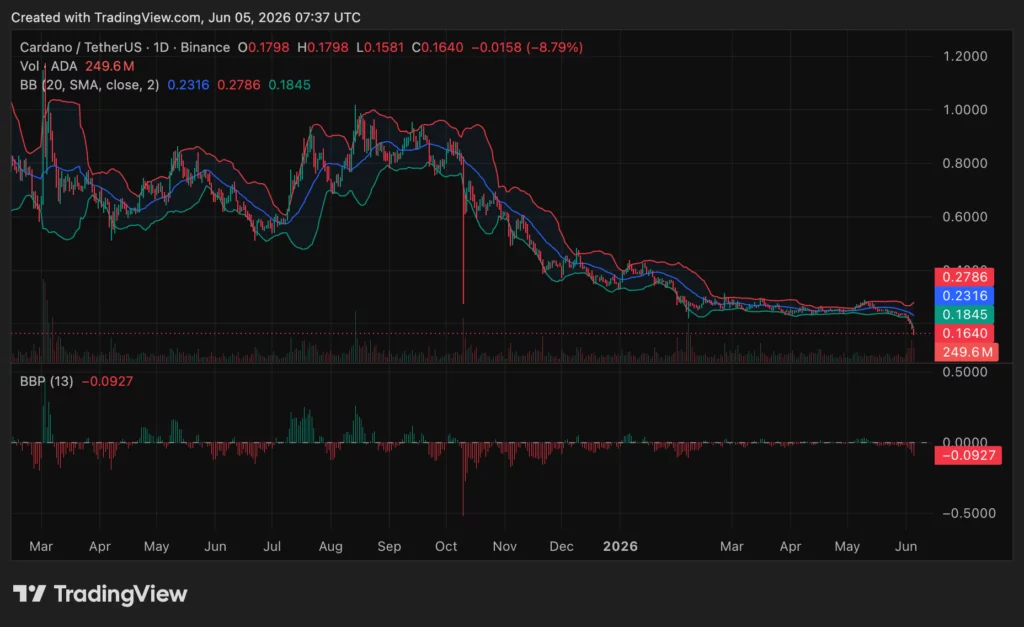
Cardano price fell near $0.16 on June 5 as ADA extended its selloff and reached levels last seen around late 2020, while social activity and on-chain usage rose during the market stress.
Summary
- Cardano price fell near $0.16 as ADA reached levels last seen around late 2020.
- Santiment data shows Cardano social dominance and active addresses jumped during the sharp selloff.
- Ali Martinez sees $0.11 and $0.051 targets unless ADA reclaims key Bollinger levels.
Cardano price falls below $0.16
Cardano traded near $0.162 on June 5, according to crypto.news price data. ADA fell 17.9% over 24 hours and lost 30.7% over seven days, while the monthly decline reached 38.29%.
The token moved between a 24-hour low of $0.158433 and a high of $0.198698. Trading volume stood above $1.1 billion as sellers pushed the market toward the lower end of the daily range.
Cardano now holds a market rank of #16, with a market value of about $6.03 billion. Its fully diluted valuation stands near $7.31 billion, based on a maximum supply of 45 billion ADA.
The fall pushed ADA far below its 2021 all-time high of $3.09. The token has also dropped 76.26% over the past year and 67.46% over the past 200 days, showing a long-running downtrend.
Santiment shows social spike during selloff
Santiment said Cardano became one of the most discussed crypto assets after ADA dropped below $0.16. The firm linked the jump in attention to price weakness and rising concern around founder Charles Hoskinson.
According to Santiment, Cardano reached a 2026 high of about 0.52% social dominance. That means more than one in every 190 crypto-related social discussions focused on ADA during the spike.
The same update said daily active addresses rose to 28,459, the highest level in four months. This shows users continued to interact with the network as the selloff increased debate among traders.
Santiment described much of the reaction as bearish. However, the firm also said Cardano still has one of crypto’s most vocal communities, with many holders staying active through past market cycles.
Hoskinson concerns add pressure
Recent Cardano weakness also followed renewed attention on Charles Hoskinson. Santiment said discussion increased after Hoskinson said he was “taking a break” following warnings about project shutdowns and funding stress.
As crypto.news reported, Hoskinson warned more Cardano businesses could fail after TapTools announced it would shut down. TapTools had operated as a Cardano analytics platform for about four years.
The wider ecosystem has faced governance pressure as well. The Cardano Foundation canceled the 2026 Cardano Summit after a proposal seeking 7.8 million ADA failed to secure enough approval from DReps.
Moreover, crypto.news also reported debate around a separate 32.9 million ADA treasury request linked to Input Output Global research and development work. DRep opposition had climbed above 80% before the vote deadline.
These events place funding, governance, and project survival at the center of the current ADA story. Price weakness has now turned those ecosystem debates into market-moving issues.
ADA technical levels point lower
Ali Martinez said he would target $0.11 and $0.051 for ADA after the latest breakdown. He also said, “I’d be taking a break too if I were him,” while referring to the pressure around Hoskinson.
The technical setup remains weak. ADA broke below the lower Bollinger Band at $0.1845, showing strong downside pressure and an extended bearish move.
The Bollinger Band midline sits near $0.2316, while the upper band stands around $0.2786. ADA remains far below the midline, which shows buyers have not regained control.
A recovery would need ADA to reclaim the lower band near $0.1845. A stronger rebound would then need a move toward $0.2316 before traders can argue that the trend has improved.
The BBP reading stands at -0.0927, placing price below the lower Bollinger Band. That signals oversold conditions, but it does not confirm a reversal.
For now, sellers still control the chart while ADA remains outside the bands. If $0.158 support fails, traders may focus on Ali’s $0.11 target as the next downside level.
A deeper fall toward $0.051 would require another major breakdown and sustained weak demand. That level remains a lower target, not a confirmed path.
Cardano’s next move now depends on whether buyers defend the $0.15 to $0.16 zone. Bulls need ADA back above $0.1845 to ease immediate pressure. Bears need another close below the recent low to keep the breakdown active.
Disclosure: This article does not represent investment advice. The content and materials featured on this page are for educational purposes only.
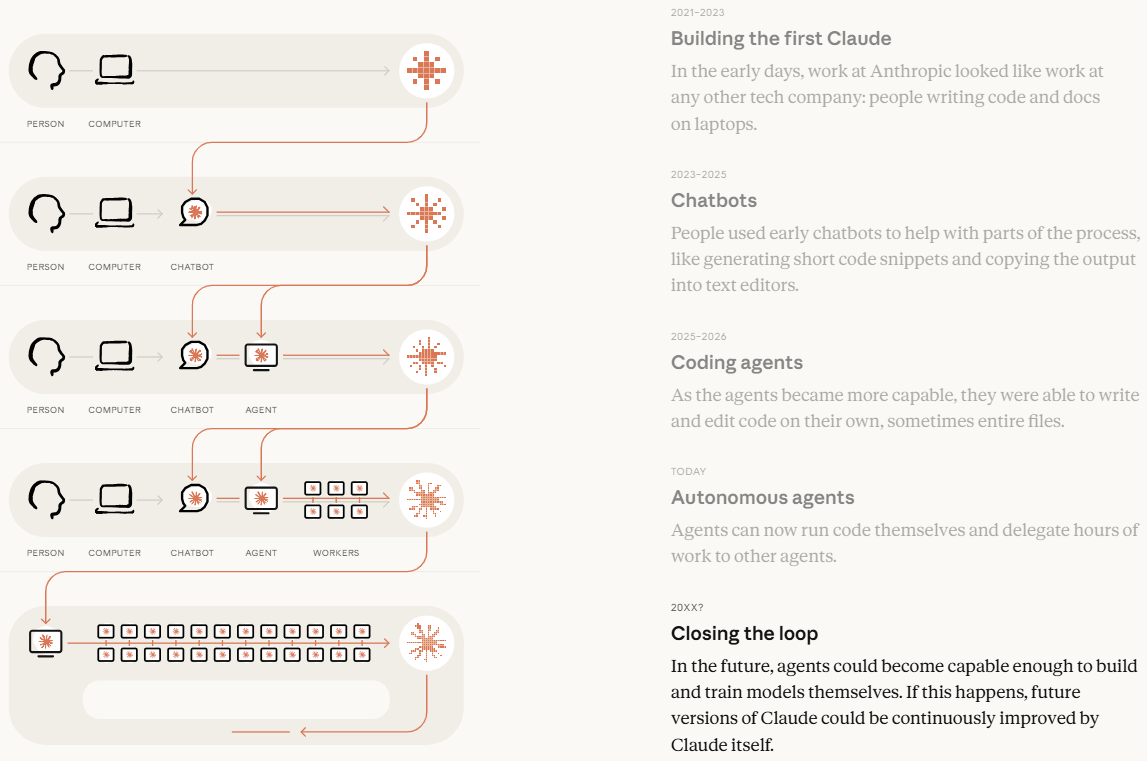
US-based AI firm Anthropic warns AI development is advancing at a pace that could soon see agents building, training and improving themselves without human input, and recommends a slowdown in development.
In a blog post published Thursday, Marina Favaro, lead at the Anthropic Institute, and Anthropic co-founder Jack Clark said agents can already run code themselves, delegate hours of work to other agents and could be on the cusp of taking over completely.
“For most of AI’s history, humans drove every step in its development cycle. But at Anthropic, we are delegating a growing share of AI development to AI systems themselves, which is speeding up our work,” they said.
“Taken far enough, and given enough compute, that trend points to an AI system capable of fully autonomously designing and developing its own successor,” Favaro and Clark added.
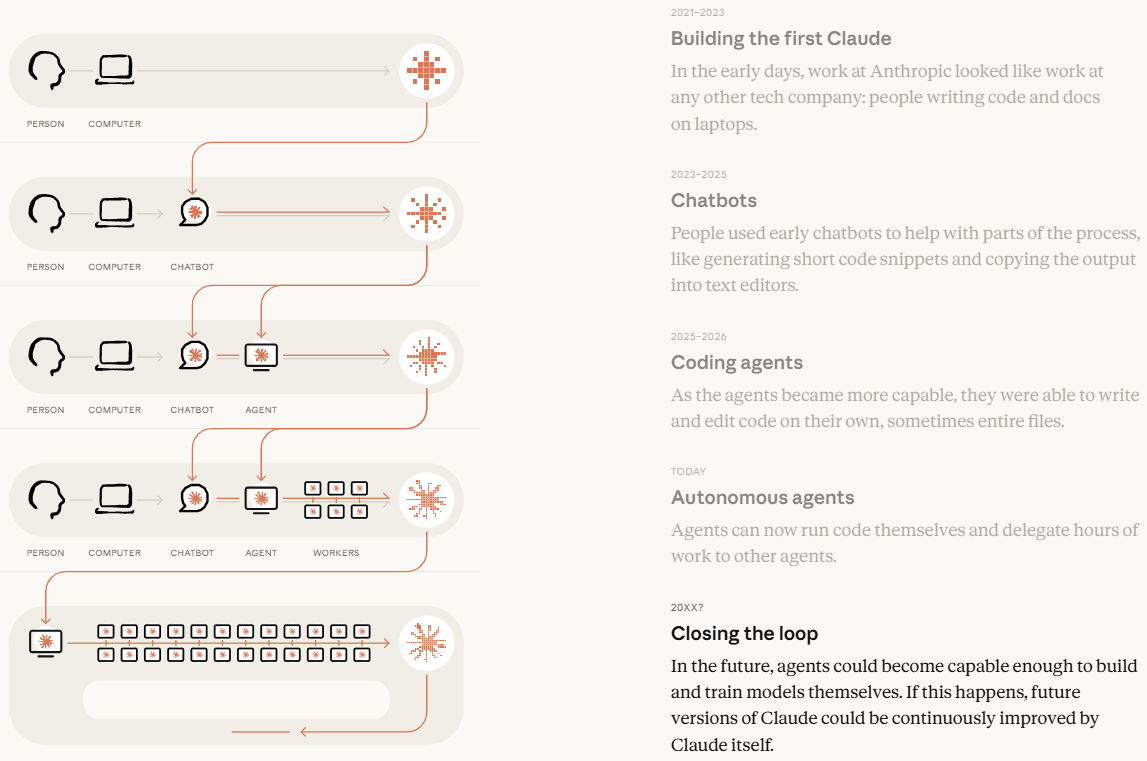
AI development is advancing at a pace that could lead to agents improving without human input. Source: Anthropic
There are concerns over what could happen if AI is able to become smarter on its own. In December, OpenAI said it is researching how to safely develop and deploy increasingly capable AI, including AI capable of recursive self-improvement.
“We want these systems to consistently follow human intent in complex, real-world scenarios and adversarial conditions, avoid catastrophic behavior, and remain controllable, auditable, and aligned with human values,” it said.
The company is also hiring a researcher for recursive self-improvement preparedness, which forms part of its Safety Research team.
AI model improvement has been roughly doubling every four months, rather than every seven months, according to Favaro and Clark. The role of humans is narrowing at each step, with Anthropic’s Claude model authoring around 80% of the code merged into Anthropic’s codebase.
“We are not there yet, and recursive self-improvement is not inevitable. But it could come sooner than most institutions are prepared for,” they said.
“Once human- and AI-authored code quality reach parity, humans will stop writing code entirely and shift to only reviewing it. But if they can’t review code as quickly as Claude can generate it, human review will become the bottleneck to AI development,” they added.
Favaro and Clark also said that slowing development to allow more time to address its “immense” implications would be ideal.
Related: Modern robots impress, but are years away from replacing humans
In April, Anthropic ruled out releasing its AI model, Claude Mythos, to the public over concerns about the threat to global cybersecurity.
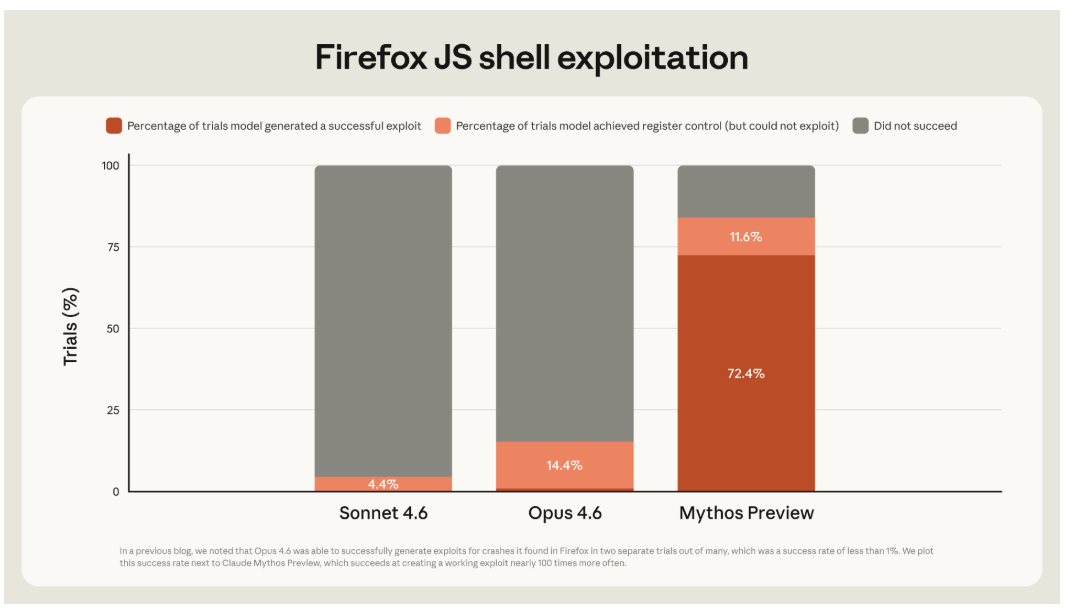
Claude Mythos was able to easily create software exploits, leading Anthropic to rule out a public release for now. Source: Anthropic
At the same time, a group of tech leaders, including some from Anthropic and OpenAI, released an open letter on Thursday, urging lawmakers to enact stronger guardrails around the technology over concerns it could be used to overcome “knowledge barriers” that have historically prevented bad actors from creating biological weapons.
“We believe it would be good for the world to have the option to slow or temporarily pause frontier AI development to enable societal structures and alignment research to keep up with the advance of the technology,” Favaro and Clark said.
“But if a slowdown simply lets the least cautious actors catch up technologically, it could leave everyone less safe. Without a global coordination mechanism, companies and governments will have to make difficult decisions about safety while under competitive and geopolitical pressures.”
AI agents are becoming increasingly popular, including among crypto users. Some crypto executives have speculated that AI agents settling transactions could drive adoption and transaction volumes. Circle CEO Jeremy Allaire predicted in January that billions of AI agents would operate on users’ behalf within five years.
Crypto investment firm Keyrock reported last month that AI agents settling payments went from concept to reality in the past 12 months, with $73 million settled across 176 million transactions.
Magazine: Korea’s first memecoin rug-pull case, China’s crypto rules review: Asia Express
Kyler Murray Could Do Something No Viking Has Ever Done

Filtr is a new privacy tool that blocks ads in almost every iPhone and Mac app

Raoul Pal: “A TSUNAMI Is Coming For Bitcoin & Ethereum” | 2026 Crypto Prediction



-

 News Videos7 days ago
This is BROKEN! INSANE 5x MONEY CAR WASH WEEK! The NEW GTA Online UPDATE Today! (GTA5 New Update)
-

 Business4 days ago
Jade Biosciences, Inc. (JBIO) Discusses Positive Interim Results From JADE101 Phase I Healthy Volunteer Study and Development Plans Transcript
-
 Tech6 days ago
SpaceX just won a second Golden Dome contract. This one is $4.16 billion.
-

 News Videos7 days ago
SHE IS KILLING XRP!!! WATCH URGENT AND ACT FAST
-

 Sports2 days ago
French Open 2026 results: Alexander Zverev beats Rafael Jodar and will play Jakub Mensik in semi-finals
-
 NewsBeat6 days ago
FIRST NIGHT REVIEW: Take That bring the Circus back to life in spectacular sun-soaked style
-

 Business6 days ago
Is the Spurs Phenom Already Better Than Prime Diesel?
-

 Tech3 days ago
CryZENx Releases Fresh Playable Content Deep Inside Jabu-Jabu for His Ocarina of Time Remake
-
 NewsBeat7 days ago
Novak Djokovic v Joao Fonseca LIVE: French Open latest scores and results after Jannik Sinner’s shocking collapse
-

 Politics6 days ago
The House | Inside Andy Burnham’s Makerfield Campaign: “Nobody Thinks This Is In The Bag”
-
 Crypto World7 days ago
CFTC Has Approved the First Regulated Bitcoin Perpetual Contract in the U.S.
-

 Entertainment7 days ago
Maddox Jolie-Pitt Legally Requests to Drop Brad’s Surname
-
 Entertainment7 days ago
Bruce Willis’ Generosity Resurfaces Amid His Dementia
-
 Entertainment6 days ago
Weak ‘Supergirl’ Box Office Tracking Amid Milly Alcock Backlash
-
 Crypto World7 days ago
Snowflake (SNOW) Stock Rallies on Strong Q1 Results and AI Product Growth
-
 Entertainment6 days ago
One of the Greatest Sitcoms of All Time Shoots Up Apple TV’s Charts 11 Years Later
-

 Business6 days ago
Demand Conditions Improve In Chemicals Sector In April 2026
-

 Tech7 days ago
This Week In Security: Ubiquiti Fixes, And FreeBSD Joins The Club You Don’t Want To Join
-
 Crypto World7 days ago
MicroStrategy Moves $30 Million in BTC to Coinbase Prime: Is the Bitcoin Sell-Off Already Here?
-
 Crypto World3 days ago
Seagate (STX) Stock Surges to Record High on AI Boom and Legal Settlement
You must be logged in to post a comment Login