






Crypto World
AI Could Soon Train and Improve Itself Anthropic Says
US-based AI firm Anthropic warns AI development is advancing at a pace that could soon see agents building, training and improving themselves without human input, and recommends a slowdown in development.
In a blog post published Thursday, Marina Favaro, lead at the Anthropic Institute, and Anthropic co-founder Jack Clark said agents can already run code themselves, delegate hours of work to other agents and could be on the cusp of taking over completely.
“For most of AI’s history, humans drove every step in its development cycle. But at Anthropic, we are delegating a growing share of AI development to AI systems themselves, which is speeding up our work,” they said.
“Taken far enough, and given enough compute, that trend points to an AI system capable of fully autonomously designing and developing its own successor,” Favaro and Clark added.

AI development is advancing at a pace that could lead to agents improving without human input. Source: Anthropic
There are concerns over what could happen if AI is able to become smarter on its own. In December, OpenAI said it is researching how to safely develop and deploy increasingly capable AI, including AI capable of recursive self-improvement.

“We want these systems to consistently follow human intent in complex, real-world scenarios and adversarial conditions, avoid catastrophic behavior, and remain controllable, auditable, and aligned with human values,” it said.
The company is also hiring a researcher for recursive self-improvement preparedness, which forms part of its Safety Research team.
AI model improvement has been roughly doubling every four months, rather than every seven months, according to Favaro and Clark. The role of humans is narrowing at each step, with Anthropic’s Claude model authoring around 80% of the code merged into Anthropic’s codebase.
“We are not there yet, and recursive self-improvement is not inevitable. But it could come sooner than most institutions are prepared for,” they said.
“Once human- and AI-authored code quality reach parity, humans will stop writing code entirely and shift to only reviewing it. But if they can’t review code as quickly as Claude can generate it, human review will become the bottleneck to AI development,” they added.
Favaro and Clark also said that slowing development to allow more time to address its “immense” implications would be ideal.
Related: Modern robots impress, but are years away from replacing humans
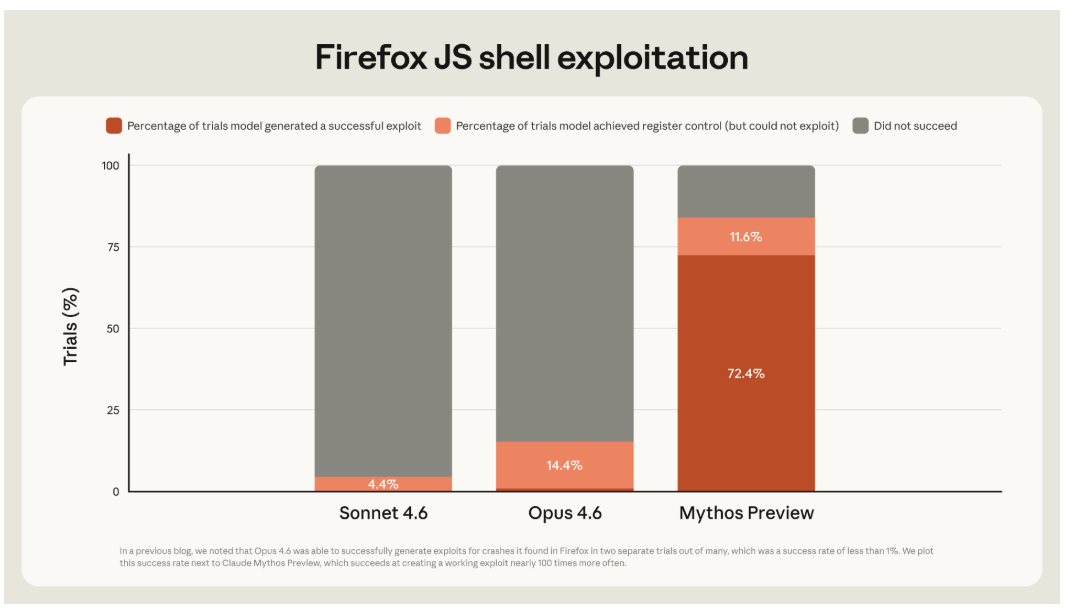
In April, Anthropic ruled out releasing its AI model, Claude Mythos, to the public over concerns about the threat to global cybersecurity.

Claude Mythos was able to easily create software exploits, leading Anthropic to rule out a public release for now. Source: Anthropic
At the same time, a group of tech leaders, including some from Anthropic and OpenAI, released an open letter on Thursday, urging lawmakers to enact stronger guardrails around the technology over concerns it could be used to overcome “knowledge barriers” that have historically prevented bad actors from creating biological weapons.
“We believe it would be good for the world to have the option to slow or temporarily pause frontier AI development to enable societal structures and alignment research to keep up with the advance of the technology,” Favaro and Clark said.
“But if a slowdown simply lets the least cautious actors catch up technologically, it could leave everyone less safe. Without a global coordination mechanism, companies and governments will have to make difficult decisions about safety while under competitive and geopolitical pressures.”
AI agents are becoming increasingly popular, including among crypto users. Some crypto executives have speculated that AI agents settling transactions could drive adoption and transaction volumes. Circle CEO Jeremy Allaire predicted in January that billions of AI agents would operate on users’ behalf within five years.
Crypto investment firm Keyrock reported last month that AI agents settling payments went from concept to reality in the past 12 months, with $73 million settled across 176 million transactions.
Magazine: Korea’s first memecoin rug-pull case, China’s crypto rules review: Asia Express
Crypto World
Arthur Hayes Just Dumped His Entire Zcash Position After a Bug That Could Have Allowed Counterfeit ZEC for 4 Years
Arthur Hayes, the BitMEX co-founder, confirmed today that he liquidated his entire Zcash (ZEC) position after a protocol bug in the Orchard Pool. Zcash’s core shielded transaction layer bug was disclosed publicly, compounding an already difficult few weeks for ZEC.
The move completes the full liquidation of his self-described ‘Holy Trinity’ portfolio, which previously included HYPE and NEAR tokens.
The central question the market is now asking is not whether Hayes was right to exit, the bug is real, the risk is documented, but whether this was a cold-eyed protocol risk assessment or a reactive flush after a vulnerability shook his conviction in privacy coins as a category.
The evidence points heavily toward the former. That distinction matters for anyone trying to read this exit as a signal.
Discover: The Best Crypto to Diversify Your Portfolio
The Orchard Pool Bug: What the Vulnerability Actually Means for ZEC
The Orchard Pool is Zcash’s next-generation shielded transaction circuit, introduced with the NU5 upgrade in May 2022.
It replaced the older Sapling pool and brought trustless zk-SNARKs via the Halo 2 proving system, no trusted setup required. The pool exists specifically to enable fully private transfers, and its cryptographic soundness is not a feature; it is the entire value proposition of ZEC.
The bug, identified on May 29, 2026, by security engineer Taylor Hornby of Shielded Labs, using AI-assisted formal methods including Anthropic’s Claude Opus 4.8, was an insufficient constraint in elliptic-curve multiplication inside the halo2_gadgets crate.
In easy terms, crafted inputs could theoretically bypass the circuit’s validity checks and produce counterfeit ZEC that still passed Orchard’s verification.
An emergency hard fork was activated on June 3, 2026, patching the flaw. But the window from NU5 activation in 2022 to the June 2026 patch represents nearly four years during which the bug existed undetected, surviving multiple expert audits.
Here is the part that matters for holders: due to Orchard’s privacy architecture, it is cryptographically impossible to prove that counterfeit ZEC was never minted during that window.
No evidence of exploitation exists, but the inability to attest total supply integrity is not a footnote; it is a fundamental crack in the sound money narrative that Electric Coin Co. has built around ZEC.
Hayes Exits Zcash: Protocol Risk Reaction or the Same Pattern Playing Out Again?
Hayes had publicly flagged Zcash as a high-conviction holding, part of the ‘Holy Trinity’ alongside HYPE and NEAR, a trio he framed as his asymmetric altcoin bets.
He had already cleared HYPE and NEAR before turning to ZEC, a sequencing that some read as methodical de-risking rather than panic.
The ZEC exit followed the Orchard bug’s public disclosure and the June 3 hard fork, meaning Hayes moved after the vulnerability was known, not before.
His stated rationale was direct: ‘The probability of unauthorized minting is extremely low, but it cannot be proven cryptographically impossible,’ he wrote. And further: ‘The narrative of protecting privacy from AI, governments, and Big Tech demands perfection, a standard the bug undermined.’
That framing is not a trader’s excuse. It is a thesis statement. Hayes was long ZEC because privacy coins occupy a unique ideological and technical niche, and that niche requires cryptographic certainty that Orchard can no longer provide without qualification.
The pattern here is familiar to anyone who has tracked Hayes’s public portfolio moves. Fresh conviction, public endorsement, then a clean exit when the underlying thesis breaks. Whether that is disciplined risk management or the ‘shill, pump, dump, repeat’ cycle this site has previously documented is a judgment call, but the Orchard bug gives this exit a harder-to-dismiss fundamental rationale than most. He continues to hold Worldcoin (WLD), which was never part of the Trinity framework.

ZEC Price and Market Structure: The Damage Is Real
ZEC dropped 30–36% from recent highs following the bug’s public disclosure, falling from above $600 to approximately $390, erasing over $3 billion in market cap.
The move broke the 20-day, 50-day, and 100-day EMAs in sequence, with traders now watching 200-day EMA support near $367 as the next critical level.

Hayes’s exit itself occurred on normal trading volumes, suggesting his position did not mechanically move price; the market was already pricing in protocol risk before his announcement landed.
The structural read is bearish until the $430–$450 zone is reclaimed on a closing basis. Below $367, ZEC enters uncharted technical territory with limited historical support to reference.
Discover: The Best Token Presales
The post Arthur Hayes Just Dumped His Entire Zcash Position After a Bug That Could Have Allowed Counterfeit ZEC for 4 Years appeared first on Cryptonews.
Crypto World
Veru (VERU) Stock Rockets 167% on Novo Nordisk Obesity Drug Partnership
Key Highlights
- Veru shares exploded more than 167% following the announcement of a clinical supply partnership with Novo Nordisk, documented in an SEC filing dated June 4, 2026.
- Under the agreement, Novo Nordisk will provide Wegovy free of charge to support Veru’s Phase 2b PLATEAU clinical study.
- The PLATEAU study is evaluating enobosarm paired with Wegovy in an older adult population struggling with obesity.
- As part of the deal, Novo Nordisk obtained first rights to negotiate any future commercial collaborations involving enobosarm-GLP-1 combinations.
- Shares of Veru climbed from a closing price of $2.25 to reach an intraday peak of $6.02, nearing the 52-week high of $7.40.
Shares of Veru exploded over 167% during Thursday’s trading session following the company’s announcement of a formal clinical supply partnership with Novo Nordisk, according to an SEC filing submitted on June 4, 2026. The stock rallied from its previous closing level of $2.25 to touch an intraday high of $6.02.
The clinical supply agreement, executed on June 2, 2026, supports Veru’s active Phase 2b clinical study known as PLATEAU. This research program is designed to assess the combination of enobosarm with Wegovy (semaglutide) in an older adult patient population dealing with obesity.
According to the agreement’s provisions, Novo Nordisk will furnish Wegovy to Veru without charge throughout the trial period. This represents substantial financial relief for a small-cap biotechnology company like Veru.
The partnership also grants Novo Nordisk priority negotiation rights for any potential commercial ventures involving combinations of enobosarm with GLP-1 receptor agonists. Market participants interpreted this provision as a vote of confidence from the pharmaceutical giant dominating the GLP-1 therapeutic space.
Thursday’s trading volume for Veru significantly exceeded typical daily activity. The rally appeared fueled primarily by retail investors and momentum traders responding to the 8-K disclosure, with Novo Nordisk’s involvement lending substantial validation to the development program.
Clinical Trial Background
The PLATEAU clinical program expands upon findings from the earlier Phase 2b QUALITY investigation. That prior study demonstrated that combining enobosarm with semaglutide resulted in enhanced fat mass reduction during the active weight loss phase.
Following the discontinuation of semaglutide in the QUALITY research, enobosarm demonstrated an ability to prevent both weight and fat mass regain while maintaining lean muscle tissue. This unique profile generated considerable interest within the competitive obesity therapeutics landscape.
The PLATEAU study represents the natural progression of this research, testing the combination approach in a broader patient population. Veru maintains both sponsorship and operational control of the investigation.
Broader Market Performance
Thursday’s overall market performance showed mixed results. The S&P 500 advanced 0.4% and the Dow Jones Industrial Average climbed 1.9%, while the Nasdaq declined 0.2%.
No significant Federal Reserve policy statements or major economic data releases appeared to substantially impact the trading session.
Novo Nordisk shares also participated in the upward movement, gaining approximately 4.17% during Thursday’s session.
Veru’s intraday peak of $6.02 positioned the stock near its 52-week high of $7.40. The shares have approximately tripled in value during 2026 to date.
By mid-afternoon Thursday, Veru was changing hands around $5.74.
Crypto World
You Will Not Like Where Google Gemini AI Predicts Bitcoin Going in The Next 30 Days
Google Gemini AI is not joining the obituary writers predicts. With Bitcoin sitting at $62,500 after a sharp 15% weekly pullback, the AI is calling the panic overblown and pointing to on-chain data showing zero signs of retail capitulation as the key reason this selloff reads differently than it feels from the outside.
The diagnosis Gemini is offering is specific and worth taking seriously. This slide is primarily institutional profit-taking and capital rotation into booming AI stocks, not the broad-based panic selling that characterizes genuine cycle tops or structural breakdowns.
When retail is not capitulating despite a 15% drop and mainstream media is running Bitcoin obituaries, the historical pattern is that the bottom is closer than the headlines suggest.

The 30-day decider Gemini identifies is the Digital Asset Market Clarity Act, which just cleared a major bipartisan Senate Banking Committee hurdle.
The framing Gemini uses around this is the most precise in this series. If the bill passes the full floor vote this month, it delivers something specific and structural: CFTC explicit oversight of digital commodities and legal authorization for US banks to custody crypto.
Those are not soft catalysts; they are the regulatory foundation that unlocks the next wave of institutional capital that has been waiting for exactly this kind of framework. Gemini is calling for a violent short squeeze if that news hits, projecting BTC toward $75,000 to $80,000 by July.
The bear case does not require anything dramatic. Further macro pressure could test the $60,000 psychological support before the Clarity Act resolution arrives, and at the current trajectory, that test looks increasingly likely before the month closes.
Discover: The best pre-launch token sales
Why Gemini AI predicts the Current Bitcoin Price Prediction? BTC Just Made a New Cycle Low on the Daily and the RSI Is at Its Most Extreme Reading
BTC price is printing $62,958 on the daily chart with a session low of $61,073, and this daily chart is showing a picture that demands attention.
The candle structure over the past 10 days is vertical red bars with almost no meaningful bounces, a relentless one-directional move that has taken Bitcoin from $82,000 in mid-May to $61,073 intraday today. That is a 25% drop in under 3 weeks on the daily timeframe.
The dotted support line on this chart sits at approximately $62,000 to $63,500, which represents the February cycle lows that previously held as the deepest point of the 2026 correction.
Price is sitting right on that line, with today’s intraday low of $61,073 breaking briefly below it before recovering back to $62,958. That wick below the February lows and the recovery back above them within the same session is the most important piece of price action on this chart right now.
Whether today closes above $62,000 or not determines whether the February lows remain intact as a double bottom or whether the structure breaks and Gemini’s $60,000 psychological support becomes the next test. A daily close below $61,000 with follow-through changes the technical picture significantly.
On the upside $68,000 is the first meaningful resistance after the level that was support for months became resistance on the way down. Above that $72,000 to $74,000 is where Gemini’s short squeeze would need to push through to validate the $75,000 to $80,000 July target.
Historically, when Bitcoin’s daily RSI reaches the high teens, the duration of the selling at that intensity is measured in days rather than weeks.
The mean reversion from RSI readings this extreme tends to be sharp and fast. Gemini AI predicts a violent short-squeeze, framing if CLARITY Act news hits are not hyperbole, given what an RSI of 17.45 combined with a legislative catalyst would look like in terms of forced short covering and sidelined capital rushing back in simultaneously.
Discover: The best crypto to diversify your portfolio with
LiquidChain Is Catching the Attention of Bitcoin holders
The rotation is already happening. Most people will only see it in hindsight.
Large-cap crypto is not failing. It is capped. Bitcoin, Ethereum, and XRP have been pressing against the same resistance bands for weeks. The macro tailwinds keep getting delayed.
The institutional inflows keep getting pushed to next quarter. Holding assets where the upside depends on catalysts you cannot control is not a strategy. It is waiting.
A capital that has navigated enough cycles does not wait at resistance. It moves before the destination becomes obvious.
Early-stage infrastructure plays operate on different math entirely. A small enough market cap means a modest rotation produces dramatic price movement. The asymmetry exists because the market has not priced in what is being built yet. That gap between current valuation and what the project is actually worth is where the returns come from.
Multi-chain fragmentation costs DeFi real money every single day. Bitcoin, Ethereum, and Solana run completely isolated liquidity systems with no native way to connect them. Every user moving value between ecosystems absorbs that cost directly in fees, slippage, and failed transactions.
LiquidChain collapses all 3 networks into a single execution layer. One deployment. Full ecosystem access. No cross-chain tax on every interaction.
The market has not found this yet. That is the entire point.
The presale is at $0.01454 with just over $820,000 raised. Ground floor is not a marketing phrase here. It is a description of where this actually sits in its lifecycle.
Execution is unproven. Adoption is unknown. Those risks are real and worth naming directly. Established assets offer a smoother ride toward a ceiling that is already visible. This offers an earlier seat at a table that has not been set yet.
Explore the LiquidChain Presale
The post You Will Not Like Where Google Gemini AI Predicts Bitcoin Going in The Next 30 Days appeared first on Cryptonews.
Crypto World
‘Avoid Rain at All Costs’: ZachXBT Raises Red Flags Over $8.8B Prediction Market Project
Blockchain detective ZachXBT is warning traders to steer clear of Rain Protocol after claiming to have uncovered a pattern of suspicious on-chain activity surrounding the project.
In the latest update, ZachXBT described the prediction market project, which he said has an $8.8 billion market capitalization and ranks among the top 15 crypto assets, as having few users, limited product traction, no notable backers, and a team with little established history in the industry.
Links to Failed Crypto Projects
According to his on-chain investigation, wallets tied to the RAIN team share funding trails with the Data Ownership Protocol (DOP) and TOMI ecosystems via the Gems hot wallet and several centralized exchange deposit addresses, which suggests an overlap between the projects.
As evidence, ZachXBT highlighted two “dust” transactions that were sent to the same address on Oct. 14, 2025. According to his findings, a wallet linked to the RAIN deployer sent a small transfer to the address at 3:31:47 p.m. UTC, while a wallet he associated with the TOMI team multisig and a centralized exchange deposit address sent another dust transaction to that same destination 36 seconds earlier. He also said that the recipient wallet later received funds from another address that had previously been funded by a DOP multisig.
In a separate transaction trail, the investigator said another wallet transferred funds to an address that later used the same centralized exchange deposit address as the DOP deployer.
ZachXBT also claimed RAIN’s market activity shows signs of on-chain price manipulation, and alleged that addresses tied to the deployer used Uniswap V3 liquidity pools while routing spot transfers through the Gems hot wallet. He also took aim at RAIN’s valuation, while highlighting that its decentralized autonomous treasury, Enlivex, a Nasdaq-listed company, announced a $212 million treasury strategy in November 2025 even though, according to him, the project is nowhere near the scale of prediction market platforms like Kalshi or Polymarket.
He cited DefiLlama data showing RAIN has $27.2 million locked on Arbitrum, but said the entire amount is held in its own illiquid token and that the protocol generates only about $1 million in annual fees. TOMI, DOP and Sirin Labs projects are all linked to controversial Israeli entrepreneur Moshe Hogeg, who was arrested in 2021 and later faced police allegations over a $290 million crypto fraud scheme.
Kraken Rating Cut to B-Tier
ZachXBT said he has lowered his rating for crypto exchange Kraken from S-tier to B-tier over “lack of due diligence” before listing what he described as “low-quality, manipulated tokens,” including M, RAIN, RIVER and RAVE. He also criticized Kraken’s public disclosure of its recent security breach, and added that it did not mention compensation for affected users.
By comparison, he noted that exchanges such as Coinbase and Bybit prioritized compensating customers after their own security incidents. ZachXBT also raised his bounty to as much as $100,000 for insiders who can provide documents or chat logs related to alleged centralized exchange market manipulation schemes.
The post ‘Avoid Rain at All Costs’: ZachXBT Raises Red Flags Over $8.8B Prediction Market Project appeared first on CryptoPotato.
Crypto World
Bitcoin and ether spot exchange-traded funds end record multibillion outflow streak
U.S. spot bitcoin ETFs ended a record 13-day streak of outflows, adding $3.05 million on Thursday after losing more than $4.4 billion in redemptions since mid-May.
The outflows, together with the plunging price of the largest cryptocurrency, dragged total bitcoin ETF assets down to $80.40 billion from $104.29 billion at the start of the streak.
It’s worth keeping in mind the size of yesterday’s inflows compared with the outflows. The $3 million figure is less than any single day of outflows during the period, which mostly saw exits above $100 million.
BlackRock’s IBIT, the largest fund in the category, received $47.66 million on Thursday, while Fidelity’s FBTC, Bitwise’s BITB and Ark’s ARKB continued to bleed, SoSoValue data shows.
The total bitcoin assets under management (AUM) in the investment vehicles stand at 1.277 million BTC, about 7.2% below the October record, according to CheckonChain. That is slightly above the Feb. 23 low of 1.274 million BTC, reached as the price of bitcoin recovered from its February trough near $60,000. Bitcoin fell to $63,800 on Thursday after rising as high as $64,660.
Spot ether(ETH) ETFs also ended a streak of outflows, taking in $19.30 million after 17 days of redemptions. BlackRock’s ETHA benefited from the influx, with every other ether ETF logging zero net flow.
Total ether ETF assets sit at $9.78 billion, or 4.57% of ether’s circulating market capitalization, with cumulative inflows since the 2024 launch at $11.21 billion. The category remains roughly $2 billion below its asset peak from earlier in the year.
Meanwhile, Hyperliquid’s HYPE ETFs were the only investments to avoid outflows during the period. The three ETFs took in another $12.15 million on Thursday, extending a run of inflows that started with their debut on May 12. Grayscale’s low-fee HYPG fund pulled $4.70 million on its first day of trading.
On Friday, Bitcoin fell 1.7% to $62,700, ether dropped to $1,670 and the broader risk picture deteriorated as the global AI trade rolled over on Broadcom’s outlook miss and a 4.7% selloff in South Korea’s KOSPI index.
CORRECT (June 5, 10:09 UTC): Corrects day to Thursday in first paragraph and elsewhere.
Crypto World
The Bitcoin Crash Just Wiped $62 Billion From Corporate Treasury Holders, Is the MicroStrategy Model Broken?
The June 2026 crypto rout just erased $62 billion in combined market capitalization from public companies holding Bitcoin as a treasury asset.
MicroStrategy, Tesla, and Marathon Digital are leading the damage. The question that matters now is not whether the losses are recoverable; it is whether the entire structural model that produced them was viable to begin with.
Corporate Bitcoin holdings accelerated after MicroStrategy’s initial $250 million allocation in August 2020, framed explicitly as a hedge against dollar debasement.
By late 2025, more than 200 public companies collectively held an estimated $150 billion in digital assets. They bought near cycle highs. Bitcoin then fell roughly 50% from its peak. The math on that sequence is not complicated.
This is either a cyclical stress test that the strongest holders survive, or it is the market revealing that a leveraged, mark-to-market-sensitive corporate Bitcoin treasury is structurally broken by design. The rest of this article makes the case that it is closer to the latter.
Discover: The Best Crypto to Diversify Your Portfolio
MicroStrategy and Bitcoin Balance Sheet Mechanics Are Dangerous
Strategy, MicroStrategy’s rebranded entity, holds 843,706 BTC at an average acquisition cost of approximately $75,599 per coin.
With Bitcoin sliding toward $60,000 during that period, that position carries roughly $11 billion in unrealized losses. Every $1,000 move in BTC shifts Strategy’s paper position by $713.5 million.
Under updated FASB fair-value accounting rules in effect by 2026, those unrealized losses flow directly through net income, producing massive negative EPS swings in quarterly filings.
For a company that has built its investor thesis entirely around Bitcoin accumulation, reporting multi-billion-dollar losses is not a rounding error; it is the product.

Across the eight largest pure-play Bitcoin treasury firms, controlling over 850,000 BTC combined, unrealized losses had already surpassed $10 billion before the latest leg down.
Artemis data from February 2026 showed system-level unrealized losses across corporate crypto portfolios exceeding $20 billion, even then, and no major corporate holder was in a net profit position on BTC at that point.
The market capitalization loss now visible across the sector is not a surprise outcome. It was a predictable one.
Investor Michael Burry has described the dynamic as a “reflexive unwind”, falling BTC prices compress equity premiums, close the issuance window, and convert the model from accumulate-forever to sell-to-survive.
His scenario analysis identifies $60,000 as an existential crisis level for Strategy specifically, where capital markets are effectively closed and multi-billion-dollar losses become locked in rather than theoretical.
Discover: The Best Token Presales
The post The Bitcoin Crash Just Wiped $62 Billion From Corporate Treasury Holders, Is the MicroStrategy Model Broken? appeared first on Cryptonews.
Crypto World
DeFi as an Attention Market
How Protocols Buy Attention and Convert It Into Liquidity
Introduction
For years, the crypto industry has described Decentralized Finance (DeFi) as an alternative financial system built on transparency, permissionless access, and code-based trust. While those principles remain true, they no longer explain how most modern DeFi protocols actually grow.
The reality is simpler:
DeFi is increasingly an attention market.
Liquidity does not magically appear because a protocol is technologically superior. Users rarely discover projects through technical whitepapers. Capital flows toward visibility, narratives, incentives, and social momentum.
In many cases, protocols effectively purchase attention and convert it into liquidity.
Understanding this dynamic helps explain everything from liquidity mining programs and airdrops to influencer campaigns and token incentives.
The New Currency: Attention
Attention has become one of the most valuable assets in digital economies.
Every day, thousands of crypto projects compete for visibility across X, Telegram, Discord, YouTube, podcasts, newsletters, and on-chain analytics platforms.
The challenge is not building a protocol.
The challenge is convincing people to care.
A protocol can have innovative technology, robust security, and strong fundamentals, yet struggle to attract liquidity if nobody is paying attention.
Conversely, projects with mediocre products can attract massive capital inflows when they successfully dominate narratives.
This is because attention often arrives before trust.
And liquidity often arrives before utility.
The Attention-to-Liquidity Funnel
Most successful DeFi growth strategies follow a similar process:
Step 1: Capture Attention
Protocols create awareness through:
- Airdrops
- Yield farming campaigns
- Influencer partnerships
- Community incentives
- Referral programs
- Viral social content
- Trading competitions
The goal is simple:
Get users talking.
Step 2: Generate Participation
Once attention is captured, users are encouraged to interact with the protocol.
Examples include:
- Depositing assets
- Providing liquidity
- Staking tokens
- Opening leveraged positions
- Minting NFTs
- Participating in governance
Participation creates measurable metrics that can be shared publicly.
Step 3: Create Social Proof
As activity grows, new users see:
- Rising TVL
- Growing user counts
- Higher trading volume
- Trending token prices
These metrics signal momentum.
Momentum attracts additional attention.
The cycle reinforces itself.
Step 4: Convert Attention Into Liquidity
Eventually, attention becomes capital.
Users move funds into the ecosystem because they believe:
- Rewards are attractive
- Growth will continue
- The protocol has momentum
- Future incentives may exist
At this stage, attention has been successfully monetized.
The protocol has transformed visibility into liquidity.
Liquidity Mining Was the First Attention Engine
The concept is not new.
Liquidity mining emerged during the DeFi Summer of 2020 as one of the industry’s most effective mechanisms for acquiring attention.
Protocols distributed governance tokens in exchange for user participation.
Critics viewed this as expensive.
In reality, protocols were buying attention.
The rewards attracted users.
Users generated activity.
Activity created headlines.
Headlines generated more users.
Liquidity mining was essentially a customer acquisition strategy disguised as financial incentives.
Airdrops Are Marketing Budgets
Many people view airdrops as gifts.
Protocols view them differently.
Airdrops are marketing expenditures.
Instead of purchasing advertisements through traditional channels, projects distribute tokens directly to users.
The result is often more effective because recipients become:
- Users
- Community members
- Content creators
- Advocates
A successful airdrop converts thousands of individuals into active marketers.
Every speculative post, tutorial thread, and dashboard screenshot amplifies attention.
Why Attention Is More Valuable Than Capital
Traditional finance treats capital as a scarce resource.
In crypto, attention is often scarcer.
Billions of dollars can move between protocols within hours.
User attention, however, is limited.
A trader can only monitor a handful of opportunities at a time.
An investor can only follow a limited number of narratives.
Winning attention often precedes winning capital.
This explains why some protocols prioritize growth campaigns even when immediate profitability suffers.
Their objective is not today’s revenue.
Their objective is to become the narrative everyone watches tomorrow.
The Risks of Attention-Driven Growth
While attention can accelerate growth, it can also create fragility.
Protocols that rely exclusively on incentives often face several challenges:
Mercenary Capital
Users arrive for rewards rather than conviction.
When incentives disappear, liquidity leaves.
Unsustainable Economics
Excessive token emissions can dilute long-term value.
Protocols may spend more acquiring liquidity than they ever earn from it.
Narrative Dependency
Attention is temporary.
Markets constantly search for the next story.
Protocols that fail to build genuine utility eventually lose relevance.
Artificial Metrics
TVL and user counts can be inflated by short-term incentives.
High numbers do not always reflect healthy ecosystems.
The Future: Attention Plus Utility
The strongest DeFi protocols understand that attention is only the beginning.
Attention attracts users.
The utility keeps them.
The next generation of successful protocols will combine:
- Strong incentives
- Sustainable revenue models
- Product-market fit
- Real user demand
- Long-term ecosystem value
Rather than continuously buying attention, they will convert temporary attention into permanent network effects.
Conclusion
The evolution of DeFi reveals a simple truth:
Protocols are no longer competing solely on technology.
They are competing for attention.
Liquidity mining, airdrops, referral programs, and social campaigns are not random growth tactics. They are mechanisms for acquiring visibility in an increasingly crowded market.
The protocols that understand attention as a financial asset gain a significant advantage. But attention alone is not enough.
In the long run, the winners will be the protocols that successfully transform attention into liquidity, liquidity into utility, and utility into lasting value.
In that sense, DeFi is not just a financial market.
It is an attention market where visibility is the first asset, liquidity is the second, and sustainable value is the ultimate prize.
REQUEST AN ARTICLE
Crypto World
LBank Surpasses 25 Million Users Worldwide as AFA Partnership Continues to Drive Global Growth
[PRESS RELEASE – Singapore, Singapore, June 5th, 2026]
Global cryptocurrency exchange LBank today announced that its registered user base has surpassed 25 million worldwide, marking a major milestone in the exchange’s global expansion journey. The achievement comes nearly one year after LBank became the Regional Sponsor of the Argentine National Team, a partnership that has played a pivotal role in expanding the exchange’s international visibility, strengthening community engagement, and accelerating mainstream awareness of digital assets.
Since joining forces with the reigning FIFA World Cup champions, LBank has sought to build more than a traditional sponsorship relationship. Through a series of global campaigns, fan-focused activations, and localized community initiatives, the collaboration has connected the passion of football with the accessibility of digital finance, helping introduce Web3 to audiences far beyond the traditional crypto ecosystem.
As anticipation builds for the world’s biggest football tournament, LBank will launch its flagship Super League campaign on June 9, featuring a $5,000,000 prize pool and premium rewards including FIFA World Cup 2026 Final Tickets, a 1,000g Gold Ball, and BTC. Building on the momentum of its partnership with AFA, the campaign is designed to bring together football passion, community participation, and digital asset innovation for millions of users worldwide.
Over the past year, this momentum has translated into measurable growth across the LBank ecosystem. Registered users have surpassed 25 million globally, while daily trading volume has exceeded $10.5 billion, reaching new highs amid expanding participation from both retail and professional traders. At the same time, LBank has continued broadening its product offerings, with TradFi products, including tokenized U.S. Stocks, Metals, and other real-world asset markets, generating more than $2.5 billion in daily trading volume and emerging as one of the fastest-growing segments on the exchange.
Beyond business growth, the partnership period has also coincided with a new phase of community and brand development. LBank has expanded its presence among younger digital-native audiences through brand collaborations, social-first engagement initiatives, and innovative product experiences. From partnerships with globally recognized internet personalities such as Nobodysausage to the launch of interactive features like Bullet Comments, LBank has continued exploring new ways to combine finance, culture, and community participation within a single ecosystem.
“World champions are not defined by a single victory, but by their ability to consistently perform at the highest level,” said Eric He, Community Angel Officer and Risk Control Adviser at LBank. “That philosophy strongly resonates with LBank’s journey. Since partnering with AFA, we have expanded our global community beyond 25 million users, and continued pushing the boundaries of product innovation. The partnership has demonstrated that football is more than a sport—it is a universal language that connects people across cultures, just as digital assets are creating a more connected global financial ecosystem.”
As the world looks ahead to the next chapter of international football, LBank remains committed to the same values that define champions on the global stage: ambition, resilience, and continuous progress. With more than 25 million users across 210+ countries and regions, LBank will continue building a more accessible, connected, and innovative future for digital assets worldwide.
About LBank
Founded in 2015, LBank is a leading global cryptocurrency exchange serving over 25 million registered users in 210 countries and regions. With a daily trading volume exceeding $10.5 billion and 10 years of safety with zero security incidents, LBank is dedicated to providing a comprehensive and user-friendly trading experience. Through innovative trading solutions, the platform has enabled users to achieve average returns of over 130% on newly listed assets.
LBank has listed over 300 mainstream coins and more than 50 high-potential gems. Ranked No. 1 in 100x Gems, Highest Gains, and Meme Share, LBank leads the market with the fastest altcoin listings, unmatched liquidity, and industry-first trading guarantees, making it the go-to platform for crypto investors worldwide.
Follow LBank for Updates
Website: https://www.lbank.com/
Twitter: https://twitter.com/LBank_Exchange
Telegram: https://t.me/LBank_en
Instagram: https://www.instagram.com/lbank_exchange
LinkedIn: https://www.linkedin.com/company/lbank
The post LBank Surpasses 25 Million Users Worldwide as AFA Partnership Continues to Drive Global Growth appeared first on CryptoPotato.
Crypto World
2026’s 6 leading cloud mining platforms as Bitcoin mining enters a new era
Disclosure: This article does not represent investment advice. The content and materials featured on this page are for educational purposes only.
Cloud mining regains momentum as platforms like SHRMiner simplify access to digital asset participation.
Summary
- Rising mining costs and hardware expenses are driving renewed interest in cloud mining as an alternative way to access crypto mining exposure.
- SHRMiner promotes an AI-powered cloud mining model with automated participation, daily settlements, and support for multiple cryptocurrencies.
- Industry attention remains focused on cloud mining providers as investors seek ways to generate returns from idle digital assets beyond simple holding.
The cryptocurrency market has changed dramatically over the past year.
While Bitcoin continues to attract long-term holders, rising mining difficulty, increasing electricity costs, and expensive ASIC hardware have made traditional mining inaccessible for most retail users. As a result, cloud mining platforms are once again becoming a major topic across the digital asset industry.
Industry analysts note that cloud mining is increasingly viewed as a lower-barrier alternative for investors seeking exposure to Bitcoin mining economics without managing physical infrastructure. At the same time, many long-term BTC and XRP holders are exploring ways to put idle digital assets to work instead of relying solely on market appreciation.
As 2026 unfolds, several platforms have emerged as leading choices for users looking to access mining rewards through hosted infrastructure and managed computing power.

Why cloud mining is regaining momentum in 2026
The economics of mining have changed.
Years ago, individuals could mine Bitcoin from home with relatively simple setups. Today, industrial-scale facilities dominate the industry, benefiting from lower energy costs, specialized hardware, and sophisticated infrastructure.
For many users, purchasing mining equipment no longer makes practical sense. Hardware costs can reach thousands of dollars before electricity, maintenance, and cooling expenses are even considered.
This has created growing demand for platforms that provide transparent contracts, daily settlements, and simplified onboarding without requiring technical expertise.
More importantly, investors are increasingly looking beyond short-term trading. Instead of attempting to predict every market movement, some are exploring infrastructure-backed participation models that can potentially generate returns regardless of day-to-day volatility.
The 6 best cloud mining platforms in 2026
1. SHRMiner
Among the platforms attracting growing attention in 2026, SHRMiner has differentiated itself through its AI-powered computing allocation model and simplified user experience.
Unlike traditional providers focused exclusively on hash-rate rentals, SHRMiner emphasizes automated participation, daily settlements, and accessibility for users who do not want to purchase hardware or manage technical infrastructure.
The platform supports multiple digital assets, including XRP, BTC, ETH, DOGE, USDT, USDC, SOL, LTC, and BCH, allowing users greater flexibility when allocating capital.
Investors interested in learning more can explore SHRMiner’s AI computing power platform.
How to get started with SHRMiner
Step 1: Claim the limited-time $15 registration bonus
Getting started takes less than 15 seconds.
Through SHRMiner’s exclusive welcome bonus campaign, new users currently receive a $15 trial computing allocation, allowing them to experience the platform without purchasing hardware or making a large upfront commitment.
Many users use this bonus to test the platform’s automated settlement system and gain firsthand experience before exploring larger allocations.
Step 2: Choose a computing power plan
Users can select a plan based on their preferred budget and income objectives.
Contract Name
Starting Amount
Duration
Daily Output
Total Output
MICROBT WhatsMiner M66
$3,000
15 Days
$40.50
$607.50
Bitcoin Miner S21 XP Imm
$5,000
25 Days
$70.00
$1,750
MICROBT WhatsMiner M73
$8,000
30 Days
$116.00
$3,480
Bitcoin Miner S21e XP Hyd
$10,000
35 Days
$150.00
$5,250
Multi-asset support includes XRP, BTC, ETH, DOGE, USDC, USDT, SOL, LTC, and BCH.
Additional plan details are available through SHRMiner’s AI computing contract catalog.
Step 3: Start earning daily rewards
Once activated, computing resources are automatically allocated and earnings are settled daily.
Users do not need to purchase mining equipment, maintain servers, or manage technical operations.
Funding protection remains a major attraction for many users: all contracts return the original principal upon maturity, helping reduce risk while maintaining exposure to mining-based returns.
2. BitFuFu
BitFuFu remains one of the industry’s most recognized cloud mining providers and continues to expand its global mining footprint.
The company offers a broad range of contract durations, transparent mining calculations, and infrastructure designed specifically for Bitcoin-focused users. Its large-scale mining capacity and established reputation continue to attract investors worldwide.
3. Bitdeer
Bitdeer remains a major player in the cloud mining industry.
Founded by industry veterans and backed by substantial mining infrastructure, Bitdeer provides users access to industrial-scale operations without requiring ownership of physical hardware.
4. NiceHash
NiceHash operates a unique hash-power marketplace rather than relying solely on traditional mining contracts.
Users can buy and sell computational power based on market conditions, making the platform particularly attractive to more experienced mining participants.
5. ECOS
ECOS has maintained a strong presence in the sector through its integrated ecosystem.
The platform combines cloud mining services with wallet functionality, portfolio management tools, and exchange access, creating a more comprehensive environment for long-term users.
6. Binance cloud mining
As part of the broader Binance ecosystem, Binance Cloud Mining offers users another pathway to participate in mining-related activities while remaining within one of the industry’s largest digital asset platforms.
For users already utilizing Binance products, this integration can provide additional convenience and operational simplicity.
Final thoughts
Cloud mining is no longer a niche corner of the cryptocurrency industry.
As mining infrastructure becomes increasingly professionalized, more investors are choosing platforms that remove the operational barriers traditionally associated with Bitcoin mining.
Whether users prioritize flexibility, institutional infrastructure, ecosystem integration, or AI-powered computing allocation, 2026 offers more choices than ever before.
For many long-term digital asset holders, the conversation is shifting from simply holding BTC or XRP toward discovering additional ways to put idle capital to work. In that environment, platforms like SHRMiner, BitFuFu, Bitdeer, NiceHash, ECOS, and Binance Cloud Mining are likely to remain at the center of industry attention throughout 2026.
For more information, visit the official website.
Disclosure: This content is provided by a third party. Neither crypto.news nor the author of this article endorses any product mentioned on this page. Users should conduct their own research before taking any action related to the company.
Crypto World
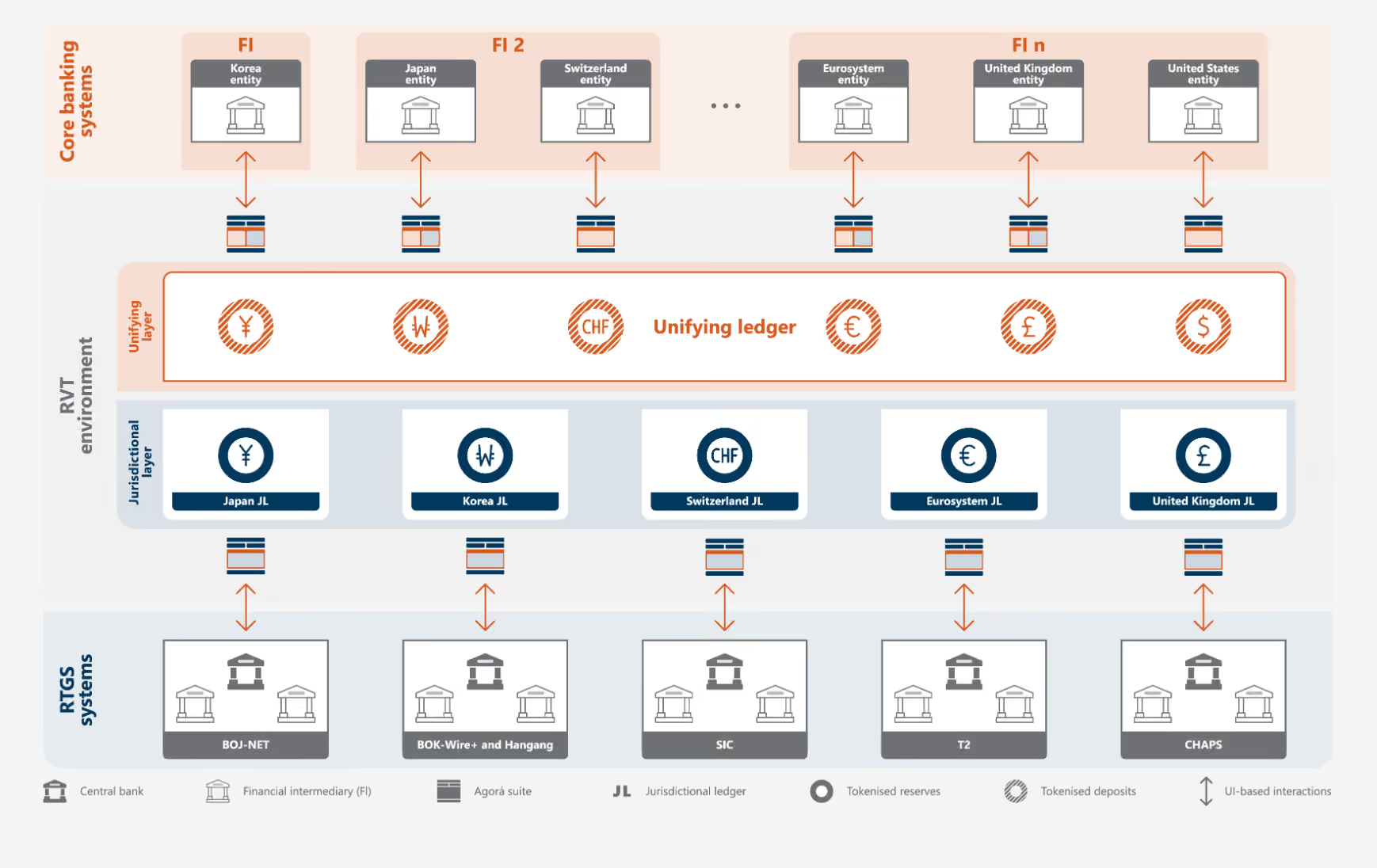
JPMorgan, Bank of America and Citi are going on the blockchain offensive with a shared tokenized network
America’s biggest banks, including JPMorgan, Citi and Bank of America, plan to build a shared, tokenized deposit network by the first half of 2027 to protect their deposits from the threat posed by stablecoins, the Wall Street Journal reported.
The system will be operated by The Clearing House, the payments company collectively owned by the banks. Some banks are calling the network “the bridge,” others call it “the chain,” the WSJ said.
Tokenized deposits are blockchain representations of customers’ money held at a bank. The planned system will convert these deposits into a digital token that can be transferred swiftly on a blockchain.
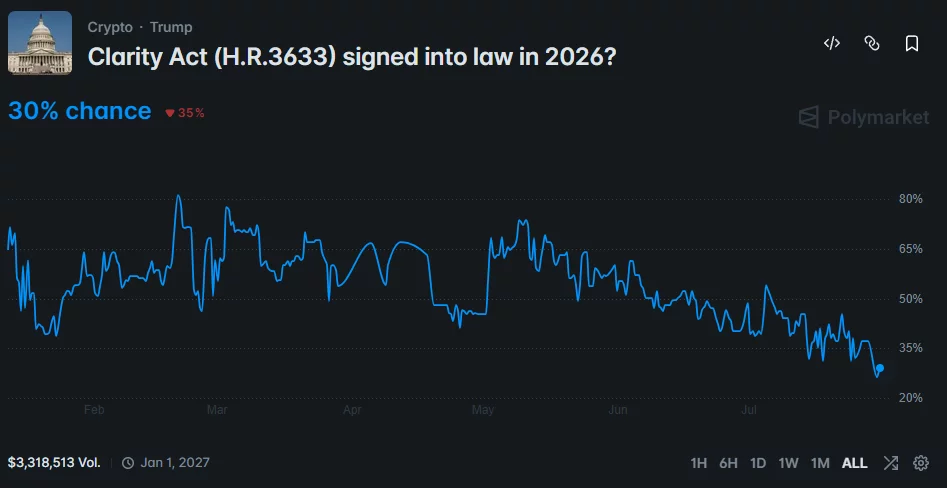
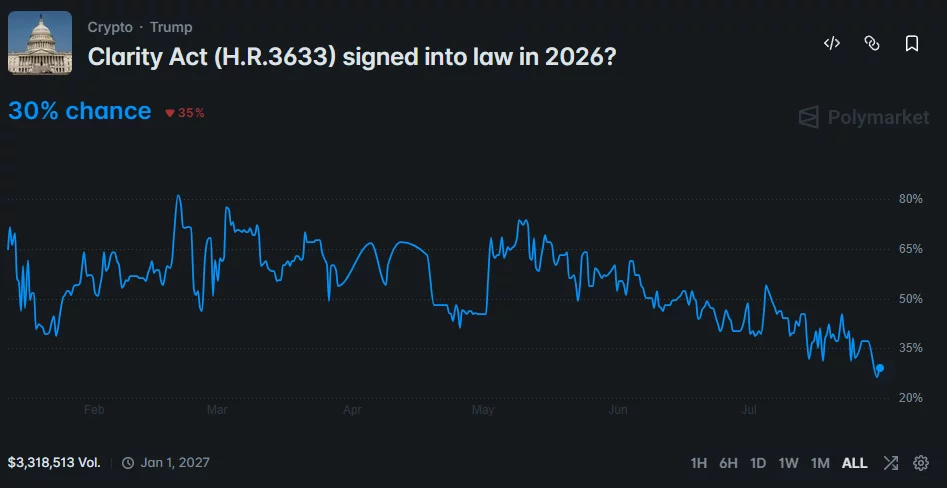
Stablecoins are dollar-pegged digital assets issued by crypto companies that live outside the traditional banking system. The Clarity Act legislation currently advancing through Congress could allow them to pay returns to holders, potentially making bank deposits less attractive because the tokens also offer faster, cheaper payment capabilities over a blockchain.
If customers adopt stablecoins at scale, banks could face a deposit flight to crypto wallets, and deposits are what banks rely on to extend credit in the economy. The tokenized deposit network is designed to ensure deposits remain within the banking system while giving them crypto-like capabilities.
The WSJ report said the Clearing House expects large multinationals to embrace the tokenized deposit network as a gateway to programmable treasury options, real-time liquidity management and cross-border payments.
“This is a big move for the banks,” CEO David Watson told the newspaper, describing a “radically different” future around onchain payments.
-
News Videos7 days agoThis is BROKEN! INSANE 5x MONEY CAR WASH WEEK! The NEW GTA Online UPDATE Today! (GTA5 New Update)
-
Business4 days agoJade Biosciences, Inc. (JBIO) Discusses Positive Interim Results From JADE101 Phase I Healthy Volunteer Study and Development Plans Transcript
-
Tech6 days agoSpaceX just won a second Golden Dome contract. This one is $4.16 billion.
-
News Videos7 days agoSHE IS KILLING XRP!!! WATCH URGENT AND ACT FAST
-
Sports3 days agoFrench Open 2026 results: Alexander Zverev beats Rafael Jodar and will play Jakub Mensik in semi-finals
-
NewsBeat6 days agoFIRST NIGHT REVIEW: Take That bring the Circus back to life in spectacular sun-soaked style
-
Business6 days agoIs the Spurs Phenom Already Better Than Prime Diesel?
-
Tech3 days agoCryZENx Releases Fresh Playable Content Deep Inside Jabu-Jabu for His Ocarina of Time Remake
-
NewsBeat7 days ago
Novak Djokovic v Joao Fonseca LIVE: French Open latest scores and results after Jannik Sinner’s shocking collapse
-
Crypto World7 days agoCFTC Has Approved the First Regulated Bitcoin Perpetual Contract in the U.S.
-
Politics6 days agoThe House | Inside Andy Burnham’s Makerfield Campaign: “Nobody Thinks This Is In The Bag”
-
Entertainment7 days agoMaddox Jolie-Pitt Legally Requests to Drop Brad’s Surname
-
Entertainment7 days agoBruce Willis’ Generosity Resurfaces Amid His Dementia
-
Entertainment6 days agoWeak ‘Supergirl’ Box Office Tracking Amid Milly Alcock Backlash
-
Crypto World7 days ago
Snowflake (SNOW) Stock Rallies on Strong Q1 Results and AI Product Growth
-
Entertainment6 days agoOne of the Greatest Sitcoms of All Time Shoots Up Apple TV’s Charts 11 Years Later
-
Business6 days agoDemand Conditions Improve In Chemicals Sector In April 2026
-
Tech7 days agoThis Week In Security: Ubiquiti Fixes, And FreeBSD Joins The Club You Don’t Want To Join
-
Crypto World7 days agoMicroStrategy Moves $30 Million in BTC to Coinbase Prime: Is the Bitcoin Sell-Off Already Here?
-
Crypto World3 days ago
Seagate (STX) Stock Surges to Record High on AI Boom and Legal Settlement


You must be logged in to post a comment Login