The banner was described as an ‘offence and racist’ erected ‘solely to sow hate and division in our community’
14:23, 05 Jun 2026Updated 14:29, 05 Jun 2026
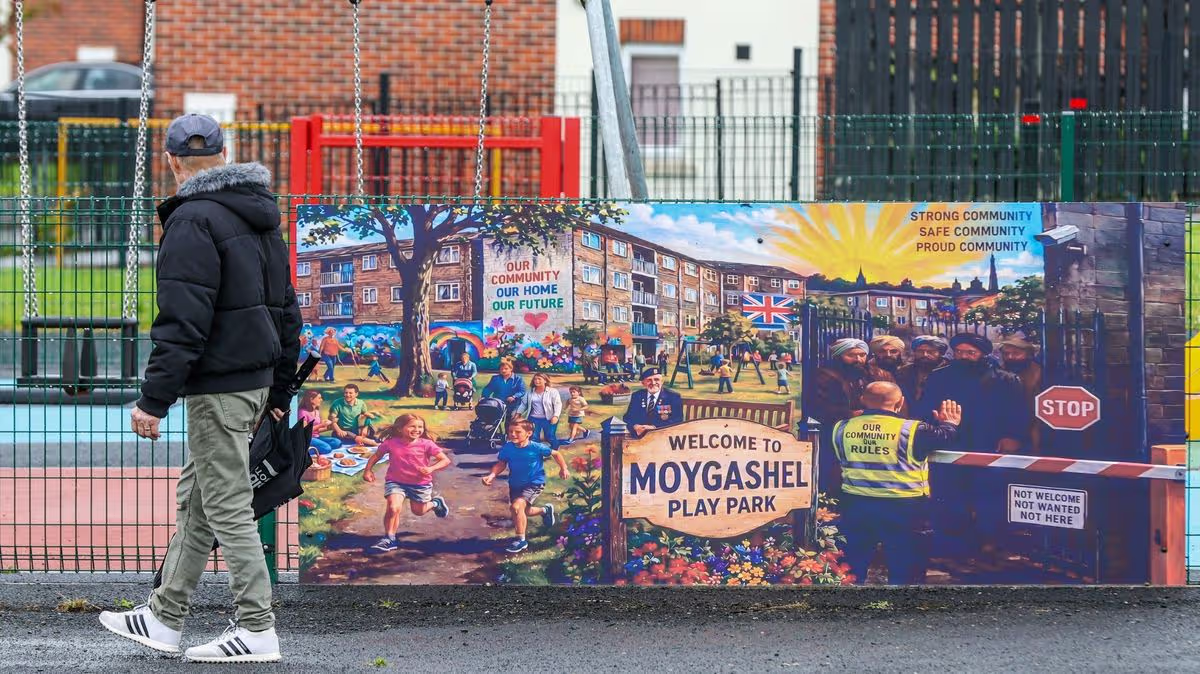
The erection of a banner at a children’s playpark in Co Tyrone is being treated as a hate incident.
Police said officers removed the banner in the Moygashel area on Friday. A police spokesperson confirmed the placing of the banner is being investigated as a criminal offence.
“As a result, officers removed the banner from the children’s playpark on Friday June 5,” they said.
Advertisement
“Police inquiries are ongoing and anyone with any information that could assist is asked to contact police on 101, quoting reference 891 29/05/26.”
Local Sinn Féin and SDLP representatives welcomed the removal of the banner.
Sinn Féin MLA Colm Gildernew described the banner as an “offence and racist”, adding it was erected “solely to sow hate and division in our community”.
He added: “There is no place in our society for racism, and it is the responsibility of all political representatives and community leaders to stand against hate and racism.
Advertisement
“Those who erected this vile banner have nothing to offer our society.”
SDLP councillor Karol McQuade said those responsible for the banner “do not speak for the people of Moygashel”.
He added: “I am glad to see that this hateful banner has now been removed. Its erection was a clear attempt to intimidate local people and make families feel unwelcome at council-owned facilities that are there for everyone.
“The people responsible for this banner do not speak for the people of Moygashel. This is one of the most diverse communities in the North and the people who have chosen to make their lives here contribute enormously to our society through their work, their culture and their involvement in local community life.
Advertisement
“I would urge the people behind these displays to show some humanity and let people live in peace.”
Residents packed out Townley Memorial Hall to voice their opposition to the proposed East West Rail train cleaning centre near Fulbourn, as many said the whole project “needs cancelling”
Local residents filled their village hall to voice their opposition to a proposed train cleaning facility. East West Rail (EWR) has identified a site near Fulbourn “as the most likely location” for the new centre, which has faced widespread resistance in the village.
Advertisement
A public meeting took place on Sunday (May 31) where residents filled Townley Memorial Hall to discuss the proposals and strategies to challenge them. James Colyer, one of the organisers, said the turnout was “beyond expectations” and the mood among residents was very clear.
The 46-year-old said: “This was literally just sprung upon us – potential site or not – and in a town of this many people we only have a limited amount of space.
“The feeling across the whole village, across Wilbraham, Teversham and all the surrounding villages is all the same. This is just utterly preposterous, utterly – utterly preposterous and will bring about the destruction of the area.”
One of our readers, Garyblowpants comments: “The whole thing needs cancelling. It will turn out to be a complete disaster like HS2. Way over budget, delivered decades late and completely out of date if it is ever finished. Cancel it now!”
Advertisement
Timturb0 adds: “Local complaints about disruption and ‘limited space’ in Fulbourn come across as classic petty NIMBY resistance — short-sighted and stubbornly unwilling to accept shared national responsibility. Residents packed the hall to label the plans ‘utterly preposterous’ and ‘devastating’ after they were supposedly ‘sprung upon us,’ yet this ignores the facts.
“The proposed Cambridge Eastern Train Care Centre sits right on the edge of Fulbourn on pre-existing fields along Wilbraham Road. With thoughtful design, it will cause limited long-term interruption to village life while delivering essential infrastructure. Britain is growing rapidly, almost entirely due to high net migration, adding millions more people who need housing, jobs, and reliable transport — especially in the Oxford-Cambridge arc. East West Rail and this depot are vital to provide frequent, dependable services, cut wasted empty mileage, ease road congestion, and support economic growth. Blocking it harms everyone.
“Suggesting ‘put it somewhere else’ is the same weak excuse that stalls infrastructure nationwide. A growing, diverse Britain demands openness to change and practical trade-offs. No village can freeze in time while the country absorbs large-scale immigration and expands.
“The way forward: insist on strong mitigation like noise barriers and screening, plus local benefits such as jobs and better services — but drop the stubborn delay tactics. Britain needs to build. Embracing necessary edge-of-village sites like this is the responsible, forward-looking response to our demographic reality.”
Advertisement
Calumen Nomen says: “East-West Rail is anything but vital. There is no viable business case for it (that’s why EWR won’t publish one), the environmental degradation is on a colossal scale and goes through much BMV (Grade 1) agricultural land.
“And the Infrastructure and Projects Authority said that ‘successful delivery of the project appears to be unachievable. There are major issues with project definition, schedule, budget, quality and/or benefits delivery, which at this stage do not appear to be manageable or resolvable. The project may need re-scoping and/or its overall viability reassessed.’ And then, of course, there’s the perverse decision to build ‘Britain’s biggest New Town’ and then by-pass it completely by this new rail-track. Oh -and we have a falling birth-rate. This is not a ‘growing Britain’.”
Camssurvivor thinks: “With British Rail being nationalised again, I expect a drop in passenger numbers. Private competition increased business by 50 per cent. Indifference in the public sector is highly likely to lead to negative outcomes.”
Rhodabike says: “Quite right, the residents are objecting. A project of this scale is not appropriate for a residential area. There’s no reason whatsoever why it has to be built next to houses.”
Advertisement
Would you welcome the proposed train cleaning centre? Comment below or HERE to have your say.
Waymo, the self-driving car division of Google’s parent company Alphabet, has announced plans to repurpose old batteries from its robotaxi fleet to use them for renewable energy storage.
Thousands of degraded batteries from Waymo’s autonomous taxis will provide storage for power grids in California and Texas following a “strategic supply agreement” with US-based B2U Storage Solutions.
The partnership will see excess energy from wind and solar installations stored in the batteries, which can then be used to provide hundreds of megawatt-hours back to the local grid when needed.
“Our shared fleet of EVs provide a massive opportunity to support the growth of clean energy on the electricity grid while expanding the circular economy,” said Adam Lenz, head of sustainability and environment at Waymo.
Advertisement
“Through this partnership, we can repurpose our batteries for local grid storage and ensure our batteries continue to provide economic and environmental value to the community long after they’ve retired from the road.”
EV batteries typically last between 15 to 20 years before their capacity degrades to around 70-80 per cent, making their driving range no longer practical for a vehicle.
A so-called ‘second life’ is increasingly common for these batteries, as they still hold a massive amount of charge and can be used to store excess solar or wind energy for homes, buildings or grids.
This second-life stage can increase the batteries’ lifespans by up to a decade before they need to be recycled.
Advertisement
B2U’s facility in Lancaster, California, already uses more than 1,300 repurposed EV batteries, according to the company.
“This agreement marks a significant milestone in B2U’s mission to provide integrated repurposing services to the automotive industry,” said B2U CEO Freeman Hall.
“By extending the use of these batteries as grid storage, we are monetising the full potential of EV batteries, now providing crucial stability to the power grid as energy demand continues to grow.”
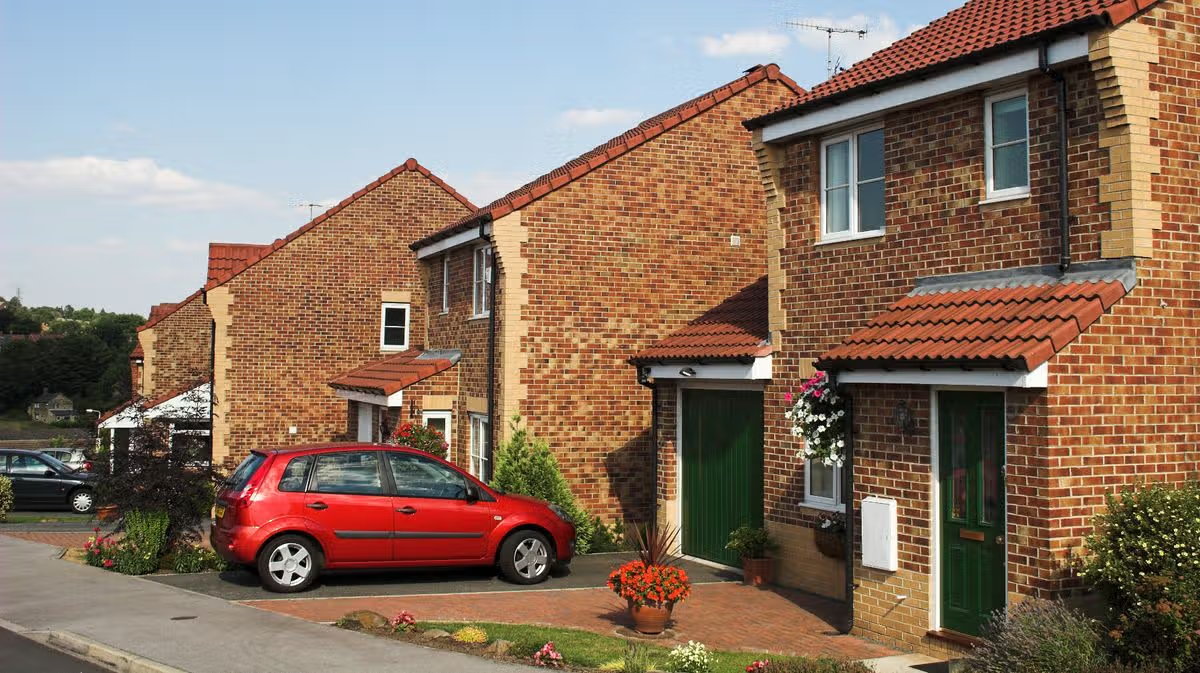
Plans to turn a garage into a hair salon have been approved at Sandpiper Close in Crossgates, Scarborough, despite numerous objections from residents.
It follows the retrospective conversion of a garage into a hair salon which was approved last month at another address at Crossgates, a five-minute walk away.
According to plans, the hair salon will operate from 9am – 5pm on weekdays, and 9am to midday on Saturdays.
No objections were made by Seamer Parish Council or the Highway Authority.
Advertisement
However, three objections were made by members of the public.
Sandpiper Close, Crossgates. Courtesy Of Applicant.
Concerns were raised about an increase in traffic movements, potential parking problems, and safety concerns as “pedestrians walk on the road”.
The Highway Authority said it did not expect the development to lead to a significant increase in vehicle movements.
There are currently two parking spaces serving the house and two additional parking spaces will be created with the proposal to accommodate clients.
Advertisement
The applicant said: “I will operate a one-seat salon with controlled client appointments that will be made so that there is no overlap of appointment times, which will prevent parking overlap.
“An appropriate parking space is available on the existing driveway for these appointments. All products used in the salon will be disposed of safely to comply with any environmental health regulations.”
Planning officers noted that the salon would operate during daytime hours, and “it is therefore considered to not significantly increase the existing level of activity within the area whilst not compromising the surrounding amenities”.
They added that the hours of operation were appropriate for the scale of business and residential setting and would be secured by condition.
Advertisement
A planning report concluded: “With appropriate conditions in place limiting the intensity of use, and by reason of the character and nature of the use proposed, Officers consider that the development can be accommodated in a residential setting.”
The application was approved by North Yorkshire Council, subject to conditions, on Thursday, June 4.
British actor Anthony Head, who was best known for his roles in Buffy the Vampire Slayer and Ted Lasso, has died at the age of 72
Emma O’Neill Content Editor and Laura Harding Press Association Entertainment Editor
16:44, 05 Jun 2026
Actor Anthony Head, widely celebrated for his iconic parts in Buffy The Vampire Slayer and Ted Lasso, has passed away aged 72, according to a statement released by his daughters.
The beloved British star was most recognised for portraying librarian Rupert Giles in the cult American supernatural drama featuring Sarah Michelle Gellar, which aired from 1997 to 2003.
His daughters, fellow actresses Emily and Daisy Head, issued the following statement to the Press Association: “It is with heavy hearts that we announce the death of our extraordinary father, Anthony Head.
Advertisement
“He passed away peacefully of complications due to pneumonia, surrounded by his family. It has been, and forever will be, an honour and a privilege to be his daughters, and to have witnessed firsthand the impact both he and his work have had on so many.
“We know how dearly he will be missed by friends, colleagues, and fans of the shows he was in – he loved his job very much, and he always considered himself incredibly lucky, to have been able to work alongside such exceptionally talented people, in such wonderful productions, across a career that spanned several decades.
“Our grief is far greater than the hole he has left behind, but we know his legacy will live on, in the shows he was a part of, and in the audiences that love them. How lucky we are to know we are able to watch him doing what he loved, even when he is no longer with us.
“We kindly ask that our privacy is respected at this difficult time.” Most recently, Head portrayed former Richmond FC proprietor Rupert Mannion, the ex-spouse of Hannah Waddingham’s character Rebecca, in the football-themed comedy Ted Lasso.
Advertisement
Among his other prominent performances were the Prime Minister in Little Britain and Uther Pendragon in Merlin, father to Prince Arthur.
Recognised for his distinctive baritone tones, Head initially achieved prominence in Britain during the 1980s through the Nescafe Gold Blend television commercials.
He starred as one half of the Gold Blend duo, opposite Sharon Maughan, embarking on a gradual romance over coffee.
These advertisements, broadcast between 1987 and 1993, remain amongst the most memorable instances of serialised marketing campaigns.
Advertisement
Head’s performance in Buffy propelled him to stardom across the Atlantic, though he departed the main ensemble during the programme’s sixth series, subsequently appearing as a guest until its finale.
His acting credits also encompassed Motherland, Manchild, Silent Witness, Spooks, Doctor Who and My Family, alongside the film Repo! The Genetic Opera.
In July 2018, he joined BBC Radio 4’s enduring drama The Archers, taking on the role of Robin Fairbrother.
He was additionally a vocalist, gracing West End stages and recording music, including tracks from the Buffy the Vampire Slayer musical episode, as well as independent projects.
Advertisement
Head’s longstanding partner, animal welfare advocate Sarah Fisher, passed away in December 2025 at 61.
Fisher served as an ambassador for Battersea Dogs And Cats Home and patron of Holly Hedge Animal Sanctuary.
Both their daughters, Emily and Daisy, pursue acting careers. Emily gained prominence for portraying Carli D’Amato in E4’s sitcom The Inbetweeners, while Daisy has featured in television programmes such as Harlots, Shadow And Bone and The Gray House.
His sibling, Murray Head, is likewise an actor recognised for his performance in the Oscar-nominated 1971 picture Sunday Bloody Sunday, and for performing the 1984 hit One Night In Bangkok from the stage production Chess.
A new Colorado law passed this week prohibits speed camera tickets for drivers going 5 mph or less over the speed limit.
Set to take effect August 12, the legislation, signed by Governor Jared Polis, also requires municipalities to mail physical warning notices during the first 30 days after a new camera is installed. In addition, the law sets a maximum fine of $120 for drivers going 25 mph or more over the speed limit, and limits how private vendors can profit from enforcement programs.
The changes were partly driven by a six-month 9News Steve On Your Side investigation led by consumer investigator Steve Staeger, which helped lead to the voiding of $2.3 million in traffic tickets in two Weld County towns.
The investigation began after drivers in Kersey reported steep fines, including $340 tickets issued near a stretch of road where the speed limit drops from 65 to 45 mph.
Advertisement
At the time, Kersey officials were working under a state statute that did not clearly spell out how to handle violations 25 mph or more over the limit, leaving enforcement open to interpretation, 9News reported.
A new Colorado law bans tickets for drivers going 5 mph or less over the limit and requires strict 30-day warning periods when new radar cameras are installed (Getty)
The town issued $340 fines for weeks until investigators found its own ordinance actually capped photo radar tickets at $40. After that discovery, officials paused the higher penalties, issued more than $500,000 in refunds and ultimately voided over $1.1 million in tickets.
The investigation also uncovered problems with the 30-day warning period for new cameras. While state law called for a warning phase, it said cities “may” issue warnings, which some towns treated as optional. In practice, that meant some jurisdictions skipped mailed notices and simply delayed ticketing, so drivers were not formally alerted that they were being monitored, according to the outlet.
In Kersey, data showed about 1,200 tickets per day during the first month of enforcement before numbers dropped as drivers became aware of the cameras, 9News reported. In nearby Hudson, a separate camera issued more than 31,000 tickets in a matter of weeks before officials later voided $1.2 million in fines.
Those findings helped drive statewide reforms, including a $120 penalty for drivers going 25 mph or more over the limit, which is three times the fine cap for lower speeds.
Advertisement
It also enforces stricter requirements for mailed warning notices and signage before enforcement begins and new rules requiring vendors to be paid flat hourly or monthly fees rather than being tied to ticket volume.
Prepare to be transported back millions of years as Emerald Park has just launched its new re-themed land, ‘Lost Valley: Land of Dinosaurs’. Building on the popularity of the much-loved Dino Dash coaster, this immersive experience will combine exciting attractions with dramatic theming and more!
At the centre of the new land is SwingoSaurus, Emerald Park’s brand-new dinosaur-themed swing attraction that promises high flying fun for the whole family. Standing 12 metres high, the exciting new family ride features 16 seats across a unique double-sided gondola, giving guests the chance to soar, swing and glide through a world ruled by dinosaurs. Launching just in time for the summer holidays, visitors can also enjoy daily Dino Meet & Greet experiences later this summer, creating unforgettable up-close encounters and magical memories for dinosaur fans of all ages.
Located just 90 minutes outside of Belfast in Ashbourne, Co. Meath, Emerald Park offers something for everyone! Younger adventurers can enjoy the Junior Zone with over 10 attractions to choose from along with multiple playgrounds, and not forgetting the Emerald Park Zoo, which is home to more than 250 animals, including big cats, birds of prey and zoo experiences such as the Petting Farm and Lemur Woods. Thrill-seekers can head to the immersive land of Tír na nÓg, where epic adventures await on rides like Na Fianna Force and The Quest.
To celebrate the launch of Lost Valley: Land of Dinosaurs at Emerald Park, we have 3 family passes to give away!
For your chance to win, simply fill in your details on the form below.
Terms and conditions: Competition open to NI & ROI residents only, entrants must be over 18, Competition closes at 23:45pm on Sunday, June 21, 2026. See entry form for full details.
Earlier, Robert Brovdi, Ukraine’s drone commander, announced that five “illegally loitering vessels” had been struck overnight in the ports of Mariupol, Berdyansk and in the coastal waters of what Ukraine calls the “temporarily occupied territories” – parts of the country that Russia currently controls.
“Avoid screens before bed” is one of the most common pieces of sleep advice. But what if the real problem isn’t screen time − it’s the way we use social media at night?
Sleep deprivation is one of the most widespread yet overlooked public health issues, especially among young adults and adolescents.
Despite needing eight to 10 hours of sleep, most adolescents fall short, while nearly two-thirds of young adults regularly get less than the recommended seven to nine hours.
Poor sleep isn’t just about feeling tired − it’s linked to worsened mental health, emotion regulation, memory and academic performance (Getty Images)
Poor sleep isn’t just about feeling tired − it’s linked to worsened mental health, emotion regulation, memory, academic performance and even increased risk for chronic illness and early mortality.
At the same time, social media is nearly universal among young adults, with 84% using at least one platform daily. While research has long focused on screen time as the culprit for poor sleep, growing evidence suggests that how often people check social media − and how emotionally engaged they are − matters even more than how long they spend online.
Advertisement
As a social psychologist and sleep researcher, I study how social behaviors, including social media habits, affect sleep and well-being. Sleep isn’t just an individual behavior; it’s shaped by our social environments and relationships.
And one of the most common yet underestimated factors shaping modern sleep? How we engage with social media before bed.
Emotional investment in social media
Beyond simply measuring time spent on social media, researchers have started looking at how emotionally connected people feel to their social media use.
Advertisement
Some studies suggest that the way people emotionally engage with social media may have a greater impact on sleep quality than the total time they spend online.
In a 2024 study of 830 young adults, my colleagues and I examined how different types of social media engagement predicted sleep problems. We found that frequent social media visits and emotional investment were stronger predictors of poor sleep than total screen time. Additionally, presleep cognitive arousal and social comparison played a key role in linking social media engagement to sleep disruption, suggesting that social media’s effects on sleep extend beyond simple screen exposure.
I believe these findings suggest that cutting screen time alone may not be enough − reducing how often people check social media and how emotionally connected they feel to it may be more effective in promoting healthier sleep habits.
How social media disrupts sleep
Advertisement
If you’ve ever struggled to fall asleep after scrolling through social media, it’s not just the screen keeping you awake. While blue light can delay melatonin production, my team’s research and that of others suggests that the way people interact with social media may play an even bigger role in sleep disruption.
Here are some of the biggest ways social media interferes with your sleep:
Presleep arousal: Doomscrolling and emotionally charged content on social media keeps your brain in a state of heightened alertness, making it harder to relax and fall asleep. Whether it’s political debates, distressing news or even exciting personal updates, emotionally stimulating content can trigger increased cognitive and physiological arousal that delays sleep onset.
Social comparison: Viewing idealized social media posts before bed can lead to upward social comparison, increasing stress and making it harder to sleep. People tend to compare themselves to highly curated versions of others’ lives − vacations, fitness progress, career milestones − which can lead to feelings of inadequacy and anxiety that disrupt sleep.
Habitual checking: Social media use after lights out is a strong predictor of poor sleep, as checking notifications and scrolling before bed can quickly become an automatic habit. Studies have shown that nighttime-specific social media use, especially after lights are out, is linked to shorter sleep duration, later bedtimes and lower sleep quality. This pattern reflects bedtime procrastination, where people delay sleep despite knowing it would be better for their health and well-being.
Fear of missing out, or FOMO: The urge to stay connected also keeps many people scrolling long past their intended bedtime, making sleep feel secondary to staying updated. Research shows that higher FOMO levels are linked to more frequent nighttime social media use and poorer sleep quality. The anticipation of new messages, posts or updates can create a sense of social pressure to stay online and reinforce the habit of delaying sleep.
Taken together, these factors make social media more than just a passive distraction − it becomes an active barrier to restful sleep. In other words, that late-night scroll isn’t harmless − it’s quietly rewiring your sleep and well-being.
About the author
Brian N. Chin is an Assistant Professor of Psychology at Trinity College. This article is republished from The Conversation under a Creative Commons license. Read the original article.
How to use social media without sleep disruption
Advertisement
You don’t need to quit social media, but restructuring how you engage with it at night could help. Research suggests that small behavioral changes to your bedtime routine can make a significant difference in sleep quality. I suggest trying these practical, evidence-backed strategies for improving your sleep:
Give your brain time to wind down: Avoid emotionally charged content 30 to 60 minutes before bed to help your mind relax and prepare for sleep.
Create separation between social media and sleep: Set your phone to “Do Not Disturb” or leave it outside the bedroom to avoid the temptation of late-night checking.
Reduce mindless scrolling: If you catch yourself endlessly refreshing, take a small, mindful pause and ask yourself: “Do I actually want to be on this app right now?”
A brief moment of awareness can help break the habit loop.
Sally, who works as a restaurant manager in Clifton in BRistol, was taking her first trip on a rental e-scooter in two years when she hit a pothole and was thrown from the vehicle
Angus McIntyre
16:24, 05 Jun 2026
A woman from Bristol spent five days in hospital recovering from injuries sustained after the e-scooter she was riding struck a pothole.
Sally*, who works as a restaurant manager in Clifton, had been using one of the vehicles to travel home following a shift last week.
However, as she turned onto the dimly-lit Redland Road, she collided with a pothole. The unfortunate woman, who described herself as naturally cautious and was taking her first ride on a rental scooter in two years, was thrown from the vehicle and sustained a deep laceration to her head.
Advertisement
Following an agonising seven-hour wait in A&E, it was confirmed she had also fractured five ribs and her collarbone. Sally attributes the poor condition of Bristol’s roads, rather than the e-scooter itself, for her accident.
“There are potholes everywhere, and I really did not see this one that I hit,” she said, reports Bristol Live.
“Obviously, Redland Road is not extremely illuminated. There’s not a lot of light, and I did not see that porthole whatsoever.
Advertisement
“I wasn’t speeding much either, because I’m always quite careful, and I was coming out from one of the minor roads as well, so the only acceleration that I had was to accelerate to restart the e-scooter.”
Sally now faces eight weeks away from work and will only be entitled to statutory sick pay during that period, considerably less than her usual earnings. She has stated her intention to pursue a compensation claim against Bristol City Council.
Councillor Ed Plowden, chair of the transport and connectivity committee, said: “Making roads safe and reliable for all users is a priority. Repairing potholes is an important part of maintaining the road network, and we continue to seek the much-needed additional funding required to more effectively meet this challenge.
“Roads are inspected regularly to check their condition. Every road is checked at least once a year, with busy roads inspected once a month. We aim to repair potholes within 28 days, in line with national guidelines and we are working closely with our contractors to make sure repairs are completed on time.”
Advertisement
Sally owes a debt of gratitude to a mystery good Samaritan for preventing the situation from deteriorating further following the incident.
A gentleman she knows only as Matthew halted his vehicle upon discovering her lying injured on the carriageway. He contacted emergency services, but upon learning an ambulance wouldn’t arrive promptly he took the initiative and transported Sally to hospital himself.
The injured woman is now eager to locate Matthew to express her gratitude personally. Yet, due to her condition when he assisted her she cannot recall any distinguishing information about him.
“He put me in his car without even thinking about it, even though I was bleeding everywhere,” she said.
Advertisement
“He tried to talk to me while I was in complete shock and hurt, to keep me awake I suppose. He dropped me off at the emergency ward at Southmead hospital and ensured I was taken care of.”
The extent of injuries sustained by e-scooter riders or resulting from incidents involving these vehicles remains challenging to determine. Based on data from police forces across Great Britain, 1,312 collisions involving e-scooters occurred in 2024, rising from 1,292 in 2023.
Six fatalities resulted from those incidents, with 444 individuals sustaining serious injuries.
The actual number of collisions involving e-scooters is likely considerably higher because, as the Department of Transport – which releases the crash statistics – acknowledges, “It should be noted that a considerable percentage of non-fatal casualties are not reported to the police. Non-fatal casualties for e-scooter users are amongst the most likely to be under-reported in road casualty data since they have no obligation to inform the police of collisions.”
Advertisement
Sally stated she was fortunate she was travelling at approximately 11.45pm on a Tuesday evening. During a busier period, she could easily have been propelled into the path of an approaching vehicle, or struck by one travelling behind her.
The likelihood of accidents increases on roads in poor condition. Research from the 2021 Dott London trial, conducted alongside cycling safety technology company See.Sense, discovered ‘strong correlations between high levels of braking and swerving, and poor road surface conditions. This could occur in areas with potholes or poor infrastructure, causing riders to swerve or brake to avoid crashes, as well in roads with rough surfaces – such as cobbled streets – resulting in reduced control of the e-scooter’.
Bristol City Council repaired 4,398 potholes during 2024/25. The local authority has received an ‘amber’ classification for road maintenance from the Department of Transport which indicates “room for improvement”.
The Fifa men’s football World Cup is one of the most powerful brands in sport, attracting global attention with a simple formula of rarity, intensity and consequence.
Every four years, this high-stakes tournament feels distinct from everything else in the football calendar. So changing the format is a gamble.
But the 2026 World Cup, held in the US, Canada and Mexico, will be the biggest yet, featuring lots more teams – 48, up from 32 in 2022 (and just 24 back in 1994). And this means a lot more matches – a jump from 64 at Qatar 2022 to 104 in this year’s event.
This level of expansion reflects a broader shift across elite football. Several big tournaments (the Champions League, the Euros, the Club World Cup) are all played with more teams than they used to be.
Advertisement
And there are clear benefits. A larger World Cup for example, allows more nations to participate, extending the tournament’s reach and audience. For smaller football nations, it increases the likelihood of qualification and the opportunity to appear on the sport’s biggest stage for the first time.
More matches and more countries participating also means the potential for even greater revenue generation in new markets.
But aside from making Fifa more money, or football more inclusive, expansion could also damage the World Cup’s strength as an event.
This strength has traditionally come from the rarity and jeopardy of the occasion.
Advertisement
Qualification has always mattered because it was a difficult thing to achieve. Reaching the tournament at all was a show of footballing prowess, and once a team was there, the structure of the competition ensured that early matches carried real consequence.
In terms of successful branding, this intensity concentrates fans’ collective competitive and emotional investment in the event.
But dramatically expanding that event risks damaging this setup. More teams means that qualification becomes less selective, while staging more matches reduces the importance of individual games (and demands a level of viewing time that could test even the most committed football fan).
In marketing terms, this weakens what’s known as “perceived consequence”, the extent to which individual matches are seen to meaningfully shape outcomes and command fans’ attention. As the tournament grows (and there are some who want 66 teams to qualify for 2030), it can lose intensity.
Advertisement
There is more football, but less at stake with every kick.
Different goals
Expansion is often justified on economic and political grounds. The cost pressures on host counties has pushed governing bodies towards larger and more widely dispersed formats (hence this tournament being held across three countries).
But recent research I carried out with a colleague suggests that staging a tournament across multiple countries can be a complicated business too. Different places operate in different ways, with different resources and goals, so alignment can prove tricky.
That said, co-hosted events can work, but only when spectators manage to perceive the tournament as one coherent event, rather than a fragmented set of parts. As scale and complexity increase, sustaining that perception becomes more difficult.
Advertisement
With more teams, more matches and football stadiums in three large countries, the 2026 World Cup brings these challenges into sharper focus. It also has to deal with a broader shift which has seen elite football become an almost constant, never-ending series
of tournaments and fixtures throughout the year.
Competitions seem to exist as part of an ongoing, always-available media flow rather than isolated events.
In this context, the World Cup risks becoming just another part of high-value extended media property designed to maximise engagement across time rather than concentrate it. But dilution can lead to the weakening of a brand as its defining elements become less clear or less exclusive.
Advertisement
The qualities that once made the World Cup brand so distinctive risk becoming less sharply defined.
As more teams qualify, entry may feel less exclusive, and as more matches are played, individual fixtures become less decisive. As tournaments grow longer and more complex, the sense of a single, shared global moment becomes more diffused.
The World Cup will almost certainly remain football’s most valuable commodity for the foreseeable future. But its long-term health depends on maintaining the qualities that make it feel exceptional rather than routine.
If expansion continues to prioritise availability over intensity, the risk is not that the World Cup will fail – but that it will gradually lose its value as a global event that transcends the sport itself.
You must be logged in to post a comment Login