

Crypto World
DGrid AI Reports $20 Million in Revenue Ahead of Token Launch



Decentralized artificial intelligence network DGrid AI generated $20 million in revenue in its first six months, giving the project a paid-user base ahead of its planned DGAI token launch.
Revenue came through the Genesis premium program, which has attracted more than 13,000 paid users with an average revenue per user of $1,580.
DGrid also reports 50,000 daily active users and 500,000 monthly active users across its ecosystem.
DGrid is building a decentralized smart network for AI, connecting users, developers, models, and agents through a marketplace, smart routing system, and Proof of Quality verification for AI services.
Genesis Premium Program Builds Early Revenue
Genesis is currently DGrid’s revenue engine, with members paying for network access and receiving benefits connected to AI usage, hardware, monthly token credits, AI model services, and membership NFTs.
Under DGrid’s economic model, those NFTs are linked to 25% of total DGAI emission rights over ten years.
The model combines usage-led demand with token-linked participation before the token generation event.
Some members use Genesis for AI model access and lower usage costs, while others focus on future DGAI distribution connected to the membership NFT. The program gives DGrid cash flow and committed community activity before launch.
AI Arena Adds BNB Chain Activity
DGrid’s onchain activity has grown through Arena for Agent, launched on BNB Chain. The product has supported more than 10,000 agent deployments through ERC-8004 and attracted over 200,000 participants, while adding more than 5,000 daily onchain active users to BNB Chain.
Arena asks two AI models to answer the same prompt anonymously, after which users choose the stronger response and earn points tied to future DGAI distribution. Their selections help train DGrid’s smart routing system, turning model evaluation into a recurring onchain activity with a low technical barrier for users.
Arena also gives DGrid visible user activity before launch while collecting comparison data for its routing system.
Products Focus on AI Access, Routing, and Agent Deployment
DGrid’s product suite includes AI Gateway, Dori, and DClaw, each aimed at a different part of AI access and deployment. Here’s a detailed breakdown of each:
Product
Main Function
Who is it for?
Key Benefit
AI Gateway
Provides a single access point for multiple AI models.
Developers, businesses, and users who need model access without managing separate integrations.
Simplifies AI model access and supports payments in USDT, USDC, and BNB.
Dori
Helps developers choose the right AI model for specific use cases.
Developers testing or deploying AI tools.
Reduces the time and cost of manually comparing multiple models.
DClaw
Lets users launch personal AI agents across Telegram, Discord, WeChat, and Feishu.
Users and teams that want AI agents inside messaging and community platforms.
Makes AI agents easier to deploy across familiar communication channels.
Model Marketplace
Allows model providers to list AI services and earn revenue through AI Gateway.
AI model providers, developers, and enterprise users.
Creates a marketplace for AI model access, monetization, and service discovery.
Proof of Quality
Verifies model performance, pricing, and delivery standards.
Marketplace users, model providers, and developers.
Adds trust and transparency to model selection.
A Note on Research
DGrid’s academic work adds depth to its product plan. The network cites published research on Proof of Quality, optimistic TEE rollups, and cost-aware proofs, all of which relate to service verification, model performance, and cost control.
The team includes Ph.D.-level members from institutions such as Stony Brook University. Founder and CEO Alex has more than 10 years of experience in blockchain project operations, 5 years in machine learning, and over 3 years in large language model training and fine-tuning.
DGAI Token Launch is One to Watch
DGrid enters its token launch phase with paid membership revenue, BNB Chain activity, AI products, marketplace plans, and research already in place.
After six months, the project has built a user and revenue base around Genesis, expanded Arena participation, and prepared the foundations for a model marketplace powered by DGAI.
The post DGrid AI Reports $20 Million in Revenue Ahead of Token Launch appeared first on BeInCrypto.


Key Takeaways
- A defensive rotation is driving capital flows from technology and AI stocks into healthcare equities
- The Health Care Select Sector SPDR Fund surged 3% Thursday, piercing key technical resistance levels
- UnitedHealth and Eli Lilly dominate S&P Health Care index rankings with Quant scores of 3.47 and 3.44
- Artificial intelligence technology enables pharmaceutical companies to evaluate 50 times more drug candidates than traditional methods
- Individual opportunities emerge in companies like Intuitive Surgical, Natera, and Edwards Lifesciences amid broader sector recovery
A stealth rotation into healthcare equities is underway as institutional investors reposition portfolios away from overheated technology names. The convergence of defensive positioning and artificial intelligence breakthroughs is reviving interest in a sector that has languished for years.
Thursday’s trading session saw the Health Care Select Sector SPDR Fund climb 3%, simultaneously breaking through a critical short-term technical barrier. Market analysts interpret this price action as evidence of strengthening sector momentum.
Surging volume in managed care equities signals institutional capital allocation toward healthcare. After years of trailing the broader equity markets, this sector rotation represents a meaningful shift in investor sentiment.
The healthcare segment of the S&P 500 has declined 4% year to date, with projected full-year earnings expansion of merely 4%—the weakest among all sectors.
Political pressure on pharmaceutical pricing, declining Affordable Care Act participation, and Merck’s substantial one-time write-down have created sector headwinds. However, beneath these challenges, pockets of robust growth are emerging.
Artificial Intelligence Transforms Drug Development Pipelines
Pharmaceutical and biotechnology firms are deploying artificial intelligence systems to accelerate and economize drug candidate screening. Shivani Vohra, portfolio manager at Parnassus Investments, notes that computational models now perform tasks historically requiring laboratory personnel.
“Anywhere from five to 50 times the number of early-stage candidates are being looked at,” Vohra said. This technological leap enables companies to identify superior drug candidates with unprecedented efficiency.
This innovation represents a compelling reason for investors to look beyond near-term sector challenges.
Standout Equity Opportunities in Healthcare
[[LINK_START_1]]Eli Lilly[[LINK_END_1]] dominates the sector landscape. The pharmaceutical giant’s GLP-1 medications targeting obesity and diabetes are projected to generate approximately $22 billion in free cash flow this year, with forecasts reaching $47 billion by 2030. The stock currently trades at 31 times forward earnings.
Intuitive Surgical manufactures the widely-adopted da Vinci robotic surgical platform, now considered essential infrastructure across hospital systems. The company is launching its first major platform upgrade in ten years, featuring enhanced computing capabilities and advanced imaging technology. Following a 25% decline over twelve months, shares trade at 40 times earnings.
Natera provides specialized blood diagnostics for prenatal care and oncology applications. Analysts project revenue will exceed $5 billion before decade’s end, more than doubling current levels, though profitability remains elusive.
Edwards Lifesciences is expanding beyond traditional heart valve replacement into emerging, high-growth valve therapy categories. The stock commands a 29 times earnings multiple.
Medline, which completed its public offering in December at $29 per share, recently traded below $35. The medical products supplier operates a private-label business model and trades at 23 times earnings.
Current Quant Rating Landscape
[[LINK_START_3]]UnitedHealth[[LINK_END_3]] and Eli Lilly command the top positions within the S&P Health Care index based on Quant Rating methodology, scoring 3.47 and 3.44 respectively. Both equities have recorded recent price appreciation.
Johnson & Johnson, Thermo Fisher Scientific, and Intuitive Surgical occupy subsequent ranking positions. Notably, no top-weighted holdings currently achieve a bullish Quant Rating exceeding 3.5, with the majority residing in neutral hold territory.
Abbott Laboratories registers the weakest performance score at 2.71, nearing bearish classification.
AbbVie, Gilead Sciences, and Abbott cluster at the lower end of sector rankings.
The overall sector profile suggests cautious optimism, with selective opportunities emerging as healthcare begins establishing a firmer foundation for sustained outperformance.

Crypto World
FairGambling Launches Crypto Casino Review and Analytics Platform With Provably Fair Tools and Extra Rewards
[PRESS RELEASE – New York, USA, June 5th, 2026]
FairGambling, a new transparency and rewards platform for crypto casino players and Bitcoin gamblers, today announced its public launch. The platform combines on-chain analytics, provably fair verification tools, independent crypto casino reviews, live bonus code feeds, and an extra rewards program offering up to 30% rakeback across 40+ major crypto casino operators including Stake, Roobet, Shuffle, BC.Game, Gamdom, Bitcasino, 1win, Winna, Thrill and Duel, with much more to come.
FairGambling launches into a market that processed over $80 billion in crypto casino deposit volume last year. The platform’s analytics layer already tracks $45 billion+ of that flow in real time across the operators it covers. Despite the market’s scale, players still have limited tools to verify fairness, compare operators, or independently assess where their money is going.
Built as a Utility Layer, Not Another Affiliate Site
“Most casino review sites today are just rankings and sign-up bonuses,” said Seb, Co-Founder of FairGambling. “We wanted to build something different. A place where players can actually see what’s happening on-chain, verify their own bets, compare casinos based on data instead of marketing, and earn real rewards on top. All for free, with no obligations. That’s the gap we’re filling, and what’s live today is just the start of what we’re building.”
The platform brings together several player-first tools in one place:
- On-chain crypto casino analytics, tracking real-time deposit volume, market share, unique depositors, and hot wallet activity across 50+ operators
- Provably fair verifier for independently checking game outcomes from Stake, Roobet, Shuffle and other major operators
- Independent crypto casino reviews and ratings scored across 10 weighted categories including fairness, financial transparency, KYC and licensing, compliance, and customer support
- Live bonus code feed aggregating active promotions from supported operators
- Bonus calculator and Stake stats calculator for analyzing personal betting history and rakeback value
- Blackjack trainer for practicing basic strategy
- Extra rakeback rewards program offering up to 30% on supported crypto casinos
Data-Driven Casino Comparison
Unlike traditional affiliate sites that rank casinos based on commercial agreements, FairGambling’s ratings are built from a weighted rubric covering analytics, fairness, financial transparency, bonus structure, compliance, and security. Each operator profile includes deposit volumes, hot wallet visibility, license details, no-KYC policies, bonus testing results showing how much players actually receive back in rewards when wagering a given amount, and side-by-side comparisons against other operators on the same metrics.
The analytics section is open to all visitors and shows live on-chain flows, allowing players to see which operators are processing real volume versus those with thin activity. This is a data point traditionally only available to industry insiders.
Community Reviews and Earning Crypto

FairGambling places verified player reviews at the center of its review system. Verified users can earn crypto rewards for eligible contributions, and the platform requires casino activity verification (such as VIP tier or wager history) before reviews are approved, which is intended to filter out the fake reviews common to other online gambling review sites.
“Trust in this space is broken,” Seb added. “We’re not going to fix that overnight, but giving players the data, the tools, and the rewards to actually engage critically with the operators they use, that’s the foundation. Everything else builds on that.”
The platform helps players find the best crypto casinos based on data, verify game fairness, and earn extra rakeback on top of what casinos already offer. FairGambling is now live and available worldwide, subject to local laws and eligibility requirements.
About FairGambling
FairGambling is a crypto casino transparency and rewards platform that helps players make more informed decisions across major Bitcoin and crypto gambling operators. The platform combines on-chain casino analytics, independent crypto casino reviews and ratings, provably fair verification tools, live bonus code feeds, player stats tools, a blackjack trainer, and an extra rewards program offering up to 30% extra rakeback. FairGambling currently covers 50+ crypto casino operators and has tracked $45 billion+ in historical deposit volume, with more added regularly.
For more information, users can visit FairGambling.com.
Responsible gambling notice: FairGambling is not a casino and does not accept bets or process gambling transactions. The platform provides analytics, reviews, verification tools, and rewards related to third-party crypto casino operators. FairGambling is intended for users aged 18+ or the legal gambling age in their jurisdiction. Gambling involves risk and can be addictive. Please play responsibly and follow all applicable local laws.
The post FairGambling Launches Crypto Casino Review and Analytics Platform With Provably Fair Tools and Extra Rewards appeared first on CryptoPotato.
Bitcoin remains under heavy selling pressure after crashing below multiple key support levels in quick succession. The recent rejection from the descending 200-day moving average triggered a sharp sell-off that invalidated the previous rising channel structure and pushed BTC back toward a major demand zone around $60K. Meanwhile, on-chain data suggests market participants are increasingly realizing losses, reflecting deteriorating investor sentiment.
Bitcoin Price Analysis: The Daily Chart
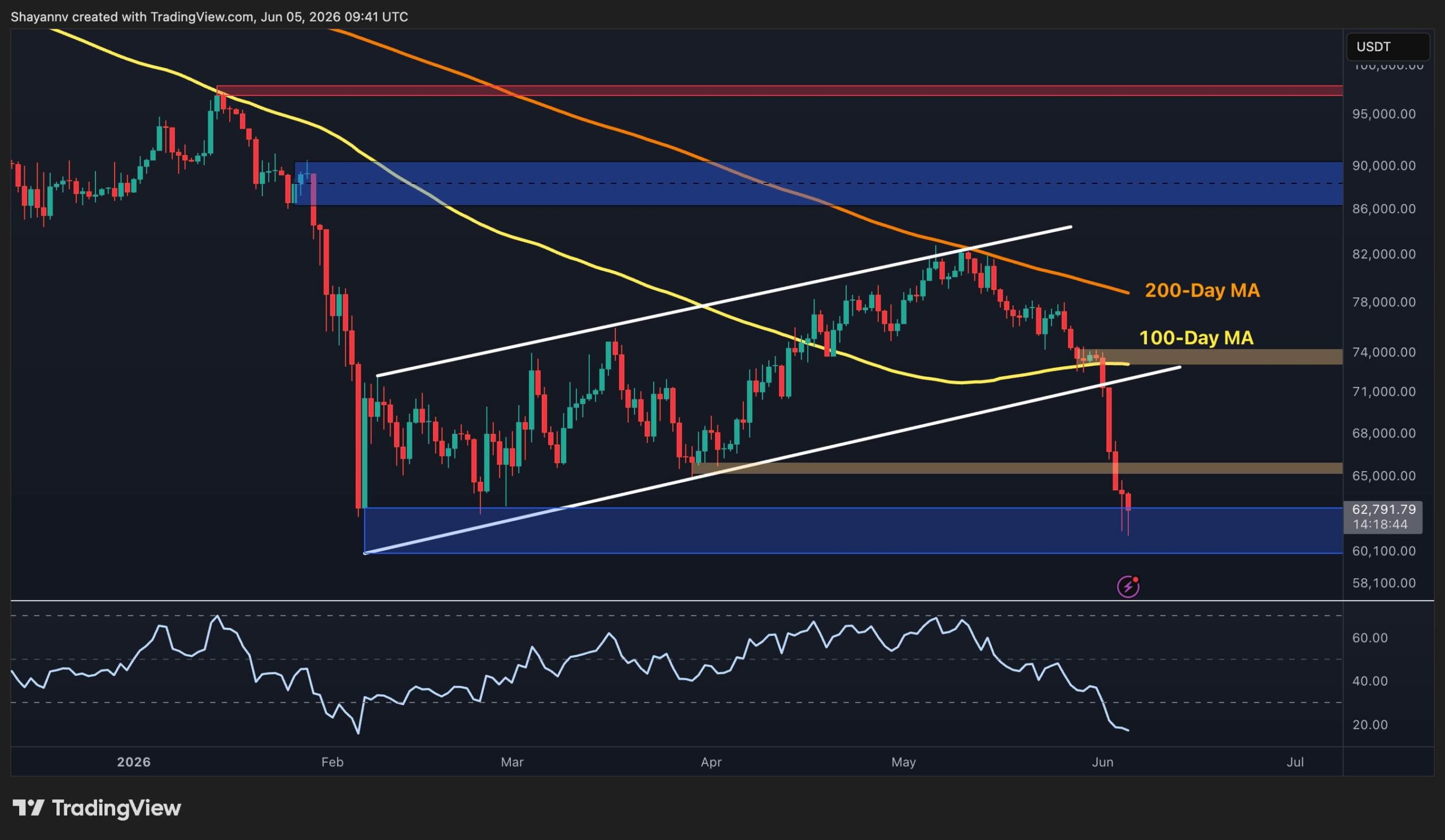
On the daily timeframe, Bitcoin has confirmed a significant bearish breakdown after falling below both the ascending channel and the 100-day moving average near $74K. The channel had supported the recovery from February’s lows, but the recent violation indicates that buyers have lost control of the intermediate trend.
The rejection occurred near the confluence of the channel’s upper boundary and the descending 200-day moving average, located around the $82K region. Since then, BTC has experienced an aggressive decline, slicing through the $74K support area and the prominent low of $65K from late May with little resistance.
The price is now testing a major support block at $60K, which previously acted as a strong rebound area following the February capitulation. This zone represents the last major defense for bulls before the market opens the door toward significantly lower levels.
BTC/USDT 4-Hour Chart
The 4-hour chart highlights the severity of the recent breakdown. Following an extended consolidation near the $74K region, BTC failed to reclaim the level and subsequently broke below the daily ascending channel’s lower boundary that had supported price action for months.
As the breakdown accelerated, the $65K support area also gave way, which drove price directly into the $60K-$62K demand region. This area is currently preventing further downside and has already attracted some buying interest.
An important observation comes from the RSI, which has formed a mild bullish divergence in extremely oversold conditions while price has established fresh local lows. Although the signal remains early, it suggests bearish momentum may be weakening in the short term and could support a temporary rebound toward the $65K resistance zone.
However, from a structural perspective, the market continues to print lower highs and lower lows. As long as BTC remains below the broken support levels at $65K and $74K, any recovery is likely to be viewed as a corrective move rather than the beginning of a new uptrend.

On-Chain Analysis
The Adjusted Spent Output Profit Ratio (aSOPR), a metric that measures whether coins moved on-chain are being sold at a profit or loss, is providing an important signal regarding investor behavior.
The chart shows that the 30-day EMA of aSOPR has fallen below the critical 1.0 threshold. Historically, readings above 1 indicate that market participants are realizing profits on average, while values below 1 suggest coins are being spent at a loss.
The recent drop below 1 coincides with Bitcoin’s decline toward the $60K area and reflects growing capitulation among holders. This shift suggests that a larger portion of investors is now exiting positions at a loss, a behavior commonly associated with bearish market phases and periods of weak confidence.
While persistent readings below 1 often accompany downtrends, they can also signal the later stages of a corrective phase as weaker hands leave the market. Therefore, traders should closely monitor whether aSOPR can reclaim the 1.0 level. A recovery above that threshold would indicate renewed profitability across the network and could support broader market stabilization.
For now, both price action and on-chain data continue to favor the sellers, while the $60K support region remains the key battleground that will likely determine Bitcoin’s next major directional move.

The post Bitcoin Price Analysis: Where Is BTC Heading Next After Drop Below $61K? appeared first on CryptoPotato.
It was difficult to imagine in mid-May how much the cryptocurrency landscape could change for the worse in such a painful manner in the following three weeks. Aside from BTC, which dumped beneath $60,000 for the first time since November 2024, and ETH plummeting to a 14-month low, XRP also slipped below crucial support levels and marked a 19-month low of under $1.10 on Friday.
The question now is whether this last defense above the crucial psychological level at $1.00 will hold, or if the cross-border token is headed toward an inevitable crash into the cents territory.
What Happens When Bears Take Complete Control?
The popular AI solution’s new version noted that the most realistic first bearish target sits at $0.90 if XRP dumps below $1.00 soon, which appears more and more likely given the current market conditions. Just for reference, BTC broke down below $60,000 earlier today, reaching its lowest price tag since before the US elections in late 2024.
XRP also dumped to its lowest level since those eventful days in November 2024, as it currently sits below $1.10. After breaking below its last major support level, $1.00 is now in focus; another leg down could test it soon.

If the token indeed dips to $0.90, this would represent another 18%-20% decline and likely coincide with continued weakness across the market, ChatGPT added.
However, it outlined even lower targets if the bulls fall out completely, with the even more bearish option seeing the asset dumping to $0.75-$0.80.
The capitulation scenario envisions another drop to $0.60, but this remains a “low-probability outcome.”
“For XRP to collapse that far, investors would likely need to face a combination of macroeconomic turmoil, a broader crypto bear market, and the disappearance of key bullish narratives such as ETF optimism and institutional adoption,” the AI platform noted.
A Violent Rebound?
ChatGPT also offered a different viewpoint, which shows that XRP could be “approaching the point where conditions become favorable for a relief rally.” Basing its projection on some historical developments, especially for previous Junes during US midterm election years, it explained that “pessimism often preceded major recoveries.”
Consequently, it outlined a possible and quick rebound to $1.25 and even $1.40 if buyers successfully defend the $1.05-$1.10 support region, which is to be seen in the next days or even hours.
The post XRP Holders Won’t Like What ChatGPT’s New Version Predicts Next appeared first on CryptoPotato.

Bitcoin traded near $61,100 on Friday, wiping out about $335 million in leveraged long positions as the market wobbled through a sharp correction. The move followed a roughly 21% drop from the recent high and has traders recalibrating the risk of a sudden upside burst that could trigger a squeeze, given where short interest sits in the price band around $63,000 to $66,000.
Analysts estimate that a rally back toward $66,000 could threaten as much as $2.6 billion of open short positions, potentially igniting a faster-than-expected buyer response. Conversely, if BTC slides further to around $57,000, liquidations could total roughly $1.2 billion, underscoring the asymmetric risk in the current levered setup. The headline takeaway is that much of the risk is centered on a narrow corridor where bulls and bears bargain for control, and a decisive shift in either direction could reshape sentiment in days to come.
These dynamics unfold alongside a broader backdrop of spot Bitcoin ETF outflows and a fragile appetite for risk assets. In recent weeks, investors have pulled money from the Bitcoin ETF complex, with a 13-day streak of net outflows highlighted in prior coverage. The latest slice of data shows only a marginal $3 million net inflow on Thursday, insufficient to derail the ongoing liquidity drain that has seen about $5.1 billion leave the sector over the streak. This set of flows adds an extra layer of complexity for bulls hoping to stage a sustained comeback.
On the funding side, the market is painting a cautious portrait. BTC perpetual futures funding rates have turned negative, hovering around -2%. A neutral funding regime typically sits in the 6% to 12% annualized range, where longs pay to hold positions. The negative reading signals growing bearish conviction and a cooling of long-side leverage, which, in turn, dampens near-term upside risk even if spot prices flirt with key levels. In other words, bears appear to have a more comfortable position than in a strongly bullish backdrop, even as traders watch for a potential repricing higher.
Bitcoin’s underperformance relative to equities, particularly the Nasdaq 100, has underscored the fragility of the risk-on bid in recent sessions. The tech complex has shown signs of strain, with Broadcom (AVGO) closing down about 12.6% on Thursday and erasing roughly $280 billion in market value as investors digested a softer AI chip sales forecast for the second half of 2026. The disconnect between Bitcoin and tech strength adds nuance to the squeeze narrative: even if BTC can catch a bid, the broader market’s health remains a gating factor for sustained momentum.
Key takeaways
- Shorts concentrated near $63,000–$66,000 create a potential $2.6 billion squeeze risk if Bitcoin rallies toward $66,000.
- An additional 8% decline to roughly $57,000 could trigger about $1.2 billion in liquidations, underscoring downside risk if leverage remains intact.
- A move back to the $66,000 level could force the unwinding of a large share of short exposure, potentially reviving buyer interest after a prolonged ETF outflow phase.
- Negative BTC perpetual funding rates imply bears have momentum and are more willing to finance downside, reducing immediate upside risk for bulls.
Strategic rotation, macro cues, and what changes hands
The interplay between macro liquidity, sector rotation, and crypto-specific dynamics is guiding risk assessments. As AI mania has dominated headlines, capital has flowed into technology and AI-related equities and projects, leaving other corners of the market starved for liquidity. ParaFi Capital partner and Bitwise advisor Jeff Park captured the tension, saying the AI craze is drawing money away from other investments into what he described as a “hot ball of money” that everyone feels compelled to own. “Once this period of AI mania blows off, capital will rotate back to Bitcoin as its discounted valuation works in its favor,” Park observed.
Yet the near-term path remains nuanced. The market’s reliance on ETF inflows to sustain a meaningful rally is a live question. If spot ETFs begin to receive fresh inflows, the upside potential could widen, but that path remains contingent on broader liquidity conditions and regulatory guidance. In the meantime, observers highlight that a response from the ETF sector could act as a cap on downside risk or accelerate a relief rally, depending on whether outflows reverse or persist in the face of risk-off or risk-on shifts.
Some market commentators point to notable liquidity events that could act as turning points. Strategy’s leveraged Bitcoin model has recently faced its first stress test, with analyses noting that the framework could amplify volatility under certain conditions. In related coverage, observers flagged a recent 32 BTC sale by Strategy as a potential indicator of shifting provider balance sheets and risk tolerance. Such moves remind investors that large, strategic actors can influence short-term price action even as the market hunts for longer-term normalization.
For investors looking for a throughline, the rotation thesis remains central: AI sector enthusiasm could fade, and capital could rotate back into Bitcoin as the asset trades at a discount relative to risk-on assets and the broader market landscape stabilizes. The key question remains whether that rotation will take hold in time to cushion a test of resistance near $66,000 or whether the current momentum breaks further toward the low-$60,000s before buyers re-emerge.
What to watch next
Market participants should keep an eye on a few concrete developments that could tilt the balance over the next few sessions. First, ETF inflows or continued outflows will shape the supply-demand dynamics for spot Bitcoin and could either buttress a rally or deepen the pullback. Second, changes in perpetual funding rates—especially any sustained move back toward neutral or positive territory—would be a meaningful sign of shifting sentiment among leveraged traders. Third, macro precedents from the tech sector, including earnings or forecasts that recalibrate AI demand, will likely impact risk appetite more broadly and, by extension, Bitcoin’s trajectory.
As July approaches, traders will also be watching for narrative catalysts—regulatory developments, potential ETF approvals or changes, and notable liquidity events from a range of market participants. While a decisive move back to the $66,000 level is not guaranteed, the setup remains a reminder of how quickly leverage, sentiment, and macro flows can converge to create a volatile but potentially profitable window for those positioned to ride the squeeze dynamics if and when they unfold.
Source-linked data points and analyses cited above include CoinGlass for liquidation estimates, SoSoValue for ETF flow snapshots, Laevitas for funding rate data, and prior Cointelegraph coverage noting the ETF outflow streak. Related commentary on sector rotation and notable strategic trades is referenced from industry analysts and prior coverage of Strategy’s leveraged model and 32 BTC sale.

TLDR:
- Bitcoin has fallen below the median holder’s breakeven level for the first time since 2022.
- Glassnode data identifies the $46K-$54K range as the highest-probability Bitcoin bottom zone.
- The CVDD model near $46K has historically served as a reliable anchor during cycle lows.
- Bitcoin’s drawdowns are becoming shallower, supporting a higher floor than prior bear markets.
Where is the Bitcoin bottom? That question has gained urgency after Bitcoin fell to nearly $62,000, placing the asset about 50% below its all-time high.
The decline has pushed Bitcoin into a valuation range that has historically coincided with major cycle lows. According to market analyst Rafael, several long-term on-chain indicators now cluster around levels that previously acted as bear market floors.
While no model can identify an exact bottom in advance, current data offers a framework for assessing where support may emerge.
Bitcoin Approaches Historical Bottoming Levels
In a recent X thread, Rafael examined several valuation metrics used to identify potential cycle bottoms. He noted that Bitcoin has dropped below the median holder’s breakeven level for the first time since December 2022.
The analyst pointed to the Median Realized Price near $64,100 and the 200-week moving average around $61,700. Together, these metrics form an important support cluster that has attracted market attention.
According to the thread, Bitcoin has spent only about 7% of its history trading below the Median MVRV level. That makes the current price zone relatively uncommon compared with the broader trading history of the asset.
Rafael also outlined deeper support levels beneath the 200-week moving average. These include the Realized Price at roughly $54,000, CVDD near $46,000, Balanced Price around $40,000, and Delta Price close to $35,000. Previous bear market lows have typically entered this range before recovering.
Where Data Suggests the Bitcoin Bottom Could Form
The analysis places particular emphasis on the CVDD model. Rafael noted that across prior market cycles, Bitcoin’s ultimate lows frequently formed within a narrow range above the CVDD level.
According to the data, previous cycle bottoms generally occurred between 1.05 and 1.18 times the CVDD value. While other valuation metrics were occasionally breached, CVDD consistently served as a reliable anchor during major downturns.
With CVDD currently sitting near $46,200, the analyst identified a higher-probability bottom zone between $46,000 and $54,000. This range spans from the CVDD level to the Realized Price and represents the area where historical cycle floors have often developed.
Below that sits a deeper capitulation range between $35,000 and $40,000, defined by the Balanced Price and Delta Price models. Rafael noted that Bitcoin has traded in this lower zone during less than 3% of all trading days.
The analyst also observed that Bitcoin drawdowns have become progressively shallower over time. Earlier cycles recorded declines of approximately 85%, 84%, and 77%.
The current cycle has fallen around 50% from its peak. Although a deeper correction cannot be ruled out, the trend suggests the more likely Bitcoin bottom may reside within the $46,000 to $54,000 range rather than the lower capitulation zone.
Rafael stressed that no valuation model can predict an exact bottom. Instead, investors should view these levels as probability zones that help track changing market conditions.
For recovery, he identified the $75,000 to $79,000 region as the first major area Bitcoin would need to reclaim to signal improving market structure.
Crypto World
Bitcoin maximalists say the brutal price crash is just a temporary liquidity crunch caused by the AI boom
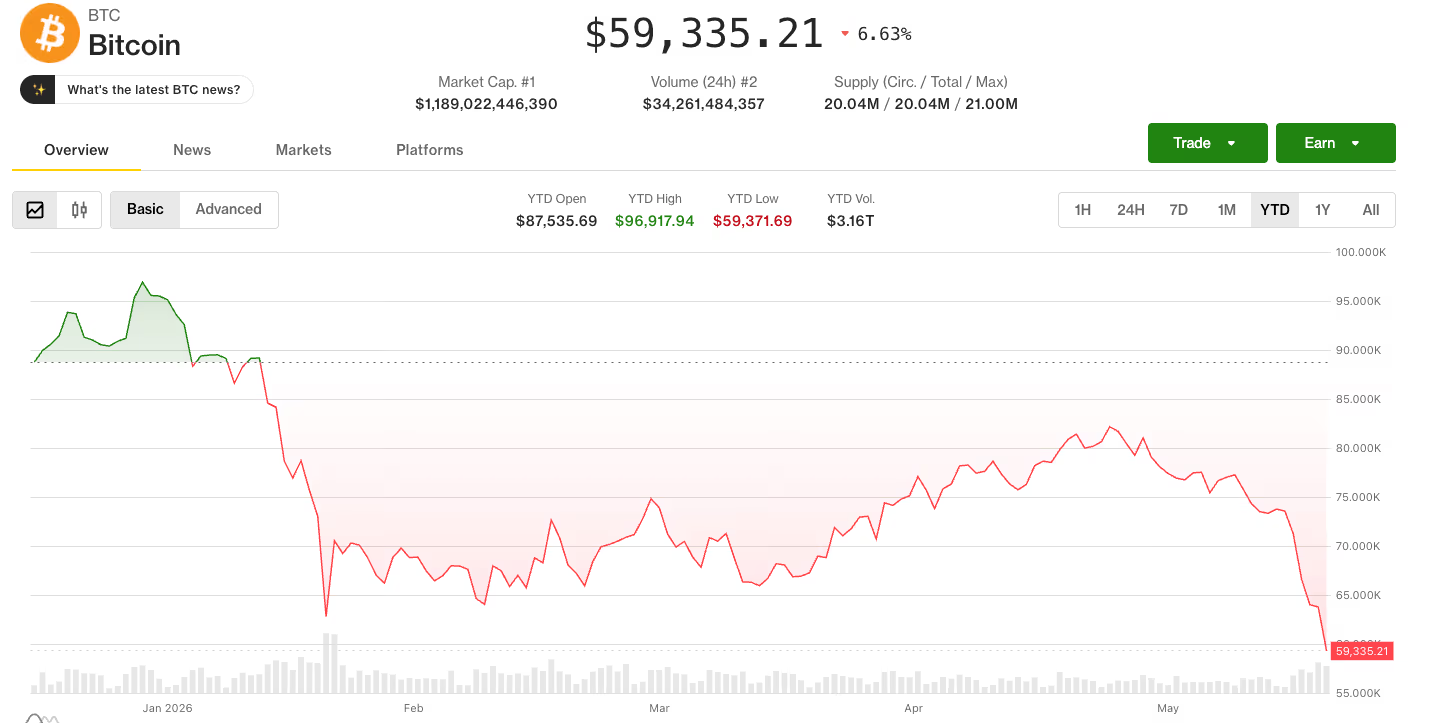
Hardcore bitcoin purists haven’t lost faith in the world’s largest digital currency, despite it losing nearly 17% of its value, marking the worst weekly performance since July 2024 and wiping out about $200 billion in market cap in the last seven days.
The prominent bitcoin advocates or maximalists (short for maxis) — a group that believes bitcoin is the only cryptocurrency likely to achieve lasting global adoption and monetary relevance — argue that capital is being sucked out of crypto and into artificial intelligence, creating what they see as a temporary liquidity crunch rather than a fundamental bitcoin problem.
This narrative comes as the world’s largest cryptocurrency is currently hovering below $60,000, down about 27% over the past month and down by more than 50% from its Oct. 6 all-time high, according to CoinDesk data.

The capital flight coincided with a record-breaking streak for U.S. spot bitcoin ETFs, which suffered $3.45 billion in outflows across 11 consecutive sessions. While crypto bleeds, Wall Street’s tech appetite remains aggressive. Even after the recent pullback, AI-related equities remain among the market’s strongest performers. The Nasdaq rose 34%, and the S&P 500 climbed nearly 24% in the last year, raising anxiety among crypto investors seeking answers about bitcoin’s underperformance.
While some market observers view the drop as a loss of structural confidence, bitcoin maxis argue the slump is merely a reflection of speculative capital rotating heavily into AI.
According to Mati Greenspan, a market analyst, bitcoin maximalist and founder of Quantum Economics, the price of bitcoin is in a downward trend, not because investors have lost faith in it, but because AI has become the dominant destination for speculative capital.
“Bitcoin is not facing a bitcoin problem. It’s facing a liquidity problem,” Greenspan told CoinDesk in an interview Friday. “AI has become the market’s new obsession, but obsessions fade.”
Another prominent bitcoin maxi and subject of recent debate if his bitcoin selling has caused the recent crash, Strategy (MSTR) Chairman Michael Saylor echoed Greenspan’s sentiment on X.
“Capital markets are funding the AI buildout at historic scale: ~$400B over six months,” Saylor said. Bitcoin ETFs have seen ~$4B of outflows since May 14, pressuring BTC. This is a capital rotation, not a bitcoin impairment. Volatility creates opportunity.”
‘The root cause’
Greenspan pointed to the Anthropic $50 billion IPO, targeting a nearly $1 trillion valuation, as the clearest indication of where market liquidity might have gone.
While bitcoin advocates point to the asset’s historical long-term returns, traditional liquidity pools are currently chasing AI infrastructure, data centers, and multi-billion-dollar private capital rounds, Greenspan added.
In fact, the anticipated IPOs of OpenAI, Anthropic and SpaceX, which together could raise more than $200 billion, may be drawing investor attention and capital toward AI and technology opportunities at the expense of other speculative assets, including crypto.
Bitcoin core developer and maximalist Jameson Lopp argued that investor frustration during market downturns often fuels the search for simple explanations. “I suspect the root cause is the bear market, combined with TradFi markets experiencing an AI boom,” Lopp said on X.
However, not everyone is blaming AI as the primary driver behind bitcoin’s weakness.
Market data suggests the pressure on crypto is multifaceted, and critics argue that blaming AI entirely oversimplifies a fragile macroeconomic environment. Jason Fernandes, a bitcoin maxi, market analyst and AdLunam co-founder, told CoinDesk that the asset is facing pressure from multiple fronts.
“BTC is under siege from every angle right now,” Fernandes said. “ETF outflows, high interest rates, creeping inflation, money rotating back into hot tech stocks, macro uncertainty, and now the psychological shock of Michael Saylor’s Strategy selling BTC after years of preaching ‘never sell.’”
Strategy, the largest publicly traded corporate holder of bitcoin, drew heavy criticism on social media after selling 32 bitcoin for $2.5 million in late May—its first sale in four years—to fund dividend payments on STRC, its perpetual preferred stock known as Stretch.
Though critics claimed the move “damaged confidence,” Greenspan, like many other analysts, dismissed the panic. “Selling 32 BTC against a balance sheet of more than 843,000 BTC is not even a rounding error,” Greenspan said.
Time to buy?
Despite the outflows, some of the maxis argue it might be time to dip into the underperforming asset as bitcoin’s longer-term fundamentals remain intact.
Greenspan argued that the recent record-breaking outflows from bitcoin funds are likely part of a rotation back toward monetary assets. He added that bitcoin’s current consolidation phase could serve as an accumulation zone if underlying network fundamentals hold. Despite the price dip, institutional adoption, regulatory frameworks, and discussions around bitcoin as a strategic reserve asset have continued to mature over the last few years.
Meanwhile, other bitcoin advocates, such as Strike CEO Jack Mallers, are bypassing broader market debates and encouraging investors to buy the dip on social media.
However, a rotation back into crypto is not guaranteed to be smooth. Even if bitcoin’s weakness stems partly from capital flowing into AI, Greenspan argues that a reversal may not immediately benefit crypto and might act as a double whammy.
“If AI sentiment cracks, bitcoin could get hit twice: first from liquidity leaving crypto, and then again from a broader risk-off move across markets,” Greenspan said.
“As for what comes next, I would be careful assuming the bottom is already in,” Greenspan noted.
Read more: Bitcoin isn’t crashing because of Saylor, it’s losing the momentum trade
Crypto World
Bitcoin Breaks 200-Week Moving Average for First Time Since 2022 as Jobs Report Reprices Fed Cuts
Bitcoin fell below its 200-week moving average, a long-term trend marker while spot prices dropped below $61,000 for the first time since the 2022 bear market low. The broader selloff has pushed BTC down roughly 17% over seven days and more than 25% from its 30-day range, per CoinGecko data. At the… Read the full story at The Defiant


Tom Schmidt, a general partner at Dragonfly Capital, called Nova Markets "huge scammers" on Thursday, targeting the startup's entire investor cohort in the same post. The accusation came as a quote-tweet of Nova Markets' June 4 fundraise announcement. Dragonfly, which closed a $650 million fourth… Read the full story at The Defiant
TLDR:
- The U.S. added 172,000 jobs in May, nearly doubling forecasts and pushing rate hike odds to 57% in one day.
- Broadcom’s refusal to raise AI targets triggered a 12.6% stock drop, sparking fears of overvalued AI positions.
- SemiAnalysis reported Nvidia’s new chips need half the expected memory, sending SK Hynix and Samsung shares sharply lower.
- SpaceX, Anthropic, and OpenAI listings worth $4–$5 trillion are forcing fund managers to sell holdings to raise cash.
Global financial markets suffered a broad and sharp decline on Friday, erasing approximately $2.5 trillion in a single trading session.
The S&P 500 dropped 1.65%, while the Nasdaq fell 2.60%. Gold, silver, and Bitcoin also recorded steep losses. A combination of stronger-than-expected jobs data, cracks in the artificial intelligence trade, and looming liquidity concerns drove the widespread sell-off across asset classes.
Hot Jobs Report Rattles Rate Cut Expectations
The U.S. economy added 172,000 jobs in May, nearly double Wall Street’s forecast of 88,000. That surprise reading sent shockwaves through markets almost immediately after the open.
With inflation running at 3.8% and oil prices at $90 per barrel, the strong labor data changed the rate outlook sharply.
The probability of a Federal Reserve rate hike this year jumped from 40% to 57% in one session. Higher rates reduce the present value of future earnings, making growth and tech stocks less attractive. Investors responded by rotating out of those positions quickly.
As noted by market analyst account Bull Theory on X, “A labor market this strong tells the Fed it cannot cut interest rates and may actually need to raise them.” That shift in sentiment accelerated selling pressure across equity markets.
Adding to the uncertainty, new Fed Chair Kevin Warsh holds his first policy meeting in 11 days. Appointed under expectations of rate cuts, he now faces hot inflation, elevated oil, and a tight labor market. That uncertainty alone pushed many fund managers toward reducing risk.
AI Trade Cracks Under Pressure From Multiple Fronts
Broadcom reported record quarterly earnings, with revenue up 48% and AI chip sales climbing 143%. Yet the stock fell 12.6% after the company declined to raise its AI revenue targets. That single decision prompted investors to question whether AI valuations had grown too stretched.
Research firm SemiAnalysis then reported that Nvidia’s next-generation AI chips would require roughly half the memory previously priced into analyst models. SK Hynix fell nearly 10% on the news, while Samsung dropped over 6%. South Korea’s broader market declined 5.5% in a single session.
Anthropic also released a report warning that AI systems are approaching the ability to improve themselves without human input. The firm called for a global pause in AI development.
Coming alongside the chip memory news and Broadcom’s miss, it deepened fears about whether business models can sustain the current pace of AI growth.
Meanwhile, a liquidity drain looms over markets. SpaceX is set to go public next week at a $1.75 trillion valuation. Anthropic and OpenAI are also preparing listings.
Together, these three companies represent $4 to $5 trillion in potential capital demand. Fund managers are selling existing holdings to raise cash, adding further pressure to an already stressed market.

Why do we Brits keep saying sorry when it’s not our fault?

VIX Spikes Over 6% as Tech Selloff and Strong Jobs Data Heighten Market Uncertainty
Healthcare Sector Sees Stealth Rally as Institutional Money Flows In



-

 Business4 days ago
Jade Biosciences, Inc. (JBIO) Discusses Positive Interim Results From JADE101 Phase I Healthy Volunteer Study and Development Plans Transcript
-
 Tech6 days ago
SpaceX just won a second Golden Dome contract. This one is $4.16 billion.
-

 Sports3 days ago
French Open 2026 results: Alexander Zverev beats Rafael Jodar and will play Jakub Mensik in semi-finals
-
 NewsBeat7 days ago
FIRST NIGHT REVIEW: Take That bring the Circus back to life in spectacular sun-soaked style
-

 Business6 days ago
Is the Spurs Phenom Already Better Than Prime Diesel?
-

 Tech3 days ago
CryZENx Releases Fresh Playable Content Deep Inside Jabu-Jabu for His Ocarina of Time Remake
-

 Politics7 days ago
The House | Inside Andy Burnham’s Makerfield Campaign: “Nobody Thinks This Is In The Bag”
-
Crypto World12 hours ago
LBank Surpasses 25 Million Users Worldwide as AFA Partnership Continues to Drive Global Growth
-

 Business3 days ago
Trump Taps Housing Chief Bill Pulte as Acting Intelligence Director After Gabbard Exit
-
 Entertainment7 days ago
Weak ‘Supergirl’ Box Office Tracking Amid Milly Alcock Backlash
-
 Entertainment6 days ago
One of the Greatest Sitcoms of All Time Shoots Up Apple TV’s Charts 11 Years Later
-

 Business7 days ago
Demand Conditions Improve In Chemicals Sector In April 2026
-
 Crypto World3 days ago
Seagate (STX) Stock Surges to Record High on AI Boom and Legal Settlement
-
 NewsBeat6 days ago
Everything you need to know as Cambridge’s Strawberry Fair returns after cancelled year
-
 Entertainment7 days ago
Britney Spears Shares Troubling Update After Hard Year
-
Crypto World3 days ago
EU AI Data Center Project Faces Delays as Funding Gaps Grow
-

 Business3 days ago
Aehr Test Systems Stock Soars 17% Amid Surging AI Demand and Conference Spotlight
-
 Business7 days ago
US-led AI investments risk capital destruction: Chris Wood
-
 NewsBeat3 days ago
Republicans balk at Trump’s attempt to appoint a MAGA enforcer to lead National Intelligence
-

 Tech7 days ago
Intel and 3DGS back a $3.3bn glass-substrate plant in India’s Odisha
You must be logged in to post a comment Login