Connect with us
DAPA Banner
DAPA Coin
DAPA
COIN PAYMENT ASSET
PRIVACY · BLOCKDAG · HOMOMORPHIC ENCRYPTION · RUST
ElGamal Encrypted MINE DAPA
🚫 GENESIS SOLD OUT
DAPAPAY COMING

NewsBeat

Locals say plans for thousands more homes ‘like building new town’

Published

on

Cambridgeshire Live

A group of over 30 parish councillors and organisations have grouped together to call on a council to look at its local plan

Locals have urged a council to “pause” its local plan as they fear the thousands of homes planned could lead to overdevelopment. Under Huntingdonshire’s District Council’s Draft Local Plan for 2026, more than 24,000 homes could be built in areas including Huntingdon and St Ives.

Advertisement

Locals including residents and parish councillors said they are concerned at the impact this could have on infrastructure including roads and doctors. As a result, over 30 parish councils and organisations have joined together in the ‘Pause the Plan’ campaign.

It asks HDC to thoroughly assess the impact it could have and to compile more evidence together before the plans are given the go-ahead.

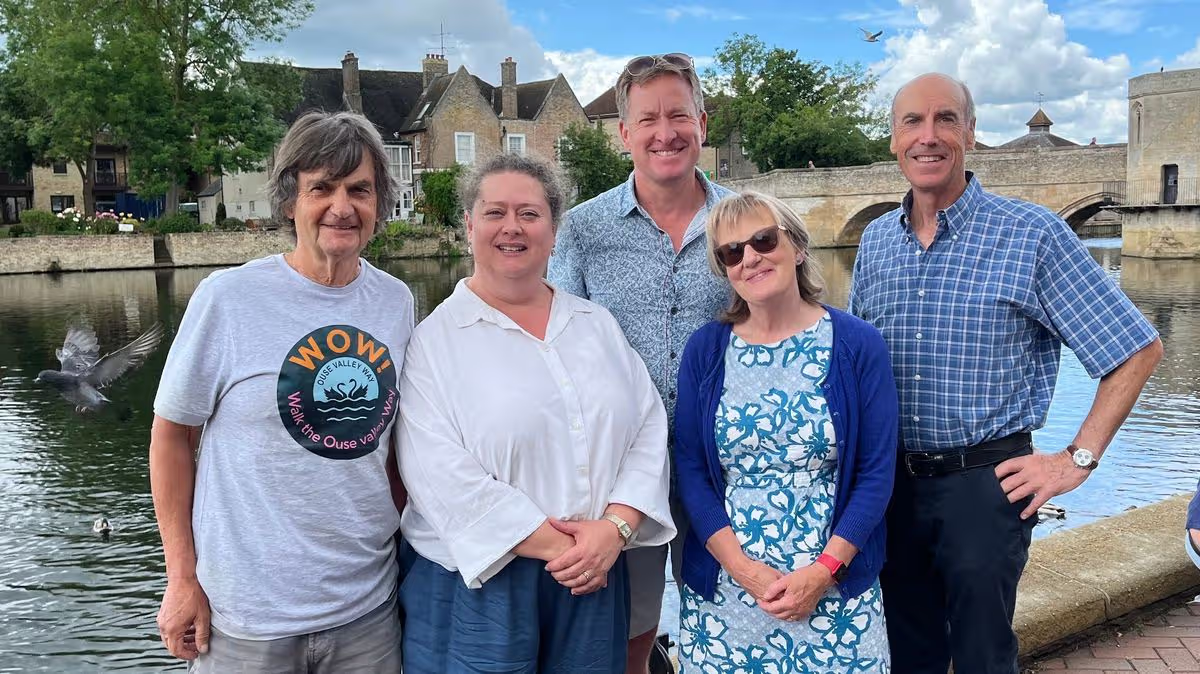
Several concerned parish councillors and a local resident have shared their thoughts on the local plan. Chris Stening, of Ellington Parish Council, said the proposed number of new homes is essentially creating a “new town”.

He said: “When you put in a new town, you get all of the infrastructure considered. But what we’re seeing in this area is lots and lots of relatively small developments. But when you total them, it’s like creating three more St Ives all in this area.”

Advertisement

Chris believes there has been “no consideration” towards the impact it could have on water and road infrastructure. He added: “That’s the real problem with the plan. That’s why we’re asking the local authorities to collect some evidence and fill the gaps to understand what infrastructure requirements are needed and then actually come up with a property community impact assessment.”

Resident Ruth Southworth feels that St Ives could “lose its identity” if the homes are built. Ruth said: “In the local plan, there is no map of the cumulative effect.

“I don’t think they properly thought through the infrastructure. We have issues with flooding, we have issues with water and water supply. To have a development of this size in such a small area means you’ve also got to consider roads.

“Sometimes it can take an hour to just come out of St Ives. We have one river crossing in St Ives and one at Huntingdon. With the floods, that’s even more challenging.”

Advertisement

Like the rest of the group, Ruth would like to see the plan paused. Paul Boothman, chair of Houghton and Wyton Parish Council, said the group is “not against development”.

However, he added: “It’s really important we have it, especially affordable housing. This is an expensive place to live and not affordable. One of the other issues we have it we also need jobs. But, there seems to be an imbalance between the jobs that this will create and the housing numbers of the people that will actually be occupying those houses.

“The risk we’ve got, or the worry we’ve got, is that if we’re not careful in building such a concentrated development in such a small area, we’re gonna end up with housing for people who won’t actually have jobs here.

“There won’t be enough created and people will be commuting. That’s going to lead to even more gridlock and infrastructure issues that we already face, but it’s going to make the situation worse.”

Advertisement

Graham Campbell, from the Great Ouse Valley Trust, is concerned about the environmental impact of the developments. He said: “We live in one of the most attractive and important landscapes. It’s not recognised in the local plan and it’s what gives our whole area identity. That’s very important to us.

“Again, we’re not against development, that’s essential. But, the overall planning and concept [we want the council] to appreciate and reflect the value of this landscape for tourism, but also for local people to enjoy.”

A HDC spokesperson has said the council is currently progressing the local plan. The spokesperson said: “We are progressing the Local Plan in line with current government legislation, which requires submission of the Proposed Submission Plan to the Planning Inspectorate, alongside all public comments, by December 31, 2026.

“An independent Planning Inspector will then undertake a thorough examination of the draft plan and supporting evidence, including public hearings, to consider all representations and recommend any necessary changes.” The council is also aware of the Pause the Plan.

Advertisement

The HDC spokesperson added: “We are aware of the concerns raised by the ‘Pause the Plan’ group and have reflected these in updates to our timetable. The next phase of public consultation will now begin in September 2026, providing additional time to consider the initial outcomes of local government reorganisation proposals and to finalise supporting evidence.

“This includes ongoing work with partners such as the Cambridgeshire and Peterborough Combined Authority on key transport infrastructure, including the A141 and St Ives improvements scheme.

“Starting consultation in September also avoids the main summer holiday period while ensuring we can still meet the national deadline. Failing to do so would require restarting the Local Plan under new legislation, delaying the delivery of an up-to-date plan for Huntingdonshire’s communities.”

Source link

Advertisement
Continue Reading
Click to comment

You must be logged in to post a comment Login

Leave a Reply

NewsBeat

Newscast – Will Henry Nowak’s Murder Change Policing?

Published

on

Newscast - Epstein Files: New Mandelson and Andrew Allegations

Available for over a year

The murder of Henry Nowak has sparked another debate about so-called ‘two-tier policing’, in which people are treated differently by police based on their ethnicity.

We look at whether it actually exists, what police guidance says, and whether the case might lead to changes in how police deal with reports of crime.

Laura is joined by former BBC legal and home affairs correspondent and Labour home affairs advisor Danny Shaw to discuss.

Advertisement

They also unpack JD Vance’s comments blaming Henry’s death on “the mass invasion of migrants”. Downing Street has responded, saying “politics should bring people together”.

You can now listen to Newscast on a smart speaker. If you want to listen, just say “Ask BBC Sounds to play Newscast”. It works on most smart speakers.

You can join our Newscast online community here: https://bbc.in/newscastdiscord

Get in touch with Newscast by emailing newscast@bbc.co.uk or send us a WhatsApp on +44 0330 123 9480.

Advertisement

New episodes released every day. If you’re in the UK, for more News and Current Affairs podcasts from the BBC, listen on BBC Sounds: https://bbc.in/4guXgXd

Newscast brings you daily analysis of the latest political news stories from the BBC. The presenter was Laura Kuenssberg. It was made by Chris Flynn and Maddie Drury. The social producer was Joe Wilkinson. The technical producer was Philip Bull. The assistant editor was China Collins. The senior news editor is Sam Bonham.

Programme Website

Source link

Advertisement
Continue Reading

NewsBeat

Kentucky Gov. Andy Beshear to join Rob Sand at Iowa rally

Published

on

Kentucky Gov. Andy Beshear to join Rob Sand at Iowa rally

DES MOINES, Iowa (AP) — Rob Sand will rally a crowd for the first time as the official Democratic nominee for Iowa governor on Sunday, kicking off a countdown to November with the support of Kentucky Gov. Andy Beshear.

The race for governor between Sand and Republican Zach Lahn stands to be one of the most competitive in the country as Iowans face a state budget deficit, struggling agricultural economy and cancer crisis.

Even as Sand downplays party politics, Democrats are putting faith in him to blaze a trail in the state after struggling electorally in recent cycles.

“We are all in on flipping Iowa,” said Beshear, chair of the Democratic Governors Association and a potential presidential candidate in 2028. “It’s certainly time for a change, and I think the people of Iowa know that Rob Sand will always put them first and lead in a way that lifts families up and doesn’t leave them out.”

Advertisement

Sand, who was unopposed on the primary ballot, learned who his opponent would be after Tuesday’s primary settled an unpredictable five-way Republican contest.

Little known before his bid for governor, Lahn made a splash as a business owner criticizing farm consolidation and tax breaks for corporate giants, a regenerative farmer who subscribes to Robert F. Kennedy’s “Make America Healthy Again” movement and a former political operative who galvanized Iowa’s conservative grassroots.

Iowa has open races for both governor and U.S. senator for the first time since 1968, plus three battleground congressional races. National attention on the state has soared in recent months, drawing President Donald Trump and Vice President JD Vance to Iowa.

Democrats will have an uphill climb with a 200,000-person deficit in statewide voter registration, and they are outnumbered in every House district. Sand, along with Senate candidate Josh Turek, say they can win over independents and Republicans who are frustrated with party politics and a Republican trifecta in Washington and Des Moines that they blame for the state’s challenges.

Advertisement

Turek will face U.S. Rep. Ashley Hinson, who already has portrayed Turek as a liberal puppet for party leader Sen. Chuck Schumer.

Lahn has also rejected Sand’s nonpartisan pitch.

“Rob Sand is not a moderate,” Lahn said in his victory speech Tuesday. “He’s a liberal career politician pretending to be someone he’s not.”

Sand says divided government is a good thing

Sand is vocal about his dislike of partisanship, his distrust of both political parties and his desire for divided government in Iowa. He says he thinks most Iowans feel the same.

Advertisement

Even if Sand is elected governor in November, he will likely have to work with Republican majorities in the state House and Senate, which recently passed bills to restrict the executive’s power that outgoing Republican Gov. Kim Reynolds signed into law.

“I’m not here to tell you that the answer to 10 years of one-party control is to give the other party 10 years of one-party control. I don’t think that’s right,” Sand said Tuesday after casting his primary ballot. “But I do think that it’s time to say enough to the people who have had 10 years of one-party control. It’s time for balanced government in Iowa.”

Neither Sand or Lahn use their party’s traditional blue or red in campaign materials, opting instead for green. They both say they aren’t beholden to their party establishments and that Iowans want a new direction, though Lahn’s Republican Party has held a statehouse trifecta for nearly a decade.

Sand’s campaign has given about $750,000 to the Iowa Democratic Party already this cycle, funding that Republicans call hypocritical for a candidate who claims he is not a party man. The Sand campaign says that sum reflects his investment in a state party-run coordinated campaign that will help him get elected as governor, even as it also supports candidates up and down the ballot.

Advertisement

Beshear brings national support as he considers his own future

As Democrats continue to debate what went wrong in 2024 and the direction of the party, Beshear has offered up his own example as the leader of a red state for lessons on how the party can go forward.

Beshear said he is trying to be a “voice of reason in the chaos” of Trump’s administration and that he is comfortable being listed among the names of Democrats considering a presidential bid in 2028, even as he said he is focused on the critical midterms.

In addition to rallying with Sand, Beshear will also be at a “Beers with Beshear” fundraiser for congressional candidate Sarah Trone Garriott, who wants to unseat Republican Rep. Zach Nunn in the competitive House district that includes Des Moines. Beshear said he will see Turek too.

The Democratic Governors Association, which Beshear chairs, gave the Iowa Democratic Party about $140,000 so far this cycle, according to filing reports.

Advertisement

Source link

Advertisement
Continue Reading

NewsBeat

Brits warned of crucial UK government checklist to avoid disruption to travel plans

Published

on

Daily Record

HM Passport Office has urged applicants to ensure digital passport photographs comply with stringent requirements – or risk applications being delayed

Brits have been warned that simple mistakes with passport photos could delay applications being processed – potentially leaving travellers without the vital documents they need ahead of summer holidays.

Advertisement

His Majesty’s Passport Office has released an official checklist for digital passport photos as the annual rush of renewals picks up pace before the peak holiday season. Officials cautioned that applications can be held back if images fail to meet strict requirements.

In a social media post, HM Passport Office said: “A quick checklist for your digital passport photo: Taken in the last month, plain background, no objects or other people, no red eye or shadows.”

The Government’s passport guidance states: “Your application will be delayed if your photos do not meet the rules.”

This could prove a costly headache for travellers who leave renewals until the last minute before their departure dates, especially families gearing up for summer breaks. Under the rules, digital passport photos must be sharp, in colour and unedited by any computer software.

Advertisement

Applicants are required to face forwards, look directly at the camera and keep a neutral expression with their mouth firmly closed. The guidance also warns against shadows appearing on the face or background, hair falling across the eyes and the wearing of tinted glasses. Photographs must be taken in front of a plain, light-coloured background with no other individuals or objects visible.

Content cannot be displayed without consent

HM Passport Office advises that pictures taken in booths or dedicated shops are more likely to meet requirements than those snapped at home on mobile phones or tablets. Officials have also reminded applicants that digital passport photos must have been taken within the last month – regardless of whether their appearance has changed since their previous passport was issued.

Parents have also been warned about strict regulations surrounding children’s photographs. Children must appear alone in the picture, while babies are not permitted to hold toys or use dummies.

Children under the age of six are not required to look directly at the camera or maintain a neutral expression, while babies under one year old need not have their eyes open. Travellers are also being urged to check their passport expiry dates well ahead of any planned trips, as numerous European nations require passports to have a minimum of three months remaining before expiry on the date of return.

Advertisement

Brits travelling to the EU must also confirm that their passport was issued no more than 10 years prior to the date of entry.

Source link

Continue Reading

NewsBeat

Palestinians in Gaza tent cities suffer from lack of proper toilets

Published

on

Palestinians in Gaza tent cities suffer from lack of proper toilets

Khan Younis, Gaza Strip (AP) — In their bare-bones tent in southern Gaza, Mostafa Shaaban built his family’s makeshift toilet behind a curtain in a corner. He dug a shallow pit in the sandy soil, poured a concrete slab around it, fixed a bottomless bucket over the hole, then topped it off with a battered, plastic toilet seat.

It reeks with a foul odor and buzzes with flies and mosquitoes only a few feet from where they sleep and prepare meals. Every week, Shaaban has to dig the sewage sludge out of the pit. But at least it’s more private than the fetid communal latrines used by hundreds of other people in their sprawling tent camp.

“I did not want the kids and my wife to use any public toilet. It is humiliating,” said the 38-year-old Shaaban, who was driven from his home city of Rafah by Israeli forces two years ago and eventually settled in a tent camp in Khan Younis.

“The situation is revolting,” he said of having the toilet inside the tent, “but at least it has more dignity.”

Advertisement

There is not a single proper toilet across the vast tent cities housing most of Gaza’s 1.7 million Palestinians left homeless by the war. Displaced families have largely been left on their own to dig their own latrines, some shared by extended families.

At communal camp toilets, men, women and children wait in long lines then do their business behind a thin cloth or sheet of metal separating them from the crowd of strangers outside. Women fear walking to the communal toilets at night.

The result is a hygienic nightmare as horrible smells drift among the tightly packed tents and pools of sewage collect from leaking cesspits or from people dumping the contents of their latrines. More than 80% of the sewage pumping stations in Gaza have collapsed under Israel’s bombardment and offensives over the past 2 ½ years, rights groups say.

Advertisement

Some aid groups have carried out projects to improve family toilets, but they have been small scale and supplies are limited. It remains far from certain when reconstruction of Gaza will begin.

The U.S.-backed official overseeing the ceasefire in place since October has blamed Hamas for holding up the process by failing to reach an agreement on disarmament. The ceasefire deal calls for the entry of major construction and repair equipment into Gaza even before disarmament, and so far little has entered.

“It’s the most basic right. Making a toilet is more important than food and water, because you see the insects everywhere, the smell covers everyone,” said Shaaban’s wife, Iman Mansour, who is pregnant with their third child. “We want something clean.”

Building a latrine is not cheap. Shaaban said it took him a long time to set up his toilet because he had to buy the pipe for the latrine hole and the concrete to seal around it. The concrete often crumbles, so he has to buy more when he can afford it.

A porcelain toilet seat runs from 1,700 to 2,000 shekels ($500 to $680), out of reach for most families. In any case, a seat in a tent latrine would simply be set over the hole to provide a more comfortable seat, unable to flush. So people improvise, using chairs or buckets with the bottom knocked out. Or they just squat over the hole.

One vendor working out of a tent in Khan Younis makes metal sheets to fit around a latrine hole that at least are easier to clean, selling them for 100 shekels ($34).

Advertisement

In one of the camps around Khan Younis, Khaled Kollab laboriously cleared the sewage drain and pools of untreated wastewater next to his tent. His tent latrine is a simple squat toilet with no seat, which he said was made of ramshackle supplies because he couldn’t afford anything better. His 3-year-old daughter, Sila, stood nearby, her body covered in lesions.

“You go into this toilet and feel humiliation and shame,” Kollab said.

___

Ezzidin reported from Cairo.

Advertisement

Source link

Advertisement
Continue Reading

NewsBeat

World Cup 2026: Are Portugal a better team without Cristiano Ronaldo?

Published

on

Cristiano Ronaldo

It was the sort of friendly that could easily have slipped from memory.

Played early in the season against Kazakhstan, who had only recently joined Uefa, the fixture took place in front of a sold-out crowd of just 8,000 fans and on a pitch so shabby that the grass had to be painted to improve its appearance.

And yet, that narrow 1-0 win in Chaves in northern Portugal has never really faded away.

That is because 20 August 2003 is the day Cristiano Ronaldo’s story with the senior Portugal national team began.

Advertisement

It would have been a stretch at the time to anticipate the boy from Madeira making his World Cup debut three years later, and entirely unrealistic to predict that he would go on to feature at a record sixth World Cup in 2026 – along with Argentina’s Lionel Messi and Mexico’s Guillermo Ochoa, both fellow six-timers.

But Ronaldo – the all-time leading scorer in international football with 143 goals – has reinvented Portuguese football, transforming its mentality like no player before him and, most importantly, redefining what an entire nation believed was possible.

“We are a small country that rarely has global impact outside football,” Joao Aroso, who worked with the forward both at Sporting and at the national team, told BBC Sport.

“Cristiano allows our small country to be known worldwide for something great – because of all the positive things he stands for.”

Advertisement

In his previous five World Cups, the superstar, now 41, always arrived with an untouchable status. It won’t be different this summer, even if the scrutiny back home around his role has only intensified since Qatar 2022.

For a long time, openly questioning Ronaldo’s place in the team almost felt like treason. Not any more.

“He doesn’t play to win, he plays to be the main figure,” argued Antonio Simoes, a member of the Portugal side that finished third at the 1966 World Cup.

“Do you understand that it’s the opposite of Eusebio? Let’s call things by their name. I have nothing against him. I can still see, I can still hear and I can still think. But I can’t run away from the reality of the facts.”

Advertisement

Portugal coach Roberto Martinez has dismissed the debate around Ronaldo as “lift talk”.

Whenever Martinez is asked questions about the five-time Ballon d’Or winner, he has pointed to the same statistic in all his recent interviews – 25 goals in his past 31 games for the Selecao.

“We are talking about the greatest player of all time. He is here because he is still performing at a very high level, not because of what he achieved in the past,” Martinez explained.

Having scored at each of his five World Cups, Ronaldo will have another chance to answer critics on the pitch.

Advertisement

The Al-Nassr man has eight World Cup goals to his name, one short of Eusebio’s Portuguese record, but the ultimate prize is obvious: helping Portugal lift the trophy for the first time.

Source link

Continue Reading

NewsBeat

What Kevin Keegan’s cancer diagnosis reveals about how we find disease

Published

on

What Kevin Keegan’s cancer diagnosis reveals about how we find disease

When the former England and Newcastle manager Kevin Keegan recently revealed that he had stage 4 cancer, the footballing world responded with an overwhelming show of support. But hidden within his story is a surprising lesson about how cancer is often discovered – not through symptoms, but by chance.

Keegan was in a car crash just weeks before his diagnosis. Studies have found that people who suffer car crash injuries are more likely to be diagnosed with cancer than similar people who haven’t.

Most experts agree that car crash injuries don’t actually cause cancer. So what explains the link?

One possibility is a shared underlying cause. People who drive a lot, simply by spending more time on the road, are more likely to have accidents. They may also lead more sedentary lives, a factor linked to higher cancer rates. Frequent drivers may be more likely to be overweight or to spend long hours in the sun (exposed to harmful UV radiation), both of which raise cancer risk. Sleep deprivation is another candidate: it raises the risk of both crashes and cancer.

Advertisement

To resolve the conundrum, we have to consider how we detect cancer. Typically, we diagnose cancer in people who undergo some type of medical examination – either because their cancer has caused them to feel unwell or for some other reason.

When people are involved in car crashes, they often end up in hospital, where CT scans and MRIs are routinely used to check for internal injuries. In the process, doctors may stumble across a tumour that would otherwise have gone unnoticed. The crash hasn’t made them more likely to have cancer – it has just made them more likely to have it found.

Keegan described it himself: “I was in a car accident and, through that, I had to have an operation. Whilst having the scan for the operation, they found out I had cancer.” People who have been in car crashes are no more likely to have cancer than anyone else – they’re just more likely to have it discovered, because the accident brings them into contact with the medical system.

Car-crash victims aren’t the only ones affected. Anyone who ends up in accident and emergency – for whatever reason – faces the same increased medical scrutiny, and is therefore more likely to have an unrelated cancer picked up in the process.

Advertisement

Detection bias

As I outline in my new book, You Don’t Know What You’re Missing, this is a classic example of a detection bias – the idea that increased monitoring of one situation compared with another can make a phenomenon appear more common than it really is. Take sharks. Despite, on average, 80 attacks and only a handful of deaths worldwide each year, people are disproportionately afraid of them.

In large part, this is probably due to an availability bias. Shark attacks are so graphic and feature so prominently in popular culture – including in films like Jaws, The Reef and The Shallows – that they occupy a disproportionate amount of space in our imaginations. However, in part, this may also be due to the misconception that sharks are attracted to crowded beaches.

Most sharks aren’t really attracted to more crowded beaches.
Vaclav Sebek/Shutterstock.com

While there is evidence that some species of sharks might be attracted by splashing, because it sounds like struggling prey, other species are put off by it. There is no strong evidence to suggest that more people in the water will lead to a higher probability of attracting a shark.

It is true, however, that there are more shark attacks in places where lots of people swim, but this isn’t primarily because sharks are disproportionately attracted to these popular areas. Popular beaches may see more attacks simply because there are more people in the water, not because sharks have a preference for popular beaches.

Advertisement

It’s also true that busy beaches are disproportionately more likely to report shark sightings. But again, this is purely a function of the fact that more people are around to spot their telltale fins poking out of the water – another detection bias.

Indeed, well-frequented beaches are more likely to have lifeguards who may be on the lookout for sharks or even to employ drones to help reassure beach users that it’s safe to go in the water.

Detection bias turns up in all sorts of unexpected places. When policing is increased in an area, you might expect recorded crime to fall. Often it rises – not because the area has become more dangerous, but because more officers means more crimes are spotted and logged. The underlying crime rate may not have changed at all.

The same thing happens in workplaces. Organisations with rigorous safety protocols can appear to have more safety breaches than those without, simply because they’re better at catching and recording them.

Advertisement

And medicine is no different. Many cancers are first spotted incidentally in A&E in patients who have attended for completely unrelated reasons. This doesn’t mean that being ill or injured causes cancer. If anything, there is evidence that people who end up requiring urgent medical care sometimes live longer as a result because conditions like cancer get caught earlier than they otherwise would have.

This article features references to books that have been included for editorial reasons, and may contain links to bookshop.org. If you click on one of the links and go on to buy something from bookshop.org The Conversation UK may earn a commission.

Source link

Advertisement
Continue Reading

NewsBeat

Liam Neeson says Americans always discuss one thing with him when visiting US

Published

on

Belfast Live

Hollywood star Liam Neeson has noticed a pattern when it comes to chatting to American during an appearance on Conan O’Brien’s podcast

Taken star Liam Neeson has revealed that, no matter where he travels in the US, Americans consistently want to share the same piece of information with him as he reflects on his early visits across the pond.

Marking his 74th birthday today, the Ballymena native has become one of Northern Ireland’s most celebrated actors over the decades.

Advertisement

His impressive body of work includes numerous beloved films, including Schindler’s List, Star Wars: Episode I – The Phantom Menace and the action-thriller franchise Taken.

Beyond his achievements on the big screen, Liam recently reflected on his experiences in America during an appearance on the Conan O’Brien Needs A Friend podcast.

Recalling one of his earliest visits to the United States in 1988, he spoke warmly of the welcome he invariably received, saying: “When I came to the States in 1988, I’m an American citizen, a very proud one too, and an Irish citizen.

“But everybody I’d meet wanted to tell me they had a connection with either Ireland or Scotland,” reports Belfast Live.

Advertisement

Finding it amusing how rarely he met someone who simply identified as American, Liam joked: “I was dying for someone to say, I’m an American. Do you know what I mean? They always wanted to make a connection.”

As he tried to understand the strong Irish links across the US, he began to appreciate the historical reasons behind them, explaining: “It made me think, okay, there was a million and a half during the potato famine in Ireland in 1845 and 1852 (who) came out here on coffin boats and coffin ships, you know.

“I was like, oh, of course. 1845, that was a nanosecond ago, you know.”

Advertisement

The Irish famine of the 1840s triggered a mass exodus, with around two million people leaving Ireland, many travelling to America in search of survival.

According to figures released this year, an estimated 31.5 million Americans claim Irish ancestry.

Having captivated audiences around the world throughout his career, Liam returned to the big screen in The Naked Gun last year.

The father of two played Lt. Frank Drebin Jr, while Pamela Anderson also starred in the film, which was directed by Seth MacFarlane, creator of Family Guy.

Advertisement

However, one iconic role fans should not expect him to revisit is Taken, with the actor jokingly telling Stephen Colbert: “There’s only so many times your daughter can be taken.”

Source link

Continue Reading

NewsBeat

Man Utd told to make ‘no brainer’ signing of axed Barcelona star in bargain transfer

Published

on

Daily Mirror

Robert Lewandowski is a man in the market for a new club after his Barcelona contract expired and Manchester United have been urged to go after the Polish striker

Manchester United have been urged to go after Robert Lewandowski after his Barcelona exit with a move described as a “no-brainer”.

Advertisement

The Pole has seen his contract expire at the Nou Camp with the Catalans opting against keeping the striker, who is now 37. Despite that Lewandowski has continued to find the net with regularity and will be an asset to whatever club he ends up at.

Lewandowski is no stranger to playing for major clubs given he has a CV that boasts Borussia Dortmund, Bayern Munich and Barcelona. He scored 120 times in his four seasons in Spain and former United star Gusieppe Rossi believes he would be an ideal addition.

United have Benjamin Sesko as their main man in attack but Rossi sees Lewandowski as the ideal man for him to learn off. The Italian told Ozoon: “Robert Lewandowski to Man Utd? Yeah, why not?

“Of course, Lewandowski would be an incredible asset for the young players, providing his experience and big-game knowledge. With Benjamin Sesko being a young, growing player, having someone like Lewandowski on the team would only benefit him. It’s a no-brainer. He has a huge resume and on a short-term deal, it’s a win-win.”

Advertisement
Content cannot be displayed without consent

United spent big on their frontline last summer, adding Sesko, Bryan Mbeumo and Matheus Cunha. All three players proved to be hits at the club, scoring 34 times between them, as they secured a return to the Champions League, which will aid their recruitment this summer.

Michael Carrick and the club’s priority is on adding a midfielder over the coming months and they’re close to finalising a deal for Ederson from Atalanta. They will still look to add another player in the middle of the pitch if they can identify one and land him for the right price with several Premier League stars linked.

United have seen Rasmus Hojlund join Napoli on a permanent deal after his loan stint in Italy, leaving the club light in attack. Lewandowski would present a cut-price option should they want to bolster their ranks in the final third.

Advertisement

The Red Devils have previously landed an elite veteran striker, signing Edinson Cavani in 2020. The Uruguayan had been prolific at PSG, becoming their all-time top scorer for a period, and moved to Manchester on a free transfer. He scored 17 times in his first year at the club.

Join our new WhatsApp community and receive your daily dose of Mirror Football content. We also treat our community members to special offers, promotions, and adverts from us and our partners. If you don’t like our community, you can check out any time you like. If you’re curious, you can read our Privacy Notice.

Upgrade your World Cup TV setup with the Sky Glass ‘designed for football’

This article contains affiliate links, we will receive a commission on any sales we generate from it. Learn more
Content Image

from £4.50

Sky

Advertisement

Get the deal here

Sky is knocking 20% off its entire range of Glass TVs to mark the start of the 2026 FIFA World Cup. Until June 17, shoppers can upgrade to the Sky smart TV that’s ‘designed for football’ from £4.50 per month when taken alongside a Sky TV and Netflix package.

Source link

Continue Reading

NewsBeat

Sara Cox confirms final BBC Radio 2 Teatime show date

Published

on

Sara Cox confirms final BBC Radio 2 Teatime show date

In April, it was confirmed that Cox would be replacing former Breakfast show host Scott Mills after the BBC fired him.

Cox hosts the weekday Teatime show from 4pm to 7pm and will launch her first Breakfast show this summer.

Currently, the BBC has not confirmed Cox’s start date for the new show.

Advertisement

Sara Cox confirms final date for Radio 2 Teatime show

Speaking to listeners, Cox announced that Monday, June 8, will mark the start of her final week on Teatime.

Sharing, “Monday is the start of Teatime’s final-ever week.

“New Breakfast Show incoming guys. Incoming, brace, brace, brace!

“Next week’s our final week of Teatime with you’s lot.

“I love each and every one of you.”

Advertisement

Adding, “So yeah, final week, bosh, is next week and then the brand-new Sara Cox Breakfast Show will be starting at some point, but I can’t tell you when.”

Previously, Cox said that hosting the Breakfast show was a “dream” following the announcement.

The DJ commented: “There are not enough adjectives to really sum up how I’m feeling about being trusted with such an iconic show but let’s start with ecstatic, honoured and incredibly chuffed.

“It’s been a dream to host the Breakfast Show since I joined Radio 2, and it feels like a bit of a full circle for me.

Advertisement

“I’ve had the most glorious seven years of my career on Teatime so thank you to my brilliant Teatime listeners who hopefully will join me at Breakfast for excellent music and all my usual nonsense plus some superstar guests.

“I honestly can’t wait to wake the nation up with the biggest, most fun breakfast show ever.”

Are you pleased that Sara Cox is the new host for Radio 2’s Breakfast Show? Let us know in the comments below.

Advertisement

Source link

Continue Reading

NewsBeat

1 million turn out for pope’s Mass in Spain and iconic procession along flower-carpeted route

Published

on

1 million turn out for pope's Mass in Spain and iconic procession along flower-carpeted route

MADRID (AP) — More than a million people poured into a central Madrid plaza on Sunday for Pope Leo XIV ’s main Mass and a procession highlighting one of the most iconic expressions of Spanish popular piety: flower carpets.

They cheered and shouted “This is the youth of the pope!” as Leo arrived for the Mass, looping around the plaza and surrounding streets in his popemobile to a crowd packed several rows deep behind barricades.

Sunday’s Mass falls on the Catholic Corpus Domini feast day, which often features processions of faithful through towns and cities led by a priest carrying the Eucharist. In Spain as in other predominantly Catholic countries, the processions often feature elaborate floral carpets arranged along the route.

Leo, who arrived in Spain on Saturday at the start of his weeklong visit, has been keen to highlight the long tradition of Catholic devotion here to encourage especially young generations to find their faith.

Advertisement

At a vigil service Saturday night, an estimated 600,000 young Spaniards knelt for several minutes in silent prayer alongside Leo, suggesting that there is indeed interest among young people despite Spain’s heavily secularized society.

“Let me take the opportunity to tell all of you: Don’t ever be afraid of thinking about a vocation to the priesthood or religious life, or other services in the church!” Leo told the crowd.

Irati Valda and Javier Hormazal, a young couple, held up a cardboard sign announcing they are going to get married on June 13 and were ushered up close to receive Leo’s blessing during the vigil.

“To see so many young people together, it’s incredible. Half a million people in silence, this is something you will only live once,” Valda said.

Advertisement

A form of popular piety dating back centuries

For Sunday’s Mass and procession, local organizers said 1.2 million people had turned out on a brilliant spring morning at the central Plaza Cibeles and surrounding streets, with more trying to get in.

The tradition of laying flower carpets — and destroying them when the procession tramples them — dates back two centuries and is popular also in Latin America, where elaborate sand designs are also made. The painstaking displays are considered an offering to the Eucharist.

Poland has already had its tradition of Corpus Domini flower carpets recognized by UNESCO, and Spain’s Galicia region is trying to have its tradition listed along with other countries as part of the world’s intangible cultural heritage.

According to Spanish organizers, the 16 flower carpets decorating the half-kilometer (mile) procession route were prepared by a Spanish florists association from Galicia. Florists used more than 30,000 flowers, most the yellow and white colors of the Holy See flag, for the carpets that feature decorations such as the Holy See keys.

Advertisement

Wildly popular religious processions, pilgrimages and feasts continue to be held in most Spanish regions. The most recognizable are Holy Week processions during the final week of Lent where brotherhoods and robed penitents parade ornate statues of Christ and the Virgin Mary through cities, towns and villages alongside marching bands. Such processions draw the faithful as well as droves of non-believers and tourists.

Spanish towns and cities also regularly honor local patron saints with fiestas. Religious pilgrimages to local shrines mix piety with communal festivities and music. In Andalusia, the El Rocío pilgrimage fetches a million people that make a long, dusty journey over the Pentecost weekend on horseback and decorated covered wagons to venerate an icon of the Virgin Mary.

Leo arrived in Spain on Saturday and urged its people to put an end to polarization and work for unity. Later Sunday he is to meet privately with members of his Augustinian religious order and address cultural leaders.

___

Advertisement

AP visual journalist Helena Alves contributed.

___

Associated Press religion coverage receives support through the AP’s collaboration with The Conversation US, with funding from Lilly Endowment Inc. The AP is solely responsible for this content.

Advertisement

Source link

Continue Reading

Trending

Copyright © 2025