



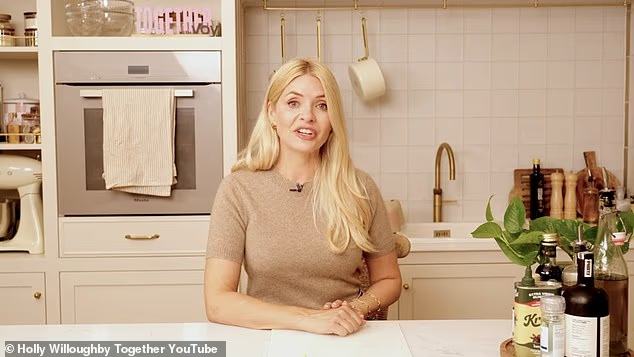
Holly Willoughby’s new YouTube show brought in 41,000 views on its first day – after it was panned by critics and branded ‘dire’.
The former This Morning host, 45, launched her first episode of the show on Tuesday, with desperate attempts at relatability thanks to swearing and unsubtle innuendos with first guest, The Devil Wears Prada star Stanley Tucci, 65.
It failed to impress critics – with a one-star review comparing her show to Meghan Markle‘s attempt to enter the lifestyle realm with her own show last year.
Last March, Meghan launched a Netflix lifestyle series, which was blasted, leading to The Guardian branding Holly’s show ‘a marginally less agonising With Love, Meghan’ while The Telegraph stated: ‘[Holly’s] dire show makes Meghan look good.’
And 24 hours after it was posted to her YouTube channel, it had received 41,000 views.
She now has 11,000 subscribers to the channel.
Holly Willoughby’s new YouTube show brought in 41,000 views on its first day – after it was panned by critics and branded ‘dire’

The star, 45, launched her first episode of the show on Tuesday, with desperate attempts at relatability thanks to swearing and unsubtle innuendos with first guest Stanley Tucci, 65
For context The Rest Is Entertainment launched in November 2023 and currently has 138K subscribers. It currently sits as one of the top three entertainment podcasts in the UK.
Their episode went up on the same day as Holly’s episode with Stanley Tucci. Their episode has accumulated 29,000 views.
On the episode, she joins Stanley in making a pasta dish – which led to The Telegraph’s Anita Singh stating: ‘They are so stuck for conversation that they end up reading out the ingredients list of a Fray Bentos steak and kidney pie.’
After a beer and wine, Stanley kicked off a cookery session by handing Holly a coloured courgette, which led to the star stating: ‘I’ve never seen one like this before’ – in a very unsubtle innuendo, similar to her This Morning slip-ups.
While fans appear to enjoy the show, the reviews have been lacklustre elsewhere, with complaints of shaky camera work and an overlong running time.
A shocking one star review came from The Telegraph, who referenced Meghan’s Netflix show With Love, Meghan.
She writes: ‘Holly Willoughby’s dire YouTube show makes Meghan look good… Not even Stanley Tucci can redeem this 50-minute borefest of awkward small talk, forced swearing and pie tin trivia…
‘Even Meghan’s producers had the good sense to keep changing things up, editing her so she whizzed from rainbow fruit platters to flower arranging to holding guests hostage while potato printing.’
Alongside a three star review, The Mirror complains: ‘The result is a 50 minute show to cook a simple dish which might have worked better as say a tighter 30-40 minute episode in my opinion…
‘And with only one guest to bounce off, a slightly edited down version, or in future having several guests with a connection might make the conversation more entertaining, fast flowing and lively. But it seems to be a deliberately laid back affair.’
The i Paper’s Sarah Carson, meanwhile, stated: ‘Her new YouTube series, ‘Together,’ is a confused attempt to present herself as relatable…
‘The public either wants honest, unfiltered imperfection or glamour and something to aspire to. Willoughby still hasn’t decided which she wants to be. Together is proof that her superpower was always her ability to be professional, not a personality.’
The Times’ Carol Midgley writes: ‘Will it be a success? Well, it looks nice, Holly may take her fanbase with her, and her profile means she will probably be able to entice a good quality of guest…

And 24 hours after it was posted to her YouTube channel, it had only received 41,000 views. She now has 11,000 subscribers to the channel

Last March, Meghan launched a Netflix lifestyle series which was widely panned, leading to The Guardian branding Holly’s show ‘a marginally less agonising With Love, Meghan’
‘Tucci was, as usual, effortlessly charismatic and at ease in front of the camera, and his recipe for spaghetti con zucchine alla Nerano looked very tasty.’
Teasers show upcoming episodes will see Holly joined by best friends Nicole Appleton and Emma Bunton, alongside Katherine Ryan and Joanne McNally.
The Guardian’s Stuart Heritage also gave the show three stars, writing: ‘The former This Morning host has done a Meghan, rebranding herself as a cookery guru with a YouTube show that veers from agonisingly dull courgette slicing to sweary banter.’
Meanwhile, Holly revealed even her own children poked fun at her new show, confessing she was out of her depth when she switched from traditional TV to digital, with her daughter Belle, 15, laughing at her efforts.
Speaking on Sara Cox’s Radio 2 Breakfast Show, Holly gushed: ‘Today is launch day, this is like I’m giving birth today!’ Yet she confessed she found it ‘weird’ that YouTube was her new home.
As Sara asked if her kids were ‘annoyed’ at her for encroaching on a younger digital platform, Holly admitted: ‘My daughter was laughing at me as I was saying ‘subscribe and ding the bell and you’ll get notifications.’
‘She was like, ‘mum, you really don’t know what you’re talking about’, and I’m like, ‘no I don’t but I’m learning!”
While reviewers were left in shock, viewers seemed enamored at her shift from smiley magazine show co-host to an edgier character, writing: ‘Glad to see beautiful Holly back and with her own show a fantastic first episode Holly can’t wait for the next…
‘I really enjoyed you and Stanley together, good to see you back hosting Holly it really suits you. I’ve followed you since This Morning, you’re an amazing host, one thing maybe have a website to put recipes up…
‘Love love love!!! Can’t wait for more. Going to cook tonight. Great show. Loved it and looking forward to more… Lovely to see you back Holly… Ahhh so excited.’
Last week, speaking to The Daily Mail’s Katie Hind, seven months after she revealed the project, Holly revealed she was not worried about reaction to the show.
She said: ‘I know I’m not everyone’s cup of tea. I know that and that’s fine. I don’t want to try to convince people if they don’t want to watch.’
Referring to her stalking ordeal, she added: ‘I don’t fear what people think. I’ve had real fear, I know what that’s like. Your perspective changes after something like that.’




















































You must be logged in to post a comment Login