
Crypto World
Cathie Wood’s ARK Buys $9.67M in Roblox Stock, Dumps PagerDuty


TLDR
- ARK Invest purchased 145,603 Roblox shares worth $9.67 million across three ETFs on February 9, 2026.
- The buy followed Roblox’s strong fourth-quarter results and improved bookings forecast from the gaming company.
- ARK continued selling PagerDuty stock, offloading $1.18 million worth of shares in its fifth consecutive day of reductions.
- The firm added healthcare positions in Recursion Pharmaceuticals and TharImmune while trimming digital ad stocks.
- Total sales included Pinterest and The Trade Desk as ARK shifts focus toward gaming and AI-driven healthcare.
Cathie Wood’s ARK Invest executed major portfolio moves on February 9, 2026. The firm bought 145,603 shares of Roblox worth $9.67 million across three exchange-traded funds.
ARK Innovation ETF, ARK Next Generation Internet ETF, and ARK Fintech Innovation ETF all participated in the purchase. The transaction represents one of ARK’s largest single-stock buys in recent trading sessions.
The Roblox purchase came days after the company released fourth-quarter earnings. The gaming platform posted results that exceeded Wall Street expectations. Management also issued positive guidance for upcoming bookings.
Several analysts have raised their price targets on Roblox stock. They point to increased engagement from users and higher spending patterns. Older demographics are spending more on the platform, which analysts view positively.
Healthcare and AI Investments Grow
ARK expanded its healthcare portfolio with two purchases on February 9. The firm bought 156,272 shares of Recursion Pharmaceuticals for $622,000. The biotech company uses artificial intelligence for drug discovery.
ARK also acquired 54,600 shares of TharImmune valued at $226,000. Both purchases align with Wood’s strategy of backing companies using technology to develop new medicines.
Additional buys included 2,114 shares of Kodiak AI worth $19,343. ARK added 444 shares of Tempus AI for $24,380. The firm also purchased 57,164 shares of Bullish totaling $1.57 million.
ARK Reduces Software and Ad Tech Exposure
ARK sold 147,125 shares of PagerDuty for approximately $1.18 million. The sale marks the fifth straight trading day ARK has reduced this position. Shares were sold through ARK Innovation ETF and ARK Next Generation Internet ETF.
The repeated selling indicates declining conviction in PagerDuty stock. The company provides incident management software for IT departments. ARK has now trimmed its stake substantially over the past week.
Pinterest was another stock ARK reduced. The firm sold 46,800 shares worth roughly $917,000. ARK also cut its Trade Desk position by 24,157 shares for about $653,000.
Both Pinterest and The Trade Desk generate revenue from digital advertising. The sales suggest ARK is moving capital away from ad-dependent business models. The firm appears to be favoring gaming and healthcare technology instead.
ARK sold 497 shares of Qualcomm for $68,257. This represents a minor position adjustment in the semiconductor sector.
Total sales on February 9 reached approximately $2.82 million. Combined with purchases of roughly $12.15 million, ARK increased its net equity exposure. The buying pattern shows Wood is deploying more capital into preferred holdings.
The portfolio changes reflect ARK’s focus on companies with strong growth potential. Roblox leads the buys while PagerDuty continues facing selling pressure. Healthcare and AI stocks received additional investment as digital advertising names were reduced.


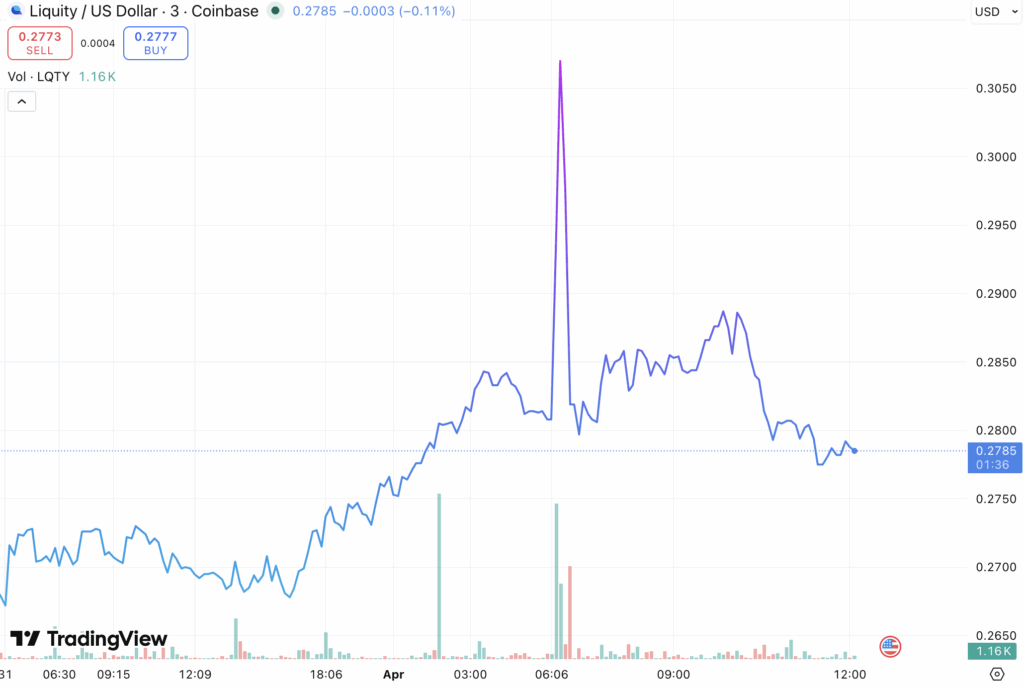
A crypto April Fool’s bit from protocol firm Liquity, which claimed it was being bought by stablecoin giant Circle, has led to allegations of “market manipulation” after it pumped the price of its in-house token.
Liquity announced on April 1 that it was acquired by Circle in a deal that would allow Circle to offer users “a non-freezable stablecoin and directly distribute yield under the Clarity Act.”
The joke pokes fun at Circle’s ability to freeze tokens and the fact that the Clarity Act, in its current form, seeks to ban yield on stablecoins.
Read more: ‘Bad actor’ Circle slammed for letting stolen $3M USDC sit unfrozen
Its freezing powers were ridiculed by the crypto investigator ZachXBT last week, who claimed Circle wrongly froze 16 wallets as part of a civil lawsuit.
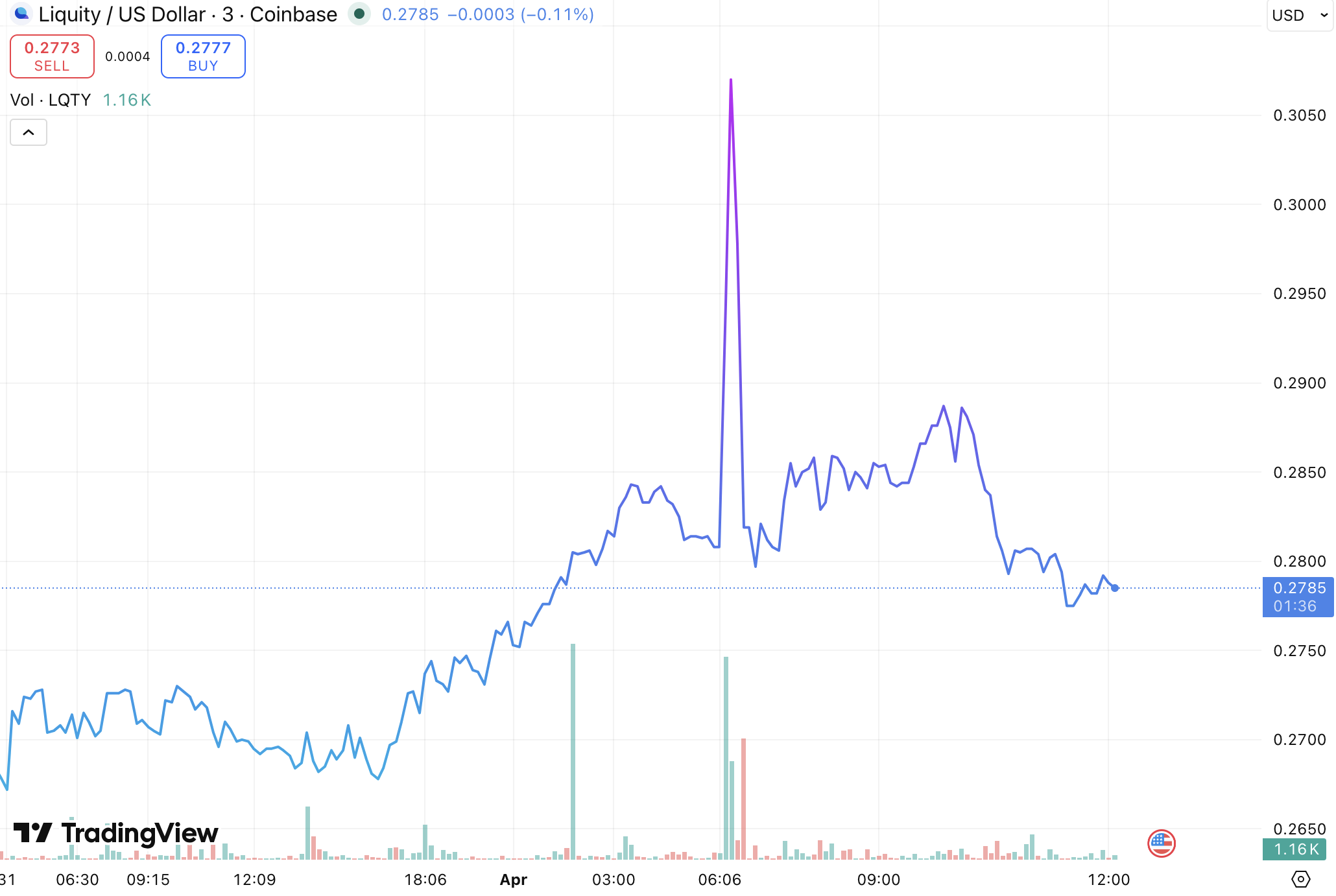
Despite the buyout announcement being a joke on Liquity’s part, it still boosted its $LQTY token by 5%.
The price, however, pulled back in just a few minutes, and is now down 6% from its April 1 peak.
Crypto users on X weren’t too impressed with the joke, describing it as an “April Fool’s pump and dump.”
Read more: WIF fundraiser says Vegas Sphere refunds will start on April Fools
Some said it was an ultra-thin line between a joke and “market manipulation,” while others described the day as an opportunity to “do crime and it’s totally legal!”
Others were more forgiving. DeFi researcher Ignas said that crypto users were losing their minds over a “mere” 5% pump.
They added, “Good taste joke, IMHO. And good project.”
Other users warned not to base your trading on headlines, as on a day like April Fools’, most of them are “facetious.”
Read more: ‘Bad actor’ Circle slammed for letting stolen $3M USDC sit unfrozen
In response to the April Fools’ post, Liquity made it clear that it was just a joke, while also promoting its own stablecoin BOLD.
Additionally, Circle clarified to Protos that the announcement was false, and said “Circle has not acquired Liquity.”
The theme of crypto April Fools’ is phony acquisitions
There were at least two more fake crypto acquisitions announcements today. Crypto wallet firm Frontrun Pro announced that it had been acquired by AI giant Anthropic as part of a $141 million deal.
Crypto copy trading account PolyGun also announced that it had been acquired by Anthropic, this time in a transaction worth $69 million.
Dogecoin also did its own corporate April Fools’ joke, announcing that it would restructure the firm into “DogeCoin Financial Solutions LLC™.”
Read more: Memescope traders have been left with a case of Monday blues
As part of this, it said it would drop its Shiba Inu logo for something navy blue, stop saying words like “wow,” “much,” and “very,” and rebrand its “Doge army” as “Stakeholders.”
Some users thought it would be funny to pretend that memecoin launcher Pump Fun is finally dropping an airdrop in the form of “Pump Fun rewards.”
The platform announced an airdrop would be coming “soon” 266 days ago.
Others joked that Bored Ape Yacht Club had replaced the images of all of its NFTs with photos of actual monkeys and chimps.
Read more: BAYC goes full ‘laser eyes’ and allegedly blinds ApeFest attendees
A bitcoiner called Didi Taihuttu claimed, while wearing his Bitcoin hat and strutting around a luxury villa, that he would be switching back to traditional banks after crypto had become too volatile.
All these examples demonstrate that trading headlines on a day like today is risky business, and that firms with financial assets to their names should be careful about just what kind of April Fools’ they run.
Got a tip? Send us an email securely via Protos Leaks. For more informed news and investigations, follow us on X, Bluesky, and Google News, or subscribe to our YouTube channel.


Artificial intelligence giant OpenAI has closed $122 billion in committed capital at an $852 billion post-money valuation, a round that dwarfs anything raised in private markets and cements the company as the most valuable startup in history by a wide margin.
The funding was anchored by Amazon, Nvidia, and SoftBank, with continued participation from Microsoft. SoftBank co-led alongside a16z, D.E. Shaw Ventures, MGX, TPG, and accounts advised by T. Rowe Price.
The investor list reads like a who’s who of global capital — BlackRock, Blackstone, Fidelity, Sequoia, Temasek, Coatue, and ARK Invest all participated.
For the first time, OpenAI opened participation to individual investors through bank channels, raising over $3 billion from that tranche alone.
OpenAI said it is generating $2 billion in revenue per month, up from $1 billion per quarter at the end of 2024. ChatGPT has more than 900 million weekly active users and over 50 million subscribers. The company claims 6x the monthly web visits and mobile sessions of the next largest AI app, and 4x the total time spent of all other AI apps combined.
Enterprise now makes up more than 40% of revenue and is on track to reach parity with consumer by end of 2026. The company’s APIs process more than 15 billion tokens per minute. Codex, its coding agent, serves over 2 million weekly users, up 5x in three months.
OpenAI also expanded its revolving credit facility to approximately $4.7 billion, supported by JPMorgan Chase, Citi, Goldman Sachs, Morgan Stanley, and others. That facility remains undrawn as of March 31.
The company framed the raise around compute as a strategic moat. Its infrastructure strategy now spans cloud partnerships with Microsoft, Oracle, AWS, CoreWeave, and Google Cloud, silicon through Nvidia, AMD, AWS Trainium, Cerebras, and its own custom chip with Broadcom, and data centers through Oracle, SBE, and SoftBank.
Meanwhile, the company said it is building a “unified AI superapp” that would combine ChatGPT, Codex, browsing, and agentic capabilities into a single product.
The pitch is that as models get more capable, the bottleneck shifts from intelligence to usability, and a single surface lets the company translate model improvements directly into adoption.
The $852 billion valuation places OpenAI above all but a handful of public companies globally. For context, that is roughly the market cap of Berkshire Hathaway, and larger than Visa, JPMorgan Chase, or Samsung.
Crypto World
Non-USD stablecoin senders on Solana nearly tripled year-over-year, led by EURC and BRZ: Dune


Solana’s non-USD stablecoin adoption surged nearly threefold in the past year, driven by EURC and BRZ growth alongside institutional integrations from Visa, Stripe, PayPal, Mastercard, and Western Union.


Key takeaways
- ZCash is one of the worst performers among the top 30 cryptocurrencies by market cap, down 3.5% in the last 24 hours.
- The coin could rally higher in the near term amid demand for privacy-focused cryptocurrencies.
ZEC slips as broader market recovers
ZEC, the native coin of the Zcash ecosystem, is down by 3.5% in the last 24 hours, making it one of the worst performers among the top 30 cryptocurrencies by market cap.
It is trading at $241 per coin, down from the $257 recorded on Tuesday. The bearish performance comes amid a decline in Zcash’s derivatives data.
According to CoinGlass, ZEC’s futures’ Open Interest (OI) reads $438 million, down from the $473 million recorded on Tuesday, reflecting the decreased notional value of open contracts.
Typically, an OI decline during a dip in spot price reaffirms the bearish narrative as traders anticipate further recovery.
Technical outlook: Will Zcash price recover above $250 soon?
The ZEC/USD 4-hour chart is bullish but inefficient as Zcash’s price faced rejection above the $250 psychological level.
It is currently trading below its 50-day EMA of $248c, suggesting that the bulls failed to take advantage of the recent rally.
Despite that, the near-term bias is cautiously bullish as ZEC holds above the recent lows, while remaining capped beneath the long-standing descending resistance line.
If the bulls regain control and ZEC’s daily candle closes above $250, it would confirm the upside breakout and open the path toward the 200-day EMA at $274, followed by the 23.6% Fibonacci retracement level at $362.
The Moving Average Convergence Divergence (MACD) line has turned higher above the signal line and moved back into positive territory on the 4-hour chart, suggesting strengthening upside pressure.

The Relative Strength Index (RSI) at 61 reinforces the recovery of bullish momentum without signaling overbought conditions.
On the downside, if the rejection candle holds, ZEC could drop towards the 38.2% Fibonacci retracement level at $231, followed by the rising trendline near the $200 psychological support level.
Bitcoin’s reputation has historically been built on extreme boom-and-bust cycles, with steep drawdowns of up to 90% following all-time highs.
This cycle, however, the decline has been closer to 50%, a shift that analysts said reflects the maturation of BTC as an asset class.
“Bitcoin’s drawdowns compressing to about 50% is a sign of a maturing market structure,” AdLunam co-founder and market analyst Jason Fernandes told CoinDesk.
“As liquidity deepens and institutional participation increases, volatility naturally compresses on both the upside and the downside,” he added, saying that “at that point, the narrative shifts from questioning its legitimacy to optimizing allocation.”
Fernandes’ comments are in response to Fidelity Digital Assets analyst Zack Wainwright’s X post Tuesday, in which he noted growth is becoming “less impulsive,” with a reduced probability of extreme downside events as bitcoin matures.
‘Less dramatic’
Wainwright pointed out that the current drawdown from the Oct. 6 all-time-high of just over $126,200 is much less significant than previous pullbacks.
“Each cycle has been less dramatic to the upside than the previous and downside risk has also been less dramatic,” he said.
Fernandes and Wainwright, of course, were referring to previous “bust” periods, most notably following the peaks of 2013 and 2017.
After reaching a high of approximately $1,163 in late 2013, bitcoin entered a prolonged “crypto winter” that saw its price plummet to around $152 by January 2015, representing a drawdown of roughly 87%. A similar pattern was seen after the 2017 bull run, when it reached $20,000 in December before plummeting roughly 84% to $3,122 over the following 12 months.
Not all analysts agree that deeper drawdowns are off the table.
Bloomberg Intelligence’s Mike McGlone told CoinDesk that he believes bitcoin could still see a “normal reversion” toward $10,000, arguing that “the crypto bubble is over” and that any downturn could coincide with broader declines across equities, commodities and other risk assets.
However, Fernandes, who has previously dissented with McGlone’s $10,000 forecast, said that scale itself is part of the story. As bitcoin grows into a larger asset class, the likelihood of 90% collapses diminishes simply because the capital required to drive such moves is too great. That effect is reinforced by institutional integration, from ETFs to pension exposure, which makes large-scale unwinds structurally harder.
Portfolio ‘efficiency’ enhancer
The shift is already showing up in portfolio construction.
“The portfolio data is really what shifts institutional behavior,” Fernandes said. “If a small 1% to 3% allocation can materially improve returns and Sharpe ratios without significantly increasing drawdowns, then bitcoin starts to function less like a standalone bet and more like an efficiency enhancer within a diversified portfolio.”
That framing changes the risk calculus. “The risk isn’t about owning bitcoin anymore,” Fernandes stated. “It’s the opportunity cost of having no exposure at all.”
Recent Fidelity research supports that transition. In a 10-year comparison across major asset classes, bitcoin delivered roughly 20,000% returns, significantly outperforming equities, gold, and bonds, while also leading on risk-adjusted measures despite its volatility.
“Bitcoin remains a relatively young asset, yet it has quickly matured into a major asset class and has been the top-performing asset in 11 out of the past 15 years,” the report noted.
At the same time, the tradeoff is becoming clearer.
“There’s a tradeoff here that’s worth articulating,” Fernandes said. “As bitcoin matures and volatility compresses, you should also expect returns to normalize. The asymmetric upside of the early cycles came with extreme drawdowns, but as those drawdowns shrink, the asset increasingly behaves like a macro allocation rather than a venture-style bet.”
That brings it back to the drawdowns.
If bitcoin is no longer falling 80%, and portfolios can benefit from small allocations without materially increasing risk, then the asset is evolving into something more investible and usable, Fernandes said, concluding that for institutions, that may be the real inflection point.
Crypto World
Fed Governor Miran still backs cuts, says interest rates could be ‘about a point’ lower this year
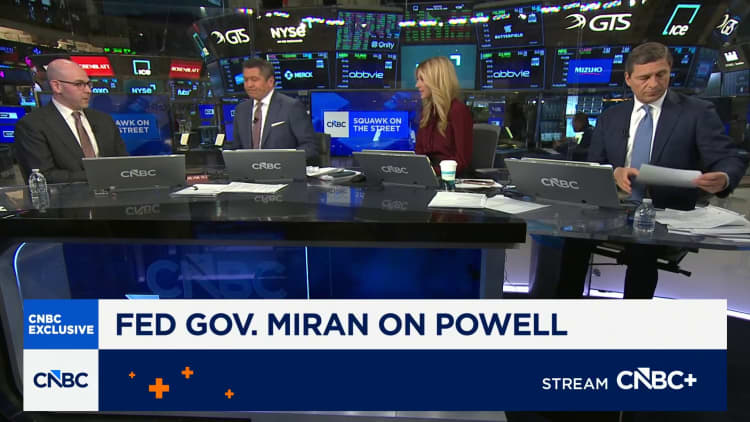

Federal Reserve Governor Stephen Miran on Monday continued his campaign for lower interest rates, telling CNBC that policymakers should disregard the current energy price spike unless there are signs it will have longer-lasting impacts.
“If I saw a wage-price spiral, or I saw evidence that inflation expectations are starting to pick up, then I would get worried about it,” he said during a “Squawk on the Street” interview. “There’s no evidence of it thus far, and you can move the monetary policy rate all you want — today tomorrow — but it’s not going to affect inflation the next couple of months.”
Citing market-based indicators, Miran said inflation expectations remain well anchored, despite the jump in oil to more than $100 a barrel and a price shock at the pump that has pushed gasoline higher by more than $1 a gallon.

Monetary policy works with a lag and isn’t geared toward short-term market gyrations, he added.
Miran has dissented at each of the meetings he has attended since September 2025. He told CNBC that he continues to think “we could be about a point easier, gradually done over the course of a year.”
The fed funds rate is currently targeted in a range between 3.5%-3.75%. Market pricing is implying no moves in either direction before the end of the year.
Miran’s term has expired, but he continues to serve as the nomination of former Federal Reserve Governor Kevin Warsh is held up in the Senate Banking Committee. If confirmed, Warsh will take over as chair for Jerome Powell when the latter’s term expires in May.

A new generation of investors is drawing crypto deeper into mainstream portfolios, even as it grapples with the asset class’s well-known volatility. Gen Z’s appetite for risk and its digital-native approach to money are shaping both the demand for cryptocurrencies and the conversation around how to manage that risk within a diversified portfolio. Findings from survey data and market commentary point to a multi-faceted dynamic: strong interest in crypto, tempered by an awareness of risk and a heavy influence from social platforms and online narratives.
According to Betterment’s 2025 Retail Survey, 64% of Gen Z and 49% of millennials say they are willing to take on more investment risk. This willingness to push the envelope aligns with a broader tilt toward crypto among younger cohorts. Separately, YouGov’s 2025 US Investment Trends report highlights that nearly two-thirds of Gen Z plan to invest in cryptocurrencies like Bitcoin this year, underscoring crypto’s rising status as a core consideration for younger investors. The combination of greater risk tolerance and a crypto-forward mindset suggests a structural shift in how Gen Z approaches wealth-building, beyond mere speculation.
That said, the Gen Z approach is not blind to risk. Crypto volatility remains a central concern for many, and the generation is keenly aware that price swings occur around the clock. Investopedia notes that while crypto is widely recognized as risky and volatile, many Gen Z investors continue to participate, viewing volatility as part of an entry price rather than a barrier to participation. In other words, recognition of risk does not appear to suppress the impulse to participate; it may even be embedded in the way they frame potential returns.
Key takeaways
- 64% of Gen Z and 49% of millennials are willing to take on more investment risk, according to Betterment’s 2025 Retail Survey.
- YouGov’s 2025 US Investment Trends report finds that nearly two-thirds of Gen Z intend to invest in cryptocurrencies this year.
- 84% of Gen Z acknowledge that cryptocurrencies are risky and volatile, yet they continue to invest, signaling a structural willingness to tolerate risk for potentially outsized gains.
- Financial FOMO drives behavior: about 70% of Gen Z report feeling financial FOMO while scrolling social media, and roughly half have made an investment influenced by that feeling, often in crypto or memecoins.
- For many young investors, crypto remains a digital-native asset class with appeal tied to high-growth narratives, but concerns about transparency and regulation persist as the market evolves.
Gen Z’s risk calculus in a digital era
Crypto’s appeal to Gen Z appears inseparable from the broader online ecosystem that shapes their financial world. Gen Z has grown up with the internet, digital wallets, and instant access to markets, which makes digital assets feel native rather than futuristic. The survey data illustrate a generation that is comfortable testing new assets, even as it calibrates its risk exposure to reflect a volatile, 24/7 market environment. The correlation between online influence and investment behavior becomes especially salient when considering how financial guidance is consumed. A notable share of younger investors turns to social platforms for insights, which elevates the importance of evaluating the quality and accountability of information accessed through these channels.
One dimension often cited in this context is how young investors source financial advice. Kiplinger’s coverage notes that about one in four Gen Z Americans obtain financial guidance from TikTok, a statistic that signals the growing role of “finfluencers” in shaping investment decisions. That dynamic, combined with the rapid dissemination of memes and viral narratives, helps explain why certain crypto stories gain outsized attention—even when the underlying fundamentals are murkier than traditional investment vehicles. In this environment, investors must balance curiosity with due diligence and a clear understanding of risk rewards.
Volatility, FOMO and the memecoin cycle
Volatility remains the price of admission for crypto, and Gen Z is not naïve about it. The generation’s understanding of risk reflects a paradox: while they recognize the inherent instability of digital assets, they are drawn by the prospect of outsized profits in a relatively new asset class. The tension between risk awareness and aspirational returns is compounded by social dynamics. Empower’s research on financial FOMO shows that 70% of Gen Z feel this pressure while scrolling social media, and a CFA Institute study cited in the broader discussion indicates that about 50% of Gen Z investors say they have made an investment driven by FOMO, often in crypto or memecoins. In other words, fear of missing out is translating into real capital allocation decisions, particularly toward assets that can deliver rapid visibility and engagement on social platforms.
The memecoin phenomenon sits at the intersection of virality, community hype, and speculative appetite. These tokens are designed to capture attention and momentum, delivering quick, event-driven price action that can attract new participants while amplifying the narrative around crypto’s potential. While this dynamic can drive activity and liquidity, it also raises questions about sustainability, risk management, and the long-term viability of such assets in a diversified portfolio. The cycle—rapid gains followed by swift corrections—has repeatedly underscored the risks associated with chasing headlines rather than fundamentals. As a result, even as crypto admissions rise among younger cohorts, memecoins can reinforce a broader skepticism about the safety and reliability of digital assets as a standalone investment thesis.
Beyond the hype, the behavioral profile of Gen Z investors highlights a broader diversification conversation. Some observers point to crypto as a potential portfolio diversifier, particularly as parts of the traditional market landscape exhibit different risk and return drivers. Yet the same conversations underscore real caveats: during periods of systemic stress, crypto has shown correlations with high-growth equities and even, at times, with traditional safe-haven narratives like gold. That raises practical questions for portfolio construction: if crypto participates in downside markets or moves in tandem with riskier equities, its diversification benefits may be more nuanced than initially assumed. For any investor, understanding when crypto serves as a genuine diversifier versus when it behaves as a high-beta, risk-on asset is essential to avoid overexposure or misaligned expectations.
Another critical theme is the lack of universal transparency and a clear regulatory framework across crypto markets. As a technology- and asset-class experiment in real-time, digital assets have not always benefited from the disclosures and governance that accompany traditional securities. MDPI’s analysis of cognitive biases, including the Dunning-Kruger effect, suggests that younger investors may overestimate their understanding of crypto and underestimate the risks, underscoring the need for robust education and clear regulatory guardrails. In the absence of consistent reporting standards and enforcement, the allure of quick profits can eclipse prudent risk assessment, increasing the likelihood of regrettable losses for inexperienced participants.
Regulation, transparency and the road ahead
While Gen Z’s crypto engagement signals a maturation of digital assets within the retail space, observers agree that regulatory clarity and improved transparency are critical for sustaining long-term participation. The tension between a rapidly evolving technology stack and the slower, more deliberate pace of policy development creates a dynamic where innovation can outpace guardrails, at least in the near term. As policymakers and industry participants negotiate better disclosure, custody standards, and product-level protections, the trajectory of Gen Z’s crypto involvement will hinge on how effectively those guardrails translate into real-world investor protections without stifling innovation.
Some researchers and market observers frame this moment as a test of crypto’s legitimacy as an investable asset class for a new generation. If regulators deliver calibrated, investor-centric rules and platforms improve transparency, crypto could expand from being a niche interest to a more mainstream, risk-aware component of diversified portfolios. Conversely, persistent gaps in transparency or regulatory uncertainty could amplify the very volatility and hype-driven dynamics that have driven memecoin cycles, potentially eroding trust among young buyers who expect clarity and accountability from market participants.
Related coverage in the broader crypto media ecosystem has noted regulators’ concerns about finfluencers and the need for responsible information dissemination, particularly as Gen Z ownership grows. For readers tracking the evolution of this space, pay attention to shifts in regulatory posture, custody and exchange standards, and how platforms adapt to the dual pressures of innovation and investor protection. As the market evolves, the balance between opportunity and risk will likely redefine crypto’s role in Gen Z portfolios.
Investors should watch how education, transparency, and policy alignment impact Generation Z’s crypto participation. The coming months may reveal whether this generation’s early-adopter behavior becomes a durable, risk-aware investment habit or whether volatility and information gaps pull the brakes on broader adoption.
Alex Tsepaev, chief strategy officer at B2PRIME Group, offers this perspective: crypto’s journey into mainstream investing is less about a single narrative of boom-and-bust and more about how a new generation learns to navigate risk, trust, and accountability in a rapidly changing financial landscape.
This opinion piece reflects the author’s view and is not an endorsement of any specific asset. Readers should conduct their own research and consider regulatory developments, platform protections, and risk management practices before making investment decisions.


Cameron and Tyler Winklevoss lent their own crypto exchange, Gemini, thousands of bitcoin (BTC) and ether (ETH) through Winklevoss Capital Fund (WCF), their private investment company. Gemini then pledged that crypto as collateral with Galaxy Digital and NYDIG to raise dollar loans.
When the exchange went public in September 2025 at $28 per share, it converted $695.6 million of WCF debt into super-voting Class B stock at a 20% discount, giving the twins 94.7% of Gemini’s voting power.
Gemini’s 10-K, filed yesterday, spelled out the entire structure. Social media users have called it a circular scheme.
The Winklevoss Capital Fund lending carousel
Here’s the basic tale of how the money flowed. The Winklevii’s WCF lent BTC and ETH to Gemini through open-term agreements, i.e. with no fixed maturity.
Gemini then posted that borrowed crypto as collateral with third-party lenders. Galaxy Digital extended $116.5 million in loans at 11-12% interest rates, collateralized at 145-155%. NYDIG provided $75 million through a repurchase agreement at 8.5%.
Gemini used the dollars for operations and regulatory capital requirements.
When the IPO closed on September 15, 2025, the exchange repaid Galaxy’s $116.5 million from $456 million in net proceeds from the IPO.
Gemini now trades on the Nasdaq under symbol GEMI.
The exchange also repaid $238.5 million under a warehouse credit facility with Ripple, though $154 million remained outstanding to Ripple at year end.
The twins’ own debt didn’t get cash repayment, however.
Gemini converted $200 million in WCF convertible notes and $475 million in WCF term loans, plus accrued interest, into 31.1 million supervoting Class B shares at $22.40 apiece.
That conversion price was 20% below what retail investors paid for otherwise equivalent Class A shares on the same day.
Class A and B stock differ only in their voting power and ownership distribution. Otherwise, they have the same par value, rights to dividends, and liquidation preference.
Class B shares are convertible into Class A on a one‑for‑one basis.
Retail paid $28 with the Winklevii at $22.40
The discount is where the circularity inflicted pain on regular shareholders.
WCF lent Gemini crypto. Gemini then pledged the crypto that it had borrowed to get even more loans. Specifically, Galaxy and NYDIG lent Gemini dollars which it used to operate.
Gemini then handed WCF equity at a discount funded by the same IPO that brought retail in 20% higher.
Read more: Sources say Winklevoss twins withdrew $280M from Genesis before it collapsed
The SEC Form 10-K confirms that Gemini still owed WCF 4,619 BTC as of December 31, 2025. That balance was worth roughly $400 million.
Gemini paid WCF $24.2 million in loan fees in 2025.
In summary, Gemini is simultaneously debtor, custodian, and a “controlled company” according to Nasdaq corporate governance standards.
Despite being publicly traded, Gemini’s co-founders still control a majority of its voting power.
Moreover, WCF holds roughly 8,757 BTC in Gemini Custody addresses, according to Arkham Intelligence data cited by crypto researcher Emmett Gallic.
Deloitte signed off clean
Deloitte has issued clean audit reports on Gemini. This is despite the reality that WCF could demand repayment of its 4,619 BTC loan at any time.
The twins could destabilize the exchange they control with a single written notice.
Gemini’s public stock now trades 88% below its IPO price. “Gemini Space Station,” its legal and rocket-based name that it certainly has not lived up to, opened at $37.01 per share on its IPO day.
It’s worth $4.42 today.
Gemini priced its IPO at $28 on September 11, 2025. It opened at $37.01 the next day and hit $45.89 before beginning a relentless decline. The stock closed at $4.42 on March 31, 2026, down 88% from the opening price, after touching a 52-week low of $3.91 this Monday.
The company’s market cap has collapsed from over $3.8 billion to roughly $520 million. Citigroup, Cantor, Truist, and Evercore downgraded the stock to a Sell rating.
A class action lawsuit alleges the company misled investors about its strategy.
Got a tip? Send us an email securely via Protos Leaks. For more informed news, follow us on X, Bluesky, and Google News, or subscribe to our YouTube channel.
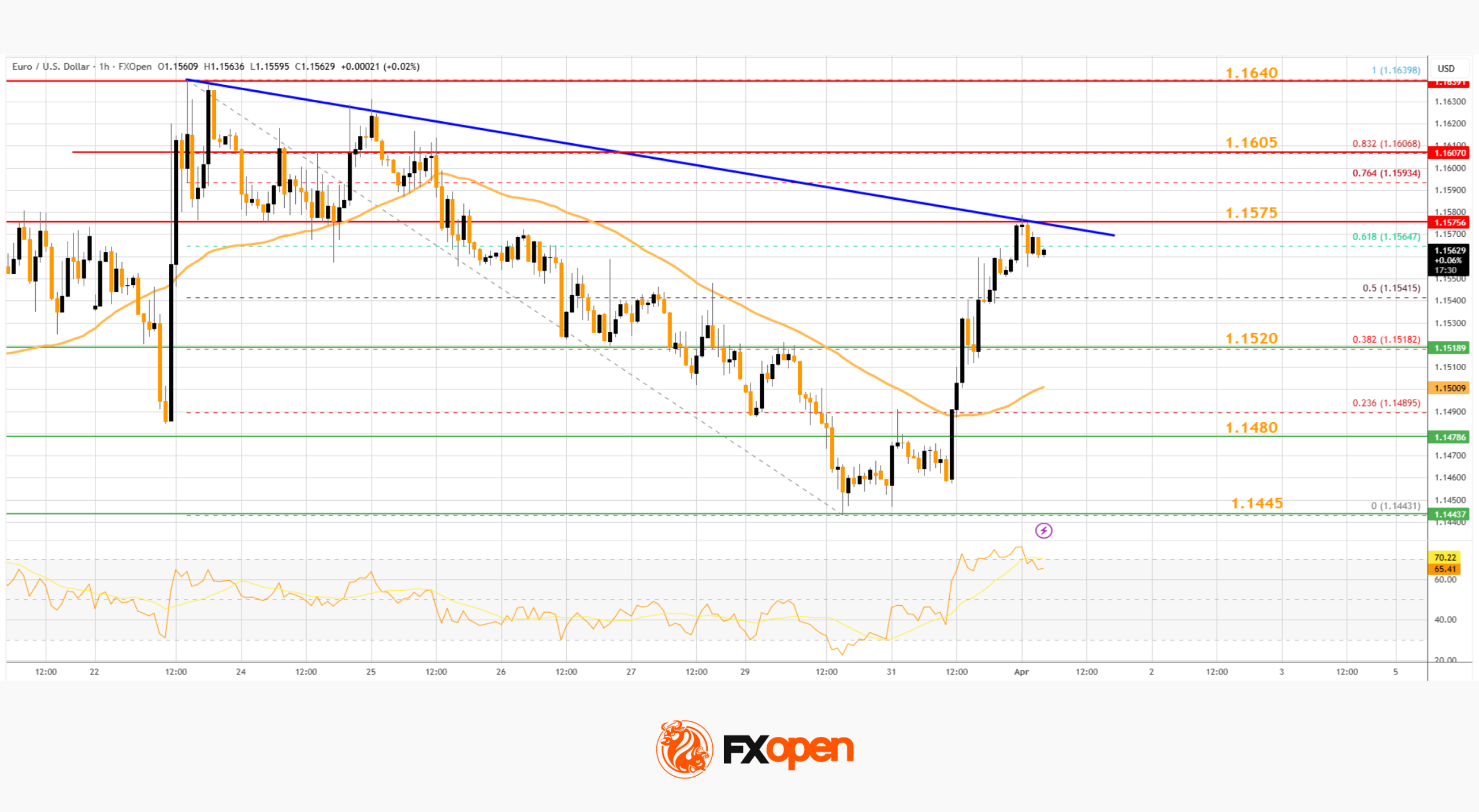
EUR/USD is recovering losses from 1.1450. USD/JPY is correcting gains from 160.50 and might decline further below 158.00.
Important Takeaways for EUR/USD and USD/JPY Analysis Today
· The Euro struggled to stay in a positive zone and declined below 1.1600 before finding support.
· There is a key bearish trend line forming with resistance at 1.1575 on the hourly chart of EUR/USD at FXOpen.
· USD/JPY rallied significantly before the bears appeared near 160.45.
· There is a major bearish trend line forming with resistance near 159.20 on the hourly chart at FXOpen.
EUR/USD Technical Analysis
On the hourly chart of EUR/USD at FXOpen, the pair started a fresh decline from 1.1640. The Euro declined below 1.1600 and 1.1520 against the US Dollar.
The pair even declined below 1.1500 and the 50-hour simple moving average. Finally, it tested the 1.1445 zone. A low was formed at 1.1443, and the pair is now recovering losses. There was a move above 1.1500 and the 50-hour simple moving average.
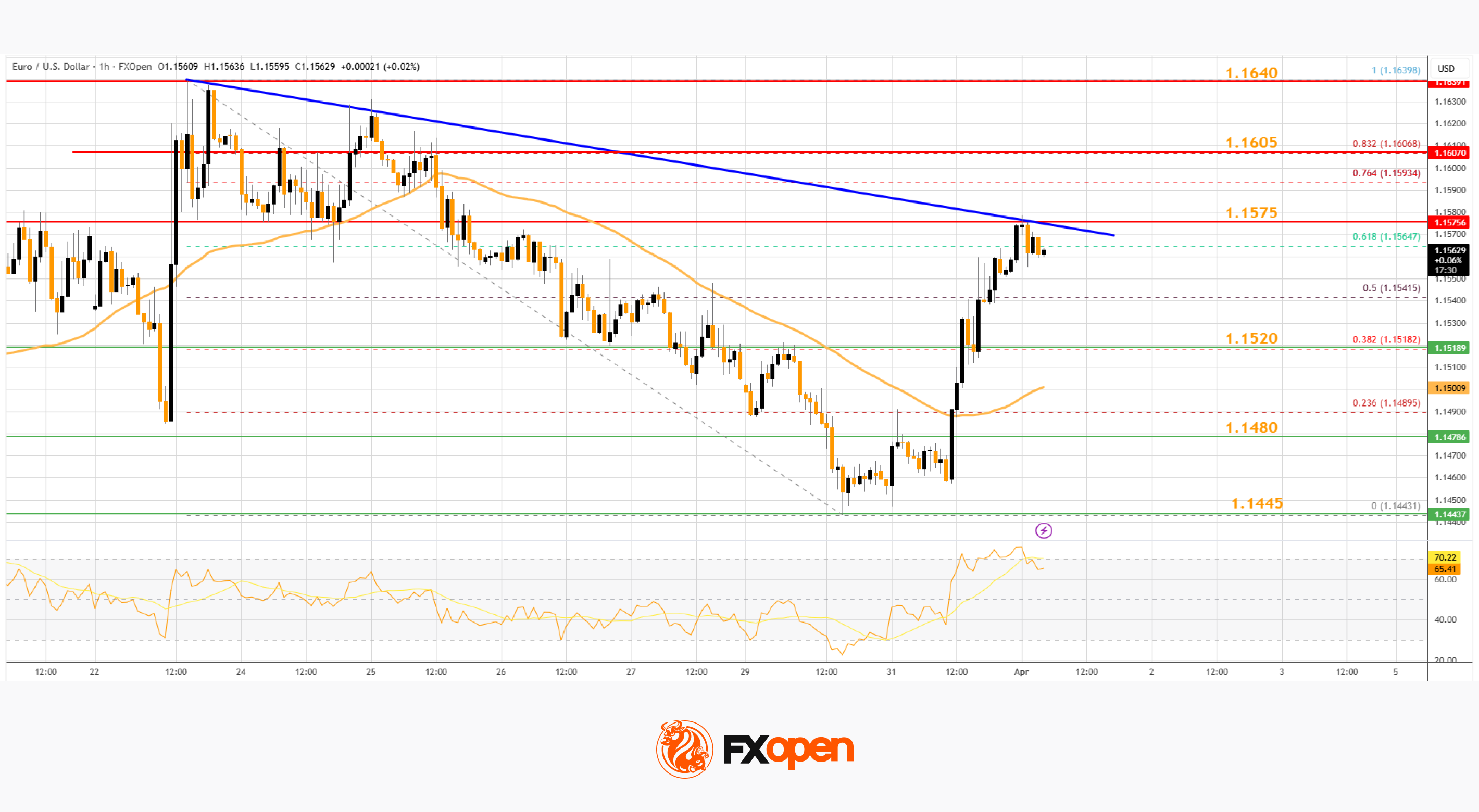
The pair surpassed the 50% Fib retracement level of the downward move from the 1.1639 swing high to the 1.1443 low. On the upside, the pair is now facing resistance near the 61.8% Fib retracement and 1.1575. There is also a key bearish trend line forming with resistance at 1.1575.
The first major hurdle for the bulls could be 1.1605. An upside break above 1.1605 could set the pace for another increase. In the stated case, the pair might rise toward 1.1640.
If not, the pair might drop again. Immediate support is near 1.1520. The next key area of interest might be 1.1480 or the 50-hour simple moving average. If there is a downside break below 1.1480, the pair could drop toward 1.1445. The main target for the bears on the EUR/USD chart could be 1.1400, below which the pair could start a major decline.
USD/JPY Technical Analysis
On the hourly chart of USD/JPY at FXOpen, the pair started a steady decline from well above the 160.00 zone. The US Dollar gained bearish momentum below 159.50 against the Japanese Yen.
The pair even settled below 159.00 and the 50-hour simple moving average. A low was formed at 158.44, and the pair is now consolidating losses. On the downside, the first major support is near 158.45.
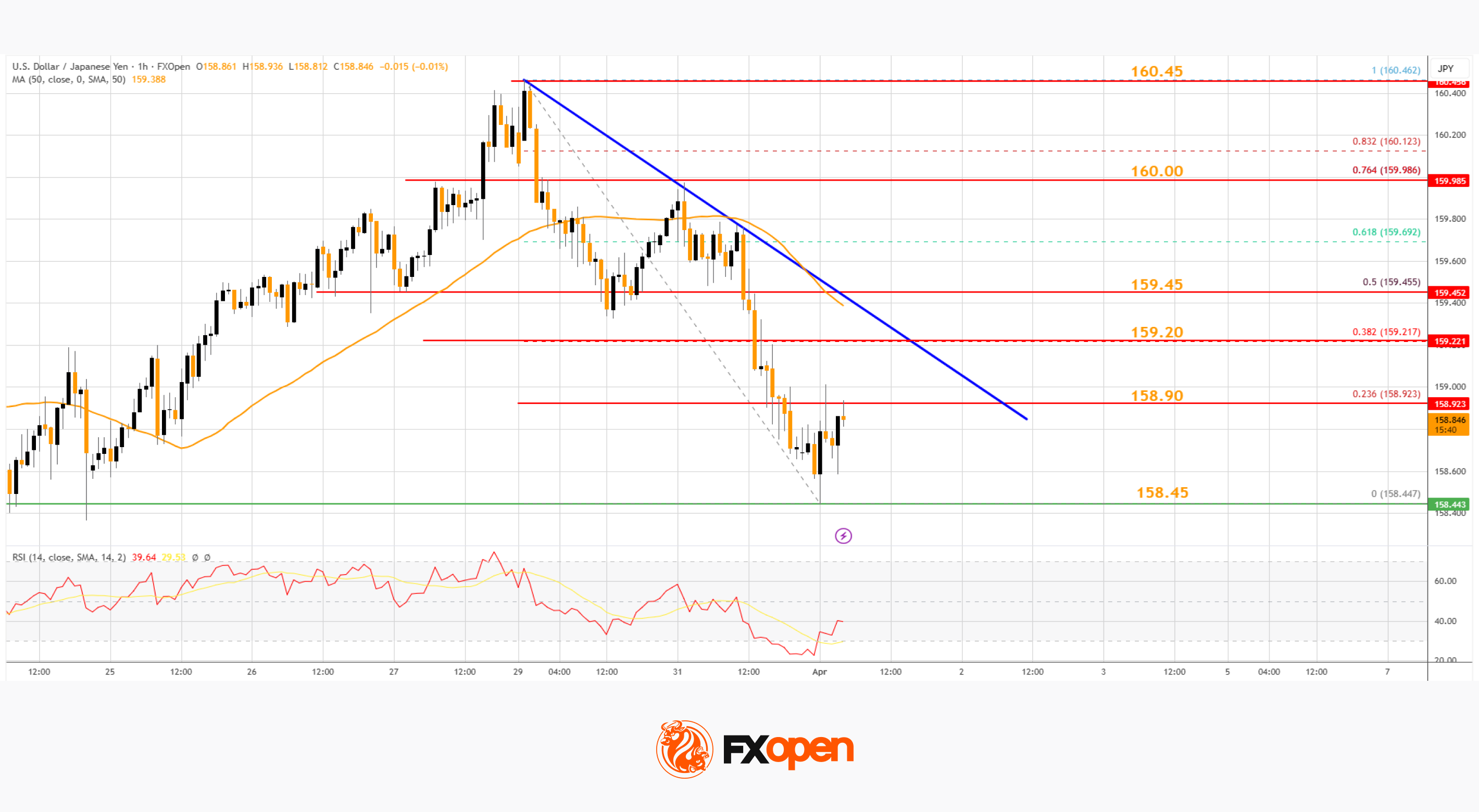
The next key region for the bulls might be 158.00. If there is a close below 158.00, the pair could decline steadily. In the stated case, the pair might drop toward 156.80. Any more losses might send the pair toward 155.00.
Immediate resistance on the USD/JPY chart is near the 23.6% Fib retracement level of the downward move from the 160.46 swing high to the 158.44 low at 158.90.
If there is a close above 158.90 and the hourly RSI moves above 50, the pair could rise toward 159.20. There is also a major bearish trend line forming with resistance near 159.20. The next major barrier for the bulls could be near the 50% Fib retracement level at 159.45, above which the pair could test 160.00 in the coming days.
Trade over 50 forex markets 24 hours a day with FXOpen. Take advantage of low commissions, deep liquidity, and spreads from 0.0 pips (additional fees may apply). Open your FXOpen account now or learn more about trading forex with FXOpen.
This article represents the opinion of the Companies operating under the FXOpen brand only. It is not to be construed as an offer, solicitation, or recommendation with respect to products and services provided by the Companies operating under the FXOpen brand, nor is it to be considered financial advice.
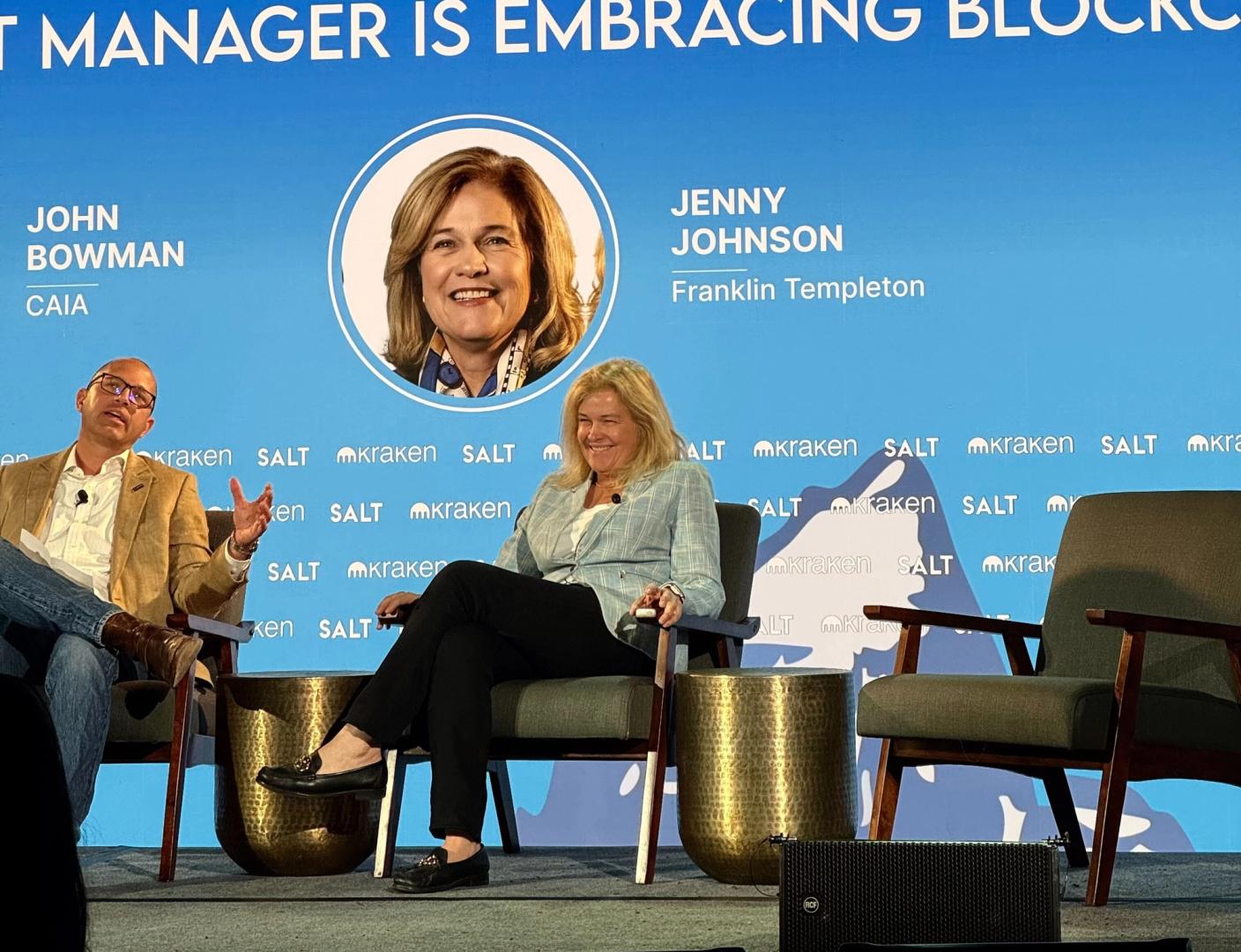
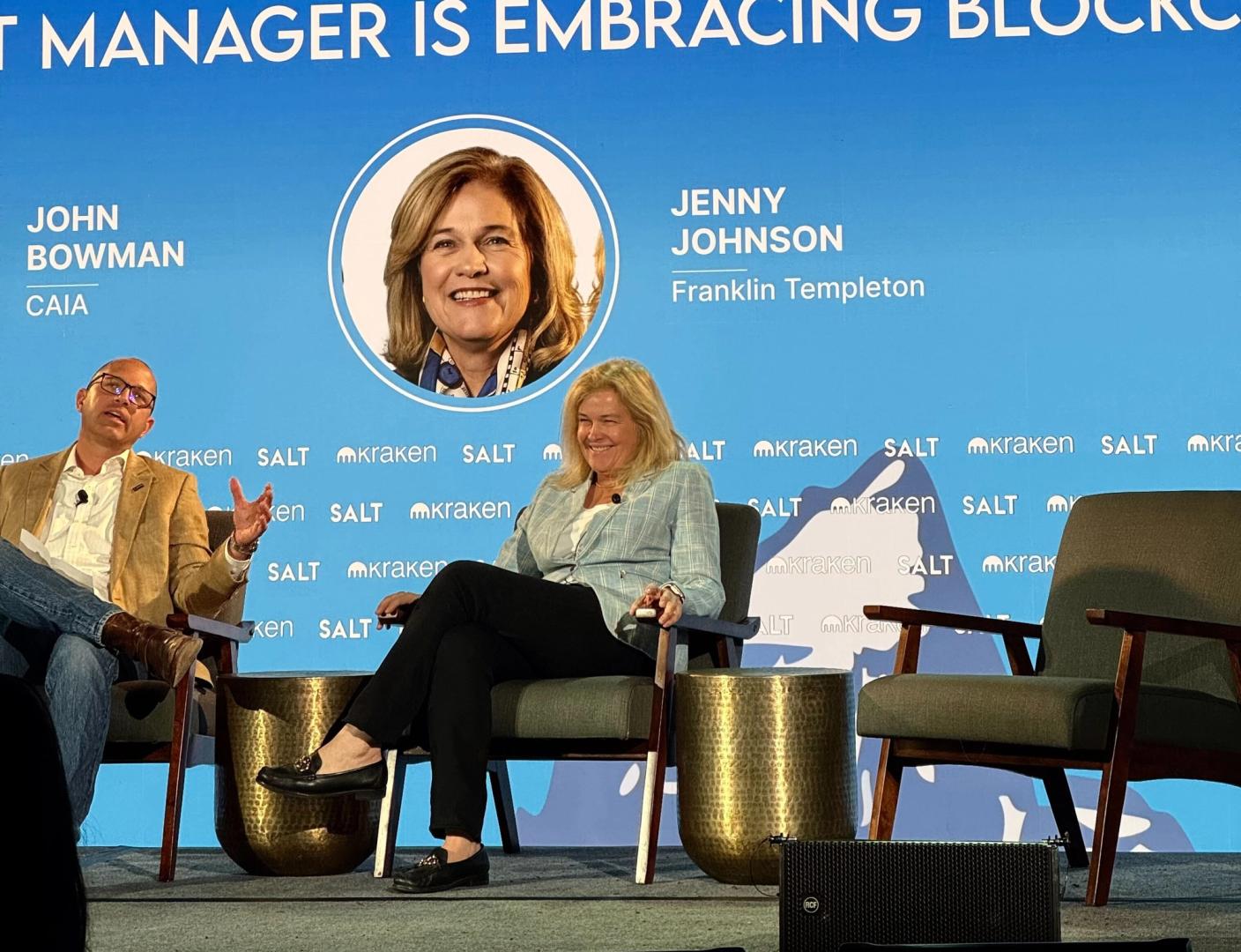
Wall Street asset management giant Franklin Templeton is launching a dedicated cryptocurrency division as it deepens its push into digital assets, anchored by a planned acquisition of crypto investment firm 250 Digital.
The new unit, called Franklin Crypto, will bring together the 250 Digital team and its liquid crypto strategies — previously managed by CoinFund — under one structure aimed at institutional investors, the firm said Wednesday.
Former CoinFund executive Christopher Perkins will lead the division, with Seth Ginns serving as chief investment officer alongside Franklin Templeton digital assets executive Tony Pecore. The group will report to Sandy Kaul, the firm’s head of innovation.
The move builds on Franklin Templeton’s existing digital asset business, which manages about $1.8 billion, and signals a shift toward offering more active crypto investment strategies alongside its current products.
“This is an exciting addition for Franklin Templeton,” CEO Jenny Johnson said, adding that the deal strengthens the firm’s ability to deliver dedicated crypto expertise to clients globally.
The launch of Franklin Crypto reflects a broader trend among large asset managers that are moving beyond passive exposure, such as exchange-traded funds, toward building in-house capabilities.
Perkins said the effort is aimed at meeting that demand. “Crypto’s institutional moment has arrived,” he said, pointing to growing interest from large investors seeking structured exposure to digital assets.
The transaction also includes an experimental element: part of the consideration will be paid using BENJI tokens, linked to Franklin Templeton’s on-chain U.S. Government Money Fund. The fund uses blockchain infrastructure to process transactions and record ownership.
That approach suggests early steps toward conducting mergers and acquisitions using tokenized assets, with settlement occurring more directly on blockchain rails.
The acquisition is expected to close in the second quarter of 2026, subject to approvals and other conditions. Financial terms were not disclosed.

Best Times and Viewing Tips for April 2 Full Moon

Liquity accused of ‘market manipulation’ after Circle acquisition April Fools’

Lizzo Didn’t Have Sex Until After Her First Grammy Win In 2020


-

 News Videos7 days ago
Parliament publishes latest register of MPs’ financial interests
-

 Business6 days ago
Instagram, YouTube Found Responsible for Teen’s Mental Health Struggle in Historic Ruling
-
 Tech6 days ago
Intercom’s new post-trained Fin Apex 1.0 beats GPT-5.4 and Claude Sonnet 4.6 at customer service resolutions
-

 NewsBeat5 days ago
The Story hosts event on Durham’s historic registers
-

 Sports5 days ago
Sweet Sixteen Game Thread: Tide vs Michigan
-
Entertainment2 days ago
Fans slam 'heartbreaking' Barbie Dream Fest convention debacle with 'cardboard cutout' experience
-
 Entertainment4 days ago
Lana Del Rey Celebrates Her Husband’s 51st Birthday In New Post
-
Crypto World1 day ago
Dems press CFTC, ethics board on prediction-market insider trades
-

 Sports23 hours ago
Tallest college basketball player ever, standing at 7-foot-9, entering transfer portal
-
 Fashion7 days ago
How to Style Spring Like WeWoreWhat: Easy Outfit Ideas for 2026
-

 Tech3 days ago
The Pixel 10a doesn’t have a camera bump, and it’s great
-

 Entertainment7 days ago
HBO’s Harry Potter Series Will Definitely Fail For One Big Reason, And It’s Not J.K. Rowling Or Snape
-

 Crypto World2 days ago
U.S. rule change may open trillions in 401(k) funds to crypto
-

 Fashion6 days ago
En Vogue in Brown Leather and Tailored Neutrals by Atelier Savoir, Styled by J Bolin
-

 Tech1 day ago
How to back up your iPhone & iPad to your Mac before something goes wrong
-

 Fashion6 days ago
What Are Your Favorite T-Shirts for the Weekend?
-

 Fashion5 days ago
Weekly News Update, 3.27.26 – Corporette.com
-

 Politics2 days ago
Should Trump Be Scared Strait?
-

 Sports2 days ago
Women’s hockey camp eyes fitness boost, tactics ahead of WC 2026 campaign | Other Sports News
-

 Tech1 day ago
Flipsnack and the shift toward motion-first business content with living visuals
You must be logged in to post a comment Login