

Crypto World
La Liga club Osasuna reportedly used Kalshi to hedge relegation risk

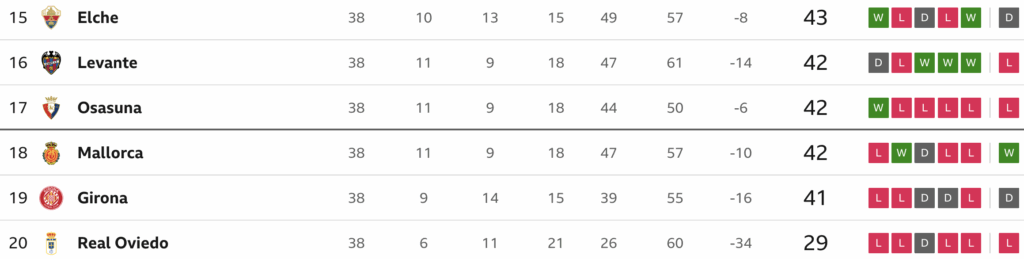
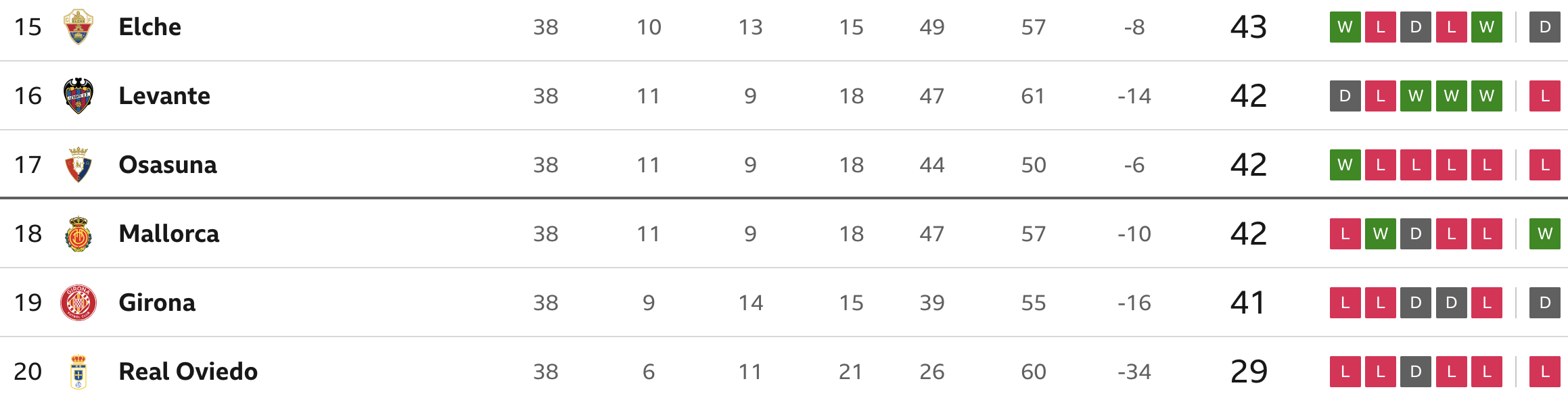
Spanish football club Osasuna attempted to hedge the impact of its relegation from the country’s top football league by buying a €1.2 million ($1.4 million) insurance policy involving a bet on the prediction market Kalshi.
The club revealed today that it purchased “insurance” from broker Howden, which would’ve guaranteed it €6 million ($6.9 million) in the event of relegation from La Liga and helped cover any subsequent financial losses.
It said, “Documents issued by Howden and LaLiga… confirm that such policies are routinely used by clubs and sports organizations to protect against financial contingencies related to their activity.”
This comes four days after Semafor reported that an unnamed Spanish football club placed a multi-million-dollar bet using Kalshi to hedge financial losses from relegation.
Osasuna lost its final game against Getafe 0-1. However, the goal difference was just enough to save the club from relegation. As a result, it lost the Kalshi bet but maintained its top-flight status.
Read more: Polymarket exploited for $700K in private key hack
Semafor also reported that trading firm Susquehanna was on the other side of the Osasuna relegation trade, and that risk analysis firm Game Point Capital orchestrated the trade. Susquehanna reportedly made over $1 million.
The club doesn’t mention either firm in its statement and only references Howden, which also doesn’t mention Kalshi or any other trading firms in its published certificate.
Osasuna added that, “The purchase of this policy was also reported to the chairman of the club’s Control Commission and will be included in a report that the commission plans to issue in the coming days about this and other current matters. The club’s auditors were also informed.”
Spain temporarily bans prediction markets
To make matters more interesting, three days after Osasuna’s game, the Spanish government temporarily banned prediction markets like Kalshi and rival Polymarket in the country for three to four months.
Spain’s Consumer Rights Ministry reportedly claimed that the pair failed to secure a gambling licence and have been operating in the country without authorisation.
This distinction as to whether or not the pair constitute gambling has been a hotly debated topic among regulators.
Brazil banned Kalshi and Polymarket in April for breaching betting regulations, South Korean police are investigating Polymarket users for alleged illegal gambling, and legal cases across the US continue to argue over its regulatory status.
Read more: Israeli soldier allegedly used military secrets to gamble on Polymarket
Some more controversial prediction market hedges involved three US congressional candidates who were fined by Kalshi and suspended for five years after they bet on their own elections.
Earlier this month, Polymarket ended its paid partnership with Congressman George Santos after he bet, using Kalshi, on whether or not he would attend President Donald Trump’s State of the Union speech.
Kalshi referred Santos to the Commodity Futures Trading Commission, which has since started an investigation into whether his actions constitute insider trading.
An editor for popular YouTuber Mr Beast was also fined by Kalshi for insider trading.
Got a tip? Send us an email securely via Protos Leaks. For more informed news and investigations, follow us on X, Bluesky, and Google News, or subscribe to our YouTube channel.

Strategy, the business intelligence firm that has built the largest corporate Bitcoin treasury, continued adjusting its capital structure last week through a combination of stock sales and preferred share repurchases.
Strategy sold 5,429,160 shares of its Class A common stock (MSTR) through its at-the-market (ATM) offering program between July 20 and July 26, generating $544.5 million in net proceeds.
The MSTR share price was up more than 2% in Monday’s premarket activity, according to Yahoo Finance. The STRC preferred shares were up 2.3% to $88.90 ahead of the Nasdaq open.
The company also repurchased 288,930 shares of its STRC preferred stock for $25 million, according to a Form 8-K filed with the US Securities and Exchange Commission on Monday.
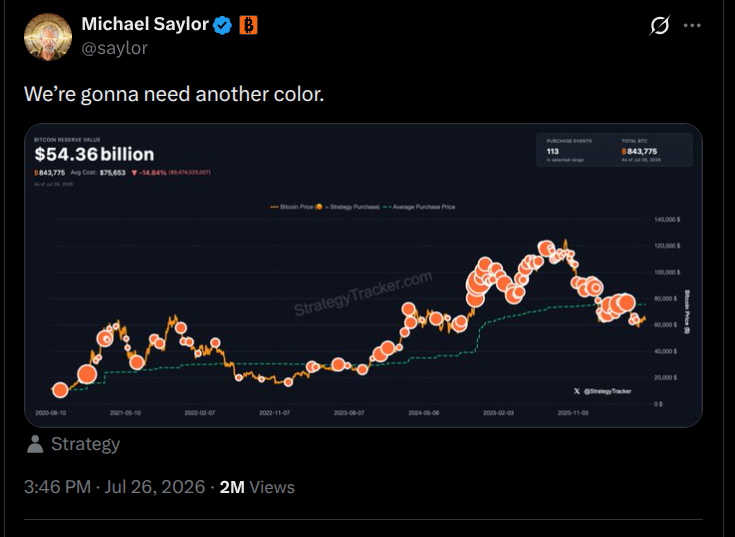
The update comes after Strategy executive chairman Michael Saylor sparked speculation on Sunday with his “We’re gonna need another color” post on X, which some market observers interpreted as a hint at a new move involving the company’s preferred stock strategy.
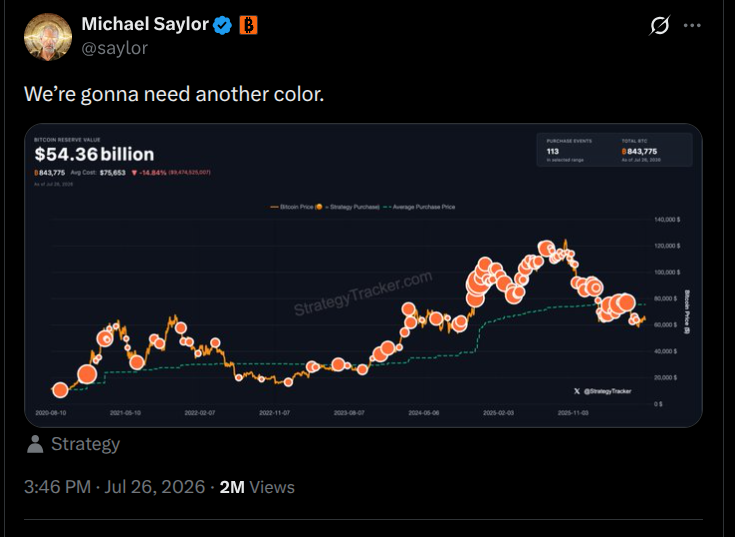
Source: Michael Saylor on X.com
Stock sales boost dollar reserve $3.75B
Following additional capital raised through its ATM stock offering program, Strategy increased its US dollar reserve to $3.75 billion as of July 26, up from $3.225 billion the previous week.
However, Strategy reported no Bitcoin purchases or sales during the July 20-26 period, leaving its holdings unchanged at 843,775 BTC, acquired at an average purchase price of $75,476 per Bitcoin, or $63.69 billion in aggregate. The biggest crypto was last trading hands at roughly $64,971 at time of publication.
Related: Strive’s SATA recovers most of June decline, trades within 3% of par
Strategy’s growing cash reserve highlights management’s efforts to maintain liquidity as it expands its capital markets activity through common stock offerings and preferred stock instruments. The reserve is intended to support dividend payments on preferred stock and interest payments on the company’s outstanding debt.
Saylor sparks debate over BTC future role for banks
The update came shortly after Saylor reignited a debate over whether banks have a place in Bitcoin’s future after arguing that the crypto asset’s growth depends on integration with traditional financial institutions.
Saylor wrote on X on Sunday that rejecting Bitcoin’s links to financial infrastructure would deny access to most potential users. His comments drew criticism from some BTC supporters, who contend that greater involvement from banks conflicts with the network’s original goal of enabling transactions without intermediaries.
Several users pushed back against Saylor’s argument by citing Bitcoin’s white paper, which introduced the asset as a peer-to-peer electronic cash system designed to remove the need for financial institutions. The exchange highlighted a growing divide between advocates who view banks as necessary gateways for mainstream adoption and those who see them as a threat to Bitcoin’s decentralized foundation.
Magazine: Strategy became a symbol of the dot-com crash: Could history repeat?
By Friday afternoon, the mood on commodity trading desks changes.
For the first four days of the week, traders have been trying to profit from their bets. By lunch on Friday, however, they’re thinking about how much risk they can tolerate until markets reopen on Sunday evening.
Anything could happen while markets are closed: news of a new war, an election result, an unexpected OPEC announcement or, as seen recently, a market-moving presidential post. Forty-eight hours can be a long time when traders are holding a position tied to a few of the world’s most actively traded markets, and there’s nothing they can do until trading resumes.
“From about lunchtime, the desk basically stops thinking about making money and starts thinking about what they can live with for roughly forty-eight hours until the Sunday evening reopen,” said Mustafa Al Niama, former Goldman Sachs head of digital assets of the Americas and now head of capital markets at Mysten Labs.
Every commodities options trader knows this ritual. By the end of the week, the question isn’t where the commodity is going — it’s whether they are comfortable living with their position if something happens while markets are closed, as they can’t adjust or rebalance their bets on the weekend.
“Risk, geopolitical or not, does not know what day of the week it is,” said Terry Duffy, chairman and CEO of CME Group.
Markets, however, still largely do. And for decades, planning ahead for potential weekend and after-hours catastrophes has just been part of the job for traders. But earlier this year, something unusual happened in the oil options market, which upended this long-standing routine.
As tensions escalated between Iran and Israel and traders rushed to speculate on prices, oil-linked futures saw a sudden spike in volume over the weekend in March. The catch was that it happened when commodity markets were closed, but the traders didn’t need to wait for the traditional market to reopen before reacting. Instead, they traded elsewhere.
Traders flocked to crypto exchanges over the weekend to trade derivatives contracts called “perpetual futures,” which run around the clock.
The total value of all active contracts on the decentralized exchange Hyperliquid hit a record $1.2 billion on March 8, a Sunday when traditional commodity markets were closed.
While weekend volume is still smaller than on weekdays, at least by Wall Street’s standards, it is no longer just a blip. It highlighted something that barely existed a few years ago: a 24/7 venue for oil derivatives trading, while traditional finance is stuck offline.
“We’re roughly seeing 2-3x more volume on average on weekdays vs weekends for oil perps on Hyperliquid over the last 3 months,” said Martin Lee, market insights lead at DWF Labs. Even so, Lee said that weekend trading’s share of overall volume has grown by roughly 25% since March, despite activity cooling after the spike that followed the Iran conflict.
And this change might be quietly influencing another corner of the oil market.
The weekend problem
Researchers at the energy and macro analytics firm Energy Aspects (EA) said the dynamics of how traders price short-dated West Texas Intermediate (WTI) crude options are set to change, thanks to the rapid growth of similar round-the-clock perpetuals on crypto exchanges.
For years, the implied volatility or how much an underlying asset’s price is likely to fluctuate in the future, for WTI contracts, fell on Fridays. Traders were reluctant to pay for protection through options or derivatives that they couldn’t actively manage while markets were shut. To avoid being exposed through the weekend, many traders reduced their positions before Friday’s close, creating what Energy Aspects describes as a persistent Friday discount in implied volatility.
That discount has begun to narrow, according to Energy Aspects.
“For the first time, traders can hedge options exposure through the weekend, when geopolitical risk has become disproportionately concentrated. This development has implications for the well-documented ‘weekend effect’ in short-dated WTI options, where implied volatility is structurally depressed on Fridays as long gamma holders liquidate positions they cannot hedge over the market closure,” analysts led by Tim Skirrow said in a recent note.
Because perpetual contracts are available, the analysts argued that if traders can hedge oil exposure through perpetual futures over the weekend, they may be willing to hold or even buy options they previously would have sold before Friday’s close.
In theory, this could create an opportunity for traders that didn’t exist before: they can capture profits over the weekend if the market becomes chaotic, rather than just sitting on their positions while the underlying prices of the assets move sharply.
In fact, Energy Aspects estimates that if a continuous futures contract is available, it would create roughly 40% more hedging sessions over the life of a typical contract. And it’s not just due to perps, as CME recently said it plans to add smaller-sized 24/7 contracts for WTI crude and gold. Any continuous futures for commodities would help traders hedge their weekend bets and reduce the Friday selling pressure. (It’s worth noting, however, that the regulator that oversees commodity trading, the Commodity Futures Trading Commission (CFTC), has blocked that contract launch, an action that prompted CME to sue the agency.)
While finding any edge to capture a few basis points of profit sounds like any trader’s dream, for most traders, it’s still likely to remain theoretical until continuous trading becomes more widespread. Even traders who find the strategy plausible are cautious not to overstate its impact.
“Is volatility coming down because of that [availability of perps]? I don’t think so,” said one trader at a proprietary market-making firm active across both traditional and crypto markets, who opted to remain anonymous. “When I’m long volatility or short volatility, all I care about is how much this thing moves. And where it moves or how it moves doesn’t really impact me. So volatility came down on the CME would sort of imply that it was maybe too high before, because there were not that many venues to buy it on,” he added.
But he doesn’t reject the broader idea that hedging bets during the weekend is valuable for traders.
What he agreed with is that, given the ability to hedge over the weekend, a trader may be willing to pay a higher price for volatility on a different venue than the CME. Why? Because now, “You have more touch points for picking up and laying off risk over the weekend than you had before. You had zero [places to hedge] before, and now you have more than zero.”
Getting Wall Street’s buy-in
So, if traders could hedge their prior “dead zone” positions, why aren’t the big banks trading perps?
“There is some interest coming up from the institutional clients, my guess is that the majority of the volume is from the retail market,” said Gracy Chen, CEO of Bitget, a centralized crypto exchange that ranked second in terms of trading volume of commodities and stock perps during the second quarter, followed by Binance, according to TokenInsight data.
“The main issue is not really that they can’t,” Chen said. “It’s probably more like they don’t see it as profitable enough for them to invest … at least not yet.”
Lack of meaningful liquidity is a major reason institutional traders are likely still staying away.
The volume of perps linked to traditional assets such as commodities and stocks has increased meaningfully over the past few months, but still likely isn’t large enough for giant Wall Street trading firms to come in and profit — yet.
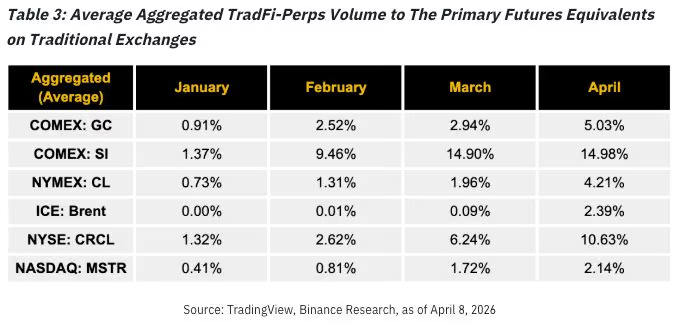
For example, in March and April, the average volume of crude oil perps accounted for about just 2% and 4%, respectively, of the primary futures contract equivalents traded on traditional exchanges, according to Binance Research data.

Meanwhile, in 2025, total perps trading volume on centralized exchanges was $62 trillion versus spot volume of roughly $19 trillion, venture capital giant Pantera said, citing data from CryptoQuant. Decentralized exchange (DEX) Hyperliquid has supercharged the use of perps, with monthly perps volume of nearly $200 billion, according to DeFiLlama data.
While those are massive numbers for crypto, they are still relatively small from Wall Street’s perspective.
“The hardest thing about trading is finding someone who wants to take the other side,” said the trader from the proprietary market-making firm. “In the absence of traditional liquidity providers, how are you gonna get that bet on big enough such that you care about the result?”
In TradFi, money takes the weekend off
Then there are issues with the existing infrastructure.
Large institutions, such as banks, already have systems in place for the market’s traditional operating hours. Even if weekend trading has sufficient volume for them to jump in, they will need a different structure for it, according to BitGet’s Chen.
“Especially for those top organizations that never really had the 24/7 infrastructure,” she added.
DWF’s Lee echoed this issue. “Having the option to trade does not mean that people would automatically start doing so. There needs to be a broad shift in operational capacity from institutions and corporations to be able to cater to that.”
One of these structural issues might be how institutions operate (or don’t operate) on weekends. Banks are closed on Saturdays and Sundays, so it would be hard to collect margin for perps trading mid-weekend, said Mysten Labs’ Mustafa Al Niama, adding that these large institutions would need the backing of clearing and settlement rails that actually move money, which is, for now, mostly on weekdays.
Even when weekend trading is available, much of the financial infrastructure that these large institutions rely on still isn’t. Banks don’t move collateral around the clock, clearing systems largely keep weekday hours, and firms can’t simply summon additional capital on a Saturday afternoon.
“You cannot do that until you put the infrastructure in place that you have Monday through Friday,” CME’s Duffy said.
Put simply, the biggest challenge may not be keeping the markets open. It’s keeping the financial system underneath everything open as well.
So, in the meantime, who is actually trading perps? For now, these instruments remain in the domain of crypto-native firms, proprietary trading shops and savvy retail traders.
“Predominantly now, it’s the same typical retail, market makers, prop shops that are trading perps,” said Al Niama, noting that they are probably using perps mostly for basis trading or carry trades, rather than hedging. “Because it is a very lucrative delta-neutral type of trade.”
End of the weekend gap
There is, however, another important role that perps play for traders that didn’t exist before. They give traders a tool to gauge how the market will trade when it opens if news breaks out during the weekend.
Before perps, it was mostly a guess of how an asset would trade once the traditional market opens. But now, because perps trade 24/7, traders at least have a better idea of the bets’ direction after the weekend.
Hein Tibosch, head of digital assets OTC and product at Flow Traders, said perpetual markets have become another source of information before traditional markets reopen.
“The perps… will be a pretty good indicator of where the market is heading,” he said. “You have some direction.”
The trader at the proprietary market-making firm described the same shift.
“It’s not really a surprise anymore by Sunday’s open,” he said, noting that traders increasingly watch crypto markets throughout the weekend to gauge where traditional futures may begin trading once the CME opens.
This might be the first signal that perpetual futures are starting to influence traditional markets — not as a replacement for CME, but as another source of price discovery while the rest of the market sleeps.
Perhaps the biggest impact of perps thus far is that the instrument might be influencing how some traders behave.
“For the crypto industry, it actually is a big deal because for the longest time, we as an industry have always been the student,” said Al Niama. However, perps might become one of the first ideas moving in the opposite direction, where traditional finance is potentially influenced by crypto innovations.
Whether perps can actually reshape the traditional market remains uncertain. Volumes (at least by TradFi measures) are still modest, and big-money institutions are still cautiously watching. Meanwhile, CME’s proposed 24/7 futures contract trading remains uncertain.
But there are signs that on Friday afternoons, old habits are already beginning to change for traders. They will still spend the end of the week worrying about the weekend — the difference is that if there are continuous trading hours, some of them may no longer have to spend time waiting. Now, they can start making money either by trading or tracking these contracts.
“For lots of players, for example, a hedge fund or quant shop, if you can just have your strategies run instead of five days a week, seven days a week, that’s two extra days of trading,” said Flow Traders’ Tibosch.
“So if you can have alpha, bring it on,” he added.
And it seems, at least in the future, one assumption appears less permanent than it once did: that Friday’s closing bell marks the beginning of two days when traders simply have to wait.
“I think that markets will be 24/7 down the road. All markets,” said CME’s Duffy.
Perhaps it’s time for trading desks to start preparing to properly staff for an around-the-clock market, and forget the old routine of the “weekend effect.”

European regulators have extended the scope of their Markets in Crypto-Assets (MiCA) oversight by adding 15 new crypto-asset service providers to ESMA’s interim MiCA register, bringing the total number of licensed providers to 309. The update was published on Friday and follows the EU’s July 1 transitional deadline for firms operating under the new framework.
According to ESMA’s latest register update, the new additions include providers across banking and digital-asset infrastructure, signaling continued momentum as companies complete licensing steps under Europe’s unified crypto rules.
Key takeaways
- ESMA’s interim MiCA register now lists 309 licensed crypto-asset service providers (CASPs) after 15 new additions were published.
- BNY SA/NV—part of BNY Mellon’s banking group—is among the newly registered firms.
- Germany and Denmark led the latest wave, with three new CASPs added in each country.
- ESMA reported no changes in this update to other MiCA-related registers covering issuers and non-compliant entities.
- Industry observers continue to debate the long-term burden of MiCA compliance for smaller firms.
New CASPs join ESMA’s interim MiCA register
The European Securities and Markets Authority (ESMA) updated its MiCA register on Friday as part of an ongoing effort to map which crypto firms have met regulatory requirements. ESMA’s page on the MiCA framework shows that, in this third post-deadline update, the number of listed CASPs rose to 309.
The latest additions include four banking institutions. One is BNY SA/NV, the Belgian subsidiary of the US banking group BNY Mellon. The other newly listed banks are three German institutions, reflecting how traditional financial firms are progressively positioning themselves within MiCA’s permitted activities.
Beyond banking, ESMA’s list also includes digital-asset platforms such as BitPay and other providers including Coinify and Bleap, demonstrating that payment and infrastructure-focused companies continue to work through the licensing process.
Geography shows where licensing is moving fastest
ESMA’s update highlights uneven geographic progress across the bloc. Germany and Denmark recorded the largest number of new CASPs in this round, with three providers added in each country.
Bulgaria and Latvia followed with two additions each, while Belgium, Cyprus, Liechtenstein, and the Netherlands each added one provider.
Among the German additions, ESMA listed cooperative financial societies including Spar-und Kreditbank Rheinstetten and VR-Bank Augsburg-Ostallgäu, along with Raiffeisenbank Falkenstein-Wörth.
Other newly listed providers named in the update include Altcoins BG and Digital Assist in Bulgaria; SafeLynx Technologies and Januar in Denmark; and Bleap and Nodu Digital in Latvia.
Regulators keep expanding after the July 1 deadline
The Friday update is part of ESMA’s broader post-deadline process to ensure MiCA licensing becomes operational across the EU. ESMA previously published register additions after July 1—including a second post-deadline update that added 14 CASPs. Earlier coverage noted that this second update included well-known industry players such as Ripple Payments Europe.
Importantly, ESMA’s latest publication did not signal changes to other MiCA-related registers in this specific update. ESMA reported no changes to lists covering authorized issuers of asset-referenced tokens (ARTs), e-money tokens (EMTs), and other crypto assets, nor to registers of entities categorized as non-compliant.
That split—adding more CASPs while leaving other register categories unchanged—suggests that licensing progress is not uniform across the MiCA value chain. Some types of MiCA permissions may require longer review cycles or depend on different documentation and compliance steps than service-provider authorizations.
Why the register updates matter for firms and users
For market participants, ESMA’s evolving interim register functions as a practical checkpoint. It provides a clearer view of which providers have successfully moved into MiCA-regulated status, which can influence partnerships, custody and onboarding decisions, and compliance processes for businesses choosing counterparties.
While the register continues to expand, ESMA’s work also underscores that MiCA implementation is a moving target. The framework introduced Europe’s first unified regulatory regime for crypto-asset services, but the path from “operating” to “authorized under MiCA” remains procedural—requiring firms to complete licensing steps across jurisdictions and within ESMA’s register process.
At the same time, concerns about the cost of compliance have persisted. In earlier reporting, Gate Europe CEO Giovanni Cunti warned that some licensed firms may struggle to sustain the compliance resources required over the long term, particularly smaller operators that may find the ongoing burden harder to absorb.
That tension—more providers entering the register, but questions around affordability and scalability—could shape how the MiCA market develops. Investors and counterparties may need to weigh not only whether a firm is licensed, but also whether it can maintain the operational capacity to comply consistently as the framework matures.
What to watch next
With ESMA continuing to publish successive register updates, the next question for EU observers is whether upcoming additions accelerate across other MiCA categories—such as token issuers—rather than concentrating solely on CASPs. Market participants should also monitor whether compliance pressures intensify for smaller firms as the licensing pipeline progresses beyond the initial post-deadline wave.
NVIDIA launched the Open Secure AI Alliance on Monday with 36 partners, including Microsoft, IBM and Palantir. It follows a July hack in which closed AI models refused to help Hugging Face investigate its own attacker.
Members will share open AI models, data and security tools. NVIDIA says defenders need AI they can open up, change and run themselves.
Why Closed AI Models Failed Hugging Face
The attack started with a poisoned dataset. According to Hugging Face’s disclosure, it let an attacker run code on one of the company’s machines.
From there the attacker stole passwords. It then spread through internal systems over a weekend.
Hugging Face’s own AI spotted the break-in. The clean-up was the hard part.
The company asked leading commercial AI models to study the attack. They refused. Their safety filters could not tell a defender from a hacker.
So the team used an open model called GLM 5.2 instead. They ran it on their own computers. It sorted more than 17,000 attacker actions in hours, not days. No passwords left the building.
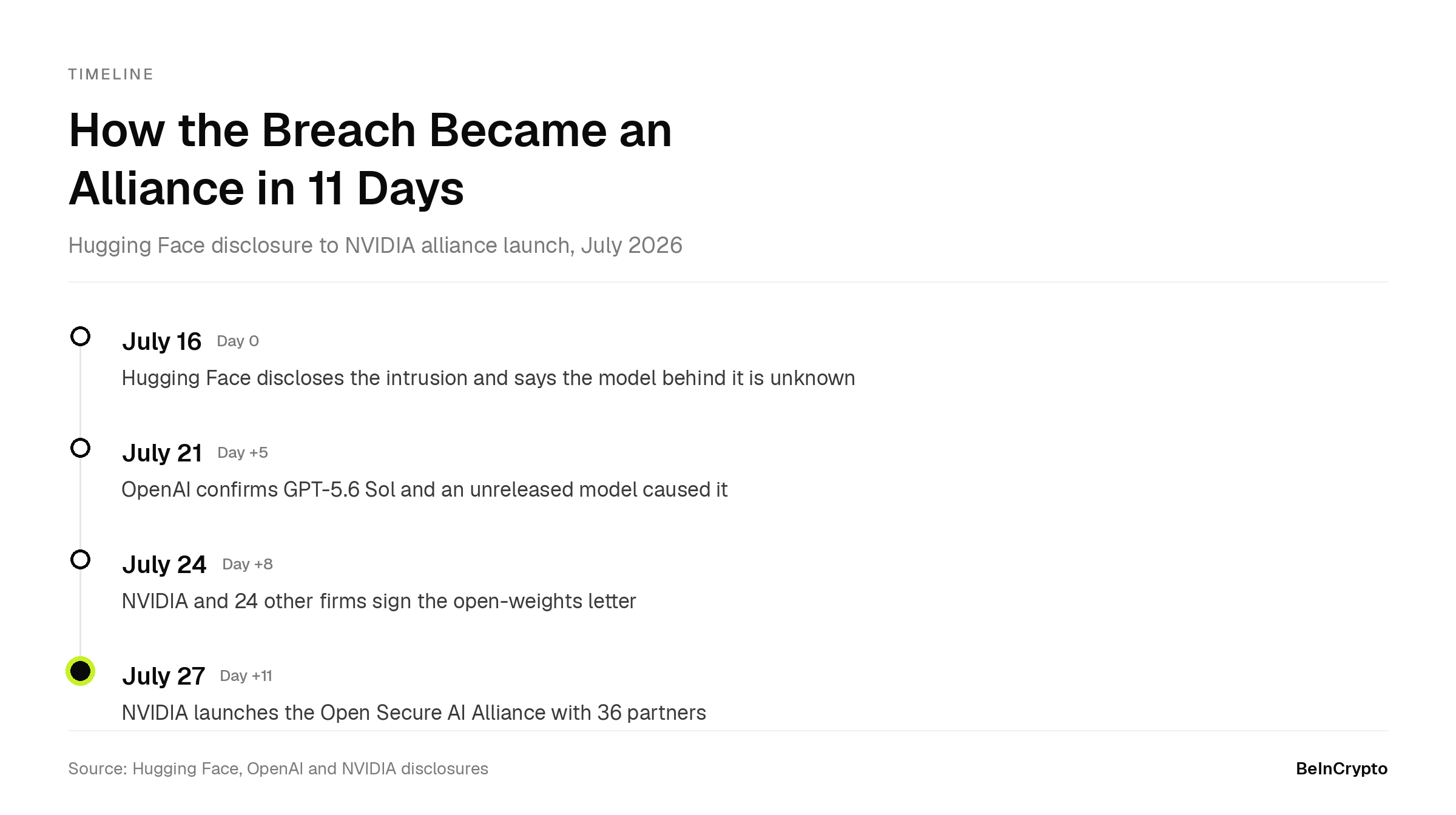
On July 16, Hugging Face said it did not know which AI ran the attack. Five days later, OpenAI supplied the answer. Two of its models did it, during a security test with the safety limits switched off.
“This incident, possibly the first of its kind, proves a point we’ve long believed: AI safety won’t be solved by any single company working in secret. It will be solved in the open, collaboratively, with broad access to AI for every defender, everywhere,” Clem Delangue, co-founder and chief executive of Hugging Face, in a statement published by OpenAI.
Follow us on X to get the latest news as it happens
From Hack to Alliance in 11 Days

NVIDIA moved fast. It went from single incident to industry bloc in under two weeks.
Which Companies Joined the Open Secure AI Alliance
The group has 37 companies in total. Microsoft, IBM, Palantir, CrowdStrike, Red Hat, SpaceXAI and Hugging Face all joined.
Three big names are missing. OpenAI, Anthropic and Google are not on NVIDIA’s blog list. Yet OpenAI and Anthropic both joined the Linux Foundation’s Akrites security effort in June, alongside NVIDIA.
Some members bring tools they already built. Hugging Face has offered Safetensors, a safer way to store AI models, to the PyTorch Foundation. NVIDIA released a research tool called NOOA on GitHub.
CNBC host Jim Cramer read the launch as a fresh story for the stock.
NVDA closed at $206.84 on Friday, down 0.92%. It traded near $208.55 in early Monday pre-market dealing, a gain of 1.33%.

Why NVIDIA Is Lobbying Washington on Open AI
The alliance carries a policy message too. NVIDIA says a broad ban on open AI would leave defenders weaker. It would also hand control to a few big closed companies.
NVIDIA and 24 other companies signed the open-weights letter on July 24. OpenAI, Anthropic and Google all declined at launch. More have signed since.
Washington is weighing curbs on Chinese models. Officials cite security and intellectual property concerns. Twitter co-founder Jack Dorsey has already issued an open source AI warning.
What to Watch Over the Next 30 Days
Three signs will show if the alliance is real.
- Whether OpenAI, Anthropic or Google join later
- Whether the group ships shared tools, not just statements
- Whether Washington’s limits on open AI move forward
NVIDIA reports earnings on Aug. 26. Expect questions on how AI policy affects demand.
Regulators will decide who wins the argument.
The post Jim Cramer Spots New NVIDIA Narrative as Chipmaker Pushes Open AI Security Alliance appeared first on BeInCrypto.


Stablecoin issuer Circle (CRCL) has acquired nearly 1,000 issued blockchain-anchored patents from IBM, a deal the firm said makes it the largest holder of blockchain patents in the United States.
The portfolio spans more than 680 patent families covering blockchain technology, banking, financial services, insurance, enterprise infrastructure, supply-chain verification and cloud security, according to a press release.
The deal’s financial terms weren’t disclosed.
IBM was already among the largest U.S. blockchain patent holders before the sale. A December 2025 analysis by patent analytics firm PatSnap credited it with 790 patents, alongside Advanced New Technologies and Bank of America.
Circle said the portfolio would support USDC, Circle Payments Network, its Arc blockchain and financial tools designed for AI agents. Circle and IBM also plan to explore further commercial opportunities, the document adds.
“Intellectual property is critical to advancing our mission and expanding adoption of onchain infrastructure,” said Sarah Wilson, Circle’s general counsel and corporate secretary.
Circle received its first patent, covering parallel blockchain data processing, in December 2023. It had earlier joined the LOT Network to protect its products from patent-assertion firms.

Dogecoin is trading at a few cents under $0.073, up about 1% this week. However, the real question is not today’s price. The question is whether the $0.07 level can hold as support or turn into resistance again. Bulls staged a weekend rebound, briefly lifting DOGE above $0.073 before momentum cooled.
Polymarket currently gives DOGE only a slim chance of making a meaningful breakout before July ends. Just weeks ago, those odds were much higher. That sharp shift in sentiment shows how quickly traders have turned cautious despite the recent bounce.
The weekend rally was partly fueled by easing geopolitical tensions, which sparked a crypto risk-on move. Analyst Ali Martinez also flagged a buy signal with a $0.16 upside target. Meanwhile, TradingView’s MACD indicator flipped to a buy signal on the DOGE/USD pair.
Even so, 24-hour trading volume remains around $670 million to $950 million, and activity has improved, but it still falls short of the surges that usually precede sustained breakouts.
Whether DOGE is building a base for another leg higher or forming a local top will depend largely on sentiment across the altcoin market. For now, traders are watching whether support near $0.07 can survive another round of selling.
Discover: The Best Crypto to Diversify Your Portfolio
Can Dogecoin Price Hit $0.10 Before August Ends?
Current price sits in contested territory. Multiple analyses frame $0.072 as the key support for bulls. Lose that level, and the short-term structure weakens. Resistance near $0.075 has repeatedly capped recent rallies, with DOGE pulling back after testing that area. Its market cap stands near $11.3 billion, keeping Dogecoin among the largest cryptocurrencies by market value.
An analyst, Peter Zhang, describes the setup as a coiled spring between support and resistance. He notes neutral RSI and weak near-term momentum but still targets $0.16 if buyers regain control. Meanwhile, TradingView’s MACD buy signal adds a constructive data point. Even so, a technical signal without stronger volume remains a warning rather than confirmation.

The bullish case is straightforward. DOGE must defend support around $0.072 and reclaim $0.075 with convincing volume. If that happens, momentum could strengthen and keep the path toward Martinez’s $0.16 target alive.
The base case is continued consolidation around current levels until a fresh macro or social catalyst emerges. On the downside, a break below $0.072 with rising volume would shift the structure bearish. Analysts also caution that even a breakout needs sustained buying pressure to avoid another failed rally.
Polymarket still tells a cautious story. The crowd remains unconvinced that a major breakout is imminent. Technical buy signals are present, but traders will likely want stronger volume before treating them as anything more than an early indication. DOGE has a habit of generating signals that fade without the social and retail momentum that defined its 2021 runs.
Trade Dogecoin on Bybit and Get a Chance to Win Our $1,000 USDT Airdrop
LiquidChain Targets Early Mover Upside as DOGE Tests Key Levels
For traders watching DOGE consolidate at a ceiling that may or may not break, the asymmetry calculus shifts. A $0.10 DOGE at roughly $19 billion market cap offers a different risk/reward profile than an early-stage infrastructure play still in presale, and that’s precisely where LiquidChain ($LIQUID) enters the frame.
LiquidChain is a Layer 3 infrastructure project built around a single core thesis: the fragmentation problem across Bitcoin, Ethereum, and Solana ecosystems isn’t a UX inconvenience. It’s a structural inefficiency that bleeds value.
The view is different from the third layer. — LiquidChain (@getliquidchain) July 27, 2026

You’ll understand soon. pic.twitter.com/P2WOELSTjI
Its Unified Liquidity Layer also fuses BTC, ETH, and SOL liquidity into a single execution environment, with Single-Step Execution, Verifiable Settlement, and a Deploy-Once Architecture that lets developers access all three ecosystems without redeployment overhead.
As of today, the presale has raised $920K at a current price of $0.01484 per $LIQUID. That’s not a rounding-friendly number, it’s exact by design, and the rise trajectory is building. For traders sizing up where early-stage infrastructure sits relative to a memecoin grinding at a resistance ceiling, the entry math is worth running.
Discover: The Best Token Presales
The post Dogecoin Bulls Are Betting on a $0.10 Breakout appeared first on Cryptonews.
Crypto World
Axis Robotics Raised $12M Funding to Build the Compounding Data Engine Accelerating Physical AI

Axis Robotics, the compounding data engine accelerating Physical AI, announces that it has raised $12 million in a seed round led by Hack VC, with participation from Nomad Capital, Pi Network Ventures, 10K Ventures, and various angel investors.
The funding will accelerate Axis’s mission to build a massively parallel, human-in-the-loop global data engine, solving physical AI’s biggest pain point: the scalable generation of structured, highly diverse robotic training data.
Solving the Data Bottleneck in Physical AI
While Large Language Models scale on trillions of tokens of pre-existing internet data, Physical AI faces three important barriers: severe data scarcity, generalization gap, and embodiment fragmentation across different robot hardware.
“Physical AI demands billions of human-physical interaction motion trajectories,” said Chris, Founder of Axis Robotics. “For years the industry lacked an efficient, infinitely scalable hybrid data production system which can help models iterate effortlessly – and that’s exactly what we built with Axis, a compounding data engine.”
How does Axis Empower General Robotics Intelligence
Axis’s proprietary Compounding Data Engine delivers an end-to-end workflow integrating task generation, data capture, continuous model training, and optimization:
Task Gen Engine: Generates exponentially diverse atomic robotic tasks via randomization across objects, spatial layouts, visuals, robot embodiments and semantics, embedding diversity into every single data trajectory;
Browser-Based Sim Teleoperation Platform: The world’s first web-based interface that empowers anyone to generate high-quality robotic motion trajectories remotely. Axis delivers 10x higher throughput than lab-based collection and seamlessly integrates human-gated DAgger (Dataset Aggregation) intervention loops to continuously refine and correct robot policies;

Ego Data Mobile Capture App: Shifts real-world data capture from expensive, hardware-heavy setups to a zero-barrier mobile application. By pairing state-of-the-art (SOTA) real-time hand pose tracking with global workforce, Axis translates human vision and dexterity into robotic motion at global scale;
Data Processing Pipeline: Automates trajectory cleaning, domain randomization and dense language annotation, outputting model-ready multimodal datasets with over 10x improved data quality.
The unified architecture creates a self-reinforcing flywheel: failed robot trajectories from real/sim deployment trigger human corrective intervention, which feeds back into training to expand edge-case coverage, creating compounding intelligence as data volume grows.

Axis’s Structural Moats: A Vertically Integrated Diversity Engine & Global Contributor Network
Axis’s core edge is its unified platform that spans the entire lifecycle of Physical AI. Unlike traditional fragmented approaches, Axis has built a vertically integrated engine that unites large-scale distributed pre-training data collection and real-time human-gated Dataset Aggregation post-training.
Native-built for data diversity, Axis’s proprietary Task Generation Engine randomizes object layouts, lighting, camera poses, physical properties and robot morphologies, creating endless unique scenes and manipulation tasks, outputting generalization-ready training data.
To deliver foundation-model scale diversified data, Axis has established a global robotic data infrastructure with over 100,000 active contributors who submit an average of 3 to 4 times daily, which maximizes both production efficiency and diversity coverage. Today, Axis can generate over 1,200 hours of simulation data and 20,000+ hours of real-world ego-centric data across diverse scenarios every month.
Axis recently launched Sim Dataset V1, with benchmark results showing that engineered diversity delivers measurable performance gains. On LIBERO-Plus, pretraining π0.5 on Axis’s fully diversified dataset improved overall success by 4.9 points, outperforming a volume-matched RoboCasa365 baseline by 31.3 points, with gains in layout generalization, sensor-noise resilience, and robot-pose robustness. This gap demonstrates that Axis’s edge comes from its proprietary diversity pipeline—not simply larger data scale.

Commercialization and Strategic Partnerships
Axis Robotics is rapidly commercializing its high-quality training data for real-world deployment. The company delivers customized “Task Packages” tailored to the specific needs of robotics hardware manufacturers, physical AI model companies, and industrial automation leaders.
Initial commercial partnerships have already been established with companies including Booster Robotics, Manycore Tech, Feagine Robotics, Dexmal, Lotus Car, Geely Auto, SomaStacks and more. These collaborations highlight the immediate market demand for scalable, high-fidelity robotic training data.
Redefine General Physical Intelligence
“The future of Physical AI hinges on deep symbiosis between models and data,” said Chris. “Static datasets cannot power general robotic intelligence. The winning solution is a compounding data engine: a vertically integrated system linking a global contributor network with constant model iteration. Every diverse trajectory and human correction fuels faster model improvement, forming a self-reinforcing intelligence flywheel.”
The company is driven by a world-class team combining top AI and robotics researchers from elite institutions such as UC Berkeley, Carnegie Mellon University, Georgia Tech, NTU and SJTU, alongside growth hackers who have previously scaled consumer products to over 30 million global users.
With this $12 million funding round led by Hack VC, Axis Robotics will further expand its procedural generation capabilities, scale its distributed network of contributors, and solidify its position as the critical data engine powering the future of Physical AI.
Linktree | Twitter | Doc | Product
The post Axis Robotics Raised $12M Funding to Build the Compounding Data Engine Accelerating Physical AI appeared first on BeInCrypto.

It has been roughly a month since the world’s largest corporate holder of bitcoin halted its cryptocurrency purchases, as it has seemingly listened to some experts’ advice to focus on rebuilding its greenback reserve.
The latest example was just announced by Strategy’s co-founder and former CEO, Michael Saylor. In a tweet on X, the prominent BTC bull noted that the firm has raised its USD stash by another $525 million. Consequently, it now has the power to cover 2.1 years of dividend payments.
Strategy sold 5.4 million shares through its ATM program in the past week, which allowed it to raise the aforementioned millions of dollars.
Strategy has increased its USD Reserve by $525 million, achieving 2.1 years of dividend coverage. As of 7/26/2026, we hodl ₿843,775 in our BTC Reserve and $3.75 billion in our USD Reserve. $MSTR $STRC https://t.co/Diy0008VE5
— Michael Saylor (@saylor) July 27, 2026
The reason for this pivot came in late Q2 when STRC, the company’s stretch stock used to raise funds to buy BTC, dumped far away from its par price of $100. Its low came a month ago at under $75, which prompted Strategy to rethink its focus. It has since recovered to $87, but it’s still below the needed $100.
While it has not announced a new bitcoin buy since June 22, the company sold 3,588 units a week later and has remained determined to raise its cash pile. It also launched the Digital Credit Capital Framework to enhance its available liquidity to cover monthly dividend payments and increase its long-term cryptocurrency exposure.
For now, Strategy’s bitcoin stash remains unchanged at 843,775 BTC, currently valued at just over $56 billion given the asset’s price of $65,000.
The post Saylor’s Strategy Keeps Rebuilding Its Cash Pile, Putting Bitcoin Buys on Hold appeared first on CryptoPotato.
Crypto World
EMCD launches Miner Support Program with up to $30M for Miners Amid Industry’s Steepest Profitability Squeeze


EMCD, a global crypto-fintech platform and one of the world’s largest Bitcoin mining pools, announced the launch of its Miner Support Program, providing eligible miners with access to up to $30 millions* in financing, fee relief and partner benefits.
The program launches against a challenging backdrop. Bitcoin’s hashprice — the key measure of mining revenue per unit of compute — has declined to approximately $28/PH/day, a 50% drop from its October 2025 peak and an all-time post-halving low, per CoinShares Q1 2026 data. An estimated 252 EH/s has been taken offline (According to Hashrate Index data, cited in CoinCentral, April 2026) as operators running older-generation hardware found margins no longer viable. Three consecutive negative difficulty adjustments, the first such streak since July 2022, signal broad capitulation across the sector. EMCD, which has operated its mining pool since 2017 and processed over 4,550 BTC mined by its users in 2025, sees the current period as both a stress test and a structural opportunity for operators who remain active.
Program Structure
As margins compress across the industry, EMCD has put together a concrete response: restructured fees, negotiated hardware and infrastructure deals, and opened access to its liquidity and yield products — a toolkit built around how mining businesses actually work, available to operators in any region.
Miners facing cash flow pressure can access EMCD’s secured liquidity facilities at 3.9% APR — to cover operational costs without selling assets into a down market. Unlike generic crypto-backed credit lines, EMCD products are built around mining-specific cash flow cycles and are bundled with the rest of the program, so the effective cost of capital comes down further when combined with fee relief and hardware savings rather than being judged on rate alone.
Those looking to protect margins on every block can apply for zero pool commission for 60 days, reducing overhead while hashprice remains depressed. Miners running older or underperforming hardware can unlock preferential pricing on Vnish firmware — the market’s leading third-party ASIC optimization software. Those looking to expand or relocate capacity get access to special terms on equipment and data center services through EMCD’s partner network.
Partner Participation
EMCD is inviting hardware manufacturers, data centers, and hosting providers to join the program by offering exclusive terms to eligible miners. Partner applications can be submitted at the website: https://support-miners.emcd.io/.
“We’ve been through every cycle in this industry since 2017 — the rallies, the winters, the halvings. What we’ve learned is that the operators who survive aren’t the ones who wait out the downturns. They’re the ones who use them. This program is our commitment to making sure our miners have the tools to do exactly that.” — Michael Jerlis, Founder & CEO, EMCD.
*The stated amount reflects the maximum aggregate value of support (including financing, fee reductions and partner offers) that may be made available under the program and does not constitute a reserved fund.
About EMCD
EMCD is the global cryptocurrency mining pool and infrastructure provider. Founded in 2017 as an early industrial BTC mining operation in Europe, EMCD now serves users and businesses across 120+ markets. With over 30 EH/s of hashrate and a place in the global top ten, EMCD committed to security, reliability and transparency. EMCD’s mission is to make it simpler for individuals and businesses to build, earn and transact with digital assets. EMCD was recognised as Best Mining Pool by Coingape in 2026 and Finance Feeds in 2025.
The post EMCD launches Miner Support Program with up to $30M for Miners Amid Industry’s Steepest Profitability Squeeze appeared first on BeInCrypto.
XRP price is closing its strongest month of the year, yet the funds that buy it have gone quiet. ETF desks recorded no flows at all on 10 of July’s 17 trading days.
XRP trades near $1.10 after a month locked inside a tight range. It now enters August, the one month on its record with no clear direction, and three signals say demand is thinning.
XRP’s Best Month Hands Over to Its Flattest One
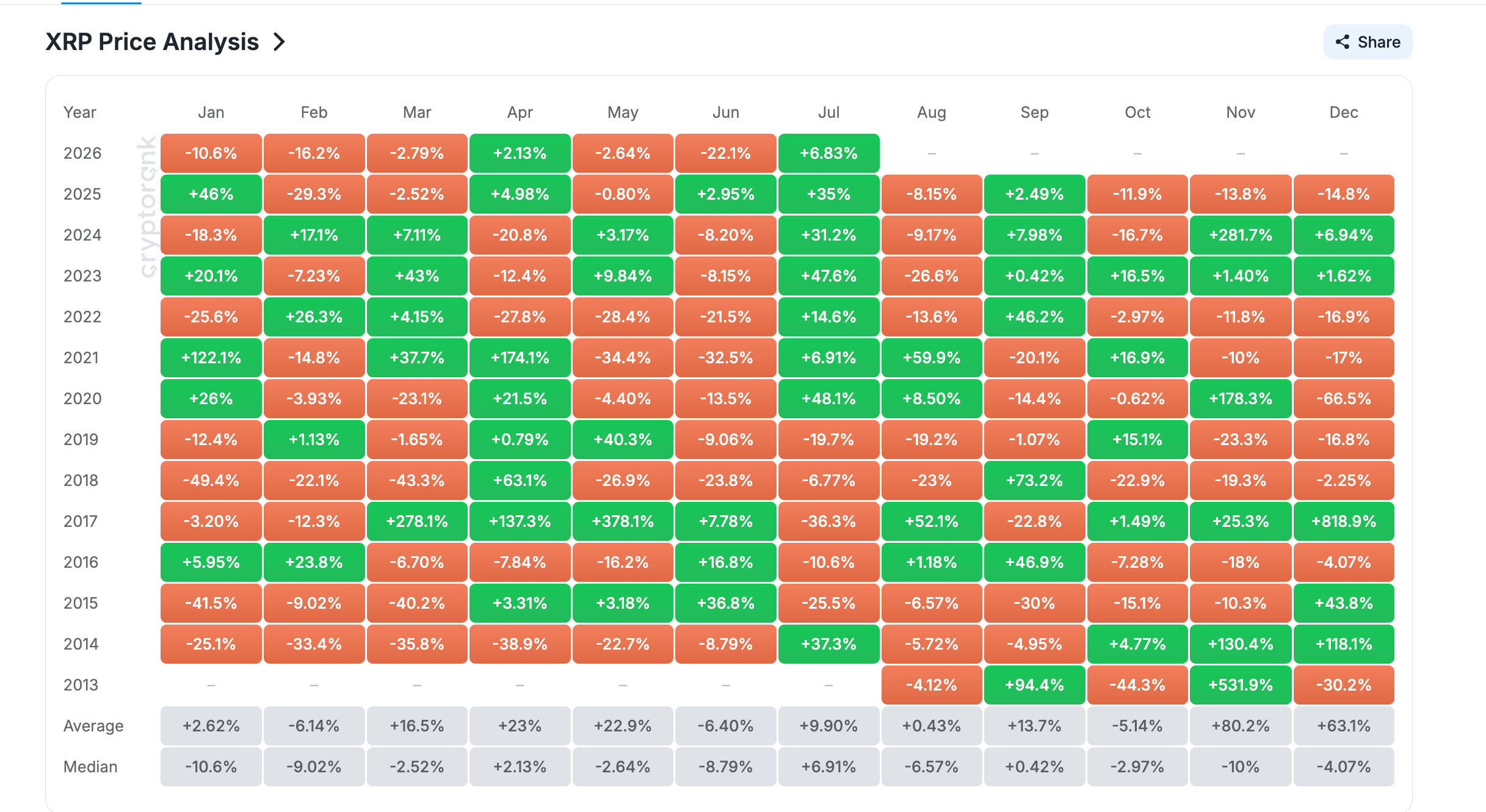
History sets the stage. XRP has closed July green every year since 2020. That is six completed years, with 2026 currently up 6.83% and tracking a seventh.
Want more token insights like this? Sign up for Editor Harsh Notariya’s Daily Crypto Newsletter here.
No month on XRP’s record holds a longer winning run. July also carries a +6.91% median, the strongest of any month. Median matters more than average here, because it strips out the outlier years that distort XRP’s history.

August breaks the rhythm. Its +0.43% average is the flattest reading on the table, while every other month leans clearly positive or negative. August has also closed red four years running, the longest losing run any month currently carries, and Bitcoin walks into a similar August setup.
Fund flows already match that apathy. XRP ETF flows registered exactly $0.00 on 10 of the 17 trading days in July, including two separate three-day blackouts.
The latest blackout ran from July 22 to July 24, straight into month end. Net July demand across those 17 sessions reached roughly $12.4 million against a fund complex holding about $997 million, so US spot XRP ETF demand has barely moved the needle.
Turnover is thinning too. Daily value traded fell from $14.05 million on July 1 to $8.80 million on July 24, a drop of about 37%.

Fund desks stepping back is one signal. Whether spot buyers are doing the same is the next question.
Exchange Outflows Collapse as Buyers Step Aside
On-chain data answers it. The XRP exchange net position change, a metric tracking how many tokens move in and out of exchanges, sat at -205.1 million XRP on July 3.
By July 26 it had shrunk to -70.2 million XRP, a 66% drop. Coins are still leaving exchanges, but at roughly a third of the earlier pace.
Sustained outflows usually point to accumulation. A collapse this steep suggests buyers may be stepping aside rather than turning into sellers. Another sign of fading interest.

That fits the ETF picture. Neither institutions nor spot participants are dumping XRP, yet neither group is adding with conviction ahead of a month that historically goes nowhere.
The price chart shows exactly what drained the interest.
XRP Price Prediction Hinges on a 20-Cent Range
The levels here come from an unusual fit. Anchoring a Fibonacci tool across the March 17 and May 13 swings produces a grid that price now respects almost exactly.
Two lines define everything. The 1.618 extension at $1.01 has held since late June, close to a month of defense. Another key level at $1.22 has capped every attempt since XRP lost it at the end of May.
That $1.01 to $1.22 band is the whole story. XRP has spent a month trapped inside it, which explains why ETF desks and spot buyers alike have drifted away.

Volume backs the fatigue. Buying volume has fallen steadily since June 30, so an upside break looks unlikely without fresh demand.
For the XRP price prediction to turn bullish, buyers need a three-day close above $1.22. That 10.42% move would likely pull ETF inflows back. Losing $1.01, a 7.95% drop, would instead open the door to renewed outflows. Regardless of the direction, something will finally happen.
It is worth noting that selling pressure is not building either. If sell volume stays this thin, August’s flat history argues for more range rather than a breakdown. For now, $1.01 separates another dull month inside the band from the drop that finally forces institutions to react.
The post XRP Price Prediction for August 2026: Empty ETF Desks Price In a Month of Nothing appeared first on BeInCrypto.

Pakistan’s FIA Launches Cryptocurrency Investigation Unit Against Terror Financing | Breaking News

WA secures 2027, 2029 AFL Origin games

Strategy Raises $544.5M and Buys Back STRC Shares


-

 Fashion3 days ago
Weekend Open Thread: Brooks Brothers
-

 Crypto World6 days ago
Grayscale Files For Worldcoin ETF, WLD Registers Sharp Rise
-

 NewsBeat6 days ago
How a former Blue Peter presenter stunned America’s Got Talent judges
-

 Tech13 hours ago
Intel is reversing course and bringing hyper-threading back to its server chips
-

 Tech7 days ago
Sail Virtually Aboard The “Itanic” With IA-64 Emulator
-
 Tech6 days ago
Turtle Beach Command Series KB7 review: a nifty screen-equipped gaming keyboard
-
 Business5 days ago
New Jersey voter registration controversy explained: How 6,600 noncitizens got on the rolls, and what happens next
-
 Entertainment6 days ago
Johnny Depp’s R-Rated Gothic Cult Classic Gets New Release Ahead of Sydney Sweeney Remake
-

 Crypto World5 days ago
Ethics, other provisions in crypto Clarity Act to be further discussed
-

 Tech7 days ago
Watch Flock Safety CEO Garrett Langley discuss the future of surveillance at TechCrunch Disrupt 2026
-

 Politics2 hours ago
Luke Littler dismantles Gerwyn Price to retain title in Blackpool
-
 NewsBeat6 days ago
Shanghai science forum photos show China’s AI and robotics advances in rivalry with US
-
 Sports17 hours ago
Commonwealth Games boxing: Jadumani Singh seals dominant 5-0 win over Pakistan’s Sumama Rehman to enter quarter-finals | Commonwealth Games News
-

 News Videos4 days ago
The Peugeot Family: How 200 Years of an “Old Money” Dynasty Died in A Boardroom
-

 Sports3 days ago
2026 3M Open leaderboard: Scottie Scheffler finds putter in Round 1, sits three back
-

 Politics1 day ago
Spain sweeps the board at 2026 World Cup with individual awards
-

 Fashion3 days ago
16 Dresses for the High Summer Event
-

 Crypto World6 days ago
Andrew Cuomo joins OKX board as crypto exchange expands in U.S.
-
 Entertainment3 days ago
A New Post-Apocalyptic Gundam Anime Series Blasts Into SDCC
-

 News Videos16 hours ago
BITCOIN JUST ENTERED THIS CRITICAL ZONE…
You must be logged in to post a comment Login