
Crypto World
Bitcoin Nears $90K as FTX-Era Bullish Divergence Reappears


Bitcoin is flashing a rare weekly bullish divergence that observers say could precede a meaningful rebound, even as the price continues to slide toward the mid-$60,000s. The momentum indicator is climbing while price remains under pressure, a pattern last seen around the FTX-era market bottom that preceded a sizable rally. As of this week, BTC traded near $63,000 after a dip from about $75,800, with the weekly RSI hovering above 34 after briefly slipping into oversold territory.
Key takeaways
- Bitcoin’s second weekly bullish divergence on record hints at a potential rebound, with upside attention centered on the 50-week moving average near $91,800.
- BTC is currently holding near the 200-week simple moving average around $62,000, a level historically associated with the market’s major bottom in prior bear markets (2015, 2018, 2020).
- A reclaim of the $64,000–$65,000 zone could open the door to higher targets, including $71,500–$73,000 and potentially toward the CME gap around $79,000.
- Despite the divergence, Bitcoin remains in the latter stages of a weekly bear flag, leaving downside risk in play if the pattern plays out toward its measured target below $50,000.
- Historical context matters: past bullish divergences on BTC’s weekly chart have preceded multi-hundred percent rallies, underscoring why traders are watching momentum as a lead indicator.
Divergence on the weekly chart and the FTX-era precedent
The weekly RSI for Bitcoin has rebounded from oversold levels, signaling a potential shift in momentum even as price continues to drift lower. In recent days, RSI climbed above 34 while BTC priced around $63,000, down from a high near $75,800 earlier in the week. This pattern — a rising or stabilizing momentum indicator while price makes new lows — is known in technical analysis as a bullish divergence and is often interpreted as a sign that selling pressure is waning before a price rebound.
Historically, a confirmed weekly bullish divergence on BTC has occurred only a handful of times in the post-2020 era. The most notable precedent cited by market observers was the divergence that appeared during the FTX-related capitulation in November 2022, which preceded a multi-fold rally from roughly $15,500 to just over $126,000. While past performance is not a guarantee of future results, the pattern remains a focal point for traders seeking to gauge whether downside momentum is ebbing ahead of a breakout.
Analyst commentary underscores the nuance: a single diverging signal is not a guarantee of a sustained upmove, but it adds to a broader deck of technical factors traders weigh as they assess risk and entry points in a choppy market.
What matters most, proponents note, is how Bitcoin behaves around critical levels and whether the divergence can be confirmed with a follow-through in price. If the weekly divergence strengthens into a confirmed signal this week, attention shifts to the next significant threshold and the potential path back toward higher horizons.
Key levels framing the near-term path
Moving-average dynamics are shaping the narrative. The first major upside target sits near the 50-week simple moving average, currently around $91,755. This level has historically acted as a dynamic resistance on the way up in recovery scenarios, so a sustained push above it could pave the way for more robust upside momentum.
Meanwhile, the 200-week moving average sits closer to support at roughly $62,000. This line has characterized a long-standing bottom in several bear-market cycles (2015, 2018, 2020), and traders view it as a defensible zone where accumulation interests can re-emerge. Notably, analyst Michael van de Poppe has highlighted the $62,000 area as a favorable accumulation zone, while noting that breaking above the $64,000–$65,000 band would be crucial for a more convincing bullish setup. He also outlined a potential trajectory higher if price gains steam, pointing to zones near $71,500–$73,000 and even a visit toward the CME-listed gap around $79,000 should momentum persist.
These levels dovetail with the broader narrative: a successful reclaim of the lower range could unlock a more constructive weather window, but only a break above key resistance would shift the odds decisively in bulls’ favor. In his assessment, the area above $90,000 is seen as the next major resistance zone, aligning with the 50-week SMA target and the structural improvement implied by a sustained weekly divergence.
Bear flag dynamics and downside risk
Despite the budding bullish momentum signal, Bitcoin is currently navigating the breakdown phase of a weekly bear flag. A bear flag forms when prices rebound within a rising channel after a sharp decline, followed by another leg lower. In Bitcoin’s case, the chart pattern has included a breach of the flag’s lower boundary, a move reminiscent of the 2022 breakdown from a symmetrical triangle consolidation.
Should the bear flag pattern play out as anticipated, the measured target lies below $50,000. That target remains in view unless Bitcoin can reclaim the flag’s lower trend line and turn the tide with sustained buying pressure. For the moment, the risk-reward profile remains delicate: a successful bounce would need to clear the invulnerable resistance around $64,000–$65,000 and extend beyond the $70,000–$75,000 zone to alter the intermediate-term trajectory.
Market observers also point to the broader macro and event-driven environment as a backdrop to these technicals. While bullish divergence signals can be enticing, they do not operate in a vacuum, and traders are mindful of the risk that a renewed bout of selling could resume if broader risk appetite wanes or macro catalysts reassert pressure on equity and crypto equities alike.
In the context of this narrative, recent commentary and charts also reference a prior divergence that foreshadowed a dramatic rally, suggesting that the divergence could herald a shift in sentiment if confirmed by price action. As always, investors should weigh multiple signals — momentum, structure, and volume — before anchoring a bet on direction.
Implications for traders and investors
What makes this development noteworthy is its potential to recalibrate near-term expectations for Bitcoin’s path out of the current consolidation. For traders, a confirmed weekly divergence paired with a reclaim of the $64k–$65k zone would be a practical cue to tighten risk controls and consider targeted exposure toward the next resistance layers around $90k and beyond.
For long-term holders, the proximity to the 200-week SMA near $62k adds a critical sentiment barometer. In past cycles, this level has functioned as a reliable anchor for subsequent macro-bull moves, especially when accompanied by stronger momentum signals. The dynamic between this support and nearby resistance around the 50-week SMA creates a frame for evaluating whether the market is entering a more durable upward phase or remains tethered to a bear-market bounce with a risk of renewed downside.
As with any chart-driven story, timing matters. The likelihood of a meaningful swing higher depends not only on momentum but on the ability to sustain gains beyond the 50-week SMA and to break decisively into higher price territory. The chart shows a plausible scenario where a sustained move above roughly $92,000 could unlock more expansive upside, but the path to such a move requires a convincing breakout and a follow-through that many traders are eagerly awaiting.
Market participants who pay attention to on-chain dynamics, macro indicators, and liquidity conditions will be watching how the price action plays out near the key levels described. For context and additional angles, readers can revisit coverage of BTC’s bottom formation and its implications for future price trajectories in related analyses, including discussion of the FTX-era bottom and subsequent rallies, as well as comparative references to other notable market events such as the 2022 crash.
Further reading and related analyses:
As the week unfolds, market watchers will be looking for a durable shift in momentum, a clear breakout above key resistance, or a reaffirmation of the bear-case path if price action backtests the lower boundary of the bear flag. The coming days could reveal whether Bitcoin is staging a true reversal or simply another data point in a volatile bear market cycle.
Readers should stay tuned for how BTC behaves around the $64k–$65k zone and whether the momentum signal strengthens with a sustained move above the 50-week SMA. Those are the levels that will likely shape the next leg of Bitcoin’s so-called macro dance, defining whether the path toward the next meaningful resistance is set or if the bear-flag scenario presses on toward more subdued price action.


South Korea’s Financial Services Commission (FSC) is reportedly preparing to work with the ruling Democratic Party on a consolidated “Digital Asset Basic Act,” aiming to unify the country’s fragmented crypto and stablecoin rulemaking after months of legislative delays. The plan comes as multiple bills remain stuck in Parliament and key policy disagreements continue to stall progress on a second-stage regulatory framework.
Separately, lawmakers are also moving toward reviewing an opposition-backed proposal to repeal South Korea’s planned crypto income tax before it takes effect on Jan. 1, 2027. That effort, along with earlier petitions, adds to the uncertainty around how and whether the tax regime will ultimately be implemented.
Key takeaways
- The FSC intends to draft a consolidated Digital Asset Basic Act with the ruling Democratic Party, potentially replacing or coordinating today’s patchwork of crypto and stablecoin bills.
- At least 10 separate digital asset and stablecoin bills are currently pending, but disputes have prevented resolution of crucial details for the next phase of regulation.
- Major unresolved issues include whether won-denominated stablecoin issuers must be majority-owned by banks and whether ownership limits should apply to large crypto exchanges.
- An opposition proposal to eliminate the crypto income tax before its Jan. 1, 2027 deadline is expected to be considered by committee structures, though review dates are not yet set.
FSC signals a consolidated legal framework for crypto and stablecoins
According to an Edaily report published Wednesday, the FSC informed the National Assembly ahead of a policy briefing that it intends to pursue a consolidated bill jointly with the ruling Democratic Party. The move is designed to establish a government-backed core framework for negotiations across the digital asset sector, particularly stablecoin issuance and circulation.
If advanced, the consolidated proposal would reportedly cover a broad set of regulatory topics, including rules for digital asset businesses, requirements for exchange entry, disclosure obligations, internal controls, and standards tied to system resilience. By centralizing these elements, the FSC appears to be targeting a common complaint among market participants: overlapping and inconsistent requirements emerging from separate bills.
Right now, South Korea has multiple legislative tracks for crypto and stablecoins. The same Edaily report says 10 separate digital asset and stablecoin bills are already pending, and that disagreements have prevented the country from settling key components of its second-stage crypto legislation.
What remains disputed: stablecoin issuer structure and exchange ownership limits
Despite the FSC’s reported plan to draft a consolidated act, the timing and method for introducing the bill have not been finalized, and crucial policy fights remain unresolved.
As the Edaily report notes, one major point of contention involves won-denominated stablecoin issuers. Regulators and lawmakers appear to be split on whether those issuers should be majority owned by banks, a structure that would effectively tie stablecoin minting power to traditional banking oversight. Another dispute centers on whether ownership limits should apply to major crypto exchanges, an issue that could significantly shape how capital and corporate control are distributed across the ecosystem.
For investors and operators, these unresolved questions matter because they influence both compliance planning and competitive dynamics. Issuer ownership rules determine who can practically obtain approval and how quickly market actors can scale. Exchange ownership limits, meanwhile, can affect the flow of liquidity and the incentives around custody, trading venues, and market-making—areas that are often central to stablecoin usage patterns.
At present, the FSC has not set a clear timetable for when the consolidated bill will be formally introduced, leaving the market to watch for further legislative signals from the FSC and the ruling party.
Opposition targets crypto tax—review expected, but not scheduled
On the tax front, separate action is underway in the National Assembly. The Finance and Economic Planning Committee was scheduled to table an opposition bill on Wednesday that seeks to abolish South Korea’s crypto income tax before it begins on Jan. 1, 2027.
The income tax amendment was introduced on March 19 by People Power Party lawmaker Song Eon-seok, according to earlier coverage by Cointelegraph in connection with the proposal to scrap the crypto tax. The bill aims to remove the provision that taxes income from transferring or lending digital assets. After being tabled, it is expected to move to the committee’s tax subcommittee for detailed consideration, Edaily reported in a separate article: Edaily (May) coverage.
In parallel, a separate repeal petition backed by more than 50,000 people is also expected to be routed to a petitions subcommittee. However, according to the Edaily reporting cited in the original coverage, the relevant subcommittees have not yet been fully constituted, and no review dates have been announced.
Why the crypto tax debate is still live despite prior confirmation
From Jan. 1, 2027, the planned tax framework would apply to annual crypto income from transferring or lending above 2.5 million won (about $1,700), at a rate of 20% plus a 2% local income tax. Supporters of the regime—namely the government and the ruling Democratic Party—argue for implementing the tax as scheduled.
Opposition lawmakers, however, contend that taxing crypto income while many traditional stock investors remain exempt is inequitable. The broader dispute is therefore less about whether crypto should be taxed at all, and more about whether the tax treatment aligns with how other asset classes are treated under South Korea’s current tax code.
Earlier, South Korea’s Finance Ministry signaled that the crypto tax would proceed after repeated delays, which means the repeal bill could become one of the key tests of how quickly political disagreement translates into legislative change. Earlier coverage by Cointelegraph said the tax would go ahead following those delays.
For market participants, the practical question is whether committee-level review and possible revisions could still alter—or unwind—the January 2027 implementation timeline. With no review dates set for either the subcommittee handling the income tax repeal bill or the petitions process, the near-term path to a definitive outcome remains unclear.
As South Korea works on a consolidated stablecoin-and-crypto regulatory baseline while simultaneously debating the crypto tax’s future, the next signals to watch are the draft Digital Asset Basic Act’s scope and timing, and whether opposition efforts on tax repeal progress into committee decisions that could credibly challenge the existing plan for 2027.

South Korea’s Financial Services Commission (FSC) is reportedly preparing to consolidate fragmented crypto rules into a single, government-backed legislative package in coordination with the ruling Democratic Party, according to an Edaily report published Wednesday. The move comes after months of delays and renewed uncertainty over how stablecoins and the broader digital-asset market will be regulated under the country’s next phase of crypto legislation.
Separately, lawmakers are also set to consider an opposition proposal to repeal the planned crypto income tax before it takes effect in 2027—an effort that could become another flashpoint in South Korea’s evolving policy debate around digital assets.
Key takeaways
- The FSC reportedly plans to work with the ruling Democratic Party on a consolidated Digital Asset Basic Act covering stablecoins and wider market conduct.
- South Korea currently has multiple separate bills pending in Parliament, but unresolved disagreements have delayed progress on its second-stage crypto framework.
- Major outstanding disputes include whether won-denominated stablecoin issuers must be majority bank-owned and whether limits should apply to ownership of major crypto exchanges.
- An opposition bill aims to abolish South Korea’s planned crypto income tax prior to its Jan. 1, 2027 start, and is expected to move to committee review.
A consolidated Digital Asset Basic Act enters the policy lane
According to Edaily, the FSC told the National Assembly ahead of a policy briefing that it intends to introduce a single consolidated bill rather than continue advancing a patchwork of proposals. The rationale, as implied by the report, is to create one central framework that lawmakers can negotiate against—potentially reducing the gridlock created by overlapping and separate draft measures.
The proposed framework would reportedly address a broad set of issues that have become common regulatory themes in South Korea’s digital-asset discussions. Edaily reports that the consolidation would cover stablecoin issuance and circulation, rules for digital-asset businesses, exchange entry requirements, disclosure obligations, internal controls, and system-resilience standards.
At present, 10 separate digital asset and stablecoin bills are already pending in Parliament. The same Edaily reporting indicates disagreements have blocked progress on crucial components of South Korea’s second-stage crypto legislation—leaving stakeholders without a clear, unified rulebook.
Disputes that could determine the shape of stablecoin regulation
While the FSC has not finalized timing or the exact form of how the consolidated bill will be introduced, Edaily points to specific disagreements that remain unresolved. Two issues stand out as likely to shape the final outcome.
First, the debate over whether won-denominated stablecoin issuers should be majority owned by banks remains unsettled. That question has direct implications for how stablecoin risk and reserve oversight would be structured, and whether issuance would effectively be channeled through institutions already embedded in South Korea’s financial system.
Second, lawmakers are also divided on whether ownership limits should apply to major crypto exchanges. That dispute matters for market concentration and conflicts of interest—particularly if exchange-linked entities can influence the stablecoin ecosystem or market access rules.
Because these decisions are described as unresolved, the consolidated approach may not immediately resolve uncertainty for market participants. Instead, it could shift negotiations from parallel bills into a single legislative vehicle—making the eventual compromises more visible, but not necessarily faster.
Opposition seeks to scrap the crypto income tax before it starts
While stablecoin and exchange regulation appears to be moving toward consolidation, South Korea’s tax policy is also entering a new round of legislative scrutiny. Separately, Edaily reported that the National Assembly’s Finance and Economic Planning Committee was scheduled to table an opposition bill on Wednesday aimed at abolishing South Korea’s crypto income tax before its planned Jan. 1, 2027 implementation.
The Income Tax Act amendment was introduced on March 19 by People Power Party lawmaker Song Eon-seok, according to earlier coverage from Cointelegraph. The proposal seeks to delete a provision that would tax income derived from transferring or lending digital assets. After being tabled, Edaily reports that the bill is expected to be sent to the committee’s tax subcommittee for detailed consideration.
In parallel, a separate repeal petition backed by more than 50,000 people is expected to go before a petitions subcommittee, though Edaily notes that neither subcommittee has been fully constituted and no review dates have been set.
What the tax schedule says—and why the repeal fight matters
The planned taxation framework starts on Jan. 1, 2027. As described in the source reporting, income from transferring or lending crypto exceeding 2.5 million won (about $1,700) annually is set to face a 20% income tax plus a 2% local income tax.
Support for implementing the tax has been attributed to the government and the ruling Democratic Party, while the opposition’s position is that taxing crypto income while most ordinary stock investors remain exempt is unfair. In May, the Finance Ministry indicated the tax would proceed after repeated delays, as noted in Cointelegraph coverage, underscoring that the issue is not simply theoretical—it is tied to a concrete start date.
From an investor and market-structure standpoint, the repeal effort is significant because tax rules can influence participation patterns, custody and lending behavior, and how users route activity between exchanges and other venues. It can also affect how issuers and intermediaries plan compliance and reporting, especially when rules are introduced in advance of a hard start date.
What to watch next in South Korea’s crypto policy churn
For now, the most immediate developments are legislative: whether the FSC’s consolidated Digital Asset Basic Act framework moves from briefing to formal proposal, and how the opposition’s tax repeal bill progresses through the committee process. Readers should watch how the unresolved stablecoin disputes—bank-ownership requirements for won-denominated issuers and any exchange ownership limits—are ultimately translated into a single bill, while also tracking whether the crypto tax debate stays on course for 2027 or gains enough momentum to change its trajectory.


South Korea’s Financial Services Commission told the National Assembly ahead of a July 29 policy briefing that it plans to prepare a consolidated Digital Asset Basic Act with the ruling Democratic Party.
Summary
- 10 pending digital asset bills could be folded into a government-ruling party proposal this year.
- 22% crypto tax remains scheduled for January 2027 despite the opposition’s repeal bill and petition.
- 2.5 million won annual exemption would apply before South Korea taxes qualifying digital asset income.
The proposed framework would cover stablecoins, exchanges, disclosures, internal controls and system resilience.
Separately, the National Assembly’s Finance and Economic Planning Committee was scheduled to table an opposition amendment seeking to remove the crypto income tax before its Jan. 1, 2027 start date. Neither proposal has changed current law.
South Korea stablecoin bill would unify 10 proposals
The FSC’s planned bill would establish rules for stablecoin issuance and circulation, define digital asset businesses and regulate their conduct. It would also set exchange entry standards, disclosure requirements and controls intended to protect users and maintain reliable trading systems.
Ten digital asset and stablecoin bills are already pending in the National Assembly. The FSC now plans to coordinate a single government-ruling party proposal that could serve as the main text for negotiations. Chairman Lee Eog-weon previously told the government that digital asset legislation should be completed during 2026, including stronger anti-money-laundering rules for stablecoins.
The plan follows South Korea’s broader effort to create a full digital asset framework. The current Virtual Asset User Protection Act mainly addresses custody, unfair trading and user safeguards. The proposed second-stage law would regulate issuers, service providers and market structure more broadly.
Issuer ownership and exchange limits remain unresolved
The FSC has not completed the bill’s wording or announced a filing date. One central dispute is whether issuers of won-backed stablecoins must be controlled by bank-led consortiums holding at least 50% plus one share. The regulator has repeatedly said that issuer ownership rules have not been finalised.
The Bank of Korea supports giving banks a leading role, arguing that stablecoins could affect monetary and financial stability. In related coverage, crypto.news reported that the central bank also favours a statutory body involving several authorities. Industry participants and some lawmakers support allowing qualified non-bank issuers under licensing and reserve requirements.
Lawmakers must also decide whether ownership caps should apply to major exchanges. The FSC’s Virtual Asset Committee discussed bank-led issuance, ownership dispersion, exchange internal controls, computer-security standards and no-fault compensation in March, but the regulator did not settle those provisions.
Opposition moves to repeal the 22% crypto tax
People Power Party lawmaker Song Eon-seok introduced bill number 2217609 on March 19. It would delete the Income Tax Act provision covering income from transferring or lending digital assets. As crypto.news previously reported, the opposition argues that taxing ordinary crypto investors while most retail stock gains remain exempt is unfair.
Under current law, annual crypto income above 2.5 million won will face a 20% national tax and a 2% local income tax from Jan. 1, 2027. The tax has already been postponed three times since its original 2022 start date.
The government and ruling party support implementation. Tax officials have said the National Tax Service is preparing guidance and has established a dedicated digital asset unit. A separate repeal petition supported by more than 50,000 people is also awaiting committee review.
What happens next for both proposals?
The FSC must complete consultations with the ruling party and other authorities before submitting its consolidated bill. The 10 existing proposals would then be reviewed alongside the new text, with unresolved stablecoin ownership and exchange-shareholding rules likely to shape negotiations.
The tax repeal amendment is expected to move to the Finance and Economic Planning Committee’s tax subcommittee. The public petition would go to a separate petitions subcommittee. Neither panel had been fully constituted when the July 29 meeting was announced, and no review dates were available.
Unless lawmakers approve a repeal or another delay, the 22% tax will take effect on Jan. 1, 2027. No verified crypto-market price movement has been directly linked to the two legislative developments.
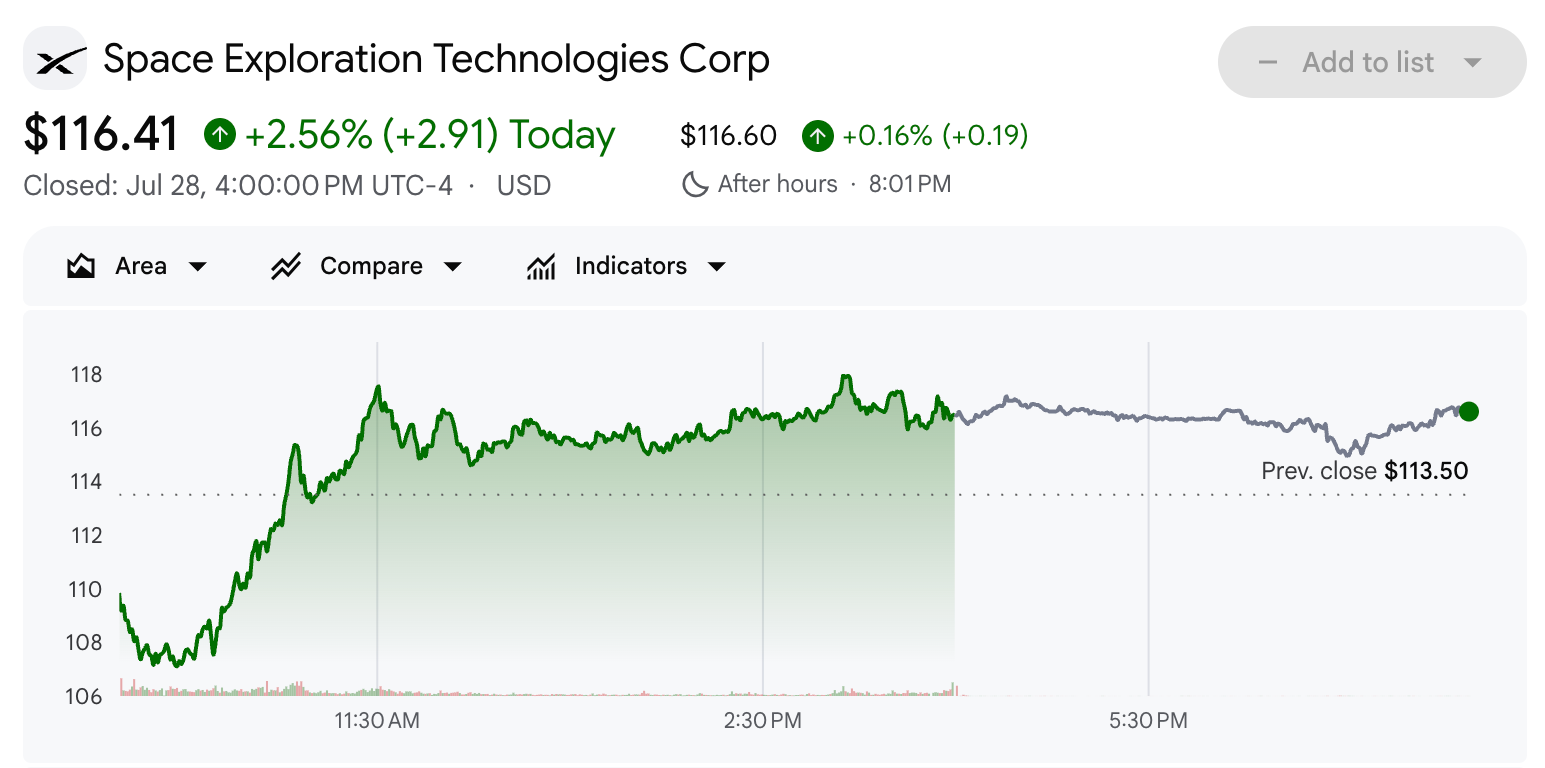
SpaceX (SPCX) stock has fallen about 29% over the past month and now trades below its initial public offering price of $135. Yet, Jim Cramer told viewers to hold off buying for now.
One key factor sits behind that call. Roughly 911.5 million shares become eligible for sale on August 6, and Cramer expects the supply to drag the price lower.
SPCX Sinks to New Lows, but Cramer Says Wait for Thursday’s Unlock
SPCX fell to $107.01 on Tuesday, its lowest level since the IPO. The stock then recovered to close at $116.41, up 2.56%. It now sits roughly 48% below its June 16 high of $225.64.
Follow us on X to get the latest news as it happens

Yet, Cramer expects further downside. This is because the number of Nasdaq shares available for trading will rise sharply next week. Around 911.5 million shares will become eligible for sale next Thursday. That will more than double SpaceX’s public float.
“If you’re looking to buy SpaceX … I’m begging you if you want to go big to at least wait for the first wave of the lockup on insider selling to expire next Thursday and let it drag the share price lower before you pull the trigger,” he said.
Despite his long-term bullish view on Musk and SpaceX, Cramer cautioned that the company’s August 4 earnings report and the August 6 lockup expiration could drive further weakness in the stock.
“Even if they report a great quarter on Tuesday, I don’t know if it can withstand the lockup expiration on Thursday,” he added.
SpaceX reports after Tuesday’s close, its first set of numbers as a listed company. Cramer said investors will closely watch its AI business, which has been boosted by multibillion-dollar computing deals with Anthropic and Alphabet.
However, he noted the contracts can be terminated with 90 days’ notice, making “new revenue stream very tough to model.” He also questioned expectations for similar deals, warning that there “aren’t many other companies with such deep pockets.”
Cramer said both issues leave Wall Street’s multi-year earnings estimates hard to trust.
Subscribe to our YouTube channel to watch leaders and journalists provide expert insights
The post SpaceX Stock Hits New Low but Jim Cramer Says Do Not Buy Yet appeared first on BeInCrypto.


Hayden Adams said critics misunderstood Uniswap’s newly approved v4 protocol fees, rejecting claims the change reduces liquidity providers’ earnings.
The investment banking giant has begun trading for the Morgan Stanley Ethereum Trust (MSSE) and the Morgan Stanley Solana Trust (MSOL) on NYSE Arca on July 28.
Both funds are priced at a 0.14% expense ratio, which undercuts every rival ETH and SOL product on the US market, as CryptoPotato covered the amended filings that locked in the 14 basis point figure earlier this month.
Notably, Grayscale’s Mini Ethereum Trust held the previous low mark among ETH funds at 0.15%. Franklin Templeton’s SOEZ was the cheapest SOL fund at 0.19%. Bloomberg ETF analyst Eric Balchunas said at the time that the pricing made the two funds “the cheapest in the U.S. and world.”
Cheapest ETH and SOL ETFs, But With Tax Cover
Both trusts stake a share of their holdings and hand the rewards back to shareholders.
“MSIM will not retain any portion of the rewards earned by either ETP for itself,” the firm said in its announcement. The registration docs put the staking targets at 50% to 80% of ETH holdings and up to 100% of SOL, run through Figment, Galaxy and Coinbase Canada, with provider service fees capped at 5%.
The Treasury and the IRS published the Revenue Procedure 2025-31 in November, a safe harbor that lets an exchange-traded product stake a single proof-of-stake asset and pass rewards to investors without a separate tax charge.
The conditions include a third-party custodian holding private keys, an independent staking provider, and SEC approval of the disclosures.
MSSE tracks the CoinDesk Ether Benchmark 4 PM NY Settlement Rate. MSOL tracks the CoinDesk Solana Benchmark at the same cutoff. MSIM acts as delegated sponsor for both, with Foreside Fund Services as marketing agent.
Building on the Bitcoin Fund
The launches follow the Morgan Stanley Bitcoin Trust (MSBT), the first crypto ETP from a US bank-affiliated asset manager, which opened earlier this year with $34 million in first-day volume.
MSBT held more than $381 million in assets under management through July 16 and carries the same 0.14% fee.
“Since introducing our first ETFs in 2023, we’ve built a diversified suite of ETFs and ETPs that now exceed $14 billion in assets under management,” said Ally Wallace, Global Head of ETFs at MSIM. The suite runs to 22 products, three of them digital asset ETPs.
The post Morgan Stanley Launches America’s Cheapest ETH and SOL ETFs With Staking Rewards appeared first on CryptoPotato.
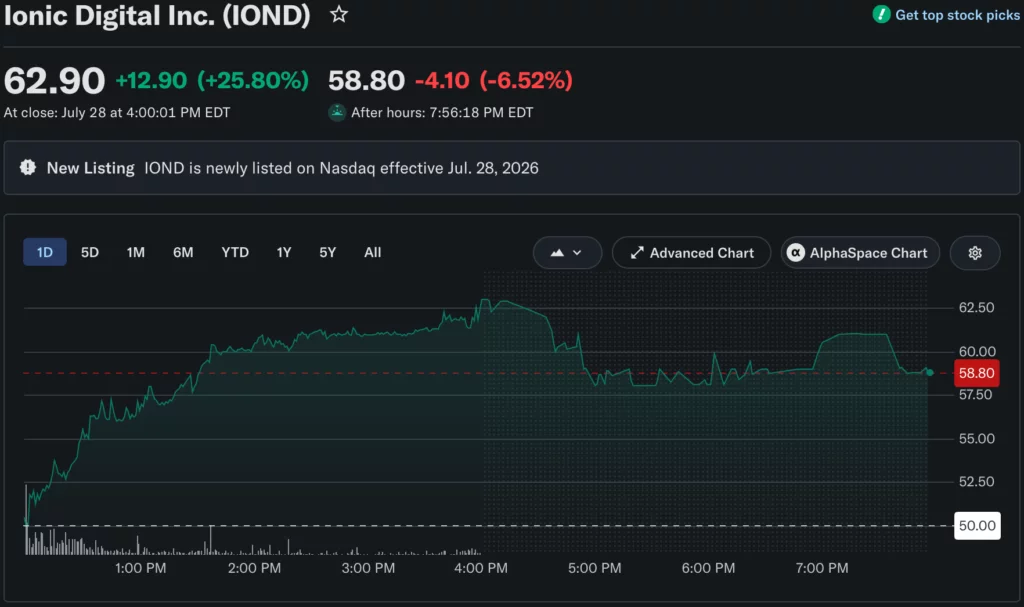
Ionic Digital shares rose 25.8% from their opening price during the company’s Nasdaq debut on July 28, closing at $62.90 after beginning public trading at $50.
Summary
- Ionic Digital climbed 26% from its $50 opening price, closing its Nasdaq debut at $62.90.
- About 44.9 million outstanding shares valued Ionic Digital near $2.8 billion at Tuesday’s closing price.
- Celsius creditors previously received roughly 37 million Ionic shares through the lender’s court-approved restructuring plan.
The closing price gave the Celsius-linked Bitcoin miner and AI infrastructure operator an equity value of approximately $2.83 billion.
The calculation is based on 44,921,427 Class A shares outstanding after the conversion of Ionic’s Series A preferred stock. It does not include potential dilution from warrants, restricted stock units or future issuances.
Yahoo Finance showed the shares falling to $58.80 after hours, 6.5% below their regular-session close. Ionic has not issued a company statement about the first-day price move.
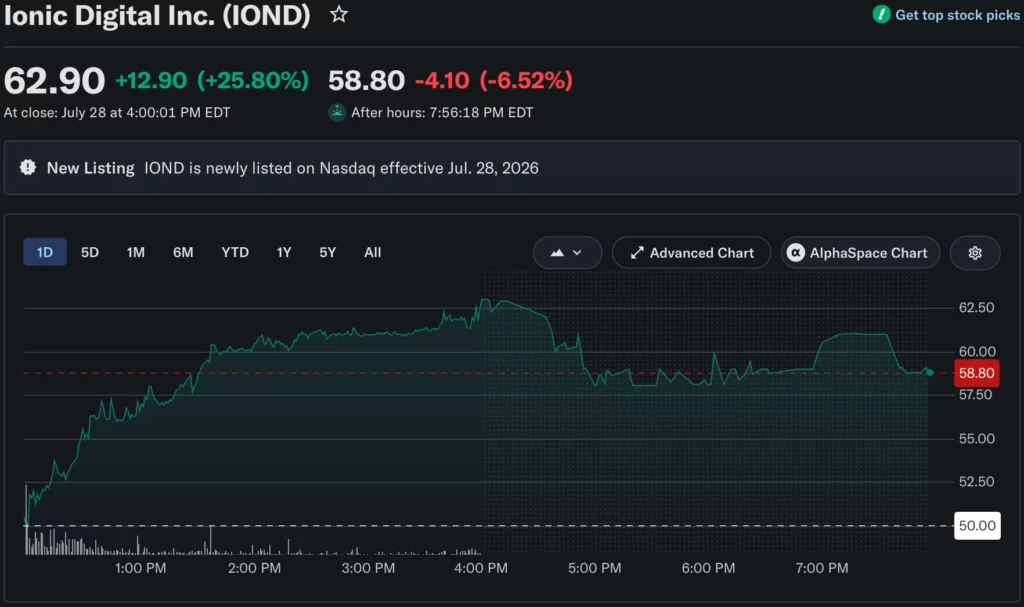
Ionic Digital rebounded from its $50 opening price
Nasdaq officially opened IOND at 11:58:52 a.m. Eastern Time through a cross involving 149,252 shares. The $50 opening price was 5.7% below Nasdaq’s $53 reference price, but the shares reversed course later in the session and finished 18.7% above that reference level.
Nasdaq had stressed that the $53 figure was not an offering price. It served only as a reference for the opening auction because Ionic had no sustained private-market trading history. The $53 level also matched the price paid by institutional investors for 7.55 million preferred shares in a $400 million private placement completed in June.
Renaissance Capital estimated that the reference price gave Ionic a $2.4 billion market value and made it the largest U.S. direct listing since 2021. Unlike a conventional initial public offering, the transaction did not involve newly issued shares or an underwritten sale. J.P. Morgan acted as Ionic’s designated financial adviser for Nasdaq’s opening process.
Celsius creditors now have a public market for Ionic shares
Ionic Digital was created in January 2024 to acquire Bitcoin mining assets and selected liabilities from Celsius Mining. The transfer formed part of the restructuring plan approved by the U.S. Bankruptcy Court in November 2023 following Celsius Network’s Chapter 11 case.
Under that plan, Ionic issued approximately 37 million Class A shares to Celsius creditors. The listing therefore creates a public trading venue for an asset that many creditors received as part of their recovery rather than purchasing through a traditional investment round. As crypto.news previously reported, Ionic had about 82,000 shareholders of record before trading began.
Ionic registered up to 10.8 million shares for resale by named stockholders. The company will not receive proceeds when those holders sell. Its SEC filing warned that the absence of an underwriter, uncertainty over available supply and potential selling by existing shareholders could produce sharp price swings.
Ionic Digital is shifting from Bitcoin mining toward AI
The company’s public-market pitch now rests heavily on its transition toward high-performance computing and AI infrastructure. Its main asset is a 234-megawatt facility in Ward County, Texas, leased to AI infrastructure provider Nscale under a 126-month agreement.
Ionic expects the existing Nscale lease to produce approximately $1.95 billion in contracted revenue through January 2037. Monthly fixed lease payments are scheduled to begin in August 2026. An additional 89 MW could increase contracted revenue to about $2.6 billion, although the added power remains subject to utility and regulatory approvals.
The changing revenue mix was already visible in the first quarter. Ionic recorded $44 million in digital infrastructure leasing revenue while Bitcoin mining revenue fell 82% year over year to $7.4 million. The company mined 95.7 BTC and held 2,815.6 BTC in treasury as of March 31.
The strategy follows a wider industry move toward AI data centres as miners seek longer-term, dollar-based contracts. In related coverage, crypto.news examined why Bitcoin miners are becoming AI infrastructure operators as mining margins face pressure from energy costs and network competition.
What happens next for Ionic Digital?
Ionic expects full-year 2026 revenue of $190 million to $195 million. Its preliminary second-quarter estimates include a net loss of $34 million to $35 million and adjusted EBITDA of $36 million to $37 million. Adjusted EBITDA is a company-defined, non-GAAP measure that excludes items including changes in Bitcoin’s fair value and share-based compensation.
The company has not announced a date for its first earnings report as a Nasdaq-listed business. Its first periodic SEC filing will offer investors a clearer view of available cash, Bitcoin sales, Nscale lease payments and the costs of converting additional mining capacity for AI workloads.
Investors will also watch how many former Celsius creditors and other legacy holders sell shares after the listing. As previously reported, Celsius began a third creditor payout of $220.6 million in August 2025, bringing reported creditor recoveries to 64.9% before accounting for the future value of Ionic equity.


Crypto security losses reached $1.1 billion across 212 verified incidents during the first half of 2026, according to an H1 report published by Blockaid on July 28.
Summary
- 212 verified incidents caused $1.1 billion in losses during 2026’s record-breaking first six months globally.
- 74% of stolen funds resulted from operational security failures rather than exploited smart contract code.
- One DPRK-linked cluster accounted for 55% of losses alone, according to Blockaid’s verified incident dataset.
Blockaid described the six-month incident count as a record and said it verified more exploits during H1 than throughout 2025.
Cperational security attacks caused 74% of the stolen value, while one cluster associated with the Democratic People’s Republic of Korea accounted for 55%. Blockaid also said the incident count was 3.4 times its 2025 total, though security companies use different definitions and coverage methods when compiling industry loss estimates.
Blockaid says operational failures drove crypto security losses
Blockaid’s figures point to a shift away from attacks that depend only on faulty smart-contract code. Compromised devices, privileged credentials, private keys, signing systems and off-chain infrastructure produced most of the measured losses. These attacks can generate valid-looking blockchain transactions because authorised credentials approve them.
That pattern reduces the protection offered by code audits alone. Audits can identify contract flaws, but they cannot stop a compromised administrator from signing a malicious transaction or prevent a bridge verifier from relying on poisoned infrastructure. Blockaid said new attack vectors emerged during H1 and warned that some could expand during the second half.
Ethereum and Solana suffered different attack patterns
Ethereum-related projects lost about $332 million, according to Blockaid’s report, with code vulnerabilities responsible for much of that total. The largest Ethereum-linked case was KelpDAO, where attackers released 116,500 rsETH worth roughly $292 million from a bridge contract after falsifying a source-chain message.
Solana-related projects lost about $326 million. More than 98% came from compromised keys and signing infrastructure rather than smart-contract bugs, Blockaid found. Drift Protocol and Step Finance accounted for most of that amount, while smaller code-related incidents affected projects including Raydium and Volo.
The network comparison does not establish that one blockchain is inherently safer. Instead, it reflects which applications were attacked and how their teams managed privileged access. A single large incident can also dominate a six-month network total.
KelpDAO and Drift dominated H1 theft
Chainalysis linked the April 18 KelpDAO attack to North Korea’s Lazarus Group. Its investigation found that attackers compromised internal RPC nodes and disrupted external nodes, causing a single-verifier system to accept a false burn event. The Ethereum-side bridge then released rsETH even though no corresponding tokens had been destroyed on the source chain.
As crypto.news reported, KelpDAO completed the operational phase of its recovery plan on May 25 after transferring a final 20,373.72 rsETH tranche into its bridge adapter. Minting, redemptions and rewards resumed, although litigation and disputed claims involving frozen funds remained unresolved.
Drift suffered a separate privileged-access attack on April 1. Chainalysis said attackers used months of social engineering and pre-signed durable-nonce transactions to gain administrative control. Drift’s April 16 recovery update valued stolen assets at $295.7 million, above the roughly $285 million early estimate used by Blockaid and several investigators.
In related coverage, crypto.news reported that Step Finance shut down after attackers compromised executive devices and drained up to $40 million from treasury-controlled assets. The company recovered about $4.7 million but said financing and acquisition talks did not produce a sustainable path forward.
Recovery continues while stolen funds remain active
Drift proposed a recovery pool supported by exchange revenue, Tether and other partners. Its plan included up to $127.5 million of proposed support from Tether, $20 million from other partners and a separate transferable recovery token. The protocol said its restart would require audits by OtterSec and Asymmetric, dedicated signing devices, timelocks and a redesigned multisig.
The theft remains an active on-chain case. As previously reported, a wallet tied to the Drift exploiter moved 23,095.1 Ether, worth about $44.4 million, into Tornado Cash between July 23 and July 24 after roughly three months of inactivity.
Blockaid expects teams to focus more heavily on transaction-intent checks, isolated signing devices, key segregation and monitoring across bridges and infrastructure. Those measures are company recommendations, not guarantees.
The next verified updates will come from Drift’s recovery-token terms and relaunch schedule, Step Finance’s remaining claims process, court proceedings tied to frozen KelpDAO funds and any asset seizures announced by law-enforcement agencies.


South Korean police have searched the home of former Incheon Mayor Yoo Jeong-bok and city offices as part of an investigation into allegations that cryptocurrency assets were omitted from his local election financial disclosure.
Summary
- South Korean police searched former Incheon Mayor Yoo Jeong bok’s home and city offices over alleged cryptocurrency disclosure violations.
- Investigators are examining claims that about 21,000 crypto tokens were left out of mandatory election asset filings.
- Election authorities previously said Yoo’s reported assets were about 78 million won lower than his actual holdings.
- Police have questioned Yoo, his wife and other people linked to the complaint while reviewing evidence seized in the searches.
According to South Korea’s Yonhap News Agency, investigators from the Incheon Metropolitan Police Agency’s Anti-Corruption and Economic Crime Investigation Unit carried out search and seizure operations on Sunday at Yoo’s residence and the General Affairs Division of Incheon City Hall, where they collected evidence including mobile phones and computers as part of an investigation into alleged violations of the Public Official Election Act.
The investigation centers on claims that Yoo and his wife intentionally failed to report approximately 21,000 cryptocurrency tokens after transferring the holdings to an overseas exchange before submitting mandatory asset disclosures during South Korea’s June 3 local elections.
Police have already questioned Yoo, his wife, identified only by her surname Choi, along with individuals connected to complainant Park Chan-dae’s campaign, Yonhap reported. The newly executed searches are part of efforts to secure additional evidence as investigators continue examining whether the reported assets should have been included in the election filings.
Police expand probe into crypto disclosure allegations
According to Yonhap, the allegations first surfaced roughly 10 days before election day, when Park Chan-dae’s campaign committee filed a criminal complaint accusing Yoo and his wife of deliberately leaving the cryptocurrency holdings out of their legally required property declaration.
The report said the Incheon City Election Commission later conducted its own review and separately referred the case to police after determining there were possible violations of election law.
Further scrutiny followed on June 2, the day before voters went to the polls, when the election commission issued a correction notice stating that the total assets listed in Yoo’s campaign materials were about 78 million Korean won lower than his actual assets, according to Yonhap. Authorities are now investigating whether the difference resulted from the omitted cryptocurrency holdings and whether the omission was intentional.
South Korea requires candidates in public elections to disclose their assets, and inaccurate or incomplete declarations can lead to criminal investigations under the Public Official Election Act if authorities determine the information was knowingly withheld.
Election authorities have already flagged reporting differences
While investigators have not publicly disclosed which cryptocurrency was involved, the reported transfer of roughly 21,000 tokens to an overseas exchange has become a central part of the investigation because prosecutors and election authorities are examining whether moving the assets affected disclosure obligations.
Yonhap reported that evidence collected during the searches will be reviewed alongside testimony already gathered from Yoo, his wife and other individuals connected to the case.
The investigation remains ongoing, and police have not announced whether additional suspects will be questioned or whether charges will ultimately be filed.
Crypto investigations have remained under close watch in South Korea
The latest case adds to a series of investigations in South Korea where digital assets have become part of political or regulatory inquiries.
In June, News1 reported that police searched cryptocurrency exchange Bithumb as part of an investigation into allegations that independent lawmaker Kim Byung-gi used his political influence to help his son obtain employment at Bithumb and Dunamu, the operator of Upbit.
Authorities questioned Kim several times while examining whether any laws had been violated through alleged influence over hiring decisions. The inquiry later expanded to include searches of Bithumb offices and interviews with exchange executives.
Although the Bithumb investigation concerns alleged employment favoritism rather than cryptocurrency ownership disclosures, both cases show that digital asset-related matters continue to receive close attention from South Korean investigators and election or financial authorities.
South Korean regulators have also maintained active oversight of the cryptocurrency sector beyond criminal investigations. Earlier this year, Bithumb challenged sanctions imposed by the Financial Intelligence Unit over alleged Know Your Customer and Anti-Money Laundering failures after a court temporarily suspended enforcement of a partial business restriction while the exchange contests the regulator’s decision through separate legal proceedings.
Crypto asset disclosures by public officials have also drawn attention outside South Korea. Earlier this month, FBI Director Kash Patel disclosed a previously unreported purchase of between $100,001 and $250,000 in Strategy stock months after the legal filing deadline under the U.S. STOCK Act.
Patel, however, attributed the delay to a miscommunication, while the Department of Justice said the transaction did not create a conflict of interest. Government watchdogs nevertheless criticized the late disclosure because Strategy is the world’s largest publicly traded corporate holder of bitcoin, renewing debate over financial transparency among senior public officials.

The crypto market is once again filled with speculation over whether Bitcoin has reached its cycle bottom. Recent exchange shutdowns have been fueling a popular narrative that such failures are a sign of a market turning point.
Crypto analyst Joao Wedson, however, said the data does not support that conclusion.
Debunking Popular BTC Bottom Theory
Wedson said only nine crypto exchanges and trading platforms have announced or completed shutdowns so far in 2026. This makes it the lowest annual total recorded in at least eight years and significantly below the number seen during the previous market cycle. According to the Alphractal founder, this directly contradicts claims that the recent closures point to a major Bitcoin bottom.
“This is exactly why data matters. Data helps eliminate narratives, unsupported conclusions, and assumptions that are repeatedly presented as facts by market analysts.”
Wedson’s comments came as several high-profile trading platforms, including BitMEX, AscendEX, and BitMart, announced plans to wind down operations in recent weeks. The closures have gone beyond a handful of well-known exchanges. Odos will end its operations on July 30, while Dango, known as the “Endgame Exchange,” is set to discontinue its Layer 1 blockchain on August 13.
In a separate development, decentralized cloud storage company Storj Labs voluntarily sought Chapter 11 bankruptcy protection in the US Bankruptcy Court. These developments have prompted some market participants to argue that the closures resemble conditions typically seen near the end of a bear market.
Fundstrat co-founder Tom Lee, for instance, said such events tend to happen at the bottom of a market cycle. Moonrock Capital founder Simon Dedi described the shutdown of centralized exchanges as a bullish sign, while arguing that weaker business models fail during a bear market and leave room for a healthier market. Ivan Liljeqvist, better known as Ivan on Tech, also tweeted, “old has to die for new to grow.”
Back when FTX collapsed in 2022, Bitcoin fell to roughly $16,000, which ended up dragging the entire market lower. In contrast, the recent announcements have had little impact on price action as it trades near $63,500.
Debate Continues
The market remains divided. But Grayscale is among those believing that the bottom may already be in. The asset manager recently said that Bitcoin has matured beyond the traditional four-year cycle and is now influenced more by macroeconomic factors such as economic growth, real interest rates, and expectations surrounding US Federal Reserve policy.
Meanwhile, analysts including Doctor Profit and Ali Martinez believe the current market presents an attractive accumulation opportunity. Doctor Profit has repeatedly pointed to the $54,000-$64,000 range as a historically strong buying zone, while emphasizing that building an average entry is more important than catching the exact bottom.
Martinez also echoed the bullish accumulation view after identifying that Bitcoin’s Sharpe ratio has fallen to levels that previously coincided with seller exhaustion and the final stages of past bear markets.
The post Don’t Be Fooled: Why Exchange Shutdowns Might Not Mean Bitcoin Has Bottomed appeared first on CryptoPotato.

BLACKROCK Just Told Congress to Pass the CRYPTO CLARITY ACT! (August 3rd Confirmation?)

Liverpool’s dream final month of transfer window as Iraola reunion secured and Barcola signs

South Korea Moves Ahead With Stablecoin Rules as Crypto Tax Repeal Debated


-

 Fashion5 days ago
Weekend Open Thread: Brooks Brothers
-
 Sports2 days ago
Commonwealth Games boxing: Jadumani Singh seals dominant 5-0 win over Pakistan’s Sumama Rehman to enter quarter-finals | Commonwealth Games News
-

 Tech2 days ago
Intel is reversing course and bringing hyper-threading back to its server chips
-

 Crypto World6 days ago
Ethics, other provisions in crypto Clarity Act to be further discussed
-

 Politics2 days ago
Luke Littler dismantles Gerwyn Price to retain title in Blackpool
-

 Sports5 days ago
2026 3M Open leaderboard: Scottie Scheffler finds putter in Round 1, sits three back
-

 Politics21 hours ago
The Part of the Electric Transition Nobody Wants to Discuss
-
 Entertainment5 days ago
A New Post-Apocalyptic Gundam Anime Series Blasts Into SDCC
-

 Fashion5 days ago
16 Dresses for the High Summer Event
-

 News Videos2 days ago
BITCOIN JUST ENTERED THIS CRITICAL ZONE…
-

 News Videos5 days ago
The Peugeot Family: How 200 Years of an “Old Money” Dynasty Died in A Boardroom
-

 Politics3 days ago
Spain sweeps the board at 2026 World Cup with individual awards
-

 Crypto World3 days ago
Ripple bought a bank in pieces. The $4 billion audit
-

 Crypto World3 days ago
XRP Ledger adds $2.6B as RWA inflows rank second
-

 Crypto World6 days ago
Uniswap (UNI) pushes deeper into tokenized RWAs with permissioned trading pools
-

 Tech4 days ago
Anthropic launches Claude Opus 5, a cheaper AI model for coding, agents and enterprise workflows
-
 Entertainment11 hours ago
‘Stargate’ Creator’s New Sci-Fi Series Returns for Season 3 Tomorrow
-
Crypto World6 days ago
SEC Agrees to Overhaul Recordkeeping After Settling Coinbase Lawsuit Over Gensler’s Lost Texts
-

 Business5 days ago
Alliance Entertainment Holding Corporation (AENT) Discusses Evolution Into Omnichannel Distribution and Fulfillment Platform for Media and Collectibles Transcript
-

 News Videos10 hours ago
Claude: Build Financial Dashboards in Minutes (2026)
You must be logged in to post a comment Login